12 Rules for a Software Factory That Doesn't Ship Slop — Dex Horthy, Factory
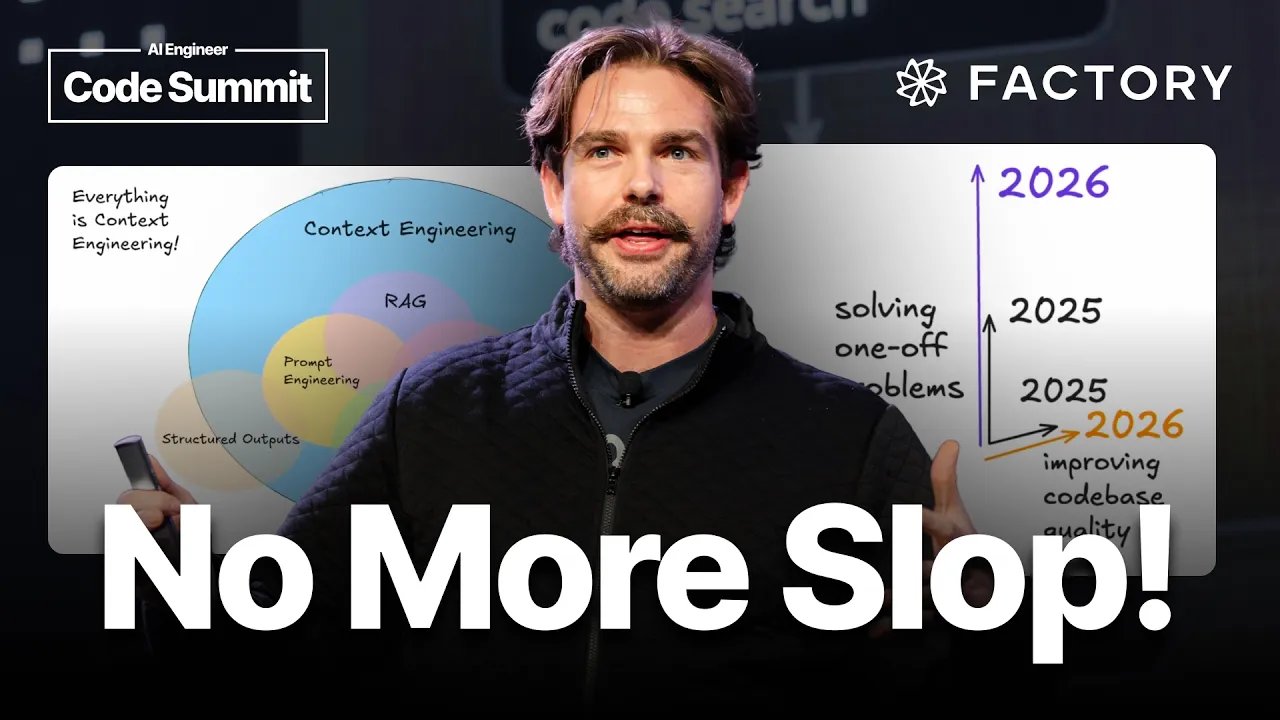
Description
The best model scores about 16% on Slop Code Bench, a new benchmark for how well agents evolve a code base over time. Dex Horthy uses that data to argue that software factories aren't new: they are good engineering with agents doing the building. He lays out 12 practices, from forward and back pressure to planning, visual alignment, lint rules against slop and a unified forge. Then he launches the Anti-Slop Manifesto and makes the case that reviewing work still matters. Read the manifesto: https://slopmanifesto.com Speaker info: - https://x.com/dexhorthy - https://factory.ai Timestamps: 0:00 - 12 factor factories and the war on slop 0:57 - Slop Code Bench: the best model scores 16% 1:42 - Software factories are just good engineering 4:01 - Forward pressure and back pressure 5:31 - 12 practices for software factories 6:16 - Know your enemy: models don't maintain code 9:20 - Plan before you build 10:50 - Align visually and let agents test 11:35 - Fight slop with lint rules 12:20 - Feature flags, evals and a unified forge 13:05 - What you can't buy 14:39 - The Anti-Slop Manifesto 18:24 - Why reviewing still matters
Summary
Generated by gpt-6.1-terraAt-a-Glance
- Verdict: Watch fully
- Core thesis: A reliable software factory combines automated work intake and agent-driven implementation with strong verification, risk-adjusted human judgment, and ownership of long-term code quality.
- Why it matters: For Ken’s agent systems and control-plane work, the talk identifies where orchestration creates leverage and where faster generation can overwhelm review or degrade the codebase.
- Best use: Use it as a design review for an agentic development workflow: map intake, verification, human approval, shared context, and ownership before increasing autonomous throughput.
Executive Summary
Dex Horthy argues that an agentic software factory is an evolution of ordinary engineering practice, not a replacement for it. Agents can turn requests and incidents into proposed changes, but the factory also needs automated testing, review, and feedback that let agents improve their work before it reaches a human.
His central concern is that passing tests or producing impressive one-off applications does not establish that an unattended agent can evolve a maintainable codebase. He cites early SlopCodeBench results and observed code-quality patterns, then recommends proportioning planning and review to the cost of getting a decision wrong.
The practical system spans agent-accessible test environments, language-specific quality rules, feature flags, shared plans and decisions, and a control plane for sessions and automation. Horthy cautions that teams must supply their own code-specific verification even when they buy infrastructure or a harness.
His broader anti-slop argument is that cheap generation transfers work to reviewers and readers. Humans should own intent and consequences, review a stake-appropriate subset of plans or outputs, and judge success by outcomes rather than production volume.
Key Takeaways
- Claim: Design the factory around both automatic work intake and mechanisms that improve changes before human review. | Evidence: Horthy calls event-driven starts such as feature requests or an incident-generated fix PR “forward pressure,” and agent review, tests, CI, linters, and potentially formal verification “back pressure.” | Implication: Ken can assess an agent workflow by asking both what triggers work and what prevents low-quality work from consuming reviewer capacity. | Caveat: He does not specify the sandbox, model selection, or orchestration implementation, and does not claim automated checks eliminate human review.
- Claim: Success on isolated tasks does not establish that agents can maintain and evolve a codebase well over successive changes. | Evidence: Horthy reports SlopCodeBench scores of 15% for GPT 5.5 and 16.3% for Astra on a benchmark using sequential checkpoints; he also cites complexity and interface-design checks and reports renewed use of Python %s formatting by some models. | Implication: Evaluate agents on sequences of realistic changes and maintainability in Ken’s own code, not only on one-shot task completion or passing tests. | Caveat: These are speaker-reported, unverified results from a benchmark he helped develop; the transcript does not explain scoring, evaluation conditions, or whether the results generalize to Ken’s repositories.
- Claim: Scale planning effort to expected rework pain rather than requiring either a full specification or a two-sentence prompt for every task. | Evidence: Horthy frames expected pain as the likelihood of later change multiplied by its difficulty: button color merits little debate, while a database schema deserves up-front alignment because it is hard to change. | Implication: Ken can reserve architecture review for consequential, hard-to-reverse decisions while keeping disposable or low-risk work fast. | Caveat: His example probabilities and effort estimates are illustrative, not measured results; human-written code also requires rework.
- Claim: Agents need direct ways to observe and test their work, supported by enforceable quality rules. | Evidence: Horthy recommends browser and screenshot access, video, curl, and a runnable iOS environment; he cites Dylan Mulroy’s TypeScript anti-slop repository of roughly 100 rules and Python rules from SlopCodeBench. | Implication: Build feedback into the execution environment and supplement generic rules with repository-specific checks before increasing autonomy. | Caveat: Generic lint rules encode preferences and detect selected patterns; they do not establish that a change satisfies the product’s actual requirements.
- Claim: A shared agentic forge should retain decisions and collaboration context, while verification remains the team’s responsibility. | Evidence: Horthy contrasts centralized GitHub patches with colleagues copying agent answers through Slack; he proposes bringing designs and decisions closer to code and describes a control plane for sessions, plans, scheduling, events, and governance. | Implication: Ken should distinguish purchasable infrastructure and harness capabilities from organization-specific acceptance criteria and provenance. | Caveat: Horthy recently joined Factory and promotes its broader control-plane offering; his claim that verification cannot be bought as a black box is an architectural judgment, not a demonstrated product comparison.
- Claim: Cheap generation can shift disproportionate work onto reviewers and contaminate future agent context, so someone must own what is passed on. | Evidence: Horthy contrasts near-zero-cost generation of a 1,000-line PR or 10-page document with the continuing cost of review, and warns that subsequent agents may copy slop left in code, chat, and knowledge bases. | Implication: Measure shipped outcomes and reviewer burden rather than agent count or PR volume, and assign a human owner for material outputs. | Caveat: He explicitly permits rough, even unreviewed output when appropriate for a prototype or low-stakes experiment; the review subset should depend on stakes.
Detailed Brief
Human alignment and controlled experimentation
- Claims: Visual artifacts can make it easier for people to align with agents than long textual plans.; Rough implementation is useful when the immediate goal is learning whether an idea is wanted, rather than establishing a permanent design.
- Evidence: Horthy’s Show Me skill produces HTML mockups, tables, and charts; he reports about 40,000 installs.; He suggests giving agents access to feature-flagging tools such as PostHog, Statsig, or LaunchDarkly so they can trial alternatives and observe performance.
- Caveats: The transcript does not specify authorization boundaries or evaluation safeguards for agents changing flags.
- Implications: Visual alignment and controlled exposure address different risks: misunderstanding intent before implementation and committing prematurely to an unproven outcome.
The Anti-Slop Manifesto extends ownership beyond code
- Claims: The manifesto prioritizes outcomes over outputs, understanding over speed, independent thinking over first drafts, and improving systems over repeatedly patching symptoms.; Horthy argues that human review can move between code, plans, designs, and results as capabilities improve, but that contributing no judgment forfeits differentiation.; He recommends disclosing agent-written material and respectfully asking colleagues to review low-quality material before sending it.
- Evidence: The manifesto was developed with collaborators including Swix and Phillip and is published at SlopManifesto.com.; Horthy cites a Pharos study reporting 30% of PRs merging without review alongside more comments, incidents per PR, and bugs per developer.
- Caveats: The Pharos findings are speaker-reported; the transcript provides no study methodology or basis for attributing the reported outcomes to AI.
- Implications: The proposed quality standard applies to internal communications and knowledge artifacts as well as shipped software.
Notable Concepts & Terms
- Forward pressure: Events or requests that automatically initiate agent work, such as routing an incident into a proposed fix.
- Back pressure: Review, testing, and verification feedback that helps agents improve work before it reaches people or production.
- SlopCodeBench: A benchmark Horthy cites for measuring code quality and evolution across sequential problem checkpoints, rather than only isolated task completion.
- Expected pain: Horthy’s planning heuristic: likelihood a decision must change multiplied by the difficulty of changing it.
- Unified forge: A shared place or linked system for code, agent sessions, plans, and the decisions behind changes.
- Anti-Slop Manifesto: A set of principles advocating human ownership, efficient use of attention, and outcome-focused evaluation of AI-assisted work.
Operator Notes / Why Ken Should Care
- Pilot one incident-to-draft-PR path with an explicit human approval gate and record time saved versus reviewer time consumed.
- Create a small sequential-change evaluation from Ken’s own repositories; track regressions, complexity, and reviewer corrections across multiple tasks.
- Define which decisions require up-front approval—for example, schema changes or public interfaces—and which can proceed as reversible experiments.
- Audit whether agent sessions can access runnable tests and whether their plans, evidence, and decisions remain discoverable alongside the resulting PR.
- Before enabling agent-controlled feature flags, define permissions, exposure limits, rollback ownership, and the evidence required to expand a test.
Source/Metadata
- Title: 12 Rules for a Software Factory That Doesn't Ship Slop — Dex Horthy, Factory
- Transcript words: 8611
- Duration seconds: 1224
- Timestamp note: No timestamps or chapters were provided. The supplied transcript substantially repeats the talk and ends with extraction noise.
Transcript
Hi everybody, I'm Dex. This is 12 Factor Factories, which started as a joke title, but then everyone started calling it that. And the war on slop. So thank you all for coming. I like to yap about coding agents on the internet, and a year ago we did the whole context engineering thing, a lot of views on YouTube, and up until about a week ago I was the CEO and co-founder at a company called Human Layer, the multiplayer coding agent workspace. And for those of you who are blessed to not be quite as terminally online as some of us may be, we are now a part of Factory, which I'm very excited about and I will be touching on during this talk. But I want to get right into it. Last summer was all about this—three months ago, feels like forever. Factories were all the hype. And I gave an intuition based talk back in June of like, we should probably still read the code and here's how RL and verifiers are working and exactly as our friends at Google were saying, models really just solving the tests, just getting them to pass. I now have some data beyond just that intuition. There's a benchmark called Slopcode Bench, which we just released actually today, a bunch of new data from the lab at University of Wisconsin, but very unsaturated benchmark. GPT 5.5 got a 15%. Astra, I think scored 16.3. So we are getting better at this. But there's a lot of ways to go. I'll talk all about that data in a sec. We of course have the study from Pharos of 30% of PRs merging without review, longer comments, more comments, more incidents per PR, more bugs per developer. And I titled this talk—I don't think it was quite correct. I said, why software factories fail? And everyone said, oh, Dex is the anti-software factory guy. Dex hates software factories. I actually love software factories. I'm a huge fan. The title was probably more along the lines of there are certain things you could do in your software factory that would cause it to fail. And here's what those things might be. And please, please don't do them. Maybe the dark factory thing. But I think the main takeaway here, and I think we've heard this from a lot of folks, is software factories is just good engineering. A friend of the pod, friend of the conference, Lauren was talking about this yesterday, of like a lot of this is just stuff we've been doing for a long time. Actually, Eno from Factory had a really—the post is much longer, but it's like the factory mindset is about how do we standardize our process, not just the output. And there's a whole bunch of stuff we'll dig into there on how we're thinking about that. But I try to kind of make the same point, right? Is like your standard software factory is going to look something like you have some engineers, some product managers, maybe a CEO or someone to drive the vision. And those people are going to come up with stuff that we want to build. And they're going to put it in a tracker. This is again, pre AI. A lot of the things we hear about software factories today were around for 30 years, right? You take stuff off the tracker, you build it, you run some unit tests, automated tests, maybe you poke it locally. When you're ready, you make a pull request. At that point, someone might pull it down, interact with it, test it. Your CI is going to run a bunch of checks and static linters and none of this is new. And if anything is wrong with it, you send it back, you go fix the problems. And when it's actually ready to go to prod, we do some canaries and rollouts and feature flags and all kinds of fun stuff there. And eventually it makes contact with our users. And I love our users. I love customers. But they do complain about things that are broken and ask for stuff that we haven't built yet. And so that goes back to the team. And at some point, something breaks at three in the morning and the customers are the first one to figure it out. So we add monitoring so that we can wake people up at three in the morning and they can solve it before anybody notices. This is your pre AI software factory. And the basic point is all you need to do to make this agentic is replace someone builds the thing with an agent builds the thing. So you have orchestration. I'm not going to go into the details of the sandbox and the model and all this stuff. But you can incrementally build this up by adding what I'll call forward pressure. What causes work to start? Can we take all of the feature requests and just route them straight to our factory? Can we take all of the incidents that happen so that when I get paged at three in the morning, I'm looking at a pull request that we think is going to solve it, not just a stack trace about what went wrong? So the forward pressure, what causes new work to start? And back pressure, which is sort of like, okay, cool. Now we can build things in minutes or hours. But the review and testing still takes hours or days if we're doing it in the old way. So we bring agentic code review, agentic testing. Anyone doing agents code reviewing their pull requests? Okay, I thought it would be a little bit more, but that's pretty good. Y'all are catching up. And then we invest heavily into our CI, CD and our linters and doing lean checks on their code, formal verification. All right, hardcore. I like it. The back pressure, how do we let agents hill climb to a better outcome without needing to involve humans? How do we just overall increase the quality of what is coming out of our build step? And agents help here. But a lot of what makes software factories good is stuff we've kind of had for decades. And just like context engineering, which was the thing that I was talking about last summer in June of 2025. There was all these ideas of RAG and memory and state and history, all this stuff. And we tried to distill out what are the timeless things that go into building agents. And so I want to distill out now some of what I think are the timeless things that go into building and designing a software factory. Because there's a lot of noise and hype. Terminally Online Twitter is going to break your brain if you spend too much time wondering what everyone else is doing. I'm also going to talk about slop because I have a very fun project that I've been working on with SWIX and a couple of other speakers here. But we'll get to that later. We're going to do 12 great practices for software factories. And I think the first time I started talking about this, it was only nine, but we are at 12 now. So I'm very excited about this. I touched on this, but loops was this concept that was very in vogue. I think this is much more useful if you think about the interplay of forward pressure and back pressure. So, again, very hyped up. But the actual tactical thing is how do you start work automatically? And how do you make sure that whatever comes out and is touched by a human by the end, all the low hanging stuff is already fixed. The outcome is as good as it can be autonomously. Number two, I will call know your enemy. I will still posit that unattended models don't do a great job of maintaining and improving code-based quality over time. So we care about having a system that's going to be still maintainable in three or six months. I mean, again, I gave this talk and said, please read the code because a lot of it is slop. Agents got really good at solving one-off problems and making video games and blender slop and all this stuff. I don't think if you steer a model to fix your code base, it can go fix your code base. But then you have to know what is there and what you want. So if you are just hands-off pushing features into the machine, you may not find that it autonomously will make things better over time. Back then I didn't have a benchmark. Now I have a benchmark that basically has the model solve problems and checkpoints. A model can clone all of Excel or Redis in a couple days, maybe even a couple hours now with agent swarms. But that requires knowing the entire problem in advance. And most of us don't write software that way. Most of us ship a feature and then ship another feature and then ship another feature. And if you're building by hand without AI, along the way you say, oh, that's a bad abstraction. We need to centralize this. We need to remove this. And so this is a benchmark that measures a model's ability to evolve a code base over time. And so Astra, again, is 16%, very pushing features into the machine, you may not find that it autonomously will make things better over time. Back then I didn't have a benchmark. Now I have a benchmark that has the model solve problems and checkpoints. A model can clone all of Excel or Redis in a couple days, maybe even a couple hours now with agent swarms. But that requires knowing the entire problem in advance. And most of us don't write software that way. Most of us ship a feature and then ship another feature and then ship another feature. And if you're building by hand without AI, along the way you say, oh, that's a bad abstraction. We need to centralize this. We need to remove this. And so this is a benchmark that measures a model's ability to evolve a code base over time. And so Astra, again, is 16%, very unsaturated. There's a bunch of data here. I probably don't have time to look at all of it, but we can look at code quality metrics like cyclomatic complexity, lines per symbol, the percentage of functions that have high complexity. There's more. There's 200 custom rules. 50 of them are based on things we've been doing for a while. A lot of them are custom based on looking at code that models write, comparing it to pre-AI repos. I read a long article about that. I've read a bunch. Gabe Orlansky, who runs the lab that does this benchmark, just put up this paper today based on some of the research we did with them. There's a bunch of stuff in here. I probably don't have time to go through all of it, but they also test the model's ability to design good libraries and interfaces. The craziest one here is models did learn to use exceptions instead of returning tuples in Python. There was a lot of patterns that were identified as probably not great that were way less present in six months ago models than they are in today's models. So it almost feels like the slop is amplifying over time. And Claude and GLM are now writing Python 3 in Python 2 style. So we have %s format strings are back, and they will not use f strings by default anymore. So things to be aware of, you may not care about this. I care about this. The jury's still out on Fable 5.2. I love reading the Anthropic blog posts about how to prompt the new models. And so allegedly, if you tell Fable it owns the code base, it should keep it clean. I haven't tested this yet. We're running the benchmark in the background right now. But for those of us not building FBS games, shouts out to Ben, built a cool game. You should go watch this video. It's insane. You should know your enemy. You should understand that work with this in mind, that if you need your code base to last a long time or your code base has been around for a long time, we should probably maintain understanding of the system and the code. To do this, we plan before we build. I highly encourage this. You should do this. We used to do this before in this old software factory. People realize, especially when building things took hours or days, and when testing and reviewing things took hours or days, even if this part is faster, this part is probably still slow if you're doing it properly, we would have architecture review. And we would have sprint planning, and we would talk as a team, and we would align in the hopes that we might decrease the percent chance that we'd have to rework something later. We wanted to be rather sure that we're building the right thing in the right way before we actually go and spend time building it, time in tokens, and then get to review and have to rework it. A lot of people overdo this as well. I've overdone this for sure, where you spend six hours working on a spec, and you're thinking, I feel like I could have just YOLO'd this. Because sometimes you can just YOLO two sentence prompt, and if it's small, you don't care, there's maybe a 50% chance you send a couple more prompts, and then it's good. You could spend five hours handwriting a detailed spec, and maybe there's a 10% of it you have to change afterwards. Or you could write all the code by hand in 20 hours, and then there's 0% chance. Well, there's a 0% chance you have to rework it because of something the agent did. People still make mistakes too. But I think about this in terms of expected pain. How likely will this have to change later times how hard will it be to change? I don't argue with the model during planning about what color the button's going to be, but I do want to make sure we get our database schemas right and stuff like that. Because it's really hard to change later. So based on your problem and what you're doing and your code base, you should probably decide where on this spectrum you want to land. Align visually, I published a skill called Show Me, which is optimized for instead of reading walls of text, you get HTML mockups, you get tables, you get charts, you get all this stuff that is optimized for the human brain, which is very visual. We've been, I think code has said, we've been running away from predators and eating fruit for millions of years. We've only been reading text for about 5,000. Anyways, you can get this, it's got about 40,000 installs. You should help agents test their work. Screenshots, browsers, videos, curl, whatever you can do to help the agent. Again, he'll climb against an outcome. Given if you're building an iOS app, make sure it can build, run, and test that app in whatever environment it's running. You should fight slop with anyone here writing in TypeScript. Some people are feeling lazy. I feel it should be more than that. But this is a repo from Dylan Mulroy, who's a principal engineer at CloudFlare. Anti-slop. If you haven't, if you're not using this, you should go check it out. It's 100-ish rules on stopping agents from building slop. Factory also has an ESLint plugin that I should probably mention. And also, again, you can go slop fork all of the Python code quality rules out of SlopCodebench. This exists for your language. You should use it. Slop is a tool. Not all slop is bad. Vibe coding prototypes, side projects. If you have something behind a feature flag, you just need to figure out if people even want it before you go put in the time. I think it's great. I don't think there's always, always, always every line of code has to be perfect. You should give models a feature flagging system. PostHog or Statsig or LaunchDarkly or whatever it is, so they can try stuff and see if it performs better and then make decisions about what the right thing to be in your tool. You should compound over time. Eval everything. Learn from past sessions. And you should unify your forge. What I mean by this is, we used to send git patches around on mailing lists. I think Linus and the Linux people still do this, but most people keep all their code in GitHub. And so before the AI native forge, we have centralized patches, but we still have people pasting clawed answers back and forth in Slack and hopefully not doing too many rounds of that because it's like, I copy out of mine and send it to my coworker. He pastes it into his agent and then they send it back to me and then I paste it into my agent and maybe we get an answer. So centralizing all of your designs and decisions and whatever you have in Notion and Google Docs and whatever it is, you should try to bring those things as close as possible together so you can understand not just the code about what something was built, but all the decisions that went into it. You can't buy everything. I think there's things in this space that just cannot be productized. Obviously you can buy VMs or you can bring your own. Dev environment I think is very personal to most teams. The harness, of course, you can go get a frontier harness or you can use something minimal like OpenCode or Pi and customize the heck out of it. And then you have this control plane picture of how do you collaborate on sessions and plans? How do you do automations and scheduling? How do you respond to events? All this governance stuff. Part of the reason I'm really excited to be working with Factory on all this stuff is they have a much bigger view of this picture and have a lot more stuff solved here. But there are parts, especially at the top here, I don't think anyone can sell you verification of your code because only you know if you have hundreds of engineers and hundreds of repos you have those opinions and you know how to test your code. Not just a black box you can buy. There are building blocks that are undifferentiated. # Cleaned Transcript Environment I think is very personal to most teams. The harness, of course, you can go get a frontier harness or you can use something minimal like OpenCode or Pi and customize it. And then you have this control plane picture of how do you collaborate on sessions and plans? How do you do automations and scheduling? How do you respond to events? All this governance stuff. Part of the reason I'm really excited to be working with Factory on all this stuff is they have a much bigger view of this picture and have a lot more stuff solved here. But there are parts, especially at the top here, is I don't think anyone can sell you verification of your code because only you know if you have hundreds of engineers and hundreds of repos you have those opinions and you know how to test your code. Not just a black box you can buy. There are building blocks that are undifferentiated, but the idea of Software Factory I think is it's a way of thinking about our work. So that's Software Factories. I also want to talk about Slop. Factories are about how do we increase human leverage, right? How do we get the best return on our time? And I've talked about why humans should be involved and what it means to be a diligent steward of what we're building and what we're doing. But I think it's bigger than just software. So I'm very excited to announce the Anti-Slop Manifesto, which you can go, if you go to SlopManifesto.com you can read it. I'll put the URL up later. But we built this in collaboration with a lot of people here, both attendees and speakers. Special shout out to Swix and Phillip. It has signers from ZoomInfo and I think XAI and OpenAI and there's a lot of cool people on there. I encourage you to go read it and check it out and be a part of it. But I'll tell you what's in it. We value outcomes over outputs. We value understanding over speed. We value our own thinking over whatever the model came up with as a first draft. We value better work over easier work. We value improving the system over just patching outputs. And the things we believe are that AI is the most useful tool most of us have ever worked with. But it can create a swarm of agents can produce more work in a single day than a human can review in their entire career. Look at some of the math stuff coming out of OpenAI. Slop is when we put less effort into producing something than we ask their consumer on the other end to spend understanding it and using AI doesn't necessarily make something slop, but it happens when we pass off AI output without taking responsibility for its quality or for the reader's experience. I believe strongly, I've been saying this for a year now, AI cannot replace human judgment. It can only amplify our judgment or perhaps our lack of judgment in certain cases. And the slop is asymmetric. The cost of producing a thousand line PR or a 10 page doc is approaching zero, but the cost of reviewing it is still fairly constant. And slop proliferates when we repeatedly work around problems instead of solving them correctly. It comes from tools that love to add and are not biased towards subtracting. I'm not going to name names. But I think a lot of slop comes from pressure. Companies are pushing their people to redefine what is humanly possible. And I think slop compounds. So the more slop sits in our knowledge base, in chat, in code, the more of it the next agent reads and copies. And the more slop flying around our team, the more we lose the will to fight it. And everything gets worse over time. Communication and quality and all of this. So as the signers, we the undersigned of the anti-slop manifesto. Guys, is it a little hot in here? I might just have to pop off the jack. There we go. They couldn't give me one of these with a factory logo on it yet, but I'm sure it's coming soon. Thus, we the anti-slop undersigners resolve that human time and attention is incredibly valuable. So we optimize for using it wisely. We fight slop because AI should make our work better, not just easier. We optimize our systems and tools and products for the efficient elicitation of human intent and for efficient human understanding. And we do our own thinking when working with a model. We explore resources, code, prior art. We really want to understand the problem before we actually get to work. And we own the intent and the taste and the consequences of what we ship. However much AI helps us to make it, we own it. And when an agent wrote something that we're sending somebody, we make that clear. And we actually make sure it's good before we drop it in Slack or email or whatever it is. And when someone sends us slop, we have to push back. We have to tell people, kindly, empathetically, and ask them to review it first. And most of us, it's a journey. I've been on both sides of this one. So I've had to have that note. I believe there will always be alpha in reviewing something. As models get better, we may stop reading most of the code. We may still review a plan or a design or a result. But if you don't review anything, if you bring nothing to the table, no thinking, then you're just going to get the same AI output as everybody else. Agent reviewers, linters, verifiers, they're very useful, but they are not sufficient. So for now, we'll still review some subset of the outputs. What subset, of course, depends on the stakes. But what shift, who's using it, and how it's helping them matters far more than lines of code or PRs merged or the number of agents we're running in parallel. It's cool if it gets you to the outcome. But unreviewed output isn't necessarily always bad. Slop is cool one shot prompts, vibe coding. These are all high leverage things that are in the right place. Slop is bad when it undermines our outcome. If we want to make a good product, a maintainable system, we want to save people time and energy. If slop undermines that, then it's bad. And I guess, finally, none of us has this figured out. We're each relearning what we will and won't accept. And there's no single right answer here. You got to calibrate yourself. The world moves fast. My goal here is these are principles that we can use to embrace our important human role in harnessing AI safely, responsibly, in a way that creates value for everyone for many years to come. So you can read and sign the manifesto at slopmanifesto.com. You know, give a shit. Care about what you're doing. I'm going to stick around for Tariq's talk, but then I'll be hanging in the hallway afterwards. Come say hi. Keep learning. Keep giving a shit. I'm excited to keep building with y'all. Thank you so much. ago I was the CEO and co-founder at a company called Human Layer, the multiplayer coding agent workspace. And for those of you who are blessed to not be quite as terminally online as some of us may be, we are now a part of Factory, which I'm very excited about and I will be touching on during this talk. But I want to get right into it. Last summer was all about this, like, you know, three months ago, feels like forever. Factories were all the hype. And I gave an intuition based talk back in June of like, we should probably still read the code and here's how RL and verifiers are working and like, exactly as our friends at Google were saying, you know, models really like just solving the tests, just getting them to pass. I now have some data beyond just that intuition. There's a benchmark called Slopcode Bench, which we just released actually today, a bunch of new data on from the lab at University of Wisconsin, but very unsaturated benchmark, you know, GPT 5.5 got a 15%. Astra, I think scored 16.3. So like, we are getting better at this. But there's a lot of a lot of ways to go. I'll talk all about that data in a sec. We of course have the study from Pharos of you know, 30% of PR is merging without review, longer comments, more comments, more incidents per PR, more bugs per developer. And I titled this talk, I don't think it was quite correct. I said, why software factories fail? And everyone said, oh, Dex is the anti-software factory guy. Dex hates software factories. I actually love software factories. I'm a huge fan. The title was probably more along the lines of, you know, there are certain things you could do in your software factory that would cause it to fail. And here's what those things, what I think those things might be. And you know, please, please don't do them. Maybe the dark factory thing. But I think the main takeaway here, and I think we've heard this from a lot of folks, is software factories is just good engineering. A friend of the pod, friend of the conference, Lauren was talking about this yesterday, of like a lot of this is just stuff we've been doing for a long time. Actually, Eno from factory had a really, the post is much longer, but it's like the factory mindset is about how do we standardize our process, not just the output. And there's a whole bunch of stuff we'll dig into there on like how we're thinking about that. But I try to kind of make the same point, right? Is like your standard software factory is going to look something like you have some engineers, some product managers, maybe a CEO or someone to drive the vision. And those people are going to come up with stuff that we want to build. And they're going to put it in a tracker. This is again, this is pre AI. A lot of the things we hear about software factories today, we're around for 30 years, right? You take stuff off the tracker, you build it, you run some unit tests, automated tests, maybe you poke it locally, when you're ready, you make a pull request. At that point, someone might pull it down, interact with it, test it. Your CI is going to run a bunch of checks and static linters and like none of this is like that new. And if anything is wrong with it, you send it back, you go fix the problems. And when it's actually ready to go to prod, we do some canaries and rollouts and feature flags and all kinds of fun stuff there. And eventually it makes contact with our users. And I love our users. I love customers. But they do like to complain about things that are broken and ask for stuff that we haven't built yet. And so that goes back to the team. And at some point, something breaks at three in the morning and the customers are the first one to figure it out. So we add monitoring so that we can wake people up at three in the morning and they can solve it before anybody notices. This is your pre AI software factory. And the basic point is like, all you need to do to make this agentic is replace someone builds the thing with an agent builds the thing. So you have orchestration. I'm not going to go into the details of the sandbox and the model and all this stuff. But you can incrementally build this up by adding what I'll call forward pressure. What causes work to start? Can we take all of the feature requests and just route them straight to our factory? Can we take all of the incidents that happen so that when I get paged at three in the morning, I'm looking at a pull request that we think is going to solve it, not just a stack trace about what went wrong. So the forward pressure, what causes new work to start? And back pressure, which is sort of like, okay, cool. Now we can build things in minutes or hours. But the review and testing still takes hours or days if we're doing it in the old way. So we bring an agentic code review, agentic testing. Anyone doing agents code reviewing their pull requests? Okay, I thought it would be a little bit more, but that's pretty good. Y'all are catching up. And then we invest heavily into our CI, CD and our linters and our, you know, doing like lean checks on their code, like formal verification. All right, hardcore. I like it. The back pressure, how do we let agents hill climb to a better outcome without needing to involve humans? How do we just overall increase the quality of what is coming out of our build step? And agents help here. But a lot of what makes software factories good is stuff we've kind of had for decades. And just like context engineering, which was the thing that I was talking about last summer in like June of 2025. There was all these ideas of like rag and memory and state and history, all this stuff. And we tried to like distill out what are the timeless things that go into building agents. And so I want to distill out now some of like what I think are the timeless things that go into building and designing a software factory. Because there's a lot of noise and hype. Like I said, Terminally Online Twitter is going to break your brain if you spend too much time wondering what everyone else is doing. I'm also going to talk about slop because I have a very fun project that I've been working on with SWIX and a couple, a handful of other speakers here. But we'll get to that later. We're going to do 12 great practices for software factories. And I think the first time I started talking about this, it was only like nine, but we are at 12 now. So I'm very excited about this. I touched on this, but loops was this concept that was very in vogue. I think this is much more useful if you think about the interplay of forward pressure and back pressure. So, you know, again, very hyped up. But the actual tactical thing is like, how do you start work automatically? And how do you make sure that whatever comes out and is touched by a human by the end, all the low hanging stuff is already fixed. The outcome is as good as it can be autonomously. Number two, I will call know your enemy. I will still posit that unattended models don't do a great job of maintaining and improving code-based quality over time. So we care about having a system that's going to be still maintainable in three or six months. I mean, again, I gave this talk and said, please read the code because a lot of it is slop. Agents got really good at solving one-off problems and making video games and blender slop and all this stuff. I don't think, you know, if you steer a model to fix your code base, it can go fix your code base. But then you have to know what is there and what you want. So if you are just hands-off pushing features into the machine, you may not find that it autonomously will make things better over time. Back then I didn't have a benchmark. Now I have a benchmark that basically has the model solve problems and checkpoints. Like a model can clone all of Excel or Redis in a couple days, maybe even a couple hours now with like agent swarms. But that requires knowing the entire problem in advance. And most of us don't write software that way. Most of us ship a feature and then ship another feature and then ship another feature. And if you're building by hand without AI, along the way you say, oh, that's a bad abstraction. We need to centralize this. We need to remove this. And so this is a benchmark that measures a model's ability to evolve a code base over time. And so Astra, again, is 16%, very unsaturated. There's a bunch of data here. I probably don't have time to look at all of it, but we can look at code quality metrics like cyclomatic complexity, lines per symbol, the percentage of functions that have high complexity. There's more. There's 200 custom rules. 50 of them are based on things we've been doing for a while. A lot of them are custom based on looking at code that models write, comparing it to pre-AI repos. I read a long article about that. I've read a bunch. Gabe Orlansky, who runs the lab that does this benchmark, just put up this paper today based on some of the research we did with them. There's a bunch of stuff in here. I probably don't have time to go through all of it, but they also test the model's ability to design good libraries and interfaces. The most, the craziest one here is like, models did learn to use exceptions instead of returning tuples in Python. There was a lot of patterns that were identified as like probably not great that were way less present in the, you know, six months ago models than they are in today's models. So it almost feels like we're like, the slop is amplifying over time. And Claude and GLM are now writing Python 3 in Python 2 style. So we have, you know, %s format strings are back, and they will not use f strings by default anymore. So things to be aware of, you may not care about this. I care about this. The jury's still out on Fable 5.2. I love reading the Anthropic blog posts about like how to prompt the new models. And so allegedly, if you tell Fable it owns the code base, it should keep it clean. I haven't tested this yet. We're running the benchmark in the background right now. But for those of us not building FBS games, shouts out to Ben, built a cool game. You should go watch this video. It's insane. You should know your enemy. You should understand that, like, work with this in mind, that if you need your code base to last a long time or your code base has been around for a long time, we should probably maintain understanding of the system and the code. To do this, we like to plan before we build. I highly encourage this. You should do this. We used to do this before in this old software factory. People realize, especially when building things took hours or days, and when testing and reviewing things took hours or days, even if this part is faster, this part is probably still slow if you're doing it properly, we would have architecture review. And we would have sprint planning, and we would talk as a team, and we would align in the hopes that we might decrease the percent chance that we'd have to rework something later. We wanted to be rather sure that we're building the right thing in the right way before we actually go and spend time building it, time in tokens, and then get to review and have to rework it. A lot of people overdo this as well. I've overdone this for sure, where you spend six hours working on a spec, and you're like, I feel like I could have just YOLO'd this. Because sometimes you can just YOLO two sentence prompt, and if it's small, you don't care, there's maybe a 50% chance you send a couple more prompts, and then it's good. You could spend five hours handwriting a detailed spec, and maybe there's a 10% of it you have to change afterwards. Or you could write all the code by hand in 20 hours, and then there's like a 0% chance. Well, there's a 0% chance you have to rework it because of something the agent did. You know, people still make mistakes too. But I think about this in terms of expected pain. Like, how likely will this have to change later times how hard will it be to change? I don't argue with the model during planning about what color the button's going to be, but I do want to make sure we get our database schemas right and stuff like that. Because it's really hard to change later. So based on your problem and what you're doing and your code base, you should probably decide where on this spectrum you want to land. Align visually, I published a skill called Show Me, which is optimized for instead of reading walls of text, you get HTML mockups, you get tables, you get charts, you get all this stuff that is optimized for the human brain, which is very visual. We've been, I think code has said, you know, we've been running away from predators and eating fruit for millions of years. We've only been reading text for about 5,000. Anyways, you can get this, it's got about 40,000 installs. You should help agents test their work, screenshots, browsers, videos, curl, whatever you can do to help the agent. Again, he'll climb against an outcome. Given if you're building an iOS app, make sure it can build, run, and test that app in whatever environment it's running. You should fight slop with anyone here writing in TypeScript. Okay. Some people are feeling lazy. I feel like it should be more than that. But this is a repo from Dylan Mulroy, who's a principal engineer at CloudFlare. Anti-slop. If you haven't, if you're not using this, you should go check it out. It's 100-ish rules on like stopping agents from building slop. Factory also has an ESLint plugin that I should probably mention. And also, again, the, you can go slop fork all of the Python code quality rules out of SlopCodebench. This exists for your language. You should use it. Slop is a tool. Not all Slop is bad. Vibe coding prototypes, side projects. If you have something behind a feature flag, you just need to like figure out if people even want it before you go put in the time. I think it's like, it's great. I don't think there's like always, always, always, always every line of code has to be perfect. You should give models a feature flagging system. PostHog or Statsig or LaunchJarkly or whatever it is, so they can try stuff and see if it performs better and then make decisions about what the right thing to be in your tool. You should compound over time. Eval everything. Learn from past sessions. And you should unify your forge. What I mean by this is, you know, we used to send git patches around on mailing lists. I think Linus and the Linux people still do this, but most people keep all their code in GitHub. And so before the AI native forge, we have centralized patches, but we still have people pasting like clawed answers back and forth in Slack and hopefully like not doing too many rounds of that because it's like, I copy out of mine and send it to my coworker. He pasted it into his agent and then they send it back to me and then I paste it into my agent and maybe we get an answer. So like centralizing all of your designs and decisions and like whatever you have in like Notion and Google Docs and whatever it is, you should try to bring those things as close as possible together so you can understand not just the code about what something was built, but all the decisions that went into it. You can't buy everything. I think there's things in this space that just cannot be productized. Obviously you can buy VMs or you can bring your own. Dev environment I think is very personal to most teams. The harness, of course, you can go get a frontier harness or you can use something minimal like OpenCode or Pi and customize the heck out of it. And then you have this control plane picture of like how do you collaborate on sessions and plans? How do you do automations and scheduling? How do you respond to events? All this governance stuff. Part of the reason I'm really excited to be working with Factory on all this stuff is like they have a much bigger view of this picture and have a lot more stuff solved here. But there are parts, especially at the top here, is like I don't think anyone can sell you verification of your code because only you know if you have hundreds of engineers and hundreds of repos you have those opinions and you know how to test your code. Not just a black box you can buy. There are building blocks that are undifferentiated, but the idea of Software Factory I think is it's a way of thinking about our work. So that's Software Factories. I also want to talk about Slop. It's Factories are about how do we increase human leverage, right? How do we get the best return on our time? And I've talked a little bit about why humans should be involved and like what it means to be a diligent steward of what we're building and what we're doing. But I think it's bigger than just software. So I'm very excited to announce the Anti-Slop Manifesto, which you can go, if you go to SlopManifesto.com you can read it. I'll put the URL up later. But we built this in collaboration with a lot of people here, both attendees and speakers. Special shout out to Swix and Phillip. It has signers from ZoomInfo and I think XAI and OpenAI and like there's a lot of cool people on there. I encourage you to go read it and check it out and be a part of, you know, but I'll tell you what's in it. We value outcomes over outputs. We value understanding over speed. We value our own thinking over whatever the model came up with as a first draft. We value better work over easier work. We value improving the system over just patching outputs. And the things we believe are that AI is the most useful tool most of us have ever worked with. But it can create a swarm of agents can produce more work in a single day than a human can review in their entire career. Look at some of the math stuff coming out of OpenAI. Slop is when we put less effort into producing something than we ask their consumer on the other end to spend understanding it. And using AI doesn't necessarily make something slop, but it happens when we pass off AI output without taking responsibility for its quality or for the reader's experience. I believe strongly, I've been saying this for a year now, AI cannot replace human judgment. It can only amplify our judgment or maybe perhaps our lack of judgment in certain cases. And the slop is asymmetric. The cost of producing a thousand line PR or a 10 page doc is approaching zero, but the cost of reviewing it is still fairly constant. And slop proliferates when we repeatedly work around problems instead of solving them correctly. It comes from tools that love to add and are not biased towards subtracting. I'm not going to name names. But I think a lot of slop comes from pressure. Companies are pushing their people to redefine what is humanly possible. And I think slop compounds. So the more slop sits in our knowledge base, in chat, in code, the more of it the next agent reads and copies. And the more slop flying around our team, the more we lose the will to fight it. And everything gets worse over time. Communication and quality and all of this. So as the sign, we the undersigned of the anti-slop manifesto. Guys, is it a little hot in here? I might just have to pop off the jack. There we go. They couldn't give me one of these with a factory logo on it yet, but I'm sure it's coming soon. Thus, we the anti-slop undersigners resolve that human time and attention is incredibly valuable. So we optimize for using it wisely. We fight slop because AI should make our work better, not just easier. We optimize our systems and tools and products for the efficient elicitation of human intent and for efficient human understanding. And we do our own thinking when working with a model. We explore resources, code, prior art. We really want to understand the problem before we actually get to work. And we own the intent and the taste and the consequences of what we ship. However much AI helps us to make it, we own it. And when an agent wrote something that we're sending somebody, we make that clear. And we actually make sure it's good before we drop it in Slack or email or whatever it is. And when someone sends us slop, this is also like we have to push back. We have to tell people, you know, kindly, empathetically, and ask them to review it first. And most of us, it's a journey. I've been on both sides of this one. So I've had to have that note. I believe there will always be alpha in reviewing something. As models get better, we may stop reading most of the code. We may still review a plan or a design or a result. But if you don't review anything, if you bring nothing to the table, no thinking, then you're just going to get the same AI output as everybody else. Agent reviewers, linters, verifiers, they're very useful, but they are not, excuse me, they are not sufficient. So for now, we'll still review some subset of the outputs. What subset, of course, depends on the stakes. But what shift, who's using it, and how it's helping them matters far more than lines of code or PRs merged or God forbid the number of agents we're running in parallel. It's cool if it gets you to the outcome. But unreviewed output isn't always necessarily bad. You know, slop is a cool one shot prompts, vibe coding. These are all like high leverage things that are in the right place. Slop is bad when it undermines our outcome. If we want to make a good product, a maintainable system, we want to save people time and energy. If slop undermines that, then it's bad. And I guess, finally, like none of us has this figured out. We're each relearning what we will and won't accept. And there's no single right answer here. You got to calibrate yourself. The world moves fast. My goal here is these are principles that we can use to embrace our important human role in harnessing AI safely, responsibly, in a way that creates value for everyone for many years to come. So you can read and sign the manifesto at slopmanifesto.com. T-L-D-R, you know, give a shit. Care about what you're doing. T-L-D-R, you know, I'm going to stick around for Tariq's talk, but then... What is that slide? All right. I'll be hanging in the hallway afterwards. Come say hi. Keep learning. Keep giving a shit. I'm excited to keep building with y'all. Thank you so much. ichaichaichaichaichaichaichaichaichaichaichaichaichaichaichaichaichaichaichaichaichaichaichaichaichaichaichaichaichaichaichaichaichaichaichaichaichaichaichaichaichaichaichaichaichaichaichaichaichaichaichaichaichaichaichaichaichaichaichaichaichaichaichaichaichaichaichaichaichaichaichaichaichaichaichaichaichaichaichaichaichaichaichaichaichaichaichaichaichaichaichaichaichaichaichaichaichaichaichaichaichaichaichaichaichaichaichaichaichaichaichaichaichaichaichaichaichaichaichaichaichaichaichaichaichaichaichaichaichaichaichaichaichaichaichaichaichaichaichaichaichaichaichaichaichaichaichaichaichaichaichaichaichaichaichaichaichaichaichaichaichaichaichaichaichaichaichaichaichaichaichaichaichaichaichaichaichaichaichaichaichaichaichaichaichaichaichaichaichaichaichaichaichaichaichaichaichaichaichaichaichaichaichaichaichaichaichaichaichaichaichaichaichaichaichaichaichaichaichaichaicha