Andrew Feldman on Building Cerebras and the Future of Chips | Ep. 57
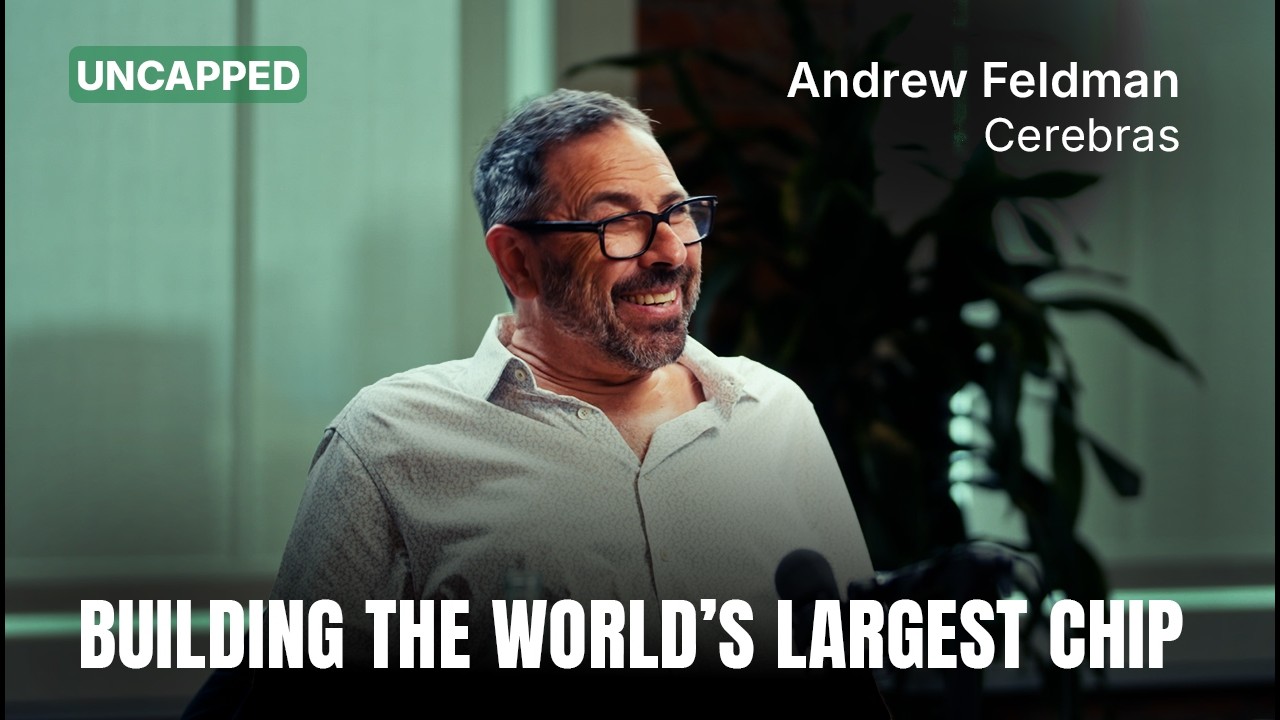
Description
Andrew Feldman is the co-founder and CEO of Cerebras Systems, the AI chip company he founded in 2016 around a single radical insight: that winning in compute requires not incremental improvement but a fundamentally different architecture. Cerebras is the creator of the world's largest chip, the Wafer Scale Engine, and counts the US government, sovereign cloud providers, and OpenAI among its customers. Alongside Eric Vishria from Benchmark, we discussed why Andrew believes that if you are going to attack Goliath, being 10% or even twice as good is not an available strategy and you have to aim for 100x or 500x better. Andrew walked through Cerebras's near-death experience: 18 months of board meetings where the only thing to report was "still can't make it," spending $8 million a month, and what kept the team going. He explained how we go from sand to a ChatGPT answer and why the US semiconductor supply chain is in a precarious position. Andrew shared what most people get wrong about what makes Nvidia great (it’s not CUDA), and why he thinks of himself as a professional David in an ongoing battle with Goliath. Timestamps: (0:00) Intro (1:07) Why Andrew started Cerebras in 2016 (2:54) Eric on why he invested despite having no chip experience (4:10) Attacking Goliath (9:44) Near-death experiences and the Valley of Death (10:44) 18 months of "still can't make it" (12:16) Solving a 75-year-old compute problem (13:26) What comes after Wafer Scale (16:19) The chip supply chain explained (22:30) Why the US punted a strategic industry (25:51) How to be a good hardware board member (27:50) Hardware vs. software investing (29:05) The pivot from training to inference (27:00) Specialization vs. flexibility (35:22) Young product leaders and seasoned hardware engineers (39:14) External relationships and TSMC (42:20) The AI infrastructure buildout (44:12) The data center supply chain (53:14) Speed creates markets (54:10) Disaggregation with AMD and AWS (55:24) What actually makes
Summary
Generated by claude-sonnet-4-5-20250929At-a-Glance
- Verdict: Watch fully
- Core thesis: Building transformational chip companies requires 100-500x advantages through radical innovation across chip/system/software, multi-year technical resilience, and hop-to-hop strategic adaptation as markets unfold—insights critical for understanding AI infrastructure, hardware venture investing, and navigating supply-constrained buildouts.
- Why it matters: Andrew Feldman details the operational reality of building wafer-scale chips, pivoting from training to inference, surviving 18-month technical valleys of death, and scaling amid unprecedented AI infrastructure demand. These patterns directly inform Ken's agent systems architecture decisions, hardware/software integration trade-offs, GTM timing in supply-constrained markets, and investment thesis work on AI infrastructure plays.
- Best use: Watch for end-to-end understanding of chip/data-center supply chain bottlenecks, vendor management at scale, board dynamics during multi-year R&D, strategic pivot mechanics (training→inference), and founder resilience patterns. Use takeaways to calibrate expectations for hardware-dependent AI companies, inform OpenClaw deployment architecture, and sharpen GTM timing around inference compute availability.
Executive Summary
Andrew Feldman, CEO of Cerebras, explains how they built the world's first wafer-scale chip by pursuing radical innovation and accepting 100-500x performance targets—necessary because incumbents improve 2x/year and startups need five years to scale. Cerebras made hard architectural bets (SRAM over HBM, flexible algebra over specialized convolution acceleration) that paid off when transformers emerged post-founding. They survived an 18-month period burning $8M/month with repeated manufacturing failures, iterating through 'only new mistakes' until July 2019 when temperature stabilized. Board partner Eric Vishria acknowledges his limited technical contribution but highlights the importance of staying in one's lane, financing patiently, and not interfering during engineering valleys.
The company pivoted from training to inference using a hop-to-hop decision model: achieve a milestone, gain new market visibility, re-decide direction. When they saw AI intelligence trajectories accelerating, they recognized inference would dominate compute demand and repositioned. Feldman credits Sam Altman as the only person who correctly predicted AI buildout scale (3.5% of GDP vs. 2% for railroads), while TSMC, Nvidia, memory vendors, and Cerebras all underestimated. Today's supply constraints span TSMC fabs (5-year build cycles, $40-50B cost), HBM, generators, electrical switches, and data centers (18 months from raw land to 50MW if permits exist). The U.S. grid runs on 1940s-50s technology; nuclear and fuel-cell innovation are returning driven by necessity.
Feldman argues speed creates new markets (Netflix moved from DVDs to studio when internet got fast; dial-up is punishment) and Cerebras is pursuing disaggregation partnerships with AMD and AWS to achieve 5x throughput gains while maintaining speed. He attributes Nvidia's dominance not to CUDA or architecture but to a decade (2003-2013) of public-company grit fighting in a flat market, embedding relentless intensity into DNA. Cerebras hires young product leaders (promote from within, no tenure rules) but seasoned chip engineers (experience predicts chip delivery success). Feldman grew up on Stanford campus surrounded by Nobel laureates and sees himself as a 'professional David,' motivated by solving hard problems others cannot, not by money or notoriety.
Key Takeaways
- Claim: New chip companies must target 100-500x advantages, not incremental improvements, because incumbents improve 2x/year and startups need five years to reach scale. | Evidence: If a market improves 2x annually and a startup takes five years to scale (best case: first tape-out works, bring-up works, AI tools used), the incumbent reaches 2^5 = 32x improvement. A 3x competitive margin means the startup must deliver 100x better at launch to intersect the market ahead of the incumbent. | Implication: For Ken: hardware-dependent AI companies claiming 2x or 10x advantages are structurally unlikely to succeed against well-funded incumbents. Investment or partnership decisions should filter for radical architectural differences (wafer-scale, new memory hierarchies, optical interconnects) rather than incremental process or cost improvements.
- Claim: Cerebras survived an 18-month manufacturing valley burning $8M/month with board meetings consisting only of 'still can't make it,' using an 'only new mistakes' failure-analysis discipline until they achieved stable operation in July 2019. | Evidence: Wafers shattered in seconds, then minutes, then ran for an hour, then shattered again. Each failure was fully analyzed to avoid repeating it. On one day in July 2019, temperature stayed flat and they realized they had solved a problem no one had solved in 75 years of computing. | Implication: For Ken: deep-tech projects require board/investor patience for multi-quarter execution uncertainty where non-technical stakeholders can contribute little besides financing and morale. Operator notes should track whether teams have exhausted technical ideas or are still iterating productively. This pattern also informs OpenClaw or future hardware-adjacent bets—expect 18-24 month valleys even with strong teams.
- Claim: Cerebras pivoted from training to inference using a 'hop-to-hop' decision model: earn the next viewpoint by achieving a milestone, see the newly visible landscape, then re-decide direction rather than locking a circuit-switched path years out. | Evidence: Initially focused on training (harder due to backprop). As they delivered product, engaged customers, and saw AI intelligence trajectories, they realized everyone would want to use AI, meaning inference would crush compute infrastructure. They repositioned to inference without abandoning the same general direction. | Implication: For Ken: in fast-moving AI markets, rigid multi-year roadmaps fail. Prefer architectures and teams that can re-decide at each major milestone. For agent systems and OpenClaw, build flexibility into the algebra/compute layer (like Cerebras avoiding hardwired convolution acceleration) so future model paradigms don't obsolete the stack.
- Claim: AI buildout is 3.5% of GDP (vs. 2% for railroads, 1% for highways/telecom), and only Sam Altman correctly predicted the scale; TSMC, Nvidia, memory vendors, and Cerebras all underestimated demand. | Evidence: People laughed at Stargate's initial scale; now 'the initial Stargate is sadly small.' Everyone including Feldman acknowledges they got it wrong except Sam. | Implication: For Ken: supply-constrained AI infrastructure (chips, HBM, data centers) will remain tight for five+ years. GTM strategies for agent systems should assume inference compute is the scarce denominator. Pricing power and differentiation will accrue to systems that maximize tokens/task per watt or per facility. Consider partnerships or architecture choices (like Cerebras disaggregation with AMD/AWS) that multiply throughput without adding supply.
- Claim: Data center supply constraints span TSMC fab capacity (5-year build, $40-50B, football-field scale), HBM, generators, electrical switches, and 18-month raw-land-to-50MW timelines; the U.S. grid is built on 1940s-50s technology. | Evidence: TSMC fabs require years of 24/7 concrete pouring for foundations; each ASML EUV lithography machine is 50-60 feet long, costs ~$500M, and only ASML makes them globally. Brownfield retrofits (old factories/paper mills with existing power permits) are faster than greenfield. Generators and transmission switches are long-lead items. | Implication: For Ken: agent deployment strategies relying on new data center capacity must account for 18-24 month lead times and fight for allocation. On-prem or hybrid models may offer faster time-to-value. When evaluating AI infrastructure investments, assess vendor relationships (TSMC wafer allocation, generator/switch suppliers) as critically as technical specs. Nuclear and fuel-cell innovation (Bloom Energy, Boom repurposed jet engines) may create step-function capacity unlocks. | Caveat: Water usage is not a real constraint—all U.S. data centers use 4-7x less water than California almond growers, and closed-loop systems further reduce consumption.
- Claim: Nvidia's dominance stems from a decade (2003-2013) of public-company grit in a flat market, embedding relentless intensity into organizational DNA, not CUDA or chip architecture. | Evidence: Stock traded horribly for a decade while Nvidia fought tooth and nail as a public company with no market attention. That fight created cultural resilience. Jensen still exhibits that intensity at events despite being a $5T company. | Implication: For Ken: when assessing chip or infrastructure companies, prioritize founder/team resilience, prior multi-year adversity, and retained underdog mentality over architecture slides or partnership announcements. For OpenClaw and future companies, consider whether near-death experiences or long technical slogs are building durable competitive moats through organizational intensity.
- Claim: Speed historically creates new markets (no market for slow search or dial-up; Netflix moved from DVDs to movie studio when internet got fast), and Cerebras is pursuing 5x throughput gains via disaggregation with AMD/AWS while maintaining speed. | Evidence: Disaggregation splits inference work: one part done by GPUs, one part by Cerebras, resulting in 5x throughput without sacrificing speed. Cerebras architecture enables this across the entire GPU landscape (Nvidia, AMD, Google TPU, AWS Trainium). | Implication: For Ken: as inference becomes the bottleneck, systems delivering frontier intelligence instantly will unlock entirely new application categories (like fast internet enabled Netflix studio). Agent systems should optimize for speed-to-answer, not just cost-per-token. Disaggregation partnerships (splitting prompt processing, KV-cache, decode) may be the fastest path to scaling inference without waiting for new supply. Consider whether OpenClaw or future agent orchestration can integrate heterogeneous accelerators to maximize throughput.
Detailed Brief
Supply Chain and Manufacturing Deep Dive
- Claims: A cutting-edge fab is 'a modern pyramid'—one of the greatest things humans make, costing $40-50B, taking 4-5 years, with football-field scale and decades of operational expertise.; ASML is the sole global supplier of EUV lithography machines (50-60 feet long, ~$500M each), and different fabs achieve different results with the same machines due to process expertise.; TSMC fabs require years of 24/7 concrete truck operation just for foundation pouring; Samsung's Texas fab began by building a dedicated power plant.; From ingot slicing to wafer dicing, the process etches transistors via photolithography such that when powered, they perform calculations—and the output is a $22 chip (vs. a $23 burrito).; Packaging, memory stacking, and optical wafer-switching are current R&D frontiers; Cerebras now leads in packaging after years of earned failures.; Wafer allocation is a 15-month lead-time capital decision, and vendors also make allocation bets, so relationships matter as much as specs.
- Evidence: Cerebras had decades-long relationships with TSMC and contract manufacturers before starting, which proved critical during contention.; Brownfield data center retrofits (old factories/paper mills with existing power permits) offer faster deployment than 18-month greenfield builds.; Generators (diesel/LNG from GE Vernova, Caterpillar) and electrical transmission switches are long-lead bottleneck items; innovation is returning (Boom repurposing jet engines, Bloom Energy fuel cells).; Tech did a poor job communicating data center benefits to local communities—should have led with thousands of construction jobs, tax-base reduction, and closed-loop water systems.
- Caveats: 'Shovel-ready' data center sites often mean 'we have dirt' with unclear permit status, not actual readiness.
- Implications: For Ken: evaluate AI infrastructure investments by assessing multi-decade vendor trust (TSMC, ASML, contract manufacturers) and whether teams have prior experience navigating these relationships. On-prem or hybrid deployment strategies may bypass data center lead times. Nuclear/fuel-cell plays (if policy enables) could unlock step-function capacity.
Strategic and Organizational Lessons
- Claims: Board members should stay in their lane: Eric contributed financing, cross-industry visibility, and patient capital but deferred all technical decisions and couldn't explain packaging.; Hardware board meetings during multi-year R&D consist of 'Can you make it? No. Can we help? No.' Investors must understand first chips are rarely good; even Google TPU's fourth/fifth generations were the breakthrough.; Cerebras made five founders work because all had worked together previously, knew each other's strengths/weaknesses, and had mutual respect and humility.; Young product leaders (promoted from within, no tenure rules) paired with seasoned chip engineers (decades of tapeout/bring-up experience) optimized for speed in product innovation and reliability in execution.; Extraordinary people reveal themselves in the first email (high signal, descending priority, no fluff) and first few weeks (meeting management, cross-org collaboration, work throughput).
- Evidence: Sean, a co-founder, was hired as an individual contributor at age 25-26 in 2007 and became an AMD corporate fellow four years later when the prior company was acquired; now he is CEO/CTO of a public company.; Feldman's childhood on Stanford campus (neighbors: William Shockley, Amos Tversky; dad's tennis partners: three Nobel laureates, one Fields medalist) embedded intellectual horsepower as the only currency.; Feldman sees himself as a 'professional David' across five startups (sold three, took one public previously, now Cerebras) and wakes up daily motivated to solve problems others cannot, not for money or notoriety.
- Implications: For Ken: when evaluating hardware-dependent AI companies, confirm prior multi-company team cohesion and technical scar tissue. Expect 5+ year timelines and patient board discipline. For OpenClaw or future ventures, consider whether founding/early teams have the 'professional David' resilience and whether product leadership can iterate quickly while core engineering stays disciplined.
Market Dynamics and Competitive Positioning
- Claims: Tokens per watt (or tokens per facility, tokens per chip, tasks per watt) will be the key metric in supply-constrained markets where demand overwhelms every denominator.; Cerebras architectural flexibility (accelerating underlying algebra, not hardwired convolutions) meant they were fastest at transformers despite transformers not existing when the architecture was set.; Disaggregation partnerships with AMD and AWS achieve 5x throughput by splitting inference work while maintaining speed; Cerebras can do this across the entire GPU landscape (Nvidia, AMD, Google TPU, AWS Trainium).; Politics and regulation are becoming larger factors; policymakers with 'absolutely no clue' making decisions on fabs, data centers, and energy policy risk slowing buildout.
- Evidence: Feldman argues thoughtful discussions about what's good for the U.S., municipalities, and rural areas are not happening; knee-jerk reactions dominate.; The U.S. lost three decades of fab/tool-vendor/packaging strategic capacity by pushing the industry offshore; the CHIPS Act is reversing this but requires 20-year policy consistency.
- Implications: For Ken: agent systems and OpenClaw should optimize for tokens/task per constrained resource (watt, chip, facility) and explore disaggregation or heterogeneous accelerator strategies. GTM timing should assume inference compute scarcity persists 5+ years. Policy/regulatory risk is rising; companies dependent on new U.S. fab capacity or data center permits face execution uncertainty beyond technical risk.
Notable Concepts & Terms
- Wafer-scale integration: Building a chip the size of an entire silicon wafer (dinner-plate scale) rather than dicing it into small chips; Cerebras's core innovation, unsolved in 75 years of computing until July 2019.
- Only new mistakes: Cerebras mantra during the 18-month manufacturing valley: each failure underwent full root-cause analysis to ensure the same failure mode never repeated.
- Hop-to-hop decision model vs. circuit-switched thinking: Hop-to-hop: achieve a milestone, gain new visibility, re-decide direction (internet routing analogy). Circuit-switched: lock a path to a distant goal years in advance (telephone circuit analogy). Cerebras used hop-to-hop to pivot from training to inference.
- Disaggregation (inference): Splitting inference workload between two chip types (e.g., Cerebras + AMD GPU) such that each does the part it's best at, achieving higher total throughput without sacrificing speed; Cerebras reports 5x gains with AMD and AWS.
- Shovel-ready (data center): Industry term meaning 'we have raw land or dirt' with unclear permit/grid status, not actual readiness to build.
- Brownfield vs. greenfield data centers: Brownfield: retrofitting existing buildings (factories, paper mills) with power already permitted; faster than greenfield (raw land, 18-month build).
- ASML EUV lithography: Extreme ultraviolet photolithography machines (50-60 feet, ~$500M each) made solely by ASML, used by all cutting-edge fabs; a global monopoly based on unreplicable technology.
- HBM (High-Bandwidth Memory): Stacked memory providing higher capacity than SRAM; Cerebras is working on HBM-on-SRAM stacking to get HBM capacity with SRAM speed.
- Professional David: Feldman's self-description across five startups: waking daily with underdog mentality, motivated by solving problems others cannot, regardless of company size or success.
Operator Notes / Why Ken Should Care
- Action: For agent systems or OpenClaw architecture, prioritize flexible algebra layers (not hardwired to current model paradigms) to survive future AI paradigm shifts, following Cerebras's transformer-readiness despite pre-transformer founding.
- Decision: When evaluating chip or hardware-dependent AI companies for investment or partnership, filter for 100-500x architectural advantages (not incremental), multi-company team cohesion, and prior adversity that built resilience. Discard pitches claiming 2-10x improvements against well-funded incumbents.
- Watch: Inference compute (chips, HBM, data centers) will remain supply-constrained for 5+ years. GTM strategies should assume scarcity and optimize for tokens/task per constrained resource. Consider partnerships or disaggregation strategies to maximize throughput without waiting for new supply.
- Risk: Long-lead vendor dependencies (TSMC wafer allocation, ASML tools, generators/switches, data center permits) mean execution timelines stretch 15-24 months beyond technical milestones. On-prem or hybrid deployment may offer faster paths to production for latency-sensitive or high-throughput workloads.
- Opportunity: Disaggregation (splitting inference across heterogeneous accelerators) offers 5x throughput gains without new supply. Investigate whether OpenClaw or future orchestration can integrate Cerebras-style disaggregation across AMD/Nvidia/cloud GPUs for agentic workloads.
- Talent: Hire young product leaders for speed/flexibility and seasoned engineers for reliability in deep-tech execution. Extraordinary people reveal themselves in first emails and meetings (high signal, no fluff, cross-org collaboration). Promote aggressively when performance justifies it, ignoring tenure norms.
- Board/investor practice: During multi-year technical valleys, stay in your lane, finance patiently, and avoid pseudo-helping on technical problems. Ask strategic questions (hiring, specialization/flexibility trade-offs, long-term market positioning) rather than short-term execution tactics. Understand that first chips rarely succeed; second/third iterations matter.
- Regulatory: Track U.S. fab policy consistency (CHIPS Act execution, local data center permitting) and energy policy (nuclear, fuel cells). Policy/regulatory risk is rising and can delay or block projects regardless of technical success.
Source/Metadata
- Title: Andrew Feldman on Building Cerebras and the Future of Chips | Ep. 57
- Transcript words: 17976
- Duration seconds: 3765
- Timestamp note: Timestamps were not present in the transcript; all temporal references are implicit or unavailable.
Transcript
You got board meetings every six weeks. All you've got to say is, still can't make it. Right? That's the board meeting. What else are we going to talk about? Still can't make it again and again. And Eric's like, should I get in? Can I do anything to help? That's right. They're like, can we help? I was like, no. But we always believed that if we could make it, there would be huge demand for it. All right. Super excited to be doing this today. Andrew, thanks a bunch for being here. So, Andrew, you're the CEO and founder of Cerebras, which is obviously one of the most important chips companies. And also really happy to have my partner Eric here, who's going to be half host, half guest, who has been working with Andrew since the beginning. But thank you both for making time. What I want to start with is, it's 2026 now, and obviously Cerebras is very important in the AI landscape. But you started the company in 2016. And AI was not what it is now back then. So I guess, what was the headspace then? What was the idea, the insight? Like, what were you building when you started the company? And what was the thinking? Well, Jack, thanks for having me. It's always fun to hang out with Eric. So I appreciate you having me. I think as a computer architect, when you see a new workload on the horizon, you get excited. Right? It's very difficult to win share in a mature market in compute. And so when something new emerges, you get excited, and you lean forward, and you say, well, can I make it faster? Can I build a chip that is better at this work? And then you ask the other question is, is there enough of this work to justify building a chip that's better? So you have two questions: Can I? And should I? And what we saw with AI was an extremely computationally intensive workload, unlike, for example, the rise of ARM processors for cell phones, that they weren't computationally intensive, they were power intensive, right? We saw a problem that was going to be hard on compute. And we saw that what was being used was an architecture that was being remodeled for it, and that we could build something better. And that was sort of the insight. And then it was a long, hard slog. Before we go to the long, hard slog, Eric, obviously for you, as an investor, you know, you were not in this AI era, but you saw something that made you invest. And you were, I think, you know, previously not a chips investor, and you've done more like that and probably never will be again. Like, would you do that every time again? Was there something that made it clear to you? Or was it like, what happened for you when you made the investment? I think one of the scariest things about venture, and I think about this all the time, is the more you work on companies, and you see the challenges, and you see how hard it is, you build up scar tissue. And then the thing is like, well, you should do it again. But like, will you do it again? And I ask myself that all the time. You actually need some naivete. You need to have this can-do attitude and naivete around it to attempt it. Otherwise, you just don't do it again. And I've definitely built up a bunch of scar tissue. And I don't know, had I actually had any idea how hard it was going to be for them, how much science and technology had to be built, how many innovations, how many times the company was going to come to the point. Don't tell your VCs how hard your stuff is. I mean, the moral of the story is, tell them it's no problem. Keep it inside, push it down. Push it down. Don't tell them. I'm doing great. Hard problem. All's good, man. Yeah. So what happened? So you basically, you know, you start the company, you get to the tape out and then you're done, right? It's like that? No, never. Okay. So how's it go? So what happened? I think we had, you know, this isn't our first chip company. This is my fifth. And the team had been together, the founding team had been together at the last one. And we had some really clear sort of philosophies on what you should do. And our view is that if you're going to attack Goliath, if there's a giant standing in the market, like Nvidia was even at that time, being a little bit better or a little bit cheaper is not an available strategy, right? They had high margins. So if you come in and even if you're two-thirds the price, they can just cut costs. They can just charge less. They can bundle it. They can do a hundred other things. What that means is you have to go out with something way better, 10, a hundred, 500 times faster. You have to come up with a product that has a value proposition that even if the other guys give it away, they can't compete. And so that's sort of one direction of our thinking. And the other, building off that, is we want to do hard things that produce that advantage, right? We want all that hard stuff within the building because that's under our control. All the other stuff's not under our control, but if we can build something that is so fast, nobody else can do it. You can't give away your parts to achieve what we can achieve. Then you're onto something. And the only way to do that in our opinion is radical innovation. You can't incremental your way to vastly better. So what has to be in your control? You have to have all aspects of the design, the implementation. You have to understand the manufacturing. You have to understand every part. And for us, that meant chip, board, system, software, all the way up to the API. And that was not easy. That makes it more expensive. It makes it take longer. It means there are more ways to fail there. When you do radical innovation, there are no vendors waiting for you, right? When you build a chip the size of a dinner plate, you can't go to a catalog and find a heat sink, right? Because nobody had ever built one bigger than a postage stamp. So nobody has stuff ready for you. And so you end up investing an enormous amount of time in building things that support your thing, right? The surrounding components. But the result of that is you develop this extraordinary expertise. We didn't start as world leaders in packaging. We're right now the best in the world at packaging. We earned it failure after failure, year after year until we got it. And so what you want to do is you want to think about how you can innovate across the various elements of the full solution and push as hard as you can. I think Andrew taught me this in semis and everything else, just to make this concrete. So if you think of whoever the incumbent is in whatever market, you know, they're getting, say, twice as good every year in a market like this that is very dynamic. For a new company to get to scale, to start to get to scale, it's going to take five years at least. Let's say with everyone moving as fast as they can, AI tools, you nail everything, first tape out works, first bring up works, you know, everything goes right, five years, okay, to get to scale. And so you're basically at two to the fifth. So that puts you at 32x. And then you need at least a multiple advantage of that. So you say 3x. So you're basically at 100x. So one of the things that happens when you hear a lot about these new ideas is they're like, hey, we're going to be 50% better, we're going to be two times better. But what they are, they're like, once we have this design, it's going to be even 10 times better than what exists today. But what exists today isn't the target. Because if you're looking at the companies that are out there right now, these big companies with a lot of resources are doing great work. Everyone's doing great. Nvidia's advancing the ball materially every year, very significantly. Nvidia and Google and Trainium, they're moving the ball. And so you got to aim at 100, 500, thousand times better if you're going to arrive, if you're going to intersect the market ahead of them. And so that, that just like when you realize that, you're like, oh, wait, it can't be small changes in something. There has to be a very big underlying architectural change, a big thought. There has to be something materially different, whether it's wafer scale, SRAM, whatever it is. even 10 times better than what exists today. But what exists today isn't the target. Because if you're looking at the companies that are out there right now, these big companies with a lot of resources are actually doing great work. Everyone's, Nvidia's advancing the ball materially every year, very significantly. Nvidia and Google and Tranium, they're moving the ball. And so you got to aim at 100, 500, thousand times better, if you're going to arrive, if you're going to intersect the market ahead of them. And so that, when you realize that, you're like, oh wait, it can't be small changes in something. There has to be a very big underlying architectural change, a big thought. There has to be something materially different, whether it's wafer scale, SRAM, whatever it is, like those things matter. You can't get there with a collection of modest improvements. Your biggest competitor buys silicon for less than you, they buy manufacturing capacity for less than you. They probably pay less for their EDA tools. And so you can't go at them straight on. You got to think about how you can deliver something profoundly different. What were the hard hurdles to get through? I had some near death experiences. That pain in my chest when you can't build the thing you're supposed to build. What are those periods? How would you frame what those periods are where you're like, we just need a certain amount of time and a certain amount of capital and it's just going to be a valley of death? Is it that you just don't know whether you're going to make a technical breakthrough? Like what are the things that lead to those? I think in our space, we were always confident that if we could make it, we'd sell it. There are sort of two axes in our life. There is, can you make it? And the other axis, can you sell it? And we always believed that if we could make it, there would be huge demand for it. Nobody had ever done wafer scale. There was a whole collection of people who were saying it could never work. We were unsure too. We believed we could do it, but there was no evidence. There was a period of time about 18 months and we couldn't make it. And we're spending about 8 million a month. And we're in board meetings every six weeks and all you've got to say is still can't make it. That's the board meeting. What else are we going to talk about? Still can't make it again and again and again. And they're like, should we get in? Can I do anything to help? And they're like, can we help? I was like, no. We can't. There's nothing that can be done. Nothing to be done. But we believed because we had ideas still. We hadn't run out of ideas. And each time we built it and it failed, we'd go through good engineering practice. We'd do a full failure analysis. We'd understand it. And we wouldn't fail that way again. All new mistakes. All new mistakes. So we had a mantra: Only new mistakes. Only new failures. And over time we could see progress. In the beginning we were shattering wafers in seconds. And then it took minutes. And then we had one run for an hour. And then we shattered some in minutes again. And then we built back up to the point where we had a day in July of 2019, where we were running and temperature was flat. And we just stood there in a tiny little office that had been converted into a lab. We drilled a hole in the wall to suck the air out. And stared at a server, which is about as exciting as looking at paint dry. And I said, Holy crap, we've solved this problem that nobody in 75 years of compute had ever solved. That was one of the great minutes of my life. When you look forward, when you look at the R and D envelope that you have going forward over the next five years, where do you take this giant thing? What could be the next wafer scale innovation? I think if you simplify what we build down to its most fundamental elements, a computer is built of three things. We do calculations, we store the results, and then we move the results to where they're useful. We build a core that does the calculation. We use memory and we move data to and from memory where we store the results. And then we have IO and that's how we ship the results to somewhere where it's useful. I think if you're in the computer business like we are for AI, you better be working on all three. You're going to be thinking about how to make your cores faster, how to make them tuned for AI, but general enough to withstand the innovation happening in AI. You better be thinking about memory and both capacity, how much you can store and how fast you can get data on and off it. And then you got to be thinking about how you get the results off your chip and somewhere where they're useful and that's your IO. And so we're working on all three of those and we have programs with the U.S. government already, big programs where we're thinking about how to stack memory, how to put HBM onto an SRAM based wafer. And what this does is it enables HBM to behave like SRAM, which is exactly what everybody wants. You get the capacity of HBM and the speed of SRAM. We're working on optical wafer stacking. You put an optical switch onto a wafer. This would change the world. Jack Dungara said, and he's one of the pioneers in big computing, we've been better at making flops than moving flops. And that's the IO part. Thinking about how to solve that problem by bringing optical switching right up against compute is something that we also have large government contracts for, and we're enormously excited about. So you got to get faster. You got to find ways to store more and get to memory faster. And you got to find ways to move those results at 10, 100, a thousand X faster to where they're useful. I want to go a bit broader in the supply chain. I think it's well understood right now that AI is very supply constrained, but I probably wouldn't say I have a perfect understanding of the supply chain. And one of my favorite things to do on this podcast is you get a successful person like you, and because there's cameras on, I get to ask you a really simple question and get to be humored with it. Could you explain in a somewhat simple way, how do we go from sand to a ChatGPT answer? Dude, it's TSMC. There's a black box. We call that TSMC. It's the supply chain. Fed by another black box called ASML. And out the other end comes great chips. We're supply constrained, but I don't know what the supply is. Can you teach me how it works? Yeah. I think the first thing to think about is that a fab, especially a fab that builds at cutting edge geometries, is a modern pyramid. It's one of the greatest things humans make. What is it? It is a collection of machines that take a chunk of silicon and use a photolithographic process in which they etch transistors into that piece of silicon such that when you deliver power to it, # Transcript Sand to a chat GPT answer? Dude, it's just TSMC. There's a black box. We call that TSMC. It's the supply chain. Fed by another black box called ASML. And out the other end comes, it comes great. We're supply constrained, but I don't know what the supply, can you teach me what the supply, how it works? Yeah. I think the first thing to think about is that a fab and especially a fab that builds at cutting edge geometries is a modern pyramid. It's one of the greatest things humans make. What is it? It is a collection of machines that take a chunk of silicon and use a photolithographic process in which they etch transistors into that piece of silicon such that when you deliver power to it, they do calculations. And it is a collection of, I mean, this is a factory. It's just a reasonable way, a real factory. It costs 40 or 50 billion to make. It has a four or five year lifetime. How big is it? Football fields. Okay. When Samsung was building a factory in Texas, they began building a power plant. The power plant was used to make concrete. They ran concrete trucks, hundreds of concrete trucks, seven by 24 for years to pour enough concrete to build the foundation on which to put the fab. These are unbelievably complicated things. So ASML makes the machines? ASML makes the machine that does the photolithography. What's that machine like? It's the size of each machine is 50 or 60 feet long and 20 feet high. Costs what? Half a billion? Yeah. They're expensive. What's interesting is that they sell the same machines to different fabs and fabs use them in different ways and are able to do different things with TSMC able to achieve things that others can't. And can anyone else make these machines? Is it really just ASML that can make these machines? Right now it's only ASML. In the world? In the world. That's weird, isn't it? Yeah. I mean, there are very few things that this is a true monopoly, not born of what De Beers did, which was trying to control supply. They have technology that others haven't been able to replicate. Are we supply constrained on lithography machines? Probably not. I think the challenge in our business is that demand moves extremely quickly. And if you've looked at a great company like Nvidia's demand, it's exponential, but you can't build fabs that fast. If a fab takes five years to build, and you see demand increasing, there's no way anybody would have expected demand to shoot up the way it has for chips. They're always behind. Yeah. And they're investing huge capital blocks in the construction of these facilities. And demand is racing past the ability to make these huge five-year bets. Yeah. And we have the same problem right now with data centers, right? AI is moving at the speed of software and data centers are moving at the speed of real estate. And that's why we're behind. That's just it. Good articulation. That's good. Okay. So TSMC buys the lithography machines. Right. So TSMC buys lithography machines. They have decades of experience. They wrap it together. They take an ingot, which is a tube of silicon. It's sliced into discs. We call wafers. The wafers are sent through the process. The process etches through a lithographic process, transistors into the silicon. It moves through the process. They're cut. We call it diced, or in our case, they're not cut. Out the other end comes chips. And what's amazing about this is you take some of the smartest people you've ever met and you put them on a project for two years and you send the results to TSMC and they run it through a factory that cost 40 or 50 billion to make and took years to make. And out the other end comes a 22 dollar chip. It blows your mind. What do you think about it? That's funny. Right. Each one of these took some of the smartest people in their field decades. It's the most impressive thing humans have ever done. It's the most impressive thing. Right. It's among the most impressive things. And a burrito is 23 dollars. That's right. Exactly. Right. And you go down the street here in the Mission District and you pay 17 dollars for a burrito. That's right. Right. And so. But once you have the chip, you're done, right? Then you're good. Once you have the chip, you've solved about a fourth of your problems. Okay. But still stay, TSMC. Yes. They operate the machine. They give you the chip. Yes. But that itself seems like not replicable. Like we don't have fabs like this in the US. Yes. We have them run by TSMC and by Samsung. So what. And Global Foundries have got one too. So how much of the bottleneck is at the TSMC level? Huge amount. Okay. Why? Huge amount. Is that because of the speed of building fabs? Yeah. It's because the demand has outpaced the ability to build fabs. And it's not like an apartment building where there are hundreds of builders you could choose to build your apartment building. The actual making of the fab is skills that only TSMC has. And so, even there, they can't do 12 at once. Right? The skills to make these things are so rare and in so few hands that you can't just knock them out. It's not a cookie cutter. And that's why we don't have enough of them right now. And the fact in the US, sort of three decades of bad policy that pushed the fabs away when the fabs left, the tool vendors, the collection of vendors who provided services to them, they all left the next step in the process called packaging. And those are companies like Amcor and ASC, they left and we just punted a strategic industry and we gotta do better. That was not smart. Yeah. So what do you think should happen there? Well, I think we should sit down with Global Foundries and TSMC and Samsung and have a 20 year period where we waive all local ordinances to allow them to build fabs. I think this is about building us domestic fab capacity. Yeah. I mean, look, when a big ship tried to parallel park in the Suez canal, we were delayed in chips and we couldn't buy washing machines. Right. I mean, if we lost our chip capacity, it would be catastrophic for our industry, not just for our industry, but for the country, for the economy. Eric, how did you as a board member, when you were learning this stuff as you went, you still obviously, I don't think Andrew has been lying to me. I think you've managed to be very helpful. Eric was extremely helpful. So how did you approach this? I have a very small circle of confidence. It is not any of the stuff that he talked about. If he asked me to explain what packaging is right now, I could not do it. I certainly could not do it in an adequate way. And Andrew explains things to me all the time. And you know, so I think it's important just to be honest. Hey, this is where you can do, and this is what you can't do. And there are periods of time in any company, particularly if you're doing technological innovation, where you just have to let the engineers engineer and the scientists do their thing and stay out of the way and keep them financed. Maybe keeping them financed was very important. I think there are a couple of things that made Eric a good board member. And I think that are foundational in being a good member. You don't know about everything and share and make us better in those domains where you're a real expert. And don't talk about those other domains. Sometimes there's a lot of words and we were lucky. We had a really good board and everybody knew what they were good at and they helped us in those domains in which And this is what you can't do. And there are periods of time in any company, particularly if you're doing technological innovation, where there's just, you just have to let the engineers engineer and the scientists do their thing and stay out of the way and keep them financed. Maybe keeping them financed was very important, I guess. I think there are a couple of things that made Eric a good board member. And I think that are foundational in being a good member, right? You don't know about everything and share and make us better in those domains where you're a real expert. And don't talk about those other domains, right? Sometimes there's a lot of words and we were lucky. We had a really good board and everybody knew what they were good at and they helped us in those domains in which they had real expertise, right? I mean, one of the advantages of the venture world is you can see across an industry, right? When we're deep in it, we're going deep, they can see wide, right? But there weren't efforts by the board to try and solve technical problems. They didn't have that expertise. Talking about how we might finance the company, thinking about all sorts of other things, they were enormously helpful and they were patient. And I think they asked thoughtful questions and our board meetings made us better. It's like, what should a board do in a hardware company in general when you expect that there's going to be much less to contribute on the product? Is it financing and recruiting? I think the question when you've got a long, hard project, right? And this is the opposite of SaaS, right? You raise money and then you spend two or three years to build one before you have any real idea what the customer's going to say. You go and you talk to customers and they say, yeah, yeah, that sounds great. Because who's not going to say, yeah, yeah, that sounds great, right? And so the product management is unbelievably difficult. You survey customers and because it's no cost and it's easy to say, yeah, yeah, this is great. Nobody wants to put their foot on the throat of somebody else's idea, right? They say, yeah, yeah, it's great. It takes you three years, two and a half years to get to the point where you can bring it to a customer. I think what you can do as investors is understand that trajectory, understand that your first chip is very rarely a good one. And it's a second or third one. I mean, even really strong teams like Google's TPU team, the fourth one was good. The first two were, the fourth, fifth were really good parts. It takes years. You have to know that going in, you have to know it's a long game, right? Ask questions related to the long game, right? Are you hiring the right people, right? Are you thinking about this in the long term? Have you made the right decision between specialization and flexibility, right? These are questions that can really help sharpen our thinking, but whether to use this one technique or this other technique in design, whether you use one tool vendor or the other, you gotta let that, you gotta let the team pick that. Yeah. Did it feel really different for you versus like an infrastructure roll? Totally. Yeah, totally. It was just very different. I mean, your time to revenue is so much longer, the revenue comes in like giant chunks. The initial customers, you know, we had US government customers, then we had huge sovereign cloud, G42, you know, then you have now today, obviously OpenAI. And so you have these things, you're, so your customer concentration's more, it just, every dynamic's different. Yeah. The investment and go to market so much less. So I think it feels really, really different. But things that are the same, by the way, are you need really good people from a whole bunch of domains coming together who stay motivated over a really long period of time. That part's actually the same. And then the market is very dynamic. Like, I mean, think about it. Pre-Transformer, you started the company pre-Transformer. We did, right? At that time, TensorFlow was dominant. So the first software, TensorFlow was dominant. ResNet was still a thing, right? These were very small, very simple networks compared to where we are today. Yeah, the actual ML, the AI looked nothing like it does today. Well, actually, I think that's really, you know, for entrepreneurs who listen to this, like it was started as a training system, like part of the vision that you pitched and part of what you explained was like training's a harder problem because of back prop. Inference, we thought was going to be on devices and computers and really distributed, which may still end up happening. And like fast forward to 2022, 2023, maybe 24, we pivoted the company or I don't know if it's the right word, but to inference. Who, how and why, and where did we get lucky? And where did you have real foresight on that? I think there's sort of two ways to make decisions and to think about it. One, I think about like an old telephone circuit, right? You, they set up a dedicated view all the way to your brother in New York. And that's one way to do vision, right? That's one way that you've got this idea of the way the future's going to look way out there. And that's a circuit, we think, right? The other way to do it is the way routers work, where the internet works, where you go hop to hop. You go to Cleveland and then there's a decision whether it's best to take the next hop. And that's sort of the way we worked, where we knew there was a pot of gold out there, but the path to it we knew was unknowable. And so each time you get over a new mountain, you look around and you re-decide. So it's this sort of hop to hop thinking. So can we build it? Yes. Can we make it work in routing? Yes. Is routing now where everybody's focusing? That's where they're focusing. Can we be a fast router? Yes. But now we're seeing the lay of the land. We're seeing the unfolding of AI, the rapid growth of intelligence. Well, who's going to use it? We use AI through inference. So we're in a position, we're engaged in conversations. We had product being used where it allowed us to see something new. And that new thing was, holy cow, the trajectory of AI will make it smart enough that everybody will want to use it. If everybody wants to use it, inference is going to crush right? The compute infrastructure, we better be there. And so each time we achieved something, it sort of moved us up a mountain or a hill, gave us a new view of the landscape. We could make some new decisions. And we were always sort of moving in the same direction, but we didn't know how to get there. And so decision, hop, you get to a point of view, think carefully, earn the next viewpoint. Yeah. Earn the next. Well, it's interesting because, you know, with software, you obviously can both think nimbly and change everything the next day, right? Hardware, you can't do it like that. That's right. Ours, we have bigger discrete decisions, right? And that's why the choice in your chip of specialization versus flexibility is so important. We made a couple of really good decisions in our first architecture, where we decided not to embed technology that would accelerate convolutional networks. Instead, we said, we don't know how long those will last. If we work underneath that and accelerate the algebra that underpins all AI we knew about, that was a really good decision because when transformers came out, we were the fastest at those two, even though we'd never seen them and never heard of them and had been invented when we set the architecture. And so it helps to make a few good decisions. Yeah. It's interesting, like on the backs of, you know, companies like SpaceX, Anthropic, Cerebrus, you know, Palantir, maybe others, but obviously like hardware is now hotter than hot. Right? And that's why the choice in your chip of specialization versus flexibility is so important. We made a couple of really good decisions in our first architecture, where we decided not to embed technology that would accelerate convolutional networks. Instead, we said, we don't know how long those will last. If we work underneath that and accelerate the algebra that underpins all AI we knew about. That was a really good decision because when transformers came out, we were the fastest at those two, even though we'd never seen them and never heard of them and had been invented when we set the architecture. And so it helps to make a few good decisions. Yeah. It's interesting on the backs of companies like SpaceX, Andro, Cerebrus, Palantir, maybe others, but obviously hardware is now hotter than hot and everyone wants to fund hardware, but it does just talking this through is crazy hard. It's really hard. Yeah. It's hard and it requires enormous internal fortitude and it requires success has historically been predicted by some experience in the field. Yeah. Different than AI where you see the advantage to- I think in AI and social networking, a lot of the founders and the leaders were building tools for themselves and their classmates and their friends and there they had unique insight. I mean, if you look at cognition, if you look at cursor, these are some of the best engineers, software engineers in the world. They're building tools for themselves, right? That's true. And that's different from- I also wonder if this last topic probably plays a big role in it, which is when you can change your opinion the next day and it's fine that you were wrong yesterday, speed and decision-making speed trumps versus if you just do something and then you have to live with that for a year. Years. Years. Years. You gotta, you can't just be wrong and fix it tomorrow. No, I think in chips we measure three times and cut once, right? We it is really unforgiving to big mistakes. And so you have to be very, very sure that you get the big items, right? Yep. One of the things that I think is interesting about how you built the company, which is you mentioned a lot of the early team have done multiple companies together. Like a lot of you guys had worked together for a long time. You're older and more experienced. I think you're not that old. But- Somebody called me a boomer. Yeah. I'm just like, my dad's a boomer. A boomer? You know, at some point you're looking up and it's just the same. It's all the same. When you're that low, you're looking up and it's just like you're eight. He's really old, like 27. Well, let's check. But you know what's interesting actually is if I look at the product leaders in your organization, if I look at some of the go-to-market leadership, it. Yeah. These are, they're actually very young. They are. And I'm just interested in how it was their intentionality around that? Not just really ageist obviously, but just how you combined the perspective of young at the cutting edge product leaders with seasoned hardware engineers. I think we tried to think really hard about where experience matters, where blistering intelligence matters. You know, if you look at our product organization, unbelievably smart. I mean, some of the best product people I've ever seen, all young, all promoted from within. You know, we don't have big company rules. You got to be in a job for this amount of time before you can get promoted. Right. I mean, if you're extraordinary, we're going to give you more and more responsibility and more and more. And if you do a great job with it, there's no end to where we will take you. You know, my co-founder, Sean, one of the five of us, I mean, in my last company, we hired him as an individual contributor. And when we were acquired four years later, the guy was 25 or 26 when we hired him in 2007, right. When we were acquired by AMD, we made him a corporate fellow, right. There was just no end. I mean, and now he's a founder and he's CEO, CTO of a public company. And we do that sort of ruthlessly. And there's some areas where to be exceptional requires a tremendous amount of experience. There's some areas where it doesn't require any experience. We don't have a long history of understanding what customers want in AI. So their methodology, smarts, insight, trump experience. In other areas, in the making of chips, it's been my experience that some odd years of previously building chips is the best predictor of whether you're going to deliver exceptional chips. And that's also from the mechanical side on the system side. There's just not a lot of chance in college or in graduate school to actually build silicon, to actually build a machine. They're so expensive. They're so hard to build. They take so long that even in a doctoral program, you don't get a chance to tape out a chip, to deliver it, to bring it up, to put it on a board, to power it, to write this off report. And so it takes some time. Are the relationships something that are critical or can those be earned quickly by young people? I think the following. First, five is too many founders without question, except that we'd worked together before. And so everybody knew what the other folks were good at. Right? And so there wasn't a lot of head-butting at all. I mean, we'd all worked together previously. We all had tremendous respect for what the others could do. And some humility about what we couldn't do. And so we were able to do that. Your specific question is, does it take a lot of time to build trust? I think within the six or eight weeks of working with someone, you can tell if they're extraordinary. Right? I mean, extraordinary people in the first email they send you, you go, whoa, that's exactly what I needed. Yeah. Right? Every list is in descending order of importance. There's not a lot of fluff. There's high signal. There's you go, whoa. And then you see that again. And then you watch the way they run a meeting and you go, whoa. And then you watch them deliver something. They motivate a bunch of people around them. They can work across the organization. You say, well, that's a person I need on the next important project. Yeah. And then they just chew through work. I always thought with recruiting, it's like, if I came away learning real things and I wanted to have another interview or meeting, just cause I was going to learn more stuff. I was like, that's my best. Yeah. The best. So good. The best. What about the external relationships? Like you've got to work with a lot of people outside your company. I don't know. You got to be in Taiwan. You got to work with, you know. You know, it helps to bring those with you a little bit. Some of them. Right? So we'd been building chips with TSMC for decades. We'd been working with our contract manufacturers for decades. And so, especially in a time of contention that those relationships had been in place for years, that you'd been good to your word, not once, not twice, not just in good times, but you'd been good to your word over good and bad times. That was really, really important. I think you earn relationships with new partners in exactly the same way. You're good to your word. You get them information early. You, right? I mean, it's you know, write a thank you note. Right? No, really. I mean, be, do what your mother said, right? Be a good person. Write a thank you note. Do what you say you're going to do. I think this to me was one of the big learnings, like particularly during the COVID era and everything. If I think of the software companies, even software infrastructure companies we work on, it's really like their vendor that matters is AWS. And like, maybe now their vendor that matters is AWS. Bad times. That was really, really important. I think you earn relationships with new partners in exactly the same way. You're good to your word. You get them information early. Right? I mean, write a thank you note. Right? No, really. I mean, be—do what your mother said, right? Be a good person. Write a thank you note. Do what you say you're going to do. I think this, to me, was one of the big learnings, particularly during the COVID era and everything. If I think of the software companies, even software infrastructure companies we work on, it's really like their vendor that matters is AWS. And maybe now their vendor that matters is AWS and a foundational model company or something like that. There's like two vendors that matter. This is—I don't know what the vendor list is, but it's insane. It's dozens, right? It's all of these components that go into the system, all of these specialty manufacturers that build the cooling plate and part of the water system. And so you have all of these things that have to kind of come together and we just aren't used to that. That meant that many dependencies in order to deliver our product, or at least I wasn't. That was a big thing. And you have to kind of work with them on—software guy coming to grips with a supply chain. Yeah. Yeah. Yeah. Yeah. Yeah. And it really is. And you're like, wait a minute, holy cow, this—all of this stuff. And when you're growing exponentially, then everything becomes even more complicated, right? Because it's like you're putting in—I had never thought about this. You know, it's like AWS, we want more capacity. You go online and you add capacity. But in terms of like number of wafers, that's a 15-month lead time kind of decision and a huge amount of capital. And your vendor is also making a huge allocation decision. And so they have to buy into it too. And so those are big learnings for me in just terms of how much complexity there is in that. One of the things we've been talking about a lot internally is that it feels like no matter how big you think it is, it is hard to wrap your head around the size of the AI build out that's happening and the CapEx going in. You know, I actually saw a chart this morning that was like 1% of GDP was spent per year on highway and telecom. Right. And then it was 2% for railroads. Yeah. And then this AI build out is like three and a half percent of GDP. It's like only one person got it right. Which was your brother. No, that's true. Yeah. I mean, the only person and everybody thought he was out of his mind. I mean, what Sam's really good at and I think is so hard is he saw an exponential and wasn't afraid. Right. You take that exponential out two or three or four or five years, you go, holy crap. Right. He wasn't afraid. Everybody else was afraid. Now it's going to slow down. And he was like, no. I remember the Stargate, like seven trillion or whatever. Right. I mean, now the initial Stargate is sadly small. Yeah. Right. And it was mind boggling. And people were laughing. They were laughing. Yeah. And so all of us got it wrong except him. I think we got it wrong. I think TSMC got it wrong. I think Nvidia got it wrong. Everybody—the memory guys got it wrong. We all got it wrong except Sam. Yeah. So, you know, you've got this insane build out going and the demand for inference seems like it's going even faster than no matter what we're going to be able to build. You know? And so then there's a lot of questions about what will that mean for the price of compute and what will it mean in terms of how much will be available and token spend and all of this. But I'm curious, day to day, what you're seeing on the data center side and your experience—now, what is that like for you? The data center is one of the links in the supply chain to deliver compute via the cloud. And the truth is, whether you deliver it via a cloud or what we call on-prem, it impacts both cases. In one case, you rent the capacity and you put your equipment in it. In the other case, your customer rents the data center. And so it is a limitation in the market right now. It exposes a whole bunch of weaknesses in the U.S. Our grid is pathetic and built on 1940s or 50s technology. We stopped doing work in very interesting technologies that turn out to be extremely clean, like nuclear. I mean, wouldn't it be ironic if it took AI to bring us back to doing nuclear? Right. I mean, that's right. Pretty, right. It showed that in these data centers we use generators as backups and these are either diesel or LNG or one form of gas, right? And these come from GE Vinova or they come from Caterpillar. There'd been no innovation in diesel gen sets for decades. Now suddenly there's innovation. The guys at Boom want to use what they designed for jets to power data centers. We're seeing all sorts of interesting things in battery backup and from Bloom Energy. You're seeing interesting fuel cell. I mean, there's just this enormous innovation because there's necessity driving it. We don't have enough data centers. They're coming on too slowly. The grid is old. And so it's an area of tremendous innovation. I think the industry did itself no favors by doing some dumb stuff at the beginning. And so we're trying to pawn off some costs on local communities. We're trying to take advantage of local municipalities. There is no reason a data center shouldn't pay its way. There's no reason why it should use very much water. We use closed loop systems, right? All the data centers in the U.S. use less than the California almond growers—not by one X or two X or four X, but between four and seven times the almond growers use more. So the water thing's just not a thing. The water thing's not a thing. Yeah. But as a community, we didn't do a good job of communicating with local communities, getting their buy-off, showing them that we're going to bring thousands and in some cases 10,000 high-paying construction jobs. We're going to pay ongoing jobs and their tax base ought to go down over time. And we didn't do a good job of that. And now we're paying the price. I mean, it kind of goes with the whole theme of tech doing a terrible job communicating about AI in general. Horrible job. We're doing a horrible job. Yeah. I think the data center thing, the other part of the data center thing is interesting to me—like, if I asked you in 2018, 2020, whatever, what's the probability that data centers were going to be a critical factor? That's another thing I'd have gotten wrong. Right? Yeah. We'd all got it wrong. We'd all got it wrong. And it was just a new thing. It's like, okay, now you have to build it all the way through and deliver it. But how long does it take to go from shovel? I know you joked about shovel. I actually want to ask you about that. But how long does it take to go from start to finish on a data center? Shovel ready is an expression you hear in the data center world. It means we haven't done shit. But we're ready. Right. We want to sell you a pile of dirt, ready for your shovels to start doing something. It does sound better. It does sound better. It does sound better. I've got raw land or I've got dirt in Oklahoma. Right. Doesn't it mean you have permits and other things that are important? Sometimes, sometimes not. We would never have expected to get where we are today. Yeah. From if you have a good builder, it takes probably from raw land and permits to stand up 50 megawatts, which is a reasonable block. How long does it take to go from start to finish on a data center? Shovel ready is an expression you hear in the data center world. It means we haven't done anything. But we're ready. Right. We want to sell you a pile of dirt, ready for your shovels to start doing something. It does sound better. Doesn't it mean you have permits and other things that are important? Sometimes, sometimes not. We would never have expected to get where we are today. Yeah. From raw land and permits to stand up 50 megawatts, which is a reasonable block, and often even the big sites unfold in 50 megawatt blocks, 50 megawatt blocks is 18 months. Now, if there's an existing building there and there's grid power already, we call those brownfield sites. A lot of what's going on right now is people are going to the rust belt and they're buying old factories, paper mills, because they had a lot of power. Right. That they had the permits for power already and retrofitting them. So how much of their supply chain bottleneck is energy versus chips versus construction versus permitting versus whatever else? Each chunk of the supply chain has its own supply chain. Yeah. So data centers need—there's plenty of concrete. In most places there's labor. Although in Wyoming where there was a battle for all these data center sites, they were bringing in electricians from as far away as Denver. Generators and electrical transmission switches are long lead time items right now. And those are hard to come by. And so those are the long poles usually. Usually you can get up what's called a cold shell. You can build a concrete tilt up building or a metal building fairly quickly. But then you have to fit it out and turn it into a high powered hotel for compute. Yeah. Right. And that takes electricians, takes cooling, chillers, all these other things. Those are all long lead time right now. I happened to fly over leaving Memphis last night, I happened to fly over Meta Hard and Meta Harder. It was astonishing. The size of the buildings and the construction nearby and everything. I was like, whoa. Yeah. That is tremendous. Which leads to an interesting question now, which is I could imagine a world where either it'll just never be enough data centers, and for ten more years it's always going to not be enough. Or because of the dynamics of the lead time and what's going on right now, you could imagine an overbuild. And betting on which of those worlds you think is going to come out is there's probably some alpha there for whoever. We won't have enough data centers. I'm just— We won't. Certainly, I mean— Yeah. Seeing out ten years in our space right now is really hard, right? Ten years ago, transformers weren't running. People were running tiny little models and trying to identify faces or cats and chairs or whatever. I mean it was—2016 was not a big AI year, right? But five years, we will still be chasing data centers and we'll still be chasing chips. And for those who use HBM, they'll still be chasing HBM. Yeah. It'll be interesting also how politics plays into all this, because now you've got probably more government interest and involvement in tech and AI specifically than we've ever had. What we need is more people who don't understand making decisions. That's clearly what we need. I think more people with absolutely no clue making important decisions. I think this is an area where there are thoughtful discussions to be had about what's good for the US and good for different municipalities, different rural areas. And those aren't being had by the politicians. Yeah. Right? They're knee jerk, they're sort of— Let me ask you a question on this, so don't move away from politics for a second. Let's say we do agree on this compute thing. The compute is constrained in some form or another, whether it's memory or chips or data center space, whatever. There's some constraint there. And the demand is overwhelming. Doesn't that argue then the only thing that matters is tokens per watt? We're going to have a limited denominator. So however much— Whether it's tokens per watt or tokens per facility or tokens per chip or something like that. But it feels like we need the most of the numerator for the limited denominator. Or task per watt maybe. And then so if that's the case, then you have—Cerebras has a speed advantage, a huge speed advantage. We do. But how do you think about that dynamic if we fast forward in terms of what the constraint actually is? I think there are a couple things. First, speed, which is what we've chosen to focus on, has historically created markets. Right? And if you think about it, right, there is no market for slow search. Right? There's no market for dial-up. Your kids are 14 and 12? If you want to punish them, right, don't take away their phone. Ratchet it back to dial-up speed. Right? This is a real punishment. Let them use it for a week at dial-up speed. We laugh and then we say, oh, it's okay for AI to be slow. Think about it. When the internet was slow, Netflix delivered DVDs in envelopes. Yeah. And when the internet got fast, they became a movie studio. That's not—they didn't get better at their other thing. They became something entirely new. And I think what we're seeing with the launch of GPT-5 or similar, right, put out in limited availability last week, people are thinking of whole new applications. You've got frontier intelligence instantly. And that opens up all sorts of new opportunities. So that's one thing you do with speed. The other thing you do is you try and think about how you can drive up throughput, how you can make more tokens. And one of the ways we're doing that is by partnering in something called disaggregation. And we're doing it with AMD, we're doing it with AWS, where you think about in the work of inference, is there a part that can be done by somebody else? And is there a part that can be done by you such that the result is higher throughput? And with AMD, we're seeing five times additional throughput, five times as much throughput, while keeping the speed the same. And we're seeing similar numbers with AWS. We have an opportunity because of our architecture to do that with the entire GPU landscape. We could do it across the board. And so there are four major chip makers right now in our category. Obviously, NVIDIA. We'd love to partner with them. There's AMD, there's the Google TPU, and there's AWS with their training chips. And we're already working with two. So that's something we've thought a great deal about. And it is a vector we are extremely interested in chasing down. What has it been about NVIDIA that has made them have the crazy runoff? I think most people are wrong about what makes NVIDIA great. First, NVIDIA is in the first quarter of the century, the great company without any question. And I think people look to a bunch of things. They look to CUDA. I don't think it's CUDA. They look to their chip architecture. I don't think it's their chip architecture. It's this unbelievable grit and intensity that was born of a decade of not having success as a public company. I think if you look at their stock chart between 2003 and 2013, 2004, 2014, for a decade, right, they traded horribly. And you're a public company. And you're fighting tooth and nail. And no one's listening to you and you can't sell very much. And the relentlessness and the grit that that takes is awesome. And to come out of that as the most valuable company a decade later, right, the most valuable company in the world, that sort of intensity and grit for a company of their size, in my view, makes them one of the great companies in history. It's not these other things. These are things people say. But that sort of a decade of being a public company and fighting and fighting and fighting, that gets in your DNA. And that's awesome. Yeah, I mean, you see Jensen still at events. Fighting tooth and nail. Yeah. Right? Could you have imagined five trillion dollar companies? Could you imagine old tech leaders before Jensen doing that? No. Right. How that kind of fight. Yeah. I mean, that in my view is what's awesome. Yeah. And no one's listening to you and you can't sell very much. And the relentlessness and the grit that that takes is awesome. And to come out of that as the most valuable company a decade later, right, the most valuable company in the world, that sort of intensity and grit for a company of their size, in my view, makes them one of the great companies in history. It's not these other things. These are just things people say. But that sort of a decade of being a public company and fighting and fighting and fighting, that gets in your DNA. And that's awesome. Yeah, I mean, you see Jensen still at events. Fighting tooth and nail. Yeah. Right? Could you have imagined— Five trillion dollar companies. Could you imagine old tech leaders before Jensen doing that? No. Right. Right. How that kind of fight. Yeah. I mean, that in my view is what's awesome. Yeah. That level of fight. I think the other stuff, cool, good, but when I look at what I can do better, when I look at what I ought to be thinking about as being a CEO, those are the things I look to. Do you think your near-death experiences gave your company some of that DNA? You know, we are, and I think this is what's interesting about Jensen too, is he sees himself still as the underdog. Now he's the big dog. But this is my fifth startup. You know, we sold three and took one public previously, and we've now taken this one public. I'm a professional David in the battle with Goliath. And I wake up every day with that mentality. And we're now bigger. We have bigger competitors, right? We have bigger challenges. We have more people throwing stones at us. And so I hope we take that. I personally wake up every day with that passion and that drive. I mean, every day I think to myself, when we started they said it would never work. You can't do wafer scale. And we made wafer scale. And then they said, all right, you did wafer scale, but you can't yield it in volume. And then we yielded it in volume. And they said, okay, you can yield it in volume, but you can't package it in volume production. And then we packaged it in volume production. And they said, okay, now you've packaged it in volume production, you only have a government customer. And we said, okay, then we won a sovereign cloud. And then they said, you don't have a hyper, you don't have a frontier lab. And then we won open air. And then they said, okay, you've got government, you've got sovereign clouds, you've got a frontier lab. You don't have a hyperscaler. Then we won a hyperscaler, right? Each time they said, you've got all these cool customers, but you couldn't do big models. Now we're serving GPT. What are they saying? What's that now? Like what are they saying you can't do now? The CEO's a boomer. But each time— I became a millennial and I showed them. You know, right? And so I think when you're a professional David, when you are an entrepreneur at heart, right, each one of those fires you up, right? We're only interested in solving problems that other people can't solve. We're only interested in doing things that other people can't do. That's why we get up every morning. It's not the money. It's not notoriety. It's because we love building cool things and we really like building cool things that are so hard that other people can't build them. Eric told me you had a pretty cool and unique childhood. I don't know if that fed into this at all, but how'd you grow up? I grew up on the Stanford campus. My parents were faculty and there's a little neighborhood where all your neighbors are other professors. My neighbor was William Shockley. That's crazy. So crazy. So all we knew about him, you know, we're 10 or 8, is that his wife gave out full-size candy bars at Halloween. Right? The inventory was at Bell Labs. He invented, he brought Silicon Valley, right? He, but the movement of Shockley to the west coast created the foundation for Silicon Valley and we're thinking he gives big Three Musketeer bars. Right? But I think there were a couple things that were glorious. First, the only currency was intellectual horsepower. Right? That was, nobody cared if you're rich. Nobody cared if you'd started a company and this was the seventies. Nobody cared. What they cared about was, well that dude's really smart. He does good work. My other neighbor was Amos Tversky. And for his work with David Kahneman, they got a Nobel Prize in economics. My dad's tennis match. There were six or eight guys in rotation. They played doubles on Saturday and Sunday. And somewhere in my mid twenties, I realized three had Nobel prizes and one had a Fields medal. That's right. And he sucks at doubles, but. That's right. No, no, no. Let me tell you, it was some old man tennis. I mean, their serves were grim. Their physics was good. It's a crazy way to grow up. It's a crazy way to grow up. And you know, we, the neighborhood was safe. We'd get on our bikes and we'd just go all summer and come back when it was dark. And so did you think you'd be an academic? I did. I actually was working on a PhD. I got a little bored. I went to the business school at Stanford while I completed my qualifying exams for my PhD. And I got sucked into this by mistake. And you know, my dad still asks me, he said, you're going to finish your PhD, Andrew. I'm like, dad, all my professors are dead. Nobody left. So yeah, amazing. All right. Well, Andrew, this is a blast. Thanks a ton for doing this with us. And obviously, you know, you've built something extremely special and it's been cool to watch and learn vicariously through Eric. So thanks for everything. It's a pleasure to be here and chat with you guys. And you know, Benchmark was an extraordinary partner. I mean, I think if you do hardware, you're going to be in bed with your backers for a decade and pick good ones. And I'm proud we did. Thank you. right, tried to parallel park in the Suez canal, right. We were delayed in chips and we couldn't buy washing machines. Yeah. Right. I mean, if we lost our chip capacity, it would be catastrophic for our, for our industry, not just for our industry, but for the country, for the country, for the economy. Eric, how did you as a board member, when you were like learning this stuff as you went, you still obviously, you know, I don't think Andrew has been lying to me. I think you've managed to be very helpful. Like what Eric was extremely helpful. So like, how did you approach this? Um, I have a very small circle of confidence. It is not any of the stuff that he talked about. If he, if he, if you asked me to explain what packaging is right now, I could not do it. I certainly could not do it in an adequate way. And Andrew explains things to me all the time. Um, and you know, so I think it's important just to be like, Hey, this is where you, what you can do. And this is what you can't do, you know? And there are periods of time in any company, particularly if you're doing technological innovation, where there's just like, there's just, you just have to let the engineers engineer and like, and the scientists do their thing and, and, and stay out of the way and keep them financed. Maybe keeping them financed was very important, I guess. I think there are a couple of things that, that made, uh, Eric a good board member. And I think that are foundational in being a good member, right? You're, you don't know about everything and, and share and make us better in those domains where you're a real expert. And don't talk about those other domains, right? That sometimes there's a lot of words and, and we were lucky. We had a really good board and everybody knew what they were good at and they, they helped us in those domains in which they had real expertise, right? I mean, one of the advantages of, of, of the venture world is you, you can see across an industry, right? When, when we're deep in it, we're going deep, they can see wide, right? But there weren't efforts by the board to try and solve technical problems. They didn't have, that, that wasn't their, their expertise. Um, talking about how we might finance the company, thinking about, uh, all sorts of other things, they were enormously helpful and they were patient. And I, I think they asked thoughtful questions and our board member, our, our, our board meetings made us better. It's like, what, what, what, what should a board do in a hardware company in general when, you know, you expect that there's going to be much less to contribute on the product? Is it financing and recruiting and? I, I, I think the, the question when you've got a long, hard project, right? And this is the opposite of SaaS, right? You, you raise money and then you spend two or three years to build one before you have any real idea what the customer's going to say. You go and you talk to customers and they say, yeah, yeah, that sounds great. Because who's not going to say, yeah, yeah, that sounds great. Right? And so the product management is unbelievably difficult. You survey customers and because it's no cost and it's easy to say, yeah, yeah, this is great. Nobody wants to, to, to sort of put their foot on the throat of, of somebody else's idea. Right? They say, yeah, yeah, it's great. It takes you three years to, to, to, two and a half years to get to the point where you can bring it to a customer. I think what you can do as investors is understand that trajectory, understand that your first chip is very rarely a good one. And it's a second or third one. I mean, even really strong teams like Google's TPU team, the fourth one was good. The first two were, the fourth, fifth were really good parts. It takes years. You have to, to know that going in, you have to know it's a long game. Right? Ask questions related to the long game. Right? Are you hiring the right people? Right? Are you thinking about this in the book? Is it, have you made the right decision between, uh, specialization and flexibility? Right? These are questions that can really help sharpen our thinking, but you know, w w w whether to use this one technique or this other technique in, in, in design, whether you use one tool vendor or the other, you gotta let that, you gotta let the team, the team pick that. Yeah. Did it feel really different for you versus like an infrastructure? Totally. Roll? Yeah, totally. It was just very different. I mean, your time to revenue is so much longer, the revenue comes in like giant chunks. It, um, the initial customers, you know, we had us government customers, then we had, you know, huge, sovereign cloud, sovereign cloud and G42, you know, then you have now today, obviously open AI. And so you have these like things, you're, so your customer concentrations more, it just like every dynamics different. Yeah. The investment and go to market so much less. So I think it feels really, really different. But things that are the same by the way, are you need really good people from a whole bunch of domains coming together who stay motivated over a really long period of time. That part's actually the same. And, and then the market is very dynamic. Like, I mean, think about it. Pre-Transformer, you started the company pre-Transformer. We did. Right. At that time, um, TensorFlow was dominant. So the first software- TensorFlow was dominant. ResNet was, was still a thing. Right. Um, these were very small, very simple networks compared to where we are today. Um, yeah, the, the actual ML, the AI looked nothing like it does today. Well, actually, I think that's really, you know, for entrepreneurs who, who, who listen to this, like it was started as a training system, like part of the vision that you pitched and part of what you explained was like training's a harder problem because of back prop inference. We thought was going to be on devices and computers and really distributed, which may still end up happening. And like fast forward to, to 2022, 2023, maybe 24, we, you pivoted the company or I don't know if it's the right word, but like to, to inference who we're how and why, and where did we get lucky? And where, where did you have real foresight on that? I think there's sort of, uh, there are two ways to, to, to make decisions and to, to think about it. What one, I think about like an old telephone circuit, right? You, you, you, they, they set up a, a dedicated view all the way to your brother in New York. And that, that's one way to do vision, right? That, that, that's one way that, that you've got this idea of the way the future's going to look way out there. And that, that's a circuit, we, we think. Right. Um, the other way to do it is the way routers work, where the internet works, where you go hop to hop. You go to Cleveland and then there's a decision whether it's best to take the next hop or, and that's sort of the way we worked, where we, we knew there was a pot of gold out there, but the path to it we knew was, was unknowable. And so each time you get over a new mountain, you look around and you re-decide. So it's, it's this sort of hop to hop thinking. So can we, can we build it? Yes. Can we make it work in routing? Yes. Is routing now where everybody's focusing? That's where they're focusing. Can we be a fast router? Yes. But now we're, we're seeing the lay of the land. We're seeing the sort of unfolding of AI, the rapid growth of intelligence. Well, who's going to use it? We use AI through inference. So we, we, we're in a position, we're engaged in conversations. We had product being used where it allowed us to see something new. And that new thing was, holy cow, the trajectory of AI will make it smart enough that everybody will want to use it. If everybody wants to use it, inference is going to crush, right? The compute infrastructure, we better be there. And so each time we achieved something, it sort of moved us up a mountain or a hill, gave us a new view of the landscape. We could make some new decisions. And we were always sort of moving in the same direction, but we didn't know how to, how to get there. And so decision, hop, you, you get to a point of view, think carefully, earn the next viewpoint. Yeah. Earn the next. Well, it's interesting because, you know, with software, you obviously can both like think nimbly and change everything the next day. Right. Hardware, you can't do it like that. That's right. Ours, we have bigger discrete decisions, right? And that's why the choice in your chip of specialization versus flexibility is so important. We made a couple of really good decisions in our first architecture, where we decided not to sort of embed technology that would accelerate convolutional networks. Instead, we said, we don't know how long those will last. If we work underneath that and accelerate the algebra that underpins all AI we knew about. That was a really good decision because when transformers came out, we were the fastest at those two, even though we've never seen them and never heard of them and had been invented when we set the architecture. And so it helps to make a few good decisions. Yeah. It's interesting, like on the, you know, on the backs of, you know, companies like SpaceX, Andro, Cerebrus, you know, Palantir, maybe others, but obviously like hardware is now hotter than hot and everyone wants to fund hardware, but it's, it does, just talking this through it is crazy hard. It's really hard. It's really hard. Yeah. It's hard and it requires enormous internal fortitude and it requires, success has historically been predicted by some experience in the field. Yeah. Different than like, you know, AI where you see the advantage to- I think in, look, in AI and social networking, a lot of the founders and the leaders were building tools for themselves and their classmates and their friends and there they had unique insight. I mean, if you look at cognition, if you look at cursor, these are some of the best engineers, software engineers in the world. They're building tools for themselves, right? That's true. And that's different from- I also wonder if this last topic probably plays a big role in it, which is when you can change your opinion the next day and it's fine that you were wrong yesterday, speed and decision-making speed trumps versus if you just, you know, you do something and then you have to live with that for a year. Years. Years. Years. You gotta, you can't just be wrong and fix it tomorrow. No, we, I think in, in chips we, we measure three times and cut once, right? We, it is really unforgiving to big mistakes. And so you have to be very, very sure that, that you, you get the big items, right? Yep. One of the things that I think is interesting about how you built the company, which is, you know, you and you mentioned a lot of the early team had, have done multiple companies together. Like a lot of you guys had, had worked together for a long time. Um, you're older and, and more experienced. I think you're not that old. But- Somebody called me a boomer. Yeah. I'm just like, my dad's a boomer. A boomer? You know, at some point you're looking up and it's just the same. It's all the same. When you're that low, you're looking up and it's just like, like you're eight. He's really old, like 27. Well, let's check. But, but you know what's interesting actually is if I look at the product leaders in your organization, if I look at some of the go-to-market leadership, it. Yeah. These are, they're actually very young. They are. And, um, and I'm just interested in like, how it was their intentionality around that? Not just really ageist obviously, but just like how you combined the perspective of, you know, young at the cutting edge product leaders with seasoned hardware engineers. I think we tried to think really hard about where experience matter, where blistering intelligence matters. Um, you know, if you look at our product organization, um, unbelievably smart. I mean, some of the best product people I've, I've ever seen, um, all young, all promoted from within. Um, you know, we, we, we don't have big company rules. You got to be in a job for this amount of time before you can get promoted. Right. I mean, if you're extraordinary, we're going to give you more and more responsibility and more and more. And if you do a great job with it, there's no end to where we will, uh, we will take you. Um, you know, my co-founder, Sean, uh, you know, one of the five of us, I mean, in my last company, we, we hired him as an individual contributor. And when we were acquired four years later, the guy was 25 or 26 when we, when we hired him in 2007, right. When we were acquired by AMD, we made him a corporate fellow, right. There was just no end. I mean, and now, uh, he's a founder and he's CEO, CTO of a, of a public company. Um, and we, we do that sort of ruthlessly. Um, and, uh, there's some areas where to be exceptional requires a tremendous amount of experience. There's some areas where it doesn't require any experience. We, we, we don't have a long history of, uh, of understanding what customers want in AI. So their methodology, smarts, insight, trump experience. In other areas, in the making of chips, it's been my experience that, that, that, uh, some odd years of previously building chips is the best predictor of whether you're going to deliver exceptional chips. And that's also from the mechanical side on the system side. There's just not a lot of chance in college or in graduate school to actually build silicon, to actually build a machine. They're so expensive. They're, they're so hard to build. Um, they take so long that even in a doctoral program, you don't get a chance to tape out a chip, to deliver it, to bring it up, to put it on a board, to power it, to write this off report. And so it takes some time. Are the, are the relationships something that are critical or can those be earned quickly by young people? Um, I, I think the following. First, five is too many founders without question, except that we'd worked together before. And so everybody knew what the other, other folks were good at. Right? And, and so there, there wasn't a lot of head-butting at all. I mean, we'd all worked together previously. We all had tremendous respect for what the others could do. And, uh, and some humility about what we couldn't do. And so we, we were able to, to, to do that. Um, your specific question is, does it take a lot of time to build trust? I, I think within the six or eight weeks of working with someone, you can tell if they're extraordinary. Right? I mean, extraordinary people in the first email they send you, you go, whoa, that's exactly what I needed. Yeah. Right? Every list is in descending order of importance. There's not a lot of fluff. There's high signal. There's, you go, whoa. And then you see that again. And then you watch the way they run a meeting and you go, whoa. And then you watch them deliver something. They motivate a bunch of people around them. They can work across the organization. You say, well, that's a person I need on the next important project. Yeah. And then they, they just, they chew through work. I always thought with recruiting, it's like, if I came away, like, learning real things and I wanted to have another interview or meeting, just cause I was like, I'm going to learn more stuff. I was like, that's my best. Yeah. The best. So good. The best. What about the external relationships? Like, you know, you've got to work with a lot of people outside your company. I don't know. You got to be in, you got to be in Taiwan. You got to work with, you know. You know, it, it helps to bring those with you a little bit. Some of them. Right? So, you know, we'd been building chips with TSMC for decades. We'd been working with our contract manufacturers for decades. And so, um, especially in a time of contention that, that, that, that, those relationships had, had been in place for years, that you'd been good to your word, not once, not twice, not just in good times, but you'd, you'd been good to your word over good and bad times. That was really, really important. I, I think you earn relationships with new, uh, with new partners in exactly the same way. You, uh, you're good to your word. Um, you get them information early. You, right? I mean, it's, you know, write a thank you note. Right? No, really. I mean, be, do, do what your mother said, right? Be a good person. Write a thank you note. Do what you say you're going to do. Um, I think this, this to me was one of the big learnings, like particularly during the COVID era and everything. If I think of the software companies, even software infrastructure companies we work on, it's really like their vendor that matter is AWS. And like, maybe now their vendor that matters is AWS and, you know, a foundational model company or something like that. There's like two vendors that matter. This is like, I don't know what the vendor list is, but it, it's, it's insane. It's dozens, right? It's, it's, it is the, all of these components that go into the system, all of these specialty manufacturers that build the cooling plate and part of the water system. And like, and so you have all of these things that have to kind of come together and, and we just aren't used to that. Like that, those meant that many dependencies in order to deliver our product, or at least I wasn't, that was like a big thing. And you have to kind of work with them on software guy coming to grips with a supply chain. Yeah. Yeah. Yeah. Yeah. Yeah. And it really is. And you're like, wait a minute, holy cow, this, all of this stuff. And when you're growing exponentially, like then everything becomes even more complicated, right? Cause it's like, you're putting in, I had never thought about this. You know, it's like AWS, we want more capacity. You know, you go online and you add capacity, like you want more capacity on, in terms of like number of wafers, like that's a 15 month lead time kind of decision and a huge amount of capital. And your vendor is also making a huge allocation decision. And so they have to buy into it too. And so I, that, those are big learning for me in just terms of like how much complexity there is in that. One of the things we've been talking about a lot internally is that it feels like no matter how big you think it is, it is hard to wrap your head around the size of the AI build out that's happening and the CapEx going in, you know, I actually saw a chart this morning that was like 1% of GDP was spent per year on highway and telecom. Right. And then it was 2% for railroads. Yeah. And then this AI build out is like three and a half percent of GDP. It's like only one person got it right. Which was your brother. No, that's true. Yeah. I mean, the only person and everybody thought he was out of his mind. I mean, what, what, what, what Sam's really good at and I think is so hard is he saw an exponential and wasn't afraid. Right. You take that exponential out two or three or four or five years, you go, holy crap. Right. He wasn't afraid. Everybody else was afraid. Now it's going to slow down. It's going to, and he was like, no. I remember the Stargate, like seven trillion or whatever. Right. I mean, now, now the initial Stargate is, is, is sadly small. Yeah. Right. And it was mind boggling. And people were laughing. They were laughing. Yeah. And so all of us got it wrong except him. I think we got it wrong. I think TSMC got it wrong. I think Nvidia got it wrong. Everybody, the memory guys got it wrong. We all got it wrong except Sam. Mm. Yeah. So, you know, you've got this insane build out going and, you know, the, the demand for, the demand for inference seems like it's going even faster than no matter what we're going to be able to build, you know? And so then there's a lot of questions about, you know, what will that mean for the price of compute and what will it mean in terms of how much will be available and token spend and all of this. But I'm curious, like day to day, what you're seeing on the data center side and your experience, you know, now, what, what, what is that like for you? The data center is one of the, the links in the supply chain to deliver compute by the cloud. And the truth is it's whether you deliver it by the cloud to via a cloud or you deliver it what we call on-prem, it impacts both case. In one case, you rent the capacity and you put your, your equipment in it. In the other case, your customer rents the data center. And so it's, that it is a, a limitation in the market right now. Um, it, it exposes a, a whole bunch of weaknesses in the U.S. Uh, our grid is pathetic and sort of built on 1940s or 50s technology. Uh, we, we stopped doing work and, in very interesting technologies that turn out to be extremely clean like nuclear. I mean, wouldn't it be ironic if it took AI to bring us back to doing nuclear? Right. I mean, that's right. Pretty, right. Um, it, it showed that, you know, in these data centers, uh, we use generators as backups and these are either diesel or, or LNG or one form of gas, right? And these come from GE Vinova or they come from Caterpillar. There'd been no innovation in, uh, in generator, diesel gen sets for, for decades. Now suddenly there's innovation. Um, the guys at Boom want to use what they designed for jets to, to, to, to power data centers. We're seeing all sorts of interesting things in, in battery backup and, um, uh, like from Bloom Energy. You're seeing interesting fuel cell. I mean, there's just this enormous innovation because there's necessity driving it. We don't have enough data centers. They're coming on too slowly. Uh, the grid is old. Uh, and so we're, it's an area of tremendous innovation. I, I think the industry did itself no, no favors by doing some dumb stuff at the beginning. Uh, and so we're, uh, trying to pawn off some costs on local communities. Uh, and so we're trying to take advantage of local municipalities. Uh, there, there is no reason a data center shouldn't pay its way. There's no reason why it should use very much water. We use closed loop systems, right? All the data centers in the U S use less than the California almond growers, not by one X or two X or four X, but between four and seven times the almond growers use more. So, I mean, The water thing's just not a thing. The water thing's not just a thing. Yeah. But as a community, we didn't do a good job of communicating with local communities, getting their buy off, showing them that we're going to bring thousands and in some cases, 10,000 of high paying construction jobs. We're going to pay ongoing jobs and their tax base ought to go down over time. And we didn't do a good job of that. And now we're paying the price. I mean, it kind of goes with the whole theme of tech doing a terrible job communicating about AI in general. Horrible job. We're doing a horrible job. Yeah. I think the data center thing, the other part of the data center thing is interesting to me is like, if you, if I asked you, I don't know, 2018, 2020, whatever, what's the probability that data centers were going to be a critical factor? Get another thing I'd have gotten wrong. Right? Yeah. We'd all got it wrong. We'd all got it wrong. And it just, and that was just like a, it's a new thing. It's like, okay, now you have to build it all the way through and deliver it. But. How long does it take to go from shovel? I know you, you joked about shovel. I actually want to ask you about that. But how long does it take to go from start to finish on a data center? Shovel ready is an expression you hear in the data center world. It means we haven't done shit. But we're ready. Right. We want to sell you a pile of dirt, ready for your shovels to start doing something. It does sound better. It does sound better. It does sound better. I've got raw land or I've got dirt in Oklahoma. Right. Doesn't it mean you have permits and other things that are important? Sometimes, sometimes not. We would never have expected to get where we, to be where we are today. Yeah. From, if you have a good builder, it takes probably from raw land and permits to stand up 50 megawatts, which is a reasonable block. And often even the big sites unfold in 50 megawatt blocks. 50 megawatt blocks is 18 months. Now, if there's an existing building there and there's grid power already, we call those brownfield sites. So a lot of what's going on right now is people are going to the rust belt and they're buying old factories, paper mills, because they had a lot of power. Right. That they had the permits for power already and retrofitting them. So how much of their kind of supply chain bottleneck is energy versus chips versus construction versus permitting versus whatever else? Each chunk of the supply chain has its own supply chain. Yeah. So data centers need, there's plenty of concrete. In most places there's labor. Although in Wyoming where there was a battle for all these data center sites, they were bringing in electricians from as far away as Denver. Generators and electrical transmission switches are long lead time items right now. And those are hard to come by. And so those are the long poles usually. Usually you can get up what's called a cold shell. You can build a concrete tilt up building or a metal building fairly quickly. But then you have to fit it out and turn it into a high powered hotel for compute. Yeah. Right. And that takes electricians, takes cooling, chillers, all these other things. Those are all our long lead time right now. I was really, I happened to fly over, leaving Memphis last night, I happened to fly over macro hard and macro harder. I, it was astonishing. Like the size of the. Nobody can build like you are. Yeah. The size of buildings and you know, the construction nearby and everything. I was like, whoa. Yeah. That is tremendous. Which leads to an interesting question now, which is like, I could imagine a world where either it'll just never be enough data centers, you know, and for 10 more years it's always gonna not be enough. Or because of the dynamics of the lead time and what's going on right now, you could imagine like an over build. And betting on which of those worlds you think is gonna come out is, there's probably some alpha there for whoever. We won't have enough data centers. I'm just. We won't certainly, I mean I. Yeah. Seeing out 10 years in our space right now is really hard, right? 10 years ago, transformers weren't running, people were running tiny little models and trying to identify faces or cats and chairs or whatever. I mean it was, 2016 was not a big AI year, right? But five years, we will still be chasing data centers and we'll still be chasing chips. And for those who use HBM, they'll still be chasing HBM. Yeah. It'll be interesting also how politics plays into all this, because like now you got probably, you know, more government interest and involvement in tech and AI specifically than we've ever had obviously. No, what we need is more people who don't understand making decisions. That's clearly what we need. I mean, I think more people with absolutely no clue making important decisions. You know, I think this is an area where they're really thoughtful discussions to be had about what's good for the US. Yeah. And good for different municipalities, different rural areas. And those aren't being had by the politicians. Yeah. Right? They're knee jerk, they're sort of... Let me ask you a question on this, so don't move away from politics for a second. Let's say we do agree on this like compute thing. The compute is constrained in some form or another, whether it's memory or chips or data center space, whatever. There's some constraint there. And the demand is overwhelming. Doesn't that argue then the only thing that matters is like tokens per watt? Like basically, we're going to have a limited number of denominator. And so however much... Whether it's tokens per watt or tokens per facility or tokens per chip or I don't know, something like that. But it feels like we need the most of the numerator for the limited denominator. Or task per watt maybe. And then so like if that's the case, then you have... Cerebrus has a speed advantage, a huge speed advantage. We do. But like how do you think about that dynamic if we fast forward in terms of what the constraint actually is? I think there are a couple things. Because first, speed, which is what we've chosen to focus on, has historically created markets. Right? And if you think about it, right, there is no market for slow search. Right? There's no market for dial-up. Your kids are what, 14 and 12? If you want to punish them, right, don't take away their phone. Ratchet it back to dial-up speed. Right? Right? This is a real punishment. Let them use it for a week at dial-up speed. Slowly. Slowly, right? That why is it... We laugh and then we say, oh, it's okay for AI to be slow. Think about it. I mean, when the internet was slow, Netflix delivered DVDs and envelopes. Yeah. And when the internet got fast, they became a movie studio. That's not... They didn't get better at their other thing. They became something entirely new. And I think what we're seeing with the launch of GPT-56 Sol, right, it's put out in limited availability last week, that people are thinking of whole new applications. You've got frontier intelligence instantly. And that opens up all sorts of new opportunities. So that's one thing you do with speed. The other thing you do is you try and think about how you can drive up throughput, how you can make more tokens. And one of the ways we're doing that is by partnering in something called disaggregation. And we're doing it with AMD, we're doing it with AWS, where you think about in the work of inference, is there a part that can be done by somebody else? And is there a part that can be done by you such that the result is higher throughput? And, you know, with AMD, we're seeing 5x additional throughput, I mean, five times as much throughput, while keeping the speed the same. And we're seeing similar numbers with AWS. We have an opportunity because of our architecture to do that with the entire GPU landscape. We could do it across the board. And so, you know, there are four major chip makers right now in our category. Obviously, NVIDIA, we'd love to partner with them. There's AMD, there's the Google TPU, and there's AWS with their training in parts. And we're already working with two. So that's something we've thought a great deal about. And it is a vector we are extremely interested in chasing down. What has it been about NVIDIA that has made them have the just crazy runoff? I think most people are wrong about what makes NVIDIA great. First, NVIDIA is, you know, in the first quarter of the century, they're the great company without any question. And I think people look to a bunch of things. They look to CUDA. I don't think it's CUDA. They look to their chip architecture. I don't think it's their chip architecture. It's this unbelievable grit and intensity that was born of a decade of not having success as a public company. I think if you look at their stock chart between about 2000, what, 2003 and 2013, 2004, 2014, for a decade, right, they traded horribly. And you're a public company. And you're fighting tooth and nail. And no one's listening to you and you can't sell very much. And the relentlessness and the grit that that takes is awesome. And to come out of that as the most valuable company a decade later, right, the most valuable company in the world, that sort of intensity and grit for a company of their size, in my view, makes them one of the great companies in history. It's not these other things. These are just things people say. But that sort of a decade of being a public company and fighting and fighting and fighting, that gets in your DNA. And that's awesome. Yeah, I mean, you see Jensen still at events. Fighting tooth and nail. Yeah. Right? Could you have imagined- Five trillion dollar companies. Could you imagine old tech leaders before Jensen doing that? No. Right. Right. How that kind of fight. Yeah. I mean, that in my view is what's awesome. Yeah. That level of fight. I think the other stuff, cool, good, but when I look at what I can do better, when I look at sort of what I ought to be thinking about as being a CEO, those are the things I look to. Do you think, did your near-death experiences give your company some of that DNA? You know, we are, and I think this is what's interesting about Jensen too, is he sees himself still as the underdog. Now he's the big dog. But, you know, this is my fifth startup. You know, we sold three and took one public previously, and we've now taken this one public. I'm a professional David in the battle with Goliath. And I wake up every day with that mentality. And that we're now bigger. We have sort of bigger competitors, right? We have bigger challenges. We have more people throwing stones at us. And so I hope we take that. I personally wake up every day with that passion and that drive. I mean, every day I think to myself, when we started they said, it would never work. You can't do way for scale. And we made way for scale. And then they said, all right, you did way for scale, but you can't yield it in volume. And then we yielded it in volume. And they said, okay, you can yield it in volume, but you can't package it in volume production. And then we packaged it in volume production. And they said, okay, now you've packaged it in volume production, you only have a government customer. And we said, okay, then we won a sovereign cloud. And then they said, you don't have a hyper, you don't have a frontier lab. And then we want to open air. And then they said, okay, you've got government, you've got sovereign clouds. You've got a, you've got a, a, a frontier lab. You don't have a hyperscaler. Then we want a hyperscaler, right? Each time they said, then they said, you've got all these cool customers, but you couldn't, you couldn't do big models. Now we're serving GPT. What are they saying? What's that now? Like what are they saying you can't do now? The CEO's a boomer. But each time- I became a millennial and I showed them. You know, right? And so I think when you're sort of a professional, David, when you are an entrepreneur at heart, right, each one of those fires you up, right? Like we're only interested in solving problems that other people can't solve. That we're only interested in doing things that other people can't do. That's why we get up every morning. It's not the money. It's not, it's not notoriety. It's because we love building cool things and we really like building cool things that are so hard that other people can't build them. Eric told me you had a pretty cool and unique childhood. I don't know if that fed into this at all, but like how'd you grow up? I grew up on the Stanford campus. My parents were faculty and there's a little neighborhood where all your neighbors are other professors. My neighbor was William Shockley. That's crazy. So crazy. So all we knew about him, you know, we're 10 or 8, is that his wife gave out full-size candy bars at Halloween. Right? The inventory was at Bell Labs. He invented, he brought Silicon Valley, right? He, he, but the movement of Shockley to the west coast created the foundation for Silicon Valley and we're thinking he gives big three musketeer bars. Right? But I, I think there were a couple things that were glorious. First, the only currency was intellectual horsepower. Right? That, that was, nobody cared if you're rich. Nobody cared if you'd started a company that this was the 70s. Nobody cared. What they cared about was, well that dude's really smart. He does good work. My other neighbor was Amos Tversky. And for his work with David Kahneman, they got a Nobel Prize in economics. My dad's tennis match. There were six or eight guys in rotation. They played doubles on Saturday and Sunday. And somewhere in my mid twenties, I realized three had Nobel prizes and one had a Fields medal. That's right. And, and he sucks at doubles, but. That's right. No, no, no. Let me tell you, it was some old man tennis. I mean, their serves were grim. Their physics was good. It's a crazy way to grow up. It's a crazy way to grow up. And you know, we, the neighborhood was safe. We'd get on our bikes and we'd just go all summer and come back when it was dark. And so did you think you'd be an academic? I did. I actually, I was working on a PhD. I got a little bored. I went to the business school at Stanford while I completed my qualifying exams for my PhD. And I sort of got, got sucked into this by mistake. And you know, my dad still asks me, he said, you're going to finish your PhD, Andrew. I'm like, dad, all my professors are dead. Nobody left. So yeah, amazing. All right. Well, Andrew, this is a blast. Thanks a ton for doing this with us. And obviously, you know, you've built something extremely special and it's been cool to just watch and learn vicariously through Eric. So thanks for everything. It's a pleasure to, to, to be here and chat with you guys. And you know, Benchmark was an extraordinary partner. I mean, I think if you do hardware, you're going to be in bed with your, your, your backers for a decade and pick good ones. And I'm proud we did. Thank you.