Agentic Sites: Building Hyper Personalized Websites — Carlos Sanchez, Adobe
Description
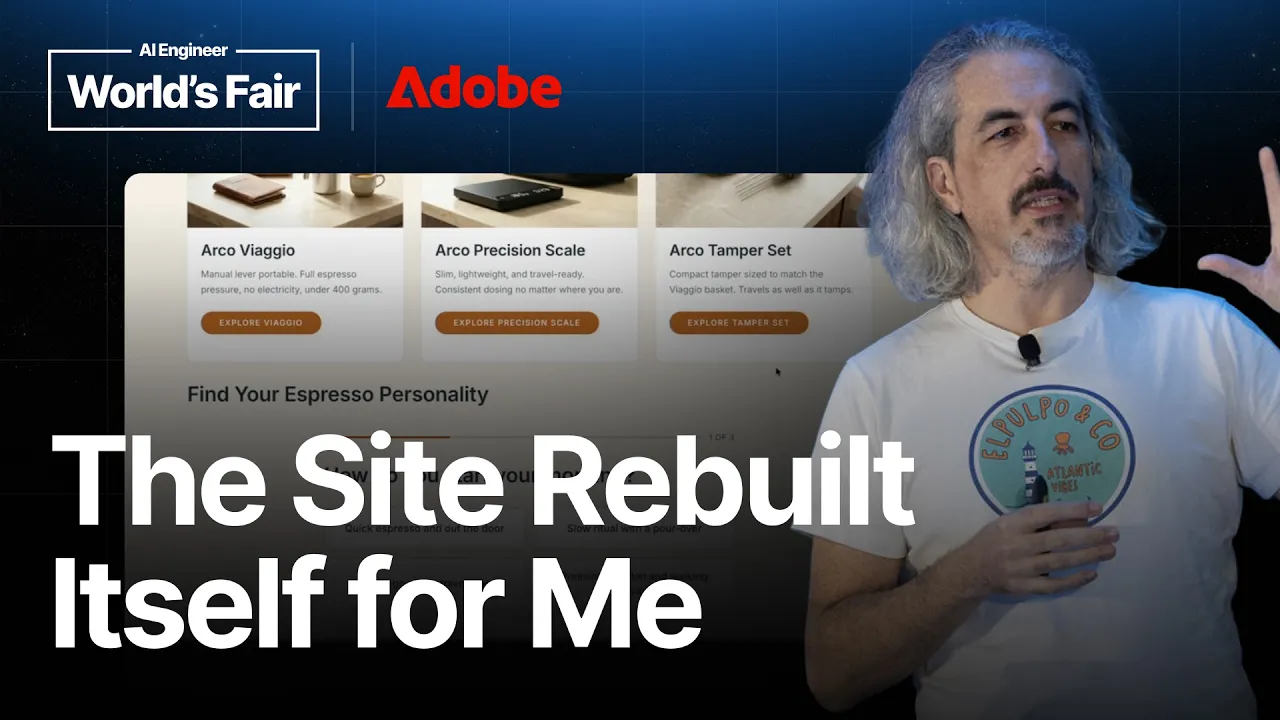
Carlos Sanchez types a request for a coffee machine he can use while camping, and the page assembles itself in under two seconds. Not a search result. A page, with camping appropriate machines, rewritten copy and a set of tips, generated for that one query. Adobe calls the goal an audience of one, which is the thing marketers have wanted for decades and could never afford. The site he demonstrates is a fully generated example, and the same tool will build one for any URL you hand it in about an hour. He did it to the AI Engineer site last week, and it produced a side by side comparison of two conferences on the fly. What keeps this from being a hallucination machine is how little it actually generates. Brand guidelines are strict, so the whole site becomes a corpus and retrieval grounds everything produced from it. Only certain blocks change, the hero, the product list, the navigation, the calls to action. Model choice is treated as a per site question rather than a global one, evaluated continuously across providers for accuracy and, unusually, for speed, because a page that takes six seconds has already lost. On their example the fastest configuration averaged 1.1 seconds against 4.6 for the runner up. His point is that this does not need a frontier model, since the work is choosing and arranging blocks. Speaker info: - https://x.com/csanchez - https://www.linkedin.com/in/carlossg/ - https://csanchez.org/ Timestamps: 0:00 - What an agentic site is trying to do 2:20 - Personalizing blocks, not whole pages 3:26 - Grounding generation in the site itself 4:37 - The architecture behind the blocks 5:46 - Evaluating models per site, for speed as well as accuracy 6:58 - 1.1 seconds against 4.6 8:07 - Why this does not need a frontier model 9:16 - Pre generating a page before it is asked for 10:23 - Letting marketers define the personas 12:44 - Audience of one 13:53 - Live demo: signals, buckets and a For You page 15:09 - Asking for a camping coffee machine 16:20 - Swap
Summary
Generated by gpt-5.6-terraAt-a-Glance
- Verdict: Watch fully
- Core thesis: Agentic sites can assemble real-time, intent-specific webpage variants from existing brand-approved content by combining browsing signals, site-grounded RAG, modular page blocks, and low-latency model inference.
- Why it matters: This is a concrete control-plane pattern for deploying generative AI in a customer-facing surface without surrendering brand governance: constrain generation to composition and copy within approved content blocks, then optimize continuously for latency and quality.
- Best use: Use the video as a reference architecture for intent-driven personalization, especially the separation of static branded content from dynamically selected or generated blocks, plus the model-evaluation and latency requirements needed for live experiences.
Executive Summary
Carlos Sanchez presents Adobe's working concept of an "agentic site," or "audience of one": a website that infers a visitor's current intent from searches and browsing behavior, then assembles a tailored page in real time. Rather than generating an entire site freely, the system personalizes bounded elements such as hero modules, product recommendations, blog feeds, navigation, calls to action, and the ordering of approved page blocks.
The core safety and quality mechanism is grounding. The system treats the existing site—product pages, guides, experiences, and blogs—as the RAG corpus, so generated responses and recommendations derive from site content. This is intended to preserve marketing control and brand guidelines while reducing the need for teams to manually author thousands of page variants.
Sanchez argues that latency is as important as answer quality for this use case. Adobe continuously benchmarks prompts and models by site type using PromFu, because a model suitable for one site's corpus and audience may not suit another. In the demonstrated 15-prompt evaluation, Cerebras running Google's Gemma 4 achieved about 1.1 seconds average generation latency versus 4.6 seconds for the next-best cited option; a live query demo took 1.64 seconds end-to-end and reported roughly 2,200–2,300 tokens per second.
The demo makes the concept tangible with a coffee-equipment site. After the visitor browses products and content, the system classifies them as an explorer, tracks visited pages and dwell time, generates a "For You" recommendation page, and changes search results for a camping-coffee query to feature portable products, related tips, and tailored copy. The presentation is strongest as an implementation pattern and proof of feasibility, though it does not provide controlled conversion results, privacy design, or production-grade safety/governance details.
Key Takeaways
- Claim: The practical form of an agentic website is constrained page composition, not unconstrained end-to-end webpage generation. | Evidence: Adobe personalizes discrete rich-content blocks—hero cards, products, blog feeds, navigation, CTAs, and block sequence—while Experience Manager continues serving the page and static content. Sanchez explicitly says marketers' strict brand guidelines make full-site free generation undesirable. | Implication: For a production agentic UX, define a typed catalog of approved modules, content sources, and allowable transformations; make the model a planner and selector within those boundaries rather than the sole page author. | Caveat: This constrains hallucination and visual-brand risk, but the transcript does not explain the approval workflow, validation rules, or fallback behavior when the model proposes an unsuitable composition.
- Claim: Intent inference from behavioral signals is the decision layer that determines personalization. | Evidence: The demo collects pages visited, time spent on pages, and user queries, buckets the visitor into an intent/persona such as "exploring," and passes those signals to the LLM. Marketers can define the desired groups—for example, purchasing versus information-seeking—and the AI selects relevant blocks and suggestions. | Implication: Treat persona assignment as an observable, testable policy layer: retain the underlying signals and confidence, allow deterministic rules where useful, and measure whether each intent policy improves the target metric. | Caveat: The speaker shows only a simple browser-signal example and does not establish that inferred personas are accurate, stable, consented to, or causally responsible for better outcomes.
- Claim: Grounding generation in the site's own corpus is the central mechanism for maintaining factual relevance and brand consistency. | Evidence: The product site, guides, experiences, and blog content are used to build RAG, and the full LLM response is said to be grounded in that site corpus. In the coffee example, a camping query produces portable-machine recommendations and camping-related tips drawn from available material. | Implication: A customer-facing implementation needs retrieval evaluation, source/citation traceability, freshness controls for commercial facts, and structured product data for comparison and recommendation tasks. | Caveat: RAG grounding reduces unsupported outputs but does not itself guarantee correct retrieval, accurate comparisons, current inventory or pricing, or compliance with promotional constraints.
- Claim: Sub-two-second latency is a product requirement for interactive personalized pages, so model routing must optimize speed alongside quality. | Evidence: Sanchez states that page generation should not take more than one or two seconds because faster sites produce better experience and conversion outcomes. Across 15 prompts for the example site, Cerebras with Gemma 4 averaged 1.1 seconds, compared with 4.6 seconds for the next cited result; the live page demo reported 1.64 seconds total and about one second LLM time. | Implication: Benchmark the exact prompt set, corpus size, output schema, and traffic environment of each deployment. Establish explicit latency budgets and use routing or fallback policies rather than selecting models solely on generic quality rankings. | Caveat: The benchmark is specific to Adobe's example prompts, site, providers, and infrastructure; it is not a general claim that one provider or model will win for every implementation.
- Claim: Smaller and faster models can be sufficient when the task is page organization and grounded copy generation rather than broad, high-reasoning synthesis. | Evidence: Sanchez says the system does not need a huge LLM because it is generating text and deciding where approved blocks belong, not processing unlimited information. He frames the operating choice as whether a model is "good enough" for the use case while being fast enough. | Implication: Decompose the workflow: use structured retrieval and rules for factual eligibility, then reserve a fast model for intent interpretation, block selection, and copy adaptation. | Caveat: This reasoning applies only if retrieval, content schemas, and available modules carry most of the task complexity; complex product eligibility, regulated claims, or multi-step decisioning may require stronger deterministic or model-based controls.
- Claim: Not all personalization must be generated synchronously; recommendation surfaces can be continuously precomputed and prefetched. | Evidence: The "For You" page is generated from browsing signals and can be updated as the visitor navigates. Sanchez notes that it could be pre-generated and prefetched, reducing the need for the highest real-time inference speed at the moment the user opens it. | Implication: Classify personalized experiences by freshness requirement: precompute likely next views and reserve synchronous inference for explicit, high-intent requests such as search queries or comparison requests. | Caveat: Pre-generation introduces costs from repeated LLM calls and risks stale recommendations as user intent changes; Sanchez explicitly flags the cost of multiple generations as a consideration.
- Claim: The same architecture can transform search into an adaptive landing page and create on-the-fly decision aids such as side-by-side comparisons. | Evidence: A query for a camping coffee machine changed the page's copy, recommendations, and supporting content. In a separate AI-engineering-site example, a query about European AI conferences produced a targeted page, including a side-by-side conference comparison intended to support a choice between two options. | Implication: High-value initial applications are decision-heavy journeys where a user's stated objective can be mapped to a bounded answer format: comparison tables, guided buying pages, targeted research collections, and next-best-content pages. | Caveat: The presentation demonstrates the interface behavior but offers no quality metrics for comparison accuracy or evidence that visitors prefer generated result pages over conventional search results.
Detailed Brief
Reference architecture and operating loop
- Claims: The front end is dynamic but modular: Edge Delivery Services composes blocks that can be updated in real time.; The browser gathers behavioral signals, while a backend service performs retrieval and model calls; a vector database supports the site RAG layer.; Adobe Experience Manager serves the underlying pages and static content, while the personalization service decides dynamic content and composition.; Marketing teams can express a personalization strategy in natural language and use analytics as a feedback loop toward an outcome such as engagement or conversion.
- Evidence: The stack cited includes Adobe Experience Manager Edge Delivery, a backend inference/reasoning service, a vector database, and providers including Cerebras and Amazon Bedrock.; Adobe uses PromFu to run prompts against multiple OpenAI-compatible and local model providers, then manually adjusts model choice, temperature, and token settings in its demo environment.
- Caveats: The talk does not specify event schemas, identity resolution, consent management, data-retention controls, experimentation methodology, or how analytics feedback is translated into safe policy changes.; Natural-language strategy definition may be useful for marketer accessibility, but it should not replace explicit guardrails, objective functions, and controlled experimentation.
- Implications: The architecture naturally separates an experience-control plane—signals, intent policy, evaluation, retrieval, and routing—from the delivery plane that renders approved components.; Continuous evaluation should be treated as deployment infrastructure, because model quality and latency depend on the particular site and task rather than on abstract leaderboards.
Prototype velocity and future interface thesis
- Claims: Adobe built an internal "Audience of One Labs" tool that can generate an agentic-site experience from an entered URL in under an hour for demonstration purposes.; Sanchez expects agentic personalization to extend beyond conventional browser navigation to assistant-mediated and ambient-device interactions.; He suggests dynamically generated images could eventually be included, but recognizes that visual quality and on-brand compliance are material constraints.
- Evidence: He describes using the tool on the AI Engineering site and generating query-specific pages from that source.; A conceptual example shows a voice query through Google producing a personalized result on a Google TV, without requiring a phone or computer.; He references a recently announced image model, "Nano Banana Light," as a possible route to fast on-the-fly image generation.
- Caveats: The less-than-one-hour claim concerns generating a demo site, not a production implementation with content audits, analytics integration, accessibility testing, security review, and brand approval.; The TV/personal-assistant scenario is an illustrative product vision rather than an established integration or measured user behavior.
- Implications: Organizations should prepare content as structured, retrievable assets that can serve both webpages and agent-mediated answer surfaces.; Prototype speed can be high, but production readiness will be determined primarily by governance, observability, data permissions, and evaluation coverage rather than initial page generation.
Notable Concepts & Terms
- Agentic sites: Adobe's term for websites that infer visitor intent and dynamically assemble personalized experiences in real time.
- Audience of one: The marketing ideal of tailoring the experience to an individual visitor rather than a broad audience segment.
- Intent-driven personalization: Using behavioral and query signals to infer what the visitor is trying to accomplish, then adapting content and layout accordingly.
- RAG from the whole site: Using the existing website as a retrieval corpus so generated copy, recommendations, and page responses are anchored in approved site content.
- Edge Delivery Services: Adobe Experience Manager's edge-oriented delivery layer used here to compose dynamic page blocks while serving site content efficiently.
- PromFu: The evaluation tool Sanchez uses to test prompts and models across providers, emphasizing both output accuracy and response speed.
- For You page: A personalized recommendation page that can be generated in advance from accumulated browsing signals and prefetched for the visitor.
- Model routing / good-enough quality: The operational principle that a faster, smaller model may be preferable when it meets the quality threshold for bounded composition and copy tasks.
Operator Notes / Why Ken Should Care
- Design any customer-facing generative site as a constrained composer: create a registry of approved components, permitted layout moves, content sources, and non-negotiable rules before introducing free-form generation.
- Build a representative evaluation suite per site or journey, with quality, factual grounding, brand compliance, cost, and p95 end-to-end latency—not only generic model benchmarks.
- Separate synchronous experiences from precomputable ones: pre-generate recommendations and likely next pages, while applying real-time generation to explicit high-intent searches and comparison requests.
- Require an experiment design before claiming value: compare intent-personalized experiences against baseline pages on conversion, engagement, abandonment, and latency, segmented by inferred intent confidence.
- Add missing production controls not covered in the talk: user consent and behavioral-data governance, source freshness, inventory/price validation, prompt-injection defenses for indexed site content, monitoring, and deterministic fallbacks.
Source/Metadata
- Title: Agentic Sites: Building Hyper Personalized Websites — Carlos Sanchez, Adobe
- Transcript words: 4596
- Duration seconds: 1242
- Timestamp note: No timestamps or chapter markers were provided. The latter portion of the supplied transcript substantially repeats earlier material.
Transcript
Hello. Thank you for coming. I'm going to talk to you about agentic sites, how we call it, building hyper-personalized websites. I'm not going to just talk about it. I'm going to show you what we're building. I've been working on this project for a bit now and will try to show you what is possible today with AI. I work at Adobe. I'm a principal scientist at a product that not many people know, Adobe Experience Manager, content management. We run a lot of websites, properties for big brands, and my background is in open source, contributing to a lot of foundations and projects. What are agentic sites and how are we building this thing? We are looking for sites that are looking at what intent the user browsing has, what is the user doing, what is the user trying to achieve. And the end goal is to personalize these pages for the current user browsing so that eventually this drives higher engagement or conversions, whatever the marketing teams want to achieve. And these pages are personalized in real time based on the user that is accessing the site and what the user is doing. The stack we're using is AM Edge Delivery. This is the part of the product we have where all the content is on the edge. And then we have a backend service that powers this experience with different LLM providers, LLM services. We use Cerebras for fast inference, or we can also use Bedrock and a bunch of others. I'll be showing Cerebras today, and you will see the reason why. The engine that is personalized in this is in the rich content and blocks. Different blocks on the site are customized depending on what the user persona is. We don't want the whole site to be generated. If you talk to marketing people, they have very strict brand guidelines. You don't want to just come up with or have some hallucinations there. So what is personalized is different sections of the site, and we use the whole site as a corpus. We build a RAG from the whole site. So what is generated is grounded on the existing site. We try to solve the problem where one size fits all. We want hyper-personalized experiences. Also, we want to help our customers do more automatic authoring, so they do not have to create thousands of different variations of the site, but use AI for this and then do these multiple layers of personalization. Some examples of what we're doing or showing in the demo are instant persona adaptation, query generation when the user searches for something on the site, where the page with the results is customized for them, and also something like recommendations, where after you browse the site for a period of time, we can create a page that recommends something based on what we think you are looking for. For marketeers, they can define this strategy in natural language, and they can use analytics to drive the loop of personalization and what is the end goal, and how this goes back again to adapt the personalization to improve that whole cycle. Everybody's talking about loops in this conference, so that's one of the loops there. How does the architecture look? It's a dynamic front end with some blocks, what I mentioned before, and with Edge Delivery Services, you compose these blocks, and they are updated in real time with the AI. In the back end, we do the evaluation of the models and the providers, and one thing we realized is that this is very dependent on the site. So we have a bunch of prompts, and we run them across a huge variety of models and providers, and then we look at the accuracy, we look at the speed, but this is going to depend highly on what type of site, how big the site is, what different area the site is targeting, what type of commerce it is, and so on. So we run this evaluation continuously. We use PromFu. Anybody heard about PromFu? Okay, some people. PromFu allows you to evaluate models and prompts against multiple model providers, and you can do local models and any of the features that we have to do with a bunch of OpenAI-compatible providers, and a lot of them, basically. We look for two things. Why? Accuracy. That's typically what people look for. But also we want the speed because we don't want the site generation to take more than one or two seconds, right? Because this is already proven, that the faster the site, the more conversions it generates, or the better the experience it is for the user. What I mentioned is different sites may have different requirements, so you may have to run this evaluation of models depending on the site. So we have 15 prompts for this example site, and at the top you can see with Cerebras on the Gemma 4 model that was announced last week, we can get an average latency of 1.1 seconds generating a page. You can compare that to the second one, which is 4.6 seconds, right? So the difference is huge. And that's why we use Cerebras for this use case. And you can see that different providers, different models have different speeds. And here is a... Let me... I can show you the whole thing here. Not this one, this one, right? So at the bottom we have others. Sometimes maybe some of them may be good. They don't need to be perfect, but they're good enough if they're fast enough. So that's going to be the kind of decisions that you need to make on whether the model is good enough for your use case or not. So we're looking, yeah, average 1.1 seconds, and then the next ones are going from 4 seconds higher. And you don't need a huge LLM to do this sort of work because you are generating text, you are deciding where to put blocks and how to organize the website. You don't need lots of information for that. So this browsing and the queries are being recorded. These are the metrics or the data we gather from the user. And this is fed into the LLM to personalize the site. And then in this example, we personalize the hero card, the products, the blog feeds, and the navigation based on the persona. Also, some of the buttons, like our call to action navigation, we can also personalize those. We create, and I'll show you, the For You page, which is a recommendation. And this is an interesting one because this you could pre-generate, right? As the user browses your site, you gather the signals and you could keep generating this. So in this case, you wouldn't need such a big speed. But that's interesting because if a user wants to buy something, you could just say, okay, For You, I will recommend these three products or something like that. And then they can see this recommendation. And if they go there, that could be prefetched for them. And obviously, you have to keep updating it as the user navigates around the site and so on. So that's also something to consider on the cost, cost of doing multiple generations, multiple LLM calls. When the user runs a query, a dynamic personalized page is shown to them. When these queries are also grouped into personas or intent types, what is this person trying to do in the site? Is he trying to buy something? Is he trying to just get information? So you can get marketers to decide what type of groups, how many groups you want to have, how you want to deal with customers. And AI will choose the blocks and the suggestions for those groups of people. And we can adapt the different blocks, the sequence of the blocks, and media. You could also do media. One of the things we consider is there was some model announced today or yesterday, the Nano Banana Light. So you could even generate images very fast on the fly, obviously not as fast as text, but that's also something that would be, I don't know, something marketing people would want, generated images. That depends a lot on the quality, if it's on brand. And this site, in this example, we have a product site, and then we have guides, experiences, blogs, and the whole response of the LLM is grounded there. And there are comparisons. We can do comparisons between products that are tailored, and the product pages can be tailored for the user. Okay. This is a bit of the stack. I'm not going to spend too much time here, but in the browser you have some layers. You have the browser where the signals get gathered from the user, and then we have the backend. We run some of these things in Google. So the backend is basically just calling the LLM and doing some reasoning using the RAG that is built on the site to do the generation. And you have, obviously, the vector database, the inference machinery, and Adobe Experience Manager is serving the pages and the static content. So let me show you, because I think this is... We call this audience of one, because the idea in marketing, they always dream of being able to personalize things for each individual. So we call it audience of one. So I have this site. This is a site that is absolutely generated. The example site is a coffee machinery site. So I can go and read some stories, and I can go and look at some products. Let's go and look at some products. Let's go and click here. Okay. So I'm browsing around the site, and I have this debugging tool thing, which, let me just go here, I think. Let's see. So down there are the signals that the browsing is giving us. I don't know if you can see it much, because I cannot see it much. So the user is bucketed into the exploring category. We have the pages that they have visited, and then we have how much time is spent on each page. All of this data is now available for the LLM. So if I go here, I already have a For You page that was generated for me based on my browsing. And you will notice that it's slightly different than everything else. But if I go here and I run a query, like I want, I'm looking for a coffee machine to prepare coffee while camping, then you're going to see some things like the text is customized: camping shouldn't mean compromising on your whatever routine. So you're going to see things like the coffee tips for camping, the coffee machine that is being recommended, the Arco Viaggio, or the Nano, which are good for a camping trip, right? So you saw how fast this was. I'm going to run it here, something similar that I have here. And I can run it in the debug mode here. And you will see, let's make this bigger. Total time, 1.64 seconds to generate the page. So this includes a round trip to the LLM. This is using Cerebras Gemma 4, so the Gemma model from Google running on Cerebras on their very fast chips. We get 2,300 tokens per second, which is not bad, I would say. And if I run it again, probably something like that, the LLM time is one second, and again, 2,200 tokens per second. So this is something that we only dreamed about before. On this example site, we have some other options because we've been showing this to customers. So we have the ability to change the different models, temperature, tokens, and so on. And we can show and try the different models and see how they behave. Besides automatic tests with PromFu, then we can manually come and tweak things and see how that works. And we also have of one labs. So we built this tool that generates an agentic site for any site we want. So if somebody wants to have a demo for a customer, come here and enter the URL. In less than an hour, you have an agentic site. I did this last week with the AI engineering site, and I got this site that is just a search box and a few things. Let me open it here, the full page. Yeah. Okay. So I could say, Europe AI conferences. So these suggestions are also AI generated, and I get a page that is more focused on these European conferences. If I go back, I can search for anything the same way I did with the article. So as a specific... There was one that was generating a good comparison side to side. Let me see if this one... Okay, here, this one. I went on this generated page with a very good comparison. If I'm looking at two conferences and I need to decide, if I figure out that the user wants to do that, this is great because that gives them a side-by-side comparison on the fly. Now, I think this is cool already, but then I have this idea that probably a bunch of people are talking about. Is the web the future still, and so on? Nobody knows. But we can also do something with this, with this audience of one, these generative sites. So imagine you have your personal assistant and you ask a query through, in this case, through Google, and you say, I want to buy, I don't remember what the query said, it was something like, I want to buy a machine, and I get this on my Google TV, right? This is absolutely personalized to my query. Okay. Okay. No, go back. This is absolutely personalized to my query. So I'm there in my living room. I don't need a phone. I don't need a computer. I don't need anything. Just my voice and something that will show me something that is absolutely personalized to me. Okay. So that one. So what I was trying to show, and hopefully you remember from this session, is that this is now possible. It's only going to get better from here on. It's only going to get cheaper. It's only going to get faster. And you will be able to have huge personalization options for sites and for other things. And you can do this with intent-driven personalization. So what is my user trying to do? What does my user want to buy? These sorts of questions. And you can assemble a page just for them. And you can also do this with multiple models. And eventually it's just going to be faster and faster, right? So that's it. Thank you for coming, and I hope you got the idea. Thanks. providers, and then we look at the accuracy, we look at the speed, but this is going to depend highly on what type of site, like how big is the site, how, I don't know, what different, what different area is the site targeting, what type of commerce it is, and so on. So we run this evaluation continuously. We use PromFu. Anybody heard about PromFu? Okay, some people. So PromFu allows you to evaluate models and prompts against multiple models providers, and you can do local models and any of the features that we have to do with a bunch of open AI compatible providers, and a lot of them, basically. We look for two things. Why? Accuracy. That's typically what people look for. But also we want the speed because we don't want the site generation to take more than one or two seconds, right? Because people, this is already proven that people want the faster the site, the more conversions it generates, or the better the experience it is for the user. What I mentioned is different sites may have different requirements, so you may have to run this evaluation of models depending on the site. So we have 15 prompts for this example site, and we have at the top, you can see with Cerebras on the GEMA 4 model that was announced last week, we can get an average latency of 1.1 seconds generating a page. You can compare that to the second one, which is 4.6 seconds, right? So the difference is huge. And that's why we use Cerebras for this use case. And you can see that different providers, different models have different speeds. And here is a... Let me... I can show you the whole thing here. Not this one, this one, right? So at the bottom we have other... Sometimes maybe some of them may be good. They don't need to be perfect, but they're good enough if they're fast enough. So that's going to be the kind of decisions that you need to make on whether the model is good enough for your use case or not. So we're looking... Yeah, we're looking... Yeah, average 1.1 seconds, and then the next ones are going from 4 seconds higher. And you don't need a huge LLM to do this sort of work because you are generating text, you are deciding where to put blogs and how to organize the website. You don't need lots of information for that. So this browsing and the queries are being recorded. So these are the metrics or the the data we gather from the user. And this is filled into the LLM to personalize the site. And then in this example, we personalize the hero card, the products, the blog feeds, and the navigation based on the persona. Also, what are some of the buttons like our call to action navigation, you can also... We can also personalize those. We create and I'll show you the for you page, which is a recommendation. And this is an interesting one because this you could pre-generate, right? As the user browses your site, you gather the signals and you could keep generating this. So in this case, you wouldn't need such a big speed. But that's interesting because it will be if a user wants to buy something, you could just say, okay, for you, I will recommend these three products or something like that. Yeah. And then they can see this recommendation. And if they go there, that could be prefetch for them. And obviously, you have to keep updating it as the user navigates around the site and so on. So that's also something to consider on the cost, cost of doing multiple generations, multiple LLM calls. When the user runs a query, a dynamic personalized page is shown to them. When these queries are also grouped into personas or intent types, so what is this guy trying to do in the site? He's trying to buy something. He's trying to just get information. So you can get marketers to decide what type of groups, how many groups you want to have, how you want to deal with customers. And AI will choose the blogs and the suggestions for those groups of people. And we can adapt, yes, the different blogs, the sequence of the blogs, and media. You could also do media. One of the things we consider is there was some model announced today or yesterday, the Nano Banana Light. So you could even generate images images very fast on the fly, obviously not as fast as tests, but that's also something that would be, I don't know if it's not something like marketing people would want to have generated images. That depends on the quality a lot, if it's on brand. And this site, in this example, we have a product site, and then we have guides, experiences, blogs, and the whole response of the LLM is grounded there. And there's comparisons. We can do comparisons between products that are tailored, and the product pages can be tailored for the user. Okay. This is a bit of the stack. I'm not going to spend too much time here, but the browser, you have some layers. You have the browser where the signals get from the user, and then we have the backend. We can have the backend. We run some of these things in Google. Some of these are the backend. So the backend is basically just calling the LLM and doing some reasoning using the rack that is built on the site to do the generation. And you have, obviously, you have to have the vector database, the inference machinery, and the Adobe Experience Manager is doing the serving the pages and the static content. So let me show you, because I think this is, so we call this audience of one, because the idea of a marketing, the, they always dream on being able to personalize things for each individual. So we call it, yeah, audience of one. So I have this site. This is a site that is absolutely generated. Example site is a coffee machinery. So I can go and read some stories, and I can go and look at some products. Let's go and look at some products. Let's go and look at some products. Let's go and click here. Okay. So I'm browsing around the site, and I have this debugging tool thing, which, let me just go here, I think. Let's see. So down there is the signals that the, that the browsing is giving us. So I don't know if you can see it much, because I cannot see it much. Then, so the user is bucketed into the exploring category. We have the pages that they have, have visited, and then we have how much time is spending on each page. All of this data is now available for the LLM. So if I go here, I already have a For You page that was generated for me, and, uh, based on my browser. And you will notice that it's slightly different than everything else. But if I go here and I run a query, uh, like I want, I'm looking for a coffee machine to, uh, prepare coffee while camping. And then you're going to see some things like the text is customized camping. And then you're going to see some things like the text is customized camping shouldn't mean compromising on your, uh, whatever routine. So, you're going to see some things like the coffee tips for camping, uh, the coffee tips for camping, uh, machine, uh, that are being recommended, the Arco Viaggio, uh, and, uh, or the nano, which are, um, good for, um, for, um, for the, um, for the, um, for a camping trip, right? So you saw how fast this was. I'm going to run it here, uh, something similar that I have here. And I can run it on the debug mode here. And you will see, let's make this bigger. Total time, 164 seconds to generate the page. So this includes a round trip to the LLM. This is using Cerebras Gemma 4. So the Gemma model from Google running on Cerebras on their, uh, very fast chips, uh, we get 2,300 tokens per second, which is not bad, I would say. And if I run it again, uh, probably something like that, uh, the LLM time is one second and again, 2,200 tokens per second. So this is something that we only dreamed about before. On the, on this side, example side, we have some other options. Uh, so because we've, we've been showing this to customers, so we have the ability to change the different models, temperature, temperature tokens, and so on. And we can, uh, we can show and try the different models and see how they behave. Besides automatic tests with PromFu, then we can manually come and tweak things and see, and see how that, how that works. And, uh, we also have, uh, of one labs. So we have, we build this tool that generates an agentic site for any site we want. So if somebody wants to have a, uh, demo for a customer, come here and enter the URL in less than an hour, you have an agentic site. I did this last week with the AI engineering site, and I got this site that is just a search box and a few things. Uh, let me open it here. The full page. Yeah. Okay. So I could say, uh, Europe AI conferences. So these suggestions are also AI generated and I get a page that is, uh, more focused on, it should be more focused on, on the, on this European conferences. If I go back, did I go, I can search for anything the same way I did with, with the article. So I, as a Pacific, there was someone that was generating a good comparison side to side. Let me see if this one. Okay. Here, this one, I went on this generated, uh, page with, uh, very good comparison. If I'm looking at two conferences and I need to decide if I figure out that the user wants to do that, this is great because that gives them a side by side comparison on the fly. Now, this, this is, I think this is cool already, but then we have, uh, I have this idea that probably the, um, a bunch of people are, we are talking about is the web there, is, is the web, the future is still and so on. Nobody knows, but we can also do something with this, uh, with this audience of one, these generative sites. So imagine you have, uh, you have your personal assistant and you ask a query through, in this case, through Google and you say, I want to buy, I don't remember what the query said, it was something like, I want to buy, uh, a machine and I get this on my Google TV. Right? So this is absolutely personalized to my query. Okay. Okay. No, go back. This is absolutely personalized to my query. So I'm there in my living room. I don't need a phone. I don't need a computer. I don't need anything. Just my voice and something that will, uh, kind of show me something that is absolutely personalized to, to me. Okay. Okay. So that one. So, what I was trying to show, and hopefully you remember from this session, is that this is now possible. It's only going to get better from here on. It's only going to get cheaper. It's only going to get faster. And you will be able to have, uh, huge personalization options for sites and for other things. And you can do this, uh, with intent driven. So what is the, what is my user trying to do? What does my user want to buy? These sort of questions. And you can, uh, assemble a page just for them. And you can also do this with, uh, multiple models. And, and eventually it's just going to be faster and faster. Right? So that's it. Um, thank you for coming. And I hope you, you got the idea. Thanks.