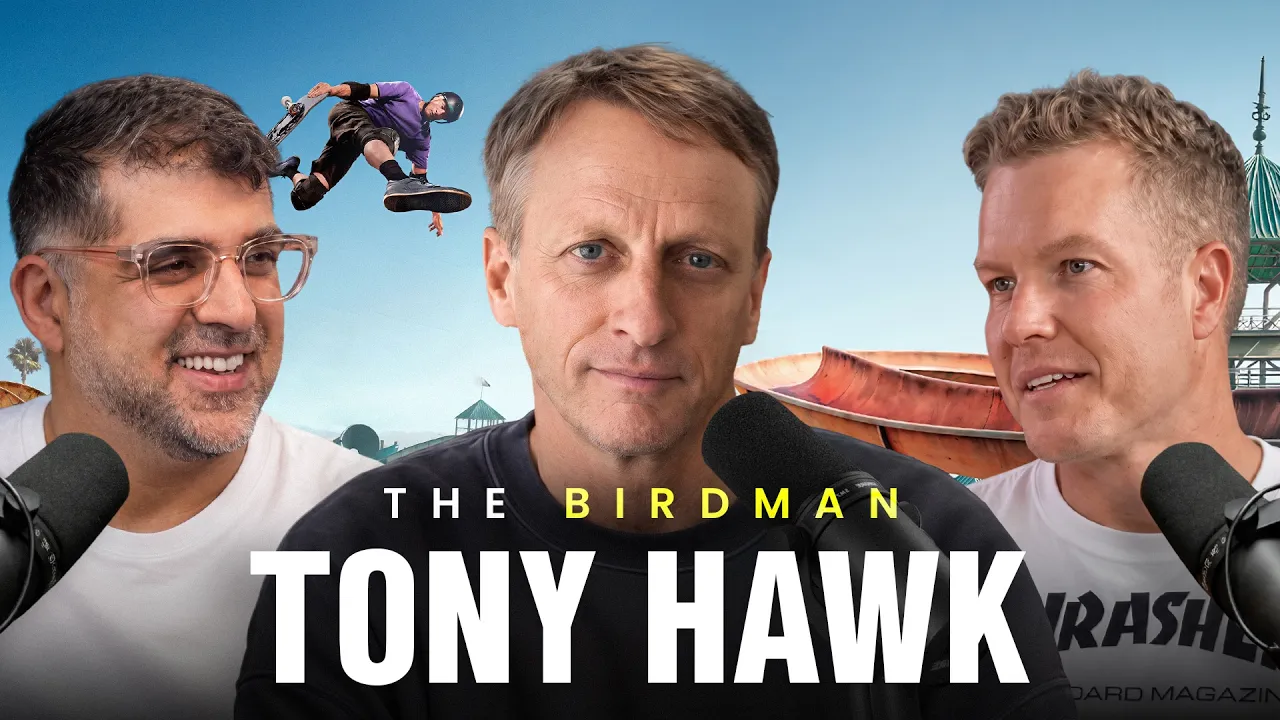
Tony Hawk inspiring us for 72 minutes straight
Description
*30+ unsexy business ideas:* https://clickhubspot.com/1qtb Episode 860: Sam Parr ( https://x.com/theSamParr ) and Shaan Puri ( https://x.com/ShaanVP ) chop it up with skateboarding legend Tony Hawk. — Show Notes: (0:00) Intro (1:20) Meeting Tony in Ethiopia (3:42) Economics of skate parks (12:38) The price of greatness (17:54) Scraping by (26:33) The 900 (35:16) Tony Hawk’s Pro Skater (52:20) Investing (58:53) Influencing on internet culture (1:03:47) Aging skaters (1:08:07) Tickets — Check Out Sam's Stuff: • Hampton (joinhampton.com): My community for founders. Average member does $25m/year. Many of the guests are members. Get after it...apply: http://joinhampton.com/mfm — Check Out Shaan's Stuff: • Shaan's weekly email - https://www.shaanpuri.com • Visit https://www.somewhere.com/mfm to hire worldwide talent like Shaan and get $500 off for being an MFM listener. Hire developers, assistants, marketing pros, sales teams and more for 80% less than US equivalents. • Mercury - Shaan uses Mercury across all of his companies. you can too: http://mercury.com/ Mercury is a fintech company, not an FDIC-insured bank. Banking services provided by Choice Financial Group, Column, N.A., Members FDIC • I run all my newsletters on Beehiiv and you should too + we're giving away $10k to our favorite newsletter, check it out: beehiiv.com/mfm-challenge My First Million is a HubSpot Original Podcast // Brought to you by HubSpot Media // Production by Arie Desormeaux // Editing by Ezra Bakker Trupiano /
Summary
Generated by gpt-5.6-terraAt-a-Glance
- Verdict: Skim
- Core thesis: Tony Hawk's unusual durability came from intrinsic obsession with progression, paired later with unusually disciplined stewardship of brand authenticity, royalty economics, and community reinvestment.
- Why it matters: It is a strong case study in turning niche credibility into an enduring consumer IP platform without losing the practitioner community that made the brand valuable.
- Best use: Use it for lessons on founder-led brand control, long-tail royalty decisions, authentic product development, and maintaining intrinsic motivation after commercial success.
Executive Summary
This is an unusually candid, high-energy long-form interview with Tony Hawk that works best as a personal operating-history rather than a conventional business case study. Hawk attributes his career to relentless repetition and a permanent orientation toward the next unsolved trick, not to early expectations of money, fame, or professional status. Skateboarding was a marginal activity when he began; he originally expected to become a math teacher and viewed free equipment or a magazine photo as meaningful success.
The business story centers on surviving one boom-and-bust cycle before the Tony Hawk's Pro Skater franchise created an enormous second act. Hawk had early skating income in the high hundreds of thousands, spent freely, and then saw sponsorship income collapse from roughly $1,500 per month to $300 over about a year. He stayed committed to skating because it was intrinsically meaningful, but adapted by learning video editing, taking consulting work, and hustling to cover his mortgage and support his child.
His largest commercial insight was that authenticity was not a creative preference but a strategic asset. After being dissatisfied with mainstream campaigns that distorted skate culture, he required final approval in his Activision deal. The game was designed first for serious skaters, using real locations, real athletes, credible music, and feedback from secretly distributed beta copies. That core-community validation enabled broad mainstream adoption rather than being sacrificed for it.
The interview also shows Hawk as a portfolio operator rather than simply a celebrity endorser. He retained future game royalties instead of accepting Activision's $500,000 buyout offer, later receiving a $4.5 million check when all four early franchise titles were simultaneously in the sales top 10. He has kept lower-margin ventures such as Birdhouse alive because they preserve connection to the culture, while using licensing, media production, speaking, selective investments, and a skate-park foundation to make the overall platform sustainable.
Key Takeaways
- Claim: Hawk's primary competitive advantage was an obsession with measurable progression rather than a desire for recognition or financial outcomes. | Evidence: He says that after winning major contests he returned to the ramp the next day to attempt a new trick; he cared more about learning what had not yet been done than covers, rankings, or contest wins. Stacy Peralta noticed not merely innovative tricks but Hawk's frustration and tenacity to repeat attempts despite risk. | Implication: For difficult product or operational work, build systems around frequent, concrete evidence of progress and orient high-agency people toward the next capability rather than external validation. | Caveat: This mindset was reinforced by a sport where progress was unusually visible and incremental; the lesson is not that all obsession is productive without a tight feedback loop.
- Claim: Intrinsic attachment to the craft made Hawk resilient when the initial market collapsed, while practical skill acquisition prevented passion from becoming financial denial. | Evidence: After an 1980s skateboarding boom, his income fell sharply around 1990-91: Airwalk payments reportedly moved from about $1,500 monthly to $1,000, then $500, and eventually $300. He did not consider quitting skating, but learned video editing, worked as a Hollywood skating consultant, and edited an NEC TurboGrafx commercial to pay bills and provide for his child. | Implication: Separate commitment to a mission from dependence on a single revenue source: preserve the core craft while deliberately acquiring adjacent monetizable capabilities and maintaining financial buffers. | Caveat: Hawk acknowledges he had mishandled prior prosperity, including not saving for taxes and buying depreciating cars, so the downturn was worsened by weak personal financial discipline.
- Claim: Authenticity with the expert community was the central product strategy behind Tony Hawk's Pro Skater, and Hawk used contractual control to defend it. | Evidence: Having participated in campaigns he felt were cheesy and indifferent to skate culture, Hawk required final approval in his Activision contract. The game used real skate spots and skaters, and Hawk distributed modified beta copies to friends and prominent skaters specifically to obtain unfiltered feedback; industry excitement about 'the game' became an early signal. | Implication: When commercializing a community-native product, win the demanding insiders first, give the domain expert meaningful approval rights, and use real practitioner testing before optimizing for broad-market messaging. | Caveat: The authenticity strategy succeeded because the underlying gameplay was already intuitive and enjoyable; cultural accuracy alone would not have created a mass-market hit.
- Claim: Retaining upside in a hit-driven IP business can dominate an apparently life-changing early cash offer when product-market signals are strong. | Evidence: Activision offered Hawk $500,000 to buy out future royalties before the first game's release. Despite viewing that amount as almost unimaginable, he declined; by the fourth release, all four Tony Hawk's Pro Skater titles were in the top 10, and an Activision contact handed him a $4.5 million royalty check. | Implication: For founders or talent licensing valuable IP, model long-tail participation explicitly and negotiate for retained economics when adoption signals, distribution capability, and downside survivability justify it. | Caveat: This was not a generic argument against liquidity: Hawk had a newly affordable mortgage, ongoing sponsorship and competition prospects, and unusually strong pre-release evidence from both skaters and game reviewers.
- Claim: Hawk views the 900 as a consequence of sustained commitment, but the decisive operational enabler was improved environmental consistency rather than pure willpower alone. | Evidence: He had never landed the 900 before the 1999 X Games and had been injured on every fully committed prior attempt. During the best-trick event, a state-of-the-art halfpipe gave him consistent speed and rotation on repeated attempts; around the sixth attempt he began committing to the landing and ultimately succeeded. | Implication: Before escalating commitment to a hard milestone, improve the repeatability of the environment and inputs; confidence is more rational when attempts become consistently high quality. | Caveat: Hawk describes deliberately not considering injury or failure while attempting the trick, a mental posture that is potentially dangerous and should not be transferred literally to business decisions with asymmetric downside.
- Claim: A durable personal brand can support a portfolio of businesses, but Hawk invests most confidently where he brings cultural credibility and operating contribution beyond capital. | Evidence: His current platform includes Birdhouse Skateboards, Hawk shoes and apparel, licensing, speaking, the Skateboard Project, and 900 Films, which has worked with brands including Liquid Death. He cites investments in Nest, Blue Bottle, DocuSign, Liquid Death, and Events.com, while noting restaurant investments such as Counter Burger did not work; he says better outcomes tend to be areas he genuinely cares about and can contribute to beyond money. | Implication: Treat a brand-led portfolio as an extension of distinct unfair advantages—distribution, taste, credibility, content, or customer access—not as a license to invest broadly in unrelated categories. | Caveat: He explicitly says there is no universal pattern and that trusted people have been a major source of deal flow; his access and celebrity platform are not generally replicable.
- Claim: Hawk's philanthropy demonstrates a concrete-feedback model that builds trust and turns giving into durable infrastructure. | Evidence: Since 2002, his foundation—now called the Skateboard Project—has contributed to close to 1,000 skate parks. Early grants of $5,000-$10,000 often helped local projects clear approval resistance by providing validation; Hawk also routed 10-20% of some endorsement contracts to the foundation. He contrasts physical parks, which people can visit and skate, with less visible charitable outcomes. | Implication: For social-impact programs, fund visible, usable outcomes and show contributors exactly what their support enabled; small catalytic grants can be disproportionately useful when local projects are already underway.
Detailed Brief
Brand extensions, cultural flywheels, and Birdhouse economics
- Claims: The Pro Skater franchise acted as a cultural distribution engine, not just a licensing product: it introduced players to skateboarding, music, athletes, and physical locations.; Birdhouse was maintained through difficult economics because it remained a cultural home base rather than a purely financial asset.; Hawk distinguishes between a venture that is strategically or personally worth maintaining and one that is conventionally profitable.
- Evidence: Hawk says non-skaters began appreciating skating's technical language after the game, while skaters recognized real spots such as San Francisco's Third and Army and athletes including Alyssa Steamer, Andrew Reynolds, and Jeff Rowley.; Birdhouse began in 1992 with pro skater Per Welinder; its first three to four years were bleak, profitability arrived around 1997-98 with X Games-driven interest, and its strongest period was roughly 1999-2005 after the game featured Birdhouse decks.; Hawk says skateboard decks have remained around $60 for decades and agrees the core deck business is not very profitable; he has used licensing to help support riders and preserve the company.
- Caveats: The transcript does not provide Birdhouse revenue, margin, ownership, or licensing economics, so the scale and subsidy requirements cannot be assessed.; A brand appearing in a successful media property can produce enormous awareness, but it is not proof that product placement will reliably create demand in other categories.
- Implications: A media product can become an ecosystem-level acquisition channel when it lets audiences participate in a culture rather than merely observe branded promotion.; Maintain non-core assets only when their strategic role—community legitimacy, talent access, brand continuity, or content supply—is explicit and funded by stronger parts of the portfolio.
Motivation, recovery, and the long career
- Claims: Hawk's late-career objective is deliberately modest: continue skating, learn new tricks, make time for family, and accept changing physical constraints.; His 'find your kickflip' message is about reaching an imperfect but real recovery milestone rather than waiting for ideal performance.
- Evidence: After breaking his femur, Hawk returned too early, displaced the healing bone despite a titanium rod, and required a second corrective recovery eight months later.; When he finally landed a kickflip again, he characterizes it as painful, scary, ugly, and far below his former standard—but still a meaningful threshold that enabled further progress.; He now uses deliberate pre-skate mobility work and advises aging skaters to take what their body can offer on a given day rather than force a predetermined outcome.
- Caveats: The injury and warm-up discussion is anecdotal and not medical guidance.; The interview's rhetoric around pushing through danger applies to athletic performance, not automatically to organizational decision-making.
- Implications: In long-lived careers, redefine progress around capability retention and staged return-to-performance, not around restoring a prior peak immediately.; Use small, observable recovery milestones to maintain momentum after a setback.
Notable Concepts & Terms
- Progression: The core skateboarding concept of measurable incremental improvement; Hawk frames it as the engine of both motivation and sport-wide innovation.
- Tony Hawk's Pro Skater (THPS): The Activision game franchise that converted Hawk's niche credibility into mass-market IP and became his major royalty windfall.
- Final approval: Hawk's contractual demand to control how skate culture and his brand were represented, presented as essential to protecting authenticity.
- The 900: Hawk's 1999 landmark trick, used here to illustrate long-horizon persistence, repeated attempts, and the importance of reliable operating conditions.
- Birdhouse Skateboards: Hawk's 1992 skateboard company; an example of maintaining a low-margin but strategically and emotionally important core-culture business.
- The Skateboard Project: Hawk's foundation, started in 2002, which supports public skate parks and makes charitable outcomes visible and locally useful.
- Find your kickflip: Hawk's recovery metaphor: achieve the next real, imperfect milestone first, because it creates a base for subsequent improvement.
- 900 Films: Hawk's in-house production company, illustrating how owned content capability can convert personal-brand demand into a repeatable commercial service.
Operator Notes / Why Ken Should Care
- For any community-native product or developer-facing tool, identify the equivalent of Hawk's final-approval right: ensure genuine practitioners have authority to reject messaging or features that violate the culture's norms.
- When evaluating licensing, creator, or platform partnerships, require an explicit comparison of upfront cash versus retained royalty/equity upside, including adoption signals and personal/company downside tolerance.
- Design an insider-beta loop for new products: recruit credible domain users, obtain candid use feedback before public launch, and treat organic peer-to-peer buzz as a leading signal rather than relying solely on broad-market surveys.
- Audit side ventures that are strategically cherished but low-margin; state whether each is being retained for culture, talent, distribution, brand integrity, or economics, and fund it accordingly.
- For charitable or ecosystem investments, prefer projects with visible end-user outcomes and catalytic local partners already carrying momentum.
Source/Metadata
- Title: Tony Hawk inspiring us for 72 minutes straight
- Transcript words: 25592
- Duration seconds: 4263
- Timestamp note: No usable timestamps or chapter markers were present in the supplied transcript. The transcript also contains substantial duplicated passages.
Transcript
Fourth game just got released. It got to be in the top 10 sales right away. And he said, the first three are still in the top 10. And I said, what does that even mean? And he's like, this is what it means. And he slid a check across the table for $4.5 million. That's how I made my first million. Tony, can we show you something really quick, just so you understand how real this is all about to be? Oh, sure. So we're business nerds, but at least one of us has grown up watching you. And I'm going to show you why I like talking to you. This is me skating. Can you see this video? Wow. That's awesome. So I'm 30. Is that 360 Flip recent? Yeah, I'm 37 years old. Damn. So look, there's a six stair. I'm jealous. That's amazing. Was that the Riverside Park right there? Riverside Skate Park. I moved right by it just, and I go every Saturday and Sunday. Sick. I'll meet you there so you can teach me how to relearn 360 Flip. Yeah, right. Have you skated there a bunch? I can't do them on flat anymore. I can only do them on banks. Well, that's more impressive. But I grew up watching you forever, and so it's pretty cool that we've intersected at this strange place called My First Million where we talk about business and stuff. But I'm so excited to talk to you. I know Sean is too. Yeah, actually, Sam, I have a funny story. So I met Tony once, many years ago now, like 10 years ago. We went on a trip to Ethiopia with Charity Water. Yeah, that's true. I was thinking, I know that face. Yeah, so we're in the middle of nowhere. There's no service. There's nothing. There's no water, right? That's why we're there. There's no water in these villages. And we're on the side of a mountain doing a hike. And this guy's like, Tony Hawk. And he recognized Tony Hawk on the side of a mountain in Ethiopia, a place where they didn't even have anything. It was incredible. And the funny thing was the whole trip was like a bunch of hoosies. It's like, oh, this guy created Spotify. This guy could do this. Nobody knew anyone except for Tony Hawk. He got recognized on the side of a mountain. I thought that was unbelievable. That was a fun trip. I had never experienced anything so remote for sure, but also the whole mission of life-changing water. It was insane. We got to fix wells. That was wild. Yeah. We got to see the water come out for the first time when the geyser blasts and stuff. It was amazing. How'd you get looped into that, Tony? I was a big donor to Charity Water. And I had actually sponsored a well in the name of my daughter, who was very young at the time. She's now in college, but we got to go visit the actual well. And people were thanking me on my daughter's behalf. And it was really cool. That's one of the amazing things Charity Water did. And this is really not about charity. It's a business lesson. You know, when Scott started Charity Water, he had no background in charity, but he decided, hey, he just asked himself the question, why don't I give to Charity Water? He's like, well, I think the main thing is you don't know where the money goes. You give it. It's a black box. You hope something good's happening, but you never really feel the impact or see the impact. And so what he was doing was, if you donated, you get a GPS tracker of exactly where in the world your thing was going. You would see the flow meter of how much water is coming from your well once it comes online. And then, for people like Tony, who were doing a full well, he would do these once in a lifetime type of things. You could go see it, go see the place, and go talk to the people who are the beneficiaries of this. And I just think that was such an unlock for him and why Charity Water, one of the reasons Charity Water was able to do so well as a nonprofit compared to the standard operating procedures of nonprofits. Yeah, I agree. Well, also, coming from having my own foundation, I see how more engaging it is to have, to know where your money goes. There's money that goes to research and that's hard to track and it obviously has value. But when we do skate parks, you have literal concrete proof of where your money goes. And here it is. And you can go skate it. What year did you start doing that? 2002. Okay. And how many have you built? Oh, wow. It's getting close to a thousand that we have contributed to. Yeah. Can you actually talk about that? Because I'm at this point in life where I've always had in my head, oh yeah, I'd love to give. I'm a good person. I'm going to give. But then it was always when I was younger, it was, well, I'll give later, right? Not now. Let me first get mine. Then I'm going to give. And I realized pretty recently, man, the getting mine never stops. You probably just have to start giving even maybe before it feels totally comfortable to do so and get going. Back in 2002, when you said you did that, was it, had you made it, made it? Or is there never a made it? What's the right way to think about that? I think it has to start with a passion of what affected you in your life or how did you overcome something or what did you see a void of? In my case, my skate park was my foundation, was my salvation. That was the place where I felt like I belonged. It was obviously the place where I honed my skills. But more importantly, I found my crew there and skating wasn't cool in the early 80s. We were a bunch of misfits, outcasts. You know, it was cliche jocks putting you in trash cans and stuff. And it's all true. But we found our friends there and our support system. And it was a safe place. And not just for skating, but to hang out. And so when I found myself having this crazy success, I could see there was obviously a lack of skate parks because cities and even parents hadn't really accepted skateboarding as valid yet. And I just thought, this is my, the best thing I can do is provide these facilities for kids who feel disenfranchised, for underserved areas. That was it. That was the idea. We had no idea what we were doing. My brother, my sister and I just started it on a whim and started figuring out projects that already had some legs or there were seeds planted for a skate park and they were up against a lot of opposition from the city or from the community. And we could give them at the very least an endorsement and a validation. So the early grants were $10,000, $5,000, but that was enough to give them some sort of incentive and acknowledgement. And usually that pushed it over, at least pushed it through to an approval process. And we learned as we went along and we ended up getting more big donations from corporations and any contracts that I entered into in terms of endorsements at the time. I made sure that 10 to 20% went straight to the foundation or that they were able to give even more. I mean, now I'm sure you guys know, skate parks everywhere. You're living near one. It's wild. Like 20 years ago, New York City, skate park, what? Yeah, now there's a bunch of them and skateboarding is very cyclical. I don't know where we are in the cycle right now, but it doesn't feel down. That's for sure. Well, I think that most of the skate parks 20, 30 years ago were temporary structures. We're now building them into communities, into the landscape, out of concrete. I feel they're more here to stay than ever. In those early days, you're talking about when you were a kid, go to the skate park, you found your crew. Was it obvious that you were good? I mean, you became the Michael Jordan of your sport. I just want to know about that. Like, would anybody have known? Could anybody have seen that when they saw you at those early days? Probably not in the first couple of years. I was pretty bad. I was just flailing. I didn't understand what style was or how to create it in my skating. All I cared about was tricks. And so whatever it takes to do tricks. The body mechanics of that aren't pretty. That's for sure. Well, I think that most of the skate parks 20, 30 years ago were temporary structures. We're now building them into communities, into the landscape, out of concrete. I feel like they're more here to stay than ever. In those early days, you're talking about when you were a kid, go to the skate park, you found your crew. Was it obvious that you were good? I mean, you became the Michael Jordan of your sport. I just want to know about that. Would anybody have known? Could anybody have seen that when they saw you at those early days? Probably not in the first couple of years. I was pretty bad. I was just flailing. I didn't understand what style was or how to create it in my skating. All I cared about was tricks. And so whatever it takes to do tricks. The body mechanics of that aren't pretty. How do you spin your board around? How do you turn this way? How do you go that way? And it was all just that's all I cared about because it was just like that was fascinating to me that there were things that hadn't been done yet that were possible and that I could do them at an early age. It wasn't until probably my third, my real third year of skating that I started to get some recognition. Everything then was competition-based. So your value, your ranking, that was the only way people were going to notice you. And I started moving up the ranks. In fact, when I finally got sponsored by the Bones Brigade, I was an amateur. I won the Amateur Series that year. And I owe a lot to Stacy Peralta because he recognized something in me that maybe I didn't even see. He saw me doing some innovative tricks. They weren't big, but they were interesting to him. But I guess what he saw in me was that I was always frustrated. And he saw that I was determined and that I had the tenacity to keep at something until I get it and against even my own safety. We talk a bunch, Charlie Munger, one of the best investors, he has this line where he's like, take something serious that most people don't. And that's a really good way to get outsized returns. And it definitely, I mean, that's obvious. That's what you did. Skateboarding was not popular at all. And it seems like you took it serious. But did you have any mental attributes that you think stood out amongst the other good guys at the time? Hey, I want to tell you about something pretty cool. We have a database of all of the business ideas that have been discussed on this podcast. So hundreds of episodes the team at HubSpot went through. They pulled out all the simple, relatable, interesting, profitable ideas that we have brainstormed. And they're all available for download for free. Just click the link in the description below. Thank you to our friends at HubSpot for sponsoring this podcast and putting together this free resource for you guys. Back to the show. I think I was just relentlessly determined. I just never gave up. And through repetition, through failure, I had to figure these things out. And I didn't know that was such an attribute at the time. It just felt more of an obsession. And even just doing things I wanted to do when I was a kid, my mom would say, or her friends would say, your kid's a nightmare. He doesn't, he won't give up. And she's, well, he's just very determined. And so she saw it as positive. That is what kept me afloat or at least motivated even through success. Because there's a mindset, especially in skateboarding, where you want to make it, right? You want to get on the cover of Thrasher, or you want to have a good video part, or you want to win a contest. And if you get to that goal, you might lose your incentives. I didn't care so much about those accolades. I cared about learning new tricks. So the day after a contest, a big one, maybe even if I had won, I'm back on the ramp trying some new trick. I'm on to the next one. Sean, there's this word that skaters use a lot. People use the word progression. I thought you were going to say a skater slang. No, they just like... There's a skater phrase we use, progression. I mean, I got much stranger ones, but go ahead. But you wouldn't think of a punk rock kid being like progression, man. That's right. You just progressed. And the idea, skating is interesting because say you ollie down a two stair. It's like you very easily can be, all right, I can do two. Let's see if I can do three. Okay, I can do three. Say I can do four. And in skating, there's very much this incremental progress that's very measurable and it's really exciting. And so when I was skating as a kid, that's one thing I remember was progression. And I remember what separated me from someone who's amazing. And then there's a whole other category, which is you, Tony, of people who are never satisfied with where they progress to. It was always, now what? Now what? Now what? And it kept going. And those are the ones, those are the ones that have the longevity. And those are the ones that kids look to because they're not just basking in their glory. Right. You know, we often will talk about the upside of greatness, the outcome of greatness, what it's like to do all the great things. But very rarely do you get to understand the price of greatness. So I want to ask you about the price of greatness. You know, there's a guy who I went to, he went to the same high school as I did. He made it to the NBA for one year. You don't even know his name. Joe Alexander. Probably never heard of this guy, had just a little vacation in the league. But he goes on TikTok and he says, here's what my life looked like from the age of nine. And he said, every day, this was my schedule. This is what I did. These were my rules I had for myself. And he's, this is what it took. Plus I had a growth spurt and got to six eight. So plus the natural gifts. Here's all the work that it took to get to the level I got to. I just want people to understand that. And I really love these videos because for those who enjoy the work, it's, oh, here's a blueprint I can follow. Here's a frame breaker. Maybe I'm capable of doing more. And for others who don't want to do the work, it's don't even dream about that stuff because this is what it takes. If I asked you, what's your version of that? What was the price of greatness when you were sort of eight, nine, ten, eleven, twelve years old? What did your life look like? As soon as the bell rang, I figured out a way to get to the skate park. That was it. I was at the skate park until either my mom got off work, which was usually late because she worked at a night school, community college, or until they closed and I was able to get a ride home from someone that was 16. That was it. I was there all day. And I mean, a lot of times I would forget to eat. I wasn't trying to be skinny, but it was eating was just a distraction. That was time away from the pool. Right. I think the difference is when you're working towards something like NBA, you know that there's this goal and there is professional, there's income, there's fans, whatever it is. To reach the top of skateboarding at the time I did it, it meant that you got your picture in a magazine. That was it. I mean, you would truly like first place for a competition was a hundred dollars and I wasn't pro. So I'm just trying to get free gear. That's the goal. When you're, I know that you were making some money when you were 16, 17, 18. I want to ask about that. Sure. I mean, that did eventually come and I got to ride the wave of skateboarding's growth and popularity, which was incredible and was something that I never dreamed of because that's the point is you, when you were a kid in those days, skateboarding, you couldn't dream of being rich or famous because no one was. So what did you think you'd be doing at age 40? Were you? it meant that you got your picture in a magazine. That was it. You would truly like first place for a competition was a hundred dollars and I wasn't pro. So I'm just trying to get free gear. That's the goal. When you're, I know that, you, you, you were making some money when you were 16, 17, 18. I want to ask about that. Sure. That did eventually come and I got to ride the wave of skateboarding's growth and popularity, which was incredible and was something that I never dreamed of because that's the point is you, when you were a kid in those days, skateboarding, you couldn't dream of being rich or famous because no one was. So what did you think you'd be doing at like age 40? Were you like, I got to just have fun now and maybe I'll teach or something? Or you didn't even think about it. Oh, I, yeah. My ultimate, I guess what I saw for myself, I was always really good at mathematics. I thought I'd be a math teacher because I always helped my friends with homework. That was it. I wasn't aspiring to some professional level. It was just more like, oh, I'm good at this and that will probably be my career trajectory. And then once I was 16, money started to come in through royalties and suddenly realized that I was living making more than my math teacher at age 17. I've noticed this trend and this is actually something that has always surprised me. We had this guy named David Rubenstein on the other day. He's like a billionaire guy who started a really successful company and we've had a bunch of incredibly successful people on. And I've asked this question many times, like, where did you think it was going to go? And almost every time, the answer has been like magnitude smaller than where they ended up. I think there's this famous scene with Jeff Bezos and he was pitching his first investor when he was starting Amazon and he was like, you know, guy, if we really nail it, I think this company can make $100 million a year. I really think it can do it. Or if you look at Uber's early pitch deck, it's like, if this goes well and the number was like 30 or 40 or $50 million a year or something like that. And it's so interesting to see that when you have these huge outsized great results, very rarely is the person who's doing it prediction even remotely in that stratosphere. Oh, no, I, please. My first year as a professional skateboarder, I had $640 in the bank from my contest earnings and I went out and bought myself a Honda scooter so that I could get to the skate park by myself and not have to rely on my parents for rides because their hours were not in tune with how much I wanted to skate. During that grind period, I've heard, I've read somewhere you had $5 a day budget for food. Well, that came later. So I went through this first wave of success which was, I like to credit to Back to the Future. Like when Back to the Future came out in 85, kids wanted skateboards. Marty McFly invented the skateboard and a lot of kids, that was their first glimpse of what's possible. So there was this wave of popularity that happened like 86 to 90-ish and I was, by then, a young adult. Suddenly I owned two houses, I had motor ramps set up and then things dropped off very quickly in 91. My income was dropping by half every month. And what were you, like, 19? In 90, I was 22 by then. What were you making leading up to that and then what did it drop to? Oh, wow. I would say probably in my best year was in the 100,000s-ish, in the late 80s, mid 80s, late 80s, that was lawyer salaries sort of thing and I had no vision of saving for the future. So I was taking all my friends on vacation and buying the newest car and then flipping that one and buying another one and paying depreciation and then buying another one and going on shopping sprees at Sharper Image and I had the invincibility of youth on my side and then all of a sudden it went down. I mean, I guess if I had to give you an example, I was making about $1,500 a month from my shoe sponsor, Airwalk, they would call me every month or so and say, oh, we really got to cut you down a little bit. So then that went to $1,000 and then two months later that went to $500 and eventually ended up at $300 within the same year time span. And as that's happening, are you worrying? As that's happening, I'm struggling to pay my mortgage. I'm taking every odd job I can and by that I mean, well, okay, so this is 1990, I'm 22. I am officially too old to be a featured skateboarder in commercials because they thought it was just a kid thing. But because they knew my name, I would get hired as a Hollywood consultant. So I remember this one shoot vividly. They asked me to build a launch ramp so that the skater could go through the frame of this thing they wanted and then they were going to drop glitter or something down as he did it. And so they gave me $500 for two days of work. They gave me $100 to build a launch ramp. I built a launch ramp in my driveway. I borrowed someone's truck. Drove it to Hollywood. Set it up in this park. Set it up exactly where they wanted. And then they said, okay, can you jump through the frame a couple times so we can see what it looks like? Okay. So I do the trick that eventually this younger kid's going to do and he does it and I drive the ramp home and paid my mortgage that month. There's this crazy story where you bought a house when you were 17 and you're like, that was insane because you were a senior in high school and had a house. But what's crazier is that your father supported it. I think you said it was maybe even his idea or he was like, yeah. It was his idea. No, it was his idea. Because he saw that I was careless with my income. I wasn't saving for taxes either. Well, and that's what I wanted to ask about your dad because you and I are young parents and your dad was like, he founded the National Skateboard Association. He encouraged you to get a house. That sounds like the most supportive dad ever. Have you learned anything about parenting from him on how to encourage your kids to do what they love? Oh, of course. Well, he was the shining example of supporting your kids even though they're doing something that isn't necessarily going to be a career, but to support them in their passions. My older sister was a singer in high school and he would carry, he was their roadie. He was a Navy pilot from World War II, a child of the Depression, had a really rough childhood. So he went all in when he had kids and he was obviously very frugal with his money. My mom had to raise four kids on a Navy salary while he was away. But, yeah, I learned that you just jump in and try to connect. My kids, they all skate, but they're all into different stuff and my daughter is in the theater and I would take her to New York and go to all the shows with her. I don't want to go to Broadway shows. That wasn't something that was my first choice going to New York, but I want to experience it with her and I want to understand it. And now she's at USC studying theater. It's that kind of thing and I definitely learned it by example from my father. When I was 17, there was a new development of homes going up of duplexes near where my parents lived and my dad said, I think that it'd be a good idea to try to get one of these homes and I can co-sign for you because you're not 18. And all I heard was you're gonna get your own place. It wasn't about the financial future. It was more like, oh my God, I have a place to party. And you know. What I mean? Or that wasn't something that was my first choice going to New York, but I want to experience it with her and I want to understand it. And now she's at USC studying theater. It's that kind of thing, and I definitely learned it by example from my father. When I was 17, there was a new development of homes going up—duplexes near where my parents lived—and my dad said, "I think that it'd be a good idea to try to get one of these homes and I can co-sign for you because you're not 18." All I heard was you're going to get your own place. It wasn't about the financial future. It was more like, oh my God, I have a place to party. You're a senior in high school with your own place. You're the popular one now. Yeah. Nobody's putting you in a trash can. So when you were in this downslide of it though, you said you're 22, you're doing these odd jobs just to pay the mortgage. Did you consider quitting at this point? I never considered quitting skating because I never started skating for money. So even if I had to find a real job at the time, I was going to find time to skate. That was just ingrained in me. That was my Zen. That was my escape. What I told myself was you better start learning other skills. I learned how to edit video. I actually had a kind of primitive video editing system, but I could do video effects and stuff. So I took some odd jobs doing that as well. I actually ironically edited a commercial for NEC TurboGrafx, which was a video game system at the time because my friend worked for them and said, "Hey, Tony could do this for a tenth of the cost that you're going to pay." And I did it. So it was just stuff like that. I was trying to hustle and make ends meet. By then I had a child. I knew I had to provide for. So it just forced me into gear. But all along I kept skating. Have you ever—and I know I'm harping on this—but there's you and then there's this guy named Rodney Mullen. Sean, have you heard that name? Rodney Mullen? No. He's another—there's him and Tony on the Mount Rushmore with two other guys, but it's definitely him and Tony on the Mount Rushmore of skating. He's like Tony, but for flat ground. He invented the kickflip, I think, but he invented so many more things. And there's this talk he gives—you can see it, I think it's on TED—and you can see how obsessed he is where he talks about being raised in the Midwest somewhere with all flat ground. He grew up on a farm in Florida. And he's obsessed. I know what it's like. Yeah. And that's why I was going to say, you guys are very similar and I'm always fascinated by this obsession and this thing, because you see it in everyone who's great. You have to have a combination of talent, luck, and this obsession. Have you ever analyzed that personality type about what makes you or someone like Rodney tick and how it's different from the average person? I haven't. Other people have tried. I recognize it. I've seen it in younger skaters where I know that they're going to make it. But what are the tells? Because you're not there with them every day. So how do you pick up on that? There's a—they can't quench their desire and they do some of the craziest stuff. They do some of the hardest things and they just have this look of intensity, not joy. It doesn't look joyous. That's what it is. You know, Rodney created the flat ground Ollie. He created the kickflip, the 360 flip, the impossible. And he did it and he was on to the next one. It's so funny. You're talking about that, not feeling joy, because you're like a very happy, nice guy. But then in '99, I think when you do the 900, one of my favorite clips is not actually the 900, but you see this lock-in moment. You see you on top of the ramp and you look like a different person. You do not seem joyful. You are just totally in the zone. And I was always curious what allows you or what you feel like when you truly lock in and you have to perform. I think it was on live TV. I remember watching it, but I don't remember if it was live or not, but you have all these people there. I'm always curious what you tell yourself before you have to do something great with all this pressure in order to lock in, because it seems like you change to a different person. I tell myself, "This is the one" every time. And I am way past testing this. There are so many elements, especially to that trick. You got to have the right amount of speed. You got to have the right snap. You got to have the right trajectory. You need enough height to be able to see your landing zone. But at some point, you take all those things for granted and you know you're going to commit to it even if one of those things isn't right, which I did obviously in that moment several times or a dozen times. Are you fearful? You don't see failure. That's what it is. I do not see when I'm doing that. I don't consider consequence. I don't consider that I might be too tired and give up. I don't consider that I might seriously injure myself because once those thoughts enter your head, they can spiral out or that will be the actual outcome of this. I knew in that moment that I'm either going to make this trick or you're going to carry me unconscious out of this arena. What were the odds of success of that trick? Well, for me, the odds up to that point in my life were 100% that I'm going to get hurt if I try to make this because every other time that I tried to make it, I got hurt. So you had never done it before that moment? No. In practice, nothing? Never? No one had. No one had made it completely and ridden away. But I knew the last time that I fully committed to it was a few years before that and I broke my rib on a ramp in a warehouse at around 2 p.m. on a weekday and I had to go pick up my oldest son. He was little then, at preschool, barely able to breathe because I had broken my rib and he's waiting for me so I had to go get him. That was the state of things in 1994. Then fast forward and no one's watching. I just did it because I wanted to make it. And then fast forward five years and it's on this huge stage on live ESPN. It just made no sense. But I blocked all that out because I was finally at the threshold of doing this thing that has plagued me for 10 years and I have the support of my peers. I think what people saw in that moment that is much bigger than what I did is they saw that there's this pursuit, this sport, that yes, it's competitive but there's so much camaraderie in it and the progression of it is dependent on a collective effort. So what they saw was like, whoa, that seems cool. I feel like a lot of kids saw that. You skate with your friends, you compete against them but they cheer you on and you can do stuff that no one's ever done. I hope that was the bigger takeaway from that moment. Well, this is crazy to me. So I obviously I'm not like Sam. I'm not a skater. I didn't, but I paid attention to this just because everybody did at that moment. It was cool. I had always assumed In that moment, that is much bigger than what I did is they saw that there's this pursuit, this sport, that yes, it's competitive but there's so much camaraderie in it and the progression of it is dependent on a collective effort. And so what they saw was like, whoa, that seems cool. I feel like a lot of kids saw that. This seems cool. You skate with your friends, you compete against them but they cheer you on and you can do stuff that no one's ever done. I hope that that was the bigger takeaway from that moment. Well, this is crazy to me. So I'm not obviously I'm not like Sam. I'm not a skater. I didn't, but I paid attention to this just because everybody did at that moment. It was cool. I had always assumed, just because I didn't really look that much into it, to be honest, but I just always assumed that I knew nobody had ever done it kind of like in competition or visibly. I didn't know you had never done it in practice, not even like that, not even close. So the gap between like kind of the expected objective result, which would have been you break your rib or worse, and then like the glory of actually pulling it off in this moment, that doesn't even make sense to me. That blows my mind that you even tried it. What was the thought process? Oh, the reason I tried it, well, I'll tell you the reason I tried it is because it was the best trick event. We had 20 minutes. My best trick at the time was a very old 720, which means that your body does a double spin 720 and your board does a 900. That's what the very old means. I had made that once in my life. And so I was like, that's my best trick, right? I did it halfway into the event. I didn't expect to be able to make it even possibly. So the fact that I did it, I didn't really have anywhere to go. And if I remember correctly, the on-site announcer, not the on-air announcer, but the on-site announcer, Dave Duncan, who has been announcing skate competitions since the 80s, he called me out. And he's like, let's see one of those 900 attempts, Tony. And I was like, dude, all the things really, I can't do it. I've never done it, but I thought, yeah, why not? That's the next stage of what I want to do. And I tried. My first couple were just for the crowd. It was just more like, look here, this is what it looks like to spin two and a half times around. Cause I can bail out of them safely. It's when I really start to commit to them is when they start getting dangerous. And I would say within probably like my fifth attempt, something clicked that every attempt was consistent. Usually we're skating on these rickety ramps. One wall is kind of vert. One wall is over vert. They're not that wide. This was state of the art half pipe that we had never really been able to ride in those years. And I felt like, wow, my speed is consistent. My spin is consistent. Before I would get maybe one good try out of five and I had to commit to that one good try. And now all the tries were good. So I guess I can commit again. I thought somewhere around the sixth attempt, I thought, all right, I'm going to commit to these landings and see how it goes. You know, I knew that the time was up. I thought we were off air because they said, you have 20 minutes. So I figured, okay, that's the live feed. But that wasn't the incentive for this. The incentive for this was to finally get past this milestone or this hurdle that had plagued me for so long. So when I finally made it, I knew that it wasn't part of the competition. I didn't think it was on air to live TV. It was just finally this relief. That's what you saw. It was just like, oh, and my first thought was, I never have to do this again. I'm free. I'm free from this burden. I'm free of this. Little did I know, watch what you wish for because little I know everywhere I went in the following years, people were like, do a 900. Wait, so were you able to just do 900s from then on? Like you, you now like. I couldn't do them occasionally, but they always took several tries and they didn't always work out. Sometimes I would just get exhausted and it didn't work or the ramp was too slippery or whatever. Sean, you should see it now. Now there's kids that would do like back to back. Is it, what's after 900? 1020? They do 900. They do back to back 900s. Yeah. One kid did a kickflip body barrel 900. He's got a kickflip in the middle of the 900s. Is this like a Roger Bannister, now they know it's possible or like is the gear better? That's what it was always. But that is the through line of skateboarding. We keep building upon what we saw, which is exactly what I did. But the era that I grew up in, a 360 was the most you could spin. And then Mike McGill did the 540. And then I did a 720. And then 14 years passed in between that and a 900. So I discovered you through your video game. I used to play it every day after school, all the Dreamcast. I loved that thing. That game was incredible. Can you tell the story about the video game? And as I understand it, there was like a moment where they tried to buy you out or like buy your royalties out. Can you just tell the video game story of the Tony Hawk first game? Sure. Well, I mean, you're talking about My First Million. That's where it came from. Without question. Well, the story of the game, it started actually more around 1997. I got a call from a video game designer. More like a coder who said, I want to, I worked on this engine for skateboarding. I want to see if you would go pitch it with me as a game to publishers and console manufacturers. And I was all in. I mean, I loved, I was an arcade kid. There was an arcade at the skate park. And the last game that had been released up to that moment was Skate or Die for Commodore 64. So we're years past that. We were coming into home consoles more now. And what he had, it was on a laptop. It was keyboard controls. It was like this skater just kind of carving around bowls. It wasn't great, but it was something. And the graphics looked better than anything that had been previously released. So I went with him to meetings. We met Nintendo. We met a few software publishers and just no takers. I mean, it was almost embarrassing the conversations that we were having with these people. Cause it was like, I remember one guy said, skateboarding isn't even popular. Why would a skateboarding video game be popular? Was this before the 900? Yeah. This is like 97 ish. And I didn't have a good answer to that. And this guy that I was working with got really frustrated. And he just said, look, I gotta find a job. I don't think this is it. I don't think this is what's happening. And I kind of agreed with him. I don't really want to go to these pitch meetings either. Cause they're just kind of degrading. And he said, but I do remember the last thing he said to me, he said, I feel like your name is now planted in the video game world as someone who would like to work on a game or do a game. And if someone does one, they'll probably call you. And I was like, sure. And about a year later, I got a call from Activision and they said, we heard you're working on a game. And I was like, I'm not, but I want to. And they said, well, we are working on a game that is skateboarding and we would like you to come see it and see if you want to be involved. And I went up to Activision. They had just released, This is what's happening. And I agreed with him. I don't really want to go to these pitch meetings either because they're degrading. And he said, but I do remember the last thing he said to me. He said, I feel like your name is now planted in the video game world as someone who would like to work on a game or do a game. And if someone does one, they'll probably call you. And I was like, sure. And about a year later, I got a call from Activision and they said, we heard you're working on a game. And I was like, I'm not, but I want to. And they said, well, we are working on a game that is skateboarding and we would like you to come see it and see if you want to be involved. And I went up to Activision. They had just released what was it called? Apocalypse with Bruce Willis. Like literally featuring the likeness and voice of Bruce Willis, which was a new thing. Were they big at the time? The game? No, the company, Activision. Activision? No. Now they're huge. I mean, their biggest hit before that was Pitfall. Okay. But was it like dozens or hundreds of employees? More like dozens. Wow. They had just been taken over. Bobby Kotick actually just took over the company and I think bought it for much less than they ever expected. And they were just trying to make something new happen. I mean, you're talking about Pitfall. That was mid eighties. The good thing about that was that they were open to anything. They didn't have this cookie cutter approach that this is how we make popular games. They have to be first person shooters. They didn't have the Call of Duty mindset. So they were willing to let us go crazy with a skate game. So I went up there and they handed me a controller and a modified PlayStation. And the first version of what became THPS that I got to play was Bruce Willis on a skateboard with a gun strapped to his back doing all-aging kickflips across the desert. And it was amazing. It was intuitive. The controls were intuitive. I was doing method errors. No, you weren't. Bruce Willis was doing method errors. Yeah, method. Yeah, he was. And I thought this could be the coolest thing ever for skateboarders. And everyone told me at the time, skateboarding was not popular, but I set out to make a skateboarding game that hardcore skaters themselves would appreciate. That was my goal. It was awesome. I don't know if you know this, Sean, but all the levels, they were real skate spots. When I moved to San Francisco, I saw Third in Army on Tony Hawk's Pro Skater. I got to go skate it. That's how I got introduced to Goldfinger and a lot of these bands. That was awesome. And Alyssa Steamer, Andrew Reynolds, Jeff Rowley, all these skaters that were on there, they were my guys now. It created a whole thing. It was pretty wild because it was authentic so the skater nerds could talk about it, but anyone was into it. It was pretty crazy. You found that sweet spot where the hardcore enthusiast respects it, but it's broad enough where a guy like me who's never skateboarded didn't know these are all real parks. I just could use it and have fun, right? It's like a Pixar movie where two different people can watch it and get it both enjoyed, but at two totally different levels. Yeah. And I didn't really expect it to resonate with non-skaters. I knew it was a fun game because I had played video games my whole life, but I also knew that it was niche and skateboarding was still more alternative. But I will say that I got lucky in all kinds of ways, but one way was I had just done a couple of big marketing campaigns and promotions for brands that I believe in, but their campaign was cheesy in terms of how it represented skateboarding because they wanted it to be Madison Avenue and they had their take on what skateboarding was. And I just went along because I was finally getting paid to do something with skateboarding. But I didn't feel like it had skateboarding's integrity in mind or they didn't really care about it. And so I told myself, if I get any more big deals from big companies, I'm going to demand that I have final approval over what goes out. That was a daring move at that time because skateboarding was still X Games, but everyone else knew better how to do commercials and campaigns. And the very first contract I signed with that approval demand was Activision. And they were throwing everything against the wall. So they said, okay, we'll trust him. And then as the game started to get developed, there was a buzz in the air about it. I mean, it's been a long time, so I'm not going to get in trouble anymore, but I burned copies of it from my friends while we were developing it. So a few of my friends had beta versions of THPS and I actually modified their PlayStation so they could play it because I wanted honest feedback from real skaters. This was before we actually chose the character skaters. And they would let other people play it and prominent skaters. And at some point there was a buzz in the skate industry about the game. They just called it the game. And I knew that we were onto something if hardcore skaters were excited to go buy a console to play this game. And then as Activision was getting close to the release date, they started sending it to game review magazines, media outlets, whoever would pay attention and started getting insane feedback. I mean, they were getting reviews of 9.0, Perfect 10, whatever. And right before the release, they called me and said, we want to offer you a buyout of future royalties. So what does that mean? They said, we want to offer you half a million dollars and then you will get royalties going forward. At that time in my life, someone saying a half a million dollars sounded like a half a gazillion dollars. Like I had never heard anyone speak those words unless they were talking about some fantastical person that we will never meet. But I had just bought a new house. I got a mortgage that I could finally afford. I had some decent prospects with sponsorships and competitions. I was still competing and I thought now I'm going to let it ride. Why not? And that's how I made my first million. Do you remember or can you recall the day after the first game or a few games in or a few years in where you started making money where you're like, oh wow, life is different now because of this game? Sure. Yeah. I would say definitely after the second release where things exploded with interest. And also because of that, people knew my name more in the general public and then suddenly I was getting offers to do bigger campaigns. I was getting invited to red carpet premieres, just random stuff that made no sense to me. It was exciting, but it was also just weird. This is a weird level of fame that I'd never expected or even wanted. But I will tell you that when the fourth game was released, I had lunch with my connection at Activision. I went up to LA. I really want to talk to you about the game and the future of it. And the fourth game just got released. It got to be in the top 10 sales right away. And he said, the first three are still in the top 10. So at that time, four out of the top 10 games were THPS. And I said, what does that even mean? And he's like, this is what it means. And he slid a check across the table for $4.5 million. Was that life changing? Yeah. Was it the same feeling as the 900, just relief? Or this time you had some joy? I mean, it's joyous. I never did it for that though. that was when the fourth game was released. If I have this right, I had lunch with my connection at Activision. Actually went up to LA. I really want to talk to you about the game and the future of it. And the fourth game just got released. It got to be in the top 10 sales right away. And he said, "The first three are still in the top 10." So at that time, four out of the top 10 games were THPS. And I said, "What does that even mean?" And he's like, "This is what it means." And he slid a check across the table for $4.5 million. Was that life changing? Yeah. Was it the same feeling as the 900, just relief? Or this time you had some joy? I mean, it's joyous. I never did it for that though. So it wasn't like, "Okay, that's it. I'm finally made it." It was nice to know that my family would not have to struggle. Do you, because not many people were doing the type of thing you did. Like you were actually in a way one of the first influencers to have a product or a brand, right? Now, today that's very common, but you're one of the early success stories. That was super strange. I mean, people would talk about Tony Hawk and they're not talking about me. Even the game designers and the people who worked at Activision would be like, "Oh, well, for the next Tony Hawk." I'm like, "Hi." Well, it's a very strange thing because there's Wayne Gretzky, Michael Jordan, Tiger Woods, Lance Armstrong, Tony Hawk. That's a very... and then maybe Kelly Slater for surfing, but it's a very strange thing I'd have to imagine. Do you guys hang out once a year? Yeah. You just get together. Face of the sports dinner that we do. Like you put your hands in the middle, like your rings touch. Wow, yeah. That's some Illuminati. No, but my name was associated with games. Like Jordan, you probably associate with shoes, right? But it was wild and I think at some point I embraced that more. I was trying to make it more like, "That's not me, that's not what the..." But I'm proud of the series and I'm proud of what I brought to it and I'm proud of how it affected kids at a formative age. Like you said, people discovered a certain type of music. They discovered a love for skateboarding. I think also a fan base discovered an appreciation for skateboarding that maybe they never had. And that was the tipping point for skateboarding because before that, the only people that skated and loved skating were skaters, right? You could not explain the nuances of a kickflip to a non-skater before 1998. They didn't care. Like, "Why are you still playing with that toy?" And after that, it was like people tuned in and they appreciated that there became a reverence for Rodney Mullen. Finally, he was like the oddball freestyle kid and all of a sudden it was like, "Nope, he created these tricks and this language." Well, I think one of the things that for me at least, I don't think I ever cared about the skating, but there was always something that I think the great athletes and the great performers transcend the sport. So to me what you did was not about skating, but it was about the idea of going for it. Like, wow, that guy really cares. He's really going for it. He's taking risk. His courage, it's cool. There's bigger ideas that you can attach to that you can use in other ways. And I'll give you an example. I think recently you talked about how you were skating, you broke your femur and you had this great tweet about coming back and just trying to do a kickflip again. And then I think the way you said it was like it was so satisfying when you finally were able to do it. Coming back from the injury, you're older now and this is a trick that you could have done in your sleep before, but now it's hard and it was so satisfying to pull it off and you were like, "Find your kickflip." And I'm not skating, but I could take that and I could use it, right? That was inspiring. Yeah. Well, I think it was more I had a bad recovery when I broke my leg. My bone actually moved out of place. It had been set with a titanium rod and I just got back out there too soon. So I kind of sabotaged the healing. Eight months later, I had to have a reset and redo again. So I never really even got to the kickflip stage in that first go around. And then when I got a reset and I started to do a proper recovery and wait enough time, when I did it, it was so hard. It was scary, painful. It was ugly. It's not the kickflip you want to promote. It was just more like I did a terrible sloppy one, but I did it. And I think that's what I was trying to convey is find your kickflip. It doesn't have to be perfect. It doesn't have to be the dream that you have set for yourself, but get to that stage because then there's more to offer. There's more to get to after that. Can you kind of give a rundown of what the Tony Hawk empire is right now? We had Rob on, Rob Dyrdek a while ago and we've become buddies with him and you guys seem similar where you have what appears to be like a fantasy factory. Like you have the warehouse with a ramp and you got a team there. What's the whole business now? Well, Birdhouse Skateboards is my first company that I started in 1992. I've got a Birdhouse board right now, by the way. Oh, thank you. You're keeping us alive. And then I do a lot of speaking engagements, kind of like Rodney. That's what Rodney's bread and butter is now. Really? And so I'm doing a lot of those. We have a charity, the Skateboard Project. We have Hawk shoes back in the mix. We have Hawk clothing as well. And we do a lot of licensing. We have our own video production company, 900 Films, who have done stuff with Liquid Death, pretty much anything that you've seen of me out there, Q and All, Ridge Wall, stuff like that. It's done through 900 Films and also just skate content. And then I have my ramp. I mean, really that's the pinnacle of the office. When you say I have my ramp, what does that mean? That's like I have my own half pipe. Yeah. I have my own half pipe in the warehouse of the office. The crown jewel. Like that literally when I hang up with you guys, I'm going there to skate. I'm not going there for a meeting. I'm not going there for some sort of pitch or concept. It's I'm going there because I want to skate. But I think you've done some good angel investments too, right? Yeah. I've definitely gotten lucky in that I get to know some of the main Silicon Valley players that I've met through the years and they've invited me to invest in some stuff that I was interested in and probably wouldn't have had a way in. What are some big ones? Nest, Blue Bottle, well, Liquid Death, but they're still trying to figure out what they're doing. Events.com, I think is about to go public and a bunch of others that I'm still holding on to. DocuSign is one of them. DocuSign, yeah. That's amazing. Do you, when you think about because it looks like you did a bunch of different business ventures, some work, some didn't, normal as an entrepreneur. Sure, yeah. If you think back now, like what was common about the ones that worked and what was common about the ones that didn't? Do you find a through line or kind of a signal there that you can now look out for more? Not always. No, I would say restaurants have been the riskiest, but also I can't stay away. What did you do or what have you done? I invested in a few. Some didn't work. One specifically, Counter Burger. I don't know if you guys ever been there, but they started a few chains. They started a few in San Diego and I invested in two of them and that didn't work. DocuSign, yeah. That's amazing. Do you think about, because it looks like you did a bunch of different business ventures, some work, some didn't, normal as an entrepreneur. Sure, yeah. If you think back now, what was common about the ones that worked and what was common about the ones that didn't? Do you find a through line or a signal there that you can now look out for more? Not always. No, I would say restaurants have been the riskiest, but also I can't stay away. What did you do or what have you done? Well, I invested in a few. Some didn't work. One specifically, Counter Burger. I don't know if you guys ever been there, but they started a few chains. They started a few in San Diego and I invested in two of them and that didn't work. But currently Chicken Hawk is our Nashville hot chicken restaurant that's here in Encinitas that I'm super proud of and it's the menu speaks for itself. People love the vibe. The vibe is 90s skate. We have a bunch of videos playing. I have a bunch of my trophies and artifacts on display there. But I would say what has worked is if it's something that I am truly passionate about and that I can contribute in more ways than just money, those seem to be the ones that do well enough and the people behind it. I mean, that's what it is. It's the dream team of people that I know and if they tap me to be involved in something, even if something I know nothing about, I'm in. And those don't always work either. But for the most part, their success rate is unparalleled. I'm a huge Birdhouse fan. But Rob, when he was on, he was like, man, skateboarding, particularly decks, it's a really hard business. The margins are small. And if I remember correctly, decks have been $60 for 20 years. The price has always been the same. They're still 60 bucks. When I was 14, they were $60. Can you tell us the origin story of it and what was the peak in terms of how big it was and was it ever even good even at its peak? Yeah, well, the first few years of Birdhouse were pretty bleak. In fact, I had a partner at the time, Per Willander, who was also a pro skater. And he, we had some heavy discussions within the third or fourth year of being in business that we can't keep doing this, we can't keep cutting our salary, but we definitely can't lose money. I got lucky that he had a business degree and he was able to keep it afloat. And then when the X Games started, we saw an uptick of interest, which actually brought us into finally being profitable around 97, 98. And then when the video game was released, I do remember having this conversation with him too where I said, we got to include our skateboards in the game as options. And he said, well, they should be paying us. And I was like, they don't have any money. They weren't throwing money around at the time. And also, I disagree because I feel this could be the ultimate marketing tool. Once this gets out there, people will know what Birdhouse is. And some of the skaters in the game were Birdhouse riders, of course, but also because I believe they were some of the best at the time. And that is what happened. When that game got released, our sales went ballistic. I mean, those were the heyday of Birdhouse in terms of recognition, in terms of the consumers wanting it. Probably 99 to 2005-ish was the peak. But I've kept it going all through the years, even through the harder times, through being creative, doing licensing, trying to supplement the paying riders through other licensing of my own. Because I still love it. It's yes, Rob's right. It is not a profitable business. But I don't care. Hey, I don't know if you saw this story about Novak Djokovic. I think it was Djokovic. It was some either him or one of the other top players. And they were he was in a slump or he was falling out of love with the sport. And his coach had a great conversation with him, which was like, when you got into this and you were at your peak, was it because you were winning? Was it because you wanted these titles? What was the thing? He's like, no, I just love to swing the racket. And he's like, do you still love to swing the racket? He's like, I love to swing the racket. He's like, well, then you should just go out there and swing the racket. And he got back on form and went back to the top and rediscovered the love of the game. Did you have moments like, after this podcast, I'm going to go skate? It seems like you really loved it. I never lost my interest in skating. Not once. In fact, at some point, all of the other stuff I was doing, especially when the video game was hitting, was just distracting from my actual skate time. And I had to schedule it out. And I remember there was a video that these guys wanted me to be in. And I thought it was important. It's a more core video, but they were offering me to have a little section in it. And I was looking at my schedule and I was like, I have from 1 p.m. to 2 p.m. next Thursday. That's all I can give you. And I remember thinking, this kind of sucks. That's how I have to schedule my skating. It used to be I just did it when I wanted to. I learned to shift that priority through later years. In all kinds of ways, it's mostly to spend time with my family, but also to find time to skate in a meaningful way, not just for a video. Hey, I want to ask you about internet culture because I grew up watching 411 videos and basically Sean, before the internet, there was magazines like Thrasher and then there was Transworld and they would put out, I don't think Thrasher did it, but these companies and Audio and Birdhouse would put out these skate videos quarterly, annually, or they would have monthly video. It was basically a video magazine and you'd have to go to the skate shop and you'd have to buy it and it was all word of mouth and it was awesome because you start falling in love with these skaters because they would show personality. It was almost like a combination of skate video, music video, and home video and then eventually, occasionally it'd be stunts which is how Jackass came to be. But it was really cool because it was vlogging before YouTube came around and it was very impactful to me and then there was zines like Thrasher, which is a magazine that's still around. They were pretty amazing and it's when YouTube, it was first E-Bombs World and then YouTube. But when it started getting popular, I remember thinking, this is just skate videos. This is what I, it was very interesting how this subculture, DIY culture, it didn't directly become mainstream but it definitely influenced the thing that influenced the thing. Do you know what I mean? Oh, for sure. I think yeah, skating, it was just a bunch of ragtag creative people trying to find an outlet. And it's funny, you said zine. Someone just gave me this. This is my zine I created in 1982. That's awesome. And my friend had one copy of it. And that's what we did. There were no skate magazines. So I just created one. So what's in that? What would be in it? Mostly pictures of my friends skating at the local park, Del Mar. I even faked some ads. I made an indie ad of independent writers. Indie didn't pay me anything to do this. In fact, my brother worked at a newspaper at the time. I used all of their resources to make these happen. And then you would distribute them where, like where would you get those out? I think I put them on display at the skate park because at that time, Del Mar Skate Ranch was the only park open in Southern California. So I just put them on display and I think I sold them for 50 cents and at one point And my friend had one copy of it. And that's what we did. There was, this is before, there were no skate magazines. So I just created one. So what would be in that? Mostly pictures of my friends skating at the local park, Del Mar. I even faked some ads. I made an indie ad of independent writers. Indie didn't pay me anything to do this. In fact, my brother worked at a newspaper at the time. I used all of their resources to make these happen. And then you would distribute them where? I think I put them on display at the skate park because at that time, Del Mar Skate Ranch was the only park open in Southern California. So I just put them on display and I think that I sold them for 50 cents and at one point the skate park manager said, hey, do you want the money from your magazines? And I had thirty dollars. And I was so excited. Well, did you meet any of the early internet company guys? Like YouTube or anything like that? Because it seems like there would have been a lot of crossover between this kind of underground world. The one guy I met in those early days was Kevin Rose. He was a hardcore skater when he was doing Dig and he actually got me to go to my first Comic-Con because he wanted to do an interview with me. And it's funny because I live in San Diego and I avoided Comic-Con like the plague because of all the traffic. But he and I got close and he's the one who led me into Blue Bottle. That's a good hookup. Hey, you said you do corporate speaking or you do speaking gigs. What's the main message you try to get across at those? Well, it depends on what it is. If it's a keynote, I'll take people through my story for the most part and try to give some examples of turning points and decision making. But also I fine tune it to what their theme is. So I'll pick specific stories to lean into depending on what their messaging is. And then sometimes I just do what they call fireside chats like with a mediator. I'll take questions from the audience. That's more fun for me because you can go different places with that and on different tangents. Is there anything that you're going to look forward to now in terms of business or accomplishments that you haven't done yet? What's keeping you up at night? Yeah, I don't have lofty goals really. I'm just trying to keep it moving. I'm still skating. So I think that's probably, as ridiculous as it sounds when I'm closing in on 60 here, that I still want to learn some new tricks. But I tried a trick yesterday and I'm going to go back at it today. It's not some high impact spinning move, but it gives me joy and incentive. But in terms of more life stuff, I mean, we have a grandchild now and that is, I understand why people gush about being grandparents because that is the most fun thing ever. And so I want to make time to be available to him and also to still provide for our family. So I'm trying to find that balance. That's always the challenge, but I'm up for it. I've been kind of depressed over the last twelve months when I go out and skate. Now it takes so much longer to warm up, to get my hips warmed up. It's crazy. And then every time, well, when you close in on fifty-eight, some days you just don't warm up. You don't get there. That's what you have to look forward to. Just pack it up. No, you don't pack it up. You just have to take what you got that day, you have to take and be, all right, that's all I could get. I used to go and I'm, I have to try one new trick and now I, I can't get hurt because I got to lift my kids up later today. And so if I feel pressure, it takes forever to get my hips activated and warmed up. It sucks, man. It sucks. It's the only time that I've felt old is skating. Well, I feel you there, but also I do have some techniques for warming up pre-skating that have helped me in my last five years for sure that I can share with you. But maybe this is the next thing. This is the next Tony Hawk Pro Skater. It's a skating for aging, stretching, a skating for aging video series that you create, DVD straight to VHS maybe. And we just distribute it to the tens, tens of people out there who are forty-plus skaters that are trying to still keep it. Well, one of my friends is a pro skater, was a pro skater in the nineties. He actually asked me, do you have any tips for sciatica? And I sent him all my stretches I do before I skate. I just set my phone up and it's, here's this one, this one, make sure your palms are out. Dude, I'm not joking. I need that. All right, here. Well, you want to see one? I'll show you one right now. All right. Give it to us. This is the first one. Can you see me right here? Yeah. All right. You get on one knee leaning forward. Everything is straight through your back. Even your neck, you're trying to push upward with your head and your neck, chin down, and then you hit hands out, twist them out, keep them twisting, keep pushing out like this. Keep all that tension for thirty seconds. Are you leaning forward in everything? No, he's upright. Yeah. You continue to lean forward, do the other one, thirty seconds. But for your hips, you want to do one outward too, like this. Oh, there you go. Okay. All right. I'm going to do that. No, that's the quickest warmup. I'm going to go to Riverside, the skate park, and sometimes I go to Tompkins, which Sean, in New York City, Tompkins, it's a little hardcore. Like the guys can be rough, they're really good. I'm going to do that. And I'll be, guys, Tony, Tony told me, it's okay. I don't think I'll see it. I don't know if that's going to get you the leverage that you think it is. He's going to say it either way. I tend to do them outside of the skate space and then I come in more warmed up like that. I'm already wearing a helmet, so I'm older than everyone. I'm wearing a helmet, so I already get a little look. Join the club. I already get a little look. Why is Tony's foundation building huge stretching areas next to all the parks that they're building? But I feel you in that, when I go to a skate park, I usually go before ten a.m. because that's the time when it's crusty old dudes, full pads, and they're not, they're stoked you're there. They're not going to give you a hard time or anything, or it's parents with little kids. Yeah. So that's, to me, that's those are the prime hours. Eight to eleven a.m. at a skate park. And Sean, one of the fun, I like having Sean here because I can explain skating. One of the fun parts when you're a kid is when you do street skating, you go to corporate buildings and you jump down the stairs and handrails and stuff and it's up, you always get the police called. And so part of the culture is kind of avoiding that and the confrontation. Right. I don't do that at all anymore because I'm, I don't want someone to take a photo where I look stupid. I don't want a confrontation. So I'm as soft as cream cheese now. It's only skate parks. Also, I don't want to look. Well, but to your advantage, there are way more skate parks than ever. Yeah, it's way better. Street obstacles. So you're living in the best timeline for that. But that was the most fun as a kid was skating until you get the police called. I like having Sean here because I can explain skating. One of the fun parts when you're a kid is when you do street skating, you go to corporate buildings and you jump down the stairs and handrails and stuff and it's up, you always get the police call. And so part of the culture is avoiding that and the confrontation. Right. I don't do that at all anymore because I'm afraid someone will take a photo where I look stupid. I don't want a confrontation. So I'm softer than cream cheese now. It's only skate parks. Also, I don't want to look— Well, but to your advantage, there are way more skate parks than ever. Yeah, it's way better. Street obstacles. So you're living in the best timeline for that. But that was the most fun as a kid: skating until you get the police called and running from the cops and going to a different— Oh, I had so many tickets. What would a ticket be? Trespassing? I got a ticket for skating on the boardwalk of the beach in Oceanside for 150 bucks in 1990. That's ridiculous. And I paid it to avoid going to court to try to fight it because I figured you can't skate on the boardwalk. I thought this was California. I thought we were living the dream. Have you been arrested? No, I got a speeding ticket in Georgia. This was around the same time, 92-ish. I literally rented a Geo Metro. I got a speeding ticket for going 70 in a 55. And the guy looked at my license and immediately his whole vibe changed because it was from California. And he's like, oh, I'm taking this guy down. And he goes, well, you're from California. I can't write you a ticket. You're going to have to come to the sheriff's department and I'm putting you in a holding cell. Wow. They're 25 over. And then, well, he just said he couldn't process a driver's license from California. Whatever his excuse was, he couldn't process it. He couldn't process a driver's license from California. And I had to pay cash to get out. And I was asking, well, how do I get cash? And luckily, there was someone with me who was one of our team riders. And I handed him my ATM card. I said, just go get as much as you can out of an ATM, please, right now. So, he had to drive into this little town, get whatever I could get, 200 bucks, come back, and I paid the fine and he let us go. I think you got hustled, my friend. It felt like a shakedown. Yeah. It's when you're at a strip club and they want to give you a lap dance, they take you straight to the ATM and then you go in the back. It wasn't, but yeah, so to answer your question, was I in jail, kind of? Well, no, you were. Well, I'll take that as a yes. I got to say, we've done a thousand episodes of this podcast. You are one of my favorite guys to ever have on. You are. Oh, I appreciate that. Such a fun hang, super humble, just a good time. And I really appreciate this. This was a lot of fun for us. Yeah, thank you. Thanks for having me. And I know, and Sam, I want to compliment you for hiding how exciting this is for you. I know you let a little bit of it out, but Sam is going to have to call a doctor after this. It's lasting for more than four hours here. So, Sam, good job. Keep doing those 360 flips. Don't lose them. I'm going to try and do them until I'm 50. And it was, you know, you're my hero as a kid and I still look up to you. So I definitely was giddy on the inside talking to you. So I really appreciate it. I appreciate it. Badass. Well, thank you. That's it. That's the pod. Charlie Munger, one of the best investors, he like has this line where he's like, take something serious that most people don't. And that's like a really good way to get outsized returns. And it definitely, I mean, that's obvious. That's what you did. Skateboarding was not popular at all. And it seems like you took it serious. But did you have any mental attributes that you think stood out amongst the other good guys at the time? Hey, I want to tell you about something pretty cool. We have a database of all of the business ideas that have been discussed on this podcast. So hundreds of episodes the team at HubSpot went through. They pulled out all the simple, relatable, interesting, profitable ideas that we have brainstormed. And they're all available for download for free. Just click the link in the description below. Thank you to our friends at HubSpot for sponsoring this podcast and putting together this free resource for you guys. Back to the show. I think I was just relentlessly determined. I just never gave up. And, you know, through repetition, through failure, I had to figure these things out. And I didn't know that was such an attribute at the time. It just felt like more of an obsession. And even just doing things I wanted to do when I was a kid, like my mom would say, or her friends would say, like, your kid's a nightmare. He doesn't, he won't give up. And she's like, well, he's just very determined. And so she saw it as positive. That is what kept me afloat or at least motivated even through success. Because there's a mindset, especially in skateboarding, where you want to make it, right? You want to get on the cover of Thrasher, or you want to have a good video part, or you want to win a contest. And if you get to that goal, you might lose your incentives. I didn't care so much about those accolades. I cared about learning new tricks. So the day after a contest, like a big one, maybe even if I had won, I'm back on the ramp trying some new trick. Like I'm on to the next one. Sean, there's this word that skaters use a lot. People use the word progression. Like you really progressed. I thought you were going to say like a skater slang. No, they just like... There's a skater phrase we use, progression. I mean, I got much stranger ones, but go ahead. But you wouldn't think of like kind of like a punk rock kid being like progression, man. That's right. You just progressed. And the idea, skating is interesting because like let's say you ollie down a two stair. It's like you very easily can be like, all right, I can do two. Let's see if I can do three. Okay, I can do three. Let's say I can do four. And like there's, in skating, there's very much this like incremental progress that's very measurable and it's really exciting. And so like when I was skating as a kid, that's one thing I remember was like progression. And I remember what's, I wasn't great. I was fine. But I remember what separated me from someone who's amazing. And then there's a whole other category, which is you, Tony, of like these people who are never satisfied with where they progress to. It was always like, now what? Now what? Now what? And it kept going. And those are the ones, I mean, those are the ones that have the longevity. And those are the ones that kids look to because they're not just basking in their glory. Right. You know, we often will talk about the upside of greatness, the outcome of greatness, what it's like to do all the great things. But very rarely do you get to understand the price of greatness. So I want to ask you about the price of greatness. You know, there's a guy who I went to, he went to the same high school as I did. He made it to the NBA for one year. You don't even know his name. Joe Alexander. Probably never heard of this guy, you know, had just a little vacation in the league. But he was, he goes on TikTok and he says, here's what my life looked like from the age of nine. And he said, every day, this was my schedule. This is what I did. This was my, these were my rules I had for myself. And he's like, this is what it took. Plus I had a growth spurt and got to six, eight. So plus the natural gifts. Here's all the work that it took to get to the level I got to. I just want people to understand that. And I really love these videos because for those who enjoy the work, it's like, oh, here's a blueprint I can follow. Here's a frame breaker. Maybe that, maybe I'm capable of doing more. And for others who don't want to do the work, it's like, don't even, don't dream about that stuff because this is what it takes. If I asked you, what's your version of that? What was the price of greatness when you were sort of eight, nine, 10, 11, 12 years old? What did your life look like? As soon as the bell rang, I figured out a way to get to the skate park. That was it. I was at the skate park until, until either my mom got off work, which was usually late because she, she worked at a night school, community college, or until they closed and I was able to get a ride home from someone that was 16. That was it. I was there all, all day. And, and I mean, a lot of times I would forget to eat. I wasn't trying to be skinny, but it was like skate, eating was just a distraction. That was, that was time away from the pool. Right. I think the difference is, is when you're working towards something like NBA, you know that there's this, there's this goal and there is professional, there's, there's income, there's fans, whatever it is. To reach the top of skateboarding at the time I did it, it meant that you got your picture in a magazine. That was it. I mean, you would truly like first place for a competition was a hundred dollars and I wasn't pro. So like, I'm just trying to get free gear. That's the goal. When you're, I know that, I mean, you, you, you were making some money when you were 16, 17, 18. I want to ask about that. Sure. I mean, that, that did eventually come and, and I got to ride the wave of skateboarding's growth and popularity, which was incredible and was, you know, something that I never dreamed of because that's, I guess that's the, that's the point is you, when you were a kid in those days, skateboarding, you couldn't dream of being rich or famous because no one was. So what did you think you'd be doing at like age 40? Were you like, I got to just have fun now and maybe I'll teach or something? Or you didn't even think about it. Oh, I, yeah. I mean, my ultimate, I guess what I saw for myself, I was, I was always really good at mathematics. I thought I'd be a math teacher because I always helped my friends with homework. That was it. Like I, I wasn't aspiring to, you know, some professional level. It was just more like, oh, I'm good at this and that will probably be my career trajectory. And then once I was 16, money started to come in through royalties and suddenly realized that I was, I live making more than my math teacher at age 17. I've noticed this trend and this is actually something that I, has always surprised me. We had, this guy named David Rubenstein on the other day. He's like a billionaire guy who started a really successful company and we've had a bunch of like really incredibly successful people on. And I've asked this question many times, like, where did you think it was going to go? And almost all time, every time, the answer has been like magnitude smaller than where they ended up. I think there's this like famous scene with Jeff Bezos and he was pitching his first investor when he was starting Amazon and he was like, you know, guy, if we really nail it, I think this company can make $100 million a year. I really think it can do it. Or if you look at like Uber's early pitch deck, it's like, if this goes well and like the number was like 30 or 40 or $50 million a year or something like that. And it's so interesting to see that like when you have these huge outsized great results, very rarely is the person who's doing it prediction even remotely in that stratosphere. Oh, no, I, please. I mean, my first year as a professional skateboarder, I had $640 in the bank from my contest earnings and I went out and bought myself a Honda scooter so that I could get to the skate park by myself and not have to rely on my parents for rides because their hours were not in tune with how much I wanted to skate. During that grind period, I've heard, I've read somewhere like you had like sort of $5 a day budget like for food. Well, that came later. So I went through this first wave of success which was, I like to credit to Back to the Future. Like when Back to the Future came out in 85, kids wanted skateboards. I mean, Marty McFly invented the skateboard and a lot of kids, that was their first glimpse of what's possible. So there was this sort of wave of popularity that happened like 86 to 90-ish and I was, by then, a young adult. I, suddenly I owned two houses, I had motor ramps set up and then things dropped off very quickly in 91. My income was dropping by half every month. And what were you like, 19? In 90, I was 22 by then. What were you making leading up to that and then what did it have to? Oh, wow. I would say probably in my best year was in the 100,000s-ish, you know, in the late 80s, mid 80s, late 80s, that was like lawyer salaries sort of thing and I had no vision of saving for the future. So I was like taking all my friends on vacation and buying the newest car and then flipping that one and buying another one and not flipping it, I mean, paying depreciation and then buying another one and, you know, going on shopping sprees at Sharper Image and, you know, I had the invincibility of youth on my side and then all of a sudden it went down. I mean, I guess if I had to give you an example, I was making about $1,500 a month from my shoe sponsor, Airwalk, they would call me every month or so and say, oh, you know, we really got to cut you down a little bit. So then that went to $1,000 and then two months later that went to $500 and eventually ended up at $300 within the same year time span. And as that's happening, are you worrying? As that's happening, I'm struggling to pay my mortgage. I'm taking every odd job I can and by that I mean, well, okay, so this is 1990, I'm 22. I am officially too old to be a featured skateboarder like in commercials because they thought it was just a kid thing. But I would, but because they knew my name, I would get hired as a Hollywood consultant. So I would, I mean, I remember this one shoot vividly. I, they asked me to build a, build a launch ramp so that the skater could go through the frame of this thing they wanted and then they were going to I think drop glitter or something down as he did it. And so they gave me $500 for two days of work. Um, and they gave me $100 to build a launch ramp. I built a launch ramp in my driveway. I borrowed someone's truck. Drove it to Hollywood. Set it up in this park. Set it up exactly where they wanted. And then they said, okay, can you jump through the frame a couple times so we can see what it looks like? Okay. So I do the trick that eventually this younger kid's going to do and he does it and I drive the ramp home and paid my mortgage that month. There's this crazy story where you bought a house when you were 17 and you're like, that was insane because you were a senior in high school and had a house. But what's crazier is that your father supported it. I think you said it was maybe even his idea or he was like, yeah. It was his idea. No, it was his idea. Because he saw that I was careless with my income. I wasn't saving for taxes either. Well, and that's what I wanted to ask about your dad because like, Sean and I are young parents and like, I think your dad was like, he founded like the National Skateboard Association. He encouraged you to get a house. That sounds like the most supportive dad ever. Have you learned anything about parenting from him on like, how to like, encourage your kids to do what they love? Oh, of course. I mean, well, he was the sharing example of supporting your kids even though they're doing something that isn't necessarily going to be a career, but to support them in their passions. My older sister was a singer in high school and he would, he would carry, like he was their roadie. You know, he was, he was a Navy pilot from World War II, a child of the Depression, had a really rough childhood of him on his own. So, he went all in when he had kids and he was obviously very frugal with his money. I mean, my mom had to raise four kids on a, on a Navy salary. Uh-huh. Um, while he was away. But, yeah, I learned, I learned that, you know, you just jump in and, and, and try to connect. I mean, you know, my kids, they, they all skate, but they're all into different stuff and, and like my, my daughter is in the theater and I would take her to New York and go to all the shows with her. I, I don't want to go to Broadway shows. You know what I mean? Like, or that wasn't, that wasn't something that was like my first choice going to New York, but, but I want to experience it with her and I want to understand it. And now she's at USC studying theater. So, it's, it's that kind of thing and, and I definitely learned it by example from my father. When I was 17, there was a new development of homes going up of duplexes near where my parents lived and my dad said, I think that it'd be a good idea to, to try to get one of these homes and I can co-sign for you because you're not 18. And, I mean, all I heard was you're gonna get your own place. You know what I mean? Like, it wasn't about, it wasn't about the financial future. It was more like, oh my God, I have a place to party. And, you know, you're a senior in high school with your own place. You're the popular one now. Yeah. Nobody's putting you in a trash can and then, um, so, so you, um, when you were in this kind of the, the, the downslide of it though, you're, you said you're 22, you're doing these kind of odd jobs just to pay the mortgage. I mean, did you consider quitting at this point? Are you just like, I don't know, what was your mindset then? And what'd you tell yourself to get kind of through that period? I, well, I never considered quitting skating because I never started skating for money. So, even if I had to find a quote, real job at the time, I was going to find time to skate that, that was just, you know, that, that was ingrained in me. That was, that was, that was my Zen. That was my, my escape. So, um, what I told myself was you better start learning other skills. And I did, I, I learned how to edit video. I actually had a kind of primitive video editing system, but I could do video effects and stuff. So I took some odd jobs doing that as well. I actually ironically edited a commercial for NEC TurboGrafx, which was a video game system at the time because my friend worked for them and said, Hey, Tony could do this for a 10th of the cost that you're going to pay. And I, and I did it. And so it was just stuff like that. Like I just was trying to hustle and, and make ends meet. And I mean, I, I, by then I had a child I knew I had to provide for. So it just forced me into gear. Um, but all along I kept skating. Have you ever, and I'm, I know I'm harping on this, but there's, there's you. And then there's this guy named Rodney Mullen. Sean, have you heard that name? Rodney Mullen? No. He's another, he there's him and Tony are on the Mount Rushmore with two other guys, but it's definitely him and Tony on the Mount Rushmore skating. He's like Tony, but was for flat ground. So he, I think maybe the kick flip he invented, but he invented so many more things. And there's this like talk where he gives and you could see it's, I think it's on Ted and you could see how obsessed he is where he talks about being, I think he was raised in the Midwest somewhere with all flat ground. And he, Florida, Florida, sorry. He, he grew up on a farm in Florida and he's like obsessed. I know what it's like. Yeah. And that's why I was going to, like, you guys are very similar and I'm always fascinated by this obsession and this like, because you see it in everyone who's great. You have to have a combination of talent, luck and this like obsession. Have you ever like analyzed that personality type about what makes you or someone like Rodney tick and how it's different from the average person? I haven't. Other people have tried. I, I recognize it. Like I've, I've seen it in younger skaters where I know that, oh, they're, they're going to, they're going to make it. But what, what are the tells? Cause you're not there with them every day. So how do you pick up on that? There's a, they can't quench their desire and they do some of the craziest stuff. They do some of the hardest things and they just have this look of intensity, not joy. It doesn't look joyous. That's what it is. You know, Rodney, like he, he created the flat ground Ollie. He created the kick flip, the 360 flip, the, the impossible. And he did it and he was on to the next one. It's so funny. You're talking about that, not feeling joy. Cause you, you're like a, a very happy, nice guy. But then in 99, I think when you do the 900, one of my favorite like clips is not actually the 900, but you see, I'm always fascinated by this like lock-in moment. You see you on top of the ramp and you look like a different person. You do not seem joyful. You are just totally in the zone. And I was always curious what allows you or what do you feel like when you truly lock in and you have to perform? I think it was on live TV. I remember watching it, but I don't remember if it was live or not, but you have all these people there. Like, I'm always curious what you tell yourself before you have to do something great with all this pressure on in order to lock in. Because it seems like you change to a different person. I think, what do I tell myself? I tell myself, this is the one every time. And I am way past testing this. And if I feel like, I mean, there's so many elements, especially to that trick. There's so many elements. It's just like, you got to have the right amount of speed. You got to have the right snap. You got to have the right trajectory. You need enough height to be able to see your landing zone. But at some point, you take all those things for granted and you know you are going to commit to it even if one of those things isn't right. Which I did, obviously, in that moment several times or a dozen times when you look at it. Are you fearful? You don't see failure. That's what it is. I do not see, when I'm doing that, I don't consider consequence. I don't consider that I might be too tired and give up. I don't consider that I might seriously injure myself because once those thoughts enter your head, they can spiral out or that will be the actual outcome of this. I knew in that moment that you're either, I'm either going to make this trick or you're going to carry me unconscious out of this arena. What were the odds of success of that trick? Well, for me, the odds, up to that point in my life, the odds were 100% that I'm going to get hurt if I try to make this because every other time that I tried to make it, I got hurt. So you had never done it before that moment? No. In practice, nothing? Never? No. No one had. No one had made it completely and ridden away. But I knew, I mean, the last time that I fully committed to it was a few years before that and I broke my rib on a ramp in a warehouse at around 2 p.m. on a weekday and I had to go pick up my oldest son, he was little then, at preschool, barely able to breathe because I had broken my rib and he's waiting for me so I had to go get him. Like, that was the sort of state of things in 1994 and then fast forward and no one's watching. Like, I just did it because I wanted to make it. And then fast forward five years and it's on this huge stage on live ESPN. Like, it just made no sense. But I blocked all that out because it was like, I'm finally at the threshold of doing this thing that has plagued me for 10 years and I have the support of my peers, which, I mean, I think what people saw in that moment that is much bigger than what I did is they saw that there's this pursuit, this sport, that, yes, it's competitive but there's so much camaraderie in it and the progression of it is dependent on a collective effort. And so what they saw was like, whoa, that seems cool. I feel like a lot of kids saw that. Like, this seems cool. Like, you skate with your friends, you compete against them but they cheer you on and you can do stuff that no one's ever done. I don't know. I, you know, I hope that that was the bigger takeaway from that moment. Well, this is crazy to me. So I, okay, so I'm not, obviously, I'm not like Sam. I'm not a skater. I didn't, yeah, but I paid attention to this just because everybody did at that moment. It was cool. I had always assumed, just because I was like, didn't really look that much into it, to be honest, but I just always assumed that I knew nobody had ever done it kind of like in competition or visibly. I didn't know you had never done it in practice, not even like that, not even close. So the gap between like kind of the expected objective result, which would have been you break your rib or worse, and then like the glory of actually pulling it off in this moment, that doesn't even make sense to me. That blows my mind that you even tried it. Like, what was the, what was the thought process? Oh, the reason I tried it, well, I'll tell you the reason I tried it is because it was the best trick event. We had 20 minutes. My best trick at the time was a very old 720, which means that your body does a double spin 720 and your board does a 900. That's what, that's what the very old means. I had made that once in my life. And so I, I was like, that's my best trick, right? I did it. I did it halfway into the event. I didn't expect to be able to make it even possibly. So the fact that I did it, I didn't really have anywhere to go. And if I remember correctly, the, the, the on-site announcer, not the, not the on-air announcer, but the on-site announcer, Dave Duncan, who has been announcing skate competitions since the 80s, he, he called me out. And he's like, let's see one of those 900 attempts, Tony. And I was like, dude, like, all the things really, you know, I can't do it. You know, I've never, haven't done it, but I thought, yeah, why not? That's, that is the next stage of what I want to do. And I tried, my first couple were just for the crowd. It was just more like, look here, this is what it looks like to spin two and a half times around. Cause I, I can, I can bail out of them safely. It's when I really start to commit to them is when they start getting dangerous. And I would say within my probably like fifth attempt, something clicked that every attempt was, was consistent. Usually we're skating on these rickety ramps. They're, you know, one wall is kind of vert. One wall is over vert. They're not that wide. Like, you know, this was state of the art half pipe that we had never really been able to ride, um, in those years. And I felt like, wow, my speed is consistent. My spin is consistent. Like before I, I would get maybe one good try out of five and I had to commit to that one good try. And now all the tries were good. So I guess I can commit again. I thought, you know, somewhere around the sixth attempt, I thought, all right, I'm going to, I'm going to commit to these landings and see how it goes. Right. You know, I knew that the time was up. I thought we were off air because they said, you have 20 minutes. So I figured, okay, that's the live feed. Right. But that wasn't, that wasn't the incentive for this. The incentive for this was to finally get past this, this milestone or this hurdle that had plagued me for so long. So when I finally made it, you know, I knew that it wasn't part of the competition. I didn't think it was on air to live TV. It was just finally this relief. That's what you saw. It was just like, oh, and, and my first thought was, I never have to do this again. I'm free. I'm free from this burden. I'm free of this. Little did I know, watch what you wish for because little I know everywhere I went in the following years, people were like, do a 900. Wait, so were you able to just do 900s from then on? Like you, you now like. I couldn't do them occasionally, but they always took several tries and they didn't always work out. Sometimes I would just get exhausted and it didn't work or the ramp was too slippery or whatever. Sean, you should see it now. Now there's kids that would do like back to back. Like, is it, what's after 900? 10, 1020? They do 900. They do back to back 900s. Yeah. One kid did a kickflip body barrel 900. You know, so he's got a kickflip in the middle of the 900s. Is this like a Roger Bannister, now they know it's possible or like is the gear better? that's what it was always. But that is the through line of skateboarding. We keep building upon what we saw, which is exactly what I did. But the era that I grew up in, a 360 was the most you could spin. And then Mike McGill did the 540. And then I did a 720. And then 14 years passed in between that and a 900. So I discovered you through your video game. I used to play it every day after school, all the Dreamcast. I loved that thing. That game was incredible. Can you tell the story about the video game? And as I understand it, there was like a, you know, because it's a business podcast, there was like a moment where they tried to buy you out or like buy your royalties out. Can you just tell the video game story of the Tony Hawk first game? Sure. Well, I mean, you're talking about My First Million. That's where it came from. Without question. Well, the story of the game, it started actually more around 1997. I got a call from a video game designer. I would say more like a coder who said, I want to, you know, I worked on this engine for skateboarding. I want to see if you would go pitch it with me as a game to publishers and console manufacturers. And I was all in. I mean, I loved, you know, I was an arcade kid. There was an arcade at the skate park. And the last game that had been released up to that moment was Skate or Die for Commodore 64. So we're, we're years past that. We were coming into home consoles more now. And, and the, what he had, it was on a laptop. It was, it was keyboard controls. It was like this skater just kind of carving in around bowls. It was, it wasn't great, but it was, it was something. And the, and the graphics looked better than anything that had been previously released. So I went with him to meetings. We met Nintendo. We met a few software publishers and just no takers. I mean, it was almost embarrassing the conversations that we were having with these people. Cause it was like, I remember one, one guy said, skateboarding isn't even popular. Why would a skateboarding video game be popular? Was this before the 900? Yeah. Yeah. This is like, this is like 97 ish. And I didn't have a good answer to that. And, and this guy that I was working with got really frustrated. And he just said, look, I gotta, I gotta find a job. Like I said, I don't think this is it. I don't think this is what's happening. And I, I kind of agreed with him. Like, I don't really want to go to these pitch meetings either. Cause they're just kind of degrading. And he said, but I do remember when the last thing he said to me, he said, I feel like your name is now planted in the video game world as someone who would like to work on a game or do a game. And, and if someone does one, they'll probably call you. And I was like, sure. And about a year later, I got a call from Activision and they said, we heard you're working on a game. And I was like, I'm not, but I want to. And they said, well, we are, we are working on a game that is skateboarding and we would like you to come see it and see if you want to be involved. And I went up to Activision. They had just released, what was it called? Apocalypse with Bruce Willis. Like literally featuring the likeness and voice of Bruce Willis, which was kind of a, that was a new thing. Were they big at the time? The game? No, the company, Activision. Activision. No. Now they're huge. I mean, their, their biggest hit before that was Pitfall. Okay. But was it like dozens or hundreds of employees? More like dozens. Wow. Um, they had just been taken over. Bobby Kotick actually just, just took over the company and I think bought it for much less than they ever expected. And they were just trying to make something new happen. Um, and like I said, I mean, you're talking about Pitfall. That was like, that was mid eighties. The good thing about that was that they were open to kind of anything. They didn't have this cookie cutter approach that this is how we make popular games. They have to be first person shooters. They have to, you know, they didn't have the call of duty mindset. Um, so they were willing to let us kind of go crazy with a skate game. So I went up there and the very, they handed me a controller and a modified PlayStation. And the first version of what became THPS that I got to play was Bruce Willis on a skateboard with a gun strapped to his back doing all-aging kickflips across the desert. And it was amazing. I mean, it was, it was like, as soon as I did, I was intuitive. The controls were intuitive. I was, like I said, I was doing, I was doing method errors. Um, no, you weren't. Bruce Willis was doing method errors. Yeah, method. Yeah, he was. And I thought this is, this could be the coolest thing ever, um, for skateboarders. And like everyone told me at the time, skateboarding was not popular, but I set out to make a skateboarding game that hardcore skaters themselves would appreciate. That was it. That was my goal. It was awesome. Like, I don't know if you know this, Sean, but all the levels, they were, those are real, like skate spots. Like when I moved to San Francisco, I was like, I saw third in army on Tony Hawk's pro skater. I got to go skate it. Or like, that's how I got introduced to like Goldfinger and like a lot of these bands. That was awesome. And then like, you know, Alyssa Steamer, Andrew Reynolds, Jeff Rowley, like all these skaters that were on there, they were like, my guys now. It, it, it created a whole thing. It was pretty wild because it was like authentic to like the skater nerds could talk about it. But then like anyone was into it. It was, it was, it was pretty crazy. You found that sweet spot where the hardcore, you know, enthusiast, you know, respects it, but it's broad enough where a guy like me who's never skateboarded didn't know these are all after real parks. I just could use it and have fun, right? It's like a Pixar movie where it has two, two different people can watch it and get it both enjoyed, but at two totally different levels. Yeah. And, and I didn't really expect it to resonate with non-skaters. I knew it was a fun game because I had played video games my whole life, but I also knew that it was niche and skateboarding was still kind of more alternative and whatever you want to say. But I will say that I got lucky in, I mean, I got lucky in all kinds of ways, but, but one way was I had just done a couple of big marketing campaigns, promotions for brands that, that I believe in, but, but their campaign was cheesy in terms of how it represented skateboarding because they wanted, you know, it was, it was Madison Avenue and they, they had their take on what skateboarding was. And I just went along because I'm finally getting paid, you know, to, to, to do something with skateboarding. And I, but I didn't feel like it, it had skateboarding's integrity in mind or they didn't really care about it. And so I told myself, if I get any more big deals from big companies, I'm going to, I'm going to demand that I have final approval over what goes out. That was a daring move at that time because skateboarding was still, you know, it was X Games, but everyone else knew better. of how to do commercials and campaigns and stuff. And so the very first contract I signed with that approval demand was Activision. And like I said, they were kind of throwing everything against the wall. So they said, okay, we'll, we'll, we'll trust him. And then as the game started to get developed, as it started, there was kind of a buzz in the air about it. I actually, I mean, it's been a long time, so I'm not gonna get in trouble anymore, but I burned copies of it from my friends while we were developing it. So like a few of my friends have beta versions of THPS and I actually modified their PlayStation so they can play it because I wanted honest feedback from real skaters. This is before we actually chose the characters skaters. And they would let other people play it and prominent skaters. And at some point there was a buzz in the skate industry about the game. They just called it the game. And I knew that we were onto something if hardcore skaters are excited to go buy a console to play this game. And then as Activision started to, as we were getting close to the release date, they started sending it to game review magazines, you know, media outlets, whoever would pay attention and started getting insane feedback. I mean, they were getting reviews of like 9.0, you know, Perfect 10, whatever. And right before the release, they called me and said, we want to offer you a buyout of future royalties. So what does that mean? They said, we want to offer you half a million dollars and then you will get royalties going forward. At that time in my life, someone saying a half a million dollars sounded like a half a gazillion dollars. Like I had never heard anyone speak those words unless they're talking about some fantastical person that we will never meet. But I had just bought a new house. I had got a, I got a mortgage that I could finally afford. I had some decent prospects with sponsorships, with a competition. I was still competing and I thought now I'm going to let it ride. Like why not? And that's how I made my first million. Do you remember or can you recall the day after the first game or a few games in or a few years in where you started making money where you're like, oh wow, life is different now because of this game? Sure. Yeah. Uh, I would say definitely after the second release where things exploded with interest. And also just in terms because, because of that people knew my name more in the general public and then suddenly I was getting offers to do bigger campaigns. I mean, I was getting invited to red carpet premieres, you know, just random stuff that made no sense to me. It was exciting, but it was also just kind of like, this is a weird level of fame that I'd never expected or even wanted. But I will tell you that when, when the fourth game was released, if I have this right, I had lunch with, with my connection at, at Activision, actually went up to LA. It's like, I really want to talk to you about, about the game and the future of it. And fourth game just got released. It got to be in the top 10 sales right away. And he said, the first three are still in the top 10. So at that time, four out of the top 10 games were THPS. And I said, what does that even mean? And he's like, this is what it means. And he slid a check across the table for $4.5 million. Was that life changing? Yeah. Was it the same feeling as the 900, just relief? Or this time you had some joy? I mean, it's joyous. It's, you know, I never did it for that though. So it wasn't like, okay, that's it. I'm finally, I finally made it. It was nice to know that my family would not have to struggle. Do you, because, you know, not, not many people were doing the type of thing you did. Like you were actually in a way, one of the first kind of influencers to have a product or a brand, right? Now, like, you know, today that's very, very common, but actually you're, you're one of the kind of early success stories. that was, that was super strange. I mean, people would talk about Tony Hawk and they're not talking about me. Even the game designers and, and the people who worked at Activision would be like, oh, well, for the next Tony Hawk, I'm like, hi. Well, it's a very, it's a, it's a very strange thing because there's like Wayne Gretzky, Michael Jordan, Tiger Woods, Lance Armstrong, Tony Hawk. Like, that's a very, and then maybe like Kelly Slater for surfing, but it's a very strange thing I'd have to imagine. Do you guys hang out once a year? Yeah. You just get together, face of the sports dinner that we do. Like, you put your hands in the middle, like your rings touch. Wow, yeah. That's some Illuminati. No, but my name was associated with games. Like Jordan, you probably associate with shoes, right? But it was wild and I think at some point I embraced that more. I was trying to, you know, make it more like, that's not me, that's not what the, but I'm proud of the series and I'm proud of what I brought to it and I'm proud of how it affected kids at a formative age. Like, like you said, people discovered a certain type of music. They discovered a love for skateboarding. I think also a fan base discovered an appreciation for skateboarding that maybe they never had. And that was the, that was the tipping point for, for skateboarding because before that, the only people that skated were, that loved skating were skaters, right? You could not explain the nuances of a kickflip to a non-skater before 1998. They didn't care. Like, why are you still playing with that toy? And after that, it was like, people tuned in and they appreciated that like there, there became a reverence for Rodney Mullen. Finally, you know, he was like the oddball freestyle kid and all of a sudden it was like, nope, he created this, these tricks and this language. Well, I think one of the things that for me, at least, you know, I don't think I ever cared about the skating, but there was always something that, you know, I think the great athletes and the great performers transcend the sport. So to me, what you did was not about skating, but it was about the idea of going for it. Like, just wow, like that guy really cares. He's really going for it. He's putting, he's taking risk, you know, his courage, it's cool. There's like bigger ideas that you can attach to that you can use in other ways. And I'll give you an example. I think recently you talked about how, you know, you were skating, you broke your femur and you had this great tweet about like coming back and just trying to do a kickflip again. And then I think the way you said it was like, it was so satisfying when you finally were able to do it. Coming back from the injury, you're older now and like, this is a trick that you could have done in your sleep before, but now it's hard and it was so satisfying to pull it off and you were like, find your kickflip. And you know, I'm not skating, but I could take that and I can use, I could find that, right? That was inspiring. Yeah. Well, I think it was more, I had a bad recovery when I broke my leg. I, my bone actually moved out of place. It was, it had been set with a titanium rod and I just got back out there too soon. So I kind of sabotaged the healing. Eight months later, I had to have a reset again and redone again. So I never really even got to the kickflip stage in that first go around. And then when I got a reset and I started to do a proper recovery and wait enough time, when I did it, it was so hard. Like it was so, you know, scary, painful. It was ugly. Like it's not the kickflip you want to promote. It was just more like I did a terrible sloppy one, but I did it. And I think that's what I was trying to convey is like find your kickflip. It doesn't have to be perfect. It doesn't have to be the dream that you have set for yourself, but get to that stage because then there's more to offer. There's more to get to after that. Can you kind of give a, a rundown of what like the Tony Hawk empire is right now? We had Rob on, Rob Dierdick a while ago and we've become buddies with him and you guys seem similar where you have like, it appears as though you have like a fantasy factory. Like you have the warehouse with a ramp and you got a team there. What's the whole business now? Well, Birdhouse Skateboards is my first company that I started in 1992. I've got a Birdhouse board right now, by the way. Oh, thank you. You're keeping us alive. And then I do a lot of speaking engagements, kind of like Rodney. That's what Rodney's bread and butter is now. Really? And so I'm doing a lot of those. I do, we do, we have a charity, the Skateboard Project. We have Hawk shoes back in the mix. We have Hawk clothing as well. And we do a lot of, a lot of licensing. We have our own video production company, 900 Films, who have done stuff with like Liquid Death, pretty much anything that you've seen of me out there, Q and All, Ridge Wall, stuff like that. It's done through 900 Films and also just Skate content. And then I have my ramp. I mean, really, that's the, that's the pinnacle of the office. When you say, I have my ramp, what does that mean? That's like, I have my own half pipe. Yeah. I have my own half pipe in the warehouse of the office. The crown jewel. Like that literally when I hang up with you guys, I'm going there to Skate. I'm not going there for a meeting. I'm not going there for some sort of pitch or concept. It's I'm going there because I want to Skate. But I think you've done some good angel investments too, right? Yeah. I've definitely gotten lucky in that I get to, you know, I sort of know some of the main Silicon Valley players that I've met through the years and they've invited me to invest in some stuff that I was interested in and probably wouldn't have had a way in. What are some big ones? Nest, Blue Bottle, well, Liquid Death, but they're, you know, they're still trying to figure out what they're doing. Events.com, I think is about to go public and a bunch of others that I'm still holding on to. DocuSign is one of them. DocuSign, yeah. That's amazing. Do you, you know, when you kind of think about, because it looks like you did a bunch of different business ventures, some work, some didn't, normal as an entrepreneur. Sure, yeah. If you think back now, like what was common about the ones that worked and what was common about the ones that didn't? Do you find a through line or kind of a signal there that you can now look out for more? Not always. No, I mean, I would say restaurants have been the riskiest, but also I can't stay away. What did you do or what have you done? I, well, I invested in a few. Some didn't work. One specifically, Counter Burger. I don't know if you guys ever been there, but they started a few chains. They started a few in San Diego and I invested in two of them and that didn't work. But currently Chicken Hawk is our Nashville hot chicken restaurant that's here in Encinitas that I'm super proud of and it's, you know, the menu speaks for itself. People love the vibe. The vibe is like 90s skate. We have a bunch of videos playing. I have a bunch of my sort of trophies and artifacts on display there. But I would say what has worked is if it's something that I am truly passionate about and that I can contribute in more ways than just money, those seem to be the ones that, that do well enough and the people behind it. I mean, that's what it is. It's just like, you know, there's sort of a dream team of people that I know and if they tap me to be involved in something, even if something I know nothing about, I'm in. And those don't always work either. But for the most part, their success rate is unparalleled. I'm a huge Birdhouse fan. But Rob, when he was on, he was like, man, skateboarding, particularly decks, like it's a really hard business. Like the margins are small. And if I remember correctly, decks have been like $60 for like 20 years. Like the price has always been the same. They're still 60 bucks. When I was 14, they were $60. Can you tell us the origin story of it and what was like the peak in terms of how big it was and was it ever even good even at its peak? Yeah, well, the first few years of Birdhouse were pretty bleak. In fact, I had a partner at the time, Per Willander, who was also a pro skater. And he, we had some heavy discussions, I would say, within the third or fourth year of being in business that we can't keep doing, we can't keep cutting our salary for one, but we definitely can't lose money. I got lucky that he had a business degree and he was able to keep it afloat. And then when the X game started, we saw an uptick of interest, which actually brought us into finally being profitable around 97, 98. And then when the video game was released, I do remember having this conversation with him too where I said, you know, we got to include our skateboards in the game as options. And he said, well, they should be paying us. And I was like, they don't have any money. You know, they weren't throwing money around at the time. And also, I disagree because I feel like this could be the ultimate marketing tool. Once this gets out there, people will know what Birdhouse is. And a lot of, you know, some of the skaters in the game were Birdhouse riders, of course, but also because I believe they were some of the best at the time. And that is what happened. When that game got released, our sales went ballistic. I mean, those were the, those were the heyday of Birdhouse in terms of recognition, in terms of the consumers wanting it. Probably 99 to 2005-ish was sort of the peak. And, but I've kept it going all through the years, even through the harder times, you know, through being creative, doing licensing, trying to supplement the paying riders through other licensing of my own. Because I still love it. You know, it's not, it's, yes, Rob's right. It is not a profitable business. But, I don't care. Hey, I don't know if you saw this story about Novak Djokovic. And it was, I think it was Djokovic. It was some, it was either him or one of the other top players. And they were, he was in a slump or he was kind of falling out of love with the sport. And his coach or whatever had a great conversation with him, which was like, you know, when you, when you got into this and you were at your peak, you know, was it because you were winning? Was it because you wanted these titles? Was it, what was the thing? He's like, no, I just love to swing the racket. And he's like, do you still love to swing the racket? He's like, I love to swing the racket. He's like, well, then you should just go out there and swing the racket. And he like, got back on form and went back to the top and kind of like rediscovered the love of the game. Did you, did you have moments like, like you said, like after this podcast, I'm going to go skate. It seems like you really loved. I never lost my interest in skating. Not, not once. In fact, at some point, all of the other stuff I was doing, especially when the video game was, was hitting, was just distracting from my actual skate time. And, and I had to schedule it out. And I remember like, there was a video that these guys wanted me to be in. And I thought it was important. It's like a more core video, but, but it was like, they, they were offering me to have a little section in it. And I was looking at my schedule and I was like, I have, I have from 1 p.m. to 2 p.m. next Thursday. That's all I can give you. And I remember thinking like, this kind of sucks. Right. That that's how I have to schedule my skating. It used to be, I, I just did it when I wanted to. I learned to shift that priority through later years. I mean, in all kinds of ways, it's mostly to, to spend time with my family, but, but also to find time to skate in a meaningful way, not just for a video. Hey, I want to ask you about internet culture because I grew up watching like 411 videos and like, basically Sean, like before the internet, like there was magazines like Thrasher and then there was Transworld and they would put out, I don't think Thrasher did it, but these, these companies and audio and Birdhouse would put out these skate videos quarterly, annually, or they would have like monthly video. It was basically a video magazine and you'd have to go to the skate shop and you'd have to buy it and it was all word of mouth and it was awesome because you start falling in love with these skaters because they would show personality. like it was almost like a combination of skate video, music video, and home video and then eventually, occasionally it'd be stunts which is how Jackass kind of came to be. But it was really cool because it was like, sort of like vlogging before YouTube came around and it was very impactful to me and then there was like zines like Thrasher, which is a magazine that's still around. They were, they were pretty amazing and it's sort of like when YouTube, it was first E-Bombs World and then YouTube. But when it started getting popular, I remember thinking, this is just skate videos. This is like what I, like it was very, it was so interesting how this like subculture, DIY culture, it didn't directly become mainstream but it definitely influenced the thing that influenced the thing. Do you know what I mean? Oh, for sure. I think that, yeah, skating, it's just, it was just a bunch of ragtag creative people trying to find an outlet. And it's funny, you said zine. Someone just gave me this. This is my zine I created in 1982. That's awesome. And my friend had one copy of it. And that's what we did. Like we, there was, this is before, you know, there were no skate magazines. So I just created one. So what would be, what's in that? What would be in it? Mostly pictures of my friends skating at the already local park, Del Mar. I even like faked some ads. Like I made an indie ad of independent writers. Indie didn't pay me anything. to do this. In fact, my brother worked at a newspaper at the time. I used all of their resources to make these happen. And then you would distribute them where, like where would you get those out? I think I put them, I put them on display at the skate park because at that time, Del Mar Skate Ranch was the only park open in Southern California. so I just put them on display and I think that I sold them for 50 cents and at one point the skate park manager said, hey, do you want the money from your magazines? And I had like $30. And I was so excited. Well, did you, did you meet any of the early internet company guys? Like, like the, like YouTube or anything like that? Because it seems like there would have been a lot of crossover between this kind of underground world. The one, the one guy I met in those early days was Kevin Rose. Cause he, he was a hardcore skater when he was doing Dig and he actually got me to go to my first Comic-Con cause he wanted to do an interview with me. And it's funny cause I live in San Diego and I avoided Comic-Con like the plague because of all the traffic. But he and I got close and, and he's the one who led me into Blue Bottle. That's a good hookup. Hey, you said you, you do like corporate speaking or you do speaking gigs. What's the main message you try to get across at those? Well, I kinda, it depends on what it is. If it's a keynote, I'll take people through my story for the most part and, and try to give some examples of turning points and decision making. Um, but also I, I fine tune it to what their theme is. Right. Um, so I'll pick specific stories to, to lean into depending on what their messaging is. And then sometimes I just do what they call fireside chats like with a mediator. I'll take questions from the audience. That's more fun for me because you can go different places with that, um, and on different tangents. Is there anything, um, that you're gonna look forward to now in terms of like business or in terms of like accomplishments that you haven't done yet? What's keeping you up at night? Oh, wow. Um, yeah, I, I don't have like lofty goals really. I, just trying to, you know, keep it moving. Um, I, I'm still skating. So I, I think that, that's probably, you know, as, as ridiculous as it sounds when I'm closing in on 60 here that I still want to learn some new tricks, but like I, I tried a trick yesterday and I'm gonna go back at it today. It's not, it's not some high impact spinning move, but it, but it's something that gives me joy and, and incentive. Um, but, but in terms of more life stuff, I mean, we have a grandchild now and that is, I understand why people gush about being grandparents because that is the most fun thing ever. Um, and so I want to make time to be available to him and, and also to still provide for our family. So I'm trying to find that, that's always the challenge, but I'm up for it. I've been kind of depressed over the last 12 months when I go out and skate. Now it takes so much longer to warm up, like to get my hips warmed up. It's crazy. And then every time I'll tell you, well, when you, when you, when you close in on 58, some days you just don't warm up. You don't get there. That's, that's what you have to look forward to. Just pack it up. No, you don't pack it up. You just have to take what you, like whatever you got that day, you have to take and be like, all right, that's all I could get. Like I used to go and I'm like, I have to try one new trick and now I like, I can't get hurt. Cause I got to lift my kids up later today. And so like, if I feel pressure, it takes forever to get my hips activated and warmed up. It sucks, man. It sucks. It's the only time that I've felt old is skating. I, well, I feel you there, but, but also I do have some techniques for, for warming up pre skating that, that have helped me in my last five years for sure that I can share with you. Um, but maybe, maybe this is the next, the next thing. This is the next Tony Hawk pro skater. It's a skating for aging, stretching, a skating for aging video series that you create DVD straight to VHS maybe. And we just distribute it to the tens, tens of people out there who are, you know, 40 plus skaters that are trying to still keep it. Well, one of my friends is a pro skater was a pro skater in the nineties. He actually asked me like, do you have any tips for sciatica? And I sent him all my stretches I do before I skate. Like I just set my phone up and it's like, here's this one, this one, make sure your palms are out. Dude, I'm not joking. I need that. All right, here. Well, you want to, you want to see one? I'll show you one right now. All right. Give it to us. This is, this is the, the first one. Can you see me right here? Yeah. All right. Yeah. You get on one knee leaning forward. Everything is straight through your back. Even your neck, you're trying to push upward with your head and your neck, chin down, and then you hit hands out, twist them out, keep them twisting, keep pushing out like this. Okay. Keep all that tension for 30 seconds. Right? Are you leaning forward? In everything. No, he's upright. Yeah. You continue to lean forward, do the other one, 30 seconds. But for your hips, you want to do one outward too, like this. Oh, there you go. Okay. All right. I'm going to do that. No, that's, that's like the quickest warmup. I'm going to go to Riverside, the skate park, and sometimes I go to Tompkins, which Sean, in New York City, Tompkins, it's kind of like, it's a little hardcore. Like the guys are, can be rough, they're really good. I'm going to do that. And I'll be like, guys, Tony, Tony told me, like, it's okay. I don't, I don't think I'll see it. I don't know if that's going to get you the leverage that you think it is, but. He's going to say it either way. I tend to, I tend to do them outside of the skate space and then I come in more warmed up like that. I'm already wearing a helmet, so I'm older than everyone. I'm wearing a helmet, so I already get like. Join the club. I already get a little look. Why is Tony's foundation building huge stretching areas next to all the parks that they're building? But I, but I feel you in that, like, you're the, you're, when I go to a skate park, I usually go before 10 a.m. because that's the time when it's crusty old dudes, full pads, and, you know, they're not, they're, they're stoked you're there. They're not going to give you a hard time or anything or it's parents with little kids. Yeah. So, that's, to me, that's, those are the prime hours, like, like 8 to 11 a.m. at a skate park. And Sean, one of the fun, I like having Sean here because I can explain skating. One of the fun parts when you're a kid is when you do street skating, you go to like corporate buildings and you jump down the stairs and handrails and stuff and it's up, you always get the police call. And so part of the culture is kind of like avoiding, getting that done to you and like the confrontation. Right. I don't do that at all anymore because I'm like, I don't want someone to take a photo where I look stupid. I don't want a confrontation. So I'm as, I'm softer than cream cheese now. It's only skate parks. Also, I don't want to look. Well, but to your advantage, there are way more skate parks than ever. Yeah, it's way better. Street obstacles. So you're living in the best timeline for that. But that was like the most fun as a kid was skating until you get the police called and running from the cops and going to a different- Oh, I had so many tickets. What would a ticket be? Like trespassing? I got a ticket for skating on the boardwalk of the beach in Oceanside for 150 bucks in 1990. That's ridiculous. And I paid it to avoid going to court to try to fight it because I was like, I guess you can't skate on the boardwalk. I thought this was California. I thought like we were living the dream. Have you been arrested? No, I got a speeding ticket in Georgia. This is around the same time, like 92-ish. And I mean, I literally rented a Geo Metro. I got a speeding ticket for going 70 in a 55. And the guy looked at my license and immediately like his whole vibe changed because it was from California. And he's like, oh, I'm taking this guy down. And he goes, well, you're from California. I can't write you a ticket. You're going to have to come to the sheriff's department and put me in a holding cell. Wow. They're 25 over. And then, well, he just said like he couldn't process, whatever it was, whatever his excuse was, he couldn't process. He couldn't process a driver's license from California. And I had to pay cash to get out. And I was like, well, how do I get cash? And luckily, there was someone with me who was one of our team riders. And I handed him my ATM card. I said, just go get as much as you can out of an ATM, please, right now. And so, he had to drive into this little town, get whatever I could get, 200 bucks, come back, and I paid the fine and he let us go. I think you got hustled, my friend. It felt like a shakedown. Yeah. It's like when you're at a strip club and they want to give you a lap dance, they take you straight to the ATM and then you go in the back. I mean, it wasn't, but yeah, so to answer your question, was I in jail, kind of? Well, no, you were. Well, I'll take that as a yes. I got to say, we've done like a thousand episodes of this podcast. You are one of my favorite guys to ever have on. You are, you are. Oh, I appreciate that. Such a fun hang, super humble, just a good time. And I really appreciate this. Like, this was a lot of fun for us. Yeah, thank you. Thanks for having me. And I know, and Sam, I want to compliment you for hiding how exciting this is for you. I know you let a little bit of it out, but like, Sam is like, you know, he's going to have to call a doctor after this. It's lasting for more than four hours here. So, Sam, good job. Keep doing those 360 flips. Don't lose them. I'm going to try and do them until I'm 50. And it was, you know, you're my hero as a kid and I still look up to you. So I definitely was giddy on the inside talking to you. So I really appreciate it. I appreciate it. Badass. Well, thank you. That's it. That's the pod. You are not a pod. You are not a pod. You are not a pod. You are not a pod. You are not a pod. You are not a pod. You are not a pod.