How to Be a 1-Person Marketing Machine in 2026
Description
Get my new brand voice guide I made with Hubspot: https://clickhubspot.com/7d2022 Join the June 10th Speedrun to learn creative direction for personal brands in a 1 week spring: https://orenmeetsworld.com/june Creator guide: https://www.hyperstudios.us/p/a-complete-guide-to-the-creator-economy In this video, Oren talks about why this is not the time to give in to summer and anti-optimization sentiment, then whiteboards out how to attack marketing as one person for your own business or a small business, and how you would expand from there. About Me: https://orenjohn.com/ For Brand Partnerships: oren@delucamediagroup.com
Summary
Generated by claude-sonnet-4-5At-a-Glance
- Verdict: Watch fully
- Core thesis: Summer 2026 is the last window to build one-person marketing competency before AI saturation, hyper-lean teams, and process commoditization make it radically harder to compete—requiring structured mastery of creative, performance, funnel, email, influencer, and word-of-mouth engineering.
- Why it matters: The speaker argues we're at an inflection point where the chillers fall behind permanently, the hitters lock in structural advantages, and anyone building marketing systems now captures disproportionate value before saturation closes the window.
- Best use: Use as a roadmap to audit your current marketing operations, identify capability gaps, and structure a weekly operating system that prioritizes creative iteration, performance analytics, and referral engineering over busywork.
Executive Summary
The speaker argues we are entering the last summer before a permanent bifurcation between 'chillers' and 'hitters' in marketing and creative work. Five years of post-COVID relaxation have now hardened into cultural habits (Euro summers, excuse content, optimization backlash), coinciding with AI-driven layoffs (18-20% workforce cuts justified by efficiency narratives but actually about right-sizing bloated processes), a flood of displaced workers, ultra-lean startups displacing legacy brands, and AI-generated personal brand saturation on LinkedIn/Instagram that creates baseline noise without breakout performance. This convergence creates a narrow window: if you don't lock in structured marketing competency and efficiency now, you risk falling into the 'creative underclass' as commoditized talent competing against hyper-efficient operators and AI tools.
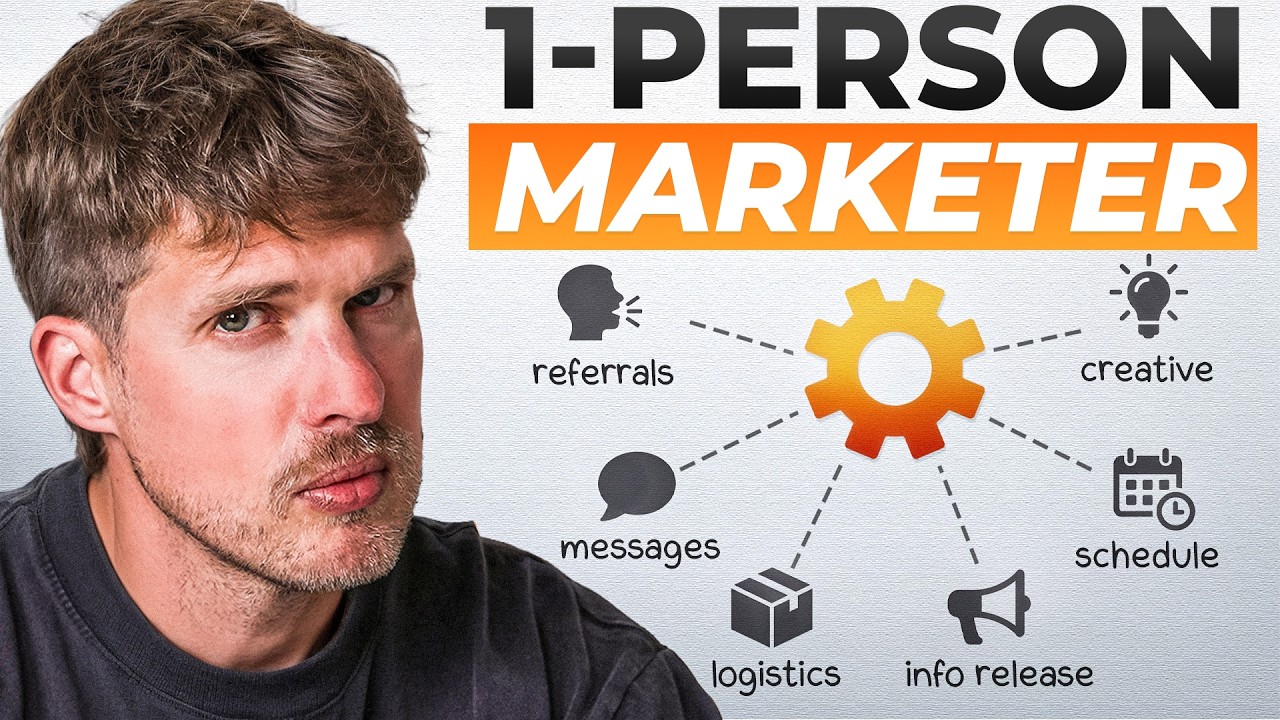
The core framework is a one-person marketing machine operating across six domains in a structured 40-50 hour week: (1) Word-of-mouth/referral engineering (product virality, billboard effects, affiliate/referral incentives before any paid marketing); (2) Monthly message planning (value props, trending angles like peptides/festivals/trade shows, mining customer support and competitor objections); (3) Eight hours/week on new creative (ideating ads, recruiting UGC creators via Minisocial/Meta Creator Manager/Tribe, briefing with frameworks from Video Database/Motion/Social Growth Engineer, tracking deliverables); (4) Four hours/week on performance marketing (loading creative into Meta/Google/TikTok/YouTube ads, analytics, learning—no excuses, media buying is now commoditized and accessible via platform courses); (5) Four hours/week on funnel/landing pages/lead forms/abandoned cart flows; (6) Four hours/week on email/CRM (broadcasts, automation, personas, sales collateral/templates); (7) Eight hours/week on influencer outreach, contracts (AI-assisted), scheduling, tracking, deliverables; (8) Eight hours/week on logistics/meetings/follow-ups; (9) Four hours/week on organic social content (lowest priority, for testing/validation only). Total: 44 hours, leaving room for scaling or personal brand work.
The speaker emphasizes tactical hygiene: performance marketing is beneath no one (Facebook/Google have free certification courses; two 2-hour blocks/week max in ads manager is sufficient); AI should be used strategically for copy/collateral (he partnered with HubSpot on a free guide teaching brand voice prompts in Claude/ChatGPT using personas and copywriting frameworks like direct response, not generic paste-and-ask workflows); organic social is deprioritized because it doesn't scale revenue compared to paid/email/influencer; and the entire system depends on message iteration (monthly review of customer support questions, social comments, competition, objections) feeding into creative briefs, landing pages, and sales templates. He warns against excuse content (anti-optimization trends that spike algorithmically every summer but undermine actual productivity) and stresses Q4 planning starts in summer (Black Friday/Cyber Monday, product ordering, campaign design must be locked by September or you're too late).
The speaker's authority comes from running marketing solo for a multimillion-dollar women's wear brand for 6-7 years in 'a few very deliberate hours a week,' being first marketing hire at multiple companies, and now consulting on lean marketing orgs at conferences. He positions this as a blueprint for founders, solo operators, and marketing hires at lean startups, with a follow-up video planned on scaling teams (creative specialist + performance/funnel specialist + influencer specialist = 3-person core). The implicit narrative is that legacy companies are drowning in process debt, new entrants are hyper-efficient, and individual operators who master this system can command disproportionate leverage—but only if they act before saturation and commoditization render the playbook table stakes.
Key Takeaways
- Claim: We are in the final summer window to lock in one-person marketing competency before permanent saturation and commoditization close the opportunity. | Evidence: Post-COVID relaxation has become a 5-year habit (2022-2026), AI-driven layoffs are cutting 18-20% of workforces (justified by efficiency narratives but actually right-sizing bloated processes), ultra-lean teams are displacing legacy brands with process debt, AI-generated personal brand content has flooded LinkedIn/Instagram with baseline noise that doesn't break out, and Q4 planning starts in summer (if you wait until end-of-September you're too late for Black Friday/Cyber Monday). | Caveat: The speaker provides no quantitative evidence for the 'last summer' claim beyond anecdotal observation of trends and his own consulting conversations. The timeline is based on pattern recognition, not data. He also acknowledges 'depending on whose life you lead, what you want out of life, you do whatever you like'—so this urgency is conditional on wanting to compete at the top tier. | Implication: If Ken is building or advising marketing systems, summer 2026 is the forcing function to audit capability gaps, hire or train operators in this framework, and front-load Q4 planning. If he's building AI tools for marketers, this window is when adoption happens before commoditization. If he's investing, companies with lean marketing orgs executing this playbook will outperform bloated incumbents with process debt. | Timestamp: 00:00-05:30
- Claim: Word-of-mouth and referral engineering must precede all other marketing—product virality, billboard effects, content cycle placement, and affiliate/referral incentives are the highest-ROI, lowest-CAC channel. | Evidence: Examples: Zoom has inherent virality (every use forces another user), clothing/logos/websites are billboard products (visible to others who might ask), cosmetics fit 'get ready with me' content cycles, cool packaging/matcha drinks/plumbing vans increase content cycle likelihood. Tools: Social Snowball for checkout affiliate offers (Groon's grew on this), asking for referrals at project completion + quarterly follow-ups + gifts for services businesses. | Caveat: The speaker assumes products can be engineered for virality, which is easier for certain categories (SaaS, apparel, local businesses with visual appeal) than others (B2B services, industrial products). He doesn't address how to retrofit virality into products that inherently lack it or what to do when referral incentives cannibalize margin. | Implication: Ken should prioritize virality mechanics in product design (for his own ventures) and investment due diligence (does the product have billboard effects, forced sharing, or content cycle hooks?). For AI systems, building referral/affiliate tooling directly into product workflows (not as afterthought) could be a wedge. For GTM, start with referral engineering before paid channels. | Timestamp: 07:45-10:20
- Claim: Monthly message planning—reviewing value props, trending angles, customer support questions, social comments, and competition—is the strategic foundation that feeds all creative, landing pages, and sales collateral. | Evidence: Examples: Cody from Allegiant Gym noticed gym members asking about peptides/GLP-1s, so they introduced messaging about professional guidance for those experimenting with new fitness tools (generated customer acquisition); the speaker's women's wear brand has separate festival marketing (Coachella, Stagecoach, EDC) that 'murders it'; electronics brands should message around trade shows, summer planning, back-to-school, end-of-year budgets. Tools: Perplexity for aggregating customer support/social/competition data. | Caveat: The speaker doesn't specify how to prioritize which trending messages to test, how many tests to run simultaneously, or how to measure message efficacy beyond ad performance (which comes later in the funnel). He assumes the operator has intuition for what's trending, which may not be true for new entrants or niche categories. | Implication: Ken should treat message planning as a monthly operating rhythm, not ad-hoc. For AI tools, automating message extraction from customer support tickets, social comments, and competitor analysis (beyond just aggregation) could save the 1-2 hours/month this takes. For investing, ask founders: what's your monthly message review process? If they don't have one, it's a red flag. | Timestamp: 10:20-13:00
- Claim: Performance marketing (Meta/Google/TikTok/YouTube ads) is commoditized, accessible via free platform courses, and should take no more than 4 hours/week (two 2-hour blocks) to load creative, review analytics, and learn—anything more is wasted time. | Evidence: Facebook and Google both offer free certification courses teaching campaign setup. The speaker says media buying is 'radically easy' and 'beneath no one'—every operator should do it themselves, no agency or specialist needed. He personally runs ads for a multimillion-dollar brand in a few hours/week. Recommended starting point: Meta ads, supplement with Google, add TikTok for lifestyle/physical products, add YouTube for services B2B. | Caveat: The speaker assumes the operator has baseline digital literacy and can follow platform courses, which may not be true for traditional business owners or older executives. He also doesn't address budget minimums, testing velocity requirements, or what to do when performance plateaus. 'Radically easy' may be true for simple e-commerce funnels but less so for complex B2B or multi-product catalogs. | Implication: Ken should skeptically evaluate any marketing hire or agency that positions media buying as specialized/complex—it's a commodity skill now. For AI systems, automating creative loading and analytics summaries (not just dashboards) could compress this 4-hour block further. For founders, if you're spending >4 hours/week in ads manager, you're either over-optimizing or lack creative iteration (the real bottleneck). | Timestamp: 17:00-19:30
- Claim: AI should be used strategically for copy/collateral via brand voice prompts in Claude/ChatGPT using personas and copywriting frameworks (direct response, etc.), not generic paste-and-ask workflows, to avoid sounding like the flood of mid-baseline AI content on LinkedIn/Instagram. | Evidence: The speaker partnered with HubSpot on a free guide 'Teach AI Your Brand Voice' with a complete system prompt template for setting up Claude/ChatGPT as in-house strategist/copywriter. It includes dialing in voice based on customer experience, providing copywriting frameworks from established marketers, testing voices/styles, and review/deployment tips to 'not look foolish.' He warns that the last 60 days saw a flood of AI creators that 'all sound alike, all the content looks relatively the same, everything on LinkedIn sounds the same' and 'performs at this mid baseline standard where it doesn't ever break out.' | Caveat: The speaker doesn't quantify how much better strategic AI usage performs vs. generic prompts, nor does he address how to maintain differentiation once everyone adopts similar frameworks. He also doesn't cover when AI copy should be avoided entirely (e.g., founder/authentic voice contexts). The reliance on personas assumes you've correctly mapped your customer base, which many businesses haven't. | Implication: Ken should download the HubSpot guide and audit how his own ventures/portfolio companies are using AI for copy—if they're using generic prompts, they're bleeding differentiation. For AI tooling, building persona-aware, framework-driven copy systems (not just LLM wrappers) could be a wedge. For personal brand, avoid AI-generated content unless it's heavily customized or risk becoming mid-baseline noise. | Timestamp: 14:00-16:00
- Claim: Creative iteration (8 hours/week on ideation, recruiting UGC creators, briefing, tracking deliverables) is the bottleneck, not media buying—scale comes from testing more creative, not optimizing existing ads. | Evidence: The speaker allocates 8 hours/week (a full day) to creative vs. 4 hours/week to performance marketing. He emphasizes recruiting designers from Dribbble/Behance, UGC creators from Minisocial (packs of UGC), Meta Creator Manager, Social Snowball, Tribe (Instagram), and ad account percentage deals. Ideas come from Video Database (maintained by speaker + Cut30 team), Motion (for SaaS), Social Growth Engineer (for SaaS), and a weekly content review newsletter. The flow is: ideate → recruit → brief → follow up → track in spreadsheet/Notion. | Caveat: The speaker assumes access to budget for paying creators and designers, which early-stage or bootstrapped businesses may not have. He also doesn't address quality control or how to identify which creators will perform before spending. The 8-hour weekly allocation may be insufficient if testing velocity needs to be higher (e.g., 10+ new creatives/week for fast-scaling brands). | Implication: Ken should prioritize creative iteration velocity over media buying sophistication when evaluating marketing orgs or hiring. For AI systems, tools that automate briefing, track deliverables, or match creative concepts to likely-performant creators could compress this 8-hour block. For investing, ask: how many new creatives are you testing per week? If it's <5, they're probably bottlenecked on creative, not budget. | Timestamp: 15:00-17:00
- Claim: Influencer/creator outreach (8 hours/week on outreach, contracts, scheduling, tracking, deliverables) should be treated like the creative recruitment flow—use AI for contract templates, track in simple docs, prioritize speed over perfection. | Evidence: The speaker allocates a full day (8 hours) to influencer work, structured as: outreach → contracts (AI-assisted, no excuses—'Just have AI work through a bunch of this for you. And as you get bigger and more legit and have resources on legal, you build templates out') → scheduling → tracking → deliverables. He positions this as similar to the creative flow, with external people being put on ad accounts for performance deals or flat fees. | Caveat: The speaker doesn't address how to identify high-ROI influencers, negotiate rates, or handle underperformance. He assumes AI can handle contract generation safely, which may expose businesses to legal risk if prompts aren't vetted by counsel. He also doesn't distinguish between micro-influencers (more scalable) vs. macro (more expensive, less controllable). | Implication: Ken should treat influencer as a scalable channel (not one-off celebrity deals) and look for operators who can run it systematically at 8 hours/week. For AI systems, contract generation + tracking/deliverable automation could be valuable (legal template libraries + workflow tools). For investing, ask: do you have a repeatable influencer process or is it ad-hoc? Ad-hoc = inefficient. | Timestamp: 22:00-24:00
- Claim: Organic social (Instagram, LinkedIn, YouTube, TikTok) is the lowest priority and should take only 4 hours/week for testing/validation, not revenue scale—paid, email, and influencer are the actual growth levers. | Evidence: The speaker allocates the final 4 hours of a 44-hour week to organic social, saying 'I've not even touched organic social on here because it doesn't matter. You want to scale. You want to focus on the things you need to scale first.' He positions it as useful for 'testing and yapping or putting together carousels for a few videos, et cetera, or filming someone else on the team if you have a team, but actually getting more content out on organic to help validate a bunch of these ideas.' | Caveat: This deprioritization assumes the business already has paid/email/influencer infrastructure and budget, which early-stage businesses may not. Organic social can be a low-cost wedge for bootstrapped businesses or personal brands building authority (the speaker himself built his audience organically before monetizing). The advice is more relevant for established businesses optimizing for revenue than zero-to-one brand building. | Implication: Ken should not over-invest in organic social for revenue-stage businesses unless it's serving a specific strategic purpose (founder brand, recruiting, community). For early-stage/bootstrapped, organic may still be necessary. For AI tools, deprioritizing organic means focusing on paid/email/influencer automation, not social scheduling/posting tools. For personal brand, organic is still necessary for Ken's own positioning. | Timestamp: 24:30-26:00
Detailed Brief
The 'Last Summer' Thesis: Post-COVID Habits, AI Layoffs, and the Chiller-Hitter Bifurcation
- Claims: Five years of post-COVID 'Euro summer' relaxation (2022-2026) have hardened into cultural habits, not temporary reactions.; AI-driven layoffs (18-20% workforce cuts) are justified by efficiency narratives but actually about right-sizing bloated processes and management layers from the overspend era.; Ultra-lean startups with no process/technical debt are displacing legacy brands that built decent-sized teams in the 2020-2024 era.; AI-generated personal brand content has flooded LinkedIn/Instagram with baseline noise that performs at mid-level but doesn't break out, closing the window for new entrants.; There is a widening gap between 'chillers' (who check out, embrace excuse content, take summers off) and 'hitters' (who lock in skills, embrace efficiency, drive results and money).; Summer 2026 is the last window to lock in competency before saturation makes it radically harder to compete.
- Evidence: Every summer (mid-May to mid-June) content performance tanks because people think about vacations, offices do summer Fridays, desire to work drops—this creates algorithmic incentive for 'excuse content' (anti-optimization, work-life balance messaging) that gets massive spikes.; Last summer (2025) was 'one of the most unproductive summers of all time for almost everyone I knew'—Euro summer in full effect, offices closing early, people embracing life.; Example: Stephen Bartlett's 'glass of wine throws me off for three days' clip sparked anti-optimization trend that goes viral every summer, amplified by 'media elite influencers, New York influencers, people with substacks' who don't believe it but post it because it works algorithmically.; AI companies (Dario, etc.) are on TV saying white-collar job class will be disintegrated by AI, giving CEOs excuse to right-size without admitting it's about cultural/process inefficiency, not actual AI value uplift.; New generation of brands (last 4-5 years) discovered Alibaba sourcing, Meta ads, direct-to-consumer—built decent teams, now being displaced by ultra-lean teams that are 'relentlessly focused on the metrics that determine success.'; HR is using AI to sort resumes, making it 'ultra competitive to get whatever jobs there are'—creators who built personal brands on LinkedIn/Instagram in last few years are 'reaping those benefits right now because you are able to circumvent those lines,' but new entrants face saturation.
- Caveats: No quantitative data provided for '18-20% layoffs' claim or 'one of the most unproductive summers' assertion—based on speaker's anecdotal consulting/conference conversations.; The 'last summer' timeline is pattern recognition, not predictive modeling—could be wrong if macro conditions shift (recession, policy changes, etc.).; Speaker acknowledges 'depending on whose life you lead, what you want out of life, you do whatever you like'—urgency is conditional on wanting top-tier competitive outcomes.; AI layoffs may actually deliver value at some companies (not addressed), and legacy brands with process debt may successfully retool (also not addressed).
- Implications: If Ken is building marketing systems or AI tools, this summer is the adoption window before commoditization—act now or miss the wave.; If Ken is advising portfolio companies, audit for process debt, bloated teams, and lack of efficiency focus—right-size before market forces them to.; If Ken is hiring or evaluating talent, prioritize 'hitters' who have locked in modern skills (performance marketing, AI-assisted workflows, creative iteration velocity) over résumé prestige.; If Ken is building personal brand, double down now before saturation makes breakout impossible—or accept that organic social is lower ROI than paid/email/influencer for revenue businesses.; Q4 planning (Black Friday/Cyber Monday, product ordering, campaigns) must start in summer—waiting until September is too late.
Word-of-Mouth and Referral Engineering (Pre-Marketing Foundation)
- Claims: Word-of-mouth and referral are the highest-ROI, lowest-CAC channel and must be engineered into the product/service before paid marketing.; Products can have inherent virality (Zoom—every use forces another user), billboard effects (clothing, logos, websites—visible to others who might ask), content cycle placement (cosmetics in 'get ready with me,' cool packaging, matcha drinks, plumbing vans), or user obsession (Claude—users love talking about efficiency even when not actually efficient).; Logistics layer: affiliate programs (Social Snowball for e-commerce checkout offers, percentage deals for creators—Groon's grew on this) and referral incentives (services businesses: free month for referrals, asking at project completion, quarterly follow-ups, sending gifts).
- Evidence: Zoom example: inherent virality because every meeting forces another user to adopt.; Clothing/logo/website example: billboard products where people are asked 'where did you get that?' and might refer.; Cosmetics example: fit into 'get ready with me' content cycles on TikTok/Instagram.; Local business example: cool packaging, unique matcha drink, wild-looking plumbing van increase likelihood of being photographed and shared.; Claude example: users obsess about efficiency and talk about it even when not actually efficient.; Social Snowball: tool for e-commerce checkout affiliate offers—customers get percentage back for promoting, compounds sales (Groon's case study).; Services example: ask for referrals at project completion when client is happy, follow up quarterly, send gifts when referrals come through.
- Caveats: Assumes products can be engineered for virality—easier for SaaS, apparel, local businesses with visual appeal than B2B services or industrial products.; Doesn't address how to retrofit virality into products that inherently lack it (e.g., enterprise software with no user-facing component).; Affiliate/referral incentives may cannibalize margin or attract low-quality customers if not structured carefully.; No mention of how to measure referral attribution or optimize referral flows beyond 'set it up and ask.'
- Implications: Ken should prioritize virality mechanics in product design (forced sharing, billboard effects, content cycle hooks) for his own ventures and as investment due diligence criteria.; For AI systems, building referral/affiliate tooling directly into product workflows (not as afterthought) could be a wedge.; For GTM strategy, start with referral engineering before paid channels—if you can't get organic referrals, paid won't save you.; For services businesses, implement referral ask at project completion + quarterly follow-ups as standard operating procedure.
Monthly Message Planning (Strategic Foundation)
- Claims: Monthly message planning—reviewing value props (better/faster/cheaper for services; stylish/durable/fit/cultural for products), trending angles (peptides/GLP-1s, festivals, trade shows, seasonal planning), customer support questions, social comments, and competition—is the strategic foundation that feeds all creative, landing pages, and sales collateral.; Messages should be tested and iterated monthly, not set-and-forget—trending messages change with seasons, news cycles, customer conversations.; Tools: Perplexity for aggregating customer support/social/competition data; direct review of support tickets, comments, sales objections.
- Evidence: Cody from Allegiant Gym (HubSpot video case study): noticed gym members asking about peptides/GLP-1s, introduced messaging about professional guidance for those experimenting with new fitness tools, generated customer acquisition.; Speaker's women's wear brand: separate festival marketing (Coachella, Stagecoach, EDC) that 'murders it'—trending seasonal angle.; Electronics example: message around trade shows, summer planning, back-to-school, end-of-year budgets.; Services example: better/faster/cheaper framework for value props.; Product example: stylish to niche, lasts longer, fits body type, prepares for cultural event.
- Caveats: Doesn't specify how to prioritize which messages to test, how many tests to run simultaneously, or how to measure message efficacy beyond ad performance.; Assumes operator has intuition for what's trending—may not be true for new entrants or niche categories.; No mention of how to handle conflicting messages or avoid diluting brand positioning with too many angles.
- Implications: Ken should establish monthly message review as operating rhythm (not ad-hoc) for his own ventures and portfolio companies—if they don't have this, it's a red flag.; For AI tools, automating message extraction from support tickets, social comments, competitor analysis (beyond aggregation) could save 1-2 hours/month and surface non-obvious patterns.; For investing, ask founders: what's your monthly message review process? What trending angles are you testing this quarter? If they can't answer, they're not operating strategically.
Weekly Operating System (44-Hour Breakdown)
- Claims: One-person marketing machine operates in 44 hours/week (assumes 40-hour baseline + 4 flex): 8 hours new creative (ideation, recruiting, briefing, tracking), 4 hours performance marketing (loading creative, analytics, learning), 4 hours funnel/landing pages (lead forms, abandoned cart, testing), 4 hours email/CRM (broadcasts, automation, personas, sales collateral), 8 hours influencer (outreach, contracts, scheduling, tracking, deliverables), 8 hours logistics (meetings, follow-ups, emails), 4 hours organic social (testing/validation only).; Creative iteration is the bottleneck, not media buying—scale comes from testing more creative, not optimizing existing ads.; Performance marketing is commoditized—free platform courses (Facebook, Google), 4 hours/week max (two 2-hour blocks), anything more is wasted time.; Organic social is lowest priority for revenue scale—paid/email/influencer are actual growth levers.; When scaling to a team: one person specializes on creative, one on performance/funnel/email, one on influencer—this is the 3-person core.
- Evidence: 8 hours/week creative: ideate (Video Database, Motion, Social Growth Engineer, weekly newsletter from speaker/Cut30), recruit (Dribbble, Behance for designers; Minisocial, Meta Creator Manager, Social Snowball, Tribe for UGC), brief, follow up, track in spreadsheet/Notion.; 4 hours/week performance: load creative into Meta/Google/TikTok (lifestyle/physical products)/YouTube (services B2B), review analytics, learn. Facebook/Google offer free certification courses. Speaker personally runs ads for multimillion-dollar brand in 'a few very deliberate hours a week.'; 4 hours/week funnel: landing pages (where people land from ads), lead forms (how many fields?), email sequences after conversion, abandoned cart flows.; 4 hours/week email/CRM: broadcasts to list, segmenting list, automation flows, personas, PDFs/testimonials/collateral for sales team, templates for sales enablement.; 8 hours/week influencer: outreach, contracts (AI-assisted—'Just have AI work through a bunch of this for you'), scheduling, tracking deliverables, ad account percentage deals.; 8 hours/week logistics: meetings (max 1 hour/day, otherwise it's a problem), follow-ups, emails, random tasks.; 4 hours/week organic social: 'I've not even touched organic social on here because it doesn't matter. You want to scale. You want to focus on the things you need to scale first.' Use for testing/validation, filming team members, carousels.
- Caveats: Assumes 40-50 hour work week—speaker says he's worked 60-hour weeks for 15 years, so this may be baseline, not realistic for many operators.; Assumes operator has baseline digital literacy, budget for creators/designers, and access to platform courses—may not be true for traditional business owners or early-stage bootstrapped founders.; Organic social deprioritization assumes business already has paid/email/influencer infrastructure—early-stage may still need organic for low-cost wedge.; Creative iteration 8-hour allocation may be insufficient if testing velocity needs to be higher (10+ creatives/week for fast-scaling brands).; No mention of customer support, product development, finance, or other functions—this is purely marketing operating system.
- Implications: Ken should use this 44-hour breakdown as audit framework for evaluating marketing hires, agencies, or portfolio companies—if they're spending >4 hours/week in ads manager, they're over-optimizing; if <8 hours/week on creative, they're under-invested in iteration.; For AI systems, compress creative briefing/tracking (8 hours), contract generation (part of 8-hour influencer block), and analytics summaries (part of 4-hour performance block) to create leverage.; For personal brand, organic social is still necessary for Ken's positioning—but for revenue businesses he advises, paid/email/influencer should be prioritized.; For hiring, look for operators who can execute this full system vs. specialists who only do one function (unless scaling to 3-person team).
AI for Copy/Collateral (Strategic Usage vs. Generic Prompts)
- Claims: AI should be used strategically for copy/collateral via brand voice prompts in Claude/ChatGPT using personas and copywriting frameworks (direct response, etc.), not generic paste-and-ask workflows.; Generic AI usage creates mid-baseline content that sounds alike, performs at baseline, doesn't break out—floods LinkedIn/Instagram with noise.; Strategic AI usage: dial in voice based on customer experience, provide copywriting frameworks from established marketers, test voices/styles, review/deploy with process to 'not look foolish.'; Speaker partnered with HubSpot on free guide 'Teach AI Your Brand Voice' with complete system prompt template for Claude/ChatGPT as in-house strategist/copywriter—covers personas, frameworks, review tips, deployment.
- Evidence: Last 60 days: 'gurus who preach content creation have switched everything to a Claude will solve your problems for you approach, write everything with AI'—creates 'flood now of these AI creators that all sound alike, all the content looks relatively the same, everything on LinkedIn sounds the same. And it performs at this mid baseline standard where it doesn't ever break out, but it fills up, it clutters everything with noise.'; HubSpot guide: 'Teach AI Your Brand Voice'—complete system prompt for Claude/ChatGPT, includes dialing in voice based on customer experience using personas, providing LLMs with copywriting frameworks from established marketers (direct response), tips for reviewing and deploying without looking foolish, Brand Voice project template as second brain for marketing team.
- Caveats: Doesn't quantify how much better strategic AI usage performs vs. generic prompts—no A/B test data, benchmarks, or case studies provided.; Doesn't address how to maintain differentiation once everyone adopts similar frameworks—if everyone uses direct response frameworks, does it still differentiate?; Doesn't cover when AI copy should be avoided entirely (e.g., founder/authentic voice contexts, high-stakes sales conversations).; Reliance on personas assumes you've correctly mapped customer base—many businesses haven't, which means AI will amplify bad assumptions.
- Implications: Ken should download HubSpot guide and audit how his own ventures/portfolio companies use AI for copy—if generic prompts, they're bleeding differentiation and sounding like everyone else.; For AI tooling, building persona-aware, framework-driven copy systems (not just LLM wrappers) could be wedge—most tools are generic paste-and-ask.; For personal brand, avoid AI-generated content unless heavily customized—risk becoming mid-baseline noise that doesn't break out.; For operators, invest time in setting up strategic AI system (personas, frameworks, review process) upfront vs. using generic ChatGPT for every task—upfront cost, compounding returns.
Notable Concepts & Terms
- Chillers vs. Hitters: The speaker's framing for the widening bifurcation between people who embrace excuse content, check out summers, and deprioritize optimization ('chillers') vs. those who lock in skills, embrace efficiency, and drive measurable results ('hitters'). Matters because the speaker argues this gap is becoming permanent, not temporary, and determines who captures value in the next era.
- Excuse Content: Content that spikes algorithmically every summer (anti-optimization, work-life balance, 'don't take things too seriously') because people's desire to work drops and social platforms reward what performs. Matters because it's a psyop that makes people feel justified in checking out, but the speaker argues this summer is uniquely bad timing to do so given AI/lean team displacement.
- Process Debt / Technical Debt: Legacy companies' burden of antiquated systems, processes, management layers, and cultural expectations from the overspend era (2020-2024) that make them execute less efficiently than new entrants. Matters because it's the structural disadvantage that ultra-lean teams exploit to displace incumbents, and a key investment/operational diligence criterion.
- Billboard Product / Content Cycle Placement: Products that are visible to others (clothing, logos, websites, cool packaging, unique drinks, wild-looking vans) and thus generate word-of-mouth or get photographed/shared in social content cycles ('get ready with me,' festival photos, etc.). Matters because it's a pre-marketing virality lever that compounds customer acquisition without paid spend.
- Creative Iteration Bottleneck: The speaker's argument that scale in performance marketing comes from testing more creative (videos, statics, UGC), not optimizing existing ads or spending more on media buying. Allocates 8 hours/week to creative ideation/recruitment/briefing/tracking vs. 4 hours/week to performance. Matters because most marketers over-index on media buying and under-invest in creative velocity.
- Social Snowball / Minisocial / Meta Creator Manager / Tribe: Tools for scaling affiliate/influencer/UGC recruitment: Social Snowball for e-commerce checkout affiliate offers; Minisocial for packs of UGC; Meta Creator Manager for outreach; Tribe for Instagram creator deals. Matters because they enable one-person teams to operationalize influencer/creator workflows that used to require agencies or full-time coordinators.
- Video Database / Motion / Social Growth Engineer: Resources for creative ideation: Video Database (maintained by speaker + Cut30 team for ad concepts), Motion (SaaS-focused creative ideas), Social Growth Engineer (SaaS-focused creative/growth tactics). Matters because they solve the 'what should I test?' problem and compress ideation time.
- One-Person Marketing Machine / 44-Hour Operating System: The speaker's framework for a solo operator executing full-stack marketing (word-of-mouth engineering, monthly message planning, 8hr creative, 4hr performance, 4hr funnel, 4hr email, 8hr influencer, 8hr logistics, 4hr organic) in a structured 44-hour week. Matters because it's a hiring/evaluation rubric for lean orgs and a blueprint for solo founders or first marketing hires.
Operator Notes / Why Ken Should Care
- For AI ops/systems: Automate creative briefing/tracking (8hr/week block), contract generation (influencer 8hr block), analytics summaries (performance 4hr block), message extraction from support/social/competition (monthly planning)—these are high-leverage compression opportunities that don't yet have great tooling.
- For GTM/marketing: Use 44-hour breakdown as audit framework for portfolio companies—if spending >4hr/week in ads manager, over-optimizing; if <8hr/week on creative, under-invested in iteration; if no monthly message review, not operating strategically; if organic social is prioritized over paid/email/influencer, misallocating resources for revenue scale.
- For investing: Diligence criteria—does the product have virality/billboard/content cycle hooks (pre-marketing leverage)? Does the team have process debt or ultra-lean efficiency? Do they have monthly message review process? Are they testing 5+ new creatives/week? If not, they're structurally disadvantaged vs. competitors who do.
- For personal brand: Speaker's implicit warning—organic social window is closing due to AI saturation, but still necessary for Ken's own positioning as thought leader. Differentiate by avoiding generic AI prompts, using strategic frameworks, and not sounding like baseline noise. Double down now or accept lower ROI later.
- For workflow: If Ken is advising or hiring marketers, look for operators who can execute this full system vs. specialists—or scale to 3-person team (creative specialist, performance/funnel/email specialist, influencer specialist). Use HubSpot AI copy guide to set up strategic LLM system, not generic ChatGPT.
- For summer 2026 specifically: Front-load Q4 planning now (Black Friday/Cyber Monday, product ordering, campaign design)—waiting until September is too late. Use summer to lock in skills (performance marketing via platform courses, AI-assisted workflows, creative iteration velocity) before saturation makes it table stakes.
Watch Map
- 00:00-05:30: Intro: 'Last summer' thesis—post-COVID habits, excuse content psyop, AI layoffs as right-sizing cover, chiller-hitter bifurcation, urgency framing
- 05:30-07:45: Context: overspend era, process/technical debt, ultra-lean teams displacing legacy brands, flood of displaced workers, AI saturation on LinkedIn/Instagram
- 07:45-10:20: Whiteboard intro + word-of-mouth/referral engineering (virality, billboard, content cycle, affiliate, referral incentives)
- 10:20-13:00: Monthly message planning (value props, trending angles, customer support/social/competition review, info release mechanisms)
- 13:00-14:00: Transition to AI for copy/collateral—HubSpot partnership plug
- 14:00-16:00: HubSpot ad read: 'Teach AI Your Brand Voice' guide—personas, copywriting frameworks, system prompt template, avoiding mid-baseline AI noise
- 16:00-17:00: Claude operator legend—one person ran majority of Claude's performance marketing at scale, validates one-person effectiveness
- 17:00-19:30: Weekly creative block (8hr/week)—ideation, recruiting (Minisocial, Meta Creator Manager, Social Snowball, Tribe), briefing (Video Database, Motion, Social Growth Engineer), tracking
- 19:30-21:00: Weekly performance block (4hr/week)—loading creative, analytics, learning; media buying commoditized (Facebook/Google courses); Meta/Google/TikTok/YouTube prioritization
- 21:00-22:00: Weekly funnel block (4hr/week)—landing pages, lead forms, email sequences, abandoned cart flows
- 22:00-23:00: Weekly email/CRM block (4hr/week)—broadcasts, automation, personas, sales collateral/templates
- 23:00-24:00: Weekly influencer block (8hr/week)—outreach, contracts (AI-assisted), scheduling, tracking, deliverables
- 24:00-24:30: Weekly logistics block (8hr/week)—meetings (max 1hr/day), follow-ups, emails, random tasks
- 24:30-26:00: Weekly organic social block (4hr/week)—lowest priority, testing/validation only, deprioritized for revenue scale
- 26:00-27:00: Total: 44hr/week breakdown, scaling to 3-person team (creative, performance/funnel/email, influencer specialists)
- 27:00-28:00: Opportunities for operators/agencies—creative strategy for brands/personal brands, this framework as service offering
- 28:00-end: Wrap: links to HubSpot guide, creator economy guide, community call Q&A; request for whiteboard video feedback
Source/Metadata
- Title: How to Be a 1-Person Marketing Machine in 2026
- Transcript words: 8291
- Duration seconds: 1484
- Timestamp note: Timestamps estimated from transcript flow and video duration (1484 seconds ≈ 24:44); no explicit chapter markers in transcript, but clear section breaks identifiable.
Transcript
Today we're going to talk about how this is potentially the last summer to lock in the skills and approach you have to not be caught in the creative underclass. If you want to be a true one-person marketing army for your business or another business, how exactly to do it. This is a bit of a different video for me. You usually don't hear me with any degree of fear in terms of how I talk about branding, marketing, social media. But we are in a pretty strange time currently. But also I want to have you take tactical takeaways from this that are super useful. This will be the first time that we brought the whiteboard out. We've got the overhead rig. When we actually map out tactics for you here today, we're going to do this all on the whiteboard and give you an exact blueprint for efficiency in marketing, entrepreneurship, and creative work. Let's lock in. So first of all, you may have noticed online on social media, there is a trend happening right now. And a lot of it was sparked by Stephen Bartlett rather notoriously saying that if he had a glass of wine, because of how optimized he is, he would be thrown off for three days. And so a lot of creators and people hopped on this and mocked this, rightfully so, ridiculous statement. And it led to this big bend you've seen in relatively viral content about anti-optimization. While that podcast clip may have been the catalyst, this actually happens every single year. Around mid-May to mid-June, you will notice content starts to tank, especially if you make serious content, content with business value, content you're promoting your stuff, trying to make sales. LinkedIn, Instagram, even YouTube, numbers start to go down. And this is because it starts to get warm outside. People have Memorial Day. They start thinking about summer vacations. Some offices start summer Fridays. And the desire to work drops. But because of social media and the way algorithms work, this also becomes a pretty massive psyop. So you'll notice a lot of media elite influencers, New York influencers, people with substacks, people that pontificate a lot, immediately hopped on this trend. They started making videos about how optimization is killing us, how you should feel free to have a couple of drinks, don't take things too seriously. But they're not saying that because they believe it. They're saying it because it works in the social media algorithms. Every summer, if you make what we call excuse content, you get a massive spike. And so it makes sense that it all shifts to this. But then it makes you feel, you start getting these messages subconsciously in your feed constantly that, yes, I should take some time off. I do need more work-life balance, whatever it is. Which honestly is totally fine as a message for most people most of the time. But in my opinion, not particularly right now. So last summer was one of the most unproductive summers of all time for almost everyone I knew. Euro summer was in full effect. People were vacationing. Offices were closing early. People were really embracing life. And what was interesting about that, and I was talking about this at the conference I spoke at the other week in London, I was meeting a lot of friends of mine who have brands or work at brands, is about that summer productivity fall off. But what's interesting is this is going into year five of this. You basically had 2022, 23, 24, 25, and now 26. All post-COVID reaction. Where naturally, as people have been locked inside and frustrated with the world around them, they want to be outside more doing more things. But the first few years is a reaction. Five years is a habit. And the hard part about this is it now comes at this time of what we'll call AI job loss. Where brands are cutting 18% of their workforce, 9%, 10%, 20%. And they're using AI as the scapegoat. The CEOs of these AI companies have made that very easy. It is inescapable to not go on TV or read the news and see Dario or somebody basically saying that the white-collar job class is going to be disintegrated by AI. They are preaching that themselves, which is a bad communication strategy, at least to the consumer. But really what it's done is given these leaders an excuse to right-size their organizations. Everyone who says this is about cutting jobs through AI, it's not. Those organizations are not seeing that uplift in value. I can almost guarantee it. If you work inside a company that's adopting AI, you've not seen that increase in value. Sure, maybe there's this or that, but it's not 20% of your workforce. What they're doing is they've realized that culturally, over the last few years, a lot of these businesses have adopted processes, management layers, hiring practices, efficiency, and guidelines that's made them radically inefficient. And they are doing whatever excuse they can to right-size the ship while everyone else is doing it, which leads to a flood of people in the job market. And it's a flood of people that are all used to that kind of job who are expecting when they get a new job, it's going to be similar to their old one and the expectations. But those expectations are shifting. Because you've noticed, every time you see companies get disrupted by a new generation of companies, they have an efficiency. So for instance, when I started making content four or five years ago, all of this new wave of brands was coming about that had discovered that they could source products from overseas just as good as these bigger brands. And Alibaba enabled this, social media let them reach them directly, meta ads worked fine. They could literally, with a much smaller organization and less investment, create something on par to a major brand at a similar price point. And a whole generation of brands were created this way over these last few years. Now, a lot of those brands, to succeed, built out relatively decent-sized teams. And what you're seeing now is you're seeing these ultra-lean teams do the same thing. Some degree because of AI, but some degree also because people are relentlessly focused on the metrics that determine success. As you've seen a new generation of brands, products, services, etc., that are really lean teams that work very hard, but are very efficient in their work displacing those previous five years of brands. And this is because that overspend era is done. What entrepreneurs are realizing is that all these big bloated companies that have their technical and process debt. Now, a lot of those brands, to succeed, built out relatively decent-sized teams. And what you're seeing now is you're seeing these ultra-lean teams do the same thing. Some degree because of AI, but some degree also because people are relentlessly focused on the metrics that determine success. As you've seen a new generation of brands, products, services, etc., that are really lean teams that work very hard, but are very efficient in their work displacing those previous five years of brand. And this is because that overspend era is done. What entrepreneurs are realizing is that all these big bloated companies that have their technical and process debt. So what that means is that if you have been investing in all these systems you spend all this money on, but they're not as good as new systems, or you built out all these people in situations, but it's not as efficient as what a new company could do to start it, that is a debt that companies have to recover from. They are going to, every day, execute on these antiquated processes and technologies that are going to lead them to perform less efficiently. And for anyone new to succeed, they have to be against that. They are against this overspend era. And you multiply all this together. How many people are applying for jobs? How many of these new companies are now relentlessly focused on efficiency? And old companies are trying to right-size. And then this widening gap between the chillers and the hitters, people that put in a lot of work wherever they are, who know all these new skills that I'm going to talk about here, that have embraced whatever technology, that know how to be efficient and drive results and money inside wherever they work, whether that's a marketer, a creator, a salesperson, a creative engineer, whatever it is. And with now more and more AI being used by HR to sort through resumes, it's going to be ultra competitive to get whatever jobs there are. You've heard me talk a lot about over the last few years, how you can differentiate yourself by being a creator, establishing a personal brand on LinkedIn, on Instagram, etc. And if you've done that over the last few years, you're reaping those benefits right now because you are able to circumvent those lines. But if you're new and you're starting right now, you'll notice this in the last 60 days, a lot of the gurus who preach content creation have switched everything to a Claude will solve your problems for you approach, write everything with AI. And we've seen this flood now of these AI creators that all sound alike, all the content looks relatively the same, everything on LinkedIn sounds the same. And it performs at this mid baseline standard where it doesn't ever break out, but it fills up, it clutters everything with noise. And you'll see, I have a pretty strong reaction. It's probably a separate video I have about how I don't think you should be using a lot of those tools for your personal brand. But it now closes the window. We've talked about how long do we have before personal brand matters or not. And now I think we are hitting this top of the bell curve, right? Where you're getting into that arc. We're entering into a timeline of where you still have efficacy to start. And if you started, how you cement yourself as someone who belongs versus falling off. And all of that plays into this summer because this becomes one of the last time periods to make it into content creation before saturation. If you are already doing that to gas pedal it before that saturation to make sure you don't fall off in this mid-level rises. To not fall into the back end of the technology and processes making these companies win right now. And then if you do have a brand or you're trying to hit your numbers for this year, Q4 starts now. If you want to execute your T5, your Black Friday to Cyber Monday timing, if you want to order the right products, have everything in, have your promotions there, have your campaigns laid out, if you want to nail the rest of the year, that is a summer exercise. If you start it end of September when everyone's back in the office and fully working in the right way, you're too late. And I want to put that out there because to me that signals that this is one of the last summers to lock in before this becomes really, really, really, really hard. And no one wants to hear that. They want the excuse content, right? You want to know you can check out. And that's fine depending on whose life you lead, what you want out of life, you do whatever you like. But if you want to lock in right now, I want to explain this one person marketing org that's such a popular concept. Break down an exact format of what you need to know and how you would need to operate to be effective in 2026. So to go through that, I'm going to bring the whiteboard out. We are going to talk through, this is any business. I know a lot of my videos focus on product businesses, but I'm going to talk about this from the lens of services businesses, B2B, software, product, any org. We're going to talk about establishing your product and process to be successful for word of mouth and referral. We're going to talk about messages, scaling information release, developing new creative, performance marketing, email and CRM, influencer, and structuring your week as a small org or single person to effectively execute on all this. Probably one of my favorite videos I've put together. I've done this a bunch, right? I still operate all the marketing at our women's wear clothing brand. On the side of all the other stuff I'm doing in a few very, very deliberate hours a week. I've done that now for six, seven years as that scaled into a multimillion dollar business. I've been the first marketing hire at a lot of companies. And then now when I go do these conversations that I have at conferences or come in with brands, a lot of it is around how do we structure our marketing org for the modern world. And if you guys like this video, I will follow up on one on how you scale a team. For now, we're going to focus on what does a lean operative look like? If you want to chat about any of this, the next community call is going to be linked below. We're going to do a workshopping live Q&A and I'll talk about some of my specific thoughts on what operators look like. I'm going to pull out the whiteboard. Let's get into it. All right, so let's talk about what does one person do in your business? Brands, a lot of it is around how do we structure our marketing org for the modern world. And if you guys like this video, I will follow up on one on how you scale a team. For now, we're going to focus on what does a lean operative look like? If you want to chat about any of this, the next community call is going to be linked below. We're going to do a workshopping live Q&A and I'll talk about some of my specific thoughts on what operators look like. I'm going to pull out the whiteboard. Let's get into it. All right, so let's talk about what does one person do in your business? And you might be that person or another business to be relentlessly effective at generating leads, sales, customers through marketing. So the first thing that matters most is word of mouth and referral. If you're already selling something, how do you optimize it to get the most out of your existing customers? Before we talk about any other channels, building with virality. So this starts before anything else happens. So there are a couple types of things that happen here that are worth understanding. First is when someone uses your product, they have to share it, like Zoom, for instance. It has an inherent virality because every time you use it, someone else is forced to use it. But the second thing is, is the person that uses it, is it a billboard for them? So for instance, that would be clothes. If you make their website, you make their logo. They're showing something off that they might be asked about that could be a referral scenario for them. So any billboard product is you absolutely need to build it in. And for a billboard on clothing, for instance, that can be as simple as whether or not you have logos visible and people care or not. If your user is excited enough to be able to share it, if they do share it, they have an incentive. Then there's just the user obsess about it, do they love it? So Claude's virality and growth, right? A lot succeeds because so many other people are interested in using Claude. The users talk about it. Even when they don't do anything efficient, they love to talk about how efficient they're being. Then is it in their content cycle? So for instance, with cosmetic products, are they doing get ready with me's? If you are a local shop or a cafe, people getting the matcha, then taking a photo of it. Now, how do you optimize for that, right? You're more likely to be in their content cycle with cooler looking packaging, that unique looking drink. If someone shows up to do your plumbing and it has the wild looking van, whatever it is, you're more likely to be inside the content cycle. So you got to think about where does your business live in this? Again, this is prep before we even get into what marketing looks like. And how do you engineer the best possible solution there? And you layer on logistics. So for product sales, software sales, what can you offer as an affiliate where you give them a reward or a percentage for promoting your products? You will see a lot of people do this at checkout. So they'll use something like Social Snowball to basically offer to customers in checkout and in the emails after checkout to help support their products and get percentages back. And businesses like Groon's grew a lot on top of this. And it's just worth having that set up from the beginning so that your sales were allowing other compound sales. Establishing a percentage in a basic program. And then for any services business, et cetera, where do you get referrals? Can you make that easy? Can you encourage it? Can you say, yeah, we're going to give you a free month of maintenance for any customer that comes over? What incentive do you have? And then where do you ask for it? And the biggest part for a lot of services businesses is to build them when you complete the project. And they're happy with it. Are you able to ask right then? Do you follow up once a quarter and ask for any referrals? Do you send them a gift when you do it? That is a process that the marketing person needs to build out almost immediately. Because if you are not doing that, you are missing your highest conversion level customer that does not have a big customer acquisition cost or CAC. So this is before anything. Now, when you actually get into monthly, what should you be doing every month as a marketing person? So the first thing I like to focus on is messages. So this is how are you communicating the value proposition of what you sell and is it changing? So first you have your value to your customer. So for instance, we talked about in my former offers video about creative work. Basically, any service businesses, you are either going to be better, you are going to be faster, or you are going to be cheaper. So it's thinking about where do you live inside that cycle? If you sell clothing, is it stylish to a particular niche? Does it last longer? Does it fit a certain body type? Is it preparing someone for a certain cultural event? What is the value you are giving them? What are new messages that you can test inside the cycle of your marketing? And you need to look at this every month because you'll start to notice trending messages work. So one note on this, if you've watched the video on HubSpot's channel that I do with Cody from Allegiant Gym, who's had some great success. We basically workshopped his funnel in a very similar position to this and he put ads in place about it. And he saw some start to actually get real customer acquisition going for his business. He had talked about how a lot of people coming to his gym were starting to ask questions about peptides and GLP-1s and they didn't know how to solve it. And we basically decided, hey, that's just worth introducing as a messaging angle. Our gym can help you from a professional level walk through the right workouts to do if you are experimenting with these new things in fitness. Excellent example of a trending value prop. Another one I mentioned, the women's wear brand that I'm a partner on and have worked on for years. Festival season murders it for us. We have a whole separate marketing and sections just around festival and dressing for festival. Coachella, Stagecoach, EDC, etc. So that is an example of a trending message. Same thing if you are in electronics and there was just a big trade show or release or people are planning summer or back to school or end of year budgets. What is trending? You need to think about those things happening this month and these messages are going to play into the rest of your marketing. So that monthly meeting, it can be you with a client. If you have a client, it can be you and your business just to brainstorm and your marketing team. Festival season murders it for us. We have a whole separate marketing and sections just around festival and dressing for festival. Coachella, Stagecoach, EDC, etc. So that is an example of a trending message. Same thing if you are in electronics and there was just a big trade show or release or people are planning summer or back to school or end of year budgets. What is trending? You need to think about those things happening this month and these messages are going to play into the rest of your marketing. So that monthly meeting can be you with a client. If you have a client, it can be you and your business just to brainstorm and your marketing team. And then you are going to make sure by reviewing customer support questions, social media comments, and competition. You can use tools like Perplexity to go through and aggregate some of this or you can just go down the lists and look at it. What has come up? There are objections inside the sales process. You can talk to the sales team, etc. These are now all messages. Now you have to deploy those messages. So the other part of this is you need from those messages to get into your info release mechanism. Because you are going to have a bunch of information and answers and ideas from this and you need to actually make a plan to release them. So this means adding more content to your website. Can you have articles, etc. that you go live on there? Email. Are you sending out emails to your customers? I would suggest sending more plain text stuff, whether that's from a founder or whatever it is. You can actually get into some of these topics. Use that in the sales process. Have template emails for salespeople if you're converting on a service or a high ticket thing. Reddit. If there are subreddits to talk about this, you have a Reddit for your company. That gets aggregated quite a bit by actual AI tools to answer questions. That's a useful one to go on. YouTube. Can you sit down and talk about common questions? That's another one that gets aggregated in AI. And then adding that information to your landing pages, which we'll get to in a second. But anyone, people go to actually view your product and buy it. Can you layer on these items to those either in part of the main or as a test? So this is that big monthly planning here. So we'll look at pre. Before you start doing any other marketing, you will look at your monthly gander. Now let's look at what an actual week looks like for a marketing operator. So I firmly believe that for most brands, there's a considerable upside in output for the amount of landing pages, articles, ad copy, SEO stuff for the blog, and sales collaterals for the sales team using AI to help them with the copy and scaling the copy. But they need to do it with a strategic framework versus just pasting the idea and asking for a version. So I partnered with HubSpot to put together a free guide. This is my guide with them. It's called Teach AI Your Brand Voice. It's a complete guide to building a copy machine in your brand voice in your favorite LLM. So inside it, we cover dialing in your voice based on your actual customer experience using personas because you want to make sure your copy is actually relevant. We have a whole segment on that. We talk about providing LLMs with copywriting frameworks. This is important. From established marketing copywriters and styles, things like direct response. It will improve your copy versus just saving you time and actually make it so it's built for marketing conversion. And you can test different voices and styles. And then tips and tricks for reviewing this and deploying this and not looking foolish. My favorite part is the Brand Voice project template. It's a complete system prompt that sets up Claude or ChatGPT within a project as your in-house strategist copywriter for this. You drop in your brand context, your personas, pick voice references, and it can write homepage copy, ads, emails, landing pages, scripts, collateral, and more. All in your brand voice ready for you to review with the process we have there and ship and take advantage of this framework I've outlined here. If you want to build a second brain for your marketing team that knows your brand voice, knows your personas, and can actually help with outperforming copy, it's an excellent free download for you and the first time I've collaborated with HubSpot on something like this. You can get it for free from the link below. And thank you so much to HubSpot for partnering on this video and working with me to put this together. I want to talk about the legend of the Claude operator for a second because there was a whole story going around how one person ran the majority of Claude's performance marketing, if not all of it, for a long time as the business scaled into billions. And people laughed at it, oh, they have an influencer team or they have agencies or whatever. But at the end of the day, there's a lot of truth to one really effective person monitoring this stuff, even at a big business and using some tools to help bring in data and generate ideas can go a massively long way. And that happens even at the highest level of companies. That's why it's worth walking through this video because you're going to start to see bosses say, well, I read the story about X or Y and you having a counter for that or you having a plan for that as a leader or a contributor or someone running a business is really important. So now that you have this monthly processes and now that you know how to engineer some of your copy to actually scale into that and get efficiency, how do you structure your week? So you want one day, I would say one day, whether you split that into two half days or you actually just dedicate a day to new creative. I'm going to put all this in terms of hours here. Let's say eight hours to be focused on new creative. So your focus here is on ideation, recruiting people to actually make that content or finding vendors, assigning that content and following up and making some of it yourself. You have to, and we'll talk about that in the timing here in a bit. But basically you want to for advertisements create new videos and statics. And to do that, you are going to want to get designers, which you can get off Dribbble or Behance. You want to get UGC or just creators who are going to be helping you to make some of those new videos at decent rates. And so you're going to be able to get those from places like Minisocial, where you can just pay for packs of UGC. You can use Meta Creator Manager for outreach. You can use Social Snowball. I will link my guide down below that I have about utilizing creators in the creator economy. For advertisements, you want to create new videos and statics. To do that, you are going to want to get designers, which you can get off Dribbble or Behance. You want to get UGC or creators who are going to be helping you make new videos at decent rates. You're going to be able to get those from places like Minisocial, where you can pay for packs of UGC. You can use Meta Creator Manager for outreach. You can use Social Snowball. I will link my guide down below that I have about utilizing creators in the creator economy. Tribe, where you can do it on Instagram. You can put stuff in the ad account on a percentage of ad spend. And you need ideas for them, which you can get from Video Database, which is the one that we maintain. Myself and the Cut30 guys focus on finding video information. And then quickly making briefs from that. You can use Motion. The Social Growth Engineer's website is amazing if you do SaaS. And I send out a content review newsletter with the Cut30 team almost every week that gives you a bunch of ideas in your inbox. Your job is to get these. To do this, you need to ideate, recruit, brief, and follow up. I will be spending eight hours a week doing this, assuming you have other responsibilities. As you begin scaling this team, this is likely just a job that does this. One day of your week is finding more people to get in this funnel. How do I assign the people that I have with new ideas? How do I make sure this is all tracked inside a doc? It could be as simple as a spreadsheet, Notion doc, whatever. So you're going to spend eight hours a week on new creative. And you are going to spend four hours a week in two two-hour blocks, or you could probably do this faster, on performance. You're going to load in performance creative. I want to note: performance marketing is beneath no one. Every single person should be running ads for their business. There's massive alpha and upside there. And media buying is commoditized. You do not need an agency. You do not need a specialist. It has become radically easy. If you are this one person doing this in your org, you should do it. Facebook has its own course teaching you how to set up these campaigns. It's very straightforward. Google ads is the same thing. They have a whole certification program. Start with that in your pre-prep if you don't know anything else. Spend those four hours a week learning that and setting it up before you even load in ads. But you should really just need two two-hour chunks at most to load in whatever new creative has been generated inside the creative process. These messages inform this creative that you then load in. And then running your analytics, checking what's working and making notes. So loading, analytics, learning. Do not spend more time in ads manager and those platforms than this. You are wasting time if you are spending more in there. Every business should be starting with Meta ads, supplementing that with Google ads. If you are a lifestyle business doing clothing or that kind of stuff, any physical product, you probably want to run TikTok in a similar way to what you're running on Meta. For services businesses, look to YouTube ads for additional scale. And I would be spending another four hours a week on your funnel related to this. That is your landing pages. Where are those people landing? If you're trying to figure out what to run to them, are you getting emails? Are those emails using lead forms? Are they using forms in there? How many rows are in the forms? What can you test to make sure you're getting that information? What emails do you send to people after that in the sales process? Your abandoned cart flow, things like that. So now you've eaten up two full days in new creative, loading in the performance, and helping improve the funnel from the creative. Matching the landing pages to your messages, stuff like that. I'd spend another four on more collateral and email. What are you supporting the sales team with? Can you be giving people more PDFs, more information, more testimonials and aggregating it there? Sending broadcasts to your list, segmenting your list. This is email marketing: broadcasts, automation, personas, collateral. Anything you can give to the sales team. Templates. This is enablement and forward-facing stuff going out to customers. And then once you're in this, you're going to start looking at influencers and creators and people that can actually broadcast with their existing audience. This is a very similar flow to what you see up here. And that is another day. When you begin to build a team, you have a person that specializes on creative. You have a person that specializes on the funnel and email and performance. You have a person that specializes on influencer. All of a sudden, that's how you have a multi-person team. You are doing outreach. You are doing contracts. No excuses here. Just have AI work through a bunch of this for you. And as you get bigger and more legit and have resources on legal, you build templates out. Scheduling, tracking, and deliverables. This is getting external people, not the only internal creative. You're putting on ad accounts external people to do that for different amounts of money. So now if you look at your week, you have one day on new creative, one day on performance and funnel, one day on influencer, one day on collateral, half day on collateral and email. That only brings us to three and a half days. Here's what else I'm going to factor in. You're going to have meetings, follow-ups, all the stuff that comes from this. You build templates out. Scheduling, tracking, and deliverables. So this is getting external people, not only internal creative. You're putting on ad accounts external people to do that for different amounts of money. So now if you look at your week, you have one day on new creative, one day on performance and funnel, one day on influencer, one day on collateral, half day on collateral and email. That only brings us to three and a half days. Now here's what else I'm going to figure. You're going to have meetings, follow-ups, all the stuff that comes from this. That's going to be an hour a day. And if it's more than that, that's a problem in itself. Let's add that up. Let's say it's going to be eight hours a week of emails, follow-ups, and other random stuff that doesn't come in here. So we're going to have another eight. This is going to be logistics. So now that's going to bring us to four and a half full days. And that's if you're working a 40-hour week, which I haven't worked a 40-hour week in the last 15 years. It's all been 60s, et cetera. I'm sure a lot of people are going to be in a similar scenario. But let's just assume that. That gives you another half day in addition to all these logistics and all this stuff. And that I will be focused on how you can be helping turn out content. Content for organic. I've not even touched organic social on here because it doesn't matter. You want to scale. You want to focus on the things you need to scale first. Hammering through a lot of this. Now to actually test and validate and do that well, let's say you want to focus on organic social for those last four hours. That should be you testing and putting together carousels for a few videos, et cetera, or filming someone else on the team if you have a team, but actually getting more content out on organic to help validate a bunch of these ideas. But that is if you are an efficient person operating in this. If you run your weeks like this, you'll see every business will be a little different. I don't need as much time on that. I need more time on this. But this is a framework. Anything else you're thinking about here does not matter. If it can't be filled up in those eight hours of logistics, it's probably not worth doing for most businesses and most sizes. And if you are worried about, is my marketing team busy enough? Am I busy enough? How would I fill up those hours? What do I do with my procrastination time? You are zoning in on all of this because you have that complete weekly plan. So opportunities that I see here, if you are a person who isn't operating your own business, but you want to be able to help businesses, this here, that new creative. So that's creative strategy. That's for ads, et cetera. And ideally some more of this, both for brands and for personal brands. Creators need stuff like this too, especially this top up here. A lot of them need this exact framework. That is an opportunity to sell into that you could be developing as a business. It's probably a separate video. So anyway, I will link obviously the HubSpot copy guide. I will link the creator economy guide to actually finding influence and creators and working with them in here. And I will link the community call where you can ask any questions on this. We can go over it live. It's all going to be downloaded in the description. Let me know if you like the whiteboard videos and the outlines, if this is helpful to show you how I think about this and how I work with teams. And I will keep those coming in the queue. Thank you all so much for watching. So now that you have this monthly processes, now that you know how to engineer some of your copy to actually scale into that and get efficiency, how do you structure your week? So you want one day, I would say one day, whether you split that into two half days or you actually just dedicate a day to new creative. I'm going to put all this in terms of hours here. Let's say eight hours to be focused on new creative. So your focus here is on ideation, recruiting people to actually make that content or finding vendors, assigning that content and following up and making some of it yourself. You have to, and we'll talk about that in the timing here in a bit. But basically you want to, for advertisements, create new videos and statics. And to do that, you are going to want to get designers, which you can get off Dribbble or Behance. You want to get UGC or just creators who are going to be helping you to make some of those new videos at decent rates. And so you're going to be able to get those from places like Minisocial, where you can just pay for packs of UGC. You can use Meta Creator Manager for outreach. You can use Social Snowball. I will link my guide down below that I have about utilizing creators in the creator economy. Tribe, one where you can do it on Instagram. You can put stuff in the ad account on a percentage of ad spend. And you need ideas for them, which you can get from Video Database, which is the one that we maintain. Myself and the Cut30 guys around finding video information. And then basically quickly making briefs from that. You can use Motion. The Social Growth Engineer's website is amazing if you do SaaS. And I send out a content review newsletter with the Cut30 team. We send out almost every week that gives you a bunch of ideas in your inbox. But your job, you want to be able to get these. And to do these, you need to ideate. You need to recruit. You need to brief. And you need to follow up. I will be spending eight hours a week doing this. Again, this is assuming you have other responsibilities. And you begin scaling this team. This is likely just a job that just does this. One day of your week is being, how do I find more people to get in this funnel? How do I assign the people that I have with new ideas? And how do I make sure this is all tracked inside a doc? It could be as simple as a spreadsheet, Notion doc, whatever. So you're going to spend eight hours a week on that new creative. And you are going to spend four hours a week in two two-hour blocks. Or you could probably even do this faster. Into performance. You're going to load in performance creative. So I want to quick note. Performance marketing is beneath no one. Every single person should be running ads for their business. There's a massive alpha and upside there. And also media buying is commoditized. You do not need an agency. You do not need a specialist. It has become radically easy. If you are this one person doing this, you're doing this in your org, you should do it. Facebook has its own course teaching you how to set up these campaigns and stuff. It's very straightforward. Google ads, same thing. They have a whole certification program. Start with that in your pre-prep if you don't know anything else. Be spending this time before you even load in ads. Spend those four hours a week learning that and setting it up. But you should really just need two two-hour chunks absolutely max to load in whatever new creative has been generated inside the creative process. These messages inform this creative that you then load in. And then running your analytics, checking what's working and making notes. So basically loading, analytics, learning. Do not spend more time in ads manager and those platforms than this. You are likely wasting time if you are spending more in there. Every business should be starting with meta ads, supplementing that with Google ads. If you are a lifestyle business, you're doing clothing, you're doing that kind of stuff, any physical product, you probably want to run TikTok in a similar way to what you're running on meta. Services businesses, additional scale. You can look to YouTube ads. And I would be spending another four hours a week on your funnel related to this. So that is your landing pages. Where are those people landing? If you're trying to figure out what to run that stuff to, are you getting emails? Those emails using lead forms? Are they using forms in there? How much rows are in the forms? What can you test to make sure you're getting that information? What emails do you send to people after that? That specifically in this sales process, your abandoned cart flow, things like that. So now you basically eaten up two full days in new creative loading in the performance and helping improve the funnel from the creative. Matching the landing pages to your messages, stuff like that. I'd be getting another four in. On more collateral and email. What are you supporting the sales team with? Can you be giving people more PDFs, more information, more testimonials and aggregating it there? Sending broadcast to your list, segmenting your list. This is really getting into email marketing. So broadcasts, automation, personas, collateral. So anything you can give to the sales team. Templates. This is enablement and forward-facing stuff going out to customers. And then once you're in this, you're going to start looking at influence and creators and people that can actually broadcast with their existing audience. This is a very similar flow to what you see up here. And that is another day. This becomes someone. Again, you begin to have, when you begin to build a team, you have a person that specializes on this creative. You have a person that specializes on the funnel and email and performance. You have a person that specializes on influencer. All of a sudden, that's how you have a multi-person team. This is the same thing. You are doing outreach. You are doing contracts. Okay, no excuses here. Just have AI work through a bunch of this for you. And as you get bigger and more legit and have resources on legal, you build templates out. Scheduling, tracking, and deliverables. So this is getting external people, not the only internal creative. You're putting on ad accounts. External people to do that for different amounts of money. So now if you look at your week, you have one day on new creative, one day on performance and funnel, one day on influencer, one day on collateral, half day on collateral and email. That only brings us to three and a half days. Now here's what else I'm going to figure. You're going to have meetings, follow-ups, all the stuff that comes from this. That's going to be an hour a day. And if it's more than that, that's a problem in itself. Let's even add that up. Let's say it's going to be eight hours a week of emails, follow-ups, and other random stuff that doesn't come in here. So we're going to have another eight. This is just going to be logistics. So now that's going to bring us to four and a half full days. And that's if you're working a 40-hour week, which I haven't worked a 40-hour week in the last 15 years. It's all been 60s, et cetera. I'm sure a lot of people are going to be in a similar scenario. But let's just assume that. That gives you another half day in addition to all these logistics and all these stuff. And that I will be focused on how can you be helping turn out content. Content for organic. I've not even touched organic social on here because it doesn't matter. You want to scale. You want to focus on the things you need to scale first. Hammering through a lot of this. Now to actually test and validate and do that well, let's say you want to focus on organic social for those last four hours. That should be you testing and yapping or putting together carousels for a few videos, et cetera, or filming someone else on the team if you have a team, but actually getting more content out on organic to help validate a bunch of these ideas. But that is if you are an efficient person operating in this, if you run your weeks like this, and you'll see every business will be a little different. I don't need as much time on that. I need more time on this. But this is a framework. Anything else, anything else you're thinking about here does not matter. If it can't be filled up in those eight hours of logistics, it's probably not worth doing for most businesses and most sizes. And if you are worried about, is my marketing team busy enough? Am I busy enough? How would I fill up those hours? What do I do with my procrastination time? You are zoning in on all of this because you have that complete weekly plan. So opportunities that I see here, if you are a person who isn't operating your own business, but you want to be able to help businesses, this here, that new creative. So that's creative strategy. That's for ads, et cetera. And ideally some more of this, both for brands and for personal brands. Creators need stuff like this too, especially this top up here. A lot of them need this exact framework. That is an opportunity to sell into that you could be developing as a business. It's probably a separate video. So anyway, I will link obviously the HubSpot copy guide. I will link the creator economy guide to actually finding influence and creators and working with them in here. And I will link the community call where you can ask any questions on this. We can go over it live. It's all going to be downloaded in the description. Let me know if you like the whiteboard videos and the outlines, if this is helpful to show you how I think about this and how I work with teams. And I will keep those coming in the queue. Thank you all so much for watching.