You’re Not Thinking Big Enough: Rebuilding Food Systems with AI Agents — Cody Menefee, Firecrawl
Description
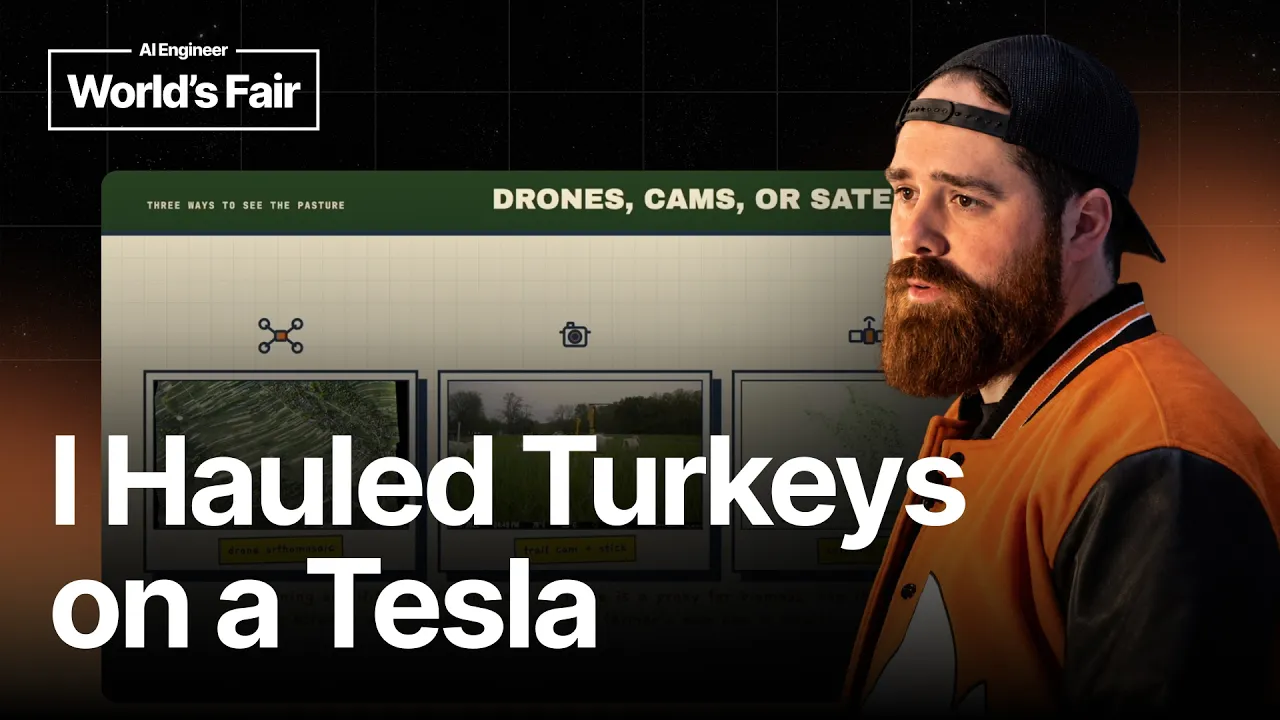
Cody Menefee once drove three hours to a processor with ten turkeys strapped to the roof of his Tesla, and reports that a windbreak of birds up top does real damage to your range. He raised them in a Nashville backyard where that is not allowed, nearly quit engineering to farm, and learned how hard it is to make money at it. Instead he asks why only three percent of cattle finish on pasture when it is better for animal, consumer, and land. The answer is labor. Grazing done right means splitting pasture into paddocks with one day of feed and moving the herd, fences, and water every day so the grass rests. GPS collars with virtual fences handle the moving but not the deciding: grass grows differently after drought, rain, or trampling, and today a farmer walks out to look. His proposal is to replace those eyes and drop a language model in the loop. Drones give the best imagery but no jurisdiction allows autonomous flights; satellites are too far away; a trail cam pointed at a measuring stick is the cheap version. Feed the model animal locations, drought conditions, and grass height, and let it suggest the next paddock for a human to confirm. Three blockers remain: a knowledge base he is scraping out of farmer YouTube channels and research papers with Firecrawl into his Open Pasture project, a vision layer that reads biomass and biodiversity, and collar makers who lock out outside software. His ask to the room is an open collar, and his closing argument is that this industry builds too much software for people who build software while problems like this wait. Speaker info: - https://x.com/cbmenefee - https://linkedin.com/in/codybmenefee - https://openpasture.dev Timestamps: 0:00 - The jacket, the stolen title, and a talk about farming 1:20 - No credentials, ten backyard turkeys, and a Tesla roof 3:34 - Why not just become a farmer 4:41 - Livestock belongs on pasture, and labor is why it isn't 5:49 - Rotational grazing and the daily move 6:28 - GPS collars solve the f
Summary
Generated by gpt-5.6-terraAt-a-Glance
- Verdict: Watch fully
- Core thesis: AI agents can expand labor-constrained, pasture-based livestock farming by combining field sensing, agronomic knowledge, and open geofencing hardware to recommend or eventually execute daily herd moves.
- Why it matters: The talk offers a concrete blueprint for applying agents to an inherently uncertain physical-world control problem, where the key challenge is assembling trustworthy context rather than forcing deterministic automation.
- Best use: Use it as an agent-system design case study: identify the sensing, knowledge, decision, human-approval, and actuator layers required before an LLM can safely operate a real-world workflow.
Executive Summary
Cody Menefee argues that AI builders are undershooting the opportunity by concentrating on software-for-software instead of labor-intensive physical systems. His example is rotational grazing: pasture-raised livestock must be moved frequently among small paddocks so grass can recover, animals receive sufficient forage, and the farm maintains productive pasture. The work is difficult largely because farmers must continually inspect variable field conditions and make judgment calls.
Existing virtual-fence companies such as Halter and NoFence address the physical labor of moving fences and animals through GPS collars, but Menefee says they do not solve the central decision problem: where the herd should go next. That choice depends on interdependent, non-static inputs including animal location and movement history, grass height and available biomass, drought and rainfall conditions, grazing impact, future pasture recovery, and whole-farm biodiversity.
His proposed stack has three missing layers: a knowledge base that captures decentralized grazing expertise; a visualization/sensing layer to estimate pasture biomass and biodiversity; and open, programmable livestock collars that can receive decisions from independent software. He presents Firecrawl and his OpenPasture project as means to extract practical knowledge from YouTube and research papers, and he identifies satellites, fixed trail cameras, and drones as potential sensing approaches with different fidelity and regulatory constraints.
The broader agent lesson is that LLMs are most valuable where there is no single deterministic answer. Rather than claiming full autonomy immediately, Menefee frames the near-term product as a system that synthesizes multimodal context and recommends the next grazing move for human confirmation. The talk is also explicitly a call for open hardware and APIs, so innovation can occur in the decision software rather than being locked into vertically integrated collar vendors.
Key Takeaways
- Claim: Rotational grazing is a labor bottleneck that limits the scalability of pasture-based livestock systems. | Evidence: Menefee contrasts unmanaged grazing with daily paddock rotation: animals otherwise repeatedly eat preferred plants, neglect others, and trample areas, degrading pasture quality. Proper rotation requires moving fences, animals, water, and maintaining records continually. | Implication: High-value automation opportunities often sit in recurring physical coordination tasks where labor includes both execution and continuous situational judgment. | Caveat: The speaker states pasture is preferable for animals, consumers, farmers, and ecosystems, but does not substantiate those broader claims in the talk.
- Claim: Virtual fencing solves movement execution but not the more valuable decision layer of selecting the next paddock. | Evidence: Halter and NoFence use GPS-connected collars and remotely drawn virtual boundaries; Menefee cites Halter as having Peter Thiel investment at a $2 billion valuation. He argues farmers still must visually inspect pasture because growth and grazing conditions vary by rainfall, drought, and prior use. | Implication: In agentic operations, installing an actuator does not eliminate the need for a control plane; sensing, state estimation, and policy selection remain separate products. | Caveat: The characterization of current vendors' capabilities is the speaker's perspective and is not independently verified in the transcript.
- Claim: Grazing allocation is a suitable LLM problem precisely because it is a multivariate judgment task rather than a deterministic rule-following task. | Evidence: The proposed decision loop would weigh GPS position, yesterday's and likely future herd locations, drought conditions, grass height across the farm, pasture state, and ecosystem-level effects. Menefee says there is not a universally correct next paddock, only a best-supported judgment. | Implication: For Ken's agent systems, the appropriate design pattern is decision support under uncertainty: assemble evidence, expose reasoning and recommendations, preserve human approval, then graduate autonomy only after operational validation. | Caveat: He recommends an LLM make suggestions that a human confirms or rejects, not immediate unsupervised control of livestock.
- Claim: An autonomous grazing system requires three integrated layers: knowledge, perception, and actuation. | Evidence: Menefee identifies (1) a grazing knowledge base, (2) visualization of biomass and biodiversity, and (3) programmable geofence collars. His OpenPasture project aggregates farmer videos and research, while Firecrawl is used to scrape and package that material as agent context. | Implication: Do not treat retrieval alone as an agent solution: robust real-world agents require domain knowledge, live state data, and a controlled path to execute decisions. | Caveat: The talk describes an architecture and active exploration, not a demonstrated production system with measured performance.
- Claim: Sensor selection is the major practical constraint in converting a farmer's visual intuition into machine-readable pasture state. | Evidence: Drone orthomosaic maps could provide high-resolution imagery but require operator skill and face line-of-sight and autonomous-flight regulatory barriers. Planet provides daily global imagery at 1-by-1-meter resolution, which Menefee favors today but says is too coarse for some needed decisions. A low-tech alternative is a fixed trail camera viewing a measuring reference to track grass height. | Implication: Build the system around sensor confidence and fallback workflows; a lower-fidelity but reliable fixed measurement may be more deployable than an autonomous high-resolution drone workflow. | Caveat: No validation is provided that any of these sensing methods accurately infer biomass, species mix, or grazing readiness at production quality.
- Claim: Open collar APIs are strategically important because closed hardware prevents independent optimization of the grazing decision layer. | Evidence: Menefee says current geofence vendors require farmers to use proprietary collars and software, preventing his own model from sending predicted GPS boundaries to the device. He calls for an off-the-shelf, repairable collar with open APIs and ideally open patents, analogizing the need to John Deere-style right-to-repair concerns. | Implication: Where an agent's value depends on real-world actuation, hardware/API access is a core platform-risk diligence item—not merely an implementation detail. | Caveat: Open hardware introduces unresolved issues around reliability, animal welfare, connectivity, safety controls, and commercial support that the talk does not address.
- Claim: Species stacking illustrates how optimizing a farm requires reasoning over system interactions, not just a single animal or pasture metric. | Evidence: Menefee cites Pasturebird's wheeled chicken houses that move one house-width every 24 hours. He says running ruminants first and chickens afterward can add nitrogen through manure while chickens peck parasites from ruminant droppings, potentially reducing parasite pressure and medication costs. | Implication: The agent objective should be a portfolio of system outcomes—productivity, forage recovery, health, inputs, and long-term resilience—rather than a narrow local metric such as grass height. | Caveat: These biological and economic effects are presented as practical rationale, without comparative data or operational thresholds.
Detailed Brief
Pasture-management objective function
- Claims: The immediate target is to keep forage in a productive juvenile growth range: not grazed so short that recovery is slow, and not left so mature that it becomes less palatable.; The intended economic endpoint is greater animal output per acre, allowing pasture-based production to compete more effectively with feedlot economics.
- Evidence: Menefee uses an illustrative misconception—100 cows on 100 acres grazing freely—to explain why unmanaged grazing is not equivalent to managed pasture.; He says pasture diversity should include a balanced mix of cool-season and warm-season grasses and legumes, supporting animal nutrition and reducing supplements such as hay and mineral inputs.
- Caveats: The talk does not specify objective weights, measurement protocols, safety constraints, or the threshold at which an LLM recommendation should be overridden.; It also does not establish the financial model for hardware, data collection, connectivity, or farmer adoption.
- Implications: A viable product needs an explicit, auditable objective function and local operating constraints rather than a generic instruction to choose the 'best' pasture.; The highest-leverage initial deployment may be recommendation and recordkeeping for a narrow grazing objective before attempting ecosystem-level optimization.
Context engineering as the actual first bottleneck
- Claims: Menefee considers the first problem to be gathering, packaging, and presenting context so an LLM can reason over it.; Much usable agronomic expertise is decentralized in practitioner-created video, rather than residing solely in structured manuals or databases.
- Evidence: OpenPasture is described as an open-source repository intended to make scraped farmer videos and research papers available to farmers.; Firecrawl's stated role is supplying web data APIs that let agents access and use web-derived context.
- Caveats: A scraped corpus may contain conflicting regional practices, undocumented assumptions, and advice of uneven quality; the talk does not describe source evaluation, provenance, or retrieval governance.
- Implications: Domain corpora for agent systems should retain source, geography, conditions, and confidence metadata so the model does not apply an anecdotal practice outside its valid context.
Notable Concepts & Terms
- Rotational grazing: Dividing pasture into paddocks and moving livestock frequently to permit forage recovery and avoid selective overgrazing; it is the target workflow for automation.
- Virtual fencing / geofencing collars: GPS-connected livestock collars that enforce remotely configured boundaries, separating the physical movement mechanism from the decision of where animals should be sent.
- OpenPasture: Menefee's open-source effort to collect and expose grazing knowledge for farmers and AI systems.
- Orthomosaic map: A stitched aerial image assembled from drone photos; proposed as a high-fidelity but operationally and regulatorily difficult sensing source.
- Planet: A satellite-imagery company cited as providing daily global imagery at 1-by-1-meter resolution; attractive for coverage but limited for detailed pasture assessment.
- Biomass: The amount of forage available for animals to consume; a central state variable the system must estimate before recommending grazing moves.
- Species stacking: Sequencing different livestock species, such as ruminants followed by chickens, to create complementary nutrient and parasite-management effects.
- Human-in-the-loop recommendation: The near-term operating model in which an LLM recommends a next move and a farmer approves or rejects it, rather than granting autonomous control.
Operator Notes / Why Ken Should Care
- Use this as a reference architecture for physical-world agents: separate retrieval/knowledge, sensor-derived live state, decision policy, approval workflow, and device-control APIs in the system design.
- When evaluating vertical-agent opportunities, prioritize domains where expensive human work is repeated contextual judgment—not merely manual execution—and identify whether a programmable actuator layer already exists.
- Require provenance, regional applicability, and confidence scoring for any practitioner-video knowledge base before it informs operational recommendations.
- Treat proprietary hardware integration as a diligence gate for agent businesses: establish API access, override controls, audit logs, and failure-safe behavior before underwriting automation value.
- Track OpenPasture and the availability of open livestock-collar platforms as possible signals that this vertical can move from conceptual architecture to buildable control system.
Source/Metadata
- Title: You’re Not Thinking Big Enough: Rebuilding Food Systems with AI Agents — Cody Menefee, Firecrawl
- Transcript words: 7415
- Duration seconds: 1105
- Timestamp note: No usable timestamps or chapters were present. The supplied transcript substantially repeats the talk and ends with repetitive extraction noise.
Transcript
All right, hello everybody. My name is Cody. I put this picture up here because this jacket so far has not actually landed as well as I thought it would. No one gets the joke. So this was to really put it in front of your face. I don't just enjoy wearing heavily branded Letterman jackets. We intentionally tried to play into the bit. So my name is Cody. I'm on the growth team at Firecrawl and today I'm here to tell you you're not thinking big enough. But before I actually get into that I have to address an elephant in the room which is Theo stole my talk. Theo put out a video about a month ago called You Need to Think Bigger but I would like to say I submitted the name for this talk a month before Theo put his video out. I didn't steal his talk. He stole my talk. So today we're actually going to talk about farming and yes I actually mean farming. More specifically I mean livestock farming and even more specifically I mean automating pasture rotation for grass-fed livestock systems. I have a feeling most of you did not expect to learn about cows and grass and farming today but I'm here so you're going to. A little bit of background on who I am and why maybe you should listen to me. The short version is I actually have no credentials that qualify me for this talk but nonetheless I'm going to do my best to give it. I grew up in Kentucky have a background in blue-collar work. I was a bartender, a mechanic, a server, a whole bunch of things. Never actually a farmer though and then I found my way into engineering software development etc. I actually don't really like taking the title of software engineer. I'm pretty averse to that. Feels like stolen valor because I am the vibe coder most of you all are scared of. I use AI agents all day long. I don't have any syntax memorized. I am not proficient in any particular coding language but I will crank out some stuff on a weekend. But today I actually work at Firecrawl where we're building context for AI agents. We have a series of web data API so you give your agents access to the web. Again I said I'm on the growth team but today we're actually going to get into some more farming stuff. But first a bit of credential I do have is this is a real picture of me hauling turkeys on top of my Tesla and I do still have a crack in that glass ceiling because of it. This was in Nashville where I live in the middle of a residential neighborhood where you are not allowed to raise turkeys but I raised 10 turkeys in my backyard because I wanted to know what it was like to actually raise livestock myself that I would eat. It's a very mentally difficult process if I'm being totally honest. But this was me loading them up onto the roof of my Tesla and then I drove for three hours with them to the processor. Had to stop at a Supercharger on the way and lots of people were taking pictures and what I can tell you is if your range is sufficiently decreased when you have a giant windbreak full of turkeys on top of the roof. So that was quite the anxious drive I can tell you. I also almost left engineering to be a farmer. I really wanted to raise chickens. This is a real product image that I came up with. I wanted to wrap turkeys in white wrapping and literally just slap the word EE on top of it. I thought it was provocative. I thought I would get you to buy chickens. But I realized it's actually really hard to make any money farming. Surprise surprise. And I have a wife. I have two kids. It didn't feel right to ask them to give up the lives they had so that I could go cosplay as a farmer and raise chickens. So I decided to pivot and see if there were ways that we could scale farming itself and the types of systems that I'm interested in when it comes to livestock agriculture. So three things I want to get accomplished in this talk is one convince you all to pursue bigger ideas. I think a lot of these talks, a lot of these conferences, a lot of us individually, spend a lot of time talking about building software for people who build software, for people who build software, so on and so forth. And I really am just going to challenge you that there are other problems to solve than just another MCP for another SaaS solution at another company. But also I'm just really trying to take advantage of a captive audience. If you corner me anywhere at any time there's a good chance I will talk to you about farming. So here I am. And hopefully I can convince you to come work at Firecrawl. So first things first, I believe livestock belongs on pasture. I think animals should live on grass. I think it's better for the animal, the consumer, the farmer, the ecosystem. I can give you a whole TED talk on each of those if I need to. You can find me later if you need me to tell you why it's better for animals to be on grass, but I don't have enough time to get into all of that. Take my word for it. Let's start there. The assumption is animals should be on grass. This is the goal I want to hit. I am not actually anti-confinement farming. I think there's a reason we needed to do that. But 97% of cows are still currently finished on feedlots. 3% are raised on pasture. My opinion here, more animals could be on grass. I want to try to figure out how we get more animals on grass. The question is why aren't they on grass? And that is labor is the bottleneck. It is a pain to actually raise animals on grass. Pasture done right actually means moving animals constantly, and that takes a lot of work. If you think about grass-fed beef, you might think of I have 100 cows, 100 acres. I put 100 cows on 100 acres. They eat grass. I got beef at the end of the year. That's not quite how it works. You will very rapidly decrease the quality of your pasture if you just let cows graze where they want because they'll graze their favorite things, ignore things that they shouldn't, trample areas consistently, so on and so forth. So the solution to that is rotational grazing. What this means is you break up your pasture into individual paddocks where the animals have enough food for one day, and then you move them every single day. This allows certain areas to rest and other areas to be grazed, and over time will increase the efficacy of your pasture. But this takes a whole lot of work. This means you have to move fences, animals, water, and keep track of it every single day in order to appropriately move the animals as often as they need to. There are some solutions actually trying to work on this problem. You may have seen a company called Halter in the news recently. Peter Thiel invested at a two billion dollar valuation. No Fence is another company. What these companies do is provide collars for the animals, connected to GPS satellites that allow you to draw virtual boundaries where you can move the animals remotely. I think this is a great step in the direction of trying to expand labor, but this has a problem which is you have to know where to move the animals. This is not a science to be honest with you. You can't just move them in a straight line across the pasture routinely every single day to the same part of land. The reason is grass doesn't grow the same every single day. There are drought conditions, rainfall, how much impact a particular section of the paddock has had, and the way that this is sold today is actually farmers going out on pasture, putting eyeballs on the grass, and making intuitive decisions about where the next best move should be. So the question is, how do we replace the farmers' eyes on pasture so that they can remotely make educated decisions on where to move their virtual fences? There's a bit more that actually goes into this as well, and that is you can't just, you have to also know how tall the grass is. Grass has a growing cycle. If you grow it way too short, it takes a really long time to come back. If you let it go too long, it becomes old and bitter, and the animals don't like it. There's this juvenile sweet spot that you want to keep the grass in. You want to cut it before it gets too tall, but then you also don't want to cut it too short. You need to keep the animals moving and then constantly coming back to the same pasture so that your grass stays at the most optimal growing age and constantly has the most productivity possible. So a couple of ways that we can do this. These are things, these are my solutions. This is something I've actually been working on thinking about how we can do this. A couple of options that I have are drone orthomosaic maps. If we could find a way to automate drone flights, we could fly them around our pasture, take a whole bunch of pictures, get some very high fidelity, high resolution images of the grass that farmers could analyze. The problem with this is there's a lot of skilled upgrades you need to do with the farmers to teach them how to fly drones. A lot of regulatory issues with keeping the drones in sight, and ideally this would be autonomous, and there currently isn't a jurisdiction in the world that Animals moving and then constantly coming back to the same pasture so that your grass stays at the most optimal growing age and constantly has the most productivity possible. So a couple of ways that we can do this. These are things, these are my solutions. This is something I've actually been working on thinking about how we can do this. A couple of options that I have are drone orthomosaic maps. If we could find a way to automate drone flights, we could fly them around our pasture, take a whole bunch of pictures, get some very high fidelity, high resolution images of the grass that farmers could analyze. The problem with this is there's a lot of skilled upgrades you need to do with the farmers to teach them how to fly drones. A lot of regulatory issues with keeping the drones in sight, and ideally this would be autonomous, and there currently isn't a jurisdiction in the world that has approved autonomous drones for these types of applications. So this is a really big bottleneck. I think it has pretty high fidelity in the quality of imagery, but is going to be a hard problem to solve in terms of actually getting all those hurdles accomplished. Satellites is my most favorite option today. There's a really cool company called Planet out there taking pictures of the entire globe every single day with a one by one meter resolution, but those satellites are really high up in the sky, and it's hard to tell some of the things you need to tell to actually make those educated decisions. The middle photo here is actually from a friend of mine out in Missouri working as a research grad assistant at the Missouri Lincoln University, and this idea is just putting a trail cam next to a tree and some measuring apparatus that that camera can look at, and just figuring out how tall is the grass in relation to that particular object, just so that we have some sort of reference point that we can use to see how well the grass is growing back. If we can solve this problem along with the collar situation, I think there's a world here where we can drop an LLM in the middle of this loop and start to work on autonomous grazing operations. And so what this would mean is an LLM essentially making the next best decision on where the animal should be any given day. And this is a multivariate analysis. This requires the LLM to have several data inputs including where the animals are in GPS location, where they were yesterday, where they might go tomorrow, what the drought condition is in the area, how tall the grass is across the entire farm. And actually it has to make this decision not just on a day-to-day basis but in varying degrees of relation. So where's the best next place for a particular cow to be, but where's the best place for the herd to be in relationship to the pasture itself, in relationship to the farm as a whole, and then more broadly the ecosystem at large. There's all of these components feed back into each other and if you can optimize this entire picture you have a more productive farm where you can actually have more animals on fewer acres, which is how we end up actually scaling to compete with the feedlot style where you can actually have more cows on fewer grass. How do we solve this problem? There's a couple of components. There's three main blockers that I think need to exist in order for us to actually create this system. The first one is building a knowledge base and this is primarily what I'm working on at Firecrawl and then an open source project I have called OpenPasture. The idea here is a lot of the knowledge on when to move, why to move, how to move, the benefits of moving, etc. is all locked up in primarily YouTube videos. There's a bunch of really cool farmers out there. I can give you a whole bunch of channels that you can go down rabbit holes on of just good old guys out in Missouri, Tennessee, Kentucky trying to move their animals every single day telling you what they're learning, telling you what species are best for this, what lagoons you want to aim for in the biodiversity and your pasture. There's a whole bunch of things that go into this and we need to build that knowledge base. Firecrawl is a toolkit that I use to actually collect this data, going out scraping those YouTube videos, scraping research papers out to archive, building this knowledge base up and OpenPasture is the actual repository I put this information in to make it available to any farmer I think that might be able to use it. The next thing to solve is the actual visualization layer. There's a lot of components we need to know about the grass that the farmer is primarily getting out of the intuition from looking at the pasture. The two main things worth figuring out about the pasture both where the animals are, where they should go and where you want them to be is what is the biomass, how much foliage actually is available for them to consume and then long term what is the biodiversity of that particular pasture. If they overgraze sections too heavily they'll start to over index on different types of cool season, warm season grasses, lagoons, etc. and ideally you want a really rounded really diverse pasture over time to make sure that the cattle are getting the nutrients they need so you don't have to supplement with things like hay, copper, aluminum, etc. Ideally they get all of the macronutrients and micronutrients from the grass itself which becomes an entirely ideally hands-off system. And then the third one is those geofence companies, so NoFence, Halter, while I appreciate the technology they're trying to push forward I have a pretty strong disagreement with them which is in order to use their software they require you by their collars and you can't plug your own software into their collars. From a business standpoint I get why this is from an industry standpoint I think it's really a pain. I would like to innovate on the software layer, I would like to push GPS locations to these collars that my LLM can predict. I don't want to have to rely on their software to do this because I don't think it's as good or I think I can make it better I'm going to be totally honest with you. So a bit of the purpose of this talk is actually a call to action for you all in the audience. I need someone to make me a collar. I need it to be open the APIs need to be open ideally it's an off-the-shelf solution some component parts that we can slap together. Farmers are pretty scrappy and like to heal their own things there's a lot of analogy towards John Deere and this sort of right to repair. So my ask to anyone maybe looking at this problem is design me a collar where the patent can be open and the APIs are open so that we can compete on software and optimize this solution. The next thing I'd like to maybe tease you about is this actually goes beyond just ruminants. So ruminants is a type of animal cows, sheep, goats, those are all ruminant animals. They chew grass, they digest it in their ruminant which is an organ that's rather called ruminants. But there's actually an additional benefit we get where we can stack species on these pastured rotations. This is a company called Pasture Bird. They were a big catalyst for me to really get obsessed with this idea. What they did is took your normal chicken house, put it up on big wheels and automated the movement so it creeps its width every 24 hours across pasture. The reason you can do it this scientifically with chickens is because they don't actually get most of their nutrients from the grass. You have to supplement them with grain feed because chickens are omnivores not quite just herbivores. So you can just inch this coop across the grass giving them a fertile land to grow on. The nitrogen from their droppings actually help as a manure or as a fertilizer for the grass itself. And there's an added benefit here when you stack the ruminants with the chickens. If you run your ruminants first, they sort of cut off the top of the grass and the chickens come behind them and peck out the parasites from their droppings and it reduces the parasite load overall across your farm which reduces the medication expense you have to actually pay to keep your animals healthy. And over term you have a more robust seed stock or breeding stock so that you can have stronger animals over time that require fewer interventions and can be left alone to just eat grass and turn into meat eventually. So the three things I really hope you will take away from this talk is one, I think we need to find big real world physical problems that we can solve that require multivariate analysis and not quite yes or no decisions. There are lots of problems out there that don't actually have deterministic solutions. I hear a lot of engineers talk about how we turn LLMs into deterministic processes and my contention is actually there's a lot of problems that you can't solve with deterministic algorithms. This is one of them, it's a multivariate analysis, there isn't a next best paddock to move to, there's just your best guess on where you think they should go. And I think if we can take systems like that, these multi data input systems and drop an LLM in the center to actually reason over the data and at least make a suggestion that the human can confirm or deny, we can really start to scale systems like this that are very much restricted by the farmers ability to scale their own labor, their own decision-making power and really give them the tools that they need to grow their operations. yes or no decisions. There are lots of problems out there that don't actually have deterministic solutions. I hear a lot of engineers talk about how we turn LLMs into deterministic processes and my contention is actually there's a lot of problems that you can't solve with deterministic algorithms. This is one of them, it's a multivariate analysis, there isn't a next best paddock to move to, there's just your best guess on where you think they should go. And I think if we can take systems like that, these multi data input systems and drop an LLM in the center to actually reason over the data and at least make a suggestion that the human can confirm or deny, we can really start to scale systems like this that are very much restricted by the farmers' ability to scale their own labor, their own decision-making power and really give them the tools that they need to grow their operations to hopefully, I think all animals could be raised on grass if we solve these problems. And then the last one is, maybe you can come help me solve some of these problems. The number one problem is actually just giving the agents the context they need, gathering the data, packaging that data, and then presenting it in a way that the LLM can reason over. And that's what we do over at Firecrawl. So you're not thinking big enough, Firecrawl is where we're building the context layer for AI and I hope you can come build it with us. We're hiring. So here's all the job postings we currently have. Go to our website, maybe find one that works out for you. Reach out to me, we'd love to have more people trying to figure out how we get data off the web to solve some of these complex problems and present that data as context to these AI agents and perhaps we can make the world a better place. My name's Cody. Open Pastures is my open source project. Firecrawl is where I do my day-to-day life and these are my socials. I'll hang around for a little bit. I love to chat more about animals, cows, birds, all you like. Thank you very much for coming. growth team at Firecrawl and today I'm here to tell you you're not thinking big enough. But before I actually get into that I have to address a bit of an elephant in the room which is Theo stole my talk. Theo put out a video about a month ago called You Need to Think Bigger but I would like to say I submitted the name for this talk a month before Theo put his video out. I didn't steal his talk. He stole my talk. So today we're actually going to talk about farming and yes I actually mean farming. More specifically I mean livestock farming and even more specifically I mean automating pasture rotation for grass-fed livestock systems. I have a feeling most of you did not expect to learn about cows and grass and farming today but I'm here so you're going to. A little bit of background on who I am and why maybe you should listen to me. The short version is I actually have no credentials that qualify me for this talk but nonetheless I'm gonna do my best to give it. I grew up in Kentucky have a background in blue-collar work. I was a bartender, a mechanic, a server, a whole bunch of things. Never actually a farmer though and then I sort of found my way into engineering software development etc. I actually don't really like taking the title of software engineer. I'm pretty adverse to that. Feels like stolen valor because I am the vibe coder most of you all are scared of. I use AI agents all day long. I don't have any syntax memorized. I am not proficient in any particular coding language but I will crank out some stuff on a weekend. But today I actually work at Firecrawl where we're building context for AI agents. We have a series of web data API so you give your agents access to the web. Again I said I'm on the growth team but today we're actually to get into some more farming stuff. But first a bit of credential I do have is this is a real picture of me hauling turkeys on top of my Tesla and I do still have a crack in that grass ceiling because of it. This was in Nashville where I live in the middle of a residential neighborhood where you are not allowed to raise turkeys but I raised 10 turkeys in my backyard because I wanted to know what it was like to actually raise livestock myself that I would eat. It's a very mentally difficult process if I'm being totally honest. But this was me loading them up onto the roof of my Tesla and then I drove for three hours with them to the processor. Had to stop at a supercharger on the way and lots of people were taking pictures and what I can tell you is if your range is sufficiently decreased when you have a giant windbreak full of turkeys on top of the roof. So that was quite the anxious drive I can tell you. I also almost left engineering to be a farmer. I really wanted to raise chickens. This is a real product image that I came up with. I wanted to wrap turkeys and white wrapping and literally just slap the word EE on top of it. I thought it was provocative. I thought I would get you to buy chickens. But I realized it's actually really hard to make any money farming. Surprise surprise. And I have a wife. I have two kids. It didn't feel right to ask them to give up the lives they had so that I could go cosplay as a farmer and raise chickens. So I decided to pivot and see if there were ways that we could scale farming itself and the types of systems that I'm interested in when it comes to livestock agriculture. So three things I want to get accomplished in this talk is one convince you all to pursue bigger ideas. I think a lot of these talks, a lot of these conferences, a lot of us individually, spend a lot of time talking about building software for people who build software, for people who build software, so on and so forth. And I really am just going to challenge you that there are other problems to solve than just another MCP for another SaaS solution at another company. But also I'm just really trying to take advantage of a captive audience. If you corner me anywhere at any time there's a good chance I will talk to you about farming. So here I am. And hopefully I can convince you to come work at Firecrawl. So first things first, I believe livestock belongs on pasture. I think animals should live on grass. I think it's better for the animal, the consumer, the farmer, the ecosystem. I can give you a whole TED talk on each of those if I need to. You can find me later if you need me to tell you why it's better for animals to be on grass, but I don't have enough time to get into all of that. Take my word for it. Let's start there. The assumption is animals should be on grass. This is the goal I want to hit. I am not actually anti-containment farming. I think there's a reason we needed to do that. But 97% of cows are still currently finished on feedlots. 3% are raised on pasture. My opinion here, more animals could be on grass. I want to try to figure out how we get more animals on grass. The question is why aren't they on grass? And that is labor is the bottleneck. It is a pain in the ass to actually raise animals on grass. Pasture done right actually means moving animals constantly, and that takes a lot of work. If you think about grass-fed beef, you might think of I have 100 cows, 100 acres. I put 100 cows on 100 acres. They eat grass. I got beef at the end of the year. That's not quite how it works. You will very rapidly decrease the quality of your pasture if you just let cows graze where they want because they'll graze their favorite things, ignore things that they shouldn't, trample areas consistently, so on and so forth. So the solution to that is rotational grazing. What this means is you break up your pasture into individual paddocks where the animals have enough food for one day, and then you move them every single day. This allows certain areas to rest and other areas to be grazed, and over time will increase the efficacy of your pasture. But this takes a whole, whole, whole lot of work. This means you have to move fences, animals, water, and keep track of it every single day in order to appropriately move the animals as often as they need to. There are some solutions actually trying to work on this problem. You may have seen a company called Halter in the news recently. Peter Thiel invested at a two billion dollar valuation. No Fence is another company. What these companies do is provide collars for the animals, connected to the GPS satellites that allow you to draw virtual boundaries where you can move the animals remotely. I think this is a great step in the direction of trying to expand labor, but this has a problem which is you have to know where to move the animals. This is not a science to actually be honest with you. You can't just move them in a straight line across the pasture routinely every single day to the same part of land. The reason is, is grass doesn't grow the same every single day. There are drought conditions, rainfall, how much impact a particular section of the paddock has had, and the way that this is sold today is actually farmers going out on pasture, putting eyeballs on the grass, and making intuitive decisions about where the next best move should be. So the question is, how do we replace the farmers eyes on pasture so that they can remotely make educated decisions on where to move their virtual fences? There's a bit more that actually goes into this as well, and that is you can't just, you have to also know how tall the grass is. Grass has a growing cycle. If you grow it way too short, it takes a really long time to come back. If you let it go too long, it becomes old and bitter, and the animals don't like it. There's this juvenile sweet spot that you want to keep the grass in. You want to cut it before it gets too tall, but then you also don't want to cut it too short. You need to keep the animals moving and then constantly coming back to the same pasture so that your grass stays at the most optimal growing age and constantly has the most productivity possible. So a couple of ways that we can do this. These are things, these are my solutions. This is something I've actually been working on thinking about how we can do this. A couple of options that I have are drone orthomosaic maps. If we could find a way to automate drone flights, we could go fly them around our pasture, take a whole bunch of pictures, get some very high fidelity, high resolution images of the grass that farmers could analyze. The problem with this is there's a lot of skilled upgrades you need to do with the farmers to teach them how to fly drones. A lot of regulatory issues with keeping the drones in sight, and ideally this would be autonomous, and there currently isn't a jurisdiction in the world that has approved autonomous drones for these types of applications. So this is a really big bottleneck. I think it has pretty high fidelity in the quality of imagery, but is going to be a hard problem to solve in terms of actually getting all those hurdles accomplished. Satellites is my most favorite option today. There's a really cool company called Planet out there taking pictures of the entire globe every single day with a one by one meter resolution, but there's still, those satellites are really high up in the sky, and it's hard to tell some of the things you need to tell to actually make those educated decisions. The middle photo here is actually from a friend of mine out in Missouri working as a research grad assistant at the Missouri Lincoln University, and this idea is just putting a trail cam next to a tree and some measuring apparatus that that camera can look at, and just figuring out how tall is the grass in relation to that particular object, just so that we have some sort of reference point that we can use to see how well the grass is growing back. If we can solve this problem along with the the collar situation, I think there's a world here where we can drop an LLM in the middle of this loop and start to work on autonomous grazing operations. And so what this would mean is an LLM essentially making the next best decision on where the animal should be any given day. And this is a multivariate analysis. This requires the LLM to have several data inputs including where the animals are in GPS location, where they were yesterday, where they might go tomorrow, what the drought condition is in the area, how tall the grass is across the entire farm. And actually it has to make this decision not just on a day-to-day basis but in varying degrees of relation. So where's the best next place for a particular cow to be, but where's the best place for the herd to be in relationship to the pasture itself, in relationship to the farm as a whole, and then more broadly the ecosystem at large. There's all of these components feed back into each other and if you can optimize this entire picture you have a more productive farm where you can actually have more animals on fewer acres, which is how we end up actually scaling to compete with the feedlot style where you can actually have more cows on fewer grass. How do we solve this problem? There's a couple of components. There's three main blockers that I think need to exist in order for us to actually create this system. The first one is building a knowledge base and this is primarily what I'm working on at Firecrawl and then an open source project I have called OpenPasture. The idea here is a lot of the knowledge on when to move, why to move, how to move, the benefits of moving, etc. is all locked up in primarily YouTube videos. There's a bunch of really cool farmers out there. I can give you a whole bunch of channels that you can go down rabbit holes on of just good old guys out in Missouri, Tennessee, Kentucky trying to move their animals every single day telling you what they're learning, telling you what species are best for this, what lagoons you want to aim for in the biodiversity and your pasture. There's a whole bunch of things that go into this and we need to build that knowledge base. Firecrawl is a toolkit that I use to actually collect this data, going out scraping those YouTube videos, scraping research papers out to archive, building this knowledge base up and OpenPasture is the actual repository I put this information in to make it available to any farmer I think that might be able to use it. The next thing to solve is the actual visualization layer. There's a lot of components we need to know about the grass that the farmer is primarily getting out of the intuition from looking at the pasture. The two main things worth figuring out about the pasture both where the animals are, where they should go and where you want them to be is what is the biomass, how much foliage actually is available for them to consume and then long term what is the biodiversity of that particular pasture. If they overgraze sections too heavily they'll start to over index on different types of cool season, warm season grasses, lagoons, etc. and ideally you want a really rounded really diverse pasture over time to make sure that the cattle are getting the nutrients they need so you don't have to supplement with things like hay, copper, aluminum, etc. Ideally they get all of the macronutrients and micronutrients from the grass itself which becomes an entirely ideally hands-off system. And then the third one is those geofence companies, so NoFence, Halter, while I appreciate the technology they're trying to push forward I have a pretty strong disagreement with them which is in order to use their software they require you by their collars and you can't plug your own software into their collars. From a business standpoint I get why this is from an industry standpoint I think it's really a pain in the ass. I would like to innovate on the software layer, I would like to push GPS locations to these collars that my LLM can predict. I don't want to have to rely on their software to do this because I don't think it's as good or I think I can make it better I'm going to be totally honest with you. So a bit of the purpose of this talk is actually a call to action for you all in the audience. I need someone to make me a caller. I need it to be open the APIs need to be open ideally it's an off-the-shelf solution some component parts that we can slap together. Farmers are pretty scrappy and like to heal their own things there's a lot of analogity towards John Deere and this sort of like right to repair. So my ask to anyone maybe looking at this problem is design me a caller where the patent can be open and the APIs are open so that we can compete on software and optimize this solution. The next thing I'd like to maybe tease you about is this actually goes beyond just ruminants. So ruminants is a type of animal cows, sheep, goats, those are all ruminant animals. They chew grass, they digest it in their ruminant which is an organ that's rather called ruminants. But there's actually an additional benefit we get where we can stack species on these pastured rotations. This is a company called Pasture Bird. They were a big catalyst for me to really get an obsessed with this idea. What they did is took your normal chicken house, put it up on big wheels and automated the movement so it creeps its width every 24 hours across pasture. The reason you can do it this scientifically with chickens is because they don't actually get most of their nutrients from the grass. You have to supplement them with grain feed because chickens are omnivores not quite just herbivores. So you can just inch this coop across the grass giving them a fertile land to grow on. The nitrogen from their droppings actually help as a manure or as a fertilizer for the the grass itself. And there's an added benefit here when you stack the ruminants with the chickens. If you run your ruminants first, they sort of cut off the top of the grass and the chickens come behind them and peck out the parasites from their droppings and it reduces the parasite load overall across your farm which reduces the medication expense you have to actually pay to keep your animals healthy. And over term you have a more robust seed stock or breeding stock so that you can have stronger animals over time that require fewer interventions and can be left alone to just eat grass and turn into meat eventually. So the three things I really hope you will take away from this talk is one, I think we need to find big real world physical problems that we can solve that require multivariate analysis and not quite yes or no decisions. There are lots of problems out there that don't actually have deterministic solutions. I hear a lot of engineers talk about how we turn LLMs into deterministic processes and my contention is actually there's a lot of problems that you can't solve with deterministic algorithms. This is one of them, it's a multivariate analysis, there isn't a next best paddock to move to, there's just your best guess on where you think they should go. And I think if we can take systems like that, these multi data input systems and drop an LLM in the center to actually reason over the data and at least make a suggestion that the human can confirm or deny, we can really start to scale systems like this that are very much restricted by the farmers ability to scale their own labor, their own decision-making power and really give them the tools that they need to grow their operations to hopefully, I think all animals could be raised on grass if we solve these problems. And then the last one is, is maybe you can come help me solve some of these problems. The number one problem is actually just giving the agents the context they need, gathering the data, packaging that data, and then presenting it in a way that the LLM can reason over. And that's what we do over at Firecrawl. So you're not thinking big enough, Firecrawl is where we're building the context layer for AI and I hope you can come build it with us. We're hiring. So here's all the job postings we currently have. Go to our website, maybe find one that works out for you. Reach out to me, we'd love to have more people trying to figure out how we get data off the web to solve some more of these complex problems and present that data as context to these AI agents and perhaps we can make the world a better place. My name's Cody. Open Pastures is my open source project. Firecrawl is where I do my day-to-day life and these are my socials. I'll hang around for a little bit. I love to chat more about animals, cows, birds, all you like. Thank you very much for coming. I love to chat now, I love to chat now, I love to chat now, I love to chat now, I love to chat now, I love to chat now, I love to chat now, I love to chat now, I love to chat now, I love to chat now, I love to chat now, I love to chat now, I love to chat now, I love to chat now, I love to chat now, I love to chat now, I love to chat now,