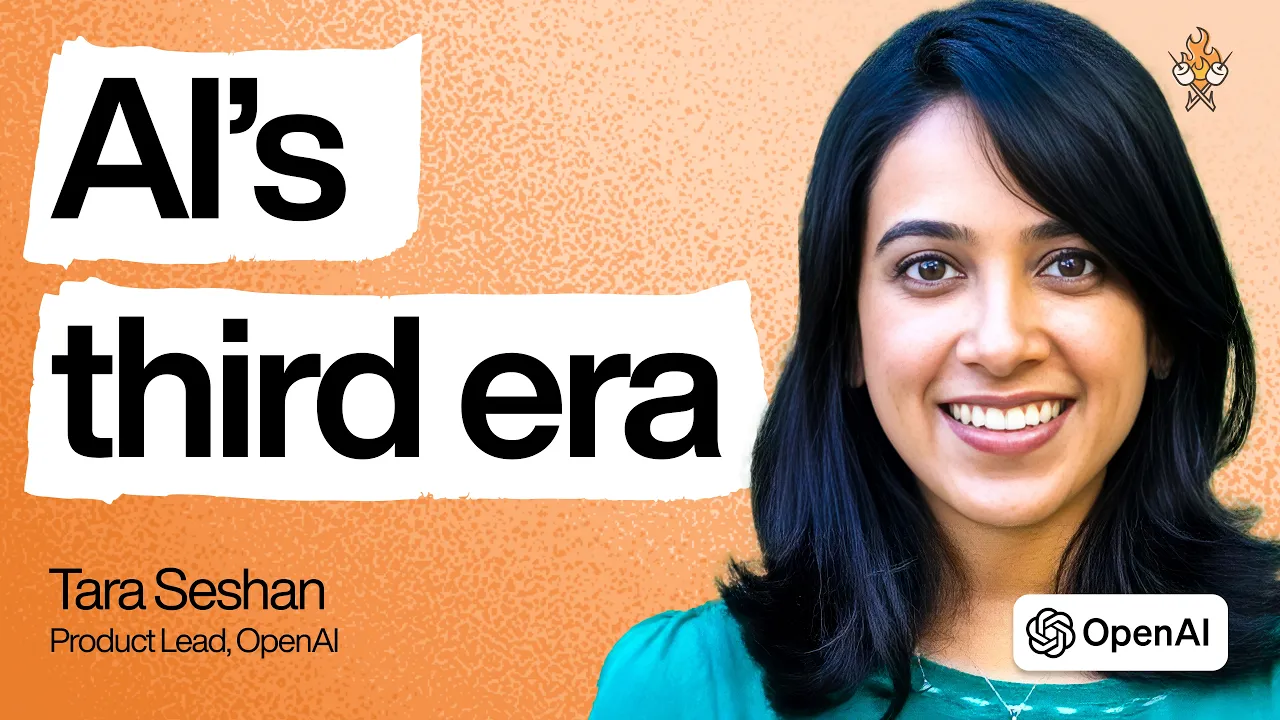
AI’s third era: the rise of persistent AI coworkers | Tara Seshan (OpenAI’s product lead)
Description
Tara Seshan leads product for Codex and ChatGPT Work at OpenAI (alongside previous podcast guest Andrew Ambrosino, who’s her engineering manager). Before OpenAI, Tara spent over six years at Stripe, where she joined as one of the first five product managers. She went on to lead product for Watershed, which Time magazine named one of the best inventions of 2022, and she is also a founder and Thiel Fellow. Most personally meaningful to me: Tara is one of the three inaugural Lenny’s Newsletter Fellows, a program I ran a couple of years ago to spotlight the most exciting up-and-coming product leaders. *In our in-depth conversation, we discuss:* 1. The shift from “rowing” to “steering,” and why human judgment and ambition will become differentiators as AI takes on execution 2. How OpenAI thinks about building for model capabilities two to three months out 3. OpenAI’s best internal memes, such as “Is this maximally accelerated?” and “Are you mainlining it yet?” 4. Why ambition is the new bottleneck for companies, and why elevating others’ ambitions is now the key part of the PM job 5. Writing as thinking vs. writing as reporting *Brought to you by:* WorkOS—Make your app enterprise-ready, with SSO, SCIM, RBAC, and more: https://workos.com/lenny Mercury—Radically different banking, now with Command: https://mercury.com/ *Episode transcript:* https://www.lennysnewsletter.com/p/ais-third-era-the-rise-of-persistent *Archive of all Lenny's Podcast transcripts:* https://www.dropbox.com/scl/fo/yxi4s2w998p1gvtpu4193/AMdNPR8AOw0lMklwtnC0TrQ?rlkey=j06x0nipoti519e0xgm23zsn9&st=ahz0fj11&dl=0 *Where to find Tara Seshan:* • X: https://x.com/tarstarr • LinkedIn: https://www.linkedin.com/in/tarstarr • Newsletter: https://substack.com/@taraseshan *Where to find Lenny:* • Newsletter: https://www.lennysnewsletter.com • X: https://twitter.com/lennysan • LinkedIn: https://www.linkedin.com/in/lennyrachitsky/ *In this episode, we cover:* (00:00) Introduction (02:18) What makes OpenAI’s cul
Summary
Generated by gpt-5.6-terraAt-a-Glance
- Verdict: Watch fully
- Core thesis: AI product development is shifting from chat interfaces to agents and then persistent AI coworkers, requiring teams to build empirically against a two-to-three-month model horizon while humans retain responsibility for direction, accountability, taste, and collaboration.
- Why it matters: This is a high-signal view from the product lead for ChatGPT Work and Codex on how frontier-agent products should be designed, adopted, validated, and operated—especially the infrastructure, UX, and organizational constraints that determine whether agent capability becomes useful work.
- Best use: Use it as an operating-model briefing for agent product strategy: shorten experimentation loops, design for persistent collaborative agents rather than one-shot chat, separate autonomous execution from human steering, and test positioning before committing to product shape.
Executive Summary
Tara Seshan argues that the industry is moving through three product eras: chat, agents that execute tasks, and persistent AI coworkers that work over time with people and eventually with teams. The key near-term design problem is not merely increasing model intelligence; it is making agents naturally useful to mainstream knowledge workers by giving them durable context, access to the right systems, reliable cloud execution, and interfaces that expose enough process for users to trust and steer them.
Her central product-management prescription is empirical speed. In fast-moving AI markets, long-range strategy is less reliable than identifying the "eigenquestion"—the single hypothesis that determines whether a product will work—and testing it quickly with users. Teams should build for models expected in two to three months, not current models and not speculative one-year capabilities. OpenAI’s cultural shorthand is to ask whether work is maximally accelerated, whether the team is "mainlining" its own product daily, and whether the scope is ambitious enough.
She sees AI changing knowledge work from rowing to steering: agents increasingly execute tactical and eventually higher-order work, while humans choose direction, make opinionated calls, remain accountable for outcomes, supply taste and expression, and coordinate other people. This blurs functional role boundaries; engineers, PMs, and designers can all contribute across disciplines, but a named DRI must still own whether the resulting product is useful, high-quality, and adopted.
The practical product lesson is that coding and knowledge work require different trust models. Code can be evaluated against tests and outputs; a financial model, strategy deck, or business recommendation cannot be trusted solely from its final artifact. Knowledge-work agents therefore need visible inputs, citations, intermediate work, relevant organizational context, and collaborative review surfaces. Seshan also distinguishes writing used to think—which she personally keeps human-led—from reporting and format conversion, which she automates aggressively.
Key Takeaways
- Claim: The next AI interface after chat and task agents is a persistent coworker model: an agent that carries work forward across multiple check-ins and can eventually collaborate with a team of humans and agents. | Evidence: Seshan describes working with an agent like a teammate: it completes a body of work, receives feedback, continues working, and syncs at intervals. She says OpenAI is exploring how colleagues can collaborate together with their agents rather than merely exchange screenshots of separate Codex threads. | Implication: Build agent systems around durable task state, iterative review, shared context, handoffs, and permissions—not solely discrete prompt-response interactions. | Caveat: She frames this as an emerging direction rather than a solved product pattern; the natural multiplayer interface and shared-agent workflow remain open questions.
- Claim: In frontier AI product development, the PM’s highest-leverage job is to isolate and test the decisive hypothesis quickly rather than construct exhaustive long-horizon strategy. | Evidence: Seshan calls the critical question the "eigenquestion," borrowing a phrase attributed to Shashir Mehrotra: identify what determines whether the product works, test it, inspect results, refine the hypothesis, and rerun the loop. She contrasts this with established markets such as payments, where more exhaustive prediction and theoretical rigor are more feasible and necessary. | Implication: For agent initiatives, replace broad roadmap certainty with a disciplined cadence of narrow hypotheses, prototypes, user trials, instrumentation, and rapid revisions. | Caveat: This is not an argument against rigor; rigor shifts from detailed future forecasting to sharp hypothesis definition and effective experimental design.
- Claim: Product teams should build for the model capabilities likely to exist two to three months ahead—neither today’s limitations nor a one-year imagined future. | Evidence: Seshan says both extremes fail: building around current-model constraints becomes obsolete, while building for a year-ahead capability is too early. She says tight communication with research is essential because product teams can understand which capabilities—such as coding or writing behaviors—research is actively improving. | Implication: Maintain a close research-to-product feedback channel; architect product constraints, UX, and workflows to survive imminent capability jumps without betting on unshipped breakthroughs. | Caveat: The two-to-three-month window is her operating heuristic in a rapidly improving model environment, not a universally stable planning horizon.
- Claim: Agent effectiveness depends as much on operational access and reliability as on raw intelligence. | Evidence: Seshan notes that local agents are useful partly because they can access data on a user’s machine. Cloud agents require substantial infrastructure and third-party-system access; an agent deprived of Google Docs, Slack, or company databases is analogous to hiring a colleague and locking them in a room without tools. | Implication: Treat identity, permissions, data connectors, cloud execution, auditability, and reliable long-running jobs as core agent-product capabilities, not implementation afterthoughts. | Caveat: More system access also creates governance, privacy, authorization, and reliability requirements that the conversation identifies as important but does not fully specify.
- Claim: Knowledge-work agents need process transparency and collaboration because their outputs cannot be validated as cleanly as code. | Evidence: For coding, users can run tests and assess whether the output works. For a deck or financial model, Seshan says users need to inspect the reasoning journey: sources, citations, inputs, in-progress work, and whether the model had the necessary context from systems such as email or Notion. | Implication: Agent UX for business decisions should include provenance, inspectable assumptions, source links, approval checkpoints, context visibility, and human review—not just a polished final answer. | Caveat: The transcript raises unresolved UX questions, including how much reasoning and intermediate process should be visible and whether a coding-style thread is the right surface for knowledge work.
- Claim: AI should expand the scope of work a person can attempt, not merely automate rote tasks; ambition becomes a competitive operating capability. | Evidence: Seshan describes individuals now being able to create designs, prototypes, pricing models, and scenario analyses themselves—capabilities previously distributed across several specialists. She cites Patrick Collison’s collection of unusually ambitious fast projects and Tyler Cowen’s prompt to ask what a 10x more ambitious or faster version would look like. | Implication: Make “what would a 10x version look like?” a recurring planning intervention, and use agents to collapse translation layers between product, design, engineering, analysis, and operations. | Caveat: The bottleneck is increasingly imagination and judgment, not only tool access; identical tools do not create differentiated outcomes by themselves.
- Claim: Use AI heavily for reporting and transformation work, but preserve human authorship for writing that is itself the act of thinking. | Evidence: Seshan distinguishes “writing as reporting”—status summaries, launch reports, and format translation—which she automates, from “writing as thinking”—strategy briefs, product theses, and arguments—which she starts and ends herself. She develops drafts to roughly 70% before seeking feedback from stakeholders, then turns thinking into mocks, prototypes, or experiment results rather than relying on long documents as proof of rigor. | Implication: Set explicit team norms for where AI may draft or summarize versus where a responsible human must formulate the thesis, own the logic, and review the final argument. | Caveat: This is a personal cognitive discipline, not a claim that every individual must avoid AI assistance in strategic writing; she does use it mid-process for research, data retrieval, and challenge questions.
Detailed Brief
ChatGPT Work and Codex: product convergence strategy
- Claims: OpenAI’s north star is to remove the need for users to choose models, harnesses, or modes; a user should describe the task and the product should select the appropriate execution system.; The current separation between Codex and ChatGPT Work is primarily a user-interface and familiarity decision, not a material difference in underlying capability.; OpenAI sees an opportunity to bring coding-agent power to a much broader knowledge-worker population without forcing those users to learn developer-oriented concepts.
- Evidence: Seshan says Work mode uses the same underlying Codex power but hides developer-specific surfaces such as work-tree detail.; She gives complex financial modeling, product pricing, and six-month revenue prediction as examples that Work/Codex can perform, noting that OpenAI’s corporate-finance team uses the capability to democratize work that previously required specialized expertise.; She characterizes ChatGPT’s evolution as bringing agents to a very large existing chat-user base, with the third era being persistent coworkers.
- Caveats: The transcript reflects a product in transition: mode selection and interface complexity still exist, and Seshan explicitly says there is more usability work to do.; The interview contains product claims and examples from an OpenAI product lead; it does not independently validate comparative performance, adoption, or reliability.
- Implications: A broad agent platform should progressively hide technical orchestration choices while preserving enough visibility for advanced users who need control.; Consumer-grade distribution may be a major route to enterprise and knowledge-work agent adoption if task delegation can be made low-friction.
Organizational operating model: founder-like ownership and outcome DRIs
- Claims: Seshan was surprised that OpenAI feels “founders-led” rather than conventionally founder-led: individuals operate with unusually little top-down direction and a thin distance from the market.; Role boundaries should loosen as capabilities converge, but outcome ownership should not loosen: someone remains accountable for whether users adopt the product and whether it is effective and high quality.; The team credits Codex’s momentum to continuous dogfooding and tight user iteration rather than a single technical or organizational breakthrough.
- Evidence: Seshan says OpenAI’s strategy and product thinking rapidly become public product or messaging rather than residing in a hidden internal strategy document.; The cultural tests she names are: “Is this maximally accelerated?”, “Are you mainlining it yet?”, and whether the team is operating at sufficient ambition.; She says desktop-team contributors independently identify deficiencies, build improvements, test whether internal users actually use them, iterate, and then ship.
- Caveats: High-autonomy, founder-like operating models require unusually capable teams and may not transfer directly to organizations with weaker ownership norms, more coordination overhead, or stricter compliance requirements.
- Implications: Measure AI-team performance through user outcomes and learning velocity rather than adherence to narrow functional job descriptions.; Dogfooding should be operationalized as sustained daily use in real workflows, with internal friction treated as product backlog input.
GTM lesson from Sutter Hill: test product-marketing fit before product shape
- Claims: Seshan’s major lesson from Sutter Hill Ventures was that product-marketing fit can precede and shape product-market fit.; For B2B products, positioning should be tested through repeated customer conversations before substantial commitment to a detailed product experience.
- Evidence: She recommends pitching roughly 100 people, iteratively refining the narrative of why the product is transformative, and only then committing to the exact product shape.; She attributes Sutter Hill’s repeatable incubation success to a playbook covering enterprise sales setup, positioning, founding-team construction, and recruiting; she specifically mentions an internal relationship-mapping tool called Reticle.
- Caveats: The transcript does not provide a complete product-marketing-fit methodology or evidence that a fixed number of customer pitches is universally appropriate.
- Implications: Before building an agent product deeply, test whether buyers understand, value, and can repeat the transformation narrative; use failed pitches to revise the wedge, category framing, and target customer.
Notable Concepts & Terms
- Three eras of AI products: Seshan’s framing: chat first, then task-executing agents, followed by persistent AI coworkers that maintain work over time and collaborate with humans.
- Steering versus rowing: The proposed future-of-work division: agents perform more execution while humans set direction, interpret feedback, make opinionated choices, and own outcomes.
- Eigenquestion: The most decisive product hypothesis to test; used as an antidote to sprawling strategy documents in a fast-changing AI environment.
- Two-to-three-month model horizon: Seshan’s planning heuristic for building product around imminent model improvements without designing around current limitations or distant speculation.
- Mainlining: OpenAI’s stronger version of dogfooding: using the product continuously in real work so builders experience and fix its actual friction.
- Writing as thinking vs. writing as reporting: A boundary for AI use: preserve human-led strategic reasoning and use models extensively for summaries, status reporting, retrieval, and format conversion.
- Mocks/prototypes, not docs: In AI product work, an interactive artifact or experiment result is often a stronger communication and decision tool than a polished long-form strategy document.
- Product-marketing fit: The idea that a validated positioning narrative can and should be tested before committing to the detailed product experience, particularly in enterprise markets.
Operator Notes / Why Ken Should Care
- Create an agent-product readiness checklist covering persistent state, cloud execution, connectors, least-privilege authorization, audit logs, approval gates, source provenance, and failure recovery before treating model quality as the sole blocker.
- Require every major agent initiative to name one eigenquestion, a short test cycle, measurable success criteria, and a designated human DRI accountable for the user outcome.
- Adopt a two-speed artifact practice: use AI for operational reporting and synthesis, but require human-originated strategic memos and final decision logic for material bets.
- Run a recurring “maximally accelerated / 10x ambition” review on roadmap items: identify work that agents now make feasible across design, analysis, engineering, and operations.
- For knowledge-work workflows, do not approve black-box final outputs alone; require traceable sources, assumptions, context coverage, and a human review path appropriate to decision risk.
- Test positioning before building deeply: conduct structured buyer conversations around the transformation narrative, record objections, and revise the product wedge before locking implementation scope.
Source/Metadata
- Title: AI’s third era: the rise of persistent AI coworkers | Tara Seshan (OpenAI’s product lead)
- Transcript words: 24814
- Duration seconds: 4904
- Timestamp note: No usable timestamps or chapters were present in the supplied transcript. The transcript also contains substantial duplicated passages and ad reads.
Transcript
If you think about the first era of AI products as chat, the second era of these products working with agents, that third era that might come soon is how do you work with a persistent co-worker who is able to get things done with you? There's this idea of the overhang of what AI is capable of and what we're actually doing with it. So hard to understand what is going to emerge in the future. You fail if you build for where the models are now. You fail if you build for where you think the models will be in a year. Both outcomes are equally wrong. The only way to build is two to three months. What if you had to most adapt to and adjust in how you operate as a PM in this world? Being prolific and empirical is way more important than being academic or theoretical. Rather than writing out some long reasoning docs, instead it's, how do I get to something I can try out and test with users as fast as possible? It feels like not only are we able to be more ambitious, we almost need to be more ambitious, which is not natural for a lot of people. Elevating others' ambitions or reminding them of what's possible here is a huge part of the product management role. I'm curious what's most surprised you about what it's actually like to work at OpenAI. I came into the company expecting that there was a treasure trove of OpenAI secret strategy. And actually, OpenAI is open. Today, my guest is Tara Seishin. Tara leads product for both Codex and JATGPT work at OpenAI. I believe this is the fastest growing and arguably most important AI product for knowledge workers today. Tara works alongside Andrew Ambrosino, who was a recent podcast guest. He's her engine manager. Prior to OpenAI, Tara spent six years at Stripe, where she joined as one of the first five product managers. And for many of those years, she was named one of the top three Stripes across the entire organization of Stripe. She also led product at Watershed, was a founder and a Teal Fellow. And most importantly of all, Tara was one of the three Lenny's Newsletter Fellows, which is a program that I ran a few years ago to highlight some of the most amazing up-and- coming product leaders. I am so excited to see Tara in this new incredibly important and impactful role. Before we get into it, don't forget to check out lenny's productpass.com for a free year of the hottest and most beautifully crafted AI products in the world, available exclusively to Lenny's Newsletter subscribers. With that, I bring you Tara Seishin. Tara, thank you so much for being here, and welcome to the podcast. Thank you, Lenny. I'm so glad to be here. It's so nice to see you. I'm even more glad. So you've been at OpenAI for just about a year now, which in most places would be a very short amount of time. In AI time, that's like a lifetime. Yes. I imagine when you joined OpenAI, you had a sense of what it was going to be like to work at a frontier lab. I'm curious what's most surprised you about what it's actually like to work at OpenAI, and ideally both good and bad stuff. So many things about working at OpenAI felt familiar to me because I had worked at other places that were high-growth, high-talent, high-intensity, hyperscaling-mode places before. And so some of the things like, oh, my colleagues are so awesome, or the urgency is really high, felt very familiar. The part that actually felt the most surprising is that many companies I've worked for, in fact, all the companies I've worked for in the past, have been founder-led. And OpenAI is actually founders-led, which is that everyone inside the company, especially in their area, is in essence a founder to some extent. The level of top-down direction at OpenAI is extremely limited relative to places I worked for prior. And so I think when I first got to the company, that was both delightful and that I had come from a founding journey before, and I was like, yes, I can continue to feel like the founder of this product area or this team. And the distance between me and the market is very, very thin. Sometimes at a larger company, you feel insulated from what users want or feel insulated from what the market demands. But actually at OpenAI, you do not at all. You are doing everything it takes to get product-market fit for your product, akin to how a founder might. But the counter to this is that, or maybe the more surprising side of this, is I came into the company expecting that there was a treasure trove of OpenAI secret strategy that I would be able to understand, akin to how at past companies you come in and you're like, ah, yes, this is the payments Bible, and this is how we think about payments and operations. And actually OpenAI is open. Every sort of thought that exists in terms of this is how the world should look or this is how products should be built or this is how the model should operate very, very quickly becomes a part of the public product or a part of the public messaging. And so that, to me, was incredibly both positively surprising and a change in my operating mode for sure. Aaron Powell Telling us there's not the secret room with AGI running there with the master plan that has all the answers. At least I'm not in that room, for sure. But I think the piece that is really inspiring to me is that so much of what OpenAI does immediately becomes something that users can touch and feel in the product. And that cycle is faster than anywhere else I've seen. Aaron Powell This episode is brought to you by our season's presenting sponsor, WorkOS. What do OpenAI, Anthropic, Cursor, Replit, Sierra, Clay, and hundreds of other winning companies all have in common? They are all powered by WorkOS. If you're building a product for the enterprise, you've felt the pain of integrating single sign-on, skim, RBAC, audit logs, and other features required by large companies. WorkOS turns those deal blockers into drop-in APIs with a modern developer platform built specifically for B2B SaaS. WorkOS Literally every startup that I'm an investor in that starts to expand upmarket ends up working with WorkOS. And that's because they are the best. Whether you are a seed-stage startup trying to land your first enterprise customer or a unicorn expanding globally, WorkOS is the fastest path to becoming enterprise-ready and unblocking growth. It's essentially Stripe for enterprise features. Visit WorkOS.com to get started or just hit up their Slack, where they have actual engineers waiting to answer your questions. WorkOS allows you to build faster with delightful APIs, comprehensive docs, and a smooth developer experience. Go to WorkOS.com to make your app enterprise-ready today. You've been a PM at a lot of different places, a long-time PM leader. What do you lose in this new world? When a market is more static or a market is more slow-moving, you have the chance to actually do some grand strategy-esque work because it's more predictable. Or you can at least understand all the pieces. As an example, payments is certainly a dynamic market to some extent. It's also an established market. And you're able to say, ah, yes, if I take this bet, my competitor might take this other bet, or reason from first principles very rigorously through what all the next actions might be. And in fact, the nature of that market mandates that you do that. Winners will think more rigorously than everybody else. And if you aren't thinking rigorously, it shows up as carelessness because a lot of those decisions that you made could have been predicted. But in this market, it's so hard to understand what is going to emerge in the future. It's very emergent. It's very fast-changing. It's really dynamic. And most importantly, it's very, very important to stay tied to the research. And so actually being prolific and being more empirical is way more important than being more academic or theoretical. And I think lots of the past companies I've worked at have been very academic and theoretical places. And it was a real switch to go from, rather than writing out some long reasoning doc, almost like a PhD thesis of what I think should be the plan for the next N amount of time, instead it's, how do I get to something I can try out and test with users as fast as possible? And so, yeah, that switch from theoretical to empirical felt very jarring at first. I was like, oh, am I not doing my due diligence here? Am I not being thoughtful enough? Like, shouldn't I be thinking through all of this in a ton of rigor? But actually, you've got to try stuff and learn as much as possible. And what that means is the thinking you need to do is being as pointed as possible about what your core hypothesis is. And that hypothesis definition is the most important thing. What is actually, to use the Shashir Rahulchow phrase, the eigenquestion? What is that specific most important thing to test, and everything else, any other grand N amount of time. Instead, it's how do I get to something I can try out and test with users as fast as possible? And so, yeah, that switch from theoretical to empirical felt very jarring at first. I was like, oh, am I not doing my due diligence here? Am I not being thoughtful enough? Shouldn't I be thinking through all of this in a ton of rigor? But actually, you've got to try stuff and learn as much as possible. And what that means is the thinking you need to do is being as pointed as possible about what your core hypothesis is. And that hypothesis definition is the most important thing. What is actually, to use the Shashir Rahulchow phrase, the eigenquestion? What is that specific most important thing to test? And everything else, any other grand strategy you concoct, is not relevant. I'd love to hear more about that because that's really interesting as almost like here's the thing of the PM role that is not changing. So much is changing. The world is changing. But there's still this piece that is even more important. Speak more to that of what specifically you think people need to focus more on. Yeah, there were so many trappings around the PM role of running execution on time and writing all these specific docs and presentations, etc. But the core of it has always been about what is the most essential question you need to ask about your product? What is the thing that will determine whether your product works or doesn't work? How do you test that? How do you look at the results? And how do you feed that back into a loop of refining your hypothesis and running it again? That truly has always been the PM job. And that involves, of course, trying to understand users, trying to understand the market, trying to understand the actual technology you're building, pulling those three things together to make the sharpest hypothesis you can, and then making the test as fast and effective as possible. And I think that has not only not changed, but it's become the most important thing at the company to be able to do. EMs are thinking this way. Engineers are thinking this way. Data scientists are thinking this way. Designers are thinking this way. Everyone has moved to focus their efforts on this really, really important problem definition and testing loop. What are we actually doing, and how do we know if it's working? And from a PM standpoint, it's great because PMs have always been really focused on trying to get that stuff right. That has always been the core of the job. And actually, many of the other trappings of the job have fallen away. And that remains the key thing to get right every time. Jason Tucker Lassenberger You mentioned this idea of a loop. And there's a lot of talk these days. Loops were so hot, I don't know, a few weeks ago on Twitter. And it feels like it continues to be a topic of discussion for knowledge work broadly. And the way I understand a loop, you essentially say, AI, here's what success looks like. Go off and build and figure it out until you achieve success. How do you think about this idea of loops expanding from just software engineering to product management to all knowledge work? Do you think that's going to be a thing? I do think that increasingly the future of work will look more like steering than rowing, in the sense that there will be agents that you'll be able to work with that do a lot of the rowing. And your role increasingly becomes steering the ship in the right direction and pointing it in the right direction. And to that point, I think that steering might grow higher and higher and higher level. The steering used to be at the level of, I wrote this line of code, press tab to, oh wait, now I'm directing something a little bit more comprehensive to maybe the goal level, maybe to an even higher level. I think the steering will continue to maybe go up layers of abstraction. But ultimately, I think it's still on a person to be able to find which direction are we pointing this in and, given feedback and additional data, where do I want to take this thing next? Some of steering, I think, is certainly about what the data tells you, but a lot of it is about making an opinionated call. I think sometimes we underrate that power of intuition or even positive determinism of what we want the future to be like, picturing, hey, I would like the product to look this way, not because the converse is not an equally viable strategy, but because I would like the world to look like the direction that I'm pushing it in. And that, I think, will always remain an opinion, at least right now, that is required from a person. And so I think that loops are awesome. Running agents in increasingly larger loops where they're doing more and more of that rowing for you is great. But right now, you really still need to steer. And I think work will also look like steering with other people over a group of agents that you guys work with together. Bringing in other teammates into that interaction between you and the agent where it's rowing and you're steering feels also incredibly valuable. That's such an interesting way of describing it. There's also two thoughts here that come up. One is if everybody has access to the same tools, the thing that will separate you is the human, the person, basically. Otherwise, we're all just going to be building the same thing. Everyone could be asking, how do we win? What do we do? And then the thing, the unfair advantage almost, is the human brain. Yeah, I think it reminds me a lot of fashion, actually, in some ways. There are certainly functional clothes that everybody can wear, and it gets the job done. But so much about what you wear, at least how I think about what I wear, is about what statement I want to make about my individuality or how I want to reflect to the rest of the world. And a lot of what makes that compelling is how it contrasts with other people's expression. The shirt I make makes a statement only because it is maybe different than what everybody else is doing or different than what some cohort of people are doing or makes a statement about my group membership or something of that kind. I think a lot of the products that we build feel similarly opinionated and artistic. Patrick Halson has this really nice statement, or maybe it's John Callsen, about software, which is that software is not like real estate. You don't put money in and get value out. It is a little bit more like filmmaking, where you can put a lot of money into a film, but that doesn't guarantee that the film is successful or good. There is some auteur statement or some opinionation and artistry that goes along with it. And I think that relies on you having something interesting to say or your team having something interesting to say about your product. There's something Marty Kagan is big on, which is this idea that when you have an idea for a product or feature, rarely is that idea the thing that ends up being it. There's this whole process that you go through to kind of figure out what the hell actually it should be. And it feels like that's kind of what you're saying here. You need to go through that process as a human to understand what it really is and what people actually want. It's never going to be like, okay, got it. Go build this thing. I got it from the beginning. Yeah, for sure. For sure. And that loop, those loops, are moving faster and faster and faster. And so your ability to form those intuitions, get the information you need to form those intuitions, and then use that to help you with people and agents to put that into action is the key. I'm curious what you think the next shift will be in how we work broadly as knowledge workers. It feels like not only do you have access to the most advanced tools that some people don't get, but also you work around the most AI-pilled, AI-forward people in the world. How are people working internally that you think will become kind of a more normal way we all work using these AI tools in the next, I don't know, three to six months? Yeah, I think there's two aspects to this. One is continuing to work with agents at higher and higher levels of abstraction, so letting the agent do more and more for you independently, coming in, providing that steering, and then letting the agent continue to cook. Let the agent cook and provide details at higher orders of abstraction feels like the way. People are increasingly thinking about agents that are persistent, that feel like teammates, that feel like co-workers, where you can work with them the way I might work with someone on my team, which is they do a whole bunch of work, I provide input, and then they do work again. We sync up at different cadences, look at each other's in-progress work, and provide more and more feedback. It feels like that co-worker model is the way that things In the next, I don't know, three to six months. Yeah, I think there's two aspects to this. One is continuing to work with agents at higher and higher levels of abstraction. So letting the agent do more and more for you independently, coming in, providing that steering, and then letting the agent continue to cook. Let the agent cook and provide details at higher orders of abstraction feels like the way people are increasingly thinking about agents that are persistent, that feel like teammates, that feel like co-workers, where you can work with them the way I might work with someone on my team, which is they do a whole bunch of work. I provide input, and then they do work again. We sync up at different cadences, look at each other's in-progress work, and provide more and more feedback. It feels like that co-worker model is the way that things are certainly going. It feels like a much more natural interface for us to be able to work with agents. And we already see a lot of that internally as well. The second is that a lot of my work with agents thus far has been one-on-one. I work with my agent, maybe it spawns some sub-agents to get some tasks done, but it's me and my agent together. And that is potentially divorced from what my colleagues are doing with their agents. And so there was a time where everyone internally was just sending their codex threads, screenshots of their codex threads, to each other on Slack. And we're like, okay, well, I wanted to share with you how I got to this number. Here's how I got to this number. Here's a screenshot of what I did. But that's also not quite the most natural way for someone to collaborate together. And so as more and more work gets done with our agents, shouldn't we be able to get work done with our agents together? And what is the most natural interface to make that happen? And those are some of the things that we're thinking about. Chat is what I'm picturing. That makes so much sense. It's like, okay, here's Tara's agent. Here's my agent. She did some work on some analysis. I'd be, hey, my agent, Lenny's agent, go check, make sure this is legit and connects to the way I think about the world. Ideally, work feels like a multiplayer game where all of us together are getting stuff done, steering our agents as our agents continue to take care of more and more of those rowing tactical tasks. It's interesting how it's just been this slow progression of trust and awareness that this can be how we work. Just this, okay, go work for longer. You can take on more. It's just like, you feel there's been this talk of the slow takeoff, the fast takeoff scenarios, and everyone's afraid of this fast AI takeoff where it's way too smart and now we're in big trouble. It feels very much like we're on the slow takeoff scenario, which is good. We're just slowly iterating. It doesn't feel that slow, but in a sense, we're not at some 300 IQ AI. I mean, the models are incredibly smart, but I think a lot of the things that have enabled us to then work with our agents together or have the agents take care of higher and higher order abstraction things certainly are about the intelligence, their ability to perform long-running tasks, and how long they can stay on task. But also, actually, there are very meat and potatoes tactical things that make this possible. Agents working locally are really convenient because they have access to all the data that's on your machine. To make an agent successful in the cloud, there is a ton of cloud infrastructure that you have to build to make that possible and just access to your systems. How can agents talk to all these third-party systems that have all of your data? Just like a colleague who you hire, who you lock into a room, never give them access to Google Docs and Slack and the company database, would not be that useful to you. Similarly, a cloud agent that is similarly isolated will not be that effective. And so a huge part of making these agents useful and achieving some of these futures are on the intelligence side, certainly, but a lot of it is also just really tactical, like data access, cloud infrastructure, and reliability pieces that feel much more prosaic than some of the broader intelligence questions, but matter in some ways just as much for end effectiveness. This touches on something else that has been coming up a bunch on this podcast, this word ambition. I know you think a lot about this too. It feels like not only are we able to be more ambitious because of these AI tools, we almost need to be more ambitious, which is not natural for a lot of people because everybody can now do all these easy things really easily. Easy stuff is super easy. The hard stuff is easy. And the thing that separates people now and companies now is just how ambitious they can be. Talk about what comes up when I talk about the need and the emergence of this need for ambition. Yeah, I think the people that we see who are most effective at using AI tools don't simply use it to automate rote tasks, but use it to expand the set of things that they are capable of doing. Back in the day, before all this AI stuff, the unicorn person was someone who was a really thoughtful product sense person who also happened to be an engineer, who may also have been a designer. That person was always the unicorn hire because they were able to really flatten the layers of translation needed between all these functions and were able to build something or ideate something really quickly and easily themselves and get it up and running, and then were able to work with a team and collaborate with a team on it. And I think the most compelling thing I found, that certainly I try to be able to do with these tools and I've seen some of my most successful colleagues be able to do with these tools, is really expand the set of things that are quote unquote within their range of possibilities so that they can start realizing more and more of what's in their head into reality the way that someone who was previously a jack of all trades was able to do. We kind of all have that superpower now, that I can spin up a set of designs on something, and I can go build an initial prototype of it, and I can figure out the right pricing model for it and model out all the scenarios. Really, the set of possibilities has widened dramatically. And actually, what that means in so many ways is that I have the ability to, to that point earlier about film, be more of an auteur as I try to get something done and realize my vision maybe to higher fidelity. And that, to me, is part of what can elevate your ambitions while pursuing new ideas and new products, because all these things are now within reach, because this new set of capabilities is now within your reach to be able to try and access. You're not really limited. Your ambitions are no longer limited by what you're capable of executing yourself, what you're capable of communicating. It can be so much wider. I think the hardest part about doing this is simply just expanding your thinking. Actually, the capabilities have expanded so dramatically, it is really expanding your thinking of what's possible in an unreasonably short time frame. And to me, the best way of trying to do that is Patrick Hallzen has on his website, patrickhalsen.com/fast, I think, all of these projects that were unreasonably ambitious, that were executed in a really, really short time period. And what, for me, is now remarkable about that list of projects is that they all existed before these tools made it possible for you to learn how to build something almost instantly or ask it with one question. Hey, can you summarize this very complicated text or this very complicated book for me immediately? Or can I try to do all of these things that were previously impossible to me but now I'm able to do? Like, can you make for me a CAD model of this idea that I might have? Really, capabilities that were truly beyond my reach are now in my reach. And so if those fast projects were possible before with the capabilities we used to have, shouldn't we just see an exponential increase of the number of those types of unreasonably quickly and effectively executed things with what AI has given us? To your point, the hardest part is just remembering even to try, just to be like, oh yeah, let me see if Codex can do this for me. It's just a new habit, a new thing we have to build in our brain. Tyler Cowen has this statement on his site, which is that most people underrate the impact of going to someone else and saying, hey, what is the more ambitious version of what you're doing? Or couldn't you try this faster? Or couldn't you try this at a 10x bigger scale? And in some ways, again, when I think of what PMs do that is incredibly effective now, or what can they do that is incredibly effective now, I think elevating others' ambitions or reminding them of what's possible here is a huge part of the product management role. Like when folks say, hey, I think we can get this done in To your point, the hardest part is just remembering to even try, just to be like, oh yeah, well let me see if Codex can do this for me. It's just a new habit, a new thing we have to build in our brain. Tyler Cowen has this statement on his site, which is that most people underrate the impact of going to someone else and saying, hey, couldn't you, what is the more ambitious version of what you're doing? Or couldn't you try this faster? Or couldn't you try this at a 10x bigger scale? And in some ways, again, when I think of what do PMs do that is incredibly effective now, or what can they do that is incredibly effective now, I think elevating others' ambitions or reminding them of what's possible here is a huge part of the product management role. When folks say, hey, I think we can get this done in this way, or we can get this done by this timeline, or maybe this is the first version of it, part of your job now is to elevate everyone's ambitions and say, actually, isn't the possibility ceiling meaningfully higher? Shouldn't we be more ambitious about what we're attempting here, or couldn't we try this faster? And I think that's a great place to be. It's a great place to be in terms of what you can build, what's possible, and in terms of how exciting the job becomes. That is so interesting. I remember Nick Turley was on the podcast, who maybe had the role before you. I think he's working at enterprise stuff now. He had this meme internally: is this maximally accelerated? Yes. There's an emoji, I think, inside the Slack: is this maximally accelerated. Is this maximally accelerated is totally an OpenAI meme. The other OpenAI meme that Andrew and Brzeeino and I love to ask the team is, are you mainlining it yet? Which is, are you using this product all day, every day to get your thing done? And I think that, in combination with are we being as ambitious as possible, which is about the scope and the scale of what you're trying to do, are we moving as fast as possible on it, and then are you mainlining it yet? Are you using it, and are you bringing all your taste to bear on whether this thing works and is something that people really want, and tightening that feedback loop as much as possible? Those, to me, are the three memes of product development that we just have to spread as much as possible now. I love that. That's like the new dogfooding. Instead of dogfooding, you got to mainline it. Yeah, exactly. And that shows so deeply in the tweets. This is mostly how I see your team communicate, of just how obsessed they are with the product and are just constantly asking, what can we do better? What's bugging you now? Here's the thing we're building. It's very clear, to your point earlier, that everyone is just the founder of their product, and it's very clear how they act as an external observer. Are there any other memes internally? Those are so interesting. Any others? I don't know. Yeah, I'm trying to think if there's other good cultural memes. Certainly a really important one is feeling the AGI, or just being conscious of AGI coming. There are so many outcomes for what it could look like or how one thinks about it. But a huge part of what puts most people at this company is believing in that mission of AGI being beneficial and trying to do whatever it takes to make that possible, both realization of AGI and ensuring that it is beneficial for humanity. And in building products, another constant refrain I have to keep in the back of my mind is, are we building for where the models are going to be in two to three months? You fail if you build for where the models are now. You fail if you build for where you think the models will be in a year. Both outcomes are equally wrong, and I'm sure many people have talked about this, but both outcomes are really equally wrong. If you're too early, you're wrong. If you build something that was overly focused on a past model's capabilities, you're entirely wrong. The only way to build is two to three months, and having this beam of models are going to get way better. I need to think about the model capability as the center of this product. I need to get out of the way of the model in terms of the product constructs that I create. How do I ensure that this is right for the model in two to three months' time? How do you know what two or three months is like? It's a challenging understanding, especially while we're on this exponential. Is it just a gut feeling? Is there anything the researchers give you a sense of? How does that work? Yeah, certainly communicating really tightly with research on where they think things are going is incredibly important. These things aren't entirely a black box, in that you kind of know, hey, we're focused on these particular things. We would like models to be better at coding in these specific ways or better at writing in these specific ways. So we certainly have focused efforts on making the model better at specific capabilities. And so knowing where that is and ensuring that product development is as tied as possible to what research has as its agenda and its roadmap is really important. A quote that I'll never forget is when Kevin Weill was on the podcast. He was chief product officer at that time. He said that this is the worst the models will ever be. And it sounds so simple, but it's hard to just wrap your head around that, that this is the worst they will ever be. It's such a cliche almost now to say that, but it's true. It's absurd. This is absurd. It's absurd. No, man. OK, I want to talk about ChatGPT the app briefly. OK, so I have it open right now. Yeah. OK, so here's what I see in it. ChatGPT, and then there's a dropdown, and there's ChatGPT and Codex. And then there's this toggle, chat and work. Tara, what is going on? What are all these things? Help us understand what each of these things are for. And where do you think this goes? Is it going to stay like this? Is there a next step that you're imagining already? Our north star here is that users do not need to make decisions between all these different options. Ideally, there is no toggle here, that you go to the box, you type in your task, like I would like to build a really awesome app that, I don't know, helps my podcast guests do research before episodes or something, and it will just pick the right harness. It'll pick the right model for you to be able to get that thing done. Ideally, the choice here is not on our users to have to pick between all these different concepts and understand not only what are they trying to do, but understand the limitations and capabilities of our products. So that is certainly where we want to go in the near term. Picking between ChatGPT and Codex is really a choice for, do you want to stay in a more development-oriented UI, or do you want to have the same power and capabilities in the ChatGPT mode? And so if you're a Codex user, keep using Codex, you're not missing out on anything. Continue using it as much as possible. But if you're a ChatGPT user who is like, what are these new agent capabilities, you should probably be in ChatGPT mode. And then when you're in ChatGPT, if you want to have conversations, if you want to search, that's where chat mode is the right thing. It's the same chat mode, you know and love, with better and better models and newer capabilities every time. But in work mode, that's where, under the covers, this is Codex. We've removed some of the coding UI, like you're not going to see a work tree pop up all of a sudden in work mode, but it is the same power to get things done, to, for example, generate a really complex financial model. That's all possible in work mode. And we see people, especially, I mentioned our corporate finance team, use work mode to do incredible things that were previously either manual or required deep expertise from one person on the team, become things that the whole team can be able to execute, or just elevate the ambitions of everyone on the team in terms of timeline or capabilities or frontier of what they can get done. Okay, that's really helpful. So there's kind of these three modes. Currently, there's the engineering mode, the chat mode, and then the do-knowledge-work mode. And the knowledge-work mode, it's actually Codex doing all that work, but people may not know what Codex is, may be afraid of it. Is there anything in that work mode that's not just Codex? Because that's actually really interesting. Is there additional harness tweaks to make it feel a little different, or is it just the same thing with a little different UI? That's all possible in work mode. And we see people, especially our corporate finance team, use work mode to do incredible, incredible things that were previously either manual or required deep expertise from one person on the team, become things that the whole team can execute, or just elevate the ambitions of everyone on the team in terms of timeline or capabilities or frontier of what they can get done. Okay, that's really helpful. So there's these three modes. Currently, there's the engineering mode, the chat mode, and then the do knowledge work mode. And the knowledge work mode, it's actually Codex doing all that work, but people may not know what Codex is, may be afraid of it. Is there anything in that work mode that's not just Codex? Because that's actually really interesting. Is there additional harness tweaks to make it feel a little different, or is it just the same thing with a little different UI? It's really at the UI level. So work mode and Codex mode, if you go to Codex and ask it to generate an amazing financial model to price your product or something like that, or tell me, predict my revenue for the next six months or something like that, Codex will do as good a job as work mode. It's really about, whilst it's doing so, what kind of UI do you want to see in the chain of thought? What kind of technical detail do you want exposed to you? It's incredible. It's similarly powerful. And so Codex users aren't missing out on anything by not switching modes. In fact, we do not want them to stay in Codex and do all the stuff you want to do in Codex. And we will show you the appropriate UI based on the things you asked for. Truly our North Star is to merge all these things so that users don't have to make any of these decisions. The separation is really more about how can we meet people where they are as much as possible in terms of the products that they use, in terms of their familiarity with concepts, and make sure that we are enabling everyone to take advantage of working with agents, which has transformed entirely the way every single developer works. We should do the same thing with knowledge work. It makes sense. There's this, because things move so fast, I would imagine somebody's like, let's try Codex. This is going to be awesome. And then it takes off and there's 10 million monthly active users. And then they're like, wait, what are we doing here? We got ChatGPT, we got Codex. How do we... So it makes sense why these things, it's not going to feel obvious and perfect for a while because you have to adjust as things work and things don't work. And there's these transition periods of, okay, cool. Now let's get people moving towards this vision of the super app, let's say. Okay. I imagine one of the hardest parts of your job is balancing this 100 billion MAU product, ChatGPT, maybe the most successful consumer product in history, with Codex, which is this new thing, and other new things that you guys want to try. How do you think about that? Just balancing these very innovative, fast-moving teams and products with this, okay, there's a billion people using this. We can't change this dramatically. Yeah. I think one of the most interesting things here is that one of the goals of launching work in ChatGPT web and launching it in the desktop app and bringing these things together was to look at those billion people who are using ChatGPT and bring them more and more of the agents' power. If you think about the first era of AI products as chat, the second era of these products is clearly working with agents and primarily has been coding agents. We'd like to bring it to more domains, certainly knowledge work. And that is part of the goal of giving all these billion chat users the power of work. Certainly the product challenge that's on us is how do we not only bring it to them, but make it natural and easy to adopt, make it not a decision they have to explicitly make. We can just help them do the right thing. How do we decomplexify it so they don't need to think about things like harnesses, which feel like crazy concepts for a billion consumers to understand? That is primarily the challenge. And then, of course, that third era that might come soon is how do you work with a persistent co-worker who is able to get things done with you, maybe collaboratively with other people? And so part of this challenge in the near term is we're introducing agents to a billion people who may not have experienced them yet. How do we do so in the easiest, most natural, and most usable way possible? Certainly there's a lot more for us to do to make that happen. But part of this is also a lesson I've had, maybe contrasting pre-AI era or past product experience with this one, which is at previous companies, polish was king. wir wir wir wir wir wir wir wir wir wir wir wir wir wir wir wir wir wir wir wir wir wir wir wir wir wir wir wir wir wir wir wir wir wir wir wir wir wir wir wir wir wir wir wir wir wir wir wir wir wir wir wir wir wir wir wir wir wir wir wir wir wir wir wir wir wir wir wir wir wir wir wir wir wir wir wir wir wir wir wir wir wir wir wir wir wir wir wir wir wir wir wir wir wir wir wir wir wir wir wir wir wir wir wir wir wir wir wir wir wir wir wir wir wir wir wir wir wir wir wir wir wir wir wir wir wir wir wir wir wir wir wir wir wir wir wir wir wir wir wir wir wir wir wir wir wir wir wir wir wir wir wir wir wir wir wir wir wir wir wir wir wir wir wir wir wir wir wir wir wir wir wir wir wir wir wir wir wir wir wir wir wir wir wir wir wir wir wir wir wir wir wir wir wir wir wir wir wir wir wir wir wir wir wir wir wir wir wir wir wir wir wir wir wir wir wir wir wir wir wir wir wasn't exactly correct, you might as well not ship it. But I think what's been really compelling and interesting about this era and this product experience has been getting the product in the hands of users when you have so much conviction that, hey, it's transformative, is way better than perfect. And that urgency and that introduction of that product is so important. So we have a lot to do to make it more usable and easier for chat users, certainly, especially for folks who are not maybe even using it for productivity but using it for consumer tasks. But yeah, done is better than perfect, and we have so much more to do. Yeah, I remember when this app first launched, there was a lot of comments about the confusion, and seeing how quickly the team iterated and responded to the feedback is exactly what I'm hearing here, is get it out, figure out what's not working, how people are using it, iterate quickly. Feels like that's the model now. And of course there are things that you can continue to iterate and get that feedback prior to launching, and there's a lot that we can and should always do better, but iterating as quickly as possible, listening to the right signals, regardless of whether that's pre-launch, post-launch, ideally pre-launch, is the key thing. This episode is brought to you by Mercury, radically different banking. Now with Spend. I've been a Mercury customer for so many years now. I switched all my business banking to Mercury, and honestly I could not be happier. It's what online banking feels like when it's built by product people, not by bankers. And now with Spend, you can give your team individual cards, set spending limits per person or per team, and have expense receipts automatically pulled in from Gmail or over text. You can even give your AI agents their own cards with their own limits and policies. Most founders start out the same way: one card used by everybody at the company. It works until it stops working. Someone goes over, a receipt disappears, you spend two days trying to figure out who spent what and why. Spend is expense management built directly into Mercury. All your team's cards, budgets, and reimbursements all live in the same place as your business banking. No chasing, no manual reviews, no end-of-month scramble. The result is a team that can move fast and a founder who is no longer the bottleneck. Learn more and get signed up at mercury.com. Mercury is a fintech company, not an FDIC-insured bank. Banking services provided by Choice Financial Group and Column N.A., members FDIC. The IO Card is issued by Patriot Bank, N.A., member FDIC, pursuant to a license from Mastercard International Incorporated. Something I've noticed on Twitter is there's definitely been this vibe shift from Claude Code to Codex in the past few months. It used to be everyone was Claude Code this, Claude Code that. More recently, it just feels like people are leaning now towards Codex, at least on Twitter, which is a bubble, but that's where a lot of tech people are. I'm curious what's shifted internally in the past, I don't know, three to six months, other than Tara joining and shaping up the ship. Is there anything that you can share that's just like, okay, we figured this thing out, we shifted this, we cut this thing? What helped shift the vibes and help Codex become as successful as it is becoming? You know, I think there's this phrase, which is before enlightenment... group and column NA members FDIC. The IO card is issued by Patriot Bank and a member FDIC pursuant to a license for Mastercard International Incorporated. Something I've noticed on Twitter is there's definitely been this vibe shift from cloud code to Codex in the past few months. It used to be everyone was cloud code this, cloud code that. More recently, it just feels like people are leaning now towards Codex, at least on Twitter, which is a bubble, but that's where a lot of tech people are. I'm curious what's shifted internally in the past, I don't know, three to six months, other than Tara joining and shaping up the ship. Is there anything that you can share that's just like, okay, we figured this thing out, we shifted this, we cut this thing? What helped shift the vibes and help Codex become as successful as it is becoming? I think there's this phrase, which is, before enlightenment, carry water, chop wood. Post-enlightenment, carry water, chop wood, sort of thing. And actually, with the Codex app, the team who initially got it up and running and were working on it were, super again, user-focused, tight iteration loop, really dogfooded the thing, mainlined the app as much as possible to get everything right. Folks started to realize that was happening externally, and on Twitter, and users started to really notice. But the team was always really focused on users, really focused on that iteration, and it was merely, to some extent, like the market catching up. That was the change, and that process has not changed internally. Everyone still constantly uses the app. Everyone who's building it, obviously as a developer, is using it for development and is constantly fixing not only their own problems, but trying to listen to other people in the company's problems and user problems. Actually, what's remarkable is that the mode of operating hasn't changed. It's always been the same thing. I had mentioned earlier, are we elevating our ambition sufficiently? Are we maximally accelerating progress? And are we mainlining it as much as possible? And I think it's great that users and folks on Twitter have noticed, but that operation, full credit to the team, that hasn't changed. What's really interesting about this answer is the very human part of it. It's you, it's Andrew, it's Tibo, it's the team just being obsessed with the customer of the product. It's not like AI was the answer. It's the humans that made the difference. Yeah, the team deserves full, full credit here. Everyone on the team is incredibly thoughtful and independent, to the point of there are many founders at OpenAI. Almost everyone on that team, the desktop team especially, acts like founders and cares about every piece and every detail. And when they notice an area that should be better, they go build it very independently and get the thing up and running. And if it doesn't test well internally, people aren't using it, people don't find it useful, they'll iterate on it and then finally ship it externally. But that loop is full credit to people on the team and individuals for making that happen. Something you touched on is this idea of roles overlapping, this idea of engineers doing PME work. You're probably shipping prototypes and building, maybe shipping to production, I don't know. It feels like that also creates a lot of challenges. I hear from a lot of people, like what is my job now as a designer? What am I responsible for? What am I not responsible for? As a marketer, what am I doing? Is that something you notice? Is that something that you're dealing with? Just any thoughts along those lines. I think the thing I've always liked the most about working at startups, and sometimes I've started at a startup that actually grew into a large company, but largely, primarily working at startups, is that there are very few boundaries around your role, that everything and nothing is your responsibility. Ultimately, you're accountable for success. Actually, Stripe was very, very much this way, where there are no boundaries around what an engineer could do versus a product manager could do versus a designer could do. Everyone could do anything. And so actually, it feels like I've always really loved that mentality, and now finally capability is catching up to that. But the thing I really care about is that someone needs to look after, or have core accountability for, is this product being used by users? Is it something that people want? Is it high quality? Is it effective? And whether that person is an engineer or a designer or a PM or whomever, someone is the DRI. And then whatever work needs to be done to make that possible, certainly people can pick it up based on their affinity, based on their capability. But I like a team that doesn't really mind what the boundaries are between individual roles, but everyone's focused on making the outcome happen. The converse of this is I also really love the craft aspects of being a PM. There are so many aspects to PM craft that I know folks like Shreyas or maybe Marty Cagan or Shashir, all these people have really espoused, that I think are wonderful. And sometimes maybe some of these questions come from, wait, I so love the craft of my than individuals can. And your craft moves from being able to do that very specific task you did in the past to now applying it to some other part of the product or the discipline. But yeah, that is still a question I'm thinking about, which is how do I balance my desire to be part of a team and use these tools and feel so compelled by how effective one can be now with all these products, with my love of, yeah, it's really fun handwriting code for an engineer all the time. And one doesn't really do that anymore. Yeah. That's where I was going to go. It's just unbelievable how different the engineering role is now. You used to write code all day. That was your job. It's no longer your job. Yeah. And that happened so quickly. I see people mourn the flow state of writing code manually yourself versus now what one does, but I think it's a tough transition. Yeah. And some people love it, some people don't. And that's a whole other topic. Along those lines, something I'd like to ask people at the frontier of AI is where do you think human brains will continue to be valuable in the future? It's impossible to predict long-term. Will we need humans? Hopefully. But I'd say in the next couple of years, where do you think human brains will continue to be most valuable? I think humans will continue to be the most valuable, certainly as an entity of accountability. So who ultimately owns the outcome here? In some ways, you can think of your agent that you're working with as your report. Ultimately, who owns what was the end product? Was it high quality? Was it the thing that you wanted it to do and say? That will certainly remain a person, at least for now. And especially in industries and places that are highly regulated or require a direct human interface, that makes a ton of sense to me. I think the human brain is also really valuable for expression. I had mentioned earlier that analogy of software is not like real estate. It is more like a film, where you could put money and a great film does not come out. The greatest films are not the ones with the biggest budgets. And given that, there's a certain artistry and opinionation and expression in building software where you feel like there is some authorship by a person or a group of people. And that part remains to me so human. What you choose to build and how it feels feels like such a human question. I also think the human brain continues to be valuable in how we care for each other and relate to one another. That piece of my work has remained so human and actually become more important than ever. The part where you talk to other people on your team and collectively figure out how you can be enthusiastic about an area, how you learn and work together, how you elevate each other's ambitions, all of that feels and remains such a human thing to do. Yeah, I think the human brain will continue to be so valuable in that regard. That said, I can't predict what will happen with the models, but those pieces feel to me to be incredibly, incredibly human. Hmm. I love that answer. There's this idea that you talked about, this overhang of what AI is capable of and what we're actually doing with it. People are always like, it feels like one of the biggest gaps is, okay, what should I do with it? of my work has remained so human and remained, actually, actually become more important than ever. The part where you talk to other people on your team and collectively figure out how you can be enthusiastic about an area, how you learn and work together, how you elevate each other's ambitions. All of that feels and remains such a human thing to do. Yeah. I think the human brain will, will continue to be so valuable in that regard. That said, I can't predict what will happen with the models, but those pieces feel to me to be incredibly, incredibly human. Hmm. I love that answer. There's this idea that you talked about, this idea of the, this overhang of what AI is capable of and what we're actually doing with it. People are always like, it feels like one of the biggest gaps is like, okay, what should I do with it? I'm curious, what are some ways that you use AI in your work that may inspire people, like, oh, wow, I didn't think about using it that. There's kind of two buckets here. One is just, what's the most, how your PM job has changed most thanks to AI that you're just like, okay, now I use AI for this stuff. And then what's, is there any super interesting creative uses of AI recently that you're like, oh yeah, I should try this. One of the most exciting ways that I use AI in work is actually build sites all the time now. I don't know if you've tried building sites in I haven't talked about sites. Sites is a really fun, amazing product. You can basically build a site, certainly in work as a presentational artifact, but I also build sites for literally anything. I built a site for the team as a game where we all played a game together using a site because sites have a database. You can build a site. I actually built a site because I went on a backpacking trip recently. I built a site of the route that tracked the elevation of everywhere we were going. Everyone on our, our trip inputted all their food. It was super fast and effective. Sites kind of realized the dream of malleable personal software that Alan Kay flagged in the, in the sixties of, like, the true personal computer is one that has personal software. In some ways, sites are the tangible way to make that possible. We'd all once dreamed of making personal software, and certainly people with tools like Notion, et cetera, try with all these blocks to configure what that could be. But with a site, it is literally a prompt. I literally, with a prompt, say, build me this exact tool that I need to get this thing done, and it just does it. They're shareable. They can use an auto update. You can use internal data to build a dashboard, for example, with lots of metrics. And rather than painstakingly laboring over some sort of slide deck, a site is just a way more dynamic surface for presentation. How do you use a site? Do you have to do anything special? You tell it, make, create a site? In Codex, be like, create a site that is a, I don't know, is a mafia game for my team. And it will just do it. And I'm thinking capital-S Site, but it doesn't matter. I imagine it just knows what sites are. Yeah, because it used to be, here's some source code, go figure out where to deploy it. And what you're saying here is it's just hosted for you, and immediately you can use it. Choose whether it's public, you can choose whether it's with your team, or choose whether it's private to you. They're great. The easy reach of building a site all the time has changed what my day-to-day looks like, which often in previous worlds used to look like creating lots of artifacts, like docs and cheats and whatever it might be. Now I just make sites all the time. And you could do that through, I imagine, work, or can you do it through all the surfaces: Codex, work, chat, GPT chat? You can do it through work. You can do it through Codex. You can do it in the web. You can do it on mobile. You can do it anywhere. Okay. I just kicked off a create a site about Tara Seishon. Great. Is that your pronounce your last name, by the way? I haven't asked you. Tara Seishon, like station. Seishon. Okay, cool. Okay, cool. Sites. Okay. Any other quick tips while we're on this topic? For people, that was a great tip. Because I don't think a lot of people know about sites. So it's very useful. Yeah. Sites are awesome. The other thing I really love is using visualize in Codex. Have you used /visualize? No. Oh, /visualize is incredibly exciting. Ask. You can just do /visualize, visualize my chat GPT usage until now, or something like that, and it will pull in all the things that you've done and create an amazing visualization for it. The number of times that I've been thinking about how do I not only pull in a bunch of charts and data, but present them in a way that is understandable and useful for the story I'm trying to tell has been infinite, and visualize makes that incredibly simple. It is surprisingly delightful to use visualize. It's just, these are such good examples of there's so much power here. We don't even know about or understand. And that's the challenge you have here. For sure. For sure. Help us know all these things. That's why podcasts like this are also useful. Can't put it all in the product. I'm going to go in a totally different direction. I want to talk about writing. I asked Brie Wolfson, who knows you well, what to ask you. Funny enough, she suggested questions for the previous podcast conversation I did with Adam Ward from Cursor. So she said, okay, you should ask her about writing slash thinking. A Tara brief is iconic. Help us understand just what makes your writing, your briefs iconic, and any tips that might be helpful for people that are maybe trying to get better at writing and writing documents. I really strongly believe that I do two types of writing at work. One is writing as thinking. And the other is writing as reporting. Writing as thinking is me writing a brief about why we should build a certain product or why we should take a certain strategy or why, maybe, a spicy take. But writing as reporting is things like, oh, I'm summarizing the status of what our team has been up to this week, and I'm sending over a report about it. Or this is our plan for this particular launch or announcement or something like that. Writing as reporting, I happily automate, or I use the models all the time to make that as simple as it can be. But writing as thinking is something I never will automate. I really strongly believe that, at least for me, the act of going through and outlining something, turning it into some level of prose, cutting it and editing it, continuing to iterate on it, is one of the most important steps for me to get my ideas in line. I think most people actually will paint with a really broad brush. Like, I will never use the models for writing, or I always use the models for writing. And actually, to me, both those broad brushes are wrong. I think you should use the models as much as possible for writing as reporting. And in as much as you think with writing, as I really do, and I think a lot of people do, you should not use it. You shouldn't replace your thinking with it. But my briefs in the past, because I write so much as a way of thinking, is that I will write a, I will go into a hole, write a brief for a new idea or a product, spend a ton of time refining that particular idea, shop it around with people and have them attack the ideas in it as much as possible and poke holes, make it stronger, and then take it to the next person and do the same thing. And so at Stripe, this is something I did many, many, many, many times over, whether that was to kick off a new product area or to suggest a big change in direction or to analyze a problem and suggest a path forward. And Stripe is incredibly oriented as a writing culture. And there are many people like Jeff Weinstein who are also very into writing and sharing briefs at Stripe. Stripe is one of the few places where a brief will go viral inside the company. And so writing as thinking there is really prized. And that's where I did the majority of that writing work. At OpenAI, I think I still write as thinking all the time. But the shareable artifact here is not really a long doc or a sort of proof of work in that way. Partially because times have changed, and a long doc is not a signal that you And so at Stripe, this is something I did many, many, many, many times over, whether that was to kick off a new product area, or to suggest a big change in direction, or to analyze a problem and suggest a path forward. And Stripe is incredibly oriented as a writing culture. And there are many people, Jeff Weinstein, who are also very into writing and sharing briefs at Stripe. Stripe is one of the few places where a brief will go viral inside the company. And so writing is thinking there is really prized. And that's where I did the majority of that writing work. At OpenAI, I think I still write as thinking all the time. But the shareable artifact here is not really a long doc or a proof of work in that way. Partially because times have changed, and a long doc is not a signal that you thought through something, because you can easily produce a long doc that indicates that you haven't. And so actually the point, maybe one of the biggest changes I've experienced personally in my day to day, which has been a big, maybe jarring change, is I used to think in a document and then do some translation of that into a presentational artifact. And that would be my indication that I thought through a problem, and this is what we're going to do, and the team moves in that direction. And now I am way more on mocks, not docs, or prototypes, not docs. And if I have something that people can try and interact with, or even better, I have results where we tried this, we ran an AB, here's the results. This is why I think we should go in this direction. That is a way better communication tool than the doc itself. And so I still write hundreds of docs all the time, but I do it for me. And I no longer do it for other people, really. That no longer is the best way to talk and communicate. That is probably the biggest change I've experienced personally in this era versus the previous era. That is so interesting. I really liked your tip of getting tons of feedback on a doc. It sounds obvious, but you can get to an iconic doc slash brief by just cheating almost and getting lots of feedback on it as you're iterating to make it stronger and stronger and stronger versus, cool, here it is, first time. And it's really going to be amazing. I honestly had a manager who told me that the right thing to always do is write a doc to 70% completion and then take it to the people that you need buy-in from and get it from 70% to 100%. And that still is a thing that I do all the time because very few great people want to interact with a perfectly polished, finished idea, a perfectly polished idea. Their new ideas just bounce off of it versus something that has more crags and more rough edges that they too can polish with you together. And I think that bringing people into the process that way, where a doc is an underlying artifact for that, is one of the best ways to collaborate that I found. How do you think about AI brain rot and starting to over-rely on AI? That's just a challenge everybody's going to have. Why not use this magic to help look at something? And then we start to lose our ability to write, read long documents. Is there anything you do that you are trying to avoid that? Yeah, I think this writing is thinking discipline is one of the main pieces that I employ in my day to day to make sure I'm not overly atrophy my thinking abilities. I think I will again outsource all writing is reporting as much as possible to the model, but writing is thinking I have to do myself. And I have this personal belief that if I'm going to make someone read my document, I have to at least read it first that number of times. Or I think about this in meetings too, that if I'm going to call a meeting with a set of people, I need to have prepped the collective amount of time that people are going to spend in that meeting before the meeting. And so when it comes to keeping my thinking sharp, I do that writing for the document myself first and make sure I've invested the collective amount of time I expect people to read it, at least in writing it, producing it. And I don't really rely on the model either for polishing my prose, which I don't think it really does, or especially not in generating the first version. But I do, of course, have the model help me a lot when it's summarization or translation of content from one format to the other all the time. So what I'm hearing is, write the idea, the brief, the plan yourself as a human, write it yourself. Don't start with AI. And even don't use it to improve on the writing. Just keep that all human. Yeah. At least for me, I start myself and I end myself. I might use AI in the middle to research specific elements or drop in some data or go pull some data or help me with... Yeah. Push back on some ideas, but start yourself and end yourself with a piece of writing, and that doesn't deteriorate your thinking. Okay. One last question. I want to ask about Sutter Hill. You had this very unusual career step. You went to your PM PM founder person, and then just, okay, EIR at Sutter Hill Ventures, which is an iconic VC. People can look it up. A lot of amazing companies came out of Sutter Hill. It has a very unique way of approaching founding where basically they incubate companies, Snowflake as an example. What was that? What was that about? What'd you learn from that experience? Sutter Hill is an iconic firm and is intentionally a very illegible firm. If you go to the Sutter Hill website, you will see nothing on the website. It is a firm that doesn't operate loudly. It tries to operate as under the radar as possible, as modestly as possible, yet is somehow responsible for some of the most iconic successes that Silicon Valley has seen. And they have this very unusual incubation model, which Mike Speiser, who is one of the amazing partners there, started and has rolled out success after success. I think the thing that was most iconic to me about Sutter Hill is that people look at finding product market fit as a dark art or building a tens of billion dollar company as a dark art, like, oh, it's luck. Oh, it's chance. Oh, it's all these things that must come together. Yet Mike Speiser has done it multiple times. And so there is clearly a way to do it. There's clearly a roadmap for making that possible. There is a set of things one can do to get this repeatedly. It's not just luck. It's not just a dark art. There is a playbook, as it were. And that playbook lives inside of the firm Sutter Hill. And they have figured out how to be right a lot in terms of calling shots and making bets. And they've learned how to be right a lot in terms of the daily compounding things that one does to create a successful company, whether that's how you set up your enterprise sales team, how you position your product, how you build the initial founding team. The recruiting at Sutter Hill is an unparalleled, excellent thing. They have a secret tool called Reticle where they have a map of everyone that they've interacted with and the 10 best people that those people have interacted with that helps them be so, so effective at this. So I went to Sutter Hill because in some way my career has been about how do I try to find product market fit as many times as possible, whether that was as a founder or in starting new products at Stripe or in joining a startup like Watershed. And so Sutter Hill is a place where they've figured out how to find product market fit on B2B products. And I wanted to learn what I could from them. What'd you learn? What's one thing you took away from that experience, other than they know how to do it? They definitely know how to do it. I think one thing that was very surprising to me that I learned there is that product market fit is sure important, but actually I really underrated product marketing fit. The idea that the way you talk about the product and the way you market it can proceed actually even building the product. It should probably come from some sort of bringing together of understanding the technology deeply and then understanding the enterprise sales process. And then that product marketing fit, that narrative, that positioning is actually even before you build a product experience, the right thing to test. So you should go pitch a hundred people, figure out how to refine that pitch as much as possible, get the marketing narrative of why this thing is transformative right, and then and only then go commit the, okay, this is exactly the product shape. took away from that experience other than they know how to do it? They definitely know how to do it. I think one thing that was very surprising to me that I learned there is that product market fit is sure important, but actually I really underrated product marketing fit. The idea that the way you talk about the product and the way you market it can proceed actually even building the product. It should probably come from some sort of bringing together of understanding the technology deeply and then understanding the enterprise sales process. And then that product marketing fit, that narrative, that positioning, is actually even before you build a product experience, the right thing to test. So you should go pitch a hundred people, figure out how to refine that pitch as much as possible, get the marketing narrative of why this thing is transformative, right, and only then commit, okay, this is exactly the product shape. And Mike's visor is unbeatable at this art. Previously, I'd always underrated PMM work. I was like, ah, it's whatever, it's the glue between these functions. It's fine. And then I realized how transformative that work, done excellently, is to a company's outcome and, in fact, can be the element that makes a company successful. Jason Valee, amazing. I so agree with that positioning. We talk a lot about that on this podcast. Okay. I'm going to show you what sites got created real quick. It was running while we were talking. Check this out. Look at this. Oh man. Make it more awesome. And it made it more awesome. Multi-product. Beautiful. Look at this. This is like a design. Look at, you got quotes, big conviction, small teams. It's true. The buyer. How do you feel about this being your website, your new website? I do think that the picture of me at maybe 19 years old at the top is really funny, but yeah. Otherwise I love, love the site. It's looking good. I think that was my badge photo from Stripe. Oh, wow. Amazing. I love that it built the whole little thing around your head. So cute. Tara, is there anything else that you wanted to share? Anything else you want to touch on before we get to a very exciting lightning round? Yeah. One thing that we've been thinking about a lot in product building, especially with ChatGPT work in this new era, is how knowledge work and coding are actually fundamentally different. And one of the surprising things we learned as a part of that is that coding is so output-oriented that when you ask it to do a coding task, you can verify whether it did the task correctly or well via tests. You can try it out and see if it works. There is a way to validate it based on the output. But knowledge work is different in that. I can't simply look at the deck in the end and see the numbers. Oh, it's 90% success or whatever in the deck, and actually believe that. I really need to think about the process and the inputs and the reasoning and how it went along the way. And so, in terms of how that looks in the product, a lot of work that we have done and have to continue to do is continue to adapt the product to knowledge work, which means way more focus on making ChatGPT your collaborator, allowing you to see all the in-progress work, see its citations and inputs, help you go on the journey with the model to get to that end output such that, in the end, you know, oh wait, this thing is right. This thing is good. This thing is useful. And that shows up certainly in the UX of the product quite a bit, but also should show up in things like the reasoning in the chain of thought. Should you see more citations along the way, for example, of how it got to that end state in that data? Is the surface of a thread, which is so suited to coding, the right place for you to see all of that for knowledge work as well? There's so many big, important product questions. And so, as we think of maybe bringing in human collaborators into your work, we also need to think about how we can make the model more of a collaborator with you as you get things done together. That is such a good point. I'm imagining an exec meeting where you're trying to pitch the exec on here's what the plan is. Here's the six, here's what I think we should be doing. So much of that is helping them see here's the work I did to get there. Here's all the steps. And so it makes sense that you need the AI to show you that same sort of work that it did, the proof of work essentially, versus engineering, where it's like, okay, I don't need to know all of the little architectural decisions you made. Just what does it look like? Is it passing all the tests that we have? So that is a really good point, just how different those two models are. And also there's the context. Does it have the context it needs to do the thing that you want it to do? Does it know, can it see your email? Can it see all your Notion docs? Such a good point. So I see the challenge in your job. I think all this work is one product. Tricky, tricky. Amazing. Anything else before we get to our very exciting lightning round? Yeah, let's jump into it. With that, we've reached our very exciting lightning round. I've got five questions for you. Are you ready? Yes. What are two or three books that you find yourself recommending most to other people? One book I really recommend to people is Barbarian Days by William Finnegan. I don't know if you've read it. It's about the life of a man who is a New Yorker reporter, but how he fell in love with surfing as his passion. The thing I took away from the book is that one can be deeply passionate and dedicated and have something be your life purpose without you being good at it. It is about the art of falling in love with surfing and his striving for excellence and perfection whilst knowing he will never reach it. It is such a compelling and transformative story for how I think one should continue to live our lives. I really, really love that book. Another book that I might recommend as a book that people should read, I really love Anna Karenina. I've been rereading the classics lately, and I love Anna Karenina because it's a book of layers. And I think that a huge part of what we're going to have to do in this new era is transform ourselves or take ourselves on a journey to do different things than what we were used to. And when I think about that book, I think about when I was 13 and I read it, I understood the plot. When I read it at 17, I understood the European history dynamics and the class warfare. And then when I read it at 30, I was like, oh, this is a story about a woman and humans. And it just reminds me of growth and that it is possible to look at the same thing through multiple different lenses as you continue to grow, which I think is the challenge that's ahead for all of us as we consider our careers as well. It's interesting on both these, I could connect to AI in the time we're living in now too. I also recently read Anna Karenina. What did you think? Really? Earlier this year. Amazing. I've never read it before. I saw it on a book list of here's what the smartest people in the world have read, and it's a whole list of books. And that was one that I hadn't read. So I got to read that. Yeah. It was amazing. Someone gave away the ending, which kind of made it less surprising. I don't want to give anything away. No spoilers. And I also felt like it was very long. But now I'm reading The Power Broker, which has set the new precedent for long. I've been reading it for half my life at this point. I love The Power Broker. Another thing I highly recommend to people is if anyone follows the Substack, Simon Hazel's Substack, where he does a slow read of important books. So he did one of War and Peace, and he's doing one of Wolf Hall, I think, or he did one of Wolf Hall, which is the Hilary Mantel book. Take it chapter by chapter. And that's the only way to read something like The Power Broker or War and Peace or even Anna Karenina. It's chapter by chapter. Speaking of that, someone, I forget who, told me this. There's a 99% Invisible book club breakdown of The Power Broker where it's 13 episodes, an hour each, and they go through a couple chapters of the book, one at a time, and talk about it. And they have special guests like Pete Buttigieg and AOC and Broker. Another thing I highly recommend to people is, if anyone follows the Substack, like Simon Hazel's Substack, where he does a slow read of important books. So he did one of War and Peace, and he's doing one of Wolf Hall, I think, or he did one of Wolf Hall, which is the Hilary Mantel book, take it chapter by chapter. And that's the only way to read something like The Power Broker or War and Peace or even Anna Karenina. It's chapter by chapter. Speaking of that, someone, I forget who told me this. There's a 99 Press Invisible book club breakdown of The Power Broker, where it's 13 episodes, an hour each. And they go through a couple chapters of the book, one at a time, and talk about it. And they have special guests like Pete Buttigieg and AOC and folks that lived in that area. And they talk about the story. And it was so, it's so fun to read and listen to their analysis of it. And then they have Robert Caro come on a couple of times. Whoa, that's amazing. Yeah. Hot tip. Okay. We'll keep going with our very lightning round. Favorite recent movie or TV show you've really enjoyed, if you've had time to watch anything. Of course, I watched The Odyssey. I found it to be an incredible, incredible film. It is about AI as, or my hot take is that it's about AI, or Christopher Nolan's view on how AI transforms society, which I loved. And I highly recommend watching The Odyssey. He is an incredible director and has bridged artistry and commercial success in a way that I think no other modern director has done. I also recently watched the film Rashomon, which is the Akira Kurosawa film that for the first time did that technique of telling a story through multiple people's perspectives, where you never know what was true in the end. That technique in film was pioneered by Kurosawa. And it reminds me what one can do under constraints. That film was made in the '50s. It was black and white. You can, there's a guy holding the camera, and yet it is so perfect. And it is such a tasteful, innovative, amazing example of creativity. And what I'm reminded of watching that film is, I have a hundred times the power and tools that he had making that film in my iPhone. And what's my excuse for not elevating my ambitions and making better stuff? It all comes back to ambition. On The Odyssey, I'm still trying to get tickets. It's so hard. I slept on it, and now it's impossible for a month. There's no seats anywhere. Kevin got us tickets at 10 PM at the Metreon earlier this week. It was so good. Next time, call me. Oh man, I have bots running on it. I have a person working on it. I have a friend trying to find a seat. It's amazing. You're going to love it. And I can't wait to hear what you think after you see it, if you agree with me that it is about AI and the collapse of morality. Okay. No spoilers. Hopefully by the time this comes out, I have seen it, but if not, if anyone has hookups, please tell me. And I'm trying to do the IMAX full power Metreon sort of thing. Yeah. Okay. Next question. Favorite or interesting AI product that you've recently discovered, ideally not an OpenAI product, but you can also go there if you want. Ooh. I mean, of course my favorite AI product is ChinaTBT and using cool sites and visualize stuff in codex, which is amazing. But outside of OpenAI products, my favorite AI products are products that my friends make for me, because now actually people can do that. I think that's so cool. I'm such a huge fan of the cozy software movement, where you make software tools for five of your friends and you guys use it together. And so I have a friend named Sebastian who made a really cool AI app that turns anything into a podcast and puts it in a little podcast app for you. And he also made a really great private social network for our friends, and it's called GATS. It is exactly what I think the future should be, which is people should make software that exactly meets their and their friends' needs. What does GATS stand for? Is that some inside joke? It is not, or at least if it is an inside joke, I don't know it. But it is the place that I, it's like private Twitter, maybe, for a small group of friends. And I learn the most interesting things on that product. It's like a WhatsApp, but not. Yes, exactly. Exactly. The podcast app is so interesting, but I feel like the version that I would love is actually podcasts in your feed of podcasts, and then new episodes get added of things you want to read or whatever. Yeah. That's what it does. It drops it in your Apple Podcasts feed or whatever you want. Amazing. I want this. It's great. Help me subscribe to this. For sure. Okay. Amazing. Okay. Two more questions. Do you have a favorite life motto that you find yourself coming back to often in work or in life? Ooh, my life motto that I come back to all the time in work is actually Toni Morrison's three takes on work. Let me pull it up really quickly. Amazing. Okay. It's four things. It's from her essay, The Work You Do, the Person You Are. The first one is, whatever the work is, do it well, not for the boss, but for yourself. The second is, you make the job. It doesn't make you. The third is, your real life is with your family. And the fourth is, you are not the work you do. You are the person that you are. I got tingles. Wow. So good. And I think that's what you have pinned to your Twitter profile. Yes. I remember seeing that. So cool. Okay. Maybe we'll show that on screen as you're talking about that. I love that. I love that. That's a great way to remember something. Just stick it to the top of your Twitter, because every time I go to Twitter, there it is again. Okay. Final question. You were a Thiel fellow back in the day. Thiel fellow, Thiel or Thiel? Thiel. Thiel. Thiel. Yeah. What an alumni group. Holy moly. It's such a great idea and program. Any story from that time that might be fun to share, something that's like, oh wow, that was crazy? I don't know. Any other Thiel fellow that you're proud of? What was the interview like? I don't know, anything along those lines. Yeah. The Thiel Fellowship was an inflection point in my life. I wouldn't be where I am without it. Maybe to the point of, there are key moments where you can tell people to elevate their ambitions, and they do. And that changes them. That was a moment where someone came to me and elevated my ambitions and said, no, you can do this. You don't have to take the path that you were on. And truly, I'm eternally grateful for them being able to do that. One of the Thiel fellows that I get to work with all the time now is Ari Weinstein, who founded a company called Sky that was acquired by OpenAI. Prior to this, he founded and worked at Apple for a while because they acquired his previous company. Ari is just one of the most creative thinkers I've ever seen and is truly the expert on what are all the cool things you can do on a Mac. And so Ari leads a lot of our computer use stuff at OpenAI, and he's shipped a whole bunch of great things for computer use. But yeah, his creativity and his joy in what he does and his love of his craft really inspires me. Ari is a cool guy. I'm trying to think, what is a good story from that time that feels, I'll explain the Thiel Fellowship for people that don't know this, and correct me if I'm wrong. Basically Peter Thiel is like, hey, people shouldn't go to college. Instead, they should just try building something that they want. And you get a hundred thousand dollars to not do college and instead just go follow your ambition. Is that roughly correct? Yeah, that is exactly right. And you're with 19 other people. At the time, it was a whole bunch of great things for computer use, but yeah, his creativity and his joy in what he does and his love of his craft really inspires me. And Ari, Ari is a cool guy. Ari is, I'm trying to think what is a good story from that time that feels, Ari is, I'm trying to think about it. I'll explain the Thiel Fellowship for people that don't know this, and correct me if I'm wrong. Peter Thiel is, "Hey, people shouldn't go to college. Instead, they should just try building something that they want." And you get a hundred thousand dollars to not do college and instead just go follow your ambition. Is that roughly correct? Yeah, that is exactly right. And you're with 19 other people. At the time, it was 20 people every year, because it's 20 under 20. And how many years did it go on for? Is it still? I think it's still going, but I think that it was the constraint of the 20 number for the first four or five years or something like that. Yeah, I think a really crazy thing that happened my year is that I was the second. Every year of the fellowship, they decided to make it all a documentary on CNBC. And so our whole, my pitch for the fellowship, getting up on stage and presenting the idea I was going to do, all of that is unfortunately live on YouTube. So if you really want to see me as a 19-year-old doing something embarrassing, it's there. Of course, one of the most amazing and successful people who came out of that batch of the fellowship is Dylan Field, who is not only an incredible talent, but also a very kind person. And yeah, I feel very lucky to be able to work with those folks. Amazing. Yeah. It's interesting that Dylan's the guy I think everyone thinks of when they think of Thiel Fellows. Yeah. Yeah. What a brand. Okay. Tara, this was incredible. Is there anything you want to plug, anything you want to point people to, and how can listeners be useful to you? Anything I want to plug and point people to? Maybe they should use the ChatGPT desktop app. They should use ChatGPT on the web and try work. It's, unfortunately, a little toggle. They can toggle over to it and try out work, ask it to do some cool thing. Ask it to build a site about you, maybe to start, or ask it to make a little visualization of your ChatGPT usage. It's a really cool way to start experiencing the power of this stuff very intimately. And the list of use cases they can do from that are infinite, and I'm happy. Here's a better idea. Here's a better idea. Ask it to build a site to tell you what you could do with work. Great. That will work. Solve all the problems. Okay. I interrupted you. I apologize. What else were you going to add or say? Yeah. My main plug is, yeah, go download the ChatGPT app, go use it on the web, even more transformatively, go try it on mobile, then take a long subway ride or something like that, or a Muni ride. And when you pop out after having no service, the thing is done for you. That's the part that feels super duper magical. You're not wandering around with your laptop open the entire time. You've finally got these things running in the cloud doing real work. Yeah. That last piece I was going to bring up, but that's, I think, a really underappreciated element of the product today on mobile. And it's most, that's just a mobile-only feature, the cloud piece. No, it's everywhere. It's everywhere. Okay. So amazing. So on your mobile app, you can go to ChatGPT, toggle work, ask it to do some work, and you don't need to actually have the, it's not running locally. It's running in the cloud. It'll keep doing work until it's done, and then you could chat to it. So it feels really simple, but that's a massively powerful thing. Okay. Anything else, Tara, before we let you go? No, that's it. Okay. Thanks, Tara. This was awesome. Thank you so much for doing this. Such a pleasure. What a journey since the fellowship back in the day. I'll talk about that more in the intro. Yeah. All right. Well, thanks for being here. Thank you. Bye, everyone. Thank you so much for listening. If you found this valuable, you can subscribe to the show on Apple Podcasts, Spotify, or your favorite podcast app. Also, please consider giving us a rating or leaving a review, as that really helps other listeners find the podcast. You can find all past episodes or learn more about the show at LennysPodcast.com. See you in the next episode. answer is it's is the very human part of it it's you it's andrew it's tibo it's the team just like being obsessed with the the customer of the product and it's not like it's not like ai was the answer it's the humans that made the difference yeah i'll give the team deserves like full full credit here the everyone on the team is incredibly thoughtful and independent and to the point of like there are you know many founders at openai like almost everyone on that team like the desktop team especially like acts like founders and cares about every piece and every detail and when they notice an area that should be better they go build it very independently and get the thing up and running and if it doesn't test well internally like people aren't using it if people don't find it useful they'll iterate on it and then finally like ship it externally but that loop is full credit to like people on the team and individuals for making that happen something you touched on is this idea of roles overlapping this idea of like you know engineers are doing a pme work you're doing probably shipping prototypes and building maybe shipping to production i don't know just it feels like that also creates a lot of challenges i hear from a lot of people like what is my job now as a as a designer what am i what am i responsible for what am i not responsible for as a marketer what am i what am i doing is that something you notice is that something that you're dealing with um just any thoughts along those lines i think the thing i've always liked the most about working at startups and sometimes i've started at a startup that actually grew into a large company but largely primarily working at startups is that there are very few boundaries around your role that like everything and nothing is your responsibility ultimately you're accountable for success actually like stripe was very very much this way where there are no boundaries around what a engineer could do versus a product manager could do versus a designer could do everyone could do anything and so actually it kind of feels like i've always really loved that mentality and now finally capability is catching up to that but the thing i really care about is that someone needs to look after the or have core accountability for is this product being used by users is it something that people want is it uh high quality is it effective and whether that person is like an engineer or a designer or a pm or whomever like someone is the dri and then whatever work needs to be done to make that possible you know certainly people can pick it up based on their affinity based on their capability but i like a team that doesn't really mind what the boundaries are between individual roles but everyone's just sort of focused on making the outcome happen the converse of this is i also really love like the craft aspects of like being a pm like there are so many aspects to pm craft that i know folks like shreyas or maybe marty kagan or shashir like all these people have really espoused that i think are are wonderful and sometimes um maybe some of these questions or come from wait i so love the craft of my wir wir wir wir wir wir wir wir wir wir wir wir wir wir wir wir wir wir wir wir wir wir wir wir wir wir wir wir wir wir wir wir wir wir wir wir wir wir wir wir wir wir wir wir wir wir wir wir wir wir wir wir wir wir wir wir wir wir wir wir wir wir wir wir wir wir wir wir wir wir wir wir wir wir wir wir wir wir wir wir wir wir wir wir wir wir wir wir wir wir wir than individuals can. And your craft moves from, you know, being able to do that very specific task you did in the past to now applying it to some other part of the product or the discipline. But yeah, that is still a question I'm thinking about, which is how do I balance my desire to be part of a team and use these tools and feel so compelled by how effective one can be now with all these products with my love of like the, yeah, it's really fun handwriting code for an engineer all the time. And one doesn't really do that anymore. Yeah. That's where I was going to go. It's just like unbelievable how different the engineering role is now. It's like you used to write code all day. That was your job. It was no longer your job. Yeah. And that happened so quickly. I see people mourn like the flow state of writing code manually yourself versus now what, what one does, but I think it is a, um, yeah, it's a, it's a, it's a tough transition. Yeah. And you know, some people love it. Some people don't. And that's a whole other topic. Kind of along those lines, something I'd like to ask people at the frontier of AI is where do you think human brains will continue to be valuable in the future? It's impossible to predict long-term will we need humans hopefully, but I'd say in the next, I don't know, next couple of years, just like, where do you think human brains will continue to be most valuable? I think humans will continue to be the most valuable as a, certainly as a, um, like an entity of accountability. So who ultimately owns the outcome here? In some ways you can think of your agent that you're working with as like your, your report, um, ultimately who owns like, what's, what was the end product? Was it high quality? Was it the thing that you wanted it to do and say like that, that will certainly remain a person at least, at least for now. And especially in industries and places that are, um, highly regulated or require like a direct human interface like that, that makes a ton of sense to me. I think the human brain is also really valuable for expression. I had mentioned earlier that analogy of, uh, software is not like real estate. It is more like a film where you could put money and a great film does not come out. Like the greatest films are not the ones with the biggest budgets. And given that there's a certain, there's a certain artistry and opinionation and expression in building software where you feel like there is some authorship by a, by a person or a group of people. And that part remains to me so human, like what you choose to build and how it feels, feels like such a, such a human question. Um, I also think the human brain continues to be valuable in like how we care for each other and relate to one another. Um, that piece of my work has remained so human and remained actually, actually become more important than ever. The part where you talk to other people on your team and collectively figure out how you can be enthusiastic about a area, how you learn and work together, how you elevate each other's ambitions. All of that feels and remains such a human thing to do. Yeah. I think the human brain will, will continue to be so valuable in that regard. That said, I, you know, can't predict what will happen with the models, but those pieces feel to me to be incredibly, incredibly human. Hmm. I love that answer. There's this idea that you talked about, this idea of the, this overhang of what AI is capable of and what we're actually doing with it. People are always like, it feels like one of the biggest gaps is like, okay, what should I do with it? I'm curious, what are some ways that you use AI in your work that may inspire people like, oh, wow, I didn't think about using it that like, there's kind of two buckets here. One is just like, what's like the most, how your PM job has changed most thanks to AI that you're just like, okay, now I use AI for this stuff. And then what's like, is there any like super interesting creative uses of AI recently that you're like, oh yeah, I should try this. One of the most exciting ways that I use AI in work is actually build sites all the time. Now. I don't know if you've tried building sites in I haven't talked about sites. Sites is a really fun, amazing product. You can basically build a site, certainly in work as a presentational artifact, but I also build sites for literally anything. I built a site for the team as like a, as a game where we all played a game together using a site because sites have a database. You can build site. I actually built a site because I went on a backpacking trip recently. I built a site of the route that like tracked the elevation of everywhere we were going. Everyone on our, our trip, like inputted all their food. It was like super fast and effective. Sites kind of realized the dream of like malleable personal software that Alan Kay, you know, flagged in the, in the sixties of like the true personal computer is one that has personal software. In some ways sites are like the tangible way to make that possible. We'd all once dreamed of like making personal software, and certainly people with tools like notion, et cetera, try with all these blocks to configure what that could be. But with a site, it is literally a prompt. I literally with a prompt say like, build me this exact tool that I need to get this thing done. And it just does it. They're shareable. They can use like an auto update. You can use like internal data to build like a dashboard, for example, with lots of metrics. And rather than like painstakingly laboring over some sort of like slide deck, a site is just a way more dynamic surface for presentation. How do you use a site? Do you have to do anything special? You tell it, make create a site? In codex, be like, create a site that is a, I don't know, is a mafia game for my team. And it will just do it. And like, like I'm thinking capital S site, but it doesn't matter. I imagine it just knows what sites are. So it's, yeah, cause it used to be, here's a, here's some source code, go figure out where to deploy it. And what you're saying here is it just hosted for you and immediately you can use it. Choose whether it's public, you can choose whether it's with your team or choose whether it's private to you. They're great. They've, the easy reach of building a site all the time has changed what my day-to-day looks like, which often in previous worlds used to look like creating lots of artifacts, like docs and cheats and whatever it might be. Now I just make sites all the time. And you could do that through, I imagine work or can you do it through, through all the surfaces, codex, work chat, GPT chat. You can do it through work. You can do it through codex. You can do it in the web. You can do it on mobile. You can do it anywhere. Okay. I just kicked off a create a site about Tara Seishon. Great. Is that your pronounce your last name, by the way? I haven't asked you. Uh, Tara Seishon like station. Seishon. Okay, cool. Okay, cool. Um, sites. Okay. Any other quick tips, uh, while we're on this topic? For people, like, that was a great tip. Cause I don't think a lot of people know about sites. So it's, um, very useful. Yeah. Sites are awesome. Um, the other thing I really love is using visualize in codex. Have you used slash visualize? No. Oh, slash visualize is incredibly exciting. Ask. You can just do slash visualize, visualize my chat, GPT usage until now or something like that. And it will pull in like all the things that you've done and create like an amazing visualization for it. The number of times that I've been thinking about how do I not only pull in a bunch of charts and data, but present them in a way that is understandable and useful for the story I'm trying to tell has been infinite and visualize makes that incredibly simple. It is like surprisingly delightful to use visualize. It's just like, it's just, these are such good examples of there's so much power here. We don't even know about or understand. And that's the challenge you have here. For sure. For sure. Help us know all these things. That's why podcasts like this are also useful. Can't put it all in the product. I'm going to go in a totally different direction. I want to talk about writing. I asked Brie Wolfson, who knows you well, what to ask you. Funny enough, she suggested questions for the previous podcast conversation I did with Adam Ward from Cursor. So she said, okay, you should ask her about writing slash thinking. A Tara brief is iconic. Help us understand just what makes your writing, your briefs iconic and any tips that might be helpful for people that are maybe trying to get better at writing and writing documents. I really strongly believe that I do two types of writing at work. One is writing as thinking. And the other is writing as reporting. Writing as thinking is me writing a, like a brief about why we should build certain product or why we should take a certain strategy or why like maybe a spicy take. But writing as reporting is things like, oh, I'm summarizing the status of what our team has been up to this week. And I'm sending over a report about it. Or this is our plan for this particular launch or announcement or something like that. Writing as reporting, I happily automate or I use, I use the models all the time to make that as as simple as it can be. But writing as thinking is something I never will automate. I really strongly believe that the, at least for me, the act of going through and outlining something, turning it into some level of prose, cutting it and editing it, continuing to iterate on it is one of the most important steps for me to get my ideas in line. I think most people actually will paint with a really broad brush. Like I will never use them, use the models for writing or I always use the models for writing. And actually to me, like that both those broad brushes are wrong. I think you should use the models as much as possible for writing as reporting. And in as much as you think with writing, as I really do, and I think a lot of people do, you should not use it. You shouldn't replace your thinking with it. But my briefs in the past, because I write so much as a way of thinking, is that I will write a, I will like go into a hole, write a brief for a new idea or a product, spend a ton of time refining that particular idea, shop it around with people and have them attack the ideas in it as much as possible and poke holes, make it stronger and then take it to the next person and do the same thing. And so at Stripe, this is something I did many, many, many, many times over, whether that was like to kick off a new product area or to suggest a big change in direction or to analyze a problem and suggest like a path forward. And Stripe is incredibly oriented as a writing culture. And there are many people like Jeff Weinstein who are also very into writing and sharing briefs at Stripe. Stripe is one of the few places where like a brief will go viral inside the company. And so writing is thinking there is really prized. And that's where I did like the majority of, of that writing work. At OpenAI, I think I still write as thinking all the time. But the shareable artifact here is not really a long dock or a sort of proof of work in that way. Partially because times have changed and a long dock is not a signal that you thought through something because you can easily produce a long dock that indicates that you haven't. And so actually the point, maybe one of the biggest changes I've experienced personally in my day to day, which has been a big, maybe jarring change, is I used to think in a document and then do some translation of that into a presentational artifact. And that would be my indication that I thought through a problem and this is what we're going to do and the team moves in that direction. And now I am way more on mocks, not docs or prototypes, not docs. And if I have something that people can try and interact with or even better, I have like results where we tried this, we ran an AB, here's like the results. This is why I think we should go in this direction. That is a way better communication tool than like the dock itself. And so I still write hundreds of docs all the time, but I do it for me. And I no longer do it for other people, really. Like that no longer is the best way to to talk and communicate. That is probably the biggest change I've experienced personally in this era versus the previous era. That is so interesting. I really liked your tip of getting tons of feedback on a doc. Like, you know, it sounds obvious, but you know, you can get to an iconic doc slash brief by just cheating almost and getting lots of feedback on it as you're iterating to make it stronger and stronger and stronger versus like, cool, here it is first time. And it's really going to be amazing. I honestly had a manager who told me that the right thing to always do is write a doc to 70% completion and then take it to the people that you need buy in from and get it from 70% to 100%. And that still is like a thing that I do all the time because very few great people want to interact with like a perfectly polished, finished idea, like a perfectly polished idea. Their new ideas just like bounce off of it versus something that has more crags and more rough edges that they too can polish with you together. And I think that, um, like bringing people into the process that way where like a doc is like an underlying artifact for that is one of the best ways to collaborate that I found. How do you think about, uh, AI brain rot and starting to over rely on AI? That's just a challenge everybody's going to have. Why not use this magic to help look at something? And then we start to lose our ability to write, read long documents. Is there anything you do that you are trying to avoid that? Yeah, I think this writing is thinking discipline is one of the main pieces that I employ in my day to day to make sure I'm not overly atrophy my, my thinking abilities. I think I will again outsource all writing is reporting as much as possible to the model, but writing is thinking I have to do myself. And I have this like personal, um, belief that if I'm going to make someone read my document, I have to at least read it first that number of times. Um, or I think about this in meetings too, that if I'm going to call a meeting with, with a set of people, I need to have prepped the collective amount of time that people are going to spend in that meeting before the meeting. And so when it comes to like keeping my thinking sharp, like I do that writing for the document myself first and make sure I've invested like the collective amount of time I expect people to read it at least in writing it producing it. And I don't really rely on the model either for polishing my pros, which I don't think it, it really, it really does, or, um, especially not in like generating the first version. But I do, I do of course have the model help me a lot when it's like summarization or like translation of content from one format to the other all the time. So what I'm hearing is, uh, write the idea, the brief, the plan yourself as a human, write it yourself. Don't start with AI. Don't NS and even don't use it to improve on the writing. Just keep that all human. Yeah. At least, at least for me, I start myself and I end myself. I might use AI in the middle to research specific elements or drop in some data or go pull some data or help me with... Yeah. Push back on some ideas, but start yourself and yourself with a piece of writing and that doesn't deteriorate your thinking. Okay. One last, uh, question. I want to ask about Sutter Hill. You had this very unusual career step. You went to your PM PM founder person, and then just like, okay, EIR at Sutter Hill Ventures, which is a iconic VC. Uh, people can look it up. A lot of amazing companies came out of Sutter Hill. It was, it has a very unique way of approaching founding where basically they incubate companies, Snowflake as an example. Um, what was that? What was that about? What'd you learn from that experience? Sutter Hill is an iconic firm and is intentionally a very illegible firm. Like if you go to the Sutter Hill website, you will see nothing on the website. It is a firm that doesn't operate loudly. It tries to operate as a firm that is under the radar as possible, as modestly as possible, yet is somehow responsible for some of the most iconic successes that Silicon Valley has seen. And they have this very unusual incubation model, which Mike Spiser, who is the, like one of the amazing partners there, started and, um, has rolled out success after success. I think the thing that was most iconic to me about Sutter Hill is that people look at finding product market fit as a dark art or building like a tens of billion dollar company as a dark art. Like, oh, it's luck. Oh, it's chance. Oh, it's all these like things that must come together. Yet Mike Spiser has done it multiple times. And so there is, there is like clearly a way to do it. There's clearly a roadmap for making that possible. There is like a set of things one can do to get this repeatedly. It's not just luck. It's not just a dark art. There is a, there is a playbook, as it were. And that playbook lives inside of the firm Sutter Hill. And they have figured out how to be right a lot in terms of like calling shots and making bets. And they've learned how to be right a lot in terms of the like daily compounding things that one does to create a successful company, whether that's how you set up your enterprise sales team, how you like position your product, how you like build the initial founding team. The recruiting at Sutter Hill is like an unparalleled excellent thing. They have a secret tool called reticle where they have a map of, you know, everyone in, uh, that they've interacted with and the 10 best people that those people have interacted with, um, that helps them be so, so effective at this. Um, so I went to Sutter Hill because in some way my career has been about how do I try to find product market fit as many times as possible, whether that was as a founder or in starting new products at Stripe or in like joining a startup like watershed. And so Sutter Hill is a place where they've figured out how to find product market fit on B2B products. And I wanted to learn what I could from them. What'd you learn? What's one thing you took away from that experience other than they know how to do it? They, they definitely know how to do it. I think, um, one thing that was very surprising to me that I learned there is that product market fit is sure important, but actually I really underrated product marketing fit. The idea that the way you talk about the product and the way you market it can proceed actually even building the product. It should probably come from some sort of bringing together of understanding the technology deeply and then understanding like the enterprise sales process. And then that product marketing fit, that narrative, that positioning is actually even before you build a product experience, the right thing to test. So you should go like pitch a hundred people, figure out how to refine that pitch as much as possible, get the marketing narrative of why this thing is transformative, right. And then, and only then go commit the, okay, this is exactly the product shape. And Mike's visor is like unbeatable at this art. Previously, I'd always kind of underrated PMM work. I was like, ah, it's whatever, like it's the glue between these functions. It's fine. And then I realized how transformative that work done excellently is to a company's outcome. And in fact, can be the element that makes a company successful. Jason Valee, Amazing. I so agree with that positioning. We talk a lot about that on this podcast. Okay. I'm going to show you what sites got created real quick. It was running while we were talking. Check this out. Look at this. Oh man. As like, as like make it more awesome. And it made it more awesome. Multi-product. Beautiful. Look at this. This is like a design. Look at, you got quotes, big conviction, small teams. It's true. The buyer. How do you feel about this being your website, your new website? I do think that the picture of me at maybe 19 years old at the top is really funny, but yeah. Otherwise I love, love the site. It's looking good. I think that was, that's my, that was my badge photo from Stripe. Oh, wow. Amazing. I love that it built, I already unshared it, but I love that it built the whole like little thing around your head. So cute. Uh, Tara, is there anything else that you wanted to share? Anything else you want to, uh, touch on before we get to a very exciting lightning round? Yeah. One thing that we've been thinking about a lot in product building, especially with ChatGPT work in this new era is how knowledge work and coding are actually fundamentally different. And one of the surprising things we learned as a part of that is that coding is so output oriented that when you, um, ask it to do a coding task, you can verify whether it did the task correctly or well via tests. You can try it out and see if it works. Like there is a way to validate it based on the output, but knowledge work is different in that. I can't simply look at the deck in the end and see the numbers. Oh, it's like 90% success or whatever in the deck and actually believe that I really need to think about the process and the inputs and the reasoning and how it went along the way. And so in terms of how that looks in the product, like a lot of work that we have done and have to continue to do is continue to adapt the product to knowledge work, which means way more focus on making ChatGPT your collaborator, allowing you to see all the in progress work, see its citations and inputs, help you go on the journey with the model to get to that end output such that, you know, in the end, oh wait, this thing is right. This thing is good. This thing is useful. And that shows up certainly in the UX of the product quite a bit, but also should show up in things like the reasoning in the chain of thought. Like, should I, should you see more citations along the way, for example, of how it got to that end state in that data? Um, is the surface of a thread which is so suited to coding the right place for you to see all of that for knowledge work as well? There's so many big, important product questions. And so as we think of, um, maybe bringing in human collaborators into your work, we also need to think about how we can make the model more of a collaborator with you as you get things done together. That is such a good point. I'm imagining an exec meeting where you're trying to pitch the exec on here's what the plan is. Here's the six, here's what I think we should be doing. So much of that is helping them see here's the work I did to get there. Here's all the steps. And, and so it makes sense that you need the AI to show you that same sort of, uh, work that it did the proof of work essentially versus engineering. We're like, okay, I don't need to know all of the little architectural decisions you made. Just what does it look like? Is it passing all the tests that we have? So that is a really good point. Just how different those two models are. And also there's like the context. Does it have the context it needs to do the thing that you want it to do? Does it know, does it, can it see your email? Can it see all your notion docs? Uh, such a good point. So I see the challenge in your job. I think all this work is one product. Tricky, tricky. Uh, amazing. Anything else before we get to our very exciting lightning round? Yeah, let's jump into it. With that, we've reached our very exciting lightning round. I've got five questions for you. Are you ready? Yes. What are two or three books that you find yourself recommending most to other people? One book I really recommend to people is Barbarian Days by William Finnegan. I don't know if you've read it. It's about a life of a man who is a New Yorker reporter, but how he fell in love with surfing as his passion. The thing I took away from the book is that one can be deeply passionate and dedicated and have something be your life purpose without you being good at it. And it is about the art of like falling in love with surfing and his striving for excellence and perfection whilst knowing he will never reach it. It is such a compelling and transformative story for how I think one should continue to live our lives. I really, really love that book. Another book that I might recommend as a as like a book that people should read. I really love Anna Karenina. I've been rereading the classics lately and I love Anna Karenina because it's like a book of layers. And I think that a huge part of what we're going to have to do in this new era is like transform ourselves or like take ourselves on a journey to do different things than what we were used to. And when I think about that book, I think about when I was 13 and I read it, I understood basically the plot. When I read it at like 17, I understood the European history dynamics and like the class warfare. And then when I read it at 30, I was like, oh, this is like a story about like a woman and humans. And it just reminds me of like growth and that it is possible to look at the same thing through multiple different lenses as you continue to grow, which I think is kind of the challenge that's ahead all of us, ahead for all of us as we consider our careers as well. It's interesting on both these, like I could connect to AI in the time we're living in now too. I also recently read Anna Karenina. What did you think? Really? Earlier this year. Amazing. I've never read it before. I saw it on a book list of like, here's what the smartest people in the world have read. And it's like a whole list of books. And that was one that I hadn't read. So I got to read that. Yeah. It was amazing. Someone gave away the ending, which kind of made it less like surprising. I don't want to give anything away. No spoilers. And I also felt like it was very long. But now I'm reading the Power Broker, which is like set the new precedent for a long, been reading it for half my life at this point. I love the, I love the Power Broker. Another thing I highly recommend to people is if, if anyone follows the substack, like Simon Hazel's substack, where he does a slow read of important books. So he did one of War and Peace and he's doing one of Wolf Hall, I think, or he did one of Wolf Hall, which is the Hilary Mantel book, like take it chapter by chapter. And that's like the only way to read something like the Power Broker or War and Peace or even Anna Karenina. It's like chapter by chapter. Speaking of that, there's a someone, I forget who told me this. There's a 99 Press Invisible book club breakdown of the Power Broker, where it's 13 episodes, an hour to each. And they go through a couple chapters of the book, one at a time and talk about it. And they have special guests like Pete Buttigieg and AOC and folks that lived in that area. And they talk about every, you know, the story. And it was so, it's so fun to read and listen to their analysis of it. And then they have Robert Caro come on a couple of times. Whoa, that's amazing. Yeah. Hot tip. Okay. We'll keep going with our very lightning round. Favorite recent movie or TV show you've really enjoyed if you've had time to watch anything. Of course, I watched The Odyssey. I found it to be an incredible, incredible film. It is about AI as, or my hot take is that it's about AI, or Christopher Nolan's view on how AI transforms society. Which I loved and I highly recommend watching The Odyssey. He is like the, he's just incredible director and has bridged artistry and commercial success in a way that I think no other modern director has like done. I also recently watched the film Rashomon, which is the Akira Kurosawa film that did for the first time did that technique of telling a story through multiple people's perspectives where you never know what was true in the end. Like that technique and film was pioneered by Kurosawa. And it reminds me what one can do under constraints. That film was made in like the 50s. It was black and white. They're like, you can, you know, there's a guy holding the camera and yet it is so perfect. And it is such a tasteful, innovative, amazing example of creativity. And what I'm reminded of watching that film is like, I have a hundred times the power and tools that he had making that film in my iPhone. And like, what's my excuse for not elevating my ambitions and making better stuff? It all comes back ambition. Uh, on the odyssey, I'm still trying to get tickets. It's so hard. I slept on it and now it's like impossible for like a month. There's no seats anywhere. Kevin got us tickets at 10 PM at the Metreon earlier this week. It was so good. Next time. Call me. I mean, oh man, I have like bots running on it. I have a person working on it. I have a friend or trying to find a seat. It's amazing. You're going to love it. And I can't wait to hear what you think after you see it. If you agree with me that it is about AI and the collapse of morality. Okay. No spoilers. Uh, hopefully by the time this comes out, I have seen it, but if not, if anyone has hookups, please tell me. And I'm trying to do like the IMAX full power Matron sort of thing. Yeah. Okay. Next question. Uh, favorite or interesting AI product that you've recently discovered if ideally not open AI product, but you know, you can also go there if you want. Ooh. Um, I mean, of course my favorite AI product is ChinaTBT and using cool sites and visualize stuff in codex, which is amazing. But outside of open AI products, um, my favorite AI products are products that my friends make for me. Cause now actually people can do that. I think that's so cool. I'm such a huge fan of like the cozy software movement where you like make software tools for like five of your friends and you guys use it together. And so I have a friend named Sebastian who, um, made a really cool, uh, AI app that turns anything into a podcast and puts it in your, like a little podcast app for you. And he also made a really great private social network for our friends and it's called GATS. It is exactly what I think the future should be, which is people should make software that exactly meets their and their friends needs. What does GATS stand for? Is that some inside joke? It is not, or at least if it is an inside joke, I don't know it, but it is the place that I, it's, it's like private Twitter, maybe for like a group of a small group of friends. And I, I learned the most interesting things on that product. It's like a WhatsApp, but not. Yes, exactly. Exactly. Uh, the podcast app is so interesting, but I'm like, I feel like the version that I would love is it's actually like podcasts in your feed of podcasts and then in just new episodes get added of things you want to read or whatever. Yeah. That's what it does. It's a, it drops it in your Apple podcast feed or whatever you want. Amazing. I want this. It's great. Help me, help me subscribe to this. For sure. Okay. Amazing. Okay. Two more questions. Do you have a favorite life motto that you find yourself coming back to often in work or in life? Ooh, my life motto that I come back to all the time in work is actually Toni Morrison's three takes on work. Let me like pull it up really quickly. Amazing. Um, okay. It's four things. It's from her essay, the work you do, the person you are. The first one is whatever the work is, do it well, not for the boss, but for yourself. The second is you make the job. It doesn't make you. The third is your real life is with your family. And the fourth is you are not the work you do. You are the person that you are. I got tingles. Wow. So good. And I think that's what you have pinned to your, um, your Twitter profile. Yes. I remember seeing that. So cool. Okay. Uh, maybe we'll show that on screen as you're talking about that. I love that. I love that. That's a great way to remember something. Just stick it to the top of your Twitter. Cause every time I go to Twitter, oh, there it is again. Uh, okay. Final question. Uh, you were a Thiel fellow back in the day. Thiel fellow, Thiel or Thiel? Thiel. Thiel. Thiel. Yeah. What an alumni group. Holy moly. Just like, so it's such a great idea and program. Uh, any story from that time that might be fun to share something that's like, oh, wow. That was crazy. I don't know. Any other Thiel fellow that you're proud of any other, what was the interview like? I don't know anything along those lines. Yeah. I, the Thiel fellowship was an inflection point in my life. I wouldn't be where I am without it. It maybe to the point of like, there are key moments where you can tell people to elevate their ambitions and they do. And that changes them. Like that was a moment where someone came to me and elevated my ambitions and said, no, you can do this. You don't have to, you know, take the path that you were on. And truly I'm eternally grateful for, for them being able to do that. One of the Thiel fellows that I get to work with all the time now is Ari Weinstein, who, uh, founded a company called Sky that was acquired by OpenAI. Um, and prior to this, he founded, um, and worked at Apple for a while because they acquired his previous company. Ari is just one of the most creative thinkers I've ever seen and is truly the expert on what are all the cool things you can do on a Mac. Um, and so Ari leads a lot of our computer use stuff at OpenAI and he's like shipped a whole bunch of great things for, for computer use, but yeah, his, his creativity and his like joy in what he does and his love of his craft really inspires me. And like Ari, Ari is a cool guy. Um, Ari is like, I'm trying to think what is like a good story from that time that feels, uh, Ari is like, I'm trying to think about it. I'll explain the Thiel fellowship for people that don't know this and correct me if I'm wrong. Basically Peter Thiel is like, Hey, people shouldn't go to college. Instead, they should just try building something that they want. And, and you get a hundred thousand dollars to not do college and instead just go follow your ambition. Is that roughly correct? Yeah, that is, that is exactly right. Um, and you're with 19 other people at the time. It was like 20 people every year. Cause it's 20 under 20. And how many years did it go on for? Is it still? Um, I think it's still going, but I think that it was like the constraint of the 20 number for like the first four or five years or something like that. Um, yeah, I think a really crazy thing that happened my year is that I was the second every year of the fellowship. They decided to make it all a documentary on CNBC. And so our whole, uh, my pitch for the fellowship, uh, getting up on stage and presenting the idea I was going to do, all of that is unfortunately live on YouTube. So if you really want to see me as a 19 year old doing something embarrassing, it's there. Um, of course, one of the most amazing and successful people who came out of that batch of the fellowship is Dylan Field, who is not only a incredible talent, but also like a very kind person. Um, and yeah, feel very lucky to, to be able to work with those folks. Amazing. Yeah. It's interesting that Dylan's like the guy, I think everyone thinks of when they think of TL Phillips. Yeah. Yeah. What a brand. Okay. Tara, this was incredible. Uh, is there anything you want to plug anything you want to point people to and how can listeners be useful to you? Anything I want to plug and point people to maybe they should use the chat GPT desktop app. Um, they should use chat GPT in the web and try work. It's like, unfortunately, a little toggle, um, they can toggle over to it and try out work, ask it to do some cool thing. Ask it to build a site about you, um, maybe to start or ask it to make a little visualize a block of your chat GPT usage. It's a really cool way to start like experiencing the power of this stuff very intimately. And the list of use cases they can do from that, you know, are infinite and I'm happy. Here's a better idea. Here's a better idea. Ask it to build a site to tell you what you could do with work. Great. That will, that will work. Solve all the problems. Okay. I interrupted you. I apologize. Uh, what else were you gonna add or say? Yeah. My main plug is yeah, go, go download the chat GPT app, go use it on web, even more transformatively, go try it on mobile, then take like a long subway ride or something like that, or a muni ride. And when you pop out after having no service, the thing is done for you. That's the part that feels super duper magical. You're not like wandering around with your laptop open the entire time. You've finally got these things running in the cloud doing real work. Yeah. That last piece I was gonna bring up, but that's, I think a really underappreciated element of the product today on mobile and it's most, that's just a mobile only feature, the cloud piece. No, it's everywhere. It's everywhere. Okay. So amazing. So on your mobile app, you can go to JGBT, toggle work, ask it to do some work and you don't need to actually have the, it's not running locally. It's running in the cloud. It'll go keep doing work until it's done and then you could chat to it. So like, it feels like really simple, but that's a massively powerful thing. Okay. Uh, anything else, Tara, before we let you go? No, that's it. Okay. Thanks, Tara. This was awesome. Thank you so much for doing this. Such a pleasure. Uh, what a journey since the fellowship back in, back in the day. I'll talk about that more in the intro. Yeah. Uh, all right. Well, thanks for being here. Thank you. Bye everyone. Thank you so much for listening. If you found this valuable, you can subscribe to the show on Apple podcasts, Spotify, or your favorite podcast app. Also, please consider giving us a rating or leaving a review as that really helps other listeners find the podcast. You can find all past episodes or learn more about the show at Lenny's podcast.com. See you in the next episode.