We've met 1,000 founders. There are only 6 types.
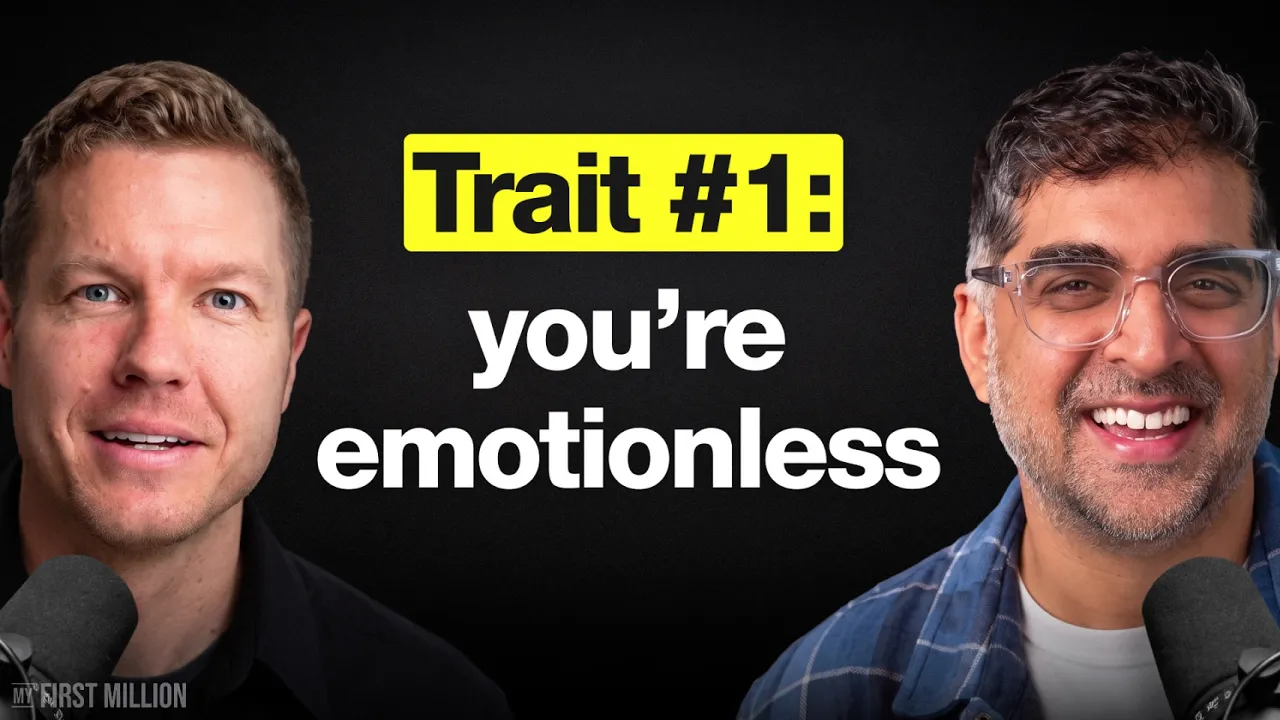
Description
*Take our founder personality quiz:* https://clickhubspot.com/xvm9 Episode 872: Shaan Puri ( https://x.com/ShaanVP ) and Sam Parr ( https://x.com/theSamParr ) talk about the different types of founders. — Show Notes: (0:00) Natural Money-Makers (1:52) Attributes of Natural Money-Makers (3:10) The Story of Nick Kokonas (8:12) The Story of Jay Gould (10:00) Can It Be Learned? (13:04) The Story of Syed Balkhi (17:58) Only Spend the Second Derivative (22:27) Trading Valuable Hours for Useless Dollars (26:50) Other Play Styles That Win — Links: • Syed Balkhi episode - https://www.youtube.com/watch?v=gzHdrQ5pDFo — Check Out Sam's Stuff: • Hampton (joinhampton.com): My community for founders. Average member does $25m/year. Many of the guests are members. Get after it...apply: http://joinhampton.com/mfm — Check Out Shaan's Stuff: • Shaan's weekly email - https://www.shaanpuri.com • Visit https://www.somewhere.com/mfm to hire worldwide talent like Shaan and get $500 off for being an MFM listener. Hire developers, assistants, marketing pros, sales teams and more for 80% less than US equivalents. • Mercury - Shaan uses Mercury across all of his companies. you can too: http://mercury.com/ Mercury is a fintech company, not an FDIC-insured bank. Banking services provided by Choice Financial Group, Column, N.A., Members FDIC • I run all my newsletters on Beehiiv and you should too + we're giving away $10k to our favorite newsletter, check it out: beehiiv.com/mfm-challenge My First Million is a HubSpot Original Podcast // Brought to you by HubSpot Media // Production by Arie Desormeaux // Editing by Ezra Bakker Trupiano /
Summary
Generated by gpt-5.6-terraAt-a-Glance
- Verdict: Skim
- Core thesis: The speakers argue that exceptional founders and investors tend to win through distinct operating archetypes, with the "natural moneymaker" defined by unemotional judgment, relentless deal-seeking, comfort with complexity, and a compounding-oriented capital allocation mindset.
- Why it matters: It offers a practical lens for identifying whether Ken should personally lead, partner, hire, or invest based on durable behavioral advantages rather than trying to force a generic founder profile.
- Best use: Use it as a prompt for an archetype and capability audit across Ken's portfolio, operating team, and investment pipeline; do not treat the categories as a validated personality framework.
Executive Summary
The central archetype is the "natural moneymaker": someone who repeatedly finds and captures economic opportunities across unrelated sectors, often without being the best product builder, manager, or public-facing founder. The speakers characterize this person as unusually rational about money, able to spot waste and arbitrage, willing to pursue even modest-return opportunities, and intuitively capable of reducing apparently complex deals into a few decisive economic variables.
Their examples are mostly investors and operators who translated judgment across domains. Nick Kokonas reportedly made tens of millions as a trader, including a roughly $100 million-profit ETF-arbitrage business built around eliminating exchange-to-exchange latency, then helped build Alinea into a rare high-margin restaurant business. Syed Balkhi is presented as another cross-domain allocator, moving from WordPress plugins into real estate, private companies, stocks, and gas stations.
A useful operating distinction is that these people do not necessarily enjoy complexity for its own sake. They make the investment rationale simple, then use existing experts, assets, and contractual structures to simplify implementation. The speakers frame a common mistake as confusing unfamiliarity with genuine risk or complexity.
The latter part broadens into informal founder archetypes: the mission-driven visionary, the extreme balancer, the operational "tank," the creative "trickster," the fiercely competitive technical "nerd," the deep student, and the trend-sniffing investor. The real recommendation is not to imitate one type wholesale, but to work with one's native wiring while selectively borrowing useful behaviors from other types. The conversation also warns that business mastery can become a trap when people continue exchanging scarce time for money that no longer improves their lives.
Key Takeaways
- Claim: A natural moneymaker is distinct from a strong founder or CEO because the core skill is portable economic judgment: repeatedly identifying where value will accrue or leak across many categories. | Evidence: The speakers contrast Ted Turner as a visionary and recruiter with figures such as Carl Icahn, Charlie Munger, Nick Kokonas, Syed Balkhi, and their unnamed dealmaking friends, who are described as succeeding through investing, trading, restaurants, real estate, acquisitions, and niche assets. | Implication: When evaluating founders, operators, or potential partners, separate domain-specific execution talent from demonstrated cross-domain capital allocation and deal judgment. | Caveat: This is an informal observational archetype, not a tested classification; the examples are selected success stories and may obscure failures, privilege, access, or survivorship bias.
- Claim: Natural moneymakers are unusually unemotional about business decisions and will cut costs or exit positions when the economics no longer justify sentiment. | Evidence: The Carl Icahn anecdote describes him eliminating 12 floors of staff at a purchased shipping company after concluding he could not identify what they did; months later, his team reportedly had not noticed an operational impact. | Implication: Ken should institutionalize evidence-based resource reviews and kill criteria, while preserving a separate check for hidden dependencies and second-order organizational costs. | Caveat: The anecdote celebrates decisiveness but does not establish that abrupt cuts are generally correct; indiscriminate cost-cutting can destroy capability, trust, and long-term value.
- Claim: The archetype treats diminishing returns as still worth capturing, creating a persistent deal-seeking behavior rather than an "enough is enough" threshold. | Evidence: One wealthy friend reportedly researched buying defaulted credit-card debt for approximately a 14% return; Jay Gould is cited as returning to railroad dealmaking despite terminal tuberculosis and family objections; Kokonas was still discussing a wine collection bought for $150,000 that he believed was worth $1 million. | Implication: Adopt the useful part—systematic opportunity capture—but set explicit capital, time, and concentration constraints so maximization does not become uncontrolled activity. | Caveat: Relentless maximization can become pathological when the marginal financial gain no longer outweighs time, attention, reputational risk, or family costs.
- Claim: What looks like comfort with complexity is often an ability to isolate a simple economic thesis and make execution tractable through leverage. | Evidence: An unnamed DTC operator faced rising cost of goods, visited European manufacturers, verified machine cost, payback period, and required volume, then recruited the existing operators to set up a U.S. plant; the factory was operating about a year later and reportedly halved COGS. Syed Balkhi similarly reduces gas-station underwriting to location, historical performance, and a triple-net lease structure. | Implication: For complex AI or operating-system initiatives, reduce each decision to the few variables that determine payoff, then borrow implementation capacity from proven vendors, operators, or templates instead of building every capability internally. | Caveat: A simple investment thesis does not eliminate difficult implementation; manufacturing, leases, and regulated assets can carry risks omitted from a short heuristic.
- Claim: The speakers advocate preserving principal and upgrading lifestyle only from investment returns, making compounding rather than earned income the basis for discretionary spending. | Evidence: Syed Balkhi's stated rule is to invest income and spend only what those investments produce; the example starts with investing $100,000 and spending its approximate $10,000 return, then compounds future contributions. The co-host uses a parallel rule of keeping annual spending below 3% of liquid net worth. | Implication: Use a formal treasury policy that distinguishes operating capital, principal preservation, and discretionary distributions rather than allowing revenue growth to automatically raise fixed spending. | Caveat: The discussion does not specify asset allocation, tax treatment, return volatility, liquidity needs, or how the rule changes in downturns.
- Claim: Founder success is not one archetype; different games reward different native strengths, and the practical goal is role fit plus selective trait borrowing. | Evidence: The speakers propose a missionary/visionary exemplified by Brian Chesky, an extreme balancer exemplified by Jesse Itzler, an operational "tank" associated with Frank Slootman, a "trickster" associated with Alex Tew and Eric Ryan, a fierce technical competitor associated with Zuckerberg and Travis Kalanick, deep students such as Dan Carlin and David Senra, and "sniffers" such as Austin Rief. | Implication: Build complementary teams deliberately: pair strategic trend detection, mission/product conviction, operational endurance, and creative distribution rather than expecting one founder or executive to embody all of them. | Caveat: The categories overlap, are developed casually, and the title's claim of six types does not match a stable or exhaustive six-type framework in the transcript.
- Claim: A "sniffer" creates investment advantage through conviction arbitrage: recognizing a person, trend, or category before consensus validates it. | Evidence: Austin Rief is credited with flagging roughly seven non-obvious opportunities early; another friend, Vishal, prompted the speaker's 2014 Bitcoin purchases and foresaw stablecoins, privacy coins, and prediction markets before those labels were mainstream. Sean Parker is cited for early conviction in Napster, Facebook, and Spotify. | Implication: Maintain an explicit frontier-trends process that records non-consensus theses, leading indicators, disconfirming evidence, and position-sizing rules before market validation arrives. | Caveat: Early conviction is valuable only when coupled with disciplined sizing, time horizon, and falsification; enthusiasm alone can resemble insight.
Detailed Brief
Nick Kokonas as the cross-domain judgment case study
- Claims: The speakers use Kokonas to argue that the natural-moneymaker trait transfers across seemingly unrelated industries.; The trait is framed as a continuing mode of perception rather than a skill exercised only inside a formal job.
- Evidence: As a trader, Kokonas reportedly noticed a price mismatch between increasingly popular ETFs and the real-time value of their constituent stocks, then used options/futures and fiber connectivity between New York and Chicago to capture the gap before slower paper-and-phone execution systems could react.; The speakers state that one arbitrage generated roughly $100 million in profit in Kokonas's best year.; He then partnered with chef Grant Achatz to build Alinea, which they describe as the first Michelin-star restaurant outside New York and as reaching roughly $26 million in annual revenue with nearly 20% profit in an industry usually known for poor economics.; During COVID, Alinea reportedly pivoted from fine dining to takeaway meals and remained profitable.
- Caveats: The account does not independently verify the financial figures, chronology, or causal role of Kokonas versus his partners and operating team.; Restaurant performance is not readily generalizable: premium positioning, brand equity, talent, and location can be decisive.
- Implications: A high-quality allocator may be more valuable in new markets than a narrow domain specialist if they can identify the few structural variables that determine economics.; Business-model resilience can come from retaining a sharp economic objective while changing the delivery mechanism during disruption.
The personal-cost critique of perpetual business optimization
- Claims: The speakers reject the simplistic idea that money-focused people are necessarily unhappy, noting both generous, contented and miserable examples.; They nevertheless argue that high-performing business people often overinvest in the domain where they receive competence, status, and feedback, while avoiding personally valuable domains where they are beginners.
- Evidence: One speaker describes business success past the point of need as trading "valuable hours for useless dollars."; He contrasts another portfolio gain with potentially larger quality-of-life gains from fitness or improving a marriage, and gives learning piano as a deliberate choice to be bad at something non-monetizable.
- Caveats: The speakers acknowledge that some people genuinely enjoy business as a sport; external observers should not assume their motivation is false or harmful.; There is no proposed measurement system for identifying the point at which additional money ceases to improve life.
- Implications: Executive performance systems should distinguish financial optimization from total-life optimization, especially for founders whose identity is tightly coupled to work.; Ken can treat time allocation as a portfolio problem: reserve capacity for relationships, health, learning, and recovery that cannot be justified by direct ROI alone.
Notable Concepts & Terms
- Natural moneymaker: An informal archetype for a person with repeated cross-domain success in deals and capital allocation, marked by cold rationality, opportunity detection, maximization, and comfort with economic complexity.
- Nose for bullshit / opportunity: The claimed intuitive ability to identify waste, flawed economics, hidden value, and arbitrage before others do.
- Diminishing returns are still returns: The maximizer's view that smaller marginal gains remain worth pursuing rather than being dismissed as beneath one's time or wealth level.
- Uncertainty versus risk: A key distinction: unfamiliar work may feel complex or dangerous without being economically risky once its decisive variables are understood.
- Second derivative spending: Spend investment returns rather than earned income or principal; the speakers use it as a compounding and downside-protection rule.
- Conviction arbitrage: Capturing returns by recognizing the significance of a trend, company, or person before broader market consensus does.
- Sniffer: An investor-oriented archetype that spots emerging winners early and tends to share high-conviction enthusiasm, unlike more secretive deal-focused natural moneymakers.
- Tank / trickster / missionary: Informal archetypes for, respectively, a pain-tolerant operator, a lateral-thinking creator of surprising products or distribution, and a founder driven by a long-term mission.
Operator Notes / Why Ken Should Care
- Run a founder-and-team archetype mapping exercise for current initiatives: identify who is strongest at capital allocation, operational execution, creative distribution, product mission, technical competition, and trend sensing; use gaps to guide hiring or partnership decisions.
- For major build-versus-buy and automation decisions, require a one-page economic thesis listing the payoff threshold, required scale, payback period, operating owner, and the external expertise that can compress execution risk.
- Create a lightweight "conviction arbitrage" tracker for non-consensus AI, agent-system, and workflow theses, including why the thesis is early, observable leading indicators, disconfirmers, and predefined exposure limits.
- Set explicit stop rules for marginal opportunities: minimum expected return, maximum owner attention, concentration limits, and reputational/security constraints.
- Separate personal/organizational wealth accumulation targets from time-allocation goals so high-ROI work does not automatically crowd out health, relationships, or exploratory learning.
Source/Metadata
- Title: We've met 1,000 founders. There are only 6 types.
- Transcript words: 12565
- Duration seconds: 2236
- Timestamp note: No usable timestamps or chapters were present. The supplied transcript contains substantial duplicated passages and trailing extraction noise.
Transcript
Can I tell you about something I've been thinking about? This idea of a natural moneymaker. I was going to ask you about this. You made up this term. What is a natural moneymaker? A natural moneymaker is a person who tends to be involved in dealmaking, brokering, and inserting themselves into situations. They tend to not build publicly, and they've built multiple businesses ranging from $100 million to many billions in multiple different fields. There's a distinct difference between a natural moneymaker and a great founder, or a great CEO, or a great entrepreneur. I consider myself to be a decent entrepreneur. I'm not a natural moneymaker. Ted Turner, one of my heroes, he started CNN. He was not a natural moneymaker. He had vision. He knew how to recruit people. He had a good sense of the market and what products to make. But a natural moneymaker does all those things, plus they're way colder about money, and they're way more logical, and they're way more rational. Yeah. I just think of my buddy Suli. I feel Suli is a natural moneymaker. A natural moneymaker. So high hit rate, whereas it seems like most people fail, fail, fail, fail, fail, finally succeed. It's this person kind of succeeds, succeeds, fails, succeeds, succeeds, succeeds, right? It's mostly success, which defies the batting averages that you're supposed to have as a business person or entrepreneur. Secondly, if you ask them to explain it, it's not a lot of words. It's a lot of instinct. So naturally, instinctively figures out where money's going to be made and where money's going to be lost. So I call this having a great nose. They sniff out bullshit where bullshit is. They sniff out opportunity where opportunity is. And they win across multiple categories, even though they might not be the best manager or the best designer or the best at anything. You can't say, well, it's because they have that one super skill. The skill is being a natural moneymaker. And I listed out some of the attributes that I've noticed they have that are different from an entrepreneur or a great CEO or a great founder. The first one is that they're unemotional about business. I said natural moneymakers have anxiety like everyone else, but they use their emotions to make money. Being emotional and passionate is actually how a lot of founders typically succeed. It's how they recruit people. But natural moneymakers are far more cold about money, far more logical. And there's a story about Carl Icahn. Carl Icahn was a tycoon, hedge fund, PE guy of the 1980s. And there's this famous story where he buys, I believe, a shipping company. And within two weeks of going to the office every single day, he was like, there's 12 floors of people here. I don't know what they do. I'm firing all of them today. We're just going to get rid of all of them today. And four or five months later, he talks to his team. He's like, so those 12 floors of people, are you noticing that they actually were doing something and it's not hurting us that they're gone? And he's like, no, didn't even notice that they were gone. And a natural moneymaker is very good at seeing nonsense and just cutting the fat and being totally unemotional and very rational about it. A lot of emotional people, I would say I'm in that category, would say, but these people have jobs. We can't do this. A natural moneymaker is far more rational. He's like, well, the numbers show this. Therefore, we do that. So the guy I just did a podcast with, it's not out yet, Nick Kakonas. I feel he's kind of like this. Do you know his story? No. It's an unbelievable story. So this guy starts as a philosophy student in college, but he likes math. And he decides, I want to be a trader, a stock trader. So he gets offers from JP Morgan and other bankers, a good salary, good job, but not a trader. Trader basically runs their own book of business. You need to be a natural moneymaker if you're going to do that, because you're basically making high-speed decisions all day. And at the end of the day, he told me, you would basically walk away and you either won or lost a house. He's like, I'd win or lose like 300 grand in a day. And the emotions of that, imagine you go to work and you made 250,000 or you lost 250,000 and you only got like 600,000 or a million bucks. You don't have that much to even work with. You're taking these huge swings every day. Why do I call him a natural moneymaker? Because he made tens of millions of dollars as a trader. His best year, his company made a hundred million in profit off of one arbitrage that he found. And he basically figured out that ETFs were getting popular and the ETF basically is owning all 500 stocks in some proportion. So what he realized was as ETFs were getting popular in the early days, the cost of the ETF, the hundred stocks that you were trying to buy, was not the same as if you actually go and find each of the hundred stocks at their current price in real time. There was a little spread, a little slippage. And so what did he do? He's like, I can basically buy, I can use options, buy a future contract on those same stocks. And with no risk, make money every single time somebody buys this. But in order to do that, he had to figure out how to run fiber cable from the New York exchange to the Chicago exchange so that he could get the price quotes in real time, whereas everybody else was calling and they would call a guy, tell him, hey, I want to buy this. Then he would write it out on a slip of paper. The guy with the slip of paper would run it over to the traders. They're like, hey, I got a piece of paper for you. Then he would take the paper and yell it out. And then the trade would get made. And that 30 seconds he realized was an opportunity. So he sniffed that one out. Okay. What happens after that? He leaves, he goes into a completely different space. He creates the best restaurant in America. The number one restaurant in America was called Alinea. It was the first Michelin star restaurant outside of New York. At the time he said the Michelin guide was not even coming to America anymore to check out restaurants. And he goes on a forum and just declares, we're going to create the greatest restaurant in America. That's our mission. We're going to create the best restaurant in America and we're going to make it so that it looks bad on the Michelin guide. If they're not giving us three stars, the fact that we're not three stars will be a reflection on them and not on us. And so he takes this audacious approach, pulls it off. He finds this amazing chef, Grant, partners with him, creates the crazy restaurant Alinea. And in an industry that famously sucks as a business. If you say, what are some of the worst businesses you can start? A restaurant would be up there. And yet as a natural moneymaker, he goes and creates this thing that at its peak, Alinea was doing 26 million a year in revenue with almost 20% profit. Even during COVID, when every restaurant shut down, they pivoted and figured it out and made money during COVID by doing takeaway dinners for people, figured it out. And then goes on and does other things. And while I'm talking to him, as soon as we get off air, he's telling me about this current arbitrage he's found with wine collections. And he's like, dude, I just bought this million dollar wine collection for 150,000. And I figured, you know, I was like, how did you even in your spare time find this? He's like, well, they find deals. They just find deals. And he's always finding deals. There is no off button. These natural moneymakers. I have, we have a friend who I was with one time. He's both of our buddies and he was on his phone when we were out. And I was like, what are you doing? money during COVID by doing takeaway dinners for people instead of high-end stuff for $35, whatever, they figured it out. And then they go on and do other things. And while I'm talking to him, as soon as we get off air, he's telling me about this current arbitrage he's found with wine collections. And he's like, dude, I just bought this million dollar wine collection for $150,000. And I figured, I was like, how did you even in your spare time find this? He's like, well, they find deals. They just find deals. And he's always finding deals. There is no off button. These natural moneymakers, I have a friend who I was with one time. He's a buddy of ours and he was on his phone when we were out. And I was like, what are you doing? He was like, well, I just found out that you could buy defaulted or soon to be defaulted credit cards, meaning you could buy the debt and I could hire this firm to go and collect the money and I could make like a 14% return or something. It was pretty not meaningful. And our friend is very wealthy. And I'm like, are you insane? And what that describes and what you described with your buddy is that natural moneymakers are maximizers. Diminishing returns are still returns. They don't say that enough is enough. And so what I've noticed with these people is like with your story, with your buddy, I buy index funds. You can do this new thing called direct indexing, which is not the same thing as what you're describing, but same sentiment where you get a small spread, a tiny one. And people like me, I'm like, that's good enough. There's too much trouble. Natural moneymakers do not say it's too much trouble. They do not say diminishing returns. They say diminishing returns are still returns. It doesn't matter. And there's this famous story about Jay Gould. So Jay Gould was in the 1800s. John Rockefeller said he was the greatest business mind of all time. And there's a story where his wife had just died, two years ago. He was the patriarch of this family, like he had three daughters and then he had two or three nieces who he looked after. And he had tuberculosis, which was a death sentence. He was about to die. He had about a year left. And when he was out to eat with his family, someone came and whispered in his ear and they're like, hey, this one railroad is going out of business. I think you can get it. And his nieces and daughters were like, please don't do this. Our family is good. And he goes, I'll think about it. And then the next week he's with his family again and he gets another call and he puts the phone down. He goes, hey, family, I've thought about it. I need to do this. I have to return to my first love, which is making money. And he did the deal and he dies about six months later. And that's an extreme example. But these natural moneymakers are extreme maximizers. It never turns off. And the perfect number is more. So I think Charlie Munger is kind of like this. Like I think famously, a couple of weeks before he died, he was still doing deals. He's still doing investments. He made money with Warren Buffett and Berkshire through the buying of businesses and stocks, but also was an incredibly successful real estate investor. I think also owned a very successful law practice before that. I think he made money in newspapers. I think Munger made money a bunch of different ways and had a very high hit rate, had an incredible nose for bullshit and an incredible nose for an opportunity, had incredible judgment. But can I ask you a question? So because the term is natural moneymaker, are you basically saying this is nature, not nurture? Meaning you either have it or you don't? I think it tends to be people who are brought up in families where they talked about this stuff at a very young age. And I would argue it tends to be instilled or they're born with it. And because the last attribute for my natural moneymakers is that they're very comfortable with complexity. The average entrepreneur, let alone the average Joe, we like simple. We say, how many times do you use that phrase in your business? Let's keep it simple. Let's just do this. Let's just keep it simple. I have noticed that natural moneymakers have very high IQs and they can grasp very complex topics. Our friend Suli, when he does a variety of deals, I don't know him that well, but I've heard him talk about stuff and the deals tend to have all these contingencies. If this happens, then this, and then if this happens, then this. And they can cut through that and they can see where and how value is locked. And they can very quickly in their head compare that to the alternatives. And the natural moneymaker tends to be really good with very complicated things. And the average Joe is not. A very complicated thing, well, it's complicated to grasp, is this idea of compounding. That's what I've noticed amongst the people I know who I describe as natural moneymakers. Breaking news. Right when we got done recording this podcast, producer Ari actually went and made a fun quiz with all of these archetypes that Sean and I are talking about on this podcast. The sniffer, the natural moneymaker, and like six other ones. And so there's a link in the YouTube description, or if you're listening on Spotify there's a link here. And it goes to this really funny quiz based off of everything that you're hearing us say now. Which archetype are you? Which will ultimately help you pick a game that you can win, that you will have a better life and enjoy it. And so I think this stuff is really interesting and I think you might like it too. So click the link and fill out the quiz now. But what about the people who are smart, good at math, high IQ, but are not natural moneymakers? What is it that they lack or what is different about them than the people who are also smart, high IQ, good at math, but are natural moneymakers? What's the gap once you have that requirement? I think that there's this slight gene of wanting to conquer. You know, Napoleon had this great quote where his peers were like, oh, I'm Irish, I'm Italian. And he was like, I'm descendants of conquerors. I just have it in me. And I've noticed that these people have a competitive streak where they want to be the best at a very young age when it comes to making money. I don't know why that happens, but I believe it's probably because of IQ and this wanting to win. Another friend of ours, Syed Balki, I believe he is the best example of someone we've had on My First Million who's a natural moneymaker. So if you guys haven't listened to that podcast, Syed basically started a WordPress blog, which is not sexy. That made some amount of profit. And using that profit and influence, he started buying WordPress plugins. And then he has since bought tons of real estate. He's a fairly prolific stock investor. He buys a lot of privately held companies as well. And I would say that he's made a lot of money in a variety of ways. And when I have heard him explain why he buys all these gas stations, and I'm like, these gas stations are beneath you, right? You're buying a $200,000 gas station. You're worth hundreds of millions of dollars. I don't get it. And he was like, he has this sentiment of, but I can get good returns from this. And I can do this, this, this, and this. And I'm like, that sounds really complicated and a lot of work. But they don't have that same nervousness about that. Yeah, it's hard to say. Because when I think of the people that this is maybe the one point you said so far that I'm like, I'm not sure that lines up with my experience, which is all the people you just mentioned that I know, Syed, Suli, whoever, they really pride themselves on simplicity. And they really respect simplicity. But you're right that they are willing to chew through what seems to me like complexity. But to them, they see it as simple. Like, I think if you ask them, they'd be like, there's nothing complicated about this. It's the simple way. And I can just do this, this, this, and this, and this. And I'm like, that sounds really complicated and a lot of work. But they don't have that same nervousness about that. Yeah, it's hard to say. Because when I think of the people that this is maybe the one point you said so far that I'm not sure that lines up with my experience, which is all the people you just mentioned that I know, Syed, Suli, whoever, they really pride themselves on simplicity. And they really respect simplicity. But you're right that they are willing to chew through what seems to me like complexity. But to them, they see it as simple. I think if you ask them, they'd be like, there's nothing complicated about this. It's this was the simple way. And to me, I think it's complicated. For example, one of them, they were selling a product like a DTC brand or DTC product, which many people do that e-commerce. It's hard to make money in e-commerce by default, sort of like restaurants in that way. Where you can get revenues, but the profit margin is pretty slim. You might be like a 10%, 6%, but 14% EBITDA margins. Then you pay taxes on that, as you take it out. But you're always buying inventory and you're always kind of living on a knife's edge with the Facebook ad platform and tariffs and other things. So your life can change at the drop of a hat. So one of those guys, they had one of these and they ran it ultra profitably at scale. And one of the things that they did along the way was they just, I was like, oh, so what'd you do then? It's like, well, the cogs kept going up. So then we built our own manufacturing plant. I was like, what? And he's like, yeah, I found these guys who do it in Europe and I called them and I said, but again, he said, made it sound simple, but I'm like, you stood up your own manufacturing at scale while you were in the middle of the whole thing. And you've never done anything like that. I've never seen you in the outdoors. So you have a factory now. And he's like, yeah, I found these guys in Europe doing it. And I called them and I said, hey, can I come see it? They said, yes. And then I was like, how does this, how much does this machine cost? And he's like, it costs this much. He's like, cool. So how long does it take to pay back? They're like, oh, it pays back in like two months or something. He's like, okay, good. Check. All I needed to know. And he's like, what scale, what scale do you need to pay that back? And they're like, this scale. He's like, got it. So that's a check. Then he's like, can I buy this machine? Can I buy yours? Who'd you buy it from? And they're like, we buy it from these guys. He's like, awesome. Can I pay you to come stand it up in wherever I'm at in the US? And they're like, I mean, we don't really do that. He's like, but how about if I just really made it worth your while to come stand it up? And they're like, yes. So he's like, great. Done. Factory. The factory was up and running a year later with that process. And their cogs dropped in half. And the business just got even more lucrative. Something that I would have shied away from because it's complex. But in his mind, I don't think he saw it as complex. I think he saw it as simple. So I think they view it as simple, whereas I think others shy away from the complexity. I think the truth is somewhere in between, meaning they're willing to do hard things that they're not familiar with. But the reason to do it is very simple. They don't need to write a six-page memo to convince themselves. The logic fits on a fortune cookie. And I think that's where simplicity plays in. The reason to do it is very simple. Doing it is actually quite difficult, maybe complex. But they'll find the simple version of it. Meaning they'll find the guys who've already done it. They'll find out how much the machine costs. They'll ask the guys to set it up. They'll do things like that along the way that make it a lot simpler. I asked Saeed about the gas station. I'm like, dude, I don't know anything about gas stations. And he's like, you just need to have a hard corner in a good area. Here's the track record of the thing. And I was like, yeah, but I don't want to manage it. And he's like, it's a triple net lease. There's nothing to manage. All right. So he immediately is like, it's simple. What are you talking about? This whole thing is simple. And I'm like, maybe it is simpler than I think on the outside, having never done it because I'm confusing uncertainty with risk. I'm confusing unfamiliarity with complexity. By the way, little finance nerd thing that I still remember from that episode. Do you remember his advice on kids and spending? No. What did he say? So the funny thing was he was like, every time I'm going to have, every time my wife gets pregnant, I buy a gas station and the gas station will pay for the kid. But he's like, the best advice I ever got from my mentor when I was very young, like when I didn't have enough money to go buy a gas station. But the core idea is the same, which is you only spend the second derivative. And I was like, dude, I don't remember what a derivative is. I don't remember calculus. Can you just explain that? And he goes, let's say you make whatever you make a hundred grand. If you make a hundred grand, that's not the pool you can spend from. You now invest the hundred grand and whatever the hundred grand is making you, that's what you get to spend on whatever you want at that point. So that's your, you'll never go broke strategy because you are only spending not your income, but the investment returns off your income. And at the beginning, that sounds small because on a hundred grand, your income might only be ten grand. That's what you get for discretionary. Do whatever you want beyond your lifestyle. You don't get to upgrade your lifestyle beyond that amount. But as that compounds, you can, and the next year you put another hundred grand and now you got two hundred grand coming in and now you're making twenty-four grand off that. And as that compounds, basically after five, seven years, you could now live life off of only the interest of only the gains of your investment income and not the core income you have from spending. I don't think most people would ever think about that rule. Do you do that? You're pretty conscious and conservative about money. Yeah. But the way that I do it seems far more simple where it's like, I want to, my annual budget is less than 3% of my liquid net worth. And I do that because I can go to bed at night knowing that it won't ever run out. But I think that is child's play compared to what you're describing. No, no. It's the same thing. When you're saying liquid net worth, I'm assuming you have that liquid net worth invested in things and you're saying, I'm only going to spend 3%. So you're spending less than what he's saying, but you're still in budget, right? You're saying the same idea, which is more like this. When you started to make more money, did you upgrade your lifestyle or did you invest the money and then only upgrade your lifestyle with the gains of the investment? Yes. You make it so you can, I just call it principle. Don't touch the principle. Only live off of the interest. It's not really interest, but that's the phrase. It's the principle principle. And the last thing is that I have noticed, and correct me if this is not true in your experience, is when people hear this or when they see me write about this topic, they think of like a miser, like someone who's unhappy and like their life is strictly business. And these people's lives, it might be strictly business, but I have not noticed a correlation between the people who are like this and people who are happy. Because you'd want to dismiss these people as like, oh, well, they're just all they do is work. When you made, as you started to make more money, did you upgrade your lifestyle or did you invest the money and then only upgrade your lifestyle with the gains of the investment? Yes. You make it so you can, I just call it principle. Don't touch the principle. Only live off of the interest. It's not really interest, but that's the phrase. It's the principle principle. And the last thing is that I have noticed, and correct me if this is not true in your experience, is when people hear this or when they see me write about this topic, they think of a miser, someone who's unhappy and their life is strictly business. And these people's lives might be strictly business, but I have not noticed a correlation between the people who are like this and people who are happy. Because you'd want to dismiss these people as, "Oh, they just care about money. Live a little." And I'm like, I don't think that's true. And I can give you a good example. We had Brian Johnson on the podcast and we said the exact same thing that everyone said to him: "Don't you want to cut loose? Don't you want to eat birthday cake?" He's like, "No, I'm happy doing this. I'm happy." And my friend Val is a natural moneymaker. He's very happy. He's very good to his family. He's a very generous guy. And then I can name other natural moneymakers who are pains in the asses. They're miserable and they are misers. And I think that there's probably a similar spread of happy and unhappy people and jackasses and not jackasses who fall in this category as any other type of entrepreneur. I agree with what you're saying, which is there's a bitter reaction that can happen when you hear about people being very planned and regimented about their money and you feel guilty for not being. And then as a defensive posture, you say, "Oh, that's no fun, right?" You quickly write it off as a defensive mechanism for yourself. You dismiss it versus just leaning and getting curious and being like, "Why do you do that? How does that work?" Either A, it's cool, that works for you, it's not what would work for me. Or maybe I could steal a little bit of that or a lot of that, and that would be improvement, right? That's a better reaction. So I do think people have that reaction and that reaction is a little silly. At the same time, I don't want to make it sound like if I think about the natural moneymakers that I've met, it's like they're all well-rounded and happy people. Maybe, but also absolutely maybe not, right? This is completely almost divorced from the natural moneymaker side. The one thing I will say is I do notice that people who love the sport of business and are really good at it and get a high from it and have built their identity on it and have status from it, it is so hard that they continue to make a trade that over time to me makes less and less sense. Meaning you're trading valuable hours for useless dollars, right? They're basically trading their time and their energy for money they will never need, never spend, never use money as a tool to improve the quality of your life. And they've passed that point where money's able to improve the quality of their life anymore. And then they'll justify it all kinds of ways: "Oh, it's for my kids. Oh, it's because I want my kids to see me working hard." It's like, no, your kids just want to see you. And they're not seeing you a lot, you know? So I don't think you want your kids to see you just sipping a Mai Tai all the time, but you're not home a lot and they probably want you home more than they want to see you working hard as a good example. And so I think people make up all kinds of screwed up stories. I think a lot of people will enjoy the rewards that they've built up of the feedback loop of being good at something and they will avoid areas of their life where they're kind of bad at because it sucks to spend time on stuff you're bad at. I can speak from my own experience. There's all kinds of things like this in my life. Fitness is one where it was always easier for me to read that next article or make that next slide deck than it is to get my ass up and run. But what will actually move the needle in the quality of my life? Getting my ass up and going to run, not reading that next article or writing that next email. That's not doing anything for me. But there's other areas of life too. In my marriage, how do I be a better husband? How do I actually show up differently? What if I improve? What if I made my marriage have twenty percent more fun, more spark, more chemistry? I don't really know exactly how to do that, but I do know I'd get more gains from that than adding another X dollars to the portfolio. That's just a number on a chart that I'm not using anymore. It doesn't do anything for me day to day. You know, it's really hard to make these trades where you say no to something you're good at and you know how to do and you have an amazing feedback loop on and you're respected for, and you go into these areas you kind of suck at and you don't know anything about. For me, I went and became a beginner piano player last year. I'm going to carve out time for something that I'm bad at, that I've never done, that most people my age don't start at. And I'm going to suck at for the next three months as I just get my bearings. It's going to cost me money and it's going to make me no money and I'm not going to become famous for it. Nobody's going to like what I do because I'll still suck at it after a year, but I'm going to do it anyway because actually playing music is really fun and actually learning a new skill is really fun. And it added this other joy to my life in a totally different way. But I had to steer away from the familiar to do that. I think that's the part I would say I noticed that people struggle with. That was a really good bit. And I would finish with saying the cool thing about my first million is that I hope that we have shown that there's an infinite ways to win the game and all of them have cool attributes. Jesse Itzler is someone you and I both really admire. I don't categorize him as a natural moneymaker. He's very wealthy. He's really nice. He's really kind. He's got a great family. We can find people who we also would describe as that who would fall in this category. This is just one category of people that I have observed. And I'm not envious of many of their lives, but I am envious of many of the attributes that they show that are weaknesses that I have. And so it's fun to ask myself, "What does Suli do? What would they do in this situation?" I may not take that route, but I would like to know how they would handle it because maybe that tool will be useful for me in any given particular situation. It's also interesting. What are the other categories? So let's say natural moneymaker. I love your phrase there. I think that's a dope one. But when I hear it and I hear it as the only option, I have a different reaction where I'm like, "Oh, I want to be that. That sounds kind of awesome. I want to be a rainmaker like that." And then also I feel a little bit bad because I'm like, "I don't think I am that. So I guess I just suck then." And no, there's actually like these different options. And so there's an interesting question of like, what are some of the other options? What are some of the other play styles we've seen that you might fall into as a mold? I want to write about more of them. I think that another one is someone who's truly a missionary where they, like I would say Brian Chesky is this, where he has dedicated his life to this mission, a mission that maybe someone else would dismiss as silly or whatever. But he's totally dedicated to making Airbnb a great company and making travel good. I truly believe that's what he's about. Then you have guys like Jesse or Richard Branson. I actually don't know Richard Branson enough to categorize him, but I know Jesse enough to know that he is someone who is very extreme with his balance. So I guess I just suck then. No, no, there's actually these different options. And so there's an interesting question of what are some of the other options? What are some of the other play styles we've seen that you might fall into as a mold? I want to write about more of them. I think that another one is someone who's truly a missionary where they—I would say Brian Chesky is this—where he has dedicated his life to this mission, a mission that maybe someone else would dismiss as silly or whatever. But he's totally dedicated to making Airbnb a great company and making travel good. I truly believe that's what he's about. Then you have guys like Jesse or Richard Branson. I actually don't know Richard Branson enough to categorize him, but I know Jesse enough to know that he is someone who is very extreme with his balance. I would call him an extreme balancer. These people like Jesse's a very extreme guy. He comes off nice and he is nice. But he has all these regimented—like I must take a vacation here. I'm going to do this adventure here because that's fun for me. I know exactly what I'm about and I'm going to go 100 to the max on this adventure. I love that. That's an awesome one. So there's the missionary. There's the extreme balancer. I don't know what else there would be. I've seen one that's kind of like in any video game, you always have this one character. You have the tank, which is your brute force, relentless forward energy. This is like the Frank Loutmans of the world. Yeah. Right. These are the operator. They're militant. They have a large span of control where they can lead an army forward and just get behind me and I can take so much damage like a tank in a video game. I don't know if you've ever played like Overwatch or something like that. They're Reinhardt. And they're just standing there. They're just marching forward, taking bullets. And they could do that for a long time. They have a high level of determination, extremely high pain tolerance. They're extremely operational. They're tactical. They have a large span of control and they can be a good leader. So that's one play style. Another play style you'll often find in these games is the trickster. And the trickster is the one who does the exact opposite. They have no pain tolerance. If you hit them, they're pretty much wiped out. But it's very hard to hit these people. And they find these cracks. They find arbitrage. They come up with Pet Rock and they'll make a million dollars selling the Pet Rock. Right? Alex, too, is a trickster. He did the million dollar homepage. And then he did Calm, Calm.com. And the first product for Calm was an app that you opened up and it just said, do nothing for two minutes. And it got popular. And he's on the late night show. And they create these viral sensations. John Feo is like this. They create these little products that are almost like—wait, it's a weighted blanket. And they'll figure out a way to sell these novelty, unique items that are completely divorced from utility. A lot of people who create products like this—I remember I met this guy who built a product that was naming stars. He's like, I created a registry where you can name a star and it's officially named in my registry. That's it. And people were paying thirty bucks to name a star after someone for their birthday. This guy was making millions of dollars doing that. That's the trickster archetype where you're an extremely creative lateral thinker. I would put Eric Ryan in that one. Eric Ryan is in there. So if you guys are curious about this psychodemographic, look up Eric Ryan on MFM. He started Method Soap, Oli, Vitamins, Welly, Band-Aids, and Trickster. Some of the ways that you've described it sound negative or sound insulting, but that's not at all what you mean— They have magic. Yeah. That's far better. They can take inanimate objects and bring them to life in a way. And they find these opportunities where everybody else ignores them. I would say you have the kind of visionary missionary type that you mentioned. I think there's probably also—you know, Paul Graham wrote this blog post, Fierce Nerd. I think there's something to the extremely high IQ, extremely high competitive drive, probably socially strange person. And this is like the Zuckerberg dynamic, the Zuckerberg archetype where you think because they're nerdy, they're weak, but no, they're actually incredibly fierce. You just have to play them on their battlefield. And it's like, if you ever go to a Magic the Gathering tournament or a chess tournament, and you think this is going to be quiet, meek, sterile—no, there's a fury in each of these people. I would say Travis Kalanick is in that category where it's all just a game and he likes playing games with aggression. Yeah. I think you have the sort of the deep students. There's some people who are like, in Game of Thrones, the guy who's just copying, writing things down on scrolls—the historians. And you find people like Dan Carlin of Hardcore History or David Senra. There's people who have an incredible long distance running style of mentality around the incredible endurance for history, for study and fascination with the inanimate dead—right? Like the people who aren't even around anymore. They don't go play the game themselves, but they'll study everybody who plays the game to a depth that is unbelievable. And they become experts in that way. And so I think there's people who do that in every industry. You'll find people who are like that. We've done almost 1000 podcasts of which some percentage were interviews and it's fun. I've found myself categorizing people. It sounds like you have as well. And that's interesting. And I think the reaction to this needs to be not that stupid or whatever, like negative story that you tell yourself, but where do I find myself drifting towards? How do they act? And what attributes can I steal or mimic from all the others that will make me fulfilled and happy? Yeah. Ray Dalio said it well. When we were like, dude, you really believe in personality tests to a degree that I don't find most incredibly intelligent billionaire types to be really into this. And his very simple point was, do you think you'll have more success fighting your nature or working with your nature? Like we all have some natural wiring of how we are. Your nature, obviously working on things or in a style that suits you is going to be better and less friction than trying to do some other style that doesn't suit you at all. And when he said it like that, I was like, oh yeah, that makes complete sense. I have never actually thought about these different places. We're doing this off the cuff. I'd be interested in—it'd be interesting to actually sit down and try to do this, but I would be down to do this with a little project. There's one more I thought of just now, which is the sniffer. And the sniffer is a little bit like the natural moneymaker, but they just sniff out deals. They sniff out opportunity. And they're less hands-on. It's really as an investor. So I've actually talked about this with Austin Rief. Austin Rief from Morning Brew, I think he's a good operator, but I don't think he's the best. I think he's one of the best sniffers. This guy has told me about seven things early that were non-obvious that I kind of dismissed that turned out to be so on point. And he really is very good at finding these off-market, off-the-beaten-path trends or sometimes just a singular person where he's like, that person's got it, or this idea is going to work, or this category is going to work. And he is so spot on, which is weird because I don't think that's what he thinks about himself. But it is so obvious to me that that is what he is absolutely world-class. I've had a couple of friends that are like this. A friend Vishal who was like this, who put me onto things very early on. My first Bitcoin purchases back in 2014 were because he immediately was like, yeah, this is huge. And by the way, the second thing he said was huge. This guy has told me about seven things early that were non-obvious that I dismissed that turned out to be so on point. And he really is very good at finding almost these off-market, off-the-beaten-path trends or sometimes just a singular person where he's like, that person's got it, or this idea is going to work, or this category is going to work. And he is so spot on, which is weird because I don't think that's what he thinks about himself. But it is so obvious to me that that is what he is absolutely world-class. I've had a couple of friends that are like this. A friend Vishal who was like this, who put me onto things very early on. My first Bitcoin purchases back in 2014 were because he immediately was like, yeah, this is huge. And by the way, the second thing he said was huge. He was like, stable coins and privacy coins and prediction markets. And this is back when the stable coin projects were all terrible. And he's like, yeah, I don't know which one it's going to be, but I know that one of these is going to be very massive. And it turned out that was correct. This was before the terms were even really mainstream. Well, because those people tend to differ from the moneymakers a little bit because they tend to be more enthusiastic. Their conviction gets really high. Yeah. And they're enthusiasts and business people. So Austin's one of my best friends. He lives on the street from me. He does this all the time where he'll say something and he gets a little lit up where he'll talk about it. And he wants to share it. A lot of my friends who are natural moneymakers, they shut up. They don't want people to know. John Parker is like this. Yeah, I agree. He's an enthusiast, but he's got an amazing nose. He obviously sniffed out the Napster opportunity. But then after that, the guy made more money off Facebook than anybody. Almost as much as Zuckerberg. He didn't even create the thing. He just saw it early on for what it was and realized what it was before anybody else. And then if you read this memo, this email he wrote to the founders of Spotify, he spotted Spotify before anybody else also. Before they—he was like, look, he believed in it before they did. You guys, well, I don't know if they're working on it. I guess what I mean is these people, they tend to think, I don't think you get it. This is going to be so much bigger. Exactly. Exactly. And so you've seen, I've seen a couple of these people that are just amazing at sniffing out the winner, the opportunity. And it's so obvious to them and it's not obvious to others. And then the world catches up. And those people make for incredible investors, obviously. It's conviction arbitrage. You believe before everybody else believes. You see it before everybody else sees it to be true. And when you do that, you can make a lot of money. Knifer. Trickster. Magician. Natural moneymaker. Yeah, natural moneymaker. Tank. Missionary. Maybe we should work on our names a little bit. But yeah, there's something here. Half sound like sexual positions. Yeah. Half sound like slurs. Yeah. All right. That's it. That's the pod. So he's like, great. Done. Factory. You know, the factory was like up and running a year later with that process. And their cogs dropped in half. And like, you know, the business just got even more lucrative. Something that I would have shied away from because it's complex. But in his mind, I don't think he saw it as complex. I think he saw it as simple. And so I think they view it as simple, whereas I think others shy away from the complexity. I think the truth is somewhere in between, meaning they're willing to do hard things that they're not familiar with. But the reason to do it is very simple. Like they don't need to write a six-page memo to convince themselves. The logic fits on a fortune cookie. And I think that's the like where simplicity plays in. Like the reason to do it is very simple. Doing it is actually quite difficult, maybe complex. But they'll find the simple version of it. Meaning they'll find the guys who've already done it. They'll find out how much the machine costs. They'll ask the guys to set it up. They'll, you know, they'll do things like that along the way that make it a lot simpler. Like I asked Saeed about the gas station. I'm like, dude, I don't know anything about gas stations. And he's like, you just need to have a hard corner in a good area. Here's the track record of the thing. And I was like, yeah, but I don't want to manage it. And if you figure out, he's like, it's a triple net lease. There's nothing to manage. All right. So he immediately is like, it's simple. What are you, what are you talking about? This whole thing is simple. And I'm like, maybe it is simpler than I think on the outside, having never done it because I'm confusing uncertainty with risk. I'm confusing unfamiliarity with complexity. By the way, little finance nerd thing that I still remember from that episode. Do you remember his advice on like kids and spending? No. What did he say? So the funny thing was he was like, every time I'm going to have, every time my wife gets pregnant, I buy a gas station and the gas station will pay for the kid. And we're like, what? But he's like, the best advice I ever got from my mentor when I was very young, like when I didn't have enough money to go buy a gas station. But the core idea is the same, which is you only spend the second derivative. And I was like, dude, I don't remember what a derivative is. Like, I don't remember calculus. Can you just explain that? And he goes, let's say you make whatever you make a hundred grand. If you make a hundred grand, that's not the pool you can spend from. You now invest the hundred grand and whatever the hundred grand is making you, that's what you get to spend as like on whatever you want at that point. So that's your, you'll never go broke strategy because you are only spending not your income, but the investment returns off your income. And at the beginning, that sounds small because on a hundred grand, your income might only be 10 grand or, well, that's what you get for discretionary. Do whatever the hell you want beyond your lifestyle. Like you don't get to upgrade your lifestyle beyond that amount. But as that compounds, you can, you know, and the next year you put another hundred grand and now you got 200 grand coming in and now you're making 24 grand off that. And as that compounds, basically after five, seven years, you could now live life off of only the interest of only the gains of your investment income and not the core income you have from spending. I don't think most people would ever, ever really do that or think about that rule. Do you do that? You're, you're pretty like conscious and conservative about money. Yeah. But the way that I do it seems far more simple where it's like, I want to, my annual budget is less than 3% of my liquid net worth. And I do that because I can go to bed at night knowing that it won't ever run out. But I think that that is child's play compared to what you're describing. No, no. It's the same thing. You're, when you're saying liquid net worth, I'm assuming you have that liquid net worth invested in things and you're saying, I'm only going to spend 3%. So you're spending less than what he's saying, but you're still in budget, right? You're saying the same idea, which was, I guess the idea is more like this. When you made, as you started to make more money, did you upgrade your lifestyle or did you invest the money and then only upgrade your lifestyle with the gains of the investment? Yes. You make it so you can, I just call it principle. Don't touch the principle. Only live off of the interest. It's not really interest, but that's the phrase. It's the principle principle. And the last thing is that I have noticed, and correct me if this is not true in your experience, is when people hear this or when they see me write about this topic, they think of like a miser, like someone who's like kind of unhappy and like their life is like strictly business. And these people's lives, it might be strictly business, but I have not noticed a correlation between the people who are like this and people who are happy. Because you'd want to dismiss these people as like, oh, well, they're just like, all they care about is money. And I'm like, dude, live a little. Yeah, yeah, yeah. And I'm like, I don't think that's true. And I can give you a good example. We had Brian Johnson on the podcast and we said the exact same thing that everyone said to him, like, don't you want to cut loose? Don't you want to like eat birthday cake? He's like, no, I'm happy doing this. I'm happy. And like my friend Val is a natural moneymaker. He's very happy. He's very good to his family. He's a very generous guy. And then I can name other natural moneymakers who are pains in the asses. They're miserable and they are misers. And I think that there's probably a similar spread of like unhappy and happy people and jackasses and not jackasses who fall in this category as any other type of entrepreneur. I agree with what you're saying, which is there's a bitter reaction that can happen when you hear about people either being very like planned and regimented about their money and you feel a little bit guilty for not being. And then as a defensive posture, you say, oh, dude, you know, that's no fun, right? You quickly write it off as a defensive mechanism for yourself. Yeah, you dismiss it versus just leaning and getting curious and being like, oh, like, why do you do that? How does that work? Like either A, it's cool. That works for you. It's not what doesn't, it's not what would work for me. Or maybe I could steal a little bit of that or a lot of that. And that would be improvement, right? Like that's a better reaction. So I do think people have that reaction and that reaction is a little silly. At the same time, I don't want to make it sound like if I think about the natural moneymakers that I've met, it's not like they're all well-rounded and happy people, you know, maybe, but also absolutely maybe not, right? Like this is completely almost divorced from the natural moneymaker side. The one thing I will say is I do notice that people who love the sport of business and are really good at it and get a high from it and have built their identity on it and have status from it, it is so hard that they are trade. They continue to make a trade that over time to me makes less and less sense. Meaning you're trading valuable hours for useless dollars, right? They basically are trading their time and their energy for money. They will never need, never spend, never use money as a tool to improve the quality of your life. And they've passed that point where money's able to improve the quality of their life anymore. And then they'll justify it all kinds of, Oh, it's for my kids. Oh, it's because I want my kids to see me working hard. It's like, no, your kids just want to see you. And they're just not seeing you a lot, you know? So yeah, I don't think you want your kids to see you just sipping a Mai Tai all the time, but like you're not home a lot and they probably want you home more than they want to see you working hard as a good example. Um, and so I think people make up all kinds of screwed up stories. And, um, I think, I think a lot of people will, they will enjoy the rewards that they've built up of the feedback loop of being good at something and they will avoid areas of their life. They're kind of bad at because God, it sucks to do, to go spend time on stuff you're bad at. I can speak from my own experience. There's all kinds of things like this in my life. You know, fitness is one where it was like, it's always easier for me to read that next article or make that next slide deck than it is to get my ass up and go run. But like, what, what is, what will actually move the needle in the quality of my life? Getting my ass up and going to run, not reading that next article or writing that next email is not doing anything for me. But there's other areas of life too. Like in my marriage, like, okay, how do I, how do I be a better husband? How do I actually show up differently? How do I, what if I improve? What if I made my marriage have 20% more fun, more spark, more chemistry? I don't really know exactly how to do that, but I do know I'd get more gains from that than adding another, you know, uh, X dollars to the portfolio. That's just a number on a chart that I'm not using anymore. You know, that it doesn't do anything for me day to day. Um, so, you know, you it's, it's really hard to make these trades where to say no to something you're good at and you know how to do, and you have an amazing feedback loop on and you're respected for to go into these areas you kind of suck at and you don't know anything about. And like, you know, for me, like I went and became a beginner piano player last year. It's like, yeah, I'm going to carve out time for something that I'm bad at, that I've never done that most people, my age don't start at. And I'm going to suck at for the next three months as I just get my bearings and it's going to cost me money and it's going to make me no money and I'm not going to become famous for it. Nobody's going to like what I do because I'll still suck at it after a year, but I'm going to go do it anyways, because actually playing music is really fun and actually learning a new skill is really fun. And it added this other joy to my life in a totally different way. But I had to like steer away from the familiar to go do that. I think that's the part I would say I noticed that people struggle with. That's great. That was a really good bit. And I would finish with saying the cool thing about my first million is that I hope that we have shown that there's an infinite ways to win the game and all of them have cool attributes. Jesse Itzler is someone you and I both really admire. I don't categorize him as a natural moneymaker. He's very wealthy. He's really nice. He's really kind. He's got a great family. We can find people who we also would describe as that who would fall in this category. This is just one category of people that I have observed. And I'm not envious of many of their lives, but I am envious of many of the attributes that they show that are weaknesses that I have. And so it's fun to ask myself, what does Suli do? What would they do in this situation? I may not take that route, but I would like to know how they would handle it because maybe that tool will be useful for me in any given particular situation. It's also interesting. What are the other categories? So let's say natural moneymaker. I love your phrase there. I think that's a dope one. But when I hear it and I hear it as the only option, I have a different reaction where I'm like, oh, I want to be that. That sounds kind of awesome. I want to be a rainmaker like that. And then also I feel a little bit bad because I'm like, I don't think I am that. So I guess I just suck then. And no, no, there's actually like these different options. And so there's an interesting question of like, what are some of the other options? What are some of the other play styles we've seen that you might fall into as a mold? I want to write about more of them. I think that another one is like someone who's truly a missionary where they, like I would say Brian Chesky is this, where he has dedicated his life to this mission, a mission that maybe someone else would dismiss as silly or whatever. But he's totally dedicated to a making Airbnb a great company and be making travel good. I truly believe that's what he's about. Then you have guys like Jesse or Richard Branson. I actually don't know Richard Branson enough to categorize him, but I know Jesse enough to know that he is someone who is very extreme with his balance. I would call him extreme balancers like these people like Jesse's a very extreme guy. He comes off nice and he is nice. But like he has all these like regimented, like I must take a, I want to take a vacation here. I'm going to do this adventure here because that's fun for me. I know exactly what I'm about and I'm going to go 100 to the max on this adventure. I love that. That's an awesome one. So there's like a missionary. There's like an extreme balancer. I don't know what else there would be. So there's like, I've seen one that's kind of like in any video game, you always have this one character. So it's like, you'll have the tank, which is like your brute force, relentless forward energy. This is like the Franks Lootmans of the world. Yeah. Right. These are the operator. They're militant. They're militant. They have a large span of control where they can lead an army forward and just get behind me and I can take so much damage like a tank in a video game. I don't know if you've ever played like, yeah, of course, like Overwatch or something like that. But like they're Reinhardt. And so they're just standing there. They're just marching forward, taking bullets. And they could do that for a long time. They have a high level of determination, extremely high pain tolerance. They're extremely operational. They're tactical. They have a large span of control and they can be a good sort of leader. So that's like one play style. Another play style you'll often find in these games is the trickster. And the trickster is the one who does the exact opposite. They have no pain tolerance. If you hit them, they're pretty much wiped out. But it's very hard to hit these people. And they find these cracks. They find arbitrages. They come up with Pet Rock and they'll make a million dollars selling the Pet Rock. Right? Alex, too, is a trickster. He did the million dollar homepage. And then he did Calm, Calm.com. And the first product for Calm was an app that you opened up and it just said, do nothing for two minutes. And it got popular. And he's on the late night show. And they create these like almost viral sensations. John Feo is like this. They create these little products that are almost like, wait, it's a weighted blanket. And like they'll figure out that like, they'll figure out a way to sell these almost like novelty, unique items that are completely divorced from utility. A lot of people who create products that are like, I remember I met this guy who built a product that was naming stars. Yeah. He's like, I created a registry where you can name a star and it's officially named in my registry. That's it. And people were paying 30 bucks to name someone, name a star after someone for their birthday. This guy was making millions of dollars doing that. That's sort of this trickster archetype where you're extremely creative lateral thinker. I would put Eric Ryan in that one. Eric Ryan is in there. So if you guys are curious about this psychodemographic, look up Eric Ryan on MFM. He started Method Soap, Oli, Vitamins, Welly, Band-Aids, and Trickster. And some of the ways that you've described it, sound negative or sound insulting, that's not at all what you mean, but it's like- They have magic. Yeah. That's far better. They can take inanimate objects and like sort of bring them to life in a way. And they find these opportunities where everybody else ignores them. I would say you have the kind of like visionary missionary type that you mentioned. I think there's probably also, you know, Paul Graham wrote this blog post, Fierce Nerd. I think there's something to the extremely high IQ, extremely high competitive drive, probably like socially strange person. And this is like the like Zuckerberg dynamic, you know, Zuckerberg archetype where you think because they're nerdy, they're weak, but no, they're actually incredibly fierce. You just have to play them on their battlefield. And it's like, if you ever go to a Magic the Gathering, you know, tournament or a chess tournament, and you think this is like, it's going to be like quiet, meek, like, you know, sort of sterile. And it's like, no, there's like a fury in each of these people. I would say Travis Kalanick is in that category where it's all just a game and he likes playing games with aggression. Yeah. I think you have the sort of the deep students. So I think, you know, there's some people who are like, you know, like in Game of Thrones, the guy who's like in the, he's like just copying, writing things down on scrolls, like the historians. And so you find people like the, what is it, Dan Carlin of Hardcore History or David Senra. There's people who, they have an incredible, like long distance running style of mentality around like the incredible endurance for history, for study and fascination with, you know, the inanimate dead, right? Like the people who aren't even around anymore. They don't go play the game themselves, but they'll study everybody who plays the game to a depth that is, you know, unbelievable. And they become experts in that way. And so I think there's people who do that in every industry, actually, you'll find people who are, who are like that. You know, we've done almost 1000 podcasts of which some percentage were interviews and it's fun. I've found myself like categorizing people. It sounds like you have as well. And that's like interesting. And I think the D the, the reaction to this needs to be not that stupid or whatever, like negative story that you tell yourself. But like, where do I find myself drifting towards? How do they act? And what attributes can I steal or mimic from all the others that will make me fulfilled and happy? Yeah. Ray Dalio said it well. He, when he was, he, we were like, dude, you really, really believe in personality tests, like to a degree that I don't find most kind of like incredibly intelligent billionaire types to be really into this. And his very simple point was, do you think you'll have more success fighting your nature or working with your nature? Like we all have some natural wiring of how we are your nature, obviously working, you know, working on things or in a style that suits you is going to be better and less friction than trying to do some other style that doesn't suit you at all. And when he said it like that, I was like, oh yeah, that makes complete sense. I have never actually thought about these different places. We're doing this off the cuff. I'd be interested in, it'd be interesting to actually sit down and try to do this, but I would be down to do this with like a little project. There's one more I thought of just now, which is the sniffer. And the sniffer is a little bit like the natural moneymaker, but they just sniff out deals. They sniff out opportunity. And they're less hands-on. It's really as an investor. So I've actually talked about this with Austin Reif. So Austin Reif from Morning Brew, I think he's a good operator, but I don't think he's the best. I think he's one of the best sniffers. This guy has told me about like seven things early that were non-obvious that I kind of dismissed that turned out to be so on point. And he really is very good at finding almost these off-market, off-the-beaten-path trends or sometimes just a singular person where he's like, that person's got it, or this idea is going to work, or this category is going to work. And he is so spot on, which is weird because I don't think that's what he thinks about himself. But it is so obvious to me that that is what he is absolutely world-class. I've had a couple of friends that are like this. A friend Vishal who was like this, who put me onto things very early on. My first Bitcoin purchases back in like 2014 were because he immediately was like, yeah, this is huge. And oh, by the way, you know, the second thing he said was huge. He was like, you know, was going to be like stable coins and privacy coins and prediction markets. And this is back when like the stable coin projects were all terrible. And he's like, yeah, I don't know which one it's going to be, but I know that one of these is going to be very massive. And it turned out that that was correct. This was like before the terms were even really like mainstream. Well, because those people tend to be, they differ from the moneymakers a little bit because they tend to be more enthusiastic. Their conviction gets really high. Yeah. And they're enthusiasts and business people. So Austin's one of my best friends. He lives on the street from me. He does this all the time where he'll like say something and he gets a little lit up where he'll like talk about it. And he wants to share it. A lot of my friends who are like these natural moneymakers, they shut up. They don't want people to know. John Parker is like this. Yeah, I agree. He's an enthusiast, but he's got an amazing nose. You know, he obviously, you know, sniffed out the kind of Napster opportunity. But then after that, you know, the guy made more money off Facebook than anybody. Almost as much as Zuckerberg. He didn't even create the thing. He just saw it early on for what it was and realized what it was before anybody else. And then if you read this memo, this email he wrote to the founders of Spotify, he spotted Spotify before anybody else also. Before they, before they, he was like, look, he believed in it before they did. You guys, well, I mean, I don't know if they're working on it. I guess what I mean is these people, they tend to think, I don't think you get it. This is going to be so much bigger. Exactly. Exactly. And so you've seen, I've seen a couple of these people that are just amazing at sniffing out the winner, the opportunity. And it's so obvious to them and it's not obvious to others. And then the world catches up. And those people make for incredible investors, obviously. You know, it's a conviction arbitrage. You believe before everybody else believes. You see it before everybody else sees it to be true. And when you do that, you can make a lot of money. Kniffer. Trickster. Magician. Natural moneymaker. Yeah, natural moneymaker. Tank. Missionary. Maybe we should work on our names a little bit. But yeah, there's something here. Half sound like sexual positions. Yeah. Half sound like slurs. Yeah. All right. That's it. That's the pod. 10 10 10 10 10 10 10 10 10 10 10 10 10 10 10 10 10 10 10 10 10 10 10 10 10 10 10 10 10 10 10 10 10 10 10 10 10 10 10 10 10 10 10 10 10 10 10 10 10 10 10 10 10 10 10 10 10 10 10 10 10 10 10 10 10 10 10 10 10 10 10 10 10 10 10 10 10 10 10 10 10 10 10 10 10 10 10 10 10 10 10 10 10 10 10 10 10 10 10 10 10 10 10 10 10 10 10 10 10 10 10 10 10 10 10 10 10 10 10 10 10 10 10 10 10 10 10 10 10 10 10 10 10 10 10 10 10 10 10 10 10 10 10 10 10 10 10 10 10 10 10 10 10 10 10 10 10 10 10 10 10 10 10 10 10 10 10 10 10 10 10 10 10 10 10 10 10 10 10 10 10 10 10 10 10 10 10 10 10 10 10 10 10 10 10 10 10 10 10 10 10 10 10 10 10 10 10 10 10 10 10 10 10 10 10 10 10 10 10 10 10