Why We Rebuilt Microsoft Office From Scratch for AI Agents - Yijia Liang, Compound AI
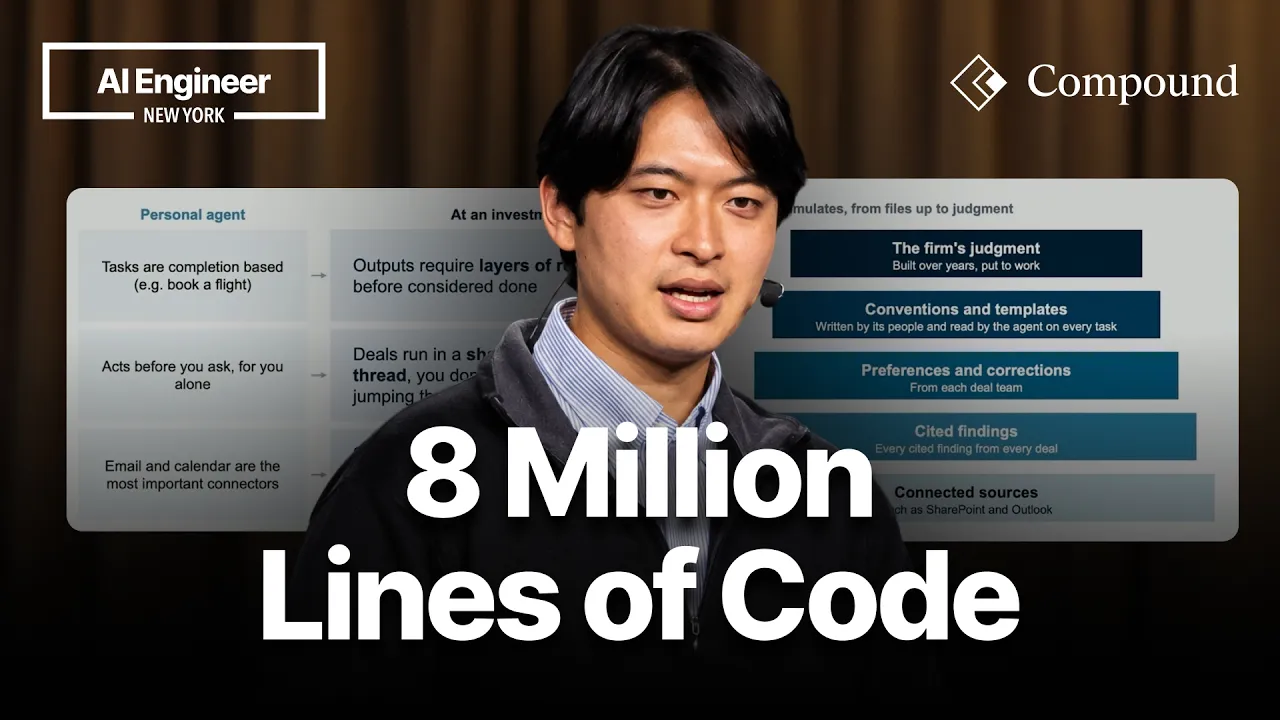
Description
Yijia Liang spent years as a finance analyst living in Excel and PowerPoint before founding Compound to build autonomous AI analysts for institutional investors. Personal agents took off because they run reliably in the background, act on their own and connect to your context, but finance needs more: multiplayer agents with their own inboxes that join deal-team email threads, a headless Office engine rebuilt from scratch with agents (1.5 trillion tokens and over 8 million lines of code) that runs work in parallel and checks its own formatting, and agent swarms that can work through data rooms of 15,000+ files. Chapters: 0:00 Intro 0:52 Why personal agents took off 1:34 Why that breaks in finance 3:12 Multiplayer agents 4:10 An inbox for every agent 5:28 Why off-the-shelf Office tools fall short 6:04 Rebuilding Office from scratch 7:38 Why headless is faster 8:21 Comments and collaboration 9:08 Write, render, check, fix 9:55 Huge data rooms and models 13:10 From copilot to autopilot 15:09 Wrap-up Yijia Liang https://getcompound.ai Join us in SF for the second annual AIE CODE summit: https://aie.codes our last flagship summit of 2026. Applications live now!
Summary
Generated by gpt-5.6-terraAt-a-Glance
- Verdict: Watch fully
- Core thesis: Finance agents can move from narrow copilots to trusted, long-running autopilots only when they are built as collaborative systems with native document engines, explicit verification loops, and source-grounded access to institutional data.
- Why it matters: This is a concrete control-plane and tooling argument: reliable high-stakes agent work requires owning the collaboration surface, execution environment, context layer, and validation loop rather than merely adding an LLM plugin to existing software.
- Best use: Watch for reusable architecture patterns for multi-user agents, headless document/workflow execution, agent swarms over large repositories, and write-render-check-fix validation.
Executive Summary
Yijia Liang, formerly a late-stage software-investment VP, frames institutional finance as a much harder environment for agents than personal-assistant tasks. Booking a restaurant can be safely delegated to a background agent; producing investment-committee models, presentations, and memos from a 15,000-file data room involves long runtimes, multiple reviewers, strict confidentiality, firm-specific output conventions, and the need for auditable accuracy.
Compound's answer is to treat the agent as a teammate embedded in the deal team's existing collaboration channel, especially Outlook. Each agent has an inbox shared by the authorized people on a thread, allowing the agent to accumulate collective context rather than forcing individuals to run isolated ChatGPT or Claude sessions and manually pass files through email and Teams. The product deliberately designs agent behavior to feel human in group threads, including avoiding a burst of redundant acknowledgments when several people email at once.
The most substantive technical claim is that off-the-shelf Office plugins, VM-driven computer-use agents, and file libraries such as OpenPyXL do not provide the throughput or controllability needed for autonomous finance workflows. Compound says it rebuilt Excel, PowerPoint, and Word as headless, high-fidelity engines, using Microsoft Office as an oracle in iterative agent loops. Ownership of the editor enables parallel execution, exact file rendering, and a closed-loop process in which agents write, render, inspect, and repair outputs before delivery.
For institutional context, Liang distinguishes breadth from depth. At breadth, he favors a lead agent that decomposes a file repository and delegates reading/searching to agent swarms rather than indiscriminately vector-indexing everything. At depth, custom spreadsheet representations and APIs avoid feeding a massive workbook's raw code-level contents into a model. The intended end state is not unreviewed autonomy: humans impart investment judgment and firm-specific preferences, while agents handle retrieval, mechanics, consistency checks, and production of cited artifacts.
Key Takeaways
- Claim: Enterprise-finance agents must be designed for team-level collaboration, not as isolated single-user copilots. | Evidence: Liang describes a deal workflow moving from a data room to IC models, slides, and memos over weeks of iteration and review; current Claude/ChatGPT deployments are characterized as siloed sessions followed by downloading, emailing, re-uploading, and collecting feedback manually. | Implication: For knowledge-work agents, the collaboration thread and shared state are first-class product primitives rather than an integration to add after generation. | Caveat: The argument is specific to collaborative, high-stakes workflows; many bounded finance tasks, such as spreading comps, are already workable with off-the-shelf tools.
- Claim: An agent operating through email needs explicit thread-scoped authorization and interaction design, not merely an attached inbox. | Evidence: Compound gives each agent a built-in inbox for Outlook-centered deal workflows and emphasizes ensuring every participant in a thread has read/write access; it also adds response latency so multiple rapid emails do not trigger multiple spammy acknowledgments. | Implication: Agent identity, permissions, membership changes, and response-coordination logic should be built into the communications layer if agents are to function as real teammates. | Caveat: Financial-firm NDA requirements make privacy and authorization especially central, so this pattern needs adaptation for lower-security environments.
- Claim: Autonomous document production at scale requires a headless native execution engine rather than desktop automation or generic file-editing libraries. | Evidence: Compound reports evaluating Office plugins, VM-based computer-use agents, OpenPyXL, and commercial engines before rebuilding Office-like Excel, PowerPoint, and Word capabilities; it claims a headless engine can recalculate 20 MB Excel workbooks 4x faster and execute work in parallel. | Implication: For agent systems that must produce and manipulate complex structured artifacts, the execution substrate can become the bottleneck and strategic moat; UI automation is unlikely to be sufficient for high-volume operations. | Caveat: The performance and fidelity figures are vendor claims in a product talk and are not independently benchmarked in the transcript.
- Claim: Reliable agent output comes from owning a closed validation loop: write, render, check, and fix. | Evidence: Liang says OpenPyXL-style workflows cannot render a document for visual verification and instead infer formatting from cell properties, while Compound uses Rust renderers and Office as a judge to target pixel-perfect output matching downloaded Office files. | Implication: Where users care about deliverable quality, build task-specific evaluators and artifact rendering into the loop rather than relying on model self-assessment or syntactic file validity. | Caveat: Visual or structural parity does not by itself prove that investment conclusions, calculations, or source interpretations are correct.
- Claim: Large institutional repositories should be handled through task decomposition and agent swarms, with findings grounded in source citations, rather than by default vector-indexing every file. | Evidence: The example is a data room with more than 15,000 files; a lead agent slices the directory, delegates file reading/search via grep or similar methods, gathers sub-agent findings, and iterates until the requested output is satisfactory, with each finding linked to source material. | Implication: Retrieval architecture should be chosen by the shape of the task: repository-scale investigation may call for hierarchical delegation and evidence collection rather than one universal semantic-search layer. | Caveat: Liang does not reject vector databases entirely; he says they remain appropriate for specific use cases.
- Claim: The practical path from copilot to autopilot is to delegate broader workflows while preserving human judgment and encoding firm-specific operating preferences. | Evidence: Compound's proposed stack runs from connected systems such as SharePoint and Outlook, to cited findings, to embedded preferences about how models and outputs should look; Liang contrasts humans judging whether a deal is good with agents checking whether numbers tie and presentation standards are met. | Implication: Autonomy should expand only alongside controls, provenance, preference capture, and review boundaries; the human role shifts toward judgment, exception handling, and policy-setting rather than disappearing. | Caveat: The transcript asserts that sufficiently strong checks can expand trusted autonomy, but it does not provide measured error rates, governance procedures, or examples of agents independently completing an entire live deal workflow.
Detailed Brief
What rebuilding Office is intended to unlock
- Claims: Owning the editor is presented as more than a performance optimization: it makes asynchronous human-agent collaboration possible directly inside the artifact.; A first draft can be generated and revised through document comments, with formatting and quality preferences supplied incrementally by one or many reviewers.; The target workflow is a five-person team revising a 100-page deck in an afternoon rather than repeatedly convening to edit it over weeks.
- Evidence: Liang says the conference deck itself was created in Compound from a generated first draft plus comments encoding lessons from consulting and investing.; Compound reports using iterative coding-agent loops, 1.5 trillion input/output tokens, and more than 8 million lines of code to recreate Office-style functionality.; For Excel specifically, it says it started from the open-source IronCalc project and produced a roughly 800,000-line Rust implementation.
- Caveats: The presentation does not show feature-coverage boundaries, interoperability edge cases, or independent confirmation of one-for-one Office parity.; The stated productivity gains are illustrative assertions, not a documented customer case study in the transcript.
- Implications: For an agent product, native artifact comments and structured revisions can be a stronger interaction model than a separate chat pane because feedback is attached to the exact object being changed.; The economic case for owning a vertical execution engine improves when it simultaneously enables speed, verification, collaboration, and proprietary product interaction.
Context design: breadth, depth, and preference layers
- Claims: Repository breadth and artifact depth are separate technical problems that should not be handled with the same context-passing mechanism.; A 30 MB spreadsheet with roughly two million formulas and multiple sensitivity tables is too large and slow to expose to a general model as raw code-level context.; A native engine can expose higher-level APIs and a compact machine-readable representation for a model to reason over large workbooks.
- Evidence: Liang cites models that take about five minutes to recalculate and describes generic LLM workflows that write code with OpenPyXL and print extensive workbook context for the model to inspect.; The proposed information stack is connected sources, source-cited findings, and embedded company/firm preferences about methods and presentation.
- Caveats: No technical detail is provided on the representation, citation-verification method, model-routing choices, or how sensitive source access is governed over time.
- Implications: A durable enterprise-agent system needs an explicit organizational-memory layer for policies and preferences, not only document retrieval.; Tool APIs should expose semantic operations over structured data so models manipulate intent-level objects rather than repeatedly reconstructing low-level file state.
Notable Concepts & Terms
- Multiplayer agent: An agent shared by all relevant collaborators on a workstream so it carries team context rather than serving one user's isolated chat session.
- Built-in agent inbox: Compound's Outlook-oriented interface for including an agent as an authorized participant in existing email threads.
- Headless Office engine: A non-desktop document-processing runtime intended to run Office-like operations in parallel, without the CPU/UI constraints of Excel, PowerPoint, or Word desktop instances.
- Office as an oracle: Using Microsoft Office behavior and rendering as the reference target against which an implementation is iteratively tested.
- Write-render-check-fix loop: A validation architecture in which an agent creates an artifact, renders it, evaluates the result, and revises it before returning it to the user.
- Agent swarms: A lead-agent/sub-agent decomposition pattern for investigating many files in parallel and consolidating their findings.
- Breadth versus depth of context: Breadth is search and synthesis over a large repository; depth is detailed reasoning over a single large, structured artifact such as a complex workbook.
- Copilot to autopilot: The proposed maturity shift from assisting individual document actions to delegating larger end-to-end workflows under sufficient checking and controls.
Operator Notes / Why Ken Should Care
- Use the write-render-check-fix pattern as a design requirement for any agent that produces user-facing documents, slides, spreadsheets, or other structured artifacts.
- Define agent permissions around collaboration membership and thread/workspace scope; do not treat email or chat connectivity as adequate authorization.
- Separate repository-scale research from deep structured-artifact analysis in the architecture, and benchmark retrieval/decomposition alternatives before defaulting to vector search.
- Evaluate whether high-volume document workflows justify a headless semantic execution layer instead of browser/desktop automation; measure throughput, rendering fidelity, and recovery behavior.
- Require provenance at the individual finding level and retain a human approval boundary for consequential judgments, even when mechanical production steps are automated.
- Investigate Compound as a market signal and potential vertical-agent reference architecture, while independently validating its claims of Office fidelity, performance, and end-to-end reliability.
Source/Metadata
- Title: Why We Rebuilt Microsoft Office From Scratch for AI Agents - Yijia Liang, Compound AI
- Transcript words: 5170
- Duration seconds: 944
- Timestamp note: No timestamps or chapters were provided. The transcript contains a substantial repeated segment, so the stated word count overstates the amount of unique content.
Transcript
I was previously an analyst in a previous life. I was a vice president at Co2 for about three years, specializing in late stage private software investments. Spent way too much time in Excel, PowerPoint, and late nights doing that type of work, and so decided to split and start building tools to replace my old job. Quick show of hands, how many people in here have used user instinct in the last day? All right, I expected more hands, but maybe people are too shy to raise them. And how many people know an analyst in finance that fully delegates their work to AI, running it autonomously? All right, one, but a lot fewer. I think if you think about the question, why did personal agents take off within the last three months? Internally, we came up with three main answers. The first, reliable background agents. You can delegate a task, book a restaurant, book a flight, and it'll do it reliably now. Computer use agents have gotten sophisticated. The models themselves have gotten better. The second is proactivity. It'll do things without you asking. It's part of that magical experience when instinct wakes you up saying, it's your wife's anniversary. Go buy some flowers. Or better yet, I already bought the flowers for you. And finally, integrations. It's connected to the systems of context that matter most for you. Email, drive, calendar. But all the factors that make personal agents work so well doesn't really translate to institutional finance today. If we think about background tasks, something as simple as booking a restaurant reservation, the analog equivalent in buy-side finance might be, how do you go from a data room to a fully prepared set of IC models, slides, and memos? Taking a process that would normally take four weeks, multiple rounds of iteration and review, and compressing that to a few days. If we think about proactivity, your managing director doesn't really want an agent rogue running around doing a bunch of things and burning tokens without them providing and soliciting input. And then finally, if you think about the context that matters, it's not just email. It's not just calendar. It could be a data room with 15,000 files. It could be SharePoint box with petabytes of unstructured data the firm has collected in its 40-year history. So how do you deal with these problems? The purpose of today's talk is to discuss how we at Compound have approached the problem of solving long-running agents in finance. On one hand, it's creating a real teammate that collaborates with you and the deal team. That's multiplayer embedding that into the app. On the other hand, it's solving how can you run long tasks in parallel in the background, reliably execute them. And so for that, we actually rebuilt Office from scratch. And then finally, it's how do you manage the context of everything, petabytes of data in SharePoint and Box. And we'll talk a little bit about how we've designed a solution for that. So the first question we have to ask is why does multiplayer actually matter for finance? If you look at the anatomy of a deal team, the type of tasks that matter for long-running workflows, for example, going from a data room into all the sorts of materials that make its way in front of an investment committee, it doesn't work for single-player siloed workflows. Today, for people who have deployed Claude or ChatGPT in their institutions, it's all single-player. People working in a plug-in, people working in the web app, producing outputs. But invariably, those people need to collaborate with their team. And what does that look like? It means downloading the file, uploading it into email, uploading it to Teams, asking for feedback. I think the right way to approach this, and this is the way we've thought about at Compound, is how do you get every person who matters on a deal onto the same thread? How can they all talk to the same agent so that one agent can share the context of everyone who matters for any particular work stream? When we thought about how do we actually bring multiplayer into a familiar context, we looked again towards personal agents. Why did they work so well? Well, you can text one in iMessage, or you can text one in WhatsApp. So for agents at Compound, every single one you create comes with a built-in inbox. Because ultimately, at the end of the day, for institutional finance, most workflows run through Outlook. You'll have chains of emails, 20 or more running. You want an agent to be part of every single one of those conversations. Designing email for agents is actually non-trivial. It's not just as simple as hooking it up with an email inbox. It requires A, authenticating, making sure everyone part of that thread has read and write access to that agent. Ultimately, at these financial firms, privacy is incredibly important. You're always under NDA, no matter what deal you look at. And so you want to make sure everyone on that thread can actually talk to the agent. But then beyond authentication, you also have to think about how do you design a real human-like experience. Because after all, we're trying to create a real teammate. If multiple people email in the same thread in quick succession, you don't want multiple acknowledgments spamming that group. You actually want to bake in some more latency to make it feel more human. And so there are other design decisions when thinking about how to create real email agents for enterprise finance. But multiplayer aside, we realized even after you solicit the input of everyone who matters, if you wanted to scale up the number of tasks and run them all in parallel, existing off-the-shelf solutions simply don't cut it. We evaluated a lot. The desktop plugins of Excel, PowerPoint, and Word. We evaluated computer use using virtual machines to try to scale up the number of agents that could work in Excel, PowerPoint, and Word natively. And we also evaluated a ton of off-the-shelf engines, whether those are open source packages like OpenPiXL or commercial engines that are available for purchase. None of them really cut it for what we were trying to look at. And with coding agents dramatically improving and bringing the cost of software down, we decided to just build our own Office from scratch. And we ran agents in many loops, spend 1.5 trillion input output tokens and over 8 million lines of code to rewrite Office from scratch. And I'll walk through a little bit of how we approached it. But it's as simple as pointing agents at an objective function, which is recreate Office in full fidelity and then letting it run. So take Excel as an example. We started with an open source solution called IronCalc. We decided, OK, how can you recreate this perfectly for Excel, use Office as an Oracle, and just run loops, benchmarking it on real files from both real-world corpus that we grabbed online and also ones that internally we created. And 800,000 lines of Rust later, we had a much more performant version compared to Excel, a one-for-one replica of the product. With this, we're actually able to do that for not only Excel, but also PowerPoint and Word. So we ran loops across every single one of these products, and we have faithful recreations. You can try it for yourself today at getcompound.ai. And it's the same method, loop agents against Office as a judge, using Rust renders to make sure that the rendering of these products was pixel perfect. So what you see in Compound is what you see when you download to Office. We needed one-for-one parity because at the end of the day, these firms only trust what they can download and what they can send. Now, let's talk about performance. Why is a headless engine so much better compared to using a VM or using desktop Excel? Well, for one, desktop Excel or PowerPoint or Word is bound to that CPU. With headless engines, you can do tasks in parallel much faster. You can build out a complex model in a much shorter amount of time. You can recalculate 20 megabyte Excels 4x faster. So every single piece of work an analyst would expect an agent to do because, again, their expectation is quality of a human at much lower speed and much lower cost. You have to have a headless engine to do this. If you tried to scale this up with Excel and PowerPoint, I think you'd be going down the wrong path. But it's not just about performance. Owning the editor actually allows you to create a much richer product experience that allows you to work and collaborate with agents asynchronously much better than you can with other products. So this entire slide deck you're seeing today, I built in Compound just by dropping in comments. I had it create a first draft. And then as you can see here on the UI, I dropped in comments for every single piece of formatting. For my consulting days, for my CO2 days, all the learnings I had on what makes a great slide, I imparted with the agent. This can also work for multiplayer. You can have multiple people part of the same team using the same multiplayer infrastructure we set up, dropping in comments. So for a team of five, you can rip through a 100 page deck in an afternoon rather than sitting in a room revising it for multiple weeks. Finally, with respect to building your own engine, it also allows us to run iterative checking loops much more. So if you have a task that, for example, is writing a complex model, it might take a few hours. But how can we make that faster? How can we make it more accurate? If you're using, for example, an OpenPy Excel code library, there's no render you can use to check formatting. You're just guessing and hoping that the model writes the right thing, and maybe you do some parsing to see a cell as a particular color or has a particular font. If you try to use Microsoft's own interface, you're going to be limited by what Microsoft provides you, which is admittedly very little. So with an own engine, you actually own the write, render, check, and fix loop. So you can rapidly iterate on the output for the user. So the last thing I want to discuss today, beyond multiplayer and building our own office, is how to deal with the context that these firms have. For firms on the buy side, they deal with situations where it crosses both breadth and depth of data. You may have situations where you have a data room over 15,000 files, and then files in that data room might be well over 20 megabytes. People in finance complain all the time, hey, I have an Excel model that's 30 megabytes. It takes five minutes to recalculate, because we have two million formulas and five sensitivity tables that need to recalculate every single time. So how do you deal with this? Well, for breadth, I think we take a look at a page out of the coding book and apply agent swarms to the large number of files. No longer do you have to index everything in a vector DB unless it's for a very specific use case. It's actually much preferable to use coding agents to read files, either through grep or through some other methodology, and then have a lead agent slice the contents of the file directory, and then have swarms of agents come back to you with insights. And then you iterate that in a loop until you're satisfied with the output required. Furthermore, through this process, you're actually able to ground every single finding in citations in the source document so that you know exactly what you show on the screen is linked to some number that the analyst can trust. If we think about the depth of data, right, take that 30 megabyte workbook, how can you actually process this more accurately? In today's world, if you were to just use ChatGPT or Claude off the shelf to process that 30 megabyte model, it would write code. It would use open source packages like OpenPy Excel. It would be expensive and slow because it's printing out every single piece of context about that model in code for the model to read. But because we've developed our own engine for Excel, we're actually not only more accurate, but a lot faster and cheaper because the engine processes it, and then lays it out in a very easy to read and easy to process format for the model. This means we can expose a much richer set of APIs and a much richer set of tools for the agent to work over. And that allows us to process these models in a much faster manner. So if we sort of take a step back and think about, OK, what is all of this context built for? At the end of the day, what we want to do is prevent people from spending time finding files, from reminding the model this is how to do things. Instead, they should be focused on imparting their judgment on the deal process. They should be focused on tailoring training agents and deploying them on every part of the deal flow. And so it goes from the bottom level, connected sources, off the shelf connectors to SharePoint or Outlook, to the cited findings grounded in the sources that matter. And then finally, embedding in the preferences, company knowledge that matters. How do you do a model? How should it look? Which differs by every single firm. So that for humans, they spend most of their time imparting judgment. They spend most of their time thinking about, is this actually a good deal? Not, did all the numbers tie? Does the model look right? Will my VP yell at me? Because it looks a different way? If we take a step back and think about the type of tasks that currently are on autopilot versus what are on copilot, I would say there's already several finance tasks. You can do pretty well with off the shelf tools. Spreading comps, as the ChatGPT head of finance mentioned earlier, they have now their own products for this. But I think there are a lot of longer running tasks that are not capable with existing solutions. How do you draft a 50 page IC presentation off the cuff? How do you get agents to build out a model exactly the way you want it for a private equity professional or a hedge fund professional? I think those are tasks that, with off the shelf tools, still exist within the copilot realm. People want to be embedded deeply in that process without letting go. But with some of the tools we've built today, I think we're able to expand the aperture for which autopilot can take over in finance firms. So rather than just using tools embedded in Excel as plugins, hand-holding along the way, you can start delegating. You can start becoming more ambitious about what AI is capable of. If I think about where we are today in the world of finance, it very much reminds me of when Opus 4.5 launched last December, where people stopped using code as a simple copilot to generate the next file or the next line of code. But they started delegating far more ambitious tasks. They started realizing, maybe I can just truly vibe it. If I have sufficient checks, if I have sufficient tests, maybe I can just trust all the code it writes. I think with some of the tooling we've built today, along with what we're planning in the future, these are the type of problems you have to solve before you get to that point for finance. How can analysts, how can the entire deal team become more ambitious with AI? How can they just drop in a data room and decide, OK, I'm going to trust every single one of the outputs. And then let's do that tenfold so we can see more deals, so we can expand the aperture of what matters. So to conclude, enterprise agents are certainly coming to finance. I strongly believe we're at an inflection point in the adoption curve, and that people are slowly becoming more ambitious, and they're moving away from copilots to autopilots. And so this was sort of how we've approached it here at Compound. If you work at a firm, and you're interested in deploying our agents to drive more of your deal work, please reach out. Or if you're an engineer, and you're curious about talking about our approach and sharing ideas, please either reach out online, or I'll be around if you want to find me. Thanks so much. onto the same thread? How can they all talk to the same agent so that one agent can share the context of everyone who matters for any particular work stream? When we thought about how do we actually bring multiplayer into a familiar context, we looked again towards personal agents. Why did they work so well? Well, you can easily text one in iMessage, or you can text one in WhatsApp. So for agents at Compound, every single one you create comes with a built-in inbox. Because ultimately, at the end of the day, for institutional finance, most workflows run through Outlook. You'll have chains of emails, 20 or more running. You want an agent to be part of every single one of those conversations. Designing email for agents is actually non-trivial. It's not just as simple as hooking it up with an email inbox. It requires A, authenticating, making sure everyone part of that thread has read and write access to that agent. Ultimately, at these financial firms, privacy is incredibly important. You're always under NDA, no matter what deal you look at. And so you want to make sure everyone on that thread can actually talk to the agent. But then beyond authentication, you also have to think about how do you design a real human-like experience. Because after all, we're trying to create a real teammate. If multiple people email in the same thread in quick succession, you don't want multiple acknowledgments spamming that group. You actually want to bake in some more latency to make it feel more human. And so there are other design decisions when thinking about how to create real email agents for enterprise finance. But multiplayer aside, we realized even after you solicit the input of everyone who matters, if you wanted to scale up the number of tasks and run them all in parallel, existing off-the-shelf solutions simply don't cut it. We evaluated a lot. The desktop plugins of Excel, PowerPoint, and Word. We evaluated computer use using virtual machines to try to scale up the number of agents that could work in Excel, PowerPoint, and Word natively. And we also evaluated a ton of off-the-shelf engines, whether those are open source packages like OpenPiXL or commercial engines that are available for purchase. None of them really cut it for what we were trying to look at. And with coding agents dramatically improving and bringing the cost of software down, we decided to just build our own Office from scratch. And like a great AI engineer would, we ran agents in many loops, spend 1.5 trillion input output tokens and over 8 million lines of code to rewrite Office from scratch. And I'll walk through a little bit of how we approached it. But it's as simple as pointing agents at an objective function, which is recreate Office in full fidelity and then letting it run. So take Excel as an example. We started with an open source solution called IronCalc. We decided, OK, how can you recreate this perfectly for Excel, use Office as an Oracle, and just run loops, benchmarking it on real files from both real-world corpus that we grabbed online and also ones that internally we created. And 800,000 lines of Rust later, we had a performance, much more performant compared to Excel, one for one replica of the product. With this, we're actually able to do that for not only Excel, but also PowerPoint and Word. So we ran loops across every single one of these products, and we have faithful recreations. You can try it for yourself today at getcompound.ai. And it's the same method, loop agents against Office as a judge, using Rust renders to make sure that the rendering of these products was pixel perfect. So what you see in compound is what you see when you download to Office. We needed one for one parity because at the end of the day, these firms only trust what they can download and what they can send. Now, let's talk about performance. Why is a headless engine so much better compared to using a VM or using desktop Excel? Well, for one, desktop Excel or PowerPoint or Word is bound to that CPU. With headless engines, you can do tasks in parallel much, much faster. You can build out a complex model in a much shorter amount of time. You can recalculate 20 megabyte Excels 4x faster. So every single piece of work an analyst would expect an agent to do because, again, their expectation is quality of a human at much lower speed and much lower cost. You have to have a headless engine to do this. If you tried to scale this up with Excel and PowerPoint, I think you'd be going down the wrong path. But it's not just about performance. Owning the editor actually allows you to create a much richer product experience that allows you to work and collaborate with agents asynchronously much better than you can with other products. So this entire slide deck you're seeing today, I built in Compound just by dropping in comments. I had it create a first draft. And then as you can see here on the UI, I dropped in comments for every single piece of formatting. For my consulting days, for my CO2 days, all the learnings I had on what makes a great slide, I imparted with the agent. This can also work for multiplayer. You can have multiple people part of the same team using the same multiplayer infrastructure we set up, dropping in comments. So for a team of five, you can rip through a 100 page deck in an afternoon rather than sitting in a room revising it for multiple weeks. Finally, with respect to building your own engine, it also allows us to run iterative checking loops much more as well. So if you have a task that, for example, is writing a complex model, it might take a few hours. But how can we make that faster? How can we make it more accurate? If you're using, for example, an OpenPy Excel code library, there's no render you can use to check formatting. You're just guessing and hoping that the model writes the right thing, and maybe you do some parsing to see a cell as a particular color or has a particular font. If you try to use Microsoft's own interface, you're going to be limited by what Microsoft provides you, which is admittedly very little. So with an own engine, you actually own the write, render, check, and fix loop. So you can rapidly iterate on the output for the user. So the last thing I sort of want to discuss today, beyond multiplayer and building our own office, is how to deal with the context that these firms have. For firms on the buy side, they deal with situations where it crosses both breadth and depth of data. You may have situations where you have a data room over 15,000 files, and then files in that data room might be well over 20 megabytes. People in finance complain all the time, hey, I have an Excel model that's 30 megabytes. It takes five minutes to recalculate, because we have two million formulas and five sensitivity tables that need to recalculate every single time. So how do you deal with this? Well, for breadth, I think, again, we take a look at a page out of the coding book and apply agent swarms to the large number of files. No longer do you have to index everything in a vector DB unless it's for a very specific use case. It's actually much preferable to use coding agents to read files, either through grep or through some other methodology, and then have a lead agent slice the contents of the file directory, and then have swarms of agents come back to you with insights. And then you iterate that in a loop until you're satisfied with the output required. Furthermore, through this process, you're actually able to ground every single finding in citations in the source document so that you know exactly what you show on the screen is linked to some number that the analyst can trust. If we think about the depth of data, right, take that 30 megabyte workbook, how can you actually process this more accurately? In today's world, if you were to just use ChatGPT or Claude off the shelf to process that 30 megabyte model, it would write code. It would use open source packages like OpenPy Excel. It would be expensive and slow because it's printing out every single piece of context about that model in code for the model to read. But because we've developed our own engine for Excel, we're actually not only more accurate, but a lot faster and cheaper because the engine processes it, and then lays it out in a very easy to read and easy to process format for the model. This means we can expose a much richer set of APIs and a much richer set of tools for the agent to work over. And that allows us to process these models in a much faster manner. So if we sort of take a step back and think about, OK, what is all of this context built for? At the end of the day, what we want to do is prevent people from spending time finding files, from reminding the model this is how to do things. Instead, they should be focused on imparting their judgment on the deal process. They should be focused on tailoring training agents and deploying them on every part of the deal flow. And so it goes from the bottom level, connected sources, off the shelf connectors to SharePoint or Outlook, to the cited findings grounded in the sources that matter. And then finally, embedding in the preferences, company knowledge that matters. How do you do a model? How should it look? Which differs by every single firm. So that for humans, they spend most of their time imparting judgment. They spend most of their time thinking about, is this actually a good deal? Not, did all the numbers tie? Does the model look right? Will my VP yell at me? Because it looks a different way. So oh, Kersher needs to update. If we take a step back and think about the type of tasks that currently are on autopilot versus what are on copilot, I would say there's already several finance tasks. You can do pretty well with off the shelf tools. Spreading comps, as the ChatGPT head of finance mentioned earlier, they have now their own products for this. But I think there are a lot of longer running tasks that are not capable with existing solutions. How do you draft a 50 page IC presentation off the cuff? How do you get agents to build out a model exactly the way you want it for a private equity professional or a hedge fund professional? I think those are tasks that, with off the shelf tools, still exist within the copilot realm. People want to be embedded deeply in that process without letting go. But with some of the tools we've built today, I think we're able to expand the aperture for which autopilot can take over in finance firms. So rather than just using tools embedded in Excel as plugins, hand-holding along the way, you can start delegating. You can start becoming more ambitious about what AI is capable of. If I think about where we are today in the world of finance, it very much reminds me of when Opus 4.5 launched last December, where people stopped using code as a simple copilot to generate the next file or the next line of code. But they started delegating far more ambitious tasks. They started realizing, maybe I can just truly vibe it. If I have sufficient checks, if I have sufficient tests, maybe I can just trust all the code it writes. I think with some of the tooling we've built today, along with what we're planning in the future, these are the type of problems you have to solve before you get to that point for finance. How can analysts, how can the entire deal team become more ambitious with AI? How can they just drop in a data room and decide, OK, I'm going to trust every single one of the outputs. And then let's do that tenfold so we can see more deals, so we can expand the aperture of what matters. So to conclude, enterprise agents are certainly coming to finance. I strongly believe we're at an inflection point in the adoption curve, and that people are slowly becoming more ambitious, and they're moving away from copilots to autopilots. And so this was sort of how we've approached it here at Compound. If you work at a firm, and you're interested in deploying our agents to drive more of your deal work, please reach out. Or if you're an engineer, and you're curious about talking about our approach and sharing ideas, please either reach out online, or I'll be around if you want to find me. Thanks so much. Thank you very much. Thank you very much. Thank you very much. Thank you very much. Thank you very much. Thank you very much. Thank you very much. Thank you very much. Thank you very much. Thank you very much. Thank you very much.