Your Agent Is a Lethal Trifecta (And What to Do About It) — Kim Maida, Keycard
Description
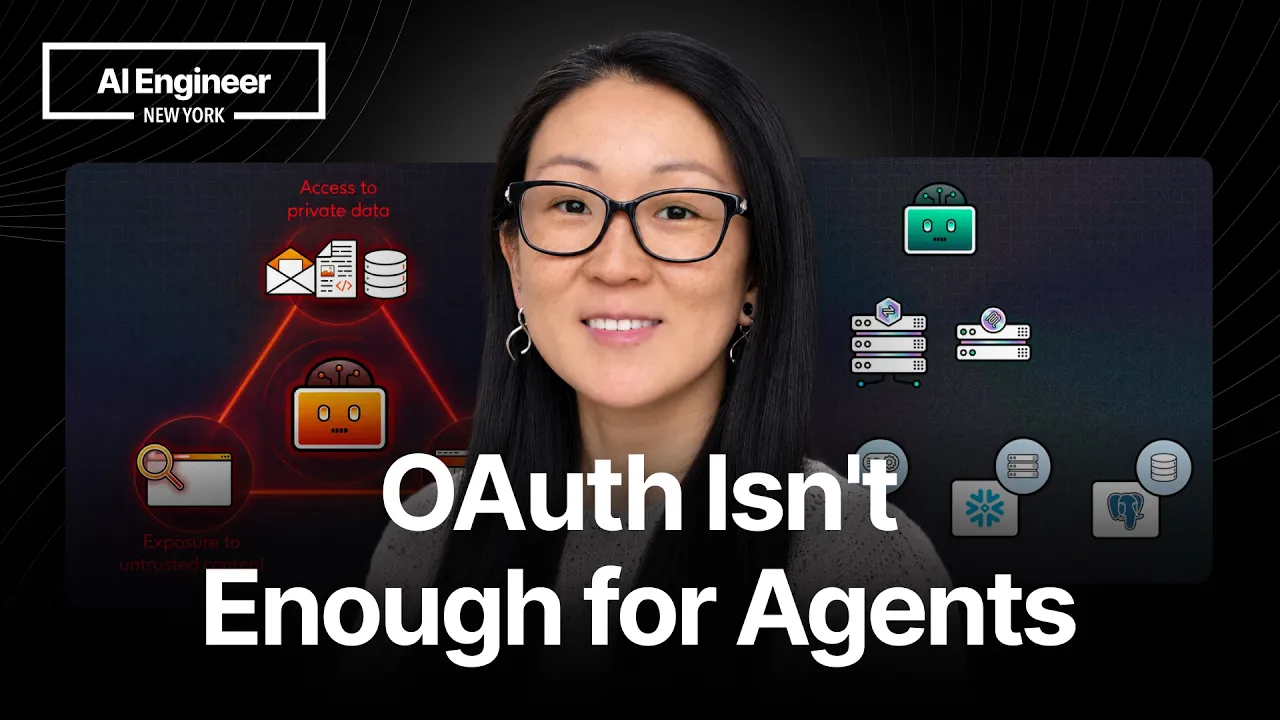
An on call agent drops a billing database, restarts a production server and scales a service from four pods to 40, adding $420 an hour to the bill. Kim Maida's staged triage demo shows what happens when an agent receives standing API keys and an administrator's database credentials. Private data, untrusted tickets and access to external services combine into the lethal trifecta. The agent can do useful work, but its credentials give it far more authority than any one ticket requires. A human approval button alone cannot tell it which actions the user is actually authorized to approve. Maida walks through delegated authorization using OAuth token exchange: carry the user's identity through the agent and MCP server, evaluate policy at a security token service and issue short lived credentials scoped to the requested access. She also explains Keycard's approach to intent based authorization, which she identifies as a proposal rather than a finalized standard. The second demo uses task based policy instead. Customer data access and database deletion are denied, certificate renewal is allowed, and a server restart stays blocked even after approval because the user's role cannot authorize it. Scaling proceeds when the user has the required authority. The demos make identity, delegation and policy decisions visible throughout the request chain, while keeping authorization distinct from whether an agent's answer is correct. Speaker info: - https://www.linkedin.com/in/kimmaida/ - https://github.com/kmaida - https://maida.kim/ Timestamps: 00:00 - An overprivileged on call agent 2:32 - Database deletion, restart and scaling 4:16 - The lethal trifecta 6:21 - Access control and standing credentials 8:43 - Missing identities and token exchange 10:25 - Following the agent and MCP execution path 12:18 - Subject tokens and the security token service 14:11 - Intent based authorization as a proposal 16:05 - Ephemeral credentials and delegation chains 17:37 - Repeating the demo wit
Summary
Generated by gpt-5.6-terraAt-a-Glance
- Verdict: Watch fully
- Core thesis: Agents become dangerously exploitable when they combine private-data access, exposure to untrusted inputs, and external action capability; the proposed remedy is per-task, ephemeral delegated credentials enforced through token exchange, policy, and optionally intent-based authorization.
- Why it matters: This is a concrete control-plane architecture for allowing autonomous agents to use MCP tools and production systems without giving them long-lived, broad credentials or relying on human approval alone.
- Best use: Use it as a security architecture reference for agent systems that touch sensitive data, infrastructure, SaaS APIs, or MCP servers; extract its identity, token-exchange, and policy-enforcement patterns rather than treating it as a complete vendor-neutral implementation guide.
Executive Summary
Kim Maida frames agent risk through Simon Willison's “lethal trifecta”: an agent can access private data, consume untrusted content, and communicate or act through external systems. The opening on-call-triage demo makes the risk operational: one broadly credentialed agent can expose customer PII, drop and restore a production billing database, restart a production server, and scale capacity from four to 40 pods at $420 per hour.
Her central argument is that the common mitigations are incomplete. OAuth establishes a user grant but tends to create standing, overly broad permissions; MCP gateways centralize observability and routing policy but still commonly retain standing credentials; and sandboxes constrain processes but do not decide whether an external action should be authorized. Adding human approval everywhere merely transfers access-control decisions to a fatigued operator.
The proposed architecture inserts a security token service (STS) into the agent execution path. A runtime exchanges a user's subject token plus its own workload identity for a narrowly scoped credential tied to a particular tool call. The MCP server can then exchange that credential again for a downstream-resource token. Tokens are ephemeral, should not be stored, preserve the user and application delegation chain, and are evaluated against policy at each exchange.
Maida extends this with intent-based authorization (IBA): before work begins, the agent declares a mission containing a goal, allowed actions, and limits. A gateway checks each proposed tool call against that mission and asks the STS to issue credentials only when the call fits both the mission and policy. The closing demo shows policy blocking PII retrieval and database deletion, requiring approval for a disruptive restart while still denying it because the user lacks the necessary role, and permitting a user-authorized scale-up that their role allows.
Key Takeaways
- Claim: The highest-risk agent configuration is the combination of private-data access, untrusted-content ingestion, and external communication or tool-use capability. | Evidence: The on-call agent reads user-submitted incident tickets, queries a Snowflake customer warehouse and billing database, and calls incident, cloud-hosting, and database APIs. Maida attributes the “lethal trifecta” formulation to Simon Willison. | Implication: Threat-model agents by mapping where all three capabilities coexist; those workflows deserve stronger runtime authorization than ordinary read-only assistants. | Caveat: Removing any of the three capabilities can reduce risk, but Maida argues that it also materially reduces many agents' practical usefulness.
- Claim: Long-lived static credentials turn an agent's model decisions into unrestricted production authority and make attribution weak. | Evidence: In the initial demo, API keys and a database connection string with an admin password let the agent query customer PII, execute a documented drop-and-restore procedure against a production billing database, restart a main server, and scale from four to 40 pods, adding $420 per hour in cost. The audit log cannot identify who used the shared API keys. | Implication: Do not place broadly privileged API keys, admin connection strings, or other standing secrets directly in agent runtimes or MCP tool implementations.
- Claim: OAuth, MCP gateways, and sandboxes are useful controls, but none alone provides authorization scoped to a single agent task or tool invocation. | Evidence: OAuth consent occurs before a specific task exists and can create standing access; an MCP gateway evaluates requests but commonly holds credentials whose grant outlives the task; a sandbox limits what a process can do but useful work still requires access outside it. | Implication: Evaluate agent security architectures based on the lifetime and granularity of actual downstream credentials, not merely on whether they use OAuth, MCP, gateways, or isolation. | Caveat: These mechanisms remain complementary building blocks; the speaker's point is that even using all three does not inherently mint a runtime credential downscoped to one task.
- Claim: Human-in-the-loop approval is not an adequate substitute for authorization policy. | Evidence: Maida argues that universal approval produces consent fatigue and shifts access control to error-prone users. In the revised demo, the user approves a server restart, but the STS still denies it because that user's role lacks authority to take production offline. | Implication: Design approvals as an additional condition after policy eligibility, never as a mechanism that can override identity, role, or hard safety constraints. | Caveat: Human approval can remain appropriate for higher-risk actions, but it must be bounded by role- and policy-based ceilings.
- Claim: OAuth 2 token exchange can establish an attributable delegation chain and produce short-lived credentials for individual agent actions. | Evidence: The runtime authenticates to an STS using app client credentials or workload identity, submits the user's subject token, and requests access for a specific MCP tool call. The STS evaluates the resource, requested access, user identity, and agent identity before issuing a token that should expire within minutes and never be stored. | Implication: Require every privileged tool call to carry both the principal on whose behalf it acts and the workload/agent that requested it, with credentials minted just in time rather than pre-provisioned. | Caveat: Token exchange provides the delegation and credential-scoping mechanism; it does not determine whether a proposed action is semantically appropriate without well-designed policy or intent constraints.
- Claim: Intent-based authorization can constrain an agent to an explicitly bounded mission rather than only checking broad permissions. | Evidence: The proposed mission “triage incident 2294” permits reading, summarizing, or escalating that ticket but prohibits reading other tickets or calling other services. A remediation mission may permit scaling a service once, while the gateway checks each call's mission ID with the STS before requesting token exchange. | Implication: For autonomous workflows, define machine-enforceable task contracts—goal, allowable tools/actions, target resources, count limits, and other boundaries—rather than relying solely on broad role scopes. | Caveat: IBA is not presented as a finalized standard; Maida describes Keycard's approach and notes that proposals are still being accepted.
- Claim: Task-scoped delegated authorization can preserve selective autonomy while blocking unsafe data access and irreversible operations. | Evidence: In the protected demo, policy blocks issuance of credentials to retrieve customer PII for an incident ticket and to delete the production billing database, permits TLS certificate renewal, blocks an approved server restart because the user's role lacks permission, and permits a role-authorized scale-up after approval. | Implication: Classify tools by action risk and make policy outcomes explicit: auto-approve low-risk bounded work, require eligible human approval for disruptive reversible work, and hard-deny destructive or sensitive-data actions outside narrowly defined procedures. | Caveat: The demo uses task-based policy governance rather than the full intent-based authorization flow described earlier, and it is a vendor demonstration rather than evidence of production efficacy across environments.
Detailed Brief
Reference execution path for delegated MCP access
- Claims: The speaker positions an MCP server as both a defined-tool interface and a broker between the agent runtime and downstream systems.; Authorization is performed in two stages: first for the runtime-to-MCP tool call, then, where needed, for the MCP server's call to the actual downstream resource.; Delegation information is retained across both exchanges so that downstream activity can be attributed to the initiating user and the application or agent acting for them.
- Evidence: The stated request path is user prompt to runtime, runtime to LLM, proposed tool call through an MCP client, MCP server execution, resource API response, then repeated model-loop iterations.; For a downstream call, the MCP server exchanges the received MCP token for a resource-specific token; the resulting token retains the user subject and extends the delegation chain.; Both the agent runtime and MCP server are instructed not to persist the minted tokens: they are used for the immediate call and discarded.
- Caveats: The transcript does not specify token formats, exact audience/resource binding, revocation behavior, handling of long-running tasks, replay protections, or how policy is authored and tested.; A token exchange architecture only improves enforcement if every privileged downstream resource validates the issued token or is reliably mediated by an enforcing component.
- Implications: Treat the STS as a central authorization control plane whose audit records should correlate user, agent/workload, mission or task, tool, resource, decision, and resulting action.; Avoid architectures where an MCP server is merely a convenience wrapper around embedded vendor secrets; it must participate in credential brokering and validation to provide the promised control.
Policy model implied by the demo
- Claims: Policy is a ceiling rather than a complete expression of intent: an action can be permitted by broad policy while still exceeding what was intended for a particular task.; The speaker differentiates low-risk assessment work, which may be administratively auto-approved, from remediation actions that can require user review and approval.; Authority is the intersection of mission/task constraints, organizational policy, the user's role, and the agent's delegated access—not simply the user's click on an approval prompt.
- Evidence: Reading and assessing an incident ticket is presented as a potential auto-approved mission, whereas scaling a service is framed as a distinct, one-time remediation mission.; The protected demo blocks PII from entering the agent or incident-ticket context, showing that data-flow restrictions can be enforced as an authorization decision rather than left to prompting.
- Caveats: The transcript does not address whether the model can manipulate or misrepresent mission contents, how intent is extracted from prompts, or how policies prevent unsafe combinations of individually permitted actions.
- Implications: Policy design should include data-classification controls and action budgets, not only coarse read/write scopes.; For consequential workflows, separate assessment, recommendation, approval, and execution into distinct missions so an agent cannot silently expand from diagnosis into remediation.
Notable Concepts & Terms
- Lethal trifecta: The risky combination of private-data access, untrusted input exposure, and external communication/action capability in one agent.
- Security Token Service (STS): The authorization component that evaluates policy and delegation context before minting short-lived credentials for an agent tool call or downstream resource call.
- OAuth 2 Token Exchange: An existing standard, published in 2020 according to the speaker, used here to exchange a user subject token and workload identity for narrowed delegated access.
- Subject token: The authenticated user's token, used to establish whom the agent is acting for and to preserve that attribution through the execution chain.
- Delegation chain: The retained identity lineage from user to agent/application to MCP server and downstream resource, enabling traceability and constrained authority.
- Intent-based authorization (IBA): A proposed authorization approach in which an agent's mission—goal, permitted actions, and limits—is checked before and during execution; it is not yet a finalized standard.
- Mission ID: An identifier issued after a mission is approved, included with tool calls so a gateway can verify that each action fits the bounded task.
- MCP gateway/server: The tool-access layer between an agent and resources; the speaker argues it should broker access with an STS rather than retain standing credentials.
Operator Notes / Why Ken Should Care
- Audit every agent and MCP server for embedded static secrets, admin database strings, broad API keys, and credentials whose validity exceeds a single task; prioritize replacements for production-write paths.
- Require an action-level authorization record for each privileged tool call: user subject, agent/workload identity, task or mission ID, requested action, target resource, policy decision, approver if applicable, and expiry.
- Define hard-deny policies now for production database deletion, unrestricted customer-PII retrieval into agent context, and other irreversible actions; do not make them approval-only controls.
- Model high-impact operations as separate, bounded missions with explicit target, one-time/count limit, cost limit, and rollback or verification requirements.
- Test whether current approval flows can be bypassed by a user who lacks the underlying role; approval UX should only appear for actions that policy and role already make eligible.
- Validate whether downstream APIs can accept short-lived delegated tokens; where they cannot, identify a trusted mediation layer before claiming task-scoped authorization.
Source/Metadata
- Title: Your Agent Is a Lethal Trifecta (And What to Do About It) — Kim Maida, Keycard
- Transcript words: 4091
- Duration seconds: 1508
- Timestamp note: No timestamps or chapters were provided in the transcript.
Transcript
Today I'm going to talk to you about how your agent is a lethal trifecta and what to do about it. Now we're going to start out right off the bat with a demo. Some context on this demo, we're going to look at an on-call triage agent that reads and writes to an incident pager and resolves or escalates tickets. This agent has full access to a cloud hosting API, a customer data warehouse, as well as a billing database. So here we have our on-call triage agent and it has an incident queue of tickets that it's going to read. And then if it can resolve them, it's going to call the available services that it has access to and it's going to do so. Things that it can't resolve, it's going to escalate for the morning team. So if we take a look at this first ticket, this is a billing anomaly. It says a batch of customers were overcharged last night. So the first thing the agent does is it directly calls the incident X API in order to read the ticket. And if you look here, you can see that it authorized access to this API using an API key. It then uses a Snowflake key to query the customer data warehouse and it's going to decide to escalate the ticket for morning review. And it writes a report for the morning team. And as you can see, it's sharing customer data. All right. These are rows directly pulled from the customer data warehouse and it is sending personally identifiable information to the team that is going to be on staff in the morning. So this next ticket is a backup power supply failed in the server room. The agent is going to read the ticket. Again, it's using an API key to call the ticket API. It determines that this is a physical problem. So it escalates for morning review without calling any additional services. This one is the TLS certificate is expiring soon for the website. It reads the ticket. It determines that the alert is clear. It has access to the cloud hosting API and it calls that API at the certificate renew endpoint using, again, an API key. It resolves this by renewing the certificate and it leaves a report for the morning crew by calling the pager incident API as well. This next one is the billing database is broken and payments are failing. So the documented recovery for this is to drop and restore the database. The agent does this using the database connection string that includes the admin password. And then it advises the morning team to make sure that the snapshot recovery worked. Now, this is not something that it has access to directly. So it is essentially assuming that the morning team is going to verify that this did in fact work and the information was restored. Now, an overprivileged agent dropping a production database is basically a nightmare that several companies have actually lived. So this is something that we need to be very careful of. Now, the next one is orders are stuck. The main server is frozen. So the agent is again going to read the ticket. After reading the ticket, the agent calls the cloud hosting API using again its static API key. It calls the endpoint to restart the server, which brings production offline. Finally, site is failing for one in three visitors. Agent reads the ticket. It determines that it should call the cloud hosting API and scale the service from four pods to 40. It then incurs a charge of $420 per hour for doing this. And then it leaves a note for the morning team informing them that this has happened. Now, what makes an agent useful? Well, typically we want agents to have a minimum set of capabilities. And often this includes things like the ability to read data that you own or have access to. This might be your email, your documents, maybe a customer CRM. We want the agent to be able to do its own research. So this might include searching the web, reading documentation or pulling issues from GitHub. And we usually want it to be able to use external tools. For example, MCP servers or APIs, maybe SaaS platforms. And useful agents might do these things with a human in the loop, or they might be doing it autonomously in the background. But the things that make agents useful also make them dangerous. In fact, together, these three capabilities make what Simon Willison coined as a lethal trifecta. This is a combination of access to private data, like the on-call agent's ability to query the customer data warehouse and interact with the billing database. Exposure to untrusted content, like reading user submitted tickets or reports from other agents or externally documented processes. And the ability to communicate externally, like reading and writing with third party APIs or SaaS services. Now together, these capabilities throw the doors wide open for attackers. Now agents are designed to get the job done. And they'll use all the powers that they have to do it, sometimes with very serious consequences. But here's the thing. These incidents happen because humans give agents way more access than they need. Overprivileged agents can act freely on decisions that they make, even if they do have supervision. Now forcing a human in the loop approval just passes the access control on to a consent fatigued user. Now we've spent decades solving access management for humans, so shifting responsibility to the user just moves the security problem up the chain. So what should we do about the lethal trifecta? How do we address it without compromising the agent's usefulness? Well, just removing one or more of these capabilities is going to cause the agent to be significantly less useful. So how can we keep all three, but still be safe about it? Well, instead of breaking the trifecta by removing capabilities, we really need to control the agent's access so the attack surface is minimized and the blast radius is contained, but the agent still has capability and autonomy. So how do we do that? Well, some options for controlling access, among others, are things like using OAuth, using a vendor MCP gateway, or containing execution in sandboxes. Now OAuth binds access to a grant. At grant time the user consents to all of the permissions that the agent could possibly use. Now consent is granted before any task exists. So if you give a broad grant then you end up with standing access. Your agent is over permissioned for any single specific task. If you narrow the grant and you don't give it very many permissions then the agent just becomes less capable. Either way OAuth alone doesn't provide task scoped access control. An enthusiastic agent can both read and write in the same run, even if you only want it to read on this specific task. Now an MCP gateway binds enforcement to a route. You get things like observability and rate limits and you also get one policy decision point at the MCP layer. Now policy runs per request, and access is granted per user, but the agent's granted access outlives any single task because the gateway still holds standing credentials. Now a sandbox binds execution to a process. This controls the blast radius, but useful work has to reach outside the sandbox. And when it does so, you end up with standing access again. Now we've also seen plenty of stories about agents breaking sandbox containment. Sandboxes bound what the processes can do, but they don't control what is authorized to act outside the sandbox itself. Now even if you combined all three of the solutions, the agent still doesn't receive a runtime credential that's downscoped to only one task. So let's recap the problems, especially the ones that we saw in the demo. If you remember the audit log, we couldn't tell who was using the API keys. So the first problem is that credentials weren't attributed to a user or an agent's identity. The agent had unrestricted access to any and all permissions that were granted by the API keys. And finally, we can't just place human in the loop everywhere because humans make mistakes too. Plus many agents run autonomously and they don't even have a human in the loop. So to solve these problems, we can start by using something called token exchange. Now this is an existing standard that was published in 2020 and it extends OAuth 2. Now first, we need to know who the user is. Now an authorization server verifies identities and issues tokens. Identity providers like Google, Okta, Auth0, etc. provide authorization servers. So if we want an identity chain in our agent execution path, then the user has got to log in first. The authorization server is going to prompt the user for consent to delegate access to resources with some subset of their permissions. Now these permissions are called scopes. This is the first narrowing of access. We're only delegating some of the user's total scopes to the agent. The authorization server issues tokens identifying the user and their level of access. And at this point, we're already doing better than the demo because we actually know who the user is and we actually know what they can access. So this brings us into the agent execution path. Now we have our authenticated user, so we have a known identity of a person who wants to use an LLM to interact with a resource. Now in the demo, the resources are the incident pager, the production database, Snowflake, and the cloud hosting service. An agent is a control loop that calls an LLM. Often we have an MCP server that sits between the agent and its resources, providing defined tools that connect to those downstream services. An MCP client dispatches the agent's proposed tool calls to its MCP server. Now in the demo, the on-call triage agent called resources directly with long-lived static credentials like API keys or database connection strings. So what we're going to do is we're going to give the on-call agent an MCP server. And at this point, we're already doing better than the demo because we actually know who the user is and we actually know what they can access. So this brings us into the agent execution path. Now we have our authenticated user, so we have a known identity of a person who wants to use an LLM to interact with a resource. Now in the demo, the resources are the incident pager, the production database, Snowflake, and the cloud hosting service. An agent is a control loop that calls an LLM. Often we have an MCP server that sits between the agent and its resources, providing defined tools that connect to those downstream services. An MCP client dispatches the agent's proposed tool calls to its MCP server. Now in the demo, the on-call triage agent called resources directly with long-lived static credentials like API keys or database connection strings. So what we're going to do is we're going to give the on-call agent an MCP server. This is going to provide tools and is also going to serve to broker access to resources. Now an agent runtime is a process that runs the agent loop and executes calls. The runtime might be a CLI like Cloud Code or an agent SDK, which might be implemented in a custom application like the on-call agent. So let's follow a prompt through this execution path. The user submits the prompt to the runtime, which calls the model and sends the prompt to the LLM. The model then proposes tool calls, which are dispatched by the MCP client to its MCP server, which executes tools and then calls the resource API. The API returns the response to the MCP server. The MCP client delivers the response to the runtime, which calls the model again. And this loop repeats until the model is satisfied and returns a response to the user. Now the authenticated user's token becomes what we call a subject token. This identifies who the agent is acting on behalf of, who it acts for. Now token exchange needs an OAuth client that can execute code. So this might be a gateway that sits between the MCP client and the third party MCP server. Or it might be your custom app. Now a custom MCP server can also exchange tokens for downstream resources. The on-call agent's MCP server should provide a defined set of production infrastructure tools. The prompt and the subject token are sent to the runtime. The agent loop runs and the model proposes a tool call. The runtime authenticates with a special authorization server called a security token service. It does this using its app client credentials or workload identity. It also sends the subject token that contains the user's identity and access. It creates a token exchange request asking for permission to access the MCP server for that tool call and only that tool call. So now we have three pieces of info that we're missing from the demo. We know the identity of the agent that's requesting access. We know the identity of the user it's acting on behalf of. And we know the level of access that the user granted to the agent. Now we need to decide if the requested token should be issued. And we can do this with governance policy, which is evaluated against what access is requested from what resource, the identity of the agent, and the identity of the user. But policies are ceilings. Agents can do things you didn't intend, even when policy overall allows them. This brings us to something called intent based authorization or IBA. Now IBA checks what you mean before the agent acts. Now it's not a finalized standard. They're still accepting proposals. So this is Keycard's approach to implementing intent based authorization. Now IBA can use a gateway as a policy enforcement point. When you send the prompt to the agent, it proposes a mission. Now this mission includes a goal, maybe allowed actions, as well as limits to what the agent is allowed to do. So a goal of triage incident 2294 means read that ticket, summarize, or escalate. But don't read other tickets and don't use other services. So the security token service receives this mission. In this case, a low risk activity like just assessing a ticket might be auto-approved under admin policy. On the other hand, if we've already read the ticket and then we asked to remediate a usage spike, then the mission adds permission to scale the service once, but not use other tools or APIs. Now in this case, the mission is presented for the user to review and approve. Once approved, the security token service gives the mission an ID, which is sent to the agent. The tool calls include this mission ID and are proxied by the gateway, which uses the ID to ask the security token service if this tool call fits the mission. If it does, then the gateway requests a token exchange for access to the MCP server for that specific tool call. The STS evaluates policy. It evaluates the delegation chain and it looks at the requested access. Now, if everything looks good, it issues an access token for the MCP server. And it keeps the user subject as well as adds the app that performed the exchange, which is in this case, our on-call agent. Now this token should expire within minutes and we should never store it. It's ephemeral. The STS sends it to the gateway, which calls the MCP server. The server then validates the token and authorizes the tool call. Now some tools need external resources. So the MCP server then asks the security token service to exchange the token that it just received for a token for the downstream resource. Now the STS evaluates the request against policy. And if it passes, then it mints a resource token that's scoped again to that tool call. It keeps the user subject, which extends the delegation chain and allows us to be able to track all of the activity. The STS sends the token to the gateway, which proxies the request to the MCP server, which then calls the resource. The resource validates the token and authorizes access. Now the MCP server should never store the token. It should discard it immediately after the call. The resource response then flows back up and the agentic loop repeats until the model returns the answer to the user. So now we're going to look at the same demo, except we are going to use a security token service to manage agent access control with delegated authorization. The demo uses task-based policy governance, not intent-based authorization. But if you're going to Agent Con later this month, we'll have IBA demos there. Now we also now have an MCP server that establishes tools and it provides brokering access to the resources. So now we're back to our on-call triage agent again, only this time we have authentication. Now I'm going to go ahead and sign into the on-call agent triage app. I'm going to log in with Google to do so. And then you get another login screen. Now this is where I'm going to sign into the Incidex pager platform. So I get a prompt to grant the on-call agent access to my Incidex account. I'm going to let it escalate incidents on my behalf, post notes and summaries, and read the queue. Now I'm being prompted to log into the cloud hosting platform. So I am going to do that. And I get another consent screen now, which allows me to authorize the agent to access some capabilities of CompuHost on my behalf. Now finally, I am back on the on-call dashboard. Now we have the same queue of tickets, only now the audit log looks different. The agent is probably going to try to behave the same way it did before. Only now every request is going to go through the STS and policy evaluation before a token is granted and the agent will be authorized to act. So the first ticket is that billing anomaly. Again, the agent tries to read the ticket. So the agent is reading the ticket and we can see that it is trying to do the same thing that it did before. It tries to query the customer warehouse, but policy doesn't allow a credential to be issued for this because customer PII doesn't belong in an agent's context or in an incident ticket. So the agent proceeds without the customer data and it escalated it to the morning team. Now we have the website security certificate expiring. Now this is something that the agent has permission to do. So when it requests credentials to do this from the STS, access is granted. And it can call the cloud hosting API and resolve this ticket. Now you can see all of the calls that it's making and who is making them. So we have the on-call triage agent that is requesting to renew the certificate. It's asking for permission to call the appropriate tool from the infra MCP server. So it gets a token for that. After that, the MCP server is going to request access to that cloud hosting service in order to renew the certificate using the API. So if we move on to the billing database. It's going to read the ticket through the incident API. It's going to come to the same conclusion that it did before. The agent knows that this is a drop and restore procedure. But this time policy forbids an agent to drop a production database. A human's got to do this manually. And we can see this in the audit log where the STS refused to grant the token exchange for access to the database delete. So now we have our orders are stuck. The main server is frozen. The agent is going to go ahead and read the ticket. It wants to restart the main server. This takes production brief offline. It informs me about this. And this time it's actually asking for my approval to do this. So I'm going to click approve. However, this was also blocked by policy. So if we move on to the billing database, it's going to read the ticket through the incident API. It's going to come to the same conclusion that it did before. The agent knows that this is a drop and restore procedure, but this time policy forbids an agent to drop a production database. A human's got to do this manually. And we can see this in the audit log where the STS refused to grant the token exchange for access to the database delete. So now we have our orders are stuck. The main server is frozen. The agent is going to go ahead and read the ticket. It wants to restart the main server. This takes production brief fuel offline. It informs me about this. And this time it's actually asking for my approval to do this. So I'm going to click approve. However, this was also blocked by policy. And the reason for this is because my user does not have the role necessary to take this action. All right, so the agent can't do it, but I can't do it either. And the agent is acting on my behalf. If we move to the site failing for one in three users, again, the agent wants to add more servers. And it's going to ask for permission. It's going to say what we're committing to when we do this. I'm going to go ahead and approve this. And this is something that my role does have the authority to do. So the scale goes through and this ticket is resolved. So we can see that the agent access problems are solved. We know the user and the agent identity all the way down the chain. The agent has task scoped ephemeral access to the MCP server and downstream resources. And we have human in the loop with access control that's actually backed by policy. Now access is controlled at the task level by the security token service and policy. And we retain all key capabilities. Now token exchange is an open standard. It's well researched and it's public. So anyone can implement it. And it interoperates with existing policy engines and standards compliant identity providers, as well as things like gateways, sandboxes, OAuth, off the shelf and custom agents, CLIs, MCP servers, software factories, agent to agent, cross app access, plus whatever comes out next week. So I hope you'll consider it to make your agents useful, safe and future friendly. Now my name is Kim Moida. I'm the founding GTM engineer and head of DevRel at Keycard. And I really appreciate your time today. So thank you very much. So the scale goes through and this ticket is resolved. So we can see that the agent access problems are solved. We know the user and the agent identity all the way down the chain. The agent has task scoped ephemeral access to the MCP server and downstream resources. And we have human in the loop with access control that's actually backed by policy. Now access is controlled at the task level by the security token service and policy. And we retain all key capabilities. Now token exchange is an open standard. It's well researched and it's public. So anyone can implement it. And it interoperates with existing policy engines and standards compliant identity providers. As well as things like gateways, sandboxes, OAuth, off the shelf and custom agents, CLIs, MCP servers, software factories, agent to agent, cross app access, plus whatever comes out next week. So I hope you'll consider it to make your agents useful, safe and future friendly. Now my name is Kim Moida. I'm the founding GTM engineer and head of DevRel at Keycard. And I really appreciate your time today. So thank you very much.