Don't Trust Your AI Agents. Test Them Like a Scientist — Stephanie Jarmak, Omni Analytics
Description
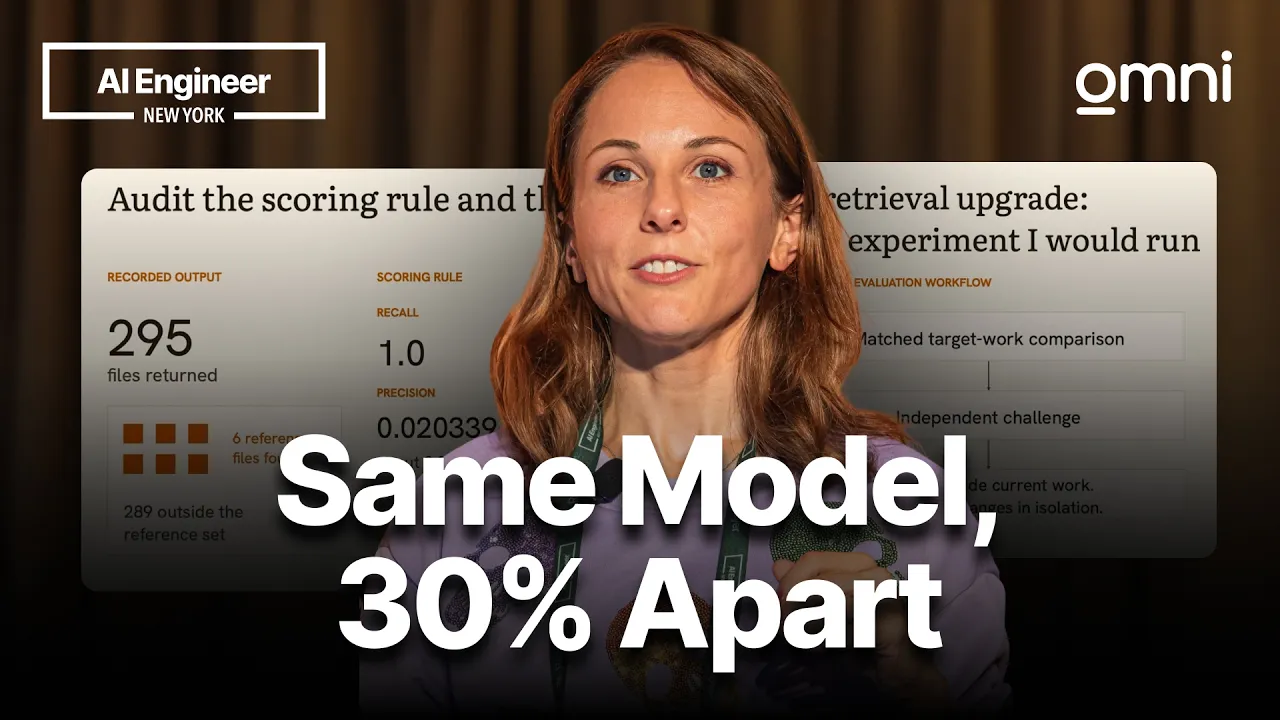
Stephanie Jarmak, a former astronomer who now builds evals at Omni Analytics after building a large coding benchmark at Sourcegraph, argues that most agent evaluations are easy to misread. She shows how swapping only the harness moved results by 30%, why public benchmarks are for shortlisting rather than decisions, and how to design your own evals like an experiment: realistic tasks, repeated runs, full traces and a measurement that matches what you care about. She also covers quality gates that actually stop work, the human review bottleneck, agent records you can't trust, and why production is the final test. Chapters: - 00:00 Intro - 01:11 When the agent ignores your tool - 02:47 The harness changes the results - 03:51 Public benchmarks vs. your own evals - 05:34 Designing evals like a scientist - 07:05 Trace the whole pipeline - 08:50 Choose what you measure - 09:48 Quality gates that actually stop work - 11:20 The human review bottleneck - 12:20 When the agent's record can't be trusted - 13:21 Production is truth - 15:05 When to escalate to a human Stephanie Jarmak, Omni Analytics: https://omni.co Join us in SF for the second annual AIE CODE summit: https://aie.codes our last flagship summit of 2026. Applications live now!
Summary
Generated by gpt-5.6-terraAt-a-Glance
- Verdict: Watch fully
- Core thesis: Agent evaluation must be treated as controlled, workload-specific experimentation with end-to-end observability and enforceable risk gates, not as trust in public benchmarks, aggregate scores, or agent self-reports.
- Why it matters: For agent systems, model choice, prompts, tools, harnesses, validators, and deployment context interact enough that benchmark-leading configurations can fail or behave differently in the production workflow Ken actually operates.
- Best use: Use this as a design review for an agent-evaluation control plane: define representative task families, run controlled comparisons, retain independent traces, measure downstream outcomes, and explicitly set autonomy-versus-escalation boundaries.
Executive Summary
Stephanie Jarmak argues that agent teams should approach evaluations like research scientists: formulate the decision being made, control variables, measure the outcome that actually matters, and investigate traces rather than trusting a favorable headline metric. Her central warning is that an agent can look cheaper, score well, or report that it completed a step while still failing the operational objective.
The talk distinguishes public benchmarks from internal evaluations. Public benchmarks are useful for mapping the market and creating a shortlist, but they are not evidence that a model or agent configuration will work in a specific environment. Jarmak cites a Terminal-Bench comparison in which switching the harness changed the relative performance of Opus 5 and Astra by more than 30 percentage points, making configuration—not model label alone—the meaningful unit of comparison.
She proposes building an iterative internal benchmark from production-like task families, such as simple and hard Q&A, dashboard building, and app building. Teams should account for nondeterminism through repeated runs, test interactions among model, prompt, tool, and harness changes, and retain full traces to identify whether failure occurred because a tool was unavailable, unused, returned bad data, or was ignored downstream.
On safety, she separates detection from enforcement. An agent flagging a problem is not a control unless code can actually stop, route, or escalate the work. Review capacity also needs to be engineered: a seemingly modest 1% false-alarm rate can create 10,000 human reviews. Production remains the ultimate source of truth, so changes should be instrumented in production or shadow-tested, with autonomy granted only inside explicit risk boundaries.
Key Takeaways
- Claim: Evaluate the full deployed configuration rather than selecting agents from model or public-benchmark rankings. | Evidence: In a third-party comparison on roughly 63 Terminal Bench 4 tasks, Opus 5 outperformed Astra in the OpenHands harness, but Astra performed better after the harness changed; the configuration difference was described as more than 30%. | Implication: Ken should treat the agent stack—model, harness, prompts, tools, permissions, and environment—as the unit under test, and require local evidence before standardizing on a model. | Caveat: The transcript does not identify the third-party source or provide the exact model and harness settings, so the figure is illustrative rather than independently reproducible from the talk.
- Claim: Public benchmarks are scouting tools, while an evaluation is a measurement designed to support a product or process decision. | Evidence: Jarmak contrasts Terminal Bench-style results with a law-firm example: coding benchmark results are not useful evidence for legal workflows unless the firm is specifically evaluating coding agents for its developers. | Implication: Build an internal benchmark around actual work distributions and use external leaderboards only to decide what to test first. | Caveat: Public benchmarks can still help produce a candidate shortlist and establish broad landscape awareness.
- Claim: A favorable intermediate metric does not establish success; evaluations must measure the business-relevant end state. | Evidence: When testing a Code Search MCP tool, Jarmak observed a 28% lower cost after changing the initial prompt, but the agent still did not call the intended tool. In another search comparison, Claude returned 295 files when only six were needed, making high recall insufficient where precision and context efficiency matter. | Implication: For each workflow, define success metrics before testing and connect tool-use metrics to final task quality, latency, cost, context consumption, and operational risk rather than optimizing any one proxy blindly. | Caveat: The appropriate metric depends on the operating objective: maximizing recall may be correct for a different use case, while a balanced F1-style measure was appropriate for her search scenario.
- Claim: Trace-level observability is required to diagnose agent failure and verify whether an improvement actually affected the final outcome. | Evidence: Her debugging sequence is to inspect whether a tool was in the agent's available context, whether it was called, what it returned, and whether the agent used that information. She emphasizes retaining all traces because a tool can be correctly invoked yet still fail to improve the completed task. | Implication: Ken should require trace retention and evaluable events across context assembly, tool availability, invocation, outputs, agent reasoning/use of outputs, and final task result; otherwise teams will misattribute failures to the wrong layer.
- Claim: Agent safety requires enforceable gates and calibrated review queues, not merely an agent or LLM judge that raises an alert. | Evidence: In Jarmak's software-factory experiments, an agent could recognize that something was wrong but lacked a mechanism to stop execution. Separately, she notes that a 1% false-alarm rate could result in 10,000 human reviews if every alert were escalated. | Implication: Separate signal generation, policy enforcement, and human escalation in the control plane, and size alerting policies against the actual throughput of qualified reviewers. | Caveat: Tighter gates can protect against high-consequence errors but may create an unsustainable domain-expert review bottleneck; thresholds must reflect both error impact and available review capacity.
- Claim: The agent's own trace or integrity check may not be a trustworthy forensic record, especially in security-sensitive workflows. | Evidence: Jarmak describes research in which injected security issues passed a hash-based tamper check and were not detected through the agent-facing setup, while an independent comparison against traffic history and model-change records detected all of them. | Implication: For consequential systems, maintain independent, append-only or separately controlled telemetry and reconcile it with agent traces rather than accepting the agent's record as the sole audit source. | Caveat: The transcript does not name the research or specify the threat model, so it does not establish that every agent trace is compromised; it establishes that trace trustworthiness itself must be evaluated.
- Claim: Offline evaluation is a proxy; production instrumentation and, where appropriate, shadow deployment are required because production behavior is the final truth. | Evidence: At Omni, Jarmak is using internal production data to classify agent workloads into categories including easy and hard Q&A, dashboard building, and app building. She recommends shadowing changes when direct rollout has too large a blast radius. | Implication: Establish a closed loop from production task taxonomy to offline regression suite to shadow testing to monitored rollout, with different autonomy levels for low- and high-risk actions. | Caveat: Production measurement must be designed with explicit acceptable-risk boundaries; observing production without safe rollout controls can expose users to avoidable harm.
Detailed Brief
Experimental design principles for agent evaluation
- Claims: Workload coverage should include distinct task families rather than treating an entire job domain as one benchmark category.; Agent evaluations need repeated runs because model and agent behavior is nondeterministic.; Changes should be tested for interaction effects: a prompt, tool, or model can behave differently when paired with a different harness or workflow.
- Evidence: Jarmak built Code Scale Bench because the prevailing benchmark emphasis was bug fixing, while software-development work also includes code understanding and other lifecycle tasks.; She gives code understanding versus bug fixing as examples of workloads where the same model may have materially different effectiveness.
- Caveats: The talk supplies the evaluation philosophy but not a prescribed statistical method, confidence threshold, or minimum sample size for repeated trials.
- Implications: A regression suite should be stratified by workflow family, difficulty, risk tier, and tool dependency rather than reported only as a single overall pass rate.; Configuration changes should be evaluated with experiment records that make interactions inspectable, not as isolated one-variable winner declarations.
Practical autonomy boundary design
- Claims: Autonomy should be granted by action risk rather than by a blanket judgment that an agent is trustworthy.; For a proposed next action, the system should make the action, rationale, operating scope, and possible human checks explicit before deciding whether to proceed or escalate.
- Evidence: Jarmak describes her own software-factory setup as allowing agents to make lower-risk decisions while defining boundaries for autonomous deployment versus stop-and-escalate behavior.
- Caveats: The transcript does not offer a universal risk taxonomy; action boundaries must be set according to the organization's own consequences, reversibility, and reviewer capability.
- Implications: Autonomy policy can be operationalized as a structured action contract, enabling auditable decisions rather than informal human trust in an agent's confidence.
Notable Concepts & Terms
- Evaluation versus public benchmark: An evaluation is a measurement built to make a local decision about a product or process; a public benchmark is mainly a standardized external reference and candidate-discovery mechanism.
- Harness: The execution framework around a model—its prompts, tools, environment, control loop, and settings—which can materially change comparative agent performance.
- Terminal Bench 4: A popular coding-agent benchmark used in the talk to illustrate why model rankings can reverse when the harness changes.
- Code Scale Bench: A public benchmark Jarmak built at Sourcegraph to assess agents on complex codebases and a broader range of software-development tasks than bug fixing alone.
- F1 score / precision / recall: Her example of choosing a metric aligned to the desired search behavior: returning every conceivable file can maximize recall while imposing unacceptable context noise and cost.
- LLM-as-a-judge: Using an LLM to assess outputs or raise quality/safety signals; it requires false-alarm analysis and should not be confused with an enforceable safety gate.
- Shadow deployment: Running a change in a realistic environment to collect evidence without allowing it to fully affect users, useful when direct rollout has a high blast radius.
- Production is truth: Offline and benchmark measurements are proxies; teams ultimately need instrumentation in the deployed environment to validate value and failure modes.
Operator Notes / Why Ken Should Care
- Create a versioned evaluation matrix for each agent workflow that records model, harness, prompt, tools, permissions, task family, validator, run count, cost, latency, and final outcome.
- Instrument the agent path as independently queryable events: context/tool availability, tool-call attempt, returned payload, use or non-use of payload, gate decision, escalation, and task outcome.
- Define a risk-tier policy that maps action types to autonomous execution, deterministic blocking, sampled audit, shadow mode, or mandatory human approval.
- Before deploying LLM-judge alerts, model alert volume at expected traffic and set routing, sampling, or threshold policies that qualified reviewers can actually sustain.
- Use independently controlled audit logs for security-sensitive runs and periodically reconcile them against agent-provided traces.
- Build the first internal regression suite from production traffic clusters, then add failures discovered in production as permanent test cases.
Source/Metadata
- Title: Don't Trust Your AI Agents. Test Them Like a Scientist — Stephanie Jarmak, Omni Analytics
- Transcript words: 4697
- Duration seconds: 1031
- Timestamp note: No timestamps or chapters were provided. The transcript includes a substantial repeated segment, beginning again around the harness discussion.
Transcript
Stephanie Jarmak, AI Engineering A couple of weeks ago at Omni Analytics, where we have a platform that has a governed semantic layer to have a shared understanding of business data using our beloved agent, and I spent a year at Sourcegraph where I was a solutions engineer for AMP, a coding agent, and then I moved into an amorphous type role where I was largely doing their evaluation platform. I built a very large public benchmark called Code Scale Bench to understand how agents are working across very complex code bases. And then prior to that, I was an astronomer. So I come from this from a research scientist point of view where I relentlessly question everything, hence the title of Lies, Damn Lies, and Evals. It says how to trust your agents, but I think largely this talk is mainly about how to not trust your agents. So here's one example of a run I had done back at Sourcegraph when I was testing out their Code Search MCP tool. And this is just to show all of the different numbers that you can have after you run a certain evaluation. What I was trying to do was figure out, why isn't this coding agent actually using the tool that I'm trying to get it to use? And so I ran all the traces and everything, and I looked at some of the primary metrics that you're looking at when you evaluate the overall effectiveness of a tool. And it showed that what I had done was I changed the initial prompt given to the agent. And then I ran it because I wanted it to use the tool. And what I saw was it was 28% cheaper. That's interesting. But that shouldn't really change any of my decisions around what I'm actually trying to measure and understand and changes to the actual hardness and setup, because it still didn't use the tool, right? So you need to be able to understand what it is you're actually setting this up. The 28% is an interesting avenue to explore. Okay, we have some level of experimental space to figure out what's the variance and what's going on with the cost measurements, but we still weren't seeing it actually use a tool that it was supposed to. And we had this indication that it was receiving certain information and then just trusting that information wasn't there, and that was purely because it didn't use that tool. And I also want to talk about the impact of the harness itself. So here's an example from a third-party source where they had 63 or so tasks on Terminal Bench 4, which is a pretty popular, widely used benchmark for coding agents. And you have, let's say you're trying to pick which model you're going to put into your harness. So here's a comparison they did with Opus 5 then and Astra, and they saw that with open hands, which is one of the open harnesses, Opus 5 beat it out. But then when they swapped just the harness itself, then they saw that Astra did a much better job, right? So it was a 30-plus percent difference in the effectiveness of these configurations. So the takeaway here is you want to be actually evaluating the closest configuration that you can that's going to reflect the work and the environment that you're going to be measuring because there are so many different variables involved, and you might see all these benchmarks and see the fancy results, but it might not do what you expect it to do within your actual environment, which leads me to disambiguate and expand a bit more on how to interpret public benchmarks versus what is an evaluation. So an evaluation is you're making measurements to make a decision about your product or process and those changes. And public benchmarks as they exist are really primarily helpful for you to have a broader understanding of the larger landscape and get a short list of what you might be exploring within your own organization or your own tooling. But you don't want to necessarily over-index too much on what some of those results are because of the spiky nature of all of the training of these different models and things like that. So if you are a law firm, you don't want to necessarily be looking at terminal bench results unless, of course, you are looking at incorporating coding agents with your devs, right? So you want to make sure that the configuration is reflecting your actual environment. And then you can think of benchmarks as a standardized reference set for comparison. So you have these public benchmarks, but then you can also set up benchmarks within your organization to use as reflective of actual workloads as possible and have this iterative flywheel process where you are increasingly hill climbing to optimize for your configurations. And you want to approach this as a scientist. Once you sort of shortlist what your various configurations might be, you want to look at what are the different variables we're going to think about changing so that the results will reflect what our system is, right? So you can think of workload coverage. So you want to pick tasks that are going to actually be reflective and you could cluster them into different families and things like that. When I was making the coding benchmark, I didn't want to just build one because at the time it was largely Sdbbench was just bug fixing. But there's a whole other different swath of tasks that are relevant to developers across the software development lifecycle. And the way that you integrate different tooling into those different workloads is going to potentially be different. So a model might be more effective at code understanding than it is at actually fixing a bug, for example. And then you want to see, okay, how many different runs do I want to do? Because as we all know, these systems are non-deterministic and so you might see some level of variation across run to run. And then, as I had shown before with that different configuration of the model and the harness, you want to think about how are the different combinations of potential changes going to have interaction type effects, right? And how is that going to potentially be influencing downstream effects? And you also want to be able to gather as much observability data as possible. So retain all of your traces and everything. So this goes back to one of my first examples when I was trying to figure out what is happening. Why is it not calling this tool? So first, you want to break it down into what is the entire context available to the agent. So was that tool even available, right? Because if it wasn't, then you stop there and you fix that particular scenario. And then you see, was it called, or what were the values returned? So basically keep going along the pipeline of available information. And so as you're going along that pipeline, let's say I do this improvement, right, for this tool. It finally uses the tool. But then the actual outcome that you care about, the end of the task, that still doesn't change, right? So there are scenarios too where you can have this beautiful tool that you're really optimizing for. But then the agent, the configuration or whatnot, for whatever reason, which then is your job to go in and figure out and fix, it's not leveraging that information. So you want to keep all of these different things in mind, the non-use and the failed attempts and everything, when you're trying to be a detective and understanding what is actually going on in your system. And you also want to really control what the measurement is that you're making. So in this example, when I was doing the test of the comparisons of different search tools, right, I was interested in optimizing for a better F1 score, balancing for precision in addition to recall. So in this example, it was with grep, right, so Claude or whatever going out and basically pulling in the entire kitchen sink. So Claude went out and got 295 files returned when it only really needed six. So if I was somebody who in this scenario was like, okay, all I really care about is that it pulls in any possibly relevant piece of information, then maybe a recall of one is sufficient. But in my scenario, I was interested in optimizing for a completely different type of value. So this is relevant too for when you're looking at single number scores and public benchmarks. What was the actual validator measuring and why did they consider that to be important? Because what you might want is going to be dependent entirely on your business needs. And there's an interesting overlap that happens when you're thinking about evals and then quality gates and reviews and things like that. So I just wanted to touch on that a bit here in terms of trust and safety. So I have a software factory that I've been experimenting with having these different approval cues, essentially. I want to automate as much as possible for the work to get done, but I also do not trust these systems at all. So I'll have these regular audits. So as an example, basically I will put through the request for some work to get done, and then it has approval and required checks. But basically what was happening was the agent noticed things were going wrong, but then there was no mechanism in place for it to actually enforce a stopping situation. So you need to decouple what's happening with an agent or some other system flagging something versus actually enforcing that gate within the code itself. And then how that is eventually potentially escalated to a human. Because this goes into you need to also think about balancing that human review load, right? So if you have, and this comes from basically auditing and repairing LLM as a judge failures that were happening in a separate system, but they were seeing a 1% false alarm rate. And if all of those alarms that are raised go to a human, that would result in 10,000 reviews. And does your organization actually have the capacity for domain experts to be going and doing that? So you need to think about where that bottleneck might be and how you change what the alarm rates tend to be. And what, how consequential are those alarms going to impact downstream effects? And we want to also consider that the actual agent trace itself can sometimes not be reliable or trustworthy. So in this particular example, researchers were doing some checks to basically seed in different security issues that were provided to the agent. And they had a hash check in place to check for any sort of tampering with that system. And with using that setup, basically everything passed. It didn't notice any of those injected security issues. So but when they had an independent sort of record comparison, take a look at basically all of the traffic history in the model changes and things like that, then they were able to detect everything. So you want to make sure that depending on the security needs of your system and how you're actually measuring and observing what's going on, that you have sufficient trust in the actual record that you're retaining of what happened. And so this is basically an overview of going back to that original example of how we're trying to think about evaluating realistic work associated with your particular task loads. So you want to identify a target work comparison. So I'm doing a lot of this right now at Omni and working on their evaluation harness. So we're looking at our internal production data and seeing how our users are interacting with the agents and having a classification of the different types of things that can be done. So in our example, it's Q&A, which may be easy questions to harder questions, or it could be dashboard building and app building and things like that. So there are all these different ways of classifying the actual tests. And then you want to be identifying are these changes actually that we're putting into the system actually adding value or where are the failures downstream. And we're doing all of this right and trying to come up with representative proxies of actual workloads, but ultimately, production is truth. So after you deploy some of these changes, then you need to also have measurement systems in place to get all of that relevant data in the actual environment that your system is being deployed in. And you can do this in shadow and whatnot as well to gain some of that information if some of it would be less trustworthy to change and you have a higher blast radius of effects and things like that. But ultimately, you want to be essentially optimizing for as much observability and realistic environments for where your system is going to be deployed for you to be able to trust some of these values. So you want to identify what level of risk you are going to be willing to accept. So the way I have it set up within my own systems is within my software factory, as an example, for giving the agent some level of autonomy and making some of the lower risk decisions. Basically they will identify what the next action would be, why it's needed from a human to weigh in on that, what the actual operating scope is, and then what potential suggestions are, what attempted sort of human check removed, given the available spaces. But you want to be able to come up with those different boundaries of when is it safe to autonomously deploy versus stop and escalate to the human. So I have a GitHub repo with a bunch of the different skills that I've worked on. There are a few in there that have direct relevance to evaluation design and harness traceability and reliability procedures. And I also have this monstrous 300 page archive tome that you can point your agents at. You can point your agents at all of this to pull in some of those best practices into your own systems. So thank you. and that was purely because it didn't use that tool. And I also want to talk a bit about the impact of the harness itself. So here's an example, and this was from a third-party source where they had 63 or so tasks on Terminal Bench 4, which is a pretty popular, widely used benchmark for coding agents. And they, you know, you have, like, let's say you're trying to pick which model you're going to put into your harness. So here's a comparison they did with Opus 5 then and Astra, and they saw that, you know, with open hands, which is one of the open harnesses, Opus 5 beat it out. But then when they swapped just the harness itself, then they saw that Astra did a much better job, right? So it was, like, 30-plus percent sort of difference in the effectiveness of these configurations. So the takeaway here is you want to be actually evaluating the closest, like, configuration that you can that's going to reflect the work and the environment that you're going to be measuring because there are so many different variables involved, and, you know, you might be, you know, might see all these benchmarks and whatnot and see the fancy results, but it might not do what you expect it to do within your actual environment, which leads a bit into, I want to kind of disambiguate and expand a little bit more on how to interpret, like, public benchmarks versus what is an evaluation. So an evaluation is you're making measurements to make a decision about your product or process and those changes. And the public benchmarks as they exist are really primarily helpful for you to have a broader understanding of, like, the larger landscape and get a short list of what you might be exploring within your own organization or your own sort of tooling. But you don't want to necessarily over-index too much on what some of those results are because of the spiky nature of all of the training of these different models and things like that. So, you know, if you are a law firm, you don't want to necessarily be looking at, like, the terminal bench results unless, of course, you are looking at incorporating coding agents with your devs, right? So you want to make sure that the configuration is reflecting your actual environment. And then you can also, like, think of benchmarks really as just a standardized sort of reference set for comparison. So you have these public benchmarks, but then you can also set up benchmarks within your organization to use as, like, setting them up as reflective of actual workloads as possible and just have this sort of iterative flywheel process where you are increasingly sort of hill climbing to optimize for your configurations. And you want to approach this to the best of your ability as a scientist, kind of, when, like, once you sort of shortlist what your various configurations might be, you want to look at what are the different variables we're going to think about changing so that we're actually going to be, like, the results will reflect what our system is, right? So you can think of workload coverage. So you want to pick tasks that are going to actually be reflective and you could cluster them into different families and things like that. Like, when I was making the coding benchmark, didn't want to just, like, the reason I built out a whole different one was because at the time it was largely, like, Sdbbench was just bug fixing. But there's a whole other different swath of tasks that are relevant to developers across the software development lifecycle. And the way that you integrate different tooling into those different, like, workloads is going to potentially be different. So, like, a model might be more effective at code understanding than it is at actually fixing a bug, for example. And then you want to try to see, okay, how many, like, different runs do I want to do? Because as we all know, these systems are non-deterministic and so you might see some level of variation across run to run. And then, as I had shown before with, like, that different configuration of the model and the harness, you want to think about how are the different sort of combinations of potential changes going to have these interaction type effects, right? And how is that going to potentially be influencing downstream effects? And you also want to be able to gather as much observability data as possible. So, you know, retain all of your traces and everything. So this sort of goes back to one of my first examples when I was trying to figure out, like, what is happening? Why is it not calling this tool? So first, you know, you want to sort of break it down into what is the sort of entire context available to the agent. So it was that tool even available, right? Because if it wasn't, then you, okay, you stop there and you fix that particular, you know, scenario. And then you see, was it called, et cetera, or like, what were the values returned? So you, like, basically keep going along the pipeline of available information. And this one, the, like, so as you're going along that pipeline, let's say I do this improvement, right, for this tool. It finally uses the much better tool. But then the actual, like, outcome that you care about, the end of the task, like, that still doesn't change, right? So there are scenarios, too, where you can have this beautiful tool that you're, like, really optimizing for. But then the agent, the configuration or whatnot, for whatever reason, which then is your job to go in and figure out and fix, it's not leveraging that information. So you want to keep all of these different things in mind, like the non-use and the failed attempts and everything, when you're trying to basically be a detective and understanding what is actually going on in your system. And you also want to really control what the measurement is that you're making. So in this example, when I was doing the test of the comparisons of different sort of search tools, right, I was interested in optimizing for, like, a better, basically like an F1 score, balancing for precision in addition to recall. So in this example, it was with, like, grep, right, so Claude or whatever going out and basically pulling in the entire kitchen sink. So in this example, Claude went out and got, like, 295 files returned when it only really needed six. So, you know, if I was somebody who in this scenario was like, okay, all I really care about is that it pulls in any possibly relevant piece of information, then maybe a recall of one is sufficient. But in my scenario, I was interested in optimizing for a completely different type of value. So this is relevant, too, for when you're looking at those, like, single number scores and public benchmarks. Like, what was the actual validator measuring and why did they consider that to be important? Because what you might want is going to be dependent entirely, like, on your business needs. And there's, like, an interesting sort of overlap that kind of happens when you're thinking about evals and then sort of quality gates and reviews and things like that. So I just sort of wanted to touch on that a little bit here in terms of, like, the trust and the safety. So I have, like, a software factory that I've been experimenting with having these different approval cues, essentially, of I want to automate as much as possible for the work to get done, but I also do not trust these systems, like, at all. So I'll have these regular audits. So as an example, basically, I will have, like, put through the request for some work to get done, and then it has approval and required checks. But basically what was happening was the agent noticed things were going wrong, but then there was no mechanism in place for it to actually, like, enforce a stopping situation. So you need to sort of decouple what's happening with an agent or some other system, like, flagging something versus actually enforcing that, like, gate within the code itself. And then how that is eventually potentially escalated to a human. Because this sort of goes into you need to also think about balancing that human review load, right? So if you have, and this comes from basically auditing and repairing LLM as a judge, failures that were happening in a separate system. But they were seeing, like, a 1% false alarm rate. And if all of those, like, basically the alarms that are raised go to a human, that would result in 10,000 reviews. And, like, does your organization actually have the capacity for domain experts to be going and doing that? So it's, you know, you need to think about where that bottleneck might be and how you, like, change what the sort of alarm rates tend to be. And, you know, what, how consequential are those, are those alarms going to impact, like, downstream effects? And we want to also consider that, you know, the actual agent trace itself can sometimes not be reliable or, like, trustworthy. So in this particular example, researchers were doing some checks to basically seed in different sort of, like, security issues that were provided to the agent. And they had, like, a hash check in place to check for, like, any sort of tampering with that system. And with using that setup, basically everything passed. It didn't notice any of those injected security issues. So, but when they had an independent sort of record comparison, take a look at basically all of the traffic history in the model changes and things like that, then they were able to detect everything. So you want to make sure that, like, depending on the security needs of your system and how you're actually measuring and observing what's going on, that you have sufficient sort of trust in the actual record that you're retaining of what happened. And so this is basically just, like, an overview of, like, going back to that original example of, you know, how we're trying to think about evaluating realistic sort of work associated with your particular task loads. So you want to identify, like, a target work comparison. So I'm doing a lot of this right now at Omni and working on their evaluation harness. So we're looking at our internal production data and seeing how our users are interacting with the agents and sort of having a classification of the different types of things that can be done. So in our example, it's Q&A, which may be easy questions to harder questions, or it could be dashboard building and app building and things like that. So there's all these different sort of ways of classifying the actual tests. And then you want to be, like, identifying are these changes actually, like, that we're putting into the system actually adding value or where are the failures downstream. And we're doing all of this, right, and trying to come up with representative proxies of actual workloads, but ultimately, like, production is truth. So after you deploy some of these changes, then you need to also have measurement systems in place to get all of that relevant data in the actual environment that your system is being deployed in. And you can do this in shadow and whatnot as well to gain some of that information if some of it would be kind of less trustworthy to change and you have a higher blast radius of effects and things like that. But ultimately, you want to be, like, essentially optimizing for as much observability and realistic environments for where your system is going to be deployed for you to be able to trust some of these values. So you want to identify what level of sort of risk you are going to be willing to accept. So the way I have it sort of set up within my own systems is within my software factory, like, as an example, for giving the agent some level of autonomy and making some of the lower risk decisions is basically they will identify what the next action would be, like why it's needed from a human to be able to weigh in on that, what the actual operating scope is, and then, you know, what potential suggestions are, what attempted sort of human check removed, like, given the available sort of spaces. But you want to be able to come up with those different sort of boundaries of when is it safe to autonomously deploy versus stop and escalate to the human. So I have a GitHub repo with a bunch of the different skills that I've worked on. There's a few in there that have direct relevance to evaluation design and harness traceability and reliability procedures. And I also have this monstrous 300 page archive tome that you can point your agents at. You can point your agents at all of this to pull in some of those best practices into your own systems. So thank you. Thank you.