Investors need to give CEOs better comp packages
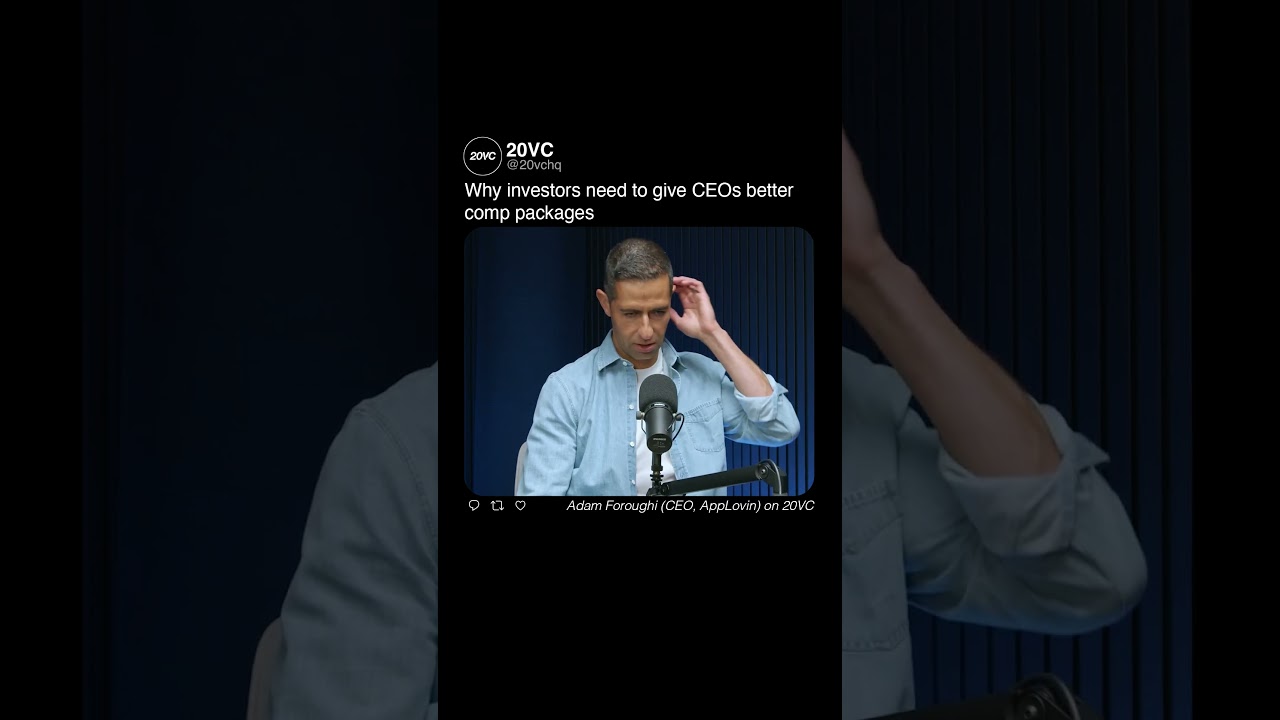
Description
#founder #ceo #investing
Summary
Generated by claude-haiku-4-5-20251001Investors Need to Give CEOs Better Compensation Packages
Main Topics
- CEO compensation strategy and alignment with shareholders
- Founder incentive structures during company turnarounds
- The relationship between financial motivation and leadership commitment
- Risk-taking and entrepreneurial drive in public companies
Key Points
- The Founder's Sacrifice: The speaker took no compensation for years, relying solely on founder's equity and minimal benefits, despite building significant company value.
- Compensation Alignment Strategy: When the company hit its lowest point (92% stock decline in 2022), the CEO requested performance-based compensation tied directly to stock recovery milestones.
- Tiered Performance Targets: Compensation thresholds were set at $9 minimum, with major payment triggers at $38-40, scaling up to the original $80 IPO price across 5-6 levels.
- Retention Through Incentives: The speaker argues that competitive compensation packages are essential to retain talented founder-CEOs who have alternative opportunities.
- Founder Risk Premium: Founders who took initial business risks deserve continued upside potential to maintain motivation during challenging turnarounds.
Notable Quotes
> "If the belief is that the CEO should then never get compensation ever again, it's completely flawed logic."
> "You want to give people who chase really big upside by creating really big things the potential to continuously have that really big upside, because it allows them to, in a way, just mentally stay motivated on what they're doing versus start drifting to other things."
Takeaways
- Board Compensation Committees should design CEO packages that tie rewards directly to stock performance recovery goals
- Founder Retention is critical—successful entrepreneurs have other opportunities and need financial incentives to stay committed
- Alignment Philosophy works best when CEO gains only when shareholders gain, creating mutual success
- Long-term Motivation requires offering meaningful upside potential rather than salary minimums alone
Transcript
We went public in 21. In the first year, the stock went up to about $40 billion market cap. In 2022, we fell about 92% to a little bit under $4 billion market cap. I, for the life of the company, had only taken equity that was my founder's stock and based on the money that I originally put in the company. So I had taken no compensation. I was taking the bare minimum to have benefits. At the bottom in 22, I made a decision, and that was, for the first time, to ask for compensation. And the reason I did that is because I felt like I'm public, turning this company around is a big task, and I'd like to align myself with investors to say, I'm going to get paid, but I'm only going to get paid if the stock recovers. So the thresholds of compensation that the comp committee on the board granted me were at a minimum, the stock was $9. We had to get to the first threshold, I think was about $38 to $40. And in order for me to get paid anything, the stock had to clear that and then keep going up from there for me to get any sort of compensation. And then there were, I think, five or six levels from there, so all the way up to a return to $80, which was our IPO price. And I had a term to go achieve it. I feel like CEOs who are founders originally started a business taking really big risk. If the belief is that the CEO should then never get compensation ever again, it's completely flawed logic. You want to give people who chase really big upside by creating really big things the potential to continuously have that really big upside, because it allows them to, in a way, just mentally stay motivated on what they're doing versus start drifting to other things. Because any founder, even at the low point I was worth quite a bit of money on paper, at least with my equity, could have walked away and started something else. I've now had three successful businesses, so I believe I could have a fourth. But I really wanted to stay committed to the company and stay aligned with investors. I feel like CEOs who are founders originally started a business taking really big risk. If the belief is that the CEO should then never get compensation ever again, it's completely flawed logic. You want to give people who chase really big upside by creating really big things the potential to continuously have that really big upside, because it allows them to, in a way, just mentally stay motivated on what they're doing versus start drifting to other things. Because any founder, even at the low point I was worth quite a bit of money on paper, at least with my equity, could have walked away and started something else. I've now had three successful businesses, so I believe I could have a fourth. But I really wanted to stay committed to the company and stay aligned with investors.