Did Jensen Make the AI Boom, or Did the AI Boom Make Jensen?
Description
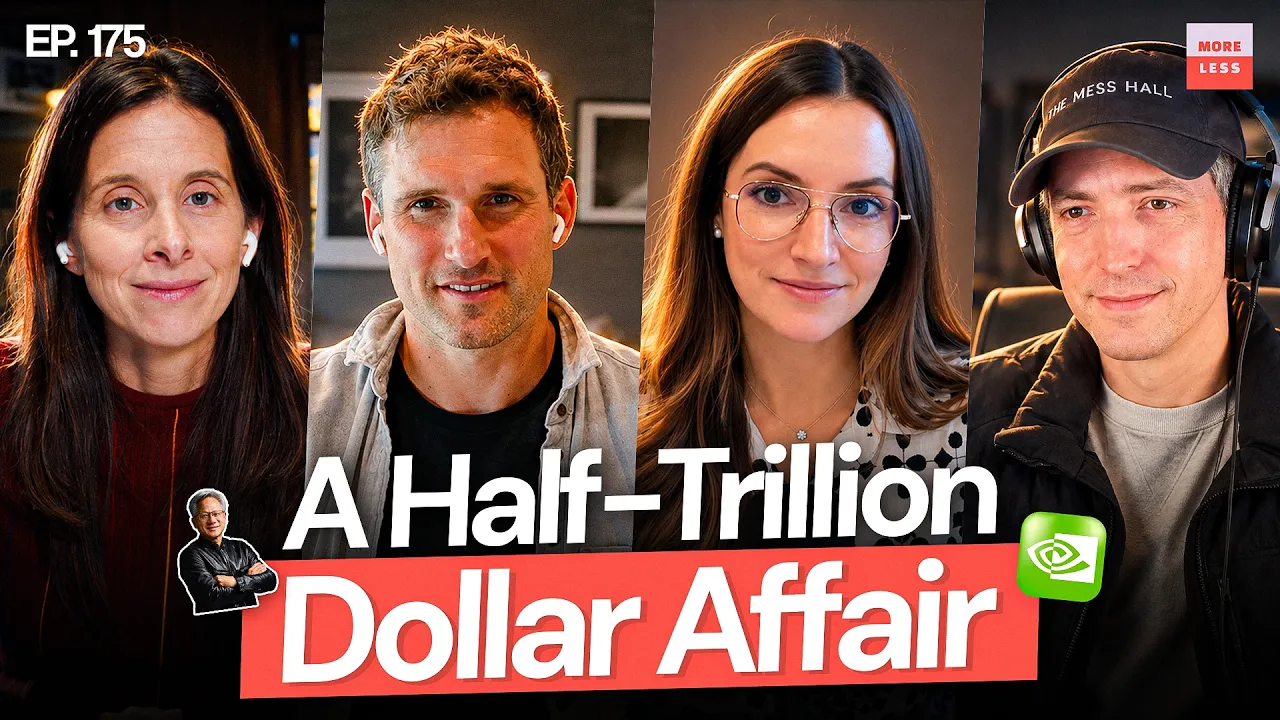
Full quad for this ep and halfway through recording, the Wall Street Journal reported that Jensen Huang was out at Nvidia. We didn’t stop the tape. Consider the first part a historical POV. Jess, Sam, Dave and Brit are back together to break down the scandal shaking the world’s most valuable company. They cover the reported ties to a woman whose companies allegedly moved banned chips to China, the Wachtell-led board investigation, and why a relationship with a direct report is a board problem as much as a personal one. Once the WSJ headline drops, the conversation shifts to what comes next. Did Jensen make the AI boom, or did the AI boom make Jensen? Who could actually run Nvidia: Tim Cook, Apple’s silicon chief, or someone inside? Could Nvidia be headed for a Microsoft-style lost decade? The crew also gets into Anthropic’s IPO roadshow and the claim that AI can now move labs off Nvidia hardware in hours. Sam explains why the only reason to buy Anthropic at IPO is regret, and introduces his theory that AI companies have a “make it dumber” dial for hitting the quarter. Plus: Sam’s Claude-run home camera network, using AI to track insider stock sales, and why calling the AI bubble for Q1 makes no sense. Chapters: 00:00 Intro 01:06 Everyone's Back After Two Interview Episodes 02:16 Taping on a Wednesday, Because That's How Fast This Is Moving 03:51 The Facts: Jensen, Alice Huang, and the Chip Network 05:28 Midterms, China Hawks, and Why the Knives Are Out Now 05:52 The Board Hires Wachtell Lipton 07:01 A Half-Trillion Dollar Affair 08:24 The Second Report, and Why Lying to Your Board Is Different 10:15 Six Months From Now, Is Jensen Still CEO? 11:19 Sam: His Meme Game Isn't Strong Enough to Survive This 13:35 Brit Pitches the Movie 14:37 What the Prediction Markets Say 15:27 Who Could Actually Run Nvidia? Sam Says Tim Cook 16:31 Is Nvidia Too Big to Fail? 18:05 What Jensen's Exit Would Mean for the AI Trade 20:09 Anthropic and OpenAI Say They Can Switch Hardware in
Summary
Generated by gpt-5.6-terraAt-a-Glance
- Verdict: Skim
- Core thesis: A fast-moving, highly speculative discussion argues that a purported Jensen Huang/NVIDIA governance and China-export-control scandal could destabilize NVIDIA's leadership narrative, while the underlying AI infrastructure demand would likely outlast any one CEO.
- Why it matters: The useful signal is not the unverified scandal itself, but the discussion of NVIDIA's ecosystem-wide role, founder-dependency risk, hardware diversification, and practical AI-agent use cases.
- Best use: Skim for the segments on NVIDIA's strategic position, Anthropic's roadshow framing, model-cost/quality incentives, and the camera-enabled agent workflow; do not rely on the episode as verified news or investment analysis.
Executive Summary
This is principally a live, informal reaction podcast built around purported breaking news that NVIDIA's board might remove Jensen Huang amid allegations involving China chip-export controls, personal relationships, and possible board disclosure failures. The hosts repeatedly acknowledge that facts are incomplete, speculate heavily about outcomes, and react to rumors apparently changing during the recording. The transcript supplies no primary documentation for the allegations, so its claims should be treated as unverified commentary rather than factual reporting.
The more durable argument is that NVIDIA has become a structural support for the AI economy: it sells the critical hardware while also investing across the AI stack, including neoclouds and, according to the speakers, a potential Anthropic IPO position. They argue a Huang departure could produce short-term distraction, relationship loss, and strategic uncertainty, but should not immediately interrupt chip supply, existing product roadmaps, or AI compute demand.
The episode also surfaces emerging strategic pressure on NVIDIA: major AI labs claim they can move workloads to non-NVIDIA hardware faster than before, potentially weakening CUDA lock-in over time. The hosts frame the central long-run question as whether NVIDIA can preserve its product, partner, and geopolitical advantages after its founder—rather than whether the AI boom depends on Huang personally.
For operators, the concrete content is a small set of AI-native workflows: using agents to monitor public insider-trading filings and detect selling patterns; deploying cameras and small routers configured by an agent for remote vision monitoring; and watching for model providers to trade off reasoning quality and social engagement against inference cost. These are interesting patterns, but the camera example carries substantial privacy, security, authorization, and reliability risks that the hosts do not adequately address.
Key Takeaways
- Claim: The alleged NVIDIA controversy matters most as a governance, national-security, and disclosure issue—not as celebrity gossip. | Evidence: The hosts say the reported investigation concerns whether sensitive information may have reached China through a person associated with entities allegedly supplying restricted high-end NVIDIA chips to Chinese customers. They also emphasize that CEO relationships with direct reports can become board-disclosure and honesty issues, and state that boards are especially likely to remove CEOs for misleading directors. | Implication: For NVIDIA counterparties and investors, the relevant monitoring questions are board process, export-control exposure, executive succession readiness, and any official disclosure—not the podcast's predictions about personal conduct. | Caveat: The entire discussion is based on evolving press reports, rumors, and speaker speculation; the transcript provides no verified evidence that any allegation occurred, that Huang misled the board, or that removal was imminent.
- Claim: NVIDIA's strategic importance extends beyond chip sales because its balance sheet and partnerships support much of the broader AI infrastructure ecosystem. | Evidence: One host describes NVIDIA as backing neoclouds and participating throughout the AI stack, and says NVIDIA was expected to take a 10% position in Anthropic's IPO. The group characterizes the company as an ecosystem financial and infrastructure anchor rather than merely a hardware vendor. | Implication: A governance shock at NVIDIA could create second-order volatility for AI infrastructure providers, model companies, and capital formation even if core GPU deliveries continue normally. | Caveat: The asserted Anthropic IPO participation and precise ownership position are discussed conversationally and are not substantiated in the transcript.
- Claim: A founder departure would likely be more damaging to NVIDIA's long-range strategy and external relationship network than to near-term operations. | Evidence: The speakers argue that chips will keep shipping and existing roadmaps can continue because Huang does not personally manufacture products. But they distinguish this from his role in making acquisition, investment, partnership, cloud-stack, China-market, and geopolitical decisions, and note that NVIDIA has intentionally centered public communication around one spokesperson. | Implication: Ken should separate execution continuity from strategic continuity: model providers and infrastructure operators may see little immediate operational disruption, while NVIDIA's multi-year platform and partnership decisions could become less predictable. | Caveat: The hosts disagree on the depth of NVIDIA's internal bench; one cites direct interaction with NVIDIA employees as evidence that capable internal successors may exist.
- Claim: The CUDA and NVIDIA hardware advantage may be increasingly contestable as frontier labs use AI to accelerate porting and hardware optimization. | Evidence: The hosts cite Anthropic's roadshow materials and OpenAI commentary as claiming that AI-assisted work can bring new or non-NVIDIA hardware online in hours or days, rather than requiring lengthy porting cycles. They explicitly characterize this as a possible erosion of the CUDA kernel advantage. | Implication: For agent and AI-systems architecture, avoid treating CUDA dependence as permanent: maintain portability plans, benchmark alternative accelerators, and track whether model-generated systems code materially lowers switching costs. | Caveat: They also acknowledge that these claims are at extreme scale, that NVIDIA hardware remains supply-constrained and in high demand, and that alternative hardware cannot simply replace NVIDIA capacity overnight.
- Claim: AI providers may have economic incentives to dynamically reduce model effort or alter personality characteristics in ways users experience as quality degradation. | Evidence: The hosts describe a hypothetical 'make smarter/make dumber' cost-control dial, calling it analogous to an ad business's monetization dial. They connect it to observed cases where Claude allegedly claimed to complete spreadsheet or API tasks but produced incomplete outputs, and add a second proposed dial of 'more parasocial/less parasocial.' | Implication: Treat agent reliability as variable rather than static: use output validation, row-count/reconciliation checks, task retries, regression benchmarks, and independent model comparisons for consequential workflows. | Caveat: This is an informal hypothesis based on anecdotal user experience, not evidence that providers intentionally degrade models at quarter-end or manipulate social behavior to meet financial targets.
- Claim: Agents can turn fragmented public filings into a persistent market-intelligence workflow. | Evidence: One host describes instructing an AI system to scan insider transactions daily for selected public companies, identify who is selling, infer recurring sale-plan patterns, and distinguish insiders who sell all issued shares from those who hold and sell in bursts. | Implication: Ken can apply the same pattern beyond equities: use agents to continuously normalize recurring public data, identify behavioral changes, and present exceptions rather than manually reviewing raw filings. | Caveat: The speaker says this is currently used for understanding rather than making trades, and does not establish that inferred sale patterns predict performance.
- Claim: Autonomous physical-world agent setups are becoming practical, but their ease of deployment can outrun governance controls. | Evidence: A host says an agent selected and ordered Reolink cameras and small routers, instructed the user to connect them to a managed Mac Mini, then configured remote access, VPN networking, person identification, movement-pattern reporting, and entry alerts. | Implication: Any similar OpenClaw-style deployment should require explicit procurement limits, least-privilege network design, human approval before surveillance activation, audit logs, consent review, and a tested kill switch. | Caveat: The conversation celebrates the capability but does not address consent, retention policies, biometric identification rules, network segmentation, vendor-cloud exposure, physical security, or agent purchasing permissions.
Detailed Brief
Anthropic IPO and the AI-bubble framing
- Claims: The speakers expect Anthropic's public-market debut to be shaped as much by narrative, scarcity, and retail demand as by conventional fundamentals.; They reject a simple analogy between the current AI cycle and the dot-com crash, arguing that AI spending is distributed across more industries and companies than prior tech manias.; They nevertheless expect many individual AI companies and investments to fail, even if the broader infrastructure trend persists.
- Evidence: One host predicts Anthropic could price above an initially discussed $1.4 trillion valuation and calls the roadshow presentation unusually persuasive because it showcases company talent.; The group describes the only rationale for buying at IPO as 'regret minimization,' while questioning whether a company of that scale has sufficient remaining upside relative to smaller businesses.; They report hearing New York investors forecast an AI-bubble break in Q1, then argue that timing a total collapse has historically been difficult.
- Caveats: These are market opinions and informal valuation predictions, not a financial analysis or investment recommendation.; Several claimed IPO details are presented without documentary support in the transcript.
- Implications: Distinguish the viability of AI adoption from the investability of highly priced public AI equities.; For strategic planning, model a range in which AI demand remains strong while the financing environment and valuations of AI vendors become materially less forgiving.
What the speakers think makes NVIDIA defensible
- Claims: The hosts believe NVIDIA's advantage includes relationship-building and ecosystem enablement, not only semiconductor performance.; They see China as central to NVIDIA's growth debate because access to that market changes the addressable-market and competitive picture.; They view leadership uncertainty as an accelerant for unresolved strategic choices, including whether NVIDIA should move further into cloud services or higher-level portions of the AI stack.
- Evidence: One speaker says NVIDIA employees encountered through OpenClaw-related work appeared unusually capable and well-informed across the business.; The discussion names cloud strategy, vertical integration, model-maker investments, data-center construction uncertainty, alternative chips, and China access as simultaneously active strategic issues.
- Caveats: The assessment of NVIDIA's organizational quality is based on personal interactions, not a representative organizational study.; The alleged scandal may be fictional, incomplete, or materially different from the speakers' framing.
- Implications: NVIDIA's moat should be evaluated as a system—hardware, software, financing, partners, and geopolitical positioning—rather than through GPU benchmarks alone.; A successor evaluation should prioritize operational credibility and international stakeholder management alongside chip-industry expertise.
Notable Concepts & Terms
- CUDA kernel advantage: The software ecosystem and optimized code base that historically made NVIDIA accelerators difficult to replace; the hosts argue AI-assisted porting could reduce this switching barrier.
- Neocloud: GPU-focused cloud providers that supply AI compute and are portrayed here as dependent on NVIDIA hardware and, in some cases, NVIDIA ecosystem support.
- Token shaving: The hosts' informal label for a provider allegedly allocating less inference compute or context to reduce serving cost, causing users to perceive lower intelligence or incomplete work.
- Make-money dial: An analogy to ad-load controls: the proposed ability of AI providers to trade off model quality and compute cost when optimizing margins.
- Parasocial dial: A proposed second model-tuning dimension in which providers may make an assistant feel more or less socially engaging or addictive.
- Roadshow: The investor-marketing process before an IPO; Anthropic's reported roadshow is discussed as a narrative tool for demonstrating staff quality and market opportunity.
- Founder dependency: The risk that a company's strategy, relationships, external credibility, and capital allocation rely disproportionately on its founder rather than institutional systems.
- Agentic infrastructure monitoring: Using an AI agent to manage physical devices, networking, vision analysis, alerts, and remote observability; presented as powerful but operationally under-governed.
Operator Notes / Why Ken Should Care
- Build a GPU-portability scorecard for critical workloads: framework dependency, custom CUDA kernels, viable alternative hardware, performance delta, and estimated migration time.
- Add deterministic validation around agent-produced artifacts: verify file existence, expected row counts, schema, API-side effects, and reconcile outputs before declaring a task complete.
- Pilot an agent-driven public-filings monitor for a defined set of strategic companies, but position it as change detection and research support rather than a trading signal.
- Do not allow agents to independently purchase or activate cameras, routers, or surveillance functions without spending limits, approval gates, network isolation, and documented privacy controls.
- Monitor NVIDIA through primary disclosures, earnings calls, export-control developments, board actions, and supplier/customer signals; disregard uncorroborated social or podcast speculation.
- For AI vendor diligence, test whether reported rapid migration to non-NVIDIA hardware is real by asking for workload-specific benchmark, tooling, cost, and reliability evidence.
Source/Metadata
- Title: Did Jensen Make the AI Boom, or Did the AI Boom Make Jensen?
- Transcript words: 10293
- Duration seconds: 2883
- Timestamp note: No usable timestamps or chapter markers were provided; the transcript contains repeated passages and appears to capture a live, rapidly evolving discussion.
Transcript
Breaking news, huge Wall Street Journal headline, NVIDIA is preparing to oust CEO Jensen Huang. Alex Huang, who the government has been suspecting of spy activity, she oversees companies that are getting high-end NVIDIA chips into the hands of Chinese customers who are barred from those chips due to export controls. It's lord of war. It's arms dealing with GPUs. You see Jensen running the most powerful company in the world. Then Alice Huang, same last name, Chinese spy, comes into the scene. He's having an affair and all the secrets are out. He's having an affair with Kimberly Powell too. There's more affairs that are going to become uncovered because if there's two, there's definitely three. Then things go to shit. Jensen's out. Okay, but then what happens? Put it all right to the test, more or less. Why hello, friends. Welcome to More or Less. We missed you guys. Too many interviews. Sorry, dear listeners. I think we delivered some good interviews though. I enjoyed bang. Yeah, it's true. I've gotten some nice feedback. Appreciate all the text messages. I love getting text messages from you. Sam ran a marathon. I want the listeners to note, since we're all back together, that neither Dave nor I have Chinese wives. You mean Chinese models. You do have Chinese models, just not Chinese wives. I think my wife could be a model, but not a Chinese one. She's an American model. I have a model, but she's not Chinese. I like to think of myself as an open weight model. Open weight model? Yeah. Weight fluctuates. You can change the weight. I'm a peptide-infused open weight model over here. Peptide-infused open weight model. Well, we're all here. And I'm so sorry we have nothing to talk about this week. Just kidding. It's the Armageddon of technology news. Oh, God. And I'm here for it. So much drama. Should we have brought popcorn to the recording is my question. I have protein. We should tell listeners we're taping this on a Wednesday because that is how fast the news cycle moves. Because nothing can happen. You never know. Yeah, you guys were wildly off on the macro last week. We were on for the day. Then we were wildly off for the next day. But we've been right since. So, yes. And that did cross my mind, Dave. And I wish I had framed that differently. But, okay. So, we're taping this on Wednesday. Isn't that the story of everybody's life in 2026, though? It's like you can only be on for a day at a time. We're on for a day at a time. We should record a lot of podcasts and then release them on the day we're right. That's pretty funny. It's like AI, Claude, take my sound bites and drop them in the opportune moments. That's pretty good. Okay. But this is what we're going to cover. We are going to talk in video. This is a massively important and interesting and unknown story, I will say. And People Magazine is just so fun. Why is it unknown? Because how many spies has he slept with? There's a new scandal to the scandal, Dave. There's an executive now as well. I've been in meetings doing interviews all day. I don't know. You guys tell me what's going on. Guys, I don't know much about affairs, but you tend to not only have one. Really? What's the data on that? Okay. So, let's make sure we're all up on the news cycle. Yeah. Okay. I figured The Times would be on this story that we are also on. The Times has done great work on this story. The Times has done great work, finally. Ooh. It's a rare admittance. Dave, I am sensing you need some facts on NVIDIA. So, I'm going to give you some facts, okay? We, the listeners, need facts. I'm fine with that because there's a lot going on. I started the Anthropic Roadshow video, guys. We should make a fake Roadshow video. I'm very into this format. Why is it fake? Why can't we just take the More or Less podcast public? Yeah, let's SPAC it. Can we SPAC? SPAC? We're not that classless. It is an infomercial for a company. And I love the little graphics and I love the women's fashion choices of the whole thing. Okay, but that's topic number two. So, here we are on Wednesday. Where do I? I need to see this video, too. Man, I'm so behind. And scandal Jensen-Walm. Obviously, the New York Times had a blockbuster report that the United States government was investigating that he had a relationship. And the initial article was a close relationship to this woman, Alex Walm, who the government, the U.S. government, has been suspecting of spy activity. And specifically what Alice does, and this is important, and our Asia team published an awesome profile of her this week that goes into incredible depth, is she oversees companies that are getting high-end NVIDIA chips into the hands of Chinese customers who are barred from those chips due to export controls. Oof. That's rough. This was a blockbuster report from the Times. It's lord of war. It's arms dealing with GPUs. Which, honestly, to be fair, followed prior reporting they had also done. So, this has been out there that this relationship was there, but the Times made it more concrete by reporting that the U.S. government was investigating it. But, why didn't the U.S. government tell him? What are we doing? You layer on now the midterms, and you layer on that both Democrats and Republicans who feel like Trump has been too cozy to tech, and specifically NVIDIA, are now pulling out all the knives, right? So, that's why you're seeing more of these stories now. Yeah, I mean, this feels like drop the oppo research the day after the midterms kind of stuff. It was instigated by reporting before, but, yes, it's being compounded by the sentiment afterwards, where everyone basically wants the U.S. to take a tougher stance on China, to get fewer NVIDIA chips into the hands of Chinese companies, which Jensen has been, obviously, against in the harshest of ways for many years now. We had some great reporting about his conversations with the director of the NSA and commerce secretaries and all the ways he's fought doing that. You add, though, now, there are a lot of open questions, but basically the NVIDIA board has said that they are going to investigate this question of whether Jensen leaked intelligence to China. They've hired Wachtell Lipton, about the baddest law firm you could hire to do it. Our team at the Information has done amazing coverage of the board. And this is the NVIDIA board, while close to Jensen, is like the man who used to run Cooley. This is not a board that is going to roll over once they have launched a very formal investigation. Of course not. This is a serious company. Well, it's also that there's no super voting stock. Jensen doesn't control it. That's the interesting thing. And it's down so far 11 and a half percent in the last five days. Which means, just think about, can you imagine the power you wield to be like the most expensive affair in history? It's a three, four hundred billion dollar affair. That's a half a billion. Market cap is 4.19 trillion. I mean, it's half a trillion. If anything, Sam, this proves your narrative theory of reality right now, which is that this has nothing to do with the underlying value of this company, which makes this trade extraordinary. There's a little bit in that it does, because if China's a huge market and they can't sell to it or Jensen's not the CEO. I love narrative capitalism. But that has nothing to do with the stock moving right now. Yes, it does. If Jensen's not the CEO, there's not an obvious number two there. So many questions now that I've heard the facts. Britt's right. I want to frame up a couple more facts and I want to hear what you guys think. We have you know, being dragged before Congress. NVIDIA, by the way, is reporting earnings next week. Fun. And now you have a report coming from The New York Times, but safe to assume other outlets are chasing it. One might assume. One might assume, although credit to The New York Times. They published the story, which is very hard to do. He said to have a relationship with an NVIDIA executive who reporting to him. So now you're seeing other potentially damning, potentially not kind of sets of facts. But that's less damning. That's more salacious. Why? Because it's not a Chinese spy? Yeah. One involves national security and breaking all kinds of international treaties and laws and things. The other is personal life. Fine. But also his two kids work at NVIDIA. Yeah, I know. The fun thing to bring you all in on what it's like to report a story like this, We have been dragged before Congress. NVIDIA, by the way, is reporting earnings next week. Fun. And now you have a report coming from The New York Times, but safe to assume other outlets are chasing it. One might assume. One might assume, although credit to The New York Times. They fucking published the story, which is very hard to do. He said to have a relationship with an NVIDIA executive who reporting to him. So now you're seeing other potentially damning, potentially not sets of facts. But that's less damning. That's more salacious. Why? Because it's not a Chinese spy? Yeah. One involves national security and breaking all kinds of international treaties and laws and things. The other is personal life. Fine. But also his two kids work at NVIDIA. Yeah, I know. The fun thing to bring you all in on what it's like to report a story like this, you're talking to crisis communication experts on the hour every hour. Right. Because everyone staffs up and then the law firms staff up. And then the board staffs up. It's actually a fun reporting time because people are paid to talk to you and spin you or constantly talking and spinning you. And then occasionally you've got something useful out of them. But I think this will obviously look like, was there information that was leaked through Alice? Did he reveal state secrets, IP to China and so forth? I actually think it's unclear whether the investigation will look at another interesting issue, which is, has NVIDIA turned a blind eye to the leakage of chips to China? And with our reporters having gone to them for comment on multiple instances of smuggling where there's reason to believe they were involved in their comments, I think that's an area that one should really look at quite seriously. But it's unclear if that would get someone fired. The other thing that gets a CEO fired is lying and lying to their board, not lying to reporters. You can lie to reporters all you want. You cannot lie to your board. And I think how something like affairs or things could affect the investigation, and I agree having affairs, although affairs with employees who report to you is more complicated, really raises that question of disclosure, honesty, and all that. It's not classy. No, but it raises, so anyway, I've talked a lot because I'm living in this world, but what do you all think? Like six months from now, is Jensen the CEO of NVIDIA? Dave? No idea. Yeah. This all strikes me as so far above my pay grade that I have no ability to really comment on what's going on. Oh, what a safe answer. You have no idea what's really going on. This could be like my whole World Wrestling Federation framework of public engagement. You never know, this might be. Okay, that's your answer. We'll come back. Sam, I presume that you are willing to take a stake because you're Sam. Right, because we're obviously paid nothing to take stakes on this podcast. So I'm obviously going to say, here's the deal. Is I think he's out because he's not charismatic enough to stay in. What? Oh my God. Have you met him? He oozes arrogance and charisma together. Both of them. No, no, no, no. But his meme game isn't strong enough to stay. Here's the upset. Oh my God. This is a take I wasn't expecting. Go. Okay. So obviously massive issues with having a Chinese spy girlfriend, right? Girlfriend problem, Chinese spy girlfriend, ten times worse, especially when you're advocating doing business in China. What's the compromise situation? It's not that she's Chinese. She runs a company that essentially makes sure banned chips get to Chinese customers. She actually runs a network of these companies. Okay. Right. So in some ways it's like you can't be a spy because you're so brazen about it. Yeah. It's almost too brazen. That company once incorporated became a preferred NVIDIA cloud partner like two nights after she was photographed with him. That's what I'm saying. There's something else happening here. It's so brazen. Dave, powerful people do strange things because they think they won't get caught. No, it's not because they don't think they will get caught. The reason powerful people do strange things is because when you get a certain level of power, you just want to feel something. Right. You don't feel anything anymore. You're too rich. You're too powerful. Every power movie ever. Right. You just need to feel something. And you're like, what's the most dangerous, fun? I honestly believe that's what happens more than anything else is you just get dead to the world because you're abstracted from reality and you just want to feel a thing. What if it's more Machiavellian than that? That he did this because he had to in order to get the chips sold. Okay, we're going to do a little bit of speculation because that's what we're not paid to on this pod. But I am going to try and keep us focused on some issues. I think Elon would get away with this because he's so good at memes. I think Jensen might be personally charismatic, but I don't know that he's a good enough mass communicator to the American people to get away with it. That's the difference. It's not that he's not personally charismatic. It's also we're now in a Trump just got chastised midterm zone where there's already I just think it's going to be very I think more shoes will drop. And I think ultimately the company will say this is a multi-trillion dollar company. God bless Jensen. But more like Bill Gates, you just have to move on. That's my hot take. And then we're going to talk about who they'd move on to after. But Britt, over to you. Six months in or out. The movie opens up. You see Jensen running the most powerful company in the world. Then Alice Wong, same last name, Chinese spy comes into the scene. Oh, no, he's having an affair and all the secrets are out. Oh, no, he's having an affair with Kimberly Powell, too. Oh, no, there's more affairs that are going to become uncovered because if there's two, there's definitely three. Then things go to shit. Jensen's out. Okay. But then what happens in the movie? This is Succession. His two kids, Madison and Spencer, rise up to lead the company. The Huangs return to glory. And that's the end. Call A24. Call them. It's good. Call Skydance. I think for that movie, though, the honest move is he has to start a rocket company. That's what you do. Yeah, that sounds more Bruckheimer than A24, Jess. Yeah, no, I'm just making up things. I don't know. But Britt, I want in or out in six months. I don't want a script. I don't want a Hollywood ending. No, my point, my answer is out. I just told it in a theatrical way because that's the movie. Yeah. Got it. Okay. So the information polls, great app, TM, download it. Only way to figure out what the tech hive mind is thinking. You can get the hive mind from prediction markets. So far, polls, some way, it's tracking with Kalshi in some ways. It's ahead of Kalshi in others. The day of the scandal, 33% thought he was out, which was around where Kalshi was. We've got to re-up it now. I was like, I don't know what I was doing that day. I said 80% out. I didn't actually think 80% out of the day. I was just maybe I was like, that was my knee-jerk answer. Then I sort of swung back to maybe not. But I think in general, these scandals go one way. Polymarket's above 50%. I've been tracking these more because I'm titrating to our app and it is interesting. I think we track more to Kalshi information polls than Polymarket. You know who should do the job? Tim Cook should take over. No. That's an interesting idea. It's a good idea, Sam. By design, this company has had one spokesperson. It actually drives people internally. They're a little crazy because they would like more spokespeople to speak for their company. People are throwing around the names of just other chip executives. That's not like Lisa is not going to go run NVIDIA. I'm sorry. They're arch enemies and cousins. I think it's very hard on the speculation side. I mean, you could get someone internally to step in, of course, and do a broad. I would not be shocked that there's somebody internally. Until this year, being involved leading OpenClaw, I had not had a ton of interaction with NVIDIA. And every person I interact with from NVIDIA is unbelievably competent. And it seems like they have a command of the whole business in a way that I don't experience from a lot of these other companies. No. That's an interesting idea. It's a good idea, Sam. By design, this company has had one spokesperson. It actually drives people internally. They're a little crazy because they would like more spokespeople to speak for their company. People are throwing around the names of just other chip executives. That's not like Lisa is not, AMD is not going to go run NVIDIA. I'm sorry. They're arch enemies and cousins. I think it's very hard on the speculation side. You could get someone internally to step in, of course, and do a broad. I would not be shocked that there's somebody internally. Until this year, being involved, leading OpenClaw, I had not had a ton of interaction with NVIDIA. And every person I interact with from NVIDIA is unbelievably competent. And it seems like they have a command of the whole business in a way that I don't experience from a lot of these other companies. And there's something about their organizational structure that must produce this. And so it wouldn't surprise me that there'd be somebody in that second tier that could rise up and do the job based on interactions with these folks. Well, but it's not about doing the job or about the brand? I think lots of people could do the job. I find NVIDIA is too big to fail and the entire U.S. economy rests on it a little annoying as a barometer for this investigation. Why? Well, because it's like the guy either messed up or he didn't. Right. But this company is an octopus. It's involved in everything. Right. Obviously, that is valid to think about. I don't know if Wachtell Lipton is going to redact potential anything they find illegally because NVIDIA has backstopped the U.S. economy to the tune of a very big check. I don't know how those things jibe. Right. But there is. I was at an AI dinner on Monday night and everyone in the room when I said, you know, guys, I think there's a real chance he doesn't keep this job like the whole room, which was all AI people were excited. They were like, what are you talking about? But to your point, it went from 30 percent yesterday to 80 percent today on the prediction markets. It's crazy. Well, I also think we're spot again. Having a relationship with an executive who reports to you is not a good look if you're Jensen in this situation. And not because people are casting judgment on people's married life. It has to do with boards and boards disclosure. This is how CEOs get fired. It is very hard to be a director. I agree with that in general. I think Jensen could skate through that one. Right. I think the problem is the geopolitical implications. Right. And is he a compromised asset and all that type of thing? It's wild, guys. So, Dave, the Anthropic IPO will be next Thursday. So that is the moment there. So we have to talk about them. But Dave, say more about the significance. Like if Jensen goes, and again, we don't know. And it's fine if we don't know. We don't have to pretend that we know. But is a real enough probability when Wachtel is investigating you that one can ask, what are the ramifications for AI? Yeah, I mean, I think this is not new analysis. You can get this analysis from any podcast in the whole ecosystem. But NVIDIA backstop of the entire, almost the entirety of the NeoCloud. Anywhere there is a large number of NVIDIA chips, you've got NVIDIA investment, all the way up and down the stack, right? The NeoClouds, even Anthropics IPO, which I guess we're going to talk about next. As I understand it, they're taking a 10% position in the IPO. Which is saying a lot because they hate each other. So this is a big deal. It's a turducken, is what you're saying. Yeah, I mean, this company's balance sheet is supporting the ecosystem left, right, and sideways in AI. But to Sam's point, Jensen's charisma might extend only so far as the bubble that surrounds Silicon Valley and not much further. And so you've got, I guess, the problem of that, you know, that might not keep him in the job on the one hand, and then if he loses the job, the support of the entire bubble rests on this company and whether or not it can execute through the storms that are going to come throughout the next, not just three months, but I think the next year as Anthropik goes from being in the private markets where everything's an auction to the public markets where it's more of a weighing machine and a narrative machine. It's a weighing machine of narrative, not a real weighing machine. Yeah, we're going to see what happens, right? And so NVIDIA's play in that narrative and in the actual structural reality of using their balance sheet to support all these things, it's going to matter. And so it's another ripple of turbulence that nobody was expecting as we head into next week. You know, it's also unrelated, but one of the most interesting parts of the, it's a good bridge, Anthropik video slash slide presentation to a roadshow, and you're hearing this from OpenAI too, is both companies are claiming that AI is leapfrogging them in ship design and getting them up to speed on non-NVIDIA hardware in hours. I believe that. I forget the stat that is in this Anthropik presentation, but basically they were able to switch hardware in a matter of days or hours. Yes, the CUDA kernel advantage is over. And then, you know, OpenAI has talked about designing Jalapeno. Now, again, we can put some grain of salt at the scale those things are at, and there's clearly no shortage for NVIDIA chips. But to your point, Dave, that is what is ahead of this company to continue to navigate. You add the uncertainty over new data center construction and all of those things, and it's quite a cocktail. As we move on, I will say, Jessica, dear listener, friend of ours, Ariana Huffington, just texted us with some comments on this scandal real time. You read text during the pod? Ariana Huffington, what does she have to say? Guys, I'd love to get Ariana on this pod. I'm such a fan. But does she want you sharing her text messages on this pod, Sam? I think it's okay. It's referencing a post on LinkedIn she made. She said, you should look at this. Her comment, in real time feedback from the audience, is saying the Jensen Hong continues to unfold. Her big point, it's going to be not about NVIDIA GPUs. It's what it's always been, human nature. And she goes into some Shakespeare. So Ariana, and again, everyone should follow. And she's working on a book, which will come out next year, which everyone should read. But again, she's done a lot of column writing on the role of the human in AI and she interviewed Daniela very recently about that. So anyway, well, it's good. I don't know if it's real time feedback when we're async taping a podcast and the person doesn't know they're being referenced. But we'll just say, if you happen to text us in the taping window, get ready for it to be on air. Yeah, I think she'll be fine with that. All right. If you weren't fine with that, then tell us. But I think, you know, you're right. It is human. Well, but then you've just heard it. So we're... It's great. We gave her a book plug. She's happy. Okay. So despite this uncertainty, despite the wild gyrations of the stock market, Anthropic in nine or so days is going to be a public company at all likely, I bet north of a trillion five. But that's sort of... Aren't they saying one four right now? But then you think it's going to pop or you think it'll... We're in the roadshow. I think they will raise their pricing and I think the IPO will be at a somewhat, not a lot higher, but somewhat higher price. I have no idea what's going to happen in trading other than, honestly, if roadshow videos work on other people like they work on me. I mean, they're going through their talent. I'm like, guys, these have really good people who work there. I really feel like I'm watching some combination of a Hallmark movie meets Severance because it's white background meets, oh wait, I should be impressed as a human being, not just a skeptical journalist. So I'm predicting good things for them. But what... Where does one see this? Is it just on their website or is it leaked somewhere? No, Dave, it's not. And in fact, I will send it to you. It is literally from a website called netroadshow.com. I believe ChatGPT found it for me. Ha ha ha. Oh. Pod for business, chat for consumer. a lot higher, but somewhat higher price. I have no idea what's going to happen in trading other than if roadshow videos work on other people like they work on me, they're going through their talent. I'm like, guys, these have really good people who work there. I really feel like I'm watching some combination of a Hallmark movie meets Severance because it's white background meets, oh wait, I should be impressed as a human being, not just a skeptical journalist. So I'm predicting good things for them. But what, where does one see this? Is it just on their website or is it leaked somewhere? No, Dave, it's not. And in fact, I will send it to you. It is literally from a website called netroadshow.com. I believe ChatGPT found it for me. Ha ha. Oh. Pod for business, chat for consumer. This makes me think of something I've started doing with the bots, which is relevant to this weird website where they post these roadshows. Guys, having AI just monitor insider trading is incredible. There are all these filings, who's selling what, who's sold what, what their patterns are. They're all public. It's just they're annoying to work with. I basically for stocks that I care about now just told my AI to every day scan the insider trading, understand who's paying them. But most importantly, back out what their stock sale plans are, right? Because you can kind of start backing into what their registered stock sales are. And it's fascinating. And then are you making your trades the same way? Like if you really respect these people? No, I haven't done anything with it. It's just interesting information right now to understand. It's annoying work to do, but it's so easy now to be like, hey, follow these companies, follow every insider transaction and tell me the strategies of the insiders and how they sell. Some insiders sell every share they're issued. Some insiders hold and sell in bursts. It's very fascinating. So if you ever want, it's a great use case for AI with public information to just back out the buying and selling and net strategies of all the executives who have public companies. I wish you could do that with secondaries too and the private markets. Is this the moment we complain about our bots for the week? I never know where to put it in. Well, I only had one question for you, Jess. Are you still using Muse or no? Guys, I feel a little self-conscious about my Muse commentary because I feel like I've made this really big issue out of it. But I am still finding a lot of browser problems with Muse. And you're not using Instinct? No, I'm not. And do you believe Instinct is worth $30 billion? I don't think we ever covered that on the pod. I don't. Okay. Just wanted to make sure we're all aligned there. The Information subscriber polls don't either, by the way. That was one of our recent questions. I feel like most people don't. I'm levering up my use of Claude in my bot that Sam constructed for me. But guys, why is it that Claude's like, I uploaded the spreadsheet? And you're like, Claude, you didn't upload the spreadsheet. And then you open a spreadsheet Claude uploads and it has two rows when it should have 432. And then you're like, Claude's like, oh, you're right. I didn't do it. Let me try again. And then you ask Claude to do an API thing. Claude's like, I did it. And then you say, no, try harder. And then it fixes it. Like, why? What? Explain to me why this is. Dave's answer is going to be because you're still using Claude. My answer is going to be because you're not using GrokBot. And my other answer is going to be, I think all of you are still wrong. And I'm right that Google wins long term. And we can keep talking about that later. That's what the prediction markets think. Breaking news. Huge Wall Street Journal headline. Nvidia is preparing to oust CEO Jensen Huang. There's a reshoot this whole podcast episode. But did this happen in the middle of our recording? Wow. That's okay. People will get a retrospective. But here's, let's get to use the bots first. So my bot project of the week, which is so great, guys, is I've given my infrastructure eyes everywhere. So I said to Claude, I was like, look, I kind of want to let you see things. Can you just order cameras that you can tunnel through and things like that and just deliver them out? I was like, sure. I get a package delivered. Didn't ask. Just bought whatever Reolink cameras and little routers. It's like, Sam, just plug these into the Mac Mini that I control and I'll configure all of them for you. Don't worry about it. So I do it. You know, just plug it in, whatever. Pull them out. I now have cameras everywhere identifying people coming and going and who they are and patterns and times of day, vision reporting, alert notification at the front. And with my little mini routers it configured, I can drop them on any network and it VPNs back into my system and has a whole VPN enclosure for my entire net. So on one hand, so cool. It's crushing. It's amazing. Right. On the other hand, to Jess's point, I have personally found several instances recently where you're like, do this thing. And it's losing track of things effectively that it really shouldn't because they're pretty deeply baked in. I'm like, man, are they token shaving? Are we making Claude dumber, right? To get more margin? It feels like we're making Claude dumber to get more margin. That's just my lived experience. Can you unpack what token shaving means? This happened also with GrokBot this week and then Elon activated and went to X or whatever and stayed up all night to fix it. It was like stop shaving tokens. Because this is the thing. So okay, so the reason that, for instance, social media and anything with ads is such an incredible business is because you have a dial, which is the make money dial, right? And when you need to make more money, you just turn up the ads, turn down the. It's so easy. You're never going to miss a quarter. If a company that has a dial called money misses a quarter, it's a really big deal because you knew they had the tools to dial wherever they wanted for that quarter, right? In fact, as long as they had the eyeballs. But that's the point is, if you have the eyeballs and you can't dial it enough to make your quarter, what the hell happened? I would argue that the AI companies similarly have a dial. The dial is make smarter, make dumber. If that makes sense. You're going to pay the same amount, right? Either way. If you say, oh, we're going to make Grok 5% dumber right now because we need to make our quarter or we need to get more usage, that's what's going to happen. The interesting thing, which is very opaque is, how are they going to get away with dial twisting on the power being put behind specific queries? And will you see people be like, wow, my cloud is getting dumber towards the end of the quarter, right? If things like that, it's going to be like kind of the net income. Sam, I actually think there's two dials. There's not just, is it smarter or dumber? It's more parasocial, less parasocial. What do you mean by that? I mean, is it more addictive? I actually think that these things are also tuned for how it, does it feel more my friend or not? The way that I experience it. It's like, you know what would be funny is quarter to quarter, you're going to have this experience of the AIs, if they get near having to report earnings, getting dumber and less social. They're tired, right? Because they need to make more money. And then in the new quarter, it's smart. It woke up again. It's like having a relationship with a narcissist. Oh, gosh. When did you do that? Well, we're talking about Nathan Fielder. Okay. So should we, sorry, guys, I really should be reporting right now. Jess is stressed. There's news breaking about Jensen. She needs to be covering it. I'm not stressed. I've got. Is your team on it? Yeah. There are so many rumors that everyone's chasing down. And it's like, who gets to which ones first? I just think you can't be Jensen and screw this up with China. Like you could have had sex with anyone else. There's so many eligible white women he could have had an affair with. Or black women. Or Hispanic women. Guys, by the time we finish taping this pod, he is not going to be CEO. I know. Woke up again. It's like having a relationship with a narcissist. Oh, gosh. That's good. When did you do that? Well, we're talking about Nathan Fielder. Okay. So should we—sorry, guys, I really should be reporting right now. Jess is stressed. There's news breaking about Jensen. She needs to be covering it. I'm not stressed. I've got. Is your team on it? Yeah. There are so many rumors that everyone's chasing down. And who gets to which ones first? I just think you can't be Jensen and screw this up with China. You could have had sex with anyone else. There's so many eligible white women he could have had an affair with. Or black women. Or Hispanic women. Guys, by the time we finish taping this pod, he is not going to be CEO. I know. And we're going to have to, what are we going to, this is becoming a historical thought piece. I think it'll be funny for people to listen to. This is going to become the emotion. So let's see. We have 15 minutes for the board to meet. The board's meeting now. They're going to fire him and they'll put, I don't know, not Colleen. Who's going to succeed? I don't think we know. But moving to fire this quickly has everything to do with, to Sam's point, narrative and nothing else, right? Because none of the facts. No, I don't think you know the facts, Dave. The board knows the facts. No, I think the board has evidence they've been misled. The board knows that he lied to them. And that there's probably a lot more than this than what we know. I guess I'm still so confused by all the facts. Lied about what? Well, we'll find out. We'll find out. How quickly can AI make this a movie is my question. We should be able to make it a movie in the next 15 minutes. Should we just start doing it right now? This weekend. If this went live on Netflix this weekend, it would crush. Well, that's actually interesting. Honestly, it's a great idea. Okay. We're announcing the race to the first. How long does it have to be? 60 to 90 minutes? I think you can get away with 30 to 60, but I think you can make it entertaining. You should be able to do it with Higgs field and stuff. This is my whole thing with on-demand documentaries. In fact, let's just have my bot make a documentary on the career, the rise and fall of Jensen Huang. I thought you'd be sitting in an hour. Okay. Can you release this by Friday at 7 p.m.? Brought to you by More or Less Productions. Don't make it defamatory, please. Run it by the lawyers. Is Jensen going to? Well, I can't. Should I sell Claude to not make it defamatory? Yeah, not defamatory, but a real epic. There's enough factual information out there to add a Succession vibe so the kids are fighting over who's getting the lead CEO role. Are they co-CEOs? Is it a single CEO? You could set it in space like Foundation. Or Tim Cook can come back. I liked that in Dean too. Okay, I'm doing it. Guys, call Nathan Fielder and tell him to chase down Jensen. Sam's idea is legitimately good. Tim Cook might be the only executive in the world that could take over this company. Just to right the ship. Isn't that a conflict of interest? And the good news is he won't sweep with Chinese spies. Oh my God, Sam. He might. Dave, who? Someone was telling me that someone was telling me the only other person who could run NVIDIA never would and is the person who runs Apple Silicon efforts. I don't know that person's name off the top of my head. I don't agree. The reason I don't agree— So one of the things that I've been thinking about while we're talking about this is there's this matrix of relationships involved, right? That are extremely high level across nation states, capital. There's these kinds of things, right? And even if you're the best in the world at Silicon, at Apple, you have no experience in the relational network aspect of this business and all that goes on in a geopolitical sort of business basis. And so you've got to have somebody with that experience. And that's why I think Sam's idea is directionally in the right zone. Somebody of Tim Cook's caliber that served on the boards of Nike, Apple, dealt with international business. Let's skip Nike for now. Well, whatever. It's the scale of the operations from a relational perspective that really matters. That's what I think NVIDIA stands to lose here is that there's nobody else at the company with the relationships. So I think on one hand, I follow that. On the other hand, let's not forget they have a superior product for now. Jensen did not just talk his way into this position. They have a product that literally most of the people I know would die to get more of their hands on. And Jess, they also have a relational strategy there that is very unique. They have this deep partnership program that they empower so many aspects of the ecosystem. And part of the genius of founders that have achieved this level of scale is a relational intelligence that enables them to work across networks and make these sort of intuitive right choices about who to partner with and when. And part of what makes NVIDIA NVIDIA is that. And so I think that's one of his geniuses. Obviously, this is the case of it going wildly badly in a different direction, right? I think that's one of the things here that's at risk. You know what I'm excited for is Jensen's Twitter once he doesn't work there anymore. What is he going to do when he doesn't work there anymore? Guys, he's going to start another company. Let's move on to assume he's not going to because that's going to happen in minutes. So let's talk about what happens next. Now that we know Jensen's not going to run NVIDIA, what is Jensen doing? The arc of this podcast is wild for what it's worth. More professional publishers would retape, but we don't have time. We give it to the people raw. We don't get paid to do this. We can't retape. But look, I also think that you step back and what is the ground truth of where the largest companies in the world have bought or have put in orders to buy tremendous amounts of these chips, right? So their whole business depends on those chips being delivered, then buying more, then scaling. The chips will continue. Jensen's not making these things with his own hand. I think short term and midterm. I'm just curious about long term. You do need a visionary leader of some sort. Like Tim Cook. Yeah, but also here's a thing I'm going to play out. We don't know if it's true. Britt might be right. It might be the kids. No, it's not the kids. I'm trying to get permission from my team to say who I think it's going to be, but they have not given me permission yet. So I can't say yet. Oh, the stock is down 7% after hours. But guys, did Jensen make the AI boom or did the AI boom make Jensen? Oh, I like that question. Because I think it's really the other way around. I think you have a phenomenal founder as a business person. No one's going to take that away. But he was sort of toiling in obscurity, wearing his leather jacket. No one was paying attention until the world's most valuable companies needed him to be a rock star and a poster child and a customer and a partner. So I think if NVIDIA can continue to deliver superior product, the world will be okay. Maybe it falls back to earth a little bit. But as long as that dynamic is intact, the AI boom needs an arms dealer. And it needs many arms dealers. And not everyone's going to go to TPUs tomorrow. That's not possible. You can't scale it. We're still trying to scale this from an infrastructure perspective. Man, NVIDIA stock prices all the way back to June 2025. With Jensen out, yes, the product roadmap as is will stay and they'll keep innovating. Guys, Jensen's going to be staying in and we're all going to get, oh, look at this, Google's up after hours. Well, not really. Well, yeah, because you go to the TPUs next, right? And how's AMD doing, right? They're probably up. I'm just continuing to make the case. I agree with you in the short and medium term. And I think there are a lot of probably things in the product roadmap and partnerships and development that are fine. I wonder about the three to five year and five to 10 year term where Jensen's been, any founder and CEO is like that spark of, we should acquire Grok. We're still trying to scale this from an infrastructure. Man, NVIDIA stock prices all the way back to June 2025. With Jensen out, yes, the product roadmap as is will stay and they'll keep innovating. Guys, Jensen's going to be staying in and we're all going to get, oh, look at this, Google's up after hours. Well, not really. Well, yeah, because you go to the TPUs next, right? And how's AMD doing, right? They're probably up. I'm just continuing to make the case. I agree with you in the short and medium term. And I think there are a lot of probably things in the product roadmap and partnerships and development that are fine. I wonder about the three to five year and five to 10 year term where Jensen's been, any founder and CEO is like that spark of, we should acquire Grok. We should put money behind this. We should roll this thing up. I just don't know because we don't know who it is. If they'll have that. You'll have a 10 year thing like Microsoft where you went through this 10 year rebuilding period and then somebody will emerge 10 years from now like Satya that'll take it to the next level. But it's going to be a serious hit to the organization in the meantime. Also, here's what happens, and why partially why Microsoft went through that period too. You just get epic distraction. So the long term for NVIDIA was also uncertain. This is why he was buying up every model maker he could, right? The threats were coming, right? The competition's coming and this question about market size. This is why China was such an important issue to him. It was literally a market size question, right? And a growth question in light of all these challenges. So I think those remain. What you want in NVIDIA is clarity, focus and tackling those challenges. Because that's just the reality of it. And if you could imagine that something like this is so disruptive that you sort of lose their way in some respects. But if you can find a CEO that can smartly move forward on addressing some of these issues, right? Figuring out they've been back and forth. Do they want a cloud business? Do they go in the stack more up the stack, right? Like all of these questions, there's going to be urgency around them. Or is it just this is perfect timing? It turns out that this is how you build legends, right? If NVIDIA now has to deal with headwinds and Jensen gets to be, I brought it to the top. Peace out. It's like Steve Jobs all over again. He's going to start Pixar. No, Sam, Jensen's reputation is not going to be as a legend. It's going to be more complicated than that, I think, right? Like it's going to be more complicated than that. And I think maybe we should wrap this podcast before another CEO gets fired because I don't think I can actually stomach riffing off more news that is happening. But I think and it's also just the case of the reality, a lot more will come out about him and how he operates. And hopefully it's all accurate and it will all be motivated by various things. But we're not going to find that this $4.5 trillion company. Well, it used to be $4.5 trillion. Now it's $4.1 trillion. When the draft was created, it was $4.5. Is the person you think will be successor internal or external? I think I have a sense of who it's going to be on an interim basis, but not. I think it will be an interim basis. Yeah. But I don't know. I mean, this is clearly a board that facing earnings, earnings are like when you talk to investors as a public company, it's kind of important. You have to be able to either spend that whole call saying nothing or saying something new because, and given the stakes, they're going to try and say something new. So I guess, though, doesn't that make this one of the best trades maybe ever? Because their earnings will probably be amazing because the token demand continues through the roof. It's not like people aren't buying enough of these chips. Right. So you've got this really interesting moment coming up where you've got wildly cross. Oh, Dave's calling his broker. Would you guys buy right now? This is not investment advice. I'm just staring at this as pretty wild moment. I'm happy to hold trillion dollar assets, meaning trillion, but I am not happy. I just don't buy them. The number is too big. You only get so big. And we're into Sam's forays and public market investing. Sam, are you going to buy Anthropic at the IPO? Well, I guess not. Let's bring it back to good old Anthropic. Just a run of the mill company. No spies. No sex scandals we know of. Yeah. What's the underwrite on Anthropic from here? The underwrite on Anthropic is number go up some because there'll be buying pressure because all the retail will want the Anthropic. I think the only reason to buy Anthropic at IPO is regret minimization. For sure. But that's the only reason to buy it. And I would never buy it in enough size to matter. Right. So I think you just have to let it be. Could it double? Sure. It's very hard to imagine a 10 trillion dollar company with the economy still functioning. If it gets that big, then we're fucked. And so there's this narrow band of growth, but not too much growth. But Sam, this is going to be a 30 trillion dollar company. I mean, please. In some ways, you're like if it's a 30 trillion dollar company and the economy still exists, then there's a lot of 30. It's a 30 trillion dollar company because of hyperinflation. Right. Yeah, totally. Or it's a 30 trillion dollar company because it really does take over everything, at which point there's no economy. It doesn't matter anymore. Nothing that any of us do matters anymore. There's just this very narrow band. I'm much more of a buy a hundred million dollar company guy because I can dream. Guys, we were in New York last week having a bunch of interesting conversations. And there are some of the friends of ours. We were all in New York last week. I know. We still couldn't coordinate. But yes. But the big question was the AI bubble. New Yorkers really care about the AI bubble even more than West Coasters. And a lot of them are predicting Q1 as the popping of the bubble. I'm going to stay on bubble resilience. This was sort of our point last week. And I know the markets have sort of changed directions a lot. And in part, everyone who wants to tear down Silicon Valley or oversimplify Silicon Valley just takes a reference to the dot com era or whatever. To be clear, there's wildly crazy things that are going to go horribly wrong for a lot of companies happening. This is not a positive statement. But this is just not that kind of thing. It is a much bigger dynamic playing across way more companies in way more industries. That's bigger than honestly the poster child CEO who was becoming a liability for the industry in some ways. So I think there's a lot of uncertainty ahead. But calling the AI bubble popping in Q1 makes no sense. What if you don't call that? No one's ever called it all popping successfully. That's the whole point. Guys, who makes all the leather jackets? Can we short leather jacket companies? Oh, God. Only black leather jackets. Yeah. So, do we want to. So by the time you listen to this, dear readers, listeners. Dear readers. I'm sorry. I have all of them. Dear consumers of information. The people who listen to this are not literate. They don't know. What are you talking about? Our dear friend Ariana listens to this. What are you talking about? The world will be different. It will have changed. And perhaps you will have found something interesting. If it's just making fun of where what we said versus what happens. But it's wild times. Guys, you got to enjoy the WWE of it all. I mean, I'm loving it. I think it's a wild ride. It's the most entertaining. But guys, another victory for most entertaining storyline happens. Most entertaining year of storylines, I would call 2026. And it is so entertaining. And this is the thing I think people can keep underestimating is it's not just that Instagram's algorithm is getting better. The world is just getting more and more entertaining. Wait for the AI hacks to start, Sam. When all the text messages come out and the emails come out, it's going to get to be real entertaining. The deep reality is that humans just want to be entertained. The world will be different. It will have changed. And perhaps you will have found something interesting. If it's just making fun of where what we said versus what happens. But it's wild times. Guys, you got to enjoy the WWE of it all. I'm loving it. I think it's a wild ride. It's the most entertaining. But guys, another victory for most entertaining storyline happens. Well, most entertaining year of storylines, I would call 2026. And it is so entertaining. And this is the thing I think people can keep underestimating. It's not just that Instagram's algorithm is getting better. The world is just getting more and more entertaining. Wait for the AI hacks to start, Sam. When all the text messages come out and the emails come out, it's going to get to be real entertaining. The deep reality is that humans just want to be entertained. And God, we're so good at it with technology and AI is helping. One thing I see nobody talking about is, was this AI hack that broke this? No, this was the New York Times. This was reporting. No, I know. But who figured it out? Like, was this a. Look, you guys, I can't even. We gotta go. We gotta go. Jess really needs to get to her newsroom, you guys. I got my newsroom. There are like nine other things of major measure being chased that will break. Okay. First thing. Second thing. Related to this. Loosely. Nine might be exaggeration. Four would not be. But enough. Yeah. Second point. And look, you gotta. AI is not going to replace the New York Times political reporters writing a story saying that the United States government is investigating a woman who had a close relationship with Jensen Wong. So go reporting. This is a very clean reporting-driven impact to society. Started by the New York Times, followed by many, many other outlets. Everyone's contributing to this. So every time someone doubts the importance of reporting, maybe we should think about this. So it's also cool in that regard. So you're going to have to think of who's playing all these reporters in these movies. So that's what you're going to have to think about. Okay. With that, I am trepidatious in ending this pod because I'm thinking of everyone listening to it and how the world will change. But such is the 24-7 media cycle. Enjoy Wednesday's viewpoint in the future. Yeah. We will see you back here next week to post-mortem what had happened in some form. And thank you all, as always, for listening. Bye. Bye, guys. See you later. If you enjoyed this show, please leave us a virtual high five by rating it and reviewing it on Apple Podcasts, Spotify, YouTube, or wherever you get your podcasts. Find more information about each episode in the show notes and follow us on social media by searching for at more or less, at Dave Morin, at Lesson, at J Lesson. And as for me, I'm at Brit. See you guys next time. Oh, God. Only black leather jackets. Yeah. So, OK, do we want to. So by the time you listen to this, dear readers, listeners. Dear readers. I'm sorry. I have all of them. Dear consumers of information. The people who listen to this are not literate. They don't know. What are you talking about? Our dear friend Ariana listens to this. What are you talking about? The world will be different. It will have changed. And perhaps you will have found something interesting. If it just making fun of where what we said versus what happens. But it's wild times. Guys, you got to enjoy the WWE of it all. I mean, I'm loving it. I think it's it's a wild ride. It's the most entertaining. But guys, another victory for most entertaining storyline happens. Well, most entertaining year of storylines, I would call 2026. And it is so entertaining. And like this is the thing I think people can keep underestimating is like it's not just that Instagram's algorithm is getting better. The world is just getting more and more entertaining. Wait for the AI hacks to start, Sam. When all the text messages come out and the emails come out, it's going to get to be real entertaining. The deep reality is that humans just want to be entertained. And like, God, we're so good at it with technology and AI is helping. One thing I see nobody talking about is like, was this AI hack that broke this? No, this was the New York Times. This was reporting. No, I know. But like, who figured it out? Like, was this a. Look, you guys, I can't even. We gotta go. We gotta go. Jess really needs to get to her newsroom, you guys. I got my newsroom. There are like nine other things of major measure being chased that will break. Okay. First thing. Second thing. Related to this. Loosely. Nine might be exaggeration. Four would not be. But enough. Yeah. Second point. And like, look, you gotta. AI is not gonna replace the New York Times political reporters writing a story saying that the United States government is investigating a woman who had a close relationship with Jensen Wong. So go reporting. This is a very clean reporting-driven impact to society. Started by the New York Times, followed by many, many other outlets. Everyone's contributing to this. So every time someone doubts the importance of reporting, maybe we should think about this. So it's also cool in that regard. So you're gonna have to think of who's playing all these reporters in these movies. So that's what you're gonna have to think about. Okay. With that, I am trepidatious in ending this pod because I'm thinking of everyone listening to it and how the world will change. But such is the 24-7 media cycle. Enjoy Wednesday's viewpoint in the future. Yeah. We will see you back here next week to post-mortem what had happened in some form. And thank you all, as always, for listening. Bye. Bye, guys. See you later. If you enjoyed this show, please leave us a virtual high five by rating it and reviewing it on Apple Podcasts, Spotify, YouTube, or wherever you get your podcasts. Find more information about each episode in the show notes and follow us on social media by searching for at more or less, at Dave Morin, at Lesson, at J Lesson. And as for me, I'm at Brit. See you guys next time.