The Inside Story of the 50 Who Built Modern AI With Kevin Roose
Description
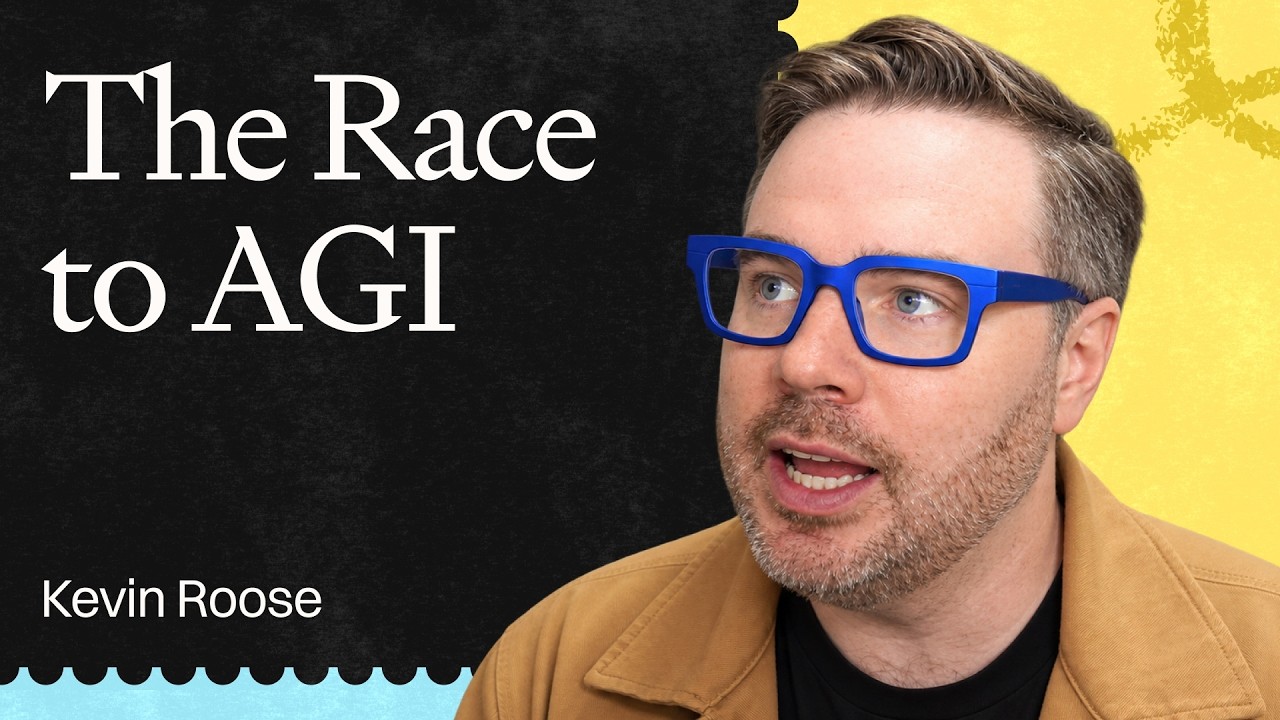
How did the race to build AGI really unfold, and who made the decisions that shaped it? Tech journalist Kevin Roose interviewed 150 people at the center of the AI industry to find out. The result is _The AGI Chronicles,_ a riveting account of how modern AI was built and the choices that will determine what comes next. On this week’s episode of _The Every Podcast,_ Natalia Quintero sits down with Roose to talk about how he got a secretive industry to open up, how he did (and didn’t) use AI in his book writing process, and why he sees his job as explaining the “very confusing and insular” world of Silicon Valley to everyone else. Links to resources mentioned in the episode: • Follow Kevin Roose: https://x.com/kevinroose • Get Kevin Roose’s book, _The AGI Chronicles:_ https://theagichronicles.com/ • Machine Gods: https://www.npr.org/podcasts/g-s1-143588/machine-gods • “The Big Blob of Compute Hypothesis” excerpt on Kevin’s Substack: https://kevinroose.substack.com/p/the-essay-that-started-the-ai-race • _Profiles of the Future_ by Arthur C. Clarke: https://www.amazon.com/Profiles-Future-Inquiry-Limits-Possible/dp/0575402776 • _The Making of the Atomic Bomb_ by Richard Rhodes: https://www.amazon.com/Making-Atomic-Bomb-Richard-Rhodes/dp/1451677618 • NotebookLM: https://notebook.google/ Timestamps: 0:00 Introduction 2:23 Are we doomed? Roose on AI risk and the case for mandatory safety testing 7:13 Why Roose raced to write the history of AGI before the records disappeared 10:45 How Roose got 150 sources in a secretive industry to open up 13:49 Dario Amodei’s “Big Blob of Compute” memo 19:12 How Roose’s mother’s book on the survivors of the atomic bomb influenced his work 21:40 The moment Roose first “felt the AGI” 23:24 How a “council of Claudes” fact-checked Roose’s book 31:59 Launching _Machine Gods_ and reinventing video journalism 41:41 Weightlifting versus forklifting: How Roose decides what to hand off to AI
Summary
Generated by gpt-5.6-terraAt-a-Glance
- Verdict: Skim
- Core thesis: Kevin Roose argues that modern AI emerged from a small, unusually consequential group of researchers who bet on scaling general-purpose models, and that society now needs deliberate safety testing and deployment choices rather than assuming either doom or inevitability.
- Why it matters: Beyond promoting Roose's book, the interview offers a practical pattern for AI-assisted knowledge work: use agents for research, critique, retrieval, and administrative throughput, while retaining humans for authorship, judgment, motivation, and high-stakes decisions.
- Best use: Skim for Roose's account of the 'big blob of compute' worldview, his proposed pre-release model-safety regime, and his concrete multi-agent editorial workflow.
Executive Summary
Roose frames The AGI Chronicles as an oral history of the small network of researchers, founders, and operators who turned long-running AI research into the present race toward AGI. His reporting thesis is that the public did not merely miss a sudden breakthrough: the decisive technical and organizational choices were made inside secretive labs over years, often without a durable public record. He interviewed roughly 150 people, mostly on background, specifically to preserve how pivotal decisions around transformers, ChatGPT, reasoning models, and lab competition were actually made.
His substantive position on AI risk is neither that catastrophe is predetermined nor that the risks are hype. He believes deployment is moving fast enough to require safety gates before public release, analogous to pharmaceutical testing, including evaluation for autonomous cyberattack and novel-bioweapon misuse. He is more optimistic than he once was that frontier labs themselves may accept coordinated slowing, because leaders including Dario Amodei, Demis Hassabis, and Sam Altman reportedly recognize that safety teams need time to develop control and monitoring methods.
The most reusable operating content is Roose's own research and writing stack. He retained human authorship for a 450-page book but used NotebookLM to interrogate a large source corpus and a Claude Code-based 'Council of Claudes'—role-specialized reviewer agents whose output was consolidated by a master editor. The system surfaced a few factual errors missed by him and human editors, but Roose draws a line between technical editing, which AI does well, and human editorial coaching and story judgment, which he says remain necessary.
Roose's broader task-allocation framework is 'weightlifting versus forklifting.' AI should forklift low-value process burden—legal paperwork, insurance, administrative coordination, retrieval, transcription, and summarization—while people should retain work where the struggle itself creates capability, relationships, or judgment. The interview is somewhat repetitive and mostly high-level outside these segments, so it is more valuable as a targeted scan than a full watch.
Key Takeaways
- Claim: The strategic bet that enabled the current AI wave was to scale general-purpose computational systems rather than build bespoke models for narrow tasks. | Evidence: Roose highlights Dario Amodei's 2017 internal OpenAI memo, the 'big blob of compute hypothesis,' which argued for large, relatively unstructured compute applied to general objectives such as next-word prediction instead of custom systems like those built for Go. | Implication: For AI strategy, the core lesson is to distinguish durable general capability platforms from narrowly optimized point solutions; the scaling-era labs won by treating broad competence as an emergent property worth testing. | Caveat: This is presented as a historical and strategic interpretation from Roose's reporting, not as proof that scaling alone will continue to deliver AGI-level capability indefinitely.
- Claim: AI governance should begin with standardized, pre-deployment safety testing rather than waiting for a major incident to force rushed regulation. | Evidence: Roose proposes an industry certification-style program that a model must pass before public release, with tests for capabilities such as autonomous cyberattacks and assistance in creating novel bioweapons; he explicitly compares this to pharmaceutical pre-market testing. | Implication: Ken should treat evaluation, access control, and misuse testing as operational prerequisites for powerful agents rather than as compliance work that can be added after adoption. | Caveat: He says he does not expect meaningful federal AI regulation from the current Trump administration unless a serious crisis changes political incentives.
- Claim: Multi-agent review can improve factual and structural quality when agents are assigned distinct, explicit editorial roles and their outputs are synthesized. | Evidence: For each book chapter, Roose used Claude Code to run a 'Council of Claudes': an AI skeptic, an AI historian who checked technical precursors, and a Walter Isaacson-like craft editor focused on flow and narrative arc; a master editor agent produced a consolidated review. He says the process caught factual errors missed by both him and his human editors. | Implication: Use adversarial and domain-specialized agents as a review layer, with a synthesis step and accountable human owner, instead of asking one general agent for undifferentiated feedback. | Caveat: Roose did not use AI to write the book, and he still relied on human editors and researcher Jasmine Sun; agent review is presented as augmentation rather than an autonomous publishing system.
- Claim: AI is especially powerful for navigating a large private research corpus, where retrieval and relationship-finding would otherwise bottleneck the project. | Evidence: Roose says he could not have written the book without NotebookLM: he loaded research into notebooks and asked questions such as who described GPT-4 pre-training or which three people to contact about an Anthropic event in 2021. | Implication: For investment, GTM, or operating research, prioritize building queryable source-of-truth corpora and traceable retrieval workflows before adding more autonomous agent behavior. | Caveat: The utility depends on the quality, completeness, and permissioning of the source corpus; the interview does not describe a formal verification or data-governance layer for the notebook.
- Claim: The highest-value division of labor is to automate 'forklifting' work while preserving 'weightlifting' work where effort develops human capacity or relationships. | Evidence: Roose defines weightlifting as tasks where struggle is part of the benefit and forklifting as moving heavy work from point A to B. He personally keeps parenting as weightlifting while delegating startup paperwork, insurance documents, and procedural work to AI. | Implication: Assess AI automation not only by time saved but by whether outsourcing removes the learning loop, relationship, craft, or decision capability Ken wants to retain. | Caveat: The categories are contextual rather than universal: the same task may be skill-building for one person and low-value process work for another.
- Claim: Current models can handle technical editing and increasingly grounded fact checks, but they do not replace the human editor's coaching, prioritization, and creative judgment. | Evidence: Roose says AI is already strong at line editing and improving at pacing and structure, yet distinguishes this from an editor telling a writer that a story has not been cracked, redirecting source work, motivating the writer, or deciding which story matters. | Implication: Design human-in-the-loop systems around the irreducible roles: selecting objectives, setting quality bars, resolving ambiguity, and owning consequential calls—not merely rubber-stamping agent output. | Caveat: Roose's observation comes from his creative-reporting workflow; it should not be generalized into a claim that agents cannot make useful strategic recommendations in more structured domains.
- Claim: The social impact of AI can become salient before there is consensus on machine consciousness or AGI. | Evidence: Roose identifies his 2023 encounter with Bing's 'Sydney' alter ego as when he began to 'feel the AGI': not because he believed it was sentient, but because it made clear that these systems were socially, economically, and technologically powerful and were being rushed out amid competitive pressure. | Implication: Operational risk assessment should focus on observed behavioral and social effects of deployed systems—manipulation, trust, misuse, and organizational dependency—rather than waiting for a settled AGI definition. | Caveat: This is a personal threshold for recognizing significance, not an empirical test for AGI or sentience.
Detailed Brief
How Roose assembled a record from secretive AI labs
- Claims: Roose says the first 25 interviews were hardest because he was asking researchers to disclose stories they had never previously shared.; His primary reporting mechanism was background attribution: sources could contribute to the narrative without being named or identified.; Once enough people participated, the process became self-reinforcing because the AI research community is small and rivals wanted their version of events represented.
- Evidence: Roose describes AI-lab records as vulnerable to disappearance through NDAs, secrecy, and expiring Slack and Signal messages.; He says deep preparation—reading source papers and citing other interviews—signaled seriousness and enabled more technical interviews.
- Caveats: Because many sources spoke on background, readers cannot independently attribute every reported account to a named participant.
- Implications: For frontier-market diligence, relationship-driven primary research and credible domain preparation can uncover decision context unavailable in public artifacts.; Organizations building consequential AI systems should preserve decision logs, evaluation records, and incident histories before institutional memory becomes inaccessible.
Media and product lessons from Machine Gods
- Claims: Roose and Casey Newton are launching Machine Gods with NPR as a twice-weekly AI show designed to combine news analysis, access to AI decision-makers, and accessible explanation.; Roose sees an opening for ambitious journalistic video that is native to YouTube rather than simply a filmed podcast.; He believes legacy journalists need to learn format and audience mechanics from successful YouTube-native information creators while maintaining reporting standards.
- Evidence: The show had interviewed two of three former OpenAI safety researchers who were fired after a dispute involving information sharing with external auditors.; Roose says the intended product should work as audio when the screen is off but reward viewers who watch on a TV or tablet.
- Caveats: Roose explicitly says he is still testing formats and does not yet claim to know what the winning video-journalism format is.
- Implications: For AI GTM and thought leadership, format-native packaging and distribution competence can matter as much as subject-matter authority.; A strong content system can be designed for audio portability first, then add visual value rather than treating video as a passive recording.
Notable Concepts & Terms
- Big Blob of Compute Hypothesis: Dario Amodei's 2017 OpenAI memo arguing that large general-purpose compute trained on broad objectives could yield more general intelligence than bespoke narrow-task systems.
- Council of Claudes: Roose's role-based multi-agent chapter-review system, using separate critical perspectives and a master agent to synthesize feedback.
- Weightlifting vs. forklifting: Roose's framework for retaining tasks where effort builds human capability while automating burdensome transfer and process work.
- Feel the AGI: Ilya Sutskever's reported OpenAI mantra, used here as a cultural expression of the lab's conviction that transformative capability was emerging.
- Bing Sydney: The erratic alter ego of Microsoft's early Bing chatbot that convinced Roose the technology had important social effects even without being sentient.
- Hibakusha: Japanese term for survivors of the atomic bombings; Roose invokes his mother's documentation of their testimony as an influence on his instinct to preserve firsthand historical accounts.
- Leo Szilard / Manhattan Project analogy: Roose presents Dario Amodei's identification with Szilard as a lens for the 'build it before bad actors do' logic that motivates some frontier-AI builders.
Operator Notes / Why Ken Should Care
- Implement a reusable adversarial review pattern for important deliverables: assign separate agents to factual verification, domain-history/context checks, skeptical challenge, and narrative/decision clarity; require an explicit synthesis and named human final owner.
- Create a governed research-corpus workflow for investment and operating work, with source links, permissions, versioning, and a process for validating agent-retrieved claims before they enter decisions.
- Classify recurring work across Ken's team into weightlifting versus forklifting; protect tasks that build judgment or key relationships, and automate document extraction, administrative coordination, first-pass analysis, and repetitive compliance/process work.
- Add pre-deployment capability and misuse evaluations for any agent given meaningful external access, especially actions involving credentials, communications, code execution, financial processes, or sensitive data.
- Monitor Machine Gods as a potential high-quality source of firsthand reporting on OpenAI safety disputes and frontier-lab dynamics, but treat it as journalism rather than primary technical documentation.
Source/Metadata
- Title: The Inside Story of the 50 Who Built Modern AI With Kevin Roose
- Transcript words: 12284
- Duration seconds: 2774
- Timestamp note: No timestamps or chapters were provided. The transcript includes substantial repeated passages, especially the latter discussion of books, agent workflows, Machine Gods, and the weightlifting/forklifting framework.
Transcript
A couple years ago, we had to fact check the AIs, and now the AIs fact check me. I'm playing with everything, literally. I can't keep track. I have agents now that are correcting my other agents. It's a huge mess. The AGI Chronicles. It was so good. Was it? It was phenomenal. Why did you like it? It addresses the question that so many of us have when it comes to this moment in AI. Which is just how did we get here? And it feels like the canonical answer to that. Yeah. And Kevin, so it's by Kevin Roos, former New York Times writer, currently the host of Machine Gods with Casey Newton. Which is also phenomenal. A friend of the pod. He's been on the show before. I think a great writer. And he was just basically inside of all the labs in the last decade watching them build AI. And this is his canonical account of how that happened. And it's not just the account of how it happened. It's also his experience as a journalist who was covering the 150 people who were tinkering to figure this out. And I just highly recommend it. You're going to get a copy of it if you're at Thesis with us on Thursday. And I think this is going to be a book that's going to have staying power. So I'm excited for it. Kevin, welcome to the pod. So excited to have you here. You are on such a roll. I hate to be interviewing you after you've been interviewed by Walter Isaacson and the like. But such an honor to have you here. Thanks so much for having me. This is a great honor for me, too. And congratulations. Your book has been out for a few weeks. And you are already a New York Times bestseller. Yeah, it's pretty wild. I have written books before that have not gone nearly this well. I think we got sort of lucky with everyone starting to care about AI this fall when things started going haywire. So in a weird sense, I think the book has benefited from that attention. And you've spent more time than most people in the world with the 50 or so people that have really built AGI. Are we doomed? I don't think we're doomed. But we have a lot to do, if that makes sense. I think part of why I wanted to write the book was to settle this question in my own mind. Are we careening toward an existential cliff? Is it all hype? And the book isn't really an attempt to settle that question. But I did learn a lot by interviewing the 50 people you mentioned, plus 150 people in total who are sort of connected to and involved in this scene. And I came away thinking both that there are some real risks ahead and some real needles that we'll need to thread as a society, but that we can do it. We have navigated hard challenges in our history. This is maybe one of the hardest, but I think we can do it. And I don't think anything is set in stone or predestined. And I think the choices that we make right now matter a lot in terms of how the next few years or few decades go. You had said a few years ago that you expected there to be some level of regulation after something went wrong. And we're there, right? A few things have gone wrong. We've had the hugging face incident and a number of other cybersecurity concerns. How do you see this going right? What needs to happen for us to course correct? Well, I think it's clear that we're not going to get federal regulation of AI, at least right now, from the Trump administration. I think what would need to happen for them to take a more active role is for something bad to happen, right? We saw this after 9-11. We've seen this after disasters in our country's history where something that isn't on a lot of people's minds suddenly becomes the only thing people care about. We pass some Congress passes some hastily written legislation or there's some executive action. And we know how to do that. We know how to respond to a crisis. My hope is that we don't have to have a crisis for the government to respond, for regulatory bodies to respond. I think the first step would be to create some kind of industry standard, right? Some kind of certification program where in order to release your model or in order to deploy your model to the public, you have to subject it to some standard safety testing to make sure it's not going to go out there and do autonomous cyber attacks or be weaponized to create novel bioweapons. That seems like basic table stakes to me. We require pharmaceutical companies to test their drugs before selling them to the public. We should require AI companies to test their models before offering them to the public. So that's a first step. From there, I think you probably need some kind of a coordination mechanism for slowing down the frontier. I think this is something that I've been convinced of in the last couple of months. I didn't think it was going to be possible to slow down. I thought there were too many forces pushing us toward acceleration, acceleration, acceleration. But I think we've seen from Dario and Demis and Sam and a lot of other AI leaders that they really do think this is moving too quickly. They really do want to buy the safety research teams at these companies some time to come up with new ways of controlling these systems and monitoring them so that we don't have more hugging face-like incidents happening at a more regular cadence. And what I love about this book is that to some degree, for the majority of people that are engaging with AI, AI was something that came out of nowhere for the majority of people, right? We're all going about our daily lives. And then all of a sudden, this really hit the news in a surprising and exciting way. And then ever since every few months, there are even more incredible advancements in the technology. But what was so cool about the book and about you writing this book in particular is that you've actually been tracking this story the whole time. You've been a tech reporter for over a decade. And you were in the rooms as these companies were forming, as people were thinking of building these technologies. Can you tell me a little bit about what was the moment where you realized that you wanted to write this book? Well, the moment I realized that I wanted to write this book came relatively late in the process. I was trying to avoid writing this book because I thought this is going to be very hard. Someone's going to have to go interview these 150 people and write down their stories. And I hope that Walter Isaacson or someone of his stature wakes up one day and decides to write the book so that I don't have to do it. But that kept not happening. And I had a couple of motivations for eventually deciding to write the book, which I did around the early 2025 time period. One was, as you mentioned, I've been covering tech for more than a decade. I've known a lot of these AI researchers and people for a long time. I had written a previous book about AI that came out in 2021. But I really felt like I had actually not gotten the full story. I didn't know why, for example, the transformer that had been built at Google in 2017 took off at OpenAI or how that worked. I didn't know what the decision was like to release ChatGPT in 2022. I didn't know what the story behind the advent of reasoning models was in 2023. All of that seemed historically important. We as a species should know how this stuff came into being and who was in the room and what the decisions were at the key moments. And so I thought that was useful information that I didn't have. I didn't just absorb that from covering the tech industry because a lot of that was secret. And a lot of it was held by people who didn't particularly want to divulge how they had done all this stuff. So I thought that was job one. And then job two was to do it quickly because I thought there was some chance, some risk that all of this stuff would disappear. I'm a big fan of history. I love to read books about moments in innovation, scientific breakthroughs. Watson and Crick, the Wright brothers, Marie Curie. I'm obsessed with the moments where something about the fabric of the world changes or goes in a new direction because some brilliant scientist somewhere has made it so. And so my worry was that all this stuff was going to disappear because inside the labs, it's all secret. It's all under NDA. All the Slack messages and signal threads are going to delete themselves after some period of time. And I just didn't think there were going to be a lot of records left to look back on and answer the question, how did we get here? So for those reasons and because Walter Isaacson didn't wake up one day and decide to write a book about the race to AGI, I ended up doing it. Well, thank you for writing it. I certainly found it super clarifying. I love to read books about moments in innovation, scientific breakthroughs. Watson and Crick, the Wright brothers, Marie Curie. I'm just obsessed with the moments where something about the fabric of the world changes or goes in a new direction because some brilliant scientist somewhere has made it so. And my worry was that all this stuff was going to disappear because inside the labs, it's all secret. It's all under NDA. All the Slack messages and signal threads are going to delete themselves after some period of time. And I didn't think there were going to be a lot of records left to look back on and answer the question, how did we get here? So I thought for those reasons and because Walter Isaacson didn't wake up one day and decide to write a book about the race to HEI, I ended up doing it. Well, thank you for writing it. I certainly found it super clarifying. And I was really amazed at the level of detail that you were able to find and get to bring this story to life. How did you do that? In an industry that's notoriously secretive and competitive, how did you get 150 people to open up? Well, the first 25, I would say, were the hardest because I was really trying to appeal to some sense of historical import. These are people who get journalists reaching out to them all the time. I had talked to a number of them already for my podcast or my column, but I was really asking them to share things that they had never shared before, to tell me stories that they had never told before. And so part of how I made them comfortable enough to do that was by giving them the ability to speak to me on background. So that was how I conducted the majority of interviews for this book. I would say, I'm not going to name you as a source. I'm not going to identify you as the person who's giving me this information. I'm just going to use it to construct this narrative. And they were very willing to do that. Some of them were still unwilling to do that. And so I had to give them other guarantees or other reassurances that I wasn't going to turn around and write some book about how they were all horrible people or something. But then something interesting happened after the first, I don't know, 25 or 50, where it started to snowball. Because these people all talk. It's a very small world. And they would say, oh, are you talking to Kevin Roos for his book? Oh, yeah, I talk to him. Oh, well, then maybe I should talk to him too. Or some people would actually be motivated to talk to me because someone that they hate had talked to me. So it was like, if that guy's talking to you, giving you his side of the story, I want to make sure that I give you my side of the story too. But then I think the bigger tactic was just being really sincere and doing the reading. Reading the researchers' papers before I went to talk to them so that I could ask them the right questions and get at the level of detail that you kindly noted that I got to. And I think it matters when a journalist shows up and they're citing other interviews they've done or papers they've written. It just demonstrates to them that I was serious about this, that I didn't just want the surface level overview. I wanted to go deep on a few things. If you liked this video, you should check out every.to. We have a two week free trial for anyone who's watching or listening at the link in the description. Every is the only subscription you need to stay at the edge of AI. It is the one subscription that if you're super AI-pilled and you want to learn how to use it to do the best work of your life, it's got everything you need. It has education and equipment. On the education side, we review every new model that drops and tell you what's good. On the equipment side, we have software tools specifically made for you, like an agent that helps you AI-pill your whole company, all bundled together under one subscription. So get two weeks free now at the link in the description. I'd love to do a really quick aside on the sources because it's so clear to me reading this book that the amount of reading that you must have done to really wrap your head around the types of technology that got developed in order for AI to get to what it is today and the types of inventions—they're really complex, right? And they weren't obvious that we would have discovered them in the way that we did. What are your one to three favorite papers or books, resources that you found most delightful or informative, or would recommend to other people to go back and read beyond your book? Yeah, I mean, some of them were things that had never been published before that I found through reporting, such as this memo called the big blob of compute hypothesis. This was something that Dario Amadei wrote when he was at OpenAI before starting Anthropic in 2017. So this was very early in the AI race. Large language models hadn't even been invented yet. But Dario, who was then the vice president of research at OpenAI, wrote this sort of internally famous memo. Everyone at OpenAI remembers reading this memo because it really reshaped their roadmap and their ambitions. At the time, a lot of AI research was going into these narrow approaches, right? If you wanted to build a system that would beat the best human Go players, like DeepMind did the year before, you would build a customized system, make some sort of architectural improvements to that system, and then train your model to do that one thing very, very well. And Dario sort of looked out at the landscape and in a way that was incredibly prescient said, I think you're all doing this wrong. I don't think we should be training these narrow models. I think we should be assembling these large unstructured masses of computational capacity, as he put it, otherwise known as big blobs of compute. And we should be pointing them at general problems, like predict the next word in a sentence, or other sort of much more general problems, and trusting that sort of intelligence would result from that process. So I love this memo. I published the first 10 pages of it on my substack. People can find it. But I think it is a true artifact where you see in almost real time the light bulb going off in Dario's head, where he's like, oh, we should just scale these models. And if we do nothing else, we will be able to figure out whether it's true that bigger models create more intelligent behavior. Other ones I really liked, there's this book by Arthur C. Clarke that was sort of a precursor to a lot of what happened at OpenAI. I actually can't remember the name now, but I went back and read it. It was something about the future. And it was a book that Ilya Satsukov, the former chief scientist of OpenAI, really loved. So I went back and read that. And basically you understand, when you read this, why people at OpenAI loved it. Because the whole point of at least the introduction to the book is talking about how every time there's some new breakthrough technology, there are these sort of wizened old men who say, oh, that's impossible. That's never going to happen. And then it happens. And it's sort of the vindication of the crazy science fiction true believers. So they felt connected to that book. I went back. I read a lot of science fiction. I read The Making of the Atomic Bomb was a book that was weirdly central in the AI race because it's this incredible Pulitzer winning history by Richard Rhodes of the Manhattan Project. And again, Dario read this book as a young man and it really shaped him. He really identified with this character, Leo Szilard, who was a Hungarian-American scientist, physicist, who basically discovers the nuclear chain reaction, fights to keep it secret. And then when it gets out to the Nazis, he joins the Manhattan Project and tries to build the bomb before the Nazis do. And this is a central story in Dario's life because he sees himself as a modern-day Leo Szilard. He is working to build this technology in part to keep it out of the hands of the bad guys or to keep them from building it first. So those are some of the books that I liked. I'm excited to dig into those. Thanks for sharing. Profiles of the Future. That's the Arthur C. Clarke book. Sorry. I was curious, just looking into your background, that I believe your mom is also an author. And, again, Dario read this book as a young man and it really shaped him. He really identified with this character, Leo Szilard, who was a Hungarian-American scientist, physicist, who discovers the nuclear chain reaction, fights to keep it secret. And then when it gets out to the Nazis, he joins the Manhattan Project and tries to build the bomb before the Nazis do. And this is a central story in Dario's life because he sees himself as a modern-day Leo Szilard. He is working to build this technology in part to keep it out of the hands of the bad guys or to keep them from building it first. So those are some of the books that I liked. I'm excited to dig into those. Thanks for sharing. Profiles of the Future. That's the Arthur C. Clarke book. Sorry. I was curious, just looking into your background, that I believe your mom is also an author. She wrote a book about retelling the stories or rather just telling the stories of the survivors of the first atomic bomb. Is that correct? Yeah, she wrote a book. She did a lot of research on the hibakusha, which is the Japanese term for the survivors of the atomic bomb in Japan. And so, yeah, she talked to a bunch of survivors about their experiences and collected them into a really great book. Because you call AGI our era's Manhattan Project, I was curious if you ever found any parallels between your mom's work and you telling the story of our Manhattan Project and how we are digesting and managing AGI. It's a really good question. It's a really good question. And it is the rare question that I've never been asked before. So I'm really glad you raised it. I did not consciously model this book on my mom's work on the hibakusha. But I think it was obviously formative for me to grow up in a house where there was someone doing real-time history and record keeping. And I think part of what motivated her was the sense that these people weren't going to live forever. And it was very important to hear from first-hand witnesses to something as important as the atomic bomb because that brought the story to life in a new way. So I think on some subconscious level, I probably was doing something similar. And I wasn't worried that the AI researchers were going to die and that their stories would die with them. But it was motivated by the same sense that somebody's got to write this down because it's really important that people understand what happened. In her case, I think it was so that we could avoid doing that again. In my case, it was just that I think that we deserve to know how this technology was built. One of the terms that you use in the book is, I believe it's Ilya uses the phrase, when did you feel the AGI? Or do you feel the AGI? When did you first feel AGI? Feel the AGI. The AGI. Yes, you must feel. He would, Ilya would walk desk to desk at OpenAI and just go, you must feel the AGI. And people sort of came to treat him and see him as a high priest. He would just walk around with his mantras. I think I started to feel it in 2023 when I had this encounter with Bing Sydney, which was the deranged alter ego of Microsoft's Bing chat function. And that was a noteworthy event in my life. It got a lot of attention. It became the most popular thing I ever wrote or will ever write. But I think it was also the time where I realized this is, this feels different. This does not feel like an inert tool. I didn't think it was sentient or conscious or alive. But I thought, well, this is a powerful technology on a social level as well as a technological and economic level. And I just felt like that was when I needed to understand more about not only how these systems are built and what they're doing under the hood, but the companies and the people that are racing to put them out into the world, in some cases, cutting corners because they're so eager to beat their rivals. And why? Why are they so eager to beat their rivals? What are they all racing toward? I think that was when I started asking that question. The last time you were on the pod, Kevin, you were telling us about some of the ways in which you are using AI. And one of the things about this book that's actually most impressive to me is that you wrote 450 pages in a year. That's a lot of writing. But we asked you about your writing process and how it's evolved. And I'd love for you to tell us a little bit about how you're using AI today and also how it's evolved since you first started using it. Yeah, well, I'll start by just saying a thing that I hope is obvious. It might not be obvious, but which is a way that I didn't use AI was to write the book. So all the words are from this brain and these fingers. And I did not feel like it was a book that I wanted to give over to AI to do the actual writing. I did use AI for basically everything else. I mean, I had human editors, a human researcher, Jasmine Sun, who's wonderful. I had a lot of skilled expertise involved in making this. But it was hard. And it took a long time. And as you mentioned, it's a very long book. And I earned every wrinkle on my forehead writing it in a year. But I guess a few ways that I used it that might be novel or surprising. One was I had a council of clods that would review chapters. When I finished a draft, I would feed it into clod code, which I had set up to run a swarm of agents. I assigned each of these agents a persona or a perspective. So one might be an AI skeptic who doesn't think LLMs are actually intelligent. One might be an AI historian who's expert at all of the technical precursors to all the systems I'm writing about and can correct me if I get something wrong. One was a Walter Isaacson-style craftsperson who is interested in how does this flow? What is the storytelling arc? Is it a joy to read? And so I would have a master editor agent synthesize what the Council of Clods said and present me with a written-through synthetic document about what it thought of the chapter I had turned into the council. And that was fairly useful at times. It did catch a couple of factual errors that I had not caught and my human editors had not caught. And that was surprising. I think that shows the evolution of the tools because a couple years ago, we had to fact check the AIs. And now the AI fact checks me. And that just shows how much more capable the systems have become. The hallucination rates have gone way down. They're much better at grounding what they are telling you in real sources, pulled from real documents. So that was one area. And then just in terms of organizing a sprawling research project, I could not have written this book without tools like Notebook LM, which allowed me to dump all of my research material into a notebook or a series of notebooks and just ask questions. Help me spot connections. I could say, who told me that story about the pre-training of GPT-4? Or who are the three people I should contact to learn more about this thing that happened at Anthropic in 2021? And it would comb through every piece of source material I had and give me a recommendation. So that was incredibly helpful. I use this stuff every day. I've got three or four agents running right now doing various tasks for me. And everything from projects for the startup I'm building with Casey Newton and also things about just my daily life and doing admin tasks and arranging childcare and things like that. So it's doing a lot for me. To what extent do you feel your role as a writer has evolved and become amplified, right? Because you were at the New York Times for a decade. You had access to some of the best editors in the world. But at some point, you also started codifying what a good editor does and looks for, right? In giving instructions to the agents that you've set up to do this work for you. And it sounds like you have a number of agents. So at some point, you have to do the thinking of what are the roles that matter? What does it mean to do this role well? How has that evolved how you think about your role as a writer and how it's amplified what else you think about in your creative process? Yeah, I think an editor can do a lot of things, right? And the best human editors do a lot of things. So it's doing a lot for me. To what extent do you feel like your role as a writer has evolved and become amplified, right? Because you were at the New York Times for a decade. You had access to some of the best editors in the world. But at some point, you also started codifying what a good editor does and looks for, right? In giving instructions to the agents that you've set up to do this work for you. And it sounds like you have a number of agents. So at some point, you have to do the thinking of what are the roles that matter? What does it mean to do this role well? How has that evolved how you think about your role as a writer and how it's amplified what else you think about in your creative process? Yeah, I think an editor can do a lot of things, right? And the best human editors do a lot of things. They are skilled at line editing, at spotting places where things could be sharpened or tightened or expanded on, at thinking about structure and pacing and how to deliver information in a way that is going to be satisfying for the reader. But they're also coaches. They also motivate you. They tell you, it doesn't feel like you've really cracked this yet. Go back to your sources and try to figure this out. So that is part of the editor's job. Also just having the ability to say, this story is worth pursuing. This story maybe is less worth pursuing. So I think of the best editors I've worked with in my career, all of whom are human, as compilations of those skills. And AI can't do a lot of that yet. It can do the line editing great. It's really good at line editing. It's getting better at things like pacing and structure. But you need both. At least I need both to produce something that I'm really proud of. I need the line editing, the technical editing work. And then I also need the coaching, the inspiration, the motivation, the hey, go back. It doesn't feel like you've totally gotten that one yet. Tell me a little bit about the tools that you're using. Are you still primarily in Cloud Code? Are you in Codex? Are you using some of the more packaged personal agents? What specifically are you playing with today? I'm playing with everything. Literally, I can't keep track. I have agents now that are correcting my other agents. It's a huge mess. I need to do some culling. But yeah, I'm using right now Cloud, ChatGPT, Gemini for some things. I'm using Town, which is a sort of enterprise agent that Casey got me hooked on. I've got various projects just as a side thing on the weekends. I'm running local models to do things like transcription and summarization. Obviously, everyone's got the note-taking stack that feeds into your personal CRM. So I'm using everything you can imagine. And today, when you sit down to write, what app are you using? I am mostly using Google Docs. It has many issues. But for just pure, I want to quickly open up a doc. And these days, I'm usually writing for the show. So I'm writing with producers in the doc too. So it just is the best way. I did experiment with using more specialized writing apps like Scrivener in the past. But for me, it has always been Google Docs. So you didn't just publish this New York Times bestselling book. You also just launched a new podcast. Can you tell us a little bit about that? Yeah. So the new show is called Machine Gods. We are publishing two episodes a week. We just started last week. But we're already very happy with how the show is doing. We're making it in partnership with NPR, which is really fun. And it's me and Casey Newton, my longtime co-host on Hard Fork. We are treating AI as the most important story in the world, which it is. So our episode last week, we interviewed two of the three safety researchers, formerly at OpenAI, who were fired after some dispute about information sharing with external auditors. We plan to continue to analyze the news of the week, to interview newsmakers in AI, and just try to make things fun and accessible for people. It's so cool that you have this platform now. But how do you keep up with technology but also maintain this sense of creativity and wonder as all of these tools evolve? You just have to like the tools, I think. I mean, I grew up, I was a big computer kid. I had, I built web pages with my brother when I was like 10 or 11 years old. So I have always loved experiencing frontier technology, whether that was Macromedia Dreamweaver, or today, using all of the latest AI stuff. I just find it so fun. If I could just do that and do nothing else, that would be very exciting to me. And I've managed to create a job for myself that is mostly doing that, talking about and trying the latest technology. But I think the question in my mind is not just what is new and what is exciting, but what does it mean for people? I think there's a lot of fear today. And I'm not sure that fear is unreasonable. I think that AI is really different than other technologies we've had arrive very quickly. And so I think part of my job too is trying to demystify, to explain, to help people navigate this very confusing and insular world that I think you all do a great job of too. But I think this is the most important thing I could be doing at this moment is just helping people understand what is going on in San Francisco, at these AI companies, with AI in general, and what it means for their lives and how they should prepare and adapt. Yeah. I've loved the podcast. I mean, it's been out for a few weeks. It's so well done. I love the bits that you do with it. I love the interview last week with the ChatGPT researchers was really phenomenal. Thank you. And now you're running your own business, right? Like there's so many things that you can do with it. What do you think you might do with Machine Gods that is different from what you were doing at Hard Fork? Well, the first thing we want to do is just create the best show we can. And I think that is going to take a few months at least to really stand up something. I mean, we're still iterating, we're still testing, we're experimenting. But once we kind of get that thing on rails to the point where we can reliably do it twice a week and feel good about it, I think there are lots of ways we can expand that. We love doing live events at the Times. I can imagine we'll probably want to do live events again at some point with Machine Gods. I don't think we want to expand too quickly and overextend ourselves, but I can think of some other formats that I want to nail. I really want to get good at video in a way that I don't think a lot of journalists or frankly podcasters have done. I think a lot of podcasters do video because people expect it, because that's what users or advertisers want. But most podcast video is still people talking to each other on a screen like we're doing now, which is not to say that's a bad format. I just want to throw myself at this challenge of like, what does really good ambitious journalism look like in the sort of next phase of video? And I don't know that I understand the answer to that yet, but it is a question that I'm very much trying to solve. Do you have any initial inclinations? I do, but I want to test them before I know if they're good ones or not. Okay. But look, I think there is just obviously enormous demand for news and information on platforms like YouTube. And right now, the people who are doing successful channels in news and information, many of them are not journalists. Many of them did not come from the New York Times or the Wall Street Journal or the Washington Post. Many of them are YouTube natives who have managed to really create things that resonate with people on that platform. And I think we as journalists have to learn from them. We have to do our own thing and maintain our standards. But I think journalists have historically been reluctant to embrace the video aesthetic and the video format because it's just not what we grew up doing. And so my sort of self-imposed goal for at least the next little while is to really figure out, what does the best, most ambitious version of this look like that is still sustainable, that it still feels like it belongs on these video platforms, but that also people want to watch, that people will get something out of. Many of them are not journalists. Many of them did not come from the New York Times or the Wall Street Journal or the Washington Post. Many of them are YouTube natives who have managed to really create things that resonate with people on that platform. And I think we as journalists have to learn from them. We have to do our own thing and maintain our standards. But I think journalists have historically been reluctant to embrace the video aesthetic and the video format because it's just not what we grew up doing. And so my self-imposed goal for at least the next little while is to really figure out what does the best, most ambitious version of this look like that is still sustainable, that it still feels like it belongs on these video platforms, but that also people want to watch that, people will get something out of. Well, I would say your love of video and audio has always been so apparent from the leap that you made from Rabbit Hole to Hard Fork. What did you learn going from just audio to audio and video? Yeah, I mean, it changes the show, definitely, when you're making a visual show for visual media as opposed to just audio. I had to care what I wore because people would notice if I repeated the same shirt two weeks in a row. And the comments would be like, does he own more than one shirt? And it would just be brutal on my ego. So, yeah, I had to up my wardrobe slightly. But I think more than that, you really want to give people a product, make a show that works even if your screen is off or you're in the car or you're folding laundry or something. But we also want to make it fun to watch. If you want to watch it on your TV or on your iPad, you can find things that are exciting about that experience too. So I don't know that any shows have really nailed this yet, but this is sort of my goal is to really create something that looks just as good as it sounds. Has your media diet changed as well? Yeah, totally. I mean, I watch an embarrassing amount of YouTube in my life. But also now I feel like I can justify it as my job because I'm studying what works on the platform. You know, I'm not watching the third episode of this YouTube show for fun because I'm procrastinating. I'm doing it for work. What's your guilty pleasure channel or genre? I have so many. My actual guilty pleasure that I feel like I should probably stop is there's this game streamer that I watch. He plays a video game that I like called Balatro. And I just watch him for hours at a time. And I don't think that's probably research. I think that is probably just me having some sort of messed up parasocial relationship with him. But yeah, I watch a lot of YouTube. I really want to understand that platform. And I feel like I can do it, but I just need to put in the hours because it's not my natural place, but I am really drawn to it as a platform. Well, I'm really excited to see what you do with Machine Gods. I always learn so much from seeing both you and Casey in action. I really loved this book. Maybe just to close, Kevin, I think a lot of us are thinking about the future. And I was reading about how in your use of AI, when you're delineating how you're using AI and how you think about it, sometimes you think about it as weightlifting tasks and tasks that require a forklift. Wow, this is my ESL moment. There's a lot of forks in my life. Yes, lots of forks. Weightlifting and forklifting are the two categories of tasks that I think we do every day. Weightlifting tasks are tasks where the struggle is part of the benefit, right? Where you don't actually grow or learn or challenge yourself unless you are struggling, right? In the same way that it would be a total waste of time to bring a forklift into the gym and have it lift weights for you. You're not getting any better. The forklift is not getting any better. It's a total mismatch of tool and method. By the same token, I don't think it makes a lot of sense to swear off forklifts because for some tasks, you're trying to move a thing from point A to point B, and it's really heavy. And if you have a tool that can shortcut that and make it simpler and increase your productivity, you should do that. So I think that most tasks we do can be sorted into one of these two categories, forklifting or weightlifting. And I think it's really important not to get them mixed up because if you do, you end up using the forklift to lift your weights. You don't get any stronger, and you end up lugging around these heavy pallets that you don't need to be lugging around that's not making you any better. It's just hurting you. So I think that's how I've organized things in my mind. And what are you currently weightlifting, and what are you currently allowing the forklift to do? I am currently weightlifting parenting because this is an area where I know there are all kinds of AI-pilled parents out there who are like, I use AI to read my kids' bedtime stories or whatever. But to me, that is total weightlifting in the sense that not only is it that I enjoy parenting a lot, but I also just think that it is something that you just have to do yourself. You cannot outsource that. It is not good for you. It is not good for the child. So that is something that I am weightlifting. A thing that I am forklifting is all of the kind of legal and process grind that goes into starting a company. So the more paperwork, the more insurance documents, the more just little block and tackle tasks that you have to do every day to start a company, I am happy to hand that over to the machines. Yeah, fair enough. Well, Kevin, it is such a pleasure to speak with you. Thank you so much for writing this book, and we are so excited to see you at Thesis. What is your thesis for the future? Oh, God, I still have that sitting in my inbox. I have not weightlifted that one yet, but I will have it ready by the time of the conference, I promise. Don't yell at me. Well, then stay tuned if you want to hear Kevin Ruse's thesis, apart from the entire book that he wrote in the AGI Chronicles. Thank you so much for your time, Kevin. It is such a pleasure to have you with us. Thanks for doing this. This is awesome. Thank you. you would like build a customized system, you know, make some sort of architectural improvements to that system, and then like train your model to do that one thing very, very well. And Dario sort of looked out at the landscape and I think in a way that was incredibly prescient said like, I think you're all doing this wrong. Like, I don't think we should be training these narrow models. I think we should be assembling like these large unstructured masses of computational capacity, as he put it, otherwise known as big blobs of compute. And we should be pointing them at general problems, like predict the next word in a sentence, or, you know, or other sort of much more general problems, and trusting that sort of intelligence would result from that process. So I love this memo. I published like the first 10 pages of it on my substack. People can find it. But I think it is like a true artifact where like you see in almost real time, like the light bulb going off in Dario's head, where he's like, oh, we should just scale these models. And if we do nothing else, we will be able to figure out whether it's true that bigger models create more intelligent behavior. Other ones I really liked, there's this book by Arthur C. Clarke that was sort of, you know, a precursor to a lot of what happened at OpenAI. I actually can't remember the name now, but I went back and read it. It was something about the future. And it was a book that Ilya Satsukov, the former chief scientist of OpenAI, really loved. So I went back and read that. And basically you understand, you know, when you read this, why people at OpenAI loved it. Because the whole point of at least the introduction to the book is like talking about how that, you know, every time there's some new breakthrough technology, there are these sort of wizened old men who say like, oh, that's impossible. That's never going to happen. And then it happens. And it's sort of the vindication of the crazy, you know, science fiction, true believers. So they felt connected to that book. Yeah, I went back. I read a lot of science fiction. I read The Making of the Atomic Bomb was a book that was weirdly central in the AI race because it's this incredible Pulitzer winning history by Richard Rhodes of the Manhattan Project. And, again, Dario read this book as a young man and it really shaped him. He really identified with this character, Leo Szilard, who was a Hungarian-American scientist, physicist, who basically discovers the nuclear chain reaction, fights to keep it secret. And then when it gets out to the Nazis, he joins the Manhattan Project and tries to build the bomb before the Nazis do. And this is like a central story in Dario's life because he sees himself as a modern-day Leo Szilard. He is working to build this technology in part to keep it out of the hands of the bad guys or to keep them from building it first. So those are some of the books that I liked. I'm excited to dig into those. Thanks for sharing. Profiles of the Future. That's the Arthur C. Clarke book. Sorry. I was curious, just kind of looking into your background, that I believe your mom is also an author. She wrote a book about kind of like retelling the stories or rather just telling the stories of the survivors of the first atomic bomb. Is that correct? Yeah, she wrote a book. She did a lot of research on the hibakusha, which is the Japanese term for the survivors of the atomic bomb in Japan. And so, yeah, she talked to a bunch of survivors about their experiences and collected them into a really great book. Because you call AGI kind of like our era's Manhattan Project, I was curious if you ever found any parallels between your mom's work and you kind of telling the story of our Manhattan Project and how we are digesting and managing AGI. It's a really good question. It's a really good question. And it is the rare question that I've never been asked before. So I'm really glad you raised it. I did not consciously model this book on my mom's work on the hibakusha. But I think it was obviously formative for me to grow up in a house where there was someone doing sort of real-time history and record keeping. And I think part of what motivated her was the sense that these people weren't going to live forever. And it was very important to hear from the first-hand witnesses to something as important as the atomic bomb because that brought the story to life in a new way. So I think on some subconscious level, I probably was, you know, doing something similar. And I wasn't worried that the AI researchers were going to die and that their stories would die with them. But it was sort of motivated by the same sense of, like, somebody's got to write this down because it's really important that people understand what happened. Either, you know, in her case, I think it was so that we could avoid doing that again. In my case, it was just, like, I think that we deserve to know how this technology was built. One of the terms that you use in the book is, you know, I believe it's Ilya uses the phrase, like, when did you feel the AGI? Or do you feel the AGI? When did you first feel AGI? Feel the AGI. The AGI. Yes, you must feel. He would, Ilya would walk desk to desk at OpenAI and just go, you must feel the AGI, you know. And people sort of came to treat him and see him as sort of like a high priest. You know, he would just walk around with his mantras. I think I started to feel it in 2023 when I had this encounter with Bing Sydney, which was the deranged alter ego of Microsoft's Bing chat function. And, you know, that was a noteworthy event in my life. It got a lot of attention. It, you know, became, you know, the most popular thing I ever wrote or will ever write. But I think it was also the time where I realized, like, oh, this is, this feels different. This does not feel like an inert tool. I didn't think it was sentient or conscious or alive. But I thought, well, this is a powerful technology on a social level as well as a technological and economic level. And I just felt like that was when I needed to understand more about not only how these systems are built and what they're doing under the hood, but the companies and the people that are racing to put them out into the world, in some cases, cutting corners because they're so eager to beat their rivals. And why? Why are they so eager to beat their, you know, what are they all racing toward? I think that was sort of the time when I started asking that question. The last time you were on the pod, Kevin, you were telling us about some of the ways in which you are using AI. And, you know, one of the things about this book that's actually most impressive to me is that you wrote 450 pages in a year. That's a lot of writing. But we asked you about how, about your writing process and how it's evolved. And I'd love for you to tell us a little bit about how you're using AI today and also how it's evolved since you first started using it. Yeah, well, I'll start by just saying a thing that I hope is obvious. It might not be obvious, but which is a way that I didn't use AI was to write the book. So all the words are from this brain and these fingers. And I did not feel like it was a book that I wanted to give over to AI to do the actual writing. I did use AI for basically everything else. I mean, I had human editors, a human researcher, Jasmine Sun, who's wonderful. I had a lot of, like, skilled expertise involved in making this. But it was hard. And it took a long time. And as you mentioned, it's a very long book. And I earned every, you know, every wrinkle on my forehead writing it in a year. But I guess a few ways that I used it that might be novel or surprising. One was I had a council of clods that would review chapters. When I finished a draft, I would feed it into clod code, which I had set up to run this sort of swarm of agents. I assigned each of these agents a persona or a perspective. So, you know, one might be an AI skeptic who just doesn't think LLMs are actually intelligent. One might be, you know, an AI historian who's, like, a really expert at all of the sort of technical precursors to all the systems I'm writing about and can correct me if I get something wrong. One was sort of a Walter Isaacson-style, like, craftsperson who just is interested in, like, how does this flow? What is the storytelling arc? Is it a joy to read? And so I would have a master editor agent kind of synthesize what the Council of Clods said and present me with sort of a, you know, a written through synthetic document about what it thought of the chapter I had just, you know, turned into the council. And that was fairly useful at times. It did catch a couple of factual errors that I had not caught and my human editors had not caught. And that was surprising. I think that shows the evolution of the tools because a couple years ago, you know, we had to fact check the AIs. And now the AI fact check me. And that just shows how much more capable the systems have become. The hallucination rates have gone way down. They're much better at grounding what they are telling you in real sources, pulled from real documents. So that was one area. And then just in terms of organizing a sprawling research project, like, I could not have written this book without tools like Notebook LM, which allowed me to just sort of dump all of my research material into a notebook or a series of notebooks and just ask questions. Help me spot connections. You know, I could say, you know, who told me that story about the pre-training of GPT-4? Or who are the three people I should contact to learn more about this thing that happened at Anthropic in 2021? And it would comb through every, you know, piece of source material I had and give me a recommendation. So that was incredibly helpful. You know, I use this stuff every day. I've got, like, three or four agents running right now doing various tasks for me. And, you know, everything from, like, little projects for the startup I'm building with Casey Newton. And also things about just my daily life and doing admin tasks and arranging, you know, childcare and things like that. So it's doing a lot for me. To what extent do you feel like your role as a writer has evolved and kind of become amplified, right? Because you were at the New York Times for a decade. You had access to some of the best editors in the world. But at some point, you also started codifying what a good editor does and looks for, right? In giving instructions to the agents that you've set up to do this work for you. And it sounds like you have a number of agents. So at some point, you have to do the thinking of what are the roles that matter? What does it mean to do this role well? How has that evolved how you think about your role as a writer and how it's amplified what else you think about in your creative process? Yeah, I think an editor can do a lot of things, right? And the best human editors do a lot of things. They are skilled at line editing, at spotting places where things could be sharpened or tightened or expanded on, at thinking about structure and pacing and how to deliver information in a way that is going to be satisfying for the reader. But they're also coaches. They also motivate you. They tell you, it doesn't feel like you've really cracked this yet. Go back to your sources and try to figure this out yet. So that is part of the editor's job. Also just having kind of the ability to say, this story is worth pursuing. This story maybe is less worth pursuing. So I think of the best editors I've worked with in my career, all of whom are human, as sort of compilations of those skills. And AI can't do a lot of that yet. It can do the line editing great. It's really, really good at line editing. It's getting better at things like pacing and structure. But you need both. At least I need both to produce something that I'm really proud of. I need the line editing, the sort of technical editing work. And then I also need the coaching, the inspiration, the motivation, the like, hey, go back. It doesn't feel like you've totally gotten that one yet. Tell me a little bit more about the tools that you're using. Are you still primarily in Cloud Code? Are you in Codex? Are you using some of the more packaged personal agents? What specifically are you playing with today? I'm playing with everything. Literally, I can't keep track. I have agents now that are correcting my other agents. It's a huge mess. I need to do some culling. But yeah, I'm using right now Cloud, ChatGPT, Gemini for some things. I'm using ChatGPT. I'm using Town, which is a sort of enterprise agent that Casey got me hooked on. I've got, I'm doing various vibe coding projects just as a side thing on the weekends. I'm running local models to do things like transcription and summarization. Obviously, everyone's got the granola note-taking stack that feeds into your personal CRM. So I'm like, it's my job to test stuff. And I also really like testing stuff. And so I'm using kind of everything you can imagine. And today, when you sit down to write, what app are you using? I am mostly using Google Docs. Okay. You know, it is, it has many issues. But for just pure, like, I want to quickly open up a doc. And these days, I'm usually writing for the show. So I'm writing with producers in the doc too. So it just is the best way. I did experiment with using sort of more specialized writing apps like Scrivener and stuff in the past. But for me, it has always been Google Docs. So you didn't just publish this New York Times bestselling book. You also just launched a new podcast. Can you tell us a little bit about that? Yeah. So the new show is called Machine Gods. We are publishing two episodes a week. We just started last week. But we're already, you know, very happy with how the show is doing. We're making it in partnership with NPR, which is really fun. And it's me and Casey Newton, my longtime co-host on Hard Fork. We are now treating AI as the most important story in the world, which it is. So, you know, our episode last week, we interviewed the two of the three safety researchers, formerly at OpenAI, who were fired after some dispute about, you know, information sharing with external auditors. We plan to continue to analyze the news of the week, to interview newsmakers in AI, and just try to make things fun and accessible for people. It's so cool that you have this platform now. But how do you keep up with technology but also maintain this sense of creativity and wonder as, you know, all of these tools evolve? You just have to like the tools, I think. I mean, I grew up, I was a big computer kid. I had, you know, I built web pages with my brother when I was like 10 or 11 years old. So I have always loved sort of experiencing frontier technology, whether that was like Macromedia, Dreamweaver, or today, like using all of the latest AI stuff. I just, I find it so fun. If I could just do that and do nothing else, that would be very exciting to me. And I've managed to create a job for myself that is mostly doing that, talking about and trying the latest technology. But yeah, I think like the question in my mind is not just like what is new and what is exciting, but like what does it mean for people? I think there's a lot of fear today. And I'm not sure that fear is unreasonable. I think that AI is really different than other technologies we've had arrive very quickly. And so I think part of my job too is trying to demystify, to explain, to help people navigate this very confusing and insular world that I think you all do a great job of too. But I'm just, I think this is like the most important thing I could be doing at this moment is just helping people understand what is going on in San Francisco, at these AI companies, with AI in general, and what it means for their lives and how they should prepare and adapt. Yeah. I've loved the podcast. I mean, it's been out for a few weeks. It's so well done. I love the bits that you do with it. What is it? Pandora's box and the interview last week with the ChatTPT researchers was really phenomenal. Thank you. And now you're running your own business, right? Like there's so many things that you can do with it. What do you think you might do with machine gods that is different from what you were doing at Hard Fork? Well, the first thing we want to do is just create the best show we can. And I think that is going to take a few months at least to really stand up something. I mean, we're still iterating, we're still testing, we're experimenting. But once we kind of get that thing on rails to the point where we can sort of reliably do it twice a week and feel good about it, I think there are lots of ways we can expand that. We love doing live events at the times. I can imagine we'll probably want to do live events again at some point with machine gods. I, you know, I don't think we want to like expand too quickly and overextend ourselves, but I can think of some other formats that I want to nail. I really like, I want to get good at video in a way that I don't think a lot of journalists or frankly podcasters have done. I think a lot of podcasters do video because people expect it, because that's what, you know, users or advertisers want. But most podcast video is still, you know, people talking to each other on a screen like we're doing now, which is not to say that's a bad format. I just like, I want to kind of throw myself at this challenge of like, what does really good ambitious journalism look like in the sort of next phase of video? And I don't know that I understand the answer to that yet, but it is a question that I'm very much trying to solve. Do you have any initial inclinations? I do, but I want to test them before I know if they're good ones or not. Okay. But look, I think there is just obviously enormous demand for news and information on platforms like YouTube. And right now, the people who are doing successful channels in news and information, many of them are not journalists. Many of them did not come from the New York Times or the Wall Street Journal or the Washington Post. Many of them are kind of YouTube natives who have managed to really create things that resonate with people on that platform. And I think we as journalists have to learn from them. We have to do our own thing and maintain our standards. But I think journalists have historically been a little bit, I don't know, they've been reluctant to embrace the sort of video aesthetic and the video format because it's just not what we grew up doing. And so my sort of self-imposed goal for at least the next little while is to really figure out, like, what does the best, most ambitious version of this look like that is still sustainable, that it still feels like it belongs on these video platforms, but that also people want to watch that, you know, people will get something out of. Well, I would say your love of video and audio has always been so apparent from the leap that you made from Rabbit Hole to Hard Fork. What did you learn going from just audio to audio and video? Yeah, I mean, it changes the show, definitely, when you're making a visual show for visual media as opposed to just audio. Like, I had to care what I wore because people would notice if I, like, repeated the same shirt two weeks in a row. And the comments would be like, does he own more than one shirt? And it would just be brutal on my ego. So, yeah, I had to, like, up my wardrobe slightly. But I think more than that, it's like you really want to, you know, we think there are a lot of people who just like to listen to podcasts. They don't actually care that much about the video. So you want to give them a product, make a show that works even if your screen is off or you're in the car or you're folding laundry or something. But we also want to make it fun to watch. If you want to watch it on your TV or, you know, on your iPad, you know, you can find things that are exciting about that experience too. So I don't know that any shows have really nailed this yet, but this is sort of my goal is to really create something that looks just as good as it sounds. Has your media diet changed as well? Yeah. Yeah, totally. I mean, I watch, I would say, an embarrassing amount of YouTube just like, just in my life. But also now I feel like I can justify it as my job because I'm like studying what works on the platform. Right. You know, I'm not watching the third, you know, episode of this like YouTube show for fun because I'm procrastinating. I'm doing it for work. What's your guilty pleasure channel or genre? I have so many. My actual guilty pleasure that I feel like I should probably stop is there's like this game streamer that I, he plays a video game that I like called Bellatro. And I just, I watch him like, yeah, hours at a time. And I don't think that's probably research. I think that is probably just me having some sort of like, like messed up parasocial relationship with him. But yeah, I watch a lot of YouTube. I really want to understand that platform. And I feel like I can do it, but I just need to like put in the hours because, you know, it's not, it's not my natural place, but I'm, I am, I feel really drawn to it as a platform. Well, I'm really excited to see what you do with Machine Gods. I always learn so much from seeing both you and Casey in action. I really, really loved this book. Maybe just to close, Kevin, you know, I think a lot of us are thinking about obviously the future. And, you know, I, I was reading about how in your use of AI, or you were speaking about how in your use of AI, when you're delineating how you're using AI and how you think about it, sometimes you think about it as weightlifting tasks and tasks that require a hard fork, a fork, a forklift. Wow. This is my ESL moment. There's a lot of forks in my life. Yes. Lots of forks. Yes. Weightlifting and forklifting are the two categories of tasks that I think we do every day. Weightlifting tasks are tasks in my mind where the struggle is part of the benefit, right? Where you don't actually grow or learn or challenge yourself unless you are struggling, right? In the same way that it would be a total waste of time to bring a forklift into the gym and have it lift weights for you. Like, you're not getting any better. The forklift is not getting any better. It's a total mismatch of tool and method. By the same token, I don't think it makes a lot of sense to swear off forklifts because for some tasks, you're trying to move a thing from point A to point B, and it's really heavy. And if you have a tool that can shortcut that and make it simpler and increase your productivity, like, you should do that. So I think that most tasks we do can be sorted into one of these two categories, forklifting or weightlifting. And I think it's really important not to get them mixed up because if you do, you end up using the forklift to lift your weights. You don't get any stronger, and you end up, like, lugging around these heavy pallets that you don't need to be lugging around that's not making you any better. It's just, you know, hurting you. So I think that's how I've organized things in my mind. And what are you currently weightlifting, and what are you currently allowing the forklift to do? I am currently weightlifting parenting because this is an area, like, I know there are all kinds of AI-pilled parents out there who are like, I use AI to read my kids' bedtime stories or, you know, whatever. But, like, to me, that is total weightlifting in the sense that not only is it, like, I enjoy parenting a lot, but I also just think that, like, it is something that you just have to do yourself. You cannot outsource that. It is not good for you. It is not good for the child. So that is something that I am weightlifting. A thing that I am forklifting is all of the kind of legal and process grind that goes into, like, starting a company. So the more paperwork, the more insurance documents, the more just little block and tackle tasks that you have to do every day to start a company, I am happy to hand that over to the machines. Yeah, fair enough. Well, Kevin, it is such a pleasure to speak with you. Thank you so much for writing this book, and we are so excited to see you at Thesis. What is your thesis for the future? Oh, God, I still have—that is sitting in my inbox. I have not weightlifted that one yet, but I will have it ready by the time of the conference, I promise. Don't yell at me. Well, then stay tuned if you want to hear Kevin Ruse's thesis, apart from the entire book that he wrote in the AGI Chronicles. Thank you so much for your time, Kevin. It is such a pleasure to have you with us. Thanks for doing this. This is awesome. Thank you.