What Makes Open Models Fast in Production — Sujee Maniyam, Nebius
Description
Open models have nearly caught up with proprietary ones. Serving them fast and cheaply is the hard part. Dylan Bristot, who leads product marketing for Nebius Token Factory, and developer advocate Sujee Maniyam explain what it takes to run open LLMs in production. Dylan covers the trade-off between closed APIs and self-hosting, and the inference → data → post-training → deployment loop. Sujee then goes layer by layer through the optimizations behind fast inference: NVFP4 on the latest NVIDIA hardware, engine selection, cache-aware routing, speculative decoding with custom draft models, KV cache offloading, disaggregated prefill and decode, and finding the quantization sweet spot. In this talk: • Why open models are now competitive, and what that means for cost and lock-in • Cache-aware routing versus naive load balancing for LLMs • Speculative decoding and training draft models on your own traffic • KV cache offloading, prefill/decode disaggregation and quantization trade-offs SPEAKERS Sujee Maniyam, AI Developer Advocate, Nebius LinkedIn: https://www.linkedin.com/in/sujeemaniyam/ X: https://x.com/sujee_dev Website: https://sujee.dev/ Dylan Bristot, Senior AI Product Marketing Manager, Nebius LinkedIn: https://www.linkedin.com/in/dylanbristot/ LINKS Nebius Token Factory: https://tokenfactory.nebius.com/ Token Factory docs: https://docs.tokenfactory.nebius.com/quickstart Nebius: https://nebius.com/ CHAPTERS 0:00 Intro 0:12 Engineering open LLMs for production 0:52 Who is Nebius 2:27 Nebius Token Factory 2:42 Closed APIs vs self-hosting 4:06 The full loop: inference, data, post-training, deploy 6:21 What we handle so you don't have to 8:06 From running models to improving them 10:01 Scaling open models to production 10:26 How good are open models? 11:26 Teacher and student models 11:46 Hardware layer: NVFP4 12:26 Choosing the serving engine 12:55 Cache-aware routing 14:24 Speculative decoding 15:29 Training custom draft models 15:59 KV cache and offloading 17:33
Summary
Generated by gpt-5.6-terraAt-a-Glance
- Verdict: Watch fully
- Core thesis: Production-grade open-model inference depends less on exposing an API than on vertically integrated infrastructure and a serving stack that optimizes routing, caching, decoding, quantization, and continuous model improvement.
- Why it matters: For agent and AI-operations systems with long contexts, repeated prompts, variable request shapes, and cost-sensitive throughput, the serving architecture can materially determine latency, reliability, and unit economics even when the underlying model is identical.
- Best use: Use this as a concise architecture primer and vendor-evaluation checklist for managed open-model inference, rather than as an independent comparison of Nebius against alternatives.
Executive Summary
Nebius positions Token Factory as a third option between proprietary model APIs, which it characterizes as easy but opaque and costly, and self-hosting, which provides control but requires a substantial infrastructure team. Its core product argument is an integrated loop: run open models, collect production completions, create or curate training data, fine-tune or distill models, and redeploy them on managed infrastructure.
The technical substance is in the inference optimizations. Sujee Maniyam argues that high-performance serving requires model-to-engine matching, cache-aware routing, speculative decoding with smaller draft models, KV-cache reuse and offloading, separation of prefill from decoding workloads, and calibrated quantization. These techniques target the actual bottlenecks of modern workloads, especially long prompts such as codebases and agentic tasks rather than short chat exchanges.
The most operationally useful claim is that performance is workload-dependent: random load balancing wastes cache locality, long-context workloads alter GPU resource needs, and quantization must be tuned against quality loss. Nebius says generic speculative draft models can deliver up to 30% improvement, while KV caching can yield 5-10x speedups where prompts or prefixes are reusable.
The presentation is partly promotional and offers few reproducible benchmark conditions, pricing comparisons, quality evaluations, or operational failure data. Still, it is worth watching for its compact mental model of the serving control plane behind an API and for the implications that agent platforms should measure prefix reuse, prompt topology, prefill/decode balance, and model-quality tradeoffs rather than treating inference as a commodity endpoint.
Key Takeaways
- Claim: Managed open-model inference can combine much of self-hosting's behavioral control with an API-like operating model, but only if the provider owns the deployment and optimization lifecycle rather than merely proxying model APIs. | Evidence: Nebius describes Token Factory as four connected layers: inference across 60+ models; Data Lab for imported inference logs, SQL-like filtering, versioning, and export; post-training via LoRA, full fine-tuning, distillation, custom speculative decoding, and quantization; and deployment back onto Nebius infrastructure. | Implication: Ken should evaluate inference vendors on the closed-loop path from production traces to training and controlled rollout, not just model catalog, endpoint compatibility, or headline token price. | Caveat: This is a vendor architecture claim, not proof that the integrated platform outperforms a well-built internal stack or competing managed providers for a given workload.
- Claim: Open models are now viable production alternatives to proprietary models for many workloads, particularly when control, portability, and token economics matter. | Evidence: Maniyam cites an Artificial Analysis benchmark in which open models are presented as competitive with, and in some cases better than, proprietary models; Nebius offers models including Jamba, Kimi, DeepSeek, Qwen, GLM-5.2, and K-2.7. | Implication: Use open models as a serious routing tier for coding, structured extraction, high-volume agent subtasks, or data-residency-sensitive workflows, but validate against task-level evals rather than general leaderboard position. | Caveat: The talk does not specify benchmark tasks, versions, latency conditions, safety performance, or the particular proprietary/open models being compared; model selection remains workload-specific.
- Claim: LLM routing must be cache-aware because request length and prefix overlap make random GPU load balancing materially inefficient. | Evidence: The speaker contrasts early short-input/short-output chat with current workloads that send large codebases for analysis, refactoring, or summarization. Nebius's router tracks where KV-cache state resides and routes requests to preserve cache coherence rather than sending traffic randomly across GPUs. | Implication: For agent systems, standardize reusable system prompts, tool schemas, repository context, and tenant/session prefixes where possible, then measure cache-hit rate as a primary inference-economics metric. | Caveat: The benefit depends on repeated or overlapping prompt prefixes and on the provider's ability to retain and locate cache state; highly unique, one-shot prompts will realize less reuse.
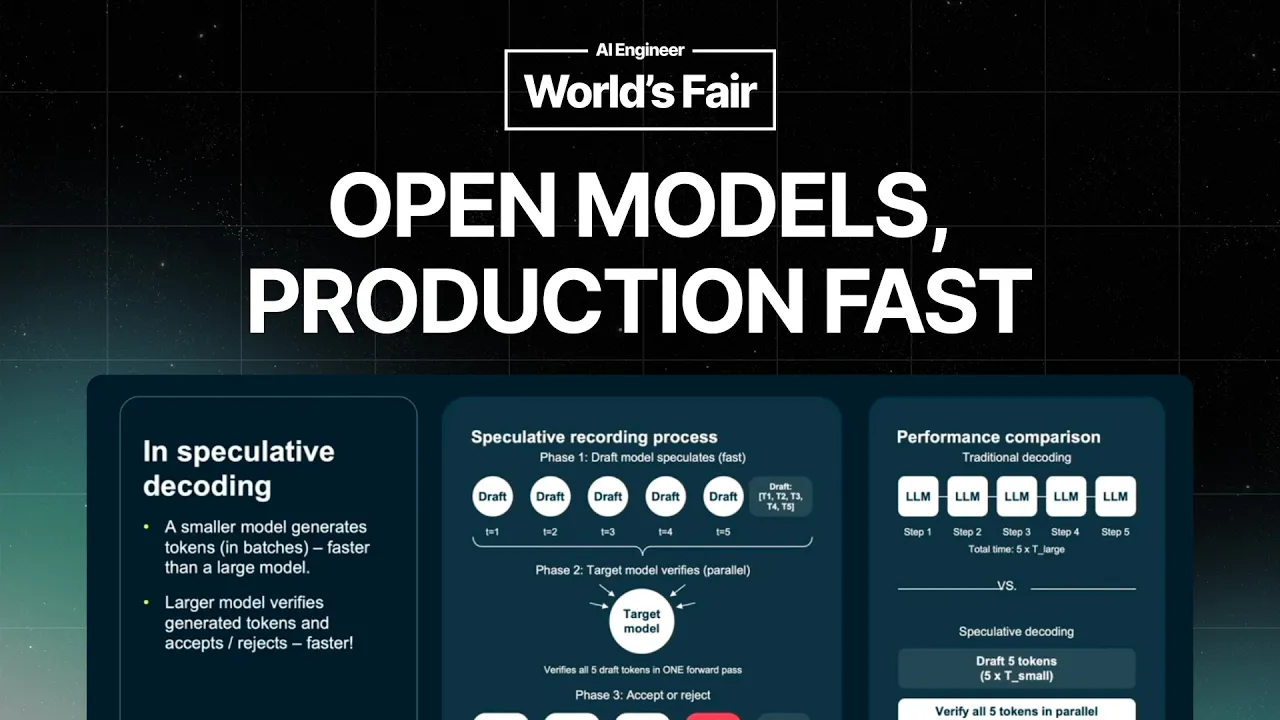
- Claim: Speculative decoding can improve large-model generation by letting a cheaper, faster draft model propose tokens that the target model verifies. | Evidence: Maniyam compares the approach to a junior engineer drafting work for a senior engineer to verify. Nebius says draft models trained on generic synthetic data produced up to 30% improvement in its experiments, with stronger results when the draft model is trained on customer-specific production data. | Implication: Where generation volume is high and a stable task distribution exists, a domain-specific draft model is a credible optimization path; it should be evaluated with end-to-end latency, acceptance rate, target-model quality, and maintenance cost. | Caveat: Speedup depends on how often the target model accepts the draft tokens; when it rejects them, it must regenerate, reducing benefit. The presentation supplies no acceptance-rate, quality, or cost figures.
- Claim: KV caching is presented as one of the highest-return inference optimizations because previously computed token state need not be regenerated. | Evidence: Nebius claims cache reuse can produce 5-10x speedups, not merely 5-10%, and says it automatically offloads cache from scarce GPU memory to regular memory and restores it when needed rather than discarding it. | Implication: Before paying for more model capacity, quantify the proportion of prefill work that is duplicated across agent runs; caching and prompt-prefix design may be a larger lever than switching model providers. | Caveat: The 5-10x claim is not accompanied by workload composition, cache-hit rate, context length, transfer overhead, or percentile latency data. Cache offloading also introduces a memory-tiering and retrieval dependency.
- Claim: Prefill and decoding should be treated as separate infrastructure workloads because prefill is compute-heavy while token decoding is memory-heavy. | Evidence: The talk says that co-locating both phases on the same GPU causes them to compete for resources. Nebius separates GPU pools for prefill and decoding and transfers the KV cache between them. | Implication: For long-context agents, capacity planning should distinguish time-to-first-token from tokens-per-second and avoid relying on a single aggregate latency number. | Caveat: The speaker says the architecture is 'working out pretty well' but provides no comparative utilization, network-transfer, tail-latency, or failure-mode measurements.
- Claim: Quantization is an efficiency-quality optimization problem, not a blanket compression setting: the useful operating point is the lowest precision that does not materially degrade the target workload. | Evidence: Nebius says it uses the NVIDIA FP4 standard on newer hardware and runs experiments to identify a model-specific quantization 'sweet spot' rather than reducing precision indiscriminately. | Implication: Require task-specific quality gates for each quantized deployment, especially for agent tool calls and structured outputs where small accuracy losses can cause disproportionate workflow failure. | Caveat: No specific precision formats, evaluated models, quality deltas, or task thresholds are given, so the result cannot be generalized across reasoning, coding, tool calling, and structured-output tasks.
Detailed Brief
The production loop Nebius says separates products from demos
- Claims: Inference is only the start of operating an open-model product; teams need observability, production-signal capture, model adaptation, and controlled redeployment.; Nebius frames vertical integration—from physical data centers and NVIDIA systems through model-serving software—as the source of its ability to optimize behavior, cost, and reliability together.
- Evidence: Data Lab is described as supporting inference-log imports, completion analysis, SQL-like dataset filtering, dataset versioning, exports, and batching.; Post-training options include LoRA, full fine-tuning, synthetic-data workflows, distillation, custom speculative decoding, on-demand quantization and calibration, and what the speaker calls its own GPO.; The platform supports dedicated endpoints, real-time and batch inference, structured outputs, and function calling.
- Caveats: The presentation does not explain governance controls around the capture and use of customer production logs, including retention, isolation, redaction, consent, or whether data is used solely for that customer's models.; Security, compliance, and enterprise readiness are asserted as platform strengths but are not substantiated with certifications, architecture, regions, SLAs, or incident-handling details.
- Implications: A practical provider diligence process should include data ownership, trace redaction, dataset lineage, rollback controls, endpoint isolation, and reproducibility of post-training artifacts.; Treat deployment as a model-release discipline: version the model, quantization configuration, prompt/tool schema, evaluation set, routing policy, and rollback path together.
What changes with modern long-context and agentic workloads
- Claims: The serving stack designed for short chat prompts is poorly matched to coding and agent workloads with large, variable inputs and outputs.; The API hides important infrastructure decisions—GPU selection, serving engine, cache placement, routing, and model precision—that can create materially different performance for the same model.
- Evidence: Nebius says it maintains internal forks of open-source serving engines and selects the engine that best fits each model rather than assuming all engines perform equally.; The speaker highlights large codebases being sent to coding agents for refactoring, summarization, and analysis as an example of the changing input profile.; Nebius says it has deployed newer NVIDIA systems and adopted FP4, although the talk supplies no measured model-level comparison tied to this hardware.
- Caveats: There are no independently replicated benchmarks, no disclosed test methodology, and no comparison against other providers under identical workloads.; The transcript contains repeated material near the end, likely from transcript duplication, rather than additional technical content.
- Implications: Benchmark providers using representative traces segmented by context length, output length, cacheability, concurrency, and tool-call constraints—not generic tokens-per-second alone.; For agent workloads, track separate service-level objectives for time-to-first-token, completion throughput, cache-hit rate, tool-call correctness, and p95/p99 latency.
Notable Concepts & Terms
- Token Factory: Nebius's managed-inference offering, positioned as an integrated system for serving, production data capture, post-training, and deployment of open models.
- KV cache: Stored attention state for already processed tokens; reusing it avoids repeated prefill computation and is central to performance for shared prompt prefixes and long contexts.
- Cache-aware routing: Sending requests to infrastructure that already holds relevant KV-cache state, rather than balancing traffic blindly across GPUs.
- Speculative decoding: A smaller draft model proposes tokens and a larger target model verifies them, potentially accelerating generation when draft acceptance is high.
- Draft model: The small, fast model used in speculative decoding; Nebius argues that training it on a customer's production distribution can increase speedup.
- Prefill/decode disaggregation: Separating context processing, characterized here as compute-intensive, from token generation, characterized as memory-intensive, into different resource pools.
- Quantization: Reducing numerical precision to improve efficiency; the key operating challenge is preserving task quality while lowering memory and compute demands.
- FP4: NVIDIA's four-bit floating-point format, cited as a newer-hardware optimization that can improve model efficiency when appropriately deployed.
Operator Notes / Why Ken Should Care
- Create a representative inference trace set for agent workloads and benchmark at least two managed/open-model providers plus any internal stack across context length, output length, concurrency, p95/p99 latency, time-to-first-token, cache-hit rate, and cost per successful task.
- Audit prompt architecture for prefix reuse: hold system instructions, tool definitions, policy text, repository context, and recurring workspace context stable and ordered consistently where that does not impair correctness.
- Treat speculative decoding as a candidate for high-volume, narrow-distribution flows; require a controlled experiment with draft acceptance rate, quality parity, end-to-end cost, and tail-latency results before adopting it.
- Add provider diligence questions on tenant cache isolation, cache retention and eviction, cache offload behavior, production-log ownership, redaction, dataset lineage, fine-tune isolation, model-version rollback, and deployment controls.
- Set separate monitoring and SLOs for prefill/time-to-first-token and decode/tokens-per-second; aggregate latency obscures the bottleneck in long-context agent workloads.
- Before using quantized models in automation, maintain task-level regression suites for tool selection, JSON/schema validity, coding correctness, and workflow completion—not just general model benchmarks.
Source/Metadata
- Title: What Makes Open Models Fast in Production — Sujee Maniyam, Nebius
- Transcript words: 4881
- Duration seconds: 1232
- Timestamp note: No usable timestamps or chapter markers were present in the supplied transcript. The latter portion repeats the speculative decoding, KV-cache, prefill/decode, quantization, and closing promotional content.
Transcript
Thank you for joining us today. I'm Dylan. I'm here today with my colleague Suji. I lead the product marketing for Nebius Token Factory, and I'm here with Suji as a developer advocate. And we're going to talk a bit about engineering open NLMs for production. So before we jump right in, I want to give a few words about what we're going to cover today. We only have 20 minutes, so we'll try to keep this brief. We're going to give you a quick intro on who we are and what we do, then talk about what it takes to build the infrastructure for inference, a few words on model shaping optimizations, which are extremely important in what we do, and then we'll talk about model serving optimizations. So we work for Nebius, specifically Nebius Token Factory. Nebius is a full stack AI cloud infrastructure. This means we're not only exposing model APIs, we run the actual physical AI layer and infrastructure underneath it. We have our own data centers, NVIDIA systems, bare metal capacity, managed cloud, and optimizing the serving and the inference through Nebius Token Factory. The top row here is really about scale and trust. We're a publicly traded company on the NASDAQ, headquartered in Amsterdam. We're very close with NVIDIA, who made a 2 billion investment in Nebius a couple months ago. And we're targeting 5 gigawatt of NVIDIA systems by the end of 2030. The bottom row is really more about the control of the stack. This is quite a good edge we have. We operate our own data centers across the EU and the US, bare metal rather than shared cloud. We're a very early adopter of NVIDIA Rubin and Bluefield Storage. And we were amongst the first European clouds to run both Blackwell Ultra, HGX B300, and GB300 in production. We also have strong contracts from Microsoft and Meta agreements that show that the largest AI builders are already building this kind of capacity from us. The last point is quite important. It's really the important bridge to this talk: the vertical integration from silicon to service that we rely on. Today we're talking about Nebius Token Factory. The idea here is to engineer AI for product. We're a managed inference company, meaning we deploy these models and optimize them for our customers. We know a few things today in the market of serving open source LLMs. Usually, most AI teams are stuck between choosing two bad options. Closed APIs are really easy to start with, but you often hit a ceiling really fast. You can't really tune the model to your specific use case. You share the info with everyone else. It operates as a black box, and the costs grow in a straight line with no way to really optimize things. The other option here is self-hosting. Obviously, it's quite fun. It gives you full control on the model, but it's a massive engineering project. You really need a dedicated team to actually keep it running. And you're usually a month away from production before you even start your actual product. Token Factory is kind of the third path we identified. You get the control and the performance of self-hosting with the simplicity of a managed inference service. We do the heavy lifting and the hard infrastructure work, and then customers move forward focused on their product. This really unlocks three main things: performance, cost, and behavior of the models. The gap between proprietary and open source models has been closing a lot. This is where we operate, and we feel comfortable operating. It's not only relying on the fact that this gap is closing down, but also figuring out how you actually make it work in your own production use cases. This is really the core of Token Factory. We've built a full-stack AI platform. Most platforms we've seen on the market either give you inference, training, data tooling. But we decided to connect everything under one loop. We have a bunch of tools to it that unlock this. On the inference side, we allow you to run models in production. We have 60 plus models on the platform: Jamba, Kimi, DeepSeek, Qwen, you name them. We have dedicated endpoints. We have different flavors on the models depending on if you want to run them fast. We have different tooling like structured outputs, function calling, and batch API. The second layer here is the data lab. This allows you to capture and structure the production logs. We see a lot of customers running these models in production, importing the completions, and wanting a way to slice and dice through these completions. We allow inference log imports, SQL-like data set filtering, data set versioning, exporting, and then batching these. The third layer is post training. We allow you to fine tune, distill, optimize these models. This is a natural follow up with the data lab. Once you have your logs and your inference and you can generate synthetic data sets, you can bring them all to post training and use that to either through LoRA or full fine tuning, make the models much more adapt to the behavior you're expecting from them. We also allow model distillation. We do custom speculative decoding for customers who need really advanced custom speculative decoding tooling. We do on-demand, specific quantization and calibration of the model depending on your preferences. And we do our own GPO. The fourth layer here is deployment. Once you run these models, once you train these models, you need a way to deploy them. This allows us to push the models into production on our own owned infrastructure. For most teams, this is a choice of different tools that you stitch together. But that creates a lot of friction and need for iteration. It slows the ability to iterate here. We allow the data flow from the inference to the training and the training flows directly into production. That allows you to keep a virtuous loop of your product. That's really what I think is the main difference between running a model and running an actual production AI system. Here is a little slide about what we handle so you don't have to. Running models in production is actually quite complicated. It takes a lot of work. We approach the value here in three main layers. The first one is optimization. We actively tune how models run so customers get much better speed and lower costs without having to figure out all of that themselves. We really do the heavy lifting around the model deployment and optimization. We do allow you to come in and just play with them. This is all around optimizing latency, throughput, and cost at the actual engine level. You could be running the same open source model on different providers and have completely different results in terms of costs. But there's a lot of technical stuff that goes on under the hood to make this work. Suji will cover that in a few minutes. The second layer is infrastructure. The fact that we actually own the hardware, we keep it running, we own this vertical stack, gives us an edge that most providers don't have. It's the control. We really control what the model does. We handle everything underneath. We just give customers full control of the behavior and we take care of the infrastructure. The third layer is enterprise readiness. I think this is really important here because running open source seems obvious. But you need a bunch of ways to secure it, make sure it works in a secure environment. There's a bunch of things here: security, compliance, reliability. They're all requirements that all these large companies usually have. They need those before they can ship anything into production. A lot of AI providers make you figure out all of these yourself. Our mission here is to really handle all of these so you don't have to. Something that comes up a lot with AI teams is that they start with inference. They just get a model up and running. Then they realize pretty quickly that running it is not just as easy as it seems. It's only the beginning of your path to running open source models at scale. They really need to understand how it's actually performing in the real world. They want to improve it over time. They need to redeploy updates without breaking things. That full cycle from running to observing to capturing and to redeploying the model is really what separates teams that ship great AI products from teams that ship demos. I think that's really important here, especially when talking about open source. Token Factory covers that full loop: inference to run the models. So as I said, Kimi, DeepSeek, all the main ones through real time inference or batch inference, through structured outputs and function calling, and on dedicated endpoints when necessary. They just get a model up and running. And then they realize that pretty quickly that running it is not just as easy as it seems. And it's only the beginning of your path to running open source models at scale. So they really need to understand how it's actually performing in the real world. And this is where we come in. They want to improve it over time. They need to redeploy updates without breaking things. And that full cycle from running to observing to capturing and to redeploying the model is really what separates teams that ship great AI products from teams that ship demos. And I think that's really important here, especially when talking about open source. And so Token Factory covers that full loop inference to run the models. So as I said, Claude, DeepSeek, all the main ones through real time inference or batch inference, through structured outputs and function calling, and on dedicated endpoints when it's necessary. And then moving on to the data lab to collect and analyze the real world signal, the completions, moving over to post training to improve and customize the model. And finally moving to the last step, and probably the most important one, which is the deployment, to push updates with full control over the model. And you actually really, it's really important for most of our customers to know where, how it's running, and what ships it's running on, the level of quantization and all that stuff. And that's really where we operate and are comfortable. Most teams today have to stitch different tools together to get this. And we actually built one platform that tries and covers it end to end. So we really see this as a continuous improvement loop. Every cycle makes your AI more specific, way faster, and much cheaper. And now we'll dive into scaling open models to production. And I'll invite Suji on stage to take it over. Suji Srinivasan, Ph.D.: All right. Thank you, Dylan. All right, everyone. So I'll zip through a few of these, but I'm happy to have a discussion afterwards. So come and find us if you have any questions. So we believe great inference starts with great models, but that's not enough. You need great infrastructure behind the scenes to get the best performance. And I believe that's what Nebius Token Factory provides. I get asked a lot, so this is great. You guys host open models. But how good are the open models really? And I'd like to show you this benchmark here. This is from Artificial Analysis. The black ones are proprietary models, and the blue ones are open models. And the cool thing you can see here is how the open models are actually very competitive, sometimes even better than a lot of the proprietary models. So the gap between proprietary and open models is very narrow. So we don't really have to chase proprietary models all the time for the intelligence. You can just as well choose an open model that's just as smart and also ends up being much cheaper in most cases, which is pretty cool. So what does it mean for customers? You get choice, right? You can run these open models in any provider, hopefully Token Factory. But so there's no vendor lock-in, and also you end up saving a lot of money on tokenomics. And here's a few examples of models we host. The top table is like the large models. We call them sort of the teacher models, right? They are very capable, very smart, but also kind of large. You can also use the large teacher models to train the smaller student models. So you sort of see both large models and small models posted. So I want to sort of structure the talk a little bit, sort of from the hardware layer, the serving layer, and the optimizing layer. So Dylan talked a little bit about hardware. We work very closely with NVIDIA. We get the latest GPUs. And not just the latest, we also optimize kernels and runtimes. So the models run really, really well. For example, something like the NVIDIA floating point four standard, we embraced it. It gives us really good model performance on latest NVIDIA chips. And if you think about model serving, that kind of takes us to the middle layer. And there are a few optimizations I will talk about, starting with the engines. Because you need an engine to serve the model. We utilize a lot of the open source engines. We have our own internal fork that we continuously tweak and optimize. And we will deploy the model on the best engine possible. You know, not all the models run equally well on all the engines. So we figured out which engines run well and will deploy the models accordingly. So as a customer, you can just use an API, not having to worry about which kind of GPU, which engine, because we take care of all that work behind the scenes. And when you have hundreds of thousands of GPUs running models, load balancing and routing becomes an issue. So a lot of the time people say, well, that's easy, right? We just put a load balancer in front, send traffic randomly to different GPUs. That's not how it works in LLMs, because the workloads are slightly different. For example, just to give you an idea, in the early days of LLMs, the inputs are small. I could just say, right, like a one-liner. And the output is all small. But now we are seeing your input could be pretty large. Like we are sending large code bases using coding agents to do refactor or summarize or analyze, right? So the output, as you can see, can vary from large to small, large to large. And routing them accordingly will give you, you know, it's not trivial. So what we employ is we employ routers that actually are cache aware. What I mean by that is like, if you look at the left side here, you will see that my cache, like different colors, it's kind of fragmented all over. So our cache rate isn't all that great because my request is landing randomly at different GPUs that may or may not have the cache. But if you look at the one on the right, you can see that now the cache is much more coherent. See the colors are kind of together. And the router knows where the caches are stored and it will route them accordingly. So when you actually do the inference, you get pretty good cache rate and very good speed. Another thing, and this is something we are really excited about, it's called speculative decoding. So the challenge is LLMs, they generate tokens one by one, one, two, three, four, right? And large models take a long time to generate these tokens. So the idea for speculative decoding is how about we employ a smaller model, which is a lot of the time faster and cheaper to generate the tokens, but then have the large model verify at the end. So it's kind of like if you're a senior engineer, you're kind of farming out the work to a junior engineer, so they're kind of doing the heavy lifting and then you are verifying the work. And this actually surprisingly scales really well. So the smaller models can generate tokens very quickly and the large model can verify. And if it's good, we are done. If the large model doesn't like the answer, it will actually regenerate the tokens. So that's kind of the worst case scenario. But most of the time, you will get pretty good performance out of this by mixing in small models and large models. And this is actually a feature we actually baked into Token Factory that gives you pretty good optimization speed. So one of the things we experimented, we sort of trained draft models. You can train them using synthetic data. Even if you train them using generic data, you get, you know, we are seeing up to 30% improvement. But it gets even better if you can train the smaller model using your own data. Right? So we did a lot of experiments here. And we are launching a feature. You can actually train these draft models almost with one click. And, you know, we will capture your production data and train the draft models for you, which is pretty cool. Another optimization behind the scenes is KV cache. This is probably one of the biggest ROI in doing inference because creating tokens is expensive, especially when you are doing one at a time. And the common sense is once you generate a token, it doesn't change. So there's no need to keep regenerating the same token over and over again. So the idea is we cache the tokens. So just to kind of give an example here, let's say this is my prompt the cat sat on. Right? Let's say those are my prompt and I'm creating the next word. And as soon as we create the next token, we cache it. And the next time we need to look up, we don't have to regenerate it. We just look up the cache. Very easy. And this actually speeds up quite a bit. So just to kind of give you some ideas, we are seeing speedups anywhere from 5 to 10x, not just 5 to 10%, actually 10x, right? Because caching really works well. The thing about caching is it takes a lot of memory, right? Because, you know, especially with our large inputs and large token windows. And one thing we've been implementing in Token Factory is when we do caching, we can actually, because GPU memory is very precious, So the idea is we patch the tokens. So just to give an example here, let's say this is my prompt: the cat sat on. Right? Let's say those are my prompt and I'm creating the next word. And as soon as we create the next token, we cache it. And the next time we need to look up, we don't have to regenerate it. We just look up the cache. Very easy. And this actually speeds up quite a bit. So just to give you some ideas, we are seeing speedups anywhere from 5 to 10x, not just 5 to 10%, actually 10x, right? Because caching really works well. The thing about caching is it takes a lot of memory, right? Because especially with our large inputs and large token windows. And one thing we've been implementing in Token Factory is when we do caching, we can actually, because GPU memory is very precious, so we can offload caching out of GPU memory automatically, save it in regular memory, and then bring it back. So we don't throw away the cache we spend a lot of time building. We actually offload it and bring it back. And all of this is done automatically. So you don't have to worry about managing cache. This is done for you behind the scenes. So this is one of the important optimizations we have done to speed up inference. Another one is called decoding. So the way you think about this is there are two stages to LLMs. One of them is filling the context that is very CPU intensive. And then another one is actually decoding that is very memory intensive. And a lot of the time if you do them in the same GPU, they are competing for resources. So what we have done is separate those two phases out. So one GPU set does pre-fill. They are very compute efficient. And the other one does decoding that's very memory efficient. And then they transfer the KV cache in between. And we have seen this is actually working out pretty well. And another thing we do, and this is already baked into our platform, we also quantize the models. And when we do quantizing, we are reducing the precision. But we don't want to go too far, right? Because then your model starts degrading in quality. So what we do is we do a lot of experiments to figure out what's the sweet spot of quantization. So you can run the models efficiently, but not degrade the performance too much. So all of these things are already built in. And there's a few more, and in the interest of time, I'll wrap this up here. And these are some of the things we covered. Spec decoding, KV cache, and when you do caching, doing routing that is actually cache aware. And also pre-fill, separating pre-fill and decoding phases. And if you're using an API, you might not realize all these blocks going behind the scenes, but they are, right? And this is what makes an inference platform really great, especially for the large models we are seeing, like the one trillion models we are seeing. And finally, I want to quickly give this out. So probably this is the most important slide of the presentation. So we can take a quick picture or scan the code. This will give you some credit on Token Factory platform. So we allow for you guys to try it out. We have all the latest open source models, GLM-52, K-27. Try them out. I've been using them a lot for coding lately, and they work really well. So if you're using Cursor or Open Code, you can very easily incorporate our models for coding work. Try them out. Let us know. And there's a Discord channel at the bottom. If you have any questions, you can post them there. Or you can message me or Dylan. We will be happy to answer your questions. So I'll stop here. We are like 10 seconds. So all right, on time. But we'll be around. Please come and talk to us if you have any questions. We'll be happy to chat more and then take your questions. Thank you all. And if it's good, we are done. If the large model doesn't like the answer, it will actually regenerate the tokens. So that's kind of the worst case scenario. But most of the time, you will get pretty good performance out of this by mixing in small models and large models. And this is actually a feature we actually baked into TokenFactory that gives you pretty good optimization speed. So one of the things we experimented, we sort of trained rough models. You can train them using synthetic data. Even if you train them using like generic data, you get like, you know, we are seeing like up to 30% improvement. But it gets even better if you can train the smaller model using your own data. Right? So we did a lot of experiments here. And we are launching a feature. You can actually train these draft models almost like with one click. And, you know, we will capture your production data and train the draft models for you, which is pretty cool. Another optimization behind the scenes is KVCache. This is probably one of the biggest ROI in doing inference because creating tokens is expensive, especially when you are doing one at a time. And the common sense is once you generate a token, it doesn't change. So there's no need to keep regenerating the same token over and over again. So the idea is we patch the tokens. So just to kind of give an example here, let's say this is my prompt the cat sat on. Right? Let's say those are my prompt and I'm creating the next word. And as soon as we create the next token, we cache it. And the next time we need to look up, we don't have to regenerate it. We just look up the cache. Very easy. And this actually speeds up quite a bit. So just to kind of give you some ideas, we are seeing speedups anywhere from 5 to 10x, not just 5 to 10% actually 10x, right? Because caching really works well. The thing about caching is it takes a lot of memory, right? Because, you know, especially with our large inputs and large token windows. And one thing we've been implementing in Token Factory is when we do caching, we can actually, because GPU memory is very precious, so we can offload caching out of GPU memory automatically, save it in a regular memory, and then bring it back. So we don't like throw away the cache we spend a lot of time building. We actually offload it and bring it back. And all of this is done automatically. So you don't have to worry about managing cache. This is done for you behind the scenes. So, and this is one of the important optimizations we have done to speed up inference. Another one is called decoding. So the way you think about this is like there are two stages to LLMs. So one of them is like sort of filling the context that is very CPU intensive. And then another one is actually decoding that is very memory intensive. And a lot of the time if you do them in the same GPU, they are kind of computing for resources. So what we have done, we sort of separate those two phases out. So one GPU set does pre-fill. They are very, you know, compute efficient. And the other one does decoding that's very memory efficient. And then they sort of transfer the KV cache in between. And we have seen this is actually working out pretty well. And another thing we do, and this is already baked into our platform, we also quantize the models. And then we do quantizing, you know, we are reducing the precision. But we don't want to go too far, right? Because then your model starts, you know, quality starts getting degrading. So what we do is we do a lot of experiments to figure out like what's the kind of the sweet spot of quantization. So you can run the models efficiently, but not degrade the performance too much. So all of these things are already built in. And there's a few more, and in the interest of time, I'll sort of wrap this up here. And these are some of the things we kind of covered. Spec decoding, KV cache, and when you do caching, doing routing that is actually cache aware. And also pre-fill, you know, separating pre-fill and decoding phases. And if you're using an API, you might not realize all these blocks going behind the scene, but they are, right? And this is what makes an inference platform really great, especially the large models we are seeing, like the one trillion models we are seeing. And finally, I want to quickly give this out. So probably this is the most important slide of the presentation. So we can take a quick picture or scan the code. This will give you some credit on Token Factory platform. So we allow for you guys to try it out. We have all the latest open source models, GLM-52, K-27. Try them out. I've been using them a lot, a lot for coding lately, and they work really, really well. So if you're using a cursor or open code, you can very easily incorporate our models for coding work. Try them out. Let us know. And there's a Discord channel at the bottom. If you have any questions, you can post them there. Or you can, you know, message me or Dylan. We will be happy to answer your questions. So I'll stop here. We are like 10 seconds. So, all right, on time. But we'll be around. Please come and talk to us if you have any questions. We'll be happy to chat more and then take your questions. Thank you all. Nate Nate Nate Nate Nate Nate Nate Nate Nate Nate Nate Nate Nate Nate Nate Nate