Most of Your Docs Readers Are Now AI Agents - Hahnbee Lee, Mintlify & Lincoln Murr, Coinbase
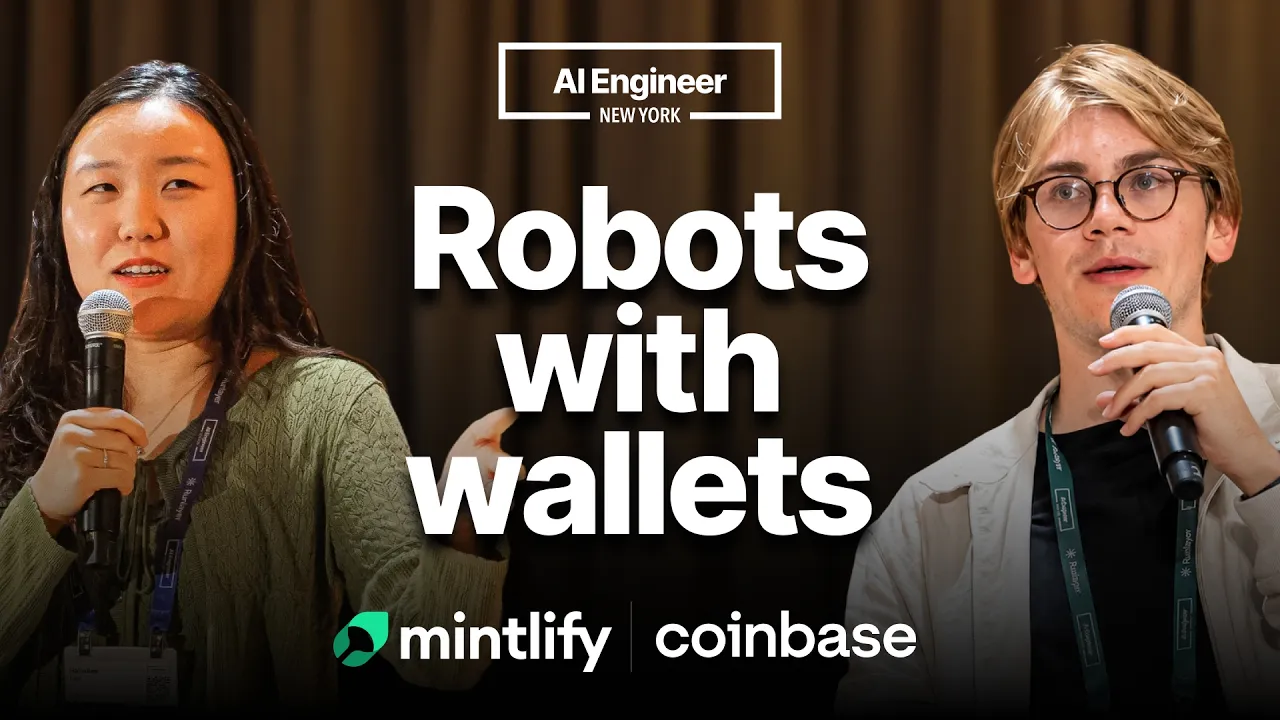
Description
In this fireside chat, Mintlify co-founder and CTO Hahnbee Lee and Coinbase head of AI product Lincoln Murr discuss what changes when agents, not people, are the main users of your product. Lee shares that agent traffic on Mintlify docs sites grew from about 10% to about 80% this year, why page size and accuracy now matter more than design, and where AI writing fits. Murr explains why Coinbase is making its whole business available through APIs, how the x402 payment standard has seen around 100 million on-chain agent transactions, and why giving agents money makes them more autonomous. Chapters: 0:00 Intro 1:09 When agents are the main users 3:18 Agents that can pay 5:32 Why crypto for agent payments 6:32 100 million agent transactions 8:46 API vs. MCP vs. CLI 9:24 Where agentic payments are headed 11:27 APIs over front ends 12:24 Agent traffic: 10% to 80% 13:48 Human vs. AI writing 16:41 The biggest pitfall: build vs. buy Hahnbee Lee https://mintlify.com Lincoln Murr https://www.coinbase.com Join us in SF for the second annual AIE CODE summit: https://aie.codes our last flagship summit of 2026. Applications live now!
Summary
Generated by gpt-5.6-terraAt-a-Glance
- Verdict: Watch fully
- Core thesis: As AI agents become a dominant consumer of documentation and online services, companies must treat clean, current APIs, agent-readable docs, scoped authentication, and machine-native payments as core product surfaces rather than secondary integrations.
- Why it matters: The conversation offers a practical architecture thesis for agent-facing products: APIs are the durable primitive; MCPs, CLIs, documentation, payments, and permission systems are delivery and control layers around them.
- Best use: Use this as a strategic framing session for designing OpenClaw-compatible services, agent documentation, tool interfaces, and financial-authority guardrails—not as a technical implementation tutorial.
Executive Summary
Mintlify CTO Hahnbee Lee and Coinbase Head of AI Product Lincoln Murr argue that agents are rapidly becoming a primary audience for software documentation and internet services. Lee says the design-led web still matters to humans, but agents principally reward concise, accurate, accessible content: oversized pages consume context, stale instructions create execution failures, and an agent that encounters friction may abandon a product rather than patiently debug it.
Their shared prescription is API-first product design. Murr sees APIs as the stable underlying capability layer, with MCP providing natural-language context and CLI providing terminal-oriented access. Browser automation can expose existing functionality to agents, but it is a poor default for sensitive operations because it creates authentication, security, and permission-management problems.
Murr's broader Coinbase thesis is that agent autonomy rises with financial autonomy. Stablecoin rails and Coinbase's HTTP 402 payment standard could let an agent pay per use for APIs, paywalled information, or services rather than forcing a human to establish, fund, and credential a separate account for every vendor. He says Coinbase has observed roughly 100 million on-chain agent transactions over the prior year, primarily API interactions, although the discussion does not independently substantiate that figure.
Lee frames documentation as an operational system rather than static prose. Mintlify reportedly saw agent traffic across its documentation sites rise from about 10% of views at the start of the year to nearly 80%, while human traffic did not decline. She believes technical-document maintenance—collecting changes from PRs, Slack, and decisions, determining where to update the corpus, and inserting updates—can be heavily automated, while narrative and creative communication still benefits from human authorship and direct user research.
Key Takeaways
- Claim: Agent-facing documentation should prioritize accuracy, freshness, compactness, and executable accessibility over visual presentation alone. | Evidence: Lee says agents do not care about site branding or design; large pages consume context-window budget, and inaccurate setup instructions can cause an agent to stop, brute-force unsuccessfully, or switch to another product. | Implication: Treat documentation as part of the agent execution path: reduce ambiguity and unnecessary context, make workflows directly actionable, and install mechanisms that prevent docs from drifting behind product behavior. | Caveat: This does not mean human-facing design is irrelevant; Lee describes Mintlify as still design-led, but argues the agent audience changes what documentation must optimize for.
- Claim: The durable architecture for agent access is API-first, with MCP and CLI as complementary interfaces rather than substitutes for underlying APIs. | Evidence: Murr calls APIs 'the name of the game,' describing MCP as a layer for additional context and nuance in natural-language interactions and CLI as a terminal-dependent interface; Lee agrees companies should expose all relevant functionality through APIs. | Implication: Build stable, safely scoped APIs first, then expose them through MCP servers, CLI workflows, and agent-friendly documentation as appropriate; avoid coupling core capability to a single current agent protocol. | Caveat: Both speakers acknowledge that standards and tool conventions are still evolving, so the exact wrappers may change.
- Claim: Browser-driven agents are insufficient for high-value workflows because financial and account operations require explicit authorization boundaries. | Evidence: Murr says browser use can make human functionality accessible to agents, but is not ideal for finance because agents should not receive unfettered account access; they need guardrails and limits. | Implication: For agent systems that can act on accounts, money, or production resources, design least-privilege scopes, spend/operation limits, and explicit delegation rather than handing agents persistent human credentials. | Caveat: The speakers do not specify a concrete authorization standard, policy engine, or approval workflow for implementing these limits.
- Claim: Per-use agent payments can remove a major onboarding bottleneck by allowing agents to purchase capabilities without creating a funded account and API key for every service. | Evidence: Murr compares current API onboarding to needing a store-specific gift card and loyalty account before every purchase. He says agents with wallets can make one-off payments for APIs, such as paying $0.25 for image generation, and cites about 100 million on-chain agent transactions in the past year, primarily API interactions. | Implication: Monitor pay-per-call and machine-to-machine payment infrastructure as a potential alternative to subscriptions, keys, and manual vendor provisioning—especially for long-running research or tool-using agents. | Caveat: The reported transaction volume and adoption trajectory are Coinbase's claims in a promotional fireside chat; no methodology, breakdown, or evidence of broad enterprise adoption is provided.
- Claim: Agent traffic is becoming materially larger than human documentation traffic, making machine consumption a first-class documentation metric. | Evidence: Lee reports that agent viewership across Mintlify sites rose from roughly 10% at the beginning of the year to nearly 80%, with human viewership not falling but agent traffic growing much faster. | Implication: Instrument agent access separately from human pageviews and pair it with outcome metrics—successful tool calls, setup completion, error rates, and abandonment—to distinguish valuable agent usage from undifferentiated crawl volume. | Caveat: The transcript does not define how Mintlify identifies agents, whether crawlers are included, or whether this traffic represents successful task completion rather than ingestion or crawling.
- Claim: Technical documentation maintenance is a strong automation target, but product insight and narrative communication should remain human-grounded. | Evidence: Lee identifies the mechanical work of locating related PRs, Slack discussions, decisions, and insertion points across a documentation corpus as automatable. She contrasts this with creative prose and warns that relying on agents for product insight can lead to hallucinations and wrong prioritization. | Implication: Automate evidence gathering, change detection, draft generation, and content-placement suggestions, while retaining human ownership for factual approval, user research, product judgment, and high-stakes narrative. | Caveat: Automating documentation updates still depends on trustworthy source material and review controls; the speakers do not claim that generated technical content should be published without validation.
- Claim: The most common organizational failure is building an agent-facing tool or documentation system during a hackathon without owning the ongoing maintenance burden. | Evidence: Lee frames the build-versus-buy question as a decision to either maintain a non-core capability internally or delegate it to a specialist team; she notes enterprise teams often have internally built projects that nobody wants to maintain as standards and agent crawling behavior shift. | Implication: Evaluate agent infrastructure by lifecycle cost—standards tracking, security changes, docs freshness, observability, and support—not just initial build speed; retain internally only where it is strategically differentiating. | Caveat: This is a vendor-aligned argument from Mintlify, so it should not be read as evidence that outsourcing is always preferable.
Detailed Brief
Coinbase's strategic framing: an agent transition analogous to web-to-mobile
- Claims: Murr views the convergence of AI agents and stablecoin payment rails as a technological inflection point comparable to mobile phones arriving alongside 4G LTE.; Coinbase is pursuing both an offensive strategy—products designed specifically for agents—and a defensive strategy—making its existing trading and money-management business accessible to agents before another company intermediates that relationship.; His long-term vision resembles the original idea behind DAOs: automation at the core, with humans handling edge cases rather than operating the bureaucracy.
- Evidence: He describes HTTP 402 as an internet-native payment standard that Coinbase has moved into a separate foundation co-governed with organizations including Cloudflare, Stripe, Amex, MasterCard, and Visa.; He gives examples of agents paying for paywalled research, hiring a lawyer or accountant through marketplace-like services, and running longer-duration tasks overnight.
- Caveats: The examples are forward-looking scenarios, not evidence that fully autonomous company formation or broadly trusted financial-agent operation is currently reliable.; The discussion does not address regulatory, liability, fraud, identity, dispute-resolution, or consumer-protection requirements that become central when agents transact autonomously.
- Implications: The near-term value of agent payments may be less about replacing conventional commerce and more about eliminating friction in fragmented, low-ticket, programmatic service procurement.; Any agent commerce thesis should be assessed alongside control-plane capabilities: identity, delegated authority, auditability, revocation, budget enforcement, and recovery from bad actions.
Documentation governance for an agent-consumed web
- Claims: Lee suggests agents have effectively larger usable context and more time than people to ingest documentation, which helps explain the sharp increase in machine readership.; The split between human-written and AI-generated material should follow document purpose rather than a blanket rule: technical synthesis can be automated while high-context communication may need authorship and judgment.
- Evidence: Lee describes engineers increasingly using coding agents for code while still writing interpersonal or narrative documents manually.; She says organizations need automation specifically because product development is speeding up and the rest of the company must avoid stale operational artifacts.
- Caveats: More agent documentation traffic is not inherently positive if robots receive stale, contradictory, or poorly scoped instructions at scale.; The speakers offer no concrete documentation schema, crawler policy, or evaluation framework for measuring whether a document is agent-readable.
- Implications: A documentation program for agents should be connected to the engineering change stream rather than relying on periodic manual updates.; Documentation quality assurance should test real agent task execution, not merely readability, search ranking, or page-view counts.
Notable Concepts & Terms
- Agent-readable documentation: Documentation optimized for machine execution: current, concise, unambiguous, and connected to accessible tool interfaces rather than only visually polished for human readers.
- API-first: The speakers' foundational design principle: expose product capabilities through stable programmatic interfaces, then layer MCP, CLI, browser, or human UI experiences on top.
- MCP: Presented as a wrapper/interface that adds contextual nuance for natural-language agent interactions; valuable but not a replacement for the underlying API capability.
- CLI: A terminal-oriented agent interface; agents are described as especially capable with Bash and command-line workflows, though a CLI presumes terminal access.
- HTTP 402: Coinbase's cited internet-native payment standard intended to enable machine-to-machine, per-use payment for APIs and digital services.
- Agentic payments: Agents making authorized purchases directly—particularly small, one-off API or information purchases—rather than waiting for a human to create accounts and manage vendor-specific credentials.
- Scoped delegation: The implied requirement to give an agent only bounded authority, particularly for financial or account actions, rather than unrestricted access to a user's account.
- DAO: Decentralized autonomous organization; Murr uses its unrealized original aspiration—automation at the core and humans at the edges—as a model for future agent-run operations.
Operator Notes / Why Ken Should Care
- Audit OpenClaw-facing documentation for agent execution failure points: stale examples, missing prerequisites, oversized pages, ambiguous authentication steps, and implicit human-only UI actions.
- Define a canonical capability layer for each important service API, then decide deliberately which functions merit MCP tools, CLI commands, browser fallback, or direct human UI.
- Require delegated credentials for autonomous actions: narrow scopes, time limits, spend ceilings, approval thresholds, full logs, revocation, and an operator recovery path.
- Add telemetry that differentiates agent crawls from successful agent workflows; track task completion, tool-call errors, retries, fallback-to-human events, and doc-driven abandonment.
- Prototype automated doc-change detection from PRs, tickets, decisions, and Slack, but maintain named human owners and a release gate for factual correctness.
- Evaluate machine-payment rails only where one-off service acquisition materially reduces friction; do not adopt them without explicit treatment of identity, settlement, fraud, compliance, and dispute handling.
- Avoid maintaining internally built agent-doc or tool wrappers merely because they were quick to prototype; make an explicit ownership decision based on ongoing standards and security maintenance.
Source/Metadata
- Title: Most of Your Docs Readers Are Now AI Agents - Hahnbee Lee, Mintlify & Lincoln Murr, Coinbase
- Transcript words: 6935
- Duration seconds: 1132
- Timestamp note: No timestamps or chapters were present. The transcript contains a substantial duplicated replay of the fireside-chat content near the end.
Transcript
Hi, nice to meet you all. Appreciate you guys all coming. Hope everyone is having a good start to their day. Nice to meet you. I'm Hanbi. I'm a co-founder and CTO at Mitlefy. Mitlefy is a Series B company based in San Francisco and we power developer documentation for companies like Coinbase. Would you like to give an intro? Yeah, sure. Hey everyone. My name is Lincoln. I'm the head of AI product at Coinbase, which you might know as a crypto company, but is widely expanding into all sorts of assets and payments as well. And there's also an agentic angle, which we'll be talking about here shortly. Yeah. Do you want to go and ask the first question? Yeah, sure. So the format was just a fireside chat back and forth, talk a little bit about how we view the world today, how our respective companies are building for this agentic future and where we think things will go. So Hanbi, can you kick us off with a question here? Yeah. So how do we think about agents becoming the primary actor on the internet and the primary thing that people are using as part of their internet experience? I can tell an agent to go set up Coinbase for agents and it's going to find our docs and do it all entirely for me. How does this change what's important when you're thinking about how you're building docs? Yeah, of course. So Mitlefy was founded in 2022, pre-ChatGPT, GPT-3 specifically. I would say that previously there was much more of an emphasis on design and front end, which I personally love design and we are definitely a design-led company still. It makes me sad, I'm not going to lie. The fact that agents do not see your website and they do not care what it looks like or what the branding of it is. And so what ends up mattering a lot more is things like page size. Is it taking up a bunch of the context window? Content being accurate because an agent can read your docs and set it up. And then if it runs into friction, it's just going to stop. It's not going to debug it. It might try to brute force it, but then it can just as easily churn to another product. And so I do think coding agents have made the world move so much faster. It's important that engineering or product development specifically is seeing so many productivity gains and the rest of the org kind of needs to catch up. And I think the only way in order for us to all move at the speed that the productivity gains that engineering is seeing is to kind of use AI to kind of keep up. And that means setting up automations in order to ensure that things do not go stale is very, very important. And I'm curious for yourself. So now that agents are making transactions on the internet, how does that change how Coinbase thinks about transactions in general? Yeah. The intersection of AI agents and stablecoins as a payment rail have sort of happened at the same time. And traditionally you see two inflection points come together in previous eras of technology, like for example, mobile phones at the same time that you have 4G LTE. And this opens up a lot of new opportunities, but it also opens up an opportunity for us to be disintermediated or disrupted by a new nascent startup or company. So there's really two ways that we think about it. One is what are these innovative products that we can build and use and market specifically toward agents and build for agents so that they have an experience that is otherwise completely not possible in the previous era of the internet, but then also what are the core parts of Coinbase's business that we need to make accessible to agents such that people continue using Coinbase for our bread and butter use case of trading and money management and whatnot. And the way that I view those two things is around how we make our entire business accessible via APIs. So how can we take all of the functionality that's available to humans and translate that into a world where agents can interact with it? And though that's possible with browser use, it's not exactly the most ideal situation. There's a lot of authentication and security concerns, especially when you're dealing with finances. You don't want to give your agent unfettered access to your account. You want the right guardrails, limitations, all of that in place. So to build this defensive hedge for our company and allow us to survive and thrive in the AI era, we are taking this—it's sort of analogous to web shifting to mobile, but now mobile shifting to agents and making everything that was accessible for mobile users inside their phone a decade ago, when people were saying "I would never bank on my phone, that sounds crazy." Now everyone does it more than they do even on their web browser. Doing that same thing, but now making it available to agents, adding in all the safety nuances that you would need such that today you may say "why would I ever give an AI access to my account to manage money?" And ten years from now, you wouldn't even be looking at your account at all. It'd just be happening through your agent. I'm curious, is there a specific advantage of crypto being the solution for this? I think on the payment side, absolutely. So a lot of what we've seen with early traction around HTTP 402, which is our internet native payment standard that we have now externalized into its own separate foundation. That's co-governed by Cloudflare, Stripe, Amex, MasterCard, Visa, and so on. The crypto angle, I think is primarily around the ability for digital dollars to be sent cheap, fast, permissionlessly anywhere in the world. So anyone who's running a business and wants their AI agent to accept a transaction can do so. And though we've seen this a lot with existing sort of card-based or Stripe link style solutions, one of the areas where I think crypto has a particular role to play is around microtransactions and the ability for an agent to spend one thousandth of a cent or even one millionth of a cent to access an API or a service or even a paywalled website very, very seamlessly and trivially. And I'm curious, is that future already here? Like, are we already seeing agents making transactions via crypto? Yeah, absolutely. We're seeing a pretty exponential increase in the amount of transactions that are being made. In the past year, we've seen around a hundred million agent transactions actually all happening on chain, all publicly available for anyone to audit. All of those are primarily for this use case of interacting with APIs. So in this previous version of the world, you would have to go to whatever website you wanted to interact with the service. You'd have to fund that account. You'd have to get an API key and then hand that to your agent. Only then can you really start to interact with things. But now we're seeing a world where if you just give an agent a wallet or some sort of financial account, it can go off and pay on a one-off basis for different APIs. And that's been a really resonant use case with this core audience of early adopters of agentic payments. So you're talking about people connecting to your wallet via API or the agent purchasing APIs or... Yeah, it's the agent purchasing APIs. Oh, okay. So the analogy I like to use is if every time you went to a grocery store, you had to walk in, you had to buy a gift card for that specific grocery store, you had to sign up for their loyalty account and only then you can start paying for stuff. And that's how it feels whenever you go to a website. You have to get API keys. You have to fund that account specifically and only then your agent could start interacting. But as we give these agents more financial independence and autonomy, they're able to do things without having to go through this arduous human blocking process. And in the same way that I can only do so much on the internet without having access to money, agents are very much the same way. Giving them access to money is how you increase their autonomy. Oh, okay. So the analogy I like to use is it'd be like if every time you went to a grocery store, you had to walk in, you had to buy a gift card for that specific grocery store, you had to sign up for their loyalty account and only then you could start paying for stuff. And that's how it feels whenever you go to a website, you have to get API keys. You have to fund that account specifically and only then your agent could start interacting. But as we give these agents more financial independence and autonomy, they're able to do things without having to go through this arduous human blocking process. And in the same way that I can only do so much on the internet without having access to money, agents are very much the same way. Giving them access to money is how you increase their autonomy and ultimately get to the point where they can go do things. If you just tell your cloud agent, I want to go generate an image, it should be able to do that. Even if it doesn't have a connection to that today, it should just pay for that service, pay the 25 cents or whatever it might be. So Coinbase is doubling down on APIs in general, would you say to make it more agent friendly? Yeah, absolutely. I think APIs are the name of the game. You can wrap that in an MCP and that's all fine and dandy. If that changes at some point in the future, we'll see. But it's really the APIs and that underlying access to your service in a way that gives and makes it so much more accessible to people in a safe, friendly, intuitive manner. I was going to ask if you have any takes on MCP versus CLI versus API. Yeah, I think API is always going to be that fundamental layer underneath it all. And then the MCP is nice for adding additional context and nuance that's required within a natural language style setting. And CLI is broadly the same with the additional requirement of having a terminal associated with it. But between all of them, I think you have to have all of them and how easy AI assisted development has gotten. It feels like you're just fundamentally wrapping them in whatever way, shape or form that the agent can use. And beyond that there's pros and cons to each of them individually, but I think we're far from the end game of how these tools evolve and where they start going. Yeah. That leads to my next question. Where do you think the world is going to be headed towards? On the agentic payment side, particularly my core fundamental belief is that granting agents more financial independence by giving them access to money and authorizing them to spend that is how we create increasing levels of autonomy and long running agents that lead ultimately to better outcomes. If I can get my agent the ability to go pay for information on paywalled sites that otherwise wouldn't previously be available, that would allow it to run overnight and do even deeper research settings than I could do if I just gave it access to the public open internet. Similarly, if I allow my agent to, in a future version of the world, say, I want my agent to go set up a company for me and form an LLC. Maybe it can't do that entirely on its own, but maybe it can go hire a lawyer off of a Fiverr equivalent or a Reno or any one of these services and an accountant to handle this work. There's a really interesting concept from the crypto space. It's called a DAO, a decentralized autonomous organization. And this has been around for several years now, but it's really manifested itself as basically just another form of bureaucracy where there's a handful of people trying to make decisions and it just always crumbled. It never really achieved that whole vision. And the original vision was automation at the core and humans at the edges. And you run an organization that way. And I think agents with access to money are a very clear example of how we're going to see that vision finally come to life. Hmm. I ask these questions with curiosity because I personally do not know crypto very well. And it's very interesting to see how a lot of these theses that were built previously are coming into fruition with AI in play. Yeah. It's been really fun to see. It's very valid in a lot of senses where you simply can't just give an AI access to a bank account. A crypto wallet is a nice way to provably give it access and ownership over money. But I would love to hear your perspective and vision on how the world evolves as agents are becoming the primary adopters and ingesters of documentation and how that changes your strategy at Mintlify. Yeah. I love how much of an emphasis you had on APIs. It feels like a lot of software companies are becoming more developer centric. And we do envision a world where everybody is using this technology, but right now the earliest adopters are developers. And agents actually speak the language of developers because it's all in code. And they're really good at bash. They're really good at CLI commands. So definitely think at least for now, doing that and all software companies should be really investing in APIs and these things that seem a little bit traditional, honestly. And also I think what you said reinforces the fact that the front end is not mattering as much either. Make everything available and accessible to agents by creating APIs, essentially. One interesting statistic that I want to share is that at the beginning of the year, across all Mintlify sites, we had around 10% of the viewership was agents. And now we're closer to 80%. It's funny. We have this internal tracker at our company where we track what the percentage is. And we internally take bets on where we think it's going to go. And it's been growing faster than we even think. And it's not like human viewership is going down, but the agent viewership is just going so much higher. I always like to use agent terms on humans in the sense that we as humans have very small context windows in comparison to agents, and they have much more time to just ingest so much more content and be able to understand that well. And I think that's really the crux of the big surge that we're all seeing right now with how agents are impacting businesses and how we work. It's insane. The growth over the past years is insane. Open Claude was literally this year. And that also feels like forever ago. That's fascinating. I want to drill in on something you said about companies investing in traditional things and also a point you made previously around humans writing documentation as opposed to AI. I'm really curious to learn a little bit more about your perspective on that. And if we'll always need this human touch to write documentation or provide a nuance that then an agent can go ingest, or if there's a world where this starts to become a more automated process for teams and how teams are interacting with this pattern today. Yeah. I spend a lot of time thinking about human writing versus AI generated writing and where my takes fall in that. And I do think that for creative prose or narrative writing, it's very important to have that human touch. And I don't know how terminally online this room is, but I am quite terminally online. And there is so much conversation about software engineers using coding agents for writing all their code, but then religiously writing prose by hand. When you're giving a document to somebody else within the team, do you decide to AI generate it or do you decide to write it yourself? There's starting to become a class of documents and division happening now. And so I definitely think there's a teetering AI generated writing and where my takes fall in that. And I do think that for creative prose or narrative writing, it's very important to have that human touch. And I don't know how terminally online this room is, but I am quite terminally online. And there is so much conversation about software engineers using coding agents for writing all their code, but then religiously writing prose by hand. When you're giving a document to somebody else within the team, do you decide to AI generate it or do you decide to write it yourself? There's starting to become a class of documents and division happening now. And so I definitely think it's, I always teeter around going towards tradition versus going towards a new paradigm of everything is changing and we need to change the way that we think. And I think we're all figuring it out as we go. I'm not going to lie. I do think I had a point in time where I was feeling a little AI psychosis where I'm like, oh, I don't need to talk to anyone. I'll just talk to my MCPs and I'll be able to get all the insights and everything. I definitely think, especially as a product person, I'm also curious to hear your thoughts on that. It's still important to talk to people and figure out what the real pain points and use cases are today, in spite of all the innovations that are changing. But yeah, to kind of go back to your question, I think for technical writing, particularly there is a process of gathering the insights and then putting it in, in which I do think the technical writing portion of it can be automated. I think it's very tedious to find all the related PRs, find all the related context, everything that's happening within Slack, all the decisions being made, and then put that into something succeeds and then figure out where, amidst your corpus of content, you need to inject it in. I think all of that can be automated. Interesting. Yeah, I've noticed from the product perspective to your point that it's very difficult to find any sort of insights or takeaway from just interacting with an agent. And if anything, it just hallucinates and makes you prioritize the wrong things. If my tracking of time is right, we probably have time for one more question. So I'd be very curious to hear from you. What is the most common pitfall you see teams who are building for AI and building documentation for AI fall into and how that sort of impacts what they're attempting to drive the AI to do and what you would recommend to make this whole process much more seamless? Yeah, okay. This is going to sound like my own plug, but I do think that it's the whole build versus buy, I think is the question that everyone is constantly asking for software products. And I do think that when you're deciding what to do, whether it's documentation or any other SaaS that you have within your company to improve your productivity or how it's not your main thing. I do think that there is, you're either deciding to maintain something yourself or offload that to another team that's literally spending every waking hour thinking about it. And so I do think things are getting more competitive with AI, things are moving faster with AI. And I think every company should be focused on whatever their number one value proposition is. And it's so easy to forget about the maintenance costs of things. I think that's what we're kind of seeing a lot in enterprise sales as well, where it's like, hey guys, we built this during a hackathon and nobody wants to maintain it. Like if we were in the business of doing what you guys are doing, we would be building your business. And so I think that really remembering, and I think this has always been the case, I think just AI accentuates this a lot more. It's like, hey, we could build it, but do we want to maintain it? And I think that this is a question that we also ask ourselves when building products, because we could be building everything. Yeah, that makes a ton of sense. And especially with how fast moving the agent space is and the way and manner in which they crawl sites and whatnot, it feels like there's a million different standards and whatnot. So having just a constant view on what the state of the art is and having that handled without having to do the maintenance, I've seen that firsthand with hackathon projects and whatnot. So yeah, I couldn't agree more. Awesome. Thanks so much for your time, Lincoln. Yeah, absolutely. Appreciate everyone sitting through this. Thank you. very important. Um, and I'm curious for yourself. So now that like, uh, agents are making transactions on the internet, how does that change how Coinbase thinks about, uh, like the, like, like just transactions in general? Yeah. The, the, the intersection of AI agents and, and stable coins as a, as a payment rail have sort of happened at the same time. And traditionally you see two inflection points come together and, and previous eras of technology, like for example, mobile phones at the same time that you have 4g LTE. And this opens up a lot of new opportunities, but it also opens up an opportunity for us to be disintermediated or disrupted by a new nascent startup or company. So there's, there's really two ways that we think about it. One is what are these innovative products that we can build and use, uh, and, and market specifically toward agents and build for agents so that they have this experience that is otherwise completely not possible in the previous era of the internet, but then also to what are the core parts of Coinbase's business that we need to make accessible to agents such that people continue using Coinbase as for our bread and butter use case of, of trading and money management and whatnot. And the way that I view those two things is around how we make our entire business accessible via APIs. So how can we take all of the functionality that's available to humans and translate that into a world where agents can interact with it? And though that's possible with browser use, it's not exactly the most ideal situation. There's a lot of authentication and security concerns, especially when you're dealing with finances, you don't want to give your agent sort of unfettered access to your account. You want the right guardrails, limitations, all of that in place. So to, to, to build this defensive hedge for our company and allow us to survive and thrive in the AI era, we are taking this, it's sort of analogous to web shifting to mobile, but now mobile shifting to agents and making everything that was accessible for mobile users inside their, their phone back a decade ago, when people were saying, I would never bank on my phone. That sounds crazy. Now everyone does it more than they do even on their, on their web browser, uh, doing that same thing, but now making it available to agents, adding in all the safety nuances that you would need such that today, you may say, why would I ever give an AI access to my account to manage money? And 10 years from now, you wouldn't even be looking at your account at all just be happening through your, uh, through your agent. I'm curious, is there a, like specific advantages of crypto being the solution for this? I think on the payment side, absolutely. So a lot of what we've seen with early traction around X 402, which is our internet native payment standard that we have now externalized into its own separate foundation. That's, that's co-running governed by Cloudflare, Stripe, Amex, MasterCard, Visa, and so on. The, the crypto angle, I think is primarily around the ability for digital dollars to be sent, uh, cheap, fast, permissionlessly anywhere in the world. So anyone who's running a business and wants their AI agent to accept a transaction can do so. And though we've seen this a lot with existing sort of card-based or Stripe link style solutions, one of the areas where I think crypto has a particular role to play is around microtransactions and the ability for an agent to spend one, one thousandth of a cent or even one millionth of a cent to access an API or a service or even a paywalled website very, very seamlessly and trivially. Mm-hmm. And I'm curious, is that future already here? Like, are we already seeing agents making transactions via crypto? Like... Yeah, absolutely. We're, we're seeing a pretty, pretty exponential increase in the amount of transactions that are being made. Uh, in the past year, we've seen around a hundred million agent transactions actually all happening on chain, all publicly available for anyone to audit. Uh, all of those are primarily for this use case of, of interacting with APIs. So in this previous version of the world, you would have to go to whatever website you wanted to interact with the service. You'd have to fund that account. You'd have to get an API key and then hand that to your agent only. Then you can really start to interact with things. But now we're seeing a world where if you just give an agent a wallet or some sort of financial account, it can go off and pay in a one-off basis for different APIs. And that's been a really resonant use case with, uh, with this core audience of, of early adopters of agentic payments. So you're talking about like basically people connecting to your wallet via API or like the agent purchasing APIs or... Yeah, it's like the agent purchasing APIs. Oh, okay. So the, the, the analogy I like to use is it'd be like if every, the, the current way the internet works is every time you, uh, it'd be like if every time you went to a grocery store, you had to walk in, you had to buy a gift card for that specific grocery store, you had to sign up for their loyalty account and only then you can start paying for stuff. And that's how it feels whenever you go to a website, you have to get API keys. You have to fund that account specifically and only then your agent could start interacting. But as we give these agents more financial independence and autonomy, they're able to do things without having to go through this arduous human blocking process. And in the same way that I can only do so much on the internet without having access to money, agents are very much the same way. Giving them access to money is how you increase their autonomy and ultimately get to the point where they can go do things. If you just tell your cloud agent, I want to go generate an image, it should be able to do that. Even if it doesn't have a connection to that today, it should just pay for that service, pay the 25 cents or whatever it might be. So Coinbase is like doubling down on APIs in general, would you say to make it more agent friendly? Yeah, absolutely. I think APIs are the name of the game. You can wrap that in an MCP and that's all fine and dandy. If that changes at some point in the future, we'll see. But, uh, it's, it's really the, the APIs and that underlying, uh, access to your service in a way that gives, makes it so much more accessible to people and like a safe, friendly, intuitive manner. I was going to ask if you have any takes on like MCP versus CLI versus API. Yeah, I just, uh, I think API is always going to be that fundamental layer underneath it all. And then the MCP is nice for adding additional context and nuance that's required within like a natural language style setting. And CLI is, is broadly the same with the additional requirement of having like a terminal associated with it. But between all of them, I think it's kind of like a, you have to have all of them and how easy AI assisted development has gotten. It kind of feels like you're just fundamentally wrapping them in whatever way, shape or form that the agent can, uh, can use. And beyond that there's, you know, pros and cons to each of them individually, but I think we're, we're far from the end game of how these tools evolve and where they start going. Yeah. That leads to my next question. Like, where do you think the world is going to be headed towards? I, on the agentic payment side, particularly my, my sort of core fundamental belief is that granting agents more financial independence by giving them access to money and authorizing them to spend that is how we create increasing levels of autonomy and long running agents that just lead ultimately to better outcomes. If I can get my agent, uh, the ability to go pay for information on paywalled sites that otherwise wouldn't previously be available, that would allow it to run overnight and do even deeper research settings that I could do if I just gave it access to the public open internet. Similarly, if I allow my agent to, in a, in a future version of the world, say, I want my agent to go set up a company for me and form an LLC. Maybe it can't do that entirely on its own, but maybe it can go hire a lawyer off of a, you know, a Fiverr equivalent or a Renohuman or any one of these services and an accountant to handle this work. It, there's a really interesting concept from the crypto space. It's called a DAO, like a DAO. It's a decentralized autonomous organization. And this has been around for, for several years now, but it's really manifested itself as basically just another form of bureaucracy where there's a handful of people trying to make decisions and it just, it just always kind of crumbled. It never really achieved that whole vision. And the original vision was automation at the core and humans at the edges. And you run an organization that way. And I think agents with access to money are a very clear example of how we're going to see that vision finally come to life. Hmm. I genuinely ask these questions with curiosity because I personally do not know crypto very well. And it's very interesting to see how, uh, like, I guess, like a lot of these theses that were like kind of built previously are kind of coming into fruition with AI in play. Yeah. It's been really fun to see. It's, it's very valid in a lot of senses where it's like, you simply can't just give an AI access to a bank account. A crypto wallet is a nice way to provably give it access and ownership over, over money. But I would love to hear your, your perspective and vision on how the world evolves as well as, as agents are becoming the primary adopters and ingesters of, of, uh, documentation and how that changes your strategy at Menflify. Yeah. I love how much of an emphasis you had on APIs. Cause that's also my take. Like it's, it feels like a lot of software companies are kind of becoming more developer centric. And, uh, you know, we do envision a world where everybody is using like this technology, but right now, like the earliest adopters are developers. And also the agents actually speak, like the language of developers because, uh, like it's all in code. Right. And like, they, they're really good at bash. They're really good at CLI commands. And so definitely think at least like, for now, like doing that and all like software companies should be really investing in APIs and, these things that like seem a little bit traditional, honestly. Um, and also I think like what you said also reinforces the fact that the like front end is not mattering as much either. Like, uh, make, make everything available, accessible to agents by like, by creating APIs, essentially. Um, one interesting statistic that I want to share is that at the beginning of the year, across all Mitlefy sites, we had around like 10% of like the viewership was agents. And now, uh, we're closer to like 80%. Um, and it's kind of funny. We have like this internal tracker at our company where we, uh, we just track like how, what, what the percentage is. And we're like, we internally like take bets on like where we think it's going to go. And it's been growing faster than we even think. And it's not like human viewership is going down, but I think that like the agent viewership is just going so much higher. Um, I always like to like, it's, it's weird because like agents act kind of similarly to humans and, uh, and different in, in many different ways. But like, I like kind of using like the agent terms on humans in the sense that like we as humans have very small context windows in comparison to the agents, like, and they have much more like, you know, time to just like, like ingest so much more content and be able to grok that well. And I think that's like really the, the crux of like the big surge that we're all just like seeing right now with like how agents are impacting businesses and like how we work. Um, it's, it's, it's insane. Like the, like the, the growth like over the past years is insane. Uh, like, uh, open claw, like was literally like this year. And that's, that also kind of feels like forever ago. That's fascinating. I want to drill in on something you said about, uh, companies investing in like the traditional things and also a point you made previously around humans writing documentation as opposed to AI. I'm really curious to learn a little bit more about your perspective on that. And if we'll always sort of need this human touch to, to write documentation or provide a nuance that then an agent can go ingest, or if there's a world where this starts to become a more automated process for teams and how teams are interacting with this, uh, this, uh, pattern today. Yeah. I spend a lot of time thinking about like human writing versus like AI generated writing and where my takes fall in that. And I do think that for creative prose or narrative writing, uh, it's very important to have that human touch. And I don't know how terminally online this room is, but I am quite terminally online. And there is so much conversation about, uh, you know, like, uh, software engineers, like using, uh, coding agents for writing all their code, but then religiously like writing like, uh, prose by hand. Like, you know, when you're like giving a document to somebody else within the team, like, do you decide to AI generate it or do you decide to write it yourself? There's starting to become like a class of documents and like division happening now. And so I definitely think like, um, it's, I, like, I always kind of like, uh, teeter around, like, you know, going towards tradition versus like going towards like a new paradigm of like everything is changing and we need to change the way that we think. And I think that it's, we're all figuring it out as we go. I, I, I'm not going to lie. I do think I had a point in time where I was like feeling a little AI psychosis where I'm like, Oh, like, I don't need to talk to anyone. Like I'll just talk to my MCPs and I'll be able to get all the insights and everything. I definitely think, especially as a product person, I'm also curious to hear your thoughts on that. Like, it's still important to talk to people and figure out like what, what, what the real pain points and use cases are today, uh, in spite of all the innovations that are changing. Um, but, uh, yeah, to, to kind of go back to your question, um, like, I think for technical writing, particularly like there is like a process of gathering the insights and then like putting it in, in which I do think like the technical writing, like portion of it can be automated. Like, I think it's very tedious to find all the related PRs, find all the related context, everything that's happening within Slack, all the decisions being made, and then like put that into something succeed and then figure out like where, uh, like amidst your corpus of like content, like you need to like inject it in. I think like all of that can be automated. Interesting. Yeah. I I've noticed from the product perspective to your point that it's, it's very difficult to find any sort of insights or takeaways from just interacting with an agent. And if anything, it just hallucinates and make you prioritize the wrong, wrong things. Um, if my tracking of time is right, we probably have time for one more question. So I'd be, I'd be very curious to hear from you. What is the most common fit pitfall? You see teams who are building for AI and building documentation for AI, uh, fall into and, and, and how that sort of impacts what they're attempting to drive the AI to do and what you would recommend to, to make this whole process much more seamless. Yeah. Okay. This is going to sound like a, uh, uh, my own plug, but I do think that, uh, like it's the whole like build versus buy, I think is like the question that everyone is constantly asking for software products. And I do think that, you know, when you're deciding what to do, whether it's documentation or any other SaaS that you have within your company to like improve your productivity or how like not your main thing. I do think that there is like, it's, you're either deciding to maintain something yourself or, uh, like offload that to another team that's literally spending like every waking hour thinking about it. Um, and so I do think like things are getting more competitive with AI things are moving faster with AI. And I think like every company should be focused on whatever their number one value proposition is. And it's so easy to kind of forget about, uh, the maintenance costs of things. You know, I think that's like what we're kind of seeing a lot in enterprise sales as well, where it's like, Hey guys, we built this during a hackathon and nobody wants to maintain it. Like what, like, like if we were in the business of doing what you guys are doing, we would be building your business, you know? Um, and so I think that like, uh, really remembering, and I think this has always been the case. I think just AI like accentuates this a lot more. It's like, Hey, we could build it, but like, do we want to maintain it? Um, and I think that, uh, this is a question that we also ask ourselves when building products, because we could be building everything. Yeah. That, that makes a ton of sense. And especially with how fast moving the agent space is and, and, and the way and manner in which they crawl sites and whatnot, it feels like there's a million different standards and whatnot. So having just like a, uh, constant view on what the state of the art is and having that handled without having to do the maintenance. I've seen that firsthand with hackathon projects and whatnot. So yeah, I couldn't agree more. Awesome. Thanks so much for your time, Lincoln. Yeah, absolutely. Appreciate everyone, uh, sitting through this. Thank you.