What Does an AI Engineer Do Now? - Aparna Dhinakaran, Arize AI
Description
Aparna Dhinakaran of Arize AI revisits what an AI engineer actually does as the field moves from writing features to running factories of agents. The job now is building the loop: evals that review non-deterministic work, telemetry that agents consume, and agents that act on it. She walks through how Arize built Signal, an always-on agent that reads traces, remembers past issues and opens PRs, covering triggers, sandboxes, durable state, and evaluating the evaluators. Chapters 00:00 Intro: what does an AI engineer do? 00:38 Karpathy's funnel: who's running thousands of agents 01:45 Rising abstraction, from code to agent factories 02:23 Then vs now: build the loop, not the feature 03:31 Signal: an always-on agent for your traces 04:45 Agents are now the main consumers of telemetry 05:19 What triggers an always-on agent 06:01 Inside a run: context, sandbox, proxy 07:11 What persists and what gets torn down 08:13 Designing durable agents 09:14 Model and harness agnostic 10:21 Writing evals, and evaluating the evaluators 12:48 Trace everything, including your coding agents 14:17 Closing the gap between labs and businesses Aparna Dhinakaran, Arize AI Join us in SF for the second annual AIE CODE summit: https://aie.codes our last flagship summit of 2026. Applications live now!
Summary
Generated by gpt-5.6-terraAt-a-Glance
- Verdict: Watch fully
- Core thesis: The AI engineer's job is shifting from building individual AI features to designing a durable, observable, evaluation-driven loop in which always-on agents build, review, monitor, and improve systems.
- Why it matters: This is a concrete operating model for moving from one-off agent workflows to an agent factory: telemetry triggers work, agents act in isolated environments, evaluations govern quality, and production traces become feedback data.
- Best use: Use it as a concise architecture and responsibility model for designing an AI operations/control plane, especially for autonomous code-improvement or observability-driven agents.
Executive Summary
Aparna Dhinakaran argues that AI engineering is becoming systems engineering for agent loops. Rather than personally writing every feature, reviewing every diff, or manually inspecting dashboards, the AI engineer should construct the build-evaluate-ship-monitor-improve loop that enables agents to perform those activities continuously and safely.
Her practical example is Arize Signal, an always-on agent that reads application traces and telemetry, identifies recurring or escalating issues, and can create a proposed fix or pull request when granted repository access. The key reframing is that telemetry should be designed for agents—not merely human dashboard users—to consume, reason over, and use as a trigger for action.
The proposed runtime pattern is operationally specific: an event, schedule, user complaint, or metric anomaly starts an agent run; the run receives relevant traces, third-party observability data, repository access, and required credentials inside a sandbox; a proxy controls ingress and egress; outputs, issues, traces, and useful learned skills are persisted; the sandbox and credentials are destroyed after the run. State lives outside the sandbox so a failed run can resume rather than restart.
Dhinakaran treats evaluation as the central human responsibility in this new model. Agents and their proposed PRs need offline evaluations before release and online evaluations against production telemetry afterward. Because evaluator trust is itself a problem, teams must build golden datasets, compare evaluator decisions with human judgment, and validate agreement before deploying evaluators. The talk is partly a Signal product pitch, but its main value is the reusable closed-loop architecture and its emphasis on eval alignment, durability, observability, and least-persistent privilege.
Key Takeaways
- Claim: An AI engineer is increasingly responsible for automating the entire engineering feedback loop, not just delivering an AI feature. | Evidence: Dhinakaran defines the loop as build, evaluate, ship, monitor, and improve, and contrasts prior work such as manual code review and dashboard inspection with setting up agents to review code and analyze telemetry. | Implication: Ken should assess AI engineering capability by whether a team can construct and govern closed feedback loops, not merely by model integration or prompt-building output. | Caveat: This is an emerging operating model rather than evidence that autonomous loops can replace engineers in all environments; the speaker explicitly notes that enterprise data is messier than constrained lab settings.
- Claim: Telemetry should become an agent-native control surface that both informs and triggers autonomous work. | Evidence: Signal reads traces to identify issues and can start on a recurring cadence such as every three or six hours, from Slack complaints, or from metric-based triggers. | Implication: Observability schemas, trace quality, event routing, and access to contextual data become first-class inputs to agent performance; weak telemetry limits what an autonomous operations layer can safely diagnose.
- Claim: Always-on agents need an ephemeral execution environment paired with durable external state. | Evidence: For each Signal run, traces, third-party APM logs and metrics, repository access, and needed keys are loaded into a sandbox; a proxy is the only route in or out. The sandbox, credentials, and repository access are removed after the run, while discovered issues, agent traces, and state are retained in memory outside the sandbox. | Implication: A production agent platform should separate short-lived execution privileges from durable workflow state, enabling both least-persistent access and recovery after infrastructure or harness failures. | Caveat: Persisting issues and learned skills introduces a separate state-governance problem: retained memory must be accurate, scoped, and protected even though the runtime environment is torn down.
- Claim: Durability is a required design property for long-running agent workflows, not an implementation detail. | Evidence: Signal is designed so that if its sandbox or harness fails mid-run, a new sandbox and harness can resume from the failed step using externally saved state rather than repeat work from zero. | Implication: Ken should require checkpointing, idempotency, resumability, and an explicit run-state model for agents that inspect large trace volumes or perform multi-step code changes.
- Claim: Model and harness portability is valuable because it enables quality-versus-cost evaluation rather than locking workflow performance to one coding agent. | Evidence: Signal began with Claude Code and also supports Cursor and Codex; within Anthropic, users can select different models. Dhinakaran says this allows teams to compare whether more powerful models improve PR quality enough to justify their cost. | Implication: Treat model selection as a measurable routing and evaluation problem: compare issue detection, PR quality, regression rates, latency, and unit cost against a stable evaluation set. | Caveat: The talk does not provide benchmark results, quality thresholds, or cost figures for these comparisons.
- Claim: Writing and validating evaluators is becoming one of the AI engineer's highest-leverage responsibilities. | Evidence: Every Signal-generated PR is evaluated; Dhinakaran says teams should inspect traces, identify common error types, build golden datasets, compare evaluator outputs with human outputs, and only ship a new evaluator after the judge aligns with human judgment. | Implication: The scarce asset is an operational definition of 'good' grounded in representative human-labeled cases, not simply an agent framework or an LLM-as-judge prompt. | Caveat: An evaluator is not automatically trustworthy merely because it is automated; the speaker explicitly identifies evaluator-human agreement as the core trust question.
- Claim: The same observability loop should evaluate agents before and after deployment, including the coding agents used to build the system. | Evidence: The talk distinguishes offline evaluation of proposed changes from online evaluation of production traces, and says teams should trace not only deployed agents but also coding agents such as Claude Code, Cursor, and Codex involved in the agent factory. | Implication: Agent development tooling itself should be included in the operational audit trail so teams can investigate how a change was generated, what context it used, and whether it improved the system in production.
Detailed Brief
Signal's proposed autonomous remediation loop
- Claims: An agent run first sweeps a configured slice of incoming traces and determines whether it found an actionable issue.; The agent must retain issue history because an observation that initially appeared insignificant can become critical as more evidence accumulates.; If the agent finds an issue, it may generate a fix or pull request when repository access has been authorized.
- Evidence: The talk describes configurable trace volumes and recurring execution windows.; Issue memory is used to distinguish previously observed problems from newly corroborated or escalating ones.; All activity inside the sandbox is traced, including calls made by the agent and PR creation.
- Caveats: The presentation does not explain approval gates, merge permissions, rollback controls, or how false-positive remediation proposals are prevented from reaching production.; The example is vendor-specific and should be read as a reference architecture rather than independently validated product performance.
- Implications: Escalation logic should consider recurrence and accumulating evidence, not only single-run anomaly detection.; A practical autonomy boundary is to let agents prepare evidence-rich PRs while retaining explicit human or policy approval for consequential changes.
The adoption gap the speaker identifies
- Claims: Dhinakaran frames the industry trajectory as moving from higher-level programming abstractions to copy-paste coding, local coding agents, cloud agents, and eventually internal teams or factories of agents.; She cites a large gap between frontier users operating thousands of agents and ordinary business environments still working with less controlled, messier data.
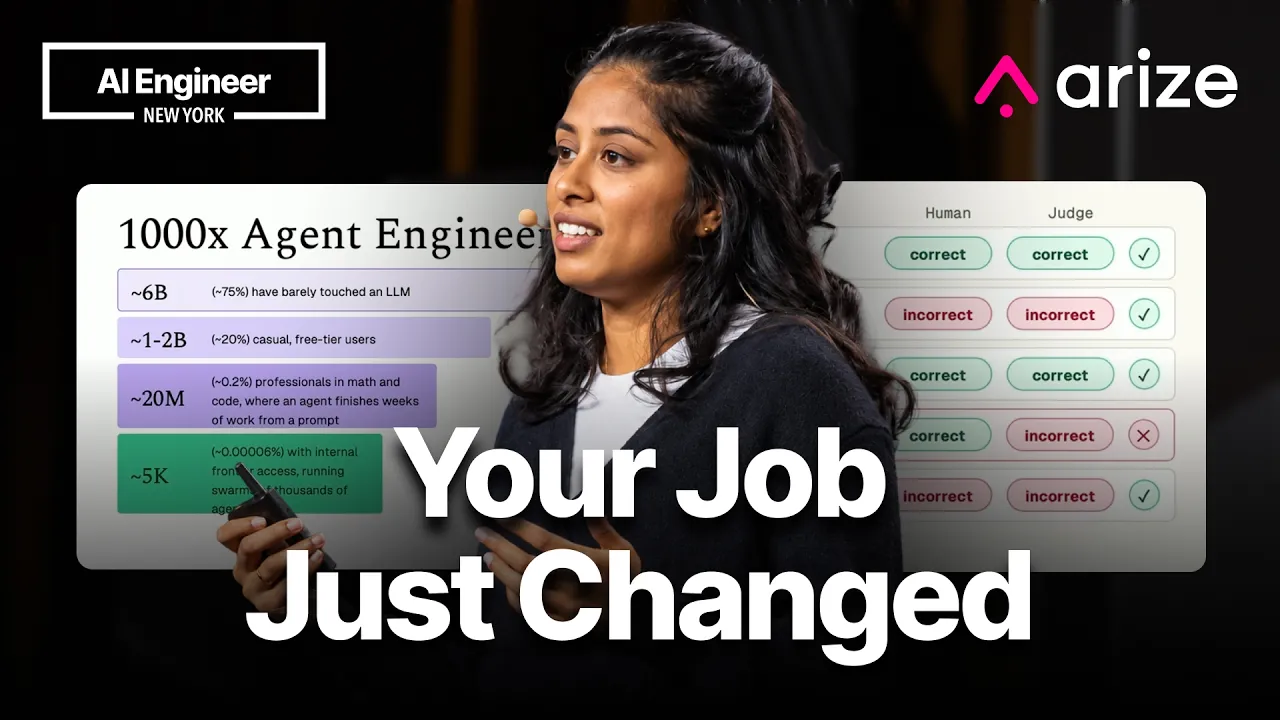
- Evidence: Referencing an Andrej Karpathy tweet, the talk cites more than six billion people having touched an LLM, one to two billion casual users, around 20 million professional users, and roughly 5,000 frontier users running thousands of agents.; The speaker positions AI engineers as the role intended to close the gap between frontier-lab practices and business deployment.
- Caveats: These adoption figures are attributed to a social-media post and are presented as directional framing, not substantiated market research.; The talk does not address organizational readiness issues such as data ownership, change-management processes, or compliance requirements.
- Implications: The near-term differentiator is likely not raw access to agents but the operational infrastructure that turns noisy business data into bounded, evaluated agent work.
Notable Concepts & Terms
- Build-eval-ship-monitor-improve loop: The speaker's definition of the AI engineer's new scope: create the system that continuously performs and improves each stage rather than handling stages manually.
- Signal: Arize's example of an always-on observability agent that reads traces, identifies problems, and can propose code fixes or PRs.
- Agent-native telemetry: Observability data structured and exposed so agents can consume it as primary users, infer patterns, and initiate work.
- Durable agent: An agent workflow whose state survives sandbox or harness failure, allowing recovery from a checkpoint rather than a full restart.
- Sandbox with proxy boundary: A per-run isolated environment in which credentials, repository access, and contextual data are scoped; a single proxy controls data ingress and egress.
- Golden dataset: A curated set of human-grounded examples used to test whether an evaluator's decisions match desired human judgment.
- Offline versus online evaluation: Offline evals test proposed changes before release; online evals inspect production traces and create fresh feedback for iterative improvement.
- Evaluate the evaluator: The principle that automated judges must be validated against human outputs before being trusted to govern agent behavior.
Operator Notes / Why Ken Should Care
- Define a minimum agent-run contract: trigger source, evidence bundle, scoped tool permissions, checkpoint state, output artifact, approval path, and teardown policy.
- Instrument coding-agent activity alongside production-agent activity so every generated change has traceable provenance and can be linked to subsequent production outcomes.
- Create a representative golden set from actual failure traces before relying on LLM judges; establish a required human-agreement threshold and revalidate after model or prompt changes.
- Separate persistent memory from persistent privilege: retain issue history and checkpoints, but expire repository credentials and execution environments per run.
- Run a model-routing experiment on a fixed issue-detection/PR corpus to determine whether stronger models improve acceptance or defect outcomes enough to warrant incremental cost.
- Do not grant autonomous merge or production-change authority solely because an agent can create a PR; add policy and review gates absent from the architecture described here.
Source/Metadata
- Title: What Does an AI Engineer Do Now? - Aparna Dhinakaran, Arize AI
- Transcript words: 4108
- Duration seconds: 927
- Timestamp note: No timestamps or chapter markers were present in the supplied transcript; the transcript also contains a near-complete repeated passage.
Transcript
AMANDA BORNES: Awesome. Well, welcome to AI Engineer. I thought given we're at AI Engineer New York, we'd revisit the question of what does an AI engineer do? I feel like every year we have an idea of what an AI engineer does and that definition changes. And as I was putting this talk together, it was timely because Karpathy actually just tweeted something this weekend where he talks about this growing gap between folks at the frontier who are running thousands of agents and swarms of always-on agents and he drops this funnel where six billion plus users have touched or interfaced with an LLM. One to two billion are casual free tier users. Twenty million are professionals who have started using it for work, taking some piece of work that would have taken weeks down to days. But those at the frontier labs, which is a super small percentage, about 5,000 users, are the ones running thousands of agents at once. As I look at this, the first question anyone asks is: where am I on this? He's drawn out a roadmap of how everyone gets to, in the next couple of years, being one of those 5,000 users running thousands of agents. This has been happening for a couple of decades now, where the abstraction layer has gotten higher and higher. Definitely faster in the last couple of years, but we've gone from engineers writing higher level abstraction languages to copy pasting code, using local agents, to using cloud agents, to the expectation now of how do all of us start running a team of agents or factories of agents internally and build toward that? What this has led to is: what is the then and now of what an AI engineer is? As an AI engineer, your job is no longer just to write the feature, to write an AI feature. It's about how do you build the loop to write that feature. It's no longer about reading the diff and doing code review. It's about how do you set up systems and agents to do the code reviews? And how do you write evals to review those non-deterministic tasks? It's no longer even about setting up metrics and software telemetry, but how do you have agents go through and read the observability data and have agents consume that telemetry to find patterns? The loop of build, eval, ship, monitor, improve—the AI engineer is now responsible not just for doing each step, but how do you build the loop that does each step? At Arise, one of the things we've rolled out is Signal to run this loop for AI engineers. Signal looks at all of the traces, reads the telemetry, identifies patterns in that telemetry, and can put up a fix or a PR if it has access to the repo. Signal is an always-on agent. Signal starts by reading traces. A simple example: it reads a certain volume of traces that came in on some cadence, and the goal is to identify issues from that telemetry data. It has to keep track of issues it's previously seen. Did it see something before that it thought was an issue? Did something seem like an issue but wasn't actually captured? And now as it collects more data, does it think it's much more of a critical issue? One of the first things we realized was that the future of who consumes telemetry data has changed. It's no longer about humans consuming telemetry data. It's not even about humans consuming it and agents taking on the task. It's about how do you set up your telemetry data so that agents are the primary consumers of that data. The observability data becomes the trigger for running and triggering these always-on agents. The first thing when building a team or factory of always-on agents is: what triggers these agents to wake up or start? There can be a variety of triggers for Signal. For us, it's configurable to run on an ongoing cadence—every three hours, six hours, pull the last X amount of traces, read them, identify problems. It can also be triggered by events—Slack messages, if a user complains about something, or a metric-based trigger. Once the agent starts, we have to figure out what an agent run actually looks like. We pull in all of the context of the traces, any additional third-party data. We allow collecting to APM logs, APM metrics, but all of the third-party telemetry data we want to pull in, access to the repo, access to the actual keys needed to run this agent. All of this information is put inside a sandbox. A proxy is the only way to get information in and out of the sandbox. Everything that happens inside the sandbox is already getting traced. Every output—the issues generated and created—is being saved to memory. Every time the agent finishes running and has swept through all of the traces, it either found something or it didn't. What stays is that if it found any issues, all of the output is saved off in memory so that the next time an agent gets spun up, it doesn't have to start from ground zero. It has a history of issues it actually found. The agents are traced, so all of the telemetry data of what the agent called, if it put up a PR, all of those things are traced. Any skills it may have learned while doing a run can also get saved to the repo. What goes away is the sandbox gets torn down, credentials obviously get removed, repo access is removed. All of the stuff that doesn't need to be saved gets torn down after the Signal run. We've designed Signal to keep this agent durable. That means if the sandbox fails or the harness fails, it shouldn't have to start everything from scratch. It should be able to pick up from the step it failed. All of the state is saved off in memory outside the sandbox. We've designed this to be a very durable agent so that if it fails, you can spin it back up, launch a new sandbox, launch a new harness to pick back up where it started. The agent gets triggered, starts, loads with all context and evidence, sweeps through the telemetry data, either finds something or doesn't, and all of that gets saved to memory. If something fails, the agent can reset. We built Signal to be agnostic of the model or the harness. Today Signal supports not just Claude, which is what we started with, but also Cursor and Codecs. The goal is to support all of the major harnesses, even the open-source ones. Signal supports multiple models. Even if you're using Claude, you can pick any of the models inside the Anthropic family. This is important because it's a way for us to evaluate the quality of the agent every time we spin it up. It helps us control costs so we can see as we use more powerful models whether the PR quality is better. Can we reduce the cost and still maintain rigor and quality of issues detected by Signal? This is something we deeply thought about from first principles when designing Signal. What does an AI engineer need to do? An AI engineer needs to learn how to write evals. Every time Signal runs and finds an issue, it puts up a PR. There are evals run on top of the agent to test that PR. An eval can be as simple as testing something as part of your development workflow—a simple prompt with outputs you're testing to make sure there are no regressions. But these evals need to be aligned with human judgment. I'd argue this is where an AI engineer should spend a lot of their time as they're building the system to run the loop. They should be spending time looking at the traces with their agents, identifying what the common errors are. There are skills—I was hearing about the Claude skill to build evals. We have a skill with Arise Evaluator to help you build and write evals, as well as align those evals with human judgment. This is probably where the shift to defining what is good becomes really important for an AI engineer. For a lot of teams we speak with and work with, the question becomes: how do I trust the evaluator? Do I really trust that the eval is going to catch issues? How do I trust that it's as good as my judgment? We spend a lot of our own time evaluating the evaluators. We spend considerable time building golden data sets. We run evals, verify them against human output, and align them to make sure the judge agrees with the human before we ship out a new evaluator. These evals can be used both in offline testing and in online testing. As an AI engineer, you've built this agent to be always-on. You run evals before shipping it into production. You ship it. Once it goes into production, the goal is to trace everything. Tracing everything means not just tracing the agents, but also tracing the coding agents behind the agents that built this. You can trace Claude, you can trace Cursor, you can trace Codecs, but all these coding agents can be traced so you can understand what happened in the factory of agents you're all building. All the traces can also be evaluated online. There's offline evaluation when you're testing what a new change is. As it goes into production, these become your online evals running on top of the telemetry data. For us, this ends up becoming the new data that gets pulled back into the agents to read the telemetry data, the evals, and surface problems inside of the traces. The system becomes: how do you go from collect data, eval that data, run agents on top of it so you can find problems and figure out where the gaps are to improve your systems? Going back to the question we started with: what does an AI engineer do? There's a pretty big gap between what's happening in the labs today and what's happening with a lot of businesses. Some of it could be that data inside businesses is a lot messier than what is very constrained and testable inside a lab. But AI engineers are the role to close that gap. I think it really starts with tracing everything—tracing the agents you're building, running evals so you can learn how to test these products, and building a system so that agents can improve from the telemetry being collected. You're no longer just building individual features, but building the system to improve your products. If you want to learn more, come check out our booth. You can check out Signal and learn more. Thank you so much for listening. I mean, definitely faster in the last couple of years, but we've gone from engineers writing higher level abstraction languages to, I mean, just copy pasting code, using local agents, to using cloud agents, to really the expectation now is how do all of us start running a team of agents or factories of agents internally and build toward that? And what this has led to is essentially, what is the then and now of what an AI engineer is? And this is a bit, I think, of a roadmap for some, but I think internally this is what we've already started to kind of push towards. As an AI engineer, your job is no longer to just write the feature, write an AI feature, it's about how do you build the loop to write that feature. It's no longer about, you know, just reading the diff and actually doing code review, it's actually how do you set up systems and agents to do the code reviews? And how do you write evals to actually do the non-deterministic, to review those non-deterministic tasks? It's actually no longer even about just setting up metrics and software kind of telemetry, but it's actually how do you have agents go through and read the observability data and have agents actually consume that telemetry to find patterns? And so this loop that we've kind of been talking about, which is the build, the eval, ship, you monitor, you improve it, well, the AI engineer is now actually responsible not just for doing each of those steps, but how do you build the loop that actually does each of those steps? And at Arise, one of the things we've rolled out in our product, and I'm going to talk about a bit of what we've learned in building this, is we've built Signal to actually run this loop for AI engineers. What Signal does is that Signal actually looks at all of the traces, it reads the telemetry, it identifies patterns in that telemetry, and it can actually put up a fix or a PR if it has access to the repo. And Signal, Signal's an always-on agent. So this is an example of how Signal starts, but it actually starts off by just reading the traces. Super simple example, but it goes through, reads, and all of this is configurable, but a certain volume of traces that came in in some cadence, it reads it, and then the goal is to actually identify issues from that telemetry data. It has to keep track of issues that it's previously seen. So we have to consider the memory of, did it see something before that it thought was an issue? Did something seem like an issue, but it wasn't actually captured? And now as it collects more data, it actually thinks it's much more of a critical issue. And so Signal actually starts off by reading the traces to identify problems. And so one of the first things that we realized was that the future of who's actually consuming telemetry data has really changed. It's no longer about humans consuming telemetry data. It's not even about humans consuming it and agents kind of taking on the task, but it really is how do you set up your telemetry data so that agents are the primary consumers of that data. And what that does is that that observability data can become the trigger for actually running and triggering these always on agents. And so the first thing that if you're building a team of a factory of really always on agents is what triggers these agents to wake up or start. And there can be a variety of triggers for Signal. For us, it's configurable to run on an ongoing cadence. So every three hours, six hours, go pull the last X amount of traces, read them, identify problems. It can also be triggered by events. So Slack messages, if some user complains about something, it can be a metric based trigger. But these are essentially triggers to kick up the agent actually starting. Once the agent actually starts, we have to spend some time figuring out, well, what does an agent run actually look like? For us, we actually pull in all of the context of the traces, any additional third party data. So we allow collecting to APM logs, APM metrics, but all of the third party telemetry data that we want to pull in, access to the repo, access to the actual, the access to any keys that are needed to actually run this agent. But all of this information is put inside of a sandbox. And this is actually what's started up every time the agent wakes up. And so the agent's triggered. We build a sandbox. We put everything that we need inside of that sandbox. There's a proxy. The only way to get information in and out of the sandbox is by the single proxy. And everything that happens inside of that sandbox is actually already getting traced. And every output, so the issues that are generated and created are all getting saved to some kind of memory. And so this happens every single time the agent actually runs. Every time the agent finishes running, so it's sweeped through all of the traces, it either found something or it didn't, there's what actually stays and what actually gets thrown away. What stays is that if it found any issues, all of the output is actually saved off in some kind of memory so that the next time an agent gets spun up, it doesn't have to start from ground zero. It has a history of what are the issues that it actually found. The agents are traced. So all of the telemetry data of what the agent called, you know, if it actually put up a PR, all of those things are actually traced. And any skills that it may have learned while actually doing a run can also get saved to the actual repo. But the things that go away is the sandbox gets torn down, any credentials, you know, obviously get removed. The repo access is removed. And so all of the stuff that doesn't need to be saved kind of gets torn down after the run of Signal. And we've designed Signal in a way to actually keep this agent durable. So that means that either if the sandbox fails or if the harness fails, then it shouldn't have to start everything from scratch in the middle of the run. It should actually just be able to pick up from the step that it failed. And all of the state so-called is kind of saved off in kind of a memory outside of the sandbox. And so we've designed this to actually be a very durable agent so that if it fails, it can spin it back up. You can launch a new sandbox, launch a new harness to kind of pick back up where it started. So all of this is essentially the underpinnings of how we built Signal to Run every single run. Agent gets triggered. Agent gets started. It loaded with all the context, the evidence. It sweeps through the telemetry data. It either finds something or it doesn't. All of that gets saved to memory. If something fails in the middle, the agent can get reset up. And we built Signal to also be agnostic of the model or the harness. So today Signal supports not just cloud code, which is what we started with, but it also supports cursor and codecs. And the goal is to actually support all of the major, even the open source harnesses out there. And Signal actually also supports multiple models. So even if you're using cloud code, you can pick any of the models inside the Anthropic family. And this is really important to us because, one, it's an awesome way for us to evaluate the quality of the agent every time we spin it up. It helps us control costs so we can see, as we use more powerful models, the better quality maybe the PRs are. But can we reduce the quality of the, you know, can we reduce the cost and actually still maintain the rigor and maintain the quality of issues that are actually detected by Signal? So this is something we deeply thought about from first principles when we were designing Signal. And this is actually a pretty good segue into what does an AI engineer need to do? Well, an AI engineer really needs to kind of learn how to write evals. And so we actually, every time Signal runs, Signal finds an issue, it puts up a PR. Well, there's evals that are run on top of the agent to test that PR. And an eval can be as simple as, you know, testing something as part of your development workflow. You have a dataset, you can be a simple prompt with outputs that you're testing to make sure that there's no regressions. But these evals can also, they need to be kind of aligned with human judgment. And I'd argue that this is actually probably where an AI engineer should be spending a lot of their time as they're building the system to actually run the loop. They should be actually spending time looking at the traces with their agents, identifying what the common errors are. And there's a lot of skills. I think I was hearing Lance yesterday talk about the Claude skill to build evals. We have a skill with Arise Evaluator to actually help you build and write evals, as well as align those evals with the human judgment. But this is probably where the shift to defining what is good becomes really, really important for an AI engineer to actually do. And for a lot of teams I think we speak with and we work with, their question becomes, well, how do I trust the evaluator? And do I really trust that the eval is, you know, is going to catch or, you know, how do I trust that it's as good as my judgment? And I'd say what we spend a lot of our own time doing for our own products is that we actually evaluate the evaluators. We spend a decent amount of time on actually building these data sets, golden fruit data sets. We run evals, verify them against the human output, and then try to align to make sure that the judge actually agrees with the human and they're in agreement before we actually ship out a new evaluator. And these evals can then be used both in an offline testing as well as in an online testing manner. And this is probably what I would say as an AI engineer is more and more of what the job is becoming. And so what I'm going to leave you guys with is, as an AI engineer, you've built this agent, you've built this agent to actually run, be always on. You run evals before you actually ship it into production. You can ship it. And then once it goes into production, the goal is to actually trace everything. And tracing everything now means not just tracing the agents, but also tracing the coding agents behind the agents that built this. So you can trace cloud code, you can trace cursor, you can trace codecs, but all these coding agents can be traced so you can understand what happened in the factory of agents that you all are building. And then these agents, all the traces can then also be evaluated online. So there's an offline evaluation when you're actually testing what a new change is. But as it goes into production, these become your online evals that you're running on top of the telemetry data. This for us ends up becoming the new data that then gets pulled back into the agents to read the telemetry data, the evals, and surface up kind of problems inside of the traces. So the system really becomes how do you go from collect data, eval that data, run agents on top of it so that you can find problems and figure out where the gaps are to actually improve your systems. So if I go back to kind of the question that we started this whole thing with, it's what does an AI engineer do? I mean, the gap between, I think there's a pretty big gap between what's happening in the labs today and what's happening with a lot of businesses. And some of it could just be the data inside of businesses are a lot more messy than what is very constrained and testable inside of a lab. But AI engineers are kind of the role to close that gap. And I think it really starts with tracing everything, tracing the agents you're actually building, running evals, so being able to learn how to test these products that we're really building, and then how do you build a system so that agents can actually improve from the telemetry that's actually being collected so that you're no longer just building individual features, but you're actually building the system to improve your products. If you want to learn more, come check out. We have a booth. You can check out Signal, learn more. But thank you so much for listening to us.