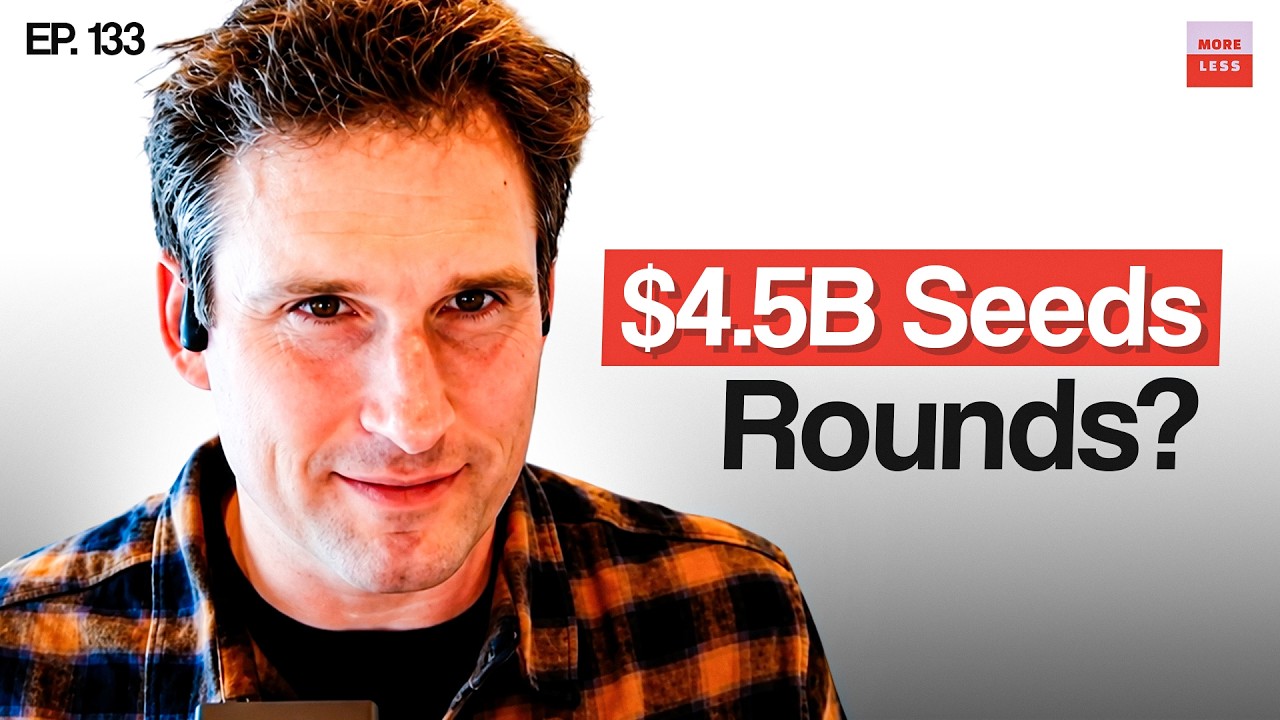
The Seed Market Is Broken: Mega-Rounds, Narrative Games, and Walkouts
Description
While Jess is off being “Davos-famous,” the squad kicks things off with the classic California vs. New York debate. From there, it’s straight into AI and VC chaos: absurd mega-seed rounds that break portfolio math, why even a great early bet like Anthropic wouldn’t return a seed fund, and a revisit of Sam’s view that there are only two ways to win right now—(1) have a real secret and stay capital-efficient, or (2) own the narrative. Dave flags a new “walkout culture” in AI, where executives jump ship the moment incentives shift. The crew then debates whether AI is actually shaping ideas or just polishing them (a fancy spellcheck?), why the question matters more than the answer, and how personal, computer-driving “Clawdbots” feel inevitable and maybe exactly where Apple should be headed, despite the security concerns. The episode rounds out with The Information's breaking news on Apple's AI pins, shrinking subscription moats and business-model shifts, plus detours into the New York Times’ sauna-bros piece, Sam’s WTF Conference protest merch, Super Bowl plans, and more. Chapters: 01:00 – Hello Davos listeners! 03:42 – SF vs. New York: where VC actually wins 05:41 – The seed valuation "fairway" vs bloated-roads 10:07 – Anthropic & OpenAI: good wins, but bad seed returns 11:58 – AI founder drama: mercenary teams & narrative fundraising 13:53 – Did Claude write its own constitution? 15:18 – AI as spellcheck on steroids 21:01 – Ralph: autonomous AI agent loop 24:03 – What ClawdBot really is; symphony orchestrator 26:51 – The Information breaks: Apple’s AI wearable pin; are phones getting tired? 29:02 – The rise of “orchestra compute” and hacked APIs 31:44 – Subscription models are at risk: Whoop, Eight Sleep, Peloton, Apple 41:18 – The New York Times' feature on Sauna Bros 44:53 – Sam's WTF Conference merch & Montana shooting plans 46:34 – Squad's Super Bowl plans We’re also on ↓ X: https://twitter.com/moreorlesspod Instagram: https://instagram.com/moreorless Spotify: h
Summary
Generated by gpt-5.6-solAt-a-Glance
- Verdict: Skim
- Core thesis: AI seed investing is being distorted by FOMO-driven mega-rounds whose returns depend on narrative dominance and retention of scarce talent, while emerging computer-level AI systems could simultaneously undermine traditional SaaS and hardware-subscription moats.
- Why it matters: The discussion connects current AI valuation excesses to practical diligence risks, then identifies a more consequential platform shift: personal AI that can operate and reprogram the user's entire computing environment.
- Best use: Use the seed-market discussion to pressure-test AI investments and the CloudBot/RALF discussion to inform agent architecture, security, and business-model planning; skip the lengthy culture, sauna, sports, and conference banter.
Executive Summary
The panel argues that headline AI seed rounds—such as a reported $480 million raise at a $4.48 billion valuation—are being driven less by conventional seed economics than by investors regretting that they missed OpenAI and Anthropic. Slow Ventures' stated baseline is much more conventional: invest $1 million to $3 million for roughly 10% ownership. The speakers contend that even extraordinary companies can disappoint a seed-fund model when they consume enormous amounts of capital, dilute early investors, or renegotiate ownership structures.
They frame today's company-building environment as offering two viable strategies: possess a non-obvious secret and compound efficiently, or dominate a broadly accepted narrative so thoroughly that capital buys cheaper customer acquisition, recruiting power, and perceived category leadership. Mega-rounds can support the second strategy, but the panel expects most narrative-led bets to fail. The risk is especially acute in AI labs because much of the valuation resides in a small group of mobile researchers and nominal co-founders rather than durable assets.
The higher-signal technology discussion concerns computer-level personal AI. The panel describes CloudBot as qualitatively different from a browser chatbot or narrow agent: it can be contacted through messaging, access the user's computer and connected devices, call or reverse-engineer APIs, and coordinate multiple tasks. They also discuss RALF-style recursive engineering, where a long PRD is decomposed into tasks and each task receives a fresh context window, allowing a system to work autonomously for hours.
Their strategic conclusion is that pervasive AI-mediated scripting may weaken closed APIs, capability subscriptions, and hardware lock-in. If users can locally recreate interfaces and control devices such as beds, exercise equipment, displays, and wearables, vendors may have to charge more upfront for hardware or continually deliver improvements that cannot be reproduced locally. Safety-critical and research-intensive services, such as Tesla's evolving driving software, may retain stronger subscription logic.
Key Takeaways
- Claim: The current AI mega-seed market is primarily a FOMO market rather than a market disciplined by seed-fund return requirements. | Evidence: The panel cites a company raising $480 million at a $4.48 billion valuation and says investors are looking back to 2023 wishing they had entered OpenAI or Anthropic. In contrast, Slow Ventures says its normal approach is to invest $1 million to $3 million and seek approximately 10% ownership. | Implication: Ken should distinguish access signaling from actual fund-return math and reject the premise that exposure to a famous AI team automatically constitutes an attractive seed investment. | Caveat: The speakers' OpenAI and Anthropic return calculations are informal, depend heavily on fund size and financing terms, and the transcript acknowledges that OpenAI's early ownership was renegotiated.
- Claim: Capital-intensive frontier-model companies can generate impressive multiples without being suitable seed-fund investments. | Evidence: One speaker estimates OpenAI seed investors are at roughly 25x after ownership restructuring. Another estimates that a hypothetical $1 million 2023 Anthropic investment could now be worth about $80 million, while still arguing that it might not return a sufficiently large seed fund. | Implication: Investment underwriting should model dollars returned to the fund, future dilution, and liquidity—not celebrate paper multiples in isolation. | Caveat: A 25x or 80x outcome can be exceptional for an individual check; the criticism only holds when evaluated against the investor's fund size, concentration limits, dilution, liquidity, and required ownership.
- Claim: The panel sees two defensible startup strategies in the current market: exploit a secret efficiently or spend aggressively to own an established narrative. | Evidence: The first path is described as knowing something others do not and deploying capital efficiently. The second is entering a category everyone already agrees is important, then using capital to dominate the narrative and lower customer-acquisition costs. | Implication: Ken should force each company or initiative to declare which game it is playing; a venture with neither proprietary insight nor a credible route to category dominance is strategically stranded. | Caveat: The speakers concede that narrative ownership can justify a larger round, but they expect it to work for only a minority of companies.
- Claim: AI lab valuations are unusually fragile because the primary assets are mobile people rather than durable technology, distribution, or infrastructure. | Evidence: The panel says Thinking Machines Lab, founded by Mira Murati, lost roughly half of its executive team within weeks. They characterize large AI founding groups as an NFL-like labor market in which co-founder titles are loosely distributed and competitors may offer ten times the compensation. | Implication: AI investment diligence should treat retention, vesting, key-person concentration, research ownership, and post-departure continuity as core valuation inputs rather than standard legal housekeeping. | Caveat: The cited $10 billion and prospective $50 billion valuations are described by one speaker as marketed fundraising figures, not necessarily completed financings.
- Claim: Computer-level personal AI is more consequential than ordinary browser-based agents because it can operate across the user's full digital environment. | Evidence: CloudBot is described as an army of assistants reachable through WhatsApp or another messaging interface, with access to the computer, connected services, and devices. The panel says it can call internet APIs, reverse-engineer interfaces that lack public APIs, and make the computer perform tasks the user could otherwise perform manually. | Implication: For OpenClaw and related systems, the valuable product layer is likely the secure control plane over tools, credentials, devices, and workflows—not another standalone conversational interface. | Caveat: The setup is described as technically nontrivial and extremely dangerous because the capability depends on granting broad access to personal systems and data.
- Claim: Long-running agent workflows become more reliable when a specification is decomposed and each task receives a fresh context window. | Evidence: The panel describes RALF as a recursive engineering method: create a potentially long PRD, run the model against each task in a new context until completion, then move to the next task using the accumulated output. Such systems can reportedly run for six or seven hours; Cursor is also cited as having attempted a seven-day browser build. | Implication: Ken should evaluate task-scoped context isolation, explicit acceptance criteria, checkpointing, and artifact handoffs as primitives for durable agent execution. | Caveat: The speaker had learned about RALF but had not personally tested it, so the discussion provides an architecture pattern rather than validated performance evidence.
- Claim: AI-generated output becomes more valuable when humans contribute unusual questions and source combinations rather than asking the model to produce conventional answers. | Evidence: One speaker describes combining an esoteric book with a half-formed thesis and using Gemini to surface additional context that changed what he needed to reread. The panel contrasts this with standard autocomplete and compression, noting Ben Affleck and Matt Damon's argument that models regress toward the mean and therefore struggle with original storytelling. | Implication: The human advantage in AI-assisted knowledge work shifts toward problem selection, unusual source material, verification, and asking differentiated questions rather than polishing generic outputs. | Caveat: The speaker explicitly questions whether Gemini's supporting information was true or merely aligned with what he wanted to hear.
Detailed Brief
AI may turn existing hardware into a programmable orchestra
- Claims: The panel suggests that the next computing shift may not require a single breakthrough device; AI can coordinate the many computers already surrounding a user.; Hardware form factors may matter less when models can rapidly create interfaces and integrations for old or closed devices.
- Evidence: Examples include controlling Samsung Frame displays, Mural frames, Tonal equipment, and old computers through generated or reverse-engineered interfaces.; One speaker's child used Claude Code to create Nintendo-style games, load them onto an SD-card cartridge, and play them on a ModRetro Game Boy created by Palmer Luckey.; The panel revives an Offline Ventures metaphor: society has assembled an orchestra of compute across phones, watches, earbuds, and appliances, but has not yet written the symphony.
- Caveats: Reverse engineering can violate service terms, create security exposure, and fail when vendors change authentication or device firmware.; The examples are prototypes and personal experiments, not evidence that mainstream users will tolerate the required setup.
- Implications: The most durable platform may be the orchestration and permissions layer that makes heterogeneous devices safely composable.; Device manufacturers without unique physical capabilities risk becoming interchangeable endpoints in a user-controlled AI environment.
Scriptability could force a reset of subscription business models
- Claims: The speakers envision a partial reversal from rented capabilities toward assets users can modify after purchase.; Hardware subscriptions are vulnerable when the subscription mainly gates software controls that a local AI can reproduce.
- Evidence: John Deere is used as the historical example of selling hardware while restricting service and modification.; Whoop, Eight Sleep, and Peloton illustrate hardware businesses whose economics rely heavily on recurring software or content charges.; The panel argues that a user who can replace Eight Sleep's interface or put arbitrary content on a Peloton screen may no longer accept the monthly fee.; Tesla's move from an upfront autonomous-driving purchase toward a reported $99 monthly subscription is offered as a counterexample because customers may be paying for continuous research, model improvement, and perceived safety.
- Caveats: Vendors can continue strengthening hardware attestation, cloud dependencies, legal restrictions, and authentication to resist local substitution.; Subscriptions remain defensible when they fund ongoing data collection, research, safety assurance, licensed content, or indispensable cloud operations.
- Implications: Future moats may rely less on interface ownership and more on proprietary data loops, physical performance, trust, safety, and continuous service improvement.; AI-native business-model analysis should ask whether recurring revenue represents recurring delivered value or merely artificial capability gating.
Wearables remain strategically plausible but the reported Apple device is unproven
- Claims: The panel is divided on whether phones will be displaced, but agrees that ambient microphones, cameras, earbuds, and glasses could become a persistent AI interface.; Apple is identified as a natural provider of computer-level personal AI because it controls the device, operating system, identity, permissions, and accessory ecosystem.
- Evidence: A reported Apple wearable pin is described as AirTag-sized, with two cameras, microphones, a speaker, and wireless charging, with a claimed target of 20 million units at launch.; The proposed experience is an always-available device that captures visual and audio context and communicates through AirPods, glasses, text, or voice.
- Caveats: The segment relies on a media report rather than an Apple announcement, and the panel provides no proof of product-market fit.; Previous ambient AI wearable products were poorly received, while privacy, social acceptability, battery life, and recording consent remain unresolved.
- Implications: A successful wearable is more likely to function as a sensor and authentication endpoint for a broader personal-AI control plane than as an isolated replacement for the phone.
Notable Concepts & Terms
- Fund-return math: Evaluating an investment by dollars returned relative to the whole fund, rather than relying on a visually impressive paper multiple.
- Own the narrative: A capital-intensive strategy in which a company tries to become synonymous with an accepted category, improving recruiting, fundraising, attention, and customer acquisition.
- Secret-driven company: A company built around a non-consensus insight that can be exploited with comparatively efficient capital rather than category-level spending.
- NFL culture: The panel's description of elite AI labor as a mercenary market where nominal co-founders and researchers transfer rapidly in response to performance and compensation.
- CloudBot: The transcript's name for a personal, computer-level AI system that can be messaged remotely and granted broad access to tools, APIs, files, and connected devices.
- RALF: A recursive engineering workflow that decomposes a PRD into tasks and processes each task in a fresh context window during a long-running autonomous execution.
- Long incantation: The panel's informal term for a detailed specification that directs an AI system through hours or days of structured work, rather than using a short prompt.
- Orchestra of compute: The idea that users already possess many networked computers and sensors, while AI can become the coordination layer that turns them into a coherent programmable environment.
Operator Notes / Why Ken Should Care
- Add a dedicated key-person and team-portability score to AI investment memos, including vesting, IP assignment, departure scenarios, and the cost of replacing each critical researcher.
- Require mega-round underwriting to show ownership after multiple dilution scenarios, expected liquidity timing, and the minimum exit value needed to return the relevant fund.
- Prototype long-running workflows with one context per task, immutable acceptance criteria, explicit checkpoints, and automatic escalation when outputs fail verification.
- Separate agent credentials by tool and task; avoid giving a single personal-AI process unrestricted access to messaging, files, browser sessions, payments, and devices.
- Create a threat model for prompt injection arriving through email, websites, documents, and messaging before enabling remote computer control.
- Audit portfolio and product subscriptions to identify recurring revenue that depends only on closed interfaces; prioritize proprietary data, safety, physical capability, or continuous service as replacement moats.
- Test generated research against primary sources before allowing AI-assisted synthesis to enter an investment thesis or executive decision.
Source/Metadata
- Title: The Seed Market Is Broken: Mega-Rounds, Narrative Games, and Walkouts
- Transcript words: 12047
- Duration seconds: 2967
- Timestamp note: No timestamps or chapter markers were present. The transcript also contains several duplicated passages, so precise navigation is unavailable.
Transcript
Would you ever invest in a company raising at a $4.48 billion valuation who's raising $480 million? Because that's what happened this week. A seed company? It's the land of FOMO, Britt. Everybody's looking back to 2023 and saying, I wish I was in Anthropic and OpenAI. You actually don't want to be in the seed of OpenAI. No. That's the irony of the whole thing, right? The seed investors are sitting at about 25x. If you had invested in Anthropic, it wouldn't have returned a seed fund even today. You make $80 million. That's great, but it was not nothing. I don't want to poo-poo it. Welcome back to another episode of More or Less. This is Britt Morin, your host for the week because... That's not Jess. Yeah. Jess is in Davos with all the fancy people and all of us VCs who don't run media companies are here. Jess went to Davos to do her solo version of More or Less with Andy Jassy and left the riffraff behind in California. Hey, we're clearly the more entertaining riffraff. Just saying. Did she get blocked from the USA house like everybody else from California? I don't know. Did that happen? I guess Gavin Newsom got blocked from going into the America house. Well, does he have a California house? Is this the Olympics? There are different houses at Davos you go into? I think we should have a California house probably at Davos. Look, my sense... I haven't gotten to speak to Jessica much in the week because she's very busy in Davos. But I think my guess is that she'll come back and say that she went in a little skeptical, but it turns out that these are her people. It turns out she's a total celebrity in the context of Davos. And people stop her in the streets and she gets all the interviews she wants. I think she's in hog heaven. Well, she did say she's run into a lot of pod listeners on the streets in Davos. So hello, all you pod listeners in Davos. It's probably the highest concentration of pod listeners. If you just think about the profile, right? Because it's people who go to Davos who want an insidery, snarky read on Silicon Valley from the outside. I feel like that's probably our demo, right? Because we insult too much of the core tech audience for them to like us. Right? Maybe they listen, but they would never admit it because we're just too insulting. But the Davos people love this. Sam, we should go to Davos and just go skiing and not go to the conference. Be the only people on the chairlift. I don't think it's that good, though. I think we ski in better places. That's fair. [SPEAKER_01] It does seem there's a lot of media people this year in Davos, and influencer people. Dr. Becky is there. I've noticed who's the number one parenting influencer. [SPEAKER_02] Steve Bartlett is there. [SPEAKER_02] Ooh, I like Steve Bartlett. Jess is like, I just moderated a panel with Steve Bartlett. It turns out you guys invested in him. [SPEAKER_03] Yeah, that's yes. [SPEAKER_03] That's news. We invested in Dr. Becky so that we both have creators we invested in there. [SPEAKER_02] Sam, do you have a founder working behind you during the podcast? [SPEAKER_02] Yeah, that's Jack. Oh, it's Jack. Oh, hey, Jack. Jack made a terrible career decision, which is to move to New York. [SPEAKER_03] I don't understand that. [SPEAKER_01] I understand a life decision, but now he came to visit to keep his job before he goes back to New York. [SPEAKER_01] I did just convince a New York GP to not move to Silicon Valley and stay in New York. [SPEAKER_01] Why? Why would you? [SPEAKER_02] Because just to keep the competition out. [SPEAKER_02] This is the moment San Francisco is the place to be. [SPEAKER_02] But I don't know. [SPEAKER_01] New York still has its place, right? [SPEAKER_01] I love New York. Well, it's definitely more fashionable. [SPEAKER_02] New York's got a pulse on culture. Maybe I'm just watching too much of the new season of Industry and I'm inspired by New York and London again. [SPEAKER_01] I've only watched the first episode of it and I have seen the season. [SPEAKER_01] It is pretty gnarly. [SPEAKER_03] It's just dark, right? I actually watched that show and I'm thinking, is this the cultural zeitgeist? Because it feels like it is. [SPEAKER_02] But the net of the show is everyone's awful and lying and cheating. [SPEAKER_02] That's the message of the show. The finance people, the tech. [SPEAKER_02] Everyone is just lying and cheating and terrible. [SPEAKER_02] And you're like, huh? It's really bad. If that's what the youth are watching and believing is a dark world out there. [SPEAKER_02] I think they're watching that and anything that's a crime series or a reality love romance show like Love Island and these things. There's some hockey player gay thing. Heated rivalry. Yeah, that's heated rivalry. The gay hockey player thing. [SPEAKER_03] I started it last night. I started it last night, Dave, and you made me turn it off. OK, we're going to skip through that. [SPEAKER_03] We're going to get to pop culture corner at the end of this episode. [SPEAKER_03] We've got more important things to talk about. There are some new announcements from Apple. There's some interesting news from OpenAI. [SPEAKER_03] What's news from Apple? [SPEAKER_03] And we have more companies raising seed rounds at multi-billion dollar valuations. Very exciting to prove that we are not yet out of the AI bubble. You guys do this part of the pod. [SPEAKER_03] I'm going to do some email. Let me know when we get to things that actually are interesting. [SPEAKER_01] Well, Sam, would you ever invest in a company raising at a $4.48 billion valuation? A seed company? We've got more important things to talk about. [SPEAKER_02] There are some new announcements, you guys, from Apple. There's some interesting news from OpenAI. What's news from Apple? [SPEAKER_03] And we have more companies raising seed rounds at multi-billion dollar valuations. Very exciting to prove that we are not yet out of the AI bubble. You guys do this part of the pod. [SPEAKER_03] I'm going to do some email. [SPEAKER_03] Let me know when we get to things that actually are interesting. [SPEAKER_01] Well, Sam, would you ever invest in a company raising at a $4.48 billion valuation? A seed company? He's raising $480 million? [SPEAKER_02] Because that's what happened this week. [SPEAKER_02] But I recently did... I recently was doing some analysis of what we've really made money on. [SPEAKER_03] And it was actually for hilariously... [SPEAKER_03] Actually, I think I'm... For the Midas seed investor list, which I call... [SPEAKER_03] It's the junior varsity. It's the all-American junior varsity capitalism team. I've made the... I've been on this list. It's the 25 top seed investors. And I was like, should I submit for this again? Do I care? It's funny. I've just never submitted for it. I don't even know how I ended up... I think I ended up on a Solana. They just put me on or whatever. It's fine. But it was funny. I was doing the analysis. And it turned out that all the things that we've ever made serious money on, even ones I had forgotten were this, are under 10x free. Yep. But that was in a different vintage, Sam. That's not in today's world. I don't know. [SPEAKER_02] I'm not convinced. [SPEAKER_02] I like... Look, in the last few weeks I've done two deals where I bought 10% of a company for a quarter million bucks each time. [SPEAKER_03] Because they're interesting, really weird ideas that I helped shape. And I don't need to own the whole thing. And I'm not going to work on it. But if the entrepreneur is going to run with it, and they're interesting. So I'm just not... I don't know. I understand. Look, I obviously have invested in things at more than 10x post and will continue to when it makes sense and it all lines up. But I don't know. I just don't really buy that these are moneymakers, right? I think if you're trying to demonstrate access, or if you're not sure where to put the seed money and there's... There's... I mean, there's a great story of our friends who had a seed fund. They pitched a seed fund to investors and then turned around and immediately put the entire thing into Stripe at a pretty good price. And they'll make a bunch of money on it because it's one in N companies. But they also had a really hard time raising their next seed fund because it's not what you're supposed to do. It's not what you're getting paid by managers to do. So as a seed fund, I'm not that into it. So what's your idea, Sam, of a seed round that is too large for Slow right now or too high of a valuation? Do you have bans on that? Or is it... For a real proper seed round? I mean, look, we're very transparent what we do, right? [SPEAKER_03] We spend one to $3 million and we want to own 10% of things. [SPEAKER_03] That's it. [SPEAKER_03] It's quite simple. Yeah. [SPEAKER_02] Okay. [SPEAKER_02] And I would call that straight up the fair way of what's happening in seed right now. [SPEAKER_02] But then we're seeing all this crazy stuff, whether it's $100 million valuation or this humans and company that raised at a $4.5 billion valuation. People are raising all kinds of numbers. Yeah. [SPEAKER_03] Because it's the land of FOMO, Britt. [SPEAKER_03] Everybody's looking back to 2023 and saying, I wish I was in Anthropic and OpenAI and all that. [SPEAKER_03] Dear God, I must do something to get this to get some of this, right? [SPEAKER_03] That's what's going on. [SPEAKER_01] The funny thing I'll keep reminding people of, because it's so funny, is you actually don't want to be in the seed of OpenAI. [SPEAKER_01] No. [SPEAKER_01] That's the irony of the whole thing, right? [SPEAKER_01] Even at these ridiculous prices, because of how that all got renegotiated, and I could be wrong and someone correct me if I am, the internet loves that. [SPEAKER_02] But if you look at the math on it, I believe the answer still holds that the seed investors are sitting at about 25X. [SPEAKER_02] That's not a terrible investment. [SPEAKER_02] That's not a firm returner for a seed fund. [SPEAKER_02] It's eh. [SPEAKER_02] So the answer is you don't even... [SPEAKER_02] I actually ran the math, Sam. [SPEAKER_02] I ran... Yeah, I did at one point too. I just haven't recently. You don't actually want to be in super capital consumptive things as a seed investor. Now, I will say, just to justify it, I think there is one... I've been telling entrepreneurs a lot this year, this is my theme of the month, that there's only two ways to make money right now and build companies, right? One, which we've talked about. One is have a secret that no one knows, right? And send capital efficiently. I know people doing this. It's great. The other is own the narrative. And the only justification you could give, right, is if you're saying that everyone agrees is good or is a good idea, and it's just a matter of can you be the company that owns the narrative and gets cheaper acquisition for customers than there is, there's an argument that if it's very capital consumptive to do that, you might One, which we've talked about. One is have a secret that no one knows, right? And just send it capital efficiently. I know people doing this. It's great. The other is own the narrative. And the only justification you could give, right, is if you're saying that everyone agrees, right, is good or is a good idea, and it's just a matter of can you be the company that quote unquote owns the narrative and gets cheaper acquisition for customers than there is, there's an argument that if it's very capital consumptive to do that, you might need a lot more capital to own a narrative than you would to go from a series seed to your million in ARR to get your series A in the oil world. So you can kind of squint and make a justify. I just don't think it's going to work out very well for most people. Dave, what were you going to add on to that? No, it definitely won't. I mean, I ran the numbers. If you had invested in 2023 in Anthropic, you know, if you had taken a core seed check, for example, a million, exactly what we're talking about, it wouldn't have returned a seed fund even today. [SPEAKER_03] It still wouldn't have been a good investment. [SPEAKER_01] I mean, I have a... [SPEAKER_01] It's fine. [SPEAKER_01] You make 80 million. [SPEAKER_01] That's great. [SPEAKER_01] It's not nothing. I don't want to poo-poo it. [SPEAKER_01] An ADX in three years liquid is not bad. [SPEAKER_01] It's actually better than the OpenAI outcome, right, by a lot. [SPEAKER_01] Right. Yeah. I will say the fun... I had a funny realization, which is I was talking to an old associate of mine who used to work at Slow, who kind of with me. [SPEAKER_02] And it was really funny. [SPEAKER_02] I was recalling the fact that just a few years ago, he had messaged me and he had two job offers, one in Anthropic and one somewhere else with a comp package associated with them. And in the classic, Sam does get things massively wrong at one point. [SPEAKER_02] He was asking, where should I go? [SPEAKER_02] I was saying, you know, you should probably go to Anthropic because I just seem to be seeing really high quality people and you'll learn a lot there. [SPEAKER_02] It seems like a good career move for you. [SPEAKER_02] It's one of those types of things. [SPEAKER_02] But I have no idea what it's worth and who knows if it's the better comp package, but I haven't actually run the numbers, but I think that person has done extremely well on their equity. [SPEAKER_02] So good for them. Good for them. Good for them. All right. So we're not willing to pay up. We're staying in the fair way. It sounds like at least for the three of us on this call of what's rational. There's still definitely an AI bubble. By the way, Thinking Machines Lab, which is one of the only other seed rounds to be a multi-billion dollar valuation. [SPEAKER_03] This is Mira Mirati's company. [SPEAKER_03] Two billion dollars. [SPEAKER_03] Has now lost half of the executive team. [SPEAKER_03] Half of the executive team has left over the last few weeks. [SPEAKER_03] So these investors who invested in this round are super pissed. [SPEAKER_03] Why is there so much drama with the AI people? [SPEAKER_03] Is it just that the money is at stake? [SPEAKER_03] It's hard being Snoop D-O-double-G. [SPEAKER_03] What I'm gathering is these rounds are investments in the people, similar with this humans and company that's 20 people, former Google, OpenAI, and those people can just leave. [SPEAKER_01] And then these investors are losing so much of the value. [SPEAKER_01] When did it become okay to do this in the valley is the real question. [SPEAKER_01] Leaving after 12 months, six months, this is bad behavior. [SPEAKER_03] Well, no, I don't think so. [SPEAKER_03] I think here's what's going on. [SPEAKER_03] I just think there's a few things. One is I don't think we have an NFL culture now. [SPEAKER_01] These are large co-founding teams, right? [SPEAKER_01] Co-founder titles thrown around very loosely, right? [SPEAKER_02] And it's pretty mercenary sports oriented, right? [SPEAKER_02] And so I do think that if you are not the principal, but you are a quote unquote co-founder and the principal convinces you to come do a thing and then it starts not working or not delivering on it, you go somewhere else, right? [SPEAKER_02] Especially because the opportunity cost is ridiculous given what people are getting paid right now. [SPEAKER_02] And I just don't think, I think that's if you're promised something that ends up being a bill of goods, right? [SPEAKER_02] It's not working, you just leave. [SPEAKER_02] And I think that it's very mercenary, but I think it's quite understandable in context right now. [SPEAKER_02] And yeah, I do think to everyone's point, because these are all purely human capital plays, there's no assets to any of these things, right? [SPEAKER_02] It's super easy to be like, someone's going to pay me 10 times as much over there. [SPEAKER_02] Sure. [SPEAKER_02] If that makes sense, I'm not leaving anything. [SPEAKER_02] So I don't know. [SPEAKER_02] I think it's all pretty understandable, but I do think it kind of makes the point that it's a very dangerous game and these numbers are all quite silly is what it comes down to. [SPEAKER_02] What's crazy is this company, which originally raised a $2 billion seed round, went on to raise at a 10 billion and is now in the process of raising at a $50 billion valuation. [SPEAKER_02] Who is this? [SPEAKER_02] Thinking machines. [SPEAKER_02] Yeah, but that's just what they market. [SPEAKER_02] It's not like. [SPEAKER_03] It's just wild to me. [SPEAKER_03] It's been a year and it's crazy that this stuff is happening right now. [SPEAKER_03] I don't know. [SPEAKER_03] I have a more important AI question, which is that Anthropic announced that they've written a new constitution for Claude. And I'm looking at it and I'm reading it and it looks suspiciously like AI writing. at a 10 billion is now in the process of raising at a $50 billion valuation. Who is this? Thinking machines. Yeah, but that's just what they, that's just marketing. [SPEAKER_03] It's just wild to me. [SPEAKER_03] It's been a year and it's crazy that this stuff is happening right now. [SPEAKER_03] I don't know. I have a more important AI question, which is that Anthropic announced that they've written a new constitution for Claude. And I'm looking at it and I'm reading it and it looks suspiciously like AI writing. [SPEAKER_03] And so the question in my head is what percentage of the Claude constitution was written by Claude? [SPEAKER_03] It's like a teenager trying to write their own curfew or something. [SPEAKER_03] And I read down to the bottom and sure enough, it's like, this was written by a lot of humans, but it was also written by some of our models. [SPEAKER_01] And so what percentage of the constitution was written by the models itself is a really interesting question. [SPEAKER_01] Like, does this just become the recursive loop that we've all been afraid of over time? [SPEAKER_01] Or how should we think about this? [SPEAKER_01] Junk in, junk out. [SPEAKER_01] I mean, it seems like this is back to the AI slop thing where Dave, you didn't necessarily resonate with the idea of a human in the loop writing model. [SPEAKER_01] But I think that's what most people are doing right now. [SPEAKER_01] Everyone's using AI to write something, they're editing it, they're making it sound more human, and then they're sending it or posting it or whatever. [SPEAKER_01] And the question is, is that just the new normal? [SPEAKER_03] Or are we against having AI be part of the genesis of any of these ideas? [SPEAKER_03] I think it's different when it's the actual constitution for one of the models. [SPEAKER_03] Or is it just the same as coding, I guess? [SPEAKER_03] Like, is all the code being written by models now? [SPEAKER_03] Doesn't matter, it's just turtles all the way down and we're fine with it. So here's the question. In the end of the day, people talk about what we're really dealing with is just super advanced spell check. [SPEAKER_01] Everyone uses spell check, right? [SPEAKER_01] There's nothing wrong with using spell check, right? [SPEAKER_01] I mean, I actually sometimes don't use spell check because I think it's proof of humanity, but that's a very niche Sam thing, right? You also write in mostly lowercase. Yeah. [SPEAKER_02] And I think that is fine. [SPEAKER_02] But I saw something you wrote the other day and it looked too perfect. [SPEAKER_02] And I'm like, oh, Sam has AI in his workflow now. [SPEAKER_03] Well, that's what I was going to say. I actually saw something you put on Twitter that looks suspiciously AI-ish. [SPEAKER_03] Those are not, like the two I put on Twitter are actually not. Which one do you think was AI driven? There's "The themes that matter in 2026," which is actually a good essay, which has no AI use in it. [SPEAKER_02] There's "The future is flat earth," which I think I may have passed actually. "The future is flat earth." [SPEAKER_02] Yeah. [SPEAKER_02] I passed that through AI and I was like, yeah, yeah. [SPEAKER_02] But it's interesting. To the point of like the experience here is funny. [SPEAKER_02] I wrote a version of that that was fine. I passed it through. I was like, this is basically the same thing and maybe slightly more readable. And so I just posted it. [SPEAKER_02] But I think one, you immediately know that. [SPEAKER_02] And two, I would never do that for an idea I actually really cared about. [SPEAKER_02] It's more just like, but it is interesting, right? [SPEAKER_02] It's a question about whether I should, how to approach some of that stuff. [SPEAKER_02] I will tell you, I actually did have one really interesting experience. [SPEAKER_02] Even I will admit somewhat co-writing. [SPEAKER_02] I haven't published this yet and I need to do another draft with that, but I was actually impressed with it. [SPEAKER_02] I did have my first experience where I was reading a pretty esoteric book and I had a half-baked idea coming out of the book. [SPEAKER_02] And I kind of wrote something, which was my high level framing coming out of it. [SPEAKER_02] And actually Gemini did a good job giving me more context and information I didn't have that became iterative and interesting. [SPEAKER_02] So the funny part about that is this set of ideas is interesting enough. And I will then have to go reread all this stuff, think about it and go from there. But I did have that kind of interesting moment. I was like, ah, this is a good example of not pure slop. This actually gave me shortcuts to a bunch of other thinking I didn't know and made sense. Right now, is it all true? Or just what I wanted to hear? [SPEAKER_02] Who knows? [SPEAKER_02] But it's interesting. Right. [SPEAKER_02] I think it advances your thinking more than anything. [SPEAKER_02] In this case, it was my first experience. And it started, the reason is it's almost like if you think about all this stuff, if the future is basically what matters is the question, not the answer. [SPEAKER_02] Barry Hitchhiker's Guide to the Galaxy, right? [SPEAKER_03] It's how you ask the question that matters, not the answer. [SPEAKER_03] And that's the human thing. You have to become the best questioner in the world. And then you're okay, well, how unique are your questions? Right? It becomes this interesting thing. [SPEAKER_02] It's if you read weirder stuff or connect problems differently, you almost end up with these secret weird incantations that feel more unique and yield, if you prompt correctly, more interesting outcomes, which you can then kind of... [SPEAKER_02] So it was my first glimpse in a while, because I'm obviously very cynical about 99.999% of this stuff. [SPEAKER_02] But I was like, oh, I can go read weird stuff other people haven't read. Think of ideas that maybe some people have thought of, but not in this context. I'm surprised that I'm surprised that I'm not going to be able to get more magic out of the box. I'm surprised that's a new feeling for you. I feel like that's what everyone... I mean, the reading things people haven't read and stuff, I get that part. It's illegible from a lot of people. So it was my first glimpse in a while, because I'm obviously very cynical about 99.999% of this stuff. But I was like, oh, I can go read weird shit other people haven't read. Think of ideas that maybe some people have thought of, but not in this context. I'm surprised that I'm not going to be able to get more magic out of the box. I'm surprised that's a new feeling for you. I feel like that's what everyone... I mean, the reading things people haven't read and stuff, I get that part. It's illegible from a lot of people. But I think that's part of the magic that people are feeling and utilizing this for. And with CloudBot, which by the way, I'm curious to hear if anyone else... [SPEAKER_03] If any of you have been playing more with building things on the side. [SPEAKER_03] Yes. I think it's unlocking this new level of ways that people are using all of this stuff to get that magical moment. So I guess I would just distinguish between the things which is autocomplete or autocompress, right? Which is what I see most people using. CloudBot is mostly autocomplete, autocompress. It's not... [SPEAKER_01] Yeah, it's first order. [SPEAKER_03] It's fine. And it is efficient. It means I don't have to hire engineers for X, Y... But it's not like... It doesn't change how you look at things, right? Like what I... The unique experience I had here, which I just haven't had before, maybe other people do, is being like, oh, shit. That's like, if I encant properly with weird enough other ideas, it will actually give me back other ideas that are interesting and require... I think the first time I've actually thought to myself, like, oh, I need to go now reread more carefully this thread, as opposed to be like, yeah, this is fine. You know, it's the way I look at it. I like this. I was watching the interview that Ben Affleck and Matt Damon did on Joe Rogan about the movie industry. And they were talking about how the models are not good at storytelling, largely because they regress to the mean, right? The math of these models is to compress, right? And so you're compressing, compressing, compressing a lot into the mean. [SPEAKER_01] And so to get it to do what you're talking about, which is encant in a weird direction or synthesize things that it's not naturally going to do requires some judo that I think most people aren't willing to put in. But it is possible. And perhaps that's a new form of knowledge creation that is going to be a huge part of the future, right? The ability to... I was looking at this one new engineering method that people are using. I've just recently... Because I've been talking about CloudBot so much, people are sending me a lot of different things to look at. And there's this new recursive engineering idea called RALF. Have you seen this, Sam? I haven't, actually. [SPEAKER_01] And as I understand it, you effectively write a PRD or you work with the model to write a PRD. And the PRD can be pretty long. And the model then runs against each step of the PRD. So each task it needs to accomplish, it runs a new context window on that task until it's finished. And then once it's finished, it goes to the next one, starts a new context window with what it learned. And then it just burns through this and you can let it run for six hours or seven hours or something. [SPEAKER_01] And so a lot of people are getting very excited about this. I haven't tried it myself personally, but it's the... There's short incantations like you were talking about. And then it seems like there's this new emergent thing, a long incantation where you're like, I'm going to long incant for seven hours. Or I saw Cursor or something did a seven day build of an entire web browser. And so there's these long things you can do now too. It's like when you send Cursor on an ayahuasca trip. Exactly. It's like, please come back with... Please talk to God and come back with a browser. It's like, I'm sorry. [SPEAKER_01] I'm sorry. My AI agent is busy. I sent it on a six day ayahuasca trip. It only threw up three times. But it came back with some good shit. But it's like, that's... Yeah. All right. Dave, is there anything new you've been playing with that you've been building and all this rolfing and clotting and like... [SPEAKER_01] RALF. Okay. You haven't used RALF though. [SPEAKER_03] I have learned about RALF. RALF and I do not have a... RALF and I do not have a relationship. That's what you do during the ayahuasca trip is you RALF all over the place. RALF. [SPEAKER_01] Okay. For anyone who's listening and isn't up to speed. RALF is named after a Simpsons character. Okay. [SPEAKER_03] Claude Butt. Like lobster claws. Not like clawed by Anthropic. Yeah. [SPEAKER_01] I liked... I liked our editors and the podcast got that wrong and then everyone in the comments corrected them. It was a classic internet moment. They're like, I can't find this. Well, the best... It was just like... It's the classic internet meme of the best way to engage people on the internet is to give them something to correct. Right? [SPEAKER_01] They can't help themselves. If you want comments, you just spell Claude Butt wrong. Say everything wrong. Yeah. We should get some comments. That raises engagement. That's all I'm saying. That's what I learned with this essay that I wrote. Everyone... I wrote this essay that's AI is the new UI. And I basically just spent the last week having everyone correct me. [SPEAKER_03] I learned the same lesson. is to give them something to correct. Right? [SPEAKER_01] They can't help themselves. If you want comments, you just spell things wrong. Say everything wrong. Yeah. We should get some comments. That raises engagement. [SPEAKER_02] That's all I'm saying. [SPEAKER_02] That's what I learned with this essay that I wrote. [SPEAKER_02] Everybody... [SPEAKER_02] I wrote this essay that's AI is the new UI. And I basically just spent the last week having everyone correct me. I learned the same lesson. It's great. It's great. [SPEAKER_01] You just have to not care at all. [SPEAKER_01] But I will say, Dave, you're mistaken that I actually didn't even see the thread exactly, but I got some notification for some reason about your post. [SPEAKER_01] And it was you apologizing or something. This is 2026. We don't apologize for things. What did I apologize for? You were like, oh, we'll try to get that right in the future. I was like, what are you doing? You're apologizing. Don't apologize. I think maybe CloudBot was apologizing on my behalf. [SPEAKER_01] Oh yeah. Dave has many digital twins that can just comment as him. I actually think it'd be pretty fun. Maybe I'll have to... That's a fun vibe-coded hour project is I'm going to make a website, which is another Sam bot. [SPEAKER_01] And all it does is apologize. [SPEAKER_03] Everyone would really know it's not you at that point, Sam. It's like, please write your grievance. [SPEAKER_02] And then it just writes an apology so that I don't have to. [SPEAKER_02] It's like, please see... [SPEAKER_02] Sam grievance bot. [SPEAKER_02] Yeah. [SPEAKER_03] It's like, oh, you're mad. [SPEAKER_02] Please go to samgrievance.com. [SPEAKER_02] It's like, I'm sorry. [SPEAKER_02] No, you have to state the reason why you're mad. [SPEAKER_02] I guess, Britt, my answer to your question about... [SPEAKER_02] My answer to your question about CloudBot is I don't even know what to describe this as. [SPEAKER_02] It feels like a new thing. [SPEAKER_02] And I don't... [SPEAKER_03] And it's interesting. And the people that haven't tried it, they hear you describe it and then they want to try it, but it's quite technical to set up. And to get it set up in the right way where it's doing the kind of things I think that we are excitedly talking about on this podcast is not trivial. [SPEAKER_01] But once you have it working, it's one of these things where once you experience it, you want this to be the way you're interacting with this stuff all the time. [SPEAKER_01] But I'm not totally sure how to describe what exactly the feeling is. And I've had a lot of people asking me that over the last week. Sam, I don't know if you have any other better ideas of how to describe this. Isn't it more like if you were... If you're describing it in layman's terms, it's not just having an agent. It's having an army of agents that you just can text with on WhatsApp or messaging platform and tell it what you want it to do. And it has access to a bunch of things, which we all... We talked about as a big security concern. [SPEAKER_03] And by the way, the CEO of Signal came out this week, of course, talking about how dangerous all this stuff is and encryption, blah, blah, blah. [SPEAKER_03] Of course, I know. [SPEAKER_03] I know. [SPEAKER_03] But it is the hypey thing right now happening at the inner, inner, inner circle of Silicon Valley thinkers. [SPEAKER_03] So I think it's important that people know about it. [SPEAKER_03] It's super dangerous. [SPEAKER_03] There's no question. [SPEAKER_03] It's... [SPEAKER_03] I mean, he's not... [SPEAKER_03] Yeah. [SPEAKER_03] I think that agentic is... Agents and agentic is a misnomer. I don't think that it's the right way to describe what these things are. And I actually think that's one of the reasons why it's so hard to describe what it is. [SPEAKER_02] It's not what everyone's talking about. There's 100 essays per week right now about agentic this, agent that, agent blah, blah, blah, blah, blah, blah. It's all that anybody's talking about. And it's not what this thing is. [SPEAKER_01] It's you're giving... [SPEAKER_01] I don't even know. [SPEAKER_01] It's computer version of AI. [SPEAKER_01] You know, or... [SPEAKER_01] It's personal AI or something like that, where you have this ability to interact with... [SPEAKER_01] With your entire computer using it. That's why, Sam, your first reaction to it was so... This security question. But the trade-off is great power, right? [SPEAKER_01] And I think that's what's got people doing it, even though, yeah, it is scary. [SPEAKER_01] It's very clear to me, actually, that this is the direction that Apple should go, I think, is maybe the thing that I've been thinking about a lot, which is to say that it's surprising to me that they haven't been thinking this way, or maybe they are behind the scenes. [SPEAKER_01] I don't know. [SPEAKER_01] But the notion that you can just make your computer do whatever you want, that you know the computer can do if you were sitting in front of it, and you can do that via text message or voice or whatever, is a really powerful thing that is far beyond the way that you can interact with these things in a web browser tab. [SPEAKER_01] Well, that's a good and interesting segue, because I, too, don't know if Apple's working on it down to the computer level, but there was a big information scoop today. I've got to honor Jess, while she's not here, that they are developing, drumroll please, an AI wearable pen. [SPEAKER_01] What? [SPEAKER_01] It's our favorite topic. And by the way, if we go back to our 2026 predictions, which all four of us on More or Less said, we would all be wearing a wearable thing in the next year. That was me. [SPEAKER_03] Okay. [SPEAKER_03] So. [SPEAKER_03] Yeah, but Britt, you've got one key problem, which is we're not going to be. [SPEAKER_01] On it down to the computer level, but there was a big information scoop today. [SPEAKER_01] I've got to honor Jess, while she's not here, that they are developing, drumroll please, an AI wearable pen. [SPEAKER_01] What? [SPEAKER_01] It's our favorite topic. [SPEAKER_03] And by the way, if we go back to our 2026 predictions, which of the four of us on More [SPEAKER_03] or Less said, we would all be wearing a wearable thing in the next year. [SPEAKER_03] That was me. [SPEAKER_03] Okay. [SPEAKER_03] So. [SPEAKER_03] Yeah, but Britt, you've got one key problem, which is we're not going to be. [SPEAKER_03] Yeah, exactly. Well, we're developing them. Nobody wants a wearable pen. 20 million units at launch, you guys. [SPEAKER_03] It features two cameras, a speaker, microphones, and wireless charging. [SPEAKER_02] It is about the size of an air tag. [SPEAKER_02] They're trying to advance this very quickly to compete more effectively with OpenAI and [SPEAKER_03] Meta and tie it into the AI assistant and smart glasses markets, blah, blah, blah. I'm confused. [SPEAKER_03] And this is becoming a thing. [SPEAKER_03] Look, the market already rejected this. [SPEAKER_03] Why are we doing it again? [SPEAKER_03] I don't think they did. [SPEAKER_03] I think this is where everyone's going. [SPEAKER_01] I think if I'm guessing the strategy meetings at the top are saying gone are the days [SPEAKER_03] of these phones with glass on them. [SPEAKER_01] We will therefore have a wearable circular device that's recording everything we're doing both visually and via audio in our days that we can talk to probably some AirPods or something [SPEAKER_03] in our ears and something in our eyes. [SPEAKER_03] And we will be fully transformed into digital humans because of this. [SPEAKER_03] I don't know. [SPEAKER_03] Agree? [SPEAKER_03] Disagree. Are the phones dead? Are we all going to be using wearables and glasses? [SPEAKER_03] I think the phone format is getting tired, but it's also I don't think going anywhere. [SPEAKER_03] And I think that there's no new information here. [SPEAKER_03] People have been having these. [SPEAKER_03] I disagree. [SPEAKER_03] I disagree. I think we're going to have one of these in our. Do you think there's something new here? Yeah. What's new? [SPEAKER_03] Well, the fact that it's not new, but Apple doing it is new. [SPEAKER_03] I don't know, Brit. [SPEAKER_03] It's just taking the watch form factor and putting it in another form factor. It's a sticky. It's sticking. [SPEAKER_02] It's a bucket watch. [SPEAKER_03] No, but it's an always on pen. It's listening. It's able to talk to you. It has cameras. It's different than a watch in that regard. And I truly believe that they're looking at this as what is the thing after phones? [SPEAKER_03] And is it a wearable and something on your eyes and maybe your ears? [SPEAKER_03] I have a totally different take on this stuff, which is that Brit, you'll remember this. [SPEAKER_03] But when we first started offline ventures, one of our first pitch decks, we talked about this idea that there is a Cambrian moment in computing and that the amount of compute that is surrounding all of us, whether that's the phone in your pocket or the AirPods in your ears or the watch on your wrist. [SPEAKER_03] There's more power in a single AirPods than in the entire Apollo mission. [SPEAKER_03] And we've assembled an orchestra of compute, but nobody's written a symphony. [SPEAKER_03] And the thing that Claudebot has taught me over the last couple of weeks is that you can now reverse engineer basically anything that has compute around you, whether it's the Samsung frame on your wall or the mural frames that are showing the photos or my tonal or these old computers behind me. [SPEAKER_03] You can very easily reverse engineer an API for something that doesn't have one. You can talk to any API on the Internet really easily. You can pull it all together super fast into a totally new interface to do something fun. [SPEAKER_01] I made a bunch of fun things this weekend that would have taken me forever before, but it was great fun to put together a bunch of things. [SPEAKER_01] And so is it actually that individual hardware devices don't matter that much anymore? [SPEAKER_01] You can create these symphony experiences across all of this stuff and even just old stuff that exists. Watching our son, our oldest son, Ansel. [SPEAKER_01] He has been really inspired by Claude Code and he started building his own Nintendo games. [SPEAKER_01] And we got this little cartridge that's an 8-bit cartridge. [SPEAKER_01] You can get them off Amazon that has an SD card in it and then you can create your own games and load them into your Game Boy. [SPEAKER_01] And so I got him one of those new mod retro Game Boys that Palmer Luckey created, which are awesome. [SPEAKER_01] They are great. [SPEAKER_01] Big fan. [SPEAKER_01] Now our kids are making their own games for it. [SPEAKER_01] That's wild. [SPEAKER_01] And so is that actually the new thing that's going on? It doesn't matter what the hardware is anymore. [SPEAKER_01] It doesn't matter if Johnny Ivan OpenAI makes something fantastical and new with another PCB in it. [SPEAKER_01] That talks to some APIs. [SPEAKER_01] You can do that to anything now. [SPEAKER_01] And that's pretty awesome. [SPEAKER_01] And that's a new thing going on. I will say, so let me riff on that for a second. A few thoughts. One is we've lived in this era right now for a long time with SaaS. You buy usage of a service within a set of parameters, which you don't control. It can be changed any way you want. In the future, it can be deprecated, whatever. You own nothing, right? [SPEAKER_02] You're paying a subscription. [SPEAKER_02] You're lucky they're listening to you. [SPEAKER_02] You know, the world with shrink wrap software used to be, right? [SPEAKER_02] You bought the thing and it's yours. [SPEAKER_02] There's open source, which is you literally can do whatever you want with it. [SPEAKER_02] And I think in some ways what maybe was happening is if you believe the cloudbot, whatever future where everything can be scripted and built on top of it, remixed and everything becomes open and there are no private APIs anymore. [SPEAKER_02] You have to move into a world where you think about anything you're buying as an asset that you can do whatever you want with. A return to shrink wrap. It's so interesting, even a step beyond that. It's a return to shrink wrap where nothing is closed source, if that makes sense. [SPEAKER_02] Closer to you just bought the thing and it's yours, right? [SPEAKER_02] There's open source, which is you bought, you literally can do whatever you want with it. [SPEAKER_02] And I think in some ways what maybe was happening a little bit is if you believe the cloudbot, whatever future where everything can be scripted and built on top of it, remixed and everything becomes open and there are no private APIs anymore. You kind of have to move into a world where you think about anything you're buying as an asset that you can do whatever you want with. A return to shrink wrap. It's so interesting, even a step beyond that, it's a return to shrink wrap where nothing is closed source, if that makes sense. [SPEAKER_02] You're just buying a resource or an asset and then you do whatever you want with it. [SPEAKER_02] And it's actually interesting because if you think about the move for the last many years has been the opposite. [SPEAKER_02] John Deere, for instance, people got really mad because they were doing stuff like we're giving you a tractor we're selling you, but we're locking it down so much and all the pieces around it. [SPEAKER_02] You can't do anything but come back to us for service. [SPEAKER_02] So we'll basically give you the hardware for free and then you pay us and we control your usage of it. [SPEAKER_02] Right. [SPEAKER_02] And if you believe the CloudBot. [SPEAKER_02] Wasn't that the same thing that happened with Monsanto and farms? [SPEAKER_02] Like they had seeds with certain genetics that you couldn't replicate. [SPEAKER_02] Yeah. [SPEAKER_02] The whole way to make money. [SPEAKER_01] Right. [SPEAKER_01] Was you don't give people capabilities and you rent them to them. [SPEAKER_01] You never, and you give away the hardware, it doesn't matter. [SPEAKER_01] You give away the capabilities and you're just locking people in your ecosystem. [SPEAKER_01] I think what might happen with where we're going, if everything becomes scriptable and open, you can't lock anything down or whatever is you kind of revert that entire business model trend. [SPEAKER_02] And it has to be: I'm selling you assets and they're yours because how am I going to stop you from doing whatever you want with them once they're in your universe? [SPEAKER_02] Right. [SPEAKER_02] And so maybe devices get really expensive or capabilities get really expensive and really open will be one possible future. [SPEAKER_02] Right. That we kind of move into because you just can't, your business model doesn't work anymore. Right. [SPEAKER_02] It's there's going to be luxury PCBs, luxury devices that have. I mean, I was thinking about this. [SPEAKER_02] Nvidia makes a DGX. [SPEAKER_02] I think it's called a Spark. [SPEAKER_02] It's a thirty-five hundred dollar machine learning, AI compute thing that you can put into your home network stack. [SPEAKER_02] And so are people just going to go after interesting configurations of hardware that they can hack themselves? [SPEAKER_02] OK, not normal people. [SPEAKER_01] The return of Dell. I don't know how you differentiate enough. [SPEAKER_01] People say that SaaS was the best business model ever. Right. Because we can argue about that being true anymore or whatever and so on. [SPEAKER_01] But there was a period where that. [SPEAKER_01] I mean, infinite, no marginal cost of replication. [SPEAKER_02] Best business model ever. [SPEAKER_02] Right. [SPEAKER_02] To a point. I mean, it depends on. I mean, it's also how you calculate it and whether you think the LTV is infinity and all. [SPEAKER_02] Sure, sure, sure. [SPEAKER_02] There was certainly an en vogue moment there. [SPEAKER_01] But a lot of that was if you think about it, culture, business models, they're downstream of technology. [SPEAKER_01] Everything is downstream of technology. [SPEAKER_01] Technology sets the table and then everyone figures out given the new technical state, how to negotiate the world and what to do with it. [SPEAKER_02] And so much of business culture has been downstream of the Internet. [SPEAKER_01] Right. And what you can do with it and how it works and what's locked down and what isn't and what you have to give up for the last many years. [SPEAKER_02] And now it's again, if you really believe that we're all going to have agents locally and there's no way to lock down any application, any service, any capability available to your eyes. Right. It's all copyable. It's all scriptable. There's no lock in on anything. [SPEAKER_02] People just have to change the business models dramatically to do anything. [SPEAKER_02] Right. Is what it comes down to. [SPEAKER_02] Which companies, therefore, do you think are most at risk in that future? I think it's anyone who's been. I think it's just anyone who's been selling you a monthly set of capabilities, basically. Right. Or the ones that are loosely locked behind APIs that are easy to figure out. Tonal or Mural or these things. [SPEAKER_02] No, I mean, Tonal is fine. [SPEAKER_02] It's you know, it's a pretty sophisticated robot that you depend on the actual mechanical hardware to get the strength training workout that you want to do. [SPEAKER_02] Right. [SPEAKER_02] Kind of. But Dave, just to push you on that, it's OK, let's take wearables for a second. [SPEAKER_02] I would argue that Whoop has been shockingly durable as a business and successful. [SPEAKER_03] Why? Why? Because you're selling me this fitness band thing. [SPEAKER_02] That's not that good of business. Right. [SPEAKER_02] You don't have a Whoop, do you? [SPEAKER_01] No, I have a Garmin. But you sold me this fitness band thing. [SPEAKER_01] I need an update on your Garmin hacking. [SPEAKER_01] The reason that it's a good business is because they're charging you a ton of money every month for a subscription. [SPEAKER_01] And the only reason they've survived, right, they've thrived is because they get so much money on the subscription. [SPEAKER_01] And rich people are like, that doesn't matter that much. Why does 8sleep have a subscription? Right? Why? Everything, everything that's hardware has a subscription. But that's because it's a better business model. Here's the problem. [SPEAKER_02] When my 8sleep all of a sudden, I'm like, I can just make my own interface for it. [SPEAKER_02] All of a sudden, the device has to cost a lot more money or something has to change because it doesn't make any sense. [SPEAKER_02] It's not fundamental to the hardware that I'm paying. Why am I paying a subscription for my bed? [SPEAKER_02] I'm paying a subscription for my bed because they can't actually make the business work selling the thing for a thousand bucks. [SPEAKER_02] And people value the subscription durability. And candidly, I ended up paying ten times more than that on the subscription basis. [SPEAKER_02] But something has to change. [SPEAKER_02] That's what Apple's done, right? The Apple iPhone is basically a subscription, right? [SPEAKER_02] All of a sudden, the device has to cost a lot more money or something has to change because it doesn't make any sense. [SPEAKER_02] It's not fundamental to the hardware that I'm paying. Why am I paying a subscription for my bed? [SPEAKER_02] I'm paying a subscription for my bed because they can't actually make the business work selling the thing for a thousand bucks. [SPEAKER_02] And people value the subscription durability. And candidly, I ended up paying 10 times more than that on the subscription basis. [SPEAKER_02] But something has to change. [SPEAKER_02] That's what Apple's done, right? The Apple iPhone is basically a subscription, right? [SPEAKER_02] You upgrade it. They even will charge you for it as such these days, right? There's a variety of different financing models. [SPEAKER_02] And so Apple might actually tell us something about the future here, which is that if you can combine hardware of a certain quality with the software package that people want, then you can. And it has to keep getting better. What does Apple really sell? [SPEAKER_02] They sell two things, right? They sell your battery because it degrades, right? [SPEAKER_02] And they sell you a camera that keeps getting better. [SPEAKER_02] Everything else is actually no one upgrades for that. Anything else? [SPEAKER_02] The only two reasons you upgrade is for a clearer camera. [SPEAKER_02] I think people maybe marginally upgrade for the chip. I think the chip plus the camera. [SPEAKER_02] Marginally. But I think the problem is the eight sleep 6.0 versus 5.0 versus whatever.0 or almost no hardware has that thing. [SPEAKER_02] If that makes sense. You just don't need to upgrade it that much, which then just means it needs to be 10 times more expensive. [SPEAKER_03] If you can't support a subscription business, which you can no longer support because it makes no sense. Right? It only made sense. But why can't eight sleep just block you from hacking into their software? It's just a game of chicken. If you, I don't know how, if they're gonna have APIs for their own software, then someone's gonna reverse engineer it. It's gonna be too easy. And it's too hard to stop anyway. It's one thing if a company is doing it, the eight sleep hacked version, that's pretty difficult, whatever. If Claudebot locally can just do it for your own hardware all the time. It's just an interesting configuration. And I think a lot of people say, well, I'm not gonna pay you whatever it is. I don't even know what it costs, but way too much per month. Peloton is 50 bucks a month for my subscription. Take the Peloton thing. Peloton, not the greatest stock in the history of the world. If you were just selling a bike, the bike isn't that expensive, right? [SPEAKER_02] If there was no subscription revenue associated with it, because I can put whatever content I want on it. And by the way, it can all be whatever generated. I don't know why you'd pay for it, right? [SPEAKER_02] Right. If I could just hack the screen and play my YouTube live or YouTube TV, I would just do that every time. Here's a good counter example. Tesla actually announced, I think last week, that they are switching the autopilot to a subscription starting next month or the month after. So they were selling it as an asset, right? You bought it for something, I don't know what the price has been for the last couple years, $10,000. It's $99 a month now. [SPEAKER_01] But they're switching to $99 a month. So what are you buying for $99 a month with autopilot? [SPEAKER_01] You're basically buying the research stream, right? The data being produced by a million miles a day being driven, plus the inference research is going to continue getting better. That's basically what you're buying. [SPEAKER_01] Well, no, what you're buying is Elon probably realized he doesn't need the cash anymore upfront or can finance it otherwise. Right. [SPEAKER_01] And it's strictly a better business model to charge people continuously than charge them once. [SPEAKER_01] But it's the opposite direction of what you're suggesting. [SPEAKER_01] Yeah, I agree. And I do wonder though. [SPEAKER_01] I guess I'm looking at it as a counterfactual, what businesses can go that direction, not the other direction. The thing there is if someone came out with a competitive model that could run on the Tesla, right, then that would be a problem. I think the problem is I don't think Tesla will play that game. And I think people on the margin, it's interesting, I feel like with driving, what you're really buying is I'm not going to die insurance. Yeah, safety, right? That's what I mean by research. You're buying that the research is getting better. And therefore, you're buying that you're not going to die at a higher rate than the person next to you. [SPEAKER_02] Just the same rate. [SPEAKER_02] But it will be funny. It's like, [SPEAKER_02] All right, I want to. We only have a little bit left, but I would be remiss not to talk about the thing that just begged us to talk about. I don't know why. [SPEAKER_02] Which is what? Sauna bros. [SPEAKER_01] Sauna bros. [SPEAKER_01] Oh, is this the awful New York Times article? Correct. There's a New York Times article that was published in the last week titled "The Europeans have some notes about American sauna culture. Don't get them started on the bathing suits or the dancing." TLDR. This article is saying we're a bunch of we're a bunch of Puritan prudes. Well, we're prudes, but we're trying to use the sauna to hack our way to wellness and we're measuring our heat and our time and we're doing all that. [SPEAKER_03] Like Brian Johnson stuff about our sauna instead of just relaxing in the sauna the way we used to do at bathhouses and having leisure time. And so the Europeans are concerned about us and they're baffled by our behavior and worried that we're warping this millennia old tradition of sauna and they're specifically calling out the sauna bros in this article. Are they calling it cultural appropriation? Because that would be great. Perhaps. [SPEAKER_02] It's because I appropriate the shit out of your conic. [SPEAKER_02] Your sauna culture. [SPEAKER_02] Sure. [SPEAKER_02] Why does the New York Times want to moralize and shame Americans for doing the most healthy thing you can possibly do for your cardiovascular, mental and metabolic health? [SPEAKER_02] That's the real question. [SPEAKER_02] Because the reporters hate funding capitalism. [SPEAKER_02] I think the point of what they're saying is we're overthinking it, though. No, but of course Americans are going to be individualist about it and compete about it and try to be the best at it. That's what we do. But people have been trying to popularize sauna for, I don't know, 50 years in America. And it's finally happening, thanks to Andrew Huberman and Brian Johnson getting the actual word out there scientifically of how healthy it is. And it's who cares? [SPEAKER_02] Why is the New York Times going to do this? [SPEAKER_02] Because we're talking about it. [SPEAKER_02] Because the reporters hate funding capitalism. I think the point of what they're saying is we're overthinking it, though. [SPEAKER_02] No, but of course Americans are going to be individualist about it and compete about it and try to be the best at it. That's what we do. But people have been trying to popularize sauna for, I don't know, 50 years in America. And it's finally happening, thanks to Andrew Huberman and Brian Johnson getting the actual word out there scientifically of how healthy it is. And it's, who cares? Why is the New York Times going to do this? Because we're talking about it. [SPEAKER_03] That's why it's fine. [SPEAKER_01] You know this. [SPEAKER_01] I know. [SPEAKER_01] Is this just the New York Times being the New York Times or is this something that anyone should care about? [SPEAKER_01] They're just so down on everything lately. [SPEAKER_03] I don't know. [SPEAKER_01] I used to be an avid New York Times reader and it's just, this stuff bothers me. [SPEAKER_01] What did you want them to write? [SPEAKER_01] Saunas are awesome? [SPEAKER_01] Yeah. [SPEAKER_01] How exciting is this? This thing that's extremely good for your health is spreading across America. [SPEAKER_02] More people should try it. [SPEAKER_02] Someone should write, you know what they should do to be a really fun article? They should calculate the energy cost of sauna and then complain about it. [SPEAKER_02] Like the sauna bros are melting the planet. [SPEAKER_02] Sam, you should make some sauna bro swag. I feel like you could get a lot of guys in your fan club and maybe some girls too. [SPEAKER_02] That could be cool. Do you have any new t-shirts this week, by the way, Sam? Any new things to show us under the shirt? [SPEAKER_01] I actually do. [SPEAKER_01] You know what I have for you? What happened to that t-shirt you were going to show last week? I don't think it happened. I don't think you ever unveiled. I forgot to show it. [SPEAKER_03] I was wearing a suit. [SPEAKER_03] This is my shirt for next year's WTF conference. [SPEAKER_01] My wife's Women in Tech and Finance conference. [SPEAKER_03] I'm going to show it to you. [SPEAKER_01] You can tell me what you think. [SPEAKER_01] Are we going to protest? [SPEAKER_01] Look at this. [SPEAKER_03] Can you see it? [SPEAKER_03] No queens. What Sam is holding up is a t-shirt that was clearly made by AI that says, no queens, down with the matriarchy. [SPEAKER_03] And it's a bunch of mostly dudes, but I see one sort of woman in front there. [SPEAKER_03] It says, you forgot the most important, equality for all. And we're going to wear it outside the WTF conference. All right. [SPEAKER_03] The men who are not allowed. Sam and Dave would like to banish women only conferences. Or have men only conferences. Either is fine. [SPEAKER_01] We already have those. [SPEAKER_01] It's called sauna bros. [SPEAKER_03] Sauna Bros. Every trip that the guys all do together where it's only bros. We always invite the women. The women don't come. You just don't title it a conference. I don't know if you always invite the women. Let's be fair. We do. What are you talking about? You two are better than others, but they're definitely bro events where women do not get invited. [SPEAKER_03] Oh, God. [SPEAKER_01] We're not back to this again. [SPEAKER_01] I don't know why the women don't want to come learn how to shoot long range sniper rifles. [SPEAKER_01] I do. I invite everyone. I actually really love that. I have a trip coming up. [SPEAKER_01] I'm really good at shooting. But have you done thousand meter shots? Because that's what we're working on. Come on, Sam. Let's go. [SPEAKER_03] I've shot rifles and pistols. No, I know. [SPEAKER_03] This is different. [SPEAKER_03] We're learning long range thousand meter shooting. [SPEAKER_03] I don't really understand what it means, but I'm in and I like Montana and we go there. So— [SPEAKER_01] Great. I'll send you the link. That's the next boys trip that you're more than welcome to come on. Am I the only girl that's coming? Yeah. Well, right now it's just you and me. I want to go. Great. I'll send you the link. Maybe we should get our spouses involved. Especially if it's in Montana. [SPEAKER_00] These engineers have invented a new gun that can shoot a thousand meters out of the box. [SPEAKER_03] It sounds awesome. [SPEAKER_03] So we're going to go check it out. That's fun. This is just the type of stuff that I think we should be doing with our networking and our time and not these conference dinner things and boring events that everyone else is hosting. [SPEAKER_02] So let's do that. [SPEAKER_03] I'm in. [SPEAKER_02] Okay. Anything else on everyone's radar going on in the world right now? [SPEAKER_02] Apparently we aren't terrifying Greenland anymore and doing any weird stuff to Europe. [SPEAKER_02] The 49ers. [SPEAKER_03] The 49ers lost. [SPEAKER_02] I'm so sad. [SPEAKER_02] Are you guys going to the Super Bowl? [SPEAKER_03] No. [SPEAKER_03] I don't think so. Not now that the 49ers aren't. [SPEAKER_02] I mean, I don't know. [SPEAKER_03] I'm going. [SPEAKER_03] I figure I'm not going to travel anywhere for the Super Bowl. You aren't even a football person, Sam. [SPEAKER_01] Do you know how football is played? [SPEAKER_03] No, but it's so close. [SPEAKER_01] Do you know what the rules are? [SPEAKER_03] Yeah, you hit the man and you put them down. [SPEAKER_02] It's violent chess. No, I will say I actually read recently— No, I didn't read. Let's not be too serious. On an airplane— [SPEAKER_02] I don't know. I'm going. [SPEAKER_03] I figure I'm not going to travel anywhere for the Super Bowl. You aren't even a football person, Sam. Do you know how football is played? [SPEAKER_03] No, but it's so close. Do you know what the rules are? [SPEAKER_01] Yeah, you hit the man and you put them down. [SPEAKER_02] It's just violent chess. [SPEAKER_02] No, I will say I actually read recently—no, I didn't read. Let's not be too serious. On an airplane—this is the opposite of reading. I watched—I'm forgetting where my media comes from—the Jim Thorpe documentary or one of them. What a guy. Amazing. [SPEAKER_03] But one of the most fascinating facts from it was in the 1920s when he was playing collegiate football, wild era. [SPEAKER_02] People love football. It was all about college football. Here's a fun fact for you. The year he started playing college football, how many college kids do you think died playing regulated college football in one year? What year was that? [SPEAKER_02] It was 1920 something. [SPEAKER_03] Died? 22. Wow. I don't know what the 10 is of the numbers. [SPEAKER_02] Can you imagine if three college football players died in the—people would lose their minds. [SPEAKER_03] How did they die? It was 22 people getting hit. It was really dangerous. We've come a long way actually. They had no pads and helmets. [SPEAKER_03] Were they not wearing anything? It was considered ungentlemanly to pass. It's gladiator. It was the gladiators. In that era, passing was looked down upon as stupid. It was rugby. You just hit people. [SPEAKER_03] It wasn't rugby. It was football, but it was a derivative. It's a wild fact. Could you imagine 22 year-old 18s? They called a meeting in the White House. They're like, everyone loves this game, but you have to stop killing so many people. And today we don't kill as many people, but we definitely mess up their brains quite a bit, which is why our children will never play football. It's okay. They don't need them anymore because of ChatGPT. [SPEAKER_02] That's fair. And we're all going to have Neuralink and wearables. So we're good. Yeah, it's all good. Sam's going to the Super Bowl. [SPEAKER_02] I don't know, man. Maybe I'll go. Maybe I won't. I might go skiing. [SPEAKER_03] Oh, we're going skiing too. [SPEAKER_02] You'll figure out how to do that. All right. Well, with that, let me do the exit, Sam. We have to thank our listeners, our back channel, all the people who like, subscribe, comment, especially when we spell things like Claudebot the wrong way, and give us more ideas on the things that they're hearing and seeing in the inner circles of Silicon Valley. Jess, we miss you. And for all of you, Jess, especially, we will be back here next week for another episode of More or Less. Goodbye. [SPEAKER_02] Bye. See you guys later. If you enjoyed this show, please leave us a virtual high five by rating it and reviewing it on Apple Podcasts, Spotify, YouTube, or wherever you get your podcasts. Find more information about each episode in the show notes and follow us on social media by searching for @More or Less at Dave Morin at Lesson at Jay Lesson. [SPEAKER_03] And as for me, I'm at Brit. See you guys next time. Let's be fair. I- We do. What are you talking about? You two are better than others, but they're definitely bro events where women do not get invited. Oh, God. We're not back to this again. I don't know why the women don't want to come learn how to shoot long range sniper rifles. I do. Like, you know, I invite- I actually really love that. I have a trip coming up. I'm really good at shooting. But have you done thousand meter shots? Because that's what we're working on. Come on, Sam. Let's go. I've shot rifles and pistols. No, I know. This is different. We're learning- We're learning long range thousand meter shooting. I don't really understand what it means, but I'm in and I like Montana and we go there. So- Great. I'll send you the link. That's the next boys trip that you're more than welcome to come on. Am I the only girl that's coming? Yeah. Well, right now it's just you and me. Um- I want to go. Great. I'll send you the link. Maybe we should get our spouses involved. Especially if it's in Montana. These engineers have invented a new gun that can shoot a thousand meters out of the box. It sounds awesome. So we're going to go check it out. That's fun. This is just the type of stuff too that I think we should be doing with our networking and our time and not like these conference dinner things and boring events that everyone else is hosting. So let's do- Let's do that. I'm in. Okay. Anything else on everyone's radar going on in the world right now? Apparently we aren't terrifying Greenland anymore and doing any weird stuff to Europe. The 49ers. The 49ers lost. I'm so sad. Are you guys going to the Super Bowl? No. I don't think so. Not now that the 49ers aren't. I mean, I don't know. I'm going. I figure I'm not- I'm never going to travel anywhere for the Super Bowl. You aren't even a football person, Sam. Do you know how football is played? No, but it's like so close. It's like- Do you know what the rules are? Yeah, you hit the man and you put them down. It's just violent chess. No, I will say I actually read recently- No, I didn't read. Let's not be too serious. On an airplane- This is the opposite of reading. I watched- I'm forgetting where my media comes from- The Jim Thorpe documentary or one of them. What a guy. Amazing. But like one of the most fascinating facts from it was in like the 1920s when he was playing collegiate football, wild era. Like people love football. It was all about college football. Here's a fun fact for you. The year he started playing college football, how many college kids do you think died playing college- regulated college football in one year? What year was that? It was like 1920 something. Oh, died? 10. 22. Wow. I don't know what the 10 is of the numbers. Can you imagine if like three college football players died in the- People would lose their shit. How did they die? It was like 22 people like getting hit. It was really dangerous. Like we've come a long way actually. They had no pads and helmets. Were they not wearing anything? It was considered ungentlemanly to pass. It's like gladiator. It was like the gladiators. In that era, like passing was looked down upon as like stupid. It was rugby. You just hit people. It wasn't rugby. It was football, but it was like a derivative. It's just like a wild fact. Could you imagine like 22 year old 18s? They called a meeting in the White House. They're like, everyone loves this game, but you have to stop killing so many people. And today we don't kill as many people, but we definitely mess up their brains quite a bit, which is why our children will never play football. It's okay. They don't need them anymore because of chat GPT. That's fair. And we're all going to have Neuralink and wearables. So we're good. Yeah, it's all good. Sam's going to the Super Bowl. I don't know, man. Maybe I'll go. Maybe I won't. I might go skiing. Oh, we're going skiing too. You'll figure out how to do that. All right. Well, with that, let me do the exit, Sam. We have to thank our listeners, our back channel, all the people who like, subscribe, comment, especially when we spell things like Claudebot the wrong way, and give us more ideas on the things that they're hearing and seeing in the inner circles of Silicon Valley. Jess, we miss you. And for all of you, Jess, especially, we will be back here next week for another episode of More or Less. Goodbye. Bye. See you guys later. If you enjoyed this show, please leave us a virtual high five by rating it and reviewing it on Apple Podcasts, Spotify, YouTube, or wherever you get your podcasts. Find more information about each episode in the show notes and follow us on social media by searching for at more or less at Dave Morin at lesson at Jay lesson. And as for me, I'm at Brit. See you guys next time.