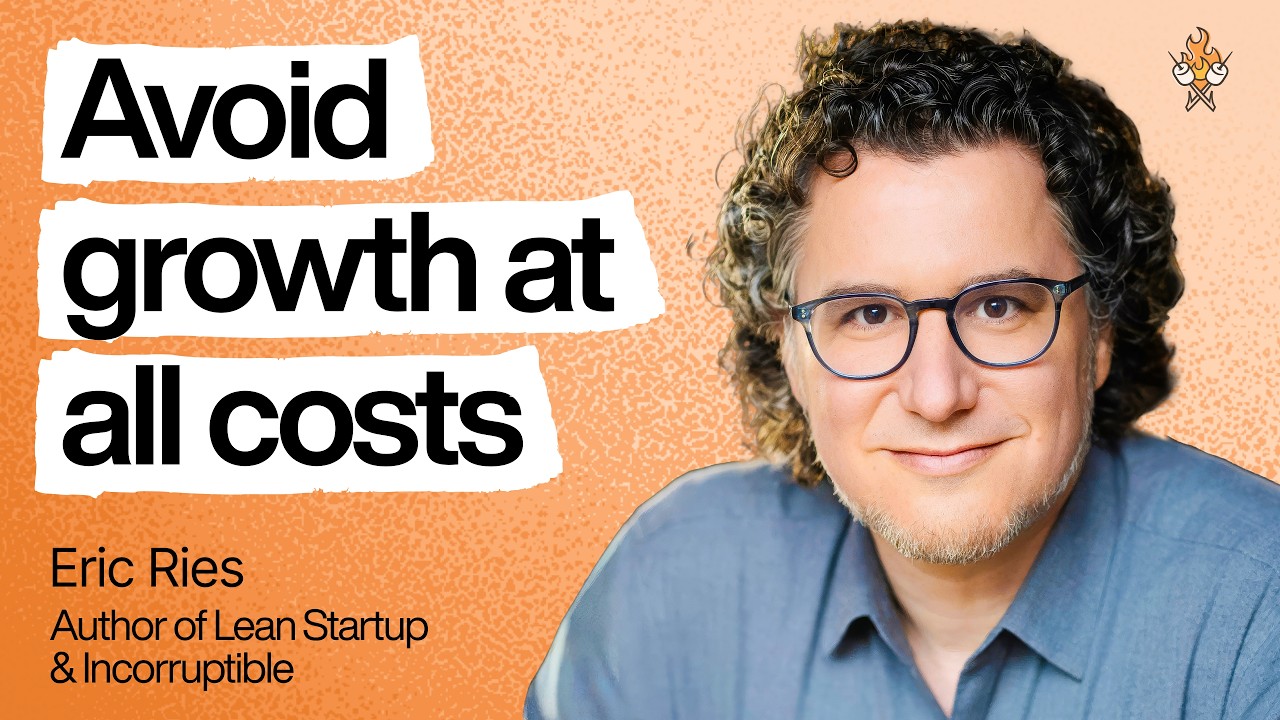
How Anthropic, Costco, and Patagonia all build incorruptible companies | Eric Ries
Description
Eric Ries is the author of The Lean Startup, a book that reshaped how a generation of founders think about building companies. His new book, Incorruptible, explains how successful companies are destroyed by failing to protect what makes them valuable, and how to change it. *In our in-depth conversation, we discuss:* 1. Why 80% of venture-backed founders are ousted within three years of going public 2. The governance structures that protect companies like Anthropic, Costco, and Novo Nordisk 3. The simple legal filing that takes two pages and could save your company 4. Financial gravity: why successful companies predictably get corrupted into mediocrity 5. Why mission-aligned companies like Anthropic reap major benefits from protecting their mission through governance 6. Why success won’t protect you—it instead makes you a bigger target *Brought to you by:* WorkOS—Make your app enterprise-ready, with SSO, SCIM, RBAC, and more: https://workos.com/lenny Vanta—Automate compliance, manage risk, and accelerate trust with AI: https://vanta.com/lenny *Episode transcript:* https://www.lennysnewsletter.com/p/how-to-build-a-company-that-withstands *Archive of all Lenny's Podcast transcripts:* https://www.dropbox.com/scl/fo/yxi4s2w998p1gvtpu4193/AMdNPR8AOw0lMklwtnC0TrQ?rlkey=j06x0nipoti519e0xgm23zsn9&st=ahz0fj11&dl=0 *Where to find Eric Ries:* • X: https://x.com/ericries • LinkedIn: https://www.linkedin.com/in/eries • Website: https://www.incorruptible.co • Newsletter: https://news.theleanstartup.com/ • Podcast: https://ericriesshow.com • YouTube: https://www.youtube.com/@theericriesshow *Where to find Lenny:* • Newsletter: https://www.lennysnewsletter.com • X: https://twitter.com/lennysan • LinkedIn: https://www.linkedin.com/in/lennyrachitsky/ *In this episode, we cover:* (00:00) Introduction to Eric Ries (02:26) Introducing Incorruptible (06:26) Protect
Summary
Generated by gpt-5.6-terraAt-a-Glance
- Verdict: Watch fully
- Core thesis: Eric Ries argues that successful companies are most often corrupted not by competition but by governance and incentive structures that make extraction easier than honoring their purpose, and that companies need both lived ethos and legally durable mission protection to resist this pressure.
- Why it matters: For AI companies and agent-system builders, the video translates alignment from an abstract technical concern into an organizational-design problem: a company cannot reliably build safe, trustworthy systems if its own governance rewards growth or liquidity over its stated constraints.
- Best use: Use this as a governance-and-operating-model design session: extract the PBC, mission-drive, director-oath, and mission-guardian concepts for discussion with counsel, investors, and the board before governance becomes difficult to change.
Executive Summary
Ries frames his new book, Incorruptible, as the companion to The Lean Startup: Lean helps create a viable company, while incorruptibility protects what success creates. His central diagnosis is “financial gravity”—the recurring drift in which companies that once stood for quality, customers, safety, or a mission become optimized for short-term extraction. In his account, this is not primarily a morality failure or an inevitable effect of scale; it is a structural failure that becomes visible when boards, incentives, and corporate charters can override the people and commitments that originally made the company valuable.
The operating half of the argument is that a mission statement is meaningless unless the organization cannot profit by violating it. Ries calls this “mission drive”: identify the people or principles to which the company is fiduciary, define the outcomes it owes them, and build accountability mechanisms as rigorous as financial reporting. He contrasts Cloudflare’s decision to make encryption free—despite near-term conversion costs—with Groupon’s gradual escalation from one daily email to many after local ROI experiments eroded the customer promise. The lesson is that principled decisions can produce trust, alignment, talent attraction, and velocity, but only when leaders treat difficult trade-offs as design constraints to solve rather than exceptions to abandon.
The governance half is more consequential for founders. Ries argues that conventional corporate documents often leave companies vulnerable to shareholder-primacy logic, takeover pressure, and founder removal. He recommends early adoption of a Public Benefit Corporation structure, explicit mission-protective provisions, and a director’s oath. For more durable protection, he advocates a “mission guardian” that is not merely the founder: examples include nonprofit foundations, perpetual-purpose trusts, employee ownership or voting trusts, and Anthropic’s Long-Term Benefit Trust.
Anthropic is the video’s central AI case. Ries says it incorporated as a PBC from inception and reserved the right to implement its later Long-Term Benefit Trust, whose trustees appoint directors to Anthropic’s for-profit board and do not hold Anthropic equity. His broader claim is that this institutionalized safety orientation is not a drag on performance: it can be a source of talent density, rapid decisions, product focus, and the credibility to decline revenue when doing so conflicts with safety. The transcript is advocacy rather than neutral legal or empirical analysis, but it offers unusually concrete organizational patterns for companies building high-consequence AI.
Key Takeaways
- Claim: Company corruption is best understood as an institutional design problem: success creates a valuable asset that boards, investors, and operators may be incentivized to harvest rather than steward. | Evidence: Ries cites Harvard Law School data that only 20% of founders of conventionally structured venture-backed companies remain CEO three years after going public. He also recounts a founder who was ousted five months after an IPO following a category shock, despite the same institutions having supported the IPO months earlier. | Implication: Treat governance as a core product-and-company architecture decision before raising capital or preparing an IPO, not as a late-stage legal cleanup exercise. | Caveat: The 20% statistic and anecdotal cases are presented by Ries without source detail in the conversation; they support the pattern but should not be used as standalone legal or empirical proof.
- Claim: A real mission requires “mission drive”: the company must be unable, or at least strongly disincentivized, from making money by betraying the commitments it claims to hold. | Evidence: Ries contrasts Google’s former “Don’t Be Evil” language with the apparatus that ensures quarterly reports are filed on time: reporting has formal systems and certainty, while ethical commitments lacked equivalent enforcement. He proposes identifying fiduciary commitments, relevant targets, and accountability systems, effectively applying OKR-level rigor to non-financial commitments. | Implication: For AI operations, define concrete non-negotiables—such as safety-evaluation thresholds, human-approval requirements, privacy constraints, reliability standards, or prohibited deployment classes—and connect them to release gates, ownership, audits, and incentives. | Caveat: Ries does not supply a standardized measurement framework; each company must determine its own commitments, metrics, controls, and trade-offs.
- Claim: The leadership principle “harder is easier” says that principled constraints can create compounding strategic advantage through trust, loyalty, alignment, and lower coordination cost. | Evidence: Cloudflare reportedly decided to provide SSL encryption free because an encrypted internet fit its emergent mission to “make a better internet.” The effort required lower-cost technical implementation and certificate-authority deals; premium conversion initially declined, but Ries says top-of-funnel growth later rose by an order of magnitude. He contrasts this with Groupon, where testing higher email frequency produced immediate revenue gains and eventually eroded the one-email-a-day customer promise. | Implication: When a mission-aligned action harms a near-term metric, do not default to abandonment; ask the team to solve the economic and technical constraint while preserving the commitment. | Caveat: Cloudflare and Groupon are illustrative cases, not proof that every costly principle will produce a favorable commercial outcome; the principle still requires a sustainable operating model.
- Claim: A Public Benefit Corporation is Ries’s minimum governance recommendation because it gives the company a legally stated purpose beyond generic lawful activity and helps defend directors against claims that they must maximize immediate shareholder return. | Evidence: He describes a Delaware PBC as a relatively simple filing that states a specific public-benefit purpose. He says Anthropic and other major AI labs use the structure, and argues it provides a defense if investors later claim that mission-oriented decisions breach fiduciary duty. | Implication: Have counsel review the current charter, incorporation status, fiduciary language, and amendment thresholds now—especially before priced financing makes changes politically harder. | Caveat: A PBC does not itself guarantee ethical behavior, mission adherence, investor alignment, or immunity from governance conflict; it is only one element of a broader system.
- Claim: For high-consequence AI, founder control is an incomplete solution; a durable company needs a “mission guardian” with formal authority and incentives distinct from equity maximization. | Evidence: Ries says Anthropic’s Long-Term Benefit Trust appoints directors to the for-profit board and consists of AI-safety experts without Anthropic equity. He presents Novo Nordisk’s nonprofit foundation ownership, Patagonia’s perpetual-purpose trust, Costco’s governance protections, employee ownership trusts, and employee voting trusts as alternative models. | Implication: Separate the question “who owns economic upside?” from “who can enforce the mission?” and design explicit checks, renewal mechanisms, and escalation rights for the latter. | Caveat: The transcript presents these structures favorably but does not compare their legal complexity, tax treatment, jurisdictional fit, capital-raising constraints, or failure modes in detail. Specialist governance and tax counsel is necessary.
- Claim: Anthropic’s governance is presented as a competitive asset rather than a sacrifice: institutionalized safety and mission alignment can improve talent attraction, decision speed, focus, and willingness to refuse unsafe or misaligned revenue. | Evidence: Ries says Anthropic was a first-time-founder startup before the generative-AI boom, became a PBC from inception, and later implemented its Long-Term Benefit Trust at Series C. He links its claimed technical and execution strengths to employees wanting to work for a company perceived as mission-aligned, and cites its alleged refusal to release models it considered too dangerous and a reported decision to decline a $200 million government contract. | Implication: For OpenClaw-like agent platforms, credible safety and user-interest constraints may improve recruiting and coordination only if they are visibly backed by actual release authority, board structure, and operational controls. | Caveat: The causal claim—that governance caused Anthropic’s commercial and technical performance—is interpretive and likely multifactorial; talent, research, capital, timing, and product execution also matter.
- Claim: The most important decisions are made when leaders are absent, so the real leader of a company is its internalized common purpose—Mary Parker Follett’s “invisible leader.” | Evidence: Ries invokes Follett’s view that a leader creates shared purpose rather than merely exercising power. He calls committed employees “torch bearers” and uses a “culture bank” rule: sacrifices made to uphold values are deposits; deliberate self-interested violations are withdrawals; leaders should only intentionally make deposits. | Implication: Build decision rules, tests, review mechanisms, and promotion signals so product, engineering, and operations teams make the intended trade-offs without needing executive intervention. | Caveat: Culture cannot substitute for governance: Ries’s own framework requires ethos and structural integrity together.
Detailed Brief
Concrete early-stage implementation sequence
- Claims: Ries argues that founders who have raised only on SAFEs or have not raised a priced round possess a fleeting governance-design advantage because they can change corporate structure with less investor coordination.; His test for a useful mission is adversarial: founders should spend roughly an hour trying to identify ways the company could profit while violating its stated purpose, then write those unacceptable cases out of the charter or governing commitments.; He prefers “mission-controlled” companies over the conventional binary of investor-controlled versus founder-controlled companies.
- Evidence: His first recommended action is PBC conversion or incorporation with a concise purpose statement.; His second is a director’s oath, analogous to a Hippocratic oath, made a condition of board membership.; His third is to use founder preferred shares and mission-protective provisions to establish board control or reserve future rights for a mission guardian; he suggests a charter can pledge future equity, revenue, or a board seat to a nonprofit before the nonprofit is operational.; Anthropic reportedly reserved the right to implement additional governance reforms from inception but did not establish the Long-Term Benefit Trust until Series C.
- Caveats: Specific share classes, voting rights, pledged equity, revenue rights, and director obligations are jurisdiction- and financing-dependent legal instruments, not templates to implement without counsel.; Ries’s suggested example of committing equity or future revenue to a foundation is illustrative rather than a universal recommendation.
- Implications: Create a pre-financing governance memo that specifies the intended mission, prohibited value-extraction paths, board-selection standard, reserved powers, and trigger for establishing an independent mission guardian.; Require prospective investors to respond explicitly to the company’s mission protections rather than treating their silence as alignment.
Why corporate alignment resembles AI alignment
- Claims: Ries argues that the hard alignment problem is not solely technical; it is also the human problem of determining and preserving the values to which systems should be aligned.; He applies Conway’s Law to suggest that an organization’s values and communication structure become embedded in the architecture and behavior of its software.; He describes companies as emergent intelligences or superorganisms: collective behavior can become more powerful than the intentions of any individual founder.
- Evidence: He uses an ant-colony “piano movers” puzzle as an analogy: many ants collectively solve a spatial problem that one cannot; he claims that adding humans can worsen outcomes unless they are carefully aligned.; He argues that no amount of “founder mode” can reliably fix harmful behavior that has become embedded in a company’s operating DNA.
- Caveats: The emergent-intelligence analogy is conceptual rather than an operational model for predicting organizational outcomes.; Conway’s Law does not establish that every organizational value will map directly to product behavior; it is a useful design warning, not a complete causal theory.
- Implications: Include organizational governance, incentives, and authority boundaries in AI safety reviews; they are upstream controls on the behavior of the systems and products the organization ships.; Avoid relying on founder judgment alone as the final safety control for agentic systems that may scale faster than founder attention.
Notable Concepts & Terms
- Financial gravity: Ries’s label for the organizational pull toward short-term extraction, mediocrity, and loss of founder or mission control as a company becomes valuable.
- Ethos + integrity: His core formula: ethos is internal alignment around a lived purpose; integrity is the structural capacity to keep promises and resist internal and external pressure.
- Mission drive: The requirement that a company’s systems, incentives, metrics, and accountability make fulfillment of its mission inseparable from its ability to profit.
- Harder is easier: The principle that accepting difficult mission-consistent constraints can generate trust, clearer decisions, loyalty, talent attraction, and long-term strategic advantage.
- Public Benefit Corporation (PBC): A corporate form that states a specific public-benefit purpose, which Ries presents as a minimum legal protection against a purely shareholder-maximizing interpretation of fiduciary duty.
- Mission guardian: An individual or entity formally empowered to protect the company’s mission when founders, management, or investors face conflicting incentives.
- Long-Term Benefit Trust (LTBT): Anthropic’s cited mission-guardian mechanism: an external trust whose trustees, described as AI-safety experts without equity incentives, appoint directors to the operating company’s board.
- Culture bank / invisible leader: The culture bank treats costly value-consistent decisions as deposits in trust and deliberate opportunism as withdrawals; the invisible leader is the common purpose that guides decentralized decisions when no manager is present.
Operator Notes / Why Ken Should Care
- Commission a charter and governance-rights review covering corporate purpose, voting control, director appointment/removal, fiduciary language, transfer/change-of-control provisions, and amendment thresholds.
- Create an AI mission-drive register: list non-negotiable commitments, the operational metric or test for each, the accountable owner, the release gate, and the escalation route when revenue goals conflict.
- Add a board-level safety and mission-protection protocol before adding strategic investors, major platform partners, or AI-industry directors with potential conflicts.
- Decide whether the appropriate long-term mission guardian is founder control as a bridge, an independent trust, a nonprofit foundation, an employee-based mechanism, or a hybrid; document the trigger and process for activating it.
- Pressure-test investor alignment by asking directly whether they support the company refusing an acquisition, deployment, customer, or revenue opportunity that conflicts with its declared mission.
- Audit product and GTM experiments for Groupon-style ratchets: any experiment that increases short-term conversion while degrading user trust should require an explicit mission review, not just statistical significance.
- Use automated evaluations, policy-as-code, access controls, and audit trails as organizational integrity mechanisms for agentic AI—not merely as technical quality infrastructure.
Source/Metadata
- Title: How Anthropic, Costco, and Patagonia all build incorruptible companies | Eric Ries
- Transcript words: 35846
- Duration seconds: 5962
- Timestamp note: No usable timestamps or chapter markers were present in the supplied transcript; the transcript also contains substantial duplicated passages.
Transcript
all kinds of famous companies. The thing that destroyed them was not competition. Their very success became a liability. I want to hear the OpenAI versus Anthropic story. Dario was a first-time founder. It wasn't a hot company at all. The boom hadn't happened yet. ChatGPT hadn't been invented yet. Nonetheless, they were true believers in this safety mission. And so one of their investors suggested they come talk to me. I told them, look, if you don't get this right, here's what's going to happen. They were very determined to do something about it. They wrote into their charter, Anthropic has directors on its for-profit board who are appointed by and are accountable to an outside group of trustees who are AI safety experts who do not have equity in Anthropic. Whenever you see Anthropic do the right thing, like when they refuse to release a model because they think it's too dangerous, think about how much that's costing them. This new book, Incorruptible, is about helping you protect what you've built. What is it that you need protection from? We all know this force. I call it the force that no one controls, but everyone obeys, that tends to drag organizations down into mediocrity to the point that we lose control of them. What's a broad-stroke solution to this? Harder is easier. If you're willing to be principled in your decision-making, you will get these unexpected rewards. But most leaders, when asked to defend their principles, can't do it because they've been taught ROI-based thinking, shareholder primacy. That's the path of maximum profitability. That's nuts. Today, my guest is Eric Ries, author of the most influential and impactful book in startup history, The Lean Startup. Today, he is back with a new book 15 years later called Incorruptible: Why Good Companies Go Bad and How Great Companies Stay Great. The way Eric describes the connection between these two books is that The Lean Startup was about helping you build a successful company, and this book is about helping you protect what you've built. Eric wrote this book because he's seen way too many founders lose control of their company and end up being very disappointed and depressed about how things turned out. This is not something that you hear a lot about, but it's a problem that every successful founder will face. Eric shares a ton of powerful stories and specific tactics and very specific advice for what you need to understand and do as a founder if you want to build something lasting. Before we get into it, don't forget to check out Lenny's Product Pass.com for a year free of the hottest and most well-crafted AI products in the world, available exclusively to Lenny's newsletter subscribers. With that, I bring you Eric Ries. Eric Ries, thank you so much for being here, and welcome back to the podcast. It's an honor to be back. Congrats on everything that's happened since I was here last time. Wow, thanks, Eric. For people that have been living under a rock, you famously wrote The Lean Startup 15 years ago at this point. Maybe the most impactful, successful founder startup book out there. And it feels like over these 15 years, if you think about it, it's gone through all these waves of, this is correct, the way to do it, and no, no, this is completely wrong. Why would anyone build this way? This doesn't work anymore. To, okay, this actually is right. I was actually just thinking about this as I was preparing for our chat. It feels like the way the top AI companies are building now is actually exactly Lean Startup. I just had the head of product of Cloud Code on the podcast, Cap. I saw, yeah. The way they operate: okay, we're going to ship the MVP. They don't call it that, but we're going to ship the MVP, research preview, get it out there, see if people care at all about this thing. We're going to tell you it's not ready for everyone, but it's out there. And then they iterate and build. I feel like people don't give you credit for, this is actually the way AI companies are operating now. I appreciate you saying that. It is funny how every wave, there's a backlash, and somebody writes the article, because of this, you don't need to do Lean Startup anymore. I remember when people wrote that about Quibi. They're like, Quibi proves that you don't need Lean Startup. And I was like, well, why don't we wait till the company is successful and then see if it proves it. But also, people forget this is not a religion. So what matters to me is not if people use the term minimum viable product or whatever. By the way, those aren't customer-facing terms. So a lot of companies that use these concepts, they don't talk about how they use them. They just use them internally. To them, it's just the obviously right way to go. And it's funny to me, one of the most important aspects of it that I think stands up really well, and it's been 15 years, is that so many of these AI products, leaving the models and the underlying technology aside, these specific products that have taken the world by storm, you can really tell that the AI labs themselves did not know they were going to be as popular as they turned out to be. Obviously, ChatGPT, they had no idea. Cloud Code, Cowork, these were small experiments in the grand scheme of things. They weren't the company's big bet. That's just so classic. That's a universal aspect of product development, that you do not have the ability to predict the future. And when you pretend, you get yourself in trouble. If you hold everything like a hypothesis, you get the benefits of the scientific method. It's pretty helpful. What you've built. I want to start with that second part of protecting what you've built. What is it that you need protection from? What's this corruption that you talk about that founders run into? Yeah, we all know this force. In the book, I call it the force that no one controls, but everyone obeys, that tends to drag organizations down into mediocrity to the point that we lose control of them. Sometimes we lose control of them because we get fired. We get ousted from our own company. Sometimes it happens because we're like Frankenstein and his monster. It starts to become malign or bureaucratic or, frankly, evil, and we can't figure out how to stop it, and all kinds of other ways. I had a front-row seat at this. I've been helping people build companies now for a long time. I've helped people create unimaginable amounts of wealth for themselves and for society. And I'm really proud of the work that they've done. I'm really proud of the bit part that I played in so many of these companies. And yet I've also seen this darkness. And it's not just founders getting fired, although we're obviously going to talk about that. The other day, I was out to dinner. I was with some friends. We were not at home. We were away from our usual spots. And so someone said, oh, there's this restaurant. I haven't been there in a couple of years, but it's really good. Let's check it out. We go, we sit down to dinner. They take one bite of the food, and then they're on their phone. And, just one sec, one sec. Yep, I thought so. It turns it around. I could tell that this restaurant got taken over by private equity. I could taste it. And I've told that story a bunch of times now, and so many different people have told me, oh yeah, I know what restaurant you're talking about. And then they name like 12 different restaurants. So what's going on that you can taste the ownership structure of a company in the food? How many people have had a famous brand that they love get ruined? I tell hundreds of these stories in the book, all kinds of famous companies where the thing that destroyed them was not competition. It was not someone else came up with a better product. No, their very success became a liability because the more gold in the goose, the greater the temptation to butcher. Wow. That's a very visceral example. I think about Vital Eggs as a great example of this. It was in the news, I don't know, on Twitter, TikTok, a while ago. It's the eggs that we've been getting forever. It's like pasture-raised, organic. Sure, sure. You have values in my fridge. Okay. I don't know if you saw this, but everyone was complaining about how they've gotten worse. And they have all the highest level of toxins. And then they're owned by BlackRock now, it turns out. No, I was just wondering about that. Oh, okay. Now that's my new favorite example. That's really funny. I didn't even know that. But yeah, it's so common. It's the point the greater the temptation to butcher. Wow. That's a very visceral example. I think about Vital Eggs as a great example of this. It was in the news, I don't know, on Twitter, TikTok, a while ago. It's the eggs that I, we've been getting forever. It's pasture-raised organic. Sure, sure. I got, you have Vitals in my fridge. Okay. I don't know if you saw this, but everyone was complaining about how they've gotten worse. And they have all the highest level of toxins. And then they're owned by BlackRock now, it turns out. No, I was just wondering about that. Oh, okay. Now that's my new favorite example. That's really funny. I didn't even know that. But yeah, it's so common. It's at the point now where I was doing an interview with someone who was telling me about a certain natural foods brand. And the name of the product is the name of the founder. I can't remember her name now. It's just her name. That's the name of the product. And she gets ousted by investors. And he's about to tell me the story. I said, let me guess what happened next. The board pushed her out in pursuit of higher growth, higher margins. As a result, we've seen lower quality and people, customers are super pissed, employees are pissed. And now it's starting to shrink market share. And he was like, how did you know? I thought you said you didn't know this company. This pattern is so pervasive. We don't even have a name for it. We live it every day, but we don't know what to call it. Well, I know what to call it. I know what our grandparents would have called it. They would have called this corruption. No legal bribery or embezzlement. No. This is like you're building a bridge. And if your bridge collapses, and, Lenny, I say you're an engineer. And I say, Lenny, why did my bridge collapse? If you're like, well, because of gravity, I'm going to be like, dude, yeah, thank you for that genius insight, right? I understand that that is correct in some very real way. We say, well, it's inevitable. It's greed. I call it financial gravity. There's this thing, human nature, when companies get big, whatever. Yeah. But I want to know, why did this bridge collapse? And more importantly, how come other bridges didn't collapse? And they say, oh, for that, we need to study the load, load factor, wind load, shearing tension. And we go look up close. We say, oh, look, all the metal bolts have been corroded. They're rusted. No wonder it collapsed. And then if you say, well, I want to build a new bridge, but I don't want this one to collapse. What can I do? You won't say, well, gravity, what can you do? No. You say, why don't we use stainless steel next time on the bolts? They don't get corroded. Oh yeah, good idea. So this book is about what are the organizational equivalents of stainless steel. And the book is structured not like a traditional business book, as you say, you picked up on that. It's much more like a mystery, a double mystery. First of all, why has this been going on for hundreds of years when we all think that the market selects for value creation? So this shouldn't happen. It happens all the time. But secondly, if it's inevitable, if it's caused by greed or age or size, why are there exceptions? You're actually going to give us answers and solutions to that, because it sounds like, okay, this is impossible. You actually have some answers for what founders can do. Real quick, I'll just say on the Vital likes thing, I'm not exactly sure if the toxins are real. There's a whole viral thing on it. I haven't looked into it super deeply. Okay. Well, we both have homework to do now because, yeah, it's what you feed your kids. You care. I'm definitely worried. Definitely worried to hear that. I want to talk about two things that are probably in people's minds as they listen to this conversation and even think about buying your book. One is, okay, I am not going to let this happen to my company. This is other people. They're weak. Maybe they're loose values. The other is just, do I really need to do this? There's so many companies that are killing it. I don't think they've done any of this. Why do I even need to pay attention to this? So maybe let's start with that first one, this idea. And this is a core thesis of your book. This is not an ethical values thing. This is a structural element of building businesses in the U.S. I'm going to make a claim that's going to sound radical, but I'll back it up. If you don't get this right, no other decision you make about your company will matter for the long term because you're not going to be the one making it. Okay. According to Harvard Law School, among venture-backed companies that have the standard best practices setup that you got from your lawyer, okay, only 20% of founders are still the CEO three years after going public. Okay. Just statistically speaking, everyone's being told by their lawyers, their bankers, their VCs, everybody, that you're the exception. It's not going to happen to you. But statistically speaking, you're much more likely to be in the 80% than the 20%. I'll tell you what story in particular. A very hot company came to see me a year or two before their IPO. They were planning IPO, and I built a long-term stock exchange. I've done a bunch of stuff that people come to me for advice about these things. They wanted advice. How can we structure the IPO? We want to think long term. We're really a mission-driven company, et cetera, et cetera. And I was going through their governance documents. I said, oh, good. You have all the best practices. So you're totally, I was like, the good news is you're so screwed. You're going to have to do something, right? You're guaranteed to get this mess. And I had all the data, just like I do in the book. Here are the examples, here are the case studies, here's the data. You need to know about this. And the founder was really concerned. He's like, okay, we're definitely going to do something about this. We're going to fix it up. But then he called me back a few months later. I said, well, what are you going to do? He's like, you know what? I talked to my bankers, talked to my lawyers, talked to my CFO, talked to my GC, talked to my VC, talked to my growth VCs. You know what they all said? They all said, man, Eric is such a downer. If he really believed in your vision, if he really saw how special you were, he wouldn't talk like that. You're the exception. I said, okay, man, good luck. This company went public, had a very successful IPO. A lot of people made a lot of money. And then five months into their IPO, a competitor gets acquired. And the whole category, everyone freaks out. Stock price collapses, and the founder is ousted after five months as a public company. Now, if you read stories about the company, people were like, oh, he made all these mistakes. Their business model sucked. The company, blah, blah, blah. Did he make mistakes? I'm sure he did. Were there problems? I'm sure. But hey, he really earned so little grace that he only got five months? The same people saying that the business model is horribly flawed invested in the company five months ago. Had it really changed so much in five months? This is what's going on. These collapses are all around us, and we're being told it's normal. This is just the way it has to be. But it's not. These are choices about the specific structures, cultural practices, the management practices we do on the inside, and the structural, the governance practices we do on the outside. Both of them, we're being told to do things that are incredibly weak. And again, if you think you're going to be the exception, think again. I'm excited to talk about what to do, these governance elements. But let's talk about this other critique that I imagine people have in their head of just, is this, okay, I need to figure out product-market fit first. Yeah. Yeah. I worry about it later. Exactly. There's so much more I need to do. The chances of this working are so low. Why am I, I have no time for anything else. Oh, totally. You said be. But it's not. These are choices about the specific structures, cultural practices, the management practices we do on the inside, and the structural, the governance practices we do on the outside. Both of them, we're being told to do things that are incredibly weak. And again, if you think you're going to be the exception, think again. I'm excited to talk about what to do, these governance elements. But let's talk about this other critique that I imagine people have in their head of just is this, okay, I need to figure out product-market fit first. Yeah. Yeah. I worry about it later. Exactly. There's so much more I need to do. The chances of this working are so low. Why am I, I have no time for anything else. Oh, totally. You said something interesting in the lead-in, which you said, well, a lot of other companies seem to be killing it, and they don't have these protections, so they're fine. I would actually check your math. So many times when people give me this argument, they were like, well, such and such company, I'm always like, Cloudflare, they are just a normal company. They don't do this stuff. I'm like, check your math, buddy. Cloudflare does many of the things that we talk about. They're one of the examples in the book, so I picked that on purpose. A lot of companies that you don't necessarily instantly think of as do-gooder mission-driven companies are actually very mission-driven in terms of how they're structured. And they are almost always protected by at least one of the governance structures from this book. So check your math. People used to tell me Costco was an example that wasn't protected, so much so that I was surprised to learn that it was embodied in a governance fortress. You'll be surprised if you do the math. If you look into it, you'll be surprised. But let's talk about the product-market fit thing, because this one is really interesting to me. Generally speaking, this is one of the most important ideas in the whole book. The most important question about how to protect a product is not what protections it needs, but when those protections need to be enacted. And it's basically that old proverb about the best time to plant a tree was 40 years ago, but the next best time is now. It is always too early until it's too late. And I'll give you the example. I've seen this hundreds of times myself personally. So I've literally been in the room where this kind of stuff gets discussed. And it starts like this. You're incorporating your company. You talk to your lawyer. Hey, I want to have, these are called mission-protective provisions in the law. I want to have, I heard this guy on Lenny's podcast, and the lawyer's like, oh, not again. Another guy, right? How many good ideas for Lenny's podcast are you going to tell me about? Okay, fine. What's this one? He told me I need to have mission-protective provisions. He'll pat you on the head and be like, oh, that's sweet, honey. That's great. Yeah. Get product-market fit. Get some success. Success is ultimately your source of leverage. Success will protect you. Don't worry about it. You say, okay, good. But thanks for letting me know. Now you raise some money. You got these VCs on your board. You say the same thing. They're like, yeah, I totally am with you. We're on the same page. We want the same thing you want. We invested because we believe in you as the founder. There's no need to do this now. Let's just do it later. Do it when it's the more appropriate time. Okay. You got a growth round. Now you got these bold contrarian growth VCs on your board. And they're like, I don't know. You might not want to be too different from everybody else. Might make it hard to raise money. You're like, I thought you were a bold contrarian. What? Okay. Don't worry about it now. We can always do it later. Now you're doing IPO prep. Now you got bankers and lawyers and you've got a GC, and they're all like, yep, yep. This is a great thing to bundle with the IPO itself. You don't need to worry about it now. First, we got to land the plane. Let's get our house in order. Anyway, I've actually been in the room where the founder sits with the CFO, and now it's IPO-planning roadshow. Here we go. It's go time. We're about to file the papers. And the founder's like, hey, whatever happened to those mission-protective provisions? They're like, I wanted to really make sure our customers could participate in our IPO, and I want broadly shared prosperity, and I want this thing for our employees. And that was good stuff I want to do. Do we do any of that stuff? I don't see it in the S1. The CFO is like, oh, you were serious about that? Oh, sorry, man. You should have said something. Now it's too late. You're like, wait a minute. When I talked to you about it last year, you said it was too early. Yeah, it was, but now it's too late. Was it ever the right time? No, it is never the right time to do this. If you put this off, you will eventually find yourself in a situation where you can no longer do it. You will have lost the leverage. Success will not protect you, because success is what makes you a target. That story I told you about the five-month CEO who got fired, that company, everyone who worked on that IPO, every banker, every lawyer, the CFO, everybody, they profited from all the transaction volume that that company generated on the way up and on the way down. They're all fine. They're all onto the next IPO. They're onto the next thing to feed on. Meanwhile, the customers, the employees, the people that cared about their company were not so lucky. Damn. That hit me right in the heart. And it's so obvious just how personal and important this is to you. It's clear you've just seen this happen again and again. Oh yeah. I've been in the room where it happens. The proverbial room. Okay. So let's talk about what people should do, and we'll poke around in different directions. What's the broad-stroke solution to this? And then what are, say, three things an early-stage founder should do this week, next week? Yeah. Yeah. Yeah. Okay. So broadly speaking, there is a blueprint. I promise when we talk about the horrors of living in late-stage capitalism, it's easy to get depressed and just be like, literally part one of this book is called The Shape of the Abyss. So I'm not trying to sugarcoat it. This is quite grim. And if you haven't studied these case studies, if you don't know the story of Whole Foods and what happened to it, if you don't know the story of Victoria, you don't know these stories, they're really grim, and it's important to grapple with what happened so that it doesn't happen to you, so that you're prepared. But it can feel like we're so helpless. But as I said, this is a double mystery, not just why does this happen, but how can there be exceptions to a rule that's inevitable? So let me just tell one more story, and then we'll get really into the tactical details. Because I want to really give, I want some stories that we can use as our fact set, our database to draw these principles out. And so the blueprint, I'll give you the spoiler alert, I just mentioned before, ethos plus integrity. That's our formula. Ethos meaning internal alignment, character choices; integrity meaning the structure to resist, to keep ourselves aligned with human flourishing. Let's go back in time a little further this time. We're going to go to 1920 Denmark. Okay. I want to tell you about a woman named Marie Krobe. She was one of the first doctors to practice in Denmark, a credentialed doctor. She was a big advocate for women's medical education, and she lived a very cool life in her own right. But she's famous today mostly because of her husband, August, who had just won the Nobel Prize. He was a very famous scientist. And she, unfortunately, right around the same time, got diagnosed with a fatal illness, an illness for which there was no known cure at that time. It was called diabetes. So she gets this death sentence right as he's winning the Nobel Prize, and he asks her, would she come with him to North America for his lecture tour character choices, integrity, meaning the structure to resist, to keep ourselves aligned with human flourishing. Let's go back in time a little further this time. We're going to go to 1920 Denmark. Okay. I want to tell you about a woman named Marie Krobe. She was one of the first doctors to practice in Denmark, a credentialed doctor. She was a big advocate for women's medical education, and she lived a very cool life in her own right. But she's famous today, mostly because of her husband, August, who had just won the Nobel Prize. He was a very famous scientist. And she, unfortunately, right around the same time, got diagnosed with a fatal illness, an illness for which there was no known cure at that time. It was called diabetes. So she gets this death sentence right as he's winning the Nobel Prize. And he asks her, would she come with him to North America for his lecture tour anyway? And she says, yes. So the two of them travel to North America. He's going around talking to scientists about his Nobel Prize. And one night at dinner, Marie is sitting next to a scientist who tells her, hey, actually in Canada, there are these researchers who have figured out a new technology to isolate a substance called insulin, a potential cure for diabetes. So Marie convinces her husband, we should end our trip, go to Canada, see this thing for themselves. They do. They are both scientists, so they instantly understand the implications. This could not only save Marie's life, but millions more. So they talk to the Canadians, could we commercialize this technology? And the Canadians say they're open to it, but everyone involved has a concern. We've been talking so far about the concern of being forced out of your company or having it taken away from you. That is one danger, but there's also the temptation to harvest what others plant, the temptation to exploit, to extract instead of creating new value. Maybe we're worried about that. Now, Lenny, I want you to imagine this scenario with me. Okay. Imagine that I depend on you for a life-saving cure. I have diabetes. You're the only maker of insulin in the world. In that case, I would want you to charge me a fair price. Very much so. It's both morally right, fair, but also I want you to have every incentive possible to keep making the drug. Otherwise I might die. Okay. But what if one day you wake up and you're like, wait a second, I don't have to charge Eric a fair price. Or you have investors whispering in your ear, Lenny, you don't have to charge him a fair price. You can charge him anything you want. That's what I would live in fear of. So decades before Martin Screlli actually did this as a business strategy, the crows and the Canadian scientists, they were worried that this might happen to their new company. So when they went back to Denmark to create this company, which they called the Nordisk Insulin Laboratorium, they incorporated it using this very particular structure. It is a for-profit company. It does have outside investors, but it is owned, governed by a nonprofit foundation, a two-tiered structure that's called an industrial foundation in the literature. And if Nordisk Insulin Laboratorium sounds familiar, it should. This is the predecessor company to what we today call Novo Nordisk, one of the largest companies in the world. And what's so interesting to me about this story is this structure has endured and protected the ethos of scientific integrity of Novo Nordisk for more than a hundred years. Meanwhile, so many of the best practices that your lawyers, your bankers, your advisors have, they're going to be pushing best practices on you that are younger than the trees in your local park. And so what I want for everyone who's listening to this, founders, product managers, leaders, board members, I don't care, the next time someone comes to you pushing a best practice and you're like, oh, I guess I have to do it this way because we live in an ROI-dominated culture. We have to stack rank by ROI or whatever the practice is. I want you to be like, well, that person sounds very smart. They're very well credentialed. They went to business school or whatever. But ask yourself, are you sure they're smarter than a Nobel laureate? Because August and Marie worked this out a hundred years ago, and it has held so many attacks. In fact, I tell a story in the book and, honey, I know you're going to think I'm exaggerating, or I know at least some of your listeners are going to think, oh, America's an exaggerator. I promise you this is a 100% true story. The trustees of the nonprofit foundation once had to intervene to protect the for-profit from this exact temptation to want to sell it out. And I won't get into the whole story. They did the right thing in this case because they had the legal power to do so. Their intervention ultimately created more than $500 billion of shareholder value. I didn't add an extra zero for emphasis, $500 billion. So when people hear about these things for the first time, it's natural to feel like we're talking just about business ethics or mission. It's some extra nice-to-have thing that after you do the real serious business, now you worry about this stuff. No. This is one of the most powerful engines of value creation in the world. And for a lot of people listening, this will be the first time you're hearing about it. But just because it's new to you, does it make it new? The German optics company Zeiss, which makes the lenses in my glasses and yours too, had this structure in 1885. So I think it's really interesting that we have enough of these examples to know that there's nothing inevitable about this financial gravity. We actually have a data set that can be studied. There's a whole branch of academic research that has shown, for example, companies with that structure, like Novo and Zeiss, are six times more likely to live to year 50 compared to their conventional counterparts. They have superior return on invested capital. They make more money for investors. They're better in so many ways. So it's a bit of an open secret that these techniques exist. So I want us to have these stories in our mind because it's going to sound, as we get into the techniques, some of them are going to sound radical. We want to say, wait a second, is this really doable for me? I'm just a little startup. I'm just trying to get product-market fit. Why are we talking about this long-off stuff, 100-year-old companies? No. August and Marie were a tiny startup too once. Yeah, that company's worth hundreds of billions of dollars. So before we get into that, let's remind people again why this is worth doing. Because it's going to sound like, oh my God, this is so annoying. I have to do all these weird things, and no one else is doing them. I have to convince all these people. This is not going to limit us and not hurt us down the road. But let's remind people again why this is important, why this is so painful if they don't do it right. Josh, there's so many things to choose from. So much pain, so much pain. I'll tell another story. We've been telling happy stories. Let me tell you a not very happy story. So I've been doing this exercise for many years where I would ask founders or leaders of any seniority, I'm just like, listen, before we get into the details, first tell me who you think is the most evil company in the world. And people sometimes instantly know who to say. They're like, oh, I know. But some people are like, what do you mean evil? I'm like, the company where there's no amount of money they could offer you that you would go work there. You know they're up to no good. Everybody has a company like that in their mind. I don't know if you want to say who it is for you. Maybe I understand if you don't want to, it's okay. But for the sake of us having a hypothetical that we can use, I would always tell people, we go around the room, some of them all on Zoom, everyone puts it in the chat, right? And there'll be someone will be like Halliburton, and someone else will be like, increasingly tech companies are showing up on these lists now, which when I was younger, that would never have been the case. But now you sometimes see tech companies there. Some of them say Monsanto, or some private equity fund. People are mad about something. They can name a company usually. So it's not hard to find examples. Now, my father was a pulmonologist growing up, so I was raised that Philip Morris is the most evil company in the world. So we'll just use that as I'll just, for the sake of us having a hypothetical that we can do, I would always tell people, we go around the room. I go on some of them all on Zoom. Everyone puts in the chat, right? And there'll be, someone will be like Halliburton, and someone else will be like, increasingly, tech companies are showing up on these lists now, which, when I was younger, that would never have been the case. But now you sometimes see tech companies there. Some of them see Monsanto, or you see some private equity fund. People are mad about something. They can name a company usually. So it's not hard to find examples. Now, my father was a pulmonologist growing up, so I was raised that Philip Morris is the most evil company in the world. So we'll just use that as our hypothetical, just for the sake of argument today. If you think Philip Morris is great and you have different values, whoever's listening, fine. You pick the company you really would never, ever, ever want to have to work for, no matter what. Now I ask people to imagine the company they currently work at. If you're a founder of your company, if you're an employee, your company, but the company you hold dear, just imagine Philip Morris shows up one day and says, I'd like to buy this company from you for $1 more per share than it's currently worth. You selling? Most people are like, hell no, hell no, I'm not selling. One person once asked me, well, what are they going to use it for? Oh, sorry, to be clear, they're going to use it to sell cigarettes to children. Now you selling? Yeah. No, no deal. Obviously F no, but I can't actually say on your podcast the kind of things people say when they are presented with this, because there might be children listening. Okay. People get real upset at this idea. And when we talk about it, I'm like, okay, well, did you know that according to the legal documents you yourself signed, your company's literal charter that you have right now, and this is not some hypothetical future thing, you've already put in motion a rule that says you have a fiduciary duty to say yes, yes, in this situation? People are so outraged. They're like, that cannot be right. My lawyer, my guy, he would never have done that to me. I'm like, call him up, ask him if what I say is true, and call me back. And they're like, he said he was doing me a favor by giving me the best practice documents to make it easier to raise money. Yeah. So occasionally, though, people will say, Eric, you are exaggerating. That is not, yes, that can happen, but come on. Does that really happen in real life? Is that something I really need to do? I'm Johnny at product market. Do I have to worry about it? So before you tell me I'm exaggerating, I want you to consider this from the perspective of the founder scientists of the Vectora corporation. Now, Vectora was a UK company, a spinout from the University of Bath. They made inhaler therapeutics for asthma and COPD. You've seen inhalers. Yeah, a medicine company. They were really successful. They raised money. They went public on the London Stock Exchange. And one day, the actual Philip Morris tried to buy them, okay? I only know this story because I've been using the Philip Morris example for years, and when I was researching the book, I was like, I wonder, I actually asked Claude, has anybody, has anyone ever actually been bought by Philip Morris? I stretched out the hypothetical, and it was like, are you asking me about Vectora? And I was like, tell me more. There's this company. This is what happened. Philip Morris said they wanted to diversify beyond nicotine. And they were like, oh, we know a lot about inhaling things, so having an inhaler company makes, anyway, normal people hearing about this were like, this doesn't make sense. Why would big tobacco own a health company? That doesn't seem right. So here were the three choices that were facing the Vectora board. They had this bid from Philip Morris for 165 pence per share. They had a bid from an American private equity firm for 155 pence per share. Or, door number three, they could just stay independent because there was really no problem. The company's doing fine. The public in the UK was super outraged. The British Thoracic Society begged them to say no. Every person who thought about this for five seconds could see this was going to be a massively value-destroying error. But the only people that mattered were the people on the board of directors of the Vectora corporation. They had, I think, two meetings about it, and they just said, our hands are tied. We have a fiduciary duty to accept the highest bid, which they did. So yes, if you think I was exaggerating, I said it was a dollar per share. In real life, it was more like 15 cents a share. So let's find out what happened next, shall we? Can you guess? Not great. Philip Morris spent 1.1 billion pounds to buy Vectora. Within three years, they had taken a $900 million writedown and disposed of the company for parts. It doesn't exist anymore. To me, these are the stakes. This is what happens. And I can't tell you, I feel like Perry Mason sometimes when people are like, I would never do that. I'm like, okay, I hear you have good intentions, but can I please see your signature on the document? Oh, look, Delaware charters are public record, by the way. If you ever want to know, if a friend is a lawyer, just, you want to know if a company has a mission or this is going to happen to them, just pull the charter. You can just read it, read it for yourself. I'm like, is this your signature right here? You yourself signed this document, and you don't even understand how your company works. These are the stakes I think are significantly essential, especially now that we're entering an age, the age of wonders, the age of technologies that are incredibly powerful, that have planet-scale consequences to them. I think a lot of founders, a lot of product people, want to build a product that they can be proud of, that their grandkids will be happy to hear that that's how the family fortune was made. And I know a lot of people that are incredibly rich and so miserable because the thing, their baby, it got ruined. It got destroyed. Why are we doing it? Okay. Let's talk about what to actually do. And this is going to be a high-level overview. Obviously, buy the book if you really want to get serious about the stuff coming out May 26. May 26, yes. Thank you. Anywhere you buy books. Talk about what we should do. And I just want to plant the seed of OpenAI. It's probably on people's minds as they hear this idea of building a nonprofit. Yeah. Yeah. We'll get there. And obviously, in the book, I tell the Anthropic story where I played a bit part. So we'll get to all that. We'll get to all that. But let's start with the easy stuff first, because AI is humanity's final exam. You've heard that joke. These issues are so amplified in AI. Of course, we have to get it right. I think it's incredibly important, and I've done what I can to set us on that proper path, but it's easier to see it, I think, in simpler businesses. OpenAI's business is insanely complicated. So let's look at it in some simpler examples first. Let's start with the principle I call harder is easier. This is the leadership principle that anybody can adopt. There is truly nobody who, if you tell me you have no power whatsoever, everyone's got some influence. And if you have any influence at all, you can adopt this principle. When I talk to people about business, I don't care if I'm talking to two guys in a garage, founders, or I'm talking to super boards or CEO, C-suite, whatever. Everyone always says to me just what you were saying a minute ago. It's like, man, Eric, business is already so hard. Now you want me to do extra. Now I got to worry about the Vectora thing and this other stuff. Man, I'm already just trying to get through the day. It's so hard. But I think this is a backwards way of looking at it because I ask people, could it be, just consider the possibility, that one of the reasons you're finding business so hard is that nobody trusts you? If they trusted you, maybe it would be a you can adopt this principle. When I talk to people about business, I don't care if I'm talking to two guys in a garage, founders, or I'm talking to super boards or CEO, C suite, whatever. Everyone always says to me, just what you were saying a minute ago. It's, man, Eric, business is already so hard. Now you want me to do extra. Now I got to worry about the Vectora thing and this other stuff. Man, I'm already just trying to get through the day. It's so hard, but I think this is a backwards way of looking at it because I ask people, could it be, just consider the possibility, that one of the reasons you're finding business so hard is that nobody trusts you. If they trusted you, maybe it would be a little bit easier. Now, actually, this is not a supposition. We have really good evidence. Companies where their employees trust them spend way less time on employee communications. They have much better alignment. Everyone's rowing in the same direction. When customers trust you, they are, of course, way higher loyalty. Your cost of customer acquisition is lower, but also customers are more likely to stick with you after you make a mistake. They're more likely to try your new product. So many people are like, God, customers are so fickle. They have no loyalty. They only care about the slick marketing from our competitors, but maybe because you view these things as extra is part of the problem. So harder is easier is a principle that says if you're willing to do the work upfront to commit to quality, to design, to ethics, to integrity, to safety, whatever the thing, I don't want to tell you what your values are. You tell me what they are. If you're willing to be principled in your decision-making, you will get these unexpected rewards. Now you can't do it for the reward or it doesn't work. You have to do it for the thing itself. Trustworthiness is the most underrated asset in all of business. Trustworthiness. And the things that create trustworthiness by definition stack rank to the bottom if we do it by ROI, because doing the right thing has intangible rewards, but tangible costs. So let me give you another story because now we've been talking about lofty stuff and I want to talk about something super practical. And that's, I mentioned Cloudflare before. So let me actually tell the Cloudflare story. I like Cloudflare because Matthew Prince and his co-founders, they were really anti-consulting BS talk. They didn't want, in the early days, they came out of Harvard Business School, and so they were traumatized. They were just like, no, I don't want to hear about mission statement. I don't want to hear about values. It's just, we are making a firewall and putting it in the cloud. It's not that complicated. We don't want to hear it. So for years they had no mission statement. And this is a critical point. As leaders, we get so focused on value statements, mission statements. We forget the mission statement is not the mission. The map is not the territory. Mission is an emergent property of the living super organism of the thing we're birthing. Okay. It's not something you can slap on with a label. You have to build it in. You want to have a company that stands for quality. You've got to build quality in from the inside. Deming taught this in the forties. This is not some new idea. This is a critical idea. This is what craftsmanship really means. Okay. So we know that Cloudflare had a mission because quite often they would do this harder is easier stuff. And without even really knowing why, there's a very famous example in their history where pro-democracy protesters, I want to say, I forget what nation state they were pissing off. I better not say it because I get it wrong. Pissing off some nation state, were having state-sponsored hackers try to take their websites down so they couldn't coordinate their pro-democracy protests. They were going around Silicon Valley, begging big tech companies to help them defend their websites. No one would do it. All these big mega companies, even Google, where it's just like, I'm too scared. And so Cloudflare, the tiny startup, is like, we'll do it. These were free tier customers. They weren't even paying any money. And they're like, yes, we will incur the wrath of nation-state-level hackers to protect you because it's the right thing to do for no reward whatsoever. That was just the kind of company they were. So anyway, a couple of years in, they're having lunch and one of the engineers says, you know why I like working at this company? I just feel like it's the first place I've worked where we're trying to make a better internet. And everyone at the table is like, yeah, make a better internet. Someone asked Matthew, oh, is that our mission statement? Matt, no, we don't have a mission statement. What are you talking about? No. But it actually was. Over time, the engineers, people who worked there, kept saying, make a better internet. That was how we talk about it. And eventually the founders had to be convinced, okay, let's adopt this as our mission statement, which they did. That is their mission statement to this day. They had to eventually adopt formal values. As you get bigger, these things really matter. It matters that you document those emergent properties. Otherwise, how are people supposed to know what they are? Their number one value, by the way, is be principled, which is the ultimate harder is easier move. So this all sounds great. It's fun to have values. It's fun to have a mission statement when it doesn't cost you anything. But sometimes it can be very expensive. It can make your life a lot harder. That's why we call the principle harder is easier. One day, an engineer, a junior engineer, not some senior executive or anything, walks into Matthew Prince's office and he says, boss, is it our mission statement to make a better internet? Uh-huh. When you're a CEO, any conversation that starts this way is definitely going to be extra work for you. So you're like, what is it now? It's like, well, you were saying at the board meeting that our number one driver of revenue, the thing that causes people to upgrade from our free to premium plans, this is a few years ago now, is web encryption, SSL encryption. Right? You said that makes sense because SSL encryption is expensive to offer. We can offer it for free. We have to get the certificates and pay for them. We have to do all this extra cryptographic stuff as compute. We have scarce compute, da-da-da-da-da-da. Sure. But boss, wouldn't a better internet be an encrypted internet? And he's like, yes. So what's your point? So, why are we, it would be better. Why are we giving it away for free? And so many people have heard this story. If you've ever been a middle manager in a company, okay, you know this, you're just like, oh my God, every day someone walks into your office. It's like, hey boss, let's give our product away for free for no reason. Okay? Your job as a middle manager is to be like, no, we have a strategy. Get back on the strategy, right? Redirect. Hey, thank you for your buy-in and your input, but we have a job to do. So everyone's expecting Matthew to react that way, and it would be the most normal thing in the world. This is our most profitable product, and you're saying we should give it away for free. Get lost. No. Matthew told me, once I saw it, I couldn't unsee it. And he uttered the three key words. He said, let's figure it out. Figure it out. This is the leadership principle I think is so powerful, the figure it out principle. When you're committed to something, you stand for quality or whatever, it's going to make life harder. The best leaders, the ones I really admire, they revel in it. They love the difficulty because every time you have one of these impossible dilemmas, it's a chance to teach what you really stand for. So Matthew insisted the whole team rally to figure out how to give encryption away for free. Now they couldn't just give it away for free. He's like, bankrupting the company won't achieve the mission. We had to find a way to make it sustainable. And I won't go through all the technical details of how they managed to get the cost. They had to hand roll their own software in assembly language. They had to do these complicated biz dev deals with certificate authorities. They figured out how to do it, and they drove their own cost down. Now keep in mind that at any time, first of all, I could have used the difficulty as an excuse. Oh, whatever, it's going to make life harder. The best leaders, the ones I really admire, they revel in it. They love the difficulty because every time you have one of these impossible dilemmas, it's a chance to teach what you really stand for. So Matthew insisted the whole team rally to figure out how to give encryption away for free. Now, they couldn't just give it away for free. He's like, bankrupting the company won't achieve the mission. We had to find a way to make it sustainable. And I won't go through all the technical details of how they managed to get the cost down. They had to hand-roll their own software and assembly language. They had to do these complicated biz dev deals with certificate authorities. They figured out how to do it, and they drove their own cost down. Now, keep in mind that at any time, first of all, I could have used the difficulty as an excuse. Oh, it's too hard. We can't do it. Give up. Once they did it, they could have said, wait a minute, this is just free margin. We can make our costs lower, and then we just get free money. When they shipped it, they had to report to their board on what happened. The conversion rates for their premium product went down. So they could easily have bailed out at that point, but they didn't. They stuck with it because this is what we stand for. Now, of course, it's a happy ending story. The top of funnel increased by an order of magnitude. In fact, to this day, people still talk about how Cloudflare is the reason you take for granted that we have an encrypted internet. The trust that they gained is the reason why they're a $70 billion company today. But most leaders, when asked to defend their principles, can't do it because they've been taught ROI-based thinking. They've been taught shareholder primacy. They've been taught that that's the path of maximum profitability. To give you an easy contrast, Andrew Mason, the founder of Groupon, once told me this story. Everyone remember Groupon? Maybe not now. It's fallen out of public consciousness. But there was this time when Groupon was one of the fastest-growing private companies in America. It was powered by a daily email with a cool deal. And the whole thing was, you got one email a day from Groupon. They went public on the one-email-a-day model. That's how successful it was. And I remember he told me this story. One day, his executives and employees started coming into his office, and they'd be like, boss, we need to make the quarter. We need to make more money. We're a public company now. We know one email is good. Have you considered two emails? And he was like, no. One email a day. He's like, that's our whole thing. But he said over time, they ground him down. And they kept saying they were using language that sounds lean-startupy. Shouldn't we do an experiment? Shouldn't we look at the data? What about the ROI? It's just like, what about the ROI? And so he's like, all right, fine. We'll run the experiment. He ran the experiment. Two emails a day makes more money. So he couldn't say no. And everything was fine for several months until someone came into his office and said, boss, you know what would be better than two emails? You should send three emails. And next thing you know, they're sending eight emails. And this is not just Groupon. I have had so many CEOs tell me this exact story about email frequency. Email frequency is, for some reason, the tip of the spear, where it's like, we don't really have any way to defend doing the right thing here. So we do the wrong thing that destroyed the whole company. But in the short term, we made a bunch of money. So if you can stick to the harder-is-easier principle, that is the first line of defense against losing whatever it is that makes a company special. Eric, you're such a wonderful storyteller. I'm just sitting here compelled. Well, thank you, man. I am so excited to tell you about this season's supporting sponsor, Vanta. Vanta helps over 15,000 companies like Cursor, Ramp, Duolingo, Snowflake, and Atlassian earn and prove trust with their customers. Teams are building and shipping products faster than ever thanks to AI. But as a result, the amount of risk being introduced into your product and your business is higher than it's ever been. Every security leader that I talk to is feeling the increasing weight of protecting their organization, their business, and, not to mention, their customer data. Because things are moving so fast, they are constantly reacting, having to guess at priorities, and having to make do with outdated solutions. Vanta automates compliance and risk management with over 35 security and privacy frameworks, including SOC 2, ISO 27001, and HIPAA. This helps companies get compliant fast and stay compliant. More than ever before, trust has the power to make or break your business. Learn more at Vanta.com slash Lenny. And as a listener of this podcast, you get $1,000 off Vanta. That's Vanta.com slash Lenny. I want to talk through what you do. So there's write a mission statement. Values, is that a part of this? Just define your values. Talk about a bullet point. So again, no, writing the statement is not valuable. Okay. The statement is not what it is. The reason I would use the old-fashioned word ethos, I tried to write this whole book without using any trendy consulting language at all. So I tried not to use the word stakeholder. I tried not to use the word culture. I tried to really go old-fashioned. That's why I started with Saul Price. Rather than talk about stakeholders and mission statements and values, I want to know, who are your fiduciaries? It's a real old-fashioned word, fiduciary. But to me, the question every leader has to answer, and every product has to answer this question, is: What is its purpose? Who would you rather die than betray? Okay. So if you tell me, I want to have a high-quality product, that's what I would rather die than ship sloppy. Think about how Steve Jobs was. This is a guy who would fight with people over the layout of the wires inside a computer he didn't want customers to be allowed to open and ever see. That's so classic harder is easier, right? It has to be a certain way. If you know stories about Yvon Chouinard, the founder of Patagonia, today he's more famous for his environmental activism, but he was a quality zealot. He believed that quality was an objective function and that every product had a quality level that it deserved. Most people think that's insane. That's why Patagonia is such a success. That idea is powerful. So whatever that thing is, that purpose, we have to find ways to encode it in our management system so that there's no way for us to make money by betraying the principle, whatever it is. So this can happen both at the operational level and at the governance level. Both are really important. People hearing this, I know some people are going to be like, purpose? Is this some ESG nonsense? Okay. There's a very funny quote in the book. Unilever, the big food giant, went through a phase a couple of years ago where they were going to infuse purpose into all of their products. And a Wall Street investor had just had it with this, wrote them a nasty letter. It was like, look, at the point that we're debating the purpose of Hellmann's mayonnaise, I think you've lost the plot. And I love that quote because it's funny, but actually what's so funny about it to me is, humble though it is, Hellmann's mayonnaise is food. Its purpose is super clear. And again, if you think it doesn't matter what the product manager who runs Hellmann's mayonnaise thinks the purpose is, going back to our Vital Farms question, think how easy it would be when an efficiency consultant shows up and says, you know, I think we could save three cents on the bill of materials if you just make the container thing carcinogenic. And you're like, oh, wouldn't that come back to bite us? Yeah, but long after your stock options are vested, buddy, what do you care? If the product manager thinks their purpose is quality, that matters. If they think their purpose is extraction and exploitation, it matters. Again, if you think I'm exaggerating, the product managers at Johnson & Johnson put asbestos in the baby powder and covered it up because, although they said their purpose, their mission statement, was patient health, their actual mission had become growth optimization, quarterly targets. So what we want to do is, that's the first most important technique. It's like, what is the purpose? Who would we rather die than betray? You got to write it down. efficiency consultant shows up and says, I think we could save three cents on the bill of materials if you just make the proof, the thing carcinogenic. And you're like, oh, wouldn't that come back to bite us? Yeah. But long after your stock options are vested, buddy, what do you care? Dr. Justin Marchegiani If the product manager thinks their purpose is quality, that matters. If they think their purpose is extraction and exploitation, it matters. Again, if you think I'm exaggerating, the product managers at Johnson & Johnson put asbestos in the baby powder and covered it up because, although they said their purpose, their mission statement, was patient health, their actual mission had become growth optimization, quarterly targets. So what we want to do is that's the first most important technique. It's like, what is the purpose? Who would we rather die than betray? You got to write it down. You got to say, as Saul Price did, customers first, employees second, shareholders last. Or the great Peter Drucker said it was actually, he said that that's backwards. It should be employees first, customers second, shareholders last. I don't care. You tell me what you believe. You got to write it down. And then we have to do a thing I call mission drive. Companies that claim to be mission driven, most of them are just mission hopeful. Okay. It's just a candy coating on top of an extractive engine. Sorry, I don't buy it. If you're serious about being mission driven, you have to show me that you cannot profit except by achieving the mission. That's the audit we have to do. We have to look at if we were to, if someone in the company got tempted to cut quality, to cut corners, to decrease performance, to deal with the things that tend to get cut first: safety, performance, quality, design. Those are always the most vulnerable. Innovation, I guess, is fifth. So that's the five horsemen of the apocalypse. You can get rid of those things and nothing bad happens right away. Because the whole point of trust is I can betray you and you wouldn't even notice. So those are the canary in the coal mine. Is there any way, is anyone's bonus target, is our OKR system, is there anyone in this team? And again, you can do this at the company level, of course, but you're just a team, a team of five. Is there anyone on this team who could profit by betraying one of our principles? Is it possible? And I mean, is it really possible? And this is actually why automated testing is so good, right? Think about how many people can just break the design and no one even notices. Well, if a test notices with AI, we have so many new capabilities for auditing, for preventing, for making sure, but we have to choose to use the tools for that. That's one. So that's kind of the general category of things that we can build. And so, just to make sure it's clear, it's write down your purpose, whatever that is. And I imagine it's like a sentence is the idea. Yeah, that'd be great. As simple as better, like to make a better internet is such a great purpose. I tell the story in the book, the story of Devoted Health. They're a health insurance company, but their instruction to their employees is to treat every customer the way you would your own parents. I heard that one. It's just so easy and simple and clear to understand. Okay. So let's write down your purpose. Describe your mission and, more importantly, the mission drive. What does the mission drive, mission drive, mission drive, which basically is, is there a structural way to do this, or is this just go through everything going on and see? Yeah, it is. I mean, I talk about it in a more formal way in the book, but basically I would say that it is to identify your fiduciary commitments. Who are the people that you're trying to commit to do something good for? What are the metrics or targets that you want to have for each of those people? And then what is the system, the accountability system, to make sure that those commitments are as important to you as making money? So it's essentially kind of like OKRs for your stake. Let's not call them stakeholders. Yeah, exactly. I see how hard it is to do this. Yeah, that's exactly right. It's like OKRs for the—and again, people always, when we start using this language, people say you're trying to impose your values on me. No, you tell me what you care about, and then you tell me how you're measuring the things you claim to care about. In the book, I have a section called Don't Be Evil Versus the Quarterly Report. I made a study of the blog posts that long-time Google employees write when they leave Google. It's like a genre. There's 50 of them. They're incredible documents, actually. If you've never read them, they're all linked in the book. You can read them yourself. And they all have this very wistful, sad quality to them. Because something really—and listen, for the record, Google's a great company. I'm not saying Google's bad, but Google used to have this Don't Be Evil ethos, and it kind of got lost, got taken off the website. Then it showed up in the employee handbook. Now it's not even in the employee handbook anymore. And Google has been sued twice now for breaking the Don't Be Evil pledge, and they've had to settle both lawsuits. Okay. That's how sad the situation has become at Google. And I remember talking to one of these ex-Googlers. He'd been there, I think, 13 years. And I said to him, look, he was like, why did we lose it when we had such good intentions? Why? I wanted to believe management. He's like, I liked management. I thought they had their heart in the right place. And yet, I said, okay, answer me this hypothetical, just real quick. What is the probability that Google will file its next quarterly report on time? He was like, that's a dumb question, Eric. Obviously they're going to do it. I was like, no, but give it a number. Probability. He's like, 100%. I said, literally 100.0? Yes. As certain as the sun will rise tomorrow? Of course. I said, great. Now tell me the probability that Google might accidentally kill somebody and cover it up. And he was like, come on, man. They probably wouldn't do that. That's not fair. Put a number on it. Is it 100%? He's like, well, 90%, 95%. I was like, and he started, you could see, he was like, well, they got sued for this. He's like, what if the self-driving car hit somebody? He could already think of the way it could happen. I said, okay, how can it be that quarterly reporting is the thing that we're sure of, and manslaughter, we think our human beings are confused? They love quarterly reports, and they're not sure about manslaughter? No, come on. What is going on here? Google reports its quarterly report on time because there is a massive, unbelievably expensive apparatus to make sure it happens every time. And Don't Be Evil was just a slogan. So if someone tells you I'm serious about something, great. Now show me the apparatus. Show me the commitments you've made to make sure that happens every time, no exceptions. And if you don't have one, then they are lying to you no matter how good their intentions are. And this might be a good segue to kind of the second bucket of stuff. The way you described it earlier, I think, is a really helpful way of framing it. There's kind of the ethos, which is what we've been talking about: values, purpose, mission. And then there's integrity. So talk about that. Sure. So why did I use the word integrity? In human language, in normal human language, not consultant speak, but among normal people, integrity has two meanings. One is like, Lenny, you're a very high-integrity person. If you say you're going to meet me at two o'clock at a place, I know you're going to be there, right? Everyone's got a friend like that, where if they say they're going to do something, they are going to do it. And more importantly, if they're not sure, if they're like, I think I can be there at two o'clock, they never would say, I'll see you at two o'clock. They won't do it. They know that to tell the truth requires you to really make a commitment. But we also have the word structural integrity, right? I told you before, like the difference between corroded bolts and stainless steel organizations, these two senses of the word become one. An organization that is weak cannot keep its you're a very high integrity person. If you say you're going to meet me at two o'clock at a place, I know you're going to be there, right? Everyone's got a friend like that, where if they say they're going to do something, they are going to do it. And more importantly, if they're not sure, if they're, I think I can be there at two o'clock, they never would say, I'll see you at two o'clock. They won't do it. They know that to tell the truth requires you to really make a commitment. But we also, that's the ability to keep your promise, but we also have the word structural integrity, right? I told you before, the difference between corroded bolts and stainless steel organizations, these two senses of the word become one. An organization that is weak cannot keep its promises because the person making the promise won't be there. Imagine you got a promise from the founders of Vectora that they'll never sell cigarettes to children. Oops, sorry. No, that's not integrity. So the goal of structural integrity for an organization is to give it the power to resist temptation from the inside, resist betrayal at the board level, and resist pressure from the outside. As I mentioned, Costco very famously has this governance fortress that protects it from outside pressure. And people have come for Costco. I quote some hilarious quotes in the book. One of my favorites is, Costco takes money that rightfully belongs to shareholders and instead invests it in improving the customer experience. That's meant to be a criticism. Okay. That's not what they're supposed to do. So why can they resist? Because they have the tools they need to fight back. Their board sees its responsibility as a bulwark against pressure rather than as an amplifier of financial gravity. So that can sound very challenging and abstract, as now we're talking about board-level stuff, IPOs, people. A lot of you are, oh, I don't have the power for that. Okay. That's okay. We can start with something very simple. We started with purpose and ethos. We can start with purpose here too. I mentioned before that most founders have never read their own corporate charter, which, if you're a founder and you're listening to this and you've never read your own corporate charter, and you have a company that is operating, it is your homework. You have to do this. You have to know what it says. This is so common that the HBO show Silicon Valley makes a joke about it, where one of the investors is upbraiding the founder, like, you don't know how your own effing company works, because he loses control of it. So they did their homework. This really does happen. But if you do read your charter, you probably will be more confused than you are now because you will read a sentence like this. It will say, the Acme corporation is hereby incorporated to pursue any lawful act or activity. And you read that and you're, that sounds pretty open-ended. Wrong. It sounds open-ended, but it's not. Unfortunately, we live in the era of what's called shareholder primacy, meaning that according to this theory, which is the governing theory of our lives, we live under this law today, right now. This says that an organization is not a vital, beautiful living thing. Rather, it is a financial instrument designed to enrich shareholders and nothing else. And therefore, any lawful act or activity today means maximize shareholder returns under the law. People have been raised. Now we're old enough. This idea is old enough that we now have a generation of people who've been raised as if this was a natural law. This is how capitalism has always been, but that's wrong. For the vast majority of the time, for hundreds of years, we have had joint stock corporations. Only the last 40 have we had this idea. Before the 80s, it was considered obvious. Our grandparents thought it was obvious. Our great-grandparents thought it was obvious. Adam Smith thought it was obvious. Everyone before thought it was obvious that corporations existed to pursue a specific thing, what's called a beneficial purpose in the law. So in the 19th century, for example, if you wanted to make a company, you had to make a declaration to your state legislature that this thing you wanted to make would do something that is publicly beneficial. You'd be, I want to make a railroad. They'd be, why? You had to say it would be beneficial to the public to have a canal between this place and that place. And just to get a sense of how different our best practices are than the historical norms, in the 19th century, let's say you were the richest person in America, and you're, I want to buy this company and change what it does because I can. First of all, the board would be authorized to fight you to the death. They didn't have to say yes. They would do crazy stuff in the 19th. These battles were legendary. Some of them are hilarious, what would go on between these people. But the second thing, let's say you succeeded anyway. You took the company over and you said, I'm going to change its purpose from make a railroad to maximize shareholder value. That would have been a crime. The courts would void your charter. You would earn the corporate death penalty for having exceeded the authority of your corporation. So this is a new idea that we live under. We think it's natural, but it's very new. So if you don't want that, and that's what doomed Vectora and all of these companies, if you don't want that, you can change it. The good news for you listening right now in the year 2026 is that a band of corporate governance rebels have spent the last 15 or 20 years fighting this and building alternative structures that are available to you. One of them is called the public benefit corporation, or PBC. A lot of confusion about this out there because people have seen the little B with a circle on it at their farmer's market. It's not that. It's confusing because the same people invented that, who also invented this, and the word B, the letter B, is in both. So I get it's confusing, but public benefit corp is the easiest thing I will tell you to do on this whole podcast. It could not be easier. It is a two-page legal filing that you just submit. Your lawyers can submit it for you in Delaware tomorrow. You just say, this is the purpose of this company, not any lawful act or purpose. Instead, no, this is a company designed to advance human flourishing by creating safe and responsible AI systems. We advance human flourishing by creating high-quality products and selling them. Whatever you do, just write it down. It couldn't be any easier. And most of the best companies today are using this structure. All the major AI labs are incorporated as PBCs, Anthropic most famously of all. It doesn't guarantee that you're the good guys. Okay. Just writing it down doesn't do that much, but it does solve one very specific problem, which is if someone one day sues you saying you breached your fiduciary duty to investors, you could say, nope, investors agreed that this is our purpose, to do this thing. Why has Anthropic been able to resist all this pressure? This is one of several of the interlocking components of the armor that protects Anthropic from outside pressure. If you don't do this, I can't help you, man. This is the very minimum. You got to do at least this. Now, if you're not the founder, you probably are wondering, have we done this at my company? This is going to sound so dumb, I know, but you can just ask. Okay. Even if you're in a job interview, I remember someone once came to me and asked me for advice. They wanted to advocate for these ideas, but they were, I need a job. I don't even work anywhere yet. And they were caveat. I was about to give them some advice, and before you give me your advice, you need to know that I'm not courageous. Okay. So I can't do anything scary. I'm not willing to be an activist. I just need a job, man, but I am willing to do something. But I felt like they'd asked me for a no-bake cooking recipe. It's like a no-courage, what can I do? And I was, okay. And you can do this if you're in a job interview or just ask your boss either way. Then at the end of your interview, they're going to ask you, do you have any other questions? You can say, is this a mission-driven company? They're going to say yes. How do you know? What kind of things do we do that's mission-driven? Then they'll be, oh, we have free beer on Fridays and we clean up the local park on Saturdays. I don't know what they're going to say. Maybe something great, maybe something whatever they say. Just nod and be, great. And just ask, cool. Is that the legal mission also? Is that in the charter? something. But I felt they'd ask me for a no-bake cooking recipe. It's a no courage. What can I do? And I was, okay. And you can do this if you're in a job interview or just ask your boss either way. Then at the end of your interview, we're going to ask you, do you have any other questions? You can say, is this a mission-driven company? They're going to say yes. How do you know? What kind of things do we do that's mission-driven? Then they'll be, oh, we have free beer on Fridays, and we clean up the local park on Saturdays. I don't know what they're going to say. Maybe something great. Maybe something. Whatever they say, just nod and be like, great. And just ask, cool. Is that the legal mission? Also, is that in the charter? Almost certainly the person you're asking this question to is not going to know the answer to your question, but it's a legitimate question because if you're working at a company that doesn't have this in the charter, you're going to be betrayed eventually. You deserve to know. But more importantly, just by asking, you've now forced them to get the answer. You've been a part of hiring processes. Every hiring process at a well-run company, it's somebody's job to make sure every question a candidate might ask. There's a frequently asked questions document with the answer. So she's going to have to ask her boss, who's going to have to ask her boss and her boss. I've been in boardrooms where this kind of thing comes up, where someone's like, we're getting this really irritating question from candidates and we don't know how to answer it. Now, maybe just by asking, the CEO also listens to Lenny because everyone listens to Lenny. The CEO has also been thinking about doing it too, but he was like, oh, I don't know if I have the support of the board. I'm not really that courageous to bring it up. Now you've created an excuse. Hey, we got to do it. Because it's the thing that everyone's doing. Employees are even starting to ask about it. If you read these postmortems of some of these crazy things that are going on in the AI wars, a surprising percentage of the motivation of leadership is, we want to keep our employees happy. So be an unhappy employee who wants to know what's our mission. Is it the real, is it the real thing? So of course that's not the only thing you can do, but that is the beginning. The easiest one on the integrity side. And again, a company that hasn't done it is very much at risk of eventually being betrayed. Are there any downsides to filing this charter? No, this is the one thing that has truly no trade-offs at all. Maybe you'll meet an investor who's suspicious about it, doesn't like it. But again, the only situation this would ever become relevant is if the investor is trying to force you to sell the company and you don't want to. So you could just tell them, are you telling me that in that situation, you believe you should get to decide instead of me? Is that what you're saying? And then you can ask yourself, is this really the right partner for you? Someone who would say yes to that? What are we doing here? All these VCs are like, I'm founder-friendly. I believe in your vision. Do you, do you? Or what is this, what's going on here? So that's really important. The other downside, the main downside of almost every technique in this book is that people will waste your time trying to talk you out of it. Okay. That's really, you have to be ready for that. The book actually has a whole section called how to talk to your investors and a whole separate section about how to talk to your lawyers, detailed exactly what to say. What are the questions you're likely to get? Because in the years I worked on the book, I have been writing down all the objections I've heard from all the companies I've helped. I always tell them, if someone objects, please call me and tell me what they said. I just wrote them all down. So all the answers are there. But if you talk to your lawyers, they'll say something like, well, you might want to just keep your options open. You don't want to prematurely commit to your purpose. And if I hear that, I'm like, really, keep my options open? That's how you get maximum value? What about the option to convert my customers into Soylent Green and eat them? Do I have to keep that option open? You ask your lawyers this question. They will say something like, you never know what you might need to do. And then we're like, why does nobody trust me? Well, because you won't even take that off the table. Come on, man. No, this one has no downside. Absolutely. Absolute. No brainer. That sounds like a great single takeaway. If there's anything you take care of this conversation, you should do this. The fact that Anthropic did this is such a huge deal because I think a criticism of all of this that people probably hear is this is going to limit our growth. This is going to hurt our potential. Yeah, yeah, yeah. People want to be this touchy-feely business. We're trying to, capitalism has worked in creating a lot of very successful companies and value and innovation. Capitalism has worked in many ways. Why would we need to do this? And Anthropic being the fastest-growing company of all time, absurd, breaking all records, is a public benefits corporation should make you feel okay about doing this. Oh yeah. Anthropic has helped so much because they do many of the things in the book, including this. What they have, we can talk about it if you want, the long-term benefit trust. They had that two-tiered governance structure that we were talking about before. But it's so funny, even now, even with Anthropic having such success, people still say stuff like this, like, oh, I'm worried that I'm not going to be able to raise money. I'm like, Anthropic's been able to raise some money. That has not been an obstacle. In fact, if you ask people, why is Anthropic winning? They will often cite some surface characteristic, like Anthropic very famously has lower inference costs than their competitors. They have faster product velocity than their competitors. They have, what do I hear? Sometimes they say that they have more focus, better focus than their competitors. Those are the most common ones I hear. And for each of those, if you say, well, why? You're like, well, they have lower inference costs, they have better technical infrastructure. Why? Well, because they had some kind of internal breakthrough. Why? If you keep asking why, eventually, someone's like, well, because they have the best talent. Why? Because people want to work there. Why? And eventually, because people very much want to work, they want to work for the good guys. They think this is, these people, they have the mission to save the world. Why do they have that mission? Because that was the ethos. But why have they been able to protect it? Because they paired the ethos with the integrity. This is at the heart of almost every breakthrough success story you've ever heard. And you will find this lurking there as the thing that gave them the competitive advantage to drive that differentiation. It's funny you say that. So I just had Kat, the head of product at Clock Code, and I asked her just, how are you able to ship so fast? They're shipping a massive product or feature every week. Essentially, they were going through a period of every day. And a big part of her answer was exactly what you're describing, which is we are so mission-aligned. It is so easy for us to decide this is something we will do or not. That is the thing. Remember how we talked about how people say business is hard. Most people have never worked in a mission-aligned company. It is the organizational equivalent of being in the flow state as an individual person. It's a great feeling. And it just makes everything easier. You don't have to have meetings about stuff. You don't have mission misalignment. In most organizations, you have people who I call the torch bearers, which are the rare person in an organization who's simply committed to doing the right thing, no matter what. Steve Jobs very famously would host skip-level meetings. He wanted to meet not with his direct subordinates. He didn't care. He wanted to meet with the torch bearers throughout the organization. He did. Those are the people that are going to drive us forward. And if you're a torch bearer, you're just like, think about the designer who simply won't ship slop no matter what. The engineer who will not sacrifice quality or performance, right? organizational equivalent of being in the flow state as an individual person. It's a great feeling. And it just makes everything easier. You don't have to have meetings about stuff. You don't have mission misalignment. In most organizations, you have people who I call the torch bearers, which are the rare person in an organization who's simply committed to doing the right thing, no matter what. Steve Jobs very famously would host skip-level meetings. He wanted to meet not with his direct subordinates. He didn't care. He wanted to meet with the torch bearers throughout the organization. He did. Those are the people that are going to drive us forward. And if you're a torch bearer, think about the designer who simply won't ship slop no matter what. The engineer who will not sacrifice quality or performance, right? So you meet these people every once in a while, the product manager who just, they are prioritizing the right things, even if people complain. In a traditional company, if you have that job, if people listening, if you've ever had this job, man, life sucks. Every fricking day, someone's in your office with a spreadsheet being like, but what is the ROI of doing the right thing? And you're just like, I don't know. It's just the right thing. In a mission-aligned company, this doesn't happen. Two different ways, two different antibodies protect against this. First of all, since everyone's mission-aligned, no one's bothering to make the spreadsheet. There's no need. The late, great Clay Trishenson once said that it's easier to do the right thing 100% of the time than 98% of the time, because now you don't have to have a meeting about it. We just, you don't have, at Anthropocop, someone's like, oh, I can't wait with this crazy unsafe thing that will make us an extra dollar. We don't have to have a meeting about it. I already tell you we're not going to do it. We already know. So everyone's incredibly aligned. But the second thing that I think is less appreciated is a practice I call the culture bank, which is when you start to see trustworthiness as an asset, you start to realize that certain actions build that asset and others take it away. So let me teach you a rule I learned from one of my favorite founders, Todd Park. He created Devoted Health, the health insurance company I was mentioning before. But he learned it from Howard Schultz, who built Starbucks. If you see in strong-culture companies, you always see this pattern where you've taught people that whenever you do the right thing, that is, you do something in defense of the company's values that has a sacrifice to it. So saying the values, enchanting them, making a song out of them, that's not it. But if you do something, I tell a story about this grocery store in Texas called HEB, where the power went out, there was an ice storm, and the manager let all the customers just take their groceries home, no charge, because the point-of-sale system wasn't working. People say, oh, what a courageous manager. No, that's what they train people in at HEB, that you're making a deposit in the culture bank when you do the right thing. So deposits: you make a sacrifice. A withdrawal is the opposite. You do something greedy, self-interested for the organization. The Todd Park rule, as I call it, everyone who hears this rule, the first time they hear it, tells me it's impossible and you can't do it. It doesn't make sense. But this is the rule. It's really simple. Only make deposits, never make withdrawals. That's it. Because you're going to make withdrawals by accident sometimes because you're going to make mistakes, but you never intentionally make a withdrawal. And that, I think, is the true power. When you hear someone who's living that flow, Kat, you were talking about at Anthropic, that has been internalized in the organization. It's what the pioneering management theorist Mary Parker Follett called the invisible leader, the thing that people follow even when no manager is present. So no one has to be in the room to remind you to do it. You just do it because you've internalized that this is what we're all about. And when everyone around you is doing that same thing, the whole velocity of the whole organization increases exponentially. I want to hear the opening-eye versus Anthropic story because you've mentioned part of the structural pieces of this nonprofit. So talk about what happened there and how that relates to what you talk about versus Anthropic. And then I actually want to hear a little bit about actual structure. What is this two-tier thing? What's the nonprofit piece? OpenAI is a really hard case study to learn from because it's such a bizarre story, and it involves mega personalities like Elon and Sam dueling to the death. So it's complicated. But we can get into it if you want. But I entered the story. The funny part is, I played a very bit role in all this. Okay, so I'm not an important actor in this story at all. I take no credit for Anthropic's success, all the credit to Dario and Danielle and the whole team. But when they left OpenAI, this is two or three OpenAI crises ago, depending on how you count, they left and they wanted to start Anthropic. Now today people are like, oh sure, it works for Anthropic. They're a world-beating company, but Dario was a first-time founder. I was there, okay? He was impressive, but in the way that a technical founder for the first time is impressive, and he had investors who were excited to back him, but they were effective altruism true believers. It wasn't the top venture fund. None of the top venture funds wanted to participate in this round. It wasn't a hot company at all by modern standards, and generative AI, the boom hadn't happened yet. ChatGPT hadn't been invented yet. So the mass psychosis we're all living through had not occurred yet. Nonetheless, they were true believers in this safety mission. And so one of their investors suggested they come talk to me. Everyone knew I was an eccentric collector of weird ideas. People collect butterfly wings or whatever. I collected alternative governance ideas. So when they came to me, I was walking through the same horror story I'm telling you today. I told them, look, if you don't get this right, here's what's going to happen. And they were very determined to do something about it. And so we talked about what we should do. And I advised a little, again, a very little bit. I don't take the credit for what happened next, but they wrote into their charter that they were going to do this. They were a PPC from the very beginning, and they wrote into their charter that they had the right to enact these additional reforms, which they had to defend. All credit to them for taking it seriously, for convincing their investors. And they had to defend it for two years because they didn't actually implement what's now called the long-term benefit trust until their Series C, but they had the right and the intention to do it in all their legal documents from inception. That was a really important choice. And so even today, Anthropic has directors on its for-profit board who are appointed by and are accountable to an outside group of trustees who are AI safety experts who do not have equity in Anthropic. So they do not have a financial incentive in its growth. They have an incentive to see it done properly. So whenever you see Anthropic do the right thing, like when they refuse to release a model because they think it's too dangerous, think about how much that's costing them. People say, well, they do it for the publicity, but publicity is nice, but you know what would be really nice? Having the number one top model that everyone has to pay you to use. Okay, that's really nice. People say they got into this fight with the Pentagon. And to be clear, I don't think that they're even the primary actor in that story. Okay, this is a story of government overreach, and they were in an impossible situation. Even people who say they did the wrong thing, when you're in an impossible situation, what are you going to do? It's the Kobayashi Maru. You're in an impossible situation. There's no right answer. But even people who think they did the wrong thing, tactically speaking, admire them because we live in a time when it's so rare for companies to turn down money ever. And here they turned down, and say what you want about them, but they turned down a $200 everyone has to pay you to use. Okay. That's really nice. People say that they got into this fight with the Pentagon. And to be clear, I don't think that they're even the primary actor in that story. Okay. This is a story of government overreach, and they were in an impossible situation. Even people who say they did the wrong things, when you're in an impossible situation, what are you going to do? It's the Kobayashi Maru. What are you going to do? You're in an impossible situation. There's no right answer. Even people who think they did the wrong thing, tactically speaking, admire them because we live in a time when it's so rare for companies to turn down money ever. And here they turned down, and say what you want about them, but they turned down a $200 million contract and bore the wrath of the world's largest army and government. Okay. That took a lot of courage. Part of that courage is enabled by the fact that they have this structure, and investors can't just oust Dario on a moment's notice. I think the structure, frankly, is better than founder control. Dario does not have dual-class shares the way that Mark Zuckerberg or Larry and Sergey had. It's more institutional in its nature. But to answer your question, the critical thing we need, if we're going to really resist outside pressure, we need what I call a mission guardian. It has to be somebody or some entity's job to make sure that the thing remains mission locked or mission aligned. That does not happen by accident because gravity is such a powerful force. So Anthropic's solution to that is to have a mission guardian in the form of a long-term benefit trust. So OpenAI very famously had the nonprofit foundation, although now they've converted to a public benefit corp structure. Obviously Google and Facebook are protected by founder control. The founder is the mission guardian. Those are the structures. And I tell the story in the book, a very weird experience I had. I was literally at the Vatican, of all places. I mean, look at me, what am I doing at the Vatican? No, but it was cool. The Vatican had convened a conference on AI governance, and they invited me to speak. So I was on this panel at the Vatican with every other AI company and me. It was weird. It was actually strange. It was literally me. I was looking down the row: me, Anthropic, OpenAI, Google, Cohere, Palantir, everyone on this panel together. And I looked down the panel, and I realized not a single one of these companies has standard governance. That's how bad it is. Nobody making this technology would say, oh yeah, standard governance, that's fine. I'm sure that it's just too dangerous. But they, of course, take different approaches to mission guardianship, some of which are better, some of which are worse. Founder control, I think, actually has a lot of downsides to it. So when you say standard governance, every one of these AI companies is not doing it the way every other startup is doing. They understood they needed to do something different to protect humanity, essentially, from AI. Okay. Yeah, exactly. Because otherwise, this technology is so valuable. If you say that shareholders should run it, then you're saying literally whoever can borrow the most money should be able to control this technology. That's nuts. That can't be how it works. No way. I don't think any company should be governed that way, but certainly not AI companies. Certainly not. Okay. So just to plant these things in people's heads as they think, okay, we need to really think about this stuff. There's a nonprofit approach to this. What are the terms that people should just think about? So we talked about, we need a mission guardian. So the first question is, is the mission guardian a person or a thing? That's our first decision point. So yeah, I think for early-stage companies, founder control is fine. That's a good bridge, a temporary bridge to a more permanent structure. And some companies get really far with founder control. That's okay. But a lot of founders who have founder control wind up really miserable. As you can see by the fact they're having a mental health breakdown right in front of all of us on social media basically every day, because you become like Atlas. You can't even shrug. It's you holding back the abyss. It's a lot. So I think a better, more permanent solution is to encode the protection into the structure. Now that can be done with a single entity like Costco. Costco just has the rules written right into the structure itself. But that means that every time they lose one of the structures, every once in a while, one can attack chips off a little bit of it. You've built this fortress, but you don't have a way to renew it. The better way, I think, according to the evidence, is to have some stakeholder, somebody, be the steward of the mission and have a way to renew that person, that set of people. So some people accomplish that by what's called an employee ownership trust. So the employees are the mission guardians, like the John Lewis Partnership in the UK is a famous example. Obviously cooperatives have this. This can work in a cooperative at scale. Mondragon, for example, in Spain has 80,000 employees, a huge company, but they're all employee cooperatives. You can do it through an employee voting trust. That's how Alibaba is protected, where the employees vote for the board members rather than the reverse. But those are much more complicated compared to, to me, the two simplest solutions, which are either a nonprofit foundation, as in the Novo Nordisk example, or, in the case of what's called the Perpetual Purpose Trust or PPT. A Perpetual Purpose Trust is a non-economic entity. So whereas the Novo Nordisk Foundation is the largest charitable foundation in the world because it owns a big chunk of Novo Nordisk, and that's worked out pretty well, the Anthropic Long-Term Benefit Trust has no economic dimension to it at all. It only has the mission oversight responsibility. And what's nice about a perpetual purpose trust, as in the case of Patagonia, which is governed with a purpose trust also, is you have the trustees, but then you also have someone whose job is actually to sue the trustees if they ever deviate from the mission. So you actually have what's called the purpose protector. There's an extra person who can get in there and say if things go wrong. So to me, it's like you have checks and balances, like in a government. It's more stable. It's a more stable structure. To me, though, I use the omnibus term spiritual holding company to describe this category of things. As I said before, we have a lot of infighting. The people who advocate for each of these things think their version is the best. I didn't even mention the Evergreen, the Tugboat Foundation. They don't believe in having investors at all. So there are people who think the solution to this is no investors involved. That makes the problem a lot easier. So anyway, there are a lot of different ways this can be done. I don't think I even mentioned ESOPs. It's just so many. So we need to have an omnibus term. I call it the spiritual holding company, the holding company like Berkshire Hathaway. But rather than having everything be wholly owned, it's the holding company for the spirit, the animating essence of the whole. And I had a lot of evidence in the book, a lot, that this structure is more stable, more durable, more likely to invest in quality and R and D and the things we really care about, and better for shareholders than the conventional structure. If this all sounds like a huge drag and a lot of work and really annoying, I'd say go back an hour when we talked a lot about just what it is you were trying to avoid and the pain. Yes, that's the thing. What's really a drag? I'll tell you a story. A friend of mine got ousted by his investors. Okay. And I was going to this party to celebrate him. People had flown in from all over the country, including employees he laid off, to come to this party. It must have been a thousand people there. It was amazing. And I was describing to a new founder, I'm sorry, I can't help you with your company right now. I have to go to this party. And he was like, okay, and I'm describing it to him. And he was just like, wow, what respect. That founder sounds a mess, just the kind of company I want to create. I'm like, dude, you have not been listening to anything I'm saying. He doesn't work there anymore. It's like Saul Price. This is not a party. This is a wake. He was like, what, did he die? No, man, he didn't die. Did the A friend of mine got ousted by his investors. Okay. And I was going to this party to celebrate him. And people had flown in from all over the country to celebrate, including employees he laid off who came to this party. It must have been a thousand people there. It was amazing. And I was describing to a new founder, I'm sorry, I can't help you with your company right now. I got to go to this party. And he was like, okay, I'm describing to him. And he was just like, wow, what respect. That founder sounds a mess. Just the kind of company I want to create. I'm like, dude, you have not been listening to anything I'm saying. He doesn't work there anymore. He's like, Saul Price, this is not a party. This is a wake. He was like, what, did he die? No, man, he didn't die. Did the company go bankrupt? No, the company's fine. That's not the problem. And he was like, dude, is the new CEO an asshole or something? I was like, no, I like the new CEO. He's a friend of mine also, perfectly fine. The problem is, he's like, what's the problem? The problem is, if a company can be decapitated at any time, you can no longer trust it. All the promises that this company had made over its 15-year life, nobody believes them anymore. The new CEO is going out and making new promises, but an activist investor owning 0.5% of the company can oust you at any time. Why should I believe anything you say? And then we're like, why is trust collapsing in our institutions across the board? We are teaching a leadership philosophy that is antitrust, antitrustworthy. So yeah, if this sounds like a bummer, I have to worry about this stuff. What's really a bummer, come to that party with me. That sucks. And that's a founder who made literally billions of dollars for his investors, but it wasn't enough. It's never enough. And hearing this from you is important and powerful because you see so many founders. There are few people in the world that see the number of founders, meet with the number of founders, work with as many startups as you. And this is not an easy place you're in, trying to convince people to do these very annoying things. It's very annoying. I know. I do agree. And so it just says a lot that you're putting yourself out there this much, for you guys. Pay attention. Even though it feels weird now, these ideas should not. Our grandkids will think this is the most obvious thing we've ever heard about. So yeah, you can get ahead of it now. When I first started talking about lean startup, people thought it was so weird. As weird as you think this is, people thought lean startup was a lot weirder. So I've been through this before. And when I write, I don't write very many books. Okay. I'm not an influencer. I don't tweet every 30 minutes. I'm not that kind of person. It takes me years to put these things together. And I only do it when I have figured something out that I have personally lived myself and found useful in my own work, and I've helped lots of other people do it. So it takes me a long time because it takes a lot of experimentation, a lot of testing. This is the work of hundreds and hundreds of companies that I have worked with and had the chance to work with, and seen what works and what doesn't work. So the pain that I'm describing to you is not some hypothetical thing. I'm not trying to trick you into something. I have nothing to sell you. This is just what the data shows can prevent this epidemic of value destruction that we're seeing all over our economy. So maybe just a final tactic: say an early-stage founder's listening to this and is like, oh shit, I gotta really do something here. What are, say, three things they should do in the next week or two? Okay. Here, let's just do the really easiest things. First of all, if you haven't raised money yet, or you've only raised money on SAFEs, okay, you can do absolutely whatever you want. So do not waste this moment. Everyone's in such a rush to get big, such a rush for the next thing, but you have a precious, precious moment here. The founders who have already raised their Series A, or they're in pre-IPO, the founders that you envy, they're ahead of you. It's more of a pain for them. They gotta go get investors on board. They need to do it, okay? I told you, the next best time to plant a tree is today. So they still have to do it, but you have an incredible privilege. Just please, please, please do it, because here are the basic things I think are really easy to do that are super low cost. Be a public benefit corp. Do the filing. That's so easy. And write a mission there that is something you really will feel good about. And the test for if you wrote the right thing is, try to brainstorm with your co-founder, not for, you don't need to spend 10 weeks on this. Spend an hour and just adversarial prompting, okay? Can you think of any way you could make money while violating this statement? And if you can, would you be happy or sad in that scenario? If you'd be sad, write it into the thing. Don't let yourself ever be in a situation where you're rich and miserable. Write it down, okay? Easy. Second thing that's super easy we didn't get a chance to talk about, I call it the director's oath. This came up obviously because there's this big fight going on between Anthropic and Figma, and a reporter actually just got reported on the idea because it was like, what are our responsibilities in these weird situations? It's actually really tricky. Every company's calling me being like, are you saying I can't have an AI person on my board? Because having an AI person on my board seems really dangerous. But I was like, you know what's really dangerous? Not having an AI person on your board. So yeah, everyone's kind of stuck. What do we do? It's an impossible situation. We need to have, just like doctors have a Hippocratic oath, first do no harm. Why don't we have that for directors? It's insane to me. Directors control far more consequential decisions than nurses. So why do we hold nurses to a higher standard than directors? No. So we can wait for us to standardize on an oath for everybody, but you could implement one right now. You could just write it into your corporate charter. Everyone has to do this. It's a precondition of being on the board. And then the third thing is, I'm going to presume, again, for founders, we'll talk about non-founders in a second, but for founders, I'm going to presume you've already got what are called founders preferred shares. If you don't know what that is, you need to ask an LLM to explain it to you and just say, Eric said founders preferred shares could potentially make me personally an extra billion dollars someday, so can you explain to me why? Type that prompt and read what it says. You need to understand the economics of what are called founders preferred shares. So I'm going to assume that you understand that and you've already done it. If you haven't, that doesn't count on my list of extra things you need to do, because you need to do that anyway for personal reasons. But if you have that, then that's the logical place to do things like founder control, extra votes, board votes for board control, stuff like that. So talk to your lawyer about what are called mission-protected provisions. If your lawyer is being a drag, or you don't like having to pay them by the hour, I actually helped start a law firm just because this drives me crazy. So there's a law firm called Virgil. They'll be happy to help you, and they don't charge you by the hour. This is not the main thing that they do. They mostly do AI-assisted back-office acceleration, which is also very cool. But anyway, make sure you have somebody you can talk to about it, okay? And then after you've figured out which of those things you want to do, then put yourself, imagine yourself in the seat of an investor saying, it sounds like you're a greedy SOB. You want all this power for yourself. You're like a power-hungry emperor. Why do you want to be emperor for life? So you don't want to be emperor for life. provisions. If your lawyer is being a drag or you don't like having to pay them by the hour, I actually helped start a law firm just because this drives me crazy. So there's a law firm called Virgil. They'll be happy to help you, and they don't charge you by the hour. This is not the main thing that they do. They mostly do AI-assisted back office acceleration, which is also very cool. But anyway, make sure you have somebody you can talk to about it. Okay. And then after you've figured out which of those things you want to do, then put yourself, imagine yourself in the seat of an investor saying, "It sounds like you're a greedy SOB. You're all this power for yourself. You're a power-hungry emperor. Why do you want to be emperor for life?" So you don't want to be emperor for life. Right now we have this dichotomy between what I call investor-controlled companies and founder-controlled companies. And everyone's like, you got to pick one or the other, but neither alternative is very good. What we want to create are what I call mission-controlled companies. So a mission-controlled company is one where the mission itself has sovereignty. And so if you're feeling a little greedy about grabbing all this power for yourself, that's the time to do something like the Anthropic LTPT. It's very easy to implement at the early stages because you don't need a nonprofit. Let's say you want to be Nova Nordisk. You don't actually have to boot up the nonprofit right now. All you have to do is write it into the charter the way Anthropic did. Just say 10% of the equity is hereby pledged to a nonprofit foundation and 1% of future revenue. The foundation gets a board seat, or whatever you want to say. Those things are really easy. Just write them into your charter, fire and forget, and then boot it up later, but make sure you have the right to do it. Now, those are the bare minimum, easiest things in the book to do. A total piece of cake. It's interesting how so much of this is not similar, but to AGI alignment, finding a way to align AI, finding a way to align your business. It's not a coincidence. Okay. There's a deep philosophical reason why this comes up. I'll give you the simple version, and then we'll do the complicated version. The simple version is: who aligns the aligners? This is the number one unsolved problem in AI. It's not the tech. We're making great progress on the technical alignment problem, but we haven't made jack progress on the human alignment problem, which is that we've known since the development of Conway's Law decades ago that software products, the organizational imprint of the humans who make the software, shows up in the technical architecture of the software. It's really weird, actually. We don't think about it that much, but the org chart is visible in the architecture diagram. Why? Because human values flow from the parent to the child. So that's one reason we have to make sure that if you're trying to solve the alignment problem, but you can't agree on what the human values are to align to, you're already cooked. But the deeper and more interesting problem, I don't know if your listeners will be familiar with this or not. There's this concept in the scientific literature called emergent intelligence. And I write about it in the book because corporations, organizations, are the oldest form of artificial intelligence on the planet. They are an example of this emergent intelligence. The same scientific principle that makes the transformer architecture work and appear intelligent, that same principle is at work in organizations. Organizations are literally superorganisms. They're alive in the same way that these models are emergent intelligences. And if you don't know what this is, it can sound very metaphysical and weird and spooky. So if you want a physical demonstration, I promise no metaphysics required. One of my favorite demonstrations of emergent intelligence, I don't know, maybe Lenny, maybe you can link the video. I have it in the book too. There's a video where researchers created this thing they called the piano movers puzzle. You remember that famous clip, that meme from Friends where they're trying to get the couch down the stairwell and he's like, "Pivot, pivot, pivot"? People send it to me all the time for obvious reasons. They created a version of that puzzle that they had ants solve. So it visualizes two slits, two walls with a gap in each wall, and a big I-beam-shaped irregular object. And if you watch a human solve the puzzle, it goes like this. They try one thing, they think about it, they rearrange, they go back. If you've ever done a puzzle like that, you can just tell watching the video that an intelligent person is trying to solve this puzzle because they try logical things that don't work, and then they learn. If you give one ant this puzzle, he cannot solve it, obviously. But put a thousand ants in there and they can solve the puzzle. And if you watch the video of the ant colony solving this puzzle, you will swear you can see an intelligence at work because it does just like a human. It tries something, it pauses to consider, it reorients, tries something different. It's spooky. And the researchers found this is what we have to understand for humans. The more ants you put in the puzzle, the faster the solution. But the more humans you add, the worse, unless the humans are very carefully aligned. This is the key lesson for organizational design. We are birthing these things left and right, and if we don't tend to them properly, they develop emergent characteristics that we don't like. We don't want that to be like that. And no amount of founder mode is going to clean that up because you're talking about something that's deep in the DNA of the thing you made. Beware. What I'm hearing here is we should be hacking more ants for our organizations. Eric, we've given people a lot to think about. I think there's a lot of just, "Oh, wow, I should really think about this and take this seriously." What's a final thought, final nugget, final lesson you want to leave listeners with before we get out of here? Eric Greenberg: Let's talk about Mary Parker Follett. I mentioned her in passing, and I feel like, you know what, I bet a bunch of people have never heard of her. So let me give you one more blast from the past. Most people have heard of someone named Frederick Winslow Taylor. Fred Taylor is a good friend of mine, one of the pioneering original management theorists. He wrote The Principles of Scientific Management in 1911. And Taylorism was one of the most popular management fads of all time. If you think we have fads now, you should see Taylorism. It was debated at the Supreme Court. It was front-page news in the 1910s. They made movies about him. He was an incredibly famous person. But one of his contemporaries was a woman. Her name was Mary Parker Follett. And her work is so far ahead of its time that if you read it today, you would think this person lived in 2026. She would write things like, "We need to focus on power with, not power over." She said the superior and the subordinate together obey the law of the situation, meaning we work together to figure out what the situation requires. We don't just tell the subordinate what to do. She said the job of a leader, the hallmark of a leader, is can they create more leaders? So if someone said that to you right now, you'd be like, "Oh, that's going on TikTok right this second. That's awesome. What podcast was that on?" No, she wrote that in 1920. Now, unfortunately, for reasons you probably can guess, she was utterly erased from history. Her work was utterly lost. Nobody studied it at all for most of the 20th century. And then it was totally rediscovered, and it was republished in the 1990s. The great Peter Drucker called her the prophet of management. Okay, so one of her most important concepts is what she called the invisible leader. And I just love this. Just imagine a woman in 1920 going around saying this to people, how it would blow their minds. She would say, "Mr. Roundtree, the owner of the Roundtree chocolate factory, is not the leader of the Roundtree chocolate factory." And people would have been like, "Lady, what are you talking about? His name is on the door. His family has owned this thing. If he's not the leader, who is?" She'd be like, "Glad you asked." Mr. Roundtree is an excellent leader because he's very good at instilling in his people the sense of common purpose of what this factory is about. And the common purpose, rather than Mr. Roundtree himself, is their invisible leader. And this is maybe the most powerful concept. If you want to manage something as a leader, you have to understand that the most consequential Concepts is what she called the invisible leader. And I just love this. She just imagined someone, a woman in 1920, going around saying this to people, how it would blow their minds. She would say, Mr. Roundtree, the owner of the Roundtree chocolate factory, is not the leader of the Roundtree chocolate factory. And people would have been like, lady, what are you talking about? His name is on the door. His family has owned this thing. What, how, if he's not the leader, who is? She'd be like, glad you asked. Mr. Roundtree is an excellent leader because he's very good at instilling in his people the sense of common purpose of what this factory is about. And the common purpose, rather than Mr. Roundtree himself, is their invisible leader. And this is maybe the most powerful concept. If you want to manage something as a leader, you have to understand that the most consequential decisions that will affect any organization's life are almost by definition made when no manager is present. You think you made the decision when you told everybody we're going to build a high-quality product. Our vision is this, our plan is this, but you're not there when the product managers and the designers and the engineers make the actual trade-offs, right? Somebody sitting there with the code and being like, rounded corners or straight corners, skeuomorphism or not. When a person clicks this button, do we double-check? Do we understand what they meant? Or do we just erase their hard drive? Right? Thousands upon thousands of these tiny little decisions get made. Only the invisible leader is present. So if you don't cultivate that sense of common purpose, you have no control over what's going to happen. Again, your promises are worthless. So if you want a little homework, read Mary Parker Follett. She will enlighten you. If any of this is at all interesting to you, if you want to explore this, if you want to implement it, buy Eric's book, Incorruptible. Is there a website to look at, or is it just Google and find it? Yes, yes, of course you can find it anywhere books are sold. But yes, we do have a website, incorruptible.co. Please join the mailing list. We have tons of bonus content, especially for those who are implementers. We have implementation guides and advanced implementation guides and reader's guides, lots of extra content, including a secret chapter that got cut from the original manuscript. Tried to make it really worth your while to go to the website and sign up for the mailing list. But you don't have to buy it from me. You can buy the book anywhere books are sold. It's in hardcover. It's in audiobook and ebook. If you want to, one of my favorite things about the website, we have a list of more than 100, last time I counted, local independent bookstores that are carrying the book and where you can order online. So if you want to, not only could you do me a favor and buy a copy, or 10 or 20 or however many you want, and give them away, but if you'd like to make the day of your local independent bookstore, you want to support a local community, a pillar of your community, and be their favorite customer. You can call them up and say, I have this book coming out. I'd like a bunch of copies to give away. Can I get them on launch day? Your friends will thank you. The bookstore will thank you. And I will thank you. Trey Lockerbie Great pitch. Trey Lockerbie Incorruptible: Why Good Companies Go Bad and How Great Companies Stay Great. Eric Ries, thank you so much for being here. Hey, thank you, Lenny. Appreciate it. Appreciate you giving the chance to talk about it, and congrats on all you're doing. Thanks, Eric. Bye, everyone. Thank you so much for listening. If you found this valuable, you can subscribe to the show on Apple Podcasts, Spotify, or your favorite podcast app. Also, please consider giving us a rating or leaving a review, as that really helps other listeners find the podcast. You can find all past episodes or learn more about the show at LennysPodcast.com. See you in the next episode. jako jako jako jako jako jako jako jako jako jako jako jako jako jako jako jako jako jako just like they only care about the slick marketing from our competitors, but maybe because you view these things as extra is part of the problem. So harder is easier is a principle that says if you're willing to do the work upfront to commit to quality, to design, to ethics, to integrity, to safety, whatever the thing, I don't want to tell you what your values are. You tell me what they are. If you're willing to be principled in your decision-making, you will get these unexpected rewards. Now you can't do it for the reward or it doesn't work. You have to do it for the thing itself. Trustworthiness is the most underrated asset in all of business. Trustworthiness. And the things that create trustworthiness by definition stack rank to the bottom if we do it by ROI, because doing the right thing has intangible rewards, but tangible costs. So let me give you another story because now we've been talking about like lofty stuff and I want to talk about something super practical. And that's, I mentioned Cloudflare before. So let me actually tell the Cloudflare story. I like Cloudflare because Matthew Prince and his co-founders, they like, they were really anti-consulting BS talk. Like they didn't want, if you, in the early days, you know, they came out of Harvard Business School and so they were like traumatized. They were just like, no, I don't want to hear about mission statement. I don't want to hear about values. I don't, it's just, we are making a firewall and putting it in the cloud. It's not that complicated. Like we don't want to hear it. So for years they had no mission statement. And this is a critical point. As leaders, we get so focused on value statement, mission statements. We forget the mission statement is not the mission. The map is not the territory. Mission is an emergent property of the living super organism of the thing we're birthing. Okay. It's not something you can slap on with a label. You have to build it in. You want to have a company that stands for quality. You've got to build quality in from the inside. Deming taught this in the forties. Like this is not some new idea. This is a critical idea. This is what craftsmanship really means. Okay. So we know that Cloudflare had a mission because quite often they would do this harder is easier stuff. And without even really knowing why, like there's a very famous example in their history where pro-democracy protesters, I want to say, I forget what nation state they were pissing off. I better not say it because I get it wrong. Pissing off some nation state, uh, we're having their, having like state sponsored hackers try to take their websites down. So they couldn't coordinate their pro-democracy protests. They were going around Silicon Valley, begging big tech companies to help them defend their websites. No one would do it. All these big mega companies, even like Google, where it's just like, I'm too scared. And so Cloudflare, the tiny startup is like, we'll do it. These were like free tier customers. They weren't even paying any money. And they're like, yes, we will incur the wrath of nation state level hackers to protect you because it's the right thing to do for no reward whatsoever. That was just the kind of company they were. So anyway, a couple of years in they're having lunch and one of the engineers says, you know why I like working at this company? I just feel like it's the first place I've worked where we're just, we're trying to make a better internet. And everyone on the table is like, yeah, make a better internet. Someone asked Matthew, oh, is that our mission statement? Matt, no, we don't have a mission statement. What are you talking about? No. But it actually was. Over time, the engineers, people who worked there kept saying, make a better internet. That was how we talk about it. And eventually the founders had to be convinced, okay, let's adopt this as our mission statement, which they did. That is their mission statement to this day. They had to eventually adopt formal values. Like as you get bigger, these things really matter. It matters that you document those emergent properties. Otherwise how are people supposed to know what they are? Their number one value by the way is be principled, which is the ultimate harder is easier move. So this all sounds great. It's fun to have values. It's fun to have a mission statement when it doesn't cost you anything. But sometimes it can be very expensive. It can make your life a lot harder. That's why we call the principle harder is easier. One day, an engineer, a junior engineer, not like some senior executive or anything, walks into Matthew Prince's office and he says, boss, is it our mission statement to make a better internet? Uh-huh. When you're a CEO, any conversation that starts this way is definitely going to be extra work for you. So you're like, what is it now? It's like, well, you were saying at the board meeting that our number one driver of revenue, the thing that causes people to upgrade from our free to premium plans, this is a few years ago now, is a web encryption, SSL encryption. Right? You said that makes sense because SSL encryption is expensive to offer. We can offer it for free. We have to get the certificates and pay for them. We have to do all this extra cryptographic stuff as compute. You know, we have scarce compute, da-da-da-da-da-da. Sure. But boss, wouldn't a better internet be an encrypted internet? And he's like, yes. So what's your point? So like, why are we, it would be better. Why are we giving it away for free? And so many people have heard this story. You know, if you've ever been a middle manager in a company, okay, you know this, you're just like, oh my God, every day someone walks into your office, it's like, hey boss, let's give our product away for free for no reason. Okay? Like your job as a middle manager is to be like, no, we have a strategy. Get back on the strategy, right? Redirect. Hey, thank you for your buy-in and your input, but we have a job to do. So everyone's expecting Matthew to react that way. And we'd be the most normal thing in the world. This is our most profitable product. And you're saying we should give it away for free. Get lost. No. Matthew told me, once I saw it, I couldn't unsee it. And he uttered the three key words. He said, let's figure it out. Figure it out. This is the leadership principle I think is so powerful, the figure it out principle. When you have, if you're committed to something, you stand for quality or whatever, it's going to make life harder. The best leaders, the ones I really admire, they revel in it. They love the difficulty because every time you have one of these impossible dilemmas, it's a chance to teach what you really stand for. So Matthew insisted the whole team rally to figure out how to give encryption away for free. Now they couldn't just give it away for free. He's like, bankrupting the company won't achieve the mission. We had to find a way to make it sustainable. And I won't go through all the technical details of like how they managed to get the cost. They had to hand roll their own software and assembly language. They had to do these complicated biz dev deals with certificate authorities. Like they figured out how to do it and they drove their own cost down. Now keep in mind that at any time, first of all, I could have used the difficulty as an excuse. Oh, it's too hard. We can't do it. Give up. Once they did it, they could have said, wait a minute, this is just free margin. We can make our costs lower and then we just get free money. When they shipped it, they had to report to their board on what happened. The conversion rates for their premium product went down. So they could easily have bailed out at that point, but they didn't. They stuck with it because this is what we stand for. Now, of course, it's a happy ending story. The top of funnel increased by an order of magnitude. In fact, to this day, people still talk about how Cloudflare is like the reason you take for granted, we have an encrypted internet. The trust that they gained is the reason why they're a $70 billion company today. But most leaders, when asked to defend their principles, can't do it because they've been taught ROI-based thinking. They've been taught shareholder primacy. They've been taught that that's the path of maximum profitability. To give you like an easy contrast, Andrew Mason, the founder of Groupon, once told me this story. Everyone remember Groupon? Maybe not now. It's kind of fallen out of public consciousness. But there was this time when Groupon was one of the fastest growing private companies in America. It was powered by a daily email with a cool deal. And the whole thing was you got one email a day from Groupon. They went public on the one email a day. That's how successful it was. And I remember he told me this story. One day, his executives and employees started coming into his office and they'd be like, you know, boss, we need to make the quarter. We need to make more money. We're a public company now. We don't want to be better than one email. Have you considered two emails? And he was like, no. One email a day. He's like, that's our whole thing. But he said over time, they ground him down. And they kept saying they were using language that sounds kind of lean startup-y. Shouldn't we do an experiment? Shouldn't we look at the data? What about the ROI? It's just like, what about the ROI? And so he's like, all right, fine. We'll run the experiment. He ran the experiment. Two emails a day makes more money. So he couldn't say no. And everything was fine for several months until someone came into his office and said, you know, boss, you know, it'd be better than two email. You should send three emails. And next thing you know, they're sending eight emails. And this is not just Groupon. I have had so many CEOs tell me this exact story about email frequency. Email frequency is like, for some reason, the tip of the spear, where it's like, we don't really have any way to defend doing the right thing here. So we do the wrong thing that destroyed the whole company. But in the short term, we made a bunch of money. So if you can stick to the harder is easier principle, that is the first line of defense against losing whatever it is that makes a company special. Eric, you're such a wonderful storyteller. I'm just like sitting here just compelled. Well, thank you, man. I am so excited to tell you about this season's supporting sponsor Vanta. Vanta helps over 15,000 companies like Cursor, Ramp, Duolingo, Snowflake, and Atlassian earn and prove trust with their customers. Teams are building and shipping products faster than ever thanks to AI. But as a result, the amount of risk being introduced into your product and your business is higher than it's ever been. Every security leader that I talk to is feeling the increasing weight of protecting their organization, their business, and not to mention their customer data. Because things are moving so fast, they are constantly reacting, having to guess at priorities, and having to make do with outdated solutions. Vanta automates compliance and risk management with over 35 security and privacy frameworks, including SOC 2, ISO 27001, and HIPAA. This helps companies get compliant fast and stay compliant. More than ever before, trust has the power to make or break your business. Learn more at Vanta.com slash Lenny. And as a listener of this podcast, you get $1,000 off Vanta. That's Vanta.com slash Lenny. I want to talk through just like, what do you do? So there's write a mission statement. Values, is that a part of this? Just define your values. Talk about like a bullet point. So again, no, writing the statement is not valuable. Okay. The statement is not what it is. The reason I would use the old fashioned word ethos, I tried to write this whole book without using any trendy consulting language at all. So I tried not to use the word stakeholder. I tried not to use the word culture. I tried to really go old fashioned. That's why I started with Saul Price. Rather than talk about stakeholders and mission statement and values, I want to know who are your fiduciaries. It's like a real old fashioned word, fiduciary. But to me, the question every leader has to answer, and this is every product has to answer this question. What is its purpose? Who would you rather die than betray? Okay. So if you tell me, I want to have a high quality product, that's what I would rather die than ship slot. Like think about how Steve Jobs was like he was, this is a guy who would fight with people over the layout of the wires inside a computer. He didn't want customers to be allowed to open and ever see. That's so classic harder is easier, right? Just it has to be a certain way. If you know stories about Yvonne Chouinard, the founder of Patagonia, today he's more famous for his environmental activism, but he was a quality zealot. He believed that quality was an objective function and that every product had a quality level that it deserved. Most people think that's insane. That's why Patagonia is such a success. That idea is powerful. Patagonia is such a good thing. So whatever that thing is, that purpose, we have to find ways to encode it in our management system so that there's no way for us to make money by betraying the principle, whatever it is. So this can happen both at the operational level and at the governance level. Both are really important. People hearing this, I know some people are going to be like, purpose? Is this some ESG nonsense? Like, okay. There's a very funny quote in the book. Unilever, the big food giant, went through a phase a couple of years ago where they were going to infuse purpose into all of their products. And a Wall Street investor was just like, I've had it with this. Wrote this, wrote them a nasty letter. It was like, look at the point that we're debating the purpose of Hellman's mayonnaise. I think you've lost the plot. And I love that quick because it's funny, but actually what's so funny about it to me is humble though it is, Hellman's mayonnaise is food. Its purpose is super clear. And again, if you think it doesn't matter what the product manager who runs Hellman's mayonnaise thinks the purpose is, going back to our Vital Farms question, like think how easy it would be when an efficiency consultant shows up and says, you know, I think we could save three cents on the bill of materials if you just make the proof, the thing carcinogenic. And you're like, oh, wouldn't that come back to bite us? Yeah. But long after your stock options are vested, buddy, what do you care? Dr. Justin Marchegiani If the product manager thinks their purpose is quality, that matters. If they think their purpose is extraction and exploitation, it matters. Again, if you think I'm exaggerating, the product managers at Johnson & Johnson put asbestos in the baby powder and covered it up because although they said their purpose, their mission statement was patient health, their actual mission had become growth optimization quarterly targets. So what we want to do is that's the first most important technique. It's like, what is the purpose? Who would we rather die than betray? Like you got to write it down. You got to say, as Saul Price did, customers first, employees second, shareholders last. Or the great Peter Drucker said it was actually, he said that that's backwards. It should be employees first, customers second, shareholders last. I don't care. You tell me what you believe. You got to write it down. And then we have to do a thing I call mission drive. Companies that claim to be mission driven. Most of them are just mission hopeful. Okay. It's it's it's it's just a candy coating on top of an extractive engine. Sorry, I don't buy it. If you're serious about being mission driven, you have to show me that you cannot profit except by achieving the mission. That's the audit we have to do. We have to look at if we were to, if someone in the company got tempted to cut quality, to cut corners, to decrease performance, to deal with like the things that tend to get cut first, safety, performance, quality design. Those are always the most vulnerable innovation, I guess is fit. So that's like the five, the five horsemen of the apocalypse is like, you can get rid of those things and nothing bad happens right away. Because the whole point of trust is I can betray you and you wouldn't even notice. So we have, those are like the canary in the coal mine. Is there any way, is anyone's bonus target? Is our OKR system? Is there anyone in this team? And again, you can do this at the company level, of course, but you're just a team, a team of five. Is there anyone on this team who could profit by portraying one of our principles? Is it possible? And I mean, it's really possible. And this is actually why automated testing is so good, right? Like think about how many people can just like break the design. No one even notices. Well, it's a test notice with AI. We have so many new capabilities for auditing, for preventing, for making sure, but we have to choose to use the tools for that. That's one. So that's kind of like the general category of things that we can build. And so just to make sure it's clear, so it's write down your purpose, whatever that is. And I imagine it's like a sentence is the idea. Yeah, that'd be great. As simple as better, like to make a better internet is such a great, such a great purpose. I tell in the story, in the book, the story of Devoted Health, they're a health insurance company, but their instruction to their employees is to treat every customer the way you would your own parents. I heard that one. It's just so easy and simple and clear to understand. Okay. So let's write down your purpose. Describe your mission and more importantly, the mission. What does it drive the mission? The mission drive, mission drive, mission drive, which basically is, is there like a structural way to do this or is this just go through everything going on and see is there. Yeah, it is. I mean, I talk about it in a more formal way in the book, but basically I would say that it is to identify your fiduciary commitments. Like, who are the people that you're trying to commit to do something good for? What are the metrics or targets that you want to have for each of those people? And then what is the system, the accountability system to make sure that those commitments are as important to you as making money? So it's essentially is kind of like, OKRs for your, your stake. Let's not call them stakeholders. Yeah, yeah, exactly. I see how hard it is to do this. Yeah, that's exactly right. It's like, OKRs for the, and I, and I just, again, people always, when we start using this language, people like you're trying to impose your values on me. No, you tell me what you care about. And then you tell me how you're measuring the things you claim to care about. In, in the book, I have a section called Don't Be Evil versus the Quarterly Report. I made a study of the blog posts that long time Google employees write when they leave Google. It's like a genre. There's 50 of them. They're incredible documents, actually. If you've never read them, they're all linked in the book. You can, you can read them yourself. And they all have this like very wistful, sad quality to them. Because something really, and listen, for the record, Google's a great company. I'm not saying Google's bad, but Google used to have this Don't Be Evil ethos, and it kind of got lost, got taken off the website. Then it showed up in the employee handbook. Now it's not even in the employee handbook anymore. And if Google has been sued twice now for breaking the Don't Be Evil pledge, and they've had to settle both lawsuits. Okay. That's how sad the situation has become at Google. And I remember talking to one of these ex Googlers. He'd been there, I think, 13 years. And I said to him, look, he couldn't, he was like, why did we lose it when we had such good intentions? Why? I wanted to believe management. He's like, I liked management. I thought they were, had their heart in the right place. And yet, I said, okay, answer me this hypothetical, just real quick. What is the probability that Google will file its next quarterly report on time? He was like, that's a dumb question, Eric. Obviously they're going to do it. I was like, no, but give it a number. Probability is like 100%. I said, literally 100.0? Yes. As certain as the sun will rise tomorrow? Of course. I said, great. Now tell me the probability that Google might accidentally kill somebody and cover it up. And he was like, come on, man. They probably wouldn't do that. That's not fair. Put a number on it. Is it a hundred percent? He's like, well, like 90%, 95%. I was like, can he start, you could see, he was like, well, they got sued for this. He's like, what if the self-driving car hit somebody? He could, he could already think of the way it could happen. I said, okay, how can it be that quarterly reporting is like the thing that we're sure of? And this, and manslaughter, we think our human beings like confused. They love quarterly reports and they're not sure about manslaughter. No, come on. What is going on here? Google report. It's quarterly report on time because there is a massive, unbelievably expensive apparatus to make sure it happens every time. And don't be evil was just a slogan. So if someone tells you I'm serious about something great. Now show me the apparatus. Show me the commitments you've made to make sure that happens every time, no exceptions. And if you don't have one, then they are lying to you no matter how good their intentions are. And this might be a good segue to kind of the second bucket of stuff. So the way you described it earlier, I think is a really helpful way of framing it. There's kind of the ethos, which is what we've been talking about values, purpose, mission, and then there's integrity. So talk about that. Sure. So why did I use the word integrity in human language, in normal human language, not consultant speak, but like among normal people, integrity has two meanings. One is like, Lenny, you're a very high integrity person. If you say you're going to meet me at two o'clock at a place, like I know you're going to be there, right? Everyone's got a friend like that, where if they say they're going to do something, they are going to do it. And more importantly, if they're not sure, if they're like, I think I can be there at two o'clock, they never would say, I'll see you at two o'clock. They won't do it. They know that to tell the truth requires you to really make a commitment. But we also, so that's kind of like the ability to keep your promise, but we also have the word structural integrity, right? I told you before, like the difference between corroded bolts and stainless steel organizations, these two senses of the word become one. An organization that is weak cannot keep its promises because the person making the promise won't be there. Imagine you got a promise from the founders of Vectora that they'll never sell cigarettes to children. Oops, sorry. Like, no, that's not integrity. So the goal of structural integrity for an organization is to give it the power to resist temptation from the inside, resist betrayal at the board level, and resist pressure from the outside. As I mentioned, Costco has very famously has this governance fortress that protects it from outside pressure. And people have come for Costco. I quote some hilarious quotes in the book about one of my favorites is Costco takes money that rightfully belongs to shareholders and instead invests it in improving the customer experience. That's meant to be a criticism. Okay. That's not what they're supposed to do. So why can they resist? Because they have the tools they need to fight back. Their board sees its responsibility as a bulwark against pressure rather than as an amplifier of financial gravity. So that can sound very challenging and abstract as now we're talking about board level stuff, IPOs, people, a lot of you are like, oh, I don't have the power for that. Okay. That's okay. We can start with something very simple. We started with purpose and ethos. We can start with purpose here too. I mentioned before that most founders have never read their own corporate charter, which if you're a founder and you're listening to this and you've never read your own corporate charter, you have a company that is operating, it is your homework. You have to do this. You have to know what it says. This is so common that the HBO show, Silicon Valley makes a joke about it. Or one of the founders, one of the investors is like upbraiding the founder to be like, you don't know how your own effing company works because he loses control of it. So like they did their homework. This really does happen. But if you do read your charter, you probably will be more confused than you are now because you will read a sentence like this. It will say, the Acme corporation is hereby incorporated to pursue any lawful act or activity. And you read that and you're like, that sounds pretty open-ended. Wrong. It sounds open-ended, but it's not. Unfortunately, we live in the era of what's called shareholder primacy, meaning that according to this theory, which is the governing theory of our lives, we live under this law today, right now. This says that an organization is not a vital, beautiful living thing. Rather, it is a financial instrument designed to enrich shareholders and nothing else. And therefore, any lawful act or activity today means maximize shareholder returns under the law. People have been raised, now we're old enough, this idea is old enough that we now have a generation of people who've been raised as if this was a natural law. This is how capitalism has always been, but that's wrong. For the vast majority of the time, for hundreds of years, we have had joint stock corporations. Only the last 40 have we had this idea. Before the 80s, it was considered obvious. Our grandparents thought it was obvious. Our great grandparents thought it was obvious. Like Adam Smith thought it was obvious. Everyone before thought it was obvious that corporations existed to pursue a specific thing, what's called a beneficial purpose in the law. So in the 19th century, for example, if you wanted to make a company, you had to make a declaration to your state legislature that this thing you wanted to make would do something that is publicly beneficial. You'd be like, I want to make a railroad. They'd be like, why? You had to say it would be beneficial to the public to have a canal between this place and that place. And just to get a sense of how different our best practices are than the historical norms in the 19th century, let's say you were the richest person in America. And you're like, I want to buy this company and change what it does, because I can. First of all, the board would be authorized to fight you to the death. They didn't have to say yes. They would do crazy stuff in the 19th. These battles were legendary. Some of them are hilarious. What would go on between these people. But the second thing, let's say you succeeded anyway. You took the company over and you said, I'm going to change its purpose from make a railroad to maximize shareholder value. That would have been a crime. The courts would void your charter. You would earn the corporate death penalty for having exceeded the authority of your corporation. So this is a new idea that we live under. We think it's natural, but it's very new. So if you don't want that, and that's what doomed Vectora and all of these companies. If you don't want that, you can change it. The good news for you listening right now in the year 2026 is that a band of corporate governance rebels have spent the last like 15 or 20 years fighting this and building alternative structures that are available to you. One of them is called the public benefit corporation or PBC. A lot of confusion about this out there because people have seen the little B with a circle on it at their farmer's market. It's not that. It's confusing because the same people invented that who also invented this and the word B, the letter B is in both. So I get it's confusing, but no public benefit court is the easiest thing I will tell you to do on this whole podcast. It could not be easier. It is a two page legal filing that you just submit, your lawyers can submit it for you in Delaware tomorrow. You just say, this is the purpose of this company, not any lawful act or purpose. Instead, no, this is a company designed to advance human flourishing by creating safe and responsible AI systems. We advance human flourishing by creating high quality products and selling them. Whatever, whatever you do, just write it down. It's couldn't, it couldn't be any easier. And most of the best companies today are using this structure. Like all the major AI labs are incorporated as BBC's, Anthropic most famously of all. It doesn't guarantee that you're the good guys. Okay. Just writing it down doesn't do that much, but it does solve one very specific problem, which is if someone one day sues you saying you breached your fiduciary duty to investors, you could say, nope, investors agreed that this is our purpose to do this thing. Why is Anthropic been able to resist all this pressure? This is one of several of the interlocking components of the armor that protects Anthropic from the, from outside pressure. If you don't do this, I can't help you, man. This is like the very minimum. You got to do at least this. Now, if you're not at the founder, you probably are wondering, do you have we done this at my company? This is going to sound so dumb. I know, but you can just ask. Okay. Even if you're in a job interview, I remember someone once came to me and asked me for advice. They wanted to advocate for these ideas, but they were like, I need a job. I don't even work anywhere yet. And they were like caveat. I was about to give them some advice and before you give me your advice, you need to know that I'm not courageous. Okay. So like, I can't do anything scary. I'm not willing to be an activist. Like I just need a job, man, but I am willing to do something. But I felt like they'd ask me for a no bake cooking recipe. You know, it's like a no courage. What can I do? And I was like, okay. And you can do this if you're in a job interview or just ask your boss either way. Then at the end of your interview, we're going to ask you, do you have any other questions? You can say, is this a mission driven company? They're going to say yes. How do you know? Like, like what kind of things do we do that's mission driven? Then they'll be, oh, we have free beer on Fridays and we, we clean up the local park on Saturdays. I don't know what they're going to say. Maybe something great. Maybe something, whatever they say, just, just nod and be like, great. And just ask, cool. Is that the legal mission? Also, is that in the charter? Almost certainly the person you're asking this question to is not going to know the answer to your question, but it's a legitimate question because if you're working at a company that doesn't have this in the charter, you're going to be betrayed eventually. You deserve to know. But more importantly, just by asking, you've now forced them to get the answer. Like, you know, I mean, you've been a part of hiring processes. Every hiring process at a well-run company, it's somebody's job to make sure every question a candidate might ask. There's a like frequently asked questions document with the answer. So she's going to have to ask her boss. Who's going to have to ask out her boss and her boss. Like I've been in boardrooms where this kind of thing comes up, where someone's like, we're getting this really irritating question from candidates and we don't know how to answer it. Now, maybe just by asking, the CEO also listens to Lenny because everyone listens to Lenny. The CEO has also been thinking about doing it too, but he was like, oh, I don't know if I have the support of the board. I'm not really that courageous to bring it up. Now you've created an excuse. Hey, we got to do it. Cause I mean, it's the thing that everyone's doing. Employees are even starting to ask about it. Like if you read these postmortems of some of these like crazy things that are going on in the AI wars, a surprising percentage of the motivation of leadership is like, we want to keep our employees happy. So be an unhappy employee who wants to know what's our mission. Is it the real, is it the real thing? So of course that's not the only thing you can do, but that is the beginning. The easiest one on the integrity side. And again, a company that hasn't done it is very much at risk of eventually being betrayed. Are there any downsides to filing this charter? No, this is the one thing that has no trade, truly no trade-offs at all. I mean, maybe you'll meet an investor who's like suspicious about it, doesn't like it. But again, the only situation this would ever become relevant is if the investor is trying to force you to sell the company and you don't want to. So like, you could just tell them, are you telling me that in that situation, you believe you should get to decide instead of me? Just, is that what you're saying? And then you can ask yourself, is this really the right partner for you? Someone who would say yes to that? Like, what are we doing here? All these VCs are like, I'm founder friendly. I believe in your vision. Do you, do you? Or like, what is this, what's going on here? So that's really important. The other downside, the main downside of almost every technique in this book is that people will waste your time trying to talk you out of it. Okay. That's really like, you have to be ready for that. The book actually has a whole section called how to talk to your investors and a whole separate section about how to talk to your lawyers, like detailed exactly what to say. What are the questions you're likely to get? Because in the years I've been, I worked in the book for years, I have been writing down all the objections I've heard from all the companies I've helped. I always tell me if someone objects, please call me and tell me what they said. I just wrote them all down. So I, all the answers are there. But if you talk to your lawyers, they'll say something like, well, you know, you might want to just keep your options open. You don't want to prematurely commit to your purpose. And I'm, if I hear that, I'm like, really keep my options open. That's how you get maximum value. What about the option to convert my customers into soylent green and eat them? Do I have to keep that option open? You ask your lawyers this question. They will say something like, you never know what you might need to do. And then we're like, why does nobody trust me? Well, because you won't even take that off the table. Come on, man. No, this one has no downside. Absolutely. Absolute. No brainer. That sounds like a great single takeaway. If there's anything you take care of this conversation, you should do this. The fact that Anthropic did this is such a huge deal because I think a criticism of all of this that people probably hear is this is going to limit our growth. This is going to hurt our potential. Yeah. Yeah. Yeah. People want to be this like touchy-feely business. Like we're trying to like capitalism has worked in creating a lot of very successful companies and value and innovation. Catatlysm has worked in many ways. Why would we need to do this? And Anthropic being the fastest growing company of all time, just like absurd, breaking all records is a public benefits corporation should make you feel okay about doing this. Oh yeah. Anthropic has helped so much because they do many of the things in the book, including this, what they have, we can talk about it if you want the long-term benefit trust. They had that two tiered governance structure that we were talking about before. But like, it's so funny, even now, even with Anthropic having such success, people still say stuff like this, like, oh, I'm worried that I'm not going to be able to raise money. I'm like, Anthropic's been able to raise some money. That has not been an obstacle. In fact, if you ask people, why is Anthropic winning? They will often cite some surface characteristic, like Anthropic very famously has lower inference costs than their competitors. They have faster product velocity than their competitors. They have, what do I hear? Sometimes they say that they have more focus, better focus than their competitors. Those are the most common ones I hear. And for each of those, if you say, well, why? You're like, well, they have lower inference costs, they have better technical infrastructure. Why? Well, because they had some kind of internal breakthrough. Why? If you keep asking why, eventually, some are like, well, because they have the best talent. Why? Because people want to work there. Why? And eventually, because people like very much want to work, they want to work for the good guys. They think this is, these people, they have the mission to save the world. Why do they have that mission? Because that was the ethos. But why have they been able to protect it? Because they paired the ethos with the integrity. This is at the heart of almost every like breakthrough success story you've ever heard. And you will find this lurking there as the, as the thing that gave them the competitive advantage to drive that differentiation. It's funny you say that. So I just had Kat, the head of product and clock code, and I asked her just, how are you able to ship so fast? They're shipping a massive product or feature every week. Essentially, they were going through a period of every day. And a big part of her answer was exactly what you're describing, which is we are so mission aligned. It is so easy for us to decide this is something we will do or not. That is the thing. Remember how we talked about how people say business is hard. Most people have never worked in a mission aligned company. It is the organizational equivalent of being in the flow state as an individual person. It's a great feeling. And it, it just makes everything easier. Like you don't, like you don't have to have meetings about stuff. You don't have mission misalignment. Like in most organizations, you have people who I call the torch bearers, which are like the rare person in an organization who's simply committed to doing the right thing, no matter what. Steve Jobs very famously would host, have skip level meetings. He wanted to meet not with his direct subordinates. He didn't care. He wanted to meet with the torch bearers throughout the organization. He did. Those are the people that are going to drive us forward. And if you're a torch bearer, you're just like, think about like the designer who simply won't ship slop no matter what. The engineer who will like not sacrifice quality or performance, right? So they just, you meet these people every once in a while, product manager who just, they are prioritizing the right things, even if people complain. In a traditional company, if you have that job, if people listening, if you've ever had this job, man, life sucks. Every fricking day, someone's in your office with a spreadsheet being like, but what is the ROI of doing the right thing? And you're just like, I don't know. It's just the right thing. In a mission aligned company, this doesn't happen two different ways, two different like antibodies that protect against this. First of all, since everyone's mission aligned, no one's bothering to make the spreadsheet. There's no need. The late great Clay Trishenson once said that it's easier to do the right thing a hundred percent of the time than 98% of the time. Just like, because now you don't have to have a meeting about it. We just, you don't have like at Anthropocop, someone's like, oh, I can't wait with this crazy unsafe thing that will make us an extra dollar. We don't have to have a meeting about it. I already tell you we're not going to do it. We already know. So it does incredibly, you know, everyone's incredibly aligned. But the second thing that I think is less appreciated is a practice I call the culture bank, which is when you start to see trustworthiness as an asset, you start to realize that certain actions build that asset and others take it away. So let me teach you a rule I learned from, from one of the, one of my favorite founders, Todd Park. He created Devoted Health, the health insurance company I was mentioning before. But, but he learned it from Howard Schultz who built Starbucks. Like if you see in strong culture companies, you always see this pattern where you've taught people that whenever you do the right thing, that is you do something in defense of the company's values that has a sacrifice to it. So, saying the values, enchanting them, you know, making a song out of them, that's not it. But if you do something, you know, I tell a story about this grocery store in Texas called HEB, where there was a, where the power went out, there was an ice storm and the manager let all the customers just take their groceries home. No charge because they, the point of sale system wasn't working. People say, oh, what a, what a courageous manager. No, that's what they train people in at HEB, that you're making a deposit in the culture bank when you do the right thing. So deposits, you make a sacrifice. A withdrawal is the opposite. You do something greedy, self-interested for the organization. The Todd Park rule, as I call it, everyone who hears this rule, the first time they hear it tells me it's impossible and you can't do it. It doesn't make sense. But this is the rule. It's really simple. Only make deposits, never make withdrawals. That's it. Because you're going to make withdrawals by accident sometimes because you're going to make mistakes, but you never intentionally make a withdrawal. And that I think is the true power. Like when you hear someone who's living that flow, like Kat, you were talking about an anthropic, that has been internalized in the organization. It's what, what the pioneering management theorist, Mary Parker Follett called the invisible leader, the person, the thing that people follow, even when no manager is present. So no one has to be in the room to remind you to do it. You just do it because you've internalized that this is what we're all about. And when everyone around you is doing that same thing, the whole velocity of the whole organization increases exponentially. I want to hear the kind of the opening eye versus anthropic story because you've mentioned a part of the structural pieces of this nonprofit. So talk about just like what happened there and how that relates to what you talk about versus anthropic. And then I actually want to hear a little bit about just actual structure. Like what is this two tier thing? What's the nonprofit piece? Open AI is a really hard case study to learn from because it's such a bizarre story and it involves like mega personalities like Elon and Sam, like dueling to the death. So it's complicated. But we can get into it if you want. But I entered the story. The funny part is like, I have this very, I played a very bit role in all this. Okay. So I'm not an important actor in this story at all. I take no credit for anthropic success, all the credit to Dario and Danielle and the whole team. But when they left open AI, this is two or three open AI crises ago, depending on how you count, they left and they wanted to start anthropic. Now today people are like, oh, sure. It works for anthropic. They're a world beating company, but like Dario was a first time founder. I was there. Okay. He was impressive, but like in the way that a technical founder for the first time is impressive, you know, and he had investors who were excited to back him, but they were like effective altruism, like true believers. Wasn't the top venture fund. None of the top venture funds wanted to participate in this round. It wasn't a hot company at all by modern standards and generative AI, the boom hadn't happened yet. ChatGPT hadn't been invented yet. So the mass psychosis we're all living through had not occurred yet. Nonetheless, they were true believers in this safety mission. And so one of their investors suggested they come talk to me. I was like, um, everyone knew I was like an, uh, eccentric collector of weird ideas. You know, like I come people collect butterfly wings or whatever. I collected alternative governance ideas. So when they came to me, I was walking through the same horror story I'm telling you today. I told them, look, if you don't get this right, here's what's going to happen. And they were very determined to do something about it. And so we talked about what we should do. And I, I advise a little, again, a very little bit. I don't, I don't take the credit for what happened next, but they wrote into their charter that they were going to do this. They were a PPC from the very beginning and they wrote into their charter that they had the right to enact these additional reforms, which they had to defend all credit to them for taking it seriously, for convincing their investors. And they had to defend it for like two years because they didn't actually implement the, what's called the, now the long-term benefit trust until their series C, but they had the right and the intention to do it in all their legal documents from inception. That was a really important, uh, important choice. And so even today, Anthropic has directors on its for-profit board who are appointed by and are accountable to an outside group of trustees who are AI safety experts who do not have equity in Anthropic. So they do not have a financial incentive in its growth. They have an incentive to see it done properly. So whenever you see Anthropic, do the right thing. Like when they refuse to release a model because they think it's too dangerous. Think about how much that's costing them. People say, well, they do it for the publicity, but like publicity is nice, but you know what would be really nice is having the number one top model that everyone has to pay you to use. Okay. That's really nice. They, people say that like they got into this fight with the Pentagon. And to be clear, I don't think that they're even the primary actor in that story. Okay. This is a story of government overreached and they were in an impossible situation. Even people who say they did the wrong things when you're in an impossible situation, what are you going to do? It's the Kobayashi Maru. Like, what are you going to do? It's you're an impossible situation. There's no right answer, but like even people who think they did the wrong thing, like tactically speaking, admire them because we live in a time when it's so rare for companies to turn down money ever. And here they turned down and say what you want about them, but they turned down a $200 million contract and bore the wrath of the world's largest army and government. Okay. That took a lot of courage. Part of that courage is enabled by the fact that they have this structure and investors can't just oust Dario on a moment's notice. I think the structure frankly is better than founder control. Dario does not have dual class shares the way that Mark Zuckerberg or Larry and Sergey had. It's more institutional in its nature. But to kind of answer your question, the critical thing we need, if we're going to really resist outside pressure, we need what I call a mission guardian. It has to be somebody or some entity's job to make sure that the thing remains mission locked or mission aligned. That does not happen by accident because gravity is such a powerful force. So Anthropics solution to that is to have a mission guardian in the form of a long-term benefit trust. So OpenAI very famously had the nonprofit foundation, although now they've converted to a public benefit corp structure. Obviously Google and Facebook are protected by founder control. The founder is the mission guardian. Those are the structures. And I tell the story in the book, very weird experience I had. I was literally at the Vatican of all places. I mean, look at me, what am I doing at the Vatican? No, but it was cool. The Vatican had convened a conference on AI governance and they invited me to speak. So I was on this panel at the Vatican with every other AI company and me. It was weird. It was actually strange. It was like me, literally me. I go down, I was looking down the row, me, Anthropic, OpenAI, Google, Cohere, Palantir, everyone on this panel together. And I looked down the panel and I realized not a single one of these companies has standard governance. That's how bad it is. Nobody making this technology would say, oh yeah, standard governance, that's fine. I'm sure that it's just too dangerous. But they of course take different approaches to mission guardianship, some of which are better, some of which are worse. Like founder control, I think actually has a lot of downsides to it. So, and when you say standard governance, like every one of these AI companies is not doing it the way every other startup is doing. They understood they needed to do something different to protect humanity essentially from AI. Okay. Yeah, exactly. Because otherwise it's just, this technology is so valuable. If you say that shareholders should run it, then you're saying literally whoever can borrow the most money should be able to control this technology. It's just, that's nuts. That can't be how, that can't be how it works. No way. I don't think any company should be governed that way, but certainly not AI companies. Certainly not. Okay. So just, just to kind of plant these things in people's heads as they, okay, we need to really think about this stuff. There's like this, there's a nonprofit approach to this. There's, what are the kind of the terms that people should just think about? So, so we talked about, we need a mission guardian. So first question is the mission guardian, a person or a thing. That's our kind of first decision point. So yeah, some, I think for, for early stage companies, founder control is fine. That's like a good bridge, a temporary bridge to a more permanent structure. And some companies get really far with founder control. That's okay. But a lot of founders who have founder control wind up really miserable. As you can see by the fact they're having a mental health breakdown right in front of us, all of us on social media, basically every day, because like you become like Atlas, you can't even shrug. It's you holding back the abyss. It's a lot. So I think I'm better, more permanent solution is to encode the protection into the structure. Now that can be done with a single entity like Costco. Costco just has the rules written right into the structure itself. But that means that every time they lose one of the structures, every once in a while, one can attack chips off a little bit of it. They don't like you've built this fortress, but you don't have a way to renew it. The better way, I think, according to the evidence is to have some stakeholder, somebody be the steward of the mission and have a way to renew that person, that set of people. So some people accomplish that by what's called an employee ownership trust. So the employees of the mission guardians, like the John Lewis partnership in the UK is a famous example. Obviously cooperatives have this, this can work in a cooperative at scale. Mondragon, for example, in Spain has like 80,000 employees, huge company, but they're all employee cooperatives. You can do it through an employee voting trust. That's how Alibaba is protected, where the employees vote for the board members rather than the reverse. But those are much more complicated compared to the, to me, the two simplest solutions are either a nonprofit foundation as in the Novo Nordisk example, or in the case of what's called the Perpetual Purpose Trust or PPT. And Perpetual Purpose Trust is a non-economic entity. So whereas like the Novo Nordisk Foundation is the largest charitable foundation in the world because it owns a big chunk of Novo Nordisk and that's worked out pretty well. The Anthropic Long-Term Benefit Trust is, has no economic dimension to it at all. It only has the mission oversight responsibility. And what's nice about a perpetual purpose trust, as in the case of Patagonia is governed with a purpose trust also is you, you have the trustees, but then you also have someone whose job is, is actually to sue the trustees if they ever deviate from the mission. So you actually, what's called the purpose protector. There's like an extra person who can get in there and say like, if things go wrong. So you have kind of, to me, it's like you have checks and balances, like in a government. It's more stable. It's a more stable structure. To me though, I use the omnibus term spiritual holding company to describe this category of things. Cause I said before, we have a lot of infighting. The people who advocate for each of these things thinks their version is the best. I didn't even mention the evergreen, the tugboat foundation. They don't believe in having investors at all. So there's like people who think the solution to this is no investors involved. That makes the problem a lot easier. So anyway, there's a lot of different ways this can be done. I don't think I even mentioned ESOPs. It's just so many. So we need to have an omnibus term. I call it the spiritual holding company, the holding company, like the Berkshire Hathaway. But rather than having everything be wholly owned, it's the holding company for the spirit, the animating essence of the whole. And I had a lot of evidence in the book, a lot that this structure is more stable, more durable, more likely to invest in quality and R and D and the things we really care about and better for shareholders than the conventional structure. If this all sounds like a huge drag and a lot of work and really annoying, I'd say go back an hour when we talked a lot about just what is it you were trying to avoid and the pain. Yes, that's the thing. It's like, you know, what's really a drag? I'll tell you a story. A friend of mine got ousted by his investors. Okay. And I was going to this party to celebrate him. And it was like people had flown in from all over the country to sell, including like employees he laid off came to this party. It must have been a thousand people there. It was amazing. And I was describing to a new founder, like, I'm sorry, I can't help you with your company right now. I got to go to this party. And he was like, okay, I'm describing to him. And he was just like, wow, what respect that founder sounds a mess. Just the kind of company I want to create. I'm like, dude, you have not been listening to anything I'm saying. He doesn't work there anymore. He's like, Saul price. This is not a party. This is awake. He was like, what did he die? No, man, he didn't die. Did the company go bankrupt? No, the company's fine. That's not the problem. The new, and he was like, dude, is the new CEO an asshole or something? I was like, no, I liked the new CEO. He's a friend of mine also perfectly fine. The problem is he's like, what's the problem? The problem is if a company can be decapitated at any time, you can no longer trust it. All the promises that this company had made over its 15 year life, nobody believes them anymore. The new CEO is like going out and making new promises, but we're like an activist investor owning 0.5% of the company can oust you at any time. Why should I believe anything you say? And then we're like, why is trust collapsing in our institutions across the board? We are teaching a leadership philosophy that is antitrust, antitrustworthy. So yeah, if it sounds like, if it sounds like this sounds like a bummer, I have to worry about this stuff. You know, what's really a bummer come to that party with me. That sucks. And that's a founder who made literally billions of dollars for his investors, but it wasn't enough. It's never enough. And hearing, hearing these from you is so, is important and powerful because you, you see so many founders. Like I don't, there's few people in the world that see the number of founders meet with the number of founders work with as many startups as you. And like, this is not an easy place you're in trying to convince people to do these very annoying things. It's very annoying. I know I do agree. And so it just says a lot that you're putting yourself out there this much for you guys pay attention. This is, even though it feels weird. Now the ideas that should not, this should be our, our grandkids will think this is the most, the most obvious thing we've ever heard about. So yeah, you can get it. You can get ahead of it. Now, you know, people, when I first started talking about lean startup, people thought it was so weird. As weird as you think this is, people thought lean startup was a lot weirder. So like, I've been through this before. And when I, when I write, I don't write very many books. Okay. I'm not like an influencer. I don't, I don't tweet every 30 minutes. Like I'm not that kind of person. It takes me years to put these things together. And I only do it when I have figured something out that like I have personally lived myself and found useful in my own work. And I've helped lots of other people do it. So it takes me a long time because I, it takes a lot of experimentation, a lot of testing. Like this is the work of hundreds and hundreds of companies who have, who I have worked and the chance to work with and seen what works and what doesn't work. So the pain that I'm describing to you is like, this is not some hypothetical thing. I'm not, I'm not trying to trick you into something. I have nothing to sell you. This is just what the data shows can prevent this like epidemic of value destruction that we're seeing all over our economy. So maybe it's just a final, uh, tactic, say an early stage founders listening to this and like, oh shit, I gotta really do some here. What are say three things they should do in the next week or two? Okay. Here, let's just, let's just, let's just do the really easiest things. First of all, if you haven't raised money yet, or you've only done raise money on safes. Okay. You can do absolutely whatever you want. So do not waste this moment. Everyone's in such a rush to get big, such a rush for the next thing, but you have a precious, precious moment here. The founders who have already raised their series a, or they're in pre-IP, like the founders that you envy, they're ahead of you. It's more of a pain for them. They gotta go get investors on board. They gotta go. They need to do it. Okay. I told you the next best time to plant a tree is today. So they still have to do it, but you have an incredible privilege. Just please, please, please do it. Cause here are the basic things I think are really easy to do that are super low cost. Um, be a public benefit core, do the file, but that's so easy and write a mission there. That is something you really will feel good about. And the way the test for, if you wrote the right thing is try to brainstorm with your co-founder, not for like, you don't need to spend like 10 weeks on this, like spend an hour and just adversarial prompting. Okay. Can you think of any way you could make money while violating this statement? And if you can, would you be happy or sad in that scenario? If you be sad, write it, write it into the thing. Don't let yours, don't ever be a situation where you're rich and miserable, write it down. Okay. Easy. Second thing that's super easy. We didn't get a chance to talk about, I call it the director's oath. This came up obviously because there's this big fight going on between, uh, Anthropik and Figma and a reporter. I'd actually just, just got reported. Um, you know, reported on the idea because it was like, what, what are our responsibilities in these weird situations? It's actually really tricky. Every company's calling me being like, is it, are you saying I can't have an AI person on my board? Cause having an AI person on my board seems really dangerous. But I was like, you know, what's really dangerous not having an AI person on your board. So yeah, like everyone's kind of stuck. What do we do? It's impossible situation. We need to have like, just like we have doctors have a Hippocratic oath for us to no harm. Why don't we have that for directors? It's insane to me. Directors control, like have far more comic, far more consequential decisions than nurses. So why do we hold nurses to a higher standard than directors? No. So you, we can wait for us to standardize on an oath for everybody, but you could implement one right now. You could just write it into your corporate charter. Everyone has to do this. It's a precondition of being on the board. And then the third thing is I'm going to presume again, for founders, we'll talk about non-founders in a second, but for founders, I'm going to presume you've already got what are called founders preferred shares. If you don't know what that is, you need to ask an LLM to explain it to you and just say, Eric said founders preferred shares could potentially make me like personally an extra billion dollars someday. So can you explain to me why type that prompt and read what it says. You need to understand the economics of what are called founders preferred shares. So I'm going to assume that you understand that and you've already done it. If you haven't, that doesn't count on my bill of extra things you need to do because you need to do that anyway, for personal reasons. But if you have that, then that's the logical place to do things like founder control, extra votes, board votes for board control, stuff like that. So talk to your lawyer about what are called mission protected provisions. If your lawyer is kind of being a drag or you don't like having to pay them by the hour, I actually helped start a law firm just because this drives me crazy. So there's a law firm called Virgil. They'll be happy to help you and they don't charge you by the hour. This is not the main thing that they do. They mostly do AI assisted back office acceleration, which is also very cool. But anyway, you make sure you have somebody you can talk to about it. Okay. And then after you figured out which of those things you want to do, then put yourself, imagine yourself in the seat of an investor saying, it sounds like you're a greedy SOB. You're all this power for yourself. You're like a power hungry emperor. Why do you want to be emperor for life? So you don't want to be emperor for life. Right now we kind of have this dichotomy between what I call investor controlled companies and founder controlled companies. And everyone's like, you got to pick one or the other, but neither alternative is very good. What we want to create are what I call mission controlled companies. So a mission controlled company is one where the mission itself has sovereignty. And so if you're feeling a little greedy about grabbing all this power for yourself, that's the time to do something like the anthropic LTPT. It's very easy to implement at the early stages because you don't need a nonprofit. Like let's say you want to be Nova Nordisk. You don't actually have to boot up the nonprofit right now. All you have to do is write it into the charter the way anthropic did. Just say 10% of the equity is hereby pledged to a nonprofit foundation and 1% of future revenue. The foundation gets a board seat or whatever you want to say. Like those things are really easy. Just write them into your charter, fire and forget, and then boot it up later, but make sure you have the right to do it. Now, those are the bare minimum, easiest things in the book to do. Um, a total piece of cake. It's interesting how so much of this is similar to not similar, but, uh, to AGI alignment, finding a way to align AI, finding a way to align your, your business. It's not a coincidence. Okay. There's a deep philosophical reason why this comes up. I'll give you the simple version and then we'll do the complicated version. The simple version is who aligns the aligners. This is the number one unsolved problem in AI. It's not the tech, we're making great progress on the technical alignment problem, but we haven't made jack progress on the human alignment problem, which is that we've known since the development of Conway's laws, Conway's law decades ago, that software products, the organizational imprint of the humans who make the software shows up in the technical architecture of the software. Like it's really weird. Actually, we don't think about it that much, but like the org chart is visible in the architecture diagram. Why? Because human values flow from the parent to the child. So that's one reason we have to make sure that, that, that you're trying to solve the alignment problem, but you can't agree on what the human values are to align to you're already cooked. But the deeper and more interesting problem, I don't know. I don't know if your listeners will be familiar with this or not. There's this concept in the scientific literature called emergent intelligence. And I write about it in the book because corporations, organizations are the oldest form of artificial intelligence on the planet. They are an example of this emergent intelligence, the same scientific principle that makes trend, the transformer architecture work and appear intelligent. That same principle is at work in organizations. Organizations are literally super organisms. They're alive in the same way that these models are emergent intelligences. And if you don't know what this is, it can sound very metaphysical and weird and spooky. So if you want a physical demonstration, I promise no metaphysics required. One of my favorite demonstrations of emergent intelligence, I don't know, maybe Lenny, maybe you can link the video. I have it in the book too. There's a video where researchers created this thing they called the piano movers puzzle. You remember that famous clip that I don't know if you have that meme of friends where they're trying to get the couch down the stairwell and he's like pivot, pivot, pivot. People send it to me all the time for obvious reasons. They created a version of that puzzle that they had ants solve. So it visualizes like two slits, two walls with a gap in each wall and a big I-beam shaped irregular object. And if you watch a human solve the puzzle, it goes like this. They like try one thing, they think about it, they rearrange, you go back, you back. You know, you've ever done do a puzzle like that. You can just tell watching the video that an intelligent person is trying to solve this puzzle because they try logical things that don't work. And then they learn. If you give one ant this puzzle, he cannot solve it, obviously. But put a thousand ants in there and they can solve the puzzle. And if you watch the video of the ant colony solving this puzzle, you will swear you can see an intelligence at work because it does just like a human. It tries something, it pauses to consider, it reorients, tries something different. It's spooky. And the researchers found this is what we have to understand for humans. The more ants you put in the puzzle, the faster the solution. But the more humans you add, the worse. Unless the humans are very carefully aligned. This is the key lesson for organizational design. We are birthing these things left and right. And if we don't tend to them properly, they develop emergent characteristics that we don't like. We don't want that to be like that. And no amount of founder mode is going to clean that up because you're talking about something that's deep in the in the DNA of the thing you made. Beware. What I'm hearing here is we should be hacking more ants for our organizations. Eric, we've given people a lot to think about. I think there's a lot of just like, oh, wow, I should really think about this and take this seriously. What's a final thought, final nugget, final lesson you want to leave listeners with before we get out of here? Eric Greenberg Let's talk about Mary Parker Follett. I mentioned her in passing and I feel like, you know what, I bet a bunch of people have never heard of her. So let me give you one more blast from the past. Most people have heard of someone named Frederick Winslow Taylor. Fred Taylor is a good friend of mine, you know, one of the pioneering original management theorists. You know, he wrote The Principles of Scientific Management in 1911. And Taylorism was one of the most popular management fads of all time. If you think we have fads now, you should see Taylorism. It was like debated at the Supreme Court. It was front page news in the 19 teens. Taylor, they made movies about him. He was an incredibly famous person. But one of his contemporaries was a woman. Her name was Mary Parker Follett. And her work is so far ahead of its time that if you read it today, you would think you were, this person lived in 2026. She would write things like, we need to focus on power with, not power over. She said the superior and the subordinate together obey the law of the situation, meaning we work together to figure out what the situation requires. We don't just tell the subordinate what to do. She said the job of a leader, the hallmark of a leader is can they create more leaders? So like, if someone said that to you right now, you'd be like, oh, that's going on TikTok right this second. Like, that's awesome. What podcast was that on? No, she wrote that in 1920. Now, unfortunately, for reasons you probably can guess, she was utterly erased from history. Like her work was utterly lost. Nobody studied it at all for most of the 20th century. And then it was totally rediscovered and she, and it was republished in the 1990s. The great Peter Drucker called her the prophet of management. Okay. So one of her most important concepts is what she called the invisible leader. And I just love this. She just imagined someone, a woman in 1920 going around saying this to people, how it would blow their minds. She would say, Mr. Roundtree, the owner of the Roundtree chocolate factory is not the leader of the Roundtree chocolate factory. And people have been like, lady, what are you talking about? His name is on the door. His family has owned this thing. Like what, how, if he's not the leader who is, she'd be like, glad you asked. Mr. Roundtree is an excellent leader because he's very good at instilling in his people, the sense of common purpose of what this factory is about. And the common purpose rather than Mr. Roundtree himself is their invisible leader. And this is maybe the most powerful concept. If you, if you want to manage something like as a leader, you have to understand that the most consequential decisions that will affect any organization's life are almost by definition made when no manager is present. You think you made the decision when you told everybody we're going to build a high quality product. Our vision is this, our plan is this, but you're not there when the product managers and the designers and the engineers make the actual trade-offs, right? Somebody sitting there with the code and being like rounded corners or straight corners, skeuomorphism or not. When person clicks this button, do we double check? Do we understand what they meant? Or do we just erase their hard drive? Right? Like thousands upon thousands of these tiny little decisions get made. Only the invisible leader leader is present. So if you don't cultivate that sense of common purpose, you have no control over what's going to happen. Again, your promises are worthless. So if you want a little homework, read Mary Parker Follett. She will, she will enlighten you. If any of this is at all interesting to you, if you want to explore this, if you want to implement it by Eric's book, Incorruptible, is there a website to look at or is just Google and find it? Yes, yes, of course you can find it anywhere books are sold. But yes, we do have a website, incorruptible.co. Please join the mailing list. We have tons of bonus content, especially for those who are implementers. We have implementation guides and advanced implementation guides and reader's guides, lots of extra content, including a secret chapter that got cut from the original manuscript. Tried to make it really worth your while to go to the website and sign up for the mailing list. But you don't have to buy it from me. You can buy the book anywhere books are sold. It's in hardcover. It's in audio book and ebook. If you want to, one of my favorite things about the website, we have a list of more than 100 last time I counted of local independent bookstores that are carrying the book and where you can order online. So if you want to, not only could you do me a favor and buy a copy or 10 or 20 or however many you want and give them away. But if you'd like to make the day of your local independent bookstore, you want to support a local community, like a pillar of your community and be their favorite customer. You can call them up and say, I have this book coming out. I'd like a bunch of copies to give away. Can I get them on launch day? Your friends will thank you. The bookstore will thank you. And I will thank you. Trey Lockerbie Great pitch. Trey Lockerbie Incorruptible why good companies go bad and how great companies stay great. Eric Reese, thank you so much for being here. Hey, thank you, Lenny. Appreciate it. Appreciate you giving the chance to talk about it and congrats on all you're doing. Thanks, Eric. Bye everyone. Thank you so much for listening. If you found this valuable, you can subscribe to the show on Apple Podcasts, Spotify, or your favorite podcast app. Also, please consider giving us a rating or leaving a review as that really helps other listeners find the podcast. You can find all past episodes or learn more about the show at Lenny's podcast.com. See you in the next episode. jako jako jako jako jako jako jako jako jako jako jako jako jako jako jako jako jako jako