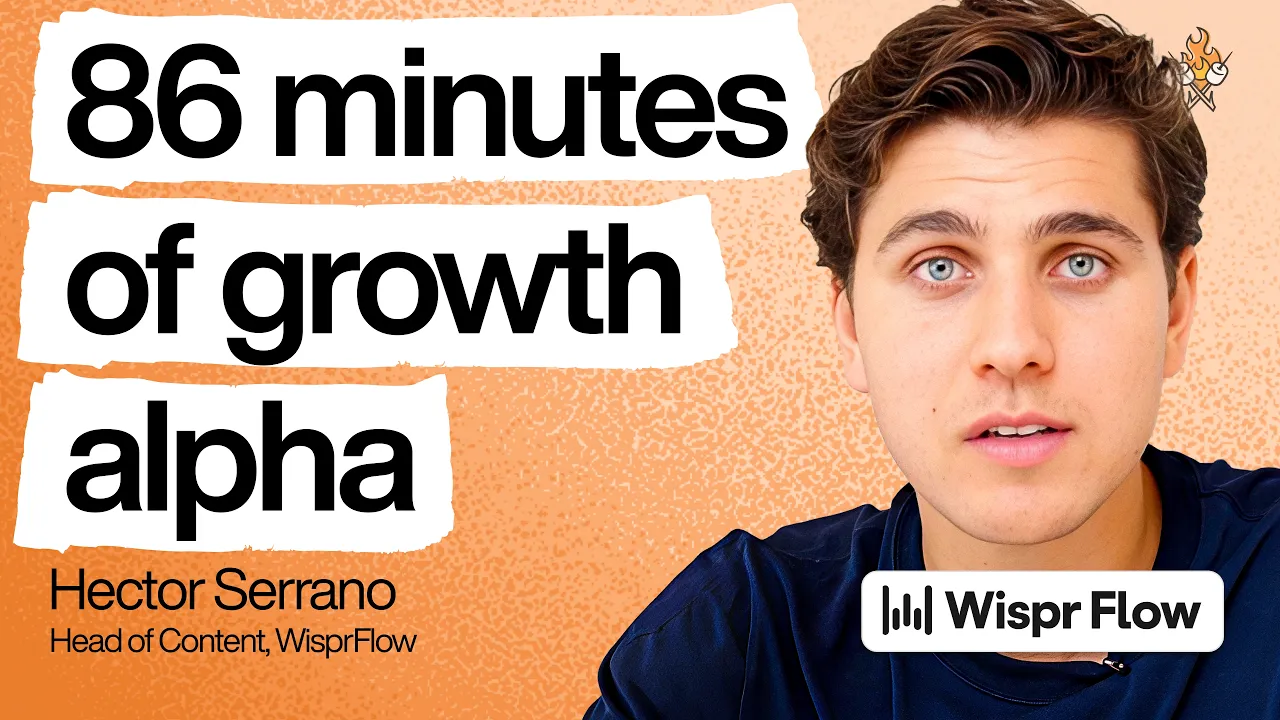
86 minutes of paid-growth alpha | Hector Serrano
Description
Hector Serrano runs one of the most innovative and successful paid growth programs in Silicon Valley. As Head of Content at Wispr Flow, a leading AI voice-to-text tool, he built a roster of 50 creators who drive 500 to 600 paid user-generated content (UGC) ads every month. The creators are paid a cut of ad spend, and the best of them earn over $13,000 a month. It’s a playbook the best DTC brands have used for years, now adapted for SaaS. Hector joined Wispr Flow at 19, before the product had PMF, and over the past year, Wispr Flow has grown revenue 30x and raised at a $2 billion valuation. *We discuss:* 1. Why paid UGC is one of the biggest untapped growth levers right now 2. The step-by-step playbook for building a successful paid-UGC program 3. Why the best marketers are “allergic to AI” 4. What makes a great modern marketing hire 5. Why YouTube is the most underrated growth lever in SaaS *Brought to you by:* WorkOS—Make your app enterprise-ready, with SSO, SCIM, RBAC, and more: https://workos.com/lenny DX—Engineering intelligence for the AI era: https://getdx.com/?utm_source=lenny&utm_medium=sponsorship&utm_campaign=q42026 *Episode transcript:* https://www.lennysnewsletter.com/p/how-a-19-year-old-intern-built-the *Archive of all Lenny's Podcast transcripts:* https://www.dropbox.com/scl/fo/yxi4s2w998p1gvtpu4193/AMdNPR8AOw0lMklwtnC0TrQ?rlkey=j06x0nipoti519e0xgm23zsn9&st=ahz0fj11&dl=0 *Highlights:* https://lennyspodcast.com/mostreplayedmoments *Where to find Hector Serrano:* • X: https://x.com/hectorserrranoo • LinkedIn: linkedin.com/in/hector-serrano-martin • YouTube: https://www.youtube.com/@hectorchats *Where to find Lenny:* • Newsletter: https://www.lennysnewsletter.com • X: https://twitter.com/lennysan • LinkedIn: https://www.linkedin.com/in/lennyrachitsky/ *In this episode, we cover:* (00:00) Teaser (01:17) What Hector does at Wispr Flow (03:10) The number-one growth lever: product-market fit (04:25) When to start investing in paid ads (08:27) The paid-
Summary
Generated by gpt-5.6-terraAt-a-Glance
- Verdict: Watch fully
- Core thesis: Wispr Flow scaled paid acquisition by treating UGC creators as a high-trust, performance-compensated creative production network rather than as one-off influencers, while reinforcing paid with founder-led organic content.
- Why it matters: This is an unusually concrete operating playbook for building a high-volume creative-testing engine: recruit a deliberately diverse creator roster, pay against ad performance with downside protection, preserve creative autonomy, and pair content supply with dedicated media buying.
- Best use: Use it as a GTM and hiring blueprint for any product-led AI/SaaS product that needs scalable paid creative, stronger founder distribution, and a more modern profile for content-growth hires.
Executive Summary
Hector Serrano describes Wispr Flow's growth as product-led first, with paid growth acting as an accelerator and learning loop rather than a substitute for product-market fit. His central argument is that paid should be activated relatively early—even with constrained budgets—because cold-traffic conversion reveals whether positioning and messaging work. But a product that does not already create genuine user enthusiasm will not sustain this model.
The core operating system is paid UGC: recruit real users or credible proxies for distinct customer segments, let them produce ads in their own voice, run the assets through paid channels, and compensate them from performance. For SaaS products with ambiguous or delayed attribution, Wispr pays a percentage of ad spend; for e-commerce, it suggests a percentage of attributable GMV. A "smart retainer" guarantees a creator a minimum payout after a defined production quota, but only tops up commission earnings rather than stacking on top of strong performance.
The program is deliberately small, selective, and community-driven. Wispr grew from roughly five creators to 50, adding a handful at a time and now reportedly receives 1,000-1,500 applications per week. Serrano emphasizes manually recruiting the initial cohort through Instagram, onboarding them personally, paying every seven days, giving them access to the product, and investing in community through weekly meetings, coaching, referrals, giveaways, and retreats. The point is not to buy isolated videos; it is to compound product knowledge and creative capability within a trusted creator network.
The video also makes a broader distribution argument: AI may automate research and operations, but the customer-facing final creative should remain human-led because AI-generated "slop" undermines trust and brand differentiation. Founder-led content and YouTube are presented as long-horizon complements to paid, creating familiarity and trust that lower eventual paid-conversion costs. Serrano's associated hiring thesis is to scout young, native social talent based on demonstrated audience-building, drive, taste, and cultural fit—not credentials—and give them runway to experiment.
Key Takeaways
- Claim: Paid acquisition should be turned on early as a controlled messaging and conversion-learning system, but it cannot repair weak product-market fit. | Evidence: Serrano says Wispr found PMF before channel expansion and calls paid an early way to test whether cold traffic responds to messaging and converts into users; he warns founders forcing growth to revisit product value and positioning. | Implication: For a PLG product, use paid experiments to validate ICP-message combinations quickly, while treating poor conversion as a product or positioning diagnosis rather than merely a creative-buying problem. | Caveat: Early paid testing should be within budget limits, and positive paid signals are not a replacement for organic user pull or a product people genuinely value.
- Claim: The scalable paid-UGC model is performance compensation with creator downside protection: percentage of ad spend for SaaS and percentage of GMV for readily attributable commerce. | Evidence: Wispr uses a "smart retainer": for example, a creator completing 25 videos under a $1,500 guarantee who earns $500 in commission receives a $1,000 top-up; one earning $3,000 receives commission only. Serrano says some creators earn up to $13,000 per month. | Implication: Design incentives around the economic signal that can actually be measured, and ensure new creators can survive the learning period long enough for creative skill and product familiarity to compound. | Caveat: Spend-based compensation is specifically suited to freemium SaaS where direct purchase attribution may be delayed or unclear; GMV share is better when a purchase can be reliably tied to an ad.
- Claim: Creative autonomy is a performance feature, not merely a creator-relations preference; detailed brand briefs tend to homogenize ads and suppress the ideas that break through. | Evidence: Serrano rejects 10-page creator guidelines and cites a top ad in which a creator placed a keyboard outside in the rain, showed raindrops "typing," and revealed a Wispr Flow download prompt. He says no two ads in their library should look alike. | Implication: Give creators the product, intended audience, economics, and broad objective—not a script—and optimize the portfolio for differentiated creative hypotheses rather than polished brand consistency. | Caveat: Autonomy does not mean no quality control: someone with real creation experience still needs to curate creators, approve content, and keep output relevant to the product.
- Claim: A paid-UGC program should begin with a small, intentionally diverse creator roster recruited manually off-platform, not broad automated outreach or a large homogeneous pool. | Evidence: Serrano recommends sending 150-250 thoughtful Instagram DMs over a week to find roughly five or six strong initial creators, then adding about five to six creators every few weeks. Wispr's roster spans moms, lawyers, engineers, sales reps, agency owners, and an eight-figure e-commerce founder. | Implication: Map audience/message gaps first, recruit credible people for each gap, and prioritize varied visual styles, life contexts, and customer identities over raw creator volume. | Caveat: The correct creator is determined by the ICP and message gap, not by follower count or youth; a technical developer tool may need a credible technical practitioner, while a high-ticket sleep product should not be sold by an implausible 18-year-old spokesperson.
- Claim: High-volume creative supply is necessary because paid ads now fatigue quickly, but scaling output must not become repetition. | Evidence: Wispr reportedly launches 500-600 ads monthly, has roughly 5,000 lifetime ads and 800-900 live ads, and sees some ads die after about $100,000 in spend—potentially in two to three weeks. Serrano says Meta groups ads when they are more than 60% similar across footage, transcript, visual frames, or on-screen text. | Implication: Build a continuous creative-production pipeline and measure creative diversity explicitly; do not let creators simply copy the current top spender, or the account will create a self-cannibalizing cluster of near-identical assets. | Caveat: The exact similarity threshold and fatigue dynamics are platform-specific operational observations from Wispr, not universal benchmarks.
- Claim: The minimum effective operating team is a creative/creator-program owner plus a dedicated media buyer; creator operations and ad optimization should be separate specialties. | Evidence: Serrano frames his role as creator communication, concepts, and asset approval, while Wispr's media buyer runs Meta, LinkedIn, YouTube, account structure, spend, and optimization. He describes the broader marketing organization as relatively flat, with specialists rather than middle management. | Implication: Do not hire a generic performance marketer and expect them to generate authentic creative supply; establish clear ownership for creator network/creative quality and for media-buying economics. | Caveat: At lower spend, one person may temporarily cover multiple functions, but Serrano's own move from sole in-house ad maker arose because one creator could not meet the required volume without burnout.
- Claim: Founder-led organic content is a long-term trust and demand-generation layer that makes paid more efficient, with YouTube deserving disproportionate investment in packaging and storytelling. | Evidence: Wispr frames content as episodes in the journey toward its goal of one billion daily active users; Serrano says Tanay Kothari's channel reached millions of views and roughly 20,000-21,000 subscribers within five videos. He argues that a strong long-form team produces better raw material for short-form clips and notes a personal YouTube video growing from 40,000 to 600,000 views over several years. | Implication: Use a founder narrative and recurring company mission as the connective tissue across YouTube, short-form, LinkedIn, X, and paid; evaluate it on cumulative trust, audience growth, and assisted conversion—not only immediate attributable revenue. | Caveat: Founder content should not be treated as an immediate sales channel; Serrano argues it must first provide value, reveal the company journey, and earn audience trust before soft-selling.
Detailed Brief
Creator acquisition, onboarding, and retention mechanics
- Claims: Early recruiting should start with people already following the brand, existing inbound DMs, and manual Instagram research rather than relying on a new marketplace profile with no payment history.; The creator relationship should be operated like a talent community and a sales process, not an anonymous production marketplace.; Paying weekly is positioned as a practical retention mechanism because rapid feedback and cash flow keep creators engaged while they learn what works.
- Evidence: Wispr's Tribe profile reportedly displays approximately $300,000 paid to creators and a 50-person creator count, which Serrano says creates strong inbound credibility once the program is established.; His onboarding flow starts by asking about the creator's background, then covers his own creator experience, the media buyer, product education, the Tribe workflow from submission to ad launch, payment cadence, example ads, and immediate setup in Discord and Wispr Flow.; Wispr offers $100 for a referred creator only after that person is judged a fit; the roster remains capped around 50 rather than using referrals to maximize headcount.
- Caveats: A referral program can look like an MLM if incentives are paid indiscriminately; Serrano's stated safeguard is to pay only for approved, useful referrals and maintain a selective capped network.; A brand without a trusted product or credible creator economics will have a harder time attracting initial talent, so early outbound must be unusually specific and personal.
- Implications: Create a creator-ops funnel with explicit stages: identify ICP gap, source, qualify for credibility and distinctiveness, live onboarding, product access, first brief/objective, rapid payment, and ongoing coaching.; Treat payout reliability and human responsiveness as reputation assets; poor creator treatment can reduce both future talent quality and commercial terms through fast word-of-mouth.
Hiring and human-quality stance
- Claims: Modern content-growth talent is difficult to identify through conventional academic or corporate résumé signals because platform fluency has no standardized career path.; A candidate who has grown even a modest audience has demonstrated consistency, platform intuition, basic production ability, and an understanding of trends.; AI is useful behind the scenes, but Serrano argues the final customer-facing creative requires human judgment and craft, particularly for AI brands seeking to project human empowerment rather than replacement.
- Evidence: Serrano suggests a rough minimum signal of 10,000-15,000 followers and gives Instagram and YouTube more weight than TikTok; he says he grew from roughly 500 to 18,000 X followers in two weeks after applying transferable platform instincts.; Wispr gave Serrano and former intern Tobin time and budget to experiment despite early failures; Serrano says it took him about a year to feel comfortable in the role.; He argues that top AI labs still use many humans for visible production work and warns of public backlash from AI-generated assets with visual artifacts, typos, or incoherent writing.
- Caveats: Follower count is only a screening proxy, not proof that a person can build a company-specific growth system; it should be paired with evidence of work ethic, taste, cultural alignment, and willingness to learn.; The anti-AI claim concerns final public creative, not operational automation, research, or human-reviewed workflows.
- Implications: Adopt a talent-scouting model closer to a sports academy: recruit high-potential young operators, provide meaningful reps and budgets, tolerate bounded early failure, and develop them into owners.; Retain human editorial approval at the final brand-facing layer even where AI accelerates research, production operations, or draft generation.
Notable Concepts & Terms
- Paid UGC: Creator-made product ads that the company distributes via paid media; at Wispr it is an ongoing performance-based production system rather than a one-off influencer campaign.
- Organic UGC: Creators post on separate creator-owned social accounts and are paid on view/CPM outcomes; Wispr previously generated roughly 500 million views in about 2.5 months but discontinued it because views did not convert sufficiently.
- Smart retainer: A minimum-earnings guarantee conditional on a production quota that tops up low commissions but does not add to high commissions, reducing early creator attrition without removing performance incentives.
- Tribe (T-R-Y-B-E): The creator-management platform Wispr uses to organize performance-based creator ads and payouts; Serrano compares its model to applying TikTok Shop-style creator economics to Meta.
- Creative fatigue: Performance deterioration as an audience sees an ad too often or sees too many similar variants; it drives Wispr's unusually high creative-output requirements.
- Andromeda: Referenced as Meta's newer advertising environment, which Serrano says accelerates creative fatigue and increases the need for varied, fresh assets.
- Creator credibility matching: Matching the creator's identity, expertise, and life context to the customer and purchase decision; UGC is not synonymous with young creators or polished influencer aesthetics.
- Founder-led content as a Netflix series: A content framework in which varied episodes document progress, setbacks, culture, and product development while continuously reinforcing one company mission.
Operator Notes / Why Ken Should Care
- Run a small paid-creative pilot with one creator-program operator and one media buyer; define a limited budget, 3-5 ICP/message gaps, weekly creative-output targets, and a clear scale/stop decision after an initial test period.
- Create a compensation model before recruiting: choose spend-share versus attributable-revenue share, set a production-quota-based minimum guarantee, establish weekly payment operations, and have legal review usage rights, disclosure requirements, and payment terms.
- Source the first creators manually from customer/follower lists and niche Instagram searches; assess each candidate against a matrix of customer credibility, distinct creative format, product affinity, and non-overlap with the existing roster.
- Instrument the ad library to flag semantic and visual duplication, creative fatigue, creator-level spend, and message/ICP coverage; do not reward copying of top ads as a default behavior.
- If pursuing founder content, define one durable mission narrative, appoint an accountable head of content, and invest first in long-form story packaging, titles, thumbnails, and retention before scaling short-form clipping.
- Add a human approval gate for all externally visible AI-assisted creative; use AI for internal acceleration only where the final asset still receives human editorial, factual, and brand review.
- Review current marketing hiring criteria: add demonstrated audience-building and content-making evidence, and consider a paid apprenticeship or internship track with real budgets and explicit learning runway.
Source/Metadata
- Title: 86 minutes of paid-UGC alpha | Hector Serrano (Wispr Flow)
- Transcript words: 26534
- Duration seconds: 5267
- Timestamp note: No timestamps or chapter markers were present in the supplied transcript. The transcript contains substantial repeated passages and sponsor material.
Transcript
You have been doing this insanely incredible job growing Whisperflow over the past couple years. You joined Whisperflow at 19. I looked up creator jobs on LinkedIn. Applied to 200 positions. I found some company called Whisperflow. I applied, had a call with Tanay and then I joined. I've never worked in a startup and I told Tanay I want equity in Whisper and Tanay laughed and was like I like you man. There's all this talk about no jobs left for young folks. AI is taking everyone's jobs. Young people are actually much better at this work. A 30, 40 year old founder doesn't understand what an 18 year old kid who's in these Discord chats scrolling every day on Instagram and TikTok. They don't understand what's actually working and the best ways to approach these new channels. I think it's a no brainer to have someone like that on your team. Actually this tweet the other day, the best marketers are allergic to AI. If we go out and start making AI slot ads, it's probably not going to be received really well. There's so much noise. If you actually focus more on the quality and less on the quantity, it gets so easy to cut through the noise. Let's talk about paid UGC. You're getting influencers creators to create a pitch for Whisper. You keep it really open for them to experiment, do whatever they see fit. They're not capped at their earnings. We have creators now that are making $13,000 a month. The hardest role to hire for right now is someone like you. I think if you just think that looking for someone with the best grades or the best score is going to get you the best hire, you're in for a rude awakening. Hector, thank you so much for being here and welcome to the podcast. Hector Thank you. Thank you. I'm excited to be on. I'm even more excited to have you here. What I'm going to try to do with this conversation is create a very tactical guide to what is working in growing a B2B SaaS product right now. You have been doing this insanely incredible job growing Whisperflow over the past couple of years. I saw the stats that revenue at Whisperflow grew 30x in the past year, which is absurd. You guys recently raised something like $2 billion in a very competitive market. Clearly you've figured something out. You've started to share some of the strategies that you've been deploying on X. And so we're going to be going deeper into the stuff that you've seen work. First of all, give us a sense of what it is you're responsible for at Whisperflow. What's your job there and what do you work on? Hector First of all, I just want to give a lot of credit to the other members of the team. What I touched on the other day is a very small part of the business. And that's mainly content as a whole. I'm a content creator myself and that's how I originally came into Whisper. And that role obviously evolved a lot. And now I'm in charge of our paid UGC program on the actual content side. I'm not on the media buying side of things. And then on top of that, also managing our organic channels for our founder, like YouTube and Instagram. Jason Tucker Okay. Awesome. Something that I've noticed about you and something that I think is really rare these days is you're very good at breaking through the noise, both in the content you create—your tweets recently have gone viral on Twitter. Everyone's sharing it all over my feeds. So clearly you figured out how to do that yourself. Also with the ad work that you do, the UGC work that you do—also very effective. So there's a lot that we can all learn from you and what you figured out. Thank you. Jason Tucker So just zooming out first, talk about the growth levers that you have been spending time on. What has been working recently in growing Whisperflow or can work for other B2B SaaS products? Hector I think the first one, and it's maybe a bit corny to say, but I think most importantly, Whisper has grown at the rate it has because of the product. It's been product-led growth since the beginning. I joined at the pre-product stage and I remember we had a few thousand users early on and it just started catching steam. Six months in, I remember Tanay said, "Wow, we really found PMF." Like we struck gold. And then from there, just adding all these other channels, whether it be organic or paid. Everything is just adding more fuel to the fire. What we found a lot of success with, through trial and error, doing a bunch of different things, testing a bunch of channels—one of the main ones we've landed on now is paid. And we're funneling that with a lot of UGC content. And we have a lot of pillars inside of paid, whether that be UGC video, statics, influencers, in-house videos, founder storytelling. Paid ads as a whole, whether it be Meta, LinkedIn, YouTube, et cetera, has definitely become one of our main pillars at Whisper. And it's one of the things I'm leading on the content side of things. Jason Tucker Awesome. Okay. So let's dive in there. But first I think to your point, it's really important to say none of this will really work if your product isn't great. If there's not real organic product market fit already. I imagine this can work for a little bit and then it just fades away if the product isn't great. So I guess, is that just like step one—this needs to be working on its own before you start investing in paid? Hector Yeah, exactly. I have a lot of founders sometimes reach out or come by the office and they're like, "What's the hack? Like how did Whisper grow so fast?" And it's like, no disrespect to other products, but if you're not having that growth early on and you're having to force it a lot, then maybe you have to go back to the drawing board and rethink how you're actually positioning the product. Is it actually valuable to your users? Why isn't it growing by itself organically? Yeah, there's really no hack besides having a good product. And then adding more levers to pull from. Jason Tucker So let me ask, when do you think it makes sense to start investing in these inorganic channels? Hector Well, I think paid is actually one of the best channels to invest in early on. And I learned this from Matt, who was actually our ex head of growth at Whisper. He's now at Victor. A lot of his lessons and lessons that I've learned from him is taking this e-commerce approach to SaaS, which a lot of companies are scared to do. They're scared to turn on the paid engine. And what happens when you actually turn on the paid engine is you learn a lot faster. Like if the messaging actually resonates with your audience, are you actually able to convert this cold traffic into users? At the end of the day, most companies aren't that skilled in organic content because it is something very new. And unless you have really young people on your team who really understand these organic channels, know how to package it, know how to make the content, it's really hard to actually get any clear numbers on whether your product actually has legs. Do people actually resonate with it? Are you actually able to track these conversions, et cetera? So I think paid makes sense from the get-go, obviously testing within your limits and your budgets. But if you're able to turn this cold traffic into paying users, then you have a clear signal there that this same messaging or this product will also work on organic if you optimize things a bit more. Jason Tucker I want to come back to that—just what that early team may look like, maybe even pre-product market fit. But what's really interesting about what you're sharing here is people—paid has been around for a long time. Running ads on Instagram, Facebook, TikTok—all these things. There's nothing new as a platform. And what you're saying here is there's still a lot of alpha and opportunity to grow substantially and do something different in paid. Hector Yeah, 100%. And a lot of times people also get scared because they'll say, "Oh, I don't want to turn on the paid engine yet or spend a bunch of money because then we're going to oversaturate this market or this ICP." But at the end of the day, it's just getting smarter with how you're positioning the product. And there's always new ways, new messaging, new ICPs you can target. Yeah, 100%. And a lot of times people also get scared because they'll say, "Oh, I don't want to turn on the paid engine yet or spend a bunch of money because then we're going to reach a point where we oversaturate this market or this ICP." But at the end of the day, it's just getting smarter with how you're positioning the product and there's always new ways or new messaging, new ICPs you can target. And you won't really reach saturation if you're savvy enough with the angles that you're approaching your content with or the paid mechanism, I guess. This episode is brought to you by this season's presenting sponsor, WorkOS. What do OpenAI, Anthropic, Cursor, Replit, Sierra, Clay, and hundreds of other winning companies have in common? They're all powered by WorkOS. If you're building for enterprises, you have felt the pain of integrating single sign-on, SCIM, RBAC, and audit logs. WorkOS turns those deal blockers into drop-in APIs built for B2B SaaS. And now there's a new kind of user that needs access to your app, agents. AI agents need to register, authenticate, and get permissions, just like a person. WorkOS handles it all. AgentAuth to give agents scope, revocable identities, agent registration with AuthMD, and Airlock to judge every agent action and allow, deny, or escalate to a human. I've noticed that every startup that I'm an investor in that expands upmarket ends up using WorkOS. Because they're the best. Go to WorkOS.com to make your app enterprise-ready today. Okay. So let's actually dive into this. So let's talk about paid UGC and paid in general. What's the overall strategy that you have employed that has worked so well? I think it would be good to start maybe from what we learned previously, actually. Yeah. So where do we go back to? I think this was like early 2025. We had an intern named Tobin. He's a good friend now. I don't know if you've heard of him. He also went pretty viral a while back. He ended up joining Polymarket. But basically Tobin came on as an early intern marketing hire. Didn't really have any experience besides some basic UGC. I think he was studying finance and wanted to be a lawyer. And he came in and Tanay just gave him a budget and was, "Just throw stuff at the wall, see what sticks." Did a few projects, nothing really worked. And then he found really good success with organic UGC. And this was also around the Cluey era when there wasn't that many people doing it successfully. Explain organic UGC. What is that exactly? Yeah. So organic UGC is you basically get a bunch of creators in a group. These creators will make videos about your product and then they will post that on their own Instagram pages or own TikTok pages. So imagine you join Whispers organic UGC group and you make an account called Lenny Whispers. And then you just upload your videos into there and then you get paid based off a CPM metric. So maybe it's like $2 per thousand views. And then it tapers off as you get higher and higher. And yeah, Tobin set that up for us. And I think in like two and a half months, it was like 500 million views, super low CPMs. And it worked decently well, but I think it was also early on in the organic UGC phase where everyone was really focused on vanity metrics. And they didn't necessarily lead to a lot of conversions because obviously the type of product that Whisper Flow is, it's a bit harder to get students to pay for it. So ultimately we ended up killing the program, which I'm not entirely against organic UGC. It's just making sure that you're not chasing the vanity metrics. And then Tobin did this a lot better at Polymark and he cracked the code with organic UGC and not just doing very top of funnel concepts. But yeah, organic UGC does work. We just didn't see that much success or the success we wanted at Whisper. And it was also going to be really hard to find someone to take Tobin's role after he left. So we're, "Let's just kill this." And then paid was working relatively well for us. So that kind of brings us to where we're at now where, not now, but like seven months ago, I realized that paid was working really well. And I was the one making all the paid assets. So I was, "What if we apply Tobin's playbook from organic UGC of building this community, building this roster and paying off performance. And we just apply it to paid and we maybe make the ads a bit more middle of funnel, maybe a bit more pitching the product." I mean, not even just middle of funnel because you need everything in paid ads, but more just pitching the product straight on instead of just screen on text ads. And then I stumbled upon Tribe, which I don't know if you want me to get into that now. Yeah, talk about Tribe and it's T-R-Y-B-E, right? Yes, T-R-Y-B-E. So Lucas Pachter, he's this guy who started Tribe. But before that, he actually started Squid Hoss, which is a clothing brand. And he grew really fast through TikTok Shop, but there wasn't really a way to do the same thing on Meta. So he made this internal tool where they could run creators ads and pay them based off performance. And then he basically made it available for everyone. And we were one of the first companies to hop on. And when I saw it, I was, "This is a no brainer. It's like the TikTok Shop method, but for Meta ads." And since SaaS companies aren't able to use TikTok Shop, it's now they've unlocked this new channel for SaaS companies to be able to run performance-based ads. And yeah, we hopped on there, built out our program. And I mean, if you fast forward to now, we're now launching like 500 to 600 ads every single month. And it's been a great process. Obviously, that's skipping a lot to where we're at now, but just wanted to give an idea of what we tried, how it worked, but also didn't work. And then how we ended up on the performance-based model that we have now for paid UGC. Okay. Amazing. We're going to go much deeper, but just to make sure everyone understands what we're talking about here. So when you talk about organic UGC, it's not free. It's basically you're getting influencers, creators to create a pitch for Whisper. You take their video, you put it on your channel, and you pay them per views. No. So they post it on their channels. They post it on their channels. Yeah. So it's CPM based. So let's say we bring you into the group and then you make your own channels on TikTok and Instagram, and it'll be like Lenny Whispers or Lenny Talks. It can be anything really, but you wouldn't post it on your main Instagram. You'd post it on an alternate, and then we would pay you a CPM based. Okay. So the big difference here is instead of CPM based, which is basically views based, they take a percentage of spend or GMV or spend. Yeah. Percentage of spend or GMV, depending on if you're in SaaS or if you're e-com, something like that. Awesome. Okay, cool. So you've shifted to this model. It's basically performance-based UGC. So just to be very clear about what this works, you find, I think you have something maybe like 50 creators right now. Yeah. Right now we have 50. Okay. And we'll talk about the progression that you recommend starting with a couple. So you find creators, they make a video talking about how awesome Whisperflow is. You use that video as an ad on Meta and TikTok and other platforms, and then they get a cut of how that app performs. Exactly. And then you have two approaches to the cut they take. Talk about that. Yeah. So obviously we don't want to just pay creators just off percentage base, especially early on, because if you come into the group, you make 30 videos and you only make a hundred bucks off of commission, then it is pretty demoralizing. And a lot of times we see with our best creators, they're our best creators because they stuck around for the longest and they've understood how the model works. So one thing we actually have included is called a smart retainer. And what that is is basically us saying, "Okay, we're going to back you as a creator. And let's say we're going to do 25 videos and we're going to pay you $1,500." Exactly. And then you have two approaches to the cut they take. Talk about that. Yeah. So obviously we don't want to just pay creators off a percentage basis, especially early on, because if you come into the group, you make 30 videos and you only make a hundred bucks off of commission, then it is pretty demoralizing. And a lot of times we see with our best creators, they're our best creators because they stuck around for the longest and they've understood how the model works. So one thing we actually have included is called a smart retainer. And what that says is we're going to back you as a creator. And let's say we're going to do 25 videos and we're going to pay you $1,500. As long as you hit that quota of videos, we'll pay you that money. But depending on how much they earn in commissions, then we might top them up or we might not even add that smart retainer in. So to make it a bit more clear, let's say that you're in our program and you hit the 25 videos and you only make $500 in commissions, then we will pay you an additional $1,000 because you hit that quota. But let's say that you also hit that quota and you make $3,000 in commission, then you strictly keep commissions and we don't add any smart retainer. So it's us saying, as long as you hit these videos and you hit these metrics, we will pay you X amount. And it makes it so that creators that join in the group month one, month two, month three, maybe they're not able to reach over that amount in strictly commissions, but they're able to make some sort of amount of money so that they actually stay dedicated and keep growing. And then three or four months down the line, you see these creators start to break out and make purely commission space, which for me as the guy running the program, or if you're a brand owner, that's the best thing because you're paying them pure profit or pure off the best performing videos instead of paying out of pocket. Also, I think some good background is I'm a creator myself. So I found that a lot of companies and even at Whisper, we were doing this sometimes as well. We would give briefs to these creators to make ads for us. And we would give them this whole sheet where it's like, don't say this, say this, use these hooks. This is how we want you to talk about the product. This is how you need to sell the product. And when you send a creator a 10 page guideline on how they need to shoot their content, what they need to talk about, you end up removing the creative aspect that creators have. And there's nothing more demoralizing than that. And I know as a creator, if I have a brand that trusts in me, brings me in for a reason and just opens the doors for me to create content how I see best fit for the product, you're going to get better content out of me than if you just put me in this box. So that's one of the main reasons that a lot of the creators want to work in our group. And we also keep it really tight knit. It's this tight knit feeling. We bring the best of the best. And then on top of that, we keep it really open for them to experiment, do whatever they see fit. They're all fans of the product. And then on top of that, they're not capped at their earnings. We're not paying them $100 per video. We're not paying them $50 a video. It's not $1,000 for the month. It's truly uncapped. If they have really good videos and they put a lot of effort in, we have creators now that are making $13,000 a month. And that's not really possible with other forms of UGC or even influencers. They're making more money than full time influencers. And they might have 1000 2000 followers on their own Instagram accounts. But this has just been a way for any creator who's talented to be able to make real money. Awesome. And the way you do it is if it's a shopping sort of product, you give them percentage of GMV. And then if it's the B2B SaaS product, you give them percentage of spend. Yeah, especially if you have a freemium product where it's hard to track direct conversion, because we also don't want to get in a place where maybe people are converting off their ads, or maybe they're not, maybe they're purchasing. And then we're running those ads and profiting off those ads. And they're not getting paid what they're worth. And with a product like Whisper, where it's hard to track those attributions, or it might take a week or two, it's best if we just keep it at percent of ad spend. But if you're selling a water bottle or a t shirt, and it's really easy to track whether the person came from this ad or that ad and if they purchase or not, then it makes more sense to do a percent of GMV. So the innovation here that has worked really well is giving the creator a piece of the action of the success of their ad. Exactly. Awesome. And then also capping the downside so that they can actually spend time doing this versus being worried that they're not going to make a living. Yeah, exactly. Because a lot of times these creators have to constantly be negotiating with brands and working with new companies, learning new things. And it's not only that these creators are all power users, but they get to work with the same company every single month. So just think about the compounding effect of how much better their videos get over time instead of you're this brand who's launching a new feature and you're scrambling to find new creators. And if you already had that internal group of creators who already know your product and already believe in you, and some of my creators understand the product better than me almost. And they come up with ideas I never could have come up with. So if you just have that internal group already, it's so easy that when we launch a new thing, whether it was the Whisper NoteTaker or all these different features that we release, it's so easy for me to just drop it in the Discord and be like, hey guys, let's make a video on this. Instead of having to go chase around and find all these different creators and brief them. And then the next month they're gone. And then two months down the line, you have to go find them again. So yeah, it just makes for a great experience, both on the brand side and the creator side. And this again comes back to the product itself has to be awesome because it'll be very hard to find creators that love your product if the product isn't awesome. Yeah. And it's just easy to burn out as a creator. If you're talking about something you don't believe in, it can get boring really quick. Yeah. It's almost a test of product market fit. Can you find creators that are excited? Yeah. That was honestly, because I guess some context as well. I was actually at Whisper, and I was the one making every single ad for a year and a half. So I made hundreds and hundreds and hundreds and hundreds of ads. Which I guess that's a testament to how much I loved Whisper. I didn't go crazy. Do you think that is actually really important for the person that takes this work to have been the person creating the ads before asking creators to create the ads? A thousand percent. Because it goes back to the point I had mentioned earlier where a lot of people who've never worked in content or who have never worked with creators end up being the ones briefing them and telling them what to do. And it's like, you would never have someone who's not an engineer telling the engineer. I would never go up to the engineering team and be like, hey, you guys need to solve this problem like this and do this and this and this. They're going to be like, what is this guy telling me? Okay. So let's go down this tangent of finding someone like Hector. What does a profile look like if you were to find Hector to lead this work at your company? This is one of the most interesting conversations I have with a lot of my friends, especially Tobin, because we both couldn't be more opposite from each other. If you look at both of our resumes lined up next to each other, and I asked you to pick one or the other, you probably in your head will think it's pretty clear which one would be the right answer. And you would never have someone who's not an engineer telling the engineer, "You need to solve this problem like this and do this and this and this." They're going to be like, "What is this guy telling me?" Okay, so let's go down this tangent of finding someone like Hector. What does a profile look like if you were to find Hector to lead this work at your company? This is one of the most interesting conversations I have with a lot of my friends, especially Tobin, as I mentioned earlier, because we both couldn't be more opposite from each other. If you look at both of our resumes lined up next to each other, and I asked you to pick one or the other, you probably would think it's pretty clear which one would be the right answer. But at the end of the day, both are the right answer. I had a 2.5 GPA. Tobin had a 4.0. I didn't go to a REACH school. Tobin went to Waterloo. I played Division One sports. Tobin didn't. There are all these different things. But at the end of the day, we both ended up being great marketers. That wasn't really evident if you looked at the face value of our resumes. But I think Whisper has done a really good job of seeing one or two really key things and also being able to see, okay, is this person a good fit for the culture? Do they seem hardworking? Do they have the same values or the same culture as people already at Whisper? I feel like Tane, Daniel, and the rest of the team are really good at not only spotting early talent and seeing what are those key things to look out for, but also seeing, okay, is this a good person, a good human to have on the team? And I think Tobin and I embody those character traits perfectly. And you might be asking, what are the traits I need to look for in a good marketing hire? Honestly, it's not that complex. Has this person grown an account, even if it's 10,000 followers? Do they somewhat understand what they're talking about in terms of creator? Have they made content? That's how basic it is. As long as they have some experience in building a following, even if it's a small following, it shows you that they understand the consistency it takes to grow a social media following. It shows you that they understand trends and how to make a video, how to edit, how to film, et cetera. I think it comes down to that. Do they seem like a hard worker? Are they a good person? Do they have those minimum 10,000 to 15,000 followers, and then take a shot on them. You can't just bring a young person in and then be like, "Okay, you're not where I want you to be. You're gone." Tane, Daniel, and the whole Whisper team always give us a lot of time to learn and fail. I know for a fact that for the first seven months at Whisper, I was all over the place. I still joke about it with Daniel. There were some hard conversations where they're like, "What the heck are they doing?" But they gave me the freedom to keep experimenting, keep trying new things. It didn't matter if you failed, as long as you're consistently learning and getting better. And that's the same for Tobin. Tobin came in, they gave him some money and some time to experiment. After two months, he found something that worked and it stuck. Okay, this is extremely valuable. There was this tweet the other day about how the hardest role to hire for right now is basically someone like you. Someone that can talk about the product, the technical aspects, get people excited, make the product compelling. And you're telling us what this profile looks like. So to reflect back what you just said: one is evidence that they're very hardworking. Two is evidence they're a good person and that their values and culture align with your company. Three, they've actually grown a platform to at least 10,000 followers. This could be any platform like Instagram or TikTok. I would say Instagram is probably the highest signal because TikTok is typically more brain rot content. Instagram is more polished, better packaged. The followers you get on there as a platform are just better. So Instagram is probably a higher signal than TikTok. It's pretty easy to grow on TikTok posting some brain rot stuff. What about X and YouTube? YouTube is decent, but I would say if you understand a platform like Instagram, you can crack any platform. Instagram and YouTube—if you can crack Instagram and YouTube, I'm confident, especially if you're a young individual, you can crack any platform. I'd never posted on X much until two weeks ago. I went from 500 followers on X to 18,000. I wasn't really used to posting on a text-only platform, but I figured it out after a week. It's a volume game. You need to keep it short, have your own style, and actually give some value. That was pretty easy to learn. If you start on X, it's a bit harder to get into video because video is a whole other beast. Sitting down and filming is not an easy thing. I've had some colleagues, and I pushed them to start making videos. Shout out to Eric, our media buyer. He struggled a little in his first one, but I think it's good to step out of your comfort zone and try to film some videos. So yes, Instagram and YouTube. That's how I discovered Doon X, and it's blown up. My entire feed is just Hector videos recently. So I didn't realize you just started posting two weeks ago. That's insane. Clearly another sign of how effective you are at this. So another bullet point I want to double down on is this idea of young talent. That's something you talk a lot about—the value and almost the alpha in hiring young people. I mean, going back to the point you just mentioned about how it's the hardest role to hire, I think it just boils down to what I mentioned with the two resumes. There's no clear path for a good marketer or a good modern marketer who understands socials. If you look for things you might think are high signal—whether it's the best grades, the best school, certain majors—you're not going to end up with the marketer that you envisioned. So I think that's why it's hard because there's no real defined path. There's no defined path of "okay, this is how you find the next Toban or the next Hector or the next X person." My suggestion, if you're trying to find someone similar to me, would be don't try to find someone similar to me because you're not going to find the right person. Give a shot to some kid who has a crazy background—the crazier the better—and obviously there's some proof in the work. But the point you were asking was the importance of young talent and why that really matters. I think I've seen this example in a lot of different industries. I don't know if you've heard of Jimmy Farley, but he's one of the TikTok Shop OG guys. He's been on there since he was 17, built a huge agency, works with some of the biggest brands. Recently, I think his agency got acquired by Physicians Choice for $2 million. Now he's in-house with them and also works with other brands. I've seen this kid surround himself with older founders, and all these older founders of these e-com brands always talk about how having a Jimmy next to you is so much alpha. Because a 30 or 40-year-old founder doesn't understand what an 18-year-old kid who's in these Discord chats or scrolling every day on Instagram and TikTok understands. They don't understand what's actually working and the best ways to approach these new channels. He's been on there since he was 17. Built a huge agency, works with some of the biggest brands. And recently, his agency got acquired by Physicians Choice for $2 million. And now he's in-house with them and also works with other brands. But I've seen this kid surround himself with all these older founders. And all these older founders of these e-com brands are always talking about how having a Jimmy next to you is so much alpha. Because a 30, 40-year-old founder doesn't understand what an 18-year-old kid who's in these Discord chats or who's scrolling every day on Instagram and TikTok understands. They don't understand what's actually working and the best ways to approach these new channels. And if you have young people next to you in whatever industry you are, whether you're in SaaS, you're in e-com, whatever it is, and you find someone that understands the things that you don't and the early things, and you're able to ask questions and learn from them, I think it's a no-brainer to have someone like that on your team. It's even if you do your best now to dive into TikTok Shop or into Tribe, you're still going to struggle because you're not going to be able to connect as much with the creators or you're not going to understand certain things. And it's just going to take you a lot longer time to get used to those things instead of putting your time into something that you're better at and then bringing someone that can manage those things for you. I love this advice. There's always talk about no jobs left for young folks. AI is taking everyone's jobs. And this is a really good example where young people are actually much better at this work. Yeah. And I think Tane is super young and she's one of the smartest people I know. And he'll still bring me into his office or hop on a call and ask me, what's working on Instagram? How are you doing this so fast? Or ask me questions about content in general. And I don't think there's ever a point where you get smart enough to where you need to stop learning. I think if you take that mentality as a founder, the day you stop growing is the day you're done. And that's something I've definitely learned from Tane. You're never too good or too smart to continue learning. And it can even be from a random 22-year-old or 19-year-old like me. Yeah. I love that. And you joined Whisperflow at 19, right? Yes. I had just turned 19. It was three days after my birthday. And how long did it take you to feel like you figured something out? You said initially it was rocky and not sure what you were doing. Yeah. I mean, give people some context. It was a weird transition because I had just quit Division One soccer three days before as well. And I literally went home, looked up creator jobs on LinkedIn. I applied to about 200 positions. I found some company called Whisperflow. So I applied, had a call with Tane, and then I joined. Yeah, it was crazy. Looking back at some of the memories, I remember it was one of the first days and we're getting ready for our launch. And I was in my calculus class. And Tane started slacking me in class. I left to go to the bathroom and popped up my laptop and I hopped into the Slack huddle. And he was basically like, our launch video isn't what it needs to be. Do you think you can edit it on CapCut or whatever tools you have and make it more Gen Z vibes? And yeah, I got out of calculus and I started editing a video. I had some editing experience, but for Tane, asking me to do that in one of my first weeks was pretty scary. But yeah, that pretty much summed up my first year at Whisper. I just picked up random stuff. Didn't really have a clear position. I'm pretty sure they didn't really know what I was doing either. I didn't know what I was doing. And yeah, it probably took me a year to feel actually comfortable. And there was a lot of ups and downs. And actually one thing I want to point out as well is I was also doing a finance internship after. So after a year, it had been a whole school year and then it was my junior year going to senior year. And that summer I had applied to a bunch of finance internships early in the year because I didn't know if content was a real career. And obviously I was enjoying Whisper and I was making some decent money for my personal brand, but I was thinking, I don't know if this is a real career. And my parents, we immigrated to the U.S., and me being in college and studying finance was a big deal. And they wanted me to go down the traditional route. So I ended up landing a finance internship in New York City. And I was bouncing two summer classes, Whisper Flow, and the finance internship. And two weeks into the internship, I absolutely hated it. And I was thinking, I do not want my life to be like this. I need to make content and Whisper work out. So I would sneak out of the office and go to some cafes in Soho and work on Whisper and my personal content. And from there, everything started to click. And then, yeah, that's how it went. What a journey. I feel like we could have a whole other conversation about the creator path and how to become a content creator on Instagram and all these platforms. That's its own thing. I'm going to come back to how you find the creators for this paid agency strategy. Which we walked through the whole strategy, honestly. I think this would be a good moment to walk through everything. So the first step is figuring out, okay, if you're in SaaS, you can do percent of ad spend. If you're in e-commerce, you can do percent of GMV. And then from there, you'll set up the group in whatever platform you choose. I think Tribe is the best one. It's the one we use at Whisper. And then once you have your group set up, it's okay, now you have to go actually find the creators. And if you think about it, it's imagine you're starting a company from zero and you land on a platform and there's thousands of creators, thousands of brands, and your company has no history. More than likely, you're not going to be able to get the best of the best. And this is where a lot of companies go wrong. They'll start doing a lot of outreach on these platforms. And it's why would a creator want to work for a brand that has no money? For example, on Tribe, it says how much money we paid out to creators. It's $300,000. It says how many creators we have in the group and how many ads we have running or whatever. And when creators see that we've paid $300,000 out and that we only have 50 creators in, you can imagine the amount of inbound we get. But on the contrary, if you're a brand who has zero dollars paid out and zero creators, it's going to be really hard to get creators in. So what I did is I went off platform and I went on platforms like Instagram. And you just look up a bunch of keywords. It can be UGC creators, tech, nine to five, lawyer, doctor, sleep, supplements, whatever niche you're in, and just go down a bunch of rabbit holes. And then you'll land on creators that you like, send them a message. And then you also go through their following and follower lists. And you also search those same keywords because typically good creators follow other good creators. And then I send around 150 to 250 DMs over a week. And these should be very targeted DMs. It shouldn't be, oh, I'm going to use some mass software and send 3000 messages. It needs to be very thoughtful because nowadays with all these automations, yes, you can do a lot of things fast. But if you do it very fast, you're probably going to get a lot of slack back or a lot of bad creators back. And I think for outreach, it's still better to do it manually. Obviously, it's going to take a bit longer. But if you do it right, I haven't had to do outreach ever again. And then you also go through their following and follower lists. And you also search those same exact keywords because typically good creators follow other good creators. And then I say from around 150 to 250 DMs over a week. And these should be very targeted DMs. It shouldn't be, oh, I'm going to use some mass software and send 3000 messages. It needs to be very, you need to care about the small things because nowadays with all these automations, yes, you can do a lot of things fast. But if you do it very fast, you're probably going to get a lot of slack back or a lot of bad creators back. And I think for outreach, it's still better to do it manually. Obviously, it's going to take a bit longer. But if you do it right, I haven't had to do outreach ever again. And yeah, from those 150 to 250 DMs, you'll probably get five or six really good creators. Then from there, you onboard them to the group. And then that's where you get to the next step, which would be actually building out the culture, which is doing all these events and things for the creators, whether it be meetings. We host weekly meetings. Now we're at a stage where we have creator coaches that help keep our creators engaged as well. We do giveaways. We're hosting a retreat in San Francisco next month. We're flying in some of our best creators from around the world. So it's these little things that you start to do to build up more and more culture. And then from there, you have a small group of creators. You've also set up the percent of ad spend and percent of GMV. And you've also built a culture. Then from there, you can slowly start to add more and more creators. And the way we did that at Whisper is we probably went from five to 10, 10 to 15, 15 to 20. We probably added five to six creators every few weeks. And since at this point you also have the five creators and you've probably paid out a bit of money, you'll start to get some people start to apply on Tribe. I think now we probably get 1000 to 1500 applications a week. So I go through those creator applications. And then from there, since we now have a lot of creators, I keep a really high bar and I only accept maybe one or two or three. But we grew pretty slowly. And now we're at 50 creators. And aside from accepting creators from Tribe, one of the things we've done actually is we've introduced a referral program where we will pay creators $100 per creator they bring into the group. And it's not some sort of MLM pyramid scheme thing. There was a bunch of people on LinkedIn. My post blew up on LinkedIn and everyone was like, this sounds like a scam. It sounds like an MLM pyramid or whatever. And we're not paying them to just bring creators. We're paying them to send a creator over. If I think they're a good fit, then we'll bring them in. But we don't want more people in. We're capped at 50. It's not like, oh, bring me 100 creators and I'll pay you for 400 creators. Then we'll pay another 100 creators. This is a very tight knit family. And it's just our way of saying thank you for helping us grow the program. And those are some different levers we've applied to grow the group. And then that brings me to the last step. Am I going too fast through this or do you probably have some questions you want to ask? I do have questions, but keep going. Yeah, that brings me to the last step, which is now you have the culture. You have the people in the group. You have a decent size. You have the percent of GMV, percent of ad spend. And now one thing that's going to start to happen is you're getting a lot of ads. And your ads are going to show in the group what is the ad that's going to most spend, the second most spend, the third spend. And your creators can see these things. And obviously you want them to see it. But it can also backfire if you're not good at coaching your creators because these creators will see the top performing ads. And they'll be like, okay, I'm going to copy those ads as well. I'm going to copy what they're doing. And if you end up doing that, what ends up happening is you get 300 ads that all look the same. They all feel the same. And Meta, when an ad is more than 60% similar, it ends up grouping it together. Whether it's the same t-shirts, you're in the same setting, you're saying the same words. And Meta is super complex now. And for example, it'll scan your ad five times over. It'll pull the transcript. It'll pull each frame out. It'll look at the text on screen. And if you think about it, nothing is going to get past that. And that's why you can reach ad fatigue really quickly if you're constantly repeating the same formats, the same messaging, the same people. So what we do is we continuously push these creators and remind them the reason these creators are making so much money and their ads are all at the top is because they kept experimenting. And they kept leaning into what they were actually good at as creators and what interests them as creators. And if you just follow what person A, B or C are doing, then your ads are just going to rank under them and you're not going to get any spend. So we constantly push creators to keep experimenting, keep doing crazy stuff. And when you look at some of the ads in our library, that's why I say the creators sometimes understand the product better than me and come up with better concepts and ideas better than me. And that's why I stay away from briefs. One example of a really good ad that we had recently was this creator had his keyboard outside his window on a roof and it was raining. And it was, okay, it stops you because it's a very interesting visual hook. And then it pans over. And on the screen, it says, what is my keyboard trying to say? And it pans over to his laptop and the raindrops are typing. And then it starts typing random words and then it says download Whisperflow. And that ended up becoming one of our best performing ads. I don't even know how he came up with that. So kudos to him. But that's what happens when you keep it really open ended. You have a fun product and you let the creators have fun and keep experimenting. And no two ads in our ad library look the same. Wow. Amazing. OK, let me try to walk through the steps here because this was so much juicy gold stuff and advice. So step one, sign up on Tribe. Tribe is where you manage creators and pay out and all that kind of stuff. Your advice here is don't work through Tribe to find them because no one's going to care about you yet. And your advice is go to Instagram, keyword search for things in your market, UGC, tech, lawyers that maybe want to make money on the side to recruit the first five. The advice is start with five. Don't go too big. Yeah. OK. And I would also, it's not even just start with five or start with lawyers or whatever. It's like you have to look at your ad library and look at your product and be like, okay, what specific gaps do we have that we actually need to fill in? Because more isn't necessarily better. And that applies to everything in life. But specifically in creators, if you just bring 100 or 200 of the same creators, that isn't going to lead to scale. Because again, everything is going to look the exact same. But when you bring in five creators that each speak to a specific audience, each speak to maybe a specific messaging of your product, you get five different creators that can all make net new concepts. And it just exponentially grows the more different creators you bring on board. So it's not just the point about bringing a few creators, it's also being very specific about those few creators you're actually bringing in. And so when you say that, it's think about what customer kind of market, what ICP you're targeting and what's a creator that will speak to that audience. Exactly. So at Whisper, we have everything from moms to lawyers. We have the awesome thing about Whisper is when you have a product that people love, you get so many cool people wanting to work with your brand. We have an eight figure e-commerce founder that loves Whisper so much that he just makes ads for us. And I find that pretty incredible. Some dude who has a successful e-commerce business, he loves Whisper so much and he just wants to be part of the community. And he's 45, has kids. # Transcript It just exponentially grows the more different creators you bring on board. So it's not just the point about bringing a few creators, it's also being very specific about those few creators you're actually bringing in. And so when you say that, think about what customer market, what ICP you're targeting and what's a creator that will speak to that audience. Exactly. So at Whisper, we have everything from moms to lawyers. We have the awesome thing about Whisper is when you have a product that people love, you get so many cool people wanting to work with your brand. We have an eight figure e-com founder that loves Whisper so much that he just makes ads for us. And I find that pretty incredible. Some dude who has a successful e-com business, he loves Whisper so much and he just wants to be part of the community. He's 45, has kids. And we have anything you can imagine. Engineers, lawyers, moms, sales reps, agency owners, any type of ICP you can imagine. And I get this question a lot from founders and different businesses reaching out. And they'll be like, oh, I have a dev tool or I'm in a sleep space. I can't make content for my brand or I haven't had success with UGC. And a lot of times what happens is people mistake UGC for thinking it's just college kids making content. But UGC is user generated content. And if you're a dev tool, your user is probably going to be an older technical person. And you can't get by bringing on an 18-year-old who isn't technical to talk about your product. Those ads might look a lot different. For example, our technical ads at Whisper, when you're speaking to an older demographic who isn't really on Instagram that much or is maybe a bit more serious, the more boring and the uglier the ads are, the better they will perform. And that can be something as simple as a screen recording of someone using your product. It could be 30 seconds long. It can be super long. Some of our best ads, you would look at them and you'd be like, these are ugly. These are such bad ads. But they actually perform the best for those specific audiences that maybe are a bit older, maybe are a bit more technical. And it's the same thing for a sleep product. If you have an expensive product in the sleep industry and you have an 18-year-old kid selling it, why am I going to buy a $3,000 product from a kid? Probably it's not going to work that way. You want to buy it from someone who maybe speaks the same way you do, who works in the same things you do, has the same problems you do. And I think UGC works for any company. The more upstream you go and the more expensive your product is and the more niche it is, it gets a little bit harder. But it's how do I find users who want to make content about my product? And this unexpected element of what works is part of the reason I imagine you run so many ads. You mentioned you do 500,000 ads a month. Part of the reason is to discover the ones that are working. Exactly. Yeah, ads is almost weird and inorganic content. I can put my finger on what works on organic. But sometimes I'll see an ad that comes in and I'm like, what the heck is this? And it ends up becoming the best performer. So that's why I think it's good to experiment. Don't have such a high bar for like, if the ad doesn't work this way or that way, we're not going to run it. Some of the ads that I made a year ago, it's a screen recording of someone using the product with some text at the top, 9 by 16, super long video. And there are best ads and there are ugliest ones as well. This season's supporting sponsor is DX. What does the DM look like when you reach out to a creator? It depends. And there's honestly some different ways to go about it. A lot of times as a brand, you'll have a lot of creators already in your DMs or a lot of creators that are already following you. So that's the number one place I would start. A lot of our early creators came from there. We would just go into our following list and look for UGC or look for creators. And then go through our DM requests and you'll come across a lot of creators. From there, they already follow you. They probably already like your product. So it gets really easy. And you can just be like, hey, Lenny, I saw your content. I really enjoyed it. I would love to have you be part of our creator group. I don't necessarily pitch it. I don't pitch the performance-based thing yet because it's still a relatively new thing for creators to hear this new model. A lot of them were skeptical at first, which I understand. But even six months ago, it was even more new. So even today, I still wouldn't start with that and pitch super hard. I'd just be like, hey, love your content. Would you like to be part of our creator group? Are you interested? From there, you'll get a response back. They'll probably ask for some more details. And then I have a PDF that's super simple. I explain the program structure, how much we pay, how much some of our creators are making. And then from there, I'll hop on a call with them, close them, and get them onboarded in Discord, get them Whisper Flow code, and then get them making videos. The other way is if they don't follow us and I'm doing outreach, I'll send them a DM and be like, hey, I stumbled across your content. I really enjoyed it. I'd love to have you be part of our Whisper Flow group. This is the tool. This is how it works. Here's the link to it. Let me know if you'd be interested. And then from there, if they're interested, I'll pitch them. And it's the same sort of route. And this is from the Whisper Flow Instagram account? Sometimes I do either or. Because since I'm a creator myself, I have a lot of, which is also the pro of hiring people who are in content. Some of our best hires at Whisper in content have been through me posting on Instagram stories or our best creator hires. I'll be like, hey, I'm looking for UGC creators. I'll post a story. Or hey, I'm looking for a videographer. Or hey, I'm looking for an editor. That's one of the cool things about hiring a content creator. If they make content in your niche or they make high-value content, they can also be used as a very good hiring mechanism. And it depends. If you have someone who's a creator, I think it works pretty well. Obviously a creator face. And then if you're a really well-known brand, obviously if you're a creator getting a message from Nike, you know what I mean? It's very impressive and you're probably more likely to get a response. So I think it just depends. So you DM them. They're interested. You send them an overview. In the early stage, the first five, you hop on a call pretty quickly and pitch them and explain the program. What does the onboarding look like? These creators are very used to just being used. Everything they do is a transaction. They make a video, they get paid, and they never talk to a person again. And we live in a day and age where everything is digital, everything is virtual. Most people are working remote. Most creators are remote. And they create community the same way a regular person would create community. And we just make sure that we connect from the get-go. It's a time, it's friends. We're working together. I don't see them as just a creator that I'm going to extract some videos from and never talk to again. I get on a call with them. And I have this whole slideshow. But before I go to my slideshow, I ask them about themselves, how they got into content, why they enjoy it. And I have a conversation. I try to get to know them. And then from there, the flow of the slideshow is I have an intro slide where I talk about myself. Most people are working remote. Most creators are remote. And they create community the same way a regular person would create community. And we just make sure that we connect from the get-go. It's like friends. We're working together. I don't see them as just a creator that I'm going to extract some videos from and never talk to again. I get on a call with them, like you said. And I have this whole slideshow. But before I go to my slideshow, I ask them about themselves, how they got into content, why they enjoy it. And just have a conversation. Try to get to know them. And then from there, the flow of the slideshow is I have an intro slide where I talk about myself. I talk about my background as a creator. So they respect me and they know I'm not just some random dude talking to them. And then from there, I'll also intro our media buyer, who's Eric. Shout out to Eric. And then from there, I explain the product. And then from there, I explain how Tribe works. So I let them know what they can expect in terms of the flow from them making the video to it getting accepted to it getting run as an ad. I tell them we pay them out every seven days, which is another hack as well. You want to keep your creators motivated. And the higher dopamine rush they can get and the more money you can get them early on, the better. So we pay out seven days. We tell them that. Then from there, we show them some example ads. And then I get them onboarded and fully going on the call. It's almost like you're closing a sales deal. You don't want to get them all excited and then you let them get off and then you have to chase them down. It's like you want to be very strategic with your time and their time. So I try to meet them, introduce myself, get them onboarded, and get them going so that they know they can start making a video right now. So a big lesson here is treat them like humans. Care about them. Help them feel like they're part of this thing, not just feel like okay, you're going to make money, shut up, don't worry about it, you're going to make money. And I think this is actually a really good outlook as well. I think the companies that will win long term are the companies that have the best relationships with creators. Because word gets out really fast. And if you're a brand that treats creators bad, doesn't pay on time, doesn't pay them whatsoever, or you just block them, word will get out. And creators probably won't want to work with you. Or you won't get the best terms. Or you won't get the best quality creators. So that's one really big thing we focus on at Whisper. It's not even just with creators, but any external agencies or anyone we work with. We always want to treat everyone with a lot of respect. And I think the companies that do that the best will win long term as well. What does the early team look like to start this initiative? Is it just Hector running this solo? Or is there a larger team that you'd start with? Honestly, it's pretty lean. So our marketing team as a whole is pretty flat. Obviously, we're growing a bit faster now at Whisper. I think we've passed 120 full-time employees now, which is pretty crazy. Because I joined, I think we were four at the time. I remember messaging Nate the other day. I was at the office and I was, "Holy cow, there's so many people around. This is crazy." But yeah, right now we're a pretty lean team. And we were even more lean before. But for Tribe specifically, to get something like this running, all you really need is someone like me to kind of be the comms with creators, come up with new concepts, approve videos, get everything kick-started. And then you need a media buyer. It's pretty rare to find someone who's a creative and also a media buyer. I don't really like numbers that much. I'm not really a numbers guy. And I don't like staring at Meta ads manager. I've heard it's a headache. So I'm happy I don't have to do that. But yeah, we have Eric on the media buying side of things. And he structures our ad account and everything. So when this media buyer is this kind of a performance marketing person that just lives in Facebook's ad system? Yeah, exactly. So Eric basically just lives on the media buying side of things on Facebook, LinkedIn, YouTube, etc. Got it. So you're kind of the creative, you're the content supply, and then this person takes it and then is responsible for running the ads, watching performance, optimizing the spend. Yeah. Got it. Okay. And then is there anyone else that you find important, valuable on that team early on and even later on? Early, if we go back to the early, early days, the marketing team was Daniel, our CMO, Matt, who was our head of growth before Eric came, and then it was me as a sole creator, just making the ads myself. So we had some external agencies here and there. And then slowly we added design. We added an in-house director and help produce films and launch videos. Then we introduced PR recently. And even now, I think we're still pretty lean. I think it might be 15 people on the marketing team full-time. We have creator partnership leads for influencers. We have a celebrity talent manager who helps us close celebrities and things like that. So even then, it's still pretty lean and everyone is an expert in their domain. And it's all very flat. We all just have free reign. We all do what we're best at. There's no real middle management. And then our CMO, Daniel, who is an absolute legend, he just has a bunch of direct reports. So I feel sorry for his calendar. But yeah, that's kind of how everything is structured. It's very flat. No middle managers and everyone just does their work. Is a core takeaway from this conversation that when you're doing paid today, UGC videos are the way to go versus your own ads that you're just creating? So are you comparing to what I was doing versus what we're doing now? You know, when you think paid ads on Facebook, Instagram, TikTok, most people think I create a video promoting my product or create an ad unit that is, hey, Whisper Flow is the best thing. And what you're doing here is you're having other people create the videos and then running that as the ad. Yeah, so the way I look at it is I was basically an in-house UGC creator. And it got to a point where ad spend was getting too high. And I'm only human and I couldn't make that many videos. And it was also getting into a year plus of making ads. So naturally, I was getting pretty burnt out being a one-man show. And I was like, okay, I have the skill set. I'm a decent creator. I can spot good creators as well. Why not just build a team? And that's an extension of myself. And yeah, that's basically what we did. And we're able to scale a lot faster, test more ideas. Since we have more ad spend, we obviously want more concepts running. And also, once you get to a pretty high budget on ads, your ads are typically going to reach fatigue a lot faster. And especially with Andromeda now, ads reach fatigue even a lot faster. Because before in 2024, when we were running ads, I could have an ad running for 12 months. And that meant my output would be a lot less. But now an ad, once it hits $100,000 in ad spend, we'll be dead. And that can be hit in a month or in two weeks, three weeks. So we constantly need more output, more volume, et cetera. And I think that if you look at our ad library, we might have 5,000 lifetime ads and maybe 800 live currently or something like that. Or 900 live currently. And especially with Andromeda now, ad fatigue happens a lot faster. Before, in 2024, when we were running ads, I could have an ad running for 12 months. And that meant my output would be a lot less. But now with the new updates and how much ad spend we're running, an ad once it hits $100,000 in ad spend, we'll be dead. And that can be hit in a month or two weeks, three weeks. So we constantly need more output, more volume, et cetera. And I think that if you look at our ad library, we might have 5,000 lifetime ads and maybe 800 live currently or something like that, or 900 live currently. And it's because they reach fatigue and then we have to turn them off. But our ad library isn't only full of UGC videos. There's a lot of different things as well. And everything from statics to high celebrity slash influencer videos to in-house ads to launch videos that we package as ads to founder-led things. So there's a lot of variety in there. And it's just having as many formats as possible because we have a lot of ad spend. And we want the more variety, the better at the end of the day. So this is just a core leg to the stool of paid ads as UGC clearly working. Do you think this will work for every company? Is this something most B2B say? Yeah, I think this works for everyone. It goes back to what I was saying. It's just finding those users that can speak to the users you want to acquire. And at the end of the day, one thing that we look at at Whisper is the B2B side and the enterprise side is all made up of individuals. And if you can find a way to make your content speak to an individual who is part of those teams and maybe you get them as a solo customer to download the app, they use it. Then they tell a friend in the company and then more people in the company start using it. And then maybe you chase down those enterprise clients and actually close the deal. That's realistically how most companies can approach that at the end of the day. And it's not like, who from X company is going to watch my video and hop on an enterprise call and want to close or whatever. But I think if you approach it from companies are made up of people and you just look at it like that and you think, okay, how do I want to sell to these people and how would these people respond well instead of getting sold to? I think you just have to break it down super simply and you're like, oh yeah, this would work for anyone. That makes sense. Also, what I'm hearing though is it's probably most effective for product-led growth, bottom-up sort of products, not like a Workday or a Salesforce. More like a Whisper flow or Ocean and things like that. And you know, if you think about it, it makes so much sense why this would work. An influencer innately is someone that influences you to do something. You're basically getting influencers slash creators to create content that pitches the product and then you put them in people's feed through paid ads. And I get why it works because they're there trying to convince them how awesome this is. I also think that a good distinction is it's not just an influencer or a creator. I almost think that creators with no following end up being better investments for brands because influencers kind of are seen now as sellouts a lot of the time. And when you see a big face or a big celebrity selling a product, it's like, oh my gosh, this person has been selling me things for the last 10 years. I know they're just getting a bag. And they're not really genuine. And there's something about not really knowing who the person is. And they're not famous. They don't have a lot of followers. And if you have these partnership ads coming from their account, it just feels a lot more genuine as well. That makes sense. The less they look like an influencer. Exactly. The less they look like they're trying to convince you and they're just talking like a regular human about how awesome your product is. I get why that would work. What I think about right now is there's that survey that someone did a while ago of just, what do you want to be when you grow up? And for young people, it was creator, influencer versus streamer. I think a lot of people were saying they want to be a streamer, a live streamer, versus astronaut or lawyer. And so this is a career path is what you're describing. This is a way you're making money doing this. A lot of people are actually making money being a creator online. So for people listening that are like, wait, maybe this could be a career for me someday. Maybe I should explore this creator life. Any advice for someone that's embarking on this? Because for many people, it may feel like I will never be as great as Hector just talking off the cuff on a video and looking interesting. Any advice for someone that's trying to explore this path and do better? I think the best advice would be to stop looking for advice. It sounds dumb, but a lot of times I'll have friends reach out and, hey, I want to get started. And I've had this happen for maybe the last three years where people are like, hey, I want to get started. I want to start making videos like you. And I hop on a call with them for two hours. I send them over a bunch of different guides, PDFs, things I've made for how they can get started. And they don't do anything with it. And it's like, at the end of the day, if you're a person who's going to ask before doing, you're probably not going to succeed. And even the best people—I've had the privilege of working with a lot of the most famous podcasters or influencers or celebrities. And a lot of these people also stutter. And they also have to refilm things. And they have specific things that they do to lock back in, whether it's weird noises they make with their mouth or they fidget with their hands. Or they have a phrase they repeat over and over again. Or I've even seen some creators where they start stuttering a lot after they've been doing the same script over and over again. And they'll put a pen in their mouth and open their mouth bigger and talk and enunciate the words more. And then when they stop and they take the pen out of their mouth, then they're able to pronounce it better. So it's a natural thing as a creator. And even if you're doing this for 5, 10, 15 years, there's going to be moments where you have to cut the video or you're going to stutter and you're going to have to refilm 10 times. And you might cuss out your camera and turn it off. But it's just turn it back on and keep filming. And yeah, that would be my advice. Just get started and stop looking for more advice. There's no better way to learn as a creator than just turning on the camera and posting. I love that advice. And what I'm also hearing is you don't have to—one, you don't see how much people struggle doing this stuff. Like you see this polished video and you don't know they have to put a pen in their mouth for a few minutes per second or cuss out their camera. Yeah. Like even my video that went kind of viral on X, I think it's a 15-minute cut. It was probably two cuts before that that were probably each 30 minutes. And then I did that last one, which was probably again 30 minutes. And then I packaged it into a nice video. And it's like I do this for a living. And I've managed our tribe group for the last seven months. And I know the back of my hand or whatever. I love that advice. And what I'm also hearing is you don't have to—one, you don't see how much people struggle doing this stuff. You see this polished video and you don't know they have to put a pen in their mouth for a few minutes per second or cuss out their camera. Yeah. Like, even my video that went kind of viral on X, I think it's a 15-minute cut? It was probably two cuts before that that were each like 30 minutes. And then I did that last one, which was probably again like 30 minutes. And then I packaged it into a nice video. And I do this for a living. And I've managed our tribe group for the last seven months. And I know the back of my hand or whatever. And even then, I still struggle going through and putting my thoughts concisely and going through everything. But it's not perfect. But I put the message out. I gave some value. And people enjoyed it. And I don't think it needs to be perfect. That's so great to hear. Because watching that video, you're just so chill, so relaxed, just sitting there talking with a little iPad. And people see that. They're like, I will never be as good at this. So that's really helpful to hear. When I think about starting to create as a content creator, I feel like I need to get a little fuzzy mic or something. I feel that's step one. Or a tiny little microphone. It's a canon event. It's a canon event. That's right. You're not a creator unless you have a tiny, fuzzy little mic. Yeah. Let me ask you one final question along these lines. Say someone's amazing. I'm going to do this. We're going to commit to this. We're going to hire. We're going to find someone to run it. What are some of the most common mistakes you find companies and people make when they're starting on this paid UGC route? I think a lot of the times is people will typically look in the wrong places and will maybe put out offers online or on LinkedIn or whatever with too high of salaries or too high requirements. And you're not going to end up attracting the best people. Like, if you put out an offer where you're going to pay, I don't know, you're like, oh, these people who are running UGC campaigns are in super high demand. I'm going to put out a job listing for $250K, $200K base salary, generous equity. You're going to end up attracting the wrong type of people. Like, when I joined Whisper and when Tone joined Whisper, I can tell you we were turning nowhere near that. We were interns. And we were just hungry kids who wanted to learn and wanted to grow and had some experience with content. And I think if you just think that throwing money out there and looking for someone with the best grades or the best school or the best experience is going to get you the best hire to run this for you, you're in for a rude awakening. And I would focus on just finding a scrappy kid who's hungry and willing to learn. And I don't know, you just get a good feeling from them. Like, I was talking to Tone recently the other day. Our first call—so I had a first call with Julia, which she was leading our marketing team initially, one of those four people. And then I had a second call with Tone. And I remember, mind you, they're hiring me as a UGC creator. I'm 19 years old. I've never worked in a startup. And I was probably not earning much money. And I told Tone, I was like, I want equity in Whisper. And Tone laughed and was like, I like you, man. And maybe it was a stupid thing to say. But I think it showed how I was naive but also hungry. And I believed in the company and I want to be part of the company. And just cues like that where it's a young, naive, hungry kid who just wants in and wants to learn and wants to grow. And I think don't look in the right place. Don't look in the wrong places because you're going to attract the wrong people. You had a couple of awesome tweets along these lines. One is that everyone looking for a marketer with the best resume is going to end up hiring a bot. Yeah. And then the other is this really important tweet that the most successful founders, investors, creators I've met aren't the most talented. They're delusionally confident. They outwork everyone and they love what they do. Yeah. I think that pretty much sums it up. And then also another one that I resonate with a lot that I put out recently was the sports outlook on hiring. Sports teams—I come from a very competitive sports background. I played over in Spain. I played for the Tabigo in La Liga Academy. I played the MLS Next in the U.S. I played Division I in college. And we have all these structures for sports teams where it's you scout young talent. You bring them in. You coach them. You develop them for 10 years. And then, if you're over in Spain or over in Europe, you eventually get them as part of your academy, maybe the second team. And then maybe you sell them to a top club. Or maybe they end up becoming a homegrown contract and they join your first team. And I think a lot of startups should kind of adopt that mentality. I think there's a lot of companies that actually don't do internship programs anymore. They don't think they're valuable. And I think they're one of the most valuable things. And if you can find the right people, it's not a very expensive thing to do. It's not very time-consuming. And I think taking a chance on young people and giving them some money to test things with and giving them some freedom to test things with and allowing them to fail and continue learning. That's one of the best models I think you can pick up from sports. And obviously it works. I don't know if you're very familiar with soccer. But I mean, look at Lamine Yamal, just won the World Cup at what, 19 years old, 18 years old. And I think that same approach can be applied to the startup world. Like, find young talent, invest in them, let them get real reps in the real world, and then eventually they might become one of your A players. I love that. And I love that also part of this is giving them time to figure it out. Yeah. What's really interesting about this conversation so far I'm realizing is I don't think we've once mentioned AI as part of this work that you do. Which is really interesting because it's what everyone talks about these days. And you actually had this tweet the other day, the best marketers are allergic to AI. Talk about what you think with how AI plays into this and how AI should not play into this. I just think, overall, when you look at a lot of the work done—even looking at the top labs—they are some of the people that have the most amount of humans actually working on a specific asset. And maybe, yes, they have a lot of the research automated or a lot of different steps internally automated. But the actual production of the asset, whether it comes to the video, the design in Figma, the editing, the post-production, et cetera, it's all done by teams of a lot of humans. And I think there's not going to be a real way to get around that, at least not anytime soon. And especially in the environment we're in now where a lot of people are very turned off by AI and it can be a scary thing to talk about. If you're an AI company like Whisper, who, in theory, enables humans to do better work—we don't want to replace anyone's job. We want to give them the tools to be able to be more productive, to do more work, and to sound more naturally and to sound like themselves more naturally. If we, on the other side, go out and start making AI slop ads and videos with AI influencers and AI designs and AI statics, it's probably not going to be received really well. And it just looks off. And when I say that, I think it goes more towards not automating the work that's going to be the final product that people are looking at. And especially in the environment we're in now where a lot of people are very turned off by AI and it can be a scary thing to talk about. If you're an AI company like Whisper, who, in theory, we enable humans to do better work. We don't want to replace anyone's job. We want to give them the tools to be able to be more productive, to do more work and to sound more naturally and to sound like themselves more naturally. If we, on the other side, go out and start making AI slop ads and videos with AI influencers and AI designs and AI statics, it's probably not going to be received really well. And it just looks off. And when I say that, I think it goes more towards not automating the work that's going to be the final product that people are looking at. But because I think you see it a lot of times, it'll end up blowing back on the companies, whether it's an animation that they made with Claude or some sort of asset that they made. And maybe there's typos or maybe the writing is all jumbled up, what happens when you do it with ChatGPT or whatever. And yeah, I think it's not worth it. The risk versus reward is not worth it. So the alpha, what I'm hearing here is, don't use AI for this work. Yeah, for the final output, especially on the creative side, what other people are going to see, I don't think AI should touch yet. That is really interesting. People, it feels like everyone's hearing lean into AI. Use AI to create launch videos. Even one of the most bullish people on AI that I know, Matt, who is now at Victor, our ex-Site of Growth, he has the most automations I've ever seen in the whole wide world. But even then, that last 10%, that's the most important, always has a human on the endpoint because you can't sacrifice as a brand having something blow up because you had something screw up or come out wrong or whatever. And yeah, I think with everyone also just shipping so much volume, whether it be on X, on LinkedIn, on Instagram, on YouTube, you're able now to make videos with Claude. You're able to have them edited. You're able to make a doppelganger of yourself with AI and all these different things and get content out faster and have these automations for tweets and have it post news articles and retweet it in whatever way. There's so much noise, as you're saying, that if you actually focus more on the quality and less on the quantity and less on building all these crazy automations and hitting volume for just hitting volume's sake, it gets so easy to cut through the noise. And if you actually have real value, you package it well and you post, not a lot. You post with purpose and for actual reason, you can cut through really easily as a brand or as a company. I think another good example of this is also Tenay's YouTube channel. We started it around three months ago. And five YouTube videos in were millions and millions of views, 20,000 or 21,000 subscribers on YouTube, which is one of the hardest platforms to grow. And a lot of people think, oh, we're starting a YouTube channel. We need to post three videos a week. And it's no. If you actually put in the time and effort and you tell a really good story and you do everything with purpose and you package it really well and you have a really good team of humans actually touching everything in there, you get a really good end product and people actually can see the effort you put into it. That's actually where I was going to go. And this could be our final thread to chat through is just this other lever, which is founder-led growth or organic. Yeah, founder-led content. Founder-led content. Just give us a sense of that growth opportunity, what you're seeing there, the opportunity to drive growth for your product through founder-led content. Yeah, I think it also ties into what we were just talking about. So much AI and so much ads and companies, et cetera. And at the end of the day, it ties back to everything in content creator and people. At the end of the day, people buy from people, people invest in people. And I think having a founder who can put his face out there, can talk on camera, you can use in ads, you can use to tell the story. It makes the company and the product feel that much more human. And when you compare two products, I would much rather, from my own experience, if I follow, let's say I follow George Heaton, who's the founder of Represent. He has a clothing brand. And then there's another ad that I see for a clothing brand. I'm much more going to buy George's product because I know how he works. I know his routine. I know the type of person he is. I know what he stands for. I know how hard he works for his company and what he actually puts into it. And I think people really appreciate that. And again, in such a digital age, being able to connect with the founder behind the product. And you not only create super fans and people who already use your product but now also love you, you also bring in this new group of people who have never seen your product. They don't really know who you are. And then slowly they start to like the content you're putting out. They start to buy into the mission. They start to buy into the company. And then they actually try the product. And it's this long horizon-type play. This long-term play that you have to make. And it's an investment. Because you can't just start a YouTube channel or found a lead brand and instantly start selling at people. Because people are just going to switch off and be like, okay, I don't want to be part of this anymore. But if you just give a lot of value, you overshare, you overdeliver, and you just open up the doors into what the culture is like, what you're building. People really appreciate that. And you get them to buy in and drop their guards. And then maybe a year in, we actually maybe have a soft seller. Maybe we have to have a, hey, guys, here's some support. Thanks for getting us to 100,000 subscribers. Just want to drop this code, blah, blah, blah. And then people are actually willing to support you. So I think again, in this world where everyone's just trying to get instant growth and everything's super fast and optimize everything from the start. These channels that maybe don't have any direct correlations in the present moment end up being some of the best long-term plays and also brand-building plays. What are some of the angles or stories that seem to work well when you're doing this sort of founder content? Is it like, here's the story of our company? Yeah. Is there anything there? So the way we kind of thought about it at Whisper is at any company you're at, every company is going to have some sort of story or some sort of mission that they're building towards. For us at Whisper, it's getting to one billion daily active users. And that's everything we do at Whisper is to get towards that goal. And when we look at the content we make, everything needs to play back into that story. And it's almost like you're building this Netflix series where each episode is obviously going to be different, but it all ties back into the overarching theme. And whether you're building in medicine or dev tools or whatever it is, there's going to be some sort of mission that you're chasing as a company. And you want to bring people along for that ride. And if you tie that into every episode or into every LinkedIn post, every X post, obviously the formatting and the messaging is different on every platform. But if you tie all of this together, it brings everyone along for the journey, it makes it a lot easier to grasp and also a lot easier to build off of because you're, okay, this is the vision, this is what we're building towards. And this is how each step actually leads us to that mission. It's almost like a physical representation of a product roadmap or what's actually happening to the company and showing it on display to the world. The ups, the downs, the struggles, everything. And you want to bring people along for that ride. And if you tie that into every episode or into every LinkedIn post, every X post, the formatting and the messaging is different on every platform. But if you tie all of this together, it brings everyone along for the journey, it makes it a lot easier to grasp and also a lot easier to build off of because you're saying, okay, this is the vision, this is what we're building towards. And this is how each step actually leads us to that submission. It's almost like a physical representation of a product roadmap or what's actually happening to the company and showing it on display to the world. The ups, the downs, the struggles, everything. That's how we think about it at Whisper and how I think other companies can think about it as well. That's awesome advice. Have a North Star, like a North Star metric that you're chasing. Yeah. And the journey there and things you're learning. Exactly. Things you're discovering, things that are surprising. And we'll point people to the channel to give them a sense of what you're actually doing there. Yeah, it's just Taneh Kathari and we just document everything on there. The episodes, we've basically done everything from showing how we launched our new product, Notetaker, to Taneh going to India and doing wedding shopping and also working remote and how he balances that and his relationship with Sahaj to just a week in the life of a founder. We also did a whiteboard breakdown where I spoke with Taneh. And it's all these different formats that all might feel different and look different, but they end up building towards this bigger vision of what Whisper is building towards. I imagine there's already some innate interest in Whisperflow when you started it. It's like a company people, when they see it. Exactly. I wonder. So there's probably a bit of, you can't start that from the beginning when no one cares about what you're doing. Yeah. Like, no one cares what you've learned because no one cares about your company yet. I honestly think you can start it, though. But maybe it put us in a bit better of a position. But I mean, there's founders who don't have brands as big as Whisper who have found success with personal brand content. And again, it's a gateway into the actual brand. And what easier way to make that accessible than through a person who's just telling their story and giving value. And so, interestingly, this is another alpha opportunity to grow, which is the founder sharing their story in a really compelling way. And you see everything starts to tie in as well because the more places you show up organically and the more touch points you have with the customer, the cheaper it's going to get when it comes to paid. Because I think a person needs to see a piece of content of the company about seven times before they actually make a purchase. If you're able to hit them on YouTube long form, which builds a bunch of trust since this is a long form platform. And then you're also posting Instagram reels from the founder. You're also posting on LinkedIn. Then when they get to Meta, on the first ad they see, they're going to convert. So I think these organic channels work hand in hand with paid. The more that you have activated and the more you have running, the cheaper all the conversions get across all platforms. And then your paid platform gets credit for that conversion. Exactly. A final thing I just want to talk through briefly. You had this awesome video where you share what the team looks like to do founder-led content. I'll briefly share because I think this is really important for people. I will point to the video where you go deeper. Basically, it's a head of content, a videographer to film you, a YouTube team to package it, and short form editor to take it and create clips. Yes, exactly. The content person, would that be you? Like, are you that person also doing the UGC paid stuff? Yeah. Yeah, yeah. So I'm the head of content, and that's why if you find a young person who understands content, they can basically do anything, whether it's organic, whether it's paid. And that's why it's important to find someone with a following as well because I understand how to build a following, and I know how to build a team now. And the funny thing is, every person that's part of my team, whether it be for UGC or whether it be for the founder-led content team, I hired them from my Instagram stories. The way I got our videographer, he's 24 years old. I posted on my Instagram story, I think it was in May, right after my college graduation, I posted, looking for a videographer full-time in San Francisco, slide up if you're the right fit. I probably had, I don't know, 80 people reply on my story. And then from there, there was this kid named Alex. He was in Australia at the time. He was an American vacationing in Australia. And he seemed like a great fit, and we flew him out to San Francisco on three-day notice, and we got him started. And then same for the YouTube agency. We met through Instagram, and now they're some of my close friends. So typically the best social people you also find on social platforms. That's how it goes. There's so much win from having an audience. That's one recurring takeaway from your story. Okay, so one last tidbit you shared in this video that we'll share is you have this head of content. There's Hector. There's someone filming, videographer. There's a YouTube team, short form. You actually shared the YouTube packaging team, if you had to pick which needs to be stronger. You found the YouTube team is more important than even the quality of the video. Yeah, YouTube is generally one of the hardest platforms, which is why when you said Instagram or YouTube, I backtracked, and I was actually YouTube is very important. And that's actually where I started as well. And I saw how much goes into making YouTube videos. It's not just you make a video, you post it, and you put a thumbnail on some picture, and then you're good. At the end of the day, the way I like to think about it is you could have a masterpiece of a video. You can make a Hollywood production movie. But if you put a bad thumbnail and a bad title that doesn't intrigue people to click on it, no one's actually going to know how good your video is. So you might have invested all this time, all this money, all this energy and effort into making this masterpiece of a video. But if you don't understand how YouTube works and how it's actually going to rank the highest, you're not going to get the results you want. And that's why I think the YouTube side is so important, because it's not only a thumbnail. It's not only the click-through rate. It's not only the title or the watch or the average view duration. It's also the storytelling, the pacing, how you package it, the intro, how the thumbnail needs to tie into the video. And there actually needs to be some sort of payoff, because if you don't, then you're going to have more of a drop-off rate. And people aren't going to stick along to actually watch the video. And the better your YouTube team is, the easier it makes it for the short-form side. Because typically, the people that you're using for short-form aren't as committed, because they typically have a lot of clients, and they're overseas as well. A lot of our short-form editors are from Germany. We have one as well in Romania, I think. And then one in Australia. And they're really good short-form editors, but they want to get a lot of clips out. So they're not going to pay as much attention to the actual storytelling. And they're not going to be that good with the clip selection. So if I send them 40 hours of footage, I might not get back the best clips. Whereas if my YouTube team is really good in the post-production, they put a super good 15-minute video, then I can send that to my editors in a clean slate with no titles, no music, etc. And they can just click the best moments and make it into really good short-form pieces. And that's the reason why I say the long-form team is the most important part. And it's also the one that has the most lifespan. YouTube videos can run on for ages and ages. And then one in Australia. And they're really good short-form editors, but they again want to get a lot of clips out. So they're not going to pay as much attention to the actual storytelling. And they're not going to be that good with the clip selection. So if I send them 40 hours of footage, I might not get back the best clips. Whereas if my YouTube team is really good in the post-production, they put a super good 15-minute video, then I can send that to my editors in a clean slate with no titles, no music, etc. And they can just click the best moments and make it into really good short-form pieces. And that's the reason why I say the long-form team is the most important part. And it's also the one that has the most likes. YouTube videos can run on for ages and ages. Even on my own personal channel, I've had a video that's been up now for five years. And I think a year ago, it was at 40,000 views. Now it's 600,000 views. YouTube videos have the longest half-life out of any platform. It's truly insane. Some of the videos we post on today's channel might be five, six million views in a few years. And that's what's cool about YouTube. It's a long-term investment. I've discovered very similar things with YouTube. It's a wondrous platform. It's maybe the only platform where new people discover you at scale. Yeah, it's insane. A lot of these platforms, I enjoy making content. But sometimes it's demotivating when it's oh, you filmed one piece of content, you posted it. You got to make a new one. Obviously, with YouTube, you have to as well. But you reap those rewards long-term. It's not on Instagram where you post a video and in 48 hours it's dead. A YouTube video, you put a lot of effort into it. And we look at some of the charts on today's videos. And we're still getting 10,000 views in the last 48 hours, even though it's been three months since it's been posted. And it's still working for us. It's still getting new eyeballs and new customers. So YouTube is amazing. I assume also with how many podcasts you have as well, the amount of views you're getting from years and years back is pretty insane. Yeah. It's fun to watch videos that climb the ranks over time. I had Elizabeth Stone on the podcast. She's CPTO at Netflix. And she slowly has climbed the charts to, she's right behind number one now. She's climbing on, she's approaching number one. So you think these are stuck at that number, but they just keep going. It's like this and all of a sudden it just goes like this. And I'm like, oh, I did not expect that. I don't get a lot of those where it's just in flux. But it does grow. And it's wow. I didn't know that was still growing. Yeah. Anyway, Hector, this was incredible. Before we get to a very exciting lightning round, is there anything else that you want to share or anything else you want to double down on and leave listeners with? I guess my last point, which I have mentioned a lot, is I would just urge other founders out there to give a chance to young talent. And find those people, believe in them, trust in them, give them opportunities. Not only will they turn into some of your best A players, but the amount of loyalty they will have is quite incredible. And whether they stay at your company or they go on to do other things, they will always be there to help you or help you bring in other young talent or guide you in the right direction when new alpha is out there. And I'm super grateful to Tanae and Daniel and the whole Whisper team for taking a shot on me. There's no better place I think I could have landed and I'm forever grateful for the opportunity I was given. That's beautiful. Wonderful. Well, with that, we've reached our very exciting lightning round. I've got five questions for you. I've seen these in the podcast. Won't be a surprise. Okay, well, here we go. First question. What are two or three books that you find yourself recommending most to other people? I'm going to give one really good book. It might be a cliche one, but Naval Ravikant's Almanac. I remember reading that about two years ago or maybe a year and a half ago. It was in this moment where I wasn't sure I wanted to do content, but I also didn't understand why it was important or why it mattered so much. I read it the first time. Didn't really make that much sense to me. Then I gave it some time and things started to line up like it said in the book about how media is one of the best forms of leverage because you don't have to ask for permission. It's permissionless leverage and you can just make stuff and put it on the internet and it will continue to work for you. I started to see that compounding effect over time of me putting myself out there. It's a book I continue to find myself coming back to and reading. I bought it for my little brother as well recently. It's something I'm always sharing with friends. And I feel like it gives direction to young people in this crazy world that we live in. That's one of my favorite books I've read. Yeah. And he went through this era of just sharing this profound advice on Twitter and then he kind of slowed down and I love that there's a book that collects it all. And I love that so much of the advice you see early. Yeah. And then you think back to it. Wow. He was so damn right. Have you read Ego is the Enemy? Is that a book or one of his lines? No, it's a book. I think it's called something like that. I was just wondering if you read it because I was interested in reading it. I was about to buy it. And you go to a bookstore. There's not that many bookstores in Puerto Rico. But yeah, I'm looking for a new book. So if anyone wants to drop some comments on the video. Does Amazon deliver to Puerto Rico? Yes, but it takes a while living on an island. Everything is a lot slower, less dopamine rush. You don't get 24 hour delivery. I love that. Okay. Next question. Do you have a favorite recent movie or TV show you have really enjoyed? I just watched the Elizabeth Holmes movie with my girlfriend. Yeah. I'm not going to spoil it, but wow. That was a really good movie. One thing that someone shared from the trailer, this is no spoiler. When they're kind of staring at each other and he puts his tongue in his mouth, his mouth is kind of doing something funny. Yeah. He turns out when he's trying not to laugh, he puts his tongue against his molars and just presses against them to keep himself from laughing. How about that? I did not know that. Yeah. But it was a good movie. I liked it. Epic. Okay. Next question. Favorite or most interesting AI product you're using right now? Ideally not Whisperflow. Honestly, I commented on your post the other day. I don't know. Did you end up downloading it or no? I just tried to check it out. It's a travel tool, right? Yeah. It's a travel agent and I travel a lot. When he's staring at that trailer, when they're staring at each other and he puts his tongue in his mouth, his mouth is doing something funny. Yeah. He turns out when he's trying not to laugh or just get great character, he puts his tongue against his molars and just presses against them to keep himself from laughing. How about that? I did not know that. Yeah. But it was a good movie. I liked it. Epic. Okay. Next question. Favorite slash most interesting AI product you're using right now? Ideally not Whisperflow. Honestly, I got to comment on your post the other day. I don't know. Did you end up downloading it or no? I just tried to check it out. It's a travel tool, right? Yeah. It's a travel agent and I travel a lot. I think I have like 55 flights or 60 so far this year. Jeez. Like 89,000 miles. And traveling is always something I'm not looking forward to because it gets pretty tiring and having to book the flights and everything. And I recently came across this product when they launched on X and I DMed the founders on Instagram and I was, yo, get me off the wait list. I want to try this out. And ever since I downloaded it, it's now been three months. I can't stop using it and recommending it to friends. And just an example, the other day I slept through my alarm and I missed my flight to SF from PR. And I texted, I woke up, I texted Miso. I was, Hey, I missed my flight. Can you get me on the next one? And I didn't have to do anything else. It took care of everything, booked me on the next flight in two hours. I just chilled, didn't have to pay anything extra. Yeah, it's the best travel agent I've tried by far. Obviously Instinct is a good agent and everything, but I don't think for travel it's anywhere as fast. And what's also cool about Miso is they have humans on the backend that will escalate things. If the agent gets stuck, they have direct connections to every major airline and everything and they can escalate things and take care of it for you. So it's a lifesaver. I can just text now, Hey, I want a flight, and I'll get it booked in a few minutes. That is extremely cool. I looked it up. It's just Miso.com. Yeah. Miso.com. What an amazing domain. I imagine no affiliation. You're just a fan. No, no affiliation. So cool. Okay. Go Miso. Okay. Two more questions. Do you have a favorite life motto that you often come back to in work or in life? Yes. I have a life motto that I like. I don't know if I'm going to butcher this, so maybe you can help me, but it's from Steve Jobs that you can't always connect the dots looking forward, but you can always connect them looking backwards. And when I look into my own life, I see that in everything. I was never the smartest kid in school. My parents were always pretty frustrated with me. I had really bad ADHD. Soccer was the only thing I had and then I lost it. And then I was lost for a few months, even though I was at Whisper and I didn't really understand all the things that were happening or why I even picked up a camera when I was 16 or why I started posting on YouTube or why I played sports. And now looking back, everything is so clear, it makes so much sense. And I understand the path I'm on in life. And I think sometimes you just got to keep going and it'll all make sense at the end. Yeah, I think that's one of my favorite quotes I come back on. I also find that to be very true. And Steve Jobs nailed it again. Hector, this was incredible. Thank you so much for sharing so much. You're awesome. Thank you. Final question. How can listeners be useful to you? I mean, if you guys want to follow me on X or on Instagram or YouTube, whatever you guys want, come join the journey. Your handle is just Hector Serrano. Yeah. It's pretty similar across platforms. It's Hector Serrano. You'll find me one way or another. Yeah. Hector, thank you so much for being here. Thank you. Thank you. Bye everyone. Thank you so much for listening. If you found this valuable, you can subscribe to the show on Apple Podcasts, Spotify, or your favorite podcast app. Also, please consider giving us a rating or leaving a review as that really helps other listeners find the podcast. You can find all past episodes or learn more about the show at Lenny's Podcast.com. See you in the next episode. Or cuss out their camera. Yeah. Like, even my video that went kind of viral on X, like, I think it's, what, a 15-minute cut? It was probably, I did two cuts before that. That were probably each, like, 30 minutes. And then I did that last one, which was probably, again, like, 30 minutes. And then I packaged it into a nice video. And it's, like, I do this for a living. And I've managed our tribe group for the last seven months. And I know, like, the back of my hand or whatever. And even then, I still struggle, like, going through and putting my thoughts concisely and going through everything. But it's not perfect. But I put the message out. I gave some value. And people enjoyed it. And, yeah, I don't think it needs to be perfect. That's so great to hear. Because watching that video, you're just so chill, so relaxed, just sitting there talking with a little iPad. And, like, people see that. They're like, I will never be as good at this. So that's really helpful to hear. When I think about starting to create a content creator, I feel like I need to get a little fuzzy mic or something. I feel like the step one. Or a tiny little microphone. It's a canon event. It's a canon event. That's right. You're not a creator unless you have a tiny, fuzzy little mic. Yeah. Let me ask you one final question along these lines. Say someone's, like, amazing. I'm going to do this. We're going to commit to this. We're going to hire. We're going to find someone to run it. What are some of the most common mistakes you find companies people make when they're starting on this paid EGC route? I think a lot of the times is people will typically look in the wrong places and will maybe put out offers online or on LinkedIn or whatever with too high of salaries or too high, like, I guess, like, requirements. And you're not going to end up attracting the best people. Like, if you put out an offer where you're going to pay, I don't know, you're like, oh, these people who are running EGC campaigns are in super high demand. I'm going to put out a job listing for $250K, $200K base salary, generous equity. You're going to end up attracting the wrong type of people. Like, when I joined Whisper and when Tone joined Whisper, I can tell you we were turning nowhere near that. We were interns. And we were just hungry kids who wanted to learn and wanted to grow and, again, had some experience with content. And I think if you just think that throwing money out there and looking for someone with the best grades or the best school or the best experience is going to get you the best hire to run this for you, you're in for a rude awakening. And, yeah, I would focus on just finding a scrappy kid who's hungry and willing to learn. And, like, I don't know, you just get a good feeling from them. Like, I was talking to Tone recently as well the other day. Our first call, so I had a first call with Julia, which she was, like, leading our marketing team initially, one of those, like, four people. And then I had a second call with Tone. And I remember, like, mind you, they're hiring me as a UGC creator. I'm 19 years old. I've never worked in a startup. And I was probably not earning much money. And I told Tone, like, I was like, I want equity in Whisper. And Tone laughed and was like, I like you, man. And, like, maybe it was, like, a stupid thing to say. But, like, I think it showed how, like, I don't know, I was naive but also hungry. And, like, I believed in the company and I want to be part of the company. And just, like, cues like that where it's, like, a young, naive, hungry kid who just wants in and wants to learn and wants to grow. And, yeah, I think don't look in the right place. Don't look in the wrong places because you're going to track the wrong people. You had a couple of awesome tweets along these lines. One is that everyone looking for a marketer with the best resume is going to end up hiring a bot. Yeah. And then the other is this really important tweet that the most successful founders, investors, creators I've met aren't the most talented. They're delusionally confident. They outwork everyone and they love what they do. Yeah. I think that pretty much sums it up. And then also another one that I resonate with a lot that I put out recently was, like, the sports outlook on hiring. Sports teams, like, I come from a very competitive sports background. I played over in Spain. I played for the Tabigo in La Liga Academy. I played the MLS Next in the U.S. I played Division I in college. And, like, we have all these structures for sports teams where it's, like, you scout young talent. You bring them in. You coach them. You develop them for 10 years. And then, like, if you're over in Spain or over in Europe, you eventually, like, get them as part of your academy, maybe the second team. And then maybe you sell them to a top club. Or maybe they end up becoming a homegrown contract and they join, like, your first team. And it's, like, I think a lot of startups should kind of adopt that mentality. I think there's a lot of companies that actually don't do internship programs anymore. They don't think they're valuable. And I think they're one of the most valuable things. And if you can find the right people, it's not a very expensive thing to do. It's not very time-consuming. And, yeah, I think, like, taking a chance on young people and giving them some money to test things with and giving them some freedom to test things with and, like, allowing them to fail and continue learning. That's, like, one of the best models I think you can pick up from sports. And, like, obviously it works. I don't know if you're very familiar with soccer. But, I mean, like, look at Lamine Yamal, like, just won the World Cup at, what, 19 years old, 18 years old. And I think that same approach can be applied to the startup world. Like, find young talent, invest in them, let them get real reps in the real world, and then eventually they might become one of your A players. I love that. And I love that also part of this is giving them time to figure it out. Yeah. What's really interesting about this conversation so far I'm realizing is I don't think we've once mentioned AI as part of this work that you do. Which is really interesting because it's, you know, it's all anyone talks about these days. And you actually had this tweet the other day, the best marketers are allergic to AI. Talk about just what you think with how AI plays into this and how AI should not play into this. I just think, like, overall, when you look at a lot of the work done, like, even, like, looking at the top labs, like, they are some of the people that have the most amount of humans actually working on a specific asset. And, like, maybe, yes, they have a lot of the research automated or a lot of different steps, like, internally automated. But the actual production of the asset, whether it comes to the video, the design in Figma, the editing, the post-production, et cetera, it's all done by teams of a lot of humans. And I think there's not going to be a real way to get around that, at least not anytime soon. And especially in, like, the environment we're in now where a lot of people are very, I guess, turned off by AI and it can be a scary, like, thing to talk about. If you're an AI company like Whisper, who, in theory, we enable humans to do better work. We don't want to replace anyone's job. We want to give them, I guess, the tools to be able to be more productive, to do more work and to sound more naturally and to sound like themselves more naturally. If we, on the other side, go out and start making AI slop ads and videos with AI influencers and, I don't know, AI designs and AI statics, it's probably not going to be received really well. And it just, it looks off. And, like, when I say that, I think it goes more towards not automating the work that's going to be the final product that people are looking at. But, because I think you see it a lot of times, like, it'll end up blowing back on the companies, whether it's, like, an animation that they made with Claude or some sort of asset that they made. And maybe there's typos or maybe the writing is, like, all jumbled up, like what happens when you do it with ChatDB2 or whatever. And, yeah, I think it's not worth it. Like, the risk versus reward is not worth it. So the alpha, what I'm hearing here is, like, don't use AI for this work. Like, yeah, for the final output, especially on the creative side, like, what other people are going to see, I don't think AI should touch yet. That is really interesting. Like, you know, people, it feels like everyone's hearing lean into AI. Use AI to create launch videos. Even one of the most bullish people on AI that I know, Matt, who is now at Victor, our ex-Site of Growth, he has the most automations I've ever seen in the whole wide world. But even then, like, that last, like, 10%, that's the most important, always has a human on the endpoint because you can't sacrifice as a brand having something blow up because you had something screw up or come out wrong or whatever. And, yeah, I think with everyone, I think with everyone also just shipping so much volume and, like, whether it be on X, on LinkedIn, on Instagram, on YouTube, like, you're able now to make videos with Claude. You're able to have the edit of them. You're able to make, what's it called? You're able to make, like, a doppelganger of yourself with AI and all these different things and get content out faster and have these automations for tweets and have it, like, post news articles and whatever and retweet it in whatever way. There's so much noise, like you're saying, that if you actually focus more on the quality and less on the quantity and less on building all these crazy automations and hitting volume for just hitting volume's sake, it gets so easy to cut through the noise. And, like, if you actually have real value, you package it well and you post, like, not a lot. You post with purpose and for actual reason, you can cut through really easily as a brand or as a company. I think another good example of this is also Tenay's YouTube channel. We started it around, like, what, three months ago? And five YouTube videos in were, like, millions and millions of views, 20,000 or 21,000 subscribers on YouTube, which is one of the hardest platforms to grow. And, like, a lot of people think, oh, we're starting a YouTube channel. We need to post three videos a week. And it's like, no. Like, if you actually put in the time and effort and you tell a really good story and you do everything with purpose and you package it really well and you have a really good team of humans actually touching everything in there, you get really good end product and people actually can see the effort you put into it. That's actually where I was going to go. And this could be our final thread to chat through is just this other lever, which is, I don't know if you described it, founder-led growth or organic. Yeah, founder-led content. Founder-led content. Just give us kind of a sense of that growth opportunity, what you're seeing there, the opportunity to drive growth for your product through founder-led content. Yeah, I think it also ties into what we were just talking about, like, so much AI and so much ads and companies, et cetera. And at the end of the day, it ties back to everything in content creator and people. Like, at the end of the day, people buy from people, people invest in people. And I think having a founder who can put his face out there, can talk on camera, you can use in ads, you can use to tell the story. It makes the company and the product feel that much more human. And, like, when you compare two products, I would much rather, like, even from my own experience, like, if I follow, I don't know, let's say I follow George Heaton, who's the founder of Represent. He has, like, a clothing brand. And then there's another ad that I see for a clothing brand. I'm much more going to buy the product, George's product, because I know how he works. I know his routine. I know the type of person he is. I know what he stands for. I know how hard he works for his company and what he actually puts into it. And I think people really appreciate that. And, again, such a digital age, like, being able to connect with the founder behind the product. And you not only, like, create super fans and, like, people who already use your product but now also love you, you also bring in, like, this new group of people who have never seen your product. They don't really know who you are. And then slowly they start to, like, like the content you're putting out. They start to buy into the mission. They start to buy into the company. And then they actually try the product. And it's, like, this long, like, horizon-type play. This, like, long-term play that you have to make. And it's an investment. Because you can't just start a YouTube channel or found a lead brand and instantly start selling at people. Because people are just going to switch off and be like, okay, I don't want to be part of this anymore. But if you just give a lot of value, you overshare, you overdeliver, and you just open up the doors into, like, what the culture is like, what you're building. People really appreciate that. And you get them to buy in and, like, drop their guards. And then maybe a year in, we actually, like, maybe have, like, a soft seller. Maybe we have to have a, hey, guys, here's, like, some support. Thanks for getting us to 100,000 subscribers. Just want to drop this code, blah, blah, blah. And then people are actually willing to support you. So I think, again, like, in this world where everyone's just trying to get, like, instant growth and everything's super fast and optimize everything from the start. These, like, channels that maybe don't have any direct correlations in the present moment end up being some of the best long-term plays and also brand-building plays. What are some of the kind of angles slash stories that seem to work well when you're doing this sort of founder-like content? Is it like, here's the story of our company? Yeah. Is there anything there? So the way we kind of thought about it at Whisper is it's, like, at Whisper, honestly, at any company you're at, is, like, every company is going to have some sort of story or some sort of mission that they're building towards. For us at Whisper, it's getting to one billion daily active users. And that's, like, everything we do at Whisper is to get towards that goal. And when we look at the content we make, everything needs to play back into that story. And it's almost like you're building this Netflix series where each episode is obviously going to be different, but it all ties back into the overarching theme. And, like, whether you're, again, building in medicine or dev tools or whatever it is, there's going to be some sort of mission that you're chasing as a company. And you want to bring people along for that ride. And if you tie that into every episode or into every LinkedIn post, every X post, obviously, like, the formatting and the messaging is different on every platform. But if you, like, kind of tie all of this together, like, brings everyone along for the journey, it makes it a lot easier to grasp and also a lot easier to build off of because you're, like, okay, this is the vision, this is what we're building towards. And this is how each step actually leads us to that submission. It's almost like a physical representation of, like, a product roadmap or what's actually happening to the company and, like, showing it on display to the world. The ups, the downs, the struggles, everything. That's kind of how we think about it at Whisper and how I think other companies can think about it as well. That's awesome advice. Basically have, like, a... North Star, like a North Star metric that you're chasing. Yeah. And the journey there and things you're learning. Exactly. Things you're discovering, things that are surprising. And we'll point people to the channel to give them a sense of what you're actually doing there. Yeah, it's just Taneh Kathari and, yeah, we just document everything on there. Like, the episodes, we've basically done everything from, like, showing how we launched our new product, Notetaker, to Taneh going to India and doing wedding shopping and, like, also working remote and how he balances that and his relationship with Sahaj to, like, just a week in the life of a founder. We also did a whiteboard breakdown where I spoke with Taneh. And it's, like, all these different formats that all might feel different and look different, but they end up, like, building towards this, like, bigger vision of what Whisper is building towards. I imagine there's already some innate interest in Whisperflow when you started it. It's like a company people, when they see it. Exactly. I wonder. So there's probably a bit of, like, you can't start that from the beginning when no one cares about what the hell. Yeah. Like, no one cares what you've learned because no one cares about your company yet. Um, I honestly think you can start it, though. But, like, maybe it put us in a bit better of a position. But, I mean, there's founders who don't have as brands as big as Whisper who have found success with personal brand content. And, again, it's like a gateway into the actual brand. And it's, like, what easier way to make that accessible than through a person who's just telling their story and giving value. And so, interestingly, this is just another, let's say, alpha opportunity to grow, which is the founder sharing their story in a really compelling way. And you see, like, everything starts to tie in as well because the more places you show up organically and the more touch points you have with the customer, the cheaper it's going to get when it comes to paid. Because what is it? I think a customer needs to, a person needs to see a piece of content of the company, like, seven times before they actually make a purchase. If you're able to hit them on YouTube long form, which is a bunch of trust built up since this is a long form platform. And then you're also posting Instagram reels from the founder. You're also posting on LinkedIn. Then when they get to meta, on the first ad they see, they're going to convert. So, like, I think these organic channels work hand in hand with paid. Like, the more that you have activated and the more you have running, the cheaper all the conversions get across all platforms. And then your paid platform gets credit for that conversion. Exactly. A final thing I just want to talk through briefly. You had this awesome video where you share what the team looks like to do founder-led content. I'll briefly share because I think this is really important for people. I will point to the video where you go deeper. Basically, it's a head of content, a videographer to film you, a YouTube team to package it, and short form editor to take it and create clips. Yes, exactly. The content person, would that be you? Like, are you that person also doing the UGC paid stuff? Yeah. Yeah, yeah. So, yeah, so I'm the head of content, and that's why if you find a young person who understands content, they can basically do anything, whether it's organic, whether it's paid. And that's why it's important to find someone with a following as well because, again, I understand how to build a following, and I know how to build a team now. And the funny thing is, like, how I was mentioning previously, is, like, every person that's part of my team, whether it be for UGC or whether it be for the founder-led content team, I hired them from my Instagram stories. The way I got our videographer, he's 24 years old. I posted on my Instagram story, I think it was in May, like, right after my college graduation, I posted, looking for a videographer full-time in San Francisco, slide up if you're the right fit. I probably had, like, I don't know, 80 people reply on my story. And then from there, there was this kid named Alex. He was in Australia at the time. He was an American, like, vacationing in Australia. And he seemed like a great fit, and we flew him out to San Francisco, like, on three-day notice, and we got him started. And then same for the YouTube agency. We met through Instagram, and now they're some of my close friends. So it's, like, typically the best social people you also find on social platforms. Sort of how it goes. There's just so much win from having an audience. That's one recurring takeaway from your story. Okay, so one last tidbit you shared in this video that we'll share is, so you have this head of content. There's Hector. There's someone filming, videographer. There's a YouTube team, short form. You actually shared the YouTube packaging team, if you had to kind of pick which needs to be stronger. You found the YouTube team is more important than even the quality of the video. Yeah, YouTube is generally one of the hardest platforms, which is why when you said Instagram or YouTube, I backtracked, and I was like, actually, YouTube is very important. And that's actually where I started as well. And I saw how much goes into making YouTube videos. Like, it's not just, oh, you make a video, you post it, and you put a thumbnail on some sort of picture, and then you're good. It's like, at the end of the day, the way I like to think about it is you could have a masterpiece of a video. You can make a Hollywood production movie. But if you put a bad thumbnail and a bad title that doesn't intrigue people to click on it, no one's actually going to know how good your video is. So you might have invested all this time, all this money, all this energy and effort into making this masterpiece of a video. But if you don't understand how YouTube works and how it's actually going to rank the highest, you're not going to get the results you want. And that's why I think the YouTube side is so important, because it's not only a thumbnail. It's not only the click-through rate. It's not only the title or the watch or the average view duration. It's also, like, the storytelling, the pacing, how you package it, the intro, how, like, the thumbnail needs to tie into the video. And there actually needs to be some sort of payoff, because if you don't, then you're going to have more of a drop-off rate. And people aren't going to stick along to actually watch the video. And, like, the better your YouTube team is, the easier it makes it for the short-form side. Because typically, the people that you're using for short-form maybe aren't as, I guess, they're not as committed, because they typically have a lot of clients, and they're overseas as well. Like, a lot of our short-form editors are from Germany. We have one as well in Romania, I think. And then one in Australia. And they're really good short-form editors, but they, again, want to get a lot of clips out. So they're not going to pay as much of attention to the actual storytelling. And they're not going to be that good with the clip selection. So if I send them 40 hours of footage, I might not get back the best clips. Whereas if my YouTube team is really good in the post-production, they put a super good 15-minute video, then I can send that to my editors in, like, a clean slate with no titles, no music, etc. And they can just click the best moments and make it into, like, really good short-form pieces. And that's kind of the reason why I say the long-form team is the most important part. And it's also the one that has the most likes. Like, YouTube videos can run on for ages and ages. Like, even on my own personal channel, I've had a video that's been up now for, like, five years. And I think, like, a year ago, it was at, like, what, 40,000 views? Now it's, like, 600,000 views. And it's, like, YouTube videos have so, like, the longest half-life out of any platform. And it's truly insane. Like, some of the videos we post on today's channel might be, like, five, six million views in a few years. And that's what's cool about YouTube. It's, like, a long-term investment. I've discovered very similar things with YouTube. It's a wondrous platform. It's maybe the only platform where you can discover, where new people discover you at scale. Yeah, it's insane. And it's, like, a lot of these platforms, I, like, trust me, I enjoy making content. But sometimes it's, like, a bit demotivating when it's, like, oh, you filmed one piece of content, you posted it. You got to make a new one. And so, obviously, with YouTube, you have to as well. But you reap those rewards as well long-term. It's not, like, on Instagram where you post a video and in 48 hours it's dead. It's, like, a YouTube video, you put a lot of effort into it. And we look at some of the charts on today's videos. And, like, we're still getting 10,000 views in, like, the last 48 hours, even though it's been, like, three months since it's been posted. And, like, it's still working for us. It's still getting new eyeballs and new customers. So, yeah, YouTube is amazing. I assume also with how many podcasts you have as well, like, the amount of views you're getting from, like, years and years back or whatever is pretty insane. Yeah. It's fun to watch videos that kind of climb the ranks over time. I had, um, Elizabeth Stone on the podcast. She's CPTO at Netflix. And she slowly has climbed the charts to, she's right behind number one now. She's, like, climbing on, she's approaching number one. And so, like, you think these are, like, stuck at that number, but they just keep going. It's like this and all of a sudden it just goes like this. And I'm like, oh, I did not expect that. I don't know. I don't know. I don't get a lot of those where it's just in flex. But it does grow. And it's like, wow. I didn't know that was still growing. Yeah. Anyway, Hector, this was incredible. Um, before we get to a very exciting lightning round, is there anything else that you want to share or anything else you want to kind of double down on and leave listeners with? I guess my last point, which I have mentioned a lot, is, like, I would just urge other founders out there, like, give a chance, like, young talent. And, yeah, just find those people, believe in them, trust in them, give them opportunities. And, yeah, like, not only will they turn into some of your best A players, but also the amount of loyalty they will have to is quite incredible. And whether they stay at your company or they go on to do other things, like, they will always be there to help you or help you bring in other young talent or guide you in the right direction when things, when new alpha is out there. Um, and yeah, I'm super grateful to Tanae and Daniel and the whole Whisper team for, like, taking a shot on me. And there's no better place I think I could have, I could have landed and I'm, like, forever in debt or however you could say that. I'm just super grateful, um, for the opportunity I was given. That's beautiful. Wonderful. Well, with that, we've reached our very exciting lightning round. I've got five questions for you. I've seen these. I've seen these in the, in the, in the podcast. Won't be a surprise. Uh, okay, well, here we go. First question. What are two or three books that you find yourself recommending most to other people? One of my, I'm going to give one book. I'm going to give one really good book. It might be a, a cliche one, but Naval Ravikant's Almanac. I remember reading that about two years ago or maybe a year and a half ago. Um, and it was like kind of in this moment where I wasn't like, I was sure I wanted to do content, but I also didn't understand why it was important or why it mattered so much. And like, I read it the first time. Didn't really make that much sense to me. And then I like gave you some time and then things started to like line up, like it said kind of in the book and like how, um, how, how does he say like media is like one of the best forms of leverage because you don't have to ask for permission. It's permissionless leverage and you can just make stuff and put it out in the internet and it will continue to work for you. Um, and like I started to see that compounding effect over time of like me putting myself out there and it's a book I continue to find myself coming back to and reading. Um, I bought it for my little brother as well recently. Um, and it's like something I'm, I'm always sharing with friends and always passing on some to read as well. And I feel like it gives direction a lot to like young people as well. Um, in this crazy world that we live in. So I don't, he said, that's one of my favorite books I've, I've read. Yeah. And I've all went through this era of just sharing this profound advice on Twitter and then he kind of slowed down and, and I love that there's a book that collects it all. Um, and I love that so much of advice you to like, you see it early. Yeah, it's fine. And then you think back to it. Wow. He was so damn right. Have you, have you read, uh, what's the ego is the enemy? Is that a, is that a book or is that one of his lines? No, it's a, it's a new book. I think, I think it's called something like, I was just wondering if you read it because I was interested in, in, in reading it. I was about to buy it. Um, and you go to a bookstore. There's not that many bookstores in Puerto Rico. Um, but yeah, I'm looking for a new book. So if anyone wants to drop some comments on the video. Oh, okay. Does Amazon deliver to Puerto Rico? Yes, but it's like a bit, it takes, it takes a while living on an island. Everything is a lot lower, a lot slower, less dopamine rush. Don't get 24 hour delivery. I love that. Okay. Next question. Do you have a favorite recent movie or TV show you have really enjoyed? I just watched the Elizabeth Holmes movie with my girlfriend. Yeah. I'm not going to spoil it, but wow. That was a really good movie. One thing that someone shared from the trailer, this is no spoiler. Uh, when, when he, you know, that trailer, when they're kind of staring at each other and he kind of puts his tongue in his mouth, like his mouth is kind of doing some funny. Yeah. Uh, he turns out when he's trying not to laugh or just get great character, he puts his tongue against his molars and just presses against them to keep himself from laughing. How about that? I did not know that. Yeah. But yeah, it was a good movie. I liked it. Epic. Okay. Next question. Favorite slash most interesting AI product you're using right now? Uh, ideally not Whisperflow. Honestly, I got to, I commented on your, your post the other day. Me so. I don't know. Did you end up downloading it or no? I just tried to check it out. It's like a travel tool, right? Yeah. It's a travel agent and I travel a lot. I think I have like 55 flights or 60 so far this year. Jeez. Um, like 89,000 miles. And traveling is always something I'm like not looking forward to because it gets pretty tiring and like having to book the flights and everything. Um, and I recently came across this product when they launched on X and I DMed the founders on Instagram and I was like, yo, get me off the wait list. Like I want to try this out. And ever since I downloaded it, it's now been like three months. Like I can't stop using it and recommending it to friends. And like just an example, like the other day I slept through my alarm and I missed my flight to SF from PR. And I texted, I woke up, I texted Miso. I was like, Hey, I missed my flight. Can you get me on the next one? And I didn't have to do anything else. Like took care of everything, booked me on the next flight in like two hours. I just chilled, didn't have to pay anything extra. Um, yeah, it's like, it's like the best travel agent I've tried by far. Um, like obviously instinct is a good agent and everything, but I don't think for travel it's anywhere as fast. And then what's also cool about Miso is they have humans on the backend that will escalate things. Like if the agent gets stuck, they have like direct connections to every major airline and everything and they can escalate things and take care of it for you. So it's like a lifesaver. I can just text now, Hey, I want a flight. And, and no, and no dissents me and I'll get it booked in like a few minutes. That is extremely cool. I looked it up. It's just Miso.com. Yeah. Miso.com. What an amazing domain. Uh, I imagine no affiliation. You're just a fan. No, yeah, no affiliation. So cool. Okay. Go Miso. Uh, okay. Two more questions. Do you have a favorite life motto that you often come back to in work or in life? Yes. I have a, I have a life motto that I like a lot. I don't know if I'm going to butcher this, so maybe you can help me, but, um, it's from Steve jobs that you can't always connect the dots looking forward, but you can always connect them looking backwards. And like, when I look into my own life, like I see that basically in everything. Like I was never the smartest kid in school. Like my parents were always pretty frustrated with me. I had really bad ADHD. Um, like soccer was the only thing I had and then I lost it. And then I was like lost for, for a few months, even though I was at whisper and I didn't really understand all the things that were happening or why even picked up a camera when I was 16 or why I started posting on YouTube or why I played sports. And like now looking back, like everything, it's so clear, it makes so much sense. And like, I understand the path I'm on, on life. And like, I think sometimes you just got to keep going and it'll all make sense at the end. And like, yeah, I think that's one of my favorite quotes I was back on. I also find that to be very true. And Steve jobs nailed it again. Um, Hector, this was incredible. Thank you so much for sharing so much. You're awesome. Um, thank you. Thank you. Final question. How can listeners be useful to you? Um, I mean, if you guys want to follow me on X or on Instagram or YouTube, whatever you guys want, come join the, the journey. And your, your handle is just Hector Serrano, Serrano. Yeah. It's pretty, it's, it's pretty similar across platforms. It's like Hector Serrano. You'll, you'll find me one way or another, but yeah. Hector, thank you so much for being here. Thank you. Thank you. Bye everyone. Thank you so much for listening. If you found this valuable, you can subscribe to the show on Apple podcasts, Spotify, or your favorite podcast app. Also, please consider giving us a rating or leaving a review as that really helps other listeners find the podcast. You can find all past episodes or learn more about the show at Lenny's podcast.com. See you in the next episode.