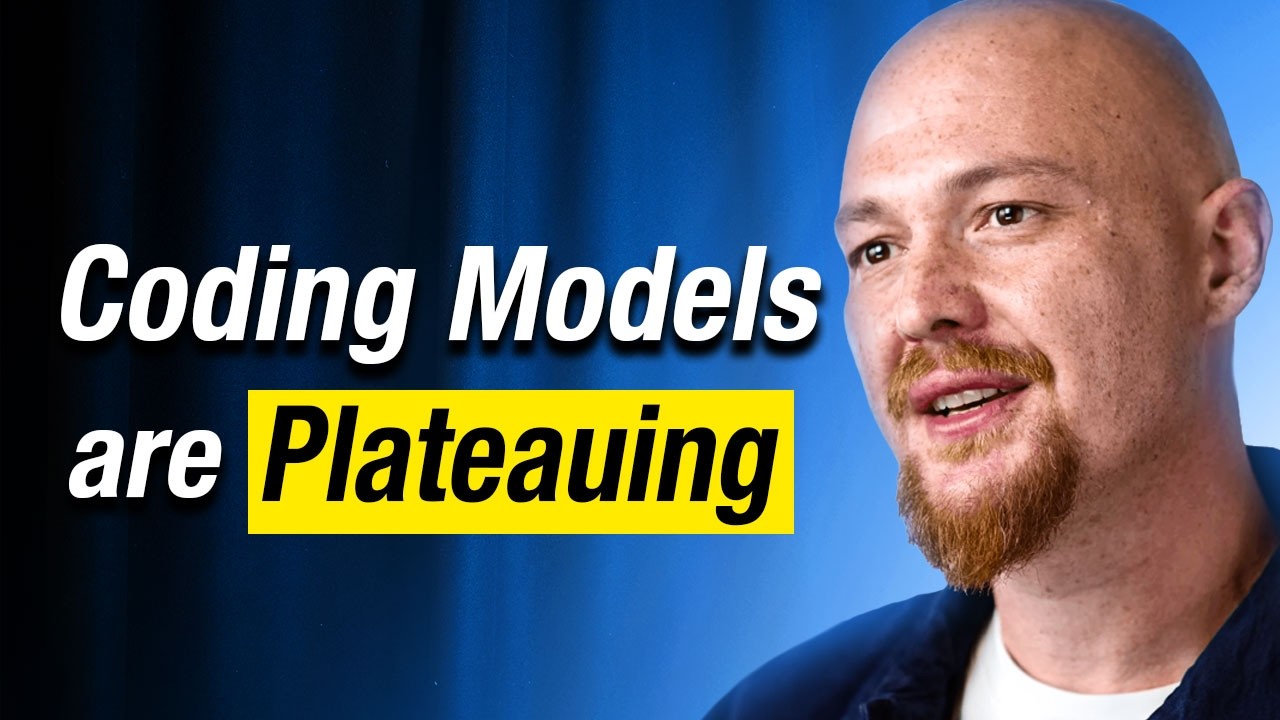
Replit CEO: Why the SaaS Apocalypse is Justified & Why Coding Models are Plateauing | Amjad Masad
Description
Amjad Masad is the Co-Founder and CEO of Replit, one of the leading "vibe-coding" platforms. Under his leadership, Replit has raised a total of $922 million in funding, recently raising at a whopping $9 billion valuation. Replit has over 50 million registered users and is used by employees at 85% of Fortune 500 companies. Replit's revenue jumped from $10 million to $100 million in nine months, and the company is on track to reach $1BN in ARR by the end of 2026. ----------------------------------------------- Timestamps: 00:00 Intro 01:00 How Replit's Vision Finally Caught Up With Technology 03:08 Why Amjad Said "Stop Learning to Code" 03:48 Building on Top of Foundation Models: How Much Is Replit vs the Model? 05:34 How Replit Routes Different Tasks Across Anthropic, Google & Custom Models 07:27 Did Cursor Make a Mistake Building Their Own Model? 11:45 What Are Replit's Gross Margins 16:38 Inference Is the New Sales & Marketing 19:50 Is the SaaS Apocalypse Real? 28:00 Is Cursor Dead? 30:24 Are IDEs Dead? 32:26 Should Students Study Computer Science Anymore? 34:58 Will AI Make Companies Smaller or More Ambitious? 38:48 Why Apple Is Blocking Replit From the App Store 47:35 What Amjad Wishes He'd Known Earlier ---------------------------------------------------------------------------------------------- Subscribe on Spotify: https://open.spotify.com/show/3j2KMcZTtgTNBKwtZBMHvl?si=85bc9196860e4466 Subscribe on Apple Podcasts: https://podcasts.apple.com/us/podcast/the-twenty-minute-vc-20vc-venture-capital-startup/id958230465 Follow Harry Stebbings on X: https://twitter.com/HarryStebbings Follow Amjad Masad on X: https://twitter.com/amasad Follow 20VC on Instagram: https://www.instagram.com/20vchq Follow 20VC on TikTok: https://www.tiktok.com/@20vc_tok Visit our Website: https://www.20vc.com Subscribe to our Newsletter: https://www.thetwentyminutevc.com/contact ----------------------------------------------- #20vc #harrystebbings #replit #vibecoding
Summary
Generated by claude-haiku-4-5-20251001Replit CEO: Why the SaaS Apocalypse is Justified & Why Coding Models are Plateauing
Main Topics
- AI Coding Models Plateauing: Approaching asymptotic limits in coding model improvements
- SaaS Apocalypse: Justified decline of traditional SaaS due to AI alternatives
- Agentic AI Revolution: The shift from simple code completion to autonomous agents
- IDE Death: Traditional IDEs becoming obsolete as AI handles code intelligence
- Product-Market Fit: The importance of explosive demand over early traction
- Apple's App Store Restrictions: Regulatory challenges facing AI coding tools
- Team Scaling: Companies becoming smaller yet more efficient through AI
- Model Strategy: Using multiple providers rather than building proprietary models
Key Points
Coding Model Plateau & Performance Over Cost
- Performance is secondary to cost only at mature S-curve stages
- Currently in growth phase where performance matters more than unit economics
- Approaching ceiling on how good coding models can become
- Open-source models getting competitive enough for fine-tuning to specific use cases
The Agentic AI Breakthrough
- September 2024: Required heavy infrastructure and guardrails for agents
- March 2025: Agent V2 released; models improved, code complexity reduced
- September 2025: Agent V3 became most autonomous agent (hours of operation)
- Post-Opus 4.6: Autonomy built into models themselves, reducing need for wrapper code
- Success requires staying "one, two, three, four, ten steps ahead" of model capabilities
Multi-Provider Model Strategy
- Anthropic: Workhorse for core agent loops (long coherence runs)
- Google Gemini: Best price-performance ratio
- Subagents: Cheaper models for specific tasks (e.g., code search)
- At one point, sending more tokens to Google than Anthropic
- No single-model dependency; use "society of models" approach
Building vs. Using Models
- 2023: Replit trained models better than GPT-3.5, but gap closed quickly
- Current reality: Frontier labs spending tens/hundreds of billions on agents
- Building own models only justified with:
- Open-source catching up (new opportunity)
- Model plateau enabling domain-specific optimization
- Three-month advantage worth the investment cost
- Not worth it competing directly with frontier models on general capability
The SaaS Apocalypse is Justified
- System of Record shift: Data warehouse (Databricks) replacing traditional SaaS tools
- Strategic approach: Building on APIs and creating hooks into existing systems rather than replacing them entirely
- Vertical SaaS replacement: Wholesale replacement with Replit
- Entrepreneurial pressure: Micro-entrepreneurs undercut SaaS pricing by 50-70%
- This maiming of customer growth is justified because the underlying technology fundamentally changed
Replit's Competitive Advantages
- Code Review: Spending as many tokens on maintenance as creation
- Built-in Testing: Agents test in browser, get feedback, iterate
- Security Agents: AI monitoring production deployments for supply chain attacks
- Quality over Cost: Willing to sacrifice margins for superior product
- Still more expensive than competitors but ROI justifies it for enterprises
The End of IDEs
- Traditional IDE features obsolete: Autocomplete, symbol clicking, basic intelligence all replaced by AI
- Will limp along for engineers who want manual control
- Still needed for: Mission-critical software (self-driving cars, NASA, SpaceX)
- Risk appetite matters: JavaScript adoption shows this principle—used in web (low risk) not planes
- Different use cases require different development approaches
Operations Teams as Underserved Market
- Current focus: Product teams (Jason Lemkin's ICP)
- Untapped opportunity: Operations teams with:
- Multiple unhappy SaaS tools
- Failed automation attempts
- Heavy Excel/manual work
- ROI: Cutting product development time plus increasing efficiency, sales, headcount reduction
- Return: "As good, if not greater than product teams"
Pricing & Economics Reality
- Model costs represent significant portion but varies:
- Replit: Much less than 80% (industry example: Anthropic keeps 40% after NVIDIA's 60%)
- Margins fluctuate: Willingness to sacrifice profitability for product innovation
- Freemium model: Core tier subsidized by growing enterprise/pro revenue
- Enterprise price insensitivity: $1,000 additional spend justified by $200K+ headcount savings
Token Pricing Trajectory
- Price of intelligence declining dramatically (not unit price)
- Unit token prices not falling as expected because:
- Only two frontier models competing (GPT-5 and Claude)
- Limited NVIDIA competition keeping hardware expensive
- Model labs less profitable than assumed
- Future pricing: Depends on competition (Gemini, open-source catching up)
Education & Career Advice
- Don't go into CS for money—that advantage is gone
- Intrinsic motivation required: Must be drawn to it "like a fly to light"
- Curriculum problem: Universities can't move at model progression pace
- Still need: People understanding data structures, algorithms, computer fundamentals
- Self-teaching viable for disciplined autodidacts; university valuable for structure/community
- ML/AI roles: Still valuable at big labs and companies like Replit
Future Company Structure
- Dramatically smaller engineering teams—but mixed outcomes:
- Some entrepreneurs prefer lean operations (Jason Lemkin model)
- Others use efficiency gains to hire and scale faster (Firecrown Media: $60M company adding 8 staff)
- Role evolution:
- Eliminate supporting roles; focus on builders + salespeople
- Salespeople → educators and transformation consultants
- Can move downmarket with lower ACV if supporting costs reduced
Notable Quotes
> "Cost question is secondary to the performance question. When you focus on cost is when you reach a certain asymptotic plateau in the S-curve."
> "For all intents and purposes, IDEs are dead."
> "The name of the game is just staying one, two, three, four, ten steps ahead."
> "I no longer think you should learn how to code. People need to learn how to create. They need to learn how to build."
> "Premature optimization is the root of all evil. As a programmer, if you think about performance and optimization early on, you're going to make the wrong decisions."
> "The real unlock wasn't just AI. It was AI that could do actions over long horizon—agentic AI."
> "If you're not into computer science, if you don't feel drawn to it like a fly drawn to a light, then don't go into it because someone told you you're going to make a boatload of money."
> "Real product market fit is the idea that the product is getting pulled out of your hand; you can't even provide it fast enough."
> "They're all going to copy what Replit does. Replit is setting the roadmap for everyone. And that's fine by me."
> "Life is much more interesting when there's a little bit of fight into it."
Takeaways
Strategic Insights
- Performance beats cost in growth phases; optimize margins only at maturity
- Multi-provider approach more sustainable than betting on single model or building proprietary
- Stay ahead through product differentiation, not model capability—use frontier models to set benchmarks, optimize everywhere else
- Open-source becoming critical to prevent AI oligopoly and pricing collusion
Business Model Implications
- SaaS apocalypse is real and justified—technology fundamentally shifted value creation
- Margins elastic—willing to sacrifice profitability for innovation to maintain leadership
- Infrastructure/maintenance costs equal creation costs—code review, testing, security
- Freemium subsidized by enterprise—accept losing money on core to capture upmarket
Market Dynamics
- Expanding TAM: Not displacing labor but supercharging it; companies become more productive
- Multiple winners possible: Market large enough for Replit, Cursor, Lovable (different UX preferences)
- Regulatory pressure coming: Apple blocking signals gatekeepers fear losing control
- Operations teams next frontier: Underserved segment with high ROI
Career & Education
- CS degree value diminished unless intrinsically motivated; bootcamp era over
- Fundamentals still matter: Data structures, algorithms, underpinnings won't change
- Learn by doing viable alternative if disciplined; university still valuable for structure
- Domain expertise + vibe coding more valuable than pure engineering skills
Personal/Leadership
- Long-term optimization over sprinting: Sustainable habits (1 day/week workout scaling) beat burnout cycles
- Product-market fit internalization: Most founders can't recognize it; look for "pulling out of hand" demand signal
- Embrace challenges: Regulatory/competitive pressure indicates importance and mission success
- Question your assumptions constantly: Changed mind on whether people should learn to code; must stay adaptable
Transcript
We're approaching a certain plateau in how good coding models could get. And so we could not have a more relevant guest than Amjad Massad, co-founder and CEO at Replit, joining us in the hot seat. Cost question is secondary to the performance question. When you focus on cost is when you reach a certain asymptotic plateau in the S-curve. The man is reshaping what it means to be a great product manager, product leader, and Replit is one of the leading vibe coding tools alongside the likes of Lovable. The name of the game is staying one, two, three, four, ten steps ahead. This was an incredible discussion with Amjad and I'm really excited for you to hear it. For all intents and purposes, IDEs are dead. Ready to go? Amjad, I'm so excited for this. I've wanted to make this one happen for a while, so thank you so much for joining me once again today. My pleasure. Great to be here. We were just chatting about the desert Replit's been through and the amazing position today. Did it take a long time for the world to see what Replit was? Or did technology take a long time to catch up to your vision of what it could be? It's more the latter, right? So the core insight that I had even before we started the company, maybe at this point 20 years ago, was that software is much more transformative than we actually think it is. Mark Andrewson wrote that software's eating the world and all of that, but I thought it's transformative for people's lives and for the prospect of wealth creation, wealth distribution, entrepreneurship, all of that. It's my story. The impact it had on my life as a kid growing up in Jordan, coming to the US and now running a multi-billion dollar company. And I've seen that even earlier than that. When I was 15, I built a little business. I was making hundreds of dollars and that was an amazing amount of money for me. I took my entire class to McDonald's when it opened up in Amman. And so that was the core insight. And initially, when I came to the US, I worked at Code Academy. And the goal was to teach everyone how to code. To make it as simple as possible. And I started seeing the stories back then even. If a fitness guy learns a little bit of coding, launches an app on the app store, makes a million bucks. It's amazing. And so when we started the company Replit in 2016, the goal was how do you make programming more accessible? How do you get to a point where there's a billion developers, not just 20 million developers at the time. And so we started solving one problem at a time, right? Solving the development environment. Replit was the first in-browser IDE. Solving the hosting environment. Solving the package management. The maintenance. The iteration. The version management. The multiplier. We solved all these problems. But there's one bottleneck. And that is people don't want to learn how to code. And it took me a long time to really accept that. Because I became the learn to code guy. And in March 2025, when I was in TPPPN, and I said, I no longer think you should learn how to code. It went super viral. People were pissed. How could you say that? And it's just the realization that there are people that are now successful. We were talking about Jason Lemkin earlier from Saster. People that are building multimillion dollar businesses solo with no developers. They don't need to learn how to code. They need to learn how to create. They need to learn how to build. And the real unlock wasn't just AI. It was AI that could do actions over long horizon, right? So we've had AI since 21, 22, GPT-3. But the unlock in 2024 was agentic AI. And that was the first glimpse of it. And we had to build a lot of infrastructure around it to make it work. Dick Coleman, how much of the magic is what you build versus the performance of models beneath you? It is a dance, I would say. Think about Elon Musk when he did self-driving 1.0, before version 13 or whatever, where it's end-to-end. They had to write a lot of software, right? They had to write a lot of classical computer vision type software in order to make it work. But then they went to end-to-end learning. So there's this thing that happens in AI. And as a founder, it's really important to understand this. At any given point, you have to plug in a lot of holes in order to build the most advanced thing that you can build. So September 2024, we had to build a lot of infrastructure, a lot of guardrails in order to make agents work. March 2025, when we released Agent V2, we had to delete a lot of that code because the models got a lot better at staying consistent. But then you upgrade your vision, right? And so September 2025, we released Agent V3, and that was the most autonomous agent on the market. It was the first to run for hours on end. And again, we had to write a lot of software in order to make it stay on track. And now, since Opus 4.6, autonomy is built into the model. And so you have to understand what is the model capability and how much infrastructure you have to build in order to make it perform. And you have to stay ahead of that in order for your product to stay the most innovative on the market. When you look at your model usage today, I've heard you say before, when I was obviously listening to your prior shows, that you have a preference for Anthropik. What does the model usage look like across different providers today? Yeah. [SPEAKER_02] So Anthropik has been the workhorse for over a year right now. It's the core agent loop because it can run for a long time coherently. But things have changed. [SPEAKER_01] Google's Gemini models are the best at price performance, for example. You know, given their price, where do they sit on the period of frontier, right? When you look at your model usage today, I've heard you say before, when I was obviously listening to your prior shows, that you have a preference for Anthropic. What does the model usage look like across different providers today? Yeah. Yeah. [SPEAKER_02] So Anthropic has been the workhorse for over a year right now. [SPEAKER_02] It's the core agent loop because it can run for a long time coherently. [SPEAKER_02] But a few things have changed. Google's Gemini models are the best at price performance, for example. Given their price, where do they sit on the frontier, right? And so for tasks, for example, like code search, we might create a subagent that is cheaper and has good enough performance. And we offload that from the main core loop, right? So now we use, and I wrote this thesis back in 22, I call it the society of models. Now we use models from every provider. Actually, at some point, we were sending more tokens to Google than we were sending Anthropic, despite Anthropic being the core workhorse. And so there's this concept of agent labs, right? We talk about AI labs, but there's agent labs, us, Cursor, some of these other companies. Our goal is to start with the user problem. [SPEAKER_01] What are we trying to fix? [SPEAKER_01] What are we trying to build? [SPEAKER_01] And walk back to the technology and use whatever model we need to use. [SPEAKER_01] In some cases, we build our own models. [SPEAKER_01] That was going to be my question, sir. [SPEAKER_01] And the reason why the shows have become more and more successful is because I've asked more and more direct questions. Cursor decided to build their own model. When we look at other players across different verticals, it's always been a mistake to build own model. [SPEAKER_02] Was Cursor's decision to build own model and your decision to, in some cases, a mistake? [SPEAKER_02] Because the equivalent model performance has always come alongside you. It ebbs and flows. AI is such a changing landscape. The answer will change every three or six months. [SPEAKER_02] So in 2023, when we train... But when you're investing your team and your resources in that, you have to weigh off. Is it worth that three-month advantage? No. Right. [SPEAKER_02] You do. [SPEAKER_02] And that's why it makes it so hard and why you have to change your mind all the time, right? [SPEAKER_02] Because there's a lead-up time. But the most important thing is optionality. So in 2023, when we were training models, we achieved better coding performance than the state-of-the-art models at the time, GPT 3.5, right? But then since Sonnet came out, later Opus, the gap has closed by a lot. And they were spending tens of billions of dollars, if not hundreds of billions of dollars, making agents work. And that would have been a dumb strategy for us to go and try to compete on that. But now I would say the opportunity opened up again for other reasons. The open source models are getting really good. And we're approaching a certain plateau in how good coding models could get. [SPEAKER_01] And so you can use your data to fine-tune a model specifically for your use case. [SPEAKER_01] I don't know if you saw, but Intercom yesterday talked about their new model that is better at customer support than the frontier models. [SPEAKER_01] And so maybe their model is going to be state-of-the-art for three to six months. And maybe six months from now, the models will zoom back ahead. How do you analyze that? Is it better to be three months ahead and spend the money? How important is it to be ahead for three months? [SPEAKER_01] It's very important. It's a matter of closing a large enterprise deal. We're constantly getting baked off against everything under the sun. And we're winning most of our enterprise deals because our product is ahead of the market consistently. The thing that I always hear is that we're using frontier models to basically set benchmarks. We're seeing where those benchmarks lie. And then we're switching to open source to get as close to them as possible with much more efficiency in terms of cost. Is that the future? [SPEAKER_02] It depends, right? [SPEAKER_02] So the cost question, I think, is secondary to the performance question, right? [SPEAKER_02] Especially in a time when it's flush with capital. [SPEAKER_02] I think when you focus on cost is when you reach a certain asymptotic plateau in the S-curve. And you don't foresee a massive improvement specifically in your domain. Like Intercom might say, you know, we don't predict that models are going to get that much better on customer support for the foreseeable future. Therefore, you know, we can focus on building our own or there's a data flywheel that we can get or there's a cost advantage that we get. But if you focus on cost at the expense of performance, you're going to lose. [SPEAKER_01] And so, you know, it's similar to any era in tech, right? [SPEAKER_01] Like it's cloud, it's mobile, it's SaaS, whatever it is. There are moments of time where the goal is growth and performance and being at the edge. And then when things kind of rationalize, when things rationalize, you focus on your gross margins. I think there's this idea in all transparency that your Replets, your Base 4s, your Lovables, and you might kill me for putting you in that bucket. But is it bluntly of $100 that you make, 80 bucks goes to the model providers? For us, it's not 80. It's way less than that. But it is a significant portion. Like anyone, even Anthropic, every $100 they make, 60 goes to NVIDIA. [SPEAKER_02] Like, you know, their margins are public. It's 40%, right? I mean, so they're also massively subsidizing their service. [SPEAKER_01] Can I be blunt? What are your margins and how have they changed over time? They changed quite a bit. And there are moments of time, last year, we were close to profitability. And then we're like, Agent 4 is going to be this massively parallel agent. Agent 4 is the most parallel agent in the world right now. You can create 20 agents and have them all coordinate and run and build your product 10x faster. But then, you know, that's when we work on. So in programming, there's this old saying, premature optimization is the root of all evil. [SPEAKER_02] Because as a programmer, if you think about performance and optimization early on, you're going to make the wrong decisions. [SPEAKER_02] So the reason margins keep moving around is we're trying to build the best product. And then after we build the best product possible, then we look around and we're like, OK, there are so many ways we can optimize. Then we go into an optimization period. Agent four is the most parallel agent in the world right now. You can create 20 agents and have them all coordinate and run and build your product 10x faster. But that's when we work on it. So in programming, there's an old saying, premature optimization is the root of all evil. Because as a programmer, if you think about performance and optimization early on, you're going to make the wrong decisions. So the reason margins keep moving around is we're trying to build the best product. And then after we build the best product possible, then we look around and we're OK, there's so many ways we can optimize. Then we go into an optimization period. When we think about price sensitivity, how do you think about essentially routing different behaviors where some models are actually OK for certain things and some need the frontier? How do you think about intelligent model selection for different functions? I would say that is the core competency IP of an agent lab, right? If you think of yourself as an agent lab, you have this tacit knowledge first of evaluating models. I think about our AI engineers. They're psychologists in many ways. When a model comes out, the first thing they do, they sit down with it for a day or two, right? They play around with it. They plug it in. [SPEAKER_02] They're OK, what are the limits? What can I do? And then we plug it. And that's more the tacit aspect of it, right? Which is very easy to underestimate. But the reason Replit, when a new model comes out, we're able to build state-of-the-art performance even better than the lab itself. We're big partners with Google. And Gemini is one of the best models at design. I would say our products are better at design using Gemini than Google's products. It's because we know how to evaluate these models, how to get the best performance out of them. And then we have a bunch of proprietary benchmarks that we use. And finally, we do a lot of A-B testing as well. So that's really what you're doing as a company that is building on top of foundation models. How concerned should we be about the proliferation of Chinese models in Silicon Valley companies? I'm not sure about this question. I guess it's a little bit above my pay grade to tell you what are the intentions of the Chinese Communist Party with regards to AI. Is there intention to actually innovate and play in the market fairly? Is there intention to destabilize? Is there intention to destroy the value of US AI labs? I don't know. I think there are reasons to be careful. And there are reasons to be optimistic about the progress. [SPEAKER_02] What I see from China. Would you have a moral issue with using a Chinese model? I don't think there's a moral issue per se. I don't think they're using slave labor or anything to do that. I would have a security issue, especially since we have enterprise customers that depend on us for sensitive data and things. So we haven't taken the step yet. I wouldn't preclude it from taking it in the future. I would love to see a US corporation investing in open source. It looks like NVIDIA is making moves in that regard. But open source is going to be very important for us to actually have a free market around AI. [SPEAKER_02] Because if we're going to end up in an oligopoly of AI companies, then there's actually an economic theory of how they'll naturally collude on price. And prices will not go down as fast as possible. They'll also control how we use these AIs. They'll also not provide everything through the API and keep some of the models for themselves. And so I think that it would be bad if we're in a situation where AGI or AI is only controlled by a few corporations. So open source is going to be very, very important. I would venture to say, maybe the US government should start a consortium of companies that are creating the best open source, national open source model so that the market stays competitive. We mentioned Jason Lampkin earlier. He said something brilliant to me, which is he said, inferences to new sales and marketing. Obviously, free is a large part of your business and many others in the space. Do you agree with Jason on inferences to new sales and marketing? And how do we think about that? Yeah. If you think about the hype period that we got with Cloud Code and Codex towards the end of 2025, early 2026, a lot of it was driven by how much free tokens they were given out. How much every other day they're saying, oh, it's 50% more tokens or less rate limits and things. So it's clear that companies are using inference as a way to loop people in. [SPEAKER_02] And I think agentic development is addictive. It's a better kind of addiction than social media or passive consumption. It's creative addiction, which is good. But I think companies are realizing that a way to rope people in is through a lot of free tokens. [SPEAKER_02] Now, there's a question about retention. But I don't disagree fundamentally with the statement that you can use free tokens to acquire users. Enterprises will try things in certain respects. I was sharing to Jason Lemkin before, and he said, your number one ICP's product teams. As product teams code or vibe more, what do they do OK in two to three years? How do they think about those functions? There's a big question about how product teams will look in the future. If I were to make a prediction, I would say that we'll still have engineers inside the organizations. Those engineers are responsible for more infrastructure, AI, ML, embedded systems, more low-level engineering. And then you have product organizations. And product organizations will have people that tilt a little more technical and have people tilt a little more design, have people tilt a little more product. [SPEAKER_02] But you're not really calling them anything different. They're product builders. And their responsibility is to figure out what to build next. [SPEAKER_02] I agree with Jason that a lot of the ICP right now is product. But one thing I'm really excited about is operations teams. And they're underserved. Operations teams are sitting at the nexus of a lot of data flow. And typically, they'll buy a lot of SaaS software. They're typically not happy with it because there's all these SaaS softwares styling the data. They try a lot of automation software that doesn't work very well. They have a lot of Excel sheets, a lot of manual work. [SPEAKER_02] They're product builders. [SPEAKER_02] And their responsibility is to figure out what to build next. I agree with Jason that a lot of the ICP right now is product. But one thing I'm really excited about is operations teams. And they're underserved. Operations teams are sitting at the nexus of a lot of data flow. And typically, they'll buy a lot of SaaS software. They're typically not happy with it because there's all these SaaS softwares styling the data. They try a lot of automation software that doesn't work very well. They have a lot of Excel sheets, a lot of manual work. And so we see a lot of our customers are building quote configurators for their sales team, automating their deal desk, automating support operations. And when they use Replit, the return on investment is as good, if not greater than product teams. [SPEAKER_01] With product teams, you're cutting down product development lifecycle, which is hugely valuable. With operations teams, you're actually being more efficient. You're selling more. You reduce headcount or you need less people. You said ops have a lot of tools that they're not happy with. That has led to the SaaSpocalypse and a lot of people believing the deterioration of value in a lot of these public companies. Is that exaggerated or is it a just cause for concern that they have lost the market caps they have? I'll tell you what we're seeing in enterprise. We're not seeing people rip out Salesforce, Workday, or really fundamental, I think the hype term is system of record type SaaS tools. And instead, they're building on their APIs and we're creating MCPs and hooks into the hot spots of the world and Salesforce and all of that. But there's also another side where we have this great partnership with Databricks. And people are skipping the SaaS tools entirely and building on top of their data warehouse. So there's another view on this where the system of record is actually your data warehouse. [SPEAKER_02] And this is a way to be bullish on Databricks and companies in that space. [SPEAKER_02] That goes to a statement that Jason has said, though, which is then it is justified because what you're seeing is the maiming of SaaS company growth. [SPEAKER_02] If you have 20, 30 percent of customers or users who are using Databricks as their warehouse and that maims that audience for the core SaaS public companies, that's enough to cause the growth to decline significantly. I would agree with that. [SPEAKER_01] I would agree with that. [SPEAKER_01] Now, a lot of vertical SaaS is in trouble as well, where you don't think of it as a system of record or there's a lot of survey SaaS software. [SPEAKER_01] And we see that getting replaced wholesale with Replit. [SPEAKER_01] And then the other side of this, there's a lot of micro entrepreneurs and it's starting on Replit today. And they're undercutting the price of a lot of SaaS companies out there, especially vertical point solutions. And then there's another pricing pressure there as well. [SPEAKER_02] What about the traditional incumbents in our space like Squarespace, Wix? [SPEAKER_02] What happens to them? I mean, if you look at the behavior of Wix, they look like they're pouring everything into Base 44. So it seems like it's now Base 44. I don't know much about their company, but it looks like they're spending a lot of ads behind Base 44. What did you think of the Super Bowl? You know, I haven't heard that many people talk about it. But I think it's good that people are getting vibe coding out there and more people are talking about it. [SPEAKER_01] But I don't think it's still in the public consciousness. How do you think about maintenance in this case? You have ops teams building tools. [SPEAKER_01] You have entrepreneurs building tools. You've got to maintain these. It's hard enough running a business. Are you going to maintain this now? This is where Replit shines. And if you talk to Jason or some of our other customers, Replit goes way further than any other vibe coding product on creating more maintainable software. For example, part of the reason Replit has been slightly more expensive than others is that we do a code review for every code change that we make. [SPEAKER_02] So we spend a lot of tokens on maintenance as much as we spend on creating that software. [SPEAKER_02] Replit also has a built-in tester. [SPEAKER_02] So if you enable all the power features, whenever the agent writes code, it goes into a testing phase, spins up a browser, tests everything in the app, goes into a code review session, reviews that, kicks it back to the coding agent, gives it feedback. [SPEAKER_02] You know, the test failed here. [SPEAKER_02] The code review is not good. [SPEAKER_02] And people enjoy looking at the code review agent because it's a dick. It's like, this looks like AI generated slop. It'll actually say that. And then it goes back. We're also building agents that are sitting in production software. So we already have security agents right now that are sitting in enterprise deployments and are monitoring activity. And they're monitoring packages, monitoring for supply chain attacks. And so the thing about AI, any problem AI creates, there's more AI that you can build to solve that problem. Have you been surprised by how price sensitive people are around security and code reviews? Not in our segment. I would say in the engineering segment, and we have some engineers use Replit, but 75% are not engineers. [SPEAKER_01] Engineers are more price sensitive because they have a lot of options. [SPEAKER_01] They can use a lot of different products on the market. [SPEAKER_01] Now, when you're an operations manager using Replit, and you just saved $10,000 on a SaaS software, you've saved another $200,000 on headcount, and you're spending an additional $1,000 to just make sure that the software is more secure, that's a no-brainer. [SPEAKER_01] The ROI has been a hundredfold for companies we work with. [SPEAKER_02] On the consumer side, there's more price sensitivity, especially if I'm an entrepreneur just dipping my toes. Which is why we reduce the price on our core plan. So I think there's going to be these different models for different use cases or different parts of your journey. If you're just starting out, you don't want to be hit with a $1,000 bill. You're going to be able to play around with $20, $30 before you commit. [SPEAKER_02] Totally get that. Is core a loss leader? Are you willing to lose money on core for the conversion to pro? Yeah, it's become a bit of the new freemium because you can't totally run an amazing free tier. which is why we reduce the price on our core plan. So I think there's going to be, and you hinted at that earlier, there's going to be these different models for different use cases or different parts of your journey. If you're just starting out, you don't want to be hit with a $1,000 bill. You're going to be able to play around with $20, $30 before you commit. Totally get that. Is core a loss leader? [SPEAKER_01] Are you willing to lose money on core for the conversion to pro? [SPEAKER_01] Yeah, it's become a bit of the new freemium because you can't totally run an amazing free tier because tokens are still very, very expensive. So you want people to pay something to recoup some of that loss. But as the percentage of our revenue becomes more enterprise, more pro, then we're willing to subsidize the cost of core a little more. [SPEAKER_02] Token costs today, how do they change over the next three years? [SPEAKER_02] Is it like they get 50% cheaper or 10 times cheaper? [SPEAKER_02] Yeah. [SPEAKER_02] It's an interesting question because there's different ways to slice it. You can look at the price of intelligence. [SPEAKER_01] The price of intelligence has gone down tremendously. [SPEAKER_01] It's really hard to quantify it, right? [SPEAKER_01] But everyone's spending way more on OpenAI than they were spending on GPT-4, but they're getting way more intelligence, way more productivity out of that. Pure unit price is not going down as much as people expected it to go. And I think part of it is we're living in a world where the true frontier models is actually just between GPT-5 and Claude. [SPEAKER_01] And so there's not a lot of pricing pressure. Now we're seeing Gemini catch up. We're seeing the open source models catch up. And so maybe as there gets more pricing pressure, we'll see unit token prices go down. Also, the other thing is, I don't think these companies are all that profitable, partly because the underlying chips are not all that cheap. And there isn't a lot of competition. At bottom, everyone's running NVIDIA, and there's not much competition there. And NVIDIA has amazing margins, especially for a hardware company. What is it, 80%? Yeah, it's pretty phenomenal. It's the world's most valuable company. I'm confused with something. I'm confused with Cursor. Can you help me out? And this is Jason's question, so you can blame him. All the hard questions, just blame Jason. Twitter says Cursor's completely dead. [SPEAKER_01] I don't have a single portfolio company that uses Twitter. [SPEAKER_02] I don't know anyone that uses Cursor, sorry. [SPEAKER_02] But they just hit $2 billion in revenue. [SPEAKER_02] Is Cursor dead, or is this narrative completely bullshit? [SPEAKER_02] I'll tell you a few principles. [SPEAKER_02] One is the market is so large. [SPEAKER_02] The market for software is not just the market for SaaS, although it's part of that. [SPEAKER_02] It is an expanding market. [SPEAKER_02] There's no existing TAM. [SPEAKER_02] You can say this is the TAM we're going after. [SPEAKER_02] Some people will say, I think Sequoia at some point said it's like the labor TAM, right? The knowledge worker labor TAM. That could be that. But it's not like we're displacing labor. We're actually supercharging labor. [SPEAKER_01] So companies are becoming more productive. [SPEAKER_01] And so it's an ever-expanding TAM. [SPEAKER_01] And it's going to be perhaps as big as the internet, if not more. And that's just software generation broadly. It's Vibe Codings, AI-powered coding, it's fully agentic coding. Coding generation in general, I think it's a hugely valuable market. So I think a lot of, and the world is large, and a lot of different companies will prefer different products. There are people at Replit today that still prefer to review every piece of code. [SPEAKER_01] And something like Cursor is good for that because it's still sitting in the IDE, right? [SPEAKER_01] So there's a portion of the market that still really likes that. And the other thing is, I think Cursor has done well at enterprise sales. And enterprise is a very sticky customer. And once they adopt something, it has to really fall tremendously behind, perhaps like GitHub Copilot, in order for people to replace it. And I don't think Cursor fell that far behind, right? They still use the latest agents. They have a good agent harness. And so I think Twitter is a distortion machine and Twitter is the inside of inside of inside baseball. It is the people at the edge of the adoption of AI. So I think if you're constantly on Twitter, which is why I think VCs don't have the best information landscape, because a lot of them just live on Twitter, but the world is much larger than that. Are IDEs dead? Will we have IDEs in two years? I think for all intents and purposes, IDEs are dead. I think they'll limp along because again, some engineers just love that control, but there's no future in them in that there's no one's going to be asking for the latest feature of intelligence or what were IDEs like? IDEs, one part were the code intelligence. We call it intelligence. It wasn't very intelligent. And so all of that is irrelevant. The autocomplete, the click to symbol, all of that stuff is irrelevant. So in that sense, IDEs are dead because AI has eaten all of that. But in terms of people who want to see the code, I think there's still a population of users that want that. I think there's still engineers that are working with software that they want to actually verify that it works. For example, life or death software. [SPEAKER_01] If I'm writing mission critical software for self-driving cars or a NASA or SpaceX mission, [SPEAKER_01] The autocomplete, the click to symbol, all of that stuff is irrelevant. So in that sense, IDEs are dead because AI has eaten all of that. But in terms of people who want to see the code, I think there's still a population of users that want that. I think there's still engineers that are working with software that they want to actually verify that it works. For example, life or death software. If I'm writing mission critical software for self-driving cars or a NASA or SpaceX mission, I think there's always going to be a need for some kind of IDEs. I'd be pretty pissed if my autopilot on my plane had problems because of a vibe coded with no IDE. Yeah, that would be pretty sad. I mean, even in planes and those kinds of software that we're talking about, they never adopted JavaScript. And the reason they never adopted JavaScript is because JavaScript is the original vibe language because JavaScript didn't have types. You could run into errors. But the reason why we adopted JavaScript is because web software was not going to kill anyone. Your Gmail, if someone pushes a bug to Gmail, not going to die. Maybe it'll be down for an hour and that's fine. So there's different risk appetites. And I think vibe coding follows the same thing where it's on the less risky type of software. So if you're a student listening to this, should you not study engineering at university? Should you not study CS? How does this inform how you think about advising young people? Before 2005, which is when I went to school, people who went to computer science were very intrinsically motivated in understanding computer science and understanding exactly how computers work. And there were hackers and really interested in programming. And then after that, computer science became a hyped up field because it's the easiest place to make money. And we had the boot camps and we had this whole thing. And computer science departments exploded because of that. Now, if you're not into computer science, if you don't feel drawn to it like a fly drawn to a light, then don't go into it because someone told you you're going to make a boatload of money working for Google. That's gone. So it's pretty dumb to tell people to go into computer science if they're not really intrinsically interested in it. Now, if you're interested in it, I think there's still ways to contribute. I think you can get into ML and AI and go work at the big labs or a company like ours. But if you're thinking about university, the curriculums are not able to move at the pace of model progression. What would you advise me as a student? Well, I will say if computer science is the field of computer science where you're learning about data structures and algorithms, that's not going to change. So there's always going to be need for people to understand the underpinnings of computer science because we still need those people. But do you think universities are the best place to learn that? Depends on the person. I think there are people who are autodidact. I would consider myself someone who is very good at teaching myself. And it depends on you. If you're really good and you can learn on the job and you can open the textbooks and you have the discipline to do that, you don't have to go to university. But if you're someone who likes the structure, who likes to meet other students and work with them and likes the discipline that university forces on you, then I think there's still a place for university. Are companies going to be so much smaller in the future? When you look at the capabilities of individual people, do you buy the ideological Silicon Valley narrative? We're just going to do more and we're going to be so much more capable? Or what are we actually like? No, we will have dramatically smaller engineering teams. I see both. So Jason is someone who wants to work with a very lean team. He's doing better than when he had people on staff. Yesterday, I met an entrepreneur at a conference in D.C. that's using Replit. I think he sells board games online. And he says, it's been so transformative on my business. We've saved so much money on SaaS. We're selling more that I decided to use the increased revenue and efficiency to hire more people. He hired eight more people. There's a customer case study we actually published on our site, Firecrown Media, a $60 million media company that owns magazines, different properties, and they've been so successful using Replit for marketing automations and all sorts of things like that, that decided to hire [SPEAKER_01] that I decided to use the increased revenue and efficiency to hire more people. He hired eight more people. There's a customer case study we actually published on our site, Firecrown Media, a $60 million media company that owns magazines, different properties. And they've been so successful using Replit for marketing automations and all sorts of things that they decided to hire more people that know how to do Vibe coding in order to sell more and do more and build more. So it depends really on the kind of company. But we see companies that were wanting to get leaner and we want less people. And I think it'll come down to the entrepreneur, the level of ambition, how they want to run their company. For us at Replit, I think what we want to try to eliminate or reduce is a lot of supporting roles. We want builders, right? We want builders and we want salespeople because I think salespeople, it's people just really want to talk to someone to sell them software and to teach them how to use it. And also the sales role is changing in that salespeople are becoming more like educators and transformation consultants. They go into companies, tell them how to use the product and what's the best way to leverage this technology. With the removal of other parts or with less engineers or with removal of other parts of the org, reducing headcount cost in those areas, are you able to justify sales reps moving down ACV categories or ranges because you don't have the cost elsewhere in the business? It depends. There's a lot of companies that now have self-serve enterprise, right? Especially in AI because there's so much demand that you can justify that. But let's say traditional SMBs still need some hand-holding and typically the cost of sale is higher because you have so much supporting staff. But if you can have a commercial AE that is, you're willing to spend an hour or two talking to a customer and onboarding them and perhaps a few hours for the rest of the year supporting them and the contract size is $10,000, $15,000. I think you're right. It's possible that becomes more of a thing. What worries you today? Are you positive? I'm genuinely, are you positive about the future? Are you negative? And just, not just about software development, about life. I know it sounds weird and macro. Well, actually, let me tell you about Replit first and what worries me there. We've gone through this, you know, first they laugh at you and then they, I forgot the quote exactly, but we're at the point where then they attack you, right? Where, you know, it's now been publicly reported that Apple is sort of blocking the Replit app. Replit has been on the App Store since 2022 doing exactly the same thing, allowing people to generate or write code and run it in a browser window. Suddenly they're saying that we are not complying with their guidelines and we've been stuck in app review for now three months. We haven't been able to push an update. And again, we've been on there for four years. We've passed a hundred Apple App Store reviews and suddenly Apple has decided that they don't want this, other apps in the category are also getting affected. I'm sorry, what the reasoning behind that is, they, sorry, I'm being disrespectful to you. They think that your apps are not as high quality in their AI and that they're making discovery harder in the app store. We're not in compliance with their guidelines and we've shown them repeatedly. But like, peeling that back one layer more, it's like they're fearful of this. [SPEAKER_01] I don't know because they're accepting apps made on Replit. They're accepting them. [SPEAKER_01] They think that your apps are not as high quality in their AI slop and that they're making discovery harder in the app store. We're not in compliance with their guidelines and we've shown them repeatedly. But peeling that back one layer more, it's they're fearful of this. I don't know because they're accepting apps made on Replit. They're accepting them into the App Store. I tweeted about one yesterday. There's, the, the acceptance rate is very high. If they think that we're generating slop, they could have said that. And second, they wouldn't have accepted the apps that are being made with Replit. So it doesn't seem like. So then what is the reason I'm dead? You are a smart dude. I'm a hopefully relatively smart dude. There is a reason behind that. I want to give them the benefit of the doubt. [SPEAKER_02] Right? I want to say that perhaps they're trying to figure out what is their posture here. And perhaps the delays is just because they're trying to figure out that out. Posture with regards to what? With regards to vibe coding. With regards to vibe coding and how people are going to be using that on the App Store. Look, maybe they're concerned that people are going to be circumventing the App Store rules. That's not what we do. Maybe there are other apps in the categories that do that. And they looked at the category as a whole. It was, okay, let's put a pause on this. But we're not doing that. We're not building an App Store. We are just making it possible for people to make apps. And so if they're concerned, and maybe that's their concern, that people are going to be making apps and getting around the App Store, that is not what we do. How detrimental is that to your business? When you think about Apple putting that additional barrier challenge, is that fuck? Or is that we'll get over it. [SPEAKER_02] Face money before. Yeah. Look, I've been on this mission for over a decade now. and at building this company for a decade. And the fact that we're such an important force in the world, in the culture, in how the world is reacting to this technology is a good thing. And it means that we are achieving our mission. We're important. Now, I never thought it was going to be easy and I'm ready for the challenges to come. And I actually challenges, you know, life is much more interesting when there's a little bit of fight into it. I think it's important to have a common enemy in a team. Amjad, you can shoot one Claude Code, Lovable, or Base 44. Which one do you shoot? [SPEAKER_02] I don't really think that way. If it's not a name, I'm going to tell Jason. The next word is a name, Amjad. I'll tell you that. They're all going to copy what Replit does. Replit is setting the roadmap for everyone. And that's fine. That's fine by me. But what I really is innovation. It's building, building the next thing that can really change how people think about software. And I feel very proud that this agentic revolution was really kickstarted by Replit agents in 2024. So the name of the game is just staying one, two, three, four, ten steps ahead. Right, dude, we're going to do a quick fire round. I say a short statement, you give me your immediate thoughts. Does that sound okay? Yep. [SPEAKER_02] What have you changed agents in 2024. So, the name of the game is just staying one, two, three, four, ten steps ahead. Right, dude, we're going to do a quick fire round. I say a short statement, you give me your immediate thoughts. Does that sound okay? [SPEAKER_02] Yep. [SPEAKER_02] What have you changed your mind on most in the last 12 months? [SPEAKER_02] How fast to scale our sales organization. I always wanted to build a hyper-efficient company. Replit is extremely efficient for our size and valuation. But I think that given how much interest we have in the market, I think we should hire as many salespeople as we can to go sell these people. Who would you most like to have on the board who you don't have on it yet? I would like to have an operator that's two decades ahead of me or something like that, a CEO that's been in the weeds and building a company from scratch but reached, went public and reached way past what I've done. Because we have a lot of VCs and they're amazing but no one who's actually an operator. Carl Eschenbach. He's a beast. Who's that? He was the CEO of Workday and now he's at Sequoia as a partner but he was CEO for a long time and he was at Adobe for many, many years. [SPEAKER_02] Tell me, when I say high performance, who do you think of first and why them? [SPEAKER_02] It's such a cliche but obviously Elon and the reason is the amount of things that you can do at the same time. Like the number of things and before that Steve Jobs running Pixar on Apple. Like I am dead by the end of the week running one company. How can you do two? That is an enigma to me. How can you do five? My favorite thing is the difference between mine and your answer to that one. Mine was Federer. But yes, I totally agree. [SPEAKER_02] I was thinking about winning 20 grand slams and consistently being awesome. I think CEOs are in a way, you should be an athlete. [SPEAKER_02] I 100% agree. I'm 100% editing this out but I don't do midweek sleepovers with my girlfriend because it impacts my sleep and that's performance. [SPEAKER_02] Yes, 100%. [SPEAKER_02] What do you invest in for yourself that has been a game changer? I hope it's not too personal but you've lost a lot of weight. You look fantastic, dude. [SPEAKER_02] Thank you. Tell me about that. [SPEAKER_02] Losing the weight has actually been three years. I always yo-yoed my weight depending on my stress level at the company and I decided in 2023 I'm going to take three years to get healthy and instead of sprinting and working out five days a week and then burning out, I'm going to work out one day a week and I started working out one day a week and then my energy levels improved, I lost some weight. Okay, now I'm going to add another day a week and okay, now I'm going to add another habit, let's add a walk, let's add a bit of stretching and it's so slow. It's I want to get healthy over the next five years. and I started working out one day a week and then my energy levels improved, I lost some weight. Okay, now I'm going to add another day a week and okay, now I'm going to add another habit, let's add a walk, let's add a bit of stretching and it's so slow. I want to get healthy over the next five years and that's been a major game changer so I'll just add another habit every once in a while. It's simple stuff, let's add a walk, let's add a sauna once a week so I really love sauna and cold, hot and cold, it's a reset, it forces you. I'm someone who's constantly thinking and I tried meditation, all that stuff and it's really hard for me. When I go into a sauna and get burnt and then go into ice cold water, you can't think, your mind freezes and that forces me into a meditative state for the next hour or so. What's the biggest advice to a new parent given all you know now about parenting? Don't stress out. I think it's the difference between the first kid and the second kid. [SPEAKER_02] and every parent will tell you, let alone the third kid, is the first kid is, oh, it's nap time, we've got to go do the nap thing, we've got to do exactly that, measure this and that and you're measuring everything, you're doing everything. Babies are quite resilient. Humans have been around for whatever, 100,000 years, we know instinctively how to raise a child and I think taking it a little easy on yourself is probably the best advice. Final one for you, what do you know now that you wish you'd known when you started Raplet? The feeling of product market fit is, you can deceive yourself into thinking you had product market fit at different points, you'll get a few customers like, oh, this product market fit. Real product market fit and people will say it, you can't really internalize it is the idea that the product is getting pulled out of your hand, you can't even provide it fast enough. I think if I understood that earlier on, perhaps I would have searched for it faster, harder or things like that. So as an entrepreneur wanting to build not a lifestyle business or small business, wanting to build a venture scale business, you have to find that moment, you have to keep pivoting and changing. Perhaps you don't change your vision but keep changing the different, keep searching until you find that explosive demand. Dude, I've so enjoyed this. I appreciate you letting me go wayward but you've been fantastic. So thank you so much for joining me. Appreciate it, man. [SPEAKER_02] Thank you. Will we have IDEs in two years? I think for all intents and purposes, IDEs are dead. I think they'll, you know, they'll limp along because again, some engineers just love that control, but there's no future in them in that there's no one's going to be asking for like the latest feature of like intelligence or like what were IDEs like? IDEs, like one part were like the code intelligence. We call it intelligence. It wasn't very intelligent. And so all of that is irrelevant. Like the autocomplete, the click to symbol, all of that stuff is irrelevant. So in that sense, IDEs are dead because AI has like eaten all of that. But in terms of like, you know, people who want to see the code, I think there's still a population of users that want that. I think there's still, you know, engineers that are working with software that they want to actually verify that it works. For example, life or death software. If I'm writing like mission critical software for self-driving cars or a NASA or SpaceX mission, I think there's always going to be a need for some kind of IDEs. I'd be pretty pissed if my autopilot on my plane had problems because of a Vibe coded with no ID. Yeah, that would be pretty sad. I mean, so, I mean, even in planes and, you know, those kind of software that we're talking about, they never adopted JavaScript. And the reason they never adopted JavaScript is because JavaScript is the original sort of Vibe language because JavaScript didn't have types. You could like run into errors. But the reason why we adopted JavaScript is because web software was not going to kill anyone. Your Gmail, if someone pushes a bug to Gmail, not going to die. Maybe it'll be down for an hour and that's fine. So there's different risk appetites. And I think Vibe coding follows the same thing where it's on the sort of less risky type of software. So if you're a student listening to this, should you not study engineering at university? Should you not study CS? How does this inform how you think about advising young people? Before 2005, right, let's say, which is when I went to school, people who went to the computer science were very intrinsically motivated in understanding computer science and understanding exactly how computers work. And there were like hackers and really interested in programming, right? And then after that, computer science became a hyped up field because it's the easiest place to make money, right? And we had the boot camps and we had this whole thing. And computer science departments exploded because of that. Now, if you're not into computer science, if you don't feel like you're drawn to it, like a fly drawn to a light, then don't go into it because someone told you you're going to make a boatload of money working for Google. That's gone. So it's pretty dumb to tell people to go into computer science if they're not really intrinsically interested in it. Now, if you're interested in it, I think there's still ways to contribute. I think you can get into ML and AI and go work at the big labs or a company like ours. But if you're thinking about university, the curriculums are not able to move at the pace of model progression. What would you advise me as a student? Well, I will say if computer science is like the field of computer science where you're like learning about your data structures and algorithms, that's not going to change. So if you, and there's always going to be need for people to understand the underpinnings of computer science because we still need kind of those people. But do you think universities are the best place to learn that? Depends on the person. I think there are people who are autodidact. I would consider myself someone who is very good at teaching myself. And so it depends on you. Like if you're really good and you can learn on the job and you can open the textbooks and you have the discipline to do that, you don't have to go to university. But if you're someone who likes the structure, who likes to meet other students and work with them and likes the discipline that university forces on you, then I think there's still a place for university. Are companies going to be so much smaller in the future? When you look at the capabilities of individual people, do you buy the ideological Silicon Valley? Oh, you know, we're just going to do more and we're going to be so much more capable? Or what are we actually like? No, we will have dramatically smaller engineering teams. I see. I see both. So Jason is someone who wants to work with a very lean team. He's doing better more than when he had people on staff. Yesterday, I met an entrepreneur at a conference in D.C. that's using Replit. I think he sells board games online. And he says, it's been so transformative on my business. We've saved so much money on SaaS. We're selling more that I decided to use the increased revenue and efficiency to hire more people. He hired eight more people. There's a customer case study we actually published on our site, Firecrown Media, like a $60 million media company that owns magazines, different properties. and they've been so successful using Replit for marketing automations and all sorts of things like that, that decided to hire more people that know how to do Vibe coding in order to sell more and do more and build more. So it depends really on the kind of company. But we see companies that were like, we want to get leaner and we want less people. And I think it'll come down to the entrepreneur, the level of ambition, how they want to run their company. For us at Replit, I think what we want to try to eliminate or reduce is a lot of supporting roles. We want builders, right? We want builders and we want salespeople because I think salespeople, it's like people just like really want to talk to someone to sell them software and to teach them how to use it. And also the sales role is changing in that salespeople are becoming more like educators and transformation sort of consultants. They go into companies, tell them how to use the product and what's the best way to leverage this technology. With the removal of other parts or with less engineers or with removal of other parts of the org, reducing headcount cost in those areas, are you able to justify sales reps moving down ACV categories or ranges because you don't have the cost elsewhere in the business? It depends. There's a lot of companies that now have self-serve enterprise, right? Especially in AI because there's so much demand that you can sort of justify that. But let's say, you know, traditional SMBs still need some hand-holding and, you know, typically the cost of sale is higher because you have so much supporting staff. But if you can have a commercial AE that is, you know, you're willing to spend like an hour or two talking to a customer and onboarding them and perhaps a few hours for the rest of the year supporting them and the contract size is like $10,000, $15,000. I think you're right. It's possible that becomes more of a thing. What worries you today? Are you positive? I'm genuinely, are you positive about the future? Are you negative? And just, not just about software development, about life. I know it sounds weird and macro. Well, actually, let me tell you about Replit first and like what worries me there. We've gone through this, you know, first they laugh at you and then they, I forgot the quote exactly, but we're at the point where like then they attack you, right? Where, you know, it's now been publicly reported that, you know, Apple is, is sort of blocking the Replit app. Replit has been on the App Store since 2022 doing exactly the same thing, allowing people to generate or write code and running it in a, in a browser window. Suddenly they're saying that we are, you know, we're, we're not complying with their guidelines and we've been stuck in app review for now three months we haven't been able to push an update. And again, we've been on there for four years. We've passed a hundred Apple App Store reviews and suddenly Apple has decided that they don't want this, other, other apps in the category are also getting, getting affected. I'm sorry, what the reasoning behind that is they, they, sorry, I'm being disrespectful to you. They think that your apps are not as high quality in their AI slop and that they're making discovery harder in the app store. We're not in compliance with their guidelines and we've shown them repeatedly. But like, peeling that back one layer more, it's like they're fearful of this. I don't know because they're accepting apps made on Replit. They're accepting them into the App Store. I tweeted about one yesterday. There's, the, the acceptance rate is very high. If they think that we're generating a slop, they could have said that. And second, they wouldn't have accepted the apps that are being made with Replit. So it doesn't seem like. So then what is the reason I'm dead? Like you are a smart dude. I'm a hopefully relatively smart dude. Like there is a reason behind that. I, I want to give them the benefit of the doubt. Right? I want to say that perhaps they're trying to figure out what is their posture here. And perhaps the delays is just because they're trying to figure out, figure that out. Um, posture with regards to what? With regards to vibe coding. With regards to vibe coding and, and how people are going to be using that on the App Store. Look, maybe they're a concern that people are going to be circumventing the App Store rules. That's not what we do. Maybe there are other apps in the categories that do that. And they looked at the category as a whole. It was like, okay, let's put a pause on this. But we're not doing that. We're not building an App Store. We are just making it possible for people to make apps. And so if they're concerned, and maybe that's their concern, that, that people are going to be making apps and getting around the App Store, that is not what we do. How detrimental is that to your business? When you think about Apple putting that additional barrier challenge, is that like, fuck? Or is that like, we'll get over it. Face money before. Yeah. Yeah. You know, look, I, I, I've been on this mission again for, for over a decade now. and, uh, at building this company for, for a decade. And, you know, the fact that we're such a important force in the, in the world, in the culture, in, in how the world is like reacting to this technology is a good thing. And it means that we are achieving our mission. We're important. Now, I, I never thought it was going to be easy and I'm ready for the challenges to come. And I actually like, like challenges, you know, life is much more interesting when there's a little bit of fight into it. I think it's important to have a common enemy in a team. Amjad, you can shoot one Claude Code, Lovable, or Base 44. Which one do you shoot? I don't really think that way. Like, if it's not a name, I'm going to go, I'm going to tell Jason. The next word is a name, Amjad. I'll tell you that. They're all going to copy what Replit does. Replit is setting the roadmap for everyone. And that's fine. That's fine by me. But what I really like is innovation. It's like building, building the next thing that can really change how people think about software. And I feel very proud that this agentic revolution was really kickstarted by Replit agents in 2024. So, it just, the name of the game is just staying one, two, three, four, ten steps ahead. Right, dude, we're going to do a quick fire round. I say a short statement, you give me your immediate thoughts. Does that sound okay? Yep. What have you changed your mind on most in the last 12 months? How fast to scale our sales organization. I always wanted to build like a hyper-efficient company. Replit is extremely efficient for our size and valuation. But, I think that given how much interest we have in the market, I think we should hire as many salespeople as we can to go sell these people. Who would you most like to have on the board who you don't have on it yet? I would like to have an operator that's like, you know, two decades ahead of me or something like that. like a CEO that's been been in the weeds and building a company from scratch but reached, went public and reached, you know, way past what I've done. Because we have a lot of VCs and they're amazing but no one who's actually an operator. Carl Eschenbach. He's a beast. Who's that? He was the CEO of Workday and now he's at Sequoia as a partner but he was CEO for a long time and he was at Adobe for many, many years. Tell me, when I say high performance, who do you think of first and why them? I mean, it's such a cliche but like obviously Elon and the reason is like the amount of things that you can do at the same time. Like the number of things and before that Steve Jobs running Pixar on Apple. Like I can, like I am like dead by the end of the week running one company. How can you do two? That is an enigma to me. How can you do five? My favorite thing is the difference between mine and your answer to that one. Mine was Federer. But yeah, sure. I totally agree. I was thinking about like, you know, just winning 20 grand slams and consistently being fucking awesome. I think CEOs are in a way it's like you should be an athlete. Oh, I 100% agree. Like I'm 100% editing this out but like I don't do midweek sleepovers with my girlfriend because it impacts like my sleep and that's like performance. Yes. Like 100. What do you invest in for yourself that has been a game changer? I hope it's not too personal but you've lost a lot of weight. You look fantastic, dude. Thank you. Tell me about that. You know, losing the weight has actually been like three years. I decide, I always yo-yoed my weight depending on my stress level at the company and I decided in 2023 I'm going to take three years to get healthy and instead of like sprinting and working out five days a week and then burning out, I'm going to work out one day a week and I started working out one day a week and then my energy levels improved, I lost some weight. Okay, now I'm going to add another day a week and okay, now I'm going to add another habit, let's add a walk, let's add like a bit of a stretching and it's so slow, it's sort of like I want to get healthy over the next five years and that's been a major game changer so I'll just like add another habit every once in a while, it's like there are simple stuff, let's add a walk, let's add a sauna once a week so I really love sauna and cold, hot and cold, it's like a reset, it forces you, I'm someone who's like constantly thinking and I tried meditation, all that stuff and it's really hard for me, when I go into a sauna and get burnt and then go into like ice cold water, you can't think, your mind freezes and that forces me into a meditative state for the next like hour or so. What's the biggest advice to a new parent given all you know now about parenting? Don't stress out, like, you know, I think it's the difference between the first kid and the second kid and every parent will tell you, let alone the third kid, is like the first kid is like, oh, it's nap time, we've got to go do the nap thing, we've got to do exactly that, measure this and that and you're measuring everything, you're doing everything. Like babies are quite resilient, you know, humans have been around for whatever, like 100,000 years, you know, we know instinctively how to raise a child and I think taking it a little easy on yourself is probably the best advice. Final one for you, what do you know now that you wish you'd known when you started Raplet? I mean, the feeling of product market fit is, you can deceive yourself into thinking you had product market fit at different points, you'll get a few customers like, oh, this product market fit, real product market fit and like people will say it, you can't really internalize it is the idea that like the product is getting pulled out of your hand, you can't even provide it fast enough. You know, I think if I understood that earlier on, perhaps I would have searched for it faster, harder or things like that. So as an entrepreneur wanting to build not a lifestyle business or small business, wanting to build a venture scale business, you have to find that moment, you have to keep pivoting and changing. Perhaps you don't change your vision but keep changing the different, keep kind of searching until you find that explosive demand. Dude, I've so enjoyed this. I so appreciate you letting me go wayward but you've been fantastic. So thank you so much for joining me. Appreciate it, man. Thank you.