All Code Is Slop (Except Mine) — Lauren Tan, SpaceXSI
Description
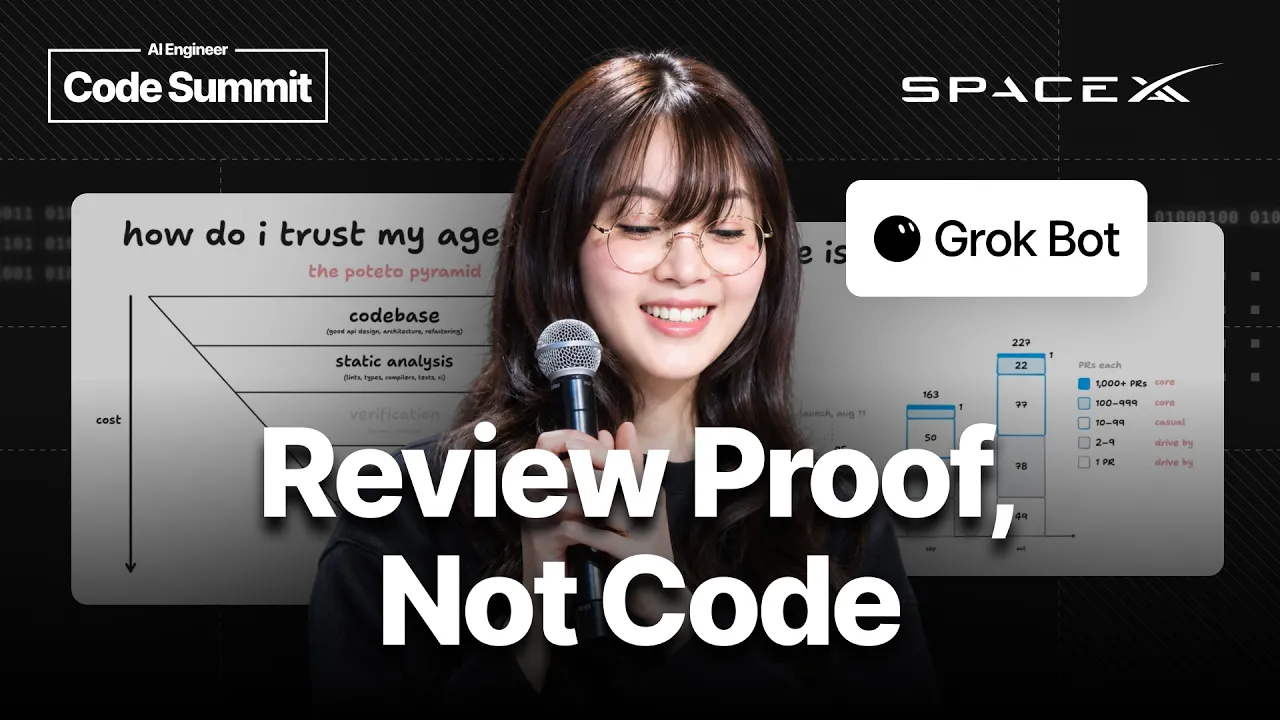
11,000 pull requests in one month, with a revert rate around 0.5%. Lauren Tan (poteto) shares how the Grok Bot team at SpaceXSI scales AI coding agents through software architecture, lint rules, automated testing, runtime verification and formal verification with TLA+ and Lean. See how Cursor agents and pstack turn these software engineering foundations into reliable software factories. Speaker info: - https://x.com/poteto - https://github.com/poteto - https://github.com/cursor/plugins/tree/main/pstack Timestamps: 0:00 - Turning slop into gold 2:03 - The trust pyramid and codebase quality 5:00 - Dune and enforceable architecture 6:56 - Replacing comments with lint rules 9:40 - Runtime verification and feature maps 10:50 - Formal verification and UI testing 11:51 - Spending tokens on verification 13:32 - 11,000 PRs and a 0.5% revert rate 15:11 - Foundations before software factories
Summary
Generated by gpt-5.6-terraAt-a-Glance
- Verdict: Watch fully
- Core thesis: Agent-driven engineering scales safely only when teams convert recurring agent mistakes into deterministic architectural constraints and invest heavily in verification before automating merges.
- Why it matters: This is a concrete operating model for moving from AI coding assistance to high-volume autonomous delivery without treating human code review as the primary quality control.
- Best use: Use it as a design pattern for an agentic software factory: harden the codebase and test/verification layers first, then add orchestration and selective auto-merge.
Executive Summary
Lauren Tan argues that the central job of an AI-era software engineer is not merely generating more code, but preserving or improving code quality while agent-assisted output increases by orders of magnitude. Her framing is “trust”: teams earn the ability to let agents act autonomously by shaping an environment in which incorrect approaches are structurally difficult or impossible.
The proposed hierarchy starts with deterministic controls in the codebase: API design, architecture, refactoring, type systems, linting, compilers, dependency rules, and tests. Prose instructions such as rules files, skills, documentation, and comments belong at the top because they require judgment, go stale, and are less enforceable. Each repeated agent correction should, where possible, become a reusable deterministic check rather than another prompt instruction.
The second pillar is verification. Rather than deeply reviewing every code diff, the GrokBot team increasingly reviews artifacts such as runtime videos, screenshots, diagrams, state-machine representations, and formal proofs/model checks. The talk presents runtime tooling, shared feature maps, reusable CLIs, TLA+, Lean, and UI property-based testing as layers that make agent work inspectable and safer.
The claimed payoff is unusually high throughput: 11,000 production PRs in one month, roughly daily stable releases, 227 October contributors, and a steady approximately 0.5% revert rate while client performance improved. The key qualification is that this outcome followed about six months of investment and formal methods remain experimental rather than a universal solution.
Key Takeaways
- Claim: The path to trustworthy agent autonomy is to prioritize deterministic constraints over prose-based instructions. | Evidence: Tan’s inverse pyramid puts architecture, API design, lint rules, types, compilers, and testing below verification and, finally, prose assets such as rules, skills, and agents.md. Her operating rule is to turn every recurring agent correction into a deterministic check where possible. | Implication: For an agent system, recurring review comments should be treated as candidates for lint rules, API redesign, dependency restrictions, or testable invariants—not additions to an ever-growing prompt. | Caveat: Some judgment-dependent guidance still belongs in prose; the claim is not that rules files or skills are unnecessary, but that they are weaker controls than executable constraints.
- Claim: A codebase becomes agent training context in practice, so legacy workarounds and anti-patterns propagate faster under agentic development. | Evidence: Tan compares the repository to a garden: agents treat existing code as the established pattern and will copy deprecated patterns, tech debt, and workarounds. She says code that once arrived in a few PRs per day can now arrive in the hundreds. | Implication: Before scaling coding agents, clean up high-frequency bad examples and establish clear canonical implementations; otherwise automated generation compounds repository debt rather than simply adding isolated defects.
- Claim: Remove nuanced, frequently misused primitives from ordinary product code instead of relying on reviewers to catch misuse. | Evidence: In Dune, an Electron client framework described as roughly analogous to Next.js for Electron apps, the team bans React useEffect in product code and permits it only inside constrained framework APIs. It also separates code into electron-renderer and electron-main directories and blocks imports between them through dependency analysis and linting to prevent renderer jank from main-thread imports. | Implication: Identify APIs that demand subtle judgment from agents and developers, then encapsulate them behind constrained abstractions with enforceable boundaries. | Caveat: Banning a primitive is appropriate only when a team provides safe framework-level alternatives; otherwise it can merely displace complexity.
- Claim: Comments and markdown instructions can become an agent failure mode when they rationalize shortcuts rather than enforce correct behavior. | Evidence: Tan recounts agents spreading imperative timers—setTimeout, requestAnimationFrame, and requestIdleCallback—to patch an architectural mismatch between VS Code’s imperative model and React’s declarative model. The timer churn caused garbage collection, lag, and jank; comments explaining the exceptions helped normalize the workaround. GrokBot subsequently banned 99% of comments and replaced them with lint errors directing agents toward root-cause fixes. | Implication: Avoid using comments as policy enforcement for agents. Where a pattern is unsafe, make the unsafe path fail mechanically and make the error message point to the intended repair. | Caveat: The transcript makes a strong team-specific claim about comments; it does not establish that most comments are harmful in every codebase.
- Claim: At high agent throughput, human review should increasingly inspect verification artifacts rather than manually reason through every code diff. | Evidence: The team reviews videos, screenshots, diagrams, and formal-verification outputs. Its runtime-verification skill includes a user-facing feature map that supplies shared product vocabulary, while reusable custom CLIs and drivers reduce token use and can themselves be tested. | Implication: Build agent-accessible runtime environments and standardized test drivers before pursuing broad auto-merge; make the intended user journey observable rather than leaving agents to infer UI semantics from code alone. | Caveat: Artifact review is only as reliable as the coverage and fidelity of the underlying verification harnesses; passing artifacts do not prove untested requirements.
- Claim: Formal and generative verification are becoming economically practical because agents reduce the cost of creating and maintaining them. | Evidence: The team uses TLA+ model checking for multi-device notification flows, Lean to check properties of a custom virtualization library such as flicker/jitter behavior, and Bombadil for UI property-based testing. Tan says formal methods have already found several bugs, while citing an observation that roughly 70% of daily agent tokens may go to verification. | Implication: Allocate significant model and engineering budget to verification, especially around cross-system flows, stateful behavior, and performance-sensitive algorithms; use formal methods selectively where their modeling cost is justified. | Caveat: Tan explicitly calls formal verification promising but not a silver bullet and says the team is still experimenting with it.
- Claim: Once deterministic guardrails and verification are mature, autonomous outer-loop workflows can safely create, fix, and merge large numbers of PRs. | Evidence: Tan reports 11,000 production PRs in a month, stable releases about once per day, 227 contributors with at least one October PR, and a relative revert rate around 0.5% while startup, typing, and chat-navigation performance improved. On each release, GrokBot can launch a Cursor project to fuzz the application, open fix PRs for discovered bugs, and auto-merge them. | Implication: Treat auto-merge and multi-agent orchestration as the final layer of an operating system for quality, not as the starting point. Automating an unreliable inner loop only scales defects and token spend. | Caveat: These metrics are presented as internal team results and are not independently validated in the transcript; Tan also says reaching this trust level took her approximately six months.
Detailed Brief
Practical trust-building sequence before autonomous merges
- Claims: Automation should follow, rather than substitute for, a reliable inner coding loop.; The team’s maturity model shifts the bottleneck from reviewing code text to establishing whether desired system properties were actually verified.; Strong controls allow lower-context or drive-by contributors to participate without requiring every contributor to absorb the full architecture.
- Evidence: Tan recommends first adding a lint rule to stop new instances of an anti-pattern, then removing legacy occurrences.; The release workflow described runs the application like a real user, fuzzes the full build, creates bug-fix PRs, and auto-merges them.; A State Chart skill in Tan’s PStack plugin visualizes user-facing state machines for review alongside videos and screenshots.
- Caveats: The transcript does not specify the approval gates, production rollback controls, security-review process, or scope restrictions that surround its auto-merge workflow.; The account is primarily about an Electron client; applicability to security-critical backends, infrastructure, migrations, and regulated systems requires additional controls not described here.
- Implications: A useful readiness criterion for autonomous coding is whether teams can state and test critical invariants, user flows, architectural boundaries, and performance constraints without relying on reviewer intuition.; Agent orchestration platforms are most valuable after repositories expose reliable execution, testing, and repair interfaces.
Notable Concepts & Terms
- Organic architecture: Tan’s idea that architecture should provide concrete, enforceable structures around which rapidly generated code can safely grow.
- Dune: The team’s client framework for Electron applications, used to encode constraints and lessons that prevent common agent-generated mistakes.
- Feature map: A user-perspective map of available application features that gives agents and humans shared UI vocabulary during runtime verification.
- Verification artifacts: Evidence such as videos, screenshots, diagrams, test outputs, and formal proofs that replaces much of line-by-line PR review.
- TLA+: A formal specification and model-checking tool the team uses for major stateful flows, including cross-device notifications.
- Lean: A theorem prover used here to verify algorithmic properties, including behavior in a custom virtualization library.
- Bombadil: A library the team uses for property-based UI testing, intended to expose bugs through generated interaction cases.
- Outer loop: The orchestration layer that launches coding/fuzzing agents, opens PRs, and can merge them after the inner development loop is made reliable.
Operator Notes / Why Ken Should Care
- Create a recurring-agent-error register; for each issue, require an owner to decide whether it becomes an API change, static rule, dependency boundary, executable test, or an explicitly accepted judgment call.
- Audit the repository for high-copy-risk patterns: deprecated APIs, workaround comments, timing hacks, ambiguous module boundaries, and examples that agents are likely to imitate.
- Establish a verification-artifact contract for agent-generated changes: reproducible runtime evidence for user-facing work, explicit invariant tests for stateful flows, and machine-readable performance checks for sensitive paths.
- Do not enable broad auto-merge until revert rate, test reliability, sandbox fidelity, rollback capability, and authorization/security boundaries are measured separately by change class.
- Budget agent tokens deliberately for test creation, execution, debugging, and verification; optimizing solely for code-generation tokens will create a misleading cost picture.
Source/Metadata
- Title: All Code Is Slop (Except Mine) — Lauren Tan, SpaceXSI
- Transcript words: 4786
- Duration seconds: 1051
- Timestamp note: No timestamps or chapters were present in the supplied transcript.
Transcript
All right, so my name is Potato. I work on GrokBot at SpaceX SI. Can I ask you a quick show of hands, how many of you have ever looked at code that somebody else wrote and you thought, that's all slop? Well, I have too. But today I'm going to convince you that you can turn that slop into gold. I did something crazy last month and I shipped 3,000 Ploycrest to production. Now, before agents, we never really cared about volume except for the outliers. At my previous company, we call these people coding machines. People like Brett Taylor, who famously rewrote all of Google Maps in a weekend. Just an insanely productive engineer. With agents, anyone can now be a coding machine. My thesis is that the job of the software engineer, the meta of being a software engineer, is figuring out how to maintain or even improve the quality of your code while massively increasing your productivity. To get there, some people call this a software factory. But I like to keep it simple. I think of it as all about trust. Not blind trust, but investing in your agent's environment so you can trust that your agents are going to do the right thing. It takes quite a lot of effort to get there. It took me six months to get to a point where I could ship thousands of pull requests, a lot of them in my sleep. But it's certainly possible, and it will take you much less time than I did. Let's start by talking about how we move from a low trust environment to a high trust one. This inverse pyramid is how I think about where to spend time on your agent's environment. The first two layers are deterministic, using your code itself. Things like good API design, architecture, refactoring, or using lint rules, type systems, compilers, or different kinds of testing. You can use both of these layers together to constrain what agents can do and force them to do the right thing by default. Verification, both runtime and formal, are great tools to layer on to find bugs and check properties and invariance in your system that you want to hold true. They also help you check whether the agent understood your goals and intent. Then finally, you want to layer in a bit of prose, things like rules, skills, agents.md, things that require judgment. Let's start with your code base. Agents generate their outputs based on their inputs, so the quality of the input really matters. Your code base is one of the largest inputs. Whenever you're correcting your agent, think about how you can make that a deterministic check instead of adding another line to your rules or agents.md, because it's far more reproducible when it's in code and it lets you trust it more. The analogy I like to use is that your code base is like a garden. Code used to arrive a few pull requests at a time. I remember going into work in 2024 and reviewing the three pull requests that my colleagues wrote. Today, that number is more like 300. Every engineer is now a team of hundreds or even thousands of agents. Code is arriving so rapidly that it almost feels like a continuous stream and it almost feels organic, like a living thing. Your code base, the constraints that you impose, the guardrails that you put up are the concrete foundations that the new code that your agents write grow around, just like the building in this picture. In many ways, the job of being a software engineer is becoming like gardening. Because code is the biggest input for agents, it means that any workarounds, anti-patterns, deprecated code, tech debt, it's now likely to be copied by the next agent since it looks like the established pattern in your code base. It's like you have weeds or pests growing in your garden, and they spread everywhere before you know it. You want to make your code base as pristine as possible so that agents are always copying the good stuff. Let's look at some real examples. Dune is a client framework that we created for GrokBot to implement this idea of organic architecture. It's not really that interesting technically. You can think of Dune as like Next.js for electron apps. But the interesting part of Dune is that it has a lot of constraints and lint rules that encode a lot of the lessons we've learned building desktop applications. One lesson is that anything that requires nuance to use well often leads to slop. Your classic example is use effect in React. It has its use cases, but it's often misused. Some people joke that you need a PhD to use use effect. It really requires a lot of nuance to use well, and agents are not good at using it. Our solution has been to ban it in product code. It's really only allowed in some places inside Dune APIs. Effectively, this problem has been categorically eliminated. We never need to catch that during code review again. Another interesting pattern we use is context through directory structure. One anti-pattern we saw with Cursor, which is an Electron app, is that agents would often import main thread code into the render thread, which would cause long tasks and jank. In GrokBot and Dune apps, we've made this very conventional. We have two top level directories, literally called electron renderer and electron main. Imports between them are forbidden or banned by our dependency graph analyzer and some lint rules. These are simple lint rules to set up, but they mean one less thing we need to review and think about during code review. One more surprising thing I've seen is agents using markdown, things like documentation, code comments, rules or skills, as a place to write down their justifications for not doing the right thing. They'll over rotate on some small correction you made and treat it like a hard rule that can never be broken again. Here's another example from Cursor. Agents really loved using imperative timers, things like set timeout, request animation frame, request idle callback. They were using these as quick fixes because they were patching over an architecture clash between VS code's imperative style and React's declarative style. Our choice of architecture actually made both the client and the agent performance much worse. When you have tons of timers being rapidly created and destroyed, it causes a lot of major garbage collection, which causes lag and jank. But the worst part is that agents wrote a lot of code comments explaining why this quick fix was justified. Before you know it, we had timers spreading everywhere and the performance of the app really suffered. In GrokBot, we learned our lesson and decided to ban 99% of comments because they go stale easily. Humans just really don't bother reading comment slop anyway, and it gives an agent an escape hatch to justify not doing the right thing because it's hard. The worst part about comments is that they're not enforceable. What seems well-intentioned, telling the next agent not to do something, never ends up actually being anything you can trust. In GrokBot and Dune, we now have lint rules that give good and very helpful error messages telling the agent to fix the root cause, the real problem, rather than just patch around it. Our general principle is that every time we correct our agents, it turns into one of these deterministic checks. We think about how to categorically eliminate that problem in the code through better API design, through better architecture. If you do this enough times, you'll find that you have fewer things to look out for in code review. At some point you realize there's nothing left to review and you can just let agents merge most of their own pull requests. So, code verification is also a really big part of how we make our agents more autonomous and increase our confidence and trust in their work. Our code review process has now really shrunk into looking at verification artifacts instead, things like videos, screenshots, diagrams, formal verification. The most basic example is runtime verification, which is giving your agent a way to run the code for itself and use debugging tools that human developers use as well, like the Chrome Dev Tools protocol. In our runtime verification skills, we have a thing called a feature map, which is basically a site map of all the features available in your application from the user's point of view. With this, agents don't need to guess when you say the thingy in the left sidebar. It gives you shared vocabulary. We also make use of custom CLIs inside these skills so agents can reuse the CLI and driver every time, which cuts down on token usage and is also testable. Recently, we've also started looking at formal verification. We now use TLA+ to do model checking of major user flows, such as notifications across multiple devices and platforms. We use Lean as well for proving certain algorithms. For example, we wrote our own custom virtualization library and we use Lean there to check that we don't have flickering or jittering problems. We're still experimenting with this approach overall. It seems very promising. We've already found quite a few bugs with formal verification. But it's certainly not a silver bullet. We're treating it as another tool, another layer in our agent's environment. Another thing we just started looking at is property-based testing for UIs. We use a library called Bombadil, and this has already caught a few UI bugs for us. I saw this tweet from Cindy. Six months ago, she said she was unable to trust her agents because of subtle bugs that were getting merged. What was missing for her in being able to trust her agents was the verification process. Six months later, she says that 70% of her daily tokens go into verification. I'd say that tracks with what I see as well—most of my token usage goes to verification. If you really look closely at her process, none of these things are new or novel techniques we've never had before. These are just good software engineering tools, but ones that might have been prohibitively expensive to use before as they were hard to understand or write or maintain. Agents drastically cut this cost down. We're entering a golden age of software testing and verification because agents let us test everything to a much greater degree than used to be economical. Formal verification can also help you better reason about how your product should work and whether your agents really understand your intent and goals. I made a new skill called State Chart in my plugin PStack, potato stack, which helps you visualize state machines from the user's point of view. I find this much easier to review alongside the videos and screenshots we provide. Now let's look at what the promised land looks like. What do you get in return for all this investment? On the GrokBot team, our velocity is taking off and rapidly increasing. Last month, our team shipped 11,000 pull requests to production, which is a wild number. Our pace of releasing the client has also increased. We cut a new stable version about once a day. The core team is also shipping much more, and we also have a lot more casual or drive-by contributors who don't always have a lot of context, but they're also contributing. In October, we had about 227 people who contributed at least one pull request. Despite this velocity accelerating, you might be thinking, isn't this going to be chaos? Isn't this going to be a bunch of slop? But actually, the number of PRs that get reverted has gotten lower on a relative basis and is steady at about half a percent. The really interesting thing about this shipping pace and volume of pull requests is that the performance of GrokBot has stayed not just stable, but has improved on multiple dimensions compared to when we launched. Startup, typing, opening new chats, switching chats, all of this has gotten faster. Keep in mind, GrokBot is still an Electron app for now, so there is a ceiling. But it's already much faster than many other agent UIs out there. For an Electron app with this high velocity and this many people contributing, I'd say that's pretty good. So before you jump into building out a software factory and automating everything you can, whenever you correct your agent, try and do it by improving your codebase first. Start with a lint rule to prevent new occurrences of anti-patterns, and then clean up those old patterns as well. Make sure that your verification story is really strong. A lot of this work is a prerequisite to automation anyway. If your inner coding loop produces slop, then automating that loop just produces more slop. You need to throw more and more tokens at the problem, which we all know is very expensive. Once you've made these investments into your codebase, static analysis, runtime and formal verification, you'll start to find that many things become possible with these foundations. You can really easily build your own factory on top of these foundations. When you're ready, GrokBot is a great way to build that outer loop. We have tons of connectors, routines that can kick off Cursor, Cloud agents and projects, which let you orchestrate hundreds or even thousands of agents. As a quick example, whenever we cut a new release now, GrokBot will automatically spin up a new Cursor project for us that will fuzz the entire application, the entire build, and it will find bugs by running the app and using it like a real user. Then it's going to open fixed PRs for each of those bugs it finds and it's going to auto-merge it, as crazy as that sounds. That's because our codebase is good enough that pull requests tend to just be good by default. Most product code that we land no longer really requires deep human review. So when you have solid foundations and good organic architecture, you can turn slop into gold and you can ship with high quality, high velocity without compromising on quality. My name is Potato, also known as Lauren. Thanks for listening to my talk. the constraints that you impose, the guardrails that you put up are the concrete foundations that the new code that your agents write grow around, just like the building in this picture. And so in many ways, the job of being a software engineer is kind of becoming like gardening. Because code is the biggest input for agents, it means that any workarounds, anti-patterns, deprecated code, tech dep, it's now likely to be just copied by the next agent since it looks like the established pattern in your code base. And it's like you have some weeds or pests growing in your garden, and then they spread everywhere before you know it. So you want to make your code base as pristine as possible so that agents are always copying the good stuff. All right, let's look at some real examples. So Dune is a client framework that we created for Groffbot to implement this idea for organic architecture. It's not really that interesting technically. You can kind of think of Dune as kind of like Next.js for electron apps. But the interesting part of Dune is that it has a lot of constraints and lit rules that we've encoded a lot of the lessons that we've learned building desktop applications. And one such lesson is that anything that requires nuance to use well often leads to slow. You know, your classic example is, you know, use effect in React, right? It has its use cases, but it's often misused. You know, some people joke that you need a PhD to use use effect. And in other words, it really requires a lot of nuance to use well. And agents are not good at using it. So our solution has been to just ban it in product code. And it's really only allowed in some places inside of Dune APIs. And effectively, this problem has now been categorically eliminated. And we never need to catch that during code review again. Another interesting pattern that we use is context through directory structure. So one anti-pattern that we saw with Cursor, which is an Electron app, is that agents would often import main thread code into the render thread, which would cause long tasks and jank. So in Grokbot and in Dune apps, we've made this very, very conventional. We have these two top level directories, literally called electron renderer and electron main. And imports between them are forbidden or banned by our dependency graph analyzer and some lint rules. And again, you know, these are simple lint rules to set up, but it means one less thing that we need to review and think about, you know, during code review. And then one more surprising thing that I've seen is agents using markdown. So things like documentation, code comments, rules or skills. And they use this as a place to write down their justifications for not doing the right thing. Or I don't know if you've ever seen this, but they'll over rotate on some small correction that you made, and they treat it like a hard rule that can never be broken ever again. And here's another example from cursor. So agents really loved using imperative timers. So things like set timeout, request animation frame, request idle callback. And they were using these as quick fixes because they were really patching over an architecture clash between VS code's imperative style and React's declarative style. So our choice of architecture actually made both the client and the agent performance much worse. And if you've ever done any performance work in JavaScript, you'll know that when you have tons of timers being rapidly created and destroyed, causes a lot of major garbage collection, which causes a lot of lag and jang. But the worst part is that agents wrote a lot of code comments, like you can see in red here, explaining why this quick fix was justified. And before you know it, we had timers spreading everywhere and the performance of the app really suffered. Now in Grokbot, we learned our lesson there and we decided to just ban 99% of comments because they go stale easily. You know, humans just really don't bother reading the comment slop anyway. And again, it gives an agent an escape hatch to justify not doing the right thing because it's hard. And the worst part about comments though is that they're not enforceable. So what seems well-intentioned, you know, like I'm going to tell the next agent not to do something, never ends up actually being anything that you can trust. So in Grokbot and Dune, we now have lint rules that give good and very helpful error messages telling the agent to fix the root cause, the real problem, rather than just patch around it. And so our general principle is that every time we correct our agents, it turns into one of these deterministic checks. And we think about how to categorically eliminate that problem in the code through better API design, through better architecture. And if you do this enough times, you'll find that you have just less things to look out for in code review. And at some point you realize there's nothing left to review and you can just let agents merge their most of their own requests. All right, moving on. So, the code verification is also a really big part of how we make our agents more autonomous and also increase our confidence and trust in their work. And our code review process has now really shrunk into looking at verification artifacts instead. So things like videos, screenshots, diagrams, formal verification. And the most basic example of this is runtime verification, which is just a fancy way of saying, giving your agent a way to run the code for itself and use debugging tools that, you know, human developers use as well, like the Chrome Dev Tools protocol. In our runtime verification skills, we have this thing that we call a feature map. And that's basically kind of like a site map of all of the features that are available in your application from the user's point of view. And so with this, agents don't need to guess when you say, you know, the thingy in the left sidebar. It gives you some shared vocabulary. And we also make use of custom CLIs inside these skills so that agents can reuse the CLI and the driver every time, which cuts down on token usage and is also testable. And then recently, we've also started looking at formal verification. So we now use TLA plus to do some model checking of major user flows, such as notifications across multiple devices and platforms. We use a lean as well for proving certain algorithms. For example, we have our own, we wrote our own custom virtualization library and we use lean there to check that we don't have, you know, flickering or jittering problems. And we're still experimenting with this approach overall. It seems very promising. We've already found quite a few bugs with formal verification. But it's certainly not a silver bullet. And we're treating it as another tool, another layer in our agents environment. And then this is a very fast video. But another thing that we just started looking at is property based testing as well for UIs. So we use this library called Bombadil. And this has also caught a few UI bugs for us already. Okay, so zooming out, I saw this tweet from Cindy. Six months ago, she said that she was talking about not being able to trust her agents because of subtle bugs that were getting merged. And really what was missing for her in being able to trust her agents was the verification process. And now six months later, she says that 70% of her daily tokens go into verification. And I'd say that that tracks with what I see as well, that most of my token usage goes to verification. And if you really look closely at her process, none of these things here are new or novel techniques that we've never had before. These are just good software engineering tools, but ones that might have been prohibitively expensive to use before as they were hard to understand or write or maintain. But agents drastically cut this cost down. And really, we're entering a golden age of software testing and verification. Because agents let us test everything to a much greater degree than used to be economical. And then formal verification can also help you better reason about how your product should work and whether your agents really understand your intent and goals. I made this new skill called State Chart in my plugin PStack, potato stack, which helps you visualize state machines from the user's point of view. And I find this much easier to review alongside the videos and screenshots that we provide. And so that's been great. Sorry for the flashback. Okay, now let's look at what the promised land looks like. What do you get in return for all of this investment? So on the GrofBot team, our velocity is taking off and rapidly increasing. And last month, our team shipped a ridiculous 11,000 pull requests to production, which is a wild number. And our pace of releasing the client has also increased. And we cut a new stable version about once a day. And then the core team is also shipping much more. And we also have a lot more casual or drive-by contributors who don't always have a lot of context, but they're also contributing. And in October, we had about 227 people who contributed at least one pull request. So despite this velocity accelerating, you might be thinking to yourself, like, isn't this going to be chaos? You know, isn't this going to be a bunch of slop? But actually, the number of PRs that get reverted has actually gotten lower on a relative basis and is steady at about half a percent. But I think the really interesting thing about this shipping pace and this volume of pull requests is that the performance of GrofBot has stayed not just stable, but has improved on multiple dimensions compared to when we launched. So startup, typing, opening new chats, switching chats, all of this has gotten faster. And keep in mind, GrofBot is still an electron app for now. So there is a ceiling, right? But it's already much faster than many other agent UIs out there. And for an electron app with this high velocity and this many people contributing, I'd say that's pretty good. So before you jump into building out a software factory and automating everything that you can, whenever you correct your agent, try and do it by improving your codebase first. Start with a lint rule to prevent new occurrences of anti-patterns. And then clean up those old patterns as well. And then make sure that your verification story is really strong. A lot of this work is a prerequisite to automation anyway. And if your inner coding loop produces slop, then automating that loop just produces more slop. And you need to throw more and more and more tokens at the problem, which we all know is very expensive. And once you've made these investments into your codebase, static analysis, runtime and formal verification, you'll start to find that many things become possible with these foundations. And that you can really easily build your own factory on top of these foundations. And when you're ready, Grokbot is a great way to build that outer loop. We have tons of connectors, routines that can kick off cursor, cloud agents and projects, which let you orchestrate hundreds or even thousands of agents. And as a quick example, whenever we cut a new release now, Grokbot will automatically spin up a new cursor project for us that will fuzz the entire application, the entire build, and it will find bugs by running the app and using it like a real user. And then it's going to open fixed PRs for each of those bugs that it finds, and it's going to auto-merge it, as crazy as that sounds. And that's because our codebase is good enough that pull requests tend to just be good by default. And most product code that we land no longer really requires deep human review. So when you have solid foundations and good organic architecture, you can turn slop into gold and you can ship with high quality, high velocity without compromising on quality. My name is Potato, also known as Lauren. Thanks to you again for listening to my talk. I got it from got it from got it from got it from got it from got it from got it from got it from got it from got it from got it from got it from got it from got it from got it from got it from got it from got it from got it from got it from got it from got it from got it from got it from got it from got it from got it from got it from got it from got it from got it from got it from got it from got it from got it from got it from got it from got it from got it from got it from got it from got it from got it from got it from got it from got it from got it from got it from got it from got it from got it from got it from got it from got it from got it from got it from got it from got it from got it from got it from got it from got it from got it from got it from got it from got it from got it from got it from got it from got it from got it from got it from got it got it