AI Writes More PRs. Who Validates Them? — Ali-Reza Adl-Tabatabai, Sonar
Description
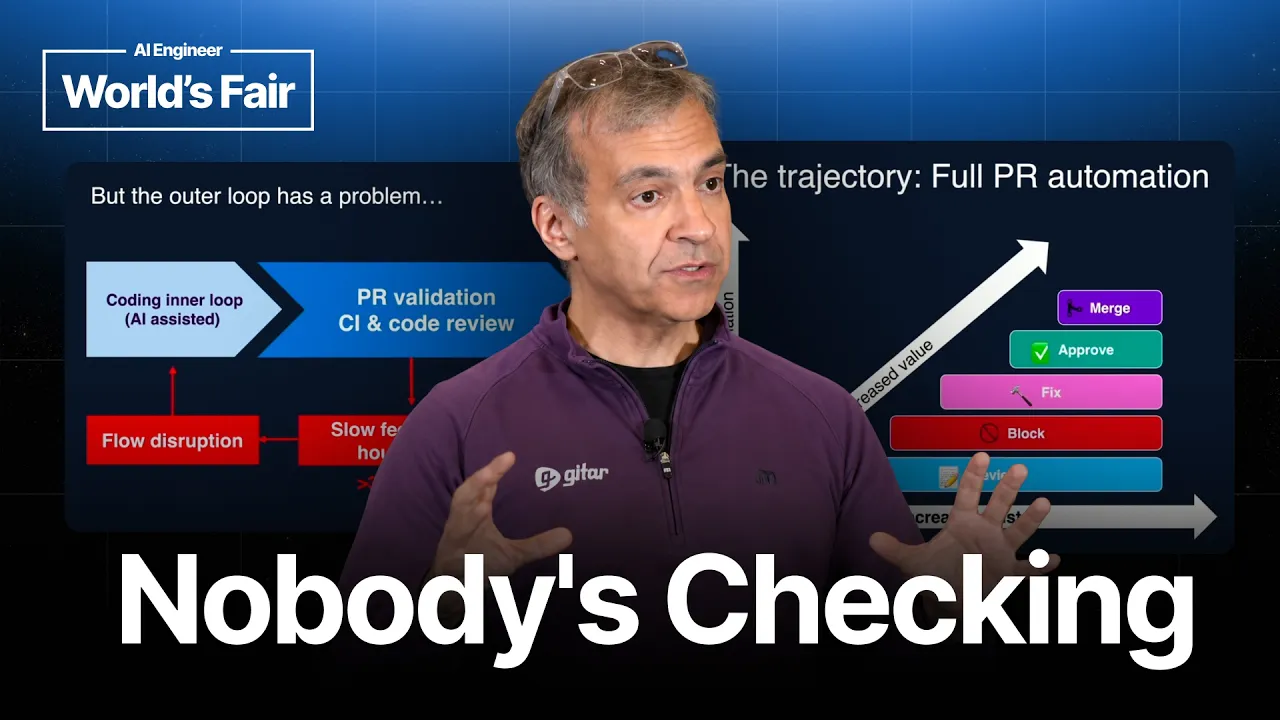
AI means more PRs, bigger PRs, and more bugs. Your choice is to slow down or rubber-stamp, unless validation gets automated too. Ali-Reza Adl-Tabatabai, co-founder of Gitar (now part of Sonar), focuses on verifying code. CI and code review are where quality gates live, and they get slower and more expensive as teams grow. AI makes it worse with more and bigger PRs, leaving teams to either slow down or rubber-stamp and risk incidents. His answer is agentic validation: an agent that reviews PRs with as little noise as possible, explains CI failures and catches flaky tests, fixes issues until the PR is green, and approves and merges based on rules you set. He describes how users build trust step by step toward full automation, the insights it gives platform teams and leaders, what's under the hood (control plane, custom harness and LLM proxy), and why combining agents with program analysis in SonarQube beats either alone. In this talk: • Why AI-generated code turns CI and code review into a bottleneck • Agentic validation: review, CI analysis, autofix and auto-merge • How teams build trust step by step toward fully automated PRs • Why agents plus program analysis beat either alone SPEAKER Ali-Reza Adl-Tabatabai, Co-founder, Gitar (now part of Sonar) LinkedIn: https://www.linkedin.com/in/aliadl/ X: https://x.com/aadltaba LINKS Gitar by Sonar: https://www.sonarsource.com/products/gitar/ Sonar: https://www.sonarsource.com Sonar on X: https://x.com/SonarSource CHAPTERS 0:00 Intro 0:43 CI and code review: the critical path 1:57 Failures cost hours and days 2:57 AI makes it worse 3:22 Slow down or rubber-stamp 3:42 Agentic validation 4:07 Noise-free code review 4:42 CI failures and flaky tests 5:02 Autofix until green 5:27 Auto-approve and auto-merge 5:47 The path to full automation 7:06 Insights for platform teams 7:36 Insights for leaders 7:56 Under the hood 9:01 Agents plus program analysis 9:36 Results 10:26 Wrap-up Recorded at the AI Engineer World's Fair 2026 in
Summary
Generated by gpt-5.6-terraAt-a-Glance
- Verdict: Skim
- Core thesis: As AI increases both the volume and size of pull requests, teams need an agentic validation layer that reviews, diagnoses CI failures, fixes issues, and progressively earns permission to approve and merge code automatically.
- Why it matters: The talk frames PR validation as the emerging bottleneck in AI-accelerated software delivery and offers a reusable control-plane pattern for safely moving from AI-assisted review to conditional autonomous execution.
- Best use: Use it as a concise product-and-architecture case study for designing agentic CI/CD validation and graduated trust controls, not as independent evidence of performance claims.
Executive Summary
Ali-Reza Adl-Tabatabai argues that centralized PR validation—CI plus code review—becomes the limiting step when AI generates more code. The conventional trade-off is to slow delivery with exhaustive human review or rubber-stamp AI-generated changes and accept greater production risk. He positions validation failures as especially costly because they create multi-hour or multi-day feedback loops, interrupt developer flow, and burden already-constrained platform teams.
Guitar, now part of Sonar, is presented as an agentic validation system that takes a PR from creation through review, CI diagnosis, remediation, and eventually conditional approval and merge. Its automation ladder is important: customers first consume AI review comments, then permit merge blocking, then enable auto-fixing and iterative repair until green, and finally authorize auto-merge under rules they define.
The technically relevant pattern is a dedicated orchestration control plane above an agent runtime and model-routing proxy. The runtime manages multi-agent execution, context and memory, tool calls, and integrations; the proxy routes across models and handles failover. The speaker claims this specialized stack enables predictable per-PR pricing while optimizing precision, coverage, and token cost.
The presentation is fundamentally a vendor talk and supplies no measured outcomes, accuracy rates, false-positive rates, security evaluation, or details of merge-policy safeguards. Its strongest transferable insight is that autonomous coding systems need an equally capable, policy-governed validation and remediation loop—ideally combined with deterministic program analysis rather than relying on agents alone.
Key Takeaways
- Claim: AI-assisted coding shifts the software-delivery bottleneck from code production to PR validation. | Evidence: The speaker says AI creates both more PRs and larger PRs, while the existing centralized validation stage must still enforce security, compliance, code-quality gates, CI, and distributed human review. | Implication: For AI-enabled engineering workflows, increasing code-generation capacity without proportionally improving validation will likely increase queue time, review burden, and production-risk exposure. | Caveat: This is a strategic framing from a company selling PR-validation automation; the talk provides no quantitative data showing the magnitude of the bottleneck across teams.
- Claim: The proposed operating model is end-to-end agentic PR validation rather than isolated AI code review. | Evidence: The described workflow reviews a newly created PR with inline findings, can enforce unresolved findings as merge blockers, summarizes CI root causes, identifies flaky tests, retries them under rules, fixes review or CI issues, and loops until the PR is green. | Implication: A useful agent design target is a closed validation-remediation loop with explicit stop conditions, rather than an assistant that only produces comments for humans to process. | Caveat: The transcript does not establish how reliably the agent distinguishes genuine defects from false positives, nor how safely it changes code in complex repositories.
- Claim: Autonomous merge should be introduced through a progressive trust ladder, not enabled as a default. | Evidence: Adoption reportedly progresses from receiving accurate reviews, to allowing the agent to block PRs, to auto-fixing issues and CI failures, and only then to defining rules for automatic approval and merge. | Implication: Ken should treat auto-merge as a policy-controlled capability gated by demonstrated precision and bounded change categories, with escalation paths for uncertain or high-impact changes. | Caveat: The speaker does not specify the policy criteria, repository classes, change-risk tiers, or audit mechanisms used to decide when autonomous merge is acceptable.
- Claim: A PR-validation agent can double as an operational intelligence layer for platform and engineering leadership. | Evidence: The system categorizes top CI failure types—such as flaky tests, infrastructure issues, and other developer-facing failures—and categorizes landed PRs across feature development, bug fixes, chores, and refactors. | Implication: Validation telemetry can be used to prioritize platform investment: fix systemic test flakiness or CI infrastructure failures before merely adding more review capacity.
- Claim: Reliable validation automation requires a purpose-built control plane, agent harness, and model-routing layer. | Evidence: Guitar's stated architecture has a PR-workflow orchestration control plane; a custom runtime for multi-agent execution, context and memory management, tool calling, and integrations; and an LLM proxy for model routing and failover. | Implication: For agentic software operations, orchestration, permissions, observability, fallback, and cost controls are first-class product layers—not implementation details delegated solely to an LLM. | Caveat: The talk describes architecture at a high level and does not explain state persistence, authorization boundaries, isolation, evaluation methodology, or recovery behavior when tools or models fail.
- Claim: The strongest validation approach should combine agents with deterministic program-analysis techniques. | Evidence: Following Guitar's acquisition by Sonar, the speaker highlights combining agentic validation with SonarQube-style taint analysis, control-flow analysis, data-flow analysis, and software-composition analysis. | Implication: Use agents for contextual diagnosis, orchestration, and repair, while retaining static and dependency-analysis tools for deterministic checks that are easier to audit and enforce. | Caveat: The claimed gains in precision, coverage, and price are prospective; no benchmark or comparative results are provided.
Detailed Brief
Why the validation loop is expensive to operate
- Claims: PR validation sits on the critical path to production and becomes slower as organizations add longer-running builds, more tools, and asynchronous review across sites and time zones.; Failures create an outer loop measured in hours or days, consuming developer time and disrupting flow state.; Platform teams must maintain fragmented, customized CI and quality tooling despite constrained headcount.
- Evidence: The speaker explicitly identifies security, compliance, and code-quality gates as centrally enforced in this phase.; He characterizes the underlying developer infrastructure and integrated tools as expensive to run and scale.
- Caveats: The presentation offers no cost model, baseline cycle times, or evidence that agent automation reduces total infrastructure or operational cost.
- Implications: Evaluate autonomous validation against end-to-end failure-loop reduction and platform-maintenance load, not only against developer review minutes saved.; The highest-value initial automation targets may be recurring CI diagnoses and bounded remediation cases rather than broad autonomous merging.
Commercial positioning and evidence gap
- Claims: Guitar is positioned as a product that can deliver merge-ready—or automatically merged—green PRs at a fixed per-PR price.; The speaker claims the custom harness improves token efficiency, precision, and coverage for this validation use case.
- Evidence: The company was acquired by Sonar approximately one month before the talk and is being integrated with SonarQube.; The talk concludes with a booth invitation for a product demonstration, reinforcing that this is a conference product pitch.
- Caveats: There are no customer case studies, evaluation-set results, merge-error rates, incident data, security assurances, or comparisons with human-only and static-analysis-only workflows.; The transcript repeats a substantial portion of the presentation and ends with extraction noise, reducing its incremental informational value.
- Implications: Treat the architecture and rollout model as useful design input, but require controlled pilots with quality, safety, and rollback metrics before using vendor claims in an investment or platform decision.
Notable Concepts & Terms
- Agentic validation: An AI system that does more than flag defects: it orchestrates review, CI diagnosis, remediation, and potentially approval or merge.
- Green PR: A pull request with required validation checks resolved or passing and therefore ready for merge under the organization's policy.
- Progressive automation / trust ladder: The rollout sequence from advisory reviews to blocking, automated fixes, and conditional autonomous merge as confidence is established.
- Control plane: The orchestration layer coordinating PR workflows, policies, asynchronous steps, and integrations rather than leaving execution to a single agent prompt.
- Agent runtime or harness: The execution environment managing multi-agent work, context, memory, tool calls, and integrations; presented as the layer optimized for validation precision and cost.
- LLM proxy: A model-access layer that routes workloads across models and provides failover, creating a reliability and cost-control boundary.
- Flaky tests: Tests that fail intermittently; the product claims to identify them and optionally retry them automatically, separating unreliable tests from likely code defects.
- Program analysis: Deterministic analysis methods such as taint, control-flow, data-flow, and software-composition analysis that the speaker argues should complement agents.
Operator Notes / Why Ken Should Care
- Define an autonomy matrix for PRs: classify change types by risk and specify which may receive AI review only, AI-generated fixes, merge blocking, or autonomous merge.
- Require a validation-agent audit trail that records the triggering evidence, tools invoked, code changes made, policy decision, model used, and fallback or human-escalation path.
- Instrument a pilot around false-positive rate, missed-defect rate, repair success rate, flaky-test retry outcomes, time-to-green, rollback frequency, and post-merge incident rate.
- Keep deterministic gates—static analysis, dependency/SCA checks, policy checks, and tests—as independent merge controls; use an agent to coordinate and explain them rather than replace them.
- Assess any vendor or internal implementation for least-privilege repository and CI permissions before granting write access or merge authority.
Source/Metadata
- Title: AI Writes More PRs. Who Validates Them? — Ali-Reza Adl-Tabatabai, Sonar
- Transcript words: 2784
- Duration seconds: 694
- Timestamp note: No usable timestamps or chapters were provided. The transcript substantially repeats the talk and ends with extraction noise.
Transcript
Good afternoon everyone. I'm Ali and I'm one of the founders of guitar.ai and previously the CEO until about a month ago when we were acquired by Sonar and are now part of Sonar. You've heard a lot in the past few days about the importance of verification in the age of AI. Today I'm going to focus my talk on code and verifying code. In almost all software teams there is a centralized validation phase that is CI plus code review. As you scale your engineering, this phase plays a critical part, especially in an AI world. First, it enforces all your quality gates centrally—security, compliance, code quality gates. It's on the critical path of getting your changes into production. The faster is always better. But as you scale engineering this becomes a challenge as you have longer running builds and tasks. You have asynchronous team review flows across sites and geographies and things get slower naturally as you grow. This is also a phase where you end up spending a lot of developer infrastructure dollars. There are expensive tools here that need to be integrated and scaled up as you scale your organization, and it all runs on very expensive infrastructure. For these reasons it's the main focus of your platform organization team or platform team. But any failure in this phase is very expensive. Failures introduce an outer loop that are typically measured in hours and days. Failures are expensive. They're costly. They really slow down your velocity. You lose developer time and that's compounded by disruptions to your flow state. It's also very expensive to optimize. You have a lot of fragmented systems that have been integrated together with bespoke configuration and scripting and you usually have a headcount-restricted, constrained platform organization trying to keep it all up and running for you. Trying to address that all with AI is complex because it requires complex workflow orchestration involving various asynchronous interaction team workflows, integrations across tools, and so on. In fact, AI makes the problem even worse. You have a lot of PRs now being generated—more PRs than before thanks to AI and bigger PRs, all of which can have defects. Your costs and your development lifecycle are shifting to the right. You have a lot more code to review. You can have potential for a lot more failures in production. Your choices are tough here. Either you slow down and ask developers to review every PR very carefully, or you rubber stamp PRs and risk incidents in production. Either way, you have less happy developers, lower sentiment, and much less productivity than you'd expect. So what's the answer? Of course, it's more AI. It's an agentic approach to validation, which is essentially what we built at guitar that we're now also shipping as part of Sonar. Basically what we have here is an agent that fully automates all the validation steps and delivers for you green PRs that are ready to merge or merge automatically. How does this work? First, when you create your PR, it reviews your PR and posts issues and inline comments. But our goal has been to make this experience as noise-free as possible, both in the way we handle the UX as well as posting issues that are real and matter. You can customize your review with your own rules and add your own custom checks and trigger your own custom workflow automations. You can also configure the system to block merging if there are any unresolved code review findings. It also analyzes CI failures and posts a summary of the root causes of those failures. In particular, it's good at catching flaky tests. You can even set up rules that automatically retry flaky tests if you want. That's a very popular feature. You can also automatically fix any code review issues or CI failures. It can fix it for you as well as address any of the issues that it raises. You can either ask it to specifically fix an issue or more interestingly, you can set it up to automatically loop until all the issues have been fixed in your PR and you have a green PR ready to merge. Finally, you can automatically approve and merge PRs that are green. You can define rules and conditions that control when PRs get automatically approved by the agents and merged automatically. We're seeing a very interesting trend in our users. There's a clear trajectory towards fully automated PRs. As users use the system and build trust in the accuracy of the AI, what we see is they work towards full automation. First, they get reviews and they're happy with them. They build trust in the accuracy of the reviews. They see that these reviews are not only accurate, but they're raising really important issues. Then they give teeth to the agent by allowing it to start blocking the PRs. Then they start using the auto fix capabilities to automatically turn PRs green and fix all the issues that were raised by code review or any CI failures that come up. Where the real interesting leap is beginning to happen now is users setting up rules that define when the agent automatically approves and merges PRs. Over time, as they build trust in the system, they unlock more levels of automation. With the additional levels of automation and with the trust, they're getting more value out of the system. Because the system processes every single PR using AI, it's also able to uncover new types of insights. For example, one insight that is very useful to platform teams is a categorization of the top CI failures. Where are you seeing failures in your CI system? Where are your developers running into failures? Are these flakiness issues that you need to address by improving the reliability of the tests? Or are there infrastructure issues that you need to address? Or are there other kinds of failures that they're running into? Very useful for platform teams. We also have another example of AI-enabled insights: categorization of PRs. What exactly is happening across your engineering team in terms of the PRs that are being landed? This is extremely useful for leadership teams. For example, what amount of PRs are going to feature development versus fixing issues, chores, refactors, and so on. Under the hood, if you look at the system, there are a number of components that constitute guitar. There are three interesting pieces here. One is the control plane that acts as an orchestration layer for handling PR workflows. Then there's an agent runtime or harness. We built our own harness here that handles multi-agent execution, context management, memory management, tool calling, all the integrations, etc. Having our own agent harness has allowed us to optimize specifically for the validation use case. It's allowed us to optimize for token costs, precision, and coverage of the agent itself. That allows us to essentially guarantee outcomes at a fixed PR price while giving really good quality results. We also have an LLM proxy that handles the routing across different models as well as things like failover. Now that we're part of Sonar, we've been integrating guitar with SonarQube. There's a ton of opportunity here in combining an agentic approach to validation with program analysis—combining agents with things like taint analysis, control flow analysis, data flow analysis, software composition analysis. All the traditional approaches combined with agents. We think there's a ton of opportunity here. Together you can get much better precision, much better coverage at a really good price point. The overall results—the value that we're seeing in all of this—is much better quality, much better security, especially with AI-generated code. Faster delivery times through all the automation, going from PRs straight to approved and merged PRs. Much higher productivity and sentiment by developers. Less time spent on actually reviewing code and worrying about what's happening in production, with more confidence and sentiment because you have much better automation in place and less grunt work. Finally, the features that we've built for platform teams gives them a lot more leverage to be able to fix issues and add customizations and see insights in this critical part of the software development lifecycle. To wrap up: PR validation is critical, even more so in AI. But AI turns validation into a friction point. Guitar, what we've built, allows you to fully automate PR validation, go from created PRs all the way to merge, completely eliminating this friction and helps you keep up with the rate at which you're generating code from AI. Finally, the combination of using agents—doing agentic validation—plus algorithmic program analysis will give you something that I think is going to be much better than either alone. If you want to talk more and see more, if you'd like to see a demo, come visit us at booth number P7, right down the hall there. Thank you. And so your choices are kind of tough here. Either you slow down and ask developers to review every PR very carefully, or you rubber stamp PRs and you risk incidents in production. Either way, you've got less happy developers, lower sentiment, and much less productivity than you'd expect. So what's the answer here? Of course, it's more AI. It's an agentic approach to validation, which is essentially what we built at Guitar that we're now also shipping as part of Sonar. And basically what we've got here is an agent that fully automates all the validation steps. And as outcomes, it delivers for you green PRs that are ready to merge or merge automatically. Now, how does this work? Well, first, when you create your PR, it reviews your PR and posts issues and inline comments, no surprise there. But our goal has been to really make this experience as noise-free as possible, both in the way we handle the UX as well as posting issues that are real and really matter. You can customize your review with your own rules and you can add your own custom checks and you can trigger your own custom workflow automations. And then you can also configure the system to block merging if there are any unresolved code review findings. It also analyzes CI failures and posts a summary of the root causes of those failures. And in particular, it's really good at catching flaky tests. And you can even set up rules that automatically retry flaky tests if you want. That's a very popular feature. You can also automatically fix any code review issues or any CI failures, any kind of failures that happen in CI, it can fix it for you as well as address any of the issues that it raises. You can either ask it to specifically fix an issue or more interestingly, you can set it up to automatically loop until all the issues have been fixed in your PR and you have a green PR ready to merge. And finally, you can automatically approve and merge PRs that are green. You can define rules and conditions that control when PRs get automatically approved by the agents and merged automatically. So we're seeing actually a very interesting trend in our users. There's a clear trajectory towards fully automated PRs. As users use the system, as they build trust in the accuracy of the AI, what we see is they work towards full automation. First, they get reviews and they're happy with, they build trust in the accuracy of the reviews. They see that these reviews are not only accurate, but they're raising really important issues. So then they give teeth to the agent by allowing it to start blocking the PRs. And then they start using the auto fix capabilities to automatically turn PRs green and fix all the issues that were raised by code review or any CI failures that come up. And then where the real interesting leap is beginning to happen now is users setting up rules that define when the agent automatically approves and merges PRs. So over time, as they build trust in the system, they unlock more levels of automation. And with the additional levels of automation and with the trust, they're getting more value out of the system. Now, because the system processes every single PR using AI, it's also able to uncover new types of insights. For example, one of the insights that is very useful to platform teams is a categorization of the top CI failures. Where are you seeing failures in your CI system? Where your developer is running into failures? Are these flakiness issues that you need to address by improving the reliability of the tests? Or are there infrastructure issues that you need to address? Or are there other kinds of failures that they're running into? Very, very useful for platform teams. We also have another example of what else we have in terms of AI enabled insights are categorization of PRs. What exactly is happening across your engineering team in terms of the PRs that are being landed? This is extremely useful for leadership teams. For example, what amount of PRs are going to feature development versus fixing issues, chores, refactors, and so on. Now, under the hood, if you look at the system, there's a number of components that constitute guitar. There are three interesting pieces here. One is the control plane that acts as this orchestration layer for handling PR workflows. And then there's an agent runtime or harness. We built our own harness here that handles multi-agent execution, context management, memory management, tool calling, all the integrations, etc. And having this, having our own agent harness has really allowed us to optimize specifically for the validation use case. And it's allowed us to optimize for token costs, precision, and coverage of the agent itself. So that allows us to essentially guarantee outcomes at a fixed PR price while giving really good quality results. We also have an NLM proxy that handles the routing across different models as well as things like failover. Now that we're a part of Sonar, we've been integrating guitar with SonarQ. There's a ton of opportunity here in combining an agentic approach to validation with program analysis. So combining agents with things like taint analysis, control flow analysis, data flow analysis, software composition analysis. So all the traditional approaches combined with agents, we think there's a ton of opportunity here. And that together you can get much better precision, much better coverage at a really great price point. So the overall results, the value that we're seeing in all of this is much better quality, much better security, especially with AI generated code. Faster delivery times through all the automation going from PRs straight to approved and merged PRs. Much higher productivity and sentiment by developers. So less time spent on actually reviewing code and worrying about what's happening in production. With more confidence as well as sentiment because now you have much better sentiment because you have a lot of automation in place and less grunt work. And finally, the features that we've built for platform teams gives them a lot more leverage to be able to fix issues and to add customizations and see insights in this critical part of the software development lifecycle. To wrap up, PR validation is really critical, even more so in AI. But AI turns validation into a friction point. And guitar, what we've built, allows you to automate this step, fully automate PR validation, go from created PRs all the way to merge, completely eliminating this friction and helps you keep up with the rate at which you're generating code from AI. And finally, the combination of using agents, doing agentic validation, plus an algorithmic program analysis, will give you something that I think is going to be much better than either alone. If you want to talk more and you want to see more, if you'd like to see a demo, come on and visit us at booth number P7, right down the hall there. Thank you. We'll see you next time, Ganon, Ganon, Ganon, Ganon, Ganon, Ganon, Ganon, Ganon, Ganon, Ganon, Ganon, Ganon, Ganon, Ganon, Ganon, Ganon, Ganon, Ganon, Ganon, Ganon, Ganon, Ganon, Ganon, Ganon, Ganon, Ganon, Ganon, Ganon, Ganon, Ganon, Ganon, Ganon, Ganon, Ganon, Ganon, Ganon, Ganon, Ganon, Ganon, Ganon, Ganon, Ganon, Ganon, Ganon, Ganon, Ganon, Ganon, Ganon, Ganon, Ganon, Ganon, Ganon, Ganon, Ganon, Ganon, Ganon, Ganon, Ganon, Ganon, Ganon, Ganon, Ganon, Ganon, Ganon, Ganon, Ganon, Ganon, Ganon, Ganon, Ganon, Ganon, Ganon,