Your AI Agents Shouldn't Care Where They Run - Nikhil Harithas, Factory
Description
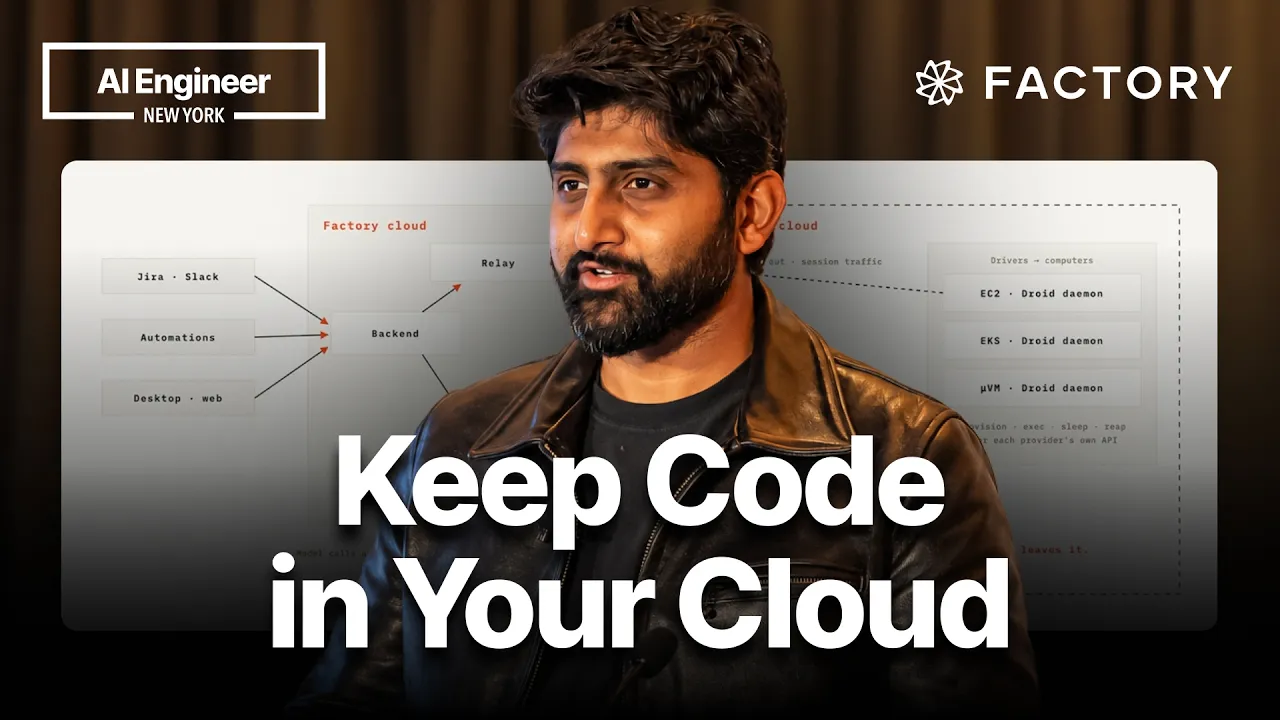
Agents can't keep borrowing your identity and running on someone else's machines, especially at banks and other heavily regulated companies. Nikhil Harithas of Factory shows how they rebuilt their coding agent, Droid, to run on any compute inside a customer's own cloud. He covers the compute gateway and relay design, bring-your-own-key model calls, snapshots and forking, and why they plan to open source the layer. 0:00 Intro 1:09 Customers where none of the defaults worked 2:44 Agents can't keep borrowing your identity 4:26 Bring your own compute 5:42 Control plane, compute gateway and relay 9:34 Bring your own key and staying in your VPC 11:21 Open sourcing the compute layer 12:24 Snapshots, forking and drivers 14:22 The hard parts of managing compute 16:44 Agents shouldn't care where they run Nikhil Harithas, Factory: https://factory.ai Join us in SF for the second annual AIE CODE summit: https://aie.codes our last flagship summit of 2026. Applications live now!
Summary
Generated by gpt-5.6-terraAt-a-Glance
- Verdict: Watch fully
- Core thesis: Enterprise agents should be treated as non-deterministic applications whose compute lifecycle, runtime location, identity, and model access are decoupled through an agent-neutral compute plane.
- Why it matters: This is a concrete architecture for deploying agents inside tightly controlled enterprise environments without forcing a full on-prem control-plane deployment or tying the agent to a particular sandbox, cloud runtime, or end-user identity.
- Best use: Use it as a design reference for an OpenClaw-style agent runtime: separate the control plane from customer-owned execution, make runtimes pluggable, and design explicitly for egress-only connectivity, resumability, snapshots, and long-running multi-agent work.
Executive Summary
Nikhil Harithas presents Factory's response to a deployment problem encountered with Blackstone: enterprise customers want coding agents to operate inside their own VPCs, with their own compute, model inference, identities, and single-tenant security boundaries. Factory's prior bring-your-own-compute approach was insufficient because installing an agent on a machine merely transferred the difficult work of provisioning, routing, retries, lifecycle management, and recovery to the customer.
Factory's proposed solution, Open Compute, is an intended open-source abstraction layer for managing agent compute independently of Factory or its Droid coding agent. The core architectural claim is that the unit of management should be a computer or sandbox, not an application-specific agent session. A driver interface can provision different backends—EC2, Kubernetes/EKS, microVMs, or third-party sandbox providers—while the agent product retains a centralized control plane.
The deployment pattern keeps execution and sensitive resources in the customer's environment while avoiding inbound network access. A controller in the customer VPC maintains an outbound WebSocket to a relay in Factory's control plane; newly provisioned agent machines also establish outbound connectivity. Requests from a CLI, Slack, Jira, or web client can then be relayed to the appropriate sandbox. Customers can use their own LLM keys and endpoints, such as Bedrock, so inference remains in the VPC as well.
The most transferable insight is not the specific product but the operational model: agent systems need a compute plane alongside the traditional control plane and data plane. That plane must support templates, start/stop/suspend, snapshots, forks, secret hydration, durable state, driver portability, idempotent provisioning, and recovery from runtime limits. These capabilities become essential when agents run for days, hand work to subagents, or must survive ephemeral-compute constraints such as AWS microVM session caps.
Key Takeaways
- Claim: Agents should not inherit a human user's identity by default; they should be deployed and governed as applications with explicit runtime and authorization boundaries. | Evidence: Blackstone's deployment requirements included customer-controlled compute, inference, identity, and single tenancy. Harithas argues that the common pattern of a sandbox simply borrowing an individual user's identity is temporary and unsuitable for enterprise delegation through tools such as Slack and Jira. | Implication: Ken should model agent identity separately from user identity: attribute requests to users for audit and policy, but issue scoped, revocable workload credentials to the agent runtime rather than passing through standing user access. | Caveat: The talk identifies the identity problem but does not specify a complete service-identity, delegated-authorization, or approval model for what an agent may do on behalf of a user.
- Claim: A viable enterprise architecture separates a centralized agent control plane from a customer-owned compute plane rather than requiring either SaaS-only execution or a fully customer-hosted product stack. | Evidence: Factory keeps backend components such as the compute gateway and relay in its control plane while Open Compute provisions the actual sandbox, EC2 instance, Kubernetes pod, or microVM inside the customer's VPC. | Implication: For enterprise deployments, offer a spectrum of sovereignty rather than a binary cloud-versus-on-prem choice: keep execution, secrets, data access, and optionally model calls customer-local while retaining a managed orchestration layer where acceptable. | Caveat: This hybrid architecture still relies on a connection to Factory's control plane and relay; it is not equivalent to a completely air-gapped or fully self-hosted deployment.
- Claim: Egress-only connectivity is a practical trust and security primitive for deploying agents in regulated customer environments. | Evidence: The Open Compute controller and newly created agent machine establish outbound WebSocket connections to Factory's relay. Factory says this avoids the need to make inbound connections into the customer's network, addressing customer concern about ingress. | Implication: Ken should consider a reverse-connection or customer-initiated worker model for private-network agents, with mutually authenticated persistent channels and policy-enforced routing rather than direct inbound access to customer runtimes. | Caveat: Outbound tunnels reduce an ingress burden but do not eliminate the need for strict relay authentication, tenant isolation, message authorization, auditing, and egress controls.
- Claim: Compute lifecycle abstraction is more important than simple bring-your-own-compute installation for reliable agent operation. | Evidence: Harithas cites unresolved lifecycle cases: a cloud provider can acknowledge a sandbox creation request without producing usable compute; a request can be dropped mid-session; the system must track which sandbox belongs to which user and route and retry correctly. | Implication: Treat worker provisioning and agent task execution as distributed-systems workflows: use idempotency keys, durable state, reconciliation loops, health checks, lease ownership, retry policy, and explicit task-to-runtime routing rather than assuming a provision call equals a usable worker. | Caveat: The talk describes the problem and interface direction but provides no measured reliability outcomes, protocol semantics, reconciliation design, or guarantees around exactly-once execution.
- Claim: Snapshots and forks are foundational primitives for long-running and multi-agent systems, not merely sandbox conveniences. | Evidence: Open Compute's proposed lifecycle includes suspend, snapshot, and fork. Factory highlights that AWS microVMs have an eight-hour session cap while its Missions product may orchestrate multiple agents for days; it needs to snapshot, rehydrate a replacement sandbox, and swap it in transparently. Forking enables handing subtasks to subagents from a preserved parent state. | Implication: Ken should distinguish checkpointable compute state from durable task state and external side effects. Build resumability around explicit checkpoints, immutable environment templates, secret rehydration, and idempotent tool operations before relying on agent cloning or swarming. | Caveat: Snapshotting mutable environments introduces unresolved concerns around secret persistence, consistency of external side effects, state size, and reproducibility; the talk only says snapshots may live in customer-controlled S3 or databases and secrets may come from customer stores.
- Claim: A small, compute-focused driver specification can create portability across runtimes and enable ecosystem contribution without coupling customers to the agent vendor. | Evidence: Factory describes drivers as wrappers for EC2, Kubernetes, or providers such as Daytona and Modal. It deliberately frames Open Compute as managing computers rather than Factory sessions, and says a driver that conforms to the specification can be generated and tested against that specification, including by Droid itself. | Implication: Define a narrow runtime-provider contract for create, inspect, route/connect, suspend, resume, snapshot, fork, and destroy. Keep agent-session semantics above that contract so the runtime layer remains reusable and customers can change infrastructure without rewriting their agent platform. | Caveat: The driver interface is described conceptually rather than published in the transcript, and the project was still in private preview with open sourcing planned in a few weeks.
Detailed Brief
Control, data, and compute planes
- Claims: Harithas frames a distinct compute plane as an emerging architectural layer for agents, alongside conventional control-plane and data-plane concepts.; The compute plane is intended to provide the advantages of local execution and customer control without requiring the customer to host every element of the vendor's control system.; The product strategy was informed by forward-deployed engineering work: difficult customer deployment constraints are treated as product signals rather than one-off implementation exceptions.
- Evidence: The Blackstone example is presented as a trillion-dollar, highly regulated institution whose requirements invalidated Factory's defaults.; Factory's deployment flow supports requests originating from its CLI, Slack, a web application, or potentially a customer's own product.; Customer ownership can extend beyond compute to model endpoints, LLM keys, snapshot storage, and secret stores.
- Caveats: The sovereignty framing is aspirational and configuration-dependent: retaining a SaaS relay/control plane may remain unacceptable for organizations requiring air-gapped operation or fully local governance.; The talk is a vendor architecture presentation and does not compare this model against alternatives such as fully self-hosted orchestration, service-mesh-mediated execution, or managed sandbox platforms.
- Implications: Enterprise readiness should be evaluated as a placement and ownership matrix: execution, credentials, model endpoint, state, observability, orchestration, and network path may each have different owners.; Forward-deployed engagements can be a high-signal mechanism for discovering which agent-platform abstractions should become durable product primitives.
Runtime portability and developer distribution
- Claims: Runtime templates define the installed software, build requirements, and containers for a sandbox, while lifecycle operations act on compute instantiated from those templates.; Keeping the abstraction session-neutral is presented as central to customer trust because it lets the runtime be used beyond Factory.; Factory used versioning and Terraform packages to help customers deploy the system while it remained in private preview.
- Evidence: The talk names template-controlled installation and snapshotting, customer-owned S3 or databases for snapshots, and customer secret stores for hydration.; Harithas specifically identifies Terraform packaging and versioning as operational challenges of distributing the deployment model before open source.
- Caveats: No details are provided on template provenance, image signing, vulnerability management, state encryption, retention policies, or cross-version snapshot compatibility.
- Implications: A portable agent-runtime product requires a distribution and upgrade story—not just an API—including infrastructure modules, compatibility contracts, version pinning, provenance controls, and safe migration paths.
Notable Concepts & Terms
- Open Compute: Factory's planned open-source, agent-neutral layer for provisioning and managing the lifecycle of customer-owned agent compute.
- Compute plane: The proposed architectural layer responsible for placing, creating, connecting, recovering, and destroying the machines or sandboxes on which agents execute.
- Compute gateway: A Factory control-plane abstraction that receives a request for agent compute and can select Open Compute or another sandbox mechanism.
- Driver: A runtime-specific adapter that maps a common compute lifecycle contract to EC2, Kubernetes, microVMs, or third-party sandbox providers.
- Relay: A control-plane component that routes client requests to customer-VPC agent sandboxes over customer-initiated persistent WebSocket connections.
- BYOK: Bring Your Own Key; the customer can supply its own model-provider credentials, allowing LLM calls such as through Bedrock to remain within its environment.
- Snapshot and fork: Mechanisms to preserve an agent environment, resume it after runtime expiration or failure, or clone it to delegate a subtask to another agent.
- Droid: Factory's coding agent, used as the initial consumer of Open Compute and as an example of an agent that can generate driver implementations against a specification.
Operator Notes / Why Ken Should Care
- Draft an agent-runtime provider interface that is independent of OpenClaw session semantics and covers provision, readiness, health, connect, checkpoint, restore, clone, and teardown.
- Decide the required deployment tiers now: managed runtime, customer-VPC worker with outbound-only connection, and fully self-hosted/air-gapped control plane; identify which enterprise segment requires each.
- Require separate workload credentials for agents, with user attribution and scoped delegation, rather than permitting direct reuse of end-user tokens in sandboxes.
- Add a reliability design review for worker provisioning and task routing: idempotency, reconciliation after provider acknowledgement failures, worker leases, reconnect behavior, retry boundaries, and durable task state.
- Define checkpoint semantics before implementing agent swarms: what is snapshotted, how secrets are rehydrated, how external tool effects are made idempotent, and how a resumed worker proves it is safe to continue.
- Monitor the Open Compute release and its driver specification; assess whether its abstraction can be adopted, interfaced with, or used as a reference rather than building an incompatible runtime layer.
Source/Metadata
- Title: Your AI Agents Shouldn't Care Where They Run - Nikhil Harithas, Factory
- Transcript words: 5730
- Duration seconds: 1033
- Timestamp note: No timestamps or chapters were present in the supplied transcript. The transcript appears to contain a near-complete duplicated rendering of the same talk.
Transcript
Good afternoon everybody. I know this is one of the last talks of the afternoon so hopefully people got some energy left. My name is Nikhil. I lead forward deployed engineering here at Factory and this episode of agents and infrastructure came out of notes from the field and so we really believe that deployed engineering is part of the sensory nervous system of an engineering org and essentially it's trying to figure out for our most complex customers what's difficult, what do we need to build, and use that to inform our product strategy. And the customer in question today is going to be Blackstone. Some of you may have heard of them. They're a large financial institution, trillion dollars in assets, and represent this fractally complex enterprise where they have a lot of regulations, have a lot of security constraints, and are really opinionated about how to deploy non-deterministic software in their environments. And it's one of those scenarios where none of our defaults worked. They couldn't run agents on their laptop, they wanted to bring their own compute and their own inference, their own identity, and single tenant everywhere. And I think I realize now that I should probably pause and explain a little bit about what we do just to make sure that in case nobody knows. We bring AI to software engineering. We're in the business of doing that with our coding agents named Droid and using that to compose software factories. And so you can imagine this requires a lot of permissions. And that is a particularly tricky thing to do when what we were trying to do with Blackstone is basically doing delegation. So you can imagine through Slack or through Jira and through your client of choice basically saying assigning something to Droid and Droid is the name of our agent. And so Droid going off and completing a task saying okay I want to assign the Jira ticket to Droid it'll come back to you with a PR. But things get complicated when you have all these constraints of an enterprise. The two fundamental questions that kept coming back again and again is who is an agent acting on behalf of and where does it run. Especially because so many of agentic products over the last year or 18 months were able to piggyback off individual identities. So maybe you spun up a sandbox and it just had your identity attached to it and it was able to use the permissions that were attached to that sandbox. But ultimately we really think that was a temporary idea because ultimately agents can't just keep borrowing your identity. They're ultimately applications. Agents are basically just slightly non-deterministic applications. And we don't need to reinvent the wheel here. We were doing this for decades of software engineering and it's about using the same systems of the past but maybe slightly repositioning them for the future. At this conference there's plenty of people offering agent sandboxes, maybe some of you want to run them in EC2 fleets. We just found that this problem of a combination of where does an agent run and who is it running as kept coming up again and again and again. And we found that even in the middle of our engagement with Blackstone there was we were going to go with one of these providers but then they changed some key constraints that meant that we wanted to maybe move to an EC2 machine. And this kept coming up to our customers again and again where somebody wants to run it on Kubernetes, somebody wants to run it on EC2 or Google Cloud or whatever it is. And we just needed a way to organically move our product to each one of these things. In the past we had a bring your own compute product but what we found is that just installing an agent on a computer was insufficient because that means that our customer still needed to deal with the compute lifecycle. It turns out that's a pretty complex problem. So what we came up with was Open Compute. Open Compute is a to-be-open-sourced project that is basically trying to abstract the compute lifecycle for any agent. We obviously build this for Droid but the idea is that this should be able to work for any arbitrary agent in your customer's environment. And this is a really important idea for us because one of our key differentiators is that we care deeply about building you a custom fit suit to deploy our product in your environment on your terms. So that means your security constraints, your compute of choice and totally in your VPC without it ever leaving your environment, where as much as possible is on your terms. So this gets you a lot of the advantages of what an on-prem deployment could give you without also having the pain of also having to port over your control layer. If you think about the previous world you would have your data plane and your control plane and this is an emergent idea of how the compute plane really needs to be spun out into its own thing for agents. So what you end up with is this pattern. This is a simplified example pattern. You have a client of some kind, you have maybe you're delegating from a third party of some kind and you basically talk to our backend which has these two concepts of a compute gateway and a relay and the compute gateway tells this open compute driver to say somebody wants to start a new session which spins up compute in their VPC which could be your micro VM of choice, it could be in EKS, it could be EC2 and then that sandbox is the machine that actually talks to the relay which talks to the client. That was a lot of words so I'm going to do that real slow. Let's say you're a client which could be our CLI, which could be our product, it could be one of your products and you have something that says I want to start a new agent session and that session talks to our backend and says I want to get compute to start this new session and so we go to our compute gateway which is an abstraction of maybe we're using open compute to get compute but maybe we're also using a sandbox, it's another abstraction to make this even clearer to say okay and now this gateway is going to say I'm going to talk to open compute which already has an open connection to the control plane of the open compute application in the customer's VPC and says hey I want to create a new computer and so what open compute is going to do, this controller is going to do and say I'm going to talk to this idea of a driver. A driver is a wrapper for a given kind of compute, so this could be one driver for EC2, one driver for Kubernetes where your pod lives, it could also be for a sandbox provider like Daytona or Modal. It is an abstraction that could wrap around your compute layer of choice. So open compute would talk to your driver of choice and in this example on an EC2 driver and say I want a new EC2 machine. So then we spin that up and then we connect that EC2 machine that reaches out to what we call our relay which is something in our control plane and keeps an open WebSocket. And this is actually an important idea because one thing that we hear from customers all the time is that they're very nervous about ingress but less nervous about egress. So basically what we promise in the system is that once set up we never need to make an inward connection. It's always the customer that's making an outward connection and establishing a WebSocket connection. So essentially, once there's a new EC2 machine that is going to be where our agent daemon starts, it's going to establish an open connection to our relay and then when you have our CLI or in Slack or our web application, when you send a hello world it's going to go to our relay which is able to relay this request to the sandbox and they're able to have a back and forth. And to kind of close out this idea, in this particular example we can assume that the actual LLM call could be established with a BYOK situation where a company brings their own key and you can imagine a Bedrock situation or something like that to do your LLM calls. So even that stays within your VPC. In this way, without deploying Factory entirely on-prem where you need to have each one of these pieces loaded in your environment, you're able to get most of what you get from that in terms of control of the non-deterministic part of the agent loop and you're going to feel like you have full observability and controllability and make sure that the blast radius of anything that you think is too risky for an agent to do is going to be contained inside a customer's VPC. And this is something we've seen pretty significant success with just because this gets you really far in gaining trust in a customer relationship. We believe that also long term that owning your stack is going to become a more and more important idea and I think that's often talked about with respect to models but the entire stack is something that eventually large enterprises are going to want to own. And so you can imagine us building out components to make it easy for a company to do all of that on their own terms, which is everything from owning their own endpoints, owning their own model, to owning their own compute layer to also hosting the product in their VPC in their environments and being able to tell the entire story on their terms. So basically in a few weeks we plan to open source this and I think it's going to be useful for people because the abstractions have nothing to do with Factory. They're to do with managing compute and being friendly for an agent to interact. The unit of work is compute. So you can imagine all the classical things that you would want to do in a compute lifecycle which is being able to pause and resume, destroy and start. And all of this is based off templates that you can control in terms of what you install and what you can have, basically snapshots of the exact requirements of your build, your containers of choice. And what you see here is the spec of what our Factory compute gateway calls. This is the abstraction that you need to conform to if you're interested in this pattern. And again a fairly standard pattern of what you do in a sandbox is suspend or create a snapshot or fork. And especially fork is a really important idea because you can imagine especially as fleets of agents and swarms of agents are gaining steam, one session delegating to another and having sub-agents and sub-agents and sub-agents is a fractal idea means that being able to save a snapshot, fork it and hand off a subtask of your problem to another agent is going to be a really important pattern. So snapshotting is also going to be really important and we also plan for this to be something that a customer can own. So we've talked a lot about compute but you can also imagine being able to save snapshots in S3 or your database of choice and eventually also being able to hydrate it with secrets in your secret store of choice. So giving customers the optionality to hydrate their compute layer however they want and wherever they want to do that. And drivers are basically this idea of the different compute stories. And I think an important idea here is that this is a project to manage computers and not sessions. And I think that was a really important idea for us because the moment you tie in the idea of a session, by session I don't mean a web session I mean a Factory back and forth, a Factory session, you get tied into it. It becomes Factory specific where I think that makes it harder for a customer to feel comfortable with hosting that software whereas this is going to be open source and a totally abstract concept that they could use for products beyond Factory. And I think just to give an idea of the complexity that this solves in dealing with compute lifecycle, you might fire off a request saying I want to start a new session and maybe AWS says that I received your request but it never acts with the new sandbox. Or maybe your request is maybe mid-session one of your requests is dropped and you don't get back. Just something to manage the bookkeeping of did I start a sandbox for you, what was it called, where is it, how do I route requests from a given user to a given sandbox, and being able to retry to make sure that the client and the sandbox understand where they are in a given conversation and just do that bookkeeping for you. And I think you can imagine that managing arbitrary compute is a fairly complex problem. One example is the fact that micro VMs on AWS have an eight hour session cap and one of our products is missions which can run for multiple days of multi-agent orchestration. So how do you save a sandbox with a snapshot and rehydrate a new one and kind of swap in place as if nothing happened is pretty difficult problems. And additionally while this has been in private preview, how do we actually communicate this idea while it's not open source. Versioning, Terraform and sharing these Terraform packages to help folks stand it up has been interesting. And I think another interesting thing that came out of the way this problem was defined is that if you just provide the spec to Droid and just say make me a driver that fits the spec, it's its own test. If something satisfies a given spec it's basically ready to go. So it's very easy to contribute new drivers and add new compute types. So this can keep getting more and more flexible over time. But ultimately, agents shouldn't care where they run. This is something that comes up for people again and again and this is the way we solve it at Factory and how we're able to give a really high level of flexibility to our deployments for our customers around the world. And that's all. Thank you. people got some energy left. My name is Nikhil. I lead forward deployed engineering here at factory and this episode of agents and infrastructure is basically came out of like notes from the field and so we really believe that deployed engineering is part of the sensory nervous system of an engineering org and essentially it's trying to figure out for our most complex customers what's difficult, what do we need to build, and use that to kind of inform our product strategy. And the customer in question today is going to be Blackstone. Some of you may have heard of them. They're a tricky little large financial institution, trillion dollars in assets, and kind of represent this kind of like fractally complex enterprise right where they have a lot of have a lot of regulations, have a lot of security constraints, and are really really opinionated about how to deploy non deterministic software in their environments. And it's really one of those scenarios where like none of our defaults like worked. It's kind of like you know they couldn't run agents in their laptop, they wanted to bring their own compute and their own inference, their own identity, and single tenant everywhere. And I think I realize now that I should probably pause and probably explain a little bit about what we do just to make sure that in case nobody knows. But we bring our time to software engineering. We're in the business of you know doing that by our coding agents named Droid and using that to compose software factories. And so you can imagine this requires a lot of permissions. And that is a particularly tricky thing to do when the thing we were trying to do with Blackstone is basically doing delegation. So you can imagine through Slack or through Jira and through kind of your kind of client of choice basically saying you know assigning something to Droid and Droid is the name of our agent. And so Droid going off and can basically completing a task saying okay I want to assign the Jira ticket to Droid it'll come back to you with like a PR. But I think that the things get complicated when you have all these constraints of an enterprise right. The two fundamental questions that kept coming back again and again is who is an agent acting on behalf of and where does it run. It is you know especially because so many of agentic products let's say over the last year 18 months were able to piggyback off of our individual identities. So like maybe you spun up a sandbox and it just it had like your identity attached to it and it was able to use like the permissions that were attached to that sandbox. But I mean ultimately like we really think that that is like was a kind of kind of temporary idea because ultimately agents can't just keep borrowing your identity that and they're ultimately they're just applications. Agents are are basically just like slightly non-deterministic applications. And you know we don't need to reinvent the wheel here. We were doing this for you know maybe decades of software engineering and it's about using the same systems of the past but kind of maybe like slightly repositioning them for the future. And so you know another thing you know at this conference there's plenty of people offering you know agent sandboxes maybe some of you want to run them in EC2 fleets. And we just found that this problem of a combination of where does an agent run and who is it who's running as guess was coming up again and again and again. And we found that even in the middle of our engagement with Laxone like you know there was we were going to go with one of these one of these providers but then they kind of changed some like key constraints that meant that we wanted to maybe move to an EC2 machine. And this just kept coming up to our customers again and again where it is like somebody wants to run it on Kubernetes, somebody wants to run it on EC2 or G Cloud or whatever it is. And we just needed a way to kind of organically move our product to each one of these things. And in the past we had a bring your own compute product but what we found is that just installing an agent on a piece of on a computer was insufficient because that means that our customer still needed to deal with the compute lifecycle. It turns out that's a like pretty complex problem. So what we came up with was was Open Compute. Open Compute is a to be open sourced project that is basically trying to abstract the compute lifecycle for any agent. That is we obviously build this for Droid but it is the idea is that this should be able to work for any arbitrary agent in your customer's environment. And this is I mean this is a really important idea for us because one of our you know key differentiators is that we care deeply about building you a custom fit suit to deploy our product in your environment on your terms. So that means you know your security constraints you know on the compute of choice and like totally in your VBC without it ever kind of like leaving your environment right where as much as possible is on your terms. So this gets you a lot of the advantages of what maybe an on-prem deployment could give you without also having like the pain of also having to port over your control layer. Like if you think about like in the previous world you would have your data plane and your control plane and this is kind of an emergent idea of like compute plane really needs to be kind of spun out into its own thing for agents. So what you end up with is this kind of pattern right. I mean this is just an example simplified pattern of you have maybe a client of some kind you have maybe you're delegating from you know a third party of some kind and you can you basically talk to our back end which has these two concepts of a compute gateway and a relay and the compute gateway kind of tells this open com our open compute driver to say somebody wants to start a new session which spins up compute in in their VBC which could be kind of your micro VM of choice it could be in EKS it could be EC2 and then that sandbox is the is the machine that actually talks to the relay which talks to the client. That was a lot of words so I'm gonna let's do that real slow. So let's say you're an agent and so let's say you're a client which could be our CLI which could be our product it could be on frankly one of your products and you have something that says I want to start a new agent session and so that session talks to our back end and says so that's that request talks to our back end and says I want to get compute to start this new session and so we go to our compute gateway which is also an abstraction of like you know maybe we're using open compute to get compute but maybe we're also using a sandbox you know so it's an it's another abstraction to make this kind of even clearer to say okay and now this gateway is going to say I'm going to talk to open compute which was and this is like a which already has an open connection to the control plane of the open compute application in the customers VBC and says hey I want to create a new I want to create a new computer and so what open compute is going to do this control this controller is going to do and is going to say I'm going to talk to this idea of a driver a driver is a kind of like a wrapper for a given kind of compute so this could be you can imagine like one driver for EC2 one driver for kubernetes you know where your pod lives it could also be you know maybe for a sandbox provider like Daytona or modal so like it is like totally like it is an abstraction that could wrap around your compute layer of choice so open compute would talk to your driver of choice and that in this example on EC2 machine an EC2 driver and say I want a new you know I want a new EC2 machine so then we spin that up and then and then we connect that EC2 machine that reaches out with to a to what we call our relay which is something in our control plane and keeps an open web socket so and this is kind of actually an important idea because one thing that we hear from customers all the time is that they're very kind of nervous about ingress but less nervous about egress so basically what we promise in the system is that once set up we never need to make an inward connection it's always the customer that's making an outward connection and establishing web socket connection excuse me so essentially so once so once and there's a a new like EC2 machine that is going to be like where our agent daemon starts it's going to establish a open connection to our relay and then when you have you know our CLI or or in slack or or our you know our web application it's when you send a hello world it's going to go to our relay which is able to relay this like literally relay this information to this request to the sandbox and they're able to kind of have a back and forth um and to kind of like just kind of close out this idea um in this particular example we can assume that the uh the actual llm call could be established with like a by ok situation where let's say a company i mean this is kind of only relevant for i'd say fairly mature engineering organizations which may already have a deal with you know one of the labs so you can they can like bring their own key and you can imagine like a bedrock situation or something like that to do your llm calls so even that stays within inside of vpc so in this way uh without kind of having like a deploying factory entirely on prem like where you need to have each one of these pieces um kind of like loaded in your environment you're able to get the most of of what you get from that of like the control of the non-deterministic part of the agent loop uh and you're going to feel like you have full observability and controllability and make sure that like the blast radius of anything that you think is like too spicy for an agent to do is going to be contained in inside a customer's vpc and um this is i mean we've seen like i'd say pretty significant success with this just because this kind of gets you really far in and kind of gaining trust in in kind of a customer relationship um we believe that also kind of like long term that like owning your sovereign is going to become a more and more important idea and i think that that's often talked about with respect to models but i mean i think that that the entire stack is something that eventually large enterprises are going to want to own and so you can imagine um you know us building out components uh to make it easy for a company to do all of that on their own terms which is everything from owning their own eva's owning their own model to owning their own compute layer to also hosting um like the product in in in their vpc in their in their environments and being kind of able to tell the entire story on their terms so um so basically that uh what you know in a few weeks we plan to open source this and i think that it's going to be useful for people just because the abstractions like have nothing to do with factory they're to do with managing compute and like being friendly for an agent to uh kind of interact right so it is uh the the unit of work is is a computer so you can imagine all the kind of classical things that you would want to do in a compute life cycle which is you know uh being able to pause and resume uh destroy and start um and all of this is based off of like templates that you can control in terms of uh you know what you install and what shy you can have like basically snapshots of um you know the exact requirements of your build your con your containers of choice and um and that so that's so that what you see here is kind of like the spec of like what our uh factory compute gateway calls like this is like the abstraction that you need to kind of um kind of confer to if you're interested in this pattern and and again a fairly standard pattern of what you do in a sandbox is to you know suspend or create a snapshot or to fork uh and especially to fork is is like a really important idea because you can imagine especially as fleets of agents and swarms of agents are are kind of gaining steam i think that uh one session delegating to another and having sub-agents and sub-agents and sub-agents is a fractal idea means that uh being able to you know save a snapshot fork it and hand off like a subtask of your problem to another agent is going to like be a really important pattern so uh yeah snapshotting is also going to be really important and uh we also plan for this to be another thing that a customer can own so we've talked a lot about compute but you can also imagine like being able to save snapshot in s3 or your kind of like database of choice and eventually also being able to hydrate it with secrets in your secret store of choice so being giving uh customers like the optionality to kind of like hydrate you know their compute layer however they want and wherever they want to be able to do that um and so yeah drivers are basically this idea of the different compute stories let's see yeah and i think that um i think an important idea here is that we are um that this is a project to manage computers and not sessions and i think that was a really important idea for us because the moment you tie in the idea of a session and by session i don't mean like a web session i mean like a factory uh back and forth like a factory session is um that you get tied into it becomes like factory specific where i think that that makes it harder for for a customer to feel comfortable with with hosting that software whereas this is like eventually going to be open source and a totally like abstract concept that they could use for for you know for products beyond factory um and i think just to give an idea of like the kind of complexity that this solves like the in in dealing with uh like compute life cycle you might you know fire off a request saying um i want to start a new session and maybe the maybe that aws says that uh you know i received your request uh but it never acts with like the new sandbox of sorts um you maybe your request is maybe uh mid-session one of your requests is dropped and you don't get back back just to something to manage like the bookkeeping of uh did i start a sandbox for you what was it called where how do i route requests from a given user to a given uh sandbox and um and being just being able to retry to make sure that like the client uh and the sandbox understand where they are in a given conversation and just like do that bookkeeping for you um and i think that you can imagine that this is um i mean managing arbitrary compute is like a fairly complex problem i mean one example is uh you know the fact that uh you know micro vms and aws have an eight hour session cap um and one of our products is uh is missions which can run for like multiple days of like multi-agent orchestration and so you know how do you uh save uh a sandbox uh with a snapshot and rehydrate a new one and kind of like swap in place as if nothing happened is like you know pretty difficult problems and uh you know some of the stuff that we've had to kind of uh slog through and and additionally just kind of like you know while this has been in kind of like private preview um how do we actually communicate this idea like while it's not open source um so like versioning uh terraform and sharing you know these terraform packages to help folks stand it up has been has been interesting um and yeah i mean i think that um another kind of interesting thing that came out of like the way this problem was defined is that if you uh you can just kind of provide the spec to to droid uh and just say just make me a driver that that fits the spec and it and it kind of like is its own test like if like if something can it's almost like a it's a very good version of test driven and spectrum development where if it satisfies a given this given spec it's it's basically ready to go so it's very easy to kind of contribute new drivers and add new kind of compute types so this can just kind of keep um getting flex more and more flexible over time but yeah i mean ultimately just to kind of close out um uh agents shouldn't care uh where they run uh this is um i think something that comes up for people again and again and this is the way we solve it at factory and and how we uh you know are able to give a really high level of flexibility uh to our deployments for our customers around the world and that's all thank you