Kalshi CEO Tarek Mansour on The Case for Prediction Markets | Ep. 48
Description
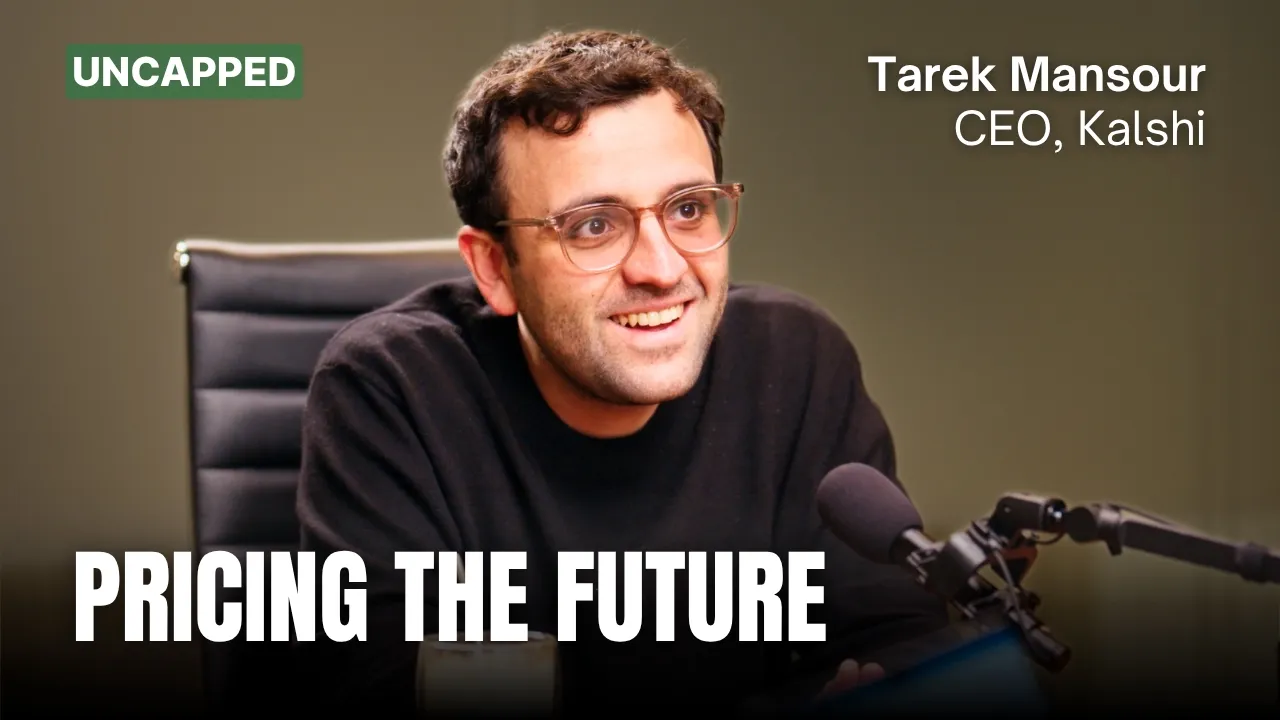
Tarek Mansour is the co-founder and CEO of Kalshi. Kalshi is a regulated prediction market exchange valued at $22B in 2026 where people trade on the outcomes of real-world events – things like inflation prints, Fed decisions, elections, or weather events. Instead of betting against a house, users trade against each other in a market, and prices reflect the collective probability of an outcome happening. Before starting Kalshi, Tarek worked as a quantitative trader at Goldman Sachs as a structured credit and equities analyst and at Citadel as a global macro trader. During his time at these firms, he realized a common thread: a lot of trading stemmed from an opinion on a future event. We covered the idea behind prediction markets and how they offer a more direct way to trade on beliefs about the future. The conversation follows the long, difficult path to building a regulated exchange in the U.S., from early skepticism to ultimately winning a landmark legal battle. We also discuss how these markets can improve forecasting, enable new forms of hedging, and change how information gets priced. Timestamps: (0:00) Intro (0:23) Kalshi’s genesis (5:05) Regulation-focused from inception (11:06) Suing the government (18:02) Gambling vs. financial markets (20:58) Defining insider trading (25:38) Incentive structure of the system (32:40) Investing vs. trading (35:31) Hedging use cases (41:38) Scaling a lean team (44:02) Defining Kalshi’s culture Links: https://x.com/jaltma https://x.com/mansourtarek_ https://kalshi.com/ https://uncappedpod.com/ friends@uncappedpod.com
Summary
Generated by claude-haiku-4-5-20251001Kalshi CEO Tarek Mansour on The Case for Prediction Markets
Main Topics
- Genesis and founding of Kalshi: From inspiration to regulatory approval
- Regulatory battles: Multi-year fight with the CFTC to legalize prediction markets
- Legal strategy: Landmark lawsuit against the government and why it succeeded
- Market mechanics: How prediction markets work and why they're different from gambling
- Business model: Why Kalshi's structure prevents predatory incentives
- Institutional adoption: Hedging and insurance use cases for prediction markets
- Company culture: Operating at scale (127 people) with minimal hierarchy
Key Points
Company Genesis
- Background: Tarek grew up in Lebanon, went to MIT, worked at Goldman Sachs and Citadel
- Key insight: Observing Wall Street traders in 2016 making terrible bets on Brexit and Trump because they were trading the market reaction to events, not the events themselves
- Core idea: Build a marketplace where people trade on actual events, not financial instruments' reactions to those events
- Early rejection: Michael Seibel at YC hackathon said it was "totally not allowed in the US"—yet Kalshi won the hackathon anyway
The Regulatory Journey (5+ years)
- 2018-2020: Two years just finding lawyers willing to take the case
- Regulatory obstacles:
- No precedent for event-based commodities
- Concerns about manipulation, listing hundreds of markets, enforcement
- "Mount Everest" of regulatory challenges
- November 2020: Bipartisan approval obtained
- Immediate reversal: New administration paused approval the same day of bipartisan vote
- 2021-2023: Years of additional requests, delays, and rejections
- End of 2023: CFTC blocked election market
- Decision point: "We strongly believe we're right on the law" → decided to sue the government
The Lawsuit and Victory
- October 2024: Won the lawsuit after one year
- What it established:
- Redefined what constitutes a financial market vs. gambling
- A financial market requires: (1) open/free market structure (not house accepting bets) and (2) a real-world event (not artificial risk)
- Parallels to 1905 grain futures case that legalized commodity hedging
- Legalized prediction markets on any real-world event (elections, sports outcomes, etc.)
- Challenge endured: Death by a thousand paper cuts—audit stretched from 2 weeks to 18 months, constant regulatory harassment
- Mindset: "At that point, it was my last shot. What else am I going to do?"
Legal & Regulatory Framework
Gambling vs. Financial Markets
- Key distinction: A financial market aggregates information about real events; gambling creates artificial risk for profit
- Three elements that matter:
- Structure: Open marketplace (participants trade with each other) vs. house model (house profits from customer losses)
- Real event: Must be a natural occurrence happening in the world, not artificial
- Business model incentive: Kalshi takes fees on volume; casino profits from customer losses
Insider Trading & Market Manipulation
- Insider trading definition: Trading on material non-public information (information you're not allowed to disclose)
- Parallel to stock markets: Same rules apply to prediction markets
- Market manipulation: Having direct control over an event AND taking a position to profit is illegal
- Examples: Politicians shorting a bill then tanking it; executives trading on their own confidential information about earnings
- Gray areas: Cousin who overhears executive gossip; benefit of the doubt tests—these are inherent in all markets
- The balance: Farmers pricing grain futures DO have inside information, but can't artificially manipulate prices
- The line: can't manipulate the underlying event, only trade on your knowledge of it
Why These Rules Matter
- Practical consequence: If people believe markets are rigged, they stop participating
- Liquidity dries up: At the extreme, "why trade if I don't have inside information?"
- Fairness principle: Insider trading should be banned because people shouldn't profit purely from being told something secret
- Distinction: Information-seeking (research, satellite imagery, neighbor polls) ≠ insider trading
Prediction Markets: How They Work
Two Core Functions
1. Price Discovery
- Aggregates information from many people to produce accurate forecasts
- Rewards people for doing real research (e.g., person who did neighborhood polls for 2024 Trump prediction)
- Average person can compete equally with Wall Street in prediction markets (unlike stock markets)
- Federal Reserve paper confirmed prediction markets as "best gauge we have on the economy"
2. Hedging/Insurance
- Open and competitive market (vs. traditional insurance with house intermediary)
- Real-world examples:
- Florida residents buying hurricane hedges when insurers pulled out
- Students hedging against student loan forgiveness reversal
- Institutions hedging political/economic risk to stock portfolios
- Corporate hedging against regulatory changes
Infinite Markets Theory
- Society is increasingly complex and interconnected—everything affects everything
- Traditional asset prices (S&P, home prices) lack full information
- Must price sub-components (AI development, COVID spread, bill passage) to price assets accurately
- Prediction markets fill this gap: Price all dimensions → better pricing of everything
Business Model & Ethics
Why Kalshi's Model Prevents Gambling Problems
- Kalshi incentive: Volume + transaction fees (not customer losses)
- Casino incentive: Customer losses are revenue → actively promote losing behavior
- Difference:
- Casinos identify big losers and hook them with perks
- Kalshi benefits from fair, transparent, healthy trading
- Practical result: Kalshi wants customers to pause, self-exclude, or limit losses (no revenue impact)
Fairness as Structural Incentive
- When house profits from customer losses, they'll optimize for unhealthy behaviors
- In fair marketplaces (prediction, stock, crypto, options), incentives naturally align with fairness
- Transparency is critical: all trades public, everyone can see everything
Trading vs. Investing
- Stocks: Most people recognize long-term holding is investing; short-term trading is zero-sum
- Prediction markets: Look more like gambling to average person, but structure is identical to stock trading
- Key insight: 9/10 Kalshi customers don't trade S&P/options because they say "I don't gamble"—they recognize zero-sum nature. Yet those markets ARE fair; they're just efficient against retail
- Kalshi advantage: Average person has a genuine edge if they do research (Wall Street doesn't have structural advantage)
Company Structure & Culture
Operating Lean (127 employees)
- Not deliberately planned: Emerged naturally from leadership intensity and hiring philosophy
- Key factors:
- Leadership intensity: Tarek and co-founder Luana are first-to-office, last-to-office, work weekends
- Minimal management layers: Luana knows what 80-85 people are doing; Tarek knows the rest
- No org charts: Dynamically organize around top X problems; people move between problems
- Self-organization: Cells in an organism—minimal bottlenecks, let people "cook"
Hiring Philosophy
- Bias toward "slow" vs. "intercept":
- Intercept: People from structured orgs who immediately see chaos and try to add process
- Slow: High-agency people who don't question it, assume it's normal
- High agency is the requirement: don't need to check on whether people work, only occasionally reorient them
- Management principle: "Don't manage people who manage work"—manage the work itself, not people
Execution Over Strategy
- Strategy is rare: Only a couple of truly non-obvious strategic decisions per year (3-4 year horizon)
- Everything else: Execution and natural next steps
- Leadership focus:
- High level: Are we directionally correct? What are 3-4 year risks?
- Deep level: Specific copy, product details, ads (Tarek and Luana write much of it)
- Middle level: Ignored (push others to also ignore it)
- Trade-off: Accept organizational chaos for speed vs. bureaucracy for order
- Comfort with shipping imperfect: Get bashed, improve 3-4 weeks later, ahead of waiting 2 months
Notable Quotes
> "If you actually believe in markets, what markets really do is aggregate information. They are a very good weighing function. What if we applied that to questions about the future?"
> "They were right about the prediction and they lost money. That's a shame."
—On traders who correctly predicted Trump would win but profited from stock decline
> "We're not going to launch a product outside of the realm of the law or regulation. We wanted to figure out how to get this regulated in the U.S. onshore, no matter how long it took."
> "You have to have tunnel vision. Look, we're going to keep going until we're proven wrong. We die. Or we find the other side."
> "All the bad things that were predicted happened. All the little things like, oh, we're not going to let you do this. We're going to delay this. We're going to kill you on this. The audit that was supposed to be two weeks is now 18 months. It's just knife after knife. But the most important thing is we won."
> "If you believe the stock market is rigged, you stop trading. The liquidity dries up. Markets that have a lot of insider trading don't exist."
> "The average person is winning more than Wall Street."
—On Kalshi's prediction market advantage for retail
> "We take on more organizational chaos. Either you're more chaotic or you have more process, which means bureaucracy and slowness."
> "At that point, it was more than just business. There was a mission thing. We wanted to deliver this to the world."
Takeaways
- Prediction markets are legitimate financial instruments, not gambling, when structured as open marketplaces trading real-world events
- Regulatory legitimacy required legal confrontation—a 5+ year journey including an actual lawsuit against the CFTC was necessary to establish precedent
- Business model structure determines ethics: Revenue from transaction volume (fair) vs. customer losses (predatory) is the critical distinction
- Prediction markets democratize information advantage: Unlike stock markets, average people can genuinely compete by doing research
- Practical use cases are expanding: Price discovery (forecasting) + hedging (insurance) are becoming central to institutional portfolios
- Lean operation depends on hiring for high agency: Most companies are over-scaled; Kalshi proves minimal layers work with the right people
- Execution beats planning: Strategic decisions are rare; focus on directional correctness and 3-4 year risks, then execute
- Speed requires accepting chaos: Shipping imperfectly and iterating beats lengthy planning cycles
- Fairness is self-reinforcing: When markets are genuinely fair and transparent, people participate; when rigged, they flee
- Regulatory persistence paid off: Kalshi's willingness to sue the government—unusual for a tiny company—ultimately reframed what prediction markets are legally allowed to be
Transcript
We decided to sue. All the bad things that were predicted happened. All the little things like, oh, we're not going to let you do this. We're going to delay this. We're going to kill you on this. We're going to, the audit that was supposed to be two weeks now is 18 months. Oh my God. It's just knife after knife. But the most important thing is we won. All right. I'm really excited to be here with Tarek, CEO of CalSheet. Thanks for doing this. I've been looking forward to it. Thanks for having me. I want to start with the history of CalSheet. So can you take me through the genesis, how the idea came together, how the company got started? [SPEAKER_00] A little bit of background before. So I grew up in Lebanon. I was born in California. I grew up in Lebanon. And Lebanon was a rough terrain to grow up in. It's super volatile, a lot of uncertainty. I found refuge in math, a mix of different things. I grew up with a single mom. My mom was like, I wanted you to be successful. Maybe math is the thing to get you back to America. And so I got really into math. And then a lot of my decisions at that point were like, what do the best smart math people do? And it's like, oh, they went to MIT. So that's why I need to get in. And got into MIT. And then the next stage was the same question. And the answer was finance. And I started spending time in finance. I worked at Goldman. I worked at Citadel. I worked at some small prop shops. The one I did at Bridgewater and Citadel as well. And there was a pattern that was emerging in a lot of these places, especially in, you know, the example I always love to give is in 2016 at Goldman. I was working on this desk and there were two questions that were bothering everybody in Wall Street. And those are the two questions that people were figuring out how to trade on. Will Brexit happen? And then will Trump win the 2016 election? People wanted to have the Trump hedge or the Trump trade. And then the thing that really stuck with me was that Brexit happened and it was a shock. Yeah. People were completely shocked that the polls were saying this is not going to happen. And people had all these smart trades about how to hedge against Brexit. But then a bunch of desks on Wall Street blew up and they lost money and all the bad stuff. When it came to Trump, there was a very similar thing that happened. The trade that we sold at Goldman, the very common trade was the Trump trade was you short the S and P because if he's going to win, the S and P is going to go down. Right. Everyone bought that trade. That was the trade. And it was a horrible trade because Trump won. And the S and P actually was, I think, the single biggest rally in the S and P's history, essentially. Yeah. It's the worst trade. It's the wrong way to trade the idea. It is exactly right. It's actually. Which is a shame. [SPEAKER_01] Cause it's what you were trying to trade was this underlying thing that you got right. [SPEAKER_01] And then you expressed it backwards. They were right about the prediction and they lost money. Yeah. [SPEAKER_01] This is when a company has quarterly earnings and people are like, oh, it's going to beat earnings. [SPEAKER_01] Yes. [SPEAKER_01] And so I'm going to buy the stock. Yes. [SPEAKER_01] And then it beats earnings and the stock goes down. And they're all smart in retrospect. [SPEAKER_00] If you actually trace the plot of whether the stock went up or down after earnings beat, I think it's 50/50. [SPEAKER_00] It's mostly priced in two things. I realized a lot of some of the smartest traders and institutions, a lot of their trading ideas or the things that they're trying to do originate from a simple human view about the future. I think Trump is going to win. [SPEAKER_00] I think there's going to be some change in diplomatic relationship between these two countries. [SPEAKER_00] I think COVID is going to come back. [SPEAKER_00] What they thought they were trading on with traditional market is the event, but what they're really trading on is this reaction function, how the market was going to react to an event. [SPEAKER_00] Yeah. They weren't trading on whether Trump was going to win. [SPEAKER_00] They were actually trading on how the S and P was going to react to Trump, which in retrospect, and now we've like, we can't really predict. It's impossible to predict. It was a very exciting idea because it's like, okay, what if we just build this marketplace where what you're trading is like- The specific thing that you're thinking about. Yeah. It's just things that people care about, whether politics or economics or weather, or really any topics that people naturally walk around the street and think about because people don't think about, you know, what is Cisco going to print? Like what are their financials next quarter? They don't think about that. They just think about, you know, the Fed might raise interest rates or things are more simple. And so that is exciting because the time could be much larger because a large number of people would care. Right. The second thing that was really interesting is, there's this, if you believe in markets, what markets really do is aggregate information, right? or really any of topics that just people naturally walk around the street and think about because people don't think about what is Cisco going to print? Like what are their financials next score? Like they don't think about that. They just think about the Fed might raise interest rates or things are more simple. And so that is exciting because the time could be much larger because a large number of people would care. Right. The second thing that was really interesting is if you, there's this kind of, if you believe in markets, what markets really do is they aggregate information, right? They are a very good weighing function. So they can figure out how to get information from a bunch of people, aggregate it and get a single price. And it's like, what if we applied that to questions about the future? Like all these kind of specific events or questions about the future, then in theory, we should get a smarter or more accurate answer or market-based answer about all these questions. And that got me really, really excited because at the time we were thinking about if you could get a little bit smarter about the future, that's a very worthwhile product to build. Right. It doesn't, you don't need to be 100% smart. Even if you get 10% smart about the future, that's more than enough. And that's how I got into the prediction market. We can talk about that, but the whole history on prediction markets and all of that. And I got really obsessed. [SPEAKER_01] So when you got started with the company, what was the first year? What were the first couple of years of building? Like, what did you do when you got started? I was actually going to go work at Citadel, because I had spent time somewhere there and I actually loved it. It was one of those situations where Luana and I started talking about it and the idea was just bothering me. Like I could not get it. I have a little bit of OCD and I get obsessed with things, but I couldn't get it off my brain. It was so, you know, I was going to go because one thing I always say is we were not entrepreneurs that were trying to figure out what product to build to build a company. That was not how Calci started. [SPEAKER_01] You just had this one idea. Like the idea kind of forced itself on us. Yeah. Like I was talking about it and no, no, no, forget about that. It's just like, no, let me just go to Citadel and pay me all this money. But then I remember that we had a friend who was going to this YC hackathon. I don't know if they still do them, but they used to do these hackathons and bring a bunch of builders and he was like, oh, I'm going to this thing. You should come. I think the deadline is passed. And we're like, well, that line is passed. And he's like, no, you should just email the guy. And we emailed, I forgot who the organizer was at the time. We emailed something like, Hey, we were trying to figure out flights or something. And he's like, yeah, fine. You should just come. So we're like, okay, well we should just go. And it's funny. We did this hackathon. We put together a front end for what the V1 of, it was a bunch of questions and a list format with yes, no. And then some probability. And it was an order book, literally we just copy pasted what the New York Stock Exchange order book would look like. And it's funny because we had judges that were going to judge the different teams and pick the finalists. And our judges are Michael Seibel and Christina from Vanta. I don't know if she had started Vanta at the time or she was in the early innings of it. When was it? It was October 2018. I think she had started. She had started. I think so. You know, we start pitching the idea and it's great. I remember Michael was like, oh, you know, everything is great about this idea, except for the fact that it's totally not allowed in the US. And you know, this has absolutely no way of existing in any way, shape or form. And you know, we walk out and we're like, look, we tried, move on. I remember I drank a bunch of beers in that hackathon. Yeah. We're done. And then this guy ends up picking us to be finalists. He's like dunks in the whole thing. And then we ended up winning that hackathon. And we're like, well, maybe we're onto something, which got us into YC. And then we're like, well, we have to give YC a shot. You know, and at the time it was like, wow, never expected to be getting into YC. And then this first year was crazy because you know how there's this thing about YC, they're the cool companies are building products and getting all these investors excited. We were the total opposite of that. We had no product, no customers. Week to week, we go to office hours and everyone's like, here's my KPIs and here's traction. And we were like, we got nothing. Nothing. We were just like, well, we talked to this lawyer who said no. [SPEAKER_01] And then the next week, it's tough because you know, I did YC and that was one of the most notable parts of the experience, which I think is a very positive part is every week you come back with your group and everybody else has grown 7% week over week. And how much have you grown? And you're just like, none, doesn't feel good. I don't even know what the product is. But we knew what the vision was always clear, but for us, the key question is how do we get it regulated? We were very, from the beginning, we made a decision. We're not going to launch a product outside of the realm of the law or regulation. [SPEAKER_01] And then the next week, it's tough because I did YC and that was one of the most notable parts of the experience, which I think is a very positive part. Every week you come back with your group and everybody else has grown 7% week over week. And how much have you grown? And you're just like, none. Doesn't feel good. I don't even know what the product is. But we knew what the vision was. The vision was always clear, but for us, the key question is how do we get it regulated? We were very deliberate. From the beginning, we made a decision. We're not going to launch a product outside of the realm of the law or regulation. We wanted to figure out how to get this regulated in the U.S. onshore, no matter how long it took. And the early days were really tough because we had no progress on regulation. Regulation is not linear. [SPEAKER_01] Yeah. It's not like you get encouraging status updates from regulators. [SPEAKER_01] Yeah. It's like there's big bang moments almost. Exactly. It's zero all the way up to approval. Yes. And nothing in between. Can you talk about what those were for you? So that was 2018. Then we spent the first two years essentially figuring out which lawyer would take this on. And I became somewhat of an expert in the law around commodities, which is where I thought this would get regulated. Essentially, there was no proof in the law of why this shouldn't exist, but there were a lot of things to figure out. [SPEAKER_01] What was the law at the time? Like what was not allowed at the time? Well, it says that a commodity could be an occurrence or a contingency. And so was the issue with the definition of the commodity? [SPEAKER_01] It was, yeah. The issue was that we're used to futures like grain and things that are tangible. Right. An election outcome is hard to put a thing around. [SPEAKER_01] Imagine walking into a regulator. You're two, 21, 22 year old MIT kids just walking into the CFTC, the regulator. And we got this lawyer Jeff, who was ex-CFTC. He got us the first meeting with the regulators. And two kids are like, here's our 40 page deck plan of how we could regulate this thing. And they're looking at us. They're like, what are you talking about? And here are all the issues. How are you going to police for manipulation? How are you going to list this sheer number of markets? Usually in markets like the CME, they list one or two new things a year or every few years. You're talking about listing hundreds of markets. That sounds crazy. So it was a lot of these hurdles, none of which felt impossible. But if you add them all up, it started to look like Mount Everest. And the problem is that you start climbing Mount Everest and then somehow you see a higher peak. [SPEAKER_01] Yeah. It keeps going and we had no certainty it was going to end. That was the toughest part. It wasn't actually the work. The work was regulatory all day. We could fix this thing and it might be we haven't made a dent. It's like a desert. You don't know if it ends. And so psychologically, it's very taxing because you're walking in that desert and you have no idea if this thing is ever going to end. You may actually just die. [SPEAKER_01] Yeah. [SPEAKER_01] And then you just walked for years in this desert. So what happened? What was the most? We were just so stubborn because we're like, look, in those situations, you have to stop thinking. You have to have no introspection. No worries. Yeah. Mark Andreessen. Yeah. I mean, he got a little flame for that one, but more like you have to have a bit of tunnel vision. Look, we're going to keep going until we're proven wrong. We die. [SPEAKER_01] Yeah. Or we find the other side. [SPEAKER_01] So can you talk about finding the other side? [SPEAKER_00] Towards the end of 2020, we started seeing that they would send an issue to us and then one after the other. And then it started fizzling out. These guys started to be like, wait, maybe these people are actually serious. And at some point you kind of run out of issues to find. We walked through all of them and worked through all of them. Thousands and thousands of legal documents and pages. And then we started angling towards an approval and we got approved in November 2020 to get the first regulated exchange for prediction markets. Then the new administration came around on the same day of our approval. The election happened. Our approval was bipartisan, Republican and Democrat, but the new administration was like, wait, pause. We're going to have to think through this. In some ways we're like, oh, we're finally through the desert. But all of a sudden, oh shit. We got dropped back into the middle of the desert. And it was like we're going to have to see if we can let you do all these things. Maybe we'll let you do four economic markets, but not this broader vision. That was disheartening. It was really hard because we'd spent two years. We're finally there. We're going to launch. Yeah, of course. And so this is not like we started the first battle to launch the exchange and we're like, fine, you know what? We'll launch with the four economic markets. We never thought that would get product market fit, which it didn't. But we're like, we got to get off the door now and launch and see what happens. And so by the end of 2021, we launched with a few economic markets, no traction whatsoever. And at the end of 2021 is when we were like, okay, we have to open up the space to get all the markets we want. And this is when we started to talk about the election market. And for prediction markets, I think we can talk about the dynamics, but we always thought that you need the diversity of markets, but you also need a catalyst. [SPEAKER_01] And so then by the end of 21, we launched with a few economic markets, no traction whatsoever, et cetera. And at the end of 21 is when we were like, okay, we have to open up the space to get all the markets we want. And this is when we started to talk about the election market. And for prediction markets, I think, and we can talk about the dynamics, but we always thought that you need the diversity of markets, but you also need a catalyst. You need something that is enough of a driving force to get people noticing so that you can break through the supply and demand. You need something strong enough to get the chemical reaction going because you have the supply and demand problem, the chicken and the egg. The chicken comes and there's no egg and vice versa. You need something strong enough to get everyone at the same time to start trading. And then after that, the thing can get going. But also I think it was one of the best ways to explain to people why prediction markets are powerful. It's like you need an event that everyone cares about and where we can provide a better product, like give a better forecast. And end of 21, we started talking to CFTC and they say, well, maybe, maybe we'll do it by end of 22 for the midterms. A whole year of that, just regulation again. [SPEAKER_00] So now you're talking about three years in, three to four years in just doing regulation. End of 22, the regulator sort of nudges the approval past the deadline, which essentially just didn't make a decision. And that was a very hard time with the company because we thought the approval was going to come. We've done all the work possible, very tunnel vision again. We didn't get it. And so in those circumstances, what happens is people blame the execution of the strategy. It's never that things are outside of your control. It's like we made the wrong decisions and it was bad. And we lost a bunch of the team at the time. And we had to do some layoffs. It was really hard time. It was really, really hard time. I think back at that time, it was one of the most painful times I've ever experienced in my life. And by the way, I went through war in Lebanon. I have had missiles drop next to my house, things like that. It doesn't compare. I think there's some form of shame because you feel shame as an entrepreneur. Totally. Right. You get it, right? That feeling of, I've had to do a layoff. It's awful. And it's you have responsibility and people are trusting you with all this. And then we come out of this in January, February. We're reconvening. What do we do as a company, et cetera. And I remember Luana has a dogmatic belief in this vision. Should we pivot? Clearly we're not going to be able to do this. And then I was like, we're going to try again. So that's the strategy for 23 is we're going to do the exact same thing as what we did in 22. And we're going to try again. It was pretty unpopular, but we did it. A whole other year of the same thing. Talking to policymakers, regulators, same regulator, et cetera. Then they ban it. They block it at the end. They block the election market at the end of 23. And same thing happens again. And this was the point where I think this was the most— Sequoia likes to call these crucible moments. But I think the key decision that got the company to where it is today, which is we sat down and we're like, what do we do from here? And again, I was driving a lot of this, but it was like, look, we strongly believe we're right on the law. We do. We also strongly believe this thing should exist. We have come so far. We're talking now we're five years in. We just got to sue the government and we got to sue our own regulator. We talked to Subor, talked to Alfred and the interesting thing that came out of that conversation is that it's definitely an anti-pattern for a company to sue its own regulator or the government in general. It's even more so for a company of 20 people that has no real product, no real—we were a nobody company. Is it an anti-pattern? I think a lot of great consumer companies have gotten to, I don't know if it's a full dispute of their own regulator or full lawsuit, but at least some legal battles. It's the sequencing. Yeah. Maybe they got big first. [SPEAKER_00] Like Airbnb and Uber were really big. [SPEAKER_00] Yeah. [SPEAKER_00] We're talking about a platform that has— Coinbase, maybe. Coinbase got really big, right? We're talking about a platform that— Yeah, yeah. It was tiny. Tiny. We had hundreds and thousands, maybe thousands of users a week. [SPEAKER_00] It was the evangelists, the really early adopters in terms of—this is the unlock that will get us going. [SPEAKER_00] Yeah. And I remember Alfred was saying, well, even if we win, even in the offshoot, the crazy shot that we win, we may still lose because the regulator could kill you in the meantime. Right. Right. And it's the death by a thousand paper cuts type, and it was real, right? This notion of lawfare or people just coming after you for all these unrelated things, but you know that it's because you sued, you sued your own government. Yeah. A lawsuit is usually a big battle. It's a big deal. But then I remember Alfred saying this is—but sometimes sort— you in the meantime. [SPEAKER_00] Right. [SPEAKER_00] Right. And it's the death by a thousand paper cuts type, and it was real, right? [SPEAKER_00] This notion of lawfare or people just coming after you for all these unrelated things, but you kind of know that it's because you sued your own government. Yeah. [SPEAKER_00] You know, a lawsuit is usually pretty big. It's a big deal. [SPEAKER_00] But then I remember Alfred saying this is that sometimes some of the best companies I've ever seen kind of start with an anti-pattern. [SPEAKER_01] Like there's something weird that happens in that company. It is unusual. [SPEAKER_01] And maybe this is yours. So we decided to sue. [SPEAKER_01] All the bad things that were predicted happen. [SPEAKER_01] All of them. Like all the little things like, oh, we're not going to let you do this. [SPEAKER_01] We're going to delay this. [SPEAKER_01] We're going to kill you on this. [SPEAKER_01] We're going to, the audit that was supposed to be two weeks now is like 18 months. [SPEAKER_01] Oh my God. And it's a nonstop, just like knife after knife. But the most important thing is we won. Like October 2024. So how long did that suit take? A year. A year. And during that year, you're just stressed out of your mind. [SPEAKER_00] Yes, but not more than the other ones because think of at that point. [SPEAKER_00] Yeah, I've gotten, it's my last shot. [SPEAKER_00] What else am I going to do? It's walking the desert has become our life. And it was our last shot. It was a bit of a desperation. Like your back is against the wall. If I don't do this, I'm not going to make it anyway. So who cares? I think we didn't think there was any shot at making it. We had to get the election market. [SPEAKER_00] At that point, it was more than just business. There was a mission thing. We wanted to deliver this to the world. We were so dogmatic about it. We want the world to see this market in action and see how powerful this thing can be. Okay. [SPEAKER_00] So you win the lawsuit. [SPEAKER_00] Now we're right. Now it's interesting because we won the lawsuit and it's this feeling. So, okay, we won the lawsuit. And specifically what the lawsuit enabled was what? So the lawsuit was basically saying it was in some ways redefining what constitutes gaming or gambling versus a financial market. And it's interesting because there was a lawsuit prior to that. So basically it's now saying things like betting on the president or the outcome of a sports game can be a financial market. It's now a financial market. [SPEAKER_00] And there were two elements to that. Very simply put, one is what is a structure? Are you an open and free market where people are just trading against each other versus a house where you're accepting bets from someone? And your business model is gambling. [SPEAKER_01] Your revenue is equal to customer losses. I see. [SPEAKER_01] And then the second thing is, is this a real thing that's happening in the world where some people may benefit from hedging or some people may benefit from. Basically by being the marketplace where other people are betting against each other, that's critical and not gambling. That's a very critical thing societally, but also legally. But also very simply, there's still a difference between two people transacting on like, what is this dice going to land on? [SPEAKER_01] Because that's an artificial risk that you're creating just for the purpose of trading or betting on it. Yeah. Versus if you're trading on a stock, which exists, a company exists, or oil or an election. Got it. So it's also the event existing, whether or not it's a natural risk. It's a natural thing. It's a natural event, not an artificial event. [SPEAKER_01] And that's important. [SPEAKER_01] That's very important. And it's interesting because the decision that came out of that lawsuit is very similar to one that came out close to 120 years earlier in 1905 in the Supreme Court, which is the one that legalized grain futures, the most boring financial market, the OG hedging market. [SPEAKER_01] Because at the time there was a state versus federal fight where the states were claiming this is gambling, because some people are speculating, right? Farmers were betting on the price of grain. So that's gambling. [SPEAKER_01] It must be gambling. [SPEAKER_01] And the Supreme Court said, look, a lot of people will speculate, but there are some people using it for hedging or getting smarter about the price of grain over time. So that's why it's a financial market. And in many ways, the speculation is necessary for that market to exist. If you want a market, if you want the stock market to exist, if you want commodity markets to exist, if you want prediction markets to exist, you need speculation. You cannot just have people ensuring themselves against stuff because the person on the other side needs to be a speculator. In some ways, it's history repeating itself, but it redefined the aperture of what's allowed. [SPEAKER_01] It would be legal for somebody to speculate on whether or not we were going to say a certain word in this podcast, would that fit the definition if people wanted to trade on that? Yeah, because it's happening. It's happening anyway. It's happening anyway. They can bet. [SPEAKER_01] And they're trading against each other. Right. [SPEAKER_01] And like, it would not be legal for us to, and we can talk about that if we had a position. [SPEAKER_01] So if we cannot go and trade on that and then you just say something, because that would be market manipulation. [SPEAKER_01] It would be legal for somebody to speculate on whether or not we were going to say a certain word in this podcast, would that fit the definition if people wanted to trade on that? Yeah, because it's happening. It's happening anyway. It's happening anyway. They can bet. [SPEAKER_01] And they're trading against each other. Right. [SPEAKER_01] And it would not be legal for us if we had a position. So if we cannot go and trade on that and then you just go say something, because that would be market manipulation. Is it illegal to bet on something where you see a bet playing out in the world, but you know the answer for sure? So it depends. And that's the whole conversation we've been having around insider trading. And there's a whole long history here, but the line that, so we're a regulated financial market. We're a regulated exchange and clearinghouse. And a lot of the rules we have are mimicked after the rules of the stock market. In the stock market, the line is drawn. It's you cannot trade on what is material non-public information. And the way that that's defined is you have a piece of information that you acquired under certain rules. Right. And one of those rules is that you cannot disclose it. So material non-public information is information you're not allowed to disclose. That if you own as an executive of Tesla and you went and said it to the press, you would get in trouble. That's, you're not allowed to do it. And trading is a form of disclosure. That's the whole point for external markets, right? Prediction markets are a way to disclose information. When you trade, maybe you're not saying it on Twitter, but you're actually trading [SPEAKER_01] that information and you're moving the price in a way that discloses the information. [SPEAKER_01] Well, let's say this morning I saw a trade that was, Jack [SPEAKER_01] and Tarek see each other today. [SPEAKER_01] And I'm like, I know the answer to that. [SPEAKER_01] So I'm going to make a big bet. Are you Jack or you're someone else? [SPEAKER_01] I'm me. Well, you have influence on that. You have direct control over that. Got it. So that would be market, that wouldn't be insider trading, that would be manipulation. Yeah. [SPEAKER_01] So the majority of participants in grain futures are grain farmers, right? [SPEAKER_01] And the way that the price of grain futures is done, this is going to be a little surprising. Yeah. Can you guess how you determine the price of grain? How do you think we determine it? I don't know. How? You literally survey a bunch of farmers that are trading in the market. [SPEAKER_00] Wow. [SPEAKER_00] It's a little weird, right? [SPEAKER_00] They definitely have inside information then, right? Because they're the guys that know what the price is. [SPEAKER_00] And it's interesting because the line there has been that inside trading is very [SPEAKER_00] hard to define in grain futures. But what we're going to draw the line is you cannot put a position and then artificially [SPEAKER_00] manipulate the underlying price. [SPEAKER_00] You cannot move the prices of, you cannot move the event or the underlying [SPEAKER_00] in a way that will help you profit. [SPEAKER_00] And so it's the same thing here. It's if you have direct control over an event, if you're a politician that was looking to pass a bill, you take a position, then you tank the bill or you try to pass it even harder. [SPEAKER_01] That's illegal. [SPEAKER_01] Yeah. [SPEAKER_01] And that's banned on Kalshi. [SPEAKER_01] I could see that could get a little gray though. [SPEAKER_01] Let's say you were, back to us talking on the podcast today. Let's say you're a friend of mine and you knew that we were, you knew it was happening. You don't really have control over it, but you could be like, you know. It's the same as the stock market. It's the cousin. Is the cousin sort of responsible? And if someone on the street heard an executive talk about some MNPI, are they allowed to trade it or not? And these lines have always been hard. So does this stuff come up a lot or is it not? [SPEAKER_01] Yeah, definitely. Because it's interesting. And look, this is a conversation that Kalshi alone will not have all the responses [SPEAKER_01] to. [SPEAKER_01] And it's a conversation where having regulators and over time policymakers. But my principles are generally simple when it comes to this. [SPEAKER_01] It's I always go back to why is insider trading banned in the stock market? There are some people that argue, maybe we should let insider trading happen in the stock market because it would make the prices more accurate. Right. If you let it happen. Yeah, it feels to me it feels unfair. Exactly. People got money for no reason other than they were told something. And that shouldn't be a source of people generating money. It's exactly it's all about unfairness. It feels there was no skill and no effort that went into. Yes. And it's actually even worse than that. There's a very practical implication, not just a moral implication to this. The practical implication is that if people believe the stock market is rigged, they stop trading. Yeah. The liquidity dries up. [SPEAKER_01] There's a nice property of markets. Markets that have a lot of insider trading in some ways are not going to exist. At some point, if I don't have insider information [SPEAKER_01] on a stock, why am I trading? [SPEAKER_01] I'm definitely the sucker. It's a mix, right? And so I think, no, you have to have information on something. [SPEAKER_00] Yeah. [SPEAKER_00] And seeking information is very good. [SPEAKER_00] They stop trading. Yeah. [SPEAKER_01] The liquidity dries up. [SPEAKER_01] There's this nice property of markets. [SPEAKER_01] Markets that have a lot of insider trading in some ways are not going to exist. [SPEAKER_01] At some point, at the limit, you'd be like, if I don't have insider information on a stock, why am I trading? [SPEAKER_01] I'm definitely the sucker. It's a mix, right? [SPEAKER_00] And so I think you have to have information on something. [SPEAKER_00] Yeah. And seeking information is very good. [SPEAKER_01] Doing research. For example, some of the—I don't know if you ever heard that apparently Two Sigma used to—I don't know if it's Two Sigma specifically, but these firms used satellite images of the parking lot at Walmart. Yeah. [SPEAKER_00] To figure out how many cars are coming in. Yeah. Probably even before that, people would just hire somebody to sit outside of Walmart. Just see what's the foot traffic. [SPEAKER_00] Exactly. That's information. That's work. [SPEAKER_01] That's work. [SPEAKER_01] Yeah. That's work. Exactly. That's work. But I think there's a balance. To me, insider information is defined as information that you could not get access to if you're not an insider. Yes. [SPEAKER_00] If you're not an insider. [SPEAKER_00] That's right. Yeah. And I think the reason you should ban it and the rules you have to build in the marketplace is how do we keep it fair? [SPEAKER_01] Yes. [SPEAKER_01] And it's very practical. If it's not fair, then people will stop participating. Yes. [SPEAKER_00] This is a message I always say: there's something nice about insider trading, which is if the marketplace is really not fair, you could trust that people will stop doing it. They won't want to do it. [SPEAKER_00] And that's why we take this very seriously. [SPEAKER_00] Yeah. I have a topic I want to get your take on because I can tell that you're extremely thoughtful about fairness and the way it should work. What's the better future? [SPEAKER_01] I think one of the discomforts people have with prediction markets is that they look like gambling and some people who are not comfortable with them. [SPEAKER_01] It's this new idea. [SPEAKER_01] And it looks like people just pulling their phone out and they're starting to do gambling. Yeah. And obviously that is not at all what your conception of it is. There's all sorts of function outside of it. But I'd be curious actually to hear your steel man version of what's the way this goes wrong? What's the bad version? Yeah. What's the bad version of gambling that you were not comfortable with that you think crosses some line that you don't think is good? And, you know, this is obviously, I think probably you and I share a baseline value of libertarian and adults should be able to do what they want to do. Obviously with some balance of we shouldn't expose people to things that are short-term addicting that are long-term bad for them. You know, there's some balance here. [SPEAKER_01] Yeah. Where are you not happy? Look, I'll tell you, I'm a risk taker. [SPEAKER_01] I'm a trader. And I've never considered myself having really gambled ever. When I trade, that's, you know, [SPEAKER_01] I speculate. There's a lot of similarities between this and there's a lot of arguments. I mean, the argument that I hear most about is people talk about ducks a lot—the it quacks like a duck. That's usually the argument: well, it looks like gambling. So maybe it is gambling. [SPEAKER_00] And it's interesting because that argument has been made about every single new type of financial market that has ever come to the U.S. or really anywhere. Right. Like the argument has been made about grain futures. We just discussed it. In some ways, when we started with life insurance back in the day, the headlines at the time were: Oh, this is morally horrible. You're gambling on people's lives. [SPEAKER_01] This is terrible. We should not have this at all. [SPEAKER_01] I mean, now I think a lot of us would agree we should have grain futures. [SPEAKER_01] We should have the stock market, which has been—we should have life insurance. [SPEAKER_01] We should have all these different things. [SPEAKER_01] But I think there is a basic yes, speculation has a flavor of—it looks sometimes like gambling, but it doesn't make it as such. [SPEAKER_01] And so I like this kind of frame of let's actually play this out and how does it go wrong? In my opinion, the things that end up contributing to this bad perception in gambling is the incentive structure in the system. It's how is the system built and what are the incentives that are built into the system. [SPEAKER_01] And when you think about a gambling business model, it's a business model where the primary KPI—the thing that will predict your net income will be pretty much equal to your net income—is your customer's losses. If that's your business model and that's what your incentive is, what are you going to do? You're going to promote losses. Losses. What else are you going to do, right? If you do a great job at stopping losses, you're going to lose money. Yeah, more throughput, bigger rig. Yes. It's just inevitable. The primary KPI, right? The thing that will not just predict your net income will be pretty much equal to your net income is your customer's losses. If that's your business model and that's what your incentive is, what are you going to do? You're going to promote losses. Losses. If you do a great job at stopping losses, you're going to lose money. Yes. More throughput, bigger rig. It's just the inevitable. And so what a lot of these businesses do is, if you're sitting in a casino and you're making money, what do they do? The bodyguard comes and takes you aside and says stop. If you're doing something informed, if you're doing something smart, if you're seeking information, the very point of financial markets, you get blocked, you get banned, or at least limited. Well, part of that happens because they're trading against you. So in a casino, blackjack, it's against the house. Yes. And so you winning is exactly me losing. Exactly. Online casino, all these models are like the counterparty is the house versus for you in a marketplace, you don't care who wins. I don't care. Yeah. And that's fundamentally different. So the way that it goes bad is like when the house is trading against its own customers, you are inevitably optimizing algorithms. One thing that does persist though, is theoretically, you don't care if on net, the two of them leave the day with more or less money between the two of them. You don't care that two people betting against each other. I'm neutral. You don't care. Yeah, exactly. If they both start with a hundred dollars, you're okay if at the end of the day, one has 110 and one has 80. I actually, in some ways prefer if they're both at a hundred. [SPEAKER_00] Yeah. In some ways. Because think of it this way, the incentive in the system is different. And going back to how it goes bad. [SPEAKER_00] If you're at a house, what are you going to do? You're going to figure out, you're going to build algorithms and whether it's physical algorithm, the casino has all these smart ways of figuring out who are the big losers in the room. And then you're going to figure out how to get them hooked, get them to come back. Even if they're losing, they know that they're losing. You give them a suite, you give them all these different things, right? Make the lights more flashy. All of that. [SPEAKER_00] The waitress comes in with a cocktail, right? All, and so that is where the unhealthy behaviors emerge because you have an algorithm that's just promoting unhealthy behaviors. Right. And we've seen it in a bunch of other contexts, even in the context of tech platforms. What I like about it in free and open marketplaces, and that applies to the stock market, it applies to crypto, it applies to options. There isn't that dynamic. That dynamic doesn't exist. What is my incentive as a company? My company, I take a small fee, a transaction fee, right? [SPEAKER_01] Yeah. [SPEAKER_01] So what I want is volume. I want people to just trade more. [SPEAKER_01] Yeah, right. And I'm actually incentivized. If I want people to trade more, the things that I want the platform to be is fair. [SPEAKER_01] Yeah. And perceived to be fair. [SPEAKER_01] I want the platform to be neutral, as neutral as possible. Yeah. And I want it to be transparent, which is another key thing. All the trades are public. Everyone can see what they do. [SPEAKER_00] And I like this model significantly more because now, when we think about going back and where's our responsibility as a platform, I have a much better shot, structurally, at creating healthy feedback loops into the product. We do this a lot, we have limits on how much people do and how much they trade. But it's not just something that we say, our business model is tied to it. If someone is doing too much excessive behavior and losing too fast, we as a business will not be hurt as much as the other types of business models. [SPEAKER_01] If we tell this person, hey, maybe you should pause. Now, I don't know if it's our job to block this person. That's a different story. We have all the incentives where we say, hey, maybe you should stop. Maybe you should self-exclude. Maybe you should put limits on you because again, they're not losing it to us. Right. [SPEAKER_00] They're losing it to someone else. Yeah. And I, that's not a positive thing for me if that's happening. [SPEAKER_00] And so that's what's exciting me. And I hope over time, not just CalShane, CalShane spends a lot of time thinking about customer protection in the context of how do we limit unhealthy behaviors or excessive behaviors? And I hope that this gets applied to all the other financial markets where retail participation is going higher, whether it's crypto, options, all these different things. Let's say that what you were trading was stocks instead of the outcome of an election or something like that. In that world, even with a fee, over 10 years of trading, the stock tends to go up versus with an election, it's just trading back and forth with a little fee. And so the outcome that you're producing is not incrementally more net worth over time. The outcome you're producing is better information and people being able to express their views. [SPEAKER_00] Yes. It does seem to me like it would be cool if you also had the other type of product where Let's say that what you were, that what people were trading was stocks instead of the outcome of an election or something like that. In that world, even with a fee, over 10 years of trading, the stock tends to go up versus with an election, it's just to trade back and forth with a little fee. And so the outcome that you're producing is not incrementally more net worth over time. The outcome you're producing is better information and people being able to express their views. It does seem to me like it would be cool if you also had the other type of product where you were helping people. Like the investment type product. I think there's a difference between investing and trading. That's right. That has always been existent, right? The stock market is, look, I think holding a stock for five years, that's investing. Now, if you trade a stock in and out over the next few days, you're going to get crushed by all the fees. That's trading. It's not just fees. Also, it's your directional view. It's not enough time. It's trading. You're, and that's a zero sum game and options are a zero sum game. All crypto, in my opinion, we'll see over time, but most of crypto trading—not if you hold Bitcoin for five years, that's investing, but if you're trading Bitcoin in and out, you're zero sum. And so my model for this is yes, that's true. [SPEAKER_01] But it's interesting because we ask our customers, a lot of them, "Do you trade, not invest? They're different. Do you trade, for example, S and P or do you trade traditional options?" and consistently like nine out of 10 of our customers, their response is no. And the reason is I don't gamble. [SPEAKER_01] And, but in people's mind, elections trading or betting, that sounds more like gambling than trading and options. That sounds financial, but actually, if you ask people, it's, "Well, I don't have a way to win enough, I don't have an edge. There's no way for me to do it. Those markets are still efficient." They're efficient. The hedge funds have way more information than I do. There isn't a way for me to be truly informed. And if I put a lot more research—so the whole point is, but if you put a lot of research, can you get better and can you win? [SPEAKER_01] And the reality is in a lot of traditional markets, the answer is no. Wall Street will always be ahead of main street. Wall Street will always be ahead of the average person. The beauty of what we're building, it's just not the case. The average person is winning more than Wall Street. Our best inflation forecaster is not a Wall Street person. [SPEAKER_01] Well, I guess by definition, the average person is neutral with you because there's a buyer and a seller of everything. But it's more about a point, like there isn't that structural advantage that Wall Street has in our markets. Yeah. I mean, what I would argue is they might be neutral with you and they're definitely going to be negative if they're going to try to trade against Citadel or something like that. [SPEAKER_01] Generally, yes. And yes, our average user is neutral, but I'm talking more about— The people who want to put in real work. Yes. People, if you put in real work and figure out how do people vote on bills or why—back in the 2024 election, the guy who put a lot of money on Trump because he did the neighbor poll. [SPEAKER_00] Totally. It's genius. It's amazing. That's the markets working exactly how they should, which is they're rewarding someone going out there, doing the research and doing the truth seeking on behalf of society. And then you get rewarded for it. You're doing a reward mechanism for someone to do research, which does not exist in a lot of traditional markets. [SPEAKER_00] Yes. And that's why when you talk to these people that are on Kalshi, the prediction market—I don't know if you saw the New York Times article about the rise of the prediction market trader. [SPEAKER_00] Yeah. That class of people that are doing this as a full-time job. [SPEAKER_00] Yes. You know, they're excited about this because it's a way for them to get rewarded for all the things they are learning about the world. By the way, one of the things that I think is very interesting is whenever there's a new financial product, there's all these emergent behaviors and properties. And an example with yours is insurance and hedging and things like that. Can you talk about when I first learned about that, I was surprised, but it makes sense with a hurricane or something like that. Isn't it? It's getting used for those types of things too, right? [SPEAKER_01] Yes. And that's, I would say the trajectory over time is that is becoming an increasingly bigger part of the platform. Obviously we started with retail, people, individuals, but now as we're getting into the institutional, that's becoming a bigger and bigger piece. But let me talk about retail and then let's talk about institutions. So yes, there's two functions of the market. One is what we call price discovery, which is predicting all these events, right? And that's one of the benefits of prediction, right? Which is you're giving people an incentive to do the price discovery, to predict all these events and that's working, right? I think a lot of people now at least understand increasingly more. [SPEAKER_01] I don't know if you saw the Fed paper that came out. You saw that? Institutional, that's becoming a bigger and bigger piece. [SPEAKER_00] But let me talk about retail and then let's talk about institutions. So there's two functions of the market. One is what we call price discovery, which is predicting all these events. Right. And that's one of the benefits of prediction, right? You're giving people an incentive to do the price discovery, which is predict all these events and that's working. Right. I think a lot of people now at least understand increasingly more. [SPEAKER_01] I don't know if you saw the Fed paper that came out. You saw that? Yeah. It's cool though. [SPEAKER_00] Yeah. Actually, the rise of micro markets, right? [SPEAKER_00] And it was the Fed itself is saying this is the best gauge we have on the economy. [SPEAKER_00] It's crazy. It's amazing. And by the way, the people is not Wall Street again. It's Main Street. We've figured out how to build this community of people that are dispersed across America that are making us smarter about the economy. [SPEAKER_01] It turns out that if you ask a big enough crowd of people how much a particular cow weighs, they get really close. [SPEAKER_01] That's how the OG original prediction market started. [SPEAKER_01] Yeah. [SPEAKER_01] It's pretty cool. [SPEAKER_01] That's how it started. It's literally bringing the wisdom of the crowd. It's happened with the elections too, with Trump and stuff like that. [SPEAKER_00] Yeah. [SPEAKER_00] Everybody's saying no, Trump won't possibly win. [SPEAKER_00] And then if you have an incentive to actually do the research, you may actually. So that's that. And the second prong is hedging and hedging is a little different from insurance. So insurance is usually regulated at the state level because there's a house involved. Right. You go to an insurance company and they give you a price. Hedging is on the open market. So hedging is I'm on a coast and I'm going to bet that a hurricane is going to knock my house over. But the key thing is it's an open and competitive market. You say I want to buy X amount of something that protects me. And then people can fill you at whatever price and they compete for that price. We see this a lot, for example, in Florida, in the Keys. Insurance companies have pulled out because they don't know how to price hurricane risk anymore. [SPEAKER_00] It's really expensive. And so we get calls. [SPEAKER_00] As of when? [SPEAKER_00] It's been two years, three years. We get a lot of calls around hurricane season where people say, Hey, I want to buy X amount of hurricane hitting this town. Yeah. I don't want to deal with the insurance process. Oftentimes they don't pay me back. There's deductibles. [SPEAKER_01] There's all this. [SPEAKER_01] I just want if the hurricane hits the town, I get paid. Yes. [SPEAKER_01] And that's a hedge. [SPEAKER_01] Yes. And that's one really clear use case that we've seen. The other one is at the time with Biden and the forgiveness market, a lot of students were hedging, smoothing out their student loans. They were super worried about having to pay back. [SPEAKER_01] But the interesting thing about division long-term is we're seeing a massive acceleration in institutional adoption of prediction markets and Calci is think about it this way. [SPEAKER_00] You own S&P as an institution, but you're really worried about an upcoming election. You're really worried about the midterms. If the Republicans win or Democrats win, you think it's going to impact your portfolio in a certain way. [SPEAKER_00] Today, you don't have any options. You may just have to sell your position before the event happens. If you want to protect yourself with prediction markets, you can actually put the hedge. [SPEAKER_00] So if you're worried about Republicans winning or Democrats winning, you can buy Republicans or Democrats. If you think that's going to impact your portfolio, your hedge is going to basically compensate for that. So you don't have to sell your position anymore. You can put on the hedge. And that's where the next generation is, AI, COVID, elections, bills passing, regulatory changes, all these different things can become insurable risks. And what Calci has provided for that is the layer one of being able to think about those risks, pricing them. Any of these risks now, we can put it on the platform. [SPEAKER_00] We have all the top super forecasters on the planet that will give you the price. [SPEAKER_00] Yeah. [SPEAKER_00] You send this thing to the system and it'll come back and spit out, hey, well, Citrini scenario happens. [SPEAKER_00] I don't know if you read that. [SPEAKER_00] Have you seen the research report from Citrini? [SPEAKER_00] Oh, Citrini. [SPEAKER_00] Yes. Yeah. [SPEAKER_00] We put it on Calci and it started at 11%. [SPEAKER_00] Now it's at 33%. [SPEAKER_00] This thing has gone up. [SPEAKER_00] Yeah. [SPEAKER_00] But it's amazing because you have a market that you can probe now instead of listening to different pundits and Twitter and people battling on Twitter. [SPEAKER_00] And then based on that, if you believe that, you can go do other trades against that. [SPEAKER_00] You can either use that to hedge if you're worried about that impacting your portfolio. [SPEAKER_00] Or the interesting thing is pricing this thing can enable us as a society to make the prices of all of our traditional assets better. [SPEAKER_00] Now there is this theory about infinite markets. [SPEAKER_00] Have you ever heard about that? [SPEAKER_00] No. [SPEAKER_00] Society is getting increasingly more complicated and more interconnected. [SPEAKER_00] So everything impacts everything. [SPEAKER_00] But it's amazing because you have a market that you can probe now instead of listening to different pundits and Twitter and people are battling on Twitter. And then based on that, if you believe that, then you can go do other trades against that. You can either use that to hedge if you're worried about that impacting your portfolio. Or the interesting thing is pricing this thing can enable us as a society to make the prices of all of our traditional assets better. Now there is this theory about infinite markets. Have you ever heard about that? No. Society is just getting increasingly more complicated and more interconnected. So everything impacts everything. The interesting thing is, as this vector, as the number of dimensions increases, our pricing of traditional assets, like the market, like the S&P or home price, et cetera, the entropy there goes up. We have less and less information. We have less and less of the relevant information. So you have to actually over time price all these different dimensions so that you can then price the S&P more accurately. And one of those dimensions, for example, is the Citrine report. What will happen with AI? What will happen with COVID? And that idea of infinite markets is very tied to prediction markets because prediction markets fill that gap. [SPEAKER_01] Prediction markets can actually price all these different things that if you get smarter about all the subcomponents, then you can be smart about the actual component. Right. Right. If you want to price a Tesla stock, you have to price whether Elon is going to leave, whether they're going to over or under deliver on deliveries, whether how fast autonomous vehicles are going to come around, all these different questions. And prediction markets can price all these different factors that then feed into the stock price. Yeah. This is very important for us to keep being smart about resource allocation over time. Otherwise, our model of the world is going to get worse. Yes. We're going to get less smart. [SPEAKER_01] Maybe as a last topic I'm interested in, I didn't realize until chatting with you that your company is small relative to the scale you're at. So you're not much over 100 people. Yeah. We're 120. You're just asking, 127 now. So how does that work? I mean, that is very small relative to what you've accomplished. So what's interesting about it is that we didn't sit down proactively and we didn't ride a dog of how are we going to build a small company that's lean. It just happened. Did you do any particular other things that this was a byproduct of? Yeah. So I think a few things, and I'm not 100% sure. So I'm still figuring out why are all these other companies so much bigger? I'm still trying to figure out am I missing something or one is Luan and I work very, very hard. Until today, we really have a chip on our shoulder. We like to think about the underdogs. What I learned over time is so, if you look at kind of, we're generally first to office, last from office, last from office, work on weekends. And I think that generally the output per person in the company is heightened because, generally the leader is really in the frontline doing a lot. Number two is we have a lot of direct reports. How many? There's not really a managerial layer in the company yet. It's 100. If you ask Luana what maybe 80, 85 of the people in the company today are doing, she knows. Wow. Because she probably checked with them on Slack in the last 48 hours. Wow. And the rest is maybe me. Well, I mean, there's a chunk of people that just don't need, like you don't need to know what they're doing. [SPEAKER_01] You know that they're just doing, you got to let them cook. So that's number two. And then I think number three is we don't think about org charts much. And I don't know how that will scale. We're still thinking about that. But we think about here are the sort of, we keep dynamically listing here are the top X problems of the company today. And who do we have on those problems? And people move between problems. [SPEAKER_01] Sort of, yeah. It's like. Do people self-organize to the problems? Yeah. It's a you know, cells in an organization. You know how if you have a if you get cut. Yeah. Your cells will just come around the cut and do their thing. Yeah. [SPEAKER_01] I mentioned to you, I really want you to read the Valve employee handbook. I think. Yeah. I'm excited about reading it. I think it's pretty good. But it just happens. And it's kind of like, make sure there's as little constraints or bottlenecks of that self-organization to happen as possible. Is this what people expected when you hired them? Is it the type? Did you hire types of people that you thought could only function in a place like this? How did you end up with that culture when it's what I would describe as extremely uncommon? You know, we don't have all the answers, obviously. But one is we do bias on slow versus intercept because people have an intercept. I think generally can land this culture and be like, what is going on? This is crazy. And that's just happened. [SPEAKER_01] Yeah. We've had this happen. Someone who's used to a big, more structured organization comes in. Or just, yeah. [SPEAKER_01] Even not big, an organization is just structured in a different way. as extremely uncommon? You know, we don't have all the answers, obviously. But one is we do bias on slow versus intercept because people have an intercept. I think generally can land this culture and be like, what on earth is going on? This is crazy. And that's just happened. [SPEAKER_01] Yeah. We've had this happen. Someone who's used to a big, more structured organization comes in. Or just, yeah. [SPEAKER_01] Even not even big, an organization is just structured in a different way. And they show up, they're like, this is crazy. This is complete chaos. Right. And cause yeah, it looks like an organism where these organisms are moving around. And so slope, because slope is, they don't know. They're just super smart, very high agency. They don't even think about what's happening. They just think it's normal. So that's one. Number two is, I always say, Brian Chesky put better. [SPEAKER_01] I didn't verbalize it when he put it into towards, but I don't manage people who manage work. So people that are just generally high agency. We never have to check on whether they're doing something. Sometimes we have to reorient a bit. Hey, actually, this is not actually that useful. We should do something else or be very much in the details. But it's about the work, not the people. [SPEAKER_01] But just, they're doing stuff. They have this high agency. I want to always be doing something. Yeah. And I bias honestly towards execution over strategy. Me too. I really do. Because look, I think strategy is hard, but what I found over time is the natural next step for a company is generally natural. It's not like if you probe for a public company, for example, and the CEO lays out a strategy. It's not like, what should we do? [SPEAKER_01] It's like, can we do it? And most of the time, how quick can we move and all of that? Most of the time, periodically, there's probably a non-obvious strategic decision that the founder needs to make, but that's probably a couple of times a year. Yes. Max, max, I think. And it's usually a little bit longer horizon than a year. Yeah. [SPEAKER_00] So I think of our role, Luan and I is, I try to very high level, are we directionally, generally in the right direction? And what are the big risks in the next three to four years? And make sure that we are thinking about those and are executing against those. And I really mean three to four years. I'm pretty paranoid. Again, from my time from Lebanon, I always think, what is the thing that's going to go wrong in three, four years? And let me work through that. And then very much in the details. So I literally am often in specific copy in the product. A lot of it, Luan and I wrote still to today, or even ads, we get into the copy, is this good? But it's very, very, very specific things. [SPEAKER_00] Yeah. And everything in between we try to not spend any time on. Yeah. And that pushes other people to not spend any time on. Yeah. And sometimes there's a subset of people that doesn't work well for. And then people can just opt out. Yeah. I mean, there's not a clean solution, you know? [SPEAKER_01] Yeah, of course. Just hard, right? Building a company. But a lot of people like it. They just don't want to be managed. [SPEAKER_01] Are you going to be able to keep the company small? I really hope so. I mean, they're scaling fast. That's one of the worries I have. Small as possible at least. I think about this a lot. That's one of the worries we have. I would say the trade-off is, you know, people sometimes walk away with, oh, this perfectly run company. And the answer is no, not at all. The trade-off is usually, I think we take on more organizational chaos. Does that make sense? And to me, I think there's a decision you make as a company. Either you're more chaotic or you have more process, which means bureaucracy and some degree of slowness. Yeah. [SPEAKER_00] And so Kailji is very comfortable with putting something out there and getting bashed for it. But that, you know, three, four weeks later, it gets much better. And now you're much better than if you had waited the two months. [SPEAKER_00] Totally. We're very comfortable with that. It's great. Tarek, this is super fun. Thanks for your time to do it. [SPEAKER_00] Thanks for having me. This is awesome. Right. And I'm actually incentivized. If I want people to trade more is the things that I want the platform to be fair. Yeah. And perceived to be fair. I want the platform to be neutral, as neutral as possible. Yeah. And I want it to be transparent, which is another key thing. All the trades are public. Everyone can see what they do. And I like this model significantly more because now, and when we think about going back, and where's our responsibility as a platform, I have a much better shot, like structurally, at creating healthy feedback loops into the product. Like if I, and we do this a lot, we have limits on like how much people do and how much they trade, et cetera. But it's not just something that we just say, like our business model is tied to it. If someone is doing too much excessive behavior and losing too fast, we as a business will not be hurt as much as the other types of business models. If we tell this person, Hey, maybe you should pause. Now, I don't know if it's our job to block this person. That's a different story. Like that's, but we have all the incentives where we say like, Hey, maybe you should stop. Maybe you should like self-exclude. Maybe you should like put limits on you because again, they're not losing it to us. Right. They're losing it to someone else. Yeah. And I, that's not a positive thing for me if that's happening. And so that's, what's exciting me. And, you know, and I hope over time, not just like CalShane, CalShane spends a lot of time like thinking about customer protection in the context of like, how do we limit unhealthy behaviors or excessive behaviors? And I hope that this gets applied to also all the other financial markets where like people, retail participation is going higher, like where it's crypto options, all these different things. Let's say that what you were, that what people were trading was like, just like stocks instead of, you know, the outcome of, you know, an election or something like that. In that world, even with a fee, you know, over 10 years of trading, like the stock tends to go up versus with, you know, an election, it's just to trade back and forth with a little fee. And so the outcome that you're producing is not incrementally more net worth over time. The outcome you're producing is better information and people being able to express their views. Yes. It does seem to me like it would be cool if you also had the other type of product where you were helping people. Like the investment type product. Yeah. Yeah. I think there's a difference between investing and trading. That's right. That has always been existent, right? Like, yes, the stock market is, look, I think holding a stock for five years, that's investing. Yeah. Now, if you trade a stock in and out over the next few days. You're going to get crushed by all the fees. That's trading. Yeah. It's not just fees. Also, it's like your directional view. It's not enough time. Yeah. Yeah. It's like you're trading. You're, you're, you're, and that's a zero sum game and options are a zero sum game. All crypto, in my opinion, we'll see over time, but like most of crypto trading, not like, not if you, if you hold Bitcoin for five years, that's investing, but if you're trading Bitcoin and out, you're zero sum. And so my, my model model for this is like, yes, that's true. But it's interesting because we ask our customers, a lot of them, Hey, like, do you trade, not invest, they're different. Do you trade, for example, S and P or do you trade traditional like options and consistently like nine out of 10 of our customers, their response is no. And the reason is I don't gamble. And like, wait, but you know, in people's mind, but like elections trading or betting, that sounds more like gambling than trading and options. Yeah. Because that sounds financial, you know, but actually like, if you ask people, it's like, well, I don't have a way to win enough, I don't have an edge. Yes. There's no way for me to do it. Those markets are still efficient. They're efficient. The hedge funds have way more information than I do. There isn't a way for me to be truly informed. And if I put a lot more research, so the whole point is, but if you put a lot of research, can you get better and can you win? And the reality is in a lot of traditional markets, the answer is no. Wall Street will always be main street. Wall Street will always be the average person. The beauty of what we're building, it's just not the case. The average person is winning more than Wall Street. Like our best inflation forecaster is not a Wall Street person. Well, I guess by definition, the average person is neutral with you because there's a, there's a buyer and a seller of everything. But it's more about a point of like, there isn't that structural advantage that like Wall Street has in our markets. Yeah. I mean, what I would argue is they might be neutral with you and they're definitely going to be negative if they're going to try to trade against Citadel or something like that. Generally, yes. Yeah. And yes, our average user is neutral, but I'm talking more about like- The people who want to put in real work. Yes. People, if you put in real work and figure out how do people vote on bills or why, it's like, you know, the, back in the 2024 election, you know, the guy who put like a lot of money on Trump because he did the neighbor poll. Totally. It's genius. It's amazing. That's the markets working exactly how they should, which is like, they're rewarding someone going out there, doing the research and doing the truth seeking on behalf of society. Yeah. And then you get, and get rewarded for it. Like you're doing a reward mechanism for someone to do research, which does not exist in a lot of the traditional markets. Yes. And that's why like when you talk to these people that are on CalSheet, the prediction market, you know, I don't know if you saw the New York Times article about the rise of the prediction market trader. Yeah. That class of people that are doing this as a full-time job. Yes. You know, they're excited about this because it's a way to, for them to get rewarded for all the things they are learning about the world. By the way, one of the things that I think is very interesting is whenever there's like a new financial product, there's all these emergent behaviors and properties. And like an example with yours is like, like insurance and hedging and things like that. Can you talk about like, like when I first learned about that, I was like, oh, that's surprising, but it makes sense with like a hurricane or something like that. Isn't it? It's getting used for those types of things too, right? Yes. And that's, I would say like the trajectory over time is like, that is becoming an increasingly bigger part of the platform. Obviously we started with retail, like people, individuals, but now as we're getting into the institutional, that's becoming a bigger and bigger piece. But let me talk about retail and then let's talk about institutions. So, so yeah, there's a two functions of the market. One is what we call like price discovery, which is the predicting all these events. Right. And that's one of the benefits of prediction, right? Which is you're giving people an incentive to do the price discovery, which is predict all these events and that's working. Right. I think a lot of people now at least understand increasingly more. I don't know if you saw the Fed paper that came out. You saw that? Yeah. It's cool though. Yeah. Actually, the rise of micro markets, right? Like, and it was like the side, the Fed itself is saying this is the best cage we have on the economy. It's crazy. It's like amazing. And by the way, the people is not Wall Street again. It's Main Street. We've figured out how to build this community of people that are dispersed across America that like are making us smarter about the economy. It turns out that like if you ask like a big enough crowd of people, like how much does a cow, like a particular cow weigh, they get like really close. You know, that's how, that's the OG original prediction market. Yeah. It's pretty cool. That's how it started. It's like literally bringing it wisdom of the, like crowd wisdom. I mean, it's happened with the elections too, with like Trump and stuff like that. Yeah. Like everybody's like, no, Trump won't possibly win. And then it's like, well, maybe if you have an incentive to actually do the research, I think you may actually, you know, but, but so that's that. And you, and, and the second prong is hedging and hedging is a little different from insurance. So insurance is usually regulated at the state level because it's also, there's a house. Right. So you go to an insurance company and they give you a price. Hedging is on the open market. So hedging is just like, I'm on a coast and I'm just going to bet that a hurricane is going to come knock my house over. But the key thing is it's an open and competitive market. You say, I want to buy X amount of something that protects me. And then people can like fill you at whatever price and they compete for that price. And we see this a lot, for example, in Florida, in the Keys, you know, insurance companies have pulled out because they don't know how to price hurricane risk anymore. It's like really expensive. And so we get like calls. As of when? It's been like two years, three years. Like where we get a lot of calls around hurricane season where people are like, Hey, I want to buy X amount of hurricane hitting this town. Yeah. I don't want to deal with the insurance process. Oftentimes they don't pay me back. There's deductibles. There's all this. I don't, I just want, if the hurricane hits the town, I get paid. Yes. And that's a hedge. Yes. And that's one like, you know, Chris, like really clear sort of use case that we've seen. The other one is like at the time with Biden and the forgiveness market, a lot of like students were hedging, like smoothing out their student loans. They were super worried about having to pay back. But the interesting thing about division long-term is like, as we're sort of, I mean, now we're seeing, you know, really like we're seeing a massive acceleration in institutional adoption of prediction markets and Calci is think about it this way. Like you own S&P as an institution, but you're really worried about an upcoming election. You're really worried about the midterms. One way or the other. If the Republicans win or Democrats win, you think it's going to impact your portfolio in a certain way. Today, you don't have any options. You may just have to sell your position before the event happened. If you want to protect yourself with prediction markets, you can actually put the hedge. So if you're worried about, for example, Republicans winning or Democrats winning, you can buy Republicans or Democrats. If you think that's going to impact your portfolio, your hedge is going to basically complement for that. So you don't have to sell your position anymore. You can put on the hedge. And that's, I think, where the next generation is like AI, COVID, elections, bills passing, regulatory, like regulatory changes, all these different things can become just insurable risks. And what Calci has provided for that is like the layer one of being able to, you know, kind of think about those risks, just pricing them. Like any of these risks now, we can put it on the platform. We have this platform. We have this, we basically have all the top super forecasters on the planet that will give you the price. Yeah. Like you send this thing to the system and it'll come back and spit out, hey, well, Citrini scenario happens. I don't know if you read that. Have you seen the research report from Citrini? Oh, Citrini. Yes. Yeah. We put it on Calci and like, you know, it started at 11%. Now it's at 33%. This thing has gone up. Yeah. But it's amazing because you have a market that you can probe now instead of like listening to different pundits and Twitter and people are battling on Twitter. And then based on that, if you believe that, then you can go do other trades against that. You can either use that to hedge if you're worried about that impacting your portfolio. Or the interesting thing is like pricing this thing can enable us as a society to make the prices of all of our traditional assets better. Now there is this theory about infinite markets. Have you ever heard about that? No. Like society is just getting increasingly more complicated and more interconnected. So everything impacts everything. The interesting thing is like, as this vector, as the number of dimension increases, our pricing of traditional assets, like the market, like the S&P or home price, et cetera, the entropy there goes up. Like we have less and less information. Like we have less and less of the relevant information. So you have to actually over time price all these different dimensions so that you can then price the S&P more accurately. And like one of those dimensions, for example, is the Citrine report. Like what will happen with AI? Will happen with COVID? And that idea of infinite markets is very tied to prediction markets because prediction markets fill that gap. Prediction markets can actually price all these different things that if you get smarter about all the subcomponents, then you can be smart about the actual component. Right. Right. Like if you want to price a Tesla stock, you have to price whether Elon is going to leave, whether they're going to over or under deliver on deliveries, whether, you know, how fast autonomous vehicles are going to come around, all these different questions. And prediction markets can price all these different factors that then feed into the stock price. Yeah. This is very important for us to keep being smart about resource allocation over time. Otherwise, our model of the world is going to just like get worse. Yes. We're going to get less smart. Maybe as a last topic I'm sort of interested in, I didn't realize until chatting with you that your company is small relative to sort of the scale you're at. So you're not much over 100 people. Yeah. We're 120, you're just asking, 127 now. So how does that work? I mean, like that is very small relative to what you've accomplished. So what's interesting about it is that we didn't sit down proactively and like we didn't ride a dog of like how are we going to build a small company that's lean. It just sort of happened. Did you do any particular other things that this was a byproduct of? Yeah. So I think a few things like, and I'm not 100% sure. So I'm still kind of figuring out like why are all these other companies so much bigger? I'm still like trying to figure out am I missing something or one is Luan and I work very, very hard, very, very hard. Like until today, like we really have a chip on our shoulder. Like we'd like to think about the underdogs. What I learned over time is like, so, so if you look at kind of, we're generally like first to office, last to office, last from office, work on weekends. And I think that just generally the output per person in the company just is heightened because, you know, generally the leader is really in the frontline doing a lot. Number two is we have a lot of direct reports. Like how many? There's not really a managerial layer in the company yet. It's like 100. Like if you ask Luana what maybe like 80, 85 of the people in the company today are doing, she knows. Wow. Because she probably checked with them on Slack in the last 48 hours. Wow. And the rest is maybe me. Well, I mean, there's a chunk of people that just don't need, like you don't need to know what they're doing. You know that they're just doing, like you got, you got to let them cook. Like, you know, so that's number two. And then I think number three is we don't think about org charts much. And I don't know how that will scale. We're still thinking about that. But like we think about like here are the sort of, like we keep sort of dynamically listing here are the top like X problems of the company today. And how, who do we have on those problems? And people move between problems. Sort of like, yeah. It's like. Do people self-organize to the problems? Yeah. It's like a, you know, like cells in an organization. Like, you know how like. Yeah. If you have like a, if you, if you, if you get cut. Yeah. Your cells will just kind of come around the cut and like do their thing. Yeah. It'll be like a bit like that. I mentioned to you, I really want you to read the valve employee handbook. I think. Yeah. I'm excited about reading it. I think it's pretty good. But it just sort of happens. And it's kind of like, make sure there's like, like as little kind of constraints or bottlenecks of that sort of self-organization to happen as possible. Is this what people expected when you hired them? Is it the type? Did you hire types of people that you thought could only function in a place like this? Like, how did you, how did you end up with that culture when it's what I would describe as extremely uncommon? You know, we don't have all the answers, obviously. But like the, um, one is we do bias on slow versus intercept because people have an intercept. I think generally can land this culture and be like, what, like what on earth is going on? Like, this is crazy. And that's just happened. Yeah. We've, we've had this happen. Uh, someone who's used to like a big, more structured organization comes in. Or just sort of, yeah. Even not even big, like an organization is just structured in a different way. And they show up, they're like, this is like crazy. Like, you know, this is like complete chaos. Right. And, and, cause yeah, it looks like an organism where like these organisms are moving around. And, and so, so slope, because slope is, they don't know. They're just, you know, they're super smart, very high agency. Like, oh, like they don't even think about what's happening. They just think it's normal. So, so that's one. Number two is like, I always say, I mean, Brian Chesky put better. I, I didn't, I verbalized it when he put it into towards, but like, I don't manage people who manage work. So people that are just like have just generally high agency. We never have to check on whether they're doing something. Sometimes we have to reorient a bit. Hey, like, actually, this is not actually that useful. Like we should like do something else or, you know, uh, or like being very much in the details. But it's about the work, not the people. But just, they're, they're doing stuff. They have this sort of high agency. I want to always be doing something. Yeah. And I, I kind of bias honestly towards like execution over strategy. Me too. I really do. Like I, because look, I think strategy is hard, but like, you know, what I found over time is like the natural next step for a company is generally kind of natural. Like, you know what I mean? It's like, it's not like if you probe like for a public company, for example, and the CEO lays out a strategy. It's not like, what should we do? It's like, can we do it? And most of the time, how quick can we move and all of that? Most of the time. Periodically, there's probably like a non-obvious strategic decision that like the founder needs to make, but that's probably a couple of times a year kind of thing. Yes. Max, max, I think. And it's usually a little bit longer horizon than a year. Yeah. So I think of our role, Luan and I is like, I try to very, very high level, like are we, are we just like directionally, generally in the right direction? And what are the big risks in the next three to four years? And like, make sure that we like are thinking about those and are executing against those. And I really, I really mean three to four years. Like I'm pretty paranoid. Again, from my time from Lebanon, I always think like, what is the thing that's going to go wrong in three, four years? And like, let me work through that. And then very much in the details. So like, I literally, I'm often like in specific copy in the product. Like a lot of it, Luan and I wrote still to today, or like even ads, like we get into the copy, like, is this good? But it's very, very, very specific things. Yeah. And everything in between we try to like not spend any time on. Yeah. And that pushes other people to not spend any time on. Yeah. And sometimes there's a subset of people that doesn't work well for. And then people can just opt out. Basically. Yeah. I mean, there's not a clean solution, you know? Yeah, of course. Just hard, right? Building a company. But, but a lot of people kind of like it. Like they, they, they, they just don't want, they don't want to be managed. Are you going to be able to keep the company small? I really hope so. I mean, they're scaling fast. That's one of the worries I have. Small as possible at least. I think about this a lot. That's one of the worries we have. I would say maybe the trade-off, which is like, you know, people sometimes walk away with like, oh, this perfectly run company. And the answer is like, no, like not at all. The, the, the trade-off is usually, I think we take on more organizational chaos. Does that make sense? Like, and to me, I think there's a bit of a decision you make as a company. Like either you're more chaotic or you're, you have, you have more process, which means bureaucracy and some degree of slowness. Yeah. And so Kailji is very comfortable with putting something out there and getting bashed for it. But like that, you know, three, four weeks later, it gets much better. And now you're much better than you've, than if you had waited the two months. Totally. We're very comfortable with that. It's great. Tarek, this is super fun. Thanks for your time to do it. Thanks for having me. This is awesome.