Acquired’s David Rosenthal on Anthropic’s IPO and Jensen’s Exit
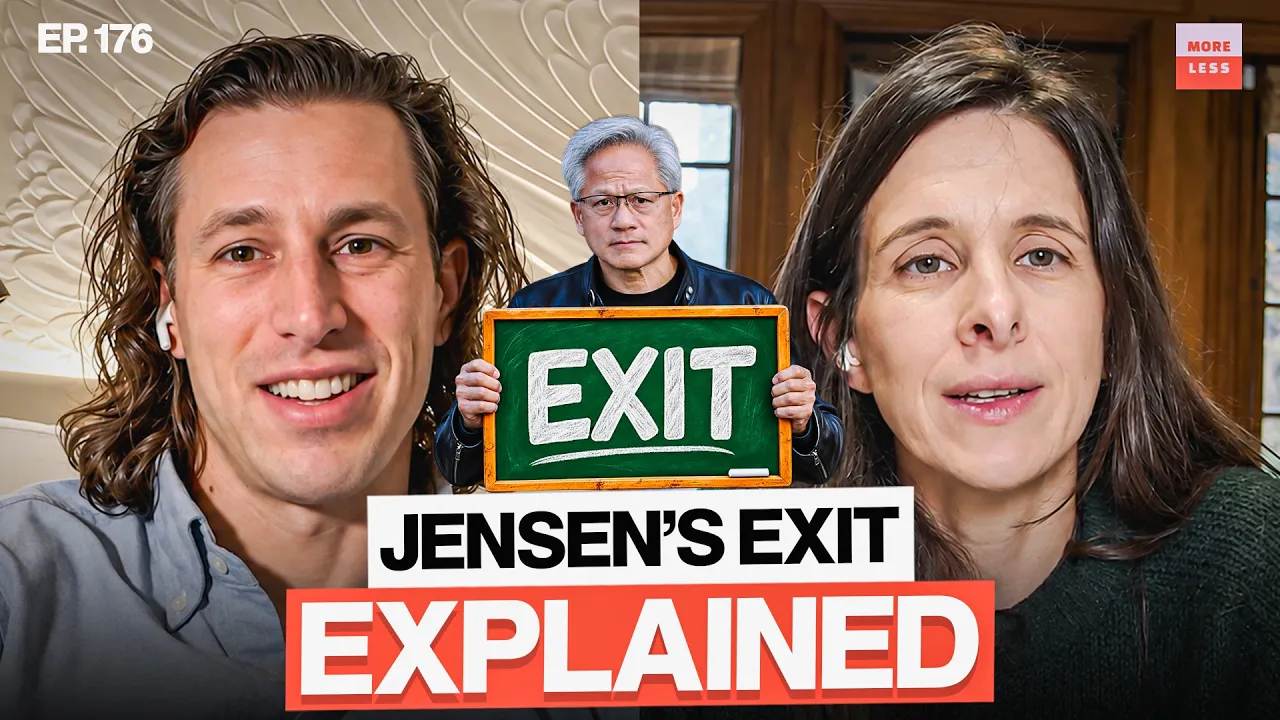
Description
Acquired's David Rosenthal has made four episodes about Nvidia and interviewed Jensen himself, which earns him the right to say the thing most of the Valley is dancing around: Jensen created the modern world we live in, and what happened to him is just sad. Sam is less sentimental. This was never about the affairs, it was about lying to your board, and governance has to win when the asset is worth $4 trillion, even if he has some sympathy for the techno princes defending the divine right of founders. Jess adds the part nobody says out loud, that Jensen flew too close to the sun surrounded by people who would sign an NDA about a video and hand over their phone without blinking. On Anthropic, Sam's read is that retail wants the AI story because it terrifies them: if the world ends, at least you own part of the thing that ended it. Plus why Acquired is still audio only, and the Microsoft part three they never published. Chapters: 00:00 Intro 01:07 David Rosenthal of Acquired Joins 02:22 From a WeWork in the Tenderloin to Selling Out Chase Center 04:01 Four Nvidia Episodes, One Per Trillion Dollars 04:46 Redeeming Last Week's Live-News Episode 05:35 Jensen Says He'd Come Back, and the Bring-Him-Back Crowd 06:12 It Was Never the Affairs, It Was Lying to the Board 07:04 Nvidia Is Now Behind the S&P Over 30 Months 07:20 Techno Kings and the Divine Right of Founders 08:30 Why Governance Wins in a $4 Trillion Asset 09:07 David: Jensen Created the World We Live In 09:40 CUDA, AlexNet, and the Long Solitary March 12:20 Sam and David Agree: It's Just Sad 13:18 72 Hours From Most Valuable Company to Gone 13:57 Overnight Success and 60 People Reporting to Jensen 15:48 Jess: He Flew Too Close to the Sun 17:28 Nvidia as Buyer of Last Resort and Price Setter 17:45 Eight TPUs for Every Ten GPUs Next Year 18:33 Is CUDA Still a Moat? 19:01 Google's TPU Bet Is Vastly Underappreciated 20:46 Anthropic's IPO: Taping the Day Before 21:02 Sam Was at the Facebook IPO When Nasdaq Failed 22:25
Summary
Generated by gpt-5.6-terraAt-a-Glance
- Verdict: Skim
- Core thesis: David Rosenthal and the More or Less hosts argue that AI is creating a volatile transition in which governance, compute supply, distribution, and low-cost capital—not merely frontier-model quality—will determine the durable winners.
- Why it matters: The discussion offers useful strategic frames for assessing NVIDIA, Anthropic, Google, and AI infrastructure, while also identifying how AI-driven security responses and operational leverage may make outages and institutional instability more common.
- Best use: Use this as a set of investor and operator mental models—especially on model-company moats, compute alternatives, organizational governance, and media distribution—rather than as a source of verified news or precise forecasts.
Executive Summary
The conversation centers on the claimed departure of Jensen Huang from NVIDIA and Anthropic’s anticipated IPO, using both as lenses for a larger argument: the AI economy is moving too quickly for institutional systems, corporate governance, and markets to maintain stable assumptions. Rosenthal emphasizes Jensen’s historic role in turning NVIDIA from a gaming-chip company into the computing substrate for modern AI through CUDA and long-term GPU investment. The hosts nevertheless argue that a company of NVIDIA’s scale cannot suspend governance norms merely to preserve founder velocity.
On AI infrastructure, the group sees NVIDIA’s moat as meaningful but no longer unquestioned. They point to Google’s TPUs, major model labs’ chip ambitions, and an alleged shift toward more non-NVIDIA capacity. Their central distinction is between the inevitability of growing demand for matrix multiplication and the uncertainty over who captures its profits, margins, and strategic control. NVIDIA may remain essential even if its present power is near a peak.
Anthropic is framed as more likely to be a durable generational company than a short-lived trade because it has demonstrated operational resilience, scale, and credible backing from Amazon and Google. Yet the speakers concede that consumer lock-in remains uncertain, AI economics are fundamentally compute-intensive, and the category is early enough that distribution incumbents such as Google and Microsoft cannot be counted out. The future prize is not just model intelligence, but the ability to turn usage into a product, distribution, and capital-allocation machine.
The closing media discussion is the most concrete operating section. Rosenthal explains Acquired’s intentionally non-algorithmic, audio-first model: roughly 2 million audio subscribers, four sponsors per episode, six-month sponsor seasons, and a separately sold back catalog that generates about half of monthly consumption. Its core tactic is to treat the RSS feed as a merchandised bookstore rather than a chronological archive—promoting evergreen “greatest hits” near the top of the feed—and to prioritize durable work over short-form social distribution.
Key Takeaways
- Claim: NVIDIA’s strategic position was built through Jensen Huang’s unusually long-duration bet on programmable GPU computing, but founder centrality also created a governance vulnerability as the company became globally consequential. | Evidence: Rosenthal traces NVIDIA’s path from CUDA investment in the 2000s through the 2012 AlexNet breakthrough, saying NVIDIA endured repeated stock drawdowns of roughly 90% while investing billions before AI demand arrived. The speakers describe an organization in which roughly 60 people reportedly reported directly to Jensen and argue that its management structure was inherited from a much smaller gaming-company era. | Implication: For founder-led AI infrastructure companies, a technically visionary CEO can be the source of strategic advantage, but scale requires independent challenge, credible management layers, and governance systems that do not depend on the founder’s personal judgment. | Caveat: The transcript’s discussion of Huang’s purported resignation, personal conduct, and board actions is conversational and speculative; it should not be treated as independently verified reporting.
- Claim: AI compute demand should continue to expand, but NVIDIA’s ability to retain its current economic power is less certain than the growth of computation itself. | Evidence: The panel repeatedly reduces AI infrastructure to multiplying numbers at unprecedented scale, while highlighting Google’s multi-year TPU investment, Anthropic’s reported TPU-based training, and model labs’ internal chip efforts. One host claims to understand that eight TPUs could ship for every ten NVIDIA GPUs next year, though this is explicitly not sourced in the conversation. | Implication: Do not equate secular AI-compute growth with a single-vendor investment thesis. Track workload portability, software ecosystems, chip availability, pricing, and the degree to which hyperscalers externalize their proprietary hardware. | Caveat: The TPU-to-GPU shipment ratio and claims about rivals’ chip roadmaps are unsourced assertions from the hosts, not verified analysis. They also acknowledge that NVIDIA demand remains strong and changes in infrastructure markets tend to happen slowly.
- Claim: Anthropic may merit evaluation as a durable platform company rather than merely an IPO trade, but its long-term moat depends on turning model scale into distribution, products, and favorable economics. | Evidence: Rosenthal says he would risk-adjustedly hold Anthropic for five years, citing its perceived quality of management, operational resilience, and maturation beyond the “wild West” phase. The discussion notes Amazon owns about 15% and Google about 14%, while contrasting Anthropic’s position with OpenAI’s more aggressive attempt to build a broader conglomerate. | Implication: Assess frontier labs as evolving conglomerate candidates: model performance alone is insufficient; the key diligence questions are cost of capital, compute procurement, enterprise retention, product execution, and proprietary distribution. | Caveat: The panel disagrees on whether it would hold Anthropic for five years, acknowledges a nonzero risk of failure, and flags weak consumer lock-in as a central unresolved issue. Rosenthal discloses that Acquired is an Anthropic partner and that he and his co-host are small investors.
- Claim: Incumbent distribution can still matter enormously in AI, even though the product landscape remains too early to declare permanent winners. | Evidence: The group compares the current moment to Google’s post-search expansion into Gmail, Maps, YouTube, Docs, Chrome, and Android, and Microsoft’s earlier platform expansion. They argue that AI’s approximately 1.2 billion users create a rare distribution asset, while pointing to Google’s AI Search Overviews and embedded consumer-agent efforts as evidence that incumbents retain leverage. | Implication: For AI product strategy, prioritize distribution surfaces, embedded workflows, and repeat engagement over standalone model access. Model labs have an opening in documents, email, agents, and work software, but incumbents already possess the routes to market. | Caveat: The speakers also cite Yahoo and AOL as reminders that scale and distribution can be squandered. They see consumer switching costs as unclear and expect the next 24 months to remain highly uncertain.
- Claim: AI-era leverage and defensive system changes may make higher operational volatility normal, including outages caused indirectly by organizations responding to perceived AI-enabled threats. | Evidence: The hosts cite contemporaneous outages involving JP Morgan Chase, United, the FAA, and Outlook, speculating that organizations may be rapidly patching old systems in response to new AI/cyber vulnerabilities. Rosenthal’s framing is that more leverage and faster systems inherently produce more volatility. | Implication: Design AI operations around graceful degradation, rollback capacity, explicit human escalation, and realistic uptime assumptions. Separately monitor whether widespread disruptions become a rationale for centralized government or platform control. | Caveat: No causal evidence is offered that AI-related patching caused the cited outages; participants explicitly acknowledge they do not know what is happening. The claim is a risk frame, not a demonstrated diagnosis.
- Claim: Acquired’s media business demonstrates that long-form, evergreen audio can outperform algorithm-chasing when content is deeply useful, reliably discoverable within a catalog, and monetized across both new and old work. | Evidence: Rosenthal says Acquired has operated for nearly 12 years, has roughly 2 million audio-platform subscribers, sells four sponsors per episode in six-month seasons, and gets about half of monthly consumption from episodes older than six months. The show changed publication dates on standout episodes—such as Costco, Rolex, Hermès, and Microsoft—to place them near the top of its feed rather than burying them chronologically. | Implication: For knowledge-media or executive-content products, build a durable library and actively merchandise it. Treat owned feeds and archives as product surfaces, not passive repositories, and avoid optimizing exclusively for algorithmic clips if they do not serve the core audience behavior. | Caveat: This strategy relies on unusually evergreen, high-engagement content and audio use cases such as driving, working out, and flying. Rosenthal says podcast discovery is weak and that building the audience took 12 years, so the model is not a quick growth play.
Detailed Brief
Investment framing: discontinuous outcomes versus index compounding
- Claims: One host argues against applying Warren Buffett-style index-fund advice universally, contending that ordinary earners face increasingly discontinuous wealth outcomes and cannot necessarily reach housing and family goals through conventional paycheck savings and market compounding alone.; The group characterizes the rise of speculative behavior in crypto, sports gambling, and concentrated AI trades as partly rational under this view, rather than solely as irrational risk-taking.
- Evidence: The argument is framed around a hypothetical worker who saves from taxed income while facing inflation and high living costs, versus access to assets that can produce nonlinear gains.; Rosenthal pushes back that broad index exposure remains appropriate for most people, creating an unresolved debate rather than a shared conclusion.
- Caveats: No personal-finance analysis, expected-return evidence, or risk comparison is provided.; The speakers’ access to private-company investments and high-growth tech networks materially differs from that of typical retail investors.
- Implications: Treat this as a sociological explanation for risk appetite and retail AI demand, not as investment advice.; For product and market analysis, assume a meaningful segment of consumers may buy AI-linked assets as perceived protection against AI disruption itself.
Acquired operating model: why audio and RSS remain strategically useful
- Claims: Acquired sees audio as a structural advantage because listeners can consume multi-hour work while driving, exercising, doing chores, or flying; four-hour screen-based programming would be far less viable.; The team intentionally reduced social clips, preferring an owned, RSS-based audience relationship over algorithmic distribution.; The podcast feed functions as a curated storefront: high-value evergreen episodes are repositioned to improve new-listener conversion into the archive.
- Evidence: Rosenthal calls driving and road trips, workouts, and plane flights the show’s “holy trinity” of consumption.; The show’s central quality bar is whether an episode will remain approximately 95% relevant five to ten years later.; The team is considering a print-magazine adaptation of edited transcripts, reflecting a belief that durable content can travel across formats without becoming short-form.
- Caveats: Autonomous driving could reduce audio’s advantage during car travel if riders shift attention to screens.; The hosts acknowledge that algorithmic media is consuming increasing amounts of attention, even if Acquired has opted out of competing directly in that format.
- Implications: Media products that monetize attention should map their business to specific behavioral windows rather than only to demographic audience definitions.; Evergreen editorial investment can produce compounding catalog revenue, but only if navigation, packaging, and re-discovery are designed intentionally.
Notable Concepts & Terms
- CUDA: NVIDIA’s GPU programming platform; Rosenthal presents it as the long-term software and ecosystem bet that positioned NVIDIA for the AI boom.
- AlexNet: The 2012 image-recognition breakthrough cited as the moment GPU-based deep learning demonstrated a major performance leap and validated NVIDIA’s AI direction.
- TPU: Google’s Tensor Processing Unit; treated as the most important large-scale alternative to NVIDIA GPUs and evidence that hyperscalers can reduce single-vendor dependence.
- Compute buying business: The speakers’ reductive description of a frontier AI lab’s economics: model companies must secure and finance vast computing capacity, making capital structure and hardware relationships strategic.
- Cost-of-capital conglomeration: The thesis that a successful technology pure play can use cheap capital, product-building ability, and distribution to expand into adjacent businesses and become a modern conglomerate.
- Recursive self-improvement: The suggested defensible advantage for frontier labs: better models may accelerate the creation of still better models, potentially creating a compounding capability moat.
- RSS as a bookstore: Acquired’s operating metaphor for its podcast feed: a controllable catalog that can be actively merchandised to surface evergreen work rather than simply ordered by date.
- Techno king / divine right of founders: The tension between founder-led speed and institutional governance; the speakers use it to explain why some observers resist board intervention even at public companies.
Operator Notes / Why Ken Should Care
- Separate verified intelligence from narrative: independently validate all claims concerning NVIDIA leadership, Anthropic’s IPO terms, ownership percentages, outages, and hardware shipment forecasts before using them in an investment or operating decision.
- Add a compute-dependency dashboard for any AI system: model portability, alternative-provider readiness, GPU/TPU availability, inference costs, rate-limit exposure, and vendor concentration should be reviewed together.
- Stress-test AI-enabled workflows for degraded service: define manual fallbacks, rollback procedures, data-integrity checks, and explicit escalation owners rather than assuming legacy systems can absorb rapid security changes.
- If building executive content or internal knowledge media, repackage high-performing evergreen material as a curated library; test feed/catalog merchandising before investing heavily in short-form social distribution.
- For AI platform diligence, score companies on distribution, capital access, and product integration separately from benchmark performance; avoid treating model quality as the sole moat.
Source/Metadata
- Title: Acquired’s David Rosenthal on Anthropic’s IPO and Jensen’s Exit
- Transcript words: 21067
- Duration seconds: 3417
- Timestamp note: No usable timestamps or chapters were provided. The transcript contains extensive duplicated passages, so the effective unique discussion is substantially shorter than the stated word count.
Transcript
What's breaking things is not the models. It's people updating because of the models. So it's like this hilarious thing was like a self-fulfilling prophecy, right? Where it's like, we have scary thing. And because we have scary thing, all these people rush to fix for it. Then again, it's very funny. One day, NVIDIA is the most valuable company in the entire world. And within 72 hours, he's gone. Two weeks ago, if you had said Jensen Hong would resign from NVIDIA, people would say that would never happen. That's insane. Look, I have a very hard time seeing it trade down, especially interestingly with the retail humans, want to own the AI story because they're terrified of the AI story. They're terrified of AI. AI is scaring the crap out of them. But it becomes this insurance policy effectively, which is, well, if the world ends, at least I own part of the end of world thing. Put it all right to the test. More or less. Why, hello, dear listeners, and welcome to a very special episode of More or Less. Because while sadly the Morans are away, the lessons have brought in a ringer. We thought one of the best podcasts, if not the best podcast around. And we're so thrilled to have David Rosenthal here with us. David, welcome to More or Less. Thank you. Thank you. Guys, can you do my intros everywhere? I just walk into a room and say, the best podcast around. Thank you. I'm just so excited. You get the context here, which is you guys do the six hour long form and meticulously detailed account, like the story of everything from Seinfeld. Not takedown. They do the definitive account. They're not the information, Sam. Come on. No takedown. From Seinfeld to, you know, whatever, to like the biggest tech companies in the world. They're meticulous. They're hours and hours. With total planning, we just get on and bullshit for an hour. So I'm excited to see you in a very non-natural environment. Great. Great, great, great. I can let my hair down. Yeah, there you go. We've already discussed our various standards in audio and how they're different. But Sam, do you want to add anything about David? Why we invited him on today? No, I'm just throwing, I mean, David makes like some of the best content, right? And you know, just going back, I started listening to Acquired a long time ago. In fact, one of the early ones you did, which was so awesome, was about Venmo with our buddy Cortina. Super early. I think that was, was that the first live one you ever did? That was not the first, but the first in front of an audience of more than like two people. And it was at the WeWork in the Tenderloin. Yeah. If you can imagine that, we've all come so far. So it was going from that to like I took a picture from like the upper rafters of the Chase Center at the one you did with Mark Zuckerberg, where you sold out the entire Chase Center, which then Mark posted. He liked it because it looked very grand. And so, you know, from the tiny WeWork all the way to selling out the Chase Center, it's been quite a journey to watch your podcast empire grow. Ah, thank you. Thank you. Well, the only thing I have to correct you on is, it's not me and my empire. It's me and Ben, my partner, my sidekick. Ben and his wife just had a baby about a week and a half ago. So he's out of commission. Breaking news. I get to be on parental leave without a baby. David, this is your perfect time to consolidate power. Now that he's out with a baby, you can consolidate your reign. Oh my God. Oh boy. No, then I would have to do stuff, you know. You're the partner that does nothing. I know that role well. Yes, yes. Yes, yes. That's my favorite role. Well, we're going to make sure to leave some time to talk about the media business because David is in one of the most interesting corners building incredible business, but it's not the only reason people listen to this podcast is to hear us inside baseball and media. So I think we've had quite a week. Now I have to ask, have you done the acquired on NVIDIA yet? Oh yeah. Well, gosh, we spend, feels like, you know, half our lives on NVIDIA, not half our lives, but we've done four total episodes on NVIDIA, which I think is the most on any company. Do you do like one hour per trillion dollars? Is that kind of how it works? That's about right. Gosh, no. That's good. So we did a three part series on NVIDIA in our, you know, usual style, just Ben and me telling the story. I mean, all together, I think that's probably about nine hours or so. And then we interviewed Jensen afterwards for the fourth piece. And well, I'm just so surprised by all of it. Well, again, we've got a lot to cover, a lot in the way of news, but we have more or less have to redeem ourselves from last week because last week's episode was a train wreck. It was not. It was awesome. What was a train wreck about it? It was taped as the news about the board meeting for his ouster and the news about the second affair were literally happening. So we would say something and revise it 30 seconds later. No, no, it was awesome. It was like literally like war of the worlds. Like we were like live broadcasting, like as it was happening and people loved it. They're like, this is so authentic because you guys are literally just doing the hot takes as news drops. That's what you want. What do you mean disaster? Okay. So we don't have to redeem ourselves, but perhaps we could update it. So Sam, what is your updated take? As we tape this, NVIDIA has announced its earnings, seems to be on course, raised its guidance. Jensen has told the world that he would be willing to come back and serve if the board will let him. Which is a great line. It's, that's a good PR line, by the way. It's like when you're not invited, it's like, you've been fired and you're like, oh, I, of course I would. Of course I'd be willing. I would serve were asked. But to be clear, he wasn't even fired. He resigned. Okay. So it's even weirder. Then the board and the interim CEO are telling everyone that the ship has sailed. They're moving on. And now you have Travis Kalanick and a couple other of these ousted founder types wearing their leather jackets on stage at DealBook saying, bring Jensen back, bring Jensen back. What's happening? First of all, let's just be clear. It's just so fun. Like the thing that the world is now optimized for is like the most fun narratives, right? More than anything else. And this is like catnip. And of course, all the CEOs come. I mean, you know, I got into this like a long thread with good old Bology back and forth on Twitter. Who's in the camp of like, bring him back. And I'm like, look, it wasn't a Chinese. I'm like, first of all, forest trees, like the issue was lying to your board. The issue was not affairs. Lying to your board, violating your code of conduct affairs with your direct reports and lying to your general counsel and board. Two, you have like a bunch of serious board members, several of whom are like have billions of dollars in NVIDIA. So that's wild to me that like your board directors have $5 billion of NVIDIA stock. That's just insane. Let's not forget a few years ago, this was a video game company. You know, it's just all the stock appreciated so fast. It's all. And the stock is now retraced. I actually did the math on this this morning. If you had bought it at the 10 for one split in June 2024 to today, you'd be up about 10%. So the stock is now basically behind the S&P over the last 30 months. Look, the story is interesting one. Cause on one hand, we live in an era of modern feudalism and modern, run by Kings. And what's interesting is the techno Kings, the Elons or whatever have super voting shares. I prefer emperors, but go with Kings. Yeah. Imperial. We live in an Imperial state. Yeah. Can women be emperors? I guess empresses, emperor. Yeah. Empress. Yeah. If asked, I could do the party. Yeah. You would serve as emperor. Yeah. Sure. Yeah. So like there's on one hand you have like the narrative, which I think a lot of the techno people totally get, which is you kind of want, 2024 to today, you'd be up about 10%. So the stock is now behind the S&P over the last 30 months. Look, the story is interesting. On one hand, we live in an era of modern feudalism run by Kings. What's interesting is the techno Kings, the Elons or whatever, have super voting shares. I prefer emperors. Yeah, Imperial. We live in an Imperial state. Can women be emperors? I guess empresses. Yeah, empress. If asked, I could do the party. Yeah, you would serve as emperor. Yeah, sure. So on one hand you have the narrative, which I think a lot of the techno people totally get, which is if you want to be nimble and win, you want a techno King who can do a bunch of stuff. The founder, the right of the founder in these types of companies is unbelievably powerful. The divine right of founders. I skipped that in history books. There's some concept, but founders, especially those with super voting stock as Jensen clearly did not have, they can move much faster and make decisions and finance things more aggressively than any professional board or manager can. So there is a real negative. You took the number one of the biggest companies in the U.S. and just defanged it. You took away the King. That's going to be a problem. That's what the tech people say. And then the rest of the world says, Hey, governance matters for people to trust Western markets and Western companies. Governance is not something we should just toss away. Right, in which case the board was totally acting reasonably. I think in this case, governance wins in a $4 trillion asset. And I don't think the board members want to get sued, but I do have sympathy for the techno princes running around defending the rights of techno Kings because there is real value in it. Wow. I mean, we concluded our coverage of NVIDIA, so to speak, it was probably three years ago now when we interviewed Jensen, I think it was three years ago, perhaps 30 months ago. Yeah, so perhaps at the top of the stock price. All I can say is that every company we come from acquired is singular, but perhaps none is more singular than NVIDIA. And what they did over the last 20 years and what Jensen did, and it was just Jensen created the modern world we live in. I'm so shocked at what has happened in the last couple of weeks. Why do you say just Jensen? Because it was truly him singularly having faith and pushing for AI that led to today. Obviously they're not a frontier model. I mean, they have Nemetron and everything, but they're not OpenAI. They're not Anthropic. They're not Google. But he started working on CUDA in the 2000s. It was just this faith that he had that GPUs and accelerated computing could be something programmable. This was before AlexNet. He was looking for a bigger market outside of gaming for NVIDIA to play in. The way he phrased it to us when we interviewed him is, you want to be close to the tree when the apple falls. And then in 2012, AlexNet happened. This is ancient history at this point. But that was the big bang moment for AI where researchers for an academic competition for image recognition architected an algorithm on GPUs. They went to Best Buy and bought some NVIDIA graphics cards and wrote this algorithm that recognized images significantly better than anything that had ever happened before. That was this moment that Jensen saw of, Oh my God, AI can get so much better. It can happen on GPUs. We can be the foundation of all of it. This was in 2012. OpenAI wasn't founded yet. ChatGPT didn't happen until 2022, 10 years later. Yeah. And then Jensen just went on this long march, like a solitary march where NVIDIA stock got crushed. He invested billions and billions and billions of dollars in building CUDA to enable all of this and building out the GPU infrastructure and everything in their supply chain. Their stock got drawn down like 90%, several times, because investors were just like, what are you doing? And the years would go by and AI didn't happen and it didn't happen and it didn't happen. And then it happened. It's all because of Jensen. That won't happen again. No, I mean, I think that's important. My concern with the whole thing, honestly, look, I personally, I'm on the side of governance here, right? But I will say two things. One is, it's a real shame because my model is one, I think we need open source. I don't want a world controlled by Anthropic, OpenAI. I think that as much as we can talk about circular finance, some of the crazy stuff going on in NVIDIA, which by the way, it's wild, right? Like the guy was investing in a bunch of stuff. I'm like, ooh, I kind of want that to happen. Right? If that makes sense. So I do think that it's very sad. I also was thinking about this the other day. It's like, yeah, sad. That's just how I feel about it. It's just sad. And that's not a commentary on what he did or didn't do, or whether it was wrong or board governance, but it's just sad. It's so sad. It's sad. And I do wonder, again, I'm not even close to in the room. So I'm just speculating from the peanut gallery per usual. It's like, look, in terms of lying to the board, is part of the problem that his family was too involved in the company? So you're really embarrassed, right? You don't want your family to realize you've had affairs, right? Like it's the classic, the coverup is worse than the crime. No, he did not lie to the board because poor Madison and Nico didn't know the extent. She was taking pictures of him with the people he was having affairs with. But it's a fair point that this is a family company. The world is full of hot takes on this topic. What would we do if we didn't have this? This has to have happened because otherwise we would have nothing to talk about this week. We'd just be talking about Anthropic. Well, no, we'd have the Anthropic idea or the stuff Sam was saying about how the world optimizes for the most entertaining thing happening. This reminds me of COVID and all the crazy stuff that kept happening during COVID. This feels like another one of those episodes where I'm like, Oh my God, how did this happen? I mean, one day NVIDIA is the most valuable company in the entire world. And it's all Jensen. And then the next day, within 72 hours, he's gone. If two weeks ago you had said Jensen Huang would resign from NVIDIA, people would say that would never happen. That's insane. Yeah. I think part of it also, my last point, David, about how this was a small company until recently. Right? It really was not an important company. It was just, I knew about it because I used to be into PC gaming, you know what I mean? But it was not an important company. Right? And so I do think part of the story is the challenges of overnight success. You just don't have time as a leader to catch up to the reality you're now working in. Right? And a bunch of the things you might be doing before, playing a little close to the line, hustling around, people will tolerate that when you're a small company. But the second you're an important player, the rules change a lot. And I just wonder how much it was that Jensen in some ways didn't have enough time to catch up to his new reality as a world leader versus some random guy working on CUDA. The company didn't go through a standard company evolution because of this. They had grown up and were already a public company for many years. used to be into PC gaming. But it was not an important company. Right. And so I do think also part of the story is the challenges of overnight success. Right. We're like, you just don't have time as a leader to catch up to the reality you're now working in. Right. And a bunch of the things you might be doing before playing a little close to the line, hustling around, people will tolerate that when you're a small company. But the second you're an important player, the rules change a lot. And I just wonder how much it was that Jensen in some ways didn't have enough time to catch up to his new reality as a world leader versus some random guy working on CUDA. The company didn't go through a standard company evolution because of this. They had grown up and were already a public company for many years as a completely different company, as a gaming company in a much smaller market in the gaming world, which is its own thing. And then again, because of Jensen's maniacal dedication to making AI a thing, that happened over a period of 10, 12, 14 years. But everybody that he brought into the company to be leaders were point person experts in exactly what needed to be. It wasn't there was a COO or a president, people that were developed as other management layers around the company. Because that already existed for a very different company. Yeah. It was 60 people reporting to Jensen. Yes. Yes. Exactly. And so you ended up with 60 people reporting to Jensen. Yeah. And he's running a small number of customers off his phone. I think you're dancing around both of you a little bit of an issue too, though, which is we can say that he just didn't have time to find the trappings of governance and good management, but he also flew too close to the sun. Right? Like, and he surrounded himself with people. And I know them all who would say, yes, let's sign the NDA about that video taken with you and your VP. And there's nothing weird about asking someone to sign an NDA and taking their phone at your developer conference, because that's just what we do. And you understand these forces and we just see them again and again, and you see them throughout the business world, throughout the political world. But I think it's sad that Silicon Valley keeps important technologies and companies getting tripped up in this pattern matching of no one being willing to challenge the boss. And maybe it has to be that way. And then we suffer the consequences from it. But I just know, oh, you got Jensen. You got Jensen at your event. You talked to Jensen, you know Jensen's phone number. Oh, wait, I'm meeting with investor. Oh, sorry. It's Jensen. And at some point you have to step back and recognize that this is not healthy. Right. And you see it with a lot of CEOs. So I think it's interesting too. I mean, obviously the market has been reacting to this expectation that NVIDIA is really going to pull back the backstopping that it was doing across the industry. And I think that NVIDIA's impact on the economics of AI had multiple dimensions. Some of it was the backstopping of going in and funding the chips directly or being a buyer of last resort of them. But customers, NeoCloud, exactly. But a lot of it was even setting the price of compute that these customers could then charge. I mean, I think this power was so ubiquitous and was used in so many ways, like who gets preferential access, right? So we'll see all of that play out. But it's also one of those, there's the history will be written here. Like, my understanding is next year, there are going to be eight TPUs shift for every 10 NVIDIA GPUs. Right. So we're at this tipping point. Your understanding. Sam, what's your source? I need to press this. Your understanding. Spoken like a man who's not a journalist, but probably right. Yes. I have lots of understandings, but the point is you're going to see a lot more TPU. The story is CUDA was very important. But now that you can reverse engineer all this stuff so easily, right? Ironically with AI, is CUDA important anymore? Looking to plan everything. Right. And so there's an interesting thing where it could be that Jensen is exiting at the maximum moment of NVIDIA power, effectively anyway. Right. And we just don't know. It's going to be an interesting moment. That's what OpenAI and Anthropic would like us to believe. And they could be right. Right. I mean, you cannot sit down with an OpenAI senior leader and they can't tell you about Jalapeno, their chip and how many orders they have and how quickly they designed it. Right. And same with Anthropic. But I also think change happens slowly. And I think NVIDIA, the demand for NVIDIA is still through the roof. It's going to be through the roof in this compute arms race. I think that's right. And I think Sandra, you're also right that Google is vastly underappreciated in what they've done over the last several years with TPUs. They very easily could have said, great, we're just going to run on NVIDIA too. No big deal. And instead they have poured tons and tons of resources into TPUs and said, we're going to externalize this. It's not going to be just for us. Anthropic is going to run on it. And then it's going to be OpenAI and so on. So I mean, to the extent NVIDIA is impaired by losing Jensen or anything else, we should all just be really happy that there are TPUs out there. Well, also let's not forget Anthropic widely considered to have the best frontier models, pretty much trained on TPUs. The TPU case has always been there. I think Google's capitalized on it, but you also have training and the whole stack. The basic upside is it turns out that multiplying numbers really fast is pretty good. This is Sam's matrix multiplication points in the pod, everybody. We're going to be multiplying a lot of numbers really fast. At scales we've never seen before. Right. Or you could have even imagined. So people are like, is there, of course, it's like will we take more photos or will we use more bits over time? It's of course we will. Now who makes profit from that? What's valuable because of that is a totally separate question. And the interesting thing with NVIDIA, go back to this whole thing. The company since the last 30 months, since the stock split has obviously grown in revenue and profit unbelievably, and will continue to be bigger for a while. But the market cares about what's going to happen on a few year basis. The narrative gets valued way ahead of reality. And so what is NVIDIA's value in five or ten years is the really interesting question. And it really could be anything. Well, that's a great segue to Anthropic. So we are unfortunately taping before IPO day. No, that's good. People like this because then it happens. They can check our commentary from before it happens. So Anthropic is going to go out at 1.5. What is it going to end first day trading at? I was thinking about this. I was thinking back to the Facebook IPO. Yes, you were there. Yeah. We all lived through this. I mean, you were there, there, but I'm one of the bobbling heads behind Mark on the cover of the New York Times. And so I was very much there. And what was interesting, right, is that was at the time the biggest IPO ever. They moved the NASDAQ bell out West. And it was this whole thing. A quaint 100 billion. A seed round. It was a seed round. I love it. It was at the time a huge IPO. And hilarious. I remember going to the gym after the IPO. We had stayed up all night. There was a hackathon the night before. Went to the gym and just watched NASDAQ fail. Right. And the whole thing, it was a disaster of an IPO because the market. It's really funny this week, looking at the FAA, looking at all these things breaking. I'm like, oh my God. Is this going to be a repeat? The most hilarious possible thing to happen to the Anthropic IPO is for NASDAQ to boink on a software update because of some upgrade they're doing to defend it from the AI that Anthropic itself has created. Right. And then tanks the IPO. Right. Like that would be the most hilarious possible outcome. A quaint 100 billion. A seed round. It was a seed round. I love it. It was at the time a huge IPO. And hilarious. I remember going to the gym after the IPO. We had stayed up all night. There was a hackathon the night before. Went to the gym and just watched NASDAQ fail. Right. And the whole thing, it was a disaster of an IPO because the market. It's really funny this week, looking at the FAA, looking at all these things breaking. I'm like, oh my God. Is this going to be a repeat? The most hilarious possible thing to happen to the Anthropic IPO is for NASDAQ to boink on a software update because of some upgrade they're doing to defend it from the AI that Anthropic itself has created. Right. And then tanks the IPO. Right. That would be the most hilarious possible outcome. And therefore, does that make it the most likely? I am happy to report I was on the phone with the NASDAQ executive a few hours ago, and I'm confident they have no software upgrades plans, but I'm not confident something will go wrong. I had the same reaction. I asked you a pricing question though, Samuel. Look, I have a very hard time seeing it trade down, especially interestingly with retail humans want to own the AI story because they're terrified of the AI story. They're terrified of AI. AI is scaring the crap out of them, but it becomes this insurance policy effectively, which is, well, if the world ends, at least I own part of the end of the world thing. It's not just retail driving this. Brad Gerstner says he wants to put five into it. That's all priced in. The marginal buyer is Steve, whether Steve buys it effectively. And I think the answer is Steve will buy it. So I think it'll trade up initially. Now the counter argument to that is the unlock is wild, right? So 10% is unlocked immediately, which is a lot. Right. And so there's a lot of center millionaires in paper stock running around who are going to do that. And so we'll just see. I think it'll trade up initially. The thing I've always said, which is the thing I still, I don't have an opinion on is what is Anthropic worth? Is it an investment or a trade? Right. It's clearly been an excellent trade, one of the best trades ever. Right. In terms of just as a trade, would you want to hold it for five years? And that's the thing I just don't know. I don't have a strong opinion about that personally. If you told me I had to buy Anthropic stock today, but I couldn't sell it for five years. Is Anthropic five years old even yet? I don't think it is. I love since you cover companies from their origins, you ask all these good questions that I don't. It is just over five years old, January 2021. 2021. So yeah, if you wanted to hold it for twice its history to date. Yeah. If you said, hey, you can buy Anthropic, you have to hold it for five years. Would I do that? Honestly, probably not. I would. You'd hold for five years. You'd lock it up, throw away the key. Yeah. Well, it depends what position size we're talking about here. Yeah, no, but if I risk adjusted, I think so. I mean, look, and I think there are important differences between OpenAI. I don't know if I'd hold OpenAI for five. I'd have to think about that a little bit more. It's not clearly yes. It's not clearly a no, but Anthropic I think has earned our respect as a well-run company. I think they have good leaders. They've, who all have their pros and cons and all of that. But I think if you look at how they have managed that business, it's been very impressive. And it's basically a compute buying business, right? In terms of what drives the economics of it. I think they've adjusted to things. They've demonstrated a lot of resilience already. So there is some probability it goes belly up, of course, but I think they're past the wild West phase. And I think their numbers demonstrate that. I also think it's wild. So Amazon has about 15%. Google has about 14%. Information was right in the center of the Microsoft OpenAI Alliance, which there was a period based on which that was seen as the most iconic partnership in business. And how could any company compete with Microsoft in the future? And then you have these bigger entities hanging out around the hoop. Jassy, Sundar being like, okay, yeah, this AI thing don't count us out. And no one really believed them. And now you look at Google and Amazon, they've got their own chips. They're not beholden to any one of these platforms. They get billions of dollars in returns. Google is the investor of the moment between SpaceX and Anthropic, right? And it's kind of wild. Not that those companies don't have challenges. It's so funny from this moment at Acquired history. We were right at that moment where you were talking about when Microsoft and OpenAI and that partnership were on top of the world. We were concluding our series on Microsoft. We did a two-part series on Microsoft. Only $2 trillion. So you get two parts. Yeah. We spoke a little bit at the end about the OpenAI partnership, but everybody assumed that the third part was coming and that it was written and that Microsoft was going to inherit the AI earth. We got so many notes and probably a year plus afterwards of, did I miss part three? Why have you not done part three? We didn't intend to because our model is, where the history, the lens that we think about through doing an episode is, will this episode still be 95% as relevant five years, ten years after we publish it? And where we left off Microsoft at part two, we just couldn't be confident in that after that point in time. But we kept asking ourselves, are we wrong? Should we just do it? And man, I'm really glad we didn't because things have changed quite a bit since then. Totally. Yeah. Do you have any Anthropic thoughts, David? What goes through your head in this moment for them? Oh, wow. Well, Anthropic is one of our partners and Ben and I are very small investors in the company. So we're obviously thrilled for them. We have an Anthropic investor ahead of the IPO. Oh my goodness. Not even a fake one where it's like, well, you're an investor because you own Amazon. I also own Amazon stocks. So yes, I guess I'm an investor though. So I'm thrilled. Now here's a question, David. Is your ownership, Amazon is 15% of Anthropic. Is your proxy ownership in Anthropic through Amazon larger or smaller than your direct ownership in Anthropic? Smaller. Smaller. We're Anthropic shareholders through. We have a small fund called Acquired Capital that primarily invests in our private company sponsors that we have in the show. We have sensitive partnerships with them. So we're sort of VCs without actually trying. We're VCs through our media business these days. So for them to be shareholders. But the only thought I would add is that you guys know as well as I do that there are generations of tech companies and Silicon Valley companies, and you know, Meta of Facebook at the time was one of those. And if you look at Google before that, Microsoft before that, et cetera. And if you looked at all of the questions and doubt and uncertainty around them at a similar comparable point in their history to where Anthropic is now, to where OpenAI is now, there's so much to end. And usually you should not bet against them. If you reach this level of scale, usage, impact on the world, these are generational companies. And I don't really see that changing. There's all sorts of questions about what is going to be different this time. Is there any consumer lock-in? Probably not. Is there any enterprise lock-in? Maybe more. But certainly I think there is for the intelligence development at the frontier for these two model companies and the recursive self-improvement. There is clearly a defensible element there. Yeah. And I feel like the reality is you look at these. If you took Facebook that IPO'd versus Meta today, the business of Facebook, it's still advertising, right? To where OpenAI is now, there's so much to unpack. Usually you should not bet against them. If you reach this level of scale, usage, and impact on the world, these are generational companies. And I don't really see that changing. There's all sorts of questions about what is going to be different this time. Is there any consumer lock-in? Probably not. Is there any enterprise lock-in? Maybe more, but certainly I think there is for the intelligence development at the frontier for these two model companies and the recursive self-improvement. There is clearly a defensible element there. And I feel like the reality is if you took Facebook that IPO'd versus Meta today, the business of Facebook is still advertising, right? But the actual business of it is wildly different. What happens is you have a machine that produces money and technology. And it lowers your cost of capital. And then if your cost of capital is low enough, all these tech companies are now massive conglomerates, right? If you think about it. And so I think there's an interesting question. People talk about pure plays. You have to ride a pure play to a certain level, but then to be really big and successful, it just seems like the answer is cost of capital conglomeration right now. We're in a new age of corporate conglomerates. And the question is OpenAI has tried to create a conglomerate style thing very quickly. And they haven't really had the pure play total win yet. Although they've done amazing. If it weren't for Anthropic, they sound great. But the question is, do you have that machine that just lowers your cost of capital consistently low enough that you get to play in all the things? Well, it's cost of capital and ability to develop products, execute, and then distribute them. Google ran this playbook, Microsoft ran this. We did a three part series on Google. Our second episode was just reliving that era after Google search and after the IPO. Gmail hit, Maps hit, they bought YouTube, they did docs, they did sheets. That's when I covered the company for the journal. It was an amazing time. Launch of Chrome. Everything. What a run they went on. Android, Chrome. They built all these products and then they distributed them through Google search and created this domination, right? And Microsoft had done the same thing a generation earlier and Meta did it in its own way with Instagram and then with stories and then reels and everything developed through Instagram and everything. So I just think once you get to the scale and the usage, and AI has what, 1.2 billion users now, once you get to that scale, that is such a valuable asset and it's such a moat and an opportunity that very, very, very few companies ever have. But you can also screw it up. There were Yahoo and AOL and you actually can screw it up. There's all sorts of histories to be written. And the interesting thing about AI for me is I go back to the open router version of the world, right? We haven't spoken about Apple consumer. What's happening is we're still in inning one and a half. We haven't even hit anyone in terms of adoption and how this stuff works. We know we'll be multiplying lots of numbers. We have no idea the margin on it and who gets to win at it. And it's unclear what lock there is because of the world. It's so unlike things before it where you racked a server or you bought a thing. It's like you got it through your legal department. What is the law? But there's a clear opportunity. Even just running the Microsoft and Google playbook, right? There's a clear opportunity for docs. There's a clear opportunity for email. There's a clear opportunity for story. OpenAI and Anthropic have just launched a bunch of these. That's all going to happen. And there are compelling reasons to users and consumers and enterprise users why you should use Anthropic docs versus Google docs or Microsoft Word and why you should switch. And so the opportunity is there. Google this week previewed some more consumer agent stuff. And they're clearly embedding it. That's not even to speak to all the agents and maybe docs are just outdated. I would trust OpenAI and Anthropic to get agents right more than anybody else. Maybe. I don't know. Theoretically, distribution should be a huge advantage. I think the fact that AI search overviews exist and the numbers are off the chart shows how distribution is an advantage. But I guess I just agree that we're early and from a product sense. So it's very hard to count any company in or out. Maybe Instinct is the Instagram of this era. I don't think it is. Although I have to say, I quite like the founder, but I don't think that business model is as unchallenged as people realize as much as I appreciate it as Finn 2.0. These browsers need to stop blocking my agents. Well, I don't have that problem. The thing that's so interesting, the kind of joke on this podcast for years has been I'm so long Google, but I never buy the stock. Right? And I know a lot of people in that position. I'm so long Google. I understand the TPU story forever. And I think about the distribution and we can go on and on and on. But I never buy the stock. And the part of this is no one understands what the hell is going to happen in the next 24 months. And when your core search business is so threatened, right? It's the same thing with this recursion of wouldn't it be hilarious if NASDAQ goes down at the Anthropic IPO because of Anthropic. We're at a point where no one has confidence about the future. And that's why you see such incredible volatility. Well, this would also be a good moment to talk about the dark horse. Surprisingly, our biggest episode of the year, most popular probably will perhaps go on to be our biggest episode of all time. And Warren Buffett's advice on this is Vanguard. And have the majority of your wealth in index funds. It's really the right thing to do. But it's not, David. I'm an anti-Buffeteer on this. For most people, it is. I don't think it is. And I'll tell you why. This is for individual people who are not in positions of access that you are. They should not have the majority of their wealth in index funds. Here's my basic problem, which is why the incredible rise in sports gambling, crypto, all these types of discontinuous assets is I think that it is a nice story to say you can just compound yourself at whatever it is, 7% at the market or whatever the number is forever and you'll live a good life. I think the problem is that because wealth has become so discontinuous, it doesn't matter how much you compound your paycheck after taxes and after inflation and given the cost of living of the things people want, right? If that makes sense, it's so discontinuous. I don't think the math pencils out the way people want it to or the way it used to in a lot of ways. So I totally think that if you have a lot of money, then that 7% compounding forever or whatever can work for you. I think a lot of the gambling of younger generations, especially young men in their twenties, is perfectly rational. If you look at the reality of it, which is I actually care about being able to afford a house and a family in the next 20 years. And I can do the math and the math doesn't actually get me there. Compounding out my investments when I put X percent of my paycheck into my 401k. And so I don't know, I think there is a reality that it's not the whole story, if that makes sense. I think the Warren Buffett strategy made a lot of sense in or the way it used to in a lot of ways. So I totally think that if you have a lot of money, then that 7% compounding forever or whatever can work for you. I think a lot of the degenerate gambling of the younger generation, especially young men in their twenties, is perfectly rational. If you look at the reality of it, which is: look, I actually care about being able to afford a house and a family in the next 20 years. And I can do the math and the math doesn't actually get me there. Compounding out my investments when I put X percent of my paycheck into my 401k. Right. And so I don't know, I get it. I just think there is a, it's not the whole story, if that makes sense. I think that the Warren Buffett strategy is a strategy that made a lot of sense in the last century, but it's not clearly the right answer in this world of discontinuous outcomes and overnight leverage. If the most hilarious thing always happens. Yeah. The world has gone down. We've alluded to it several times. We have outages across a ton of services, JP Morgan Chase, United, the FAA. And it's like, I'm curious what you guys think about it, because what we appear to have happening is everyone has detected all these vulnerabilities with AI, with all this new cyber capabilities. And they're saying, let's patch these vulnerabilities. So everyone's patching, patching, patching. And then the systems are crumbling under these patches because they're very, very old. Is that what's really happening? And also, how do we feel about this? We're kind of chill with it, but it feels a little ominous, a little COVID-like to use your analogy, David. What do you think? I have no idea what's going on, but whether it's because of patching or other things going on, I think this is what the labs kind of warned about a few months ago. The latest generation of models. And people at the time thought, oh, why are you not releasing them? Why do you have all these ulterior motives? Well, there's some irony, David, because it's actually like, what's breaking things is not the models. It's people updating because of the models. So it's like the hilarious thing was a self-fulfilling prophecy. Yes. Where it's like, we have a scary thing. And because we have a scary thing, all these people rush to fix for it. That again, it's very funny. Yeah. Yeah. Maybe that's it. I think we just have to be braced for more volatility to be wonky about it. Like in all dimensions, that's the headline. If you go faster in your car, right, and you need fewer people to do fast things. Right. And leverage just creates volatility. That's what it does. Right. And so for me, we have a bunch more leverage and you're going to have a lot more volatility. Like the VIX is weirdly low. Are the consumers rolling with it now? Like, do I have more patience for the next incremental outage? Because I'm just like, this is the state of the world now? No, probably not. I still want to get on the airplane. I still want to access my bank account. Probably depends how long this period lasts. Well, I think it's going to be the new normal. I just think we're going to be in this state permanently. Right. On a lot of things. Right. The interesting thing for me will be the low-grade stuff is fine. Right. Like if Chase goes down and I can't read my balance for an hour, whatever, even for a day, it's not a big deal. Who needs Outlook? No, just kidding. I mean, it's actually very funny. It's really funny. I don't know your experience, but my experience of the Outlook thing was exactly who couldn't work, as you'd expect. It was like accountants and lawyers. Everything else was fine. I did not know there was an Outlook outage. I was at a tennis tournament, but it did not affect my life. But I think the low-grade stuff is fine. I think the interesting question is just how does the world respond to it effectively? And when you have bigger problems, do you end up with a thing where the government uses it as a cover story to centralize a bunch of stuff? You know what I mean? Like what ends up being the political and narrative side effects? Look, what's going to happen? At some point, Waymo won't work for a day. It'll be slightly annoying. No, well, right now we have atmospheric rivers. So the Waymos have been pulled. They've also been pulled for highways, but that's suspicious. And I will have more to say on that topic shortly. But yeah, I mean, I think my, obviously you can tell where my brain is because I'm like, do consumers have a higher tolerance for slightly improperly personalized emails now? Is there just more of a willingness to let AI do its thing? Not that I actually think information consumers have a high tolerance for experimentation, so we should lean into that anyway, but I'm sort of, you know, oh sorry. We now obviously have very serious things that have to be buttoned up, but it makes me feel a little freer with the experimentation around the rest of it. Yeah. I mean, if you unwind the internet 10 or 15 years, the idea of a service going down for an hour was the end of the world. Right? Oh yeah. 10, 15 years. Yeah, yeah. That was uptime. Uptime. Nine nines. Nine nines. Yeah. Yeah. Yeah. Yeah. Maybe three nines is fine. But you said 10, 15 years, you know, we're all getting sold. I was like, yeah. Like early 2000s. Yeah. No big deal. That was more than 10, 15 years ago. Okay. David, in our last couple of minutes here, let's talk about the media business. So can you tell us, what an amazing story. It must be wild to be writing. How many years now have you been doing Acquired? Because it's been longer than people realize, I think. Yes. We are entering our 12th year now. 12th year. So The Information is 13. You're still an RSS-only business. We are an RSS primary business, by which you mean audio platforms. Yeah. So tell, what is the business of Acquired? I'm actually really curious too. I want to hear how The Information is going, but you can do a four-part series. We can do a four-part series. We'll do a four-part series on the business of Acquired. I'd be happy to do that for everyone. That would be so fun. Our listeners might get bored of hearing about that after a while. Roughly put, the business of Acquired is we are primarily a podcast with audio. As Sam was alluding to, we do occasionally do video. We are capable of doing video, but we mostly choose not to. For our most recent episode we published, which is on the business of Seinfeld, like Seinfeld as a business asset, which was a departure for us. Usually we cover companies, but it was just a fun thing. Every now and then we're just like, we got to do something fun. We made video for that and we put it on Netflix because Seinfeld lives on Netflix. And so we thought, how fun would it be for this Acquired episode to live alongside Seinfeld on its current home? So we're capable of it, but we choose not to. The business is really who listens to Acquired and how deeply they're engaged with it and how deeply they're engaged with our episodes. That's why we're primarily audio. Our sponsors. So we have four sponsors on every episode. Our new seasons are six-month seasons, so we do the first half of the year, second half of the year. And our sponsors are for those. And then we also resell our back catalog. When I was talking about longevity, our bar for the artistic side, artistic merits of an Acquired episode is five, 10 years from now. Will this hold up? Will this still be 95% as relevant? That also ties to our business because our back catalog, which we define as our episodes older than six months, which have a separate set of sponsors, is a very large business for us and is about half of our traffic. In any given month, about half of our consumption is old episodes. And so, yeah, all of this is why we primarily have decided to, in some sense, And that's why we're primarily audio, only our sponsors. So we have four sponsors on every episode. Our new seasons, our six month season, so we do first half of the year, second half of the year. And our partners, our sponsors are for those. And then we also resell our back catalog. When I was talking about longevity, our bar for the artistic side, artistic merits of an acquired episode, our five, 10 years from now, will this hold up? Will this still be 95% as relevant? That also ties to our business because our back catalog, which we define as our episodes older than six months, which have a separate set of sponsors, that is a very large business for us and is about half of our traffic. About in any given month, half of our consumption is old episodes. And so, all of this is why we primarily have decided to be Luddites, but from a technology perspective and perhaps a culture perspective. But the audio podcasting realm is the last bastion of RSS-based, non-algorithmic driven media. Our audience is primarily on Spotify and Apple Podcasts. And the user behavior is, as anybody who listens to a podcast knows, you decide you're going to listen to a podcast while you're driving or walking or working out or doing the dishes or going on a plane flight. And you scroll to see your favorite shows and you look what your favorite shows have. That's not how YouTube works. That's not how TikTok works. That's not how Instagram works. And for us, it means that it took us 12 years to build the audience size that we have. We have probably around 2 million subscribers across our audio platforms. It took a very, very long time to build that because there's no discovery. There's no good discovery. Everything happens by word of mouth. But the flip side of it is that our feeds, they use the feed, even as a non-algorithmic feed, but the acquired feed is so valuable because it's our bookstore on the internet with our episodes. And we know that when somebody comes and subscribes to acquired and listens to acquired, they're going to see our episodes, they're going to listen to them, and then they're going to go back in the back catalog. And we actively merchandise our feeds. So this year we started, we had this realization, wait a minute, we can change the publish dates on these episodes. Why is this 100% chronological? We should take our best episodes that we've ever made and we should make them slot four, five, six in our feed so that as new listeners come in and they discover, they see the Costco episode, they see the Rolex episode, the Hermès episode, the Microsoft series, et cetera. Our greatest hits, why would we bury those down in slot 76? Let's move them up. Let's merchandise our bookstore. Just taking some notes here as running a small podcast empire. We got to get those. But anyway, all this is because it's an RSS medium, we can do this. And so social clips, the playbook that every podcast does, we killed them this year. We're sometimes wondering if we're just two monks in our little old world with tinfoil hats on pretending there's no algorithms out there. I have a subscription news outlet, primarily text-based, so we can be monks together. If you start delivering acquired podcasts only like through FedEx on records, that now we're talking. In fact, you know what you should do? You should have a very special acquired, right? That's like $1,000. That should be really fancy, right? And it should only be available on vinyl, right? And you should sell it only to your super fan membership or something, right? Like an artwork, you have to like go through pain and suffering to listen to this. Exactly. You're like, oh, have you heard the latest vinyl? Well, it's funny, I'm laughing. We do have a, we haven't actually gotten around to this, but I still think it's a good idea and I want to do it. We have an idea, we want to create like a magazine version of acquired, basically take our transcripts and lightly edit them and have a beautiful magazine created with them with some imagery. And then we just want to mail it to people. Like anybody can sign up and give us your mailing address and we'll send it to you in the mail. Why not? Everyone is now, magazines are the new medium. Everyone's into magazines. Carly Kloss is relaunching Life magazine today, I think, as we speak. Well, my friend Brad Hargraves, I think this is public, is launching a news, everyone's launching magazines because physical is great. Well, it's also, as an investor in a magazine. A high gloss tennis magazine. A high gloss tennis magazine. This explains the tennis tournament. Oh, yeah. You could do an acquired on my interest in tennis, but dude, there are these moments that media is very faddish and I think you guys are the poster child and it's so impressive and I know it's so difficult. So congratulations of just sticking to your knitting and being excellent at knowing your audience. But these fads really do come, especially as the industry is scrounging for models and attention and all this kind of stuff. And I don't know, I just wonder, is there anything in your crystal ball or that you see and observe that you think, our audience would be interested, especially people building companies around the space? Like, what do you predict? And do you, in any dimension, in the AI disruption dimension or just something small you're seeing that makes you excited? Well, one thing Ben and I are always talking about is, it's all a good story or business, but the algorithmic feeds are increasingly eating more and more time there. I will say one thing that gives us some confidence and I think is maybe underrated is the magic trick that makes our long form accessible and consumed and engaged with by so many people in this short form atomized world is because it's just audio and you can do other things while you're listening to an episode. Like, if that weren't the case, if we were on a screen and we made four hour episodes all the time, I think good luck to us. I don't think we would have anywhere near the show or the business that we do now. It's surprising to me how underappreciated the audio aspect and this particular magic trick of you can consume it while you're doing other things is. I think that's really valid. If you think about it, social media works because of bathrooms, right? Metaphorically speaking and literally, yes. There was a huge amount of unmonetized unmedia time in the bathroom. I've always wanted to see this study of whether since social media you need to put more stalls in per person on a floor because time spent in bathrooms has clearly gone up. Yes. The average session has gone up by 20% in a bathroom. You know, there's some Facebook way to think about it. I love it. There's something there. Maybe Facebook, maybe Meta needs to buy a toilet company. But there's something there. This is the vertical integration we need right now. Yes. I think for you, you're really monetizing the treadmill time or maybe for you, your biggest challenge is time spent waiting in line has gone down or if airlines became more efficient and had fewer delays, would it drive down acquired podcasting? Listen, maybe. Yeah. I mean, the holy trinity of acquired consumption is car, both commuting and road trips, working out, and plane flights. Yeah. And what's interesting for you is the first one's going to be threatened by Waymo because all of a sudden I can look at a screen, right? And so self-driving is going to be a real issue for car consumption time, right? What was second? What was second? Working out. Working out, especially running and walking. That's great. I mean, you're very indexed to the growth in run clubs. Yeah, you're good there. I think I predict. Yeah. Your biggest challenge is time spent waiting in line has gone down. Or if airlines became more efficient and had fewer delays, would it drive down acquired podcasting? Listen, maybe. Yeah. I will say the R3, our holy trinity of acquired consumption, is car—both commuting and road trips—working out, and plane flights. Yeah. And what's interesting for you is the first one's going to be threatened by Waymo because all of a sudden I can look at a screen, right? And so self-driving is going to be a real issue for car consumption time, right? Two, you said, what was second two? What was second? Working out. Working out, especially running and walking. That's great. I mean, so you're very indexed to the growth in run clubs. Yeah, you're good there. I think I predict yeah, social run clubs probably not good for us. Yeah, we don't want people talking to other people. We want them talking to us. Yeah. You need less social running. You need to sell the story of running by yourself in the woods for 12 hours. I'm in New York this week and one of my favorite things to do here is run in Central Park and just looking around. I'm pretty sure we're good. I agree. Do you do the reservoir loop? I sometimes do the reservoir. I really try and save up and I do the full loop and it's just glorious. But yeah, I didn't see a lot of people talking to each other. Third is airplanes, which I think you're safe on delays and things like that. Yeah. Jessica, I'm curious for you though. I mean, if you are open to talking, yeah, how—you've been doing this longer than we have. Like, if you had told Jessica 13 years ago when you were leaving the Wall Street Journal what the information would look like today, are you happier or more disappointed, or did you expect how it's doing now? I expected how it's doing now. I mean, I think that's a bold thing to say that maybe you're not supposed to say as a founder, but I saw Katy Perry or someone ask that question, answer it. So if she can get away with it, I'll try. But no, I mean, my thesis that the best way to understand biggest business story lines was to follow tech has proved true. And I think our paid sub growth is very solidly in double digits, revenue way up. So I think this whole woes me—do people still want information? Can people tell a difference? Like if in the world of business journalism, focus on the technology sector, which might actually be a rare island in the ecosystem, it's been a tremendous year. So I think the thesis is playing out. The fun part of it is the consumer behavior changing. I think the industry spends a lot of time worrying about that. But if your product is indispensable, that takes care of itself. And so as long as we're telling you about NVIDIA's joint ventures to help Chinese customers get chips from Singapore, something about Anthropic is run, right? People are going to find that. So I'm very optimistic and positive in this moment. But man, it's a brutal business, David. Other people get to launch a product and see it soar. We have to remake our product constantly, right? I have to remake ours hour by hour, right? You have to remake it for unrelenting cadence, right? Yes. Yes. It is. It is a treadmill. Yeah. That's why David has worked with one person and you have a hundred people on your team. But it applies equally to us. It's just we do different. You guys probably know. No, but that pressure, right? You're only as good as your last episode. I always laugh. You guys probably know Sequoia Capital has this saying that they always say we're only as good as our last investment. Come on, guys. We all know VC is a brand reputation business and you have a boat and there's all these, blah, blah, blah. Sure. I'm glad you have that ethos and I believe you all work very hard, but you're not only as good as your next investment. In the media world, we truly are only as good as our next episodes and our next episodes in our case, next pieces in your case. So like— Oh, come on, David. You have a huge back catalog you're monetizing. You're fine. You can go coast the rest of it. Oh, sure. Yeah, that business is good. But yeah, I'm kidding. I'm kidding. No, yeah, yeah, yeah. Yeah. I'll just say, I think as the only shit poster on the internet who doesn't run a media company on this podcast. Sam, you have a very successful newsletter. Don't sell yourself short. Oh, yeah. I just monetize it differently. Some podcasts that you were showing me, your Lesson Boys podcast, in addition to this, the glorious podcast here. This friend, Sterling franchise. Yeah. But I was going to say, I think the two of you probably have the two richest audiences of any publications in the world. My bet off the top of my head is that Jess has probably read by more billionaires than you. But you might be more listened to than anyone among single digit millionaires. Could be. Well, also we have different business. I'm just, I was going to— Wow. Our sales department's right here, you know. Yeah. Yeah. Thanks. If you need a job in marketing, it's good. It's the area, you know, podcast side sales. But I was going to say, you know, Jessica, to you, we have fundamentally different business models and you were so right to do paid paywall and paid media and subscription media when you did. And I remember, we were talking before we hit record, but we were both at the Wall Street Journal at the same time. We were. I was on the business side, a very random one year stint there. You know, people thought you were crazy. You're going to go launch an internet paid subscription internet media site. I mean, that was like nobody else was doing that and you were so right. And then none of those other new free news media sites are still around and you're thriving. And it was the right decision. Well, David, thank you. I feel like we really delivered for our listeners here. This was so fun. More or less community. Give him a virtual round of applause. You're a friend of the pod. We're going to have you back on. I'm not the more ends, but hopefully I could put my finger in the leak for the week. But you do like Google as much as them. So you're on the same page there. I'm kidding. All right. We're going to be off for Thanksgiving next week, everybody. I feel like the programming announcement to people who might be worried if they don't get a new episode on Thanksgiving week. But we are going to be back with the full quad. And thank you for listening to more or less. Happy Thanksgiving. Bye, guys. Bye. If you enjoyed this show, please leave us a virtual high five by rating it and reviewing it on Apple Podcast, Spotify, YouTube, or wherever you get your podcast. Find more information about each episode in the show notes and follow us on social media by searching for @moreorlss, @DaveMorin, @Lesson, @JayLesson. And as for me, I'm @Brit. See you guys next time. Bye. That's going to be a problem. That's what the tech people say. And then the rest of the world says, Hey, governance matters for people to trust Western markets and Western companies. Governance is not something we should just toss away. Right. In which case the board was totally acting reasonably. I think in this case, governance wins in a $4 trillion asset. And I don't think the board members want to get sued, but I do have sympathy for the techno princes running around defending the rights of techno Kings because there is real value in it. Oh goodness. Wow. I mean, you know, we sort of concluded our coverage, so to speak of NVIDIA. It was probably three years ago now when we interviewed Jensen, I think it was three years ago, perhaps 30 months ago. Yeah. So, so yeah, perhaps, perhaps at the top of the, of the stock price. All I can say is that every company we come from acquired is singular, but perhaps none is more singular than NVIDIA. And what they did over the last 20 years and what Jensen did, and it was just Jensen created the modern world we live in. Like, and so I'm just so, what has happened to me, what has happened in the last couple of weeks is so shocking. And why do you say just Jensen? Because it was truly, truly him singularly having faith and pushing for AI that led to today. You know, obviously they're not a frontier model. I mean, I guess they have Nemetron and everything, but like, you know, they're not open AI. They're not Anthropic. They're not Google. But he started working on CUDA in the 2000s. And it was just this faith that he had that GPUs and accelerated computing could be something programmable. This was before Alex Nepp. And he was like looking for a bigger market outside of gaming for NVIDIA to play in. And he wanted to, the way he phrased it to us when we interviewed him is, you want to be close to the tree when the apple falls. And then in 2012, AlexNet happened. And folks listening, this is like the ancient history at this point in time. But that was like the sort of big bang moment for AI where these researchers for an academic competition for image recognition, architected an algorithm on GPUs. They just like went to Best Buy and bought some NVIDIA graphics cards and wrote this algorithm that recognized images significantly better than anything that had ever happened before. And that was this moment that Jensen saw of like, Oh my God, AI can get so much better. It can happen on GPUs. We can be the foundation of all of it. This was in 2012. Open AI wasn't founded yet. ChatGPT didn't happen until, what was it, 2022, I think, 10 years before. Yeah. And then Jensen just went on this like, kind of long march, like solitary march where, I mean, the NVIDIA stock got crushed. He invested billions and billions and billions of dollars in building CUDA to enable all of this and building out the GPU infrastructure and then everything in their supply chain. I mean, their stock got drawn down like 90%, like several times because investors were just like, what are you doing? And the years would go by and AI didn't happen and it didn't happen and it didn't happen. And then it happened, you know, and it's all because of Jensen. That won't happen again. No, I mean, I think that's important. My concern with the whole thing, honestly, look, I personally, I'm on the side of governance here, right? But I will say two things. One is, it's a real shame because my model is one, I think we need open source. I don't want a world controlled by Anthrop. I can open AI. Like, I think that as much as we can talk about circular finance, some of the crazy stuff going on in video, which by the way, it's wild, right? Like the guy was like investing in a bunch of stuff. I'm like, Ooh, I kind of want that to happen. Right. If that makes sense. So like, you know, I do think that it's very sad. I also like, I was thinking about this the other day. It's like, yeah, sad. That's just how I feel about it. It's just sad. And that's not a commentary on what he did or didn't do, or, you know, whether it was wrong or board governance, but it's just, it's sad. It's so sad. It's sad. And it's like, I do wonder again, I'm not even close to in the room. So I'm just speculating from the peanut gallery per usual. It's like, look, in terms of lying to the board. Is part of the problem that like his family was like too involved in the company. So like, you're really embarrassed, right? You don't want your family to realize you've had like six affairs, right? Like it's the classic, the coverup is worse than the crime. No, he did not lie to the board because poor Madison and Nico, you know, didn't know the extent she was taking pictures. of him with the people he was having affairs with. But it's a fair point that this is a family company. I mean, again, the world is like full of, of hot takes on this topic. What would we do if we didn't have this? This has to have happened because otherwise we would have nothing to talk about this week. We'd just be talking about the anthropic. Well, no, we'd have the anthropic idea or we'd have, you know, Oh, I was, this whole episode, Sam, do what you were saying about, you know, the, the world optimizes for the most entertaining thing happening. This reminds me of COVID and all the just, crazy stuff that kept happening during COVID. This feels like another one of those episodes where I'm like, Oh my God, how did this happen? I mean, you know, one day NVIDIA is the most valuable company in the entire world. And it's all, you know, Jensen. And then the next day, I mean, within 72 hours, like he's gone. Like if you, two weeks ago, if you had said Jensen Hong would, Hong would resign from NVIDIA, people would say that would never happen. That's insane. Yeah. I think part of it also last, my last, I mean, happy to keep going, but like part of it, your point, David, about how this was a small company until recently. Right. It really was like, it was not an important company. It was just like, whatever I knew about it. Cause I was, used to be into PC gaming, you know what I mean? But it was like not an important company. Right. And so I do think also part of the story is like the challenges of like overnight success. Right. We're like, you just don't have time as like a leader to catch up to the reality you're now working in. Right. And like a bunch of the things you might be doing before playing a little close to the line, like hustling around, like people will tolerate that when you're a small company. But the second, like you're an important player, the rules change a lot. And I just wonder how much it was that like Jensen in some ways, like didn't have enough time to catch up to his new reality as like a world leader versus some random guy working on CUDA. The company didn't go through a standard company evolution because of this. Like they had grown up and were already a public company for many years as a completely different company, as a gaming company in a much smaller market in the gaming world, which is like its own thing. And then again, because of Jensen's maniacal dedication to making AI a thing, you know, that happened over a period of 10, 12, 14 years. But everybody that he brought into the company to be leaders were like sort of point person experts in exactly what needed to be. It wasn't like there was a COO or like a president, like, you know, people that were developed as other, you know, management for, you know, layers around the company. Like, cause that already existed for a very different company. Yeah. It was like 60 people reporting to Jensen. Yes. Yes. Exactly. And so you ended up with the 60 people reporting to Jensen. Yeah. And he's just running a small number of customers off his phone. I think you're dancing around both of you a little bit of an issue too, though, which is you, we can say that like, he just didn't have time to find the trappings of governance and good management, but he also flew too close to the sun. Right? Like, and he surrounded himself with people. And I know them all who would say, yes, let's sign the NDA about that video taken with you and your VP. And there's nothing weird about asking someone to sign an NDA and taking their phone, your developer conference, because that's just what we do. And, you know, you understand these forces and we just see them again and again, and you see them throughout the business world, throughout the political world. But I think it's sad that Silicon Valley keeps an important technologies and companies keep getting sort of tripped up in this pattern matching of like, no one being willing to challenge the boss. And maybe it sort of has to be that way. And then we suffer the consequences from it. But I just know like, Oh, Oh, you got Jensen. You got Jensen at your event. You talked to Jensen, you know, Jensen's phone number. Oh, wait, I'm meeting with investor. Oh, sorry. It's Jensen, you know? And like, at some point you have to step back and recognize, that this is not healthy. Right. And you see it with a lot of CEOs. So I think it's interesting too. I mean, obviously the market has been reacting to this expectation that NVIDIA is really going to pull back the backstopping that it was doing across the industry. And I think that NVIDIA's impact on the economics of AI had multiple dimensions. Some of it was the sort of backstopping of going in and funding the chips directly or being a buyer of last resort of them. But yeah, customers, NeoCloud, exactly. But a lot of it was even like setting the price of compute that these customers could then charge. I mean, I think this power was so ubiquitous and was used in so many ways, like who gets preferential access, right? So we'll see all of that play out. But it's also like one of those, there's like the history will be written here. Like, look, my understanding is next year, there are going to be eight TPUs shift for every 10 NVIDIA GPUs. Right. So we're at this like tipping point. You're understanding. Sam, what's your source? I need to press this. You're understanding. Spoken like a man who's not a journalist, but probably right. Yes. I have lots of understandings, but like the point is like, you're going to see a lot more TV, you know, the story is like, Oh, CUDA was very important. But now that you can kind of reverse engineer all this stuff so easily, right? Ironically with AI, is CUDA important anymore? Looking to plan everything. Right. And so there's an interesting thing where like, it could be that Jensen is exiting at like maximum moment of NVIDIA power, effectively anyway. Right. And like, we just don't know. Like, it's going to be an interesting moment. That's what open AI and Anthropic would like us to believe. And they could be right. Right. I mean, you cannot sit down with an open AI senior leader and they can't tell you about jalapeno, their chip and how many orders they have and how quickly they designed it. Right. And same with Anthropic. So, but I also think change happens slowly. And I think NVIDIA, the demand for NVIDIA is still through the roof. It's going to be through the roof in this compute arms race. I think that's right. And I think, Sandra, you're also right that like Google is vastly underappreciated in what they've done over the last several years with TPUs. You know, they very easily could have said, great, we're just going to run on NVIDIA too. No big deal. And instead they have poured, you know, tons and tons and tons of resources into TPUs and said, we're going to externalize this. It's not going to be just for us. Anthropic is going to run on it. And then it's going to open AI and like, yeah. So, I mean, to the extent NVIDIA is impaired by losing Jensen or anything else, like we should all just be really happy that there are TPUs out there. Well, also let's not forget Anthropic widely considered to have the best frontier models, you know, pretty much trained on TPUs. You know, the TPU case has always been there. I think Google's capitalized on it, but you also have training and the whole stack. The basic upside is, is like, look, it turns out that multiplying numbers really fast is like pretty good. This is Sam's matrix multiplication points in the pod, everybody. That we're going to be multiplying a lot of numbers really fast. At like scales we've never seen before. Right. Or you could have even imagined. So people are like, is there, of course, it's like kind of like, will we take more photos or like, will we use more bits over the, it's like, of course we will. Now who makes profit from that? What's valuable because of that is a totally separate question. And the interesting thing with NVIDIA, go back to this whole thing. It's like the company since the last 30 months, since the stock split has obviously grown in like revenue and profit unbelievably, and will continue to be bigger for a while. But the market cares about what's going to happen on a few year basis. The narrative gets valued way ahead of reality. And so what is NVIDIA's value in five or 10 years is like the really interesting question. And like, it really could be anything. Well, that's a great segue to Anthropic. So we are unfortunately taping before IPO day. No, that's good. People like this because then it happens. They can check our commentary from before it happens. So Anthropic is going to go out at one five. What is it going to end first day trading at? I was thinking about this. You know, I was thinking back to, I was thinking back to the Facebook IPO. Yes, you were there. Yeah. We all lived through this. I mean, you were there, there, but I'm one of the bobbling heads behind Mark on the cover of the New York Times. And so I was very much there. And what was interesting, right, is that was at the time, the biggest IPO ever. They moved the NASDAQ bell out West. And like, it was this whole thing. A quaint 100 billion. A seed round. It was a seed round. I love it. It was at the time, like a huge IPO. And hilarious. I remember going to the gym after the IPO. We had stayed up all night. There was like a hackathon the night before. Went to the gym and just watched NASDAQ fail. Right. And like the whole thing, like it was like a disaster of an IPO because the market. It's really funny this week, looking at the FAA, looking at like all these things breaking. I'm like, oh my God. Is this going to be like a repeat? The most hilarious possible thing to happen to the Anthropic IPO is for like NASDAQ to boink on a software update because of some upgrade they're doing to defend it from the AI that Anthropic itself has like created. Right. And then like tanks the IPO. Right. Like that would be the most hilarious possible outcome. And therefore, does that make it the most likely? I am happy to report. I was on the phone with the NASDAQ executive, but a few hours ago, and I'm confident they have no software upgrades plans, but I'm not confident something will go wrong. I had the same reaction. I asked you a pricing question though, Samuel. Look, I have a very hard time seeing it trade down, especially like interestingly with the retail humans want to own the AI story because they're terrified of the AI story. Like again, they're terrified of AI. AI is scaring the crap out of them, but it becomes this like insurance policy effectively, which is, well, if the world ends, at least I own part of the end of the world thing. It's not just retail driving this. Brad Gerstner says he wants to put five into it. I mean, like it's, that's all priced in. The marginal buyer is like Steve, whether Steve buys it effectively. And I think the answer is Steve will buy it. So I think like it'll trade up initially. Now the counter argument to that is like the unlock is wild, right? So like 10% is unlocked immediately, which is a lot. Right. And so if, I mean, there's a lot of center millionaires in paper stock running around who are going to like that. And so like, we'll just see, I think it'll trade up initially. The thing I've always said, which is the thing I still, I don't have an opinion on is like, what is the anthropic worth? Like, is it an investment or a trade? Right. It's clearly been an excellent trade, like one of the best trades ever. Right. In terms of just as a trade, would you want to hold it for five years? And like, that's the thing I just don't know. Like I don't have a strong opinion about that personally. If you told me I had to buy anthropic, stock today, but I couldn't sell it for five years. Is the anthropic five years old even yet? I don't think it is. See, I love since you cover companies from their origins, you ask all these good questions that I don't. It is just over five years old, January, 2021. 2021. So yeah, so if you wanted to hold it for twice its history to date. Yeah. If you were, if you said, hey, you can buy anthropic, you have to hold it for five years. Do you, would I do that? Honestly, probably not. I would. You'd hold for five years. You'd lock it up, throw away the key. Yeah. Well, it depends what position size we're talking about here. Is this like, you know? Yeah, no, but, but if I like risk adjusted, I think so. I mean, like, look, and I think there are important differences between open AI. Like, I don't know if I don't open AI for five. I'd have to, I'd have to think about that a little bit more. It's not clearly. Yes. It's not clearly a no, but anthropic I think has earned our respect as a well-run company. I think they have good leaders. They've who all have their pros and cons and all of that. But I think if you look at how they have managed that business, it's been very impressive. And it's basically a compute buying business, right? Like in terms of what drives the economics, of it, I think they've adjusted to things like open, like they've demonstrated a lot of resilience already. So again, there is there some probability goes belly up of course, but I think they're past the wild West phase. And I think their numbers demonstrate that. I also think it's wild. So Amazon has about 15%. Google has about 14%. And information was right in the center of the Microsoft open AI Alliance, which there was a period based on which that was seen as the most iconic partnership in business. And how could any company compete with Microsoft in the future? And then you have these bigger entities sort of hanging out around the hoop. Jassy Sundar being like, okay, yeah, this AI thing don't count us out. And no one really believed them. And now you look at Google and Amazon, they've got their own chips. You know, they're not beholden to any one of these platforms. They get billions of dollars in returns. You know, Google is the investor of the moment between SpaceX and Anthropic, right? And it's kind of wild. So not that those companies don't have challenges. It's so funny from, you know, this is taking me back to that moment at acquired history. We were right as that moment where you were talking about when Microsoft and OpenAI and that partnership were on top of the world. We were doing and concluding our series on Microsoft. We did a two-part series on Microsoft. Only $2 trillion. So you get two parts. Yeah. Only $2 trillion. Well, yeah. We spoke like a little bit at the end about the OpenAI partnership, but everybody, we got so many people assumed that the third part was coming and that it was written and that Microsoft, you know, was going to inherit the AI earth. And we got so many notes and for probably a year plus afterwards of like, did I miss part three? Why have you not done part three? And we didn't intend to because our sort of model is like, where the history, the lens that we think about through doing an episode is, will this episode still be 95% as relevant five years, 10 years after we publish it? And where we left off Microsoft at part two, we just couldn't be confident in that after, after that point in time, but we kept asking ourselves like, are we wrong? Like, should, should we just do it? And, uh, man, I'm really glad we didn't because things have changed quite a bit since then. Totally. Yeah. Do you have any Anthropic thoughts, David? What, what goes through your head in this moment for them? Oh, wow. Well, Anthropic is one of our partners and Ben and I are very, very small investors in the company. So, um, we're obviously thrilled for them. We have an Anthropic investor ahead of the IPO. Oh my goodness. Not even a fake one where it's like, well, you're an investor because you own Amazon. I also own Amazon stocks. So yes, I guess I'm an investor though. So I'm thrilled. Now here's a question, David is, is your ownership. Amazon is 15% of Anthropic. Is your proxy ownership in Anthropic through Amazon larger or smaller than your direct ownership in Anthropic? Smaller, smaller, smaller. We're Anthropic shareholders through, we have a small fund called Acquired Capital that primarily invests in our private company sponsors that we have in the show. We have sensitive partnerships with them. So we're sort of VCs without actually trying, we're VCs through our media business these days. So for them to be shareholders. But the only thought I would add is that you guys know as well as I do that there are generations of tech companies and Silicon Valley companies and, you know, meta of Facebook at the time was one of those. And if you look at their Google before that, Microsoft before that, et cetera, et cetera. And if you looked at all of the questions and doubt and uncertainty around them at, you know, a similar comparable point in their history to where Anthropic is now, to where an open AI is now, there's so much to end. And like, usually you should not bet against them. You know, if you reach this level of scale, usage, impact on the world, these are generational companies. And I don't really see that changing. There's all sorts of questions about what is going to be different this time. And, you know, is there any consumer lock-in? Like, I don't know, probably not. Is there any enterprise lock-in? Maybe more, you know, but certainly I think there is for the intelligence development at the frontier for these two model companies and the recursive self-improvement, there is clearly a like defensible element there. Yeah. And I feel like the reality is you look at these, if you took face, the Facebook that IPO'd versus the meta today, the business of Facebook, it's still advertising, right? But like the actual business of it is like wildly different. Like what happens is you have a machine that produces money and technology. And it lowers your cost of capital. And then if your cost of capital is low enough, all these tech companies are now massive conglomerates, right? If you think about it. And so I think there's an interesting question, you know, people talk about pure plays. You have to ride a pure play to a certain level, but then to be really big and successful, like it just seems like the answer is cost of capital conglomeration right now. Like we're in a new age of corporate conglomerates. And the question is like open AI has tried to kind of create a conglomerate style thing very quickly. Right. And like they haven't really had the pure play total win yet. Although they've done amazing. If it weren't for Anthropoc, they sound great. But like the question is like, do you have that machine that just lowers your cost of capital consistently low enough that you get to play in all the things? Well, it's cost of capital and ability to develop products, execute, and then distribute them. I mean, like Google ran this playbook, Microsoft ran this. I mean, Google, God, we did a three part series on Google. Our second episode was just like reliving that era after Google search and after the IPO went. Gmail hit, Maps hit, you know, they bought YouTube, they did docs, they did sheets, they did. That's when I covered the company for the journal. It was an amazing time. Launch of Chrome, like everything. What a run that they went on. Like, oh my goodness, Android, Chrome, like they built all these products and then they distributed them out through Google search and created this just domination, right? Like, and Microsoft had done the same thing a generation earlier and meta did it in its own way, you know, with Instagram and then with stories and then reels and, you know, everything developed through Instagram and everything. So like, I just think once you get to the scale and the usage, and AI has, I think, what, 1.2 billion users. Now, once you get to that scale, like, that is such a valuable asset and it's such a moat, an opportunity that very, very, very few companies ever have. Yeah. But you can also screw it up. I mean, like there were the, the Yahoo and the AOLs and like, you actually can't like, there's all sorts of, it's the histories to be written. And the interesting thing about AI, the whole thing for me is like, again, I go back to like the open router version of the world, right? We haven't spoken about Apple consumer, like what's happening is we're still in inning, like one and a half, like we haven't even hit anyone in terms of adoption and how this stuff works. We know we'll be multiplying lots of numbers. We have no idea the margin on it and who gets, who gets to win at it. And it's unclear, unlike any lock it is, because of the world, it's so unlike things before it where like, oh, you like racked a server or you bought a thing or you, whatever. It's like, well, I guess like you got it through your legal department. Like what is the law? You know what I mean? Like what is the, but there's a clear opportunity. I mean, even just running, you know, the Microsoft and Google playbook, right? Like there's a clear opportunity for docs. There's a clear opportunity for email. Like there's a clear opportunity for story. Like all the, you know, opening, you know, Anthropoc has just launched a bunch of these, like that's all going to happen. And like, there are compelling reasons to, users and consumers and enterprise users, why you should use Anthropoc docs versus Google docs or Microsoft word and why you should switch. And so the opportunity is there. Google this week, sort of previewed some more consumer agent stuff. And they're clearly embedding it. Right. Then that's not even to speak all the, you know, the agents and maybe docs are just outdated. Like, you know, I would trust open AI and Anthropoc to get agents right more than anybody else. Maybe. I don't know. Theoretically, distribution should be a huge advantage. I think the fact that AI search overviews exist and the numbers are off the chart shows how distribution is an advantage. But I guess I just, I agree that we're just kind of like early and from a product sense. And so it's very, like, you can't really count any company in or out. Maybe instinct is the, the Instagram of this era. I don't think it is. Although I actually, I have to say, I quite like, I like, quite like the founder, but I don't, I think that business model is a little more challenged than people realize as much as I appreciate it as Finn 2.0. These browsers need to stop blocking my agents. Well, I don't have that problem. The thing that's so interesting, I was like, you know, Dave, you don't know this, but my kind of joke on this podcast for like years has been like, I'm so long Google, but I never buy the stock. Right. And it's like, I know a lot of people in that position. It's like, I'm so long Google. I'm like, I understand, you know, I've been talking about the TPU story forever. And like, I think about the distribution, like we can go on and on and on and on, but I never buy the stock. And the part of this is like, no one understands what the hell is going to go on in the next 24 months. And like when you're as core search business is so threatened. Right. It's like, it's the same thing with like this like recursion of like, wouldn't it be hilarious if NASDAQ goes down at the Anthropic IPO because of Anthropic. We're at a point where no one has confidence about the future. And that's why you see such incredible volatility. Well, this would also be a good moment to talk about the dark horse. Surprisingly, our biggest episode of the year, most popular probably will perhaps go on to be our biggest episode of all time. And Warren Buffett's advice on this is Vanguard. And, you know, have the majority of your wealth in index funds. It's really the right thing to do. But it's not, David. I'm like an anti-Buffeter on this. For most people, it is. I don't think it is. And I'll tell you why. I mean, this is like individual people who are not in the, you know, positions of access that you are should not have the majority of their wealth in index funds. Here's my basic problem, which is I think why, for instance, the incredible rise in sports, gambling, crypto, like all these types of discontinuous assets is I think that it is a nice story to say, oh, well, you can just compound yourself at whatever it is, 7% at the mark, whatever the number is forever. And you'll live a good life. I think the problem is that because wealth has become so discontinuous, it doesn't matter how much you compound your paycheck after taxes, right? And after inflation and given the cost of living of the things people want, right? If that makes sense, it's so discontinuous. I don't think the math pencils out the way you people want it to, or the way it used to in a lot of ways. So like, I totally think that like, if you have a lot of money, then that 7% compounding forever or whatever, you know, can work for you. I think a lot of the degenerate gambling of like, you know, the younger generation, especially young men in their twenties, is like perfectly rational. If you look at the reality of it, which is like, look, I actually care about being able to afford a house and a family in the next 20 years. And I can do the math and the math doesn't actually get me there. Compounding out my investments when I put X percent of my paycheck into my 401k. Right. And so, I don't know, like I get it. I just think there is like a, it's not the whole story, if that makes sense. I think that the Warren Buffett strategy is a strategy made a lot of sense in the last century, but it's not clearly the right answer in this world of like, discontinuous outcome, overnight leverage. If the most hilarious thing always happens. Yeah. The world has gone down. We've alluded to it several times. We have outages across ton of services, JP Morgan Chase, United, the FAA. And it's like, I'm curious what you guys think about it, because what we appear to have happening is everyone has detected all these vulnerabilities with AI, with all this new cyber capabilities. And they're saying, let's patch these vulnerabilities. So everyone's patching, patching, patching. And then the systems are crumbling under these patches because they're very, very old. Is that what's really happening? And also like, how do we feel about this? We're kind of like chill with it, but it feels a little ominous, a little COVID like to use your analogy, David. What do you think? I have no idea what's going on, but you know, whether it's because of patching or, or other things going on, you know, I mean, I think this is what the labs kind of warned about a few months ago, you know, the latest generation of models, like, and people at the time thought, Oh, why are you not releasing them? Why do you know, this is all these ulterior motives and like, well, but there's some irony, David, because it's actually like, what's breaking things is not the models. It's people updating because of the models. So it's like those hilarious thing was like a self-fulfilling prophecy. Yes. Where it's like, we have scary thing. And like, because we have scary thing, all these people like rush to fix for it. That again, it's very funny. Yeah. Yeah. Maybe, maybe that's it. I think we just have to be braced for more volatility just to be wonky about it. Like in all dimensions, like that's the, the headline. If you go faster in your car, right. And you need fewer people to do fast things. Right. And like, there's leverage just creates volatility. That's like what it does. Right. And so for me, like we have a bunch more leverage and you're gonna have a lot more volatility. Like the VIX is like weirdly low. Are the consumers rolling with it now? Like, do I have more patient for the next incremental outage? Because I'm just like, this is the state of the world now, you know? No, probably not. Like, I still want to get on the airplane. I still want to get my bank account. Probably depends how long this period lasts. Well, I think it's going to be the new normal. I just think we're going to be in the state permanently. Right. On a lot of things. Right. The interesting thing for me will be the low grade stuff is fine. Right. Like if chase goes down and I can't like read my balance for an hour, whatever, you know, even for a day, it's not a big deal. Who needs outlook? No, just kidding. I mean, it's actually very funny. It's really funny. I don't know your experience, but my experience of the outlook thing was like exactly who couldn't work is you'd expect. It was like accountants and lawyers. Like everything else was fine. I did not know there was an outlook out. I was at a tennis tournament, but I had no idea. This is not affect my life. But I think it's like the low grade stuff is fine. I think the interesting question that I think is more interesting is just how does the world respond to it effectively? And like when you have bigger problems, do you end up with a thing where like the government uses it as a cover story to like centralize a bunch of stuff or like, you know what I mean? Like what ends up being like the political and narrative tack on effects? Look, what's going to happen? Like at some point, like Waymo, like won't work for a day. It'll be slightly annoying. No, no. Well, right now we have atmospheric rivers. So the Waymo's have been pulled. They've also been pulled for highways, but that's suspicious. And I will have more to say on that topic shortly. But yeah, I mean, I think my, I obviously you can tell where my brain is. Cause I'm like, do consumers have a higher tolerance for slightly improperly personalized emails now? Is there just more of a like experiment? Let AI do its thing. And like, not that I actually think information consumers have a high tolerance for experimentation. So like we should lean into that anyway, but I'm sort of, you know, oh, sorry. We now, obviously there are very serious things that have to be buttoned up, but it makes me feel a little freer with the, the experimentation around the rest of it. Yeah. I mean, I do think that there would like, if you unwind the internet 10 or 15 years, the idea of a service going down for an hour was like, the end of the world or what? Oh yeah. 10, 15. Yeah, yeah, yeah, Yeah. Yes. 15. Yes. Yes. People like that was even uptime, uptime, uptime. And now like that. Nine nines. Nine nines. Yes. Yeah. Yeah. Yeah. Yeah. Maybe like three nines is fine. But you said 10, 15 years, you know, we're all getting sold. I was like, yeah, yeah. Like early 2000s. Yeah. No big deal. That was, that was more than 10, 15 years ago. Okay. David, in our last couple of minutes here, let's talk about the media business. So can you tell us, I mean, what an amazing story. It must be wild to be writing. How many years now have you been doing acquired? Cause it's been longer than people realize, I think. Yes. Yes. We are entering our 12th year now. 12th year. So the information is 13. You're still an RSS only business. We are an RSS primary business, by which you mean audio platforms. Yeah. So tell, what is the business of acquired? I'm actually really curious too. I want to hear, I want to hear how the information is going, but you can do a four part series. We can do a four part series. We'll do a four part series on the business of acquired. I'd be happy to do that for everyone. That would be so fun. Our listeners might get bored of hearing about that after a while. Roughly put, the business of acquired is we are primarily a pot audio podcast, as Sam was alluding to. We do occasionally do video. We are capable of doing video, but we mostly choose not to. For our most recent episode we published, which is on the business of Seinfeld, like the Seinfeld as a business asset, which was a departure for us. Usually we cover companies, but it was just a fun, every now and then we're just like, we got to do something fun. We made video for that and we put it on Netflix because Seinfeld lives on Netflix. And so we thought, how fun would it be for this acquired episode to live alongside Seinfeld on its current home? So we're capable of it, but we choose not to. The business is really who listens to acquired and how deeply they're engaged with it and how deeply they're engaged with our episodes. And that's why we're primarily audio, only our sponsors. So we have four sponsors on every episode. Our new seasons, our six month season, so we do first half of the year, second half of the year. And our partners, our sponsors are for those. And then we also resell our back catalog. When I was talking about longevity, our sort of bar for the artistic side, artistic merits of an acquired episode, our five, 10 years for now, will this hold up? Will this still be 95% as relevant? That also ties to our business because our back catalog, which we define as our episodes older than six months, which have a separate set of sponsors, that is a very large business for us and is about half of our traffic, about in any given month, half of our consumption is old episodes. And so, yeah, all of this is why we primarily have decided to, in some sense, sort of be Luddites, but from a technology perspective and a perhaps culture perspective. But the audio podcasting realm is the last bastion of RSS-based, non-algorithmic driven media. Our audience is primarily on Spotify and Apple Podcasts. And the user behavior is, as anybody who listens to a podcast knows, you know, you decide you're going to listen to a podcast while you're driving or walking or working out or doing the dishes or going on a plane flight. And you scroll to, you see your favorite shows and you look what your favorite shows have. And like, that's not how YouTube works. And that's not how TikTok works. And that's not how Instagram works. And for us, it means that it took us 12 years to build the audience size that we have. We have probably, give or take 2 million-ish subscribers across our audio platforms. It took a very, very long time to build that because there's no discovery. There's no good discovery. Everything happens by word of mouth. But the flip side of it is that our feeds, they use the feed, even as non-algorithmic feed, but the acquired feed is so valuable because it's, you know, we think of it as our like bookstore on the internet with our episodes. And we know that when somebody comes and subscribes to acquired and listens to acquired, they're going to see our episodes, they're going to listen to them, and then they're going to go back in the back catalog. And we like actively merchandise our feeds. So this year we started, we had this realization of like, wait a minute, we can change the publish dates on these episodes. Why is this 100% chronological? We should take our best episodes that we've ever made and we should make them slot, you know, four, five, six in our feed so that as new listeners come in and they discover they see the Costco episode, they see the Rolex episode, the Irma's episode, the Microsoft series, et cetera. You know, our greatest hits, why would we bury those down in slot 76? Let's move them up. Let's merchandise our bookstore, you know. Just taking some notes here as, you know, running a small podcast empire. We got to get those, but. But anyway, all this is like, because it's an RSS medium, we can do this. And so social clips, again, just sort of the playbook that every podcast. We killed them this year. We're sort of like, sometimes we wonder if we're just like, two like monastic, like monks, you know, like in our little old world for tinfoil hats on pretending there's no algorithms out there. I have a subscription news outlet, primarily text-based, so we can be monks together. If you start delivering acquired podcasts only like through FedEx on records, that now we're talking, in fact, you know what you should do? You should have a very special acquired, right? That's like $1,000. That should be like really fancy, right? And it should only be available on vinyl, right? And you should sell it only to your super, like part of a super fan membership or something, right? Like an artwork, you have to like go through pain and like suffering to listen to this. Like, you know? Exactly. Like you, and like, you're like, oh, have you heard the latest vinyl? Vinyl. Well, it's funny, I'm laughing. We do have a, we haven't actually gotten around to this, but I still think it's a good idea and I want to do it. We have like a idea, We want to create like a magazine version of acquired, like basically take our transcripts and, you know, lightly edit them and have, you know, like a beautiful magazine, you know, created with them with some imagery. And then we just want to mail it to people. Like anybody can sign up and like, come give us, give us your mailing address and we'll send it to you in the mail. Like, why not? Everyone is now, this is like, magazines are the new medium. Like everyone's into magazines. Carly Kloss is relaunching Life magazine today, I think, as we speak. Well, my friend Brad Hargraves, I think this is public, is like launching a news, I mean, everyone's launching magazines because like physical is great. Well, it's also, as an investor in a magazine. A high gloss tennis magazine. A high gloss tennis magazine. This explains the tennis tournament. Oh, yeah. You could do an acquired on my interest in tennis, but I don't know, dude, but like, there are these moments that media is very faddish and I think you guys are the poster child and it's so darn impressive and I know it's so darn difficult. So congratulations of just like sticking to your knitting and being excellent at knowing your audience. But like, these fads really do come, especially as the industry is scrounging for models and attention and all this kind of stuff. And I don't know, I just wonder like, is there anything in your crystal ball or that you see and observe that you think, you know, I don't know, our audience would be interested, especially people building companies and around the space? Like, what do you predict, right? And do you, in any dimension, in the AI disruption dimension or just something small you're seeing that makes you excited? Well, I mean, one thing Ben and I are always talking about is like, you know, it's all, it's a good story or sort of business, but like, the algorithmic feeds are increasingly eating more and more time there. You know, I will say one thing that gives us some confidence and I think is maybe, you know, maybe podcasts or an audio podcast particular still underrated is the magic trick that makes our long form accessible and consumed and engaged with by so many people in this short form atomized world is because it's just audio and you can do other things while you're listening to an episode. Like, if that weren't the case, if we were on a screen and we made four hour episodes all the time, I think good luck to us. You know, I don't think we would have anywhere near the show or the business that we do now. Sort of surprising to me how underappreciated I think the audio aspect in this particular magic trick of you can consume it while you're doing other things is. I think that's really valid. I mean, if you think about it, like social media works because of bathrooms, right? Like, if you think about it, it's like metaphorically speaking and literally, yes. There's like, there was a huge amount of unmonetized unmedia time in the bathroom. I've always wanted to see this study of whether since social media you need to put more stalls in per person on a floor because like, it's clearly like time spent in bathrooms has gone up. Yes. The average session has gone up by 20% in a bathroom. You know what I mean? Like, there's like some Facebook way to think about it. I love it. There's some like, you know, like some, maybe Facebook, maybe Meta needs to buy like a toilet company, but there's like some like thing there. This is the vertical integration we need right now. Yes. I think for you, like again, like it's like you're really, you know, you're just monetizing the treadmill time or like maybe for you, it's like your biggest challenge is time spent waiting in line has gone down or like if airlines became more efficient and had fewer delays, would it drive down acquired podcasting? Listen, maybe. Yeah. I mean, I will say like the R3, our sort of holy trinity of acquired consumption is car, both commuting and road trips, working out and plane flights. Yeah. And what's interesting for you is like the first one's going to be threatened by Waymo because all of a sudden I want to, I can look at a screen, right? And so like self-driving is going to be a real issue for car consumption time, right? Two, you said, what was second two? What was second? Working out. Working out, especially running and walking. That's great. I mean, like, so you're very indexed to the growth in run clubs. Yeah, you're good there. I think, I predict. Yeah, social run clubs probably not good for us. Yeah, we don't want people talking to other people. We want them talking to us. Yeah. You need less social running. You need to like sell the story of running by yourself in the woods for 12 hours. I'm in New York this week and one of my favorite things to do here is run in Central Park and just looking around. I'm pretty sure we're good. I agree. Do you do the reservoir loop? I sometimes do the reservoir. I really try and save up and I do the full loop and it's just, it's glorious. But yeah, I didn't see a lot of people talking to each other. Third is airplanes, which I think you're safe on delays and things like that. Yeah. Jessica, I'm curious for you though, like how, I mean, if you are open to talking, yeah, how, you've been doing this longer than we have. Like, is this, if you had told Jessica 13 years ago when you were leaving the Wall Street Journal what the information would look like today, are you happier or more disappointed or did you expect how it's doing now? I expected how it's doing now. I mean, and I think that's, I know that's a sort of bold thing to say that maybe you're not supposed to say as a founder, but I saw like Katy Perry or someone, yeah, ask that question, answer it. So if she can get away with it, I'll try. But no, I mean, my thesis that the best way to understand biggest business story, lines was to follow tech has proved true. And I think that our paid sub growth is like very solidly in double digits, revenue way up. So I think this whole woes me, do people still want information? Can people tell a difference? Like if in the world of business journalism, focus on the technology sector, which might actually be a rare island in the ecosystem, you know, it's been a tremendous year. So I think the thesis is playing out. The fun part of it is like the consumer behavior changing. Like I think the industry spends a lot of time worrying about that. But if your product is indispensable, that takes care of itself. And so as long as we're telling you about NVIDIA's joint ventures to help Chinese customers get ships from Singapore, you know, something about Anthropic is run, right? Like people are going to find that. So I'm very optimistic and positive in this moment. But man, it's a brutal business, David. You know, like other people get to like launch a product and see it soar. We have to remake our product constantly, right? Like I have to remake ours hour by hour, right? You have to remake it for unrelenting cadence, right? Yes. Yes. It is. It is a treadmill. Yeah. That's why David has worked with one person and you have a hundred people on your team. But it applies equally to us. It's just we do different. You guys probably know. No, but that pressure, right? You're only as good as your last episode. I always laugh. You guys probably know, you know, Sequoia Capital has this saying that they always say, you know, we're only as good as our last investment. Like, come on, guys. You know, we all know VC is a brand reputation business and you have a boat and like there's all these, you know, blah, blah, blah. Sure. I'm glad you have that ethos and I believe you all work very hard, but like you're not only as good as your next investment. In the media world, like we truly are only as good as our next episodes and like our next episodes in our case, next pieces in your case. So like, Oh, come on, David. You have a huge back catalog you're monetizing. You're fine. You can go coast the rest of it. Oh, sure. Yeah, that business is good. But like, yeah, I'm kidding. I'm kidding. No, yeah, yeah, yeah. Yeah. I'll just say, I think as the only shit poster on the internet who doesn't run a media company on this podcast. Sam, you have a very successful newsletter. Don't sell yourself short. Oh, yeah. I just monetize it differently. Some podcasts that you were showing me, your Lesson Boys podcast, in addition to this, you know, glorious podcast here. This friend, Sterling franchise. Yeah. But I was going to say, I was going to say, I think the two of you probably have the two richest audiences of any publications in the world. My bet off the top of my head is that Jess has probably read, here's my bold bet, David, by more billionaires than you. But you might be more listened to than anyone among single digit millionaires. Could be. Well, also we have different business. I'm just, I was going to- Wow. Our sales department's right here, you know. Yeah. Yeah. Thanks. If you need a job in, you know, marketing, it's good. It's the area, you know, podcast side sales. But I was going to say, you know, Jessica, to you, like, we have fundamentally, you know, just different business models and like, you were so right to do paid paywall and paid media and subscription media when you did. And I remember, I mean, it was funny, we were talking before we hit record, but we were both at the Wall Street Journal at the same time. We were. I was on the business side, a very random one year stint there. You know, it was, people thought you were crazy. Like, you're going to go launch an internet paid subscription internet media site. I mean, that was like, nobody else was doing that and you were so right. And then none of those other new, you know, free news media sites are, you know, still around and you're thriving. And it was the right decision. And you're hired for information marketing, but no day. I mean, yeah, but on to the next challenge. Well, David, thank you. I feel like we really delivered for our listeners here. This was so fun. More or less community. Give him a virtual round of applause. You're a friend of the pod. We're going to have you back on. I'm not the more ends, but, you know, hopefully I could put my finger in the, in the leak for the week. But you do like Google as much as them. So you're on the same page there. I'm kidding. All right. We're going to be off for Thanksgiving next week, everybody. I feel like the programming announcement to people who might be worried if they don't get a new episode on Thanksgiving week. But we are going to be back with the full quad. And thank you for listening to more or less. Happy Thanksgiving. Bye, guys. Bye. If you enjoyed this show, please leave us a virtual high five by rating it and reviewing it on Apple Podcast, Spotify, YouTube, or wherever you get your podcast. Find more information about each episode in the show notes and follow us on social media by searching for at more or less at Dave Morin, at Lesson, at Jay Lesson. And as for me, I'm at Brit. See you guys next time. Bye.