I Gave a Poker Lecture at Harvard... Then They Asked About Cheating
Description
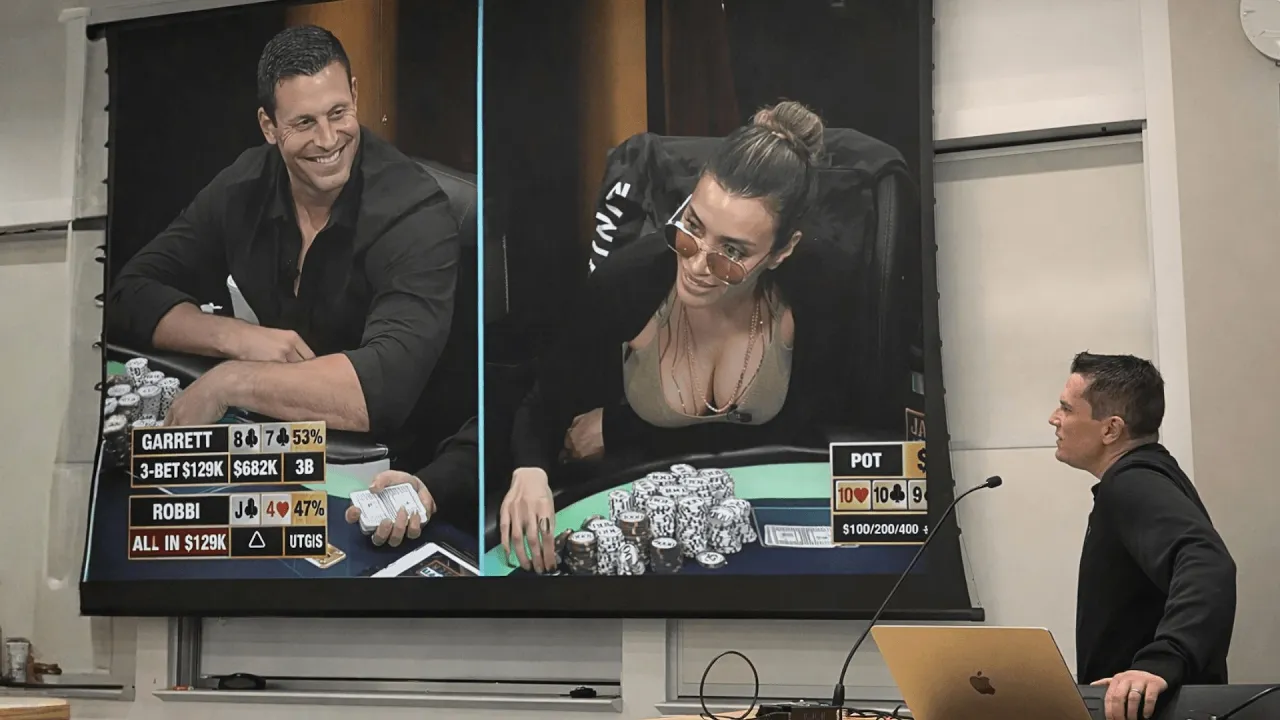
Want to learn and play on ClubWPT Gold? Use code BART to get started: https://bit.ly/Bart-WPTG Recorded October of 2025 Bart speaks at Harvard and breaks down the live poker concepts that matter most: pot odds, implied odds, thin value, bet-folding, live tells, and moving up in stakes. He then opens it up for audience Q&A. Topics include rake, famous cheating controversies, and lessons from high-stakes games around the world. Get 25% off your first month of training from Crush Live Poker here: http://crushlivepoker.com/a/harvard-25 ✅ Checkout our latest Crush Live Poker Free Training videos and podcasts here: https://bit.ly/FREE-CLP-TRAINING 0:00 — Intro / Bart’s Background 5:42 — Pot Odds vs Equity 10:34 — Implied Odds 15:44 — Minimum Defense Frequency 16:48 — The Most Important Cash Game Concept 18:40 — Thin Value Betting + Bet-Folding 20:20 — Preflop Math: 20 / 30 / 40 Rule 22:00 — River Polarization 23:12 — Live Tells That Actually Matter 25:54 — Q&A Begins 26:03 — Rake Considerations 28:29 — Hustler Casino Live Garrett vs. Robbi Famous Jack-4 Hand 40:13 — Crazy China Poker Stories 44:37 — Online Poker, Bots, and Club WPT Gold 49:54 — What’s a Good Win Rate? 56:07 — Sports Betting Arbitrage 1:03:50 — Moving from 1/2 to 2/5 👉 To submit a hand for consideration for the call-in show read instructions here: https://crushlivepoker.com/support#faq-24533. Join the CLP Discord community and follow our socials: ► https://discord.gg/8gUmrKaEpx ► https://www.facebook.com/CrushLivePoker/ ► https://www.instagram.com/crushlivepoker/ ► https://twitter.com/CrushLivePoker
Summary
Generated by claude-haiku-4-5-20251001Harvard Poker Lecture: Summary
Main Topics
- Poker Mathematics & Theory - Odds, equity, pot odds calculations, and hand selection strategies
- Live Poker Strategy - Cash game fundamentals and profitable play techniques
- Poker Cheating Scandals - Analysis of famous cheating incidents and detection methods
- International Poker Experience - Teaching wealthy clients in China and experiencing high-stakes games
- Sports Betting & Gambling - Arbitrage opportunities, bonus conversions, and sports betting strategy
- Online Gambling - Risks, bots, collusion, and legitimate platforms (Club WPT Gold)
Key Points
Poker Mathematics
- Pot Odds vs. Equity: Understanding the relationship between pot odds offered and hand equity is fundamental
- Betting 100 into 100 pot = 2:1 odds = 33% equity needed
- Quick calculation: 8 outs × 4 (with 2 cards to come) = ~32% equity
- Implied Odds: Ability to win additional money on future streets can justify calls that don't have direct pot odds
- Hand Selection Metrics (20-30-40 Rule):
- Small pairs (20× stack): Need 20 times the raise size in opponent stacks to call
- Suited connectors (30×): Need 30 times the raise size
- Gap suited connectors (40×): Need 40 times the raise size
Critical Live Poker Concepts
- "Way Ahead, Way Behind" - Most important concept: bet for value with hands that get called by worse hands, not hands that fold worse and only get called by better
- Thin Value Betting - Where most profit comes from in live games; betting one pair hands on the river
- Bet and Raise Folding - Live players call too much and rarely bluff raise; betting then folding to raises is profitable
- River Polarization - Balanced ranges make you harder to play against than purely polarized betting (all-in with nuts or bluffs)
Live Tells
- Betting Speed - Consistent fast betting despite board changes that should affect hand strength often indicates a bluff
- Example: if board pairs or brings flush, most hands need time to reconsider; instant same-speed bet suggests bluff
Rake Considerations
- Rake is typically consistent across stake levels (e.g., 10% up to $10 at all levels)
- At $2/$5 with 30 hands/hour: $150/hour rake = $900 in 6 hours (a full buy-in)
- Lower stakes are harder to beat due to same rake amount taking larger percentage of winnings
- Professional hourly: ~$150/hour at $5/$10 (after rake at Commerce)
Notable Quotes
> "It's amazing how many people get scared at percentages."
> "The skill level of live poker is just far, far inferior to people that play online thousands and thousands of hands."
> "You have to go really thin for value. That's where your win rate's going to go up."
> "If you were making that bet as a value bet and you get scared when the guy calls you, you've probably done something wrong because you want to get the weaker hands to call you."
> "I would never tell anybody to become a professional poker player now because it's less about your skill and more about whether I can get into the game."
> "Mathematically, it doesn't matter [running it twice], but cheating-wise, you might know you're going to win the first run because of the rigged deck."
Takeaways
For Poker Players
- Master the math - Understanding odds and equity calculations is non-negotiable; it separates winners from losers
- Bet thin for value - Most profit in live poker comes from betting marginal hands for value, not avoiding tough spots
- Adjust to player types - Live players call more and bluff less; exploit this with value betting and occasional fold-outs
- Know rake impact - Calculate whether the rake allows profitable play at your stake level
- Move up stakes quickly - Competition doesn't increase dramatically from 1/3 to 2/5; rake considerations make higher stakes more beatable
- Learn from live tells - Betting patterns and speed reveal hand strength more reliably than player tells
For Aspiring Professionals
- Focus on game selection and bankroll management
- Understand that skill matters less at higher levels; politics and access to soft games become crucial
- Consider specialized sites like Club WPT Gold for practice (legitimate with security measures)
- Private games are being consolidated in Vegas; this affects game availability
Regarding Cheating
- Statistical hand analysis requires significant sample size; single hands can appear suspicious but aren't definitive proof
- The Garrett Adelstein vs. Robbie Firepunk hand remains ambiguous—no conclusive evidence, but several suspicious factors
- Card marking and super-user accounts are catchable; online scandals (Ultimate Bet, Absolute Poker) had whistleblowers and company admissions
- Modern detection: AI monitors non-human play patterns; proper security departments can identify collusion and bot usage
Sports Betting Arbitrage
- Bonus bet arbitrage available: convert $1,000 in bonus bets to ~$700 guaranteed profit by betting both sides
- Sports betting sites limit winning players to $1 bets while allowing massive exotic bets with 10-15% house edge
- Discriminatory practices exist: unlike blackjack card counting (which is legal), sportsbooks can limit profitable bettors
- Sweepstakes gambling (Club WPT Gold) offers legal arbitrage opportunities with proper regulatory structure
Critical Context: The Garrett Adelstein Hand
The lecture extensively discusses a controversial hand where Garrett Adelstein (pro player) lost a large pot to Robbie Firepunk (amateur) with Jack-4 offsuit calling an all-in—a mathematically questionable decision. Key evidence discussed:
- Against cheating: She gave money back; nothing substantiated in 2 years; he was 53% to win anyway
- For cheating: Jack-4 is an impossible call; she claimed to misread her hand (unlikely given video evidence); her background didn't support such aggressive play
- Conclusion: Ambiguous; could be beginner's error, misread, or cheating—but no definitive proof either way
Transcript
Why would you necessarily run it twice? Mathematically, it actually doesn't matter, but cheating-wise, you wouldn't know if you were going to win both runs, but you might know you're going to win the first run because of the rigged deck that you're using. Hi, guys. How's it going? My name is Bart Hanson, and I own the live poker training site Crush Live Poker. And Trey contacted me a couple of months ago about speaking in front of you guys, and I'm pretty excited because normally the general public doesn't understand some of the stuff that I actually like to talk about, which is some of the technical stuff like odds, equity, stuff like that. You'd be amazed how many people get scared at percentages. So when I heard that there was a trading group in here, I was like, oh, this is great. Quant quizzes coming. I just want to go over some of my accomplishments and my credentials really quick. So I founded my training site, which is like a Netflix where people pay to watch videos and podcasts and teaches them specifically how to play live, no limit cash. In 2012, I am not much of a tournament player. I know you guys had a tournament up there, but I do go to the series every single summer. I've made six final tables at the WSOP. I finished fourth in the monster stack a few years ago. So I think I've made like over a million dollars. I play quite a few 10 Ks every single summer and I always play the main event. As we get to questions, you can literally ask me about anything. Primarily though, people know me as cash, no limit live cash. Tournaments are obviously a little bit different if you guys are experienced with that. But the other thing too, that's really cool is that I taught some of the richest people in the world in China between 2010 and 2019. I went to China 15 times. And the backstory behind that was that there are these guys that just started playing poker, guys that were worth a lot of money in China. And some of them were getting beaten so badly that some of the pros actually contacted me to try to teach them at least to lose less or to try to even get to break even. So I actually developed a super fast crash course that I'm actually going to go through here, five to ten minutes, that would get these guys that just didn't know even the basic stuff to lose less and how to break even. And in live poker, the skill level is so slow. The skill level, if you guys have ever been on Core, I know it's 21 plus. I don't know how many of you guys are over 21, but the casinos in Connecticut, the skill level of live poker is just far, far inferior to people that play online thousands and thousands of hands. So there are certain things that you can do that are going to make you a winner pretty easily, especially if you understand the math. So that's how people know me, but I actually got my start as a poker commentator. And this is how I got good at poker. I was actually the commentator at the first live stream called Live at the Bike back in 2005. It was literally might have been one of the first regular live streams of anything. This was back before YouTube, back before Twitch, back before Justin TV, if anyone knows the history of this stuff, which was before Twitch. We had to have our own bandwidth to stream out. I did live cash commentary five days a week, five hours a day for two years. That's how I learned how to play. I used to play limit poker. I never really played any big bet, but watching people with their hole cards, watching the good players and the bad players got me to a point where I knew what the good players were doing and what the bad players were doing. And then when I finally took a dive into the game, like I hopped into like five, ten, I was instantly one of the best players in the room. Just because I would say like maybe an hour of commentary was the equivalent of playing for like 50 hours because I had to look at the cards, do commentary. So it was just really, really quick. So I did that for a few years. Then Live at the Bike went off. Then it came back in 2011. I did it again for like another five to eight years. Then if anybody's ever watched Hustler Casino Live, that came right after COVID. That's the big live cash game on YouTube. And when I lived in Austin, I used to go out there a lot more. You have to be there to commentate. So I don't get out there as much, maybe only a few times a year, but I was actually the person that commentated on the famous Jack for cheating hand. By the way, if we do have time, we could play that at the end if we do have time, but there was this big, big hand where we still don't know if there was cheating that went on between this amateur player and this very well-known pro. And this happened all in the same week where the chess cheating scandal went on with Magnus Carlsen. And then the fishing where the guy was loading the bass fishes with weights that all went on in the same week. So it made national news. And I got on Howard Stern show. It was surreal. It was surreal. That was quite the hand. So I've done a lot of commentary. That's how people know me. I was also run through like on Boston Globe, which my mother's friends who are over 70, they were the ones that kind of said, oh my God, you're in Boston Globe. Like it was in print. Like nobody actually reads the print magazine newspaper now, but that was pretty cool. A magazine and my YouTube channel has taken off. So I know all about YouTube channel, YouTube analytics, the poker space, all that type of stuff. So that's how people know me as a commentator and as a player. So when I went over to China to give these guys, actually, we're going to do odds first. This is where I think that you guys, hopefully, will be way ahead of the general public with some of this stuff. So this might be a little bit of review, but I think it's very, very important to understand that there's equity. And then there's odds. If somebody bets a hundred dollars into a hundred dollar pot, what are the pot odds that I'm getting? Can anyone? That's the percentage. What are the odds? Anyone in sports gamble here at all or anything like that? Two to one. Yes. Two to one. So yes. So equity is one over three. And then to get odds, it's just minus one and you get two to one. So if I flip a coin, my equity is one over two, which is 50%. My odds are actually one to one in this particular situation. Because we play no limit. You can actually bet any amount, but usually people don't bet more than the size of the pot. So if somebody bets a hundred percent of the pot, like a hundred into a hundred, you are getting two to one. late? Can anyone? That's the percentage. What are the odds? Anyone in sports gamble here at all or anything like that? Two to one. Yes. Two to one. So yes. So equity is one over three. And then to get odds, it's just minus one and you get two to one. So if I flip a coin, my equity is one over two, which is 50%. My odds are actually one to one in this particular situation. Cause we play no limit. You can actually bet any amount, but usually people don't bet more than the size of the pot. So if somebody bets a hundred percent of the pot, like a hundred into a hundred, you are getting two to one. You have 33% equity. If someone bets half the pot, that's your, for example, betting a hundred into 200, the pot's 300, a hundred for you to call, you are getting three to one or one over four and so on. And so forth. Two to one is 33%. Three to one is 25%. Four to one is 20%. It's amazing how many people don't understand that concept. This is not necessarily my favorite visual, but if you are doing, if you're trying to figure out equities on the fly, there's a shortcut where you can actually multiply your outs times four, if you're getting all in on the flop and you have two cards to come or times two with one card to come. So for example, if I have eight outs and I'm going to see two cards, like we get it all in on the flop, you can just multiply eight by four and you get 32%. If you do it with one card to come, it's actually times 2% and then you add 2%. It's not exact. So it'd be about 18. So if I have 12 outs with two cards to come, it's 48% or with one card to come, it's about 26%. So that's a really quick way to do math in your head. You can also divide your outs by number of unseen cards. I'm pretty good at math in my head because you can equate it directly to pot odds. So say for example, I have 15 outs and there are 45 unseen cards in the deck. 15 over 45 is one over three. So that equates to two to one I need in pot odds, which means that if I have 15 outs with one card to come and someone who bets pot, I'm getting the direct price right now because it's two to one. Someone's betting a hundred into a hundred, the pot's 200. It's a hundred for me call and I have 15 outs out of 45. So one over three in equity. So that's a really quick way to do pot odd calculations. Real world examples. Usually if you move all in with a flush draw on the flop, you have nine outs. I'm using the example of a dry flush draw. You don't have anything else going on like an over card or a gut shot or anything like that. It's actually about 35%, but you can see it's pretty close. Nine times four is 36%. Flush draw on the turn, meaning that you have nine outs with one card to come. Nine times two is 18 plus 2% is 20%. And that's about what the odds are of a flush draw. Nine over 45 ish, one over five, four to one, which means that if somebody bets a hundred into a $300 pot, the pot's 400, it's a hundred for me to call. I'm getting a direct price right now. I can actually call, I'm getting a direct price. That's of course, if we see the person's cards, they could have other hands that might kill us. Like if they have a set and not all of our flush cards are good, things like that. Here is a real world example of exactly that. Someone has ace king. They show us that they have ace king of hearts. They move all in for 400 into a $1,200 pot. That means that the pot's now 1600. It's 400 for us to call. And that means that we are getting four to one in pot odds. We have 20%, which is one over five. So we can make that call at perfect equilibrium. That was us knowing that he has ace king. We don't always have that luxury because someone could have a set of Queens and some of our flush outs might not be good, things like that. And then finally for this part, there's implied odds. What's implied odds? Implied odds is how much can I make later on in the hand? Maybe I'm not getting a direct price now, but we still have money left behind on the river so I can make more money. So in this example, if we have $1,500 stacks and our opponent bets $400 into a $600 pot and we have a dry flush draw with seven, eight of spades, we know that's 20% equity. We're only getting two and a half to one, right? It's going to be a thousand dollars, 400 for us to call. We need four to one, but can we make extra money on the river? Can we make another $600 on the river to make it at least a break-even call? That's number two. So if they're betting 400 into 600, we need to make 1600. We need to, and the best way to do this is to multiply our what we need for the pot odds, which is four to one by their bet size. So four to one, four times 400 is 1600. We need to make 1600 by the river in order for it to be a break-even call. As long as we can make 600 more on the river in this particular situation, we call the 400. If we make our flush, we bet 600 and get called. It's at least break-even. So if you're really deep, you can make some very light calls with some speculative hands. If you think you're going to be able to make a lot of money, here's a really great example here with a gut shot. A gut shot's an inside straight draw. So King, seven, three, our hand is five, four of spades. We have a gut shot here to a six. We're on the flop, but we're really looking at this as just one card. Even though there are two cards left, we're looking at the flop call as one card. We've got four outs with one card to come times two is eight plus two is 10. We've got about 10% equity, which equates to about nine to one in needed pot odds. So if our stacks are 2000 and he bets a hundred dollars into a hundred dollar pot, and we need to make nine to one in pot odds, we need to make how much by the river? If he bets a hundred and we need to make nine to one, how much do we need to make on the river? At least we need nine to one. He's betting a hundred. So how much do we need to make in total? It's just the pot odds times the bet. Yep. 900. We need to make 900. He's betting a hundred into a hundred. So we're going to win that 200 right there. We need to make 900 by the river. So 700 or more, Nine to one in needed pot odds. So if our stacks are 2000 and he bets a hundred dollars into a hundred dollar pot, and we need to make nine to one in pot odds, we need to make how much by the river? If he bets a hundred and we need to make nine to one, how much do we need to make on the river? At least we need nine to one. He's betting a hundred. So how much do we need to make in total? It's just the pot odds times the bet. Yep. 900. We need to make 900. He's betting a hundred into a hundred. So we're going to win that 200 right there. We need to make 900 by the river. So 700 or more, if we can make 700 or more by the end, this is going to be a profitable call. We also have what's called the backdoor flush draw here too, which gives us a little bit of extra equity as well. But that's, again, that's really heavy odds type of stuff, but that's how we look at some of the math of these particular situations. Also too, when you are facing a decision, like, let's say that you have pocket aces and somebody check raises you all in on the turn. How do you figure out whether or not I should call? Well, we can take a look. And what I like to do is actually try to do a weighted average in my head. So let's say, for example, I know that he's going to have a set a lot, which means three of a kind, right? But then, so he's going to have a set that beats me with my aces on the turn, but he also is going to have a combo draw some of the time. How do I figure that out in my head? Well, I know, as you get more experience, you'll know this, but I have 6% equity against the set because I've got basically two outs to improve. And then of the drawing hands in this example, I have 70% equity. So it's a weighted average. If there's eight different combinations where you're 6% and then there's four different combinations where you're 70%, you can just average that out. You can reduce the eight and the four down to two and one and do two times six, which is 12 plus 70, 82, divided by three. That would be basically my equity against a range that had two times more sets than combo draws. 27.33%. How much would I need about from the pot? Would you say, what does 27.33% equate to approximately in pot odds? We know that 33% is two to one, 25% is three to one. So if we were getting two and a half to one from the pot, it would be very close. If the pot was like 1200 and we had to call say 500, it would be very close, right? Two and a half to one needed. And then finally, minimum defense frequency. I promise this, once we get through these odds, this stuff will get lighter. Minimum defense frequency basically says when you are on the river and getting a decision on the river, if somebody bets a hundred into a hundred dollar pot, you're getting laid two to one. It's a hundred to win 200. But there's also another way to look at this, which is minimum defense frequency, which means that your opponent is risking a hundred to win a hundred dollars on his bluff. So how often do you have to defend? It's the compliment. If people know that mathematical term, the compliment, if my opponent bets half the size of the pot, a hundred into a $200 pot and he's bluffing, he only needs to have that work 33% of the time, which means that we need to defend with 67% to make him indifferent because if he can get through us more than 33%, he's got a profitable bluff. So there is that. Okay. Now I'm going to zoom through the stuff that's really simple. This is the stuff that I brought up the guys from China to basically break even or winning players. This is probably the most important concept in all of no limit poker: the concept of way ahead, way behind. It's a little bit different in a tournament because you have more protection betting, but most of the time, in a cash game and a no limit cash game, you want to bet for value, meaning that you think you have the best hand and you're getting called by worse, or you're trying to get the guy to fold as a bluff. So you don't want to make a bet with a hand that gets everything that is worse than your hand to fold and only better to call. So if you have a hand like one pair and you make a gigantic bet and that's going to fold out all the worst one pairs and only the better hands will call, for the most part, that's a mistake if you're betting for value. So a lot of times you'll get into a situation when you're new to poker where you make a bet and then all of a sudden you get scared when you are called. If you were making that bet as a value bet and you get scared when the guy calls you, if you're heads up especially, you've probably done something wrong because you want to get the weaker hands to call you. You don't want the weaker hands to all fold and only better to call. So this is really one of the most important concepts in no limit hold'em. You can do some protection betting which means, oh you've got pocket nines and the board's eight high, you don't want to just check and let a guy with king queen get there. That's in a tournament. And then there's also stuff called range betting which has to do with GTO and computers and stuff like that where sometimes you just bet your entire range in a given situation. The second most important concept is thin value bets. This is where you're going to make all your money in no limit cash games live is thin value betting. You cannot be scared of betting especially on the river with one pair hands. It's where you make all your money. A lot of people get very scared that if they bet in position on the river, what if somebody raises me? The frequency of people check raises bluffing the river is so small that it's almost a free roll bet. You have to take your value on the river. You have to bet thinly for value in live games. It's where your win rate's going to go up. You shouldn't be scared of opening the betting back up. As you get to more difficult opponents, sure, sometimes you have to check behind with hands that are in between because they might be capable of bluffing you. But at these stakes you have to go really thin for value. Another key concept: bet and raise folding for value. What does that mean? You should be betting your hand for value until your opponent basically raises you because live players call too much and they don't bluff raise enough. So their response is going to be call, call, call. So there's nothing wrong with betting a hand for value and then if you get raised, fold. up. You shouldn't be scared of opening the betting back up. As you get to more difficult opponents, sure, sometimes you have to check behind with hands that are in between because they might be capable of bluffing you. But at these stakes you have to go really, really thin for value. Another key concept, bet and raise fold for value. What does that mean? You should be betting your hand for value until your opponent raises you because live players call too much and they don't bluff raise enough. So their response is going to be call, call, call. So there's nothing wrong with betting a hand for value and then if you get raised, fold. Obviously not always, but that is a real, real big key. And sometimes even raising with the second nuts and then re-raising and then folding if someone were to come back over the top. That's a whole concept. Bet folding is very, very key if you want to be a big winner at Live Poker. Here's another very, very simple concept for people that are super new to it and it amazed the Chinese guys. Preflop hand and math, preflop math and hand selection. 20, 30, 40. What does that mean? It's pretty simple. It means if you want to call with a small pair, this is the 20 part of this. If somebody raises and I want to call with pocket threes and I'm trying to set mine, I'm trying to make three of a kind on the flop. I need to be able to make 20 times their raise size in order to call. So if somebody raised to $25, me and my opponent both need to be $500 deep in order for me to call. And that takes into account the fact that you'll flop a set one out of eight times, but your opponent also has to have something too. You can flop a set of threes and your opponent can have pocket Kings and it comes out ace three deuce. You're not going to get his whole stack because there's an ace out there or you can flop a set of threes and your opponent might have ace king and the board comes out queen deuce three. You're not going to get his stack because he didn't flop anything. So that's where the 20 times accounts for that. 30 times are suited connectors. I like to tell some of my students. So if somebody opened for a raise and I had five, six suited and I wanted to call to try to make a hand, if they made it 25, me and my opponent would have to be at least $750 deep. There's a lot of stuff that beginners don't really know. 40 times is gap suited connectors. Like a hand, like seven, nine suited, 10, eight suited, something like that. River polarization discussion. So a lot of times when you get to a situation on the river and your opponent bets very, very large, they are saying I either have a really strong hand or a bluff. That's what polarization means. So I either have the nuts or I have a bluff. If you can get your game to a level where you're not always polarized, I call it depolarized, you become a much harder player to play against. So if I'm betting in a situation where other people are polarized, but I'm not polarized and my opponent thinks, well, this guy doesn't have the nuts. I'm going to call him. And then I turn over the one pair hand that's better than his, then I'm very, very difficult to play against because you can't bluff catch me as much because I have other hands in my range that I'm value betting that is not polarized. So you can't take bluff catching types of hands and bluff catch me quite as much. That's another really key, key spot. Live tells. I am not a big guy on live tells, but I think one of the biggest live tells that people can have is the way that they bet their pacing, the speed of their bet. And what I mean by that is, if you can conclude on the river, let's say a guy's been betting pre-flop on the flop, on the turn and on the river. If the nuts change, which means the board pairs and a third suit comes in where everything changes, like he's been betting like he has aces the whole time. Then all of a sudden, maybe the board's nine, five, four with two spades and he bets and you call with pocket tens. The turn's a deuce and he bets and you call with pocket tens. And now the river comes and it's a four that pairs the board and it brings in the front door flush, like the four spades comes in. You check and then he bets without any thinking with the same speed that he's been betting the entire time. A lot of times that's a bluff because any hand that he would have would, whether it's value, whether he had aces and he wanted to make a thin value bet, whether he had a flush, he's going to be concerned about the board pairing, whether he had a full house, he's going to be concerned about extracting the most value. Every single hand that he has, which should dictate that he should take some time and think about what he should do. So if he doesn't, a lot of times that's a bluff. He's not thinking about it at all. That's one of the big ones. Some other topics, I know Trey's going to ask me some questions and I'll take questions. I know I know a bunch about all forms of gambling, not just poker, sports betting, rake considerations, things like that. But there's been some big changes in gambling tax law. I'm open for anything. And I don't know, we don't have to go over this right now. I was going to say, if any of you guys are over 21, we can talk about it later on if we have time, but there's always free money to be made with absolutely no risk by taking advantage of the bonus bets that the legal online sports sites give with no risk. I'm talking about betting, taking a bonus bet and betting on the other side of the line on a different site and basically arbitraging the bonus. And at any time, right now in Massachusetts, I checked it last night. You could just, they're basically giving away two or $3,000. You have to know how to do it. If people are interested in that, we can talk about it, but that also goes towards poker odds as well. While we do this, I'll take any questions. I don't know if anybody wants to ask about anything, any type of gambling, any type. Go ahead. Can you talk about rake considerations? Yes, I can talk about rake considerations. What are rake considerations? So rake considerations are the amount, rake, of course, is the amount of money that gets taken out of the pot when you go to a casino or when you're playing in a home game, or when you're playing in a tournament, the tournament fee. So like at Encore in Everett, If people are interested in that, we can talk about it, but that goes towards poker odds as well. While we do this, I'll take any questions. I don't know if anybody wants to ask about anything, any type of gambling, any type. Yeah, go ahead. Can you talk about rake considerations? Yes, I can talk about rake considerations. What are rake considerations? So rake considerations are the amount, so rake, of course, is the amount of money that gets taken out of the pot when you go to a casino or when you're playing in a home game, or when you're playing in a tournament, the tournament fee. So at Encore in Everett, they take 10% up to $10, which is a lot. When I was playing in Vegas, they probably take half that. They take 10% up to $5. So if you play that out and I'm playing in a $2, $5 game where most of the time, the rake is pretty much always going to be the maximum. If I'm playing 30 hands an hour, they're taking $150 from the table every single hour. So over the course of 10 hours, they've taken $1,500 or over the course of six hours, they've taken $900 off of the table. That's an entire buy-in from one person. So you have to, so it's not a zero sum game in casino poker with a rake. You have to be that much better than everybody else in order to overcome that. And in a tournament, if it's 15 or 20%, the crazy thing is the lower the tournament buy-ins, the more the percentages. If you play a $50 daily, they're going to take 20 bucks, 40%. That's unbeatable. I think at the main event, when we play the 10 case, they take 3 to 5%. And the smaller ones, they take 10%, which is just about at the limit. But if you start playing in home games or private games where they're taking 20, 30 bucks out of every single pot, you can just do the math. It becomes impossible to win. Also, you might have a situation where we're playing in Texas where it's a time game, meaning that they're not charging you every single pot. They're charging you a time fee. That means that you get to play more hands. If I'm taking a rake or in California, a flat drop where they actually took the entire amount, it was $7 after the flop, no matter how big the pot was. At 5-5, if one person limps, the pot's 15, they took $7. So I wouldn't want to have one guy limp and then me over limp because they were going to take $7 out at 20. So that's what rake considerations are. Bet three bet means bet and then re-raise the raise. It looks to me at the time, maybe she was just raising with the nine. So if I was him and I think she doesn't have a 10 and she's just trying to raise here to end the hand or I'm going to come back over the top. She's going to fold the nine. I don't think in his spot, I don't think she has a 10 because of the way that she's played this. Is she calling the flop so dry heavy and then just min raising turn? He's got such a gigantic, he's got a 15 out draw against the nine. This is what's called the semi bluff. So even if she had ace nine, he's probably somewhere around 35% against ace nine, which is massive in hold'em. But if you add the extra fold equity in there too, it just becomes an unbelievable mathematically profitable play. He only needs her to fold a little bit of the time. That's what he probably thought that she had something like ace nine, king nine. She calls? One more point. I prefer once, but it's up to you. Oh my God. So far so good. What is going on here? I prefer once, but it's up to you. What's interesting about this situation as they run it more than once or twice is whether or not, as you can see, cheating is going on. If somehow she can see his cards or somehow knows that she's going to win the hand, why would she run it twice? Meaning if she knew there were cheating mechanisms where they would know who the winner of their cards was, these cards were loaded and they would know the winner of the hand. The deck would tell you the winner of the hand through a computer. So why would you run it twice in a situation where you knew you were good with jack four because you could see the cards? Why would you necessarily run it twice? Mathematically, it actually doesn't matter. But cheating wise, you wouldn't know if you were going to win both runs, but you might know you're going to win the first run because of the rigged deck that you're using. Because here's the thing. This is not unprecedented. I was a part of commentating a different cheating scandal where we knew the guy cheated in Sacramento called Stones. So if you're Garrett there, how can somebody call where she's losing the queen jack? It would make a lot more sense if she did have pocket fours and she called off. She doesn't have anything. So this is where it gets really hard where the general public, because this made national news, they're like, oh, she just made a great read on him and made a great call. What? With jack four? Because you lose to everything else. You lose to king queen, you lose to queen jack, you lose to jack eight. You can't call. There's a couple of explanations of what happened, and we still don't know the answer, is that she's such a beginner to the game that she doesn't know that it's a call that you can't make. If you can follow what I'm saying, she's not experienced enough to realize that it's an impossible call to make. She should never make that call. Now people are like, well, you can do whatever you want with your money. Okay. We never saw her in a game like this where she had a quarter million dollars. It's not like she was playing for $200. So that was really strange. That's one explanation, that she literally was so new to the game. She had no clue. Later, she says after this that she misread her card. Right, right, right. She lied because you can see multiple times in the recording. She stares at her card. So another explanation that she gave after the fact, which I said I didn't believe, was that the hand before she actually had, what was the turn card again? What was the actual turn? Three. The hand before she said she had jack three. So she said she thought she had jack three, which if she had jack three, it's not really a discussion. If she actually thought she had jack three, there's not really a discussion. I have come around to thinking that this was actually a gigantic fluke and it wasn't cheating because of the fact that nothing has come out in the So another explanation that she gave after the fact, which I said I didn't believe, was that the hand before she actually had, what was the turn card again? What was the actual turn? Three. The hand before she said she had jack three. So she said she thought she had jack three, which if she had jack three, it's not really a discussion. If she actually thought she had jack three, there's not really a discussion. I never have come around to thinking that this was actually a gigantic fluke and it wasn't cheating because of the fact that nothing has come out in the last two years more. But I never believed that she thought she had jack three. I think she said it immediately afterwards to make herself look better, but I never believed that story. So that's another explanation. Another explanation was that she misread her hand. So it's either she knows so little about poker that she doesn't understand how to call with jack four or she misread her hand. Those are the explanations for not cheating. The explanation for cheating is that she can see the cards or she can see what he has. Yeah. Yeah. She played in quite a lot of tournaments preceding that big game. Some tournaments and she played on the show a couple of times way smaller. So you're talking about somebody going from the equivalent of a two, five, five, ten game. No one really knew who she was. So all of a sudden, I'm going to hop in this game. I'm going to hop in this game and I'm going to make the craziest call that anyone's ever seen in televised poker and the history of poker. And then there was a guy who was playing at this table that was with her that got really upset when they tried to take, when Garrett took the money back. Well, I didn't want to get ahead of ourselves, but you want to play out the rest. I mean, you can, I can fast forward to probably twelve minutes or something. Yeah. Of course I knew at the time that he thought he was cheated a hundred percent just based upon, because I would have thought I would have been cheated a hundred percent too. If I was him, I thought I would have been cheated a hundred percent. He handled it really badly though, post because he basically came to his own conclusion that there was cheating based upon the hand, but didn't give any other evidence, even though he said that he knew he was going to bring forth other evidence. He never did. So he was almost judge and jury himself. There was never any evidence that she cheated, any hardcore evidence of the way that it was done besides the fishiness of the hand. And there was some circumstantial stuff that came later on. One of the guys that worked for the show took money off of her stack after the game, which somewhat implies that maybe she was working with him, but that guy had apparently stolen money from other people's stacks too. So also another interesting part of this is that, and I was there too, when it happened, I was in a room with Gary because we were on a delay. We were always on a two or three hour delay. So when I got to the casino to commentate, I'm two hours behind, meaning the game is already going on, but I'm commentating live when the viewers see it. So if it's 3 PM in real time, I'm commentating on the game at 5 PM when everybody sees it at 5 PM, because there's a two hour delay. So they told me that something big went down. That's all I knew. When I walked in, I was in the room with Garrett, Robbie and Ryan, and I think Phil Ivey, and they were discussing what just happened. And Robbie gave the money back to Garrett, gave it back. Now, so what does that mean? Does that implicate, what does that mean exactly? Does that mean that she is that more evidence that she's cheated or less evidence? Because if you were a cheater, why would you give the money back if you were a cheater? So yeah, go ahead. So if she gives it back, she thinks that the problem would just sort of go away if she gives it back because she knows she cheated and she doesn't want to have it. Well, that's one way to do it. But the other thing is what were her actual intentions of this? Her intentions were really to actually get famous in the poker community. And I can make the argument that she gave it back so that the problem would go away because she didn't want to cause such a stir with the star of the show. You see what I'm saying? So all this stuff can go either way. So there was never really any evidence of what actually happened. And the thing is, he was 53% to win. They ran it twice, which means that the chances of him losing both runs was under 25%. We never would be talking about this if he didn't lose both runs. It just happened to be that he lost both runs. So I still don't know. People say, well, I mean, I definitely thought there was cheating in the beginning, but then when nothing else came out, I was, I can't really. She's played tournaments. Now the thing about the whole Mike Postle thing is he is a cheater for sure. Even though we didn't have any hard evidence, but if you ever go to YouTube, you can Google me and crush live poker and stones cheating. There were just so many hands go down the line. And you're, this is a hand. There wasn't one specific hand that proves it. But if there's a 10% chance of cheating in one hand and a 90% chance of not cheating, if you have 50 hands like that, then it's 90% not cheating to the 50th power. If you get to pretty much 0% not cheating. Right. You know what I'm saying? So and then he never played in anything. He only played on the stream. And then after the scandal, he never played ever again. And now people tell me that he plays in some golf, Florida card room where his stats, his VPIP stats, he plays 20 slash 15 stats now, which means not many hands at all. Whereas in stones, he was playing 80% of hands and had the craziest win rate. So it was pretty obvious that he was here though. It's a lot less obvious. That's the whole thing pretty much. Yeah. So I don't know. I mean, what do people think? You know, it's pretty crazy hand, right? At the time you would think, there's not straight, right. But now that nothing's happened, there's not really nothing's come out since then. Any evidence that anything happened? It's crazy. Do you really think cheating scandal, what type of evidence comes out that the person is cheating? That depends on the cheating scandal. I mean, the big cheating scandal that happened first was back in 2007 and 2008, which was called the pot ripper scandal, which was back before they basically outlawed online gambling company called Ultimate Bet. It's a pretty crazy hand, right? At the time you would think, oh, there's, it's not straight, right. But now that nothing's happened, there's not really nothing's come out since then. Any evidence that anything happened? It's crazy. Do you really think cheating scandal? What type of evidence comes out that the person is cheating? That depends on the cheating scandal. The big cheating scandal that happened first was back in 2007 and 2008, which was called the pot ripper scandal, which was back before they outlawed online gambling company called Ultimate Bet and Absolute Poker. There was a tournament where it was very obvious that the person that won the tournament was using super user, meaning that he could see the cards. There was a whistleblower internally from the company that actually emailed the hand histories out for all the players, emailed it out to the media and to the guy that got cheated. And then the company admitted that they had a super user. So that was pretty damning. But besides that, there was another guy, a couple of guys that went around recently and actually they got busted at Chasers, a father son crew where they were marking cards and stuff like that. But a lot of that stuff, unless you catch them, the thing about learning about the possible thing is if you want to catch somebody cheating, you want to catch them red handed because a lot of the general public isn't going to understand statistical analysis and they don't understand. Why would you think, why are you jumping to the conclusion that she's cheating just based upon that hand? Well, cause that's not how poker. I mean, I look at that hand and I would have said there was 99% chance that she was cheating at the time based upon just that situation. But now I think it's more like 50-50. I don't know. So if anybody's familiar with Chinese currency, which is RMB, I think it's six to one, seven to one now. The largest bill that they have is I believe a hundred. So that's like $16. Their largest bill is like $16 US. I was at a Chinese farmers game where they were playing the equivalent of $300, $600 no limit. Their biggest bill is $16. So these guys were bringing in satchels and bags of cash. They were playing at this run down house, kitchen table, smoking cigarettes, throwing them on the floor, under the kitchen table, bathroom smells of raw sewage coming up. Very rural China. And they're playing a 300, 600 game. That was pretty wild. I also sat behind a game that was the equivalent of 50,000, 100,000 Hong Kong dollar blinds at one to eight. So it's like eight to one. So I think it was $6,000, $12,000 US and there was millions of dollars on the table. I used to be able to sit behind my main client. I couldn't tell them what to do, but I would sit behind him and look at his cards and then I would take notes and then we would review a session after the fact. He gave me a couple plaques, these $500,000 gold wind plaques that I just had on my pants. I was just hanging out right here on my pants. You know, $1.5 million in Hong Kong dollars just sitting there. The amount of wealth for the very wealthy was amazing. Although I will say that all of those guys no longer live in China and they all got their kids to go to places like Harvard, places in Vancouver, Berkeley, UCLA. I think the law is that you're only technically allowed to get out the $50,000 equivalent per year out of China. So I would see these money laundering operations go through Macau too. Macau was off of Hong Kong where gambling is legal and you would hire these junkets. If you wanted to get money out of China and you were wealthy, to get it out and bypass, you would hire what's called a junket, which was basically a casino in a casino. It was a travel agency type of casino. They would send you down to Macau, you would give them RMB, they would give you Hong Kong dollars that you'd have to gamble through and then you could get the Hong Kong dollars out. And at that time you could actually do a direct wire transfer from the Wynn in Macau to the Wynn in Las Vegas. They actually cracked down on that and they busted, I think it was called Sun City a few years ago, or the Chinese government actually put a halt to it. Another interesting thing is online gambling in China is illegal, but they have a system that is very similar to what we used to have in the late 2000s where they have all these offshore casinos and poker sites in the Philippines that service Chinese citizens illegally, which is a big thing with China because they want to crack down on it. But there's a huge industry in Manila, which I've been to, live dealers doing blackjack. I've actually been to a factory, a warehouse of dealers, real people dealing blackjack into a camera, live streaming. And you gamble in China on that. It's technically illegal. So yeah, some wild stuff. There's a couple of things here too. And I want to mention something because this is actually a really unique time for online gambling. And it might only last the next few months. If anybody's ever heard of Club WPT Gold and sweepstakes gambling. But to answer your question about that, it's so a site like ACR or any of these other, I'm trying to think, what is another one besides ACR that's big? Like Clubs? No, Clubs is actually sweepstakes. Any type or Bovada, it's not in the interests of those casinos to cheat and mess with their RTA, to mess with their random number generator because they're making rake. Why do they want there to be cheating in the game where they're just making rake? The problem with online gambling now is that you don't know if you're playing against a bot. And most of the time you are. But to answer your question about that, it's a site like ACR or any of these other, I'm trying to think, what is another one besides ACR that's big. Like Clubs. No, Clubs is actually sweepstakes. Any type like Bovada, it's not in the interests of those casinos to cheat and mess with their RTA, to mess with their random number generator because they're making rake, right? Why do they want there to be cheating in the game where they're just making rake? The problem with online gambling now is that you don't know if you're playing against a bot. And most of the time you are. Or people that are using real time assistance, which is basically I'm using a solver in real time. It's scraping the cards and it's telling me what to do. But there is an actual legitimate site. The WPT, the World Poker Tour was bought out. The World Poker Tour is all the stuff that you watch on TV besides the World Series of Poker. The company bought them out. I know the owners of the company. They bought the WPT out last year. And the WPT launched a sweepstakes gambling site called Club WPT Gold. Sweepstakes gambling is a carve out in the law. You might have seen the advertisements for it, for stake and coins and things like that, where for no purchase necessary using a dual currency model of gold coins and sweep coins, you can actually gamble and it's not illegal because it's called the sweepstakes model. You're using sweep coins that can be redeemed for actual money. Club WPT Gold is a legitimate site that's using the sweepstakes model that I would 100% trust because I know the owners and the games are really soft on there. I feel like it's only going to last for maybe five or six months because right now there's a lot of states that are having laws in their state houses that are banning sweepstakes gambling. New York just did it. Jersey just did it. There's one actually on Newsom's desk in California. The way that the owner is handling it is that they're just going to exit each market as it gets barred from each state. But right now in Massachusetts, it's fine. So they're operating in 40 states. You don't have that RTA because they have legitimate security because it's very hard to multi-table. They've made it that way. It actually mimics a live game. So if you ever wanted to practice, this might be one of the unique times where I could actually recommend an online site for the first time in 15 years. Whereas before I never would say don't play on any of those sites because it's all what you said. But right now, and I think you only have to be 18 to play. Yeah, if you go to Club WPT Gold and they're going to start introducing PLO in a few weeks too, which is going to be insane. PLO is four card. Also, my name, Bart, if you haven't signed up and you use the code Bart, they give Crush Live poker subscribers, but you don't have to be a Crush Live poker subscriber. They give people that sign up with my code free rolls. They gave us a $20,000 free roll a few months ago for people that signed up with my code. And then another $10,000 one. But I'm not mentioning it because of the code. I'm literally, I know the owners and I would say those are really soft games. And it's a great way to practice anything else though. Any other site I would not go on for the reasons that you talked about. You can't really, you can't trust the collusion, bots. I don't think the random number generator is rigged necessarily, but the other stuff that goes on. Yeah. There's still going to be people using GTO Solvers, right? The thing I would say about that though is that they at least have a security department that's actually sweeping for that. I've seen some things where they've been implemented with AI where they're looking for people that take lines that they think wouldn't be consistent with a human playing. Another interesting thing that they experimented with too. I was talking to them about it. They have a, I don't know if it would really be widely accepted is okay. You want to play a game online. Would you as a consumer be okay playing with a bot if you knew that the bot was minus two big blinds per hundred or break even so that you always had a game to play? Because they could program bots to be different skill levels. Use these bot props. Props are people. I actually started off as a prop at the Bike, but there are people that get put into the game so that the game will go because the casino is making money when the game goes to take a rake. If I've got four players and that's not going to run a table, but I can put two people that are props that are paid by the casino, not shills into the game. Now I have a table and I can take a commission, same thing online. [SPEAKER_06] So if they can put in losing bots into the game, how would the consumer respond to that? It's an interesting question. [SPEAKER_06] Yeah. Can I ask how many big blinds per hour would you say is a good way to return online? At what level? [SPEAKER_06] At one, two, three, five. So the lower level that you go, the more the rake is going to have a consideration on that. So if you, because remember you have to understand that the guy who asked about rake considerations, the rake is basically the same across all levels. At Encore down the street, they start at time at 5-10. But where I cut my teeth at Commerce, it was a rake or a drop all the way up to 5-10. It's the same at the lowest game as it is at the highest game. So let's say it's 10% up to $10. It's going to be the same at 1-2 as it is at 2-5 or 5-10. So you can see how much more difficult it is to actually beat 1-2, even with weaker players, because the commission that they're taking is so high. When I was playing full time between 2012 to 2019 at Commerce, I probably was making about $150 an hour at 5-10. So that was probably 11 to 12. And that was a pretty big drop too, because they were taking $7 a hand. So let's say it's 10% up to $10. It's going to be the same at one, two, as it is up to two, five or five, 10. So you can see how much more difficult it is to actually beat one, two, even with weaker players, because the commission that they're taking is so high. When I was playing full time between 2012 to 2019 at Commerce, I probably was making about $150 an hour at 5-10. So that was probably 11 to 12. And that was a pretty big drop because they were taking $7 a hand. That game, I think, is beatable for $50 an hour at the 2-5, because I go in and play at least one time a week. We are playing a lot of 2-5-10, but I think I probably have played 400 hours in that game, and I might be up to $70 an hour. But a lot of times it's 2-5-10. The 5-10 game is not that good. And the only reason why I go and play is just to stay relevant. I go in once a week to get material for my podcast, for my call-in show. If you guys have ever seen, you can check out Crush Live Poker. I'd say call-in hands. And if you ever want to submit a hand, just tell me in the email that you are here at my talk, and I'll get you on the show. Yeah, people submit hands, and sometimes they submit non-hands, which are funny too. There was a guy that called in from Aurora, Illinois a couple weeks ago, where he flopped top set. He flopped top set against the guy. He slow played the flop, so it was a two-flush board. He had pocket jacks. It was jack-five-deuce. He checked it back. The turn was the seven of clubs, so it brought a three-flush in. The guy checked. He bet. The guy from out of position called. When the guy from out of position called, he said, I check blind on the river. That's what he said. He said, I'm going to call the turn. I check blind on the river. The river brought out a fourth club, so the guy who called in, he didn't have a club. He just had top set. All right, I check behind. Then the guy goes, no, I want to bet. This guy's like, you check blind. He's like, no, that's not binding. I didn't check blind. And then they called the floor over, and the dealer spoke to the floor guy over, and the floor ruled that the river card coming out changes the action. And I'm like, how do you check blind anyway? When you check blind, it's always before the river comes out, right? It was the most crazy, it was the most egregious ruling I've ever heard. So we've had situations like that on the call-in show. There was another guy that called from Mexico that he ran a triple barrel bluff. [SPEAKER_01] He bluffed the guy with six high. The guy called him on the river. [SPEAKER_05] All the guy had was six high. He lied about his hand. He said, I have aces. He got the guy to muck. And then he showed the bluff, and then the pot was awarded to him. So there's all these types of non-hand type calls and things like that. Yeah. How often do you guys mostly play tournaments or cash or what? Mostly cash? Yeah, mostly cash. Who are the guys that are the traders from Hudson here? They're not here. Oh, okay. Because I had a quant quiz for sports gambling. It's very interesting with sports gambling with the bonus bets, because hedging is a mathematical thing where they give you these bonus bets. But it's equivalent to poker too. Yeah. Would you say it's worth to drive to Chasers and the rake is up to five bucks, and then the poker board is up to 10 bucks, which is crazy for 1-3. How big of a difference is it if the rake is up to five and up to 10? Is that what it is? Is it only up to five at Chasers for 1-3? Yeah, it's 10% up to five. And of course that's 10% up to 10. Yeah, and then they have 1-3-500 at Chasers. Is Chasers 18 or 21? Yeah. Okay, so well, if you're under 21, yes, it's worth it to go to Chasers. I mean, I would say yes. You could do it. It's worth it to drive further up? I mean, there's a lot of games at Encore. There's a ton of games. There's very few games at Chasers. So you don't have the game selection, I would say. I would have to think about how often the rake at 1-2 or 1-3 gets up to the maximum. So you've got to play a $100 pot, right, to get up to 10. I'd say it's probably very often. I mean, I would look at that as costing probably an extra two to $3 a hand that you win over the course of an hour. So if you win four hands per hour, it might cost between $10 to $15 an hour more of your hourly. So if you had, because your hourly is going to be based on how deep people buy in in those games. The interesting thing about severely capped games, capped buying games is that the longer sessions that you play, the more your hourly is later on in the session. People do this the wrong way. They stay when they're stuck. I want to win it back. But you should really stay the longest when you're winning because now you're getting deeper with other bad players. But I would look at it as an extra $10 to $15 an hour. So if you win four hands per hour, it might cost between $10 to $15 an hour more of your hourly. So if you had, because your hourly is going to be based upon in those games, how deep people buy in. The interesting thing about severely capped games, capped buying games is that the longer sessions that you play, I feel like the more your hourly is later on in the session. People do this in the wrong way. They stay when they're stuck. I want to win it back. But you should really stay the longest when you're winning because now you're getting deeper with other bad players. But I would look at it as an extra $10 to $15 an hour. So if you beat the game for $25, would it be maybe the difference of $10 and not $15 to $20? Something like that. But it's further away too, right? So, yeah. Yeah. You talk about sports betting arbitrage. Yeah. So sports betting arbitrage just means that I'm betting both sides of the line, but I win no matter who wins. So in American odds, sports betting plus $200 means that you're getting paid two to one. [SPEAKER_04] So if I bet $100 on a plus $200, if I win, I get $200 back, not including my bet. So a coin flip would be plus $100. That would be 50-50. [SPEAKER_04] Plus $200 would be 33, meaning that you'd get paid two times your money. [SPEAKER_04] If I can find a bet where on one side it's plus $200. Oh, by the way, if you're betting a favorite, minus $200 means that you have to lay $200 to win $100. So plus $200 means I bet $100, I win $200. Minus $200 means I have to bet $200 to win $100. If I can find a market where the line is plus $200 on one side, and if I put money on both sides of the line, I win no matter what. And there's calculators. You can just look them up that will tell you how to do that. The sports bonus thing is just that if you're a new player, and specifically in Massachusetts, if you're a new player, these sites will give you bonus bets. Bonus bets are bets that only pay the win amount. So if I have a $100 bonus bet and I bet on a team that's plus $300 and they win, I get $300 back. I don't get the $100 back, but I get the $300 back. You can arbitrage the bonus bets at about 70%. So if a site's going to give you $1,000 in bonus bets, that's worth $700 no matter if you know how to do it with no risk, if you're betting both sides of the line. When sports betting first came out in Massachusetts here two or three years ago, FanDuel and DraftKings were giving away $5,000 no sweat bets. A no sweat bet was you had to bet with real money and if you lost, you got a bonus bet of $5,000. Those could get converted at 40%. So they were just giving away $6,000 or $7,000 at the start if you knew what to do. And again, it's not hard to do if you have any interest in it. If anyone just turned 21 and you have never had accounts, there's definitely thousands to win. If you do a little research and you understand the math without any risk because you're betting both sides of the line. The crazy part of gambling nowadays and including poker, it's less about skill when you get up to the higher levels and almost more about politics and what games you can actually get into. There aren't many good public games above 5-10 where you can just walk in and play. That's why the game at Encore is so bad. And now in Vegas, they let these casinos run private games inside the casino. [SPEAKER_07] So the guys that you wanted to play with, the guys that were negative 30 big blind per hour, guys that you'd want at your table, they've all been poached to these private games. You don't really see private games at 2-5, but at the higher levels, you see it. So I would never tell anybody to become a professional poker player now because it's less about your skill and more about whether I can get into the game. And I actually equate that to how crazy it is with these sports gambling apps. They pump so much money into advertising for these highly exotic bets like single game parlays where their hold is 10, 15%. If you start arbitraging the sports gambling sites, even for small money, you will get limited immediately. All of my accounts, I had 10 different friends and family accounts. They've all been limited. They've all been capped. There's so few people that are winning sports bettors, but when the computers find them, and I'm only taking a couple of hundred bucks from each site, they limit you to a dollar per bet. But they can force feed the rest of the population these gigantic sports single game parlay bets, which are so negative EV and so detrimental. I feel like there's going to be some laws changed. I don't know. It's because the lawmakers don't really know anything about gambling, but how did they get to cut people off that are winners and then just print money in these other exotic bets? Also, in blackjack, right? It's not illegal to count cards, but if I go and spread one to ten at their best rules in blackjack, they're going to back me off and throw me out of the casino. In states like New Jersey, when you play blackjack, you can't be discriminated against based on your play. So I'm wondering... Yeah, in Atlantic City, can they not kick you out? They can't kick you out and I don't think they can cap you either. Yeah, so they must not use the... they must... they must nerf what we call nerf their rules, meaning... They have more decks than usual. Six to five. Well, six to five is unplayable. Yeah, nerfing would be... unplayable in the sense that it's 2%. Yeah, nerfing would be you can't find a double deck game where they stand on soft 17. That's worth 0.5%. So right now, the best blackjack games are... And there's only a few of them on the strip and they're all $200 minimums or... Obviously one and a half to one in blackjack, stand on soft 17, double deck. You can beat that game by counting, but in order to beat blackjack, you need to spread your bets. Meaning if my minimum bet's 100, I need to be able to bet up to 2000. If I start doing that, they're just going to kick me out immediately. where they stand on soft 17. That's worth 0.5%. So right now, the best blackjack games is... And there's only a few of them on the strip and they're all $200 minimums or... Obviously three and a half... I mean, one and a half to one in blackjack, stand on soft 17, double deck. You can beat that game by counting, but in order to beat blackjack, you need to spread your bets. Meaning... If my minimum bet's 100, I need to be able to bet up to 2000. If I start doing that, they're just going to kick me out immediately. Immediately. Yeah. Do you think sites like Oddsjam... Because you said that... Oddsjam is one of the ones I use. Yeah. Right. No. Are they still viable since you said that you get limited so quickly nowadays? I think there are sites that are way less. I think Oddsjam is like 199 bucks a month. I think there are other sites that are... I use Crazy Ninja Odds. It's free. I do have... I actually get a free account to Oddsjam because I did a commercial for them on Hustler. I actually approached them. I said, I will do a read for you guys because they charge a lot. And then there's another site in there that's like 20 bucks a month. I still think it's worth it to bonus convert. The question is how long can you last arbitraging and how sophisticated are you? You have to be sophisticated moving money around through PayPal and get multiple friends and family accounts and know how to move and stuff like that. So yeah. Do you think Plus EV Bets might be better in terms of not getting limited so quickly? Thanks. The question is, is Plus EV Bets better? Which is like a site telling you, oh, this is going to be a positive EV bet. You can lose. You're not match betting. I've never had a whole lot of success with Plus EV Bets from those sites, even from Oddsjam, to be honest with you. But I don't have the time put in to really know that much. So yeah. I'm going to go ahead. Okay. Yeah, go ahead. You said the live time game that I'm playing for isn't that good. Right. Do you usually play the 2.5? [SPEAKER_07] I usually play the 2.5 because it's the level that most of my subscribers are at. So I find that I produce the best audio content based upon the game, them relating to that game. But if I was on my own playing for profit, there's no doubt in the world that I would play PLO. I've played 2.2 PLO, and I'm... I didn't. I'm sorry. Did I cut you off? Keep going. Is that what your question was based on? Yeah. I was just wondering. How would you say is the jump from 1.2 a local casino where the games are super... Okay. So that's a good question. I don't think there's that big of a jump from 1.2 or 1.3 to 2.5. And I always tell all my subscribers this too, because of the rake considerations. If you want to do this as a hobby and make money and be a part-time profitable recreational player, we actually have a podcast on my site called Race to the $5 Blind Level. You really, that is, you want to get up to 2.5 as quickly as possible. And what, because of the rake considerations and because of the fact that the competition is not that much tougher. And if you are in a room where they spread 5.10 like Encore, then it's really good because the best players are actually playing, battling it out at 5.10. And some of the techniques that you can use, you don't have to buy in for the max. Like say you're buying in for 500 at 1.3 and you want to move up to 2.5, you don't have to buy in for a thousand. You can use the same buy-in. You can short buy, you can buy in for 300. It's going to be boring. It's going to be a lot of pre-flop. But I jump in the game and get a little acclimated to the players and then watch them and figure out, wow, these guys aren't all that good. And just pay attention to showdowns. Some of the stuff that I talked about before, it's seeing certain players turn hands over in certain positions that they shouldn't play or not making value bets where they should is very good. I try to immediately peg somebody as a good or a bad player. One of the things about Club WPT Gold that's cool is that when you're playing, you can click on a player and you see their stats, their VPIP and their pre-flop raise all the time and the number of hands they played. So right there, I'm mentally, I get in a hand with somebody post-flop. Oh, I'm going to play a hand differently if a guy's 45 slash three versus 22, 18. You know what I mean? So I would always recommend trying to hop up to 2.5 as quickly as possible. Especially here. I don't think the competition is, I don't play a whole lot of 1.3, but I don't think the competition's that much more difficult. It's just during the day, it's nitty. And sometimes when the 5.10 game isn't going, you've got 5.10 players in there. But if you're going there at night where there's multiple tables and multiple games, I would recommend trying to hop in. It's interesting too. I know so much about YouTube. If anyone has interest. So in the poker space, the RPM for poker and YouTube, which means the money that I get per thousand views is like $8 per thousand. So if I have a video that's a hundred thousand views, that's 800 bucks. So if I've got a million views in a month, that's 8,000 dollars. But shorts, which are verticals, are 25 cents per thousand. So literally 40 times less. And it's weird because I have a guy that cuts my content into shorts and it really has built up my brand awareness and a lot of my subscribers, but it's a rigged thing. I don't really know these verticals in any sector, vertical videos, YouTube shorts, it's just very hard to make money on shorts. The guy that has the most views in poker now on YouTube? Wolfgang. Have you ever heard of Wolfgang? Yeah, yeah, yeah. It's all shorts. He's all shorts. And up until maybe the last year... And it's weird because I have a guy that cuts my call and show into shorts and it really has built up my brand awareness and a lot of my subscribers, but it's this rigged thing. I don't really know these verticals in any sector, vertical up and down videos, YouTube shorts. It's very hard to make money on shorts. The guy that has the most views in poker now on YouTube is Wolfgang. Have you ever heard of Wolfgang? Yeah, yeah, yeah. It's all shorts. He's all shorts. And until maybe the last year, his regular videos would only get 15 or 20,000 views. And then he'd have shorts that would get 15 million views. It's just, yeah. No more questions. I think we're good. Okay. Yeah. Thank you so much. All right. No problem. Yeah. Yeah. Thanks for having me. there's four different combinations where you're 70%, you can just average that out. You can reduce the eight and the four down to two and one and do two times six, which is 12 plus 70, 82, divided by three. That would be basically my equity against a range that had two times more sets than combo draws. 27.33%. How much would I need about from the pot? Would you say, what does 27.33% equate to approximately in pot odds? We know that 33% is two to one, 25% is three to one. So if we were getting like two and a half to one from the pot, it would be very close. If the pot was like 1200 and we had to call say 500, it would be, it would be very close, right? Two and a half to one needed. And then finally, minimum defense frequency. I promise this, once we get through these odds, this stuff will get lighter. Minimum defense frequency basically says when you are on the river and getting a decision on the river, if somebody bets like a hundred into a hundred dollar pot, you're getting laid two to one. It's a hundred to win 200. But there's also another way to look at this, which is minimum defense frequency, which means that your opponent is risking a hundred to win a hundred dollars on his bluff. So how often do you have to defend? It's like the compliment. If people know that mathematical term, the compliment, if my opponent bets half the size of the pot, a hundred into a $200 pot and he's bluffing, he only needs to have that work 33% of the time, which means that we need to defend with 67% to make him indifferent because if he can get through us more than 33%, he's got a profitable bluff. So there is that. Okay. Now I'm going to zoom through the stuff that's really, I find really, really simple. This is the stuff that I brought up the guys from China to basically like break even or winning players. This is probably the most important concept in all of no limit poker, the concept of way ahead, way behind. It's a little bit different in a tournament because you have more protection betting, but most of the time, like in a cash game and a no limit cash game, you want to bet for value, meaning that you think you have the best hand and you're getting called by worse, or you're trying to get the guy to fold as a bluff. So you don't want to make a bet with a hand that gets everything that is worse than your hand to fold and only better to call. So if you have a hand like one pair and you make a gigantic bet and that's going to fold out all the worst one pairs and only the better hands will call, for the most part, that's a mistake if you're betting for value. So a lot of times you'll get into a situation when you're new to poker where you make a bet and then all of a sudden you get scared when you are called. If you were making that bet as a value bet and you get scared when the guy calls you, if your head's up especially, you've probably done something wrong because you want to get the weaker hands to call you. You don't want the weaker hands to all fold and only better to call. So this is really one of the most important concepts in no limit hold'em. You can do some protection betting which means, oh you've got pocket nines and the board's eight high, you don't want to just check and let a guy with king queen get there. That's in a tournament. And then there's also stuff called range betting which has to do with GTO and computers and stuff like that where sometimes you just bet your entire range in a given situation. The second most important concept is why is thin value bet? This is where you're going to make all your money in no limit cash games live is thin value betting. You cannot be scared of betting especially on the river with one pair hands. It's where you make all your money. A lot of people get very, very scared that if they bet in position on the river, well what if somebody raises me? The frequency of people check raises bluffing the river is so small that it's almost like a free roll bet. You have to take your value on the river. You have to bet thinly for value in live games. It's where your win rate's going to go up. You shouldn't be scared of opening the betting back up. As you get to more difficult opponents, sure, sometimes you have to check behind with hands that are in between because they might be capable of bluffing you. But at these stakes you have to go really, really thin for value. Another key concept, bet, this is basically, this is how people know me as Crush Live Poker. Bet and raise folding for value. What does that mean? You should be betting your hand for value until your opponent basically raises you because live players call too much and they don't bluff raise enough. So their response is going to be call, call, call. So there's nothing wrong with betting a hand for value and then if you get raised, fold. Obviously not always, but that is a real, real big key. And sometimes even raising, raising with the second nuts and then re-raising and then folding if someone were to say, come back over the top. That's a whole concept. Bet folding is very, very key if you want to be a big winner at Live Poker. Here's another very, very simple concept for people that are super new to it and it amazed the Chinese case guys. Preflop hand and math, preflop math and hand selection. 20, 30, 40. What does that mean? It's pretty simple. It means if you want to call with a small pair, this is the 20 part of this. If I, if somebody raises and I want to call with like pocket threes and I'm trying to set mine, I'm trying to make three of a kind on the flop. I need to be able to make 20 times their raise size in order to call. So if somebody raised to $25, me and my opponent both need to be $500 deep in order for me to call. And that takes into account the fact that you'll flop a set one out of eight times, but it's not, but your opponent also has to have something too. You can flop a set of threes and your opponent can have pocket Kings and it comes out ace three deuce. You're not going to get his whole stack because there's an ace out there or you can flop a set of threes and your opponent might have ace king and the board comes out queen deuce three. You're not going to get his stack because he didn't flop anything. So that's where the 20 times accounts for that. 30 times are suited connectors. I like to tell some of my students. So if somebody opened for a raise and I had five, six suited and I wanted to call just to try to like make a hand, if they made it 25, me and my opponent would have to be at least $750 deep. There's a lot of stuff that beginners don't really know. 40 times is like gap suited connectors. Like a hand, like seven, nine suited, 10, eight suited, something like that. River polarization discussion. So a lot of times when you get to a situation on the river and your opponent basically bets very, very large, they are saying I either have a really strong hand or a bluff. That's what polarization means. So I either have the nuts or I have a bluff. If you can get your game to a level where you're not always polarized, I like to call it depolarized, you become a much harder player to play against. So if I'm betting in a situation where other people are polarized, but I'm not polarized and you and my opponent thinks, well, this guy doesn't have the nuts. I'm going to call him. And then I turn over the one pair hand that's better than his, then I'm very, very difficult to play against because you can't bluff catch me as much because I have other hands in my range that I'm value betting that is not polarized. So you can't take bluff catching types of hands and bluff catch me quite as much. That's another really key, key spot. Live tells. I am not a big guy on live tells, but I think one of the biggest live tells that people can have is the way that they bet their pacing, the speed of their bet. And what I mean by that is, is that if you can conclude on the river, let's say a guy's been betting pre-flop on the flop, on the turn and on the river. If the nuts change, which means the board pairs and like a third suit comes in where everything changes, like he's been betting, like he has aces the whole time. Then all of a sudden, maybe the board's nine, five, four with two spades and he bets and you call with pocket tens. The turns a deuce and he bets and you call with pocket tens. And now the river comes and it's a four that pairs the board and it brings in the front door flush, like the four spades comes in. You check and then he bets without any thinking at with the same speed that he's been betting the entire time. A lot of times that's a bluff because any hand that he would have would, whether it's value, whether he had aces and he wanted to make a thin value bet, whether he had a flush, he's going to be concerned about the board pairing, whether he had a full house, he's going to be concerned about extracting the most value. Every single hand that he has, which should dictate that he should take some time and think about what he should do. So if he doesn't, a lot of times that's a bluff. He's not thinking about it at all. That's one of the big ones. Some other topics, I know Trey's going to ask me some questions and I'll take questions. I know literally, I know a bunch about all forms of gambling, not just poker, sports betting, break considerations, things like that. But there's been some big changes in gambling tax law. I'm literally up for, for anything. And I don't know, actually, we don't have to go over this right now. I was going to say, if any of you guys are over 21, we can talk about it later on if we have time, but there's always, there's free money to be, there is free money to just make with absolutely no risk by taking advantage of the bonus bets that the legal online sports sites give with no risk. I'm talking about betting, taking a bonus bet and betting on the other side of the line on a different site and basically arbitraging the bonus. And at any time, like right now in Massachusetts, I checked it last night. You could just, they're basically giving away two or $3,000. You have to know how to do it. If people are interested in that, we can talk about it, but that sort of goes towards poker odds as well. While we do this, I'll take any questions just so yeah. I don't know if anybody wants to about anything, any type of gambling, any type. Yeah, go ahead. Yeah. Can you talk about rate considerations? Yes, I can talk about rate considerations. What are rate considerations? So rate considerations are the amount, so rake, of course, is the amount of money that gets taken out of the pot when you go to a casino or when you're playing in a home game, or when you're playing in a tournament, the tournament fee. So like at Encore in Everett, they take 10% up to $10, which is a lot. When I was playing in Vegas, they probably take half that. They take 10% up to $5. So if you play that out and I'm playing in a $2, $5 game where most of the time, the rake is pretty much always going to be the maximum. If I'm playing 30 hands an hour, they're taking $150 from the table every single hour. So over the course of 10 hours, they've taken 1500 or over the course of say like six hours, they've taken $900 off of the table. That's like an entire buy-in from one person. So you have to, so it's not a zero sum game in casino poker with a rake. You have to be that much better than everybody else in order to overcome that. And in a tournament, if it's like 15 or 20%, the crazy thing is the lower the tournament buy-ins, the more the percentages. If you play like $50 daily, they're going to take 20 bucks, 40%. That's unbeatable. I think at the main event, when we play the 10 case, they take three to 5%. And the smaller ones, they take 10%, which is just about at the limit. But if you start playing in home games or private games where they're taking 20, 30 bucks out of every single pot, you can just do the math. It becomes impossible to win. Also too, you might have a situation like we're playing in Texas where it's a time game, meaning that they're not charging you every single pot. They're charging you a time fee. That means that you get to play more hands. If I'm taking a rake or in California, a flat drop where they actually took the entire amount, it was $7 after the flop, no matter how big the pot was. At 5-5, if one person limps, the pot's 15, they took $7. So I wouldn't want to have one guy limp and then me over limp because they were going to take $7 out at 20. So that's what rate considerations are. Bet three bet means bet and now re-raise the raise. It looks to me at the time, oh, maybe she was just like raising with the nine. So if I was him and I think she doesn't have a 10 and she's just sort of like, I'm going to stop. I'm making a raise here to like try to like end the hand or I'm going to come back over the top. She's going to fold the nine. I don't think in my, in his spot, I don't think she has a 10 because of the way that she's played this. Is she calling the flop so dry heavy and then just min raising turn? He's got such a gigantic, he's got a 15 out draw against the nine. This is what's called the semi bluff. So even if she had ace nine, he's probably somewhere around 35% against ace nine, which is massive in hold them. But if you add the extra fold equity in there too, it just becomes an unbelievable mathematically profitable play. He only needs her to fold a little bit of the time. That's what he probably thought that she had something like ace nine, king nine. She calls? One more points. I prefer once, but it's up to you. Oh my God. So far so good. What is going on here? I prefer once, but it's up to you. What's interesting about this situation as they run it more than once or twice is whether or not, as you can see, cheating is going on. If somehow she can see his cards or somehow knows that she's going to win the hand, why would she run it twice? Meaning like she knew there were cheating mechanisms where they would know who the winner of their, these cards were loaded and they would know the winner of the hand. Like the deck would tell you the winner of the hand through a computer. So why would you run it twice in a situation where you knew you were good with jack four because you could see the cards? Why would you necessarily run it twice? Mathematically, it actually doesn't matter. But cheating wise, you wouldn't know if you were going to win both runs, but you might know you're going to win the first run because of the rigged deck that you're using. Because here's the thing. This is not unprecedented. I was a part of commentating a different cheating scandal where we knew the guy cheated in Sacramento called Stones. So if you're Garrett there, how can somebody call where she's losing the queen jack? It would make a lot more sense if she did have pocket fours and she called off. She doesn't have anything. So this is where it gets really hard where the general public, because this made like national news, they're like, oh, she just made a great read on him and made a great call. What? With jack four? Because you lose to everything else. You lose to king queen, you lose to queen jack, you lose to jack eight. You can't call. There's a couple of explanations of what happened was that, and we still don't know the answer, is that she's such a beginner to the game that she doesn't know that it's a call that you can't make. If you can follow what I'm saying, like she's not experienced to realize that it's an impossible call to make. She should never make that call. Now people are like, well, you can do whatever you want with your money. Okay. We never saw her in a game like this. That's she had like a quarter million dollars. It's not like she was playing for $200. So that was really strange. That's one explanation that she literally was so green to the game. She had no clue. Yeah. Later, she says after this that she misread her car. Right, right, right. She lied because you can see multiple times in the recording. She stares at her car. So, so, so, so, so another explanation that she gave after the fact, which I said I didn't believe, was that the hand before she actually had, what was the turn card again? What was the actual turn? Three. The hand before she said she had jack three. So she said she thought she had jack three, which that, if she had jack three, it's not really a discussion. Like if she actually thought she had jack three, there's, it's not really a discussion. I never, I have come around to thinking that this was actually a gigantic fluke and it wasn't cheating because of the fact that nothing has come out in the last two years more. But I never believed that she thought she had jack three. I think she said it immediately afterwards to make herself look better, but I never believed that story. So that's another explanation. Another explanation was, was that she misread her hand. So it's either she knows so little about poker that she doesn't understand how to call with jack four or she misread her hand. Those are the explanations for not cheating. The explanation for cheating is, is that she can see the cards or she can see what he has. Yeah. Yeah. She played in quite a lot of tournaments preceding that big game. Some tournaments and she played on the show a couple of times way smaller. So you're talking about somebody going from like the equivalent of like a two, five, five, 10 game. No one really knew who she was. So all of a sudden, hey, I'm going to hop in this game. I'm going to hop in this game and I'm going to make the craziest call that anyone's ever seen in televised poker and the history of poker. And then there was a guy who was playing at this table that was sort of with her that got really upset when they tried to take, when Garrett took the money back. Well, I didn't want to get ahead of ourselves, but you want to play out the rest. I mean, you can, yeah, I can fast forward to probably like 12 minutes or something like that. Yeah. Of course I knew at the time that he thought he was cheated a hundred percent just based upon, because I would have thought I would have cheated a hundred percent too. If I was him, I thought I would have been cheated a hundred percent. He handled it really badly though, post because he basically came to his own conclusion that there was cheating based upon the hand, but didn't give any other evidence, even though he said that he knew he was going to bring forth other evidence. He never did. So he was almost like judge and jury himself. There was never any evidence that she cheated, any hardcore evidence of the way that it was done besides the fishiness of the hand. And there was some circumstantial stuff that came later on. One of the guys that worked for the show took money off of her stack after the game, which somewhat implies that maybe she was working with him, but that guy had apparently stolen money from other people's stacks too. So also another interesting part of this is that, and I was there too, when it happened, I was in a room with Gary because we were on a delay. We were always on a two or three hour delay. So when I got to the casino to commentate, I'm two hours behind, meaning like the game is already going on, but I'm commentating live when the viewers see it. So if it's 3 PM in real time, I'm commentating on the game at 5 PM when everybody sees it at 5 PM, because there's a two hour delay. So they told me this, that something big went down. That's all I knew. When I walked in, I was in the room with Garrett, Robbie and Ryan, and I think Phil Ivey, and they were discussing what just happened. And Robbie gave the money back to Garrett, gave it back. Now, so what does that mean? Does that implicate, what does that mean exactly? Does that mean that she, is that more evidence that she's cheated or less evidence? Because if you were a cheater, why would you give the money back if you were a cheater? So yeah, go ahead. So if she gives it back, she, she thinks that the problem would just sort of go away if she gives it back because she knows she cheated and she doesn't want to have it. Well, that's one way to do it. But the other thing is what, what was her actual intentions of this? Her intentions were really to actually get famous in the poker community. And I can make the argument that she gave it back so that the problem would go away because she didn't want to cause such a stir with the star of the show. You see what I'm saying? So all this stuff can go either way. So there was never really any evidence of what actually happened. And the thing is, is that he was 53% to win. They ran it twice, which means that the chances of him losing both runs was under 25%. We never would be talking about this if he didn't lose both runs. It just happened to be that he lost both runs. So I, I still don't know. People say, well, I mean, I definitely thought there was cheating in the beginning, but then when nothing else came out, I was like, I can't really She's played tournaments. Now the thing about the whole Mike Posse thing is, is he is a cheater for sure. Even though we didn't have any hard evidence, but if you ever go to YouTube, you can Google me and crush live poker and stones cheating. There were just so many hands go down the line. And you're like, this is a hand. There wasn't one specific hand that proves it. But if there's like a 10% chance of cheating in one hand and a 90% chance of not cheating, if you have 50 hands like that, then it's just 90% not cheating to the 50th power. If you, you get to pretty much 0% not cheating. Right. You know what I'm saying? So, and then he never played in anything. He only played on the stream. And then after the scandal, he never played ever again. And now people tell me that he plays in like some golf, Florida card room where his stats, his VPIP stats, he plays like 20 slash 15 stats now, which means not many hands at all. Whereas in stones, he was playing like 80% of hands and had the craziest win rate. So it was pretty obvious that he was here though. It's a lot less obvious. That's the whole thing pretty much. Yeah. So I don't know, like, I mean, what, what do people think? You know, it's pretty, it's a pretty crazy hand, right? At the time you would think, oh, there's, it's not straight, right. But now that nothing's happened, like there's not really nothing's come out since then. Any evidence that anything happened? It's crazy. Do you really think cheating scandal, like what type of evidence comes out that the person is cheating? That depends on the cheating scandal. I mean, the big cheating scandal that happened first was back in 2007 and 2008, which was called the pot ripper scandal, which was back before they basically outlawed online gambling company called ultimate bet and absolute poker. There was a tournament where it was very obvious that the person that won the tournament was super using, meaning that he could see the cards. There was a whistleblower internally from the company that actually emailed the hand histories out for all the players, emailed it out to like the media and to the guy that got cheated. And then the company admitted that they had a super user. So that, that was pretty damning. But besides that, there was another guy, a couple of guys that went around recently and actually they got busted up at chasers, a father son crew where they were marking cards and stuff like that. But a lot of that stuff, unless you catch the thing about, learn about the possible thing is if you want to catch somebody cheating, you, you kind of want to catch them red handed because a lot of the general public isn't going to understand statistical analysis and they don't understand. Oh, why would you think, why are you jumping to the conclusion that she's just cheating just based upon that hand? Well, cause that's not how poker, I mean, I look at that hand and I would have said there was 99% chance that she was cheating at the time based upon just that situation. But now I think it's more like 50, 50. I don't know. I don't know the answer. Speaker 1 I think the next one is like having traveled to China, like teaching just like rich businessmen in the area. Like what are some of like the craziest moments you've encountered? Like just any crazy stories from going there? Speaker 1 So if anybody's familiar with Chinese currency, which is RMB, I think it's six to one, seven to one, seven to one now. So the largest bill that they have is I believe a hundred. So that's like $16. Okay. $16. Their, their largest bill is like $16 us. I was at like a Chinese farmers game where they were playing the equivalent of like $300, $600, no limit. Okay. Where they had all brought cash. Speaker 1 But their biggest bill is $16. So, I mean, these guys were bringing in satchels and bags and bags of cash. And we, they were playing at like this. It was real. Like I went all over China. They were playing at this like run down house, kitchen table, smoking cigarettes, throwing them, throwing them like on the, on the floor, like under the kitchen table, bathroom, smells of like raw sewage coming up. Like just very, very rural China, very, very rural China. And they're playing a 300, 600 game. So that was pretty, that was pretty wild. I also sat behind a game that was the equivalent of, they were playing 50,000, 100,000 Hong Kong dollar blinds at one eighth. So it, so it's like eight to one. So I think it was $6,000, $12,000 US and there was millions of dollars on the table. So I, I used to be able to sit behind my main client. I couldn't tell them what to do, but I would sit behind him and look at his cards and then I would take notes and then we would, we would review a session after the fact. He gave me a couple plaques, these $500,000 gold, like wind plaques that I just had like on my pants. I was just hanging out right here, like on my pants. I was like, you know, $1.5 million in like Hong Kong dollars just sitting there. So, I mean, the amount of wealth, I was treated really well over in China. The amount of wealth for the very wealthy was amazing. Although I will say that all of those guys no longer live in China in China and they all got their kids to like go to places like Harvard, places in Vancouver, Berkeley, UCLA. Because I think the law is that you, you're only technically allowed to break. I think technically allowed to get out the $50,000 equivalent per year out of China. So, I would see these money laundering sort of operations go through Macau too. So, Macau was off of Hong Kong where gambling is legal and you would hire these junkets. So, if you wanted to get money out of China and you were wealthy to get it out to bypass, like you would hire what's called a junket, which was basically a casino in a casino. It was a travel agency type of casino. They would send you down to Macau, you would give them RMB, they would give you Hong Kong dollars that you'd have to gamble through and then you could get the Hong Kong dollars out. And actually at that time you could actually do a direct wire transfer from the win in Macau to the win in Las Vegas. So, they actually cracked down on that and they actually busted, I think it was called Sun City a few years ago, they busted or the Chinese government actually put a halt to it. Another interesting thing is online gambling in China is illegal, but they have a system that is very, very similar to what we used to have in the late 2000s where they have all these offshore casinos and poker sites in the Philippines that service Chinese citizens illegally, which is like a big sort of thing with China because they want to crack down on it. But there's a huge industry in Manila, which I've been to, live dealers like doing blackjack. I've actually been to a factory, like a warehouse of like these just dealers, real people dealing blackjack in a camera, live streaming. And you gamble in China on that. It's technically illegal. So, yeah, some wild stuff. How much cheating do you think goes on in these offshore casinos? Like I've played the ones like Costa Rica and I'm like, you would never know if they were screwing you, right? So, it's not, there's a couple of things here too. And I want to mention something because this is actually a really, really unique time for online gambling. And it might only last the next few months. If anybody's ever heard of Club WPT Gold and sweepstakes gambling. But to answer your question about that, it's so like, like a site like ACR or like any of these other, I'm trying to think, what is another one besides ACR? That's like big. Like Clubs. No, Clubs is actually sweepstakes. Any type or like Bovada, it's not in the interests of those casinos to cheat and mess with their RTA, to mess with their random number generator because they're making rake, right? Why do they want there to be cheating in the game where they're just making rake? The problem with online gambling now is that you don't know if you're playing against a bot. And most of the time you are. Or people that are using real time assistance, which is basically, I'm using a solver in real time. It's scraping the cards and it's telling me what to do. But there is an actual legitimate site. The WPT, the World Poker Tour was bought out. The World Poker Tour is like all the stuff that you watch on TV besides like say the World Series of Poker. The company bought them out. I know the owners of the company. They bought the WPT out last year. And the WPT launched a sweepstakes gambling site called Club WPT Gold. Sweepstakes gambling is a carve out in the law. You might have seen the advertisements for it, like for stake and coins and things like that, where for no purchase necessary using a dual currency model of gold coins and sweep coins, you can actually gamble and it's not illegal because it's called the sweepstakes model. You're using sweep coins that can be redeemed for actual money. Club WPT Gold is a legitimate site that's using the sweepstakes model that I would 100% trust because I know the owners and the games are really soft on there. I feel like it's only going to last for maybe five or six months because right now there's a lot of states that are having laws in their state houses that are banning sweepstakes gambling. New York just did it. Jersey just did it. There's one actually on Newsom's desk in California. The way that the owner is basically handling it is that they're just going to exit each market as it gets barred from each state. But right now in Massachusetts, it's fine. So they're operating in 40 states. You don't have that RTA because they have legitimate security because it's very hard to multi-table. They've made it that way. It actually mimics a live game. So if you ever wanted to practice, this might be like one of the unique times where I could actually recommend an online site for the first time in like 15 years. Whereas before I never would say don't play on any of those sites because it's all like you said. But right now, and I think you only have to be 18 to play. Yeah, if you go to Club WPT Gold and they're going to start introducing PLO in a few weeks too, which is just going to be insane. PLO is just four card. Also too, my name, Bart, if you haven't signed up and you use the code Bart, they give Crush Live poker subscribers, but you don't have to be a Crush Live poker subscriber. They give people that sign up with my code free rolls. Like they gave us a $20,000 free roll a few months ago for people that signed up with my code. And then another $10,000 one. But I'm not mentioning it because of the code. I'm literally, I know the owners and I would say those are really, really soft games. And it's a great way to practice anything else though. Any other site I would not go on for the reasons that you talked about. Just, you can't really, well, you can't trust the collusion, bots. I don't think the random number generator is rigged necessarily, but just the other stuff that goes on. Yeah. There's still going to be like people just using GTO Solvers, right? I mean, the thing I would say about that though, is that they at least have like a security department that's actually sweeping for that. Like I've seen some things where they've been, they've implemented AI where they're looking for people that take lines that they think wouldn't be consistent with a human playing. Another interesting thing that they experimented with too. I was talking to them about it. They have a, I don't know if it would really be widely accepted is okay. You want to play a game online. Would you as a consumer be okay playing with a bot if you knew that the bot was minus two big blinds per hundred or break even so that you always had a game to play it? Because they could program bots to be different skill level. Use these bot props. Props are like people. I actually started off as a prop at the bike, but there are people that get put into the game. So that the game will go because the casino is making money when the game goes to take a rink. If I've got four players and that's not going to run a table, but I can put two people that are props that are paid by the casino, not shills into the game. Now I have a table and I can take a commission, same thing online. So if they can put in losing bots into the game, how would the gen, how would like the consumer respond to that? It's an interesting, it's an interesting question. Yeah. Can I ask how many big blinds per hour would you say is a good way to return online? At what level? At one, two, three, five. So the lower level that you go, the more the rake is going to have a consideration on that. So if you, because remember you have to understand that the guy who asked about rake considerations, the rake is basically the same across all levels. At Encore down the street, they start, they started at time at 510. But where I cut my teeth at commerce, it was a rake or a drop all the way up to 510. It's the same at the lowest game as it is at the highest game. So let's say it's 10% up to $10. It's going to be the same at one, two, as it is up to two, five or five, 10. So you can see how much more difficult it is to actually beat one, two, even with weaker players, because the commission that they're taking is so high, so high. When I was playing full time between 2012 to 2019 at commerce, I probably was making about $150 an hour at 510. So that was probably like 10, that was probably what, like 11 to 12. And that was a pretty big, there was a pretty big drop too, because they were taking $7 a hand. That game, I think, is beatable for $50 an hour at the 2-5, because I go in and play at least one time a week. We are playing a lot of 2-5-10, but I think I probably have played 400 hours in that game, and I might be up to $70 an hour. But a lot of times it's 2-5-10. The 5-10 game is not that good. And the only reason why I go and play, because it's just to stay relevant. I mean, I go in once a week to get material for my podcast, for my call-in show. If you guys have ever seen, you can check out Crush Live Poker. I'd say call-in hands. And if you ever want to submit a hand, just tell me in the email that you are here at my talk, and I'll get you on the show. Yeah, people submit hands, and sometimes they submit like non-hands, which are kind of funny too. There was a guy that called in from Aurora, Illinois a couple weeks ago, where he flopped top set. He flopped top set against the guy. He slow played the flop, so it was like a two-flush board. He had pocket jacks. It was like jack-five-deuce. He checked it back. The turn was like the seven a club, so it brought a three-flush in. The guy checked. He bet. Okay? The guy from out of position called. When the guy from out of position called, he said, I check blind on the river. That's what he said. He said, I'm going to call the turn. I check blind on the river. The river brought out a fourth club, so the guy who called in, he didn't have a club. He just had top set, so he's like, oh, you know, you know. All right, I check behind. Then the guy goes, no, I want to bet. This guy's like, you check blind. He's like, no, that's not binding. I didn't check blind. And then they called the floor over, and they called the floor guy over, and they called the, or the dealer spoke to the dealer, and they called the floor guy over, and the floor ruled that the river card coming out changes the action. And I'm like, how do you check blind anyway? I mean, when you check blind, it's always before the river comes out, right? It was the most crazy, it was the most egregious ruling I've ever heard. So we've had situations like that on the call and show. There was another guy that called from Mexico that he ran a triple barrel bluff. He bluffed the guy with six high. The guy called him on the river. All the guy had was six high. He lied about his hand. He said, I have aces. He got the guy to muck. And then he showed the bluff, and then the pot was awarded to him. So there's like, you see all these types of like non-hand type calls and things like that. Yeah. How often do you guys, do you guys mostly play tournaments or cash or what? Mostly cash? Yeah, mostly cash. Who are the guys that are the traders from Hudson here? They're not here. Oh, okay. Because I had like a, I won't bring it. I had like a quant quiz for sports gambling. It's very interesting with sports gambling with the bonus bets, because hedging like is a mathematical thing where they give you these bonus bets. But it's equivalent to poker too. Yeah. Would you say it's worth to like drive to chasers and the rake is up to five bucks, and then the poker board is up to 10 bucks, which is like crazy for 1-3. Like how big of a difference is it if the rake is up to five and up to 10? Is that what it is? Is it only up to five at chasers for 1-3? Yeah, it's 10% up to five. And of course that's 10% up to 10. Yeah, and then they have 1-3-500 at chasers. Is chasers 18 or 21? Yeah. Okay, so well, if you're under 21, yeah, it's worth it to go to chasers. I mean, I would say, yeah, I mean, I would, I mean, you could do it out. It's, is it worth it to drive like further up? I mean, there's a lot of games at Encore. There's a ton of games. There's very few games at chasers. So you don't have the game selection, I would say. I would have to like think about how often does the rake at 1-2 or 1-3 get up to the maximum. So you've got to play a $100 pot, right, to get up to 10. I'd say it's probably very often. I mean, I would look at that as costing probably an extra two to $3 a hand that you win over the course of an hour. So if you win four hands per hour, it might cost between $10 to $15 an hour more of your hourly. So if you had, because your hourly is going to be based upon in those games, how deep people buy in. The interesting thing about severely capped games, capped buying games is that the longer sessions that you play, I feel like the more your hourly is later on in the session. People do this in the wrong way. Like they stay when they're stuck. I want to win it back. But you should really stay the longest when you're winning because now you're getting deeper with other bad players. But I would look at it like an extra $10 to $15 an hour. So if you beat the game for $25, would it be maybe the difference of $10 and not $15 to $20? You know what I mean? Something like that. But it's further away too, right? So, yeah. Yeah. You talk about sports betting arbitrage. Yeah. So, sports betting arbitrage just basically means that I'm betting both sides of the line, but I win no matter who wins. So, in American odds, sports betting plus $200 means that you're basically getting paid two to one. So, if I bet $100 on a plus $200, if I win, I get $200 back, not including my bet. So, a coin flip would be plus $100. That would be 50-50. Plus $200 would be 33, meaning that you'd get paid two times your money. If I can find a bet where on one side it's plus $200. Oh, by the way, if you're betting a favorite, minus $200 means that you have to lay $200 to win $100. So, plus $200 means I bet $100, I win $200. Minus $200 means I have to bet $200 to win $100. If I can find a market where the line is plus $200 on one side, and if I put money on both sides of the line, I win no matter what. And there's calculators. You can just look them up that will tell you how to do that. The sports bonus thing is just that if you're a new player, and specifically like in Massachusetts, if you're a new player, these sites will give you bonus bets. Bonus bets are bets that only pay the win amount. So, if I have a $100 bonus bet and I bet on a team that's plus $300 and they win, I get $300 back. I don't get the $100 back, but I get the $300 back. You can arbitrage the bonus bets at about 70%. So, if a site's going to give you $1,000 in bonus bets, that's worth $700 no matter if you know how to do it with no risk, if you're betting both sides of the line. When sports betting first came out in Massachusetts here two or three years ago, FanDuel and DraftKings were giving away $5,000 no sweat bets. A no sweat bet was you had to bet with real money and if you lost, you got a bonus bet of $5,000. Those could get converted at 40%. So, they were just giving away $6,000 or $7,000 at the start if you knew what to do. And again, it's not hard to do if you have any interest in it. If anyone just turned 21 and you have never had accounts, there's definitely thousands to win. If you do a little research and you understand the math without any risk because you're betting both sides of the line. The crazy, crazy part of now gambling nowadays and including poker, it's less about skill when you get up to the higher levels and almost more about politics and what games you can actually get into. There aren't many good public games above 510 where you can just walk in and play. That's why the game at Encore is so bad. And now in Vegas, they let these casinos run private games inside the casino. So, the guys that you wanted to play with, the guys that were like negative 30, big blind per hour like guys that you'd want at your table, they've all been poached to these private games. You don't really see private games at like 2.5, but at the higher levels, you see it. So, I would never tell anybody to like become a professional poker player now because it's less about like your skill and more about, oh, can I get into the game? And I actually equate that too. It's so crazy with these sports gambling apps. They pump so much money into advertising for these highly exotic bets like single game parlay's where their hold is like 10, 15%. If you start arbitraging the sports gambling sites, even for small money, you will get limited immediately. All of my accounts, I had like 10 different friends and family accounts. They've all been limited. They've all been capped. There's so few people that are winning sports bettors, but when the computers find them, and I'm only taking a couple of hundred bucks from each site, they limit you to like a dollar per bet. But they can force feed the rest of the population these gigantic sports single game parlay bets, which are so negative EV and so detrimental. I feel like there's going to be some laws changed. I don't know. It's because the lawmakers don't really know anything about gambling, but how did they get to cut people off that are winners and then just print money in these other exotic bets? Also too, in blackjack, right? It's not illegal to count cards, but if I go and spread like one to 10 at like their best rules in blackjack, they're going to back me off and throw me out of the casino. In states like New Jersey, when you play blackjack, you can't be discriminated against your play. So I'm wondering... Yeah, in Atlantic City, can they not kick you out? They can't kick you out and I don't think they can cap you either. Yeah, so they must not use the... they must... they must nerf... what we call like nerf their rules, meaning like... They have more decks than the shoot. Six to five. Well, six to five is unplayable. Yeah, nerfing would be... I mean, unplayable in the sense that it's like 2%. Yeah, nerfing would be like you can't find a double deck game where they stand on soft 17. That's worth 0.5%. So right now, like, the best blackjack games is... And there's only a few of them like on the strip and they're all like $200 minimums or... Obviously three and a half... I mean, one and a half to one in blackjack, stand on soft 17, double deck. You can beat that game by counting, but in order to beat blackjack, you need to spread your bets. Meaning... If my minimum bet's 100, I need to be able to bet up to like 2000, if I start doing that, they're just going to kick me out immediately. Immediately. Yeah. Do you think sites like Oddsjam... Because you said that... Oddsjam is one of the ones I use. Yeah. Right. No. Are they still viable since you said that you get limited so quickly nowadays? I think there are sites that are way less. I think Oddsjam is like 199 bucks a month. I think there are other sites that are... I use Crazy Ninja Odds. It's free. I do have... I actually get a free account to Oddsjam because I did a commercial for them on Hustler. I actually approached them. I said, I will do a read for you guys because they charge a lot. And then there's another site in there that's like 20 bucks a month. I still think it's worth it to bonus convert. The question is how long can you last arbitraging and how sophisticated are you? You have to be sophisticated moving money around through PayPal too and get multiple friends and family accounts and know how to move and stuff like that. So yeah. Do you think Plus EV Bets might be better in terms of not getting limited so quickly? Thanks. The question is, is Plus EV Bets better? Which basically is like a site telling you, oh, this is going to be a positive EV bet. You can lose. You're not match betting. I've never had a whole lot of success with Plus EV Bets from those sites, even from Oddsjam, to be honest with you. But I don't have the time put in to like really know that much. I mean, so yeah. I'm going to go ahead. Okay. Yeah, go ahead. You said the live time game that I'm playing for isn't that good. Right. Do you usually play like the 2.5? I usually play the 2.5 because it's the level that most of my subscribers are at. So I find that I produce the best audio content based upon the game, them relating to that game. But if I was on my own playing for profit, there's no doubt in the world that I would play PLO. I've played 2.2 PLO, and I'm I didn't. I'm sorry. Did I cut you off? Keep going. Is that what your base your question was? Yeah. I was just wondering. How would you, what would you say is the jump from like 1.2 a local kind of casino where the games are super? Okay. So that's a good question. I don't think there's that big of a jump from 1.2 or 1.3 to 2.5. And I always tell all my subscribers this too, because of the rate considerations. If you want to do this as a hobby and make money and be like a part-time profitable recreational player, we actually have a podcast on my site called Race to the $5 Blind Level. You really, that is, you want to get up to 2.5 as quickly as possible. And what, because of the rate considerations and because of the fact that the competition is not that much tougher. And if you are in a room where they spread 5.10 like Encore, then it's really good because they're the best players are actually playing, battling it out at 5.10. And some of the techniques that you can use, you don't have to buy in for the map. Like say you're buying in for like 500 at 1.3 and you want to move up to 2.5, you don't have to buy in for a thousand. You can use the same buy-in. You can short buy, you can buy in for 300. It's, I mean, it's going to be boring. It's going to be a lot of pre-flop. But I like to say, jump in the game and get a little bit acclimated to the players and then watch them and figure out, wow, these guys aren't all that good. And just pay attention to showdowns. Like some of the stuff that I talked about before, it's like seeing certain players turn hands over in certain positions that they shouldn't play or like not making value bets where they should is a very, very good. Like I try to immediately peg somebody as a good or a bad player. One of the things about club WPT gold that's kind of cool is that when you're playing, you can click on a player and you see their stats, their VPIP and their pre-flop raise all the time and the number of hands they played. So that right there, like I'm mentally, like I get in a hand with somebody post-flop. Oh, I'm going to maybe play a hand differently if a guy's like 45 slash three versus like 22, 18. You know what I mean? So I would always recommend trying to hop up to two, five as quickly as possible. Uh, especially here. I don't think the competition is, I mean, I don't play like a whole lot of one, three, but I don't think the competition's that much more difficult. It's just like during the day, it's kind of nitty. And sometimes when the five, 10 game hasn't going, you've got five, 10 players in there. But if you're going to go there like at night where there's multiple tables and multiple games, I would recommend trying to hop in, dive in. It's interesting too. Like I know so much about YouTube. If anyone has interest. So in the poker space, the RPM for poker and YouTube, which means the money that I get per thousand dollars and per thousand views of widescreen is like $8 per thousand. So if I have a video, that's a hundred thousand views, that's like 800 bucks. So if I've got a million views in a month of widescreen, that's like $8,000. But shorts, which are like verticals are like 25 cents per thousand. So literally 40 times less. And it's, it's weird because I have a guy that cuts my call and show into shorts and it really has built up, I think my brand awareness and a lot of my subscribers, but it's kind of like a rigged thing. Like I don't really know this, these vertical in any sector, vertical up and down videos, like YouTube shorts, like it's just, it's very, very hard to make money on shorts. Like the guy that has the, you know, who has the most views in poker now on YouTube? Wolfgang. Have you ever heard of Wolfgang? Yeah, yeah, yeah. It's all shorts. He's all shorts. And up until like, up, up until like a long, like maybe the last year, his regular videos would only get like 15 or 20,000 views. And then he'd have shorts that would get like 15 million, you know, it's just, yeah. No more questions. I think we're good. Okay. Yeah. Thank you so much. All right. No problem. Yeah. Yeah. Thanks for having me.