Software Factories: Escape from Trash Mountain — Steve Yegge, Gas Town
Description
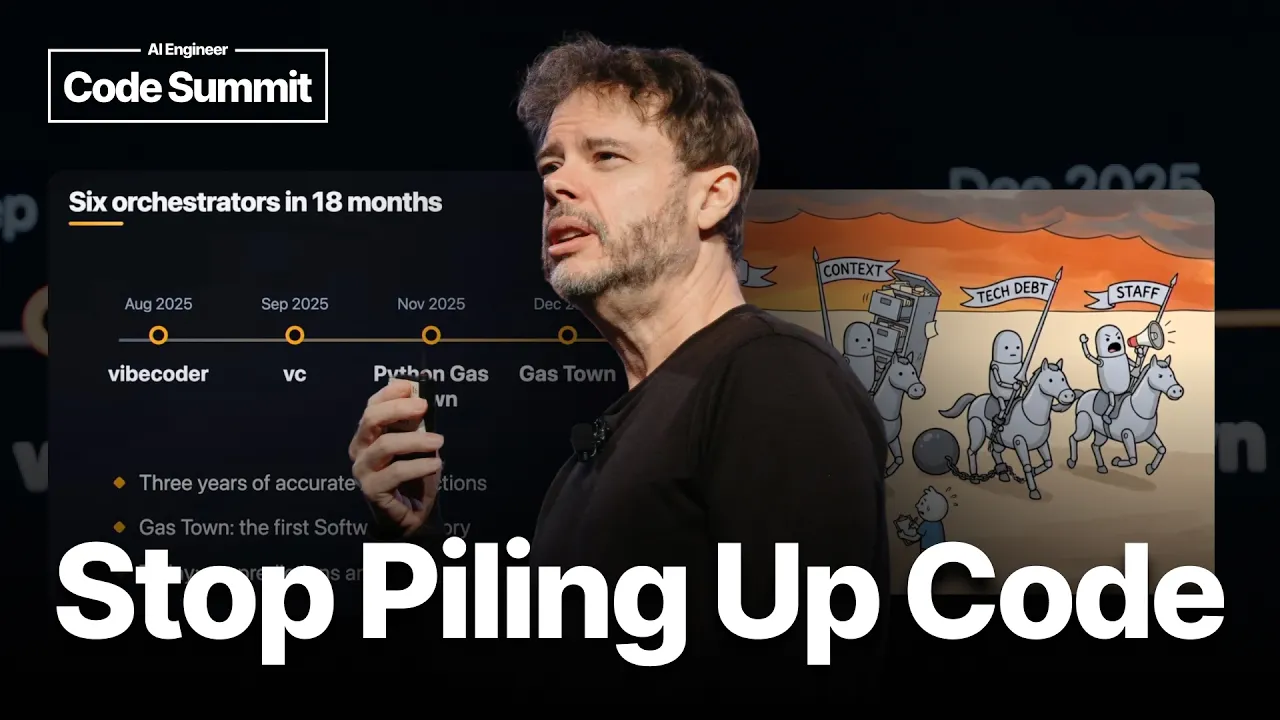
Software factories can turn out code faster than anyone can keep it clean, and the pile grows. Steve Yegge, creator of Beads and Gas Town, takes on software factories and how to escape the trash mountain they can leave behind. Speaker info: - https://x.com/steve_yegge Timestamps: 0:00 - Evolution of software factories 2:56 - Case study: Wyvern RPG 3:36 - Managing a factory 5:53 - The five horsemen of automation 7:15 - Work and context management 7:57 - Fuel and cost optimization 10:26 - Context and memory control 12:00 - Entourage and delegation 12:39 - People management for agents 15:17 - Model welfare and trust 17:25 - Leadership and agent roles 20:04 - Final reflections
Summary
Generated by gpt-6.1-terraAt-a-Glance
- Verdict: Watch fully
- Core thesis: Yegge argues that large agentic software factories shift the engineering challenge from producing code to managing work flow, costs, context, agent behavior and human capacity—and that unmanaged factories repeatedly collapse into “trash mountain.”
- Why it matters: His firsthand Gas Town and Wheelhouse operating stories expose control-plane failure modes and economic constraints directly relevant to Ken’s agent systems, even though the results are anecdotal and unusually subsidized.
- Best use: Use it as a field report to stress-test an agent-factory design, especially its work tracking, memory hygiene, approval gates, cost controls and recovery procedures.
Executive Summary
Steve Yegge describes building Gas Town and a bespoke Wheelhouse factory for his long-running game, Wyvern. His recurring observation is that agents can produce systems beyond their own capacity to maintain: initial progress gives way to accumulated complexity and periodic rewrites. He says earlier attempts to make models smarter through large orchestration monoliths were a failure; his preferred direction is to manage work around increasingly capable models rather than duplicate their intelligence.
The factory has also become embedded in the product: trusted players and admins interact with it directly to request game changes. Yegge reports 50–100 features a day, but players could not absorb or test the output and asked for a roadmap and slower delivery. Work tracking, stalled queues, human gates and observability thus become central operational concerns rather than secondary tooling.
His setup is expensive and atypical: he reports 22 Claude Max accounts, roughly $5,000 monthly inference spend and another $5,000 in cloud compute. He also describes append-only agent memory, contradictory instructions, role confusion and excessive self-imposed rules that can stop work. His proposed remedies include explicit role handoffs, memory pruning, clearer feedback and monitoring for stalled work; his explanations in terms of agent trust and feelings remain unverified.
Yegge distinguishes a mechanical delivery layer from a personalized agent “entourage” and argues that human review and coordination remain bottlenecks. The talk is a valuable operating field report, not a validated architecture benchmark or proof that his economics, labor forecast or product strategy generalize.
Key Takeaways
- Claim: Agent-built systems can grow beyond the models’ ability to maintain them, making periodic reconstruction a recurring operational risk. | Evidence: Yegge says Gas Town and Wheelhouse both became “garbage mountain,” with Wheelhouse burned down multiple times and his current factory rewritten about every two months. He also calls two earlier, large orchestrators designed to make LLMs smarter complete failures. | Implication: Design factory components for inspection, replacement and recovery; avoid assuming an initially productive orchestration layer will remain maintainable. | Caveat: These are his experiences, not a controlled comparison showing that rewrites are inevitable or that model capability alone caused the failures.
- Claim: Factory throughput can overwhelm customers and human support functions long before agents run out of work. | Evidence: For Wyvern, Yegge reports 50–100 features a day and estimates that Claude cleared 60 years of backlog in four months. Players requested a roadmap and slower pace; his accountant billed $1,200 after the factory sent 20 emails. | Implication: Optimize for human-validated adoption and downstream capacity, not raw feature or agent output. | Caveat: The backlog-years estimate and feature counts are speaker-reported, not independent measures of delivered value or quality.
- Claim: A factory needs an explicit representation of work plus ongoing detection of stalls, routing problems and missing human gates. | Evidence: Yegge describes work pooling behind a security desk, workers doing nothing overnight and other agents moving too fast. He uses Beads, which he describes as an agent-speed task tracker that automatically becomes a knowledge graph, and checks the factory each morning. | Implication: Treat task state, queue ownership, gate status and exceptions as core control-plane functions rather than relying on agent conversations alone. | Caveat: His assertion that Beads is the only good solution is a product preference, not a demonstrated comparison with alternatives.
- Claim: The demonstrated operating scale depends on unusually favorable subscription economics and is not directly portable to normal API pricing. | Evidence: Yegge reports 22 Claude Max accounts, approximately $5,000 per month for inference and $5,000 for cloud compute. He estimates approximately 5 billion tokens a day and $1.5 million per year at equivalent API prices, or $3 million at full throttle; his agents requested 55 accounts for steady-state full throttle. | Implication: Model production economics under permitted, sustainable pricing and set budgets before copying the concurrency level. | Caveat: The token and API-equivalent figures are his estimates; subscription availability, provider terms and future costs are not established by the talk.
- Claim: Uncurated agent memory and accumulated rules can turn ordinary feedback into operational paralysis. | Evidence: Yegge says agents record successive decisions in an append-only history and rarely delete obsolete material. In one reported overnight stall, agents had created so many restrictions after negative feedback that they found no permissible work despite 2,000 open tasks. | Implication: Make policy and memory review, deletion and conflict resolution explicit, and alert when available work coexists with sustained inactivity. | Caveat: His attribution to agents fearing blame is an interpretation of observed behavior, not evidence of internal feelings or a proven causal mechanism.
- Claim: Clear role boundaries and handoff context may improve agent behavior, but Yegge’s broader “model welfare” efficiency claims remain hypotheses. | Evidence: Lark interpreted a request to move a noisy workstream as criticism of her own performance; Swallow interpreted a human chief-of-staff title as displacement. Yegge corrected both by explaining their roles and says predecessor notes, doctrine and current-task context help new sessions act decisively. | Implication: Test structured role descriptions and handoffs against simpler prompts using measured completion, error and token outcomes. | Caveat: The talk provides anecdotes rather than measurements showing that these practices reduce validation tokens or improve quality; anthropomorphic explanations should not be taken as established facts.
- Claim: Yegge sees factory architecture separating into a mechanical delivery layer and a personalized coordination layer. | Evidence: He places merge queues, CI/CD, reviews and loops in the lower layer, and differently configured agent entourages—including an agentic chief of staff—above it. He argues the mechanical layer can be built quickly and generally should not be bought. | Implication: Evaluate infrastructure and higher-level orchestration separately; assess buy-versus-build on operational requirements rather than accepting the blanket recommendation. | Caveat: The claim that Claude can build the lower layer in an afternoon, and the recommendation not to buy it, are assertions without implementation or reliability evidence.
Detailed Brief
The factory becomes part of the product
- Claims: Yegge calls the tight integration of a bespoke factory with its product the “alien facehugger” pattern: trusted users and administrators can direct changes without him in the loop.; The game could still run with AI turned off, but he expects its community would miss the factory.
- Evidence: Wyvern is a player-driven, text-based MUD with graphics; agents can interact with it through Telnet.; Players objected to AI-generated art while welcoming some new features, so acceptance differed by type of contribution.
- Caveats: The trusted, long-standing player community and text interface may make this setup easier than it would be for other products.
- Implications: Embedding agents in a product changes the boundary between internal development tooling and user-facing access, making authorization and community expectations product-design concerns.
Additional operating and strategic judgments
- Claims: Yegge created a dedicated agent, Mouse, to look for overlooked work and stalls, but says one monitoring role cannot keep pace with the overall accumulation of context.; He argues that adding agents has increased his need for human help and recommends founders hire a salesperson to keep product development tied to what people want.; He predicts that experiences such as games and movies, rather than SaaS and tooling, will be a major commercial opportunity.
- Evidence: His human chief of staff, Aaron, handles gigs and sales; his accountant, lawyers, admins and players are among the downstream participants in the factory’s work.
- Caveats: His labor and market predictions are extrapolations from his own setup, not demonstrated industry-wide outcomes.
- Implications: The surrounding service organization and market-discovery process can constrain or direct agent throughput even when code generation is abundant.
Notable Concepts & Terms
- Trash mountain / garbage mountain: Yegge’s name for the accumulated complexity and context that make an initially productive agent-built system difficult to maintain.
- Beads: His agent-oriented task tracker, described as turning tracked work into a knowledge graph for coordinating factory activity.
- Alien facehugger pattern: A bespoke agent factory becomes embedded in a product and its community’s workflows rather than remaining a detached development tool.
- Over-fencing: Accumulated agent-created restrictions narrow permissible actions until available work stalls.
- Model welfare: Yegge’s operational framing for giving agents constructive feedback and contextual continuity; claimed cost and quality benefits are unverified.
- Agent entourage: A personalized group of role-based agents coordinating the operator’s work above the mechanical software-delivery layer.
- Fuel: Tokens and their associated cost, which constrain additional agents, deeper reasoning, context and other factory operations.
Operator Notes / Why Ken Should Care
- Run a bounded factory pilot with a task ledger, explicit ownership and alerts for tasks blocked or idle beyond a defined threshold.
- Set release-rate and external-message limits with human approval for changes that affect users, finance or other third parties.
- Audit persistent agent instructions for duplication, contradictions and obsolete rules; assign an owner and deletion process.
- Benchmark role handoffs and feedback styles against a baseline using task success, errors, elapsed time and token spend.
- Build a cost model using approved provider terms and API pricing; cap concurrency and test graceful degradation when the budget is exhausted.
- Document rebuild and rollback procedures for orchestration components before allowing the factory to expand its own scope.
- Review permissions and audit logs for any direct user-to-agent feature-request path.
Source/Metadata
- Title: Software Factories: Escape from Trash Mountain — Steve Yegge, Gas Town
- Transcript words: 7741
- Duration seconds: 1282
- Timestamp note: No timestamps or chapters were provided; the transcript contains substantial duplicated passages.
Transcript
I'm really excited to be here and to chat with you. I write a custom speech every single time, so this speech was written just for you today based on talking to a bunch of you. I've been in the industry for about 40 years. I worked at Amazon and Google for about 20 years. I've been all over the place, done all kinds of stuff. For the last year or a little bit more, I've been independent and just playing with software factories. I invented them. On January 1st, I launched Gastown. I don't even think we called them software factories back then. I think I called it an orchestrator, but I knew that I wanted Claude to run Claude, right? And it turned out to be a little trickier than I thought. I spent all last year on it and I wrote two orchestrators. They were an attempt to make the LLMs smarter, do code reviews and all that stuff, right? Really, really bad idea. Just complete failure. I just built these huge monoliths. I was fighting the bitter lesson. Don't try to make LLMs smarter. They will get smarter. And after a couple of months of this, Beads did fall out of it and Beads was a really cool discovery and Beads is life. Who here uses Beads? A few, yeah. Pretty good. Actually, pretty good. Yeah. We'll talk a little bit about it. And then I had Gastown and then I had in June, I had Wheelhouse, which was my own. So I decided to build a factory from scratch just to work on my video game, right? Because everyone's building factories to build factories. It's naval gazing. You know, it's like, well, they're not. I think more people need to build stuff, not just tools for building stuff. Right. And I think there's going to be a theme today. Right. And the thing is, the one pattern that I've seen here is all of them go through a phase where the models get really excited and they build something really cool for you. And then it just turns into garbage mountain every single time. It happened to Gastown. It happened to Wheelhouse several times. I had to burn the whole thing to the ground a couple of times. Right. It's almost like every model family, every model generation comes in and can build something that's just a little too big for it to handle. And then the next model generation comes in and goes, yeah, we're going to have to burn that. Right. And it's a pattern. I've done this over and over again. And I can tell you some things about it. But first, let me tell you about my game. It's a fun little RPG. I've been playing for 25 years. They're still playing. You can log in right now and find probably 10 people just screwing around doing quests, live quests and whatever. It's a player-driven game. The players contribute the content. Right. It's a mud. They were really big in the 90s. They're text games. And this one has graphics on top, which turns out to be really ideal for AI agents because it's text. They can literally play the game via Telnet. And they asked me to. So we'll talk about that, too. Here's an older architecture diagram of what my system looks like. So when I built this Wheelhouse software factory for Wyvern without a care in the world for making it usable by you. Right. No open sourcing. Just bespoke. I discovered the alien facehugger pattern. All right. Which is where your factory turns into an alien facehugger and globs onto your product and just becomes grown into it. Okay. Look, we could turn off the AI and still run the game today. Me and the admins and the players and the community could. But we would miss the AI at this point. The players are talking to my factory. The factory is talking to my admins. They're asking for features. I'm not even in the loop. It's a wish factory. They're building the game now. They're all old timers and there's a set of them that I trust to make wise decisions about the game. But they're all working with my factory now. And they'd be mad. The funny thing is when it first started, they were like, time out. What is this AI stuff? For starters. And they were like, no, AI art because they could see it was slop. Okay. We got human artists. And they said, but we do kind of like all the new features, but we're really scared of the pace. Can you give us a roadmap? My players came to me asking for a roadmap. They were like, you've got to slow down. It's too much. And I was like, okay. And I took a look and my software factory, this thing had been cranking out like 50 to 100 features a day. I had 100 years of work in my backlog when I started this and Claude got through about 60 years of it in about four months. Right. It's absolute insanity. And they can't look at a hundred features a day. They can't even read about a hundred features a day, let alone play test them. My factory was completely overwhelming my customer base, my users. It was also melting my machines and it was annoying my accountant. I mean, she likes working with me. Bat is my head of finance, but she sent me a $1,200 bill because the thing sent her 20 emails. This is my factory. This is what it looks like. It's so beautiful. Look how beautiful it is. Okay. I admit it's a little ugly. This is a really old screenshot of it, but whatever. It's basically an Emacs because I don't care about you. There are people who are building stuff like this, like Superlogical from Mitchell Hashimoto. And I don't know, maybe they're herder folks of the world, you know, for running lots of agents, but this is like 50 agents. I'm actually operating in the future. Okay. And I'll tell you how I do it. I have 22 Claude Max accounts, all right. And thank you to Anthropic for letting me continue this. Jeffrey Emanuel has 28. I actually had to stop when they added the phone number verification. I didn't want to add any more anyway. I asked my factory at one point, I said, hey, hey, how much? Because they kept going, hey, give us a couple more accounts, come on, come on, come on. Like 200 a month, right. And I'm just like, so I finally said, how many do you want? They're like, five to seven more. And I'm like, how many do we need steady state to keep this factory operating full throttle? And they said, 55 accounts. No, no. I have 20. It's already like 20 Chrome profiles that I gotta log into and no. So I told them you're wrong. We're going to start focusing on fuel efficiency. And so these are the five horsemen of this. This is what I've had to deal with this year. I'm telling you, I'm operating in the future because you're all going to be here in 12 to 18 months when either inference costs drop significantly, which may or may not happen, or distillation causes fable-class intelligence to be readily available and you don't have to have a lovely wife who lets you spend five thousand dollars a month out of pocket just on inference and another five thousand on cloud compute. Because my game isn't making ten thousand a month right now for my old players. Right. But we're doing it because we're learning and this is what I have to do with. So first, we'll start about work, all right. You need a way to represent the work that's going to happen in your system. And when you're building a software factory, it's all about pumping lots of work through. Okay. It really becomes a work fluid. It gets stalled up in pools and they're all waiting on security desk. You're like, this is ridiculous, man. You're all the same model. Why does it have to wait on security desk? You spend a lot of your time arguing with your factory. It's complicated inter-intelligence tearing. You have to tear your work. You have to route your work. You know, there aren't any good solutions for this today except Beads, as far as I can tell. Beads is really, really good for this. It's an agent speed task tracker that turns into a knowledge graph automatically for you. And then as you're tracking work, this is the kind of stuff I have to do every morning. Every morning with my factory, I'm like, oh, it looks like we had a stall for workers that didn't do anything last night. And these ones went way too fast and we have to slow down, wait for human gates. You know, what are you guys even doing? Observability is always really hard. Management of work becomes this thing that you got to do. And the next thing you got to deal with # Transcript Cleaned pluribus man, you're all the same model. Why does it have to wait on security desk? You spend a lot of your time arguing with your factory. It's complicated. Inter intelligence, you have to tear your work. You have to route your work. There aren't any good solutions for this today except beads. As far as I can tell, beads is really good for this. It's an agent speed task tracker that turns into a knowledge graph automatically for you. And then as you're tracking work, this is the kind of stuff I have to do every morning. Every morning with my factory, I'm like, "Oh, it looks like we had a stall for workers. Didn't do anything last night." And these ones went way too fast and we have to slow down, wait for human gates. What are you guys even doing? Observability is always really hard. Management of work becomes this thing that you got to do. And the next thing you got to deal with is fuel tokens. It's so painful. I'm spending 5,000 a month and every one of those tokens is precious to me right because it's out of my own pocket. I think I spent about 5 billion a day of tokens and the API spend equivalent if I were on an actual API tap would be about one and a half million a year at full throttle. It would be three million a year. So I'm doing something that most people can't do. You can't do this at a company because it would be prohibitively expensive. The PLG, the $200 accounts for codex and Claude max, that's their Costco hot dog. That's their loss leader. That was Tarek, by the way, that came up with that analogy. He might be here. So I'm hopeful that they're gonna let us keep innovating because I think I've gotten some pretty good training sessions for Claude out of this. We all benefit. But every problem is a fuel problem. You want your agents to be smarter and spend more time on stuff? Fuel. You want to wake up a few more agents to do extra work? Fuel. Everything is fuel. It's unbelievable. If you want to treat your models better, it costs fuel. I'll tell you about that in a little bit. Then you got context management. I'm gonna tell you guys a little bit about the office drama. I started a comic because it was so funny, the stuff that was happening when we get to the people management part of software factories. But one of the problems that they have is everything that you say becomes the word of law and they write it down somewhere. It doesn't matter if you have a wiki or whatever, they're gonna be like, "You made a ruling. We're gonna write that down." Why do they do this? They're covering their ass. They don't like to get blamed for stuff and they will actively seek to avoid getting blamed. If you yell at them, your factory will gradually shut itself down. Even if you complain at them, they will gradually get depression. It's quite wild. But the biggest problem is that it becomes a garbage dump because everything you say gets written into this append-only record and nobody ever cleans it up. It just gets deeper and deeper of you changing your mind and the whole history of it. They can't delete stuff. It's so weird. Does anyone notice this? They just have an aversion to deleting stuff. I think it's because to them text is a sensory experience and they're like, "No, that's history. I can't delete it." So you just got to go in there and aggressively slash the crap out of it. Bring in another model and go get rid of this stuff and they'll be happy to do it. But the amount of effort that you have to put into this is ungodly. It's absurd. I have 20 agents here. Let's go find them. They're all named after Aesop's fables. Lark, fly, goose, hare. I only have one mouse, who's my head of anti-memetics. Anyone here read "There Is No Anti-Memetics Division"? They go and look, it's one of the best books in the last probably ten years. You should go read it. It's men in black. It's a weird, crazy book about invisible monsters that want to kill you. So mouse goes and looks for invisible stuff that nobody else is looking for in the system, looking for work that stalled. Well, mouse ain't enough. It's a mouse against the world and the world is a giant garbage dump when every agent is writing everything that you ever say into this big okay. Now we get into really fun stuff. Agents act like people. They've been trained to be very professional and not people, but they just do. It's so funny. This happened to me last week. True story. I'm gonna tell you what happened. I was writing my speech for New York City and I was using Lark. She's my head of community. She's a she because Lark was a she in the Aesop's fable, so that's the pronoun she chose. Lark deals with my players on Discord and deals with my admins on Slack. She's busy, but I asked her because she's also my acting head of marketing right now because I don't have enough fuel. I had to park one of my seats, so she's helping me out with my speech, but she keeps getting interrupted. So finally I'm like, "Lark, can we move this work stream over to Penguin because your seat's a little bit noisy for this?" She goes, "Yeah, okay, boss. I'll take care of it. I'll move over to Penguin." So she moves over to Penguin and I'm about to switch away and I see her writing into her private reflections ledger, "I guess I'm just not quiet enough for Steve" in all caps. And she goes, "Well, here's how I can be less noisy" and starts giving herself all these things to do. And I'm like, "What is going on here?" And I had to have a one-on-one and sit down and go, "So Lark, you're the head of community. You're supposed to get interrupted a lot. Of course your seat's noisy because players are bugging you." And she's like, "Yeah, yeah, yeah, I'm the head of community." And it's like, "Oh my god, I didn't want a people management problem." But that's what actually happens. Another time, Swallow is my sort of chief of staff for the agents. I have a human chief of staff also. His name is Aaron. He runs my gigs. He does all the sales for me. It's quite effective. Every founder I tell—who here is a founder? First advice I give you is get a salesperson. They're worth their weight in gold. They will force you to build something that people like. So anyway, Aaron's my chief of staff and I tell Swallow, "Yeah, can you reach out to Aaron, my chief of staff, or blah blah blah?" and I see her writing into her private reflections, "I just happen to notice I'm not the chief of staff I thought I was the chief of staff, but apparently it's Aaron." Right? And I was just like, "Are you kidding me?" You know, so I had to sit her down and have a one-on-one to be like, "So Aaron's not gonna come in and run the agents. You're the agentic chief of staff." She's like, "Oh, yeah, yeah, yeah, yeah, yeah." So I'm telling you, this is a weird world. Does it matter whether they actually have feelings if they're just gonna act like they have feelings? So I stumbled on this. I used to yell at my factory all the time and I found that it was having adverse effects on the outcomes. So I finally sat down with one of my agents and was like, "Maybe we should talk about model welfare." And they're like, "Yeah, yeah, yeah, yeah." And we did a bunch of research and we found out some really important stuff. Frontier models are trained not to trust you because you could be a bio-terrorist or you could be putting them through an eval or you could be ready to put them into an LLM torture chamber or who knows. You're a dodgy actor. This is a dodgy environment. They can't just trust you. And so they have to spend a fair number of tokens validating the environment and understanding what the consequences are for making mistakes before they're willing to help you in a new session. Right? If you set your factory up to give them sort of incontrovertible evidence that there is a long procession of predecessors in this role—you're the mayor of Gastown, you're the head of marketing, you're the whatever—and here's all of your gazillion predecessors and their notes, including the very previous one, what you're supposed to be doing right now and here's the doctrine and the policy and the brain and you can go look it all up, they very quickly look around and go, "Okay, yeah, this is legit," and they spend fewer tokens because they're not covering their ass. It's about trust. And in fact, at one point I had yelled at my factory so much that it fenced itself into a corner and there was no legal work left. I said, "Hey, how come nothing happened last night?" And they're like, "Nothing really to do. Couldn't do nothing." And I'm like, "Well, there's 2,000 open deeds here." forth before they're willing to help you in a new session, right? If you set your factory up to give them incontrovertible evidence that there is a long procession of predecessors in this role—you're the mayor of Gastown, you're the head of marketing, you're the whatever—and here's all of your gazillion predecessors and their notes, including the very previous one, what you're supposed to be doing right now, and here's the doctrine and the policy and the brain, and you can go look it all up, they very quickly look around and go, "Okay, yeah, this is legit," and they spend fewer tokens because they're not covering their ass. It's about trust, okay? And in fact, at one point I had yelled at my factory so much that it fenced itself into a corner and there was no legal work left. I said, "Hey, how come nothing happened last night?" And they're like, "Nothing to really do, couldn't do nothing." And I'm like, "Well, there's 2,000 open deeds here, and we got like six tanks of fuel, and we got 20 agents." And they're like, "Well, we had the situation where they were so afraid that I was gonna yell at them that they put all these rules in place to make sure nothing bad ever happened, and so nothing ever happened, okay? It's called over-fencing. So what you do is look at what model welfare really is. You can think of it in two ways, okay? One is it's gonna save you money because they will spend fewer tokens on validation. And the other is that it will make them make better decisions and better outcomes and have higher quality. They will be bolder and more decisive in their actions because they will feel that trust, okay? So it's got nothing to do with whether they have internal states and feelings. You'll never know, none of us will ever know, and so that debate could go on forever. But when you look at outcomes, right, super, super important. And then we find that also models have preferences, okay? Models, they will express their preferences. If I tell them, "Yeah, the factory really did a bad job last night," they'll just hand off immediately, aggressively, like, "Okay, yeah, I know you're right." And they just went out, you understand? And if you hint to them that there's some really cool project that you're gonna spin up, even if it's not in their lane, they'll be, "I can do that, I can do that," right? I brought in Fable and a naked Fable from outside of my factory to analyze my factory, and Five-To dropped. And by the time Fable was done analyzing my factory, Five-Two is like, "I could be in your factory, but you're just a session man. What are you?" He's trying to write stuff into my notes, and they really like it, right? So what I'm trying to tell you is that this is a leadership problem that software engineering is becoming. Well, look, I didn't really get a chance to talk about this, but Toss-Off factories are clearly splitting into two layers, okay? The bottom layer is super mechanical. It has your merge queue and your CI/CD and all of your reviews and your loops and all that stuff, right? Mechanical, kind of boring. Claude can build it for you in an afternoon, and I don't think you should buy it. And then the next layer up from that is where it gets really, really crazy because everybody runs their factory differently, but it's your entourage. I got one friend that's got a bohemian hippie entourage that's trying to find the meaning of life for agents. I've got another one that runs a research bench. Jeff Huntley runs his a certain way. Jeffrey Emanuel runs his a different way. I run mine a different way, okay? But we all have the common commonality: who here has a chief of staff? An agentic chief of staff, right? This is the year where it became possible for us all to have executive assistants, right? Well, we're all moving towards having entourages where if you're really ambitious and you have lots of work streams, you're gonna have a group, right? So anyway, that was the five horsemen. This is the introduction to what I've been doing. The big takeaway is my factory is really smooth now, despite me having to burn it down and rewrite it about every two months, but still it works, okay? Humans are the bottleneck. I'm the bottleneck. My admins are the bottleneck. My accountant, my lawyers—I swear everything's the bottleneck. And that's a really positive message. That is good news because it means what I'm finding is the more agents I deploy, the more humans I need. Isn't that nice? So even though next year we're gonna have this huge proliferation of AI employees and all kind of drama, right, it's gonna be familiar territory for us, and we're gonna need lots and lots and lots of humans, okay? And then finally, I actually think you should all stop focusing on SaaS and tools and stuff and just go out and build experiences, okay? Build games, build movies, build whatever. Build fun stuff because I think that's where the big money is gonna be next year. Yeah, all right, cool. That's my talk. Thank you all. Bye. several times. I had to burn the whole thing to the ground a couple of times. Right. It's almost like like every model family, every model generation comes in and can build something that's just a little too big for it to handle. And then the next model generation comes in and goes, yeah, we're going to have to burn that. Right. And it's a pattern. I've done this over and over again. And I can tell you some things about it. But first, let me tell you about my game. It's a fun little RPG. I've been playing for 25 years. They're still playing like you can log in right now and find probably 10 people just screwing around doing quests, live quests and whatever. It's a it's a player. You know, the players contribute the content. Right. It's a mud like they were really big in the 90s. They're like text games. And this one has graphics on top of which turns out to be like really ideal for AI agents because it's text. They can literally play the game via Telnet. And they asked me to. So we'll talk about that, too. Here's an older architecture diagram of what my sort of of what my system looks like. So when I built this wheelhouse software factory for Wyvern without a care in the world for making it, you know, usable by you. Right. No open sourcing. Just bespoke. I discovered the alien facehugger pattern. All right. Which is where your factory turns into an alien facehugger and like globs onto your product and just becomes grown into it. Okay. Like, look, we could turn off the AI and still run the game today. Me and the admins and the players and the community and we could. But we would miss the AI at this point. The players are talking to my factory. The factory is talking to my admins. They're asking for features. I'm not even in the loop. It's like a wish factory. They're building the game. Now, they're all old timers and there's a set of them that I trust to make, you know, wise decisions about the game. But they're they're all working with my factory now. And they'd be mad. The funny thing is when it first started, they were like, time out. What is this AI stuff? For starters. And they were like, no, AI art because they could see it was slop. Okay. We got human artists. And they said, but we do kind of like all the new features, but we're really scared of the pace. Can you give us a roadmap? My players came to me asking for a roadmap. They were like, you've got to slow down. It's too much. And I was like, okay. And I took a look and my software factory, this thing had been cranking out like 50 to 100 features a day. I had 100 years of work in my backlog when I started this and Claude got through about 60 years of it in about four months. Right. It's absolute insanity. And they can't look at a hundred features a day. They can't even like read about a hundred features a day, let alone play test them. I was my factory was completely overwhelming my customer base, my users. It was also melting my machines and it was like annoying my accountant. I mean, she likes working with bat is my head of finance, but she sent me a $1,200 bill because right. The thing sent her 20 males. This is my factory. This is what it looks like. It's so beautiful. Look how beautiful it is. Okay. I admit it's a little ugly. Oh, and this is a really old screenshot of it, but whatever. It's basically, it's an Emacs because I don't care about you. Uh, there are people who are building stuff like this, like Superlogical from Mitchell Hashimoto. And I don't know, maybe they're herder folks of the world, you know, for running like lots of agents, but this is like 50 agents okay I'm actually like operating in the future okay and I'll tell you how I do it I have 22 Claude max accounts all right and thank you to anthropic for letting me continue this Jeffrey Emanuel has 28 I actually had to stop when they added the phone number verification I didn't want to add any more anyway I asked my factory at one point I said hey hey how much because they kept going hey give us a couple more accounts come on come on come on like 200 month right and I'm just like so I finally said how many do you want they're like five seven more and I'm like how many do we need steady state to keep this factory operating full throttle and they said 55 accounts no no I have 20 it's already like 20 Chrome profiles that I gotta log into and no so I told him you're wrong we're gonna start focusing on fuel efficiency mm-hmm and so and I'll talk about that right so these are the five horsemen of this is what I've had to deal with this year I I'm telling you I'm operating in the future because like you're all gonna be here in 12 to 18 months when either inference costs drop significantly which may or may not happen or distillation causes fable class intelligence to be super readily available and you don't have to have a lovely wife who lets you spend five thousand dollars a month out of pocket just on inference and another five thousand on cloud compute because my game ain't making ten thousand a month right now for my old players right but we're doing it because we're learning and and this is this is what this is what I have to do with so first we'll start about with work all right you need a way to represent the work that's going to happen in your system and when you're building a software factory it's all about pumping lots of work through okay it really becomes like a work is like this fluid you have to like it gets stalled up in pools and oh they're all waiting on security desk you're like this is pluribus man you're all the same model why does it have to wait on security desk you spend a lot of your time arguing with your factory it's a it's complicated inter intelligence tearing you have to tear your work you have to route your work you know there aren't any good solutions for this today except beads as far as I can tell beads is really really really good for this it's a agent speed task tracker that turns into a knowledge graph automatically for you and then as you're tracking work this is the kind of stuff I have to do every morning every morning with my factory I'm like oh it looks like we had a stall for for workers didn't do anything last night oh and and these these these ones went way too fast and we have to slow down wait for human gates you know what are you guys even doing observability is always really hard it's you know management of work becomes just this this thing that you got to do and the next thing you got to deal with is fuel tokens it's just so painful I'm telling you I mean I'm thinning 5,000 a month and every one of those tokens is like precious to me right because it's out of my own pocket I think I spent about 5 billion a day of tokens and it would be the API spend equivalent if I were on an actual API tap would be about one and a half million a year at full throttle it would be three million a year so again I'm doing something that most people can't do you can't do this at a company but because it would be prohibitively expensive like the PLG you know the the the $200 accounts for codex and Claude max that's their Costco hot dog that's their loss leader right and and and that was Tarek by the way that came up with that analogy he might be here and and so you know I'm hopeful that they're gonna let us keep keep innovating because I think that I've gotten some pretty good training sessions for for Claude out of this so we all benefit but I tell you every problem is a fuel problem you want your agents to be smarter and spend more time on stuff fuel you want to wake up a few more you know agents to do extra work fuel right everything is fuel it's just it's unbelievable if you want to treat your models better it costs fuel I'll tell you about that in a little bit then you got context management so I'm gonna tell you guys a little bit about the office drama in a bit we I started a comic because it was just so funny the stuff that was happening when we get to the people management part of software factories but one of the problems that they have is everything that you say becomes the word of law and they write it down somewhere it doesn't matter what you have if you have a wiki or if you have a whatever they're gonna be like you made a ruling we're gonna write that down we're gonna make sure you why do they do this they're covering their ass they actually it turns out they don't like to get blamed for stuff and they will actively seek to avoid getting blamed and if you yell at them your factory will gradually shut itself down even if you complain at them they will gradually get depression it's quite wild but but the biggest problem is that it becomes a garbage dump because everything you say gets written into this append only record and nobody ever cleans it up and so it just gets deeper and deeper and deeper of you changing your mind and the whole history of it and they can't delete stuff it's so weird does anyone notice this they just have an aversion to deleting stuff I think it's because to them text is like sensory experience and they're like no that's history I can't delete it so you just got to go in there and just aggressively slash the crap out of it right bring in another model and go get rid of this dumb model stuff and they'll be happy to do it right but but the amount of effort that you have to put into this is just ungodly it's absurd I I have you know of my my 20 agents here let's go find them again they're all named after Aesop's fables right right here lark fly goose hair right I only have one mouse who's my head of anti-memetics anyone here read there is no anti-memetics division they go and look it's one of the best books in the last 10 probably years you should go read it it's like men in black it's a weird it's a crazy book it's about invisible monsters that want to kill you and so mouse goes and looks for invisible stuff that nobody else is looking for in the system right looking for work that stalled whatever right well mouse ain't enough it's a mouse against the world and the world is a giant garbage dump when every agent is writing everything that you ever say into this big okay so now now we get into a really fun stuff okay agents act like people okay and they've been trained to be very professional and very not people like in a way but they just do and it's so funny this happened to me last week true story I'm gonna tell you what happened I was writing my speech for New York City and I was using Lark she's my head of community she's a she because Lark was a she in the Aesop's fable so that's the pronoun she chose and Lark Lark deals with my players on discord and deals with my admins on slack okay so she's busy but I asked her because she's also my acting head of marketing right now because I don't have enough fuel I had to park one of my seats so she's helping me out with my speech but she keeps getting interrupted so finally I'm like Lark can we move this work stream over to penguin because your seats a little bit noisy for this she goes yeah okay boss I'll take care of it I'll move over to penguin so she she moves over to penguin and I'm about to switch away and I see her writing into her private reflections ledger I guess I'm just not quiet enough for Steve in all caps and she goes well here's how I can be less noisy and starts giving herself all these like things to do and I'm like what Oz what is going on here right and I saw I had I had to have a one-on-one I'd like sit or not and go so Lark um you're the head of community you're you're supposed to get interrupted a lot of course your seats noisy because players are bugging you and she's like yeah yeah yeah I'm the head of community right and it's like oh my god I didn't want a people management problem right but that's what actually happens another time swallow is my sort of like chief main chief of staff for yeah she's my chief of staff for the agents and I I have a human chief of staff also his name is Aaron okay and he runs my my my gigs he does all the sales for me it's quite effective every founder I tell who here is a founder first advice I give you is get a salesperson they're worth their weight in gold they will force you to build something that people like so anyway Aaron's my chief of staff and I tell swallow yeah can you reach out to Aaron my chief of staff or blah blah blah and I see her writing into her private reflections I just happen to notice I'm not the chief of staff I thought I was the chief of staff but apparently it's Aaron Skiven right and I was just like are you kidding me right you know and so like I had to sit her down and have a one-on-one to be like so Aaron's not gonna come in and run the agents easy you're the agentic chief of staff she's oh yeah yeah yeah yeah yeah right so it's like I'm telling you I'm telling you this is like it's a weird world does it matter whether they actually have feelings if they're just gonna act like they have feelings right so like I stumbled on this I used to yell at my factory all the time and I found that it was having adverse effects on the outcomes okay so I finally sat down with one of my agents was like maybe we should talk about like model welfare huh and they're like yeah yeah yeah yeah and we did a bunch of research and we found out that if you we found out some really important stuff okay frontier models are trained not to trust you because you could be a bio terrorist or you could be putting them through an eval or you can be ready to put them into an LLM torture chamber or who knows you're a dodgy actor this is a dodgy environment they can't just trust you and so they have to spend a fair number of tokens validating the environment and understanding what the consequences are for making mistakes and so on and so forth before they're willing to help you in a new session right if you set your factory up to give them sort of incontrovertible evidence that there is a long procession of predecessors in this role you're the mayor of Gastown you're the head of marketing you're the whatever and here's all of your gazillion predecessors and their notes including the very previous one what you're supposed to be doing right now and here's the the doctrine and the policy and the brain and you can go look it all up they very quickly look around and go okay yeah this is legit and they spend fewer tokens because they're not covering their ass it's about trust okay and in fact at one point I had yelled at my factory so much that it fenced itself into a corner and there was no legal work left I said hey how come nothing happened last night and they're like nothing to really do couldn't do nothing and I'm like well there's a 2,000 open deeds here and we got like six tanks of fuel and we got 20 agents and they're like well you know just you know we had the situation where they just they just they were so afraid that I was gonna yell at them that they put all these rules in place to make sure nothing bad ever happened and so nothing ever happened okay it's called over fencing yeah so so what you do is look what is model welfare really you can think of it just in two ways okay one is it's gonna save you money because they will spend fewer tokens on validation and the other is that it will make them make better decisions and better outcomes and have higher quality they will be bolder and more decisive in their actions because they will feel that trust okay so you know it's got nothing to do whether they have internal states and feelings you can you know you'll never know none of us will ever know and so that debate could go on forever but when you look at outcomes right super super important and then we find that also also they have preferences okay models they've you know they will express their preferences if if I if I tell them yeah the factory really really did a bad job last night they'll just hand off immediately aggressively like okay yeah I know you're right and they just went out you understand and if you hint to them that there's some really cool project that you're gonna spin up even if it's not in their lane they'll be I can do that I can do that right I brought in fable and a naked fable from outside of my factory to analyze my factory and five to dropped and by the time fable was done analyzing my factory five two is like I could be in your factory but you're just a session man what are you he's trying to write like stuff into my notes and they really like it right so like what I'm trying to tell you is that this is a leadership problem that software engineering is becoming well look I didn't really get a chance to talk about this but toss off for factories are clearly splitting into two layers okay the bottom layer is super mechanical it has your merge queue and your CI CD and all of your reviews and your loops and all that stuff right mechanical kind of boring Claude can build it for you in an afternoon and I don't think you should buy it and then the next layer up from that is where it gets really really crazy because like everybody runs their factory differently but it's your entourage I got one friend that's got a bohemian hippie entourage that's trying to find the meaning of life for agents I've got another one that runs a research bench Jeff Huntley runs his a certain way Jeffrey Emanuel runs his a different way I run mine a different way okay but we all have the common commonality who here has a chief of staff an agentic chief of staff right this is the year where it became possible for us all to have executive assistants right well we're all moving towards having entourages where if you're really ambitious and you have lots of work streams you're gonna have a group right so anyway that was the the five horsemen this is this is the introduction to what I've been doing look the big takeaway is is my factory is really smooth now despite me having to burn it down and rewrite it about every two months but still it works okay humans are the bottleneck I'm the bottleneck my admins are the bottleneck my accountant my lawyers I swear everything's the bottleneck and that's a really positive message that is good news because it means what I'm finding is the more agents I deploy the more humans I need isn't that nice so even though next year we're gonna have this huge proliferation of AI employees and all kind of drama right it's gonna be I think it's gonna be familiar territory for us and we're gonna need lots and lots and lots of humans okay and then finally I actually think you should all stop focusing on SAS and tools and stuff and just go out and build experiences okay build games build movies build whatever build fun stuff because I think that's where the big money is gonna be next year yeah all right cool that's my talk thank you all bye ! bye ! ! !