Building Agents Is Trivial Now, Context Is the Next Frontier — Jeff Ng, Unblocked
Description
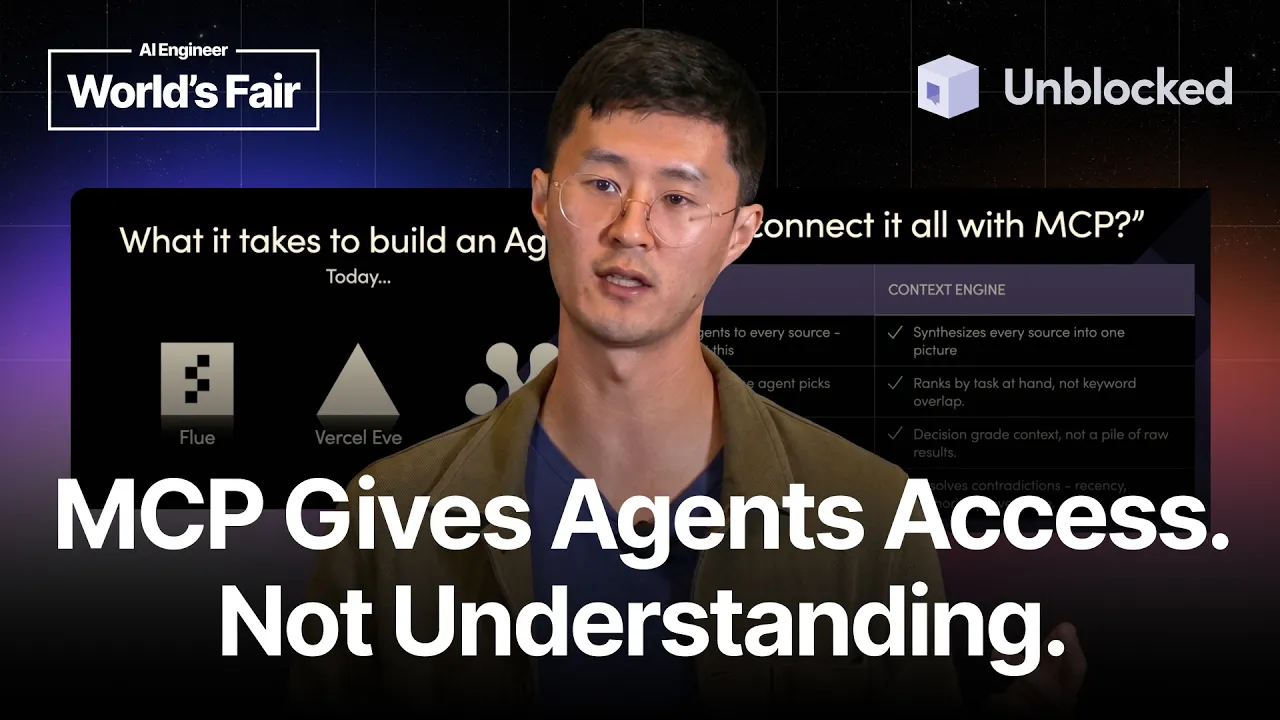
An agent built to enrich Linear tickets read a report that time to first character in Unblocked's own QA pipeline had gone from hundreds of milliseconds to three or four seconds, and recommended turning async dispatch back on. The recommendation was wrong. A support engineer had explicitly disabled that setting days earlier because it caused an outage. The agent had the ticket and the repository and reasoned soundly from both, but never saw the Slack thread where the engineers worked through the failure, or the postmortem that came out of it. Jeff Ng's point: standing an agent up has become the easy part, and missing context is what still breaks them. Six months ago the same build took a team a quarter, because checkpointing, sandbox isolation, and observability all had to be solved first, none of which improves what an agent can do. Cloud primitives and agent frameworks have absorbed that work, so defining an agent now comes down to a model, instructions, tools, and a sandbox. What that removes is the plumbing, not the judgment a person supplies on every turn: why the code is the way it is, what broke last time, what the team decided to do about it. Something has to carry that load once nobody is babysitting, and Ng argues MCP does not, because access is not understanding and an agent left to reconcile contradictory results picks badly. He reruns the same agent against a context engine spanning docs, code, tickets, and conversations, and the recommendation flips from repeating the outage to preventing it. Speaker info: - https://getunblocked.com Timestamps: 0:00 - Six months ago this took a team a quarter 1:02 - The taxes: state, sandboxes, observability 3:02 - Primitives and frameworks remove the plumbing 4:21 - Demo: enriching a Linear ticket 5:36 - The fix that had already caused an outage 7:00 - Why this does not happen locally 8:17 - What a context engine does 10:36 - The same agent, grounded
Summary
Generated by gpt-5.6-terraAt-a-Glance
- Verdict: Watch fully
- Core thesis: Agent infrastructure has become easy to assemble, but reliable autonomous agents now depend primarily on a permission-aware context engine that turns fragmented organizational knowledge into reconciled, task-specific understanding.
- Why it matters: Ken's agent systems will fail silently if they act on tickets, code, or tool outputs without the decision history, incident knowledge, and role-scoped context that humans normally provide interactively.
- Best use: Use this as a concise architecture argument for separating raw system access from a context-control layer before deploying background agents into production workflows.
Executive Summary
Jeff Ng argues that the hard part of agent development has shifted. Managed infrastructure and agent frameworks now absorb much of the former production burden: durable state, sandboxing, observability, and deployment primitives. An agent can consequently be defined with relatively little code—model, instructions, tools, and execution sandbox—but that simplicity does not make its conclusions dependable.
His central example is a Linear issue-enrichment agent that searched the codebase and recommended re-enabling asynchronous dispatch to fix a QA latency problem. The recommendation appeared technically reasonable, but was operationally dangerous: async dispatch had recently caused an outage and had been deliberately disabled. The agent lacked the subsequent Slack incident discussion and a Linear post-mortem, so it confidently recreated a known bad decision.
Ng frames humans as the implicit context layer in local interactive agent use: people recognize why code is unusual, remember prior incidents, notice missing facts, and correct the agent turn by turn. That protection disappears for background agents, where incomplete institutional knowledge becomes a silent and scalable source of misinformation.
The proposed remedy is a context engine that connects code, tickets, documents, and conversations; models their relationships; resolves conflicting information; applies access controls; and returns a synthesized, ranked slice of relevant knowledge. This is explicitly positioned as distinct from MCP: MCP provides raw access to systems, while a context engine is meant to provide grounded understanding that an agent can safely act on.
Key Takeaways
- Claim: Production-grade agent construction is becoming commoditized, shifting differentiation and reliability work toward context quality rather than basic orchestration. | Evidence: Ng says that six months earlier an agent could require a team and a quarter, while cloud providers such as Cloudflare, Vercel, and AWS plus frameworks including Flu, Vercel AI, and Mastra now package much of the required infrastructure. | Implication: Do not treat rapid agent deployment as evidence of operational readiness; allocate design effort to knowledge grounding, policies, and failure containment rather than merely tool wiring. | Caveat: The talk does not benchmark these frameworks or establish that all production requirements—particularly governance and evaluation—are solved by their primitives.
- Claim: State durability, isolated execution, and observability remain essential production requirements even though they do not directly improve an agent's reasoning capability. | Evidence: Long-lived agent runs need checkpoints for message history, tool calls, and loop position; restarting loses token spend and adds latency, while replaying can duplicate side effects. Sandboxes limit secret reads, network access, and damage to shared hosts; debugging requires logs and traces across multiple systems. | Implication: Any autonomous workflow should have resumable state, idempotent or compensated side effects, isolated execution boundaries, and end-to-end tracing before it is allowed to run unattended.
- Claim: An agent can be logically correct from the artifacts it sees yet operationally wrong because the decisive facts often live outside the immediate ticket and codebase. | Evidence: The Linear enrichment agent saw a QA pipeline time-to-first-character regression of three to four seconds instead of hundreds of milliseconds and recommended re-enabling async dispatch. It missed that async dispatch had caused an outage days earlier, was disabled intentionally, and was discussed in Slack and a post-mortem ticket. | Implication: For incident response, code changes, support triage, and other high-consequence workflows, retrieval must include decision records and recent operational history—not only source code and the initiating work item. | Caveat: This is a single vendor-presented anecdote rather than a measured reliability study, but it illustrates a common failure mode in engineering organizations.
- Claim: Humans currently compensate for agent context gaps in interactive use, but background agents lose that correction mechanism and can spread errors silently. | Evidence: Ng says an engineer interacting locally supplies missing facts, asks clarifying questions, and recognizes why the system is the way it is; the autonomous agent has only its prompt, explicitly exposed tools, code, and current ticket. | Implication: Increase review gates, confidence thresholds, escalation paths, and evidence requirements as agent workflows become less interactive and more autonomous.
- Claim: A useful context engine should provide synthesized, permission-scoped understanding rather than merely retrieve a large set of documents. | Evidence: Ng defines the engine as connecting docs, code, tickets, and conversations; building an organizational model; reconciling and ranking information; resolving cross-system conflicts; respecting user or agent access roles; and returning only the relevant slice as an actionable summary. | Implication: A context layer should be evaluated as a control plane with provenance, permissions, freshness, conflict-resolution policy, and task-level accuracy—not as generic RAG or a connector bundle. | Caveat: The presentation does not describe the technical method for entity resolution, conflict adjudication, freshness handling, provenance, or evaluation of the synthesized output.
- Claim: MCP solves connectivity, not knowledge synthesis; exposing multiple MCP servers can increase rather than reduce agent uncertainty. | Evidence: Ng contrasts Slack, Linear, and GitHub MCP connections with a context engine: MCP returns raw results, leaving the agent to choose what to believe when systems conflict, while irrelevant results consume context-window capacity and raise context costs. | Implication: Use MCP for controlled data access, but place a retrieval, reconciliation, authorization, and summarization layer between heterogeneous enterprise sources and autonomous reasoning loops. | Caveat: MCP can still be a suitable transport layer or tool interface; the criticism is directed at using raw MCP access as the complete context strategy.
- Claim: Grounded organizational context has applications beyond issue enrichment, including coding, review, customer success, and sales. | Evidence: Ng cites hydrating coding-agent plans for tools such as Claude Code or Codex, making PR reviews reflect expert team knowledge, and surfacing accurate answers for customer-success and sales teams. | Implication: Prioritize context-engine investment first in workflows where institutional knowledge materially changes the recommendation and where an erroneous answer creates meaningful operational or customer risk. | Caveat: These are asserted use cases; the talk provides a live before/after example only for issue enrichment.
Detailed Brief
A practical context-control-plane design lens
- Claims: The speaker's architecture separates four concerns: operational agent infrastructure, raw source access, organizational knowledge modeling, and task-specific context delivery.; The intended output is not a document dump but a compact explanation that reduces the agent's need to independently infer history and reconcile contradictions.; The product-level proposition is that institutional and tribal knowledge should be made available to agents in the same way it is implicitly available to experienced employees.
- Evidence: The improved issue-enrichment run calls the Unblocked context engine before the agent produces its plan.; The engine identifies both the relevant Linear post-mortem and the engineering Slack discussion, then passes the resulting understanding to the agent as a summary.; With this added context, the agent changes from recommending the outage-causing configuration to recommending an action intended to prevent recurrence.
- Caveats: A synthesized summary can itself omit, distort, or over-prioritize facts; the presentation provides no mechanism for source citations, contradiction display, or human audit of the engine's synthesis.; Role-aware filtering is necessary but creates a potential quality trade-off: permission restrictions may leave an agent without decisive context, which should be represented as uncertainty rather than silently filled by inference.; The talk is partly a product pitch for Unblocked and defers implementation detail to a separate breakout session.
- Implications: Require source provenance and recency signals in any context packet supplied to high-impact agents so reviewers and downstream systems can inspect why a recommendation was made.; Treat absent or inaccessible decision history as a condition for escalation or restricted actions, rather than allowing the agent to produce a fully confident operational recommendation.; Instrument context quality separately from model quality: measure whether the retrieved synthesis contained the relevant decision record, not only whether the final answer looked plausible.
Notable Concepts & Terms
- Context engine: A proposed layer that transforms scattered organizational data into a reconciled, permission-aware, task-relevant understanding for an agent.
- Grounded context: The output of the context engine: ranked and scoped context intended to support action rather than raw documents for the model to interpret.
- MCP (Model Context Protocol): Characterized here as a useful access mechanism for systems such as Slack, Linear, and GitHub, but insufficient by itself for conflict resolution and knowledge synthesis.
- Implicit human context layer: The operational knowledge, memory, judgment, and clarification supplied by a human when using an agent interactively.
- Silent failure: A background agent's plausible but wrong output, which can misinform people or other agents without immediate human correction.
- Checkpoint and state persistence: Durable storage of an agent's history, tool calls, and execution position, needed to resume long-running jobs without expensive restarts or duplicate side effects.
- Async dispatch: The configuration change in the example that improved parallelism but had previously caused an outage, demonstrating why code-level optimization context was insufficient.
Operator Notes / Why Ken Should Care
- Define a standard context packet for unattended agents: current task, relevant code and records, recent incident/post-mortem history, decision rationale, access scope, source links, and freshness timestamps.
- Audit existing MCP-connected agents for cases where they receive raw multi-system search results and are expected to resolve contradictory facts without an explicit policy.
- Add a no-autonomous-action rule for operational recommendations when a required source category—such as incident history, change records, or policy documentation—is unavailable or permission-blocked.
- Track context retrieval quality in evaluations: recall of decisive prior incidents or decisions, conflict detection rate, provenance coverage, and answer changes after grounded context is supplied.
- Stress-test any agent that proposes configuration reversions or incident fixes against historical post-mortems to detect recurrence of previously rejected or harmful actions.
Source/Metadata
- Title: Building Agents Is Trivial Now, Context Is the Next Frontier — Jeff Ng, Unblocked
- Transcript words: 4090
- Duration seconds: 802
- Timestamp note: No timestamps or chapters were provided. The transcript contains a substantial repeated segment and trailing non-substantive repetition.
Transcript
Hi, all. My name is Jeff. I'm a founding engineer at Unblock, and I'm here to talk to you about how building agents has actually gone pretty easy. But unfortunately, they still get things confidently wrong. So six months ago, it required a team's effort and a quarter to build out an agent. An agent is more than just models and tools. It's the models, the tools, and everything required to build out a production service. Here are some examples of the different systems necessary in order to build something out. Each one of these was its own company or at least a company function. I'm not going to go through each one of these, but a few stood out to me. First one, checkpoint and state persistence. Agent runs, they're typically long-lived and stateful. Unfortunately, infrastructure itself, though, that's ephemeral. Crashing without durability can actually lead to a lot of state loss, and that state includes things like message history, tool calls, as well as where you are in the loop. Without these things, you can't resume the session. One option is maybe you want to restart the session. Unfortunately, that's actually quite expensive as well. You lose out on all the tokens that you had originally used, as well as latency. From a user experience standpoint, you've already triggered that session. Now you have to wait for the whole thing to go again. And lastly, side effects. Your agent might have performed some side effects, and now there's a chance of those doubling up. So next thing, sandbox infrastructure, right? So as we all know, we're running more and more agent-generated code, as well as third-party code. This gets all run on your infrastructure, and due to that, there are some complexities. Because of that, we want to introduce isolated sandboxes, which help prevent unnecessary reads of environment secrets, unnecessary network access. In general, we don't want to take down the shared host. And then, observability. How do we answer the question, where did this fail? Typically, this includes tracking logs and traces from across half a dozen systems. Everything I've mentioned here, none of this actually improves an agent's capabilities. They're all taxes one has to pay in order to get an agent out there to play the game. Thankfully, things have changed quite a bit. The whole ecosystem has matured quite a bit, and cloud infrastructure players such as Cloudflare, Vercel, AWS, they've gone and taken some of that complexity away and built primitives that these frameworks, Flu, VercelEve, Mastra, with these together, they've taken a lot of complexity away, and you can focus more on building the actual agent itself, the core logic that actually helps you and your team and your customers. So, here's an example of one. I've played around with Flu and Cloudflare. And as you can see on the left-hand side, we handle everything as mentioned before. So the primitives plus the framework lead to a situation where it's actually not that much code to define an agent. One of the things I was shocked at when I first took a look at the documentation. To get into details, all you really have to do when defining an agent is, A, deciding which model you want to use, B, the instructions or the system prompt, C, the tools that you want the agent to have access to, skills, the things that I can do, as well as the sandbox location, where things are being run. So, to give you an example of this, I've actually gone and built out an issue enrichment system, specifically for Linear. So, what this does is, given a Linear ticket and access to your code repository, it'll go out, fetch a Linear ticket, determine whether or not it's a feature or a bug. From there, it'll do some code searching, provide all that context to the agent, and then come up with a plan of next steps. On the left-hand side here, this is an issue that one of my colleagues, a support engineer, had posted, I think, a month ago. To summarize it, what had happened was, we had some pretty serious degradation in our agentic QA pipeline. Time to first character was taking three to four seconds, when it should realistically be in the hundreds of milliseconds. So, let's see what happens when we put this through the system. So, as you'll see here, I've set up the agent to go fetch an agent. I've given it the skills and tools to actually go and fetch the code, search code, and query against that. That's being passed back to the agent, which is doing some reasoning against that right now. And then, just wait a little bit. At this point, we've updated the Linear issue ticket. The recommendation here is to re-enable our async dispatch, which makes sense. It allows us to run a lot more of our QA pipeline in parallel on a single machine. Sounds great, right? Unfortunately, this is wrong. This had actually caused an outage a few days ago, and one of our support engineers had explicitly disabled this before the ticket was shown. So, where did things go wrong? Why did it get it wrong? The agent I had written, it didn't have a full picture. It was missing the context from the Slack discussion that happened after the issue, where the engineers came together, went through the actual outage, what went wrong, what was the fix, and the next steps. It also was missing the post-mortem Linear ticket, which came as a result of that. In general, it had a narrow understanding of the problem. This concept of missing knowledge and intent that's sorted across an organization and different systems, it's something that comes back again and again. And since this was deployed as a background agent, this is going to make that mistake silently in the background, misinforming both my teammates and potentially other agents. So, I guess the next question is, why don't we run into this locally? We all use agents locally. We don't necessarily run into these issues. Well, you, the human, the engineers, we currently act as that context layer. When working with an agent, you're there to ask questions, catch any errors, and supply the missing facts on every single turn. A person knew why the code is the way it is, what broke last time, and what we've decided to do about it. The agent, though, it only has what's on the right-hand side, right? It has instructions, the tools and skills we specifically gave it, the code, as well as the ticket in front of it. So, when a human is in the loop with the agent, we're there to catch this fear. Ultimately, we're there to babysit the agent. But as agents have gone trivially easy to deploy, as I've shown earlier with Flu and Cloudflare, without the human in the loop, this issue becomes more and more prevalent. This missing context becomes a silent failure. All that intuition and knowledge that we've had as humans needs to be replaced. Something needs to carry the load. So, that thing, that's a context engine. A context engine is a system that provides task-relevant information based on who you are and what matters. It also resolves all the conflicts across multiple data sets. It understands your access roles or the agent's access roles and only respects that and only provides information that's relevant. And most importantly, it delivers a synthesized understanding that an agent can act on, not just a list of documents that it has to reason upon itself. So, how does this context engine work? Well, let's take a step back. What does an agent actually need? An agent needs context outside of the context. It's not just your source code. Think about everything that you need to work day to day. It's not just the code. It's the Slack discussions where decisions are made, the documentation where we show all the best practices. All that is important to your day-to-day process, and that's true for your agent as well. So, what we do here is we connect everything: the docs, code, tickets, conversations. We then build a model of your organization, of your system, and we piece together how all of these things work together and make it generally available to your agents. From that model, the agents are only provided a slice of that data which has been reconciled, ranked, and scoped to your permissions. Scattered context comes in, grounded context comes out. The obvious next question is, why can't we just do this with MCP, right? You could connect a Slack MCP, a Linear MCP, a GitHub MCP, and with that, all that data is accessible. MCP is great at access, but access isn't understanding. An MCP hands the agent the raw results, and you're now dependent on the agent to actually decide what to believe in. You end up flooding the agent with irrelevant data, filling up the context window, and overall context costs just go up. It also leaves a local agent to handle conflicts in data. Your Linear MCP and your Slack MCP may come back with different results. You're just leaving the agent to make that decision somewhat ad hoc at this moment. So, back to the original problem I had earlier. This is the same file, same agent, but now we've connected the context agent. What we do here is we're currently prompting Unblock to do some research on the ticket and provide that context to the agent. So, let's see that in action. Sorry about that. So, here we go. We're doing a very similar thing. We're fetching the Linear ticket. Well, you'll notice here that we're actually calling the Unblock context engine. And what it's done here is actually it's found the relevant Linear post-mortem, as well as a Slack conversation where we've had the entire discussion between the engineering teams. And as part of that, we've returned an understanding, and that's now been provided to the agent as a summary. So, the agent no longer has to actually reason from those documents. And at this point, you'll notice here, the agent now has been updated. The recommendation has gone from breaking and causing another issue to actually preventing another outage. So, the example I've shown here is issue ticket enrichment. But this context layer can actually go a lot further. For example, coding. Everyone here does coding with a cloud code or codex. Using an Unblock context engine to actually hydrate the agent plan goes a long way in terms of saving context and tokens. Code review. It makes the PRs look as if they've been reviewed by an expert-oriented team. Who doesn't like that? As well as surfacing the correct answers to your customer success team as well as sales. In general, there are many instances where you might want an agent to have institutional and tribal knowledge of your organization. I just want to leave you on this. I think this quote encapsulates what we're trying to solve at Unblocked. The gap isn't intelligence, it's context. So, thank you. I'll be at booth P16 along with the rest of my team if you guys have any questions. There will be additional breakout sessions later tomorrow, I believe, that go a lot more in-depth about actually how the context engine works and how you can benefit from that. Cheers. Cheers yay yay yay yay yay yay yay yay yay yay yay yay yay yay yay yay yay yay yay yay yay yay yay yay yay yay yay yay yay yay yay yay yay yay yay yay yay yay yay yay yay yay yay yay yay yay yay yay yay yay yay yay yay yay yay yay yay yay yay yay yay yay yay yay yay yay yay yay yay yay yay yay yay yay yay yay yay yay yay yay yay yay yay yay yay yay yay yay yay yay yay yay yay yay yay yay yay yay yay yay yay yay yay yay yay yay yay yay yay yay yay yay yay yay yay yay yay yay yay yay yay yay yay yay yay yay yay yay yay yay yay yay yay yay yay yay yay yay yay yay yay yay yay yay yay yay yay yay yay yay yay yay yay yay yay yay yay yay yay yay yay yay yay yay yay yay yay yay yay yay yay yay yay yay yay yay yay yay yay yay yay yay yay yay yay yay yay yay yay yay yay yay yay yay yay yay yay yay yay yay yay yay yay yay yay yay yay yay yay yay yay yay yay yay yay yay yay yay yay yay yay So as we all know, we're running more and more agent-generated code, as well as third-party code. This gets all run on your infrastructure, and due to that, there are some complexities. Because of that, we want to introduce isolated sandboxes, which help prevent unnecessary reads of environment secrets, unnecessary network access. You know, just in general, we don't want to take down the shared host. And then, observability. How do we answer the question, where did this fail? Typically, this includes tracking logs and traces from across half a dozen systems. Everything I've mentioned here, none of this actually improves an agent's capabilities. They're all taxes one has to pay in order to get an agent out there to play the game. Thankfully, things have changed quite a bit. The whole ecosystem has matured quite a bit, and cloud infrastructure players such as Cloudflare, Vercel, AWS, they've gone and taken some of that complexity away and built primitives that these frameworks, Flu, VercelEve, Mastra, with these together, you know, they've taken a lot of complexity away, and you can focus more on building the actual agent itself. The core logic that actually helps you and your team and your customers. So, here's an example of one. I've played around with Flu and Cloudflare. And as you can see on the left-hand side, you know, we basically handle everything as mentioned before. So, the primitives plus the framework lead to a situation where it's actually not that much code to define an agent. One of the things I was shocked at when I first took a look at the documentation. To get into details, all you really have to do when defining an agent is, A, deciding which model you want to use, B, the instructions or, you know, the system prompt, C, the tools that you want the agent to have access to, skills, the things that I can do, as well as the sandbox location, where things are being run. So, to give you an example of this, I've actually gone and built out an issue enrichment system, specifically for linear. So, what this does is, given a linear ticket and access your code repository, it'll go out, you know, fetch a linear ticket, determine whether or not it's a feature or a bug. From there, it'll do some code searching, provide all that context to the agent, and then come up with a plan of next steps. On the left-hand side here, this is an issue that one of my colleagues, a support engineer, had posted, I think, a month ago. To summarize it, what had happened was, we had some pretty serious degradation in our agentic QA pipeline. Time to first character was taken three to four seconds, when it should realistically be in the hundreds of milliseconds. So, let's see what happens when, you know, we put this through the system. So, as you'll see here, I've set up the agent to go fetch an agent. I've given it the skills and tools to actually go and fetch the code, search a code, and query against that. That's being passed back to the agent, which is doing some reasoning against that right now. And then, just wait a little bit, at this point, we've updated the linear issue ticket. The recommendation here is to re-enable our async dispatch, which makes sense. It allows us to run a lot more of our QA pipeline in parallel on a single machine. Sounds great, right? Unfortunately, this is wrong. This had actually caused an outage a few days ago, and one of our support engineers had explicitly disabled this before the ticket was shown. So, where did things go wrong? Why was it, you know, why did it get it wrong? The agent I had written, it didn't have a full picture. It was missing the context from the Slack discussion that happened after the issue, where the engineers came together, went through the actual outage, what went wrong, what was the fix, and the next steps. It also was missing the post-mortem linear ticket, which came as a result of that. In general, it had a narrow understanding of the problem. This concept of missing knowledge and intent that's sorted across an organization and different systems, it's something that comes back in the back again. And since this was deployed as a background agent, this is going to make that mistake, silently in the background, misinforming both my teammates and potentially other agents. So, I guess the next question is, why don't we run into this locally? You know, we all use agents locally. We don't necessarily run into these issues. Well, you, the human, the engineers, we currently act as that context layer. When working with an agent, you know, you're there to ask questions, catch any errors, and supply the missing facts on every single turn. A person knew why the code is the way it is, what broke last time, and what we've decided to do about it. The agent, though, it only has what's on the right-hand side, right? It has instructions, the tools and skills we specifically gave it, the code, as well as the ticket in front of it. So, when an agent is in the loop, oh, sorry, when a human is in the loop with the agent, we're there to catch this fear. Ultimately, we're there to babysit the agent. But as agents have gone trivially easy to deploy, as I've shown earlier with Flu and Cloudflare, without the human in the loop, this issue becomes more and more prevalent. This missing context becomes a silent failure. You know, all that intuition and knowledge that we've had as humans needs to be replaced. Something needs to carry the load. So, that thing, that's a context engine. A context engine is a system that provides task-relevant information based on who you are and what matters. It also resolves all the conflicts across multiple data sets. It understands your access roles or the agent's access roles and only respects that and only provides information that's relevant. And most importantly, it delivers a synthesized understanding that an agent can act on, not just a list of documents that it has some reason upon itself. So, how does this context engine work? Well, let's take a step back. What does an agent actually need? An agent needs, clearly, it needs context outside of the context. It's not just your source code. Think about everything that you need to work day to day. It's not just the code. It's, you know, the Slack discussions where decisions are made, the documentation where we show all the best practices. All that is important to your day-to-day process, and that's true for your agent as well. So, what we do here is we connect everything. The docs, code, tickets, conversations. We then build a model of your organization, of your system, and we piece how all of these things work together and make it generally available to your agents. From that model, the agents are only provided a slice of that data which has been reconciled, ranked, and scoped to your permissions. Scattered context comes in, grounded context comes out. The obvious next question is, why can't we just do this with MCP, right? You could connect a Slack MCP, a Linear MCP, a GitHub MCP, and with that, all that data is accessible. MCP is great at access, but access isn't understanding. An MCP hands the agent the raw results, and you're now dependent on the agent to actually decide what to believe in. You end up flooding the agent with irrelevant data, filling up the context window, and overall context costs just go up. It also leaves a local agent to handle conflicts in data. Your Linear MCP and your Slack MCP may come back with different results. You're just leaving the agent to make that decision somewhat ad hoc at this moment. So, back to the original problem I had earlier. This is the same file, same agent, but now we've connected the context agent. What we do here is we're currently prompting Unblock to do some research on the ticket and provide that context to the agent. So, let's see that in action. Sorry about that. So, here we go. We're doing a very similar thing. We're fetching the Linear ticket. Well, you'll notice here that we're actually calling the Unblock context engine. And what it's done here is actually it's found the relevant linear post-mortem as well as a Slack conversation where we've had the entire discussion between the engineering teams. And as part of that, we've returned an understanding, and that's now been provided to the agent as a summary. So, the agent no longer has actually reason from those documents. And at this point, you'll notice here, the agent now has been updated. The recommendation has gone from breaking and causing another issue to actually preventing another outage. So, the example I've shown here is issue ticket enrichment. But this context layer can actually go a lot further. For example, coding. Everyone here does coding with a cloud code or codex. Using an unblocked context engine to actually hydrate the agent plan goes a long way in terms of saving context and tokens. Code review. It makes the PRs look as if they've been reviewed by an expert-oriented team. Who doesn't like that? As well as surfacing the correct answers to your customer success team as well as sales. In general, there are many instances where you might want an agent to have institutional and tribal knowledge of your organization. I just want to leave you on this. I think this quote encapsulates what we're trying to solve at Unblocked. The gap isn't intelligence, it's context. So, thank you. I'll be at booth P16 along with the rest of my team if you guys have any questions. There will be additional breakout sessions later tomorrow, I believe, that goes a lot more in-depth about actually how the context engine works and how you can benefit from that. Cheers. Cheers yay yay yay yay yay yay yay yay yay yay yay yay yay yay yay yay yay yay yay yay yay yay yay yay yay yay yay yay yay yay yay yay yay yay yay yay yay yay yay yay yay yay yay yay yay yay yay yay yay yay yay yay yay yay yay yay yay yay yay yay yay yay yay yay yay yay yay yay yay yay yay yay yay yay yay yay yay yay yay yay yay yay yay yay yay yay yay yay yay yay yay yay yay yay yay yay yay yay yay yay yay yay yay yay yay yay yay yay yay yay yay yay yay yay yay yay yay yay yay yay yay yay yay yay yay yay yay yay yay yay yay yay yay yay yay yay yay yay yay yay yay yay yay yay yay yay yay yay yay yay yay yay yay yay yay yay yay yay yay yay yay yay yay yay yay yay yay yay yay yay yay yay yay yay yay yay yay yay yay yay yay yay yay yay yay yay yay yay yay yay yay yay yay yay yay yay yay yay yay yay yay yay yay yay yay yay yay yay yay yay yay yay yay yay yay yay yay yay yay yay