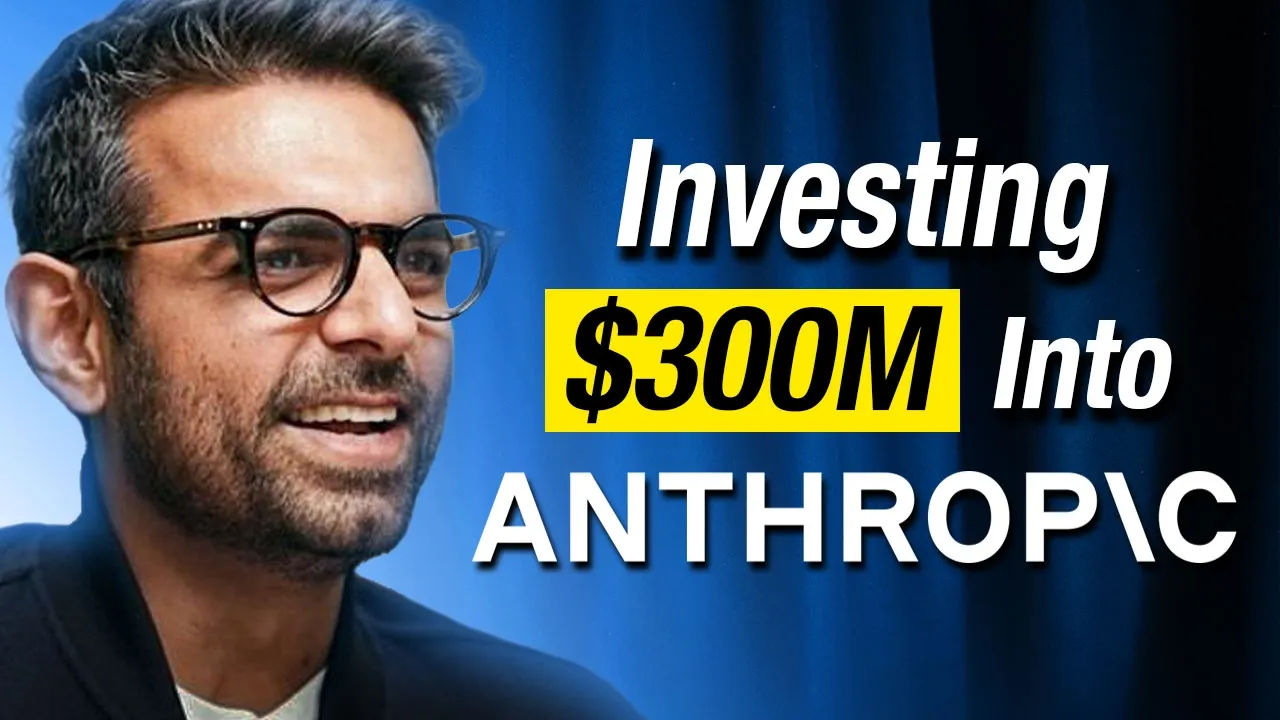
The Early Days of Anthropic & How 21 of 22 VCs Rejected It | The Four Bottlenecks in AI | Anj Midha
Description
Anjney Midha is the founder of AMP, and a founding investor in Anthropic. Most recently, Anj was General Partner at Andreessen Horowitz, leading frontier AI investments. He serves on the boards of Mistral, Black Forest Labs, Sesame, LMArena, OpenRouter, Luma AI and Periodic Labs and is an early angel in ElevenLabs among others. Prior to that, Anj was the cofounder/CEO of Ubiquity6 (acquired by Discord) and a partner at Kleiner Perkins. ----------------------------------------------- Timestamps: 00:00 Intro 01:25 Are Scaling Laws Dead? 02:55 The Four Bottlenecks Holding AI Back 07:36 Why AI for Science Sucked 09:36 Sovereign Data & the Cloud Act 13:31 The Investment Thesis Behind Mistral 14:27 The Brutal Early Days of Anthropic 20:52 Public Benefit Corporations: Mission vs Profit in the Age of AI 23:06 The AMP Grid: Building the Electricity Grid for Compute 25:21 Co-Founding Companies Like Kleiner Used to 35:30 We're in a GPU Wastage Bubble, Not an AI Bubble 37:49 Why Compute Isn't Fungible 42:16 How China Is Winning the AI Race 45:15 Coordinating Defense Against AI Distillation Attacks 49:07 Perfect Competition Is for Losers 01:01:43 Quick-Fire Round ----------------------------------------------- Subscribe on Spotify: https://open.spotify.com/show/3j2KMcZTtgTNBKwtZBMHvl?si=85bc9196860e4466 Subscribe on Apple Podcasts: https://podcasts.apple.com/us/podcast/the-twenty-minute-vc-20vc-venture-capital-startup/id958230465 Follow Harry Stebbings on X: https://twitter.com/HarryStebbings Follow Anjney Midha on X: https://twitter.com/AnjneyMidha Follow 20VC on Instagram: https://www.instagram.com/20vchq Follow 20VC on TikTok: https://www.tiktok.com/@20vc_tok Visit our Website: https://www.20vc.com Subscribe to our Newsletter: https://www.thetwentyminutevc.com/contact ----------------------------------------------- Legal Disclaimer: The content of this podcast is for informational and entertainment purposes only and does not constitute financial or investment adv
Summary
Generated by claude-haiku-4-5-20251001The Early Days of Anthropic & The Four Bottlenecks in AI | Anj Midha
Main Topics
- Anthropic's founding journey: Early fundraising challenges and the founding team's vision
- The four critical bottlenecks in AI: Context feedback, compute, capital, and culture
- Compute infrastructure and standardization: Building the "AMP Grid" as an independent system operator
- Frontier systems vs. foundation models: Rethinking how AI companies should be structured
- Western AI security: Defending against Chinese adversarial distillation and state-sponsored attacks
- The "back to the future" era of venture capital: Deep partnership models versus traditional check-writing
- Optimal competition: Why having 3-4 strong competitors per category beats both monopolies and perfect competition
Key Points
Anthropic's Early Days
- 21 of 22 VCs rejected Anthropic's seed round pitch due to lack of understanding of AI fundamentals
- Original fundraising target was $500M but had to re-anchor to $100M seed round
- Founders Tom Brown, Dario Amodei, and others spent 12-24 months turning research hypothesis into business hypothesis
- Amazon's $4B partnership was crucial because they understood the compute multiplier advantage
- The core insight: every dollar of venture capital could produce intelligence 6x cheaper than competitors
The Four Bottlenecks
- Context Feedback Loops: Data needed for continuous frontier research (most important for business advantage)
- Example: Periodic Labs uses physical verification of materials to create unique training data
- Data locked in national labs, academic institutions, and manufacturing plants is unavailable on internet
- Compute Infrastructure:
- We're in a "GPU wastage bubble" with billions in unutilized compute
- Compute is NOT fungible across chip generations (H100s can't be easily swapped for GB200s)
- This is the biggest existential threat to innovation
- Capital: Needed to continuously fund compute and feedback loops
- AMP is deploying ~$40B in compute infrastructure over 4 years (20% equity, 80% debt)
- Europe needs Google-level infrastructure (~12-15 gigawatts) for sovereignty
- Culture: Often the most important but overlooked
- Mission-driven teams attract best researchers
- Right culture solves the algorithmic innovation problem automatically
- Dario's clarity of mission at Anthropic is exemplary
Periodic Labs Case Study
- Demonstrates context feedback loops in practice
- Uses LLMs to predict new superconductors → robots synthesize → physical machines validate → data feeds back into training
- Shows that scaling laws hold in unexplored domains (no saturation in superconductor discovery)
Compute Standardization Crisis
- Pre-standardization era (like electricity in 1885)
- No open standards for how compute flows across data centers, chip types, or secure boundaries
- Results in boom-bust cycles, wars between companies, and ecosystem waste
- Solution: RFC (Request for Comments) process similar to TCP/IP for internet
The China Threat
- Chinese companies are executing full-stack systems co-design better than the West
- Strategy: Use open-source Western models as bootstrapping mechanism, do adversarial distillation at scale, reach frontier, then stop open-sourcing
- Huawei chips rivaling Western performance through systems integration
- Solution proposed: "Iron dome" for inference—coordinated defense protocol across Western frontier labs to detect and respond to distillation attacks
Frontier Systems vs. Foundation Models
- Critical reframing: Companies like Anthropic, Mistral, Periodic aren't "foundation model companies"—they're frontier systems companies
- Foundation models are just one component of the full stack
- Anthropic has Cloud Code → why wouldn't a model company also need applications?
- Marketing-driven categories misleading investors and founders
Venture Capital Evolution
- Returning to "back to the future" model: deep partnership like Arthur Rock (Intel), Bob Swanson (Genentech), Mike Markkula (Apple)
- Founders need partners embedded in operations, not just check-writers
- Anj spends 3 days/week at Periodic Labs in daily standups
- Traditional SaaS-era venture (just writing checks) doesn't work for frontier infrastructure
Optimal Competition Theory
- Perfect competition (50+ companies in same category) = race to bottom, everyone loses
- Monopoly = hoarding, no innovation, "mafias"
- Optimal competition = 3-4 excellent teams per frontier area
- Returns extraordinary for investors
- Competition keeps teams innovating
- Prevents stagnation
Inference Bottleneck
- Demand for inference growing combinatorially (not linearly) over next 3-5 years
- Current problem: 50 inference companies all competing for scarce compute
- Winners determined by compute supply access, not technical superiority
- "If you're making a steam engine, you need coal"
Notable Quotes
> "AI alignment is hard, but not the hardest problem. Human alignment is really the problem right now."
> "If we don't secure frontier model inference behind a coordinated iron dome, I don't think we have a sustainable shot at staying at the frontier over the next decade."
> "Perfect competition is for losers... monopolies are mafias. What we need is optimal competition."
> "The ground truth of these businesses, machine learning systems businesses, they've always been frontier systems businesses, they were never just foundation model businesses."
> "The bitter lesson is holding well and alive." (On scaling laws continuing to work in unexplored domains)
> "Take life seriously, but don't take it so seriously that you forget what makes it worth living, which is have fun with friends, work on interesting projects with people you love."
> "When the future is not determined, anyone who tells you they can predict it with certainty should be taken with a healthy dose of suspicion."
> "He was right" (Anj's desired tombstone inscription—his obsessive desire to identify where the future is going)
Takeaways
For Investors
- Do the hard work: Educate yourself on frontier technology fundamentals; don't outsource due diligence
- Invest in bottlenecks: Capital allocation advantage comes from understanding where constraints are
- Build, don't just allocate: Venture managers must build with AI themselves to understand real challenges
- Expect huge capex outlays: Frontier technology requires massive infrastructure investment; typical venture returns models don't apply
For Founders
- Understand your full-stack: Don't position as "foundation model company"—think systems integration from the beginning
- Build unique context feedback loops: This is where defensibility and business advantage accrue
- Recruit with mission: Culture and clear mission attract top talent better than any perks
- Partner deeply with investors: Find partners who understand the domain and embed in operations
For Policy/Infrastructure
- Standardize compute: Create open RFC-style process for compute standards (like TCP/IP for internet)
- Coordinate Western defense: Build "iron dome" protocol for frontier inference against adversarial attacks
- Reform pension funds: Unlock capital for frontier infrastructure deployment in US-allied countries
- Manage competition: Actively discourage funding of commoditized categories (50 inference companies) in favor of consolidation
Macro Trends
- We're at 1885 industrial revolution stage for AI—need to build grid infrastructure
- Compute is the constraint, not algorithms or capital
- European sovereignty requires 12-15 gigawatts of local infrastructure
- China's full-stack integration is the existential competitive threat
- Next 3-5 years will see combinatorial demand growth for inference—supply will determine winners
Key Insight: The next trillion-dollar companies won't be "foundation model companies" but rather frontier systems companies that own unique context feedback loops, secure compute infrastructure, and maintain mission-driven cultures—combining deep venture partnership with full-stack integration.
Transcript
AI alignment, don't get me wrong, is hard, but not the hardest problem. Human alignment is really the problem right now. Our guest today is the most prominent AI investor in the ecosystem, Anj Midha. Why is he the most prominent? Three reasons. Number one, he's one of the founding investors of Anthropic. Number two, he led AI investments for Andreessen Horace, where he made investments in Black Forest Labs, Mistral, Sesame, among others. And then third and finally, today he's the founder of AMP, where he provides compute and invests in the world's best AI companies. [SPEAKER_01] If we don't secure frontier model inference, or what I call state-of-the-art inference, behind a coordinated iron dome, I don't think we have a sustainable shot at staying at the frontier over the next decade. There's no saturation in superconductor discovery at all. Ready to go? Anj, I am so looking forward to this, dude. I have stalked the shit out of you for the last three or four days. I spoke to Bing Gordon. I had to catch up with Bing before this. Very nice to speak to him. So thank you so much for joining me today, dude. [SPEAKER_01] Thanks for having me. It's too long. It only took us, what, eight years, nine years? I forget when it was. [SPEAKER_00] I was 12 when we last did it. 12 in startup land is 25, right? [SPEAKER_00] Dude, I'm confused. Help me out. I had Demis on the show the other day from DeepMind. He was, yeah, I'm not sure if we're seeing scaling laws, but we are definitely seeing slightly diminishing returns or performance as we scale. So potentially, are we getting to a stage where increased compute is no longer leading to increased performance? [SPEAKER_01] Oh, no, absolutely not. No, that's not true at all. In certain domains that are well explored, like coding, for example, yes, there's an increasing amount of compute required to get an incremental gain in some eval that's super saturated. But if you said, Anj, what about material science? I'm sitting here at Periodic Labs office. This is my incubation. My latest incubation is called Periodic Labs. I spend three days a week here in Menlo Park. We have a 30,000 square foot facility where we have LLMs that then predict new materials, new superconductors. We then have robots synthesize those new materials. And then we have physical machines like x-ray diffraction machines validate whether those materials have the properties that were predicted by the LLMs. And then we pipe that verification data back into our training run, however many times we need. And I can tell you throwing more compute at the problem is probably having super exponential gains right now per iteration. So it depends on which domain you're talking about, which modality. There's no saturation in superconductor discovery, for example, at all. The bitter lesson is holding well and alive. I totally get that. Can I ask you, when we look at the bottlenecks around performance and progression today, what are the bottlenecks that really persist most significantly to you? Is it algorithms? Is it data? Is it compute? Can you help me understand which is most lagging? [SPEAKER_01] So there's four or five. It's context feedback, which I'm happy to talk about. It's compute. There's capital, which you need to continuously deploy the compute and context feedback loops. And then there's culture. And I think that culture actually might be the most important bottleneck of all. But those are the four, I would say. Now, look, algorithmic innovation, I think, is a function of culture, because if you have the right culture, you get to attract the best researchers. The best researchers then want to work on pushing the frontier. And algorithmic innovation just falls out of having a really good team that's very flexible on what kind of architecture they want to use. If you have the right culture, the algorithmic innovation bottleneck solves itself, because the researchers are not focused or tied to one architecture versus another. They're not going, I'm all in on other lamps or transformers versus diffusion models. The best scientists and researchers just want to solve the problem, the mission. And if you have a very mission-driven culture where they want to move the frontier of coding or the frontier of material science, the algorithmic stuff takes care of itself. But so that's not the bottleneck anymore, in my view. Two, three years ago, that was a huge bottleneck where we were trying to figure out which algorithms scale, if there are some limits to the transformer architecture versus diffusion models. And what I've come to realize is if you solve the culture problem, you can solve the research and the algorithmic problem. Then the bottlenecks are context feedback, which is what is the data you need to keep doing frontier research over and over again. That's step number one, because I think that is where you have the most business and commercial advantage. I think there's lots of alpha and value to be gained in pre-training, mid-training, and so on. But that last mile, where you deploy a model or an agent in some new domain, and then you collect feedback on how it's performing in real time. And then you, like I was saying here, we do physical verification of material science at Periodic. Wherever there are some unique context feedback loops that are missing today, that's where you probably have the biggest bottlenecks on capabilities. And so what you should be doing if you're trying to advance the frontiers is, okay, these models suck. For example, about a year ago, I realized there was a lot of talk about models being good at physics and chemistry, AI for science. And I was a visiting scientist at the applied physics department at Stanford. And we started benchmarking these models—Claude, Gemini, and so on. And surprise, they sucked. They were so bad. And I was, there's a disconnect between the marketing hype of AI for science and the reality where these models are terrible. At the time, they were starting to get good at code, but they were terrible at scientific analysis. And the conclusion was pretty simple. They were just missing a lot of the physics and chemistry data you need to reason about the physical world. But to do that, we don't have enough of that data on the internet, because the internet is mostly pre-trained data about things like blogs and coding. But if you need physics and science, that's a real bottleneck, because that data is locked up in national labs and academic labs, it's locked up in physical semiconductor manufacturing plants. How do you get that data? And that was the bottleneck I realized was really the critical part of getting these models to reason about the physics and science frontier, which is something I care about deeply. And so the way we [SPEAKER_01] The physics and chemistry data, you need to reason about the physical world. But to do that, we don't have enough of that data on the internet, because the internet is mostly pre-trained data about things like blogs and coding. But if you need physics and science, that's a real bottleneck, because that data is locked up in national labs and academic labs, it's locked up in physical semiconductor manufacturing plants. How do you get that data? And that was the bottleneck I realized was really the critical part of getting these models to reason about the physics and science frontier, which is something I care about deeply. And so the way we solved that at periodic was set up a physical lab with robots doing all that. You could apply that same recipe to whatever domain where you want to see more progress. Then you ask, okay, how much compute and infrastructure do you need to keep that RL loop or the physical verification loop scaling at bigger and bigger scale? And then you need the capital to fund all this, you need equity, debt, a whole bunch of different structured finance vehicles. So that's the compute bottleneck. And then lastly, is the culture, because if you have all of those three things, but you don't have the right team and the right mission driven culture, the whole thing falls apart. And so those in my mind are the four bottlenecks I wake up every day trying to figure out how we unblock for the best teams. [SPEAKER_00] If we just go through them, when we look at that context feedback on the data side, will we see a generation of vertically integrated foundation model companies, like periodic for a ton of different things? Yeah. You know, when I went to grad school for machine learning, I went to Stanford for bioinformatics, which was machine learning applied to healthcare. We were in a space that was not as good as marketing as it is today. So super intelligence, love it. You know, at the end of the day, what are we talking about? We're talking about very powerful models within some domain. And we are seeing within distribution, very, very powerful capabilities that are superhuman, because there's no way, for example, I as an individual scientist could analyze the reams and reams of data coming out of the lab here without AI models. There's just no chance. And so the fact that you can take all of the data from training from a physical lab and throw it at a bunch of AI models and ask it to analyze things is a superhuman capability. We didn't have that before. Okay, fine. So let's call that super intelligence. Within coding, within material science, within each of these domain distributions, we are seeing capabilities that are superhuman. We didn't have them before. And in fact, I would say we're even starting to see automation of those tasks, especially where there's coding involved, starting to be somewhat recursive. Where if you have a good coding model, then you can say, okay, let me automate data analysis, let me automate data cleaning and so on. Some people would call that recursive self-improvement, totally happening. But it's not like I can just say to a coding model, please bootstrap a physical R&D lab for me in Menlo Park, get all the permitting, go raise money, go find Anj to raise money from, go set up the physical infrastructure, and just bootstrap all this data. That's an entirely different kind of frontier and execution problem. My question to you then is, how do I determine what is not going to get Claudified in that vertical model company buildout? Because you could look at Cursor and say, well, they've built their own vertical model end to end. And it's been Claudified, if we're being blunt. Periodic won't be because of the physical data that's being produced in the labs. How do I know what will be Claudified versus won't in that model? Yeah, this is a good question. Okay, if we want to unlock frontier progress generally across a bunch of domains, then where are the bottlenecks? And where will the value accrue? Context is not necessarily the moat, I would not say yet. I think venture capitalists are very quick to analyze moats. But I would say context feedback loops, where you have unique and differentiated access, is where progress will be most legible to you. And if there are other teams who don't have access to that context, it'll also be where you have a superior business model. And so here's an example I give in the class, right? Sovereign data. Are you familiar with the Cloud Act? Yeah. [SPEAKER_01] Okay. So the US Cloud Act says that if there's any data workloads, infrastructure, cloud workloads running on infrastructure that is managed by an American company, then the US government has to be able to access that data. Now, if you happen to be running military, defense, mission critical workloads in Europe, on AI infrastructure that is managed by an American company, well, that context, which is super critical, can't be sent across the border. That's an example of a unique and sensitive context that needs to be run locally. And so if you're ASML, you're CMA CGM that's doing logistics at scale, and some of this logistics is with mission critical supplies, you can't have your supply chain data being processed by an AI bot that's running on servers that is subject to the Cloud Act. So what do you do? You look for local infrastructure partners. You start asking, hey, who are the providers, AI infrastructure providers in Europe that we trust? Well, it turns out there aren't that many who can actually handle mission critical infrastructure at scale for AI. So you call up someone called Arthur Mensch, who is a French scientist from DeepMind turned entrepreneur and starts a lab called Mistral, who is running massive workloads. And you say, Arthur, would you actually build infrastructure that can be secure locally? And that's why suddenly in July of 2025, at VivaTech in Paris, you have President Macron and Jensen standing on stage next to Arthur, a 33-year-old scientist unveiling a gigawatt AI infrastructure facility in Paris. Why? Because the context, the mission critical context of those workloads is so important to be run locally, that you can't run them on Amazon, AWS, GCP, or Azure. And it's the first time in 15 years that the hyperscaler dominance is up for grabs for startups. With the greatest of respect, is that the core investment thesis of Mistral for you? [SPEAKER_01] For me? Yeah. Independence at scale, at every part of the AI infrastructure stack—land, power, shell in Europe, that's sovereign, it's local. Compute infrastructure, that's local. And models that are trained locally, by the way, fully open, so they can be deployed and customized globally wherever needed. But certainly in Europe, the full independent stack is the bet. that you can't run them on Amazon, AWS, GCP, or Azure. And it's the first time in 15 years that the hyperscaler dominance is up for grabs for startups. [SPEAKER_00] With the greatest of respect, is that the core investment thesis of Mistral for you? For me? Yeah. Independence at scale, at every part of the AI infrastructure stack, land, PowerShell in Europe, that's sovereign, it's local. Compute infrastructure, that's local. And models that are trained locally, by the way, fully open, so they can be deployed and customized globally wherever needed. But certainly in Europe, the full independent stack is the bet. Yeah. [SPEAKER_00] Do Anthropic and OpenAI just accept that and roll over? I don't understand, because government is a mega portion of their efforts and workload today. And both of them, when I speak to them, they're like, Oh, we're absolutely coming for Europe. So how do they get around that? Well, I can't speak for OpenAI too much, because I'm not involved there directly. But Anthropic, I will say, the mission and vision has always been very American aligned, right? They've always said, Hey, America is the crown jewel of the world in terms of innovation. This is where we're located. Anthropic is located in Silicon Valley. And I think the company really wants to do what's best for the American government and the American way of life, which is democracy and freedom. It turns out the world's largest enterprise customers are governments and fortune 500 companies. And many of those that are overseas need these workloads to be running locally. You said about obviously being involved with Anthropic since the earliest of days, I'm just fascinated. I think people forget about their early days, people talk about SPF investing early and what a visionary he was, right? What was Anthropic and Dario like in the early days? Well, so I've known Tom forever. Tom was one of the lead authors on GPT-3. We'd been friends for many years. Tom gave me a call and said, Anj, you know, for various reasons, we want to leave and start this new lab called Anthropic. We're going to need a lot of capital. We're going to need compute. I had already sold Ubiquity 6 at that point. So I'd gone through the founder journey. And Dario, Tom, and I started doing these weekly sessions in early 2021 to try to figure out how to turn what was really a research hypothesis, right? Which is scale, the scaling recipe into a business hypothesis. And look, I would say it took 12 to 24 months. And they did a lot of the hard work on figuring out how to operationalize the idea of this AI pair programmer, right? Where you take the context feedback loop of the local repository, the files, the directories of programming, and in a very methodical way, make predictable progress on the capabilities of software engineering. And I thought it was very good. My biggest flaw as an investor and as a founder is being too early to things. That was my lesson with Ubiquity 6. I was early to the whole computer vision, which is now obviously blowing up the whole multimodal generative modeling space. And since then, I have updated my strategy on how to get timing right. But at the time, the recipe was pretty simple, right? Raise some money, buy some compute, get a little bit of context data on programming, put out a basic version of the model, deploy it with teams that we trust who are doing coding, and pipe that feedback loop back into the training run over and over again. And when you do that with inference, inference gives you two things, right? It gives you revenue to buy more compute, and it gives you the context feedback to keep improving the capabilities curve. And I was like, great, this makes total sense, guys, let's go raise money. I've invested a bunch of my money that was just life savings, which was not much given I was a poor founder at the time, where most of my net worth was tied up in Discord stock. And it pains me sometimes to look back at the emails of friends. So I introduced them to 22 friends up and down Sandhill Road. And so there's some investors there. And we got 21 no's, right? And I was like, what are you guys thinking? And they said, well, this recipe sounds good in theory, but where's the proof? And I said, proof? These are the guys who invented GPT-3. How much more proof do you want? And they said, what's GPT-3? I said, Oh my God, how do you go about educating somebody who doesn't even understand the technology and the breakthroughs that are happening in the machine learning community? Now, I was lucky because I had that training from grad school, I'd started a computer vision company. So something that was super legible to me was a completely different world. And for those investors we were pitching, remember, we originally tried to go out and raise 500 million, and then had to re-anchor to only raising 100 million dollar seed round, which at the time felt like a lot, but of course was tiny compared to how much OpenAI had raised, because by then I think OpenAI had already raised a billion dollars. And so the whole idea of compute multipliers where we could, for every dollar of venture capital raised, produce a unit of intelligence for six times less was not understood by the VCs, which is why over the next 24 months, the people who got it were either people in the ML community who also had an overlap with the effective altruist community like SPF, but also Amazon, right? This was very legible to Amazon, because they were watching what was happening with Azure and OpenAI. And they were like, well, this is super aligned. If you guys actually can create a bunch of state of the art models that are hosted on Amazon, that's super aligned to the AWS business. And that's why it resulted in deep compute and capital for equity partnership with Amazon that was originally 4 billion dollars. A lot of this is public now. But at the time, it was a really tough journey. And I would give Dario, Tom, the other co-founders, Daniela, Jack, Sam McCandlish, Jared Kaplan, they were going through such a brutal time getting this company going. People don't understand. Is there anything you would have advised them differently knowing all that you know now? I'm not sure I would because the world is a very different place today, you know? And at the time it really did feel like there was no one they Amazon that was originally $4 billion. A lot of this is public now. But at the time, it was a really tough journey. And I would give Dario, Tom, the other co-founders, Daniela, Jack, Sam McCandlish, Jared, Jared Kaplan, they were, it was such a brutal time getting this company going. [SPEAKER_00] People don't understand. Is there anything you would have advised them differently knowing all that you know now? I'm not sure I would because the world is a very different place today. And at the time it really did feel like there was no one they could trust. [SPEAKER_00] Is it not impossible not to be hauled up in front of Congress if you reach a certain scale? [SPEAKER_00] Yeah. Whether you're Google or whether you're Facebook or whether you're Anthropic fighting against the Pentagon, you get to a scale where it is impossible not to have that conflict. Oh, absolutely. What are you talking about? Look, I started AMP as a public benefit corporation because I think it's actually a very aligned model. Have you heard of REI, right? REI is a public benefit corporation. They make billions of dollars in revenue and profit. Have they ever been hauled up in front of Congress? No. Ben and Jerry's public benefit corporation. Have they been hauled up in front of Congress? No, it's because they self-moderated, right? At the time they said, here's our mission, but we have to make, we have to build a business. And as long as you hold those two things in tension, those things are not in conflict long term. If your goal in life is long term to push humanity forward in some stable, reliable way, then there are always tensions where you have your mission and then you have your profit motive and you've got to be able to moderate between those two. And I think public benefit governance allows you to do that. And I think we need more public benefit charters in Silicon Valley and in technology. And I think we will get there. If you look at the arc of infrastructure businesses, for example, right? [SPEAKER_00] I actually had a chat with a mutual friend of ours who asked not to be revealed. Okay. And they said, for fuck's sake, all these PBCs, public benefit corporations, will these startup founders not just win their market first? [SPEAKER_01] How are they feeling? Are they investors in Anthropic? [SPEAKER_01] No. Okay. So tell them to give me a call when they'd like to be investors in the world's fastest growing business of all time. And then they can lecture me about public benefit governance and market share options. Public benefit governance gives the leadership the ability to make decisions that sometimes are not legible to shareholders as best for them. What decision can you foresee with AMP that is aligned to your mission, but does not put the profit motive slash incentive first? [SPEAKER_01] There are many up and down the stack because we see ourselves as a full stack scaling partner to the best frontier technology teams. And we also see ourselves a little bit as how our job is to propose independent standards for AI. And as an institution, try to evangelize the adoption of those standards through profit generating businesses. We have a venture capital business. We also have an infrastructure business. A good example of this for now is we're actually giving away most of our compute at cost. Now, if you're a shareholder, you'd go, wait, do you have billions of dollars of compute infrastructure? You're giving away at cost? Yes, because we think that's the right thing for humanity. And we think that's the right way long term to have a healthy independent ecosystem, which is what our mission is. Our mission says AMP is a public benefit holdings company. Our vision is to ensure there's a healthy independent frontier technology ecosystem. Our mission is to maximize the world's frontier output. To do that long term, we think the teams that are truly doing innovation, truly pushing the frontier of science and engineering need compute access. And many of those teams today can't afford to pay price gouging, the extraordinary prices for compute infrastructure today. And so we're happy to provide them access to that in a way that's mission aligned. [SPEAKER_00] Anj, how do you secure the compute supply? Maybe I should know this, but it's the most starved resource today. How do you secure a resource that no one else can seemingly secure? Well, step one is you get there first before people realize how valuable it is. And luck. I've been beating the drumbeat on this for four years now, right? When I got to A16Z as a general partner, the first thing I did is I sat down with Mark and Ben and said, we need more compute. We need compute access for these incubations I'm going to do. And they said, no problem, Anj. Let's set up a program. What do you need? So we used our balance sheet to start procuring compute through the Oxygen program. That gave me the ability to build pretty deep relationships with the industry and build trust with compute partners who now we have lots and lots of relationships with that we're scaling in ways that would be very hard if I didn't have that time and the flexibility to understand what is required to really get that infrastructure right. We've talked a little bit publicly about what we're building, which is the AMP Grid, which is essentially what the electricity grid did for electricity. We're trying to do for compute infrastructure. We see ourselves as an independent system operator of the grid. We're not a cloud provider. We don't own our own data centers. We're not a traditional venture capital firm either. We see ourselves as an independent system operator, which means our job is to coordinate capacity across the ecosystem in a way that allows the best teams, the best independent teams to provision for their base load, not their peak. So they don't have to over provision. But when they want to spike up and down for training runs, for inference needs, they feel secure that the capacity exists. We are roughly in 1885 industrial revolution England right now, where you have all these frontier labs that are factories and the steam engine has been discovered. You can use steam to produce all kinds of new products. And many of them are running their own generators in their backyards at half capacity. And I'm going, this makes no sense. Let's all pull our generators so that a shoe factory can spike up during the day, a steel factory can spike up during the night, and then you maximize utilization and ultimately output. [SPEAKER_00] When you think about allocating it, are you not using compute and the cost of compute as a loss leader for your venture fund business, which then comes in and says, okay, you name any of your incredible businesses that you're in, whether it's your Anthropics, your Mistrales, your Black Forest Labs, and say, okay, you'll get the compute at cost. But for that, we need $300 million invested. And that's your way of winning. That's not at all how we make the... Those are not... That's not the deal. during the night, and then you maximize utilization and ultimately output. [SPEAKER_00] When you think about allocating it, are you not using compute and the cost of compute as a loss leader for your venture fund business, which then comes in and says, okay, you name any of your incredible businesses that you're in, whether it's your Anthropics, your Mistrales, your Black Forest Labs, and say, okay, you'll get the compute at cost. But for that, we need $300 million invested. And that's your way of winning. That's not at all how we make the... Those are not... That's not the deal. The deal is I incubate new companies, like Periodic Labs, one at a time. That's all I can only do is one at a time. Because I like to team up with scientists or engineers who are at the forefront of their field. It takes a lot of work to create these new companies from scratch. In many ways, I had the privilege to realize that we are entering a back to the future era of venture capital. If you think about the birth of modern industries, let's talk about semiconductors, gene editing, the biotech industry, or self-driving cars. Silicon Valley, in the early days of the founding of what I call these frontier industries, the way you start the most iconic companies is very different from how companies were funded for the last 10 years in the Zorp era. Intel, for example, was a very close partnership between a couple of scientists and an investor called Arthur Rock, who was a founding investor and was at the office every day. Arthur literally wrote the stock incentive plan. He used to run all hands at the company every week. If you look at Genentech, which was incubated in the basement of Kleiner, the co-founders were Herb Boyer, professor at UCSF, and Bob Swanson, who was an associate at Kleiner. And I got to apprentice in that mode of venture capital, because when I got to Kleiner, I was wrapping up grad school at Stanford Med School, but I was working nights and weekends at Kleiner on the investing team. And Brooke Byers, who was at KPCB, had an office next to me, and he had some free time. So I would go to him and ask him to teach me your ways. And he regaled me with all the stories of how Genentech was being founded. And I was like, wait, so you're saying Bob co-founded Genentech here in the basement of Kleiner? And he was like, yeah, we were. That's what it meant to be a partner. And I said, well, that's not what happens here anymore. We write a bunch of checks to SaaS companies, and then they go off and do stuff. And he was like, different times. [SPEAKER_00] Are they mutually exclusive? And what I mean by that is, can you have a venture ecosystem where you have a bunch of people writing a bunch of checks, as we have done for the last 10 years, and a next generation, or to your point, a back to the future era of venture capital, where you co-found the business side by side? Can they run side by side? Or are we actually entering an era where we're back to the future era, as you say, where value accrual is in the co-founding and incubation side? I think it's very hard for them to coexist inside of one person. And it's very hard to coexist sometimes inside of even one firm, because there's a reason I'm sitting here at Periodic Labs. I work here three days a week, every day from 8am to 8:30am for the last year, Liam Doge and I have had a standup every morning where we go through the priorities of the company. And then we make them, we prioritize, we go and execute. The compute team of AMP is sitting upstairs, procuring compute for the Periodic guys. My role models have always been the Arthur Rocks and Bob Swansons and the Mike Markkula of personal computing. Effectively, the first CEO for the first year of Apple was Mike Markkula. He was an angel investor. And he was the one doing all the CapEx, supply chain and capital and all of that stuff that allowed Steve Jobs and Woz to focus on the product and the engineering. And that kind of deep partnership is what I get really excited about. [SPEAKER_00] Can I get back to something you said before, which is like, we're at the industrial revolution stage. And I was like, okay, help me understand that. If we're at the industrial revolution stage, what does that mean for where we're going and how I should be acting as an investor today? You have to hold two things in conflict that can seem paradoxical. And this is the most important thing I learned from Mark and Ben, which is when the future, the future is not determined. And so anyone who tells you that they can predict the future with certainty should be taken with a healthy dose of suspicion. And instead, I try to approach things like a scientist and go, what are the biggest bottlenecks? Let's come up with a hypothesis on how these bottlenecks will be solved. And let's run multiple experiments in parallel. And then whichever one emerges, you just have to be very truth-seeking and be willing to say you were wrong. And I would say as an investor, your job is to come up with a hypothesis for where the future is going, and be willing to make multiple different experiments that are aligned with your mission in parallel and be willing to be wrong and be honest with your LPs that some of them may be wrong. [SPEAKER_00] What do you say to a Brian Singerman of the world who always said that I'm not smart enough to predict the future, but my job is to pick founders that are able to do so. I think that the most, the safest way to predict the future is to invent it. So do the hard work, come up with your point of view on if we're an industrial revolution in England, what happened next? And what were the emerging properties of the businesses that became valuable in institutions over the next 50 years after 1885? And then figure out which part of that world, which figure from history of that era, do you look up to the most? And go read about their lives and the businesses they ran and the tensions that emerged in the practice of their business later in life, because then they made mistakes when they were young and try to learn from their mistakes and then go and execute. [SPEAKER_00] What's a parallel property direction from 1885 onwards style timeframe that you think will play out in the next era? Well, obviously in the world of infrastructure, I think we need something like the grid for compute infrastructure. So that's what I've spent most of my days on. world, which figure from history of that era do you look up to the most? And what would you go read about their lives and the businesses they ran and the tensions that emerged in the practice of their business later in life, because then they made mistakes when they were young and try to learn from their mistakes and then go and execute. [SPEAKER_00] What's a parallel property direction from 1885 onwards style timeframe that you think will play out in the next era? Well, obviously in the world of infrastructure, I think we need something like the grid for compute infrastructure. So that's what I've spent most of my days on, which is a coordinating mechanism that allowed the transition of coal and electricity from being these resources that were being hoarded to being stable, reliable commodities that the best engineering teams, the best factories had access to, right? That's what I think about a lot. I think if you're so talented at media and you're so talented at storytelling, and your mission is to push the European continent, I think one of the things, if I was you is I would be talking, trying to figure out how do we educate the leading capital allocators and infrastructure allocators in Europe about the coming era, whether that's through media, whether that's through educational programs and get them to understand their role in unblocking the bottlenecks for the best scientists and engineers in Europe. And largely a lack of pension fund reform in a lot of cases, to be quite honest. [SPEAKER_00] Okay. So spend your time on pension fund reform. How much more cash do we need in Europe for frontier AI to be what we think it can be? Is it like 2x? Is it 10x? That's a good question. I would try to go about it from a top down approach and bottoms up sizing approach. For us at AMP, when I look at the grid, we are building out, which is a reasoning by analogy. We've started securing about 1.3 gigawatts of compute infrastructure. That's roughly $40 billion of cloud spend over the next four years. And that is financed roughly between about 20% of equity, the remaining is debt. So 20%, that's about $10 billion of equity capital. The remaining is all debt capital. We have a bunch of partners that help us put together these equity and debt packages to secure compute infrastructure for our companies. I would say in Europe, I would talk to Arthur and figure out how much he thinks is required for the independent ecosystem over there. But in multiples of gigawatt, if you're doing your atomic unit of math in gigawatts, I would, from a top down perspective, think Google is roughly at 12 to 15 gigawatts of infrastructure for internal and external deployed needs. Now, they have a huge land power shell pipeline coming. But if Europe does not have access to Google level infrastructure, then what are you guys even doing? That's roughly what the continent needs for full sovereignty, to have at least as much infrastructure locally as there is within the alphabet holdings pool over the next four years. [SPEAKER_00] Is the debt what's easier, the equity raise or the debt raise? I would say the biggest challenge has been figuring out the right aligned financial structure across both in a way that's legible to capital allocators at scale. Took me about a year to really get all the pieces right. But there are very large equity pools, a lot of balance sheets, long term mission line balance sheets in the world who have, who are mission aligned at wanting to help frontier scientists researchers, university labs get access to the compute they want. But they don't have OPEX. They don't have cash to spend on the compute. So if you can find a way to align equity, debt balance sheets in a way that's de-risked, the fundraising is not a problem. It's actually a systems design problem, which took me again a year, probably took me four years to get right. But now that we figured it out, it's not been a problem. [SPEAKER_00] Do you think we are under invested still today in data centers? We are deeply under invested in security, in secure compute. Let me put this, we are not in an AI crisis. We're not in an AI bubble, for sure, which is the question I keep getting asked. We are definitely in a GPU wastage bubble, where there are stranded pockets of compute, billions of dollars of compute that are sitting unutilized. And if we could pull them together on a grid across the independent ecosystem, why are they unutilized? For a couple of different reasons. One is their compute is not fungible. So unlike electricity, which had to go through a process of standardization, AC/DC, where megawatts are megawatts are megawatts, compute is not fungible today. So forget fungibility of compute across different manufacturers, like NVIDIA and AMD. Within a manufacturer, NVIDIA chips, for example, the H100s, the GB200s, the GB300s, these are all completely different chip types. So if you have one cluster where you're doing a training run on H100s, and then you want to do continued post training of that, or have that do a distributed training run of that training workload on GB200s, it doesn't work. So they're stranded pools of compute because flops are the atomic unit of computation. I wish flops were fungible, but not all flops are born equal today. And so if you provisioned a cluster two, three years ago with H100s, and now you want to run some of those workloads on newer generation models, you're memory bound by H100 chips. You can't unlock the benefits of the Blackwell chip without basically buying a new cluster. And so now suddenly you have this H100 cluster that you don't want to do training on anymore, because it's old school. The chip doesn't have the right memory properties to train your frontier models. And so it's very hard for any individual company to see all of this stuff. But when you're on seven or eight boards, like I am, and you've been doing this 15 years, and you start to see patterns emerge, you're going, wait a minute, why is there all this unutilized compute sitting here and there? This is pointless for everybody. [SPEAKER_00] Are frontier models moving faster than the pace of chips, as you said there with H100s, where you have newer and newer models, and then you're training them on older and older chips, because that's what's free. And it's not moving in lockstep. Is that the problem that we're articulating? No, no, the problem we're articulating is that compute is When you're on seven or eight boards like I am, and you've been doing this 15 years, and you start to see patterns emerge, you're going, wait a minute, why is there all this unutilized compute sitting here and there? This is pointless for everybody. [SPEAKER_00] Are frontier models moving faster than the pace of chips, as you said there with H100s, where you have newer and newer models, and then you're training them on older and older chips, because that's what's free. And it's not moving in lockstep. Is that the problem that we're articulating? No, no, no. The problem we're articulating is that compute is not fungible. There are no standards for fungibility, and there are no institutions enforcing standardization of compute enough. So we are in the pre-standardization era of compute today, which was the pre-standardization era of electricity in 1885. And hopefully we can self-regulate, self-standardize, and self-enforce standardization so that we can skip the boom and bust cycles that happened with electricity over the next 50 years. This happens with every infrastructure cycle in the pre-standardization era. It happened with electricity in 1885, it happened with steel, it happened with railroads. Every time you have this boom and bust cycle, what happens is wars are fought, companies backstab each other. It's super painful. My view is that compute not being fungible is what's resulting in all this talk about AI, the AI bubble. But what people forget is that we don't have an AI capabilities bubble. The capabilities are extraordinary in every domain. We have an infrastructure wastage crisis right now. It's because there are no open standards, there's no open protocol for how flops from one data center can flow to somebody else who needs it across chip types, across secure boundaries. It's resulting in a lot of pain for the ecosystem. [SPEAKER_00] If we have compute standardization in the way that you said, will we remove the boom and bust cycle, or is that just one part of it? I think that will go a long way in preventing this and instead just allowing this. [SPEAKER_00] I'm sorry for asking. So you're like, Jesus Christ, Harry, I'm a professor at Stanford and you waste my time with this, which is a fair statement. British accent goes a long way there. What is the biggest bottleneck or barrier to compute standardization that you want to achieve? It all goes back to alignment, man. Misaligned incentives up and down the stack. [SPEAKER_00] How is Silicon Valley and DC not on the same alignment? For one, I don't think we have standardized on whether AI should be regulated, treated, procured as just good old fashioned software, or like a new kind of system. You know, I went to grad school for machine learning. What you learn in machine learning 101 is models are statistical. They're not deterministic, right? So when you have a statistical system, it's different. There are some properties of a statistical system that are different from a spreadsheet. A spreadsheet is deterministic software and a statistical model today is not. Should the procurement of a spreadsheet be the same from an IT perspective as a statistical model? Open debate. That is the core debate. That's the problem. AI alignment is hard, but not the hardest problem. Human misalignment is the problem right now we have in the world. We need technologists who understand the difference between deterministic software and statistical systems to propose a set of standards for how procurement should work. Then we need standards people in DC. We have NIST. We have various bodies in the government that should get together and say, thank you guys for proposing this standard. This is where it makes sense. This is where it doesn't. This is called an RFC process. We're going to standardize on this definition of procurement. This is what happened with TCP/IP with the internet. It happened with AC, DC and electricity. We have not done that yet for the model era. The standardization process is being confused with marketing. President Trump is trying to do his best, from what I can tell, in giving America enough freedom to innovate so these standards can even be discovered in our labs here. First, you need somebody to actually pioneer and figure out what the standards should look like. [SPEAKER_00] There's a lot of noise. Do you worry that the CCP is subsidizing a generation of Chinese models that are now being used by American companies, whereby they have frontier models to essentially set where model capabilities can be, and then have a real effort to make the open source Chinese models as close to those benchmarks as possible, much cheaper? Yeah. The engineering execution right now, up and down the stack in China, is extraordinary. Here's what's happening. What they realized is that the AI scaling race is not a chip race. It's a full stack systems co-design race. If you can't compete head to head on chips for now, what do you do? You compete on systems design. You say, okay, we don't have leading edge chips yet. So we try to compete on systems. You co-design the chip that you have, might be Huawei, with the compute infrastructure, with the training run. Then you design that to have a bunch of performance improvements at every layer of the stack. Then you do adversarial distillation at scale, where you take Western models from various different endpoints, you distill the state of the art, and then you try to get as many performance gains as possible on that data. Then you release that back out to the world as open models, and you see what people react to, you get feedback, you do the next run, and the next run, and then you catch up. At the point you catch up, you say, wait a minute, we're starting to be at the frontier. Why do we need to open source anymore? This is good enough for our local domestic needs. It's beautiful. It's actually resulted in innovation. They're innovating at every step of the cycle. That's why Huawei chips are able to produce capabilities improvements today in China that rival some of the best chips here when integrated up and down the stack. In a sense, it's the Google strategy, right? Google is integrated with PowerShell, TPUs, Borg, XBorg, GQM, Gemini, then the deployment. The systems co-design up and down results in efficiency that gives you huge performance gains at the end of the day. China has replicated that strategy using open source as a bootstrapping mechanism to catch up. It's extraordinary. [SPEAKER_00] Does that concern you? Are you kidding? Absolutely. That's why I think what we need is a Western grid where all frontier inference is served through an iron dome. in China, that rival some of the best chips here when integrated up and down the stack. In a sense, it's the Google strategy, right? Google is integrated, Land PowerShell, TPUs, Borg, XBorg, GQM, Gemini, then the deployment. The systems co-designed there up and down results in efficiency that gives you huge performance gains at the end of the day. China has replicated that strategy using open source as a bootstrapping mechanism to catch up. It's extraordinary. Does that concern you? Are you kidding? Absolutely. That's why I think what we need is a Western grid where all inference, frontier inference, is served through an iron dome, right? Where if there's any adversarial distillation attacks on any one of our teams, we coordinate together. Because I'm on seven boards, I'm in group chats where I get texted by one founder saying, Anj, is anyone else noticing today that there's a huge spike in distillation from this region? And then I put them in a group chat, we coordinate, it's very informal right now. [SPEAKER_00] But what we need is... You said before that state-sponsored attacks on frontier AI labs are getting worse. What do we not know that we should know? We should know that there are insider threats. We should know that there's distillation happening across the US and Europe that is taking advantage of our not being united. That distillation is taking advantage of our political systems. That our mission-critical infrastructure is quite vulnerable, especially data centers that are serving workloads that are being used by enterprises. And I think that from a business standpoint, if we don't secure frontier model inference, or what I call state-of-the-art inference, behind a coordinated iron dome, I don't think we have a sustainable shot at staying at the frontier over the next decade. [SPEAKER_00] I'm sorry, what does that mean, an iron dome for inference, in terms of sustaining it? It means that all inference is served, no matter which company is serving it, through a shared proxy that can tell each other when there's an attack happening on one part of the frontier. Think of it as an iron dome across the entire Western Front, right? And just because you're here, you're in one company, you can't see that your model being served through this other company is being distilled. So it's a deployment coordination protocol. It's basically my group chat that I've got with a bunch of different founders, but scaled. Where people go, we're seeing this attack today, and others go, we are too. Let's coordinate on defensive response. [SPEAKER_00] I'm sorry for my lack of cohesion on this question. Really, I feel guilty, and I don't blame you for leaving this interview thinking, God, he's got worse over the eight years, not better. But I was watching this interview, speaking of inference, with someone, I think, from Base 10. And they were saying that the demand for inference has grown not linearly, but combinatorially. And that is how we would see it progress over the next three to five years. Do you agree with that? If we keep scaling capabilities, that will definitely happen. The problem is there are a couple of bottlenecks on scaling capabilities that are quite existential. One of them we've talked about is the four core bottlenecks on capabilities progress. It's context, compute, capital, and culture. And I think capital allocation is a huge problem. We've got to educate people on why these capabilities are extraordinary. This is the biggest financial bonanza of all time, if you know where to allocate. I mean, there's a reason why I invested in Anthropic in the seed round. And now, as you've pointed out, the returns of all the body of work I've done in the last four years are attracting LPs at the highest levels. But we're just getting started. And so I think some of these projections you see are correct if we unblock the bottlenecks along the way. And computer infrastructure, secure compute infrastructure that's fungible, that's standardized, that's the biggest bottleneck. I think if there's any reason why OpenAI, Anthropic, Gemini, and so on, don't hit their revenue targets over the next few years, it's because they won't have access to enough compute. There's a related bottleneck. When I was at Stanford many years ago, as a kid, I took this class that Peter taught called, I think it was turned into this book called Zero to One. This is Peter Thiel. I used to be an editor for the Stanford Review. And he had this quote, which is competition is for losers. And having done this now for 15 years, I've kind of updated my theory of business. And I think he was not wrong, but he was insufficiently precise, which is that I think perfect competition is for losers. I also think monopolistic, what does that mean? Perfect competition is for losers? It means that if you have 10 different, like 50 companies all doing LLM training or doing coding models, that's a losing proposition. It's like restaurants. There's no defensibility. That's why restaurants go out of business all the time. It's very hard for them to differentiate. On the other hand, in monopolistic situations, monopolies are mafias. If once you have a monopoly at one part of the stack, they stop innovating. Instead, they try to go up or down by using their balance sheet to acquire. They start hoarding resources. They start saying, you give me this, and I will force you to basically subsume yourself to me. And I'm seeing that kind of behavior up and down the stack. And mafias are not good for innovation. I think we're in an era where what we need is optimal competition. The optimal competition set up is you have three or four teams in every frontier that are making extraordinary progress. And so if you invest in them, you get extraordinary returns, but they're not so comfortable as to be a monopoly such that they can stop innovating. And that's important because when they stop innovating as humanity, we're fucked. And so I believe that optimal competition is something we need to transition to in frontier technology. And I think we need leaders, stewards, venture capitalists, politicians, educators to remind the world that we have already lived through this era of boom and bust and so on. And so these companies, like what's going to happen, right? Like you said, Anj, Baystan, and inference, all these companies. Inference is an extraordinary growth curve ahead, but it's not going to be an extraordinary growth curve if there are 50 inference companies all competing with each other on a race to the bottom, which is what's happening right now. It is not clear to me that we need 50 inference companies. And it's not clear to me that VCs are smart enough to realize that they're just lighting hundreds of millions of dollars on fire in a category where having four or five really good inference trusted providers is net good. through this era of boom and bust and so on. And so these companies, like what's going to happen, right? You said, Anj, Baystan, and inference, all these companies. Inference is an extraordinary growth curve ahead, but it's not going to be an extraordinary growth curve if there are 50 inference companies all competing with each other on a race to the bottom, which is what's happening right now. It is not clear to me that we need 50 inference companies. And it's not clear to me that VCs are smart enough to realize that they're lighting hundreds of millions of dollars on fire in a category where having four or five really good inference trusted providers is net good. [SPEAKER_00] But will the VC subsidization of 50, 20, 50, 60, 70, whatever companies it is, not make it impossible for the good companies, the four or five to progress through that cycle? [SPEAKER_01] Anj, it's a bit of a self-destructive mechanism because if you have 50 different companies all competing for scarce compute resources, then the folks who are actually innovating can't get it. And so they can't do their next round of product innovation and so on. And that's the problem when you have something like this. Is that where we are now? [SPEAKER_01] That's where we are right now. The best inference teams are calling me up. Actually, all the inference teams are calling me up and saying, Anj, do you have compute for us? Because their product is reselling compute, but it's been hoarded. It's been hoarded by the hyperscalers. It's been hoarded by people who are not innovating, but are sitting on compute. And it's so obvious to me now that I've left A16Z, I'm an independent ecosystem public benefit corporation, that the existential threat to innovation in this category is lack of compute. That's why AMP started procuring compute for the independent ecosystem a while ago. And so we are trying to find a way to get these teams enough compute that they need to keep innovating. What will determine the four or five inference companies that win versus the others that don't? Supply. Access to supply. [SPEAKER_00] It's that simple? Yep. Compute supply. If you don't have compute, how do you do inference? What are you selling? You need a product to sell. So if you're making a steam engine, you need coal. [SPEAKER_00] One of your former partners tweeted last night that we're going to enter a time where only model creators access the most powerful models. And that will power, obviously, the services and the application layer or the apps that they provide. Do you believe that will be a world in which we exist, where model providers inherently safeguard the best models for their provisioning of apps, a la Claude, potentially, or not? [SPEAKER_00] What Martin is suggesting is that in competing cases, they will offer a worse model, which gives them an advantage. As an example, Eleven Labs, which serves a huge amount of application layer companies, will reserve their latest models so they can offer the best customer support and then sell their older models to Sierra and Decagon so they have a worse quality model, retaining the best for themselves. The embedded assumption there, what we have learned empirically over the history of technology, is that if you have a general purpose product, like the iPhone, that works for everybody, then the natural incentive is to amortize the cost of product development of this over the largest number of users. So if you have a general model that's good for everybody, it will be available to everyone. If you have specialized models that are good for some people, there will be product segmentation. And I think what this is telling us is that if there are many custom models, some of them will be accessible, others will not be. And so if anything, I think we should see the fact that there are Frontier Model Labs saying, hey, here's a new model we have. It only makes sense for some large enterprises to access this as vindication of the ecosystem truth that there's going to be an ecosystem of different models of different types. There's no one large God model. And because if there was, I think there would be the market desire to have prime ministers, presidents, and I and students all use the same iPhone. Because inherently you can raise the most money and invest the most product budget dollars for a general product and amortize the cost of that across everybody. But if you have specialized models, yeah, I don't think they're going to be accessible to everybody and they don't need to be. I think this open and closed access thing is somewhat overblown. I think it just empirically from a systems perspective, if you look at the history of technology, if you have general products, they're distributed to the masses. If you have custom products, they have enterprise segmentation, some are accessible to the enterprise, others are not. [SPEAKER_00] Are there foundation model layer companies that are yet to be built that will be worth over $100 billion? Oh, so many. Periodic is one. I'm sitting in one right here. But they're not foundation model companies. I would call them frontier systems companies. This is the problem. Every time I kept calling, trying to educate people four years ago where they'd be like, Anj, but Anthropic is a foundation model company and Mistral is a foundation model company. No guys, that's just one part of what they do. Maybe they're starting there because that's a core competence. But there's a reason why Anthropic also has a thing called cloud code. And there's a reason why Mistral has something called Mistral compute. And there's a reason why Microsoft, who's a cloud, also has a copilot business. You know, these labels, categories of foundation model, need to be viewed, I think, with more suspicion than they are. What matters is the systems co-design, the systems, the full stack frontier research loop that you need to run with customers. And then later, when that happens, when you say, Oh my God, Anj, Anthropic is now they have they were a model company and now they're launching a product called cloud code. And I was like, What do you mean? If that was the part of the plan all along? Of course you need to have a pair programmer interface for a model. Why would you assume otherwise? Because you just weren't paying attention. And you had your neat market maps that your associates were giving you. And you thought that was truth. These, the commercial community has forgotten how to build businesses. And they've forgotten the difference between first principles and marketing. That's the problem. That's one of the other misalignment problems. The ground truth of these businesses, machine learning systems businesses, they've always been frontier systems businesses, they were never just foundation model businesses. Now, okay, if you had to package that up and tell your LPs that because that was legible to them, then I can't blame you. I guess, but the LPs I work with, I'm very upfront with them. I say, Look, these categories are going your associates were giving you. And you thought that was truth. These, the commercial community has forgotten how to build businesses. And they've forgotten the difference between first principles and marketing. That's the problem. That's one of the other misalignment problems. The ground truth of these businesses, machine learning systems businesses, they've always been frontier systems businesses, they were never just foundation model businesses. Now, okay, if you had to package that up and tell your LPs that because that was legible to them, then I can't blame you. I guess but the LPs I work with, I'm very upfront with them. I say, Look, these categories are going through huge reinventions. And if you want, when you partner with me, what you get is a full stack partner, and I will tell you the first principles of what's going on. And these first principles insights will change over time. But you got to be comfortable with huge capex outlays in businesses that end up winning the entire category. That's what frontier technology is. So I don't know, I think foundation models have been deeply misunderstood. And this is part of why I started the class four years ago, I just thought security at scale was going through a bunch of reinvention. And then we reinvented the class to be infrastructure at scale last year. And this year, it's frontier systems, because not enough people realize that to keep the tech, the capabilities frontier moving, you need to think about these projects, these companies as frontier systems projects, not foundation model projects. Does that make sense? [SPEAKER_00] It does. But when I hear about the capex required, I respectfully asked, Do you have enough money? I think the $1.3 billion was no. How much money? Yeah, how much money do you need? Well, for the gigawatt, 1.3 gigawatt, which was our proof of concept, that capital is not a problem. I think the question is, if you want to scale beyond that? Yeah, we need way more capital to be deployed across the Western front in the United States and US allied countries. How much money do you think you need? As long as the capabilities frontier keep moving, and we want a healthy, independent ecosystem, we'll just keep raising more capital. There's no end to that. I don't really. The day machine learning stops working as a systematic way to give humanity more capabilities, that's when I'll say we have enough, Harry. But that's so far out. I don't even know how to reason about that. [SPEAKER_00] I could talk to you all day, but before we do a quick fire, how will venture be fundamentally different in five years time than it is today? Well, again, go back to history, right? I think there will be a few people like Arthur Rock and Bob Swanson and Mike Markkula who turn their practice into institutions, then there'll be others who don't. And I think if they don't evolve themselves for what entrepreneurs of this era need, then I think they should get out of the venture capital business because we don't need more bankers. One of the beautiful things... My friend Vlad, who runs Robinhood, floated recently this venture fund thing on Robinhood? Yeah, Robinhood ventures, I think it is. Yeah. But when you have software that can play many of the coordinating roles of venture capital firms, why do you need somebody who's just a pure... To borrow a marquism, a rapper on LPs, right? Look, here's what I'm most concerned about with the capital ecosystem. Not enough of the wealth creation opportunity that's happening in Frontieria is being shared with the public. And that's not good for anybody. Because if you don't share this wealth creation opportunity with the people who are supposed to be welcoming this technology into their lives, which is ultimately the public, what are they going to do? They're going to say, I don't want these data... [SPEAKER_00] With the greatest of respect, a lot of the money in venture capital funds are from endowments, pension funds, teachers funds. And so that wealth distribution should ultimately trickle down if we believe in that. But how many venture capital firms were in the seed round of Anthropic? [SPEAKER_00] Oh, none. That's the answer for you. And that's happening again and again and again. There's a huge misallocation of public capital into venture managers who are not capturing enough value in Frontier AI. Instead, they're investing in a bunch of stuff that's not going to exist. And the public's going to be mad. Did you put 300 million bucks into Anthropic in one go? I've had the privilege to invest many hundreds of millions of dollars into Anthropic across several rounds from the first to the most recent one. So I consider that lucky. I intend to give most of that away to public benefit causes, public benefit education programs. And I think we're at the very beginning part of Anthropic's journey on commercial progress. Dude, I'm going to do a quick fire round with you because otherwise I'm going to take all day. You can advise an LP investing in venture funds. One thing. What do you advise them? Educate yourself. Take the class. Do all the readings. Don't skip the hard work. Too many LPs are outsourcing their hard work. The work they're supposed to be doing as capital allocators, which is understanding what's actually going on. And then decide which venture managers and allocators you think have a unique defensible advantage of the bottlenecks. I would be investing in the bottlenecks. Dude, too many GPs are not doing the work. The amount of GPs who've never built anything with AI is astonishing. I agree. Completely agreed. And I don't think you can be... You'll laugh at me. I've built with every different vibe code provider. I'm trying to turn my media company into an AI first media company. It's pathetic compared to the stuff that you do. But at least I'm trying. I'm seeing the bottlenecks of super base integrations and everything that comes with it. And you learn by building. I think if you're not doing that in the beginning, you shouldn't be investing, period. [SPEAKER_01] I completely agree. I mean, I was... There's a sovereign country that came to me at the end of last year and said, Anj, we want to bring 26 of our ministers to your house and do a one-year program where we educate... It's a frontier AI program where we learn what's going on in AI from lectures and so on. And then we want to do a deployment project where each of our ministers actually build AI agents. And I said, you know what? That... Like if you take Stanford CS 153, that... It's a microcosm of this course I'm doing with this country, the sovereign fund that we partnered with. And that's the way. You have to work... Do the work to read the literature, understand what's going on in research, and then deploy yourself. Build tools. You know, the class project, the Stanford CS 153 class project is the one-person frontier lab. Because I do believe genuinely that what would have taken 50 people to do [SPEAKER_01] then we want to do a deployment project where each of our ministers actually build AI agents. And I said, you know what? That... If you take Stanford CS 153, that... It's a microcosm of this course I'm doing with this country, the sovereign fund that we partnered with. And that's the way. You have to work... Do the work to read the literature, understand what's going on in research, and then deploy yourself. Build tools. The class project, the Stanford CS 153 class project is the one-person frontier lab. Because I do believe genuinely that what would have taken 50 people to do four years ago now with the right AI tools you can do with one person. And as a leader, if you haven't played with these tools and deployed yourself and built your own agent, I don't think you understand what's going on. I'm not letting the ministers who are taking this class with me graduate until they build and deploy agents. I've told them that they're not getting their graduate certification. [SPEAKER_00] Have you told your wife that you were 26 ministers coming to your house? She let me co-host them. We're on a date night, Ange. She let me co-host them at our house in SF a few weeks ago. And I'm very lucky to... I don't deserve Viv, I'll tell you that. But she's very, very... She's mission aligned. And we both believe that the best thing we could be doing with our time is educating at scale. [SPEAKER_00] What makes Dario so good that other people don't see from the outside? One, sheer scientific brilliance. Truly world-class technical ability in his domain. An obsessive desire for truth-seeking, to keep reasoning, reasoning, reasoning, to keep doing experiments until he's... He's a physicist at heart. I think Dario is a physicist at the end of the day. He's not actually a computer scientist. And so a physicist, a world-class physicist tries to derive... And he's an applied physicist, derive laws, general laws of reality by looking at data and running empirical experiments. He's an empiricist. And he has an obsessive desire to be a good empiricist. And the third is mission alignment, culture. He said, this is our focus. This is our mission. No drift. We won't take shortcuts. We are willing to make huge trade-offs to hit this mission. And that attracts the best talent. Incredible talent. In the face of criticism of people saying, you're a mercenary. You're blah, blah, blah. You're just doing this for profit. No, actually, it turns out there's a ruthless desire to stay focused on the mission. And that results in hard trade-offs and priorities. And if you're not aligned on that mission, then you'll just think he's crazy or he's evil or whatever. It's crazy how much ad hominem attacks people have seen against him. But he's got that clarity of mission. [SPEAKER_00] What have you changed your mind on in the last 12 months? The biggest one is health. I've had some health experiences. Both family members and myself have had health experiences that made me realize we all just don't know how much time we have on earth. And that makes you stop taking for granted how much time we have. And so I started taking time much more seriously. But I would say, every lecture I do at Stanford, we talk a lot about scaling laws and technical stuff, but I also give the kids an Andres life scaling laws lesson at every... I'm very inspired by Richard Feynman. Feynman's lectures always combine technical education with a little bit of life coaching for them. And my number one scaling law for them, for the students was take life seriously, but don't take it so seriously that you forget what makes it worth living, which is have fun with friends, work on interesting projects with people you love. Don't take relationships for granted. It's humans that make the world go around. And if you're so focused on your next fund or your next raise or whatever, you just take for granted the one thing we all don't know how much we have, which is time with each other. And so I just started valuing my time more, my relationships with people. There are so many people. My parents, I left my parents behind in India to move to college at Stanford, and I have gone weeks of my life not calling them or texting them. And now they're in their 60s. And I've... [SPEAKER_00] I would give you a hug if we were in person. I'm so sorry, man. Don't worry, it's okay. [SPEAKER_00] The first money we ever made from the show, we made it because my mom has MS, and we couldn't afford treatment for her. And the only way that I could pay for it was by putting adverts in the show. And that was how we did it. And they still pay for it. Thank you to Vanta for paying for mom's MS. [SPEAKER_00] Yes. [SPEAKER_00] Thank you, Christina. Thank you for the corporate sponsors. The trade-offs, the sacrifices are... [SPEAKER_00] Parents are amazing. [SPEAKER_00] Parents are insane. [SPEAKER_00] How do you escape the money treadmill? I didn't have money when I grew up. And I was like, I'll be happy when I get X amount of money. Any advice on escaping that money treadmill? I was very lucky that I went to Singapore on a government scholarship and Lee Kuan Yew, who was the founding father of Singapore, I'm a big Lee Kuan Yewist, realized that the best... They didn't have many resources. They didn't have money as a founding nation. They didn't have anything basically other than themselves and their location, their strategic location. And he realized we need to build a talent program. We need to run this country like a company. We would recruit the best talent from across Asia. And because I think I was top 10 or something in some public exam in the 10th grade in India, I was tapped to be a scholar in Singapore. And I was a government scholar. Now I didn't have to actually, I was lucky enough that my parents could have paid for it. We had a family business in telecom, but it was very important to me to be independent from my parents because in Indian culture and a lot of cultures where if you don't have financial independence, you are always beholden to somebody else. And in the case of community cultures, like India, there's a lot of pressure to adhere to their values and so on. And I think I did cause subconsciously, I'm very lucky. I have a sister actually who lives in London and who fought my battles for me. She's seven years older. my parents could have paid for it. We had a family business in telecom, but it was very important to me to be independent from my parents because in Indian culture and a lot of cultures, if you don't have financial independence, you are always beholden to somebody else. And in the case of community cultures, like India, there's a lot of pressure to adhere to their values and so on. And I think I did that subconsciously. I'm very lucky. I have a sister actually who lives in London and who fought my battles for me. She's seven years older. And I got to see that she was a rebel and she wanted to do all kinds of things, including she wanted to go to fashion school and they didn't want her, but she had to go to law school because they were paying for it. And she actually fought some of my battles and made me realize that the more independent I was, the more freedom I had, and freedom matters to me a lot. And so I have always found I'm willing to just define my goal, my financial goals through independence is what has always mattered to me. And so I'm willing to make big trade-offs in money to retain my independence. And anytime I find my independence feeling threatened, I go, you know what? I need to change. That's what matters to me. I think you need to figure out what is your mission and what matters to you more than anything else, so you're willing to just turn down all kinds of money and job opportunities. That clarifies a lot where you spend your time. Does that make sense? [SPEAKER_00] My mission. Yeah. My mission is really to enrich the already very rich family offices of Europe. Okay. Well then you've got a ways to go on the treadmill, brother. How was that not a bug? I didn't read the memo. Fuck. [SPEAKER_00] You know, I also think that people are just not very funny anymore. We lack a little bit of humor in a lot of society. It's so sad. I was with my partner the other day. I'm like, you speak like AI and he's like, I know. And you know what? I talked to my wife like I talked to Claude and she fucking teaches me. I'm like, yeah, that's not a good thing. Dude, final one. It's a bit morbid, but what do you want to be remembered for? What do you want Ange's legacy to be? You know, Viv asked me this like three years ago at a party. We were at our anniversary or something. We were with like 10 of our friends, our closest friends, including some of the co-founders of Anthropic. And so there were all these classic San Francisco kind of dinner parties. And she puts me on the spot and I just blurted out. She asked what do you want it to say on your tombstone? And I blurted out, he was right. And the room just went dead quiet and they were like, yep. And it's because I have this obsessive desire and need to try to learn where the future is going and then tell everybody about it. And then everybody thinks I'm some snake oil salesman or whatever. And then now that's changed because now it turns out I was so right. I made LPs so much money that they are now asking me, Ange, can you, you know, I was invited back to teach this class at Stanford. Right. And so people are fine. I guess I've realized, okay, Ange might know a thing or two about the future. Let's go get his take. I went to this boarding school in India called Rishi Valley and it was founded by. [SPEAKER_00] Seven years of no tech, no tech seven years. Yeah. Rural India. No wonder, no wonder you're a happy and adjusted person. It's taken me a while to get here, but yeah. Would you let your children have social media? Yes. I think it'd be crazy to not let them have access to social media, but I think it has to be done in moderation. And most parents have a really hard time moderating it with their kids. And it's really hard to moderate. You know, with Rishi Valley, I had access to a computer once a week. And so you need to enforce something like that, where you don't take it for granted. It's within a structured environment. And then you develop good habits and protocols and practices and not be dependent on it. Usually I would plan my Wikipedia sessions. Like I had to plan, like you've got one hour a week in the computer room in Rishi Valley. So you really got to plan the highest use of that time. And so you're not dependent on it, but you just use it as a high leverage strategic asset. That's how I think technology should be viewed. You shouldn't take it for granted. The problem is people keep saying we're going to have the singularity soon. I'm like, have you realized where we've been at this for like 10 years? Half of you outsourced your brain and thinking to this device anyway. [SPEAKER_00] Oh, dude. I so enjoyed doing this. Thank you so much for putting up with me. [SPEAKER_01] You've been utterly fantastic. [SPEAKER_00] No problem, man. Thank you for doing this. The consistency with which you've kept up this. I mean, you're an institution now, right? The hard thing is, I mean, I can't believe this. You've been at this, we've gotten old together, right? When you were doing this, you were a kid. I was much younger. Dude, me and Pat Grady, Pat Grady was like one of the first people I met in Venture and he was an associate and I was like 17 years old. And I laughed with Pat. I said to him the other day, dude, you've gone from associate to head of Sequoia. And I've gone from podcast to podcaster. Thank you. And models that are trained locally, by the way, fully open, so they can be deployed and customized globally wherever needed. But certainly in Europe, like the full independent stack is the bet. Yeah. Do Anthropic and OpenAI just accept that and roll over? I don't understand, because government is a mega portion of their efforts and workload today. And like both of them, when I speak to them, they're like, Oh, we're absolutely coming for Europe. So how do they get around that? Well, I can't speak for OpenAI too much, because I'm not involved there directly. But Anthropic, I will say, you know, the mission and vision has always been very, I think it's always been very American aligned, right? They've always said, Hey, America is the crown jewel of the world in terms of innovation. This is where we're located. Again, Anthropic is located in Silicon Valley. And I think the company really, really wants to do what's best for the American government and the American way of life, which is democracy and freedom. It turns out, the world's largest enterprise customers are governments and fortune 500 companies. And many of those that are overseas need these workloads to be running locally. You said about obviously being involved with Anthropic since the earliest of days, I'm just fascinated. I think people kind of forget about their early days, almost people talk about like, Oh, SPF investing early and what a visionary he was, right? What was Anthropic and Dario like in the early days? Well, so I've known Tom forever. Tom, you know, was one of the lead authors on GPT-3. We've been friends for many, we'd been friends for many years. Tom gave me a call and said, Anj, you know, we, for various reasons, we want to leave and start this new lab called Anthropic. We're going to need a lot of capital. We're going to need compute. I had already sold Ubiquity 6 at that point. So I'd kind of gone through the founder journey. And so Dario, Tom, and I started doing these weekly sessions in early 2021 to try to figure out how to turn what was really a research hypothesis, right? Which is scale, the scaling recipe into a business hypothesis. And look, I would say it took like really 12 to 24 months. And they did a lot of the hard work on figuring out how, how do we really sort of operationalize this, the idea of this AI pair programmer, right? Where you take the context feedback loop of the local repository, the files, the directories of programming, and kind of sort of, you know, in a very methodical way, make predictable progress on the capabilities of software engineering. And I thought it was a very, you know, if anything, my biggest flaw is, as an investor, as a founder, is being too early to things. That was my lesson with Ubiquity 6. I was early to the whole computer vision, which is now, you know, obviously blowing up the whole multimodal sort of generative modeling space. And since then, I have, I think, updated my strategy on how to get timing right. But at the time, you know, our, the recipe was pretty simple, right? Raise some money, buy some compute, get a little bit of context data on programming, put out a basic version of the model, deploy it with, with teams that we trust who are doing coding, and then pipe that feedback loop back into the training run over and over again. And when you do that with inference, inference gives you sort of two things, right? It gives you revenue to buy more compute, and it gives you the context feedback to keep improving the capabilities curve. And I was like, great, this makes total sense, guys, let's go raise money. I've invested a bunch of my money that was just life savings, which was not much given I was a poor founder at the time, which, where most of my net worth was tied up in discord stock. And it pains me sometimes to to look back at the emails of friends. So I introduced them to 22, you know, friends up and down Sandhill road. And so there's some investors there. And we got 21 no's, right? And I was like, what, what are you guys thinking? And they said, well, the orange, this recipe sounds good in theory, but like, where's the proof? And I said, proof? These are the guys who invented GPT-3. How much more proof do you want? And they said, what's GPT-3? I said, Oh, my God, like, how do you go about educating somebody who doesn't even understand the technology and the breakthroughs that are happening in the machine learning community? Now, I was lucky because I had that training from grad school, I'd start a computer vision company. So something that was super legible to me just was a completely different world. And then for those investors, we were pitching, remember, we originally tried to go out and raise 500 million, and then had to re-anchor to only raising 100 million dollar seed round, which at the time felt like a lot, but of course, was tiny compared to how much OpenAI had raised, because by then I think OpenAI had already raised a billion dollars. And so the whole idea of compute multipliers where we could, for every dollar of venture capital raised, produce a unit of intelligence for six times less was not, like the VCs did not understand it, which is why, you know, over the next 24 months, the people who got it were either people like, you know, some of the folks in the ML community who also had an overlap with the effective altruist community like SPF, but also Amazon, right? This was very legible to Amazon, because they were watching what was happening with Azure and OpenAI. And they were like, well, this is super aligned. If you guys actually can create a bunch of state of the art models that are hosted on Amazon, that's super creative to the AWS business. And that's why, you know, it resulted in deep compute and capital for equity partnership with Amazon that was originally $4 billion. You know, a lot of this is public now. But at the time, it was, it was a really tough journey. And I would give Dario, Tom, the other co-founders, you know, Daniela, Jack, Sam McCandlish, um, like it, Jared, Jared Kaplan, they were, it was such a brutal time getting this company going. Like people don't understand. Is there anything you would have advised them differently knowing all that you know now? I'm not sure I would because the world is a very different place today, you know? And at the time it really did feel like there was no one they could trust. Is it not impossible not to be hauled up in front of Congress if you reach a certain scale? Yeah. Whether you, whether you're Google or whether you're Facebook or whether you're anthropic fighting against the Pentagon, it, you get to a scale where it is impossible not to have that conflict. Oh, absolutely. No, what are you talking about? Look, I started AMP as a public benefit corporation because I think it's actually a very aligned model. Have you heard of REI, right? REI is a public benefit corporation. They make billions of dollars in revenue and profit. Have they ever been hauled up in front of Congress? No. Like Ben and Jerry's public benefit corporation. Have they been, you know, hauled up in front of Congress? No, it's because they self-moderated, right? At the time and they said, here's our mission, but we have to make, we have to build a business. And as long as you hold those two things in sort of, those things are not in conflict long term. If your goal in life is long term to push humanity forward in some stable, reliable way, then you all, there are always tensions where you have your mission and then you have your profit motive and you've got to be able to, to like moderate between those two. And I think public benefit governance allows you to do that. And I think we need more public benefit charters in Silicon Valley and in technology. And I think we will get there. If you look at the arc of infrastructure businesses, for example, right? I actually, I actually had a chat with a mutual friend of ours who asked not to be revealed. Okay. And they said, for fuck's sake, all these PBCs, public benefit corporations, will these startup founders not just fucking win their market first? I mean, how are they feeling? Are they investors in Anthropic? No. Okay. So tell them to give me a call when they'd like to be investors in the world's fastest growing business of all time. And then they can lecture me about public benefit governance and market shared options. Public benefit governance gives the leadership, the ability to make decisions that sometimes are not legible to shareholders as best for them. What decision, what decision can you foresee with AMP that is aligned to your mission, but does not put the profit motive slash incentive first? There are many up and down the stack because we see ourselves as a full stack scaling partner to the best frontier technology teams. And we also kind of see ourselves a little bit as how our job is to propose independent standards for AI. And as an institution, try to evangelize the adoption of those standards through profit generating businesses. We have a venture capital business. We also have an infrastructure business. A good example of this for now is we're actually giving away most of our compute at cost. Now, if you're a shareholder, you'd go, wait on, do you have billions of dollars of compute infrastructure? You're giving away at cost? Yes, because we think that's the right thing for humanity. And we think that's the right way long term to have a healthy independent ecosystem, which is what our mission is. Our mission says AMP is a public benefit holdings company. Our vision is to ensure there's a healthy independent frontier technology ecosystem. Our mission is to maximize the world's frontier output. To do that long term, we think the teams that are truly doing innovation, like truly doing, pushing the frontier of science and engineering need compute access. And many of those teams today can't afford to pay price gouging, the extraordinary prices for compute infrastructure today. And so, you know what? Yeah, we're happy to provide them access of that in a way that's mission aligned. Anj, how do you secure the compute supply? Maybe I should know this, but it's the most starved resource today. How do you secure a resource that no one else can seemingly secure? Well, step one is you get there first before people realize how valuable it is. And luck, you know, I've been beating the drumbeat on this for four years now, right? When I got to A16Z as a general partner, the first thing I did is I sat down with Mark and Ben and said, we need more compute. We need compute access for these incubations I'm going to do. And they said, no problem, Anj. Let's set up a program. What do you need? So we used, you know, our balance sheet to start procuring compute through the oxygen program. That gave me the ability to build pretty deep relationships with the industry and build trust with compute partners who now we have lots and lots of relationships with that we're scaling in ways that would be very hard if I didn't have that time and the sort of flexibility to understand that what is required to really get that infrastructure right. You know, we've talked a little bit publicly about what we're building, which is the amp grid, which is essentially a what the electricity grid did for electricity. We're trying to do for compute infrastructure. We see ourselves as an independent system operator of the grid. We're not a cloud provider. We don't own our own data centers. We're not a traditional venture capital firm either. We see ourselves as an independent system operator, which means our job is to coordinate capacity across the ecosystem in a way that allows the best teams, the best independent teams to provision for their base load, not their peak. So they don't have to over provision. But when they want to be able to spike up and down for training runs, for inference needs, they feel secure that the capacity exists. We are roughly in 1885 industrial you know, revolution England right now, where you have all you know, these these frontier labs are like factories that the steam engine has been discovered. You can use steam to produce all kinds of new products. And many of them are running their own generators in their backyards at half capacity. And I'm going, this makes no sense. Let's all pull our generators so that a shoe factory can spike up during the day, a steel factory can spike up during the night, and then you maximize utilization and ultimately output. When you think about allocating it, are you not using compute and the cost of compute as a loss leader for your venture fund business, which then comes in and says, okay, you name any of your incredible businesses that you're in, whether it's your Anthropics, your Mistrales, your Black Forest Labs, and say, okay, you'll get the compute at cost. But for that, we need $300 million invested. And that's your way of winning. That's not at all how we make the... Those are not... That's not the deal. The deal is... Okay. ...we... The deal is I incubate new companies, like periodic labs, one at a time. That's all I can only do is one at a time. Yeah. Because I like to team up with scientists or engineers who are at the forefront of their field. It takes a lot of work to create these new companies from scratch. You know, in many ways, I had the privilege to realize that we are entering a back to the future era of venture capital. If you think about the birth of modern industries, you know, let's talk about semiconductors, gene editing, you know, the biotech industry, or self-driving cars. Silicon Valley, in the early days of the founding of what I call these frontier industries, the way you start the most iconic companies is very different from how companies were funded for the last 10 years in the Zerp era. Intel, for example, right, was a very close partnership between a couple of scientists and an investor called Arthur Rock, who was a founding investor, and was at the office every day. Arthur literally used to, Arthur wrote the stock incentive plan. He used to run all hands at the company every week. If you look at Genentech, which was incubated in the basement of Kleiner, right? It was co-founders were Herb Boyer, professor at UCSF, and Bob Swanson, who was an associate at Kleiner. And I got to apprentice in that mode of venture capital, because when I got to Kleiner, you know, I was 20, I was wrapping up grad school at Stanford Med School, but I was working nights and weekends at Kleiner on the investing team. And Brooke Byers, who was the KPCB&B, had an office next to me, and he had some free time. So I would go to him and be like, Brooke, you know, teach me your ways. And he regaled me with all the stories of how Genentech was being founded. And I was like, wait, so you're saying basically, Bob, like, co-founded Genentech here in the basement of Kleiner? And he was like, yeah, we were, that's what it meant to be a partner. And I said, well, that's not what happens here anymore. Like, we write a bunch of checks to SaaS companies, and then they go off and do stuff. And he was like, different times. And if you look at- Are they mutually exclusive? And what I mean by that is, can you have a venture ecosystem where you have a bunch of people writing a bunch of checks, as we have done for the last 10 years, and a next generation, or to your point, a back to the future era of venture capital, where you co-found the business side by side? Can they run side by side? Yeah. Or are we actually entering an era where we're back to the future era, as you say, where value accrual is in the co-founding and incubation side? I think it's very hard for them to coexist inside of one person. And it's very hard to coexist sometimes inside of even one firm, because there's a reason I'm sitting here at periodic labs. I work here three days a week, every day from 8am to 8.30am for the last year, Liam Doge and I have had a standup every morning where we go through the priorities of the company. And then we make them, we prioritize, we go and execute. I mean, the compute team of AMP is sitting upstairs, procuring compute for the periodic guys. My role models have always been the Arthur Rocks and Bob Swanson's and the Mike Markkula, personal computing. Effectively, the first CEO for the first year of Apple was Mike Markkula. He was an angel investor. And he was the one doing all the CapEx, you know, supply chain and capital and all of that stuff that allowed Steve and Jobs and Woz to focus on the product and the engineering. And that kind of deep partnership is what I get really excited about. Can I get back to something you said before, which is like, we're at the industrial revolution stage. And I was like, okay, help me understand that. If we're at the industrial revolution stage, what does that mean for where we're going and how I should be acting as an investor today? You have to hold two things in conflict that can seem paradoxical. And this is the most important thing I learned from Mark and Ben, which is when the future, the future is not determined. And so, anyone who tells you that they can predict the future with certainty should be taken with a healthy dose of suspicion. And instead, I try to approach things like a scientist and go, what are the biggest bottlenecks? Let's come up with a hypothesis on how these bottlenecks will be solved. And let's run multiple experiments in parallel. And then whichever one emerges, you just have to be very truth seeking and, and be willing to claim, like, say you were wrong, right? And I would say as an investor, your job is to come up with a hypothesis for where the future is going, and be willing to, to make multiple different experiments that are aligned with your mission in parallel and be willing to be wrong and be honest with your LPs that some of them may be wrong. Honest with your- What do you say to a Brian Singerman of the world who always said that I'm not smart enough to predict the future, but I, my job is to pick founders that are able to do so. I think that the most, the safest way to predict the future is to invent it. Right? So do the hard work, come up with your point of view on if we're an industrial revolution, England, what happened next? And what were the emerging properties of the businesses that became valuable in institutions over the next 50 years after 1885? And then figure out which part of that world, which figure from history of that era, do you, do you look up to the most? And what would, you know, go read about their lives and the businesses they ran and the, and the tensions that emerged in the practice of their business later in life, because then they made mistakes when they were young and try to learn from their mistakes and then, and then go and execute. What's a parallel property direction from 1885 onwards style timeframe that you think will play out in the next era? Well, obviously in the world of infrastructure, I think we need something like the grid for, in the compute infrastructure. So that's what I've spent most of my days on, which is a coordinating mechanism for, that allowed this, the, the, the, the, the, not the commoditization necessarily, but the transition of coal and electricity from being these resources that were being hoarded to being stable, reliable commodities that, that the best engineering teams, the best factories had access to, right? That's, so that's, that's what I think about a lot. I think if you're, since, since you're so talented at media and you're so talented at storytelling, um, I think I would, and, and your mission is to push the European continent. I think one of the things, if I was you is I would be talking, trying to figure out how do we educate the leading capital allocators and infrastructure allocators in Europe about the coming era, whether that's through media, whether that's through educational programs and get them to understand their role in unblocking the bottlenecks for the best scientists and engineers in Europe. And largely a lack of pension fund reform in a lot of cases, to be quite honest. Okay. So spend your time on pension fund reform. How much more cash do we need in Europe for frontier AI to be what we think it can be? Is it like 2x? Is it 10x? That's a good question. I would try to go about it from a top downs approach and bottoms up sizing approach. Um, you know, for us at AMP, when I look at the grid, we are building out, which is sort of a reasoning by analogy. Uh, we've started securing about 1.3 gigawatts of compute infrastructure. That's roughly $40 billion of cloud spend over the next four years. And that is financed roughly, you know, between with about 20% of equity, the remaining is debt. So 20%, that's about $10 billion of equity capital. The remaining is all debt capital. We have a bunch of partners that help us put together these equity and debt packages to secure compute infrastructure for our companies. I would say in Europe, I would talk to Arthur and figure out how much he thinks is required for the independent ecosystem over there. But in multiples of gigawatt, like if you're doing sort of your atomic unit of math in gigawatts, I would, from a from a top down perspective, you know, I think Google is roughly at 12 to 15 gigawatts of that I'm aware of, of infrastructure for internal and external deployed needs. Now, they have a huge land power shell pipeline coming. But you know, if Europe does not have access to Google level infrastructure, then what are you guys even doing? Right? Like, that's roughly what the continent needs for full sovereignty, right? To have as at least as much infrastructure locally as there is within the alphabet holdings, sort of pool over the next four years. Is the debt what's easier the equity raise or the debt raise? I would say the biggest challenge has been figuring out the right aligned financial structure across both in a way that's legible to capital allocators at scale. Took me about a year to really get all the pieces right. But they're very large equity pools. They're a lot of balance sheets, long term mission line balance sheets in the world who don't have who have, who are mission aligned at wanting to help frontier scientists reach researchers, university labs get access to the compute they want. But they don't have operate, they don't have OPEX. They don't have cash to spend on the compute. So if you can find a way to align equity, debt balance sheets in a way that's risk, sort of de-risked, the fundraising is not a problem. It's actually a systems design problem, which took me again, a year, probably took me four years to get right. But now that we figured it out, it's not been a problem. Do you think we are under invested still today in data centers? We are deeply under invested in security, in secure compute. Okay, let me put this, we are not in an AI crisis. We're not in an AI bubble, for sure, I'll tell you that, which is the question I keep getting asked. We are definitely in a GPU wastage bubble, where there are stranded pockets of compute, like billions of dollars of compute that are sitting unutilized. And if we could pull them together on a grid across the independent ecosystem, why are they unutilized? Sorry, for a couple of different reasons. One is their computer is not fungible. So unlike electricity, which had to go through a process of standardization, you know, ACDC, where megawatts are megawatts are megawatts, computer is not fungible today. So forget fungibility of compute across different manufacturers, like NVIDIA and AMD. Within a manufacturer, NVIDIA chips, for example, the H100s, the GB200s, the GB300s, these are all completely different chip types. So if you have one cluster where you're doing a training run on H100s, and then you want to sort of do continued post training of that, or have that do a distributed training run of that training workload on GB200s, it doesn't work. So they're just like stranded pools of compute because flops are the atomic unit of computation is flops. I wish flops were fungible, but not all flops are born equal today. And so if you provisioned a cluster two, three years ago with H100s, and now you want to, you actually want to run some of those workloads on for the newer generation models, you're memory bound by H100 chips, you can't unlock, you know, the benefits of the Blackwell chip without basically just like buying a new cluster. And so now suddenly you have this H100 cluster that you don't want to do training on anymore, because it's old school. It doesn't, like the chip doesn't have the right memory, memory properties to train your frontier models. And so, and it's very hard for any individual company to have, like, see all of this stuff. But when you're on seven or eight boards, like I am, and you've been doing this, you know, 15 years, and you start to see patterns emerge, you're going, wait a minute, why is there all this unutilized compute sitting here and there? This is loopheless for everybody. Are frontier models moving faster than the pace of chips, as you said there with H100s, where you have newer and newer models, and then you're training them on older and older chips, because that's what's free. And it's not moving in lockstep. Is that the problem that we're articulating? No, no, no, the problem we're articulating is that compute is not fungible. There are no standards for fungibility, and there are no institutions enforcing standardization of compute enough. So we are in the pre-standardization era of compute today, which was the pre-standardization era of electricity in 1885. And the next, I hope we can self-regulate, self-standardize, and self-enforce standardization so that we can skip the boom and bust cycles that happened with electricity over the next 50 years. And this happens with every infrastructure cycle in the pre-standardization era. It happened with electricity in 1885, it happened with steel, it happened with railroads, and every time you have this boom and bust cycle, what happens is wars are fought, companies backstab each other. It's super painful, it's annoying. And my view is that compute not being fungible is what's resulting in all this talk about AI, the AI bubble. But what people forget is that we don't have an AI capabilities bubble. The capabilities are extraordinary in every domain. We have an infrastructure wastage crisis right now. And it's because there are no open standards, there's no open protocol for how flops from one data center can flow to somebody else who needs it across chip types, across secure boundaries. And it's resulting in a lot of pain for the ecosystem. People are just... If we have compute standardization in the way that you said, will we remove the boom and bust cycle, or is that just one part of it? I think that will go a long way in preventing this, and instead just allowing this. I'm sorry for asking. So you're like, Jesus Christ, Harry, I'm a professor at Stanford and you waste my time with this, which is a fair statement. British accent goes a long way there. What is the biggest bottleneck or barrier to compute standardization that you want to achieve? It all goes back to alignment, man. Misaligned incentives up and down the stack. How is Silicon Valley and DC not on the same alignment? For one, I don't think we have standardized on whether AI should be regulated, treated, procured as just as good old fashioned software, or like a new kind of system. You know, look, again, I went to grad school for machine learning. And what you learn in machine learning 101 is models are statistical. They're not deterministic, right? So when you have a statistical system, it's different from, there are some properties of a statistical system that are different from a spreadsheet. A spreadsheet is deterministic software and a statistical model today is not. And so should the procurement of a spreadsheet be the same from an IT perspective as a statistical model? Open debate. That is the core debate. That's the problem. AI alignment, don't get me wrong, is hard, but not the hardest problem. Human misalignment, human alignment is really the problem right now we have in the world. We need technologists who understand the difference between deterministic software and statistical systems to propose a set of standards for how procurement for this should work. And then we need standards people in DC. We have this thing called NIST. We have various bodies in the government that should get together and say, thank you guys for proposing this standard. This is where it makes sense. This is where it doesn't. This is called an RFC process. And we're going to standardize on this definition of procurement. This is what happened with TCP IP with the internet. It happened with AC, DC and electricity. We have not done that yet for the model era. And unfortunately, the difference between like, these are called open standards. The standardization process is being confused with marketing. Now, President Trump is actually, I think, trying to do his best, from what I can tell, in at least giving America enough freedom to innovate, that these standards can even be discovered in our labs here. Because first, you need somebody to actually pioneer and figure out what the standards even should look like. I think that there's just a lot of noise. Do you worry that basically the CCP is subsidizing a generation of Chinese models that are now being used by American companies, whereby they have frontier models to essentially set where model capabilities can be, and then have a real effort to make the open source Chinese models as close to those benchmarks as possible, much, much cheaper? Yeah. I mean, the engineering execution right now, up and down the stack in China, is extra. Here's what's happening, right? What they realized is that the AI scaling race is not a chip race. It's a full stack systems co-design race, where if you can't compete head to head on chips for now, what do you do? You compete on systems design. You say, okay, we don't have leading edge chips here, right, yet. So let's try to compete on systems. You co-design the chip that you have, might be Huawei, with the compute infrastructure, with the training run. And then you design that, okay, to have a bunch of performance improvements at every layer of the stack. And then what you do is you do adversarial distillation at scale, where you take Western models, and then you, from various different endpoints, you distill the state of the art, and then you try to get as many performance gains as possible on that data. And then you release that back out to the world as open models, and then you see what people react to, and then you get feedback, and then you do the next run, and the next run, and then you catch up. And at the point you catch up, you say, wait a minute, we're starting to be at the frontier. Why do we need to open source anymore? This is good enough for our local domestic needs. It's beautiful. It's actually, and that has actually, by the way, resulted in innovation. They're innovating in every step, a part of the cycle. And that's why Huawei chips are able to produce capabilities improvements today, in China, that rival some of the best chips here when integrated up and down the stack. In a sense, it's the Google strategy, right? Google is integrated, Land PowerShell, TPUs, Borg, XBorg, GQM, Gemini, then the deployment. I mean, the systems co-designed there up and down results in efficiency that gives you huge performance gains at the end of the day. China has replicated that strategy using open source as sort of a bootstrapping mechanism to catch up. It's extraordinary. Does that concern you? Are you kidding? Absolutely. That's why I think what we need is a Western grid that is where all inference, frontier inference, is served through an iron dome, right? Where if there's any adversarial distillation attacks on any one of our teams, we coordinate together. Because I'm on seven boards, I'm in group chats where I get texted by one founder saying, Anj, is anyone else noticing today that there's a huge spike in distillation from this region? And then I put them in a group chat, we coordinate, it's very informal right now. But what we need is... You said before that state-sponsored attacks on frontier AI labs are getting worse. What do we not know that we should know? We should know that there are insider threats. We should know that there's distillation happening across the US and Europe that is taking advantage of our dist... Of us all not being united. That distillation is taking advantage of our political systems. That our mission-critical infrastructure is quite vulnerable, especially data centers that are serving... Workloads that are being used by enterprises. And I think that from a business standpoint, if we don't secure frontier model inference, or what I call state-of-the-art inference, behind a coordinated iron dome, I don't think we have a sustainable shot at staying at the frontier over the next decade. I'm sorry, what does that mean, an iron dome for inference, in terms of sustaining it? It means that all inference is served, no matter which company is serving it, is served through a shared proxy that can tell each other when there's an attack happening on one part of the frontier. Think of it as an iron dome across the entire Western Front, right? And just because you're here, you're in one company, you can't see that your model being served through this other company is being distilled. So it's a deployment coordination protocol. It's basically my group chat that I've got with a bunch of different founders, but scaled. Where people go, we're seeing this attack today, and others go, we are too. Let's coordinate on defensive response. I'm sorry for my lack of cohesion on question. Really, I feel guilty, and I don't blame you for leaving this interview thinking, God, he's got worse over the eight years, not better. But I was watching this interview, speaking of inference, with someone, I think, from base 10. And they were saying that the demand for inference has grown not linearly, but combinatorially. And that is how we would see it progress over the next three to five years. Do you agree with that? David Wright If we keep scaling capabilities, that will definitely happen. The problem is there are a couple of bottlenecks on scaling capabilities that are quite existential. One of them we've talked about is the four core bottlenecks on capabilities progress we've talked about, right? It's context, compute, capital, and culture. And I think capital allocation, huge problem. We've got to educate people on why these capabilities are extraordinary. This is the biggest financial bonanza of all time, if you know where to allocate. I mean, there's a reason why I invested in Anthropic in the seed round. And now, as you've pointed out, like, the returns of all the body of work I've done in the last four years are attracting LPs at the highest levels. But we're just getting started. And so that, I think some of these projections you see are correct if we unblock the bottlenecks along the way. And computer infrastructure, secure compute infrastructure that's fungible, that's standardized, that's the biggest bottleneck. I think if there's any reason why OpenAI, Anthropic, Gemini, and so on, don't hit their revenue targets over the next few years, it's because they won't have access to enough compute. I will say there's, there's like a related bottleneck. When I was at Stanford many years ago, as a kid, I took this class that Peter taught called, I think it was turned into this book called Zero to One. This is Peter Thiel. I used to be, I was an editor for the Stanford Review. And he had this quote, right, which is competition is for losers. And, you know, having done this now for 15 years, I've kind of updated my theory of business. And I think he was, he was not wrong, but he was insufficiently precise, which is that I think perfect competition is for losers. I also think monopolistic, what does that mean? Perfect competitions for losers? It means that if you have 10 different, like 50 companies all doing LLM training or doing coding models, that's, that's a losing proposition. It's like, you know, perfect competition is like restaurants. There's no defensibility. That's why restaurants go out of business all the time. It's very hard for them to differentiate. On the other hand, in monopolistic, monopolies are mafias. If once you have a monopoly at one part of the stack, they stop innovating. Instead, they try to go up or down by using their balance sheet to acquire. They start hoarding resources. They start saying, you give me this, and I will force you to basically subsume yourself to me. And I'm seeing that kind of behavior up and down the stack. And mafias are not good for innovation. I think we're in an era of, what we need is optimal competition. The optimal competition set up is you have three or four teams in every frontier that are making extraordinary progress. And so if you invest in them, you get extraordinary returns, but they're not so comfortable as to be a monopoly such that they can stop innovating. And that's important because when they stop innovating as humanity, we're fucked. And so I believe that optimal competition, we are living, we, we need to transition to the optimal competition in frontier technology. And I think we need leaders, stewards, venture capitalists, politicians, educators to remind the world that we have already lived through this era of boom and bust and so on. And so these, these companies, like what's going to happen, right? Like you said, Anj, Baystan, and inference, all these companies. Inference is an extraordinary growth curve ahead, but it's not going to be an extraordinary growth curve if there are 50 inference companies all competing with each other on a race to the bottom, which is kind of what's happening right now. Like it is not clear to me that we need 50 inference companies. And it's not clear to me that VCs are smart enough to realize that they're just lighting hundreds of millions of dollars on fire in a category where having four or five really good inference trusted providers is net good. But will the VC subsidization of 50, 20, 50, 60, 70, whatever companies it is, not make it impossible for the good companies, the four or five to progress through that cycle? Anj, it's a bit of a self-destructive mechanism because if you have 50 different companies all competing for scarce compute resources, then the folks who are actually innovating don't have, can't get it. And so they can't do their next round of product innovation and so on. And that's the problem when you have like this. Is that where we are now though? That's where we are right now is the best inference teams are calling me up. Actually, all the inference teams are calling me up and saying, Anj, do you have compute for us? Because that's their product is reselling compute, but it's been hoarded. It's been hoarded by the hyperscalers. It's been hoarded by people who are not innovating, but are sitting on compute. And it's so obvious to me now that I've left A16Z, I'm an independent ecosystem, public benefit corporation, that the existential threat to innovation in this category is lack of compute. Now, that's why AMP started procuring compute for the independent ecosystem a while ago. And so we are trying to find a way to get these teams enough compute that they need to keep innovating. What will determine the four or five inference companies that win versus the others that don't? Supply. Access to supply. It's that simple? Yep. Compute supply. If you don't have compute, how do you do inference, man? What are you selling? You need a product to sell. So if you're making a steam engine, you need coal. One of your former partners tweeted last night that we're going to enter a time where only model, I'm trying to remember it and I wrote down parts of it, but only model creators access the most powerful models. And that will power, obviously, the services and the application layer or the apps that they provide. Do you believe that will be a world in which we exist, where model providers inherently kind of safeguard the best models for their provisioning of apps, a la Claude, potentially, or not? What Martin is suggesting is that in competing cases, they will offer a worse model, which gives them an advantage. As an example, Eleven Labs, which serves a huge amount of application layer companies, will reserve their latest models so they can offer the best customer support and then sell their older models to Sierra and Decagon so they have a worse quality model, retaining the best for themselves. The embedded assumption there, what we have learned empirically over the history of technology, is that if you have a general purpose product, like the iPhone, that works for everybody, then the natural incentive is to amortize the cost of product development of this over the largest number of users. So if you have a general model that's good for everybody, it will be available to everyone. If you have specialized models that are good for some people, there will be product segmentation. And I think what this is telling us is that if there are many custom models, some of them will be accessible, others will not be. And so if anything, I think we should see the fact that there are Frontier Model Labs saying, hey, here's a new model we have. It only makes sense for some large enterprises to access this as vindication of the ecosystem truth that there's going to be an ecosystem of different models of different types. There's no one large God model. And because if there was, I think there would be the market desire to have prime ministers, presidents, and I and students all use the same iPhone. Because inherently you can raise the most money and invest the most product budget dollars for a general product and amortize the cost of that across everybody. But if you have specialized models, yeah, I don't think they're going to be accessible to everybody and they don't need to be. I think this open and closed access thing is somewhat overblown. I think it just empirically from a systems perspective, if you look at the history of technology, if you have general products, they're distributed to the masses. If you have custom products, they have enterprise segmentation, some are accessible to the enterprise, others are not. Are there foundation model layer companies that are yet to be built that will be worth over $100 billion? Oh, so many. Periodic is one. I'm sitting in one right here. But they're not foundation model companies. I would call them frontier systems companies. This is the problem. Every time I kept calling, trying to educate people four years ago where they'd be like, Anj, but Anthropic is a foundation model company and Mistral is a foundation model company. No guys, that's just one part of what they do. Maybe they're starting there because that's a core competence. But there's a reason why Anthropic also has a thing called cloud code. And there's a reason why Mistral has something called Mistral compute. And there's a reason why Microsoft, who's a cloud, also has a copilot business. You know, these labels are categories of foundation model need to be viewed, I think, with more suspicion than they are. What matters is the systems co-design, the systems, the full stack frontier research loop that you need to run with customers. And then later, when that happens, when you say, Oh my God, Anj, Anthropic is now they have they have they were a model company and now they're launching a product called cloud code. And I was like, What do you mean if that was the part of the plan all along? Of course, you need to have a pair programmer interface for a model. Like, why would you assume otherwise? Oh, because you just weren't paying attention. And you had your neat market maps that your associates were giving you. And you thought that was that was truth. These, the commercial community has forgotten how to build businesses. And they've forgotten the difference between first principles and marketing. That's the problem. That's one of the other misalignment problems. The ground truth of these businesses, machine learning systems businesses, they've always been frontier systems businesses, they were never just foundation model businesses. Now, okay, if you had to package that up and tell your LPs that because that was legible to them, then I can't blame you. I guess but the LPs I work with, I'm very upfront with them. I say, Look, these categories are going through huge reinventions. And and and if you want, when you partner with me, what you get is a full stack sort of partner, and I will tell you the first principles of what's going on. And these first principles insights will change over time. But you got to be comfortable with huge capex outlays in businesses that end up winning the entire category. That's what frontier technology is. So I don't know, I think foundation models have been a deeply misunderstood. And this is part of why I started the class four years ago, I just thought security at scale was going through a bunch of reinvention. And then we reinvented the class to be infrastructure at scale last year. And this year, it's frontier systems, because not enough people realize that to keep the tech, the capabilities frontier moving, you need to think about these projects, these companies as frontier systems projects, not foundation model projects. Does that make sense? It does. But when I hear about the capex required, I respectfully asked, Do you have enough money? I think the $1.3 billion was no how much money? Yeah, how much money do you need? And well, for the gigawatt 1.3 gigawatt, which was kind of our proof of concept that that capital is not a problem. I think the question is, if you want to scale beyond that? Yeah, we need way more capital to be deployed across the Western front in the United States, and US allied countries. How much money do you think you need? As long as the capabilities frontier keep moving, and we want a healthy, independent ecosystem, we'll just keep raising more capital. There's no end to that. I don't really... The day machine learning stops working as a systematic way to give humanity more capabilities, that's when I'll say, we have enough, Harry. But that's so far out. I don't even know how to reason about that. I could talk to you all day, but before we do a quick fire, how will venture be fundamentally different in five years time than it is today? Well, again, go back to history, right? I think there will be a few people like Arthur Rock and Bob Swanson and Mike Markkula who turn their practice into institutions, then there'll be others who don't. And I think if they don't evolve themselves for what entrepreneurs of this era need, then I think they should get out of the venture capital business because we don't need more bankers. One of the beautiful things... My friend Vlad, who runs Robinhood, floated recently this venture fund thing on Robinhood? Yeah, Robinhood ventures, I think it is. Yeah. Yeah. But when you have software that can play many of the coordinating roles of venture capital firms, why do you need somebody who's just a pure... To borrow a marquism, a rapper on LPs, right? Look, here's what I'm most concerned about with the capital ecosystem. Not enough of the wealth creation opportunity that's happening in Frontieria is being shared with the public. And that's not good for anybody. Because if you don't share this wealth creation opportunity with the people who are supposed to be welcoming this technology into their lives, which is ultimately the public, what are they going to do? They're going to say, I don't want these data... With the greatest of respect, a lot of the money in venture capital funds are from endowments, pension funds, teachers funds. And so that wealth distribution should ultimately trickle down if we believe in that. But how many venture capital firms were in the seed round of Anthropic? Oh, none. That's the answer for you. And that's happening again and again and again. There's a huge misallocation of public capital into venture managers who are not capturing enough value in Frontier AI. Instead, they're investing in a bunch of stuff that's not going to exist. And the public's going to be mad. Did you put 300 million bucks into Anthropic in one go? I've had the privilege to invest many hundreds of millions of dollars into Anthropic across several rounds from the first to the most recent one. So I consider that lucky. I intend to give most of that away to public benefit causes, public benefit education programs. And I think we're at the very beginning part of Anthropic's journey on commercial progress. Dude, I'm going to do a quick fire round with you because otherwise I'm going to take all day. You can advise an LP investing in venture funds. One thing. What do you advise them? Educate yourself. Take the class. Do all the readings. Do the readings. Don't skip the hard work. Too many LPs are outsourcing their hard work. The work they're supposed to be doing as capital allocators, which is like understanding what's actually going on. And then decide which venture managers and allocators you think have a unique defensible advantage of the bottlenecks. I would be investing in the bottlenecks. Basically. Dude, too many GPs are not doing the work. The amount of GPs who've never built anything with AI is astonishing. I agree. Completely agreed. And I don't think you can be... You'll laugh at me. I've built with every different vibe code provider. I'm trying to turn my media company into an AI first media company. It's pathetic compared to the shit that you do. But at least I'm trying. I'm seeing the bottlenecks of super base integrations and everything that comes with it. And you learn by building. I think if you're not doing that in the beginning, you shouldn't be investing, period. I completely agree. I mean, I was... There's a sovereign country that came to me at the end of last year and said, Anj, we want to bring 26 of our ministers to your house and do a one-year program where we educate... It's a frontier AI program where we learn what's going on in AI from lectures and so on. And then we want to do a deployment project where each of our ministers actually build AI agents. And I said, you know what? That... Like if you take Stanford CS 153, that... It's a microcosm of this course I'm doing with this country, the sovereign fund that we partnered with. And that's the way. You have to work... Like do the work to read the literature, understand what's going on in research, and then deploy yourself. Like build tools. You know, the class project, the Stanford CS 153 class project is the one-person frontier lab. Because I do believe genuinely that what would have taken 50 people to do four years ago now with the right AI tools you can do with one person. And as a leader, if you haven't played with these tools and deployed yourself and built your own agent, I don't think you understand what's going on. I'm not letting the ministers who are taking this class with me, I'm not letting them graduate until they build and deploy agents. I've told them that they're not getting their graduate certification. Have you told your wife that you were 26 ministers coming to your house? She let me co-host them. We're on a date night, Ange. She let me co-host them at our house in SF, you know, a few weeks ago. And I'm very lucky to... Viv... I don't deserve Viv, I'll tell you that. But she's very, very... She's mission aligned. And we both believe that the best thing we could be doing with our time is educating at scale. What makes Dario so good that other people don't see from the outside? One, sheer scientific brilliance. Truly like world-class technical ability in his domain. An obsessive desire for truth-seeking to admit, like to keep reasoning, reasoning, reasoning, reasoning, to keep doing experiments until he's... He's a physicist at heart, right? Like, I think Dario is a physicist at the end of the day. He's not actually a computer scientist. And so a physicist, a world-class physicist tries to derive... And he's an applied physicist, derive laws, general laws of reality by looking at data and running empirical experiments. He's an empiricist. And he has an obsessive desire to be a good empiricist. And the third is mission alignment, culture. He said, this is our focus. This is our mission. No drift. We won't take shortcuts. We are willing to make huge trade-offs to hit this mission. And that attracts the best talent. Incredible talent. In the face of criticism of people saying, you're a mercenary. You're blah, blah, blah. You're just doing this for profit. No, actually, it turns out there's a ruthless desire to stay focused on the mission. And that results in hard trade-offs and priorities. And if you don't... If you're not aligned on that mission, then you'll just think he's crazy or, you know, he's evil or whatever. It's crazy how much ad hominem attacks people have seen against him. But he's got that clarity of mission. What have you changed your mind on in the last 12 months? You know, the biggest one is health. I've had some health experiences. Both the family members and myself have had health experiences that made me realize we all just don't know how much time we have on earth. And that makes you stop taking for granted how much time we have. And so I started taking time much more seriously. But I would say, and this was my kind of... Every lecture I do at Stanford, we talk a lot about scaling laws and technical stuff, but I also give the kids like an Andres life scaling laws lesson at every... I'm very inspired by Richard Feynman. Feynman's lecturers always kind of combine technical education with a little bit of life coaching for them. And my number one scaling law for them, for the students was take life seriously, but don't take it so seriously that you forget what makes it worth living, which is have fun with friends, work on interesting projects with people you love. Don't take relationships for granted. It's humans that make the world go around. And if you're so focused on your next fund or your next raise or whatever, you just take for granted the one thing we all don't know how much we have, which is time with each other. And so I just started valuing my time more, my relationships with people. You know, there's so many people. I mean, my parents, you know, I left my parents behind in India to move to college college at Stanford, and I have gone weeks of my life not calling them or texting them. And now they're, you know, in their 60s. And I've... I would give you a hug if we were in person. Fuck, I'm so sorry, man. Don't worry, it's okay. Oh, Jesus. You know, the first money we ever made from the show, we made it because my mom has MS, and we couldn't afford treatment for her. And the only way that I could pay for it was by putting adverts in the show. And that was how we did it. And they still pay for it. Thank you to Vanta for paying for mom's MS. Yes. Thank you, Christina. Yeah. Thank you for the corporate sponsors. Yeah, man. The trade-offs, you know, the sacrifices are... Parents are amazing. Parents are insane. How do you escape the money treadmill? I didn't have money when I grew up. And I was like, I'll be happy when I get like, you know, X amount of money. Any advice on escaping that money treadmill? I was very lucky that, you know, I went to Singapore on a government scholarship and Lee Kuan Yew, who is the, you know, was the founding father of Singapore, I'm a big Lee Kuan Yewist, realized that, you know, the best, like, they didn't have many resources. They had, they didn't have, they didn't have money as a founding nation. They didn't have, they didn't have nothing basically other than themselves and their location, their strategic location. And he realized we need to build a talent program. We need to run this country like a company. And I, we would recruit, um, the best talent from across Asia. And because I think I was the top 10 or something in some public exam, when in the 10th grade in India, I was tapped to be a scholar in Singapore. And I took, I was a government scholar. Now I didn't have to actually, I was lucky enough that my parents could have paid for it. We had a family business in telecom, but it was very important to me to be independent from my parents because in Indian culture and a lot of cultures where like, if you don't have financial independence, you are always kind of beholden to somebody else. And in, in the case of community cultures, like India, like there's a lot of pressure to adhere to their values and so on. Um, and I, I think I did cause subconsciously, I'm very lucky. I have a sister actually who lives in London and who fought my battles for me. She was, she's seven years older. And I got to see that she was a rebel and she wanted to do all kinds of, you know, things, including she wanted to go to fashion school and they didn't want her, but she had to go to law school because they were paying for it. And she actually, I think fought some of my battles and made me realize that the more independent I was, the more I had more freedom I had and freedom matters to me a lot. And so I have always found I'm willing to, I just define my goal, my financial goals by through independence is what has always mattered to me. And so I'm willing to make big trade-offs in money to retain my independence. And anytime I find my independence feeling threatened, I go, you know what? I need to change. So I, I, that's what matters to me. I, I think you need to figure out what is your mission and what, what matters to you more than anything else. So you're willing to just turn down all kinds of money and job opportunities and so on. Cause that clarifies a lot where you spend your time. Basically. Does that make sense? My mission. Yeah. My mission is really to enrich the already very rich family offices of Europe. Okay. Well then you've got a ways to go on the treadmill, brother. How was that not a bug? I didn't read the memo. Fuck. Um, you know, I also think that people are just not very funny anymore. Like we lack a little bit of humor in a lot of society. It's so sad. I was with my partner the other day. I'm like, you speak like AI and he's like, I know. And you know what? I talked to my wife, like I talked to Claude and she fucking teaches me. I'm like, yeah, that's not a good thing. Dude, final one. Um, it's a bit morbid, but like, what do you want to be remembered for? Like what do you want Ange's legacy to be? Uh, you know, Viv asks me, asked me this like three years ago at a party. We were like, I think it was at, at our like anniversary or something. We were with like 10 of our friends, our closest friends, including some of the co-founders of Anthropic. And, uh, so there were all these, you know, it, it, it was one of these classic San Francisco kind of like dinner parties. And she puts me on the spot and I just blurted out. I want, she, I think what she'd asked was like, what do you want it to say on your tombstone? Uh, and I, and I blurted out, he was right. And, and the room just went dead quiet and they were like, yep. And it's because I have this obsessive desire and need to try to learn where the future is going and then tell everybody about it. And then everybody thinks I'm like some snake oil salesman or whatever. And then like, now that's changed because now it turns out I was so right. I made LPs so much money that they are now asking me, Ange, can you, you know, people like I w I was invited back to teach this class at Stanford. Right. And so people are, are fine. I guess I've realized, okay, Ange might know a thing or two about the future. Let's go get his take. I went to this boarding school in India called Rishi Valley and it was founded by seven years of no tech, no tech seven years. Yeah. Rural India. No wonder, no wonder you're a happy and adjusted person. It's taken me a while to get here, but yeah. Would you let your children have social media? Yes. I, I, I, I think it'd be crazy to not let them have it so have access to social media, but I think it has to be done in moderation. And most parents have a really hard time moderating it with their, with their kids. And then it's really hard to moderate, you know, I, with Rishi Valley, I had access to a computer once a week. And so you need to enforce something like that, where you, you don't take it for granted. It's within a structured sort of environment. And then you develop good habits and protocols and practices and not be dependent on it, but usually I would plan my Wikipedia sessions. Like I had to plan my, like you've got one hour a week in the computer room in Rishi Valley. So you really got to plan like the highest use of that time. And so you're not dependent on it, but you just use it as a high leverage strategic asset. I, that's how I think technology should be viewed. You shouldn't take it for granted. Like the problem is, you know, people keep saying we're, we're, we're going to have the singularity soon. I'm like, have you realized where we've been at this for like 10 years, half of you outsourced your brain and thinking to this device anyway. Oh, dude. Uh, I, I so enjoyed doing this. Thank you so much for putting up with me. You've been utterly fantastic. No problem, man. Thank you for doing the consistency with which you've kept up this. I mean, you're an institution now, right? Like the hard thing is, I mean, I can't believe this. You you've been at this, we've gotten old together, right? When you were doing this, like you said, you were a kid. I was much younger. Dude, me and Pat Grady, Pat Grady was like one of the first people I met in Venture and he was an associate and I was like a 17 year old. And like, I laughed with Pat. I said to him the other day, dude, you've gone from associate to like head of Seccoia. And I've gone from podcast to to podcaster. So so so so so ! so ! so Thank you.