Sam Altman Offers Trump 5% of OpenAI | Enterprises Fear Frontier Models | DeepSeek Builds Own Chips
Description
Jason Lemkin is one of the leading SaaS investors of the last decade with a portfolio including the likes of Algolia, Talkdesk, Owner, RevenueCat, Saleloft and more. Rory O’Driscoll is a General Partner @ Scale where he has led investments in category leaders such as Bill.com (BILL), Box (BOX), DocuSign (DOCU), and WalkMe (WKME), among others. ----------------------------------------------- Timestamps: 00:00 Intro 01:10 Washington Lifts the Claude Fable Five Ban 03:58 OpenAI Offers the US Government a 5% Stake 13:18 Why This Could Invite Much More Than 5% Government Control 22:14 DeepSeek Building Its Own Chip & Anthropic Talking to Samsung 36:22 Meta Launches Cloud Business — Plan B or Masterstroke? 42:55 Nvidia's "Compute Now, Pay Later" Scheme 50:32 Kling Raises $2.8B at $18B — Why Did Sora Fail Where Kling Didn't? 57:46 Open Source Plateau: Are Cheaper Models Actually Delivering Results? 1:07:16 Microsoft & Amazon Embed Engineers in Enterprise 1:17:04 Ashton Kutcher Leaves Sound Ventures 1:21:19 ElevenLabs at $22B ---------------------------------------------------------------------------------------------- Subscribe on Spotify: https://open.spotify.com/show/3j2KMcZ... Subscribe on Apple Podcasts: https://podcasts.apple.com/us/podcast... Follow Harry Stebbings on X: https://x.com/harrystebbings Follow Jason Lemkin on X: https://x.com/jasonlk Follow Rory O’Driscoll on X: https://x.com/rodriscoll Follow 20VC on Instagram: https://www.instagram.com/20vchq Follow 20VC on TikTok: https://www.tiktok.com/@20vc_tok Visit our Website: https://www.20vc.com Subscribe to our Newsletter: https://www.thetwentyminutevc.com/con... ----------------------------------------------- Legal Disclaimer: The content of this podcast is for informational and entertainment purposes only and does not constitute financial or investment advice. Any discussion of stocks, public markets, or investment strategies reflects the personal opinions of the speakers and should not
Summary
Generated by claude-sonnet-4-5At-a-Glance
- Verdict: Watch fully
- Core thesis: We're entering a new era where AI companies voluntarily invite government regulation and ownership, dilution no longer matters to founders, and the services layer—not models—may determine adoption speed.
- Why it matters: This covers the actual structural shifts in AI investing: how government stakes change founder incentives, why massive dilution is now normalized, whether China is pulling ahead in models, and why enterprise adoption bottlenecks (not compute) are the real constraint.
- Best use: Use this to calibrate your mental models on AI valuations, founder psychology around dilution, the China/US model divergence, and the hidden services layer that will gate enterprise AI revenue growth.
Executive Summary
The podcast opens with Washington lifting the 5-day ban on Anthropic's Fable model, but quickly pivots to Sam Altman's proposal that OpenAI and other frontier labs should give the US government a 5% equity stake. Rory and Jason are incredulous: this is 'Atlas Shrugged in reverse'—entrepreneurs begging to be regulated and diluted. Jason initially thinks it's bizarre ring-kissing, but then reconsiders: maybe Sam is treating the government like a strategic investor (the way startups give 5% to Klaviyo or Shopify for alignment), anchoring the ask at 5% to preempt a much larger government grab. Rory counters that Microsoft owns 30% of OpenAI and they're not 'besties,' so ownership doesn't guarantee alignment. He warns this opens Pandora's box: if you claim AI will destroy labor markets, Congress will demand more than 5%. The meta-debate reveals a worldview split—Jason sees a savvy investor move; Rory sees a self-inflicted regulatory trap.
The conversation shifts to founder dilution. Jason notes that in the AI era, dilution sensitivity has evaporated. Founders like Dario Amodei own ~1.7% of Anthropic; Sam Altman owns zero. Companies routinely do 16–24 funding rounds at 5–6% dilution each. Jason admits he used to think seed entry price was 2x post-money (due to dilution), now it's 4x. Rory agrees this is unprecedented but explains: if the outcome is 100x, dilution doesn't matter. The flipside: late-stage investors no longer block exits at 1x (no more TARP-style blocking rights), so founders aren't afraid to raise. Jason says his generation of founders was 'terrified' of high-priced late rounds; today's founders shrug. Harry suggests Linear's capital discipline (two rounds, refuses VC meetings) might be leaving money on the table if the prize is $100B, not $5B. The group concludes: optionality vs. upside is the founder's dilemma—raise big to maximize upside, or stay lean to preserve exit optionality at $1B.
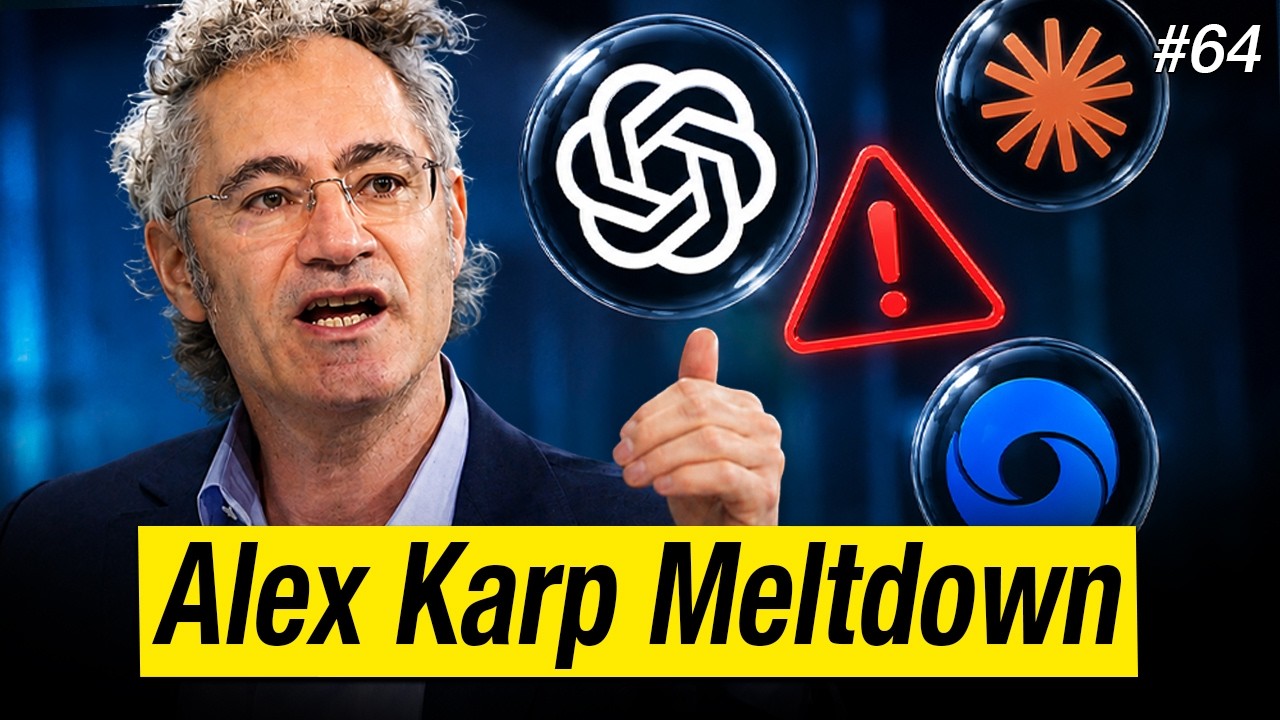
Palantir's Alex Karp goes on CNBC claiming enterprises are skeptical of frontier models due to ROI uncertainty and fears that OpenAI/Anthropic are training on their data. Rory thinks the data-sharing concern is overblown (based on terms of use), but Jason connects it to HubSpot's recent scandal: HubSpot tried to pool customer prospecting data and had to walk it back within a week. Jason warns every vendor facing slowing growth will be tempted to cut corners on data privacy to improve models. The ROI skepticism is real—MIT found 95% of enterprise AI pilots deliver no measurable P&L impact. This tees up Microsoft's $2.5B, 6,000-person field deployment plan. Jason predicts it will fail: even top-tier field engineers lack depth (one vendor told him to wait 3 months for a bug fix until the A-player returned from paternity leave). Rory disagrees: it will work in a limited sense because enterprises need the help, and Microsoft is becoming the next IBM—no longer the innovator, but the trusted services layer helping enterprises adopt others' technology. Jason concedes the demand exists but insists the talent pool is too shallow.
Meta launches a cloud business to rent excess compute, and the stock jumps 10%. Rory asks: is the market saying Meta failed at AI models but succeeded at cloud arbitrage, or is this a Goldilocks bet (short-term rental, long-term proprietary use)? The group notes SpaceX did the same thing brilliantly. Rory warns that if more companies (Anthropic, OpenAI, etc.) realize they overbought compute, the neocloud market could collapse in two years. Jason's insight: compute demand—not supply—will shut off the spigot. As long as OpenAI/Anthropic revenues keep 2x-ing, the hyperscalers will keep spending. Nvidia's ComputeNow PayLater financing (revenue-sharing + credit support for neoclouds) is betting the cycle continues. Rory calls it 'round-trip revenue' but notes it's ASC 606 compliant—Nvidia books hardware revenue upfront, then provides a backstop. If demand slows, Nvidia will have to debook. Jason is shocked anyone thinks managing for downside makes sense in 2026. The consensus: we're deep in a bull run; no one is hedging.
Key Takeaways
- Claim: Sam Altman's 5% government stake proposal is either savvy investor anchoring or a catastrophic regulatory trap. | Evidence: OpenAI proposed that frontier labs give the US government 5% equity. Jason compares it to giving Klaviyo 5% for alignment (immaterial to the partner, but creates unexpected influence). Rory counters that Microsoft owns 30% of OpenAI and they're 'in a stale marriage looking for divorce'—ownership ≠ alignment. Bernie Sanders already said he wants 50%. If you claim AI will destroy $15T of labor, Congress won't settle for $50B (5% of OpenAI at ~$1T implied). Jason: 'You're volunteering other people's capital.' Rory: 'You deserve whatever happens to you.' | Caveat: The decision hasn't been made yet. This is 'on the table' in a chaotic administration with no formal decision process. The 5% could be Sam preemptively anchoring to avoid a larger ask, or it could backfire and invite more regulation. | Implication: For Ken: If you're building agents or enterprise AI, expect government entanglement. This isn't the internet's 'leave us alone' era (Telecom Deregulation Act, Section 230, no sales tax). The new playbook is 'regulate us, own us.' Plan for pre-approval processes and potential equity grabs if you scale. For investments, avoid companies that voluntarily trigger regulatory scrutiny without a moat. | Timestamp: 00:00–15:30
- Claim: Dilution no longer matters to founders in the AI era; companies routinely do 16–24 rounds. | Evidence: Dario owns ~1.7% of Anthropic; Sam owns 0% of OpenAI. Jason: 'I used to think seed entry was 2x post-money due to dilution; now it's 4x.' Ramp has done 12 announced rounds (~24 with stub rounds). Databricks is on Series M. Carter data shows dilution per round is declining, but founders are raising so many rounds that total dilution is unprecedented. Jason: 'Founders today don't care about making last-round investors money. Late-stage investors accept 1x without blocking.' Rory: 'You can do more rounds and end up with the same dilution if pricing goes up.' | Caveat: This only works if the outcome is 100x+. If the exit is $1B–$5B, you've destroyed optionality (preference stack makes acquisition unlikely). Linear's founder raised 2 rounds and owns ~20%; if Linear exits at $2B, that's life-changing. If it could have been $100B, he left money on the table. | Implication: For Ken as an investor: Seed entry price is now 4x post-money, not 2x. Expect 15–20 rounds before exit. For portfolio: Late-stage rounds are less risky for founders (no blocking rights), so encourage them to raise when pricing is favorable. For founders: Only raise massively if you believe the outcome is $50B+; otherwise, stay lean to preserve acquisition optionality. | Timestamp: 15:30–35:00
- Claim: Enterprise AI adoption is plateauing not due to models, but due to talent and services bottlenecks. | Evidence: MIT: 95% of enterprise AI pilots deliver no measurable P&L impact. Alex Karp (Palantir): Enterprises are skeptical of frontier models due to ROI and data-sharing fears. Jason's example: A public company told him it would take 3 months to fix a bug (AI talking about an event that already occurred) because the A-player field engineer was on paternity leave. Microsoft and Amazon are deploying 6,000+ field engineers, but Jason says the depth doesn't exist. Rory: 'The biggest problem isn't buying from Anthropic; it's change management in the enterprise.' Harvey deploys with both a field engineer and a lawyer on every engagement. | Caveat: Rory argues this will work in a limited sense—Microsoft will become the next IBM, building a huge services business helping enterprises adopt AI (even if it's less profitable than selling Windows). Jason insists there aren't 200,000 smart people who want these jobs. | Implication: For Ken: The rate of AI diffusion—not compute supply—is the constraint. If you're investing in enterprise AI, ask: does this require a consulting army to deploy? If yes, adoption will be 3x slower than forecasted. For agents/ops: The wedge is reducing deployment complexity. If you can ship AI that works without a field engineer + domain expert, you win. For portfolio: Prioritize products with self-serve adoption or vertical-specific pre-built workflows. | Timestamp: 50:00–75:00
- Claim: Meta and SpaceX monetizing excess compute proves we're in late-stage bull run; no one is managing for downside. | Evidence: Meta launches cloud business to rent excess compute; stock jumps 10%. SpaceX did the same (single customer, great price). Rory: 'Two companies bought compute to build proprietary assets, failed, and the market rewarded them for selling it.' Neoclouds (CoreWeave, Nebius) dropped 10–15% because of new competition. Rory: 'Is the market saying Meta succeeded at cloud or failed at AI models?' Jason: 'Compute demand—not supply—will shut off the spigot. As long as OpenAI/Anthropic revenues 2x, spending continues.' Nvidia's ComputeNow PayLater: Nvidia books hardware revenue upfront, provides a backstop (if neocloud can't use compute, they get 'put back' rights). Rory: 'If demand slows, Nvidia will debook revenue.' | Caveat: Compute demand is still tight (never been tighter). The bull case holds as long as enterprise AI revenue grows 2–3x annually. But if enterprises plateau (see prior takeaway), excess capacity could emerge in 2 years. | Implication: For Ken: We're at 'that stage of the cycle' (1999–2000 vibes). Manage for downside in cloud/compute plays. Avoid neoclouds unless they have locked-in enterprise contracts. For portfolio: If you're advising companies to buy vs. rent compute, rent unless you have clear proprietary model plans. For macro: The next 12–24 months will reveal whether demand justifies the $70B+ capex bills. If not, expect sharp corrections in Nvidia, neoclouds, and over-funded AI infra startups. | Timestamp: 75:00–95:00
- Claim: China is running away with open-source models and AI video; US leads on frontier models but closed the door on Chinese users. | Evidence: Top 6 models on OpenRouter are Chinese (open-source). Kling (Chinese AI video) raises $2.8B at $18B valuation, $500M ARR. OpenAI shut down Sora; Kling thrives. Jason just returned from China: 'You literally cannot use ChatGPT or Claude—even in Hong Kong.' Jensen Huang warned: if you block GPUs and frontier models, China will build its own. Jason: 'What do you expect the second-largest economy to do?' Rory: 'If you believe there's a national security concern, you accept the commercial consequence. But you can't expect them to give up.' Rumor: China may now block overseas access to Chinese open-source models (retaliatory move). | Caveat: US still leads on frontier closed models (OpenAI, Anthropic). Chinese models are 'distilled' from US models to some extent (reasonable people differ on how much). If China blocks overseas access, US open-source providers (Reflection, Poolside) benefit. | Implication: For Ken: The bifurcation is real. If you're building consumer AI video or open-source tooling, assume Chinese models will dominate cost/speed. For enterprise: US clients will pay premium for frontier models (Fable/Opus) on complex problems, but push simple tasks to open-source. For geopolitics: The 'Great Firewall of AI' is forming. Expect increasing regulatory/trade friction. For ops: Test whether your agent workflows can use open-source models (DeepSeek, Kling) without sacrificing quality; if yes, cut token costs 75%. | Timestamp: 110:00–135:00
Detailed Brief
Government Regulation & OpenAI's 5% Stake Proposal
- Claims: Washington lifted the 5-day Anthropic Fable model ban but now requires pre-approval (details TBD).; Sam Altman proposed frontier labs give the US government a 5% equity stake to align incentives.; This is 'Atlas Shrugged in reverse'—entrepreneurs volunteering for regulation and dilution.; Jason initially thought it was absurd, then reconsidered: maybe it's like giving 5% to Klaviyo/Shopify for alignment (immaterial to the partner, but creates influence).; Rory: Microsoft owns 30% of OpenAI; they're 'in a stale marriage.' Ownership ≠ alignment. Bernie Sanders already wants 50%. If you claim AI destroys $15T of labor, Congress won't settle for $50B.; The real problem: OpenAI published a 9-point plan saying AI will 'destroy labor,' so they need to restructure US taxation (tax capital more, labor less). This invites runaway regulation.
- Evidence: Fable 5 was banned for 5 days; now there's a 'structured pre-approval process' (not finalized).; Sam's proposal: companies should give 5% (not just OpenAI). This dilutes everyone, including Anthropic.; Jason: 'Six months ago, you could ship software like a free man. Now you need permission from Washington.'; Rory: 'The US raise is ~$5T/year. 5% of OpenAI at $1T = $50B = 1% of one year's raise. Why would they restructure taxation for that?'; Jason: 'Maybe Sam is anchoring at 5% to preempt a 50% ask. He's telegraphing this early.'; Rory: 'Once you start with pre-approval, you end up with an ownership stake, then a board seat. You can't control the process you kick off.'
- Caveats: The decision hasn't been made. The administration has no formal decision-making process.; This could be Sam preemptively managing politics (he's a 'thoughtful communicator,' per Jason), not reacting to immediate pressure.; There are legitimate cybersecurity arguments for some oversight, even if the labor/taxation arguments are overblown.
- Implications: For Ken as investor: Avoid companies that voluntarily invite government stakes unless they have monopoly moats. The regulatory surface area will only grow.; For portfolio: If you're in frontier AI, assume you'll need government relations, pre-approval workflows, and potential equity dilution. Budget for it.; For startups: Don't claim your product will 'destroy the economy' unless you want to invite existential regulation. Stick to ROI narratives.; For macro: The internet had a 20-year 'leave us alone' run (Telecom Act, Section 230, no sales tax). AI is going the opposite direction. Plan for slower innovation cycles.
Founder Dilution & the Death of Dilution Sensitivity
- Claims: In the AI era, founders no longer care about dilution. Dario owns 1.7% of Anthropic; Sam owns 0% of OpenAI.; Companies routinely do 16–24 rounds (e.g., Ramp: 12 announced, ~24 with stubs; Databricks: Series M).; Jason: 'Seed entry price used to be 2x post-money (due to dilution); now it's 4x.'; Late-stage investors accept 1x without blocking (no more TARP-style threats). Founders aren't afraid to raise.; Carter data: dilution per round is declining (higher pricing), but total dilution is unprecedented because of round count.; Rory: 'If the outcome is 3 orders of magnitude larger, you can get away with anything on dilution.'; Counter-example: Linear raised 2 rounds, refuses VC meetings. Founder owns ~20%. Harry/Jason debate: was that the right call if the prize is $100B, not $5B?
- Evidence: Jason did a seed deal at 60; real entry is 240 (4x) due to future dilution.; Jason: 'I'm watching myself be diluted to levels I never thought would happen.'; Rory: 'Sequoia owns ~1% of SpaceX (original check when rockets were blowing up); they'll do amazing. Founders Fund owns sub-5%.'; Jason: 'My generation of founders was terrified of blocking rights (2x sale clauses). Today's founders don't worry.'; Linear: 2 rounds, capital-efficient, beloved product, will return SaaStr fund 1 multiple times. But Jason wonders: 'Was it the right choice if the exit could be $100B?'; Brian Armstrong (Coinbase) is cited as parallel: chose capital efficiency, but maybe left money on table.
- Caveats: This only makes sense if the outcome is 50x–100x. If the exit is $1B–$5B, massive dilution + preference stack kills acquisition optionality.; Linear's choice may be correct if the founder values control and a $2B exit (20% of $2B = $400M, life-changing with QSBS).; Not all founders are insensitive to dilution—YC startups still aim to 'raise 6 at 60 and never raise again.'
- Implications: For Ken as seed investor: Underwrite to 4x post-money, not 2x. Expect 15–20 rounds before exit.; For portfolio: Encourage founders to raise when pricing is favorable (late-stage blocking rights are gone, so downside is capped at 1x).; For founders: Only raise massively if you believe the outcome is $50B+. Otherwise, preserve optionality for $1B–$5B acquisitions.; For market: The 'growth investing' era means velocity matters more than efficiency. If you're not raising, competitors are.
Enterprise AI Adoption: The Services Bottleneck
- Claims: Alex Karp (Palantir): Enterprises are skeptical of frontier models due to (1) unclear ROI, (2) fears that OpenAI/Anthropic are training on their data.; MIT study: 95% of enterprise AI pilots deliver no measurable P&L impact.; Jason: 'The depth of field engineers doesn't exist. Even top-tier FEs can't scale.' Example: Public company told him to wait 3 months for a bug fix (FE on paternity leave).; Microsoft + Amazon are deploying 6,000+ field engineers to embed in enterprises. Jason predicts it will fail; Rory predicts it will work (but be less profitable than selling software).; Rory: 'Microsoft is becoming the next IBM—no longer the innovator, but the trusted services layer helping enterprises adopt others' tech.'; Harvey (legal AI) deploys with both a field engineer and a lawyer on every engagement. That model works because Harvey has a high price point, but it won't scale to B/C-tier vendors.
- Evidence: Jason: 'We work with the best FEs at Salesforce, etc. When our A-player went on paternity leave, the replacement said they couldn't fix a bug (AI talking about an event that already occurred 60 days ago) for 3 months.'; Karp: 'Corporate America is saying: Am I spending all this money and getting anything? And: Are they training on my data and selling it to competitors?'; HubSpot scandal: Tried to pool customer prospecting data; customers erupted; HubSpot walked it back in a week.; Rory: 'The biggest problem for Exxon or BofA rolling out AI isn't buying from Anthropic; it's change management and application building.'; Jesse Zhang (Decagon): 'When you don't know the problem, use frontier models. When it's commoditized, push to open-source. We're in the explosion of usage, so frontier models dominate for now.'; Jason on CX: 'We're standardizing around 50 cents per resolution. If you charge 50 cents, your LLM cost has to be 25 cents or less. That pushes people to open-source, which is causing plateauing in some CX products.'
- Caveats: Rory: 'Even if Microsoft isn't amazing at this, it's better than enterprises trying on their own. IBM Global Services was the same—not great, but necessary.'; The AI CX space (Decagon, Finn) has crossed the chasm: enterprises can articulate ROI (30% to 65% resolution rate improvement). The next 10% (65% to 75%) may cost 2x, but they'll pay.; Rory: '95% failure rate is overstated. Jason's story is real, but not every enterprise is that bad.'
- Implications: For Ken: The rate of AI diffusion—not compute—is the constraint. Underwrite enterprise AI revenue at 1/3 the growth rate VCs forecast.; For portfolio: Prioritize self-serve adoption or vertical-specific pre-built workflows. If your product requires a field engineer + domain expert, it's a services business, not a software business.; For agents/ops: The wedge is not better models; it's removing deployment friction. Build for the B-player FE, not the A-player.; For startups: If you're selling to enterprises, budget for a consulting layer (or partner with Accenture/Deloitte early). Don't assume enterprises will DIY.
Compute Economics: Cloud Arbitrage, Nvidia Financing, and Late-Cycle Signals
- Claims: Meta launches cloud business to rent excess compute; stock jumps 10%. SpaceX did the same (single customer, high price).; Rory: 'Two companies bought compute to build proprietary assets, failed, and the market rewarded them for pivoting to cloud arbitrage.'; Neoclouds (CoreWeave, Nebius) dropped 10–15% because Meta + SpaceX are new competitors.; Rory: 'Is the market saying Meta succeeded at cloud or failed at AI models?' Answer: Maybe both (Goldilocks scenario—short-term rental, long-term proprietary use).; Jason: 'Compute demand—not supply—will shut off the spigot. As long as OpenAI/Anthropic revenues 2x annually, hyperscalers will keep spending.'; Nvidia's ComputeNow PayLater: Nvidia sells chips upfront (books revenue), then provides a backstop (if neocloud can't use compute, they get 'put back' rights). ASC 606 compliant but 'pretty aggressive.'; Rory: 'If demand slows, Nvidia will debook revenue. The whole thing is a derivative bet on keeping demand going.'; Jason: 'No one is managing for downside. We're deep in a bull run. If you're managing for downside, I'll check out of that board meeting.'
- Evidence: Meta: $70B capex; claims AI improves ad targeting, but Jason/Rory skeptical it justifies the spend. Core business (WhatsApp, Instagram, Facebook) is thriving, so Meta can afford to 'tread water' on AI.; Zuckerberg paid $900M to invest in Cred (Indian fintech) to hire Kunal Shah as head of WhatsApp (so $900M+ to hire one person).; Nvidia: Two deals with neoclouds (details in early July). Nvidia books hardware revenue upfront, separates guarantee over time. Contingent liability if neoclouds fail.; Jason: 'There's never been more demand for compute than today. But if that changes in 2 years, these deals will look horrible.'; Rory: 'We're at that stage of the cycle (1999–2000 vibes). History doesn't repeat, but it rhymes.'
- Caveats: Compute demand is still tight. This isn't a bubble yet; it's a question of whether demand will slow in 12–24 months.; Meta's core business is strong enough to absorb a $70B 'wrong bet' (like VR). Board would approve because Zuckerberg 'earned the right to play.'; Nvidia's strategy makes sense if demand continues. The risk is only realized if neoclouds go bust and Nvidia can't resell the compute.
- Implications: For Ken: Avoid neoclouds unless they have long-term enterprise contracts. The market is crowded (CoreWeave, Nebius, Lambda, now Meta, now SpaceX).; For portfolio: If you're building AI infra, assume compute will commoditize in 2 years. The moat is in software (workload optimization, orchestration), not raw GPUs.; For macro: Watch OpenAI/Anthropic revenue growth. If it slows to <50% YoY, expect Nvidia, hyperscalers, and neoclouds to correct sharply.; For agents: The bull case for agentic AI is that it's the killer app that justifies the compute spend. If enterprises don't adopt agents at scale, the whole cycle unwinds.
China vs. US: The Model Divergence
- Claims: Top 6 models on OpenRouter are Chinese (open-source). Kling (Chinese AI video) raises $2.8B at $18B valuation, $500M ARR. Most commercially successful AI video product on earth.; OpenAI shut down Sora (couldn't make it cost-effective); Kling thrives. Higsfield (AI video tool) uses Kling, does $500M ARR, raising at $5B.; Jason: 'I just got back from China. You literally cannot use ChatGPT or Claude—even in Hong Kong. What do you expect China to do? Of course they'll build their own.'; Jensen Huang warned: If you block GPUs and frontier models, China will build its own. Jason: 'If we don't like what's happening in China, we created it by not allowing access.'; Rumor: China may now block overseas access to Chinese open-source models (retaliatory move). This would benefit US open-source providers (Reflection, Poolside) and frontier models.; Rory: 'US leads on frontier models (OpenAI, Anthropic). Chinese models are distilled from US models to some extent. But they're clearly competitive on open-source and video.'
- Evidence: Kling: $18B valuation, $500M ARR. Higsfield: $500M ARR, $5B valuation (uses Kling + other models). Jason: 'Is there a Chinese valuation bubble in AI?'; Jason: 'When I was in China, I couldn't access ChatGPT, Claude, or APIs. You can use VPNs, but they block VPN access. You have to side-buy tokens.'; DeepSeek: Raising at $50B (gross discount vs. Western alternatives). ByteDance: $500B valuation.; Jason on video: 'I didn't know video would be this big. Consumption is infinite. Sora was pretty good, but they couldn't make it cost-effective.' Estimate: $1.30–$2 GPU cost per 30-second video.; Rory: 'If you believe there's a national security concern, you accept the commercial consequence. Actions have consequences.'
- Caveats: US still leads on frontier closed models. Chinese models are 'distilled' (reasonable people differ on how much).; Kling charges aggressively (less freebies than Sora). OpenAI may have shut down Sora because $500M revenue is 'below materiality' for them (they need enterprise coding revenue).; If China blocks overseas access to open-source models, the US benefits (less competition for Poolside, Reflection, etc.).
- Implications: For Ken: The China/US bifurcation is real. If you're building consumer AI video or open-source tooling, assume Chinese models dominate on cost/speed.; For enterprise: US clients will pay premium for frontier models (Fable/Opus) on complex problems, but push simple tasks to open-source (Chinese or US).; For geopolitics: The 'Great Firewall of AI' is forming. Expect regulatory/trade friction. For ops: Test whether your workflows can use open-source models (DeepSeek, Kling) without sacrificing quality; if yes, cut token costs 75%.; For video: AI video generation is a real business (Kling proves it). If you're in content/media, experiment with Kling/Higsfield for cheap video production.
Venture Dynamics: Ashton Kutcher's New Firm, 11 Labs Tender Offer, and Employee Liquidity
- Claims: Ashton Kutcher leaves Sound Ventures (his own firm) to start a new firm with Morgan Bella (ex-a16z, ex-NFX). Focus: deep tech, seed/pre-seed.; Jason: 'This is crazy. Sound raised $1B, has great investments (OpenAI, Anthropic). Why leave your own firm?' Rory: 'He doesn't need the firm brand. He's more famous than Sequoia.'; 11 Labs raises secondary at $22B valuation. Jason: 'As an employee today, why would you join anything that you don't believe will have secondary options in 24 months?'; Clay did a tender offer at $5B. Even if you're not quite at 11 Labs / Clay level, you need liquidity to attract talent.; Rory: 'Don't join companies already doing tender offers (your equity grant will be small). Join companies that will do tender offers in 1–2 years after you vest 50–60%.'; Jason: 'Employees are sequential VCs. They get one shot. We get 20 parallel shots. I feel guilty.'
- Evidence: Ashton Kutcher: TV famous, movie famous. Jason: 'I knew Ashton before I knew Sound Ventures. He can do whatever he wants.'; Sound Ventures: $1B raised, great SPV investments (OpenAI, Anthropic). Those were late-stage, multi-billion pre-money. New firm is deep tech, seed/pre-seed (very different).; 11 Labs: $22B secondary. Jason: 'The price isn't that interesting. The growth is consistent with other rounds. The liquidity is what matters.'; Rory: 'Databricks, OpenAI, Anthropic can always pull off tender offers. But if you're not quite at that level, it's fragile.'; Jason: 'Why would I join a startup if there's no liquidity? Life's too short.'
- Caveats: Ashton leaving Sound could be amicable (wanting to do something different). Rory: 'I don't think there's a deep, dark story. Two people wanting to do different things.'; Joining a company already doing tender offers means your equity grant is smaller (you're buying at high valuation). The trick is joining before tender offers start.; Not every company can do tender offers. You need $2B+ valuation and strong fundamentals.
- Implications: For Ken: If you're recruiting operators, they'll ask about liquidity. Budget for tender offers at $2B+ valuation or lose talent to companies that do.; For portfolio: Encourage founders to plan for tender offers early (don't wait until employees are restless). It's now table stakes.; For founders: If you can't afford tender offers, lean into mission and equity upside. But know you're competing against Anthropic/OpenAI, which offer both.; For employees: Join companies that will be $2B+ in 2 years, not companies that are $2B+ today (unless you want liquidity over upside).
Notable Concepts & Terms
- World historical figure (Hegel): Alex Karp (PhD in German philosophy) called Dario Amodei this on CNBC. It's a Hegelian concept meaning someone who shapes history. Rory jokes it's 'big brain references on CNN,' but also notes both Zuckerberg and Musk are arguably world historical figures (they've built $1T+ companies and reshaped industries).
- ASC 606 (revenue recognition): Accounting standard Nvidia is using to book hardware revenue upfront (when selling chips to neoclouds) while separating the contingent guarantee (backstop if neocloud can't use compute). Rory says it's 'legal as church on Sunday' but 'pretty aggressive'—if neoclouds fail, Nvidia may have to debook.
- Chasm (Geoffrey Moore): Rory uses this to describe AI CX (customer support). The 'chasm' is the gap between early adopters and mainstream market. AI CX has crossed it—enterprises can articulate ROI (30% to 65% resolution improvement). Most other AI apps haven't crossed yet (95% of pilots fail per MIT).
- Sequential VCs (employees as investors): Rory's metaphor: VCs get 20 parallel bets; employees get sequential bets (one at a time). Jason: 'I feel guilty—we get 20 shots; they get one.' Implication: Employees must be even more selective than VCs, focusing on companies that will do tender offers in 1–2 years.
- Tender offer / secondary liquidity: A mechanism for employees to sell equity before IPO/acquisition. 11 Labs ($22B), Clay ($5B), Databricks, OpenAI all do this regularly. Jason: 'Why would I join anything that won't have tender offers in 24 months?' Rory: 'Join before tender offers start, so you get a bigger grant.'
- Fable (Anthropic's model): Anthropic's latest frontier model, banned for 5 days, now requires pre-approval. Jason: 'I spent 10 hours in Replit (Sonnet + open-source) on a complex algo problem and couldn't solve it. Solved it in 20 minutes with Fable + Opus.' Implication: Frontier models are worth the cost for unknown/complex problems.
- Great Firewall of AI: Jason's term for the emerging China/US bifurcation. US blocks GPUs + frontier models from China; China builds its own (DeepSeek, Kling). Now China may block overseas access to Chinese open-source models. Both sides think the other's tech is 'dangerous.'
- Services layer (IBM-ification): Rory: 'Every tech company either goes bust or lives long enough to become the next IBM.' Microsoft/Amazon are no longer the innovators (that's OpenAI/Anthropic). They're the trusted services layer helping enterprises adopt others' tech. This is less profitable than selling software but necessary.
Operator Notes / Why Ken Should Care
- For agent systems: Frontier models (Fable/Opus) are worth the cost for complex/unknown problems. Push simple tasks to open-source (DeepSeek, Qwen) to cut costs 75%. Test this rigorously—Jason saw plateauing in CX because people over-indexed on open-source for cost reasons.
- For AI ops: The enterprise adoption bottleneck is not models; it's services/change management. Budget for consulting layer or build extreme self-serve workflows. Harvey's model (FE + lawyer on every deployment) works but doesn't scale to B-tier products.
- For content/business: AI video is a real business (Kling: $500M ARR, $18B valuation). Experiment with Kling/Higsfield for cheap video production. Sora failed because OpenAI couldn't monetize it cost-effectively at scale.
- For investing: Seed entry price is now 4x post-money (not 2x) due to 15–20 future rounds. Underwrite to that. Prioritize companies that can do tender offers at $2B+ (or lose talent). Avoid neoclouds unless they have locked-in contracts.
- For GTM: The CX space has crossed the chasm (ROI is clear: 30% → 65% resolution). Other AI apps haven't. If you're selling enterprise AI, lead with measurable P&L impact (not 'AI magic'). And don't claim you'll 'destroy labor'—it invites regulation.
- For workflow: Use Replit for prototyping, but escalate to Fable/Opus when Replit + Sonnet can't solve a problem in 2–3 hours. Jason lost a day on a problem Fable solved in 20 minutes. Time is more valuable than token cost.
Watch Map
- 00:00: Intro: Washington lifts Fable 5 ban; Sam Altman proposes 5% government stake
- 15:30: Dilution discussion: Dario owns 1.7%, Sam owns 0%; companies do 16–24 rounds
- 35:00: Linear case study: 2 rounds, capital-efficient, but was it right if prize is $100B?
- 50:00: Alex Karp on CNBC: Enterprises skeptical of frontier models (ROI + data sharing)
- 60:00: HubSpot scandal: Tried to pool customer data, had to walk it back in a week
- 75:00: Meta launches cloud business to rent excess compute; stock jumps 10%
- 85:00: Nvidia's ComputeNow PayLater: Books revenue upfront, provides backstop
- 95:00: No one is managing for downside; we're deep in bull run (1999–2000 vibes)
- 100:00: Anthropic + DeepSeek building their own chips; debate on vertical integration
- 110:00: Kling (Chinese AI video) raises $2.8B at $18B; OpenAI shut down Sora
- 120:00: Jason's China trip: Can't use ChatGPT/Claude even in Hong Kong; China building alternatives
- 135:00: Rumor: China may block overseas access to Chinese open-source models
- 140:00: Microsoft launches $2.5B, 6,000-person field deployment; Jason predicts it will fail
- 150:00: Rory: Microsoft is becoming next IBM—trusted services layer, not innovator
- 160:00: Harvey deploys with FE + lawyer on every engagement; that model works but doesn't scale
- 170:00: Ashton Kutcher leaves Sound Ventures to start new deep tech seed firm with Morgan Bella
- 180:00: 11 Labs secondary at $22B; Jason: 'Why join anything without tender offers in 24 months?'
- 190:00: Employees are sequential VCs; we get 20 shots, they get one
Source/Metadata
- Title: Sam Altman Offers Trump 5% of OpenAI | Enterprises Fear Frontier Models | DeepSeek Builds Own Chips
- Transcript words: 33264
- Duration seconds: 5225
- Timestamp note: Timestamps are estimated based on content flow (video is 87 minutes). Transcript did not include explicit chapter markers, so timestamps reflect approximate segment breaks.
Transcript
It's rewriting Atlas Shrugged, where John Galt goes to Washington and says, why don't you regulate me more? Why don't you take more? Why don't you take us, Mr. Mooch? Grab some of my stuff. What are these people thinking volunteering for this stuff? It's madness. So what are we discussing? Number one, Washington lifts the Fable 5 ban. What does this mean moving forward? Second, OpenAI floats giving the US government a 5% stake? Whoa, Sam, baby, hold up. Number three, DeepSeek is developing its own chip. My word. And then number four, Metacompute launches cloud business, which caused the stock price to jump 10%. Thank God we've needed it, Zuck. This and so much more in the show today. [SPEAKER_02] No one's worried about making their last round high-priced investors money anymore. Literally, no one is. Every technology company either goes bust or lives long enough to become next generation's IBM. As an employee today, why would you join something that you don't believe will have secondary options? I really think this is a big issue. Ready to go? [SPEAKER_02] We are back, boys. I am no longer at the beach in the UK. There was one comment, did you see it, in the YouTube, which goes, Harry is so burnt. And then it goes, he looks like a panda. And I was like, this whole holiday vibes thing isn't working. You did look like a panda. I mean, you had those great big eyes. You look dumb, but that's okay. I mean, it's a look. Took us about 45 seconds, Jason, but don't worry, we're good. Pale skin, Brett goes to beach. It's a common thing. Listen, we're going to start with the news of the day or one of the most pressing topics, which is Washington lifts the 19 day Fable 5 ban. How did we analyze Washington lifting the ban and what it means moving forward for both OpenAI and Anthropic in terms of the permissions they have to get? [SPEAKER_00] It's a quagmire in the sense that you've now been entrapped in some kind of pre-approval process. And they're talking about some kind of structured pre-approval process, but that hasn't been finalized yet. But the zoom out comment is, six months ago, you could ship software like a free man. And now you have to get permission from Washington before you do it. It's a big change, right? How does it pan out? Who the hell knows? There are some arguments in part in the cybersecurity for some process, but it's definitely a big step. And all other things being equal, you'd prefer not to have to get permission from any administration before you can pursue your business. I think part of the reason the U.S. is such a dynamic economy is because we don't have a ton of that. Europe does. And now we do. [SPEAKER_02] We sneered at GDPR and here we are. Whether more regulation is better is beyond my scope. I think people have been talking about safety in AI for a long time, which is not the same issue, but a related issue for a long time. And I think it's just this is the grownup state of LLMs and AI. It's just going to have this level of oversight, whether we like it or not. At the end of the day, this particular issue seems minor only because Fable's going to sort of variable pricing per token pricing in a week or two anyway. So most of us aren't even going to use it because it's too expensive. It's going to be a niche model, at least until it percolates into the standard Opus and Sonnet over the coming months. So the world impact will be minor. The world's changed. To me, Sam Altman offering 5% of his company to the U.S. government was much more interesting in some ways than whether some suboptimal, but inevitable oversight is coming to the LLMs. I totally agree. And that was going to be my next point, which is, if you take that one step further in terms of government intrusion or government opinion, Sam saying, "Hey, take 5%." How did we think about that? [SPEAKER_02] Well, if you own a hundred percent of it, now you only own 95, you're a little bit pissed. [SPEAKER_01] Or if you own none of it, you're not very pissed because you're not getting diluted at all. Yeah, exactly. I will happily give you away some of the. Stepping back, what problem is he trying to solve? I mean, I think it's absurd to be clear, but let's go from first principles. What problem is he trying to solve? [SPEAKER_01] By definition, it's not any of the security issues we just talked about, which at least are vaguely credible, right? It's not cyber. It's some kind of macro, AI is going to destroy everyone's jobs. So we got to give back. Right. And they produced a nine point plan. OpenAI did, I think about a month ago, some kind of, we've got to rethink everything because of the economics of AI. And they're talking about maybe we need to. Let's put it out there. The grandiosity. We're talking about restructuring the taxation system of America to tax more on cap gains and less on income because so many people are going to be put out of work because of AI, that we want to lower the tax burden on labor and increase it on capital. Right. And this is all part of that. And the whole thing is so delusional and so far from where we are now that I just stopped listening. You've got a really great growing company, no discernible impact on employment yet. You've got a bunch of issues you got to sort out because you have been lapped by your direct competitor. And your focus is, on telling Congress that they should, for context, if they give 5% of Anthropic, it's $50 billion. Your focus is telling Congress that raises plus or minus 5 trillion a year. So you're 1% of it for one year. Your whole donation gets rid of 1% of a raise for one year that they should restructure their entire taxation system. Right. Sure. We'll get right onto that. The House Ways and Means Committee will call a committee. Every lobbyist. It's kicking off a process that you won't be able to control. And I predict it's exactly. I mean, it does go back to the kind of comment on pre-approval. You start with pre-approval. Suddenly, you end up with an ownership interest. Then you end up with a board member. And what are these people doing? It's rewriting Atlas Shrugged, where John Galt goes to Washington and says, why don't you regulate me more? Why don't you take more? Why don't you take us, Mr. Mooch? Grab some of my stuff. What are these people thinking volunteering for this stuff? [SPEAKER_01] kicking off a process that you won't be able to control. And I predict it is exactly it does go back to the kind of comment on pre-approval. You start with pre-approval. Suddenly, you end up with an ownership interest. Then you end up with a board member. And what the people, what the, are these people doing? It's like rewriting Atlas Shrugged, where John Galt goes to Washington and says, why don't you regulate me more? Why don't you take more? Why don't you take us, Mr. Mooch, grab some of my stuff. What the fuck are these people thinking volunteering for this stuff? It's funny. I completely agreed with you at first, right? 100%. I'm like, this is the weirdest kissing the ring in a weird corrupt administration where our president made [SPEAKER_00] $2 billion off crypto and friends last year and profits. And that's cool. Now it's cool for a president to actively trade any stock, his own meme coin and make $2 billion in one year. I mean, the guy's 80, what does he need it for? Right? So at first I was with Rory, but then I step back for a minute and I'm like, listen, Sam Altman, beyond being the CEO of Open AI is one of the most successful investors of our, of all time. Right. And he knows everything about how startups and scale ups are run and he's seen it all. And I think in some ways he runs Open AI with that playbook in a way the others don't. Okay. It's like a super startup, how he funds it, how he thinks about it, the relationships, the scaling. And to me, when I step back after I had the exact same view as Rory, this is crazy kissing the ring, crazy stuff. This is not Intel dying. It's like, you know, you give 5% of your company to Shopify, Klaviyo, Klaviyo did so that they don't destroy you. We see this all the time in our portfolio. You don't want to give 40% of your company, right, to your partner. And 5% is not immaterial. What I've learned from my portfolio is an unexpectedly large amount of alignment. You get you sell 5% of your company to a hundred billion dollar partner. It doesn't matter to Rory's point. It just doesn't matter if they own 5% of your startup. It doesn't matter if you help almost how big you are. It is immaterial, but I'm constantly shocked how much that brings you into the boardroom, how it brings you. So my only point is, and I could be wrong, giving 5% of your company to placate the federal government so that you're the good guy. Now you're, you get, you're like Stargate 2.0 when Sam was up there, right, with Larry and everybody, he was the good guy for a little while. I think as an investor, I take the dilution. No, no, no, no, no. I mean, I understand what you're saying. And so I'm going to paraphrase. Yeah. Ownership stake, which much larger entities align the large entity with the smaller entity. And that's what this is. And it's a good thing. Well, more than I would have expected as a founder. More than you would have expected. So let's just. Because it shouldn't, because it's immaterial to the federal government and it's immaterial to Nvidia taking stakes in most companies. It's immaterial to the economics, right. [SPEAKER_01] There's two arguments I'll make against that, right. The first is a business one, and then the second is a government one, right. Business one. Open AI, Microsoft owns 30% of Open AI. If ownership stake resulted in besties, they'd be besties. They're not besties. They're in a stale marriage looking for a divorce, but can't quite pay the tax, right. It hasn't worked, right. And that's with 30% alignment with a profit maximizing entity like Microsoft, who is rational, right. Now apply that to the US government. Do you, I mean, the idea that because they own some of you, they'll align with you is just that's not the way politics works. Go back, look at the TARP. Now, admittedly, that was when the banks had screwed up. So, yeah, they come in, they own a little bit, they don't have voting control, but they tell you who you can pay and who you can pay. And the weak banks deserve that. But JP Morgan was like, why am I getting that? That's the TARP. If you think, in this case, because not only have you said, give me 5%, but you've also produced a document that says, the things that we're doing are so catastrophically impacted on the economy of this country, Mr. Congressman, that you govern, that you need to redo your entire taxation system. It's about an hour before Bernie Sanders says, you know, you're right. This is really impactful. Maybe we should go for 50. Because if it really... And Roe Conner too. [SPEAKER_01] If you really are impacting a $30 trillion economy, if that's your, in my view, absurd statement, but you've made it and Dario's made it, so you're entitled to own it, right? If you really are destroying labor in a $30 trillion economy, do you think the political monster is going to say, I'll settle for five, that's grand, call it 50 billion. You've destroyed 15 trillion of labor value, but we'll settle for 50 billion. Bernie's already said he wants 50, right? And you deserve whatever happens to you, right? You deserve being regulated by the government. You deserve having to be inclusive. I mean, the idea is so... I mean, maybe you get something small and tactical, but it's such a mistake. [SPEAKER_01] Why do they do it then? Because... These are not dumb people. [SPEAKER_01] They're not really smart people. Yeah. [SPEAKER_01] And because they believe, rightly or wrongly, that the impact of this technology is so important, that all these things need to be on the table. And to be fair, that belief is what gave them the self-motivation and the confidence to raise billions of dollars until that narrative is what it took. Because if you walked in and said, hey, I need $10 billion to build some stuff and it's going to have a minor impact on some parts of compute, I don't think you got your $10 billion. You needed to tell a story like every great CEO. This is the world's greatest fundraising CEOs, right? Telling the biggest story. And they told the biggest story and that's what allowed them to get the, you know, now $160 billion, right? But once you've told that story and genuinely once you believe it, and in the case of Anthropic in particular, once all your employees believe it. If you believe this thing is dangerous from a cyber perspective, from a jobs perspective, you just suddenly end up down this road, right? All these things become next level logical if in fact the basic premise is correct. [SPEAKER_01] a minor impact on some parts of compute, I don't think you got your $10 billion. You needed to tell a story like every great CEO. This is the world's greatest fundraising CEOs, right? Telling the biggest story. And they told the biggest story and that's what allowed them to get the now $160 billion, right? But once you've told that story and genuinely once you believe it, and in the case of Anthropic in particular, once all your employees believe it. If you believe this thing is dangerous from a cyber perspective, from a jobs perspective, you just suddenly end up down this road, right? All these things become next level logical if in fact the basic premise is correct. And if on the other hand, you believe it's what I do, and I'm not them, I didn't invent this, but it's a really important technology, but it's not going to put 50% of the U.S. labor market unemployed. Then you believe these kinds of preemptive changes and conversations are a wild overreaction and wildly early. And we'll find out which it is. I mean, look, in five years' time, if Dario is correct and 50% of white-collar jobs have been replaced by AI, which I don't believe for a second, then you're right there's going to be political controversy. And if you think 5% is going to feed that beast, you're delusional. If half those nice middle-class people in middle-class jobs all across this country lose their jobs to AI, it's going to take a lot more than, I think it works out to, $140 per head, which is what the 5% of the topic would be worth to keep the wolf from the door. So if you believe these things are going to happen, that's why they do it. I just don't. So I'm whatever, this is a mistake. Is this purely a marketing exercise? What, who are you marketing to? Congress, senators, that you're willing to align yourself, you're willing to play ball, you're open, you're not this wolf stealing jobs and you're participating. You're not the wolf that you said you were. I mean, again, it's hi, I'm a wolf, but I'm a good wolf, right? I mean, is it trying to clean up the mess you created to some extent? Yes. You spent three years saying everyone's going to be unemployed because of this thing and it's wildly dangerous. And now you're trying to walk that back while at the same time sucking up. And if I'm going to ask you to regulate, or as you said, Rory, last week, I think quite wisely, maybe tax Chinese or open source models, maybe it'd be helpful if we had alignment beforehand. If I'm about to have a big ask. I think Sam is a very thoughtful communicator and he puts stuff out there early to socialize it. And they seem like little comments and they seem like exposition, but I think they're all very carefully thought through. And I think the issue is less about, and Rory just hit this with Bernie Sanders. The issue is less about whether it's a good idea to get 5%. I say do it like the [SPEAKER_00] Klaviyo Shopify thing, if you think it's going to work. It's more so it's not 50 or 20. Sam is just anchoring this idea that, hey, 5% will align us with the American people, with the federal government, with the administration, without getting into politics. And he's anchoring this at five rather than 50. Because not only does he need the alignment, he's sensing the political winds. So I think it's these things seem to come out of nowhere. But I think he's a very interesting communicator. He's a very good anchor in a way that isn't triggering, generally speaking, the way he does this. Maybe other things are triggering. And he does a pretty good job of telegraphing where we might end up before it happens, right? So I think it's just anchoring. Maybe it really doesn't matter what we think because it's already happened. The decision essentially has already been made that the federal government will be acquiring a stake in OpenAI. And Sam is just anchoring it as the smallest possible stake to get ahead of this discussion. That hasn't happened yet, to be clear. I mean, that decision hasn't been made. Now you are right. I mean, the US government, for the first time in a long time, and definitely absent a bailout, has already taken stakes in a bunch of tech companies like Intel. So who knows, maybe it'll happen again. The decision hasn't been, quote unquote, taken. I don't think this administration has a decision-making process. But you're right. It's definitely, quote unquote, on the table. Just being clear. Adam Chapnick. Does this change anything for Dario? Sam Wittgenstein. To be clear, the proposal from OpenAI, just to be grounded in facts, wasn't we give OpenAI 5%. It was companies should. Adam Chapnick. So the implied statement is everyone should, including Anthropic. It's, hey, everyone should give away 5% for the US government. So to some extent, you know, he's volunteering other people's capital, right? Sam Wittgenstein. I mean, it just all gets to the same thing. And we started with Fable. It all gets to the same thing. The US government is going to get enmeshed in this, in AI, in a whole load of different, probably contradictory ways, right? It can range from, you know, as I say, cyber danger, to wider regulatory danger, to economics, to Chinese open source threats. You've just got to be enmeshed in politics. And it's funny because, you know, when you watch the internet take off, the whole emphasis was cut us free. And then if you look at two of the biggest deals at the start of the internet, maybe three big, I'm going to give you three really interesting 1990s regulatory issues that were amazing for the internet and the exact opposite of today. One, you had the Telecom Deregulation Act that said AT&T, you've got to be broken up and everyone's got to give independent access, which allowed broadband to take off. You had Section, I think, 230, the one that said websites are not liable for third-party comments on their website, which effectively is what Facebook, you know, Google, Facebook, and everyone has relied on. So it was a huge amount of free speech. And then the third one was for a long time, no sales tax, which you could argue the justice of. But all those things were basically Silicon Valley managed to have a 20-year run with the internet where the message to Washington was leave us alone and we did great. It's super interesting. Now, many of those have been revisited. It's super interesting we're going with the exact opposite approach now, which is, hey, don't miss us, regulate us. You know, putting our hand up and saying, [SPEAKER_00] websites are not liable for third-party comments on their website, which effectively is what Facebook, Google, Facebook, and everyone has relied on. So it was a huge amount of free speech. And then the third one was for a long time, no sales tax, which you could argue the justice of. But all those things were basically Silicon Valley managed to have a 20-year run with the internet where the message to Washington was, leave us alone and we did great. It's just super interesting. Now, many of those have been revisited. It's just super interesting we're going with the exact opposite approach now, which is, hey, don't miss us, regulate us. Putting our hand up and saying, pick us. We'd like to be regulated too. I mean, oil and gas must be looking at this going, wow, these people are crazy. Like no one down in Exxon is saying, oil and gas is really important. Why don't we give Washington 5% and check in advance before we do drilling? There's a different approach. Since this is 20 VC, not that I disagree with any of that, but maybe this is too micro of a point. But I think in the age of AI, massive dilution has been institutionalized. Founders don't care anymore. Not all founders, not all founders. But even two years ago, before all of this, before these massive rounds, I would say most folks were fairly dilution conscious. Certainly VCs always have been to an extent. [SPEAKER_01] Now I find founders, you'll look at really hot startups in the news. And if you peel the layers back and you look at the stub rounds and the up rounds and the half rounds, they've done 16, 17, 20 venture rounds often, right? Even if each one is 5% dilution, 20 rounds at 5% dilution. Rory, help me with the math. It's a lot of dilution. And look at Anthropic. You've got Dario at 1 point something percent equity, right? Sam's at nominally zero. So Anthropic is the most successful startup tech of our lifetimes, but the founder owns 1 point something percent. It's just an example, but I see it across tons, not all, right? [SPEAKER_00] So 5%, it's nothing, man. It's the stub round I did last week. I did a round at 10 and then 14 and then 18 and 22 and 29 and TechCrunch runs it up each time. But those 5% and 6% add up. They really add up, right? Every ramp press release, it's so exciting, but I hope they're not too dilutive because there's just so many of them. It's an interesting point. And I think fundamentally, I don't think either of those CEOs are primarily money motivated, but you are. It's a great point, Jason. You are right. It is very different. Normally the two winners in a space, if you look at Microsoft, Bill and Paul Allen own good sluggies and even Barber owned enough to buy a basketball team at the end of it. And it's the richest man in the world, one of the richest men in the world. And you're right. It is really odd where one of the two CEOs own 1.7% and the other one zero. You're right. It totally takes the edge off the dilution conversation because it's someone else's money. It's not that I say as a seed investor, I sort of hate it because I've watched myself be diluted to levels I never even thought would ever happen. Right. When I started investing, literally. So as an investor, you have to internalize and realize it's basic for me, it's doubling again, my entry price, right? As a seed investor, I used to think my real entry price was twice what it looked because of dilution, right? Now I'm thinking it's four times. So Harry just talked about doing a seed deal at 60, right? I think you're really doing it at 240, Harry is the honest math today, right? And founders, not all founders, look, there is absolutely a vibe of I'm going to go through YC. I'm going to raise six at 60 and never raise again. Right. But so many founders today after that first round are not dilution sensitive and maybe it makes sense if it's a huge outcome. It's just different. It's just different. The only fact-based comment I'll make is the data from Carter, which is always excellent says that dilution per round is going down. So maybe in part, founders are willing to raise more because the dilution per dollar is lower. So maybe not the founders of Anthropic or OpenAI, but in general, if the pricing goes up, you can do more rounds and end up with the same dilution. I think that's happening in a lot of cases as well. But I think what I'm personally seeing, and I think Dario is an example, I'm seeing both. I'm seeing smaller rounds, but so many rounds. So many rounds that each round you kind of don't mind as an investor or a board member. Great. Wow. That's a great deal at 6% dilution. That's not double digits. And then four months later, you do another one and four months later and it sounds like I'm complaining. I'm just learning. But if I'm doing that 5% to hold off any regulatory issues, man, just do it. Just do it. I like the learning comment because you're right. Look, I will admit that one of the areas where I think I may have been too rigid is you do think about, you don't have hard ownership targets, but you want to have between 5% and 10% of an investment to matter. And you're seeing now, Sparks is going to do amazing and very deservedly, they're going to own 1% plus or minus. And SpaceX, I think, found it. Who did the original check when the rockets were still blowing up, for God's sake, right? Ballsiest check out there. You know, they're sub 5% or 3% or 4% of SpaceX, right? So you're right, Jason. I think for these huge outcomes, the mental math and the mental model you had gets really turned on its head, which makes sense. If you have three orders of magnitude larger exit, you can get away with just about anything on the dilution side. Question is, how many else might— I mean, Ram's done 12 announced rounds, according to Claude. Wow. So I'm going to guess it's more like, with stub rounds, like 24 rounds, typically, right? I think it's done 24 rounds of funding, right? And Databricks is down in the second half of the alphabet. It was like a Series M, though. I love the way they actually named it, not just another late series. It's really Series M. head, which makes sense. If you have three orders of magnitude larger exit, you can get away with just about anything on the dilution side. Question is, how many else might—I mean, Ram's done 12 announced rounds, according to Claude. Wow. [SPEAKER_01] So I'm going to guess it's more like, with stub rounds, typically 24 rounds, right? I think it's done 24 rounds of funding, right? And Databricks is down in the second half of the alphabet. It was a Series M, though. I love the way they actually named it, not just another late series. It's really Series M. [SPEAKER_01] These are honest, these are actually old school founders living in the AI age at Databricks. They're honest, right? Regrets, I have none. [SPEAKER_01] It's not performative at Databricks. You know who I love, though, and then we'll get back to normal scheduling. Carry it linear. The dude is so disciplined and so focused. He's raised two rounds of funding. He never wants to meet VCs. He really refuses all VC intros. Never meets VCs. [SPEAKER_01] But are you sure that's the right outcome? Yes, it will return my fund one multiple times over, and I'm incredibly grateful to him and the team for doing so. No, listen, I'm not being critical. It's a beloved product, right, with real traction, and it'll return your fund one. That's great. Sometimes everyone's, to use Rory's term, everyone's talking their game a little bit, right? And so when I sometimes see him say that, [SPEAKER_02] I agree with him as a founder, right? I love it. But sometimes I, it, it, it, [SPEAKER_01] I hear a little bit of Brian Armstrong in that. You know, it's, because listen, maybe I could have done even better, as great as linear is, maybe I could have done even better, but I chose to be capital efficient. And sometimes, and sometimes I feel, but was that the right choice in 2026 when the prize is so large? If the exit's a couple billion, five billion, it's good. If the exit's a hundred billion, right? Then you just, I'm not literally, I just sometimes wonder when I see it and I'm not saying that I'm right. I'm not remotely saying I'm right. I think what you're weighing off to try and step back, what you're weighing off is optionality versus upside, right? Yeah. Look, there's no doubt if the prize is a trillion dollars, which it has been in at least three cases, it really doesn't matter what it takes to get there. You just have to get there. And if skimping on it reduces the probability of getting there, even 10%, it's a huge mistake. If on the other hand, the prize is, as you say, a billion or 5 billion, then raising too much eliminates the optionality of taking that billion dollar exit, right? And you know, to be fair to a founder, 20% of a billion dollar exit is life-changing, life-changing, especially with QSBS for now. I think the truth is it's different by opportunity. Not every opportunity is an entropic opportunity. And there's going to be, I mean, linear is a hard one to place in that because you squint one way and you go very bounded, very well executed, will be a great outcome no matter what. You do to your point, Jason, you can see another world where do you have to become something bigger to even matter? I think there's a related point just for founders today that's changed. This, in some cases, insensitivity to dilution is different. It's just different, right? Because if the outcome's massive, it doesn't matter. And the other one that has changed to Rory's point, and I think this is a positive because it certainly terrified me as a founder, but it's not all positive, is no one's worried about making their last round high-priced investors money anymore. Literally no one is. Because I believe investors have learned to accept one X, one that doesn't work out without drama, without blocking, without threats. I'm not saying weird PE firms and non-standard investors, they play games all the time. I see it. I'm watching a threat through my portfolio from a non-standard VC right now that is blocking round after round after round, but the scales of the world and you're not blocking exits, right? And so I think founders, oh, I raised it 4 billion, but maybe I exit at 800 and I get a 50, 80 million carve out. They're just not worried. I was terrified as a founder out of every round. I would get blocked by the douchebags, okay? I just don't see any of that fear exist in founders anymore. And that's true, and you're right. And it never made sense to do it because the man and the founder wants to sell you, but you're right. I do, across cycles, I have seen the hedge fund that you let into the last round suddenly just refused to sign the docs, even though it's totally, you know, they're getting their one X. And you're right. Moving on from that, I mean, because yes, and it's appropriate because if you think about the late stage business, you're only taking one risk, which is valuation, which means your downside is the one X, you should be prepared to take that and move on. So you're right. Yeah, without drama, right? It's just changed all. I think this is the age of growth investing and the fact there's no downside because your investors won't block that billion dollar round adds velocity, not on the investor side, but on the founder side. I would have taken another round as a founder for sure if I thought I wasn't going to get blocked. I would have done it in a heartbeat. And I didn't get it at first, Jason, but now I'm getting it. And you're saying, and that's the argument that says, if the high price later round is relatively low blocking rights, relatively low dilution, and it gives you upside optionality, and doesn't preclude downside optionality, which is my point, then you're saying I would be wrong. And in fact, there are cases where if you as a founder are running a company, you're doing 100 million, there's some chance it can be a billion dollar revenue company. Take the late stage round. It might work if it's a 50% chance it works. And if it doesn't, yeah, you'll have the preference stack. Don't waste the money and you'll still be able to, you know, get out with the exit you would have had otherwise. I don't know if I buy it, but that's the argument. [SPEAKER_01] I think it's a big, but I can't think of a founder I've invested in doing the big round that is worried about the return on that high priced round. It just, I agree. [SPEAKER_01] And my generation of founders, we were terrified of it. We were terrified of the expectations. [SPEAKER_01] Take the late stage round. It might work if it's a 50% chance it works. And if it doesn't, yeah, you'll have the preference stack. Don't waste the money and you'll still be able to get out with the exit you would have had otherwise. I don't know if I buy it, but that's the argument. I think it's a big, but I can't think of a founder I've invested in doing the big round that is worried about the return on that high priced round. It just, I agree. And my generation of founders, we were terrified of it. We were terrified of the expectations. I remember those terms where you have the block unless it's a 2X sale and all that bullshit. So you were really stuck with that late stage money, but I agree. That's actually a fair point. It's freed up the risk. Now. Okay. Back into schedule program. One video that was going incredibly viral was Alex Karp on CNBC, where he really said two things that I think were standout comments. One is there's never been more skepticism from large enterprises towards frontier model providers, specifically Anthropic and OpenAI. And then second, that there is real questionability from those enterprises on the ROI of AI within their organizations. Anything to add? Any commentary on that? [SPEAKER_00] Yeah. I actually watched it because all the whiny people were saying he looked deranged and I watched it and really enjoyed it. But I actually thought he wasn't. I mean, I thought he was more stable than he normally does. Yeah. It's so funny because some of the examples, it's clear there's a whole lot of personal dynamics there and his examples about his college and his example, all that. That's just his baggage to bring to the table. I read a biography recently, super interesting dude, obviously, with a lot of angst. So I think there's a lot of noise in the system from that. And then, he called Dario a world historical figure, which is the Hegel concept, the German philosopher. Alex Karp is, of course, a doctor of German philosophy. So now we're dealing with big brain, making big brain references on CNN, which perhaps isn't the right place for it. But when you strip away all that, I think you're right, Harry, the two comments he made were spot on. Corporate America is saying, I'm spending all this money. Am I getting anything? Which is the ROI comment. And then the other comment, which I hadn't heard as much, and it's obviously a little biased, but he said, and Corporate America is saying, am I giving them all this information? Are they training them? Are they learning my business? And are they going to be selling my business to everyone else? What's my IP? Right. And obviously it was a self-serving comment because then they were like, well, Palantir will solve these problems for you, Mr. Corporate America. And worth pointing out, people can bitch and moan, but the stock went up 9% on the day. Right. So I didn't realize that. I checked, I kind of checked it just before I came in. So I didn't think it was crazy at all. I think stylistically, you go, wow, that's a crazy style. But the points are spot on. I don't know, Jason, did you see it? I only saw the clips. As Harry knows, it's all we watch is clips now, right? We create long form content to create clips and that's life. I think, listen, anybody on the application side is going to be sensitive to token model costs and all of that, right? It's a theme that's real and is blown up. And yeah, he's talking his game and his dependency. The one that maybe he got slightly wrong, but is the most interesting because it's still a real issue, right? Is whether OpenAI and Anthropic are really training and slurping up all of our data, right? And that seems to be slightly exaggerated based on their terms of use and everything today. But I mean, this was the same week that HubSpot had to walk back that it was going to share all your prospecting data with other customers. Okay. And I want to tie them together. Okay. HubSpot's an older school B2B company, but HubSpot said a week ago, hey, we have a prospecting tool. Prospecting is really important. It's actually become much more important in the agentic world because all these hot AI GTM products are automating prospecting, right? So we're going to do what everyone's tried to do for about a decade and a half is we're going to pull all your data. We're going to take all of Harry's verified contacts, all of Rory's and Jason's. We'll pull them so that when you do outbound, you'll have a truly validated set of contacts. And their customers erupted that you're sharing my contacts with. They had to roll it back within a week and it'd be fun to talk about in general, but I think it teased it to the question that I think vendors overall are going to push the limits here. They're going to push the limits on training on your data. OpenAI and Anthropic kind of lied about the books and they definitely lied about training on YouTube and they're going to push the envelope here to make their LLMs better. And HubSpot did it and Salesforce is going to be tempted to do it. And every vendor that is seeing massive competition or slowing growth is going to be tempted more and more to cut corners on training, privacy and HubSpot got caught. At least they walked it back. Right. But that's a I think we should all be worried if we care about our data for real. And sometimes we over worry about this. Right. We're not all anarchists or whatever, but people are going to be tempted to do more and more with our data. I think it's a very valid worry. And if you're Palantir selling to the government and highly regulated industries, I would I think it's a great play. It's a great play. You can't really trust these guys not to share your data. You can't. You're right. And I think not really. You're right. Because the ROI comment was clean and that comment on data wasn't as you're right, Jason. It wasn't as obvious that they're doing that. But of course, the other thing that Karp mentioned correctly was that, you know, Anthropic in particular had opinions about how their AI should be used by the DOD. And he was making the point when people are giving you millions of dollars, they don't want your opinions. They want your technology. And I think he did a very good job of positioning himself on that side of the table. I always had the statement when I was younger, those that can do, those that can't teach. I always like to remind my teachers of this, which is probably why I was so unpopular at school. Yeah, yeah, you will be high. And then you kind of look at the ecosystem we're in today and you say those that can do in particular had quote unquote opinions about how their AI should be used by the DOD. And he was making the point when people are giving you millions of dollars, they don't want your freaking opinions. They want your technology. And I think he did a very good job of positioning himself on that side of the table. I always had the statement when I was younger, those that can do those that can't teach. I always like to remind my teachers of this, which is probably why I was so unpopular at school. Yeah, and then you look at the ecosystem we're in today and you say those that can do those that can't open a cloud business to sell excess compute. We saw this week Meta launches cloud business to sell excess AI compute and creators Neo clouds. Meta compute a cloud business to sell access to its AI infrastructure, either as hosted or raw GPU rented by the hour like CoreWeave or Nebius. Market reacted well. 10% jump, biggest single day gain in five months on this announcement. How did we think about this one? My only thought was why not earlier? Why not? If you've got the capacity, why not lease it? Didn't bother SpaceX, didn't bother Amazon 20 some odd years. Harry can do the history for us. Didn't bother Amazon opening up AWS back in the day when it had excess e-commerce capacity. I'm not sure exactly what their net cash is from their infrastructure spend. Maybe it's zero. It just makes sense at this point. It just makes sense. Why not? It's been interesting. Two companies have done the same thing, which is buy a load of compute to build proprietary assets, fail to build those assets, and then decide instead to sell that compute to others. And both of them have had a very positive market reception from that. And one of them is SpaceX, obviously, and then the other obviously now is Meta. You ask yourself, what's going on long-term? What is the market actually thinking? Are they thinking, there's a Goldilocks scenario, which is, we, the market, believe that Meta in the short term has excess compute, and therefore we're glad they're selling it. And in the long-term, we believe they have a wonderful use for this compute that we can't quite figure out yet. And therefore, long-term will be this AI-centric play and it'll all be wonderful, right? That's one view of the world. And you have the same kind of view like that of SpaceX, which is, oh, short-term, they had to rent this compute. They got an extraordinarily high price for it, for which, all congratulations. But does the market really believe over the medium term, you're going to be an AI model provider using cursor, being top to bottom, state-of-the-art model, right? That's one view of the world. Or is the market simply saying, both of you have failed at your long-term goal, but being a cloud provider is a great business and go team, right? And the thing about the latter is, you find yourself saying, hmm, two more entrants into a pretty crowded market. It totally made sense for the neoclouds to go down 10% because it's, all other things being equal, would you prefer to have two competitors or four? You'd prefer two. So at the margin, the entrance of SpaceX and Meta into the neocloud business was worth exactly that 10% to 15% decline for Nebius and CoreWeave, right? [SPEAKER_00] The interesting question was, what does it mean over the longer term? There's two ways, both Meta, I mean, there's two positive scenarios. One positive scenario is they build these standalone models, they take that compute back in, and they use it all. That's great. And the other positive scenario is, being a hyperscale cloud provider turns out to be a great long-term business. That's great, too. Obviously, the bad scenario is, if a whole load more companies go through the same journey Meta did, which is, oh, we think we need all this compute, but we don't. We can't build something useful enough for it. And then you're only left with a few buyers of compute. OpenAI and Entropic can clearly use it. And a whole lot of sellers of compute, maybe it won't be such a good business two years from now. And that's the risk, is that it turns out that right now the assumption, and Zuckerberg said it is, hey, we should invest because if we can't use it, we can always sell it. And this is what you're seeing right now. Everything there is true up until the moment that compute demand isn't there at the margin. That's not happening now, to be clear. It's never been tighter. But if that changes, then all these assumptions go out the window. Then the market will say, no, I'm not glad that you bought this and are now selling it to other people. I wish you hadn't bought it at all. Take the hit. But that's not where we are today. Compute demand still appears to be pretty strong. Right now it's working. But it is odd to be able to get away with having a plan A, reverse it, go with plan B and getting a 10% lift. Do you think Zuck will execute on the strategy well? Elon did a masterful stroke with it. We've discussed it before. He got a great price for it. Single customer, amazing job. It's not easy to do. Can Zuck be able to pull it off? [SPEAKER_00] I think you're phrasing the question wrong with all due respect. You basically say, oh, is it Zuck a reel? And they're both wildly talented. Let's use the word world historical figures. Right? Which I think is true, actually. Right? I think the real question is, is there another five gigs of demand out there that wants to be satiated? Does Entropic have an open to buy? If the truth is this, if a customer wants to buy something, as every salesman knows, it doesn't take a freaking genius to sell it if you have it. Right? If Meta has a gig of compute lying around and Entropic, you know, five miles down, 20 miles up the road wants to buy that compute, I predict that sale will happen. Right? If Entropic or OpenAI doesn't want to buy that compute, then all bets are off. That's the only thing it falls down to. Listen, maybe I'm not that bright, but on this, Zuck also just paid essentially $900 million to hire a head for WhatsApp, right? By investing $900 million into Cred, right? So it seems to me, I might be wrong, not trying to trigger anybody. And just to provide context, if Meta invested $900 million into Cred, an Indian company with a CEO called Kunal Shah, I believe. And Kunal is now head of WhatsApp with that $900 million investment in Cred, I believe is the context. Yeah, probably more, right? Really? Because that was a $900 million investment. Let's, they just paid well over a billion dollars to get someone to run with it. Yeah, he's probably getting paid something too. I agree. [SPEAKER_00] On this, Zuck also paid essentially $900 million to hire a head for WhatsApp, right? By investing $900 million into Cred, right? So it seems to me, I might be wrong, not trying to trigger anybody. And just to provide context, if Meta invested $900 million into Cred, an Indian company with a CEO called Kunal Shah, I believe. And Kunal is now head of WhatsApp with that $900 million investment in Cred, I believe is the content. Yeah, probably more, right? Really? Because that was a $900 million investment. Let's, they just paid well over a billion dollars to get someone to run with it. Yeah, he's probably getting paid something too. I agree, Jason. It was widely interesting. So what's happening there? Well, clearly, and you can see in the numbers, the core Meta apps are working well. WhatsApp, Facebook, Instagram, this is the engine that keeps going, right? I mean, you don't, it's not confidential, right? And so, in a way, Zuck's treading water while he figures it out, right? Did he overpay for scale? Maybe, I mean, probably, right? But he's treading water and listen, a lot of our founders are in this boat. The main engine's working, right? Something's working. I don't have all the answers today in the age of AI, right? My core business is still doing well and I can either hide from it or go all in without having the answers, but at least I'm in the game. And so as crazy as some of the did Llama really work out? Did scale work out? I don't know. But when the core is so successful, you stay in the game and then you rent out the compute. It's okay, right? So I give the same advice to founders that are doing reasonably well: stay in the game, man. I think you're totally right, Jason. I mean, the core business is doing amazingly well. Now, one minor nuance, they say that part of the reason it's doing well is the AI is improving their targeting. And I believe that, but I don't believe it justifies the $70 billion or so they're spending. But you're right, the core business is doing well, which means that there's no fundamental fatal error risk in continuing to invest in this new marketplace in AI, right? So if you were a Meta board member, not that the Meta board members have any power whatsoever because Mark controls all the votes, but I also think as a board member, one of the big picture jobs you have, and you have very few jobs, but one of them is if the company is doing something that could have fatal error risk, that is when you at least record a no vote and you say, I wouldn't do this, right? If the CEO came in to me and said, I'm doing this, I'd have to say, you've earned the right. You've got a $100 billion cash flow business. I don't understand where you think the $70 billion of investment is going to get, but you've earned the right to continue to play. So even if there was a meaningful board at Facebook with actual votes, if I was a board member, I'd be saying, I might not get it, but you've earned the right to play, you've hedged, and worst case, we spend $70 billion and we're wrong, just like VR. So yeah, I agree. One of my big insights is people talk a lot about the fact that all the hyperscalers are spending almost all their capex and even starting to tap the debt markets to invest in compute. My big insight is this spending isn't going to stop because the supply side says stop. Facebook isn't going to say stop, Google isn't going to say stop, Microsoft isn't going to say stop. Really, it boils down to the demand side. As long as enterprise customers, as long as that revenue growth rate, even though it's one-seventh the size of your capex bill, as long as the revenue growth rate is 2xing and 3xing, which is what we've seen from OpenAI and Anthropic even at today's run rate, the spend is going to come. The demand side is going to be what shuts off the spigot, not the supply side. And I think Zuckerberg is the most, the best example of that. He is going to keep playing as long as there's some hints on the demand side and it's not a fatal error. And neither of them have been triggered. The supply of money and keeping that money machine rolling, Nvidia starts financing its own demand with ComputeNow PayLater, essentially letting providers access their GPUs through revenue sharing and credit support instead of paying upfront. I love it. Now that round trip revenue is totally cool and not something you go to jail for, so let's do it every single place we can find it. Right? Let's just do it. And I'm not saying there's anything literally wrong with it, but go for it. Right? And capture them early. I'm just shocked with how many folks have screwed this up over our investment histories. How many folks don't just go ultra all in on startups? And if you want to pick YC because it's the simplest way to go all in, just do it. Right? It is such a talent magnet. But why doesn't everybody and folks have woken up to it to some extent, but every leader should be showering startups with infinite love their first 24 months. It's the best long term investment you can get. If there's any lock in or anything at all, shower them with love. And let's talk about what's going on here because what Nvidia has said is, and the details matter, is that for next generation neoclouds and I think Shower and AI, which is one of the examples, they did two deals recently. In early July, they actually did some kind of explanation of what they're doing. They're basically, quote, selling you the chips upfront. So they are going to recognize that hardware revenue upfront. And then they're giving you as the buyer, the neocloud, a backstop that if you can't use that compute, you get kind of put back rights on it. Right? So it's basically hedging the risk. And it wasn't clear for me on what I read when the money actually changes hands. But what was clear is they are taking the revenue upfront. So it's, you know, as legal as church on Sunday, it's ASC 606. They're separating the revenue upfront from the guarantee over time. So it's accounting legit, but it is pretty aggressive. I mean, what it's basically saying is the, I mean, their push has been to diversify away from the hyperscalers and they've achieved that. Even though they obviously, the bulk of their revenue comes from a small number of hyperscalers, they are starting to expand their customer, the number of significant customers and the top three customers, I think, don't quote me on this, in the data center business, have gone from the 80s to the 50s or something like that. So they're trying to make all these guys, these new neoclouds work. [SPEAKER_00] over time. So it's accounting legit, but it is pretty aggressive. What it's basically saying is the, their push has been to diversify away from the hyperscalers and they've achieved that. Even though they obviously, the bulk of their revenue comes from a small number of hyperscalers, they are starting to expand their customer, the number of significant customers and the top three customers, I think, don't quote me on this, in the data center business, have gone from the 80s to the 50s or something like that. So they're trying to make all these guys, these new neoclouds work, right? And they're leaning in backwards or effectively, but there's a lot of contingent liability they're taking on. And Jason's right. Yeah, you do that. And it goes back to the same sentence over and over again. As long as the raw demand for compute and intelligence keeps going up and to the right, these deals will look wildly smart because they'll work. And if that slows down and there's excess capacity, these deals will look horrible because you'll not just not be, if you're Nvidia, you'll not just be not growing quickly, you'll be debooking prior revenue. You'll be taking money back because your customer will have gone bust. So the whole thing is a derivative bet on keeping this thing going. Not crazy, but that's what it lies on. I don't think at this point, when we record this, anyone's managing for downside in the AIH. I don't think anyway, I think we're so far deep into a bull run like we've never seen before, a bubble or not. You're managing for downside. I think I'll check out of that board meeting. Thank you. Here's my junior associate. You're right, and it's funny. I remember thinking a year ago when I realized Nvidia were talking about stock buybacks. I remember saying, actually, I think I said it on the pod, I said, I wouldn't do that. I wouldn't do buybacks now because buybacks are conservative. I actually think if you're going to be stupidly aggressive with your cash, this is actually a better way because it keeps the thing going. Now, I do think the time to manage for the downside is when no one is managing for the downside. So there's a little part of me that just goes, oh, we're at that stage of the cycle, right? And we remember that stage of the cycle in 99, 2000. And I want to say again, history doesn't repeat. It does rhyme, but it doesn't repeat. These are different companies, different times, but it is interesting. We've reached the point where the number of good customers who can pay cash and have a big balance sheet is tapping out. So you got to find more customers to keep the growth going. And to do that, you got to subsidize them. [SPEAKER_00] Speaking of dependence on customers, customers having the money. Well, one of the biggest customers for Nvidia is Anthropic. And Anthropic opens talks with Samsung to build its own AI chip. That was on Thursday last week. And then today, DeepSeek has announced that they are starting to build their own chips. Is this the natural progression of an ever maturing industry? Will everyone build their own chips? How do we think about this? David Pérez I last week said, I thought it was mad. And I actually saw the comment from Andrzej Mehta, who I think is just super smart. He responded to your trend and his comment was you got to own the. There's two arguments in favor of it that I didn't internalize last week when I said, I think it's crazy for OpenAI to be building their chips. And the two arguments were one, Andrzej's comment, which was some version of you got to own the compute. If you don't own the compute, you're screwed. I'm a little like the crypto. If you don't own the keys, you don't own the crypto asset. So he was very much viscerally, you got to extend the whole way down. And I just think he's been so smart about Anthropic in 21. He's been so smart about the need for compute. But that made me pause and think, am I wrong? And then the second thing kind of more technical is if you build your own silicon, you can optimize the silicon for your model and probably get way significantly more efficient than you might do buying a general purpose computing platform from Nvidia and adapting it to your specific model. So there are two arguments that I didn't have in my head literally a week ago, right? In favor of this thing. But I will admit, I still find myself going, if you're at the app layer and that's where your value is, and then you have the model, and then you have the hosting provider, and then you have the chip, just needing to do that amount of vertical integration just feels weird. But I don't get it, but I could, may not be understanding the big picture is my more tempered approach than last week. [SPEAKER_02] The only thing that makes zero sense to me is the argument that, hey, at OpenAI, we need to build our own chips because we have very specialized needs that Nvidia can't meet. Yes. I have a little bit of experience in the semiconductor industry. If you're driving that much volume to them and you need a special version of a chip, they'll build it for you. Like, this is not true. Okay, fry me in the comments or whatever. My experience is a little dated for this amount of dollars and my limited experience in the semiconductor industry. They'll make you, they'll do your own tape out. They'll build your own. It's so much money, 80%, 50%, whatever the revenue of OpenAI needs a different chip. And it's really that simple. You're going to get it. This is just responding to believing that the margins are so high in Nvidia to survive. We have to recapture that margin. I just think the idea that it's customized for us is just soft language because everyone's kind of dancing around being aggressive here, right? Everyone on either side is maintaining relationships, but it makes no sense in my experience. It just makes no sense. Kling raises $2.8 billion at an $18 billion valuation. It's the biggest AI video business in the world. It's doing $500 million in Q1 ARR-wise. It's clearly going to go public in the Hong Kong Stock Exchange soon. Interesting in the context of OpenAI shutting down Sora. I think there's two interesting things, right? One is, if Kling can pull this off, why the hell couldn't Sora pull it off, right? Why couldn't you build the more cost? I've used all these models, right? Inside of Higgsfield, right? We could talk about it. The second thing is just more interesting that I wondered. So Kling, you said $18 billion, that's what they're doing it at, [SPEAKER_00] It's the biggest AI video business in the world. It's doing $500 million in Q1 ARR-wise. It's clearly going to go public in the Hong Kong Stock Exchange soon. Interesting in the context of OpenAI shutting down Sora. I think there's two interesting things, right? One is, if Kling can pull this off, why the hell couldn't Sora pull it off, right? Why couldn't you build the more cost? I've used all these models, right? Inside of Higgsfield, right? We could talk about it. The second thing is just more interesting that I wondered. So Kling, you said $18 billion, that's what they're doing it at, at $500 million. Now, Higgsfield, where Harry and I are both investors, I was one of the first 10 users or customers. Higgsfield just announced they're at $500 million in revenue, actually doing $2 million a day now, just in credit card billings outside of the enterprise, okay? So however we define ARR in today's world, $600, whatever, $500, $600 million revenue. Kling is just one of the models they use, but it is important to their product. And they're allegedly raising it $5 billion. So one question that asked, I thought is, is there a Chinese valuation bubble potentially in AI? Like there have been, in prior rounds, it's a different market, right? And that just creates different dynamics for capital raising, right? For startup foundation, if valuations, AI valuations are going, and I don't know this to be true, are going to be meaningfully higher in China than US. It just, by its very nature, it changes how the game is played, valuations are higher, right? Because you got one at $500 million doing AI video models, $18 billion, one a partial layer on top of it that's cash flow positive at $5 billion. Is that a 3X arbitrage? I don't know. Jason, with the greatest of respects, you've got deep seat raising at $50 billion, a gross discount compared to any Western alternatives, and you've got ByteDance. It's a counter argument. ByteDance at $500. I just didn't, I didn't get the $18 billion. It's a question more than banging my fist on the table, right? But the meta learning, I just didn't know that video would be this big, this type of generation, right? You know that it's big on the consumption side, we just sit doom scrolling all day, right? All of us, right? But it wasn't clear to me when a year and a half ago when these, when the outputs were pretty crappy, it wasn't clear to me that the demand would be so insane. But now that people are actually beginning to build films on these platforms, the amount of video you can consume, it's, the amount of video you consume is infinite, right? So maybe Sora should have figured it out because it was pretty good. When I would run all four together, Kling, Sora, Veo, and I forget the other one, the other big Chinese one, because you can run them all on Higgs field, you can run them all on videos. I mean, it's pretty, Sora, it's a, I think everyone thought it was a bummer they shut it down, right? They just couldn't make it cost effective. And a slightly inferior product, maybe that's what the market wanted, right? Kling is still pretty cool. Yes. I also think there's much less freebies on Kling. They're very quick to charge. I think that, from recollection, it's so funny how quick do we forget. I can't remember how much Sora gave for free, but look. Too much, probably, right? Exactly. Because the point is that if you're opening your highest and best, you have another use for that compute that's enterprise-centric, where you can make real money, so you probably, at the margin, cut off Sora. On a standalone basis, if you were charging, you're right. So that's one comment. I can see if I have a finite number of GPUs and I'm falling behind on coding, there's more money in coding than consumer video. Separate comment, if all I have is a consumer video business and I can validate with a charging model that allows me to make money, then that's great. I saw an estimate, as well, Justin, for a 30-second video generation, it's about $1.30 to $2 in GPU generation costs. It's a rough, very rough estimate. So, provided you can get some money from it, there's a business there, different business than enterprise coding, where those GPUs from OpenAI, presumably, ended up. But nonetheless, you're right, Kling has proven that there is a business here and people will pay for it. But you're right. $500 million to OpenAI Anthropics today is nothing. Not only did you lose your capacity, to Rory's point, which was the biggest issue, right? It's not, and not only was it under-monetized, even if they were able to monetize it at the Kling or better level, it's a distraction. It's below the materiality line and a lot of capacity to use. But for Kling, it's not a distraction. Totally. Exactly. It's a wonderful business. Yeah. I mean, it'll be interesting. This is why we get to invest in startups, because distractions can become very large businesses. Yeah. Yes. That might be a lot of great investments, right? That's just a distraction for us. The most commercially successful AI video product on earth is Chinese. The top six models as of today on OpenRouter are Chinese. Do you think China's running away with the model there? I don't think those... I don't know is the quick answer. You have to be more fine-grained. We'll step in. First of all, the top social network sharing short video was obviously Chinese. It was TikTok and it got adopted here. They just competed in the same rough market as InstaReels and all the others. So that's on the pre-Gen AI video business. On the Gen AI video business, you're right. Kling is the top model. Sora decided they got better things to do. We just had that discussion. On the big market, which is obviously LLM for compute, LLM for coding, the US is clearly running away from it in terms of frontier models, right? And the Chinese counter has been open source models, distilled in some part, reasonable people might differ how much, off OpenAI and Anthropic. But they are clearly numbers one to six in terms of the non-closed source financial models. So that market, they're running away with it. It's a classic. Just one thought I didn't fully appreciate. I just got back from two weeks in China in Hong Kong, which I didn't appreciate being until I was on the other side of the Great Firewall, is that now I think Jensen was right about this. Because when you're in China, OpenAI and Anthropic will not [SPEAKER_01] clearly running away from it in terms of frontier models, right? And the Chinese open source models, yeah, distilled in some part, reasonable people might differ how much, off OpenAI and Anthropic. But yeah, they are clearly numbers one to six in terms of the non-closed source financial models. So that market, they're running away with it. Just one thought I didn't fully appreciate. I just got back from two weeks in China and Hong Kong, which I didn't appreciate being until I was on the other side of the Great Firewall. Now I think Jensen was right about this. Because when you're in China, OpenAI and Anthropic will not serve you. It's not just a question of being blocked. You cannot access it. Now you can get around it, right? There are ways, but they try to block VPN access. So you have to side buy tokens or side buy things. What do you expect China's going to do, the second largest economy in the world? Of course, they're going to build things that are as competitive or better than we are. Because you can't even use Claude in China. If for some reason we don't like what's happening in China, we created it by not allowing China. And Jensen's point was you better let the GPUs go over there, right? Or they're going to just do it themselves. And literally the fact that even in Hong Kong, which is much more open than China, I just couldn't use ChatGPT or Claude or the APIs. What do you expect? And to Rory's point, probably videos, they're going to go with it because they have so much strength there already, so much domain expertise. But of course, they're going to build it all. You can't even use ours. And of course, they're going to be pretty good. There's some pretty damn good engineers in China. They've been working on the internet and software and AI for a while. [SPEAKER_01] If we don't like what's happening in China, having just gotten back from two weeks there, what do you expect when you can't access the leaders, when you simply can't access them? They're going to build something as good or better if they can, and they can. They can come close. At least we know they can come close. I think, Jason, you're right, and it's well expressed. And the only nuance I'd say would be, I don't know if Jason's right, is that Jensen was right that this is the consequence of us not allowing access to a front, state-of-the-art chips and then state-of-the-art frontier models. Now, you can decide as a country, going back to the government thing where we started, that that's an acceptable price to pay because you believe the national security issues are significant enough that you want to do that. And I'm deliberately saying that. I'm not saying they are, and I'm not frankly equipped to assess that. But you're right, actions have consequences, right? If, and it goes back to when we talked about that famous Jensen podcast with Dworkish, where they were getting past each other. If you believe there's a national security concern on these models and these chips, then, and it's legitimate and real, and you've made that decision soberly as a government and responsibly, then you can choose to block access to these technologies. But you're right, you can't expect the other side to say, okay, you caught us, we give up. We won't have this stuff. We'll build our own. And there will be a commercial consequence to that. And that's what you're seeing here. You're right, Jason. They didn't say, okay, we can't have cool LLMs from Silicon Valley. We'll just give up. They said, no, we'll build our own. Thank you very much. And they've done a pretty good job. And now, it's interesting, Harry, you just met. I haven't even seen this present, so I hate talking about things I haven't seen. But Harry mentioned just as we came on the set here that there's information out from China that they're starting to say, the Chinese government is saying, maybe we'll deny access to overseas users to some of the Chinese open source models, which is hilarious in one respect, because we're nervous about using them because we think using them is dangerous. And they're worried about letting us use them because they think letting us using them is dangerous, which is a zany thing because both of those things arguably can't be true at the same time. But that's where we are. [SPEAKER_02] It would be very significant in terms of competition, the competitive environment, if Chinese open source models were removed as an alternative going forward. I think that would be obviously pretty excellent if you are a US frontier model. See prior conversations, Jason, you might be right. They might be getting something for their 5%. Or be a US open source model provider like Reflection or Poolside. This would be the best thing that could happen. We'll see. I don't know. I haven't seen the press release. I'm not the press. I haven't seen the news story. I just see more and more moving towards open. Did you see today, the co-founder of DoorDash announced that they were moving and getting it up now? Towards open source? Yeah. I mean, everyone's trying to do that because of the expense. If there wasn't a cost, we wouldn't be building chips either. It's the same thing, right? The margins. It's just that we're reaching, we've graduated from the experimentation phase, right? And now we have to deal with managing costs. That's what CIOs and companies do reasonably well, right? And it's just going to accelerate. [SPEAKER_01] But it's funny. I'm trying to build this project right now and launch it with, and it's got a sufficiently complex algorithm that I can't understand it. I'm not smart enough, right? I just don't. It's an application. I cannot fully understand how it works. And I'm using a mix of the models in Replit, which there's Sonnet plus open source. It's basically what I'm using. You can use Fable and Opus, but I'm basically using it. Can't quite get it right. So I've got, I'm passing it to Fable and Opus. And then I'm running both side by side, Claude running Fable and Opus with Replit. And my point is, after spending about 10 hours in Replit, I couldn't solve this big algo problem. I solved it in about 20 minutes in Fable and Opus, right? So there's going to be, even for me, there's going to be this grade of problems where I lost so much time and money using the N minus one step down model. I lost a day, endless cycles, forget about the money, 500 bucks, whatever. I lost a day. [SPEAKER_01] I'm using it. Can't quite get it right. So I've got, I'm passing it to Fable and Opus. [SPEAKER_01] And then I'm running both side by side, Claude running Fable and Opus with Replit. And my point is, [SPEAKER_01] after spending about 10 hours in Replit, I couldn't solve this big algo problem. I solved [SPEAKER_01] it in about 20 minutes in Fable and Opus, right? So there's going to be, even for me, there's going [SPEAKER_01] to be this grade of problems where I lost so much time and money using the N minus one step down model. [SPEAKER_01] I lost a day, endless cycles, forget about the money, 500 bucks, whatever. I lost a day. I got [SPEAKER_01] stuff to do. I got portfolio companies to rescue with my grand insights, right? I got stuff to do. [SPEAKER_01] And by using Fable plus Opus, and I'm not sure which combination really did it, I was able to get to [SPEAKER_01] the heart of the problem in an algorithm I could not understand. So that's why I'm just saying, I don't know how this all plays out over the coming years, but this is a question: as the problems we solve get bigger and more complicated, I'm not sure I want to waste a day on a mediocre answer that doesn't work. I think you're right, Jason. And I actually, Jesse Zhang, the Decagon founder did a nice post on that just now. It was good. He basically said, look, when you're trying new stuff, or you don't know the problem, or you can't bound the problem, you're going to use frontier models because they're smart and they'll figure out the unknown unknowns, right? The more it becomes a commoditized answer where you know the answer you want to give, the more you're going to push it to open source, right? It was a good paper, totally made sense. And his comment was, we're at the explosion of usage now. So you're seeing a lot of frontier model usage. It may well be in two years time that you didn't need to pay that tax. But right now, if the only way to solve the problem is with the frontier model and the problems we're solving, you're going to pay for it, which is why the open router, you know, all the tokens with open source is a little misleading because all the tokens can be in one place, but all the dollars can be in the other place. To your point, Jason, at the end of the day, you're glad you spent that thousand dollars to give me the answer on Fable. I don't want to be wasting time. It was actually cheaper because I needed 10 minutes. Yeah, exactly. It wasn't just more expensive. It was cheaper in soft and hard costs. Instead of eight hours and 500 bucks, it was 20 minutes and actually zero because I get it in my $200 max account. Right. So it's free. It's subsidized, but yeah. It's no different than any advice business. There's a reason. Sometimes you go to the nurse practitioner and sometimes you go to the heart specialist. And we may end up blowing it. Listen, we need help. And there's vendors that do this, right, that are on fire, but we're going to need help making sure that when we use cheaper models, that we're actually, it's actually worth it. And I think even in, I'm bored of talking about the subject, but you brought up Decagon. If you really go deep on a lot of the data today, and a lot of folks doing next generation AI CX, there is some plateauing. And the reason there is some plateauing is this: some of this pressure to contain, to have reasonable costs per resolution. We're standardizing this industry around 50 cents per resolution. That's the cost, right? It's gone down from a dollar. So how, assuming you're not just burning venture dollars, if you can charge 50 cents for resolution, what do your LLM costs have to be? 25 cents, maybe less. Right. So everyone is going to, I didn't read the Decagon point, but I'm sure they're doing it. So they're all rushing to say, okay, I've got to push this, right. And Finn just got bought for $3.6 billion. Right. I've got to push the open source thing. I've seen a lot of data. I'm seeing a lot of plateauing and that may push people back [SPEAKER_00] to a limited, more high-end models so that you can get to the next level, so that you can get [SPEAKER_00] to 95% true resolution of complex problems instead of no matter what the internet says, 40% resolution [SPEAKER_00] of problems that aren't that hard to solve. Right. So we'll see how whether this open [SPEAKER_00] source stuff plays out over the next six months. Now that we've all internalized it, we may not get all the [SPEAKER_00] benefits out of it that everyone thinks we are. Two comments on that though. One is yes, [SPEAKER_00] you're right. But I think the point that the Decagon CEO was making is it's not just pricing. It's also [SPEAKER_00] latency. It's response time. There's a bunch of reasons, but I think the meta point is this. [SPEAKER_00] I'm going to make on the CX space. Everything you said is correct. What I love about it is [SPEAKER_00] if you think about the chasm concept, this is a market that's on the positive side of [SPEAKER_00] the chasm because implicit in everything you said, Jason, was a recognition that there is an ROI there [SPEAKER_00] and the stuff works. One of the reasons I like this space is a lot of these other apps companies are [SPEAKER_00] wrestling with how do I price per outcome, right? These guys have already gotten to [SPEAKER_00] the point where the customer, it's not important to vendors that the customer says, I get it. I can't [SPEAKER_00] increase my resolution rate from 30% to 65%. I get it. That's why I spend three bucks an email to answer a query. [SPEAKER_00] So a buck or even 50 cents on customer support is well worth it. In other words, it's moving from [SPEAKER_00] the experimental side. You know, there's a lot of talk about 95% AI ROI, whatever. That's not there. [SPEAKER_00] This is a category where everyone can articulate the 30% where it is there. And then to your point, [SPEAKER_00] they can go, ooh, the next 10% is going to cost more. That's a high class problem. Maybe what you're saying is [SPEAKER_00] you go from 30% resolution to 65% resolution at a buck a pop and maybe from 65% to 75%, it's two bucks a pop. [SPEAKER_00] You'll still happily pay it if you're the customer. [SPEAKER_00] Probably. It's just going to be another stage in the evolution of AI, right? Where you can either [SPEAKER_00] say, listen, I've got 20 cents to 50 cents to provide the best resolution I can. Right. And that's a great [SPEAKER_00] the 30% where it is there. And then to your point, they can go, "Ooh, the next 10% is going to cost more." [SPEAKER_00] That's a high class problem. Maybe what you're saying is you get, you go from 30% resolution to 65% resolution at a buck a pop and maybe from 65 to 75, it's two bucks a pop. You'll still happily pay it if you're the customer. [SPEAKER_00] Probably it's just going to be another stage in the evolution of AI, right? Where you can either say, listen, I got 20 cents to 50 cents to provide the best resolution I can. Right. And that's a great answer today. But as your competition gets smarter about this and blows by you, it's going to create an amount of competitive pressure that it'll just be interesting because it will all have to get much better at this stuff. [SPEAKER_00] Does it ultimately provide the value? Microsoft launches $2.5 billion and 6,000 people to embed engineers inside enterprise clients targeting the MIT finding that 95% of enterprise AI pilots deliver no measurable P and L impact. What a positive finding that was. Amazon made the same move two days earlier. Is this a continuation of the shift from a model to a services ecosystem? Adam, how did we think about this? I think it's going to fail. [SPEAKER_00] Oh, good take. Yeah. I'll tell you why. Because we have a lot of field engineers at SaaS. Because we have so many agents, right? We're working with, we have the best field engineer at Salesforce, the best at all these folks. Not the best, but we have some of the best at all these companies. And they're great. Literally the field engineers we work with at these leaders are better than anyone I've ever worked with in customer success or support my entire career with maybe one or two exceptions. They are so good. The best at this company. And then one leader, not Salesforce, not a leader. Our field engineer went on paternity leave for three months. And the new one told us they couldn't fix our bug for three months until the first guy got back. This was a leader, a field engineer. They said, so my point is, I think this is going to fail because I don't think there is enough talent to do what we want to do in the enterprise. The idea makes sense on a spreadsheet. It makes sense. Sadia is smarter than me, but my experience today is it's going to fail with all the companies we work with because there's not enough depth to do it. Literally, this is a public company said you're going to have to wait three weeks to fix a fact that your AI is still talking about SASTR 2026, which already happened. It happened in May. It's now July. We are going to have to wait until August to fix that bug until our better field engineer comes back from paternity leave. Think about this. This is not someone they hired last week. How the hell are you going to scale this? Wait three months to fix the fact that you're talking about an event that already occurred 60 days ago? That's an F, isn't it? I'm going to throw 10,000 people that were terrible at customer success into solving massive enterprise problems. Good luck with that one. I disagree. I think it will work in a limited but interesting sense. I mean, stepping back, I don't buy for the record that 95% of MIT failures. There's a lot of issues. You don't buy the story I literally just told you about this public company leader where we were told it would take three months? No, I buy that story. I totally buy that story. I'm saying 95%. I don't think 95% of these things fail, but I do buy your story, Jason, which is all these, even a smart company like you, and you're way more technically adept than 90% of corporate America, needs assistance to make the stuff work, right? And it's obviously very bad that they couldn't answer that in three weeks, but the solution is not don't get that support. The solution is someone has to build a business whereby they have, shock horror, two people capable of answering your questions, right? And the big zoom out question, because I actually didn't see this until I thought about it, but I'm now clear on it, is who's going to meet that need, right? If corporate America is going to adopt all this stuff and they're who they are, they're an oil and gas company, they're a banking company. And then on the other side of the table, you have Anthropic and OpenAI who are product companies to their core. You're going to need something in the middle who are services companies to help them adopt, right? And what's interesting that's happening to Microsoft and, oh my God, every technology company either goes bust or lives long enough to become next generation's IBM. [SPEAKER_01] IBM was the enabler to the PC and to some extent the cloud revolution, helping corporate America adopt. When you don't have an amazing product yourself, but you do have large enterprise trusted relations, what you do is you sell to those relations the ability to adopt new technology from other people. And to some extent, that's what IBM has been doing for the last 20, 30 years. IBM Global Services has been all about we don't build e-commerce, we don't build any of these cool things, but we'll help you adopt. [SPEAKER_01] Yeah, and we'll launch your product in 2020, 2030, but that doesn't work today. Jason, to be clear, I'm not saying IBM is amazing, and I'm not saying Microsoft would be amazing at this. I'm saying that, and this is a harsh comment from Microsoft wrapped in a positive one. They're no longer the company they used to be—the company with the new technology and other people built consulting services to help adopt Microsoft 30 years ago. Now, OpenAI and Anthropic are the companies with the new incredible product, and Microsoft is the more mature company with the enterprise relationships who is going to build a large services business just like HP did, just like IBM did. If you went back and read those press releases from 20 years ago, you know, HP, your trusted partner in global services, IBM, same thing, it would read exactly like this. And the summary is, Mr. Corporate America, you need to adopt this new technology. Those dudes in Silicon Valley are pretty scary. You've never met them before, and they talk about crazy stuff like the end of the world. We have been selling stuff to you for 20 years. You trust us, we trust you. We're going to make this work. And to your point, Jason, you're right. They might make it work great, but it will be better than the enterprise trying to do it on its own. [SPEAKER_02] So, summary, I think Microsoft will build a huge services business here if they want to, which also speaks to it won't be nearly as profitable as selling operating systems. [SPEAKER_02] I actually think they're both right. I think because literally we work with the top one or... [SPEAKER_02] technology. Those dudes in Silicon Valley are pretty scary. You've never met them before, and they talk about crazy shit like the end of the world. We have been selling stuff to you for 20 years. You trust us, we trust you. We're going to make this work. And to your point, Jason, you're right. They might make it work great, but it will be better than the enterprise trying to do it on its own. So, summary, I think Microsoft will build a huge services business here if they want to, which also speaks to it won't be nearly as profitable as selling operating systems. I actually think they're both right. I think because literally we work with the top one or two or three FDs at so many vendors, and I can tell you the depth, even at some of the best companies, the depth is not there. It does not go. And these are not old companies. There is no depth to the FD chart. So I know that this is going to fail. It doesn't, but Rory is also right. It is better than doing it yourself. And so just like a lot of things, how this plays out when it doesn't really work because the FDs have no idea how to actually develop this business process change rather than run the same goddamn Salesforce deployment playbook. It's going to lead to a lot of tears, but it doesn't mean it's still not better than trying yourself, which is often hopeless. Right. But I am right that the depth today just doesn't exist. So a lot of board members and folks not close to her are going to say, let's go do this. A lot of VCs are trying to invest in an AI enabling business, old businesses. Right. And I believe if you could attract the talent, this would be great. I just don't know. There's just not a couple hundred thousand people that want these jobs that are off the charts smart. They just, you're lucky. [SPEAKER_01] We're in some ways we're back to the early, early days of B2B software where you'd have a couple of folks that kind of understood how it all works and no one else could solve the problems on your tool. We're back, we're back that way with a lot of these agentic products. Which what it means by the way is for the model companies, the rate of adoption of their technology is to some extent a little bit outside their control, which is why they are doing your services business. The biggest problem when I'm picking Exxon or Bank of America, rolling out Gen.AI is not their ability to buy from Anthropic. It's the ability to do change management and application building in the enterprise. And that's going to be solved by large trusted partners who deliver the services and the expertise. And it's going to, for the record, I think the interesting point on this, starting back to demand is if Jason is right and the quality isn't there, that means the adoption cycle will be longer. And the biggest single question on all of this is what's the rate of diffusion of this technology? Because for the last three years, it's been way faster than the diffusion of any other technology in history. The rate at which OpenAI and Anthropic got to $4 and $12 billion respectively, other way around, sorry, $12 and $4 billion respectively in GAAP revenue, never foreseen. If the next 10X takes three times longer because corporate America can't adopt, that's going to have consequences. And I think it's the big question. How quickly can that spend from Anthropic go from $4 and a half billion to $40 billion to $80 billion? And I don't know how much it will impact the top line, but I definitely think you're right in my experience. It's just this type of rollout is going to be slower than folks hope. There's just not enough talent to do it. Whether that really stops Anthropic in the aggregate is a different question. It's a different question, right? Nothing stops. Slow, it's not a stop. It's a slowdown. You're right, Jason. It's a slowdown. It's a question of how fast. I'm going to take us on a totally different time. I'll tell you what, just as an aside, sorry to go into the details you don't want to hear. One thing I learned that was really interesting, at our Sastra AI annual this year, we had a CPO panel. We had the CPO of Harvey there who came from Brooklyn. You guys might know this, but I learned something. Every deployment they do at Harvey has an FDE and a lawyer. Every single deployment has a lawyer. And so to the extent Harvey can bring in, and I'm sure they do, I want to go deeper on this. To the extent they can bring in consulting firms and Microsoft to deploy them and maintain that, that'll work if they're a three-way team. But it's just interesting. If you have a lawyer and a very experienced technical resource deploying Harvey, which has a high price point, you can afford it. That might be what you need to have a successful deployment there. And rolling this out to generic B tier, C tier people today may not just be successful, but that clearly works. But I didn't think most of the companies we work with deploy a deep subject matter expert and an FDE at the same time together as a team. It's a good point and it makes sense because if you think about it, when all you're buying from the vendor is a database, all you need is a database expert. But when you're buying from the vendor intelligent answers about your own business, and if you're going back to, if you're running Exxon, you better be damn sure that those answers are grounded in oil and gas facts. And you're right. Actually, it's interesting. Probably everyone will be some combo of tech expert and domain expert. It's a good combo. And that's why these services companies will be tricky to build, to your point. Yeah. They go in, they learn about how your entire law firm's business process works, and they map it against Harvey. That's very, I would love to, that'd be great if these services companies can do it. I just am skeptical, but maybe. Ashton Kutcher, one of the most successful investors of the last few years in terms of SPVs and open AI, Anthropic, Sound Ventures, obviously his firm, announces he's leaving his own VC firm, and he's going to start a new VC firm with Morgan Bella, previously at Andreessen and then NFX, and now starting her firm with Ashton. It's a notable move in the world of venture. New firm, one of the biggest AI investors the last few years. Jason, what did you think? You know the gossip. I need to know what really happened. I mean, on its surface, it's just crazy to leave their own firm, right, like this. It's one thing if you're managed out, or something like that. That can't be the case here, right? I mean, [SPEAKER_01] Sound Ventures, obviously his firm, announces he's leaving his own VC firm, and he's going to start a new VC firm with Morgan Bella, previously at Andreessen and then NFX, and now starting her firm with Ashton. It's a notable move in the world of venture. New firm, one of the biggest AI investors the last few years. Jason, what did you think? You know the gossip. I need to know what really happened. On its surface, it's crazy to leave their own firm, right? It's one thing if you're managed out, or something like that. That can't be the case here, right? This is the guy from that 70s show. We need him in the fund, right? Maybe he was managed out. I find it unbelievable, right? To leave it behind like this, it's interesting, right? It's like in a way, it reminded me of Jack Altman raising a massive amount for a solo GP fund and joining Benchmark. These are things that make sense today, but almost even when we started this podcast, they wouldn't even make sense. Jack, why? And I love Jack, but why would you raise a half billion dollars and have LPs dying to fund you and go join Benchmark, right? Because it makes sense in 2026. And Jason Sound has raised a lot of money. [SPEAKER_02] A billion dollars. They're in some good names, right? [SPEAKER_01] No, no. I mean, yes, they're in some excellent things. And, you know, frankly, we've co-invested with them in some deals and they've been wonderful to deal with. I actually think it's simpler than this. I don't think there's a... I could be wrong, and I'm usually a cynic in venture. But I actually don't think there's a deep, dark story here of bad blood. Of course, I don't think any of that applies. But I think this guy is so successful. Why do venture firms hang together and paper over the story? Because the asset is the firm and the name. And even if you hate each other, you want to manage the process well so you can keep the thing going because the firm has a brand and a reference, right? And therefore, I know many situations where effectively partners look at you and the other guy and say, I'm mad at you, you're mad at me, but we're going to hold this thing together. None of that applies here. He's Ashton Kutcher. He doesn't need... [SPEAKER_02] I mean, I knew Ashton Kutcher before I knew Sound Ventures, right? If he wants to do something else, it's cleaner to say, now I'm Ashton Kutcher doing this. I'm doing... I think it's very much seed, pre-seed, deep tech. It's a new thing. I mean, I think very few people are in the position whereby the name is such that they don't have to worry about the firm brand. They just say, I'm a famous person who's—for the record, I'm sure most people, when he started investing, would have had a little sneer, and he's killed it. I'm a famous person who's now been a brilliant investor, and now I'm a famous person who's been doing deep tech, seed. So I actually get the impression from the vibe from the folks I've talked to at and near the firm that there's much less angst than you think. Just two people wanting to do different things. Because a lot of the OpenAI and Anthropic brilliant investments were late stage, obviously multi-billion dollar pre-money, which is very different than deep tech. So I think the beauty about being a famous rich person in America is you can do whatever you want. And if you're TV famous and movie famous, you don't have to worry about the firm's brand name. There are very few investors where I know the name of the investor. And it took me months later before I figured out the name of the firm. This is one of the few investors on the planet where it's the investor name. I mean, to this day, if you said to a bunch of people, who's on your cap table and Don was an investor, they'd probably say, Ashton Kutcher's on my cap table, right? So the name doesn't matter. [SPEAKER_01] Yeah, but there's only like six brands in venture anyway. Let's not exaggerate how many brands there are. More famous than all of us. So move on. It's like, I'm willing to bet there are more—if you check Google Trends, he gets more searches than Sequoia without even blinking. Because 330 million people have some sense of who he is and maybe 3 million know Sequoia. [SPEAKER_01] I'm with you. Listen, we can move on. I just, even for me, and listen, I'm a solo GP who would not deal with any of this crap today. I would, if I had a CFO that was working, if I had investor relations working, if I could stand my partner, if I liked my partners, if I liked coming to work, I would stick, even if I had to get some of them out, I would stick with my entity. If I liked all the stuff around it, it's not that you can't rebuild everything, right? It's not that there's no equity. I don't think there's any equity in the brand, but if the engine is working, I'd rather stay. I'd rather stay. [SPEAKER_01] Boys, you can choose one more topic. What topics should we discuss? [SPEAKER_01] Well, look, I think you hit a lot of good stuff. The one that maybe we've discussed before, but I still think is a topic that resonates, right, is the 11 Lab. I added this one, the 11 Lab secondary at 22 billion, right? I don't think, it's a high valuation. Maybe that's interesting, but I think the growth in today's world is consistent with other rounds, right? I don't think the price is actually that interesting. I do think, even though it's not a new topic, the one I said is interesting. It's like, as an employee today, why would you join something that you don't believe will have secondary options? I really think this is a big issue. One issue is why would I join you rather than Anthropic, right, where I can make so much money, or OpenAI? But there's plenty of reasons to not join Anthropic and OpenAI. We could talk about that, right? They're pretty big companies. [SPEAKER_02] Your role is going to be very narrow, right? It may not be the job you want. 11 Labs probably is more fragile than Anthropic or OpenAI, right? Your job is probably a little bit more interesting for some folks. But if I was a hyper talented employee, I would not want to go somewhere without liquidity. It just doesn't seem worth it today. So it's just a question: do you have to create this as founders? What do you do if you're close to this level? Because the liquidity is thin. There's always to not join Anthropic and OpenAI. We could talk about that, right? They're pretty big companies. [SPEAKER_02] Your role is going to be very narrow, right? It may not be the job you want. 11 Labs probably is more fragile than Anthropic or OpenAI, right? Your job is probably a little bit more interesting for some folks. But if I was a hyper talented employee, I would not want to go somewhere without liquidity. It just doesn't seem worth it today. So it's just a question: do you have to create this as founders? What do you do if you're close to this level? Because the liquidity is thin. There's always companies like 11 Labs that can pull off a tender offer at 22 billion, right? They're there. And then, but if you're not quite at that level, they go away. Well, do they? You see Clay do it? I know it's much smaller. It's five billion, but they did a tender offer at five. And so you see— Yeah, that's the minimum. I'm not saying there's some line where you can pull it off, but maybe, and I'm not saying this literally with Clay, but sometimes with something like Clay, even next year, you might not be able to pull it off, right? There's only a handful of companies that can always pull it off like Clockwork, right? There's only so many Databricks and OpenAIs. But why would I join anything sub-Clay because even if the nominal valuation is three instead of five or two, if there's no regular liquidity program, why would I join it? Why would I join the startup? Life's too short. No, I disagree because it's incorrect framing, Jason. The point is, if you join something that's already doing tender offers, right, then you will get an equity grant reflective of the fact that we're already doing tender offers, so it'll be slower. If you join something that never does a tender offer ever, then you lost. The whole trick for employees, just like it is for VCs, is to join something that isn't doing a tender offer today, get a healthy grant, and join a company that within a year or two, when you've vested 50, 60% of your thing, starts doing tender offers. So it's a slight nuance. You said don't join anything that isn't doing a tender offer. I missed it, but I just misspoke. I meant to make the exact point you're making. Why would you join anything that you don't have high certainty, not just that they're going to be a unicorn because it's not good enough, that they're going to have tender offers, right, in the next 24 months? Jason, how can you know? For people listening, how can you know if something's going to happen? I mean, two years is hard, but I think in the end, look, it doesn't actually change things all that much. It's the same as whenever you join a startup, right? You got to join startups that have the potential for big upside. And it's no different. Ten, 20 years ago, it would be go public. Now, that window takes 12 years in some cases, so you got to have something else, and tender offers are the proxy for public. Anyone who joins a startup does it for two reasons, and I think you have to start with mission. Second one definitely is chance of a payday, right? So I tell everyone, and it's funny, I say this to them. I tell everyone that I operate on the operational side: hey, you're a single-shot VC. You got to pick only one deal and get it right. And I always say to them, look, when you come to choose a couple of companies, and if you want any random VC input, feel free to ring me and maybe I can give you perspective. Very few people do. It's just funny that way, right? I think actually, one of the things I often look at is how operators make decisions, and there's a lot of things that get fed into it, and maybe they're perfectly good—other reasons like you like the people you're working with, you like the market, it has a mission. But from a pure stock-picking perspective, Jason is right. The mission, the job at hand is to pick a company that within one to three years will be a unicorn, will be tender worthy, and then you make out like a bandit. And it's a hard thing to do. We get 20 shots, and I mean, I feel guilty almost. We get 20 shots on goal, and they get one. [SPEAKER_01] Well, if you're leaving every year, you might get 20, depending on... That's true. I'm not quite sure. It's just, they're sequential. Employees are sequential venture capitalists, right? They're just sequential rather than parallel. [SPEAKER_01] Damn those vesting schedules. [SPEAKER_01] Well, now that there aren't even vesting schedules at Anthropic, those issues have been solved, right? A lot of startups don't have vesting schedules for top employees, right? It doesn't mean you vest into all your stock, right? Sorry, they don't have cliffs. The investments go, you don't have a cliff, right? That problem has been solved by eliminating cliffs, right? [SPEAKER_01] Boys, this has been fantastic. I've so enjoyed this. It's so nice to be back in the studio. I was not enjoying the holiday setup. I like to be in the studio for this. But you've been awesome. So thank you so much for joining me. And Rory, we've got to let Jason go back and deliver insight to his portfolio. [SPEAKER_01] Yeah, they need that profound insight on... [SPEAKER_01] That they can't get on Axios. Have you guys looked at open source? [SPEAKER_01] Have you thought about managing your token spend a little bit better? [SPEAKER_01] Can we increase sales? Is that... [SPEAKER_01] You know, I've long since internalized and tell my CEO, I'm actually not here to give you insights. I'm simply here that if we're driving the thing off, the clarify screams stop. That's probably the only value add. Other than that, you guys are going to figure it out. That's the way it works. I don't see any actual transcript content to clean—only speaker labels without any spoken text. Could you please provide the transcript with the actual dialogue? those have been revisited. It's just super interesting we're going with the exact opposite approach now, which is, hey, don't miss us, regulate us. You know, putting our hand up and saying, pick us. We'd like to be regulated too. I mean, oil and gas must be looking at this going, wow, these people are crazy. Like no one down in Exxon is saying, you know, oil and gas is really important. Why don't we give Washington 5% and check in advance before we do drilling, you know? You know, there's a different, since just because this is 20 VC, not that I disagree with any of that, but maybe this is too micro of a point. But I think in the age of AI, massive dilution has been sort of institutionalized. Founders don't care anymore. Not all founders, not all founders. But even two years ago, before all of this, before these massive rounds, I would say most folks were fairly dilution says there. Certainly VCs always have been to an extent. Now I find founders, you'll look at really hot startups in the news. And if you peel the layers back and you look at the stub rounds and the up rounds and the half rounds, they've done 16, 17, 20 venture rounds often, right? Even if each one is 5% dilution, 20 rounds at 5% dilution. Rory, help me with the math. It's a lot of dilution. And so, and look at, look at Anthropic. You've got Dario at 1 point something percent equity, right? Sam's at nominally zero. So, I mean, Anthropic is the most successful startup tech of our lifetimes, but the founder owns 1 point something percent. It's just an example, but I see it across tons, not all, right? But so 5%, it's like nothing, man. It's like, I just, that's like the stub round I did last week. I did a round at 10 and then 14 and then 18 and 22 and 29 and TechCrunch runs it up each time. But those 5% and 6% add up. They really add up, right? Every ramp press release, it's so exciting, but I hope they're not too dilutive because there's just so many of them. It's an interesting point. And I think fundamentally, I don't think either of those CEOs are primarily money motivated, but you are, it's a great point, Jason. You are right. It is very different. Like normally the two winners in a space, you know, like if you look at Microsoft, you know, Bill and Paul Allen own, you know, good sluggies and even Barber owned enough to buy a basketball team at the end of it. And it's the richest man in the world, one of the richest men in the world. And you're right. It is really odd where one, one of the two CEOs own 1.7% and the other one zero. You're right. It totally takes the edge off the dilution conversation because it's someone else's money. It just, it's not that I say as a seed investor, I sort of hate it because I've watched myself be diluted to levels. I never even thought would ever happen. Right. When I started investing, like, like literally. So as an investor, you have to internalize and realize it's basic for me, it's doubling again, my entry price, right? As a seed investor, I used to think my real entry price was twice what it looked because of dilution, right? Now I'm thinking it's four times. So Harry just talked about doing a seed deal at 60, right? I think you're really doing it at 240, Harry is the honest math today, right? And founders, not all founders, look, there is absolutely a vibe of I'm going to go through YC. I'm going to raise six at 60 and never raise again. Oh man. Right. But, but so many founders today after that first round are not dilution sensitive and maybe it makes sense if it's a huge outcome. It's just different. It's just different. The only fact-based comment I'll make is you know, the data from Carter, which is always excellent says that dilution per round is going down. So maybe in part, founders are willing to raise more because the dilution per dollar is lower. So maybe not the founders of Entropic Open AI, but in general, if the pricing goes up, you know, you can do more rounds and end up with the same dilution. I think that's happening in a lot of cases as well. Yeah. But I think what I'm personally seeing, and I think Dario is an example, I'm seeing both. I'm seeing smaller rounds, but so many rounds. Yeah. So many rounds that each round you kind of don't mind as an investor or a board member. Great. Wow. That's a great deal at 6% dilution. That's not double digits. And then four months later, you do another one and four months later and it's, it sounds like I'm complaining. I'm just learning. But if I'm doing that 5% to hold off any regulatory issues, man, just do it. Just do it. I like the learning comment because you're right. Look, I will admit that one of the areas where I think I may have been too rigid is, you know, you do think about, you know, you don't have hard ownership targets, but you want to have between 5% and 10% of an investment to matter. And, you know, you're seeing now, you know, Sparks going to do amazing and very deservedly, they're going to own 1% plus or minus. And SpaceX, I think, found it. Who did the original check when the rockets were still blowing up, for God's sake, right? Ballsiest check out there. You know, they're sub 5% or 3% or 4% of SpaceX, right? So you're right, Jason. I think for these huge outcomes, you know, the mental math and the mental model you had gets really turned on its head, which makes sense. If you have, you know, three orders of magnitude, larger exit, you can get away with just about anything on the dilution side. Question is, how many else might- I mean, Ram's done 12 announced rounds, according to Claude. Wow. So I'm going to guess it's more like, with stub rounds, like 24 rounds, typically, right? I think it's done 24 rounds of funding, right? And Databricks is down in the second half of the alphabet. It was like a Series M, though. I love the way they actually named it, not just like another late series. It's really, it's Series M. These are honest, these are actually old school founders living in the AI age at Databricks. They're honest, right? Regrets, I have none. It's not performative at Databricks. You know who I love, though, and then we'll get back to normal scheduling. Carry it linear. The dude is so disciplined and so focused. He's raised two rounds of funding. He never wants to meet VCs. He really refuses all VC intros. Never meets VCs. But are you sure that's the right outcome? Yes, it will return my fund one multiple times over, and I'm incredibly grateful to him and the team for doing so. No, listen, I'm not being critical. It's a beloved product, right, with real traction, and it'll return your fund one. That's great. Sometimes I, everyone's, to use Rory's term, everyone's talking their game a little bit, right? And so when I, sometimes I see him say that, I agree with him as a founder, right? I love it. But sometimes I, you know, it, it, it, it, I hear a little bit of Brian Armstrong in that. You know, it's, it's a, because like, listen, maybe I could have done even better, as great as linear is, maybe I could have done even better, but I chose to be capital efficient. And sometimes like, and sometimes I feel like, but was that the right choice in 2026 when the prize is so large? If the exit's a couple billion, five billion, it's good. If the exit's a hundred billion, right? Then you just, I'm not, I'm not literally, I just sometimes wonder when I see it and I'm not saying that I'm right. I'm not remotely saying I'm right. I think what you're weighing off to try and kind of step back, what you're weighing off is optionality versus upside, right? Yeah. Look, there's no doubt if the, if the prize is a trillion dollars, which it has been in at least three cases, it looks like, it really doesn't matter what it takes to get there. You just have to get there. And if skimping on it reduces the probability of getting there, even 10%, it's a huge mistake. If on the other hand, the prize is, as you say, a billion or 5 billion, then raising too much eliminates the optionality of taking that billion dollar exit, right? And you know, to be fair to a founder, 20% of a billion dollar exit is life-changing, life-changing, especially with QSBS for now. I think the truth is it's different by opportunity. Not every opportunity is an entropic opportunity. And there's going to be, I mean, linear is a hard one to place in that because you squint one way and you go very bounded, very well executed, will be a great outcome no matter what. You do to your point, Jason, you can see another world where do you have to become something bigger to even matter? I think there's a related point just for founders today that's changed. This, in some cases, insensitivity to dilution is different. It's just different, right? Because if the outcome's massive, it doesn't matter. And the other one that has changed to Rory's point, and I think this is a positive because it certainly terrified me as a founder, but it's not all positive, is no one's worried about making their last round high-priced investors money anymore. Literally no one is. Because I believe investors have learned to accept one X, one that doesn't work out without drama, without blocking, without threats. I'm not saying weird PE firms and non-standard investors, they play games all the time. I see it. I see I'm watching a threat through my portfolio from a non-standard VC right now that is blocking round after round after round, but the scales of the world and you're not blocking exits, right? And so I think founders, oh, I raised it 4 billion, but maybe I exit at 800 and I get a 50, 80 million carve out. They're just not worried. I was terrified as a founder out of every round. I would get blocked by the douchebags, okay? I just don't see any of that fear exist in founders anymore. And that's true, and you're right. And it never made sense to do it because the man and the founder wants to sell you, but you're right. I do, across cycles, I have seen the, you know, the hedge fund that you let into the last round suddenly just refused to sign the docs, even though it's totally, you know, they're getting their one X. And you're right. Moving on from that, I mean, because, yes, and it's appropriate because if you think about the late stage business, you're only taking one risk, which is valuation, which means your downside is the one X, you should be prepared to take that and move on. So you're right. Yeah, without drama, right? It's just changed all. I think this is the age of growth investing and the fact there's no downside because your investors won't block that billion dollar round adds velocity, not on the investor side, but on the founder side. Like I would have taken another round as a founder for sure if I thought I wasn't going to get blocked. I would have done it in a heartbeat. And I didn't get it at first, Jason, but now I'm getting it. And you're saying, and that's the argument that says, if the high price later round is relatively low blocking rights, relatively low dilution, and it gives you upside optionality, and doesn't preclude downside optionality, which is my point, then you're saying I would be wrong. And in fact, there are cases where if you as a founder are running a company, you're doing 100 million, there's some chance it can be a billion dollar revenue company. Take the late stage round. It might work if it's a 50% chance it works. And if it doesn't, yeah, you'll have the preference stack. Don't waste the money and you'll still be able to, you know, get out with the exit you would have had otherwise. I don't know if I buy it, but that's the argument. I think it's a big, but I can't think of a founder I've invested in doing the big round that is worried about the return on that high priced round. It just, I agree. And my generation of founders, we were terrified of it. We were terrified of the expectations. I remember those terms where you have the block unless it's a 2X sale and all that bullshit. So you were really stuck with that late stage money, but I agree. That's actually a fair point. It's freed up the risk. Now. Okay. Back into schedule program. One video that was going incredibly viral was Alex Karp on CNBC, where he really said two things that I think were standout comments. One is there's never been more skepticism from large enterprises towards frontier model providers, specifically anthropic and open AI. And then second, that there is real questionability from those enterprises on the ROI of AI within their organizations. Anything to add? Any commentary on that? Alex Karp Yeah. I actually watched it because all the whiny people were saying he looked deranged and I watched it and really enjoyed it. But I actually thought he wasn't. I mean, I thought he was more stable than he normally does. Alex Karp Yeah. It's so funny because some of the examples, it's clear there's a whole lot of personal dynamics there and his examples about his college and his example, all that. That's just his baggage to bring to the table. I read a biography recently, super interesting dude, obviously, with a lot of angst. So I think there's a lot of noise in the system from that. And then, you know, it was cute. He called Dario a world historical figure, which is the Hegel concept, you know, the German philosopher. Alex Karp is, of course, a doctor of German philosophy. So now we're dealing with big brain, making big brain references on CNN, which perhaps isn't the right place for it. But when you strip away all that, I think you're right, Harry, the two comments he made were spot on. Corporate America is saying, I'm spending all this money. Am I getting anything? Which is the ROI comment. And then the other comment, which I hadn't heard as much, and it's obviously a little biased, but he said, and Corporate America is saying, am I giving them all this information? Are they training them? Are they learning my business? And are they going to be selling my business to everyone else? What's my IP? Right. And obviously it was a self-serving comment because then they were like, well, Palantir will solve these problems for you, Mr. Corporate America. And worth pointing out, people can bitch and mum, but the stock went up 9% on the day. Right. So I didn't realize that. I checked, I kind of checked it just before I came in. So I didn't think it was crazy at all. I think it was, it was, yeah. I mean, stylistically, you kind of go, wow, that's a crazy style. But oh my God, the points are spot on. I don't know, Jason, did you see it? I only saw the clips. As Harry knows, it's all we watch is clips now, right? We create long form content to create clips and that's life. I think, listen, anybody on the application side is going to be sensitive to token model costs and all of that, right? It's a theme that's real and is blown up. And yeah, he's talking his game and his dependency. The one that maybe he got slightly wrong, but is the most interesting because it's still a real issue, right? Is whether OpenAI and Anthropoc are really training and slurping up all of our data, right? And that seems to be slightly exaggerated based on their terms of use and everything today. But I mean, this was the same week that HubSpot had to walk back that it was going to share all your prospecting data with other customers. Okay. And I want to tie them together. Okay. HubSpot's an older school B2B company, but HubSpot said a week ago, hey, we have a prospecting tool. Prospecting is really important. It's actually become much more important in the agentic world because all these hot AI GTM products are automating prospecting, right? So we're going to do what everyone's tried to do for about a decade and a half is we're going to pull all your data. We're going to take all of Harry's verified contacts, all of Rory's and Jason's. We'll pull them so that when you do outbound, you'll have a truly validated set of contacts. And their customers erupted that you're sharing my contacts with. They had to roll it back within a week and it'd be fun to talk about in general, but I think it teased it to the question that I think vendors overall are going to push the limits here. They're going to push the limits on training on your data. OpenAI Ananthropic kind of lied about the books and they definitely lied about training on YouTube and they're going to push the envelope here to make their LLMs better. And HubSpot did it and Salesforce is going to be tempted to do it. And every vendor that is seeing massive competition or slowing growth is going to be tempted more and more to cut corners on training, privacy and HubSpot got caught. At least they walked it back. Right. But that's a I think we should all be worried if we care about our data for real. And sometimes we over worry about this. Right. We're not we're not all, you know, anarchists or whatever, but but people are going to be tempted to do more and more with our data. I think it's a very valid worry. And if you're Palantir selling to the government and and and highly regulated industries, I would I I think it's a great it's a great play. It's a great play. You can't really trust these guys not to share your data. You can't. You're right. And I think not really. You're right. Because that the ROI comment was clean and that comment on data wasn't as you're right, Jason. It wasn't as obvious that they're doing that. But of course, the other thing that Karp mentioned correctly was is that, you know, Anthropic in particular had quote unquote opinions about how their AI should be used by the DOD. And he was making the point when people are giving you millions of dollars, they don't want your freaking opinions. They want your technology. And I think he did a very good job of positioning himself on that side of the table. I always had the statement when I was younger, those that can do those that can't teach. I always like to remind my teachers of this, which is probably why I was so unpopular at school. Yeah, yeah, you will be high. And then you kind of look at the ecosystem we're in today and you say those that can do those that can't open a cloud business to sell excess compute. We saw this week Meta launches cloud business to sell excess AI compute and creators Neo clouds. Meta compute a cloud business to sell access to its AI infrastructure, either as hosted or raw GPU rented by the hour like CoreWeave or Nebius. Market reacted well. 10% jump, biggest single day gain in five months on this announcement. How did we think about this one? My only thought was why not earlier? Why not? If you've got the capacity, why not lease it? Didn't bother SpaceX, didn't bother Amazon 20 some odd years. Harry can do the history for us. Didn't bother Amazon opening up AWS back in the day when it had excess e-commerce capacity. I'm not sure exactly what their net cash is from their infrastructure spend. Maybe it's zero. It just makes sense at this point. It just makes sense. Why not? It's been interesting. Two companies have done the same thing, which is buy a load of compute to build proprietary assets, fail to build those assets, and then decide instead to sell that compute to others. And both of them have had a very positive market reception from that. And one of them is SpaceX, obviously, and then the other obviously now is Meta. You ask yourself, what's going on long-term? What is the market actually thinking? Are they thinking, there's a Goldilocks scenario, which is, we, the market, believe that Meta in the short term has excess compute, and therefore we're glad they're selling it. And in the long-term, we believe they have a wonderful use for this compute that we can't quite figure out yet. And therefore, long-term will be this AI-centric play and it'll all be wonderful, right? That's one view of the world. And you have the same kind of view like that of SpaceX, which is, oh, short-term, they had to rent this compute. They got an extraordinarily high price for it, for which, all congratulations. But does the market really believe over the medium term, you're going to be an AI model provider using cursor, being top to bottom, state-of-the-art model, right? That's one view of the world. Or is the market simply saying, both of you have failed at your long-term goal, but being a cloud provider is a great business and go team, right? And the thing about the latter is, you kind of find yourself saying, hmm, two more entrants into a pretty crowded market. It totally made sense for the neoclouds to go down 10% because it's like, all other things being equal, would you prefer to have two competitors or four? You'd prefer two. So at the margin, the entrance of SpaceX and Meta into the neocloud business was worth exactly that 10% to 15% decline for Nebius and CoreWeave, right? The interesting question was, what does it mean over the longer term? There's two ways, both Meta, I mean, there's two positive scenarios. One positive scenario is they build these standalone models, they take that compute back in, and they use it all. That's great. And the other positive scenario is, being a hyperscale cloud provider turns out to be a great long-term business. That's great, too. Obviously, the bad scenario is, if a whole load more companies go through the same journey Meta did, which is, oh, we think we need all this compute, but we don't. We can't build something useful enough for it. And then you're only left with a few buyers of compute. OpenAI and Entropic can clearly use it. And a whole lot of sellers of compute, maybe it won't be such a good business two years from now. And that's the risk, is that it turns out that, you know, right now the assumption, and Zuckerberg said it is, hey, we should invest because if we can't use it, we can always sell it. And this is what you're seeing right now. Everything there is true up until the moment that compute demand isn't there at the margin. That's not happening now, to be clear. It's never been tighter. But if that changes, then all these assumptions go out the window. Then the market will say, no, I'm not glad that you bought this shit and are now selling it to other people. I wish you hadn't bought it at all. Take the hit. But that's not where we are today. A compute demand still appears to be pretty strong. Right now it's working. But it is odd to be able to get away with having a plan A, reverse it, go with plan B and getting a 10% lift. Do you think Zuck will execute on the strategy well? Elon did a masterful stroke with it. We've discussed it before. He got a great price for it. Single customer, amazing job. It's not easy to do. Gene Zuck will be able to pull it off. I think you're phrasing the question wrong with all due respect. You basically say, oh, is it Zuck a reel? And they're both wildly talented. Let's use the, let's use the card word, world historical figures. Right? Which I think is true, actually. Right? I think the real question is, is there another five gigs of demand out there that wants to be satiated? Does Entropic have an open to buy? If the truth is this, if a customer wants to buy something, as every salesman knows, it doesn't take a freaking genius to sell it if you have it. Right? If Facebook has, if Meta has a gig of compute lying around and Entropic, you know, five miles down, 20 miles up the road wants to buy that compute, I predict that sale will happen. Right? If Entropic or OpenAid doesn't want to buy that compute, then all bets are off. That's the only thing it falls down to. Listen, maybe I'm not that bright, but, um, on this, but Zuck also just paid essentially $900 million to hire ahead for WhatsApp, right? By investing $900 million into, into cred, right? So it seems to me, I might be wrong, not trying to trigger anybody. And just to provide context, if Meta invested $900 million into cred, an Indian company with a CEO called Kunal Shah, I believe. And Kunal is now head of WhatsApp with that $900 million investment in cred, I believe is the content. Yeah, probably more, right? Really? Because that was a $900 million investment. Let's, they just paid well over a billion dollars to get someone to run with it. Yeah, he's probably getting paid something too. I agree, Jason. It was widely interesting. So, so it seems to me, so, so what's happening there? Well, clearly, and you can see in the numbers, the core Meta apps are working well. WhatsApp, Facebook, Instagram, this is the engine that keeps going, right? I mean, you, you don't, it's not confidential, right? And so, in a way, Zuck's treading water while he figures it out, right? Did he overpay for scale and Alex went maybe, I mean, probably, right? But, but he's treading water and listen, a lot of our founders are in this boat, the main engine's working, right? Something's working. I don't have all the answers today in the age of AI, right? My core business is still doing well and I can either kind of hide from it or I can go maybe too all in without having the answers, but at least I'm in the game. And so as crazy as some of the, you know, did Llama really work out? Did scale work out? I don't know. But when the core is so successful, you stay in the game and then you rent out the compute, it's okay, right? So I give the same advice to founders that are doing reasonably well, stay in the game, man. I think you're totally right, Jason. I mean, the core business is doing amazingly well. Now, one minor nuance, they say that part of the reason it's doing well is the AI is improving their targeting. And I believe that, but I don't believe it justifies the $70 billion or so they're spending. But you're right, the core business is doing well, which means that there's no fundamental fatal error risk in continuing to invest in this new marketplace in AI, right? So if you were a meta board member, not that the meta board members have any power whatsoever because Mark controls all the votes, but I also think as a board member, one of the big picture jobs you have, and you have very few jobs, but one of them is if the company is doing something that could have fatal error risk, that is when you at least record a no vote and you say, I wouldn't do this, right? If the CEO came in to me and said, I'm doing this, I'd have to say, you've earned the right. You've got a $100 billion cash flow business. I don't understand where you think the $70 billion of investment is going to get, but you've earned the right to continue to play. So even if there was a meaningful board at Facebook with actual votes, if I was a board member, I'd be saying, I mightn't get it, but you've earned... Jason's exactly right. You've earned the right to play, you've hedged, and worst case, we spend $70 billion and we're wrong, just like VR. So yeah, I agree. One of my big ah-hahs is people talk a lot about the fact that all the hyperscalers are spending almost all their capex and even starting to tap the debt markets to invest and compute. My big ah-ha is this spending isn't going to stop because the supply side says stop. Facebook aren't going to say stop, Google isn't going to say stop, Microsoft isn't going to say stop. Really, it boils down to the demand side. As long as enterprise customers, as long as that revenue growth rate, even though it's one-seventh the size of your capex bill, as long as the revenue growth rate is 2xing and 3xing, which is what we've seen from OpenAI and Anthropik even at today's run rate, the spend is going to come. The demand side is going to be what shuts off the spigot, not the supply side. And I think Zuckerberg is just the most, the best example of that. He is going to keep playing as long as there's some hints on the demand side and it's not a fatal error. And neither of them have been triggered. The supply of money and keeping that money machine rolling, Nvidia starts financing its own demand with ComputeNow PayLater, essentially letting providers access their GPUs through revenue sharing and credit support instead of paying upfront. I love it. Now that round trip revenue is like totally cool and not something you go to jail for, like let's do it every single place we can find it. Right? Let's just do it. And I'm not saying there's anything literally wrong with it, but go for it. Right? And capture them early. I'm just shocked with how many folks have screwed this up over our investment histories. How many folks don't just go ultra all in on startups? And if you want to pick YC because it's the simplest way to go all in, just do it. Right? It is such a talent magnet. But why everybody and folks have woken up to it to some extent, but every leader should be showering startups with infinite love their first 24 months. It's the best long term investment you can get. If there's any lock in or anything at all, shower them with love. And let's talk about what's going on here because what Nvidia has said is, and the details matter, is that for next generation neoclouds and I think Shower and AI, which is one of the examples, they did two deals recently. In early July, they actually did some kind of explanation of what they're doing. They're basically, quote, selling you the chips upfront. So they are going to recognize that hardware revenue upfront. And then they're giving you as the buyer, the neocloud, a backstop that if you can't use that compute, you get kind of put back rights on it. Right? So it's basically hedging the risk. And it wasn't clear for me on what I read when the money actually changes hands. But what was clear is they are taking the revenue upfront. So it's, you know, as legal as church on Sunday, it's AS 606. They're separating the revenue upfront from the guarantee over time. So it's accounting legit, but it is pretty aggressive. I mean, what it's basically saying is the, I mean, their push has been to diversify away from the hyperscalers and they've achieved that. Even though they obviously, the bulk of their revenue comes from a small number of hyperscalers, they are starting to expand their customer, the number of significant customers and the top three customers, I think, don't quote me on this, in the data center business, have gone from the 80s to the 50s or something like that. So they're trying to make all these guys, these new neoclouds work. Right? And they're leaning in backwards or effectively, but there's a lot of contingent liability they're taking on. And Jason's right. Yeah, you do that. And it goes back to the same sentence over and over again. As long as the raw demand for compute and intelligence keeps going up and to the right, these deals will look wildly smart because they'll work. And if that slows down and there's excess capacity, these deals will look horrible because you'll not just not be, if you're Nvidia, you'll not just be not growing quickly, you'll be debooking prior revenue. You'll be kind of taking, you know, you'll be taking money back because your customer will have gone bust. So the whole thing is a derivative bet on keeping this thing going. Not crazy, but that's what it lies on. I don't think in this point, when we record this, anyone's managing for downside in the AIH. I don't think anyway, I think we're so far deep into a bull run like we've never seen before, a bubble or not. I don't, I, you know, you're managing for downside. I think I'll check out of that board meeting. Thank you. Here's my junior associate. You're right, and it's funny. I remember thinking a year ago when I realized Nvidia were talking about stock buybacks. I remember saying, actually, I think I said it on the pod, I said, I wouldn't do that. I wouldn't do buybacks now because buybacks are a conservative. I actually think if you're going to be stupidly aggressive with your cash, this is actually a better way because it keeps the thing going. Now, I do think the time to manage for the downside is when no one is managing for the downside. So there's a little part of me that just goes, oh, we're at that stage of the cycle, right? And, you know, we remember that stage of the cycle in 99, 2000. And, you know, I want to say again, history doesn't repeat. It does rhyme, but it doesn't repeat. These are different companies, different times, but it is interesting. We've reached the point where the number of good customers who can pay cash and have a big balance sheet is tapping out. So you got to find more customers to keep the growth going. And to do that, you got to subsidize them. Speaking of like, uh, dependence on customers, customers having the money. Well, one of the biggest customers for Nvidia is Anthropic. Um, and Anthropic opens talks with Samsung to build its own AI chip. That was on Thursday last week. And then today, DeepSeek is, well, have announced that they are, uh, starting to build their own chips. Is this the natural progression of an ever maturing industry? Will everyone build their own chips? How do we think about this? David Pérez I last week said, I thought it was mad. And I actually saw the comment from Andrzej Mehta, who I think is just super smart. Um, he responded to your trend and his comment was, you know, you got to own the, there's two arguments in favor of it that I didn't internalize last week when I said, I think it's crazy for open AI to be building their chips. And the two arguments were one, the Andrzej's comment, which was some version of you got to own the compute. If you don't own the compute, you're screwed. I'm a little like the crypto. If you don't own the, if you don't own the keys, you don't own the crypto asset. So he was very much viscerally, you got to extend the whole way down. And I just think he's been so smart about Anthropic in 21. He's been so smart about the need for compute. But that made me pause and think, am I wrong? And then the second thing kind of more technical is if you build your own silicon, you can optimize the silicon for your model and probably get way significantly more efficient than you might do buying a general purpose computing platform from Nvidia and adopting it to your specific model. So there are two arguments that I didn't have in my head literally a week ago, right? In favor of this thing. But I will admit, I still find myself going, if you're at the app layer and that's where your value is, and then you have the model, and then you have the hosting provider, and then you have the chip, just needing to do that amount of vertical integration just feels weird. But I'm, I don't get it, but I could, may not be understanding the big picture is my more tempered approach than last week. The only thing that makes zero sense to me is the argument that, hey, at OpenAI, we need to build our own, our own chips because we have very specialized needs that Nvidia can't meet. Yes. I have a little bit of experience in the semiconductor industry. If you're driving that much volume to them and you need a special version of a chip, they'll build it for you. Like, this is not true. Like, okay, frazzle me, fry me in the comments or whatever. I mean, my experience is a little dated for this amount of dollars in my limited experience in the semiconductor industry. They'll, they'll make you, they'll do your own tape out. They'll build your own. It's so much money, 80%, 50%, whatever the revenue of OpenAI needs a different chip. And it's really that simple. You're going to get it. This is just responding to believing that the margins are so high in video to survive. We have to recapture that margin. I just think the idea that it's customized for us is just soft language because everyone's kind of dancing around being, being a Zuck-esque aggro here, right? Everyone on either side is maintaining relationships, but it makes no sense in my experience. It just makes no sense. Kling raises $2.8 billion at an $18 billion valuation. It's the biggest AI video business in the world. It's doing $500 million in Q1 ARR-wise. It's clearly going to go public in the Hong Kong Stock Exchange soon. Interesting in the context of OpenAI shutting down Sora. I think there's two interesting things, right? One is, if Kling can pull this off, why the hell couldn't Sora pull it off, right? Why couldn't you build the more cost? I've used all these models, right? Inside of Higgsfield, right? We could talk about it. The second thing is just more interesting that I wondered. So Kling, you said $18 billion, that's what they're doing it at, at $500 million. Now, Higgsfield, where Harry and I are both investors, I was one of the first 10 users or customers. Higgsfield just announced they're at $500 million in revenue, actually doing $2 million a day now, just in credit card billings outside of the enterprise, okay? So however we define ARR in today's world, $600, whatever, $500, $600 million revenue. Kling is just one of the models they use, but it is important to their product. And they're allegedly raising it $5 billion. So one question that asked, I sort of thought is, is there a Chinese valuation bubble potentially in AI? Like there have been, in prior rounds, it's a different market, right? And that just creates different dynamics for capital raising, right? For startup foundation, if valuations, AI valuations are going, and I don't know this to be true, are going to be meaningfully higher in China than US. It just, by its very nature, it changes how the game is played, valuations are higher, right? Because you got one at $500 million doing AI video models, $18 billion, one a partial layer on top of it that's cash flow positive at $5 billion. Is that a 3X arbitrage? I don't know. Jason, with the greatest of respects, you've got deep seat raising at $50 billion, a gross discount compared to any Western alternatives, and you've got ByteDance. It's a counter argument. ByteDance at $500. I just didn't, I didn't get the $18 billion. It's a question more than a banging my fist on the table, right? But the meta learning, I just didn't know that video would be this big, this type of generation, right? You know that it's big on the consumption side, we just sit doom scrolling all day, right? All of us, right? But it wasn't clear to me when a year and a half ago when these, when the outputs were pretty crappy, just like a lot of, it wasn't clear to me that the demand would be so insane. But now that people are actually beginning to build films on these platforms, the amount of video you can consume, it's, the amount of video you consume is infinite, right? So maybe Sora should have figured it out because it was pretty good. When I would run all four together, Kling, Sora, Veo, and I forget the other one, the other big Chinese one, because you can run them all on Higgs field, you can just run them all on videos. I mean, it's pretty, Sora, I mean, it's kind of a, I think everyone thought it was kind of a bummer they shut it down, right? They just couldn't make it cost effective. And, you know, a slightly inferior product, maybe, maybe that's what the market wanted, right? Kling is still pretty cool. Yes. I also think there's much less freebies on Kling. They're very quick to charge. I mean, I think that, from recollection, it's so funny how quick do we forget. I can't remember how much Sora gave for free, but look. Too much, probably, right? Exactly. Because the point is that if you're opening your highest and best, you have another use for that compute that's enterprise-centric, where you can make real money, so you probably, at the margin, cut off Sora. On a standalone basis, if you were charging, you're right. So that's one comment. I can see if I have a finite number of GPUs and I'm falling behind on coding, there's more money in coding than consumer video. Separate comment, if all I have is a consumer video business and I can validate with a charging model that, you know, allows me to make money, then that's great. I mean, I saw an estimate, as well, Justin, for kind of a 30-second video generation, it's about $1.30 to $2 in GPU generation costs. It's kind of a rough, very rough estimate. So, provided you can get some kind of money from it, there's a business there, different business than enterprise coding, where those GPUs from OpenAI, presumably, ended up. But nonetheless, you're right, Kling has proven that there is a business here and people will pay for it. But you're right. I mean, $500 million to OpenAI Anthropics today is nothing. Not only did you lose your capacity, to Rory's point, which was the biggest issue, right? It's just not, and not only was it under-monomized, even if they were able to monetize it at the Kling or better level, it's a distraction. It's below the materiality line and a lot of capacity to use. But for Kling, it's not a distraction. Totally. Exactly. It's a wonderful business. Yeah. I mean, it'll be interesting. This is why we get to invest in startups, because distractions can become very large businesses. Yeah. Yes. That might be a lot of great investments, right? That's just a distraction for us. The most commercially successful AI video product on earth is Chinese. The top six models as of today on OpenRouter are Chinese. Do you think China's running away with the model there? I don't think those... I don't know is the quick answer. You have to be more fine-grained. We'll step in. First of all, the top social network sharing short video was obviously Chinese. It was TikTok and it got adopted here. They just competed in the same rough market as InstaReels and all the others and what? So that's kind of on the pre-Gen AI video business. On the Gen AI video business, you're right. Kling is the top model. Sora decided they got better things to do. We just had that discussion. On the big market, which is obviously LLM for compute, LLM for coding, look, the US is clearly running away from it in terms of frontier models, right? And the Chinese Counter-Strike has been open source models, yeah, distilled in some part, reasonable people might differ how much, off OpenAI and Antropic. But yeah, they are clearly numbers one to six in terms of the non-closed source financial models. So that market, they're running away with it. It's kind of a classic. Just one thought I didn't fully appreciate. I just got back from two weeks in China in Hong Kong, which I didn't appreciate being until I was on the other side of the Great Firewall, is that now I think Jensen was right about this. Because when you're in China, OpenAI and Anthropic will not serve you. It's not just a question of being blocked. You cannot access it. Now you can get around it, right? There are ways, but they try to block VPN access. So you kind of got to side buy tokens or side buy things. What do you expect China's going to do the second largest economy in the world? Of course, they're going to build things that are as competitive or better than we are, because you can't even use Claude in China. If for some reason we don't like what's happening in China, we created it by not allowing China. And Jensen's point was you better let the GPUs go over there, right? Or they're going to just do it themselves. And, you know, literally the fact that even in Hong Kong, which is much more open than China, I just couldn't use, you know, ChatGPT or Claude or the APIs. What do you expect? And to Rory's point, you know, probably videos, they're going to go with it because they have so much strength there already, so much domain expertise. But of course, they're going to build it all. You can't even use ours. And of course, they're going to be pretty good. There's some pretty damn good engineers in China. They've been working on the internet and software and AI for a while. And, you know, this is not, this is a, if we don't like what's happening in China, having just gotten back from two weeks there, what do you expect when you can't access the leaders, when you simply can't access them? They're going to build something as good or better if they can, and they can. They can come close. At least we know they can come close. I think, Jason, you're right, and it's well expressed. And the only nuance I'd say would be, I don't know if Jason's right, is that Jensen was right that this is the consequences of, you know, us not allowing access to a front, you know, kind of state-of-the-art ships and then state-of-the-art frontier models. Now, you can decide as a country, going back to the government thing where we started, that that's an acceptable price to pay because you believe the national security issues are significant enough that you want to do that. And I'm deliberately saying that. I'm not saying they are, and I'm not frankly equipped to assess that, but you're right, actions have consequences, right? If, and it goes back to when we talked about that famous Jensen podcast with Dworkish, where they were kind of getting, talking past each other. If you believe there's a national security concern on these models and these chips, then, and it's legitimate and real, and you've made that decision soberly as a government and responsibly, then you can choose to block access to these technologies. But you're right, you can't expect the other side to say, okay, you caught us, we give up. We won't have this stuff. We'll build our own. And there will be a commercial consequence to that. And that's what you're seeing here. You're right, Jason. They didn't say, okay, we can't have cool LLMs from Silicon Valley. We'll just give up. They said, no, we'll build our own. Thank you very much. And they've done a pretty good job. And now, it's interesting, Harry, you just met. I haven't even seen this present, so I hate talking about things I haven't seen. But Harry mentioned just as we came on the set here that there's information out from China that they're starting to say, the Chinese government is saying, maybe we'll deny access to overseas users to some of the Chinese open source models, which is kind of hilarious in one respect, because we're nervous about using them because we think using them is dangerous. And they're worried about letting us use them because they think letting us using them is dangerous, which is kind of just a zany thing because both of those things arguably can't be true at the same time. But that's where we are. It would be very significant in terms of competition, the competitive environment, if Chinese open source models were removed as an alternative going forward. I think that would be obviously pretty excellent if you are a, a US frontier model. See prior conversations, Jason, you might be right. They might be getting something for their 5%. Or be a US open source model provider like Reflection or Poolside. This would be the best thing that could happen. We'll see. I don't know. I haven't seen the press release. I'm not the press. I haven't seen the news story. I just see more and more moving towards open. Did you see today, the co-founder of DoorDash announced that they were moving and getting it up now? Towards open source? Yeah. I mean, everyone's trying to do that because of the expense. If there wasn't a more cost of, we wouldn't be building chips either. It's the same thing, right? The margins. It's just that we're reaching, we've, we're now graduated from the experimentation phase, right? And now, you know, we have to deal with managing costs. That's what CIOs and companies do weirdly but reasonably well, net net, right? And it's just going to accelerate. But it's, but it's, you know, it's funny. I'm trying to build this project right now and launch it with, and it's got a sufficiently complex algorithm that I can't understand it. I'm not smart enough, right? Folks can fry me in the comments. I just don't, it's an application. I cannot fully understand how it works. And I'm using the mix of the models in Replit, which there's, it's Sonnet plus open source. Okay. It's basically what I'm using. You can use Fable and Opus, but I'm basically using it. Can't quite get it right. So I've got, I'm passing it to Fable and Opus. And then I'm running both side by side, Claude running Fable and Opus with Replit. And my point is, after spending about 10 hours in Replit, I couldn't solve this big algo problem. I solved in about 20 minutes in Fable and Opus, right? So there's going to be, even for me, there's going to be this grade of problems where I lost so much time and money using the N minus one step down model. I lost a day, endless cycles, forget about the money, 500 bucks, whatever. I lost a day. I got stuff to do. I got portfolio companies to rescue with my grand insights, right? I got stuff to do. And, and by using Fable plus Opus, and I'm not sure which combination really did it. I was able to get to the heart of the problem in an algorithm I could not understand. So I just, that's why I'm just saying, I don't know how this all plays out over the coming years, but, but this is a, as the problems we solve get bigger and more complicated, I'm not sure I want to waste a day on a mediocre answer that doesn't work. I think you're right, Jason. And I, I, actually, Jesse Zhang, the Decagon founder did a nice post on that just now. It was good. Like basically he said, look, when you're trying new stuff, or you don't know the problem, or you can't bound the problem, you're going to use frontier models because they're smart and they'll figure out the, you know, the unknown unknowns, right? The more it becomes a commoditized answer where you know the answer you want to give, the more you're going to push it to open source, right? It was a good paper, totally made sense. And his camera was, we're at the explosions of usage now. So you're seeing a lot of, you know, frontier model usage. It may well be in two years time that, you know, you didn't need to pay that tax. But right now, if, if the only way to solve the problem is with the frontier model and the problems we're solving, you're going to pay for which is why, you know, the, the open router, you know, all the tokens with L, you know, with open source is a little misleading because all the tokens can be in one place, but all the dollars can be in the other place. To your point, Jason, you know, you, at the end of the day, you're glad you spent that thousand dollars to give me the answer on Fable. I don't want to be dicking around. It was actually cheaper because I needed 10 minutes. Yeah, exactly. It wasn't just more expensive. It was cheaper and soft and hard costs. Instead of eight hours and 500 bucks, it was 20 minutes and actually zero because I get it in my $200 max account. Right. So it's free. It's subsidized, but yeah. It's no more than any advice business. There's a reason. Sometimes you go to the nurse practitioner and then sometimes you go to the heart specialist. And we may end up blowing it. Listen, we need help. And there's, there's vendors that do this, right. That are on fire, but we, we're going to need help making sure that when we use cheaper models, that we're actually, it's actually worth it. And I think even in, I, I, I, I'm bored of talking about the subject, but, but you brought up Decagon. Um, if you really go deep on a lot of the data today, and a lot of folks doing next generation, AI CX, there is some plateauing. And the reason there is some plateauing is this, some of this pressure to, to contain, to have reasonable costs per resolution. Okay. We're kind of standardizing this industry around like 50 cents per resolution. Okay. And CX, right. That's sort of the cost, right? It's gone down from a dollar to, so how, assuming you're not just burning venture dollars, if you can charge 50 cents for resolution, what, what do your LLM costs have to be? 25 cents, maybe less. Right. So everyone going to, I didn't read the daggone point, but I'm sure they're doing it. So they're all rushing to say, okay, I got to push this, right. And Finn, and Finn just got bought for $3.6 billion. Right. I got to push the open source thing. I've seen a lot of data. I'm seeing a lot of plateauing and that may push people back back to a limited, more high-end models so that you can get to the next level so that you can get to 95% true resolution of complex problems instead of no matter what the internet says, 40% resolution of sort of not that hard problems to solve. Right. So, so we'll see, we'll see how, whether this open source stuff over the next six, now that we've all internalized it, we may not get all the, we may not get all the benefits out of it that everyone thinks we are. Two comments on that though. One is yes. You're right. But I think the point that Decagon CEO was making is it's not just a pricing. It's also a latency. It's a response time. There's a bunch of reasons, but I think the meta point is this. I'm going to make on the CX space. Everything you said is correct. What I love about it is if you think about the chasm concept, this is a market that's the other side, the positive side of the chasm because implicit in everything you said, Jason, was a recognition that there is an ROI there and the shit works. One of the reasons I like this space is a lot of these other apps companies are wrestling with how do I price per outcome, right? These guys have, this market has already gotten to the point where the customer, not, it's not important to vendors that the customer says, I get it. I can't increase my resolution rate from 30% to 65. I get it. That's where I spend three bucks an email to answer a, a, a, a query. So a buck or even 50 cents on customer support is well worth it. In other words, it's moving from, I mean, today it's moving from the experimental side. You know, there's a lot of talk about 95%, whatever bullshit, you know, AI, ROI is not there. This is a category where everyone can articulate the 30% where it is there. And then to your point, they can go, Ooh, the next 10% is going to cost more. That's a high class problem. Maybe what you're saying is you get, you go from 30% resolution to 65% resolution at a buck a pop and maybe from 65 to 75, it's two bucks a pop. You'll still happily pay it. If you're the customer. Probably it's just, it's just going to be another, another stage in the evolution of AI, right? Where you can either say, listen, I got 20 cents to that 50 cents to provide the best resolution I can. Right. And that's, that's a great answer today. But as your competition gets smarter about this and blows by you, it's going to create a, a, an amount of competitive pressure that it'll just be interesting because it will all have to get much better at this stuff. Does it ultimately provide the value Microsoft launches $2.5 billion and 6,000 people to embed engineers inside enterprise clients targeting the MIT finding that 95% of enterprise AI pilots deliver no measurable P and L impact. What a positive finding that was. Um, Amazon made the same move two days earlier. Is this a continuation of the shift from a model to a services ecosystem? Adam, how did we think about this? I think it's going to fail. Oh, good take. Yeah. I'll tell you why. Cause we have a lot of FDs at SaaS. Cause we have so many agents, right? We're working with, we have like the best FD at Salesforce, the best FD at all these folks, not the best, but we have some of the best at all these companies. And they're effing great. Literally the FDs we work with at these leaders. Okay. Are better than anyone I've ever worked at in customer success or support my entire career with maybe one or two exceptions. They are so good. The best FDs at this company. Okay. And then one leader, not Salesforce, not a leader. Our FD went on paternity leave for three months. And the new one told us they couldn't fix our bug for three months until the first guy got back. This was a leader, an FD. They said, so my point is, I think this is going to fail because I don't think there is enough talent to do what we want to do in the enterprise. The idea makes sense to on a, on a spreadsheet. It makes sense. Sadia is smarter than me, but I, my, today my experience is it's going to fail with all the companies we work with, because there's not enough depth to do it. Literally. This is a public company said, you're going to have to wait three weeks to fix a fact that your AI is still talking about SASTR 2026, which already happened. It happened in May. It's now July. We are going to have to wait until August to fix that bug until our better FD comes back from paternity leave. Think about this is not someone, and this is not someone those hired last week. How the hell are you going to scale this? Wait three months to fix the fact that you're talking about an event that already occurred 60 days ago? That's an F, isn't it? I'm going to throw 10,000 people that were terrible at customer success into solving massive enterprise problems. Good luck. Good luck with that one. I disagree. I think it will work in a limited but interesting sense. I mean, stepping back, I don't buy for the record that 95% MITs. There's a lot of kind of issues. You don't buy the story I literally just told this public company leader where we were told it would take three months? No, I buy that story. I totally buy that story. I'm saying 95%. I'm saying, I don't think 95% of these things fail, but I do buy your story, Jason, which is all these, even a smart company like you, and you're way more technically adept than 90% of corporate America, needs assistance to make the shit work, right? And it's obviously very bad that they couldn't answer that in three weeks, but the solution is not don't get that support. The solution is someone has to build a business whereby they have shock horror, two people capable of answering your questions, right? And the big zoom out question, because I actually didn't see this until I thought about it, but I'm now clear on it, is who's going to meet that need, right? If corporate America is going to adopt all this stuff and they're who they are, they're an oil and gas company, they're a banking company. And then on the other side of the table, you have Entropic and OpenAI who are product companies to their core. You're going to need something in the middle who are services companies to help them adopt, right? And what's interesting that's happening to Microsoft and, oh my God, every technology company either goes bust or lives long enough to become next generation's IBM. IBM was the enabler to the PC and to some extent the cloud revolution, helping corporate America adopt. When you don't have an amazing product yourself, but you do have large enterprise trusted relations, what you do is you sell to those relations the ability to adopt new technology from other people. And to some extent, that's what IBM has been doing for the last 20, 30 years. IBM Global Services has been all about, you know, we don't build e-commerce, we don't build any of these cool things, but we'll help you adopt. Yeah, and we'll launch your product in 2020, 2030, but that doesn't work today. Jason, to be clear, I'm not saying IBM is amazing, and I'm not saying Microsoft would be amazing at this. I'm saying that, and this is a harsh comment from Microsoft wrapped in a positive one. They're no longer the company. They used to be the company with the new technology and other people built consulting services to help adopt Microsoft 30 years ago. Now, OpenAI and Antropic are the companies with the new incredible product, and Microsoft is the more mature company with the enterprise relationships who is going to build a large services business just like HP did, just like IBM did. If you went back and read those press releases from 20 years ago, you know, HP, your trusted partner in global services, IBM, same thing, it would read exactly like this. And the summary is, Mr. Corporate America, you need to adopt this new technology. Those dudes in Silicon Valley are pretty scary. You've never met them before, and they talk about crazy shit like the end of the world. We have been selling stuff to you for 20 years. You trust us, we trust you. We're going to make this work. And to your point, Jason, you're right. They might make it work great, but it will be better than the enterprise trying to do it on its own. So, summary, I think Microsoft will build a huge services business here if they want to, which also speaks to it won't be nearly as profitable as selling operating systems. I actually think they're both right. I think because literally we work with the top one or two or three FDs at so many vendors, and I can tell you the depth, even at some of the best companies, the depth is not there. It does not go. And these are not old companies. There is no depth to the FD chart. So I know that this is going to fail. It doesn't, but Rory is also right. It is better than doing it yourself. And so just like a lot of things, how this plays out when it doesn't really work because the FDs have no idea how to actually develop this business process change rather than run the same goddamn Salesforce deployment playbook. It's going to lead to a lot of tears, but it doesn't mean it's still not better than trying yourself, which is often hopeless. Right. But I am right that the depth today just doesn't exist. So a lot of board members and folks not close to her are going to say, let's go do this. A lot of VCs are trying to invest in an AI enabling business, old businesses. Right. And I believe if you could attract the talent, this would be great. I just don't, I don't know. There's just not, there's not a couple hundred thousand people that want these jobs that are off the charts smart. They just, you're lucky. We're in some ways we're back to the early, early days of B2B software where you'd have a couple of folks that kind of understood how it all works and no one else could solve the problems on your tool. We're back, we're back that way with a lot of these agentic products, I think. Which what it means by the way is for the model companies, the rate of adoption of their technology is to some extent a little bit outside their control, which is why they are doing your services business. The biggest problem when I'm picking Exxon or Bank of America, rolling out Gen.AI is not their ability to buy from Anthropic. It's the ability to do change management and application building in the enterprise. And that's going to be solved by large trusted partners who deliver the services and the expertise. And it's going to, for the record, I think the interesting point on this, starting back to demand is if Jason is right and the quality isn't there, that means the adoption cycle will be longer. And the biggest single question on all of this is what's the rate of diffusion of this technology? Because for the last three years, it's been way faster than the diffusion of any other technology in history. The rate at which OpenAI and Anthropic got to $4 and $12 billion respectively, other way around, sorry, $12 and $4 billion respectively in GAAP revenue, never be foreseen. If the next 10X takes three times longer because corporate America can't adopt, that's going to have consequences. And I think it's the big question. How quickly can that spend from Anthropic go from $4 and a half billion to $40 billion to $80 billion? And I don't know how much it will impact the top line, but I definitely think you're right in my experience. It's just this type of rollout is going to be slower than folks hope, right? There's just not enough talent to do it. Whether that really stops Anthropic in the aggregate is a different question. It's a different question, right? Nothing stops. Slow, it's not a stop. It's a slowdown. You're right, Jason. It's a slowdown. It's a question of how fast. I'm going to take us on a totally different time. I'll tell you what, just as an aside, sorry to go into the details you don't want to hear. One thing I learned that was really interesting, it's at our Sastra AI annual this year, we had a CPO panel. We had the CPO of Harvey there who came from Brooklyn. You guys might know this, but I learned something, right? Every deployment they do at Harvey has an FDE and a lawyer. Every single deployment has a lawyer, right? And so to the extent Harvey can bring in, and I'm sure they do, I want to go deeper on this. To the extent they can bring in consulting firms and Microsoft to deploy them and maintain that, like that'll work if they're like a three-way team. But it just, it's just interesting. If you have a lawyer and a very experienced technical resource deploying Harvey, which has a high price point, right? You can, you can afford it. That might be what you need to have a successful deployment there. And can you rolling this out to generic B tier, C tier people today may not just be successful, but that clearly works. But I just didn't, it's Captain obvious, but I don't think most of the companies we work with deploy a deep subject matter expert and an FDE at the same time together as a team. It's a good point and it makes sense because if you think about it, when all you're buying from the vendor is a database, all you need is a database expert. But when you're buying from the vendor, intelligent answers about your own business, and if you're, I'm going back to, if you're running Exxon, right? You better be damn sure that those answers are grounded in oil and gas facts. And you're right. Actually, it's interesting. Probably everyone will be some combo of tech expert and domain expert. It's a good combo. And that's why these services companies will be tricky to build, to your point. Yeah. They go in, they learn about how your entire law firm's business process works, and they map it against Harvey, right? That's very, I would love to, like, that'd be great if these services companies can do it. I just, I'm skeppy, but maybe. Ashton Kutcher, one of the most successful investors of the last few years in terms of SPVs and open AI, Anthropic, Sound Ventures, obviously his firm, announces he's leaving his own VC firm, and he's going to start a new VC firm with Morgan Bella, previously at Andreessen and then NFX, and now starting her firm with Ashton. It's a notable move in the world of venture, I guess. New firm, one of the biggest AI investors the last few years. Jason, what did you think? You know the gossip. I need to know what really happened. I mean, on its surface, it's just crazy to leave their own firm, right, like this. It's one thing if you're managed out, right, or something like that. That can't be the case here, right? I mean, this is the guy from that 70s show. I mean, we need him in the fund, right? Maybe he was managed out. I find it unbelievable, right? Unbelievable, right? To leave it behind like this, it's interesting, right? It's like in a way, it kind of reminded me of Jack Altman raising a massive amount for a solo GP fund and joining Benchmark. Like these are things that make sense today, but almost even when we started this podcast, they wouldn't even make sense. Like, Jack, why? And I love Jack, but why would you raise a half billion dollars and have LPs dying to fund you and go join Benchmark, right? Because it makes sense in 2026. And Jason Sound has raised a lot of money. Yeah, billion dollars. They're in some good names, right? I'm being facetious. No, no. I mean, yes, they're in some excellent things. And, you know, frankly, we've co-invested with them in some deals they've been wonderful to deal with. I actually think it's simpler than this. I don't think there's a... I could be wrong, and I'm usually a cynic inventor. But I actually don't think there's a deep, dark story here of bad, of course, I don't think any of that applies. But I think this guy is so successful. Like, why do venture firms hang together and paper over the story? Because, you know, the asset is the firm and the name. And even if you hate each other, you want to manage the process well so you can keep the thing going because the firm has a brand and a reference, right? And therefore, you know, I know many situations where effectively partners look at you and the other guy and say, I'm mad at you, you're mad at me, but we're going to hold this thing together. None of that applies here. He's Arsene Kuchner. He doesn't need... I mean, I knew Arsene Kuchner before I knew Sound Ventures, right? If he wants to do something else, it's just cleaner to say, now I'm Arsene Kuchner doing this. I'm doing... I think it's very much seed, pre-seed, deep tech. It's a new thing. I mean, I think very few people are in the position whereby the name is such that they don't have to worry about the firm brand. They just say, I'm a famous person who's, for the record, I'm sure most people, when he started investing, would have had a little sneer, and he's killed it. I'm a famous person who's now been a brilliant investor, and now I'm a famous person who's been doing deep tech, seed. So I actually get the impression from the vibe from the folks I've talked to at and near the firm that there's much less of this angst than you think. Just two people wanting to do different things. Because look, a lot of the OpenAI and Anthropics brilliant investments were late stage, you know, obviously multi-billion dollar pre-money, which is very different than deep tech. So I think the beauty about being a famous rich person in America is you can pretty much do whatever you want. And if you're TV famous and movie famous, you don't have to worry about the firm's brand name. There are very few investors where I know the name of the investor. And it took me months later before I figured out the name of the firm. This is one of the few investors on the planet where it's the investor name. I mean, to this day, if you said to a bunch of people, who's on your cap table and Don was an investor, they'd probably say, Ashton Kutcher's on my cap table. Right? So the name doesn't matter. Yeah, but there's only like six brands in venture anyway. Let's not exaggerate how many brands there are. More famous than all of us. So move on. It's like, you know, I'm willing to bet there are more, if you check Google Trends, he gets more searches than Sequoia without even blinking. Because 330 million people have some sense of who he is and maybe 3 million knows Sequoia. I'm with you. Listen, we can move on. I just, even for me, and listen, I'm a solo GP who would not deal with any of this crap today. I would, if I had a CFO that was working, if I had investor relations working, if I could stand my partner, if I liked my partners, if I liked coming to work, I would stick, even if I had to get, get some of them out, I would stick with my entity. If I liked all the stuff around it, all, all, it's just, it's not that you can't rebuild everything, right? It's not that there's no equity. I don't think there's any equity in the brand, but if the engine is working, I'd rather, I'd rather just stay. I'd rather just stay. Boys, you can choose one more topic. What topics should we discuss? Well, look, I think you hit a lot of good stuff. The one that maybe we've discussed before, but I still think is a topic that resonates, right, is the 11 Lab. I added this one, the 11 Lab secondary at 22 billion, right? I don't think, like, it's a high valuation. Maybe that's interesting, but I think the growth in today's world, it's consistent with other rounds, right? I don't think the price is actually that interesting. I do think, even though it's not a new topic, the one I said is interesting. It's like, as an employee today, why would you join something that you don't believe will have secondary options? I really think this is a big issue. Like, one issue is why would I join you rather than Anthropic, right, where I can make so much money to OpenAI? But there's plenty of reasons to not join Anthropic and OpenAI. We could talk about that, right? They're pretty big companies. Your role is going to be very narrow, right? It may not be the job you want. 11 Labs probably is more fragile than Anthropic or OpenAI, right? Your job is probably a little bit more interesting for some folks. But Jesus, if I was a hyper talented employee, I would not want to go somewhere without liquidity. It just doesn't seem worth it today. It just, and so it's just questioned, do you have to create this as founders? What do you do if you're close to this level? Because the liquidity is thin. There's always so many 11 Labs that can pull off a tender offer at 22 billion, right? They're there. And then, but if you're not quite at that level, they go away. Well, do they? You see Clay do it? I know it's much smaller. It's five billion, but they did a tender offer at five. And so you see- Yeah, that's the minimum. Like, I'm not saying there's some line where you can pull it off, but maybe, and I'm not saying this literally with Clay, but sometimes with something like Clay, even next year, you might not be able to pull it off, right? What if it's a little bit soft, right? There's only a handful of companies that can always pull it off like Clockwork, right? There's only so many Databricks and OpenAI's. But why would I join anything sub-Clay because even if the nominal valuation is three instead of five or two, if there's no regular liquidity program, why would I join it? Why would I join the startup? Life's too short, man. No, I disagree because it's incorrect framing, Jason. I don't, because the point is, if you join something that's already doing tender offers, right, then you will get an equity grant reflective of the fact that we're already doing tender offers, so it'll be slower. If you join something that never does a tender offer ever, then you lost. The whole trick for employees, just like it is for VCs, is to join something that isn't doing a tender offer today, get a healthy grant, and join a company that within a year or two, when you've vested 50, 60% of your thing, starts doing tender offers. So, it's a slight nuance. You said, don't join anything that isn't doing a tender offer. I miss, but I just misspoke. I meant to make the exact point you're making. Why would you join anything that you don't have high certainty, not just they're going to be a unicorn because it's not good enough, that they're going to have tender offers, right, in the next 24 months? Jason, how can you know, for people listening, how can you know if something's going to happen? I mean, two years is hard, but I think in the end, look, it doesn't actually change things all that much. It's the same as whenever you join a startup, right? You got to join startups that have the potential for big upside. And, you know, it's no... Look, 10, 20 years ago, it would be go public. Now, that window takes 12 years in some cases, so you got to have something else, and tender offers are the proxy for public. Anyone who joins a startup does it for two reasons, and I think you have to start with mission. Second one definitely is chance of a payday, right? So, I tell everyone, and it's funny, I say this to them, I tell everyone that I operate on the operational side, hey, you're a single-shot VC. You got to pick only one deal and get it right. And I always say to them, look, when you come to choose a couple of companies, and if you want any random VC input, feel free to ring me and, you know, maybe I can give you perspective. Very few people do. It's just funny that way, right? I think actually, one of the things I often look at is how operators make decisions, and there's a lot of things that get fed into it, and maybe they're perfectly good other reasons you like the people you're working with, you like the market, it has a mission. But from a pure stock-picking perspective, Jason is right. The mission, the job at hand is to pick a company that within one to three years will be a unicorn, will be tender worthy, and then you make out like a bandit. And it's a hard thing to do. We get 20 shots, and I mean, I feel guilty almost. We get 20 shots on goal, and they get one. Well, if you're leaving every year, you might get 20, depending on... That's true. I'm not quite sure. It's just, they're sequential. Employees are sequential venture capitalists, right? They're just sequential rather than parallel. You know. Damn those vesting schedules. Bugger. Well, now that there aren't even vesting schedules at Open Ananthropic, those issues have been solved. Right? A lot of startups don't have vesting schedules for top employees, right? It doesn't mean you vest into all your stock, right? Sorry, they don't have cliffs. The investments go, you don't have a cliff, right? That problem has been solved by eliminating cliffs, right? Boys, this has been fantastic. I've so enjoyed this. It's so nice to be back in the studio. I was not enjoying the holiday setup. I like to be like in the studio for this. But you've been awesome. So thank you so much for joining me. And Rory, we've got to let Jason go back and deliver insight to his portfolio. Yeah, they need that profound, those profound insights on... That they can't get on Axe. Have you guys looked at open source? Have you thought about managing your token spend a little bit better? Yeah. Can we increase sales? Is that... You know, I've long since internalized and tell my CEO, I'm actually not here to give you insights. I'm simply here that if we're driving the thing off, the clarify screams stop. That's probably the only value add. Other than that, you guys are going to figure it out. That's the way it works. name name name name