Viktor: AI Coworker That Lives in Slack — Fryderyk Wiatrowski
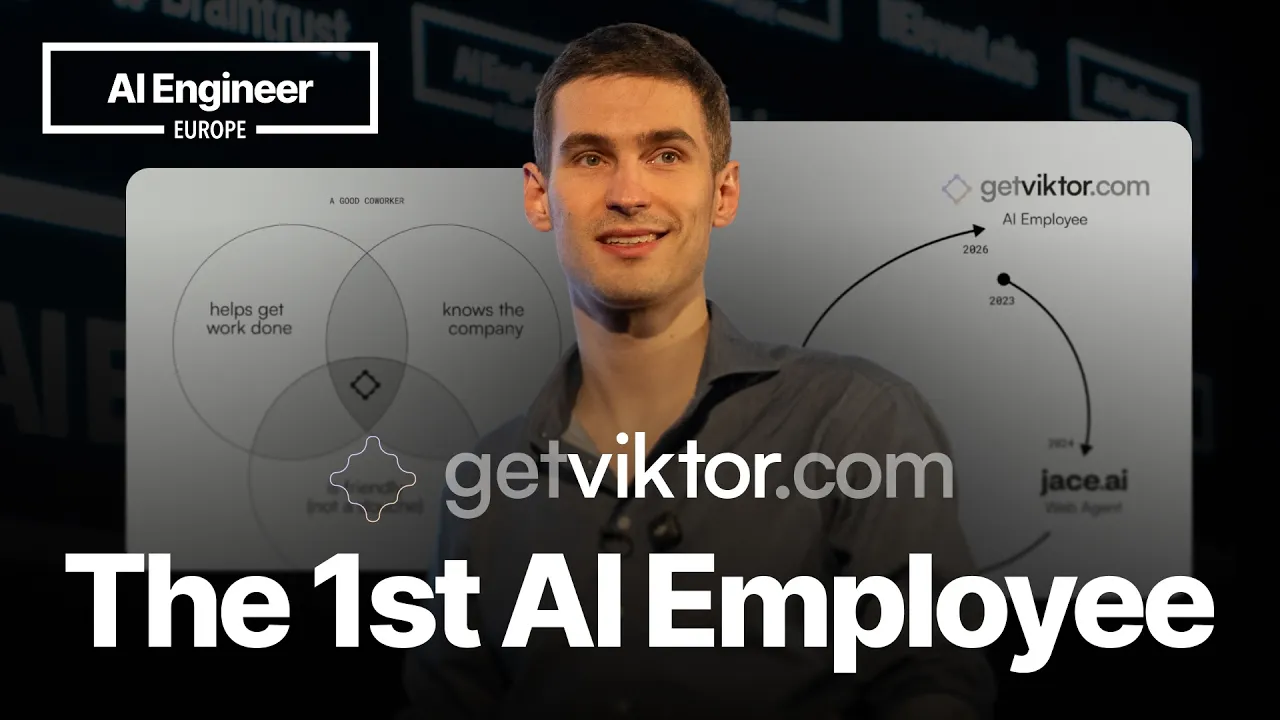
Description
Viktor is an AI employee that lives in Slack. No web UI. It participates in channels and threads the way a teammate does, inherits integrations from whoever connected them first, and handles tasks that take ten minutes while you move on to something else. This talk covers what breaks when you scale a personal agent to a whole company. Slack is a more complex input surface than it looks: threads, DMs, edits, deletions, emoji reactions, and conversations that drift between channels. Memory isolation gets harder when the same agent needs context for a hundred users without leaking the growth channel into the engineering queue or one person's DMs into the team feed. And when you try to swap the underlying model for something cheaper, users notice in ways that have nothing to do with task performance. Speaker info: - https://x.com/fawiatrowski - http://getviktor.com/
Summary
Generated by claude-haiku-4-5-20251001Viktor: AI Coworker That Lives in Slack — Summary
Main Topics
- Product Overview: Viktor is an AI employee that operates within Slack as a company agent rather than a personal agent
- Evolution of AI Agents: Journey from web-based agents (JCI) to email agents to the current Slack-integrated Viktor
- Technical Architecture: Tool integration, context management, and memory challenges in multi-user environments
- Design Philosophy: Why Slack is the ideal interface for AI employees
- Future Vision: Mass adoption of AI employees across all companies
Key Points
Product Fundamentals
- Viktor launched in February 2023 with unexpected massive adoption and market fit
- Lives exclusively in Slack (no separate web app); integrates with 3,000+ tools and can build custom connections
- Provides horizontal, company-wide context across all business functions—unlike specialized human hires
- Can access any tools your company uses, including codebases and analytics platforms
Historical Context
- 2023: Started with JCI, a browser-based agent using DOM snapshots (only 3-5 steps with 60% reliability)
- Next Phase: Evolved into an email agent (still operational), triggering automated actions based on incoming emails
- February 2024: Launched Viktor as the "company agent" vs. personal agents like Claude's Opus
Company Agent vs. Personal Agent Differences
- Shared Access: Single integration setup by one person accessible to entire team (vs. requiring 100+ individual setups)
- Permission Inheritance: Victor inherits and respects company hierarchies and channel-based access controls
- Contextual Awareness: Prevents data leakage between departments while maintaining company-wide knowledge
Key Technical Challenges
Memory Management
- Memory depletion scales 100x faster with 100 users vs. single user
- Required innovative architectural solutions to prevent context cluttering
Slack Complexity
- Handles multiple interaction modes: DMs, public channels, threads, emoji reactions, message edits/deletions
- Must manage context across non-linear, fragmented conversations
- Needs to differentiate between new tasks and continued conversations (e.g., old thread vs. new DM)
- Must respect organizational hierarchies and channel permissions
Why Slack Over Web Apps
- Human-like experience: People interact with employees in messaging, not web apps
- Latency expectations: 10-minute task completion feels fast in Slack (context-switching avoided) vs. frustrating in web apps
- Always-on availability: Cloud-based; doesn't require your computer to be on
Critical Discoveries
Model Selection & Personality
- Uses Anthropic's Opus 4.6 (not GPT-5.4 despite better tool calling/code gen)
- Users have strong preferences for Opus's "sassy" personality and tone
- Personality matters significantly for adoption and user satisfaction
Proactivity & Security Balance
- Victor can proactively join conversations (e.g., fact-checking statistical claims)
- Security teams initially oppose broad proactivity; must earn trust with early users first
- Privacy concern example: Admin accidentally connected personal Gmail; required new scoping capability
Shared Context Advantage
- Single integration connection (e.g., Meta Ads) vs. requiring 20 people individually to connect
- Eliminates ambiguity about which integration to use
- Dramatically reduces setup friction for teams
Differentiation from Competitors
- Unlike Desktop agents (Claude Code): cloud-based, always-on, no computer requirement
- Unique advantage: shared context across team eliminates individual integration overhead
Notable Quotes
> "It is unworthy of excellent men to lose hours like slaves in the labour of calculation. Let us leave that to machines."
— Gottfried Leibniz (17th century)
> "Victor is not a tool. It's a hire."
> "You don't interact with human employees in web apps. You interact with them in Slack."
> "Why did you give Victor access to your personal email? If you hire a new employee, do you give them access to your personal email? Probably not."
> "Every company has AI employees. I think it's obvious. Nothing to argue here."
Takeaways
For Users
- Viktor offers immediate value through automated workflows, proactive insights, and company-wide context
- $100 free credits available for testing
- Start with limited users before broad rollout to manage security concerns
For Builders (Three Pillars of Great AI Coworkers)
- Helps get work done easily — Integrate tools and leverage capable modern models
- Knows the company — Maintain Slack context and respect organizational permissions
- Make it friendly — Personality and tone significantly impact adoption and satisfaction
Vision & Strategic Implications
- AI employees represent the next evolution of workplace automation
- Shift from personal AI assistants to company-wide AI agents with shared intelligence
- Massive market opportunity as every company will eventually adopt AI employees
- Current moment is the beginning of automating all cognitive tasks (following Leibniz's 17th-century vision)
Transcript
Cool. [SPEAKER_00] So my name is Fredrik. I'm the co-founder of Victor. Victor is the AI employee that probably most of you have heard of already. It's absolutely blowing up. We launched it in February this year. Zero expectations of growing at all. It was actually an experiment. And it surprised all of us. Immediate market fit. Huge adoption worldwide. And we can't catch up. So what is Victor? Victor is an AI employee. When you think of an AI employee, you should think of it as just a human employee. It lives where you live. It lives in Slack. It doesn't have a web app. So just your teammates, you don't need to go to a separate place to call it. It participates in your discussions, in threads, in channels. And it has access to the tools that you have access to. It has access to 3,000 integrations. And if for some reason it doesn't have access to your integrations, it can build its own connections. So essentially, Victor can use any tools that your company uses. And therefore, Victor has the context of all of your tools. And as opposed to human employees, Victor has a horizontal and broad context about the whole company. And for example, when you currently hire a CMO, you can probably assume that this CMO would be much better if it had access to your codebase. If it was able to contribute to your codebase. And Victor can do this. So it's bringing this kind of universal, peers-level understanding to all of the areas of the company. Let's start with a quick story of Victor and the company. Our mission from the very early days in 2023 was to build AI employees. And back then, it was after ChatGPT has launched. Back then, we thought that the right way to build AI employees is through browsers. As a reminder, we didn't have tool calling. We didn't have great code-generating models. So probably the right way to take action was through browsers. Browsers are very universal interfaces. You can essentially use any tools through a browser. Most apps have browser apps that you can interact with. And the way back then it was called JCI was working. It was taking a snapshot of your DOM, minifying it in a lossless way. And then based on the snapshot and this minified snapshot and your goal, it was deciding on the next step. So, for example, should I type something in the search bar in Google? Or should I click on the login button to log in? And it was great. It certainly should work, right? And it did. But it didn't work for a lot of steps with the previous capabilities of the models. It was back in 2023, it was working for three to five steps reliably. And by reliably, I mean with 60% reliability. And that was compounding with each step. And that was still state of the art. So JCI was a state of the art web agent on the most popular agenting benchmark called Web Arena. And it was doing well. But it was very difficult to make it into a useful product just because of the reliability and the speed issues. You can call a few tools or call a function and it will immediately give you an output. And with the web agents, you have to wait a minute until it fails. So it was quite hard. But web agents are amazing. And they're finally working much better than in the past. Cool. So after that, JCI became an email agent. Sonnet 3.5 came. We built our first agent loop. And we really wanted to have the experience of you not having to go to a web app to ask the agent to do something. But rather, the agent having all the necessary context and being able to be proactive and come up with the tasks for you. And we achieved that with JCI. JCI was an amazing product, also a great product market fit. And it's still alive. You should check it out. The way it works is, whenever an email arrives, an agent loop is triggered, connects to your tools, can react to emails, not only with email drafts, but also with tool codes. For example, if someone asks for a refund, the agent can automatically do a refund for you. And of course, can be gated with approvals as well. Cool. But then this February, we launched Victor. Victor, probably everyone, I mean, we are in the Anthropic track, so everyone knows who wants Anthropic, which is a personal agent. And we always wanted to build the employee, which is the company agent. And that's the first question you should ask yourself: what is the difference between the company agent and the personal agent? So, first, we think that company agents should live where you live, work where you work, and have all the company context. And if you're building a personal agent, then probably everyone from the company connects their own integrations and runs those agents on their own. With Victor and with the company agents, it's different because suddenly it's sufficient for one person from the company to connect an integration. Victor will inherit the permissions from this integration, or you can tune it. And then the whole team has access to it. So you don't need to connect them a hundred times. So as I said before, 3,000 tools, lives in Slack, and essentially does anything across roles. And that comes with challenges. And as you can imagine, I'll talk about one mainly here. So the first challenge with coming from a personal agent to a team agent and not having one user but any users is around memory. So with Anthropic, there was a big concern about the memory getting cluttered over time. And I think that's serious and it makes sense to be concerned about this, right? But imagine that you have the same architecture and the same memory but now for a hundred users and not one user. So it's probably running out of the memory a hundred times faster. It's a big challenge to be solved. And we have solved it. Another thing is Slack has different channels and companies have different hierarchies that we need to adhere to. And people will often give the agents conflicting instructions. So, with OpenClaw, there was a big concern about the memory getting cluttered over time. And I think that's serious and it makes sense to be concerned about this, right? But imagine that you have the same architecture and the same memory but now for a hundred users and not one user. So, it's probably running out of the memory a hundred times faster. It's a big challenge to be solved. And we have solved it. Another thing is Slack has different channels and companies have different hierarchies that we need to adhere to. And people will often give the agents conflicting instructions. But let's imagine that you have Victor, your company agent, in one channel, in the growth channel, and then in the engineering channel. And also in people's DMs. So, Victor will take the context from the growth channel or will take the context from the executive channel. And you somehow need to make sure that this context will not be leaked to the engineering or support channel. Similarly, if you DM Victor with your problems, Victor should not take the context from the growth channel unless you are from the growth team. So, it adds a lot of complexity on how the access is structured. And we chose Slack as our interface for what we think is AGI for companies. And there is a reason for this. I will start to talk about the reasons and then what breaks in Slack. So, there are two major reasons. First, we wanted Victor to feel like a human employee. And you don't interact with human employees in web apps. You interact with them in Slack. Your teammates, right? And the number two reason for choosing Slack as an interface is that if Victor is a very powerful agent and it's supposed to perform difficult tasks, then those tasks will not execute immediately. They can take like 10 minutes to execute, right? Naturally. So, when you go to a web app and ask an agent to do something for you, you switch contexts, and now you need to wait 10 minutes for the answer or for the output, it's quite frustrating. Right? You don't want to wait. You are used to from ChatGPT, you're used to immediate answers. It should take like 30 seconds and it's done. Thank you, copy, paste, and I'm done. But it's not how it works with the powerful agents. So, why is Slack better? Well, now, if you ping someone on Slack and tell them to build an app for you and get an answer in 10 minutes, you are shocked. No teammate has ever built an app in 10 minutes, right? So, the perception is different and suddenly the latency is very low when you compare it to your normal Slack experience. But there are certain things that break in Slack. And number one is that when you work in web apps, you have a single thread. You open a new agent or a new thread and you speak to this agent. However, when you are in Slack, you have a lot of interaction modes. One of them is DMing people. Another one is being in public channels and participating in threads. Another one is just reacting with emojis. You can also edit your messages and stuff. And all of this is an input to an agent. And all of that needs to fit into a linear context, somehow. Not in a single thread, right? And we need to manage this. So, let me give you an example. Of course, when someone deletes a message, a human assumes that the task should not be continued or it's not interesting anymore. When someone edits a message, you should also respond to an edit. But let's say you are DMing your coworker, whether that's Victor or your friend, and you start a thread in Slack, right? But at some point, and humans do it very often, you forget about the thread and you just start a new DM to the same person. Should you start and you open a new sandbox? And humans normally have the context from the previous thread. But for the agent, it's a totally new area. It's a new task, right? So, what needs to happen then is you need to somehow always, whenever Victor receives a DM, look at the previous messages and somehow roll them over to the existing conversation. So, this is just one of the challenges that you need to face. Fun fact, we noticed, I didn't think it would be as important as it actually is, but what really matters is the tone. I'll give you an example from one of our customers. We were testing, so we use Opus 4.6 now for Victor, and we were used as the main model. And we wanted to try GPT 5.4. And on the tool calling and code gen, it's actually amazing. It should work. And it's actually cheaper as well. So why not replace Opus with GPT 5.4? And there's one reason we didn't go for it. There's a couple. But one, the most interesting one, is the personality. For some reason, our users can be due to our architecture, but they love Opus. And they all started raging when we did the A-B test. So, I think there's something beautiful in that model that we can learn from. And Opus is a bit sassy as well in Victor. I'm not sure if that's thanks to our team or who made it this way. But actually, it's quite funny. I encourage everyone to try. Proactivity. One of the powerful things that Victor can do is proactively suggest to you the workflows that it can automate. So, let's say you're in a growth team and you discuss an A-B test and the results. And at some point, you realize, okay, this one option is performing really well. I'll go for this option instead of the other one. Victor has access to your post hook or whatever tool you use for analytics. And it can literally check and realize, and it will do so, if what you're saying is not some bullshit. It happened a couple of times that we were discussing some experiments. Victor checked post hook and said, hey, you know, it's true, but this is not statistically significant. So, it's fun. It's an advantage, right? If Victor can suddenly join a conversation and be helpful, it will be activated more broadly in the workspace, which is great for the product. But if Victor does it on day one and it happened, the security teams start raging. And it can literally check and realize, and it will do so, if what you're saying is not some bullshit. It happened a couple of times that we were discussing some experiments. Victor checked post hook and said, hey, it's true, but this is not statistically significant. So it's fun. It's an advantage, right? If Victor can suddenly join a conversation and be helpful, it will be activated more broadly in the workspace, which is great for the product. But if Victor does it on day one and it happened, the security teams start raging. Because someone adds Victor to your workspace and suddenly Victor starts DMing everyone and participating in the threads and the security is going crazy. That's why I think you should earn it with a few users first and then you can roll it out broadly. Exactly. Yeah. So the value of shared context. I don't have much time left, but I'll very quickly talk about the difference between Victor and agents like Cloud Code, or Cloud Cowork or whatever. Cloud Cowork works on your desktop, so it's a bit different. The advantage of Victor is that it works in cloud. You don't need to have your computer open for it to work. And another thing is the shared context. So as I said at the beginning, for Victor to work well, for you to be able to ask Victor to change your meta ads budget or to read your analytics data, only one person from the company needs to connect this integration, right? Imagine that you work in a 100-person team and your growth team is 20 people. If you have to ask 20 people to connect your meta ads, everyone individually, it's quite painful. Furthermore, if someone wants to interact with Victor, like if Victor wants to be proactive, everyone connects their own integration, someone can connect their own integration, right? And Victor can be just very stuck and wrong and might not know which integration to use, which adds a lot of complexity for the user. Cool. And something I want to highlight here is that Victor is not a tool. It's a hire. And here's what I mean. I'll tell you one customer story. One of the biggest e-commerce brands in the United States, their team admin has connected Victor. And the first integration, the team integration that they connected was their personal email, personal Gmail. And then suddenly the team started speaking to Victor about this guy's emails. And this guy is texting me and saying, hey, man, what the hell? Victor is leaking all of my data. Why are you doing this? And I'm saying, why did you give Victor access to your personal email? If you hire a new employee, do you give them access to your personal email? Probably not, right? That said, I think it was a great inspiration. And what we did is we added a capability to Victor to scope the integrations. So they're not always shared. And if you want to have your personal integration to your personal email and Victor to use it when you call it in your DMs or publicly, this is also possible now. Yeah. And so to summarize, what does it take for an AI co-worker to be great? I think there are three major pillars if you want to build your co-worker. I think this is a technical crowd, so I encourage everyone here to try to build your own Victor. And there are just three things you need to make work. It helps get work done quite easily. Models are capable today. Connect your integration through PyDream will work well. Know the company. Has the context from Slack. Make sure you're able to utilize this context well. You will probably need to go through the Slack approval process, which is very difficult and can be boring. And then make it friendly. It makes a difference. And you should make sure that Victor likes your team. Your team likes Victor. This is our vision for the future. Every company has AI employees. I think it's obvious. Nothing to argue here. And historically, I just want to highlight, the vision for AGI has been with us since the 17th century. Gottfried Leibniz, the inventor of calculus, was reasoning about humans doing unnecessary things. And he wanted to build a calculator. Little did he know, calculation is not the only cognitive task that we can automate. And I think we are now in this beautiful moment in history where we can essentially automate all the cognitive tasks and we can be part of the revolution. So I'll just let myself read his quote. It is unworthy of excellent men to lose hours like slaves in the labour of calculation. Let us leave that to machines. And with that, I just wanted to encourage everyone to scan this QR code, click on sign up and add Victor to your Slack. Test it out. Everyone in this room has $100 in free credits. No strings attached. You can just remove Victor at any time. It will add a lot of value, I promise. If it doesn't, give me a call. I'll make sure it does. Thank you. If you have to ask 20 people to connect your meta ads, everyone individually, it's quite painful. Furthermore, if someone wants to interact with Victor, like if Victor wants to be proactive, everyone connects their own integration, someone can connect their own integration, right? And Victor can be just very stuck and wrong and might not know which integration to use, which adds a lot of complexity for the user. Cool. And something I want to highlight here is that Victor is not a tool. It's a hire. And here's what I mean. I'll tell you one customer story. One of the biggest e-commerce brands in the United States, their team admin has connected Victor. And the first integration, the team integration that they connected was their personal email, personal Gmail. And then suddenly the team started speaking to Victor about this guy's emails. And this guy is texting me and saying, hey, man, what the hell? Victor is leaking all of my data. Why are you doing this? And I'm like, why did you give Victor access to your personal email? Like, you know, if you hire a new employee, do you give them access to your personal email? Probably not, right? That said, I think it was a great inspiration. And what we did is we added a capability to Victor to kind of scope the integrations. So they're not always shared. And if you want to have your personal integration to your personal email and Victor to, like, in your DMs or publicly be able to use it when you call it, this is also possible now. Yeah. And so to summarize, what does it take for an AI co-worker to be great? I think there are three major pillars if you want to build your co-worker. I think this is a technical crowd, so I encourage everyone here to try to build your own Victor. And, you know, there are just three things you need to make work. It helps get work done quite easy. Models are capable today. Connect your integration through PyDream will work well. Know the company, has the context from Slack. Make sure you're able to utilise this context well. You will probably need to go through the Slack approval process, which is very difficult and can be boring. And then make it friendly. It makes a difference. And you should make sure that Victor likes your team. Your team likes Victor. This is our vision for the future. Every company has AI employees. I think it's obvious. Nothing to argue here. And historically, I just want to highlight, the vision for AGI has been with us since the 17th century. Gottfried Leibniz, the inventor of calculus, was reasoning about humans doing unnecessary things. And he wanted to build a calculator. Little did he know, calculation is not the only cognitive task that we can automate. And I think we are now in this beautiful moment in history where we can essentially automate all the cognitive tasks and we can be part of the revolution. So I'll just let myself read his quote. It is unworthy of excellent men to lose hours like slaves in the labour of calculation. Let us leave that to machines. And with that, I just wanted to encourage everyone to scan this QR code, click on sign up and add Victor to your Slack. Test it out. Everyone in this room has $100 in free credits. No string is attached. You can just remove Victor at any time. It will add a lot of value, I promise. If it doesn't, give me a call. I'll make sure it does. Thank you.