The AI Bubble WILL Burst | Should we be fearful of Chinese Open-Source | Jerry Murdock
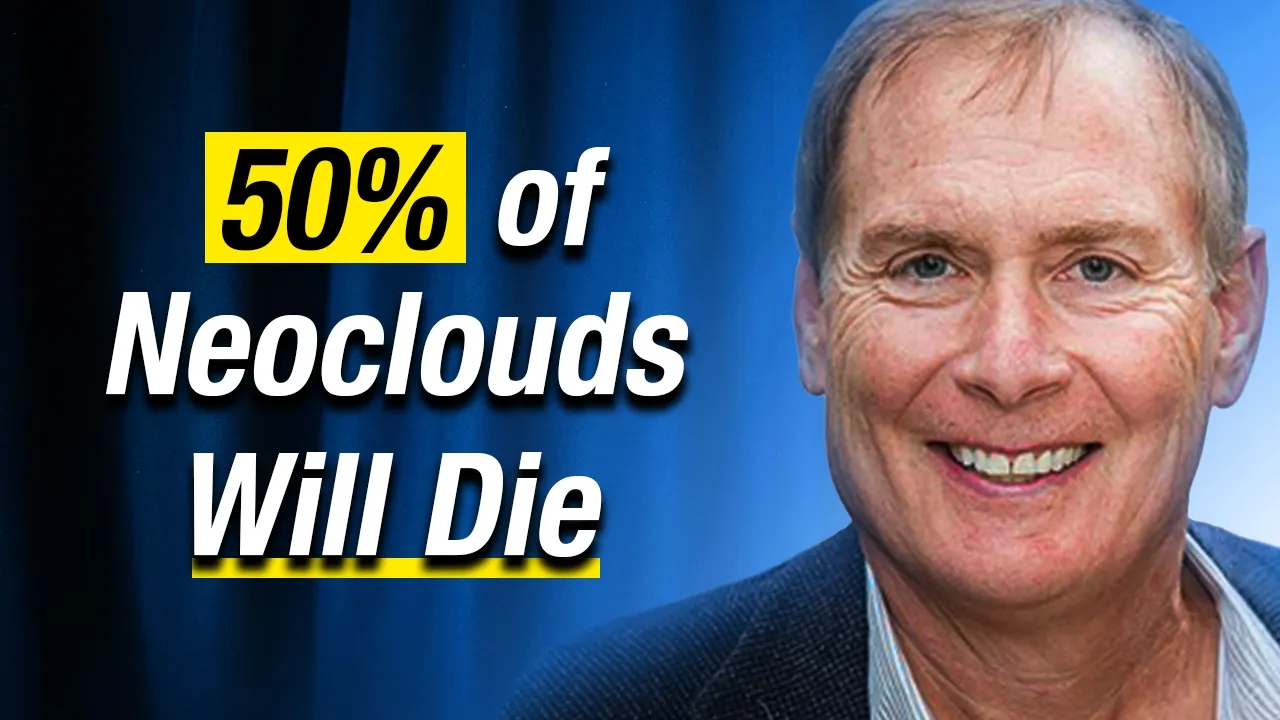
Description
Jerry Murdock is the Co-Founder of Insight Partners, which manages over $90 billion in assets. Jerry personally backed companies including Twitter, Nest and Docker, while Insight's portfolio includes giants such as Shopify, Wiz and monday.com. Across three decades, Insight has helped produce 55+ IPOs and become one of the most powerful technology investment firms in the world. ----------------------------------------------- Timestamps: 00:00 Intro 01:15 Will the AI Bubble Burst? 03:43 The Warning Signs in Credit Markets That Nobody Is Counting 05:09 Japan's $1 Trillion in Treasuries 07:17 If There's a Credit Dislocation, Half the Neo Clouds Go Away 09:57 Millions of Specialized Models vs a Handful of Frontier Providers 12:39 Open Source vs Frontier: Token Traffic vs Dollar Traffic 16:58 The Demand for Intelligence Is Endless 18:53 Should Enterprises Be Scared Frontier Labs Will Eat Their Lunch? 21:24 The Golden Age of Cyber 23:02 Why Sandboxes Are the Most Important & Most Underrated Security Layer 24:48 Should We Get Used to Lower Margins in the AI Era? 36:16 Is OpenRouter a Long-Term Business? 40:49 Are Venture Cycles Getting Shorter? The Cursor Case Study 43:40 Can You IPO With Less Than $1B in Revenue Today? 45:28 The Coworker Era Has Begun 46:59 Private Equity Is Highly at Risk to Any Financial Dislocation 59:20 Quick-Fire Round ---------------------------------------------------------------------------------------------- Subscribe on Spotify: https://open.spotify.com/show/3j2KMcZTtgTNBKwtZBMHvl?si=85bc9196860e4466 Subscribe on Apple Podcasts: https://podcasts.apple.com/us/podcast/the-twenty-minute-vc-20vc-venture-capital-startup/id958230465 Follow Harry Stebbings on X: https://twitter.com/HarryStebbings Follow Jerry Murdock on X: https://twitter.com/aspenjfm Follow 20VC on Instagram: https://www.instagram.com/20vchq Follow 20VC on TikTok: https://www.tiktok.com/@20vc_tok Visit our Website: https://www.20vc.com Subscribe to our Newsletter: https://ww
Summary
Generated by gpt-5.6-terraAt-a-Glance
- Verdict: Watch fully
- Core thesis: Murdock argues that AI demand and frontier-model innovation are real, but a debt-fueled buildout is vulnerable to a macro credit shock that would consolidate infrastructure, punish undifferentiated vendors, and elevate capital-efficient, security-first agent infrastructure.
- Why it matters: The interview directly addresses the durability of AI infrastructure businesses, open versus frontier model deployment, sandboxing for agents, model-routing economics, and the operational AI strategy required to survive the shift from SaaS copilots to agentic co-work.
- Best use: Use it as a strategic-investment and architecture discussion: separate its useful infrastructure and security patterns from its highly speculative macro and market-timing calls.
Executive Summary
Jerry Murdock’s central view is not that AI is fake, but that its financing structure is fragile. He expects a meaningful correction or “bubble burst” to be possible between October 2026 and March 2027 if geopolitical escalation triggers inflation, a credit-market disruption, or asset deflation. His analogy is prior technology cycles: the underlying assets and innovations can remain valuable while the heavily indebted companies that financed their buildout fail or are forced to sell.
That distinction drives his market map. Hyperscalers have durable cash-generating businesses and could use a downturn to acquire distressed assets cheaply; neoclouds and low-margin infrastructure providers lack that resilience. He predicts at least half of neoclouds disappear within 36 months, with survival determined less by headline revenue or valuation than by management quality, capital efficiency, and a demonstrated willingness to generate profits. He contrasts Fireworks favorably with Baseten on those grounds, while acknowledging this is his investment judgment rather than a full operating comparison.
For AI systems, Murdock expects a large, lasting split rather than winner-take-all. Frontier models should retain high-value demand if they continue advancing on complex reasoning and eventually continuous learning, while open-source models gain heavily in specialized, cheaper, customizable enterprise workloads—especially where data must remain behind the firewall. He rejects the idea that all tokens are equivalent: customized models can produce materially different output quality, verbosity, and unit economics.
His most concrete operating warning concerns agent security. Containers alone are not a sufficient boundary for probabilistic agents that can autonomously invoke many tools and libraries; he argues that sandboxing, tool-behavior controls, tracing, and purpose-built isolation will become core infrastructure. He also expects simple model-routing markups to erode as inference exchanges and direct procurement make routing a commodity. For incumbent SaaS and PE-owned software, his warning is that superficial AI copilots are inadequate: companies need a genuine agentic product and system-of-record strategy before autonomous co-work changes their category economics.
Key Takeaways
- Claim: The AI buildout can remain strategically valid while a financial dislocation destroys the weaker companies financing it. | Evidence: Murdock compares the risk to the dot-com era, when fiber remained valuable but many companies that laid it went bankrupt. He cites unusually high hyperscaler debt, historically low free cash flow at Meta, narrow private-credit spreads, leverage failures such as “Leopold,” and potential Treasury-market stress if Japan were forced to sell a large portion of its roughly $1 trillion Treasury holdings. | Implication: Do not treat AI category growth as equivalent to investability. Stress-test counterparties, vendors, and portfolio companies for funding access, debt exposure, burn rate, and an abrupt decline in asset values. | Caveat: His timing call—a possible bubble burst between October 2026 and March 2027—is explicitly conditional on an Iran-related escalation or another macro shock; the transcript provides no quantitative model proving that scenario.
- Claim: Hyperscalers are positioned to survive a downturn, but at least half of neoclouds may fail within 36 months. | Evidence: He says hyperscalers have recurring businesses and balance-sheet capacity that would let them absorb a disruption and buy cheaper distressed assets; by contrast, he forecasts that “at least half” of neoclouds go away within 36 months and that a macro disruption could accelerate failures immediately. | Implication: For infrastructure selection or investment, prioritize durable unit economics and execution quality over GPU access, revenue scale, or fundraising valuation; avoid assuming every compute intermediary is a durable platform. | Caveat: The survival criterion is not a public metric: Murdock says outsiders cannot see “under the covers” and that management quality, organization, capital efficiency, and profitability will decide outcomes.
- Claim: Open-source and frontier models will coexist because specialization, customization, privacy, and cost expand total demand rather than immediately cannibalizing frontier demand. | Evidence: Murdock says enterprises cannot generally customize the largest OpenAI or Anthropic models, creating an opening for tuned open models. He contrasts frontier-model costs described as double-digit dollars per token with open-source costs around 10–11 cents per token, while arguing that global AI demand is still only in low-single-digit fulfillment. | Implication: Use a portfolio architecture: route specialized, repetitive, data-sensitive workloads to tuned/self-hosted models and reserve frontier capacity for complex or highest-value work. The opportunity is in the orchestration, customization, and secure deployment layer—not merely access to a base model. | Caveat: He believes frontier providers retain the advantage on complex tasks only so long as they continue innovating; he explicitly identifies stalled model progress as a possible trigger for a valley of disillusionment.
- Claim: Tokens are not interchangeable economic units because model customization and output behavior materially affect effective cost and task value. | Evidence: Against the “a token is a token” view, Murdock argues that customized models have distinct styles and may be concise or verbose, producing different token volumes and outcomes. He gives coding, customer service, and onboarding as workloads where specialized open-source models can be cheaper and pay off faster. | Implication: Measure AI economics at the workflow level—task completion, quality, retries, latency, output length, and human review—not through raw token price or aggregate token traffic alone. | Caveat: The transcript does not offer benchmark data comparing task success, latency, or total cost across the named providers and models.
- Claim: Agent security requires sandboxing and tool-level controls; containers by themselves are inadequate for probabilistic agents. | Evidence: Murdock says Docker itself has acknowledged that containers are not sufficient and highlights Docker Sandboxes and E2B cloud sandboxes. His core scenario is an agent opening 100 sandboxes, trying many libraries and tools, then selecting an approach—behavior that creates a substantially larger and less deterministic attack surface than a developer manually building one application. | Implication: Treat agent execution as an isolated, observable runtime: enforce sandboxes before tool execution, constrain network and filesystem access, govern tool permissions, capture traces, and assume agent behavior will explore more broadly than a predefined workflow. | Caveat: He presents sandboxing as foundational but does not provide a complete security architecture for identity, authorization, secrets, data egress, supply-chain controls, or incident response.
- Claim: Simple model-routing aggregators charging a markup are likely to be disrupted by inference exchanges and direct procurement. | Evidence: Murdock characterizes OpenRouter’s reported 5% markup as economically unsustainable and points to Akinaki’s Dodex, Venice.io, and other emerging exchanges as alternatives that can source inference and route models without the aggregator fee. | Implication: Avoid embedding a permanent-margin assumption into routing-layer strategy. Build portability across providers, evaluate the value of routing beyond convenience, and distinguish an orchestration/control plane from a pass-through reseller. | Caveat: This is a forward-looking prediction; the transcript does not establish that exchanges can match routing platforms on reliability, unified APIs, governance, enterprise support, or compliance.
- Claim: Incumbent SaaS companies and leveraged PE software portfolios face an increasingly urgent threat unless they develop a substantive agentic strategy. | Evidence: Murdock calls the emerging phase the “co-work era,” in which autonomous agents and agentic systems begin to replace or reshape conventional SaaS workflows. He says companies without a compelling AI product, system of record, and thoughtful strategy may have little strategic optionality within two years; he also flags PE portfolios carrying roughly 4–6x leverage as vulnerable if EBITDA falls, churn rises, and markets dislocate. | Implication: Assess software assets by whether AI is changing the underlying workflow, data advantage, and system-of-record position—not whether a copilot has been added. For leveraged portfolios, model downside cases involving AI-driven churn and lower EBITDA before refinancing risk appears. | Caveat: He believes it is still early enough for SaaS companies to pivot, and he does not claim every copilot-enhanced SaaS product is doomed.
Detailed Brief
Where Murdock sees durable AI value versus temporary land-grab economics
- Claims: Early-cycle low or zero margins can be a deliberate customer-acquisition strategy, but Murdock would not invest in a company that turns low margins into its operating culture.; Infrastructure firms can justify rapid growth when they solve ecosystem bottlenecks created by frontier models, but he does not extend that growth expectation broadly to application-layer companies.; He prefers companies that create differentiated value above raw compute rather than monetizing commodity usage alone.
- Evidence: He describes early markets as an Oklahoma land rush: companies accept low margins to secure customers and relationships, intending to expand margins later.; For sandbox providers, he prefers a “bring your own compute” model that charges for better sandbox orchestration, networking, tracing, and visibility rather than simply reselling compute.; He cites Fireworks’ apparent ability to scale behind OpenAI, Anthropic, and open-source adoption as an example of an infrastructure layer benefiting from the ecosystem.
- Caveats: His views on Fireworks, Baseten, E2B, and Docker are opinionated and partly informed by his investment relationships; they should not substitute for independent diligence.; Fast infrastructure growth can still be exposed to underlying provider pricing, supply concentration, and changing model architectures.
- Implications: Underwrite gross-margin potential based on unique control-plane, reliability, security, or workflow value—not on temporary demand for scarce compute.; Ask whether a company can retain pricing power after supply normalizes and direct procurement becomes easier.
Continuous learning, data, and the next model transition
- Claims: Murdock expects continuous-learning models, followed eventually by lifelong-learning systems, to be architecturally different from today’s largely static trained models.; If that transition occurs, he expects current model generations—including today’s open-source leaders—to be replaced rather than simply incrementally updated.; Enterprise data is valuable primarily through evolving context and differentiated use, not as a permanently static commodity.
- Evidence: He defines continuous learning as maintaining memory and adapting to dynamic events so models and physical-AI systems can perform more complicated tasks.; He identifies sample-efficient learning—extracting useful generalization from small amounts of data—as an early but incomplete indicator of progress.; His example is that Shake Shack, Burger King, and McDonald’s would operationalize similar categories of data differently, making use context a source of value.
- Caveats: Murdock assigns no reliable schedule: he says continuous learning could be two to three years away or ten years away and compares the uncertainty to repeatedly overestimating progress in curing cancer.; He says a failure to solve sample-efficient and continuous learning, combined with a financial shock, could create a valley of disillusionment.
- Implications: Do not lock product architecture or investment theses to the permanence of a current model family.; Design data systems for continuously refreshed context, provenance, adaptation, and enterprise-specific use rather than one-time model training.
Strategic and market views outside the core agent stack
- Claims: Murdock considers ownership of custom chips sensible as a short-term optimization for large model companies but not the most compelling long-term investment layer.; He believes the model-agent-human interaction layer—customization, loops, security, and control—is more attractive than chip ownership.; He expects blockchain-based agent payments and inference procurement to become more credible applications than speculative crypto use cases.
- Evidence: He says ASICs can be better suited than GPUs for specialized models because GPUs are expensive for that use case.; He references discussion at the Santa Fe Institute with chief scientists from major AI companies, where one conclusion was that the important opportunity lay in complexity between models, agents, and humans; he also says AGI remains difficult even to measure.; He names Akinaki, Venice, Robinhood Chain, Solana, and Ethereum as examples of infrastructure or rails he believes could demonstrate real utility.
- Caveats: The blockchain discussion includes unverified-attribution claims about Bitcoin being vulnerable to hacking within two to four years; the transcript does not supply technical evidence.; His conclusion that chip ownership is unnecessary long term depends on uncertain model and hardware evolution.
- Implications: Favor investments and product work that improve execution, payment, identity, policy, observability, and human-agent coordination over undifferentiated hardware ownership.; If experimenting with agent payments or inference markets, separate operational utility from token speculation and evaluate security and settlement risks independently.
Notable Concepts & Terms
- Neoclouds: AI-focused cloud/compute providers; Murdock sees them as especially vulnerable to capital-market stress and eventual consolidation.
- Co-work era: Murdock’s term for a shift from AI copilots toward agentic systems that operate alongside or autonomously for users, creating a more serious threat to conventional SaaS workflows.
- Sandboxing: Isolated execution environments for agents and their tools; presented as the minimum foundational control because containers alone do not adequately constrain probabilistic agent behavior.
- Bring your own compute: A sandbox-provider business model that avoids low-margin compute resale and instead charges for higher-value orchestration, networking, tracing, and visibility.
- Continuous learning: The anticipated ability of models to retain and update knowledge from ongoing experience, potentially requiring fundamentally new architectures rather than static training plus inference.
- Sample-efficient models: Models that can learn or generalize usefully from small data samples; Murdock treats this as a necessary but not sufficient step toward robust continuous learning.
- Inference exchange: A marketplace or exchange for purchasing inference across providers, potentially bundling routing and challenging aggregators that take pass-through markups.
- System of record: The durable proprietary workflow and data position that Murdock thinks SaaS companies need alongside an agentic AI strategy to remain defensible.
Operator Notes / Why Ken Should Care
- Require sandboxed execution, least-privilege tool access, egress restrictions, secret isolation, and traces for every autonomous-agent workflow; do not rely on a container boundary as the primary security control.
- Create workflow-level model-routing scorecards that compare task quality, failure/retry rates, latency, privacy requirements, and total cost—not just token price or provider availability.
- Keep routing portable: maintain direct provider paths and abstraction layers so a single aggregation provider or markup is not embedded as permanent infrastructure.
- For external AI infrastructure vendors, add diligence on debt, burn, capital commitments, gross-margin trajectory, customer concentration, and contingency plans for constrained compute financing.
- For any SaaS or software-asset evaluation, demand a concrete agentic roadmap tied to the system of record and workflow redesign; reject superficial “AI copilot” positioning as proof of defensibility.
- Monitor whether continuous-learning and sample-efficient-learning claims become technically demonstrable before treating them as near-term product assumptions.
Source/Metadata
- Title: The AI Bubble WILL Burst | Should we be fearful of Chinese Open-Source | Jerry Murdock
- Transcript words: 12904
- Duration seconds: 4208
- Timestamp note: No timestamps or chapter markers were present in the supplied transcript; the transcript also contains repeated passages.
Transcript
If there is a dislocation, no one is better prepared to survive it than hyperscalers. Let's take neoclouds. I think at least half of them go away within 36 months. Jerry Murdoch, joining me in the hot seat today, he's the founder of Insight. They manage over $90 billion. Jerry has seen pretty much every technology cycle of the last 25 years. He's invested in some of the biggest companies across those 25 years. And today we debunk whether we are in a bubble or not, whether China will beat the frontier models, whether we are about to have the greatest cybersecurity threats of our lifetime, this and so much more. Fireworks is making a lot more money than Base 10. The more you customize the model, the more the token changes its value. Ready to go? Do you know what? I love my... I think I genuinely have the best job in the world because I get to sit down with people like you, and I'm dumb as rocks, but I get to ask questions that normally I wouldn't be able to ask. And I get to learn from the greatest minds. So thank you so much for joining me for a second time, Jerry. I'm happy to be here. Now, I want to touch first on something that you said to me before, which was, you said if the Iran war continues to fester, then you expect to see a correction. And depending on the depth of the correction, the AI bubble will burst between October the 26th and March 27. Can you help me understand your thinking here? If you look at what happened in 2001, the end of the dot-coms, the innovations stopped for a while. And then new innovations came in. The LAMP stack, which led to all that of websites. Google started taking off. 2008, cloud computing, very slow to take off. And this is because these financial disruptions slow things down. The stream of commerce gets disrupted. And right now with AI, debt is a huge part of this. It's so unique compared to previous cycles. So much debt. All the hyperscalers have taken on much more debt than they ever have before. And the challenge becomes, will these guys get disrupted if the credit markets have a disruption, which would be certainly what would happen if we had a problem in the overall capital markets? The concern for you here is that we'll have a credit market disruption caused by the global conflict, which will then impact the ability for these hyperscalers to borrow cheaply? Well, that's one potential disruption. I see several that could occur. And I think if it's going to happen, it's going to happen if this is around war. We can't have it just continue. And the reason I say this right now is complacency. We've got tremendous red lights that have been going on for a year or more on the credit markets. And there's just complacency. It's like, oh, we're fine. And I don't think people are accounting for risk. I mean, if you think about it, those guys that are in the private debt market, the spreads are too narrow between real risk and not so much risk. And they're not really accounting for that. And so I'm concerned about that as one sector. But there's multiple because this AI revolution is incredibly complex, with massive amounts of dollars being spent on it globally. What are the signs to you that we're seeing a cracking in the credit markets? Well, complacency is the first thing you look at. When it happened in 2008, 2010, there was a handful of people, which there's always been documentaries about these guys that made money on shorting the housing market. But everybody else in the world had no idea what was really happening. It was complacency complete. And what you had was a really ugly situation where the people that were supposed to be keeping an eye on things, which were the credit rating agencies and the credit risk departments of the big banks, were asleep at the wheel. And this terrible thing happened. And there was enforcing this risk people didn't recognize because historically, there had never been a huge default problem with mortgages. And that was the kind of thinking that was there. And they didn't realize the underlying problems associated with credit. I see the same thing today in that, in the credit markets, there are many opportunities for there to be problems. In the late 90s, you had long-term credit blow up. We just had Leopold blow up because he wasn't accounting for the leverage that he put on his fund. I still see that there's these little warning signs, that the complacency is the biggest issue. In Japan, another problem, right? So this is the second time the U.S. has bailed out the yen. And why are they bailing out Japan? That's because Japan holds a trillion dollars in treasuries. And if they have to unwind that, if they sell 100 billion worth of treasuries, the market could absorb it. But if they sold 300 billion worth of treasuries, a third, in order to be able to buy dollars to support the yen, we would have a real problem on our hands immediately. Immediate global problem. So you just see, I do a lot of backcountry skiing. And you recognize the avalanche conditions when they're worse or they're better. And you recognize things can be just easily tipped over. And so the war in Iran, if it gets really ugly, which it hasn't yet, if things collapse and inflation comes back, these are disruptors. There's multiple different opportunities for disruption, all based on the war. Can I ask you, though, when we look at prior credit market cycles, like you mentioned there, was the challenge not the underlying assets were of poor quality? When we look at the hyperscalers today, yes, Facebook is having a bond issuance that's priced higher than expected. But Meta's core business is throwing off hundreds of billions of cash flow. They don't need to borrow, really. They could do it off balance sheet. It's an optimization game. The assets are good. I think you just saw that the free cash flow is the lowest it's ever been in the history of the company. Number one. Number two, back in the dot-com bubble, there was a lot of fiber that got laid in the ground. And that fiber was always valuable, but the companies that laid the fiber and stuff, they all went bankrupt. So when you're really heavily dependent on debt and there's a dislocation, the underlying value of the asset declines. It may not decline forever, but it declines pretty sharply in a very short period of time. And that's when you have margin calls. That's the way it goes. What should they do from here? They should not take out such levels of debt. How do you expect this to play out? Well, I mean, look, people are making decisions on the risk that they see to their business. If there is a dislocation, no one is better prepared to survive it than hyperscalers. I mean, all the hyperscalers have enough ongoing business, and they've been very consistent. That's why they're worth what they're worth. The Magnificent Seven is there because they've been doing this for a long time. And so they know that they could absorb this. And if it happens, it'll be good for them because everybody else gets wiped out, and then assets become cheaper for them to acquire. And they're still in good shape. The demand for AI compute is not going to change. That's not going to go away. The issue is the ability to fund it in the short term. Let's take neoclouds. Neoclouds right now, there's a whole bunch of them. I think at least half of them go away within 36 months. And if there's an economic disruption, a lot of them go away right away. Can you help me understand that? I can't pass that over. What will separate the neoclouds that go away and become valueless versus those that retain value and become even more valuable? That's the answer to the question around which hedge funds are going to go away and which ones aren't. If you looked at Leopold's returns, you'd think he's never going to go away. And he's probably going to survive this because he still has a good return for the year. But people are going to be a little wary about his risk-taking capabilities. And so it's underlying, it's the people running the company. What's going to separate one neocloud from another is who is running it. How are they organizing it? We don't see it, you and I and everybody else. We can't see under the covers how that company is being run. I can tell you, look at inference providers. I think Fireworks is making a lot more money than Base 10. And you look at the efficiency there and you think, oh, well, Base 10 is raising money at the same valuation. Well, it's not the same business. I bet on Fireworks over Base 10, 10 times better business, in my opinion, because they're more capital efficient. That's purely based on capital efficiency? Capital efficiency and their willingness to make profits on business. I think Cursor was pretty smart in the Base 10 contracts from last year with Cursor. I don't think there was much profit in it for Base 10. What's going to separate one neocloud from another is who is running it. How are they organizing it? We don't see it, you and I and everybody else. We can't see under the covers how that company is being run. I can tell you, look at inference providers. I think Fireworks is making a lot more money than Base 10. And you look at the efficiency there and you think, oh, well, Base 10 is raising money at the same valuation. Well, it's not the same business. I bet on Fireworks over Base 10, 10 times better business, in my opinion, because they're more capital efficient. That's purely based on capital efficiency? Capital efficiency and their willingness to make profits on business. I think Cursor was pretty smart in the Base 10 contracts from last year with Cursor. I don't think there was much profit in it for Base 10. They just got revenue and they got scale from it, but they didn't get a lot of earnings. And so, if you're not making a lot of money and you're putting up a lot of money, you're at risk. You're absolutely at risk. You mentioned Fireworks there. We had Lynn on the show. Amazing founder, where she said that actually specialized intelligence would be the future and that the majority of companies would have their own models trained on their own data. And that would be very important. Do you think we have a world of millions of specialized models in this way and a couple of frontier providers? How do you see that? Well, on two things, in the big overall view, if we say that models are there to provide intelligence and we look at the world and you've got 7 billion people, how many intelligent people do we have in the world? In some ways, you're going to see that models are going to replicate humans in this sense of being specialized and being able to do a specific task in a specific way. Someone who's cutting a gem has a certain intelligence about how to do that work that's pretty specialized. And I think you're going to see intelligence is, in the early days of these models, it's all going to be about specialization and the ability to customize. What's happening is that you can't customize Anthropic models or OpenAI models right now, not the big frontier models. You're not allowed to do that. So that's just giving an opening, I think, for open source models to be tuned. As I mentioned on our last call, I thought that open source models and ASIC chips were going to be part of a tsunami of their own. And if you're looking at a frontier model with double-dollar-digit cost per token, and you're looking at an open source model that's 10, 11 cents per token, while all tokens aren't created equal, it's still enough of a difference that there's going to be a massive adoption of. And by the way, it's not like AI is only demands for enterprise customers or a few consumers. It's a global demand by every business in the world today. Even though people haven't quite acted on that demand, it's like websites at first, right? In the 90s, only a certain amount of companies had websites. But the building out of websites has not slowed down. It's massive. It's just the desire for that and the need for website building continues to this day. It's endless. And I think it's the same thing when we look at intelligence, the demand for it is going to be endless by endless numbers of people. And this is helping creating the opportunity for open source and ASIC chips. Totally get you on cost efficiency of open source compared to frontier models. But what everyone says is you're seeing the token traffic go towards open models, and you're seeing the dollar traffic, the revenue, go towards frontier models. Is that how you expect it to continue? And will frontier just be paid a lot more for harder problems and open source take the majority of easy? That's a great question. I'm going to give an answer, but I want to caveat it this way: And that there's opportunity in the answer for short-term disruptions that last from three months to a year, where economics appear to have leveled out. As long as the frontier model companies, and I'm convinced they have goals for continuous learning and ultimately lifelong learning in these models, and so if they can execute against those goals over the next decade, the demand for those models will never cease. And so they'll just continue to grow. But because the global demand is so massive, I'd assume that we're probably in single-digit demand fulfillment today. Single digits, low single digits. And I suspect that open source has a long way to go to fill in the need. And of course, it's going to be low cost. And of course, most of the dollars are going to go to the people that can afford to pay for them. Right? Teslas were really expensive at the beginning. And only wealthy people could afford a Tesla at the beginning. And now that's changed. And so I think that's the way it's going to work. Only the wealthiest companies and people can afford these models in the early days. And open source is going to be suffering from a very big catch-up game in terms of revenue. But they're going to get a lot of money and a lot of things very, very soon. It's coming. A token is a token is actually what Gavin Baker said the other day. And Jensen doesn't give a shit whether you put it on a frontier or an open source. He wins at the end of the day. Right. Do you agree with that perspective? And how did you analyze his open source evangelism with his letter? I disagree with a token is a token. That may be true at the moment with pretty much frontier models. But I disagree with it because companies like Fireworks and others are helping companies to customize. The more you customize the model, the more the token changes its value. Right? Because the more you customize what's being produced. And some models, they talk a lot more than other models. And so they produce a hell of a lot more tokens. And so essentially you're saying the efficiency gains that can come when you work with a provider like Fireworks means that one token goes a lot further than another token in a lot of cases. Well, there's two things. So each model, and the more it's customized, the more it's going to have a particular, I'll say, style to it. And whether it's a verbose style or a style of brevity, that's going to matter a lot in the overall cost. And I think that what we're going to see is, as enterprises and people with money have more time to understand these, more and more customization is going to occur to do things. When you talk about agentic systems, it's natural that you think, hey, you're going to use an open source model for coding because they've got that figured out. But for customer service, for onboarding, you can see open source models being really ideal because it's a highly specialized task. And I think that highly specialized tasks are going to be something that pays off a lot quicker, right? And a lot cheaper. You can take your, if you only have a million dollars to spend, you could spend that million dollars on customization and getting specific tasks done a lot more efficiently than you can on a frontier model. How does this not cannibalize frontier models' business? I'm not one who wants to see the OpenAI and Anthropic challenge. Their thriving is good for all of us. But I don't understand how that doesn't cannibalize their business, making their TAM smaller. But don't forget, we're talking about intelligence. Intelligence is, you want more of it all the time and you want different flavors of it. Right? Humans have emotional intelligence. They have all different styles of intelligence. We know that learning, some people have more visual intelligence, if you will. And I think that we're going to see the same thing with models. We're going to absolutely see this thing that prohibits the cannibalization of frontier models, at least in the short term. What I've seen with every new wave of technology in my career, the market initially expands. And then the contraction comes when there's a contraction in global markets. And then you see the fallout. And then you start again with more innovation. It's this continuous cycle of Cambrian explosion of innovation, followed by these glacial periods when ecosystems collapse and then they grow back again. And so I think as long as frontier models can continue to innovate, because they have the money and they have the ability to do more innovation, there's never been a time yet where the open source model has trumped a frontier model on innovation yet. They might be better at specialization, but they certainly don't compete yet in complex and being able to do complex tasks. When you think about that challenge of frontier versus open, Alex Karp has said, the biggest enterprise customers in the world don't want to work with frontier model providers. They're scared that they're going to eat their lunch, move into that business. Is that true? Or is that Alex rather self-servingly saying, and Palantir will help implement a full infrastructure that's not that? Well, look, Alex has a bunch of customers that, of course, are very worried about that. followed by these glacial periods when ecosystems collapse, and then they grow back again. And so I think as long as frontier models can continue to innovate, because they have the money and they have the ability to do more innovation, there's never been a time yet where the open source model has trumped a frontier model on innovation yet. They might be better at specialization, but they certainly don't compete yet in complex and being able to do complex tasks. When you think about that challenge of frontier versus open, Alex Karp has said, the biggest enterprise customers in the world don't want to work with frontier model providers. They're scared that they're going to eat their lunch, move into that business. Is that true? Or is that Alex rather self-servingly saying, and Palantir will help implement a full infrastructure that's not that? Well, look, Alex has a bunch of customers that, of course, are very worried about that. All the CIA and all the intelligence organizations, of course, they're paranoid about that. So he's, one, got a huge customer base that that's exactly the way those people think. But two, look, there's two issues, right? One is the data. And yes, they've been giving their, Anthropik's been getting all this data and OpenAI already for years. So in some ways, the cat's out of the bag, right? Look, if you worry from a security perspective, Apple could already rob my bank tomorrow. They have all my passwords. Apple has everything on me, right? If they wanted to. I think Amazon has a lot of data too. Maybe not the prized data, but they have a lot of data. Microsoft, Satya Nadella himself, came out and said, look, we've got a lot of the data around the communication, how communication works inside an organization. So enterprises have already given up a lot of their secret sauce to the years. And they should be cautious. I agree with Alex that enterprises need to be smart about just continuously shoving their data up into Anthropik and OpenAI. They need to practice discernment, and they need to think about what they want to keep behind the firewall. And they need to continuously have an iterative conversation about that and be careful. And I think, in part, this is what's going to drive the open source opportunity, is that, yeah, we don't want that stuff uploaded into the cloud. We want it behind the firewall. So, two things. One, recognize that enterprises have already given up a lot to third-party companies. And B, yeah, they need to be careful going forward. They need to be careful going forward. And security is front and center more than ever before. We're seeing hacks like we've never seen before. We're seeing OpenAI and Hugging Face. Anthropik came out saying, hey, mea culpa, our models actually hacked three companies. And it's almost like a brag now to have a, our models hacked companies. Thanks. Yeah. How do you think about the golden age of cyber that is to come? Well, there's no question that there's a heck of a lot of complacency around security overall. Even people that think they're getting the job done, they're complacent. They haven't really thought through. I don't know how many developers are running their models in YOLO mode, but probably a lot. And so they're thinking, oh, I'll put the model in the container. I'll put the tools in the container. I'm okay. Well, containers aren't safe. You need sandboxes. This is why the big container company, Docker, said themselves, containers aren't safe. You better put in a sandbox. And that's why they've had huge success with Docker sandboxes. That's why E2B is successful with cloud sandboxes. People don't realize how important it is to really step up the game on security. Everybody, in my opinion, is underestimating it. When you think about investing today personally, do you want to do a lot more in security? What can I take from that? I'm a venture investor. You know this. Dude, you know I'm here to ruthlessly make money, Jerry. You know me. What should I take from that? Well, look, if you look at Fireworks and say, gee, I'm lucky I invest in Fireworks versus Base10 or CoreWeave or any of the other inference providers. Why? Because that team was the geniuses that understood Python the best. PyTorch in particular. So you've got this team of people that have a different take and have a different set of aspirations in what they are doing. They're going to move up the stack. They're going to move up and do a lot more fine-tuning and refinement and customization for people. And they're going to be the best ones at it. That's why they're going to succeed. I think you're going to see the same thing in security. And the most important thing that is underestimated is the need for sandboxes. The truth is there's going to be thousands of different forms of sandboxes. And you're going to need a company that understands how models look at tools and what that behavior is and be able to take that behavior and optimize for it. Because these agents, we forget sometimes, are probabilistic. It's not like a developer says, okay, I'm going to go build this little app over here, and I'm going to pick two different libraries. I'm going to see which one does best, and I'm going to generate my app. No, an agent could say, I'm going to open up a hundred different sandboxes with a hundred different libraries and then determine which is the best app. Right? And where's all these different tools? That knowledge is in a handful of companies today. And if you look at E2B and you look at Docker, they're probably the two best at understanding all that stuff. So you start there because if you don't get the sandbox right, forget everything else. I have to ask you, you mentioned Fireworks multiple times. Lynn has margins in the 35% range, she said on the show publicly. Many companies within the AI application layer in particular have very depressed margins, lower than that, 20%. Right. Should we just all get used to a lower-margin generation of companies? And that is AI, sadly. Or should we think differently about margin in this generation? Early in a cycle with new technology, it's always a real estate game. Right? When they wanted to populate Oklahoma with settlers, they just had this giant date, had all these people out there, pulled down the flag, and everyone ran and just put their stake in the ground and said, this is mine. And it didn't matter if it belonged to Native Americans or not. They just did it. And I think, in the same way, you've got people doing the exact same thing. They're taking low margins or zero margins, in some cases, just to get the customers, to get the relationship, to get the real estate. And so it's a strategy. If you've got capital, you're going to own the real estate. And then you're going to go back later and get the margins built into the business. So you don't worry about that. You're like, it's a land grab. It's more important to put your flag in the ground, and we can expand margin later. Well, it's just a strategy. I would not invest in people that build a culture around that idea of low margin. Now, that's why I probably lost out on investing in Amazon because I didn't buy into Bezos' idea that your margin is my opportunity. It turned in groceries and books and things. Yeah, he's right. And in compute, he was right. He was absolutely right. And he scaled it in a different way. But most people aren't thinking like Jeff Bezos in that regard. I believe that you need to build a culture that works. And if you don't want to give all your company away to venture capitalists, you might think about monetizing and generating margin, effective margin. And you can be clever about it. If I talk about the sandbox example, the newest thing is, most sandbox people make money on compute. Frankly, that's a dumb idea, in my opinion. You want to have a model that says, bring your own compute. And we'll make money because we understand how to run sandboxes better. We know how to network them better. We know how to provide traces better. We know how to do all these things that are going to give you visibility into what you're doing. And so, again, innovation is what should be on your front of your mind. And that innovation better drive margin. So even if you don't have it right this minute, if you're not thinking about it, I won't invest in you. You said, hey, we need to rebuild the entire stack. When you think about that and the rebuilding of the entire stack, if you start with chips, we see more and more people coming in at the chips layer, whether it's Etched or Fractal in the UK. Yeah. Frankly, that's a dumb idea, in my opinion. You want to have a model that says, bring your own compute. And we'll make money because we understand how to run sandboxes better. We know how to network them better. We know how to provide traces better. We know how to do all these things that are going to give you visibility into what you're doing. And so, again, innovation is what should be on the front of your mind. And that innovation better drive margin. So even if you don't have it right this minute, if you're not thinking about it, I won't invest in you. You said, hey, we need to rebuild the entire stack. When you think about that and the rebuilding of the entire stack, if you start with chips, we see more and more people coming in at the chips layer, whether it's Etched or Fractal in the UK. Yeah. How do you see that? I said it last February. Look, ASIC chips are really ideal if you're thinking about model customization. If you're saying, look, we're at a new phase in this AI buildout, or what we really want to do is do a lot of model specialization. You don't need a GPU for that. Too expensive. You can absolutely take an ASIC chip. And so I think the number of people designing chips, or ASIC chips, is because they recognize that trend. And they want to take advantage of it. Do you need to own the chip layer as a model company today, do you think? When you see DeepSeat building their own chips, you see Anthropic now building their own Jalapeno from OpenAI. I'm not sure Jalapeno is the best name. It bothers me. I love Mexican food. I love spicy food, but I don't know. I'm just not sure about that one. The next iteration is called Padron Papa. Look, actually owning the chip is going the wrong way long term. Short term, it makes sense for larger companies because they want to optimize chipsets for models. And that's what they're thinking about. But when I was at the Santa Fe Institute, I'm on the board there, we had a meeting with a bunch of chief scientists from all the major AI companies. And what we came back with out of that meeting, well, two points, was one, we don't know how to measure AGI even if it shows up. But the second point that's useful to this conversation is that we should focus on this complexity between the model and the agent and, therefore, the human being to the degree that they're in the loop. That's where the opportunity is. And sure enough, I think that's where the most compelling place I would focus on in investing is that level, which is, from the loops to customization, multiple things. And security, all of that stuff from the model out is where I think it's far more interesting. Going back to the chips, short term, I can see why people do it. Long term, I think it's unnecessary. I'm an investor in Lagora, and they obviously fight intensely with Harvey. When you look at the two of them, you think, God, what a competitive landscape. What have been your lessons over the last few years, decade, two decades, when you have two very well-funded competitors like this? Fund the guy who is the small startup right now, watching them battle it out. Particularly in the legal market, the chances of being early and taking, when you're in that competitive situation, you're going to take risks and you might regret them. And the first one of those guys that has a security leak and security problem, and it will happen, is going to wreck their market opportunity. And you think, oh, well, the other one's going to win. Well, probably not, because they'll probably both be vulnerable because they're looking at each other and they're watching what each other is doing. So for me, I look at that situation like, I want to go for the next innovative young company who's maybe not trying to do all things for all lawyers and be more highly specialized. Like Get Dynasty is in the trust world, do something very specific. And by the way, this has been a lot of advice, Peter Thiel's advice is start with a niche, dominate the niche, and then grow it out. And so when you're trying to take a whole ocean like the legal system, I just wonder if it's contrary to Peter Thiel's advice. Do you worry that we just throw price out of the window? It seems like we've never been less price sensitive. This is crazier than 2021, Jerry. I mean, I'm investing every single day on the ground. I consistently have founders say, oh, we're raising 100. And I'm like, oh, well, how much are you raising? And they're like, we're raising 100. I'm like, that's the friends and family round. What the fuck? And when I said to a founder the other day, we write 25 million dollar checks, they were like, OK, good. So you're small and collaborative. Have we just lost price sensitivity? And is that OK, given all outcomes can be trillion dollar companies? It's evidence that we're still in the hype cycle, right? We're in the hype cycle because expectations are beyond everyone's imagination. And so if you're saying I'm going to be a trillion dollar company, my opening round's 100 million or something, or even a billion, whatever the valuation is, you just recognize and you have to look in your head and look at the people that are going to take that money. And you're going to recognize, has that number been well thought out, or are they just doing it because the market's doing it? And I would argue that it looks like Anthropic and OpenAI, those crazy mega rounds at 100 billion, 150 billion, might actually have been cheap. I mean, I think Gavin Baker probably believes that, and others believe that. And so for a few companies, yeah. But how many trillion dollar companies are we going to have? I think discernment, again, is necessary here to decide what really can have the sort of hyperscale-type growth associated with it and which ones are going to be also-rans or a little more of a slower-growth opportunity. And we need to sort those out a little better. It's slower-growth venture anymore, Jerry. If we look at Fireworks, it's three and a half years to a billion. It'll be four years to two billion if they hit end-of-year targets this year. Four years to two billion. Jerry, do you remember when it was Slack, 18 months to 10 million, and we were like, wow, wow. I think in the case of Fireworks, look, they're benefiting because of OpenAI and Anthropic. They are the next level, right? And now with open source taking off, they're benefiting from that. And so they ride on the shoulders of these model builders, and they're the next layer that needs to get developed. And so they can scale right behind that. But if you're somebody else, saying the app layer, I'm just not buying that. I'm not buying it for the legal, and I'm not buying it for the app layers yet. But for infrastructure, absolutely. But I get killed for this. I say publicly, triple, triple, double, double. Dad, do you remember this? Am I glib and my kid, you are a product of a cycle? Or is this just a new expectation level for venture? You are glib at some times. Not all the time, but right now you are. Yeah. I would argue that general statements don't apply here. You have to be highly specific. Look, if you look at Anthropic and you look at what they've done, Anthropic and OpenAI, it's never been done in the history of the world. It shows the importance of the time. So we are definitely, if we look through the history of venture, in a completely different era. And the frontier model companies have done something extraordinary in the history of the world, right? I mean, this is definitely on the level of inventing fire, electricity, whatever you want to call it. It's truly extraordinary what the frontier model companies have done. They've lit the match to AI. And the companies that can follow right on top of them and not get killed by them, but can grow and solve more infrastructure problems and help create an ecosystem around the model companies, those guys, they deserve those economics. Other categories? No way. Like, for example, neoclouds. No way. I don't buy it. I think one or two of those neoclouds are going to end up dominating. And a lot of them, at least half of them, are going to go away. And they're going to go away with massive amounts of money being burned as part of it. Does the model routing layer carry enough value to you to be independent? My opinion is Open Router has massive amounts of transactions because people are basically lazy, right? It was easy. OK, I need to connect to this model. I'm just going to use Open Router. They've lit the match to AI. And the companies that can follow right on top of them and not get killed by them, but can grow and solve more infrastructure problems and help create an ecosystem around the model companies, those guys, they deserve those economics. Other categories? No way. For example, neoclouds. No way. I don't buy it. I think one or two of those neoclouds are going to end up dominating. And a lot of them, at least half of them, are going to go away. And they're going to go away with massive amounts of money being burned as part of it. Does the model routing layer carry enough value to you to be independent? My opinion is Open Router has massive amounts of transactions because people are basically lazy, right? It was easy. Okay, I need to connect to this model. I'm just going to use Open Router. And Open Router charges 5% on top of that, which is a crazy amount of money. That's not going to last. You're going to see exchanges. There's a blockchain company called Akinaki that has just launched Dodex on their main net. And this thing is an exchange to go out and buy inference. And as part of that, all the model routing is done for you. And so I think you're going to see multiple opportunities to an Open Router-type product where people that are hosting the models themselves will provide, through an exchange, an easy way to acquire the inference. And the need for an Open Router-type product, particularly paying the 5% markup for the inference, won't matter, right? Because that's what those things do. And my humble opinion is that they're not necessary long term. So if you're on the board of Open Router and the $10 billion acquisition comes through, what do you say? You say, fuck yeah, this is great. A lot of people take the money when they can. And look, credit to Open Router, they're there early. Developers didn't see another alternative. They could just go there, go to the API, and they're willing to pay 5% markup to get their inference. And guess what? Shame on the enterprises for letting them burn all that money. That's a huge amount of money, by the way. And so I think that you're going to see a big disruption in that model in the next three, four, five months. Actually, not just Akinaki, but Venice. Venice.io is doing that. And there are two or three other guys that are now in the process of building exchanges that you can go directly to, get the inference you need, without paying the 5% markup. I think you very accurately said where we are today, the potential dislocation of excitement, dislocation due to external affairs, and then the re-blossoming of an ecosystem, so to speak. Yeah. If you think about that, and you advise me as a venture investor deploying, say, your money today, what would you say to me? Play the game on the field, Bill Gurley style, be mindful, don't spunk cash into Neo Labs at a billion dollars pre for one person out of OpenAI. What would you say to me? Well, I think Bill's on the board of the Santa Fe Institute with me. His guidance is pretty smart. He's pretty much on point with a lot of things with venture capital. What I would suggest is you look for impact. You look for people that are going to be just way different than anyone else. And you look at them and you realize it's not that they want to build this business. It's that they have to build this business. And if you find that in a person and you recognize that they have the commitment to it, because the commitment to it is all in. There's no other option. Look for that, and look for the fact that what they're going to do has impact if they do it. When you review the founders you've worked with, where was that most obviously striking? It's rare, right? Because you could say all the founder-driven Mag7 companies would qualify, right? I mean, Elon, Jensen, Zuckerberg, they all qualify for that definition. But you look at these other companies that you say, well, Fireworks looks to be like that. A to B is definitely like that. That's one of my companies. And A to B, the founder, Vignan, he's absolutely going to do it. There's no question in my mind. And Avin, this guy came out of Meta as well. His name is Saudi Khan. But Onkosha said this is one of the best CEOs ever seen. And Vinod was one of the best CEOs building Sun. So when someone says that, you take it seriously. Do you think we see a compression in liquidity timelines? We have Cursor scaling to a 60 billion sale in four years. Yeah. Do we see venture cycles get shorter in this environment, given companies grow faster? I think what Cursor did, because the team is really smart, is they pivoted out of the IDE space. And they pivoted. And in that pivot, they convinced Elon that they could build models. They hadn't proved it yet, but they convinced him that they knew enough to do it. And Elon was pretty desperate to solve his problem with XAI. And so it was a great fit. And they got the 60 billion. So you hit the bid. If OpenRouter gets a $10 billion bid from Stripe, you take it. I think those are not the norm. Those are the abnormal. Those are events that are happening because the board and the management realize, hey, maybe what we've built isn't a decade company. Maybe this is something that we need to move out of. And we take the win for what we had. And I had a few companies back in the day that I wish had done that. Flipboard was one of them. And I wish Flipboard had taken the billion-dollar exit. But they didn't. And... What happened there? They had a billion-dollar exit on the table. Well, they had an opportunity. Yeah. They had two bidders going for them at the time that were very, very interested in them at around, I'll say, within 20% of that number. And one of them was Twitter. And the other one was TikTok, the founder of ByteDance. And the founder just... He got advice from someone called The Coach, who was pretty famous at the time. They said, hey, don't sell your company. And The Coach was unfortunately passing away. And I think the board bought into The Coach's advice. And they stayed with it. And now Flipboard, you don't care about it, right? You missed the opportunity. I think those opportunities happen with a lot of companies. I have a lot of arrows in my back from this situation. So you just have to know when it's a time to go and when it's a time not to go. The one I love is one of my dear friends once said to me, You know, Harry, I've never regretted making millions of dollars. And I say this from my G650. I always remember that. Can I ask you, we mentioned, obviously, Curtis selling to X. It seems like IPO markets are open for the rare few, for Anthropic and OpenAI when they want to, for SpaceX. But I'm concerned that your Airtable of the world at 485 couldn't IPO. You can't IPO with less than a billion dollars in revenue today. Does that concern you? No. I just think that we're at a moment in time where if you want a proper IPO, you need to be on track for that. But I would think Cursor, if they had gone out last summer, if they wanted to, they could have gone. I mean, they would have been taken, despite the fact. I think the management team was wise to realize that they weren't quite ready for that and didn't do it. But they could have. Absolutely, they could have. The numbers were crazy. And so there's always a banker willing to do it. The question is which bankers, and is it the right thing to do? Do you worry that Airtable is the start of a much broader generational cohort that will be sold at a mega discount to last round? No, I don't. First of all, there's not that many buyers like Bending Spoons, right? And so there's not that many buyers there. So I don't. I think the companies, if they're at four or five hundred million, if they have the kind of revenue, the question is, are they going to continue having the revenue? If they haven't already integrated AI in a compelling way, I'm not optimistic about their future at all. And if you don't have a really thoughtful AI strategy and a thoughtful AI product, I don't believe that you're going to have an opportunity to do much of anything with the company in two years. Are we not seeing most of the SaaS generation put lipstick on the pig, so to speak? Ah, fuck, let's sprinkle some pixie dust in this. And oh, now you want an AI co-pilot. No, I don't. First of all, there are not that many buyers like Bending Spoons, right? And so there are not that many buyers there. So I don't, I think the companies, if they're at four or five hundred million, if they have the kind of revenue, the question is, are they going to continue having the revenue? If they haven't already integrated AI in a compelling way, I'm not optimistic about their future at all. And if you don't have a really thoughtful AI strategy and a thoughtful AI product, I don't believe that you're going to have an opportunity to do much of anything with the company in two years. Are we not seeing most of the SaaS generation put lipstick on the pig, so to speak? Ah, fuck, let's sprinkle some pixie dust in this. And oh, now you want an AI co-pilot. And oh, there you go. Right, right, right. In New York, yeah. Well, it's a good thing you mentioned that because we're in a new era now. We've gone to what I call the co-work era, where it's really more agentic, where we're, I mentioned autonomous agents. And I think to those few companies that have deployed autonomous agents successfully, co-work is becoming the new trend. And as co-work becomes more successful and more stable and more broadly used, I would be really concerned about SaaS companies that don't have some kind of system of record or some kind of AI strategy in place to succeed. Because the co-work era, it begins the threat. So the threat to the SaaS world is just starting right now. But it's still early days. So you've got time to pivot. If you're a SaaS company, you've got time to do AI and bolt on AI and figure out some other direction. But if you're not doing that now, good luck. Good luck. If you're not doing that now, dude, I look at PE today and I, I like the PE model, but I'm looking at your Toma Bravos of the world. And I'm just like, ouch. I really like Orlando and he was great on the show. And I want him to succeed. But fuck, that's a hard job you've got with your Cooper and your Ana plans of the world. Yeah. Do we just have a vintage which sucks and we just get over it? Well, it's amazing. In 2001, TPG had a terrible fund in ventures, like everybody did. They survived it because they had a whole lot of telecom investments that just evaporated. Forceman Little had a lot of telecom investments, and that led to the end of the firm. Firm ended, died, no more. Or worse than little. So look, I suppose these PE firms that have challenging portfolios, they have time to do something about it now. But when and if a financial dislocation comes, that's the problem because they're all levered up. The problem with the PE business is the leverage on the businesses. And if EBITDA drops, churn increases. And if it happens rapidly through a financial dislocation and there's a margin call, effectively, on the debt. Yeah. It's going to be tough. It's going to be really tough. Dude, a lot of these assets are like four to six X levered. It's high. Yeah, it's high. Look at Leopold was only three and a half X levered and he had to sell a lot of assets. I agree it doesn't look good. But look, they have enough EBITDA today and they have PE firms that know their survival's at stake. And the PE firms have time to come up with some strategies as long as the market stays up. This is the point I was making that the global markets are critically important to what's going to happen in the tech sector. Critically important. And if you have this location, I think it was Tom Lee that called for a 10% decline or drawdown in the S&P this fall. If he's right, and if it's any worse than that, I don't know how people handle when assets deflate and you're levered up. I don't know how you handle that. You said that, the 10% drawdown. And you said earlier about fire and inventing fire with the frontier models. Sam was like, hey, administration, take 5% of frontier models. Do you think the answer when you create fire is you have to be owned at least partly by the administration? Well, first of all, that's never happened in the history of the United States until this current administration. So that's never been necessary. I don't see why it's necessary now. If you look at utilities providers in the UK, you have your British Gas and British Telecoms. I know they're not now, because they were sold and privatized. But you have your Royal Mail. Actually, the majority of utilities were state-owned. But look, you have a history of socialism in European countries. Post-World War II, socialism has existed and people have always supported that. And I do think there was a need for the governments to get involved because there weren't the capital markets available to them like there were in the United States. And obviously in the United States, there's always been public-private collaboration, right? But Sam's already built the company to this size without needing to sell 5% to the government. So why does he need to do it now? Right? It makes sense if, like a Manhattan-style project, if we did that for AI 10 years ago, fine, do it because it's strategically important to the country. But today, given the size of them, I think the only reason you do it is for political reasons. Talking about strategically important for the country, do you think it's right that we have export controls on chips? I think it's important that we think about how we're going to deal with our technology. We need to really have a strategy. I'm not a believer in regulation for regulation's sake. You need to put it in the context. Give us a strategy. Let's publicize the strategy. Let's debate the strategy. Let's have people responsible for it. We don't need just some regulator to come out and say, let's just do this. Do you worry about the dominance of Chinese open source models and the ability for backdoors to be introduced into their models? Or do you think this is grossly overestimated? The main thing about open source and Chinese models today is, one, all these models are not going to exist in 10 years. There's going to be completely different ones. So if there are backdoors today, they better do what they're going to do now because they're not going to exist in 10 years. What do you mean by that? Like Kimmy won't be a dominant model in 10 years? I mean, all the open source models that we're using right now, they won't be used. They'll be replaced by something else. First of all, within 10 years, I believe we, and I think some people are thinking two or three years, continuous learning models will come into existence. That means that every generation of every model that we have today dies, goes away. Two things. What is a continuous learning model and why does that mean every generation dies for this? Ah, because it's a goal. Today, one of the most important goals of the model builders, particularly frontier models, is continuous learning so that it can do more complicated tasks. Just like humans, we're, in theory, continuous learning, but robots. So physical AI will need to have some ability that maintains its memory so it can continuously do complicated tasks and learn and deal with dynamic events that come into it. And so these models will be fundamentally different than the models that have been trained to date. And so continuous learning models will come in and once they're deployed, there'll be a whole new breed of open source models based on this new capability of continuous learning. And then those will evolve into what's called lifelong learning, which is truly more how human intelligence works. But those models, in my humble opinion, will replace every model that exists today. Does continuous learning and potential lifelong learning not denigrate the value of frontier models? They're going to replace frontier models. I don't think you can bolt on continuous learning into an existing frontier model. I think they're going to try and the early stages will look like that. But I think ultimately it'll call for a new form of architecture and completely new training, right? When you train a model today, it's kind of static, dumb, it's trained. Then you go out there in the world, right? And so continuous learning models, I think, will be architecturally different, ultimately. Would you have done SSI at 30 billion, Iliad's company, which is supposedly coming out with the first version of that continuous learning model end of August? And then those will evolve into what's called lifelong learning, which is truly more how human intelligence works. But those models, in my humble opinion, will replace every model that exists today. Does continuous learning and potential lifelong learning not denigrate the value of frontier models? They're going to replace frontier models. I don't think you can bolt on continuous learning into an existing frontier model. I think they're going to try, and the early stages will look like that. But I think ultimately it'll call for a new form of architecture and completely new training, right? When you train a model today, it's static, dumb, it's trained. Then you go out there in the world, right? And so continuous learning models, I think, will be architecturally different, ultimately. Would you have done SSI at 30 billion, Iliad's company, which is supposedly coming out with the first version of that continuous learning model at the end of August? I don't know him. I don't know him. And I don't do model deals like that unless I know them or someone I trust knows them. So I can't say. Got you. You said there about training being a shot and done. I'm an investor in McCaw. I think data itself is much harder than people give it credit for in terms of acquisition, cleaning, and deployment. How do you feel about data-providing companies as a commodity or as a valuable asset? Well, data keeps changing. So the thing about data is it's not static. And so there's, of course, value to context, right? Data gives you the context and memory, right? And I do think that if you're an enterprise business, your data, the way you do it, right, will be different than the way someone else does. Take hamburger companies, right? I mean, Shake Shack's data is going to be utilized differently than, say, Burger King will do it, or McDonald's. And so I do think that there's going to be highly unique use cases for data that is really important. But you have to have a system where the data continues to evolve and change, and the underlying utilization of it can change as the data changes. I think I buy Lynn's thesis that you'll have specialized models for companies. And part of the training for those models will require additional surplus data. And then you'll see the likes of McCaw go from purely selling to frontier models to selling to enterprises and even mid-market, who need specialized data that they might not have. And that massively opens the TAM. That's a $200 billion opportunity. Right now, models are essentially task-driven to a large degree. With models, frontier models are doing some levels of creativity, but if you really went into deep creativity, like go solve climate change, right, you're going to need a diversity of intelligence. You think about board levels and you think about management teams. You need diversity of intelligence to be able to solve really difficult problems. And so the market is going to change from let's just solve tasks and do it a great way, let's do minimal creativity with writing and visual arts, to being, oh, we really need a lot of diversity of intelligence to be creative enough to solve the problems that matter. And the problems that we're going to get paid for. I find everything that we talk about today so exciting. And then I just have one pullback in my mind, which is just a lot of wise people say you always overestimate what you can do in a year and underestimate what you can do in 10, right? Is that the case here? Am I massively getting ahead of myself when I think about a lot of what we've spoken about and actually, calm down, kiddo? It takes longer than you think. My feeling is that continuous learning feels like it's two to three years away. Maybe it's 10 years away. We don't know. I mean, we've been thinking we're on the cusp of solving cancer for the past 15 years, right? And we got a little something. We got immune. I've got a little bump with the new drugs like Keytruda to do cancer-solving problems with the immune system. But we haven't solved cancer yet. We're managing it better, but we thought we'd be over it by now, and it hasn't happened. So I think I apply the same thinking to continuous learning models. We are getting a little bit of success with sample-efficient models. Sample-efficient models means when you just get a little bit of data, a small sample, and you can extrapolate enough beyond that to come up, to be useful, and to learn from that small sample. And so learning from small samples is starting to happen, but when they actually become robust enough to be useful, I don't know. And my feeling is that these things take a breakthrough from where we are. And just like with cancer, we need more of a breakthrough. And the complexity that they're trying to solve is huge. So I'm not going to bet against them, but I would say what could send us into the valley of disillusionment is a combination of a global financial event and a failure for the models to continue to grow and evolve. And we're going to get to a place that if we don't solve sample-efficient models and we don't solve continuous learning, we're going to feel like, hey, our inflated expectations are somehow not being met. Jerry, I'd love to do a quickfire with you because I could talk to you all day, literally. Who goes out first, OpenAI or Anthropic? It appears like Anthropic. Over or under, NVIDIA will be a $10 trillion company in five years. Over. Why is it so mispriced then right now? It's been flat for the last 12 months despite numbers going through the roof. I don't get it. I think it's because the market doesn't go like a rocket ship forever. You're going to have these plateaus, right? And I think that there are areas of things not really accelerating as fast as you think they are. We don't know because right now there are these circular transactions that are obfuscating real growth in the market because the hyperscalers are trying to get ahead of the game. But we don't know. Demand is going to have a lot to do with people having money in their pocket. And if you have a 10%, 15% dislocation in the markets, people are going to feel poor. And that's going to affect the credit markets. That's going to affect everything. That's going to affect demand. It always does. At least shorter. I can't believe I'm about to say this to you, Jerry, but fuck it. We've known each other a while. In the UK, we have a game called Shag, Marry, Kill. Okay. And I'm going to apply it to three companies. And the application is: Kill is short, Shag is buy quick but you'll probably flip it, and Marry is you're in it for the long term. You've got Meta. You've got Google. And you've got Microsoft. Because of the scale? I'm going to say long term for all of them. No. Here's why. When Meta's got 2 billion users with all their things, when Google's got 2 billion users with all their things, there's a kind of stability in that. Because consumers are really slow to accept new changes and things. So because of those two companies having such a substantial consumer business, and Microsoft's consumer business is good too, it acts like a buffer, a stabilizer that gives them time to catch up. I mean, let's face it, all three of them have failed on the coding agent side. But I don't know if they're going to fail forever. I think you have to say this mass customer base gives them this incredible time to catch up with problems. And that's why they're going to be trillion-dollar companies for at least a decade, in my humble opinion. They may not be as important as they are today. That's not the question you asked. But as an economic buyer, would I hold their stock for long term? Yeah, I would. Even Microsoft, with no model, relatively shitty AI products, you'd still be a buy. Yeah, here's why. They control communication for the global enterprises. Microsoft email, as dumb as it is, I mean, Exchange, whatever you want to call it, that's not going away. That thing is a money machine that cannot change. It cannot just disappear. It controls. By the way, what's really interesting, we talk about the speed of AI and stuff. They won't be able to control agent communication, but human communication, that's not going away. And they're going to be able to monetize that forever. You can't get rid of it. It's not like it's your cable system at home where you can say, fine, I don't need Xfinity anymore. Get rid of it. You're not getting rid of Microsoft anytime soon. And these guys have built these kind of businesses because of the scale that supports their underlying business. And the consumer is, in my humble opinion, the thing that's keeping those companies afloat more than anything. You got to short one of the Mag 7, which would it be. That thing is a money machine that cannot change. It cannot just disappear. It controls. By the way, what's really interesting, we talk about the speed of AI and stuff. They won't be able to control Asian communication, but human communication, that's not going away. And they're going to be able to monetize that forever. You can't get rid of it. It's not like it's your cable system at home where you can say, fine, I don't need infinity anymore. Get rid of it. You're not getting rid of Microsoft anytime soon. And these guys have built these kind of businesses because of the scale that supports their underlying business. And the consumer is, in my humble opinion, the thing that's keeping those companies afloat more than anything. You got a short one of the Mag 7, which you would be. Well, it would be Meta. It would be Meta. Yeah. And it would be Meta because that's the one that may become boring. It may become like a telephone company. It'll just be this malaise, like owning an AT&T or something. That's what you think about it. Whereas I think... Even with it being the largest, so I push back, it's the largest ads business in the world. It's got WhatsApp and it's got Instagram. Yeah. WhatsApp, again, they control human communication on WhatsApp in a very meaningful way. They haven't monetized it yet. But those users, they're going to find ways to keep the users. You got 2 billion plus, maybe there'll be 3 billion in five years. I don't know. We got half the world using your application. I'm sorry. That's something that's stable. That's a stable thing. I can't say it might be boring. It'll just generate dividends out to you. So as an economic buyer, you don't necessarily always need growth. You can take big fat dividends and just punch the coupon. At least for the next five years, it's going to be considered a safe haven, right? The Mag 7 is the Mag 7 because people say, hey, I'll put my money there. I might be underwater for a year or two or less of a return than I had. But long term, those things are going to be there, and they're going to benefit with every positive cycle in the markets. Is Apple's AI strategy unforgivable mistakes, or is it genius patience waiting to see how a developing ecosystem plays out? The answer to that is something that it's going to be hard to know. We'd have to go sit down with Tim Cook now that he's retired. Maybe he'd tell us. What is the culture around AI at Apple? How are they thinking about it? What are they doing in there? I know they're using Claude Code, huge, massive Claude Code customer. But how are they thinking about it? Do they have anything innovative to say? Have they been intelligent, watchful observers, or are they just dumb consumers? If they're consuming, sorry, they're in big trouble. They're going to suffer. But if they're watchful observers and they've got something up their sleeve, then we could be surprised by them. Which PE firm will navigate the next five years best? That's not fair. That's a tough question. I'd have to look at the portfolios to see it. I wouldn't want to make that bet. Which will navigate the worst? Well, I don't know who's worse, but my company, Insight, they have a very small PE portfolio. Very, very small. It almost doesn't even matter. So I think, I feel the best about them long term because they've been really intelligent about how they deployed the capital there. But the people that are all in on PE all the time, I just don't know about that. I think they're highly at risk to any kind of financial dislocation. Anything. Which venture investor do you think has fared most well in the transition to an AI world? Oh, good question. Well, look, I think there's five or six firms that have just done phenomenal. The guys like Menlo that did Anthropic, how do you say early, but early enough, they're going to do great. I think Benchmark, while they missed Anthropic and OpenAI, they've done amazing with Factory and a bunch of other great ones that we've talked about. So I think despite the fact that they're missing the big frontier models, they have a great portfolio. I think Koeshla is also phenomenal. Vinod with Avin and his companies, they did amazing. So I think Koeshla is in that group of, I mean, they're just going to crush it. Koeshla, Menlo, and Benchmark have all just done amazing. I have one final one for you. And this is the beauty of what we do, I think, which is seeing the future hopefully ahead. What seems crazy today that you think will be quite obvious in five years' time? Blockchain for agent payments. Blockchain is in the valley of disillusion right now. It's really in a bad spot. IBM CEO came out and said Bitcoin's at risk of being hacked in three to four years. Tom Lee came out and said Bitcoin's at risk of being hacked in two years. Google said that Bitcoin's being hacked in two years. And that greed element of blockchain, which is exactly what the Bitcoin thing is all about, in my opinion, is about greed bringing down the whole blockchain thing. While Solana and Ethereum, they're looking like they have a long-term potential. And I do think that new things like Venice or Aki Naki or what Robinhood did with Robinhood chain, great. They got a billion in revenue probably. Those innovations, whether you're tokenizing stocks or you're going to do payment rails, or you're going to use blockchain for buying inference, like on Aki Naki or Gonca, those things are going to be real innovations. And people are going to be blown away that blockchain has found true utility other than some supposed form of utility. Jerry, I've absolutely loved having you on. No, seriously, I learned so much from you. I love what I do because of shows like this. So thank you so much for joining me. And you've been amazing, dude. Cheers. Take care. Cheers. Cheers. Cheers. Cheers. But those users, they're going to find ways to keep the users. You got 2 billion plus, maybe there'll be 3 billion in five years. I don't know. We got half the world using your application. I'm sorry. That's something that's stable. That's a stable thing. I can't say it might be boring. It'll just generate dividends out to you. So as an economic buyer, you don't necessarily always need growth. You can take big fat dividends and just, you know, punch the coupon. At least for the next five years, it's going to be considered a safe haven, right? The mag 7 is the mag 7 because people say, hey, I'll put my money there. I might be underwater for a year or two or less of a return than I had. But long term, those things are going to be there and they're going to benefit, you know, with every, you know, positive cycle in the markets. Is Apple's AI strategy unforgivable mistakes or is it genius patience waiting to see how a developing ecosystem plays out? The answer to that is something that it's going to be hard to know. We'd have to go sit down with Tim Cook now that he's retired. Maybe he'd tell us. What is the culture around AI at Apple? How are they thinking about it? What are they doing in there? You know, I know they're using Claude Code, huge, massive Claude Code customer. But how are they thinking about it? Do they have anything innovative to say? Have they been intelligent, watchful observers or are they just dumb consumers? If they're consuming, sorry, they're in big trouble. They're going to suffer. But if they're watchful observers and they've got something up their sleeve, then we could be surprised by them. Which PE firm will navigate the next five years best? That's not fair. That's a tough question. I mean, I'd have to look at the portfolios to see it. I wouldn't want to make that bet. Which will navigate the worst? Well, I don't know who's worse, but my company Insight, they have a very small PE portfolio. Very, very small. It almost doesn't even matter. So I think, I feel the best about them long term because they've been really intelligent about how they deployed the capital there. But the people that are all in on PE all the time, I just don't know about that. I think they're highly at risk to any kind of financial dislocation. Anything. Which venture investor do you think has fared most well in the transition to an AI world? Oh, good question. Well, look, I mean, I think there's five or six firms that have just done phenomenal. You know, the guys like Menlo that did Anthropic, how do you say early, but early enough, you know, they're going to do great. I think Benchmark, while they missed Anthropic and OpenAI, they've done amazing with, you know, Factory and a bunch of other great ones that we've talked about. So I think despite the fact that they're missing the big frontier models, they have a great portfolio. I think Koeshla is also phenomenal. I mean, Vinod with Avin and, you know, his companies, they did amazing. So I think Koeshla is in that group of, I mean, they're just going to crush it. Koeshla, Menlo and Benchmark have all just done amazing. I have one final one for you. And this is kind of the beauty of what we do, I think, which is seeing the future hopefully ahead. What seems crazy today that you think will be quite obvious in five years time? Blockchain for agent payments. Blockchain is in the valley of disillusion right now. It's really in a bad spot. I mean, IBM CEO came out and said Bitcoin's at risk of being hacked in three to four years. Tom Lee came out and said Bitcoin's at risk of being hacked in two years. Google said that Bitcoin's being hacked in two years. And that greed element of blockchain, which is exactly what the Bitcoin thing is all about, in my opinion, is about greed bringing down the whole blockchain thing. While Solana and Ethereum, they're looking like they have a long-term potential. And I do think that new things like Venice or Aki Naki or what Robinhood did with Robinhood chain, great. They got a billion in revenue probably. Those innovations, whether you're tokenizing stocks or you're going to do payment rails, or you're going to use blockchain for buying inference, like on Aki Naki or Gonca, those things are going to be real innovations. And people are going to be blown away that blockchain has found true utility other than some supposed form of utility. Jerry, I've absolutely loved having you on. No, seriously, I learned so much from you. I love what I do because of shows like this. So thank you so much for joining me. And you've been amazing, dude. Cheers. Take care. Cheers. Cheers. Cheers. Cheers.