Brian Singerman on Founders Fund, GPx, and Looking for Greatness | Ep. 56
Description
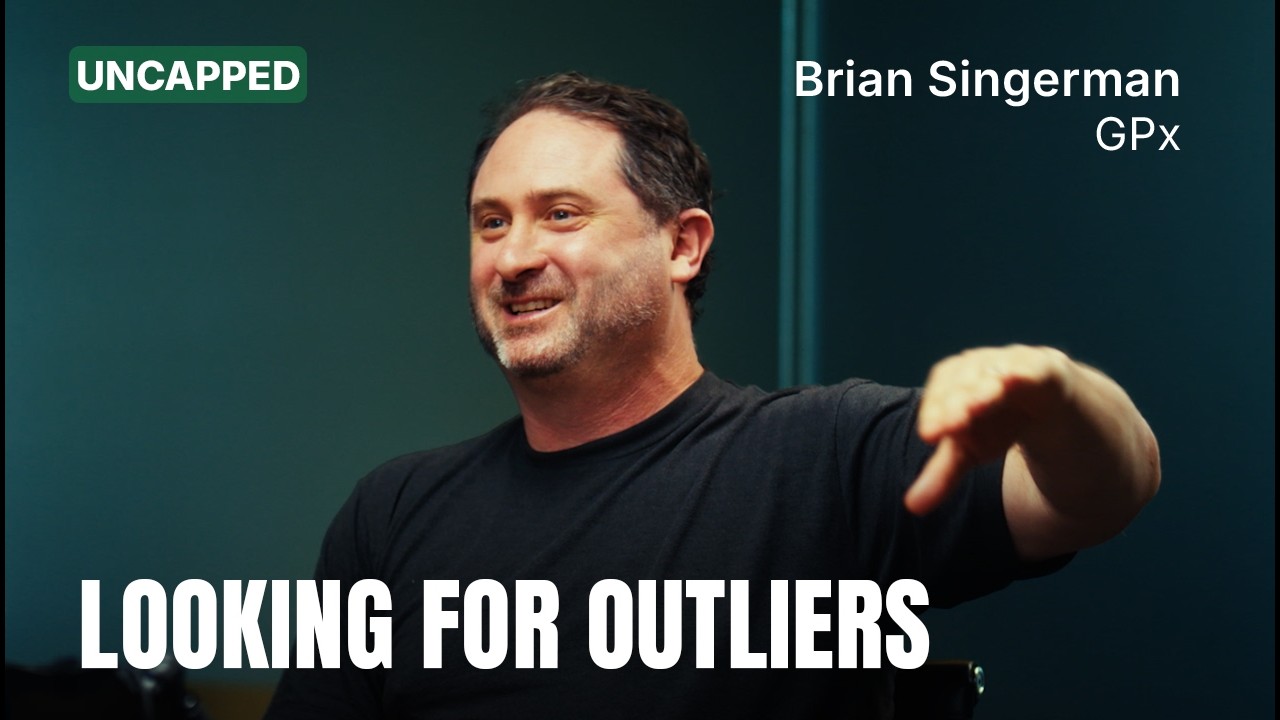
Brian Singerman is the co-founder of GPx, a fund launched in 2025 alongside Lee Linden of Quiet Capital. GPx backs elite emerging managers at the early stage, then provides programmatic capital to co-lead later-stage investments when those managers choose to bet their career on a breakout company. Before GPx, Brian was a General Partner at Founders Fund for over a decade, where he was involved in investments including Anduril, Stemcentrx, and Airbnb. He transitioned to Partner Emeritus at Founders Fund in December 2024. We discussed Brian's framework for identifying outlier founders, why he has no checklist, no rubric, and no list of attributes, and why he is always looking for the single thing someone is genuinely better at than anyone else. Brian walked through the Anduril founding team as a case study in complementary spikes, explained what Peter Thiel is actually best at as a venture capitalist, and broke down how Founders Fund made the second most money on Airbnb despite being the 30th investor. We also got into GPx's strategy, why Brian thinks SPVs are dead, his framework for the optimal LP allocation to venture, and when to make a concentration bet. Timestamps: (0:00) Intro (0:50) Why you can't have a checklist for founders (1:46) How Brian looks for spikes (3:55) How Founders Fund played to its strengths (6:54) The Anduril founding team (12:04) Shared beliefs as the foundation of company culture (14:12) How Brian spent time with founders (19:06) What Brian is genuinely best at (20:25) GPx: backing elite emerging managers (23:12) Why Brian knew he was done with traditional VC (25:30) "I'm looking for people who could have beaten me in my prime" (29:38) GPx's structure and the bet-your-career mechanism (30:40) The optimal LP allocation to venture (34:49) Why SPVs are dead (41:00) How Founders Fund made the second most money on Airbnb (43:51) The concentration strategy (49:10) How Founders Fund worked and Peter's role (52:16) What makes Peter Thiel the best ve
Summary
Generated by gpt-5.6-terraAt-a-Glance
- Verdict: Watch fully
- Core thesis: Brian Singerman argues that exceptional venture outcomes come from identifying people with a genuinely non-copyable edge, organizing teams and firms around those specific strengths, and concentrating capital only when conviction is earned rather than performed.
- Why it matters: The discussion offers reusable operating principles for evaluating founders, building complementary leadership teams, selecting emerging managers, designing investment decision systems, and avoiding false concentration in an AI-era capital glut.
- Best use: Use it as a high-signal calibration session on talent assessment, high-conviction capital allocation, solo-GP strategy, and how trust can beat brand in competitive company formation.
Executive Summary
Singerman rejects founder scorecards, rubrics, and generic labels such as "spiky." His actual test is whether a person knows precisely what they are unusually good at, openly recognizes what they are not good at, and can shape the game around that edge. He frames career success as the intersection of what someone loves, what they are best at, and what they can realistically win at. His investing edge at Founders Fund, he says, was distinguishing an A-plus founder from an A-minus one in a power-law market—not merely filtering out weak founders.
The operating implication is that no individual needs to be exceptional at everything, but the team needs complementary, clearly owned strengths and shared foundational beliefs. Anduril is his prime example: Palmer Luckey generates practical, prescient product ideas; Matt Grimm operationalizes them; Trae Stephens builds high-level networks; and CEO Brian Schimp integrates strong personalities into trusted final decisions. The CEO's job is less to be the best specialist and more to understand each person's strengths and limits well enough that the team accepts the integrated call.
Singerman's new GPX platform applies this philosophy to emerging and solo venture GPs. He is not primarily selecting managers who can identify great companies; he is selecting people with a specific venture game they can win, potentially better than he could. GPX supplies strategic counsel, LP access, and programmatic follow-on capital when a selected GP makes a career-defining commitment—roughly 20% of a fund—rather than relying on slow SPVs or forcing routine concentration.
His strongest investment lesson is that concentration is valuable only when the investor has both an exceptional company and earned certainty that it is exceptional. Founders Fund's late Airbnb investment illustrates the point: it reportedly invested about $150 million at roughly a $2 billion valuation after initially missing the company, and still made an enormous outcome because being right mattered more than owning the earliest or cheapest stake. Conversely, most fund vintages will not contain a SpaceX-level company; forcing a 20% to 40% position in a merely best-in-portfolio company is a recipe for loss.
Key Takeaways
- Claim: Evaluate founders and operators through their concrete, exploitable advantage—not a universal attribute checklist. | Evidence: Singerman says Founders Fund repeatedly failed to define a reusable founder rubric, calls labels such as "type A" or "not needy" nonsense, and instead seeks the specific thing an individual is best at and can leverage to win. | Implication: For founder or operator assessment, push past polished descriptions of intelligence, grit, or domain expertise and identify the particular capability that changes the odds of winning. | Caveat: The strength cannot be unrelated to the actual company or game; it must be usable in the context where the person is competing.
- Claim: High-performing founding teams should be complementary rather than uniformly excellent, but they require a CEO who can integrate and command respect from distinct elite personalities. | Evidence: He describes Anduril's four-founder structure: Palmer Luckey as product visionary, Matt Grimm as operational executor, Trae Stephens as relationship and network builder, and CEO Brian Schimp as the person trusted to make final decisions amid substantial conflict. | Implication: When assessing an AI or defense-style company with unusually strong specialists, diligence the interfaces: who owns vision, execution, external access, and conflict resolution—and whether the CEO can actually hold the system together. | Caveat: Complementarity alone is insufficient: founders must share core beliefs that will set company culture, as Singerman says Palantir's founding group shared a strong pro-America orientation.
- Claim: A useful litmus test for a founder team is whether the right person answers the hard question and others comfortably admit their limits. | Evidence: In pitch meetings, Singerman would probe where he believed the team was weak; confidence increased when another founder took the question because it was their domain. He preferred "I don't know; meet my co-founder" to a CEO pretending to understand every function. | Implication: Structure diligence and hiring interviews to expose ownership boundaries, rather than rewarding universally polished answers. Lack of role-specific truthfulness is a coordination and judgment risk.
- Claim: GPX is designed to back emerging managers with a non-copyable venture strategy, then add capital when they make a career-level conviction bet. | Evidence: Singerman and Quiet Capital's Lee Linden offer selected GPs strategic counsel, LP support, and automatic/programmatic capital when a GP commits roughly 20% of their fund to a company. He cites a hypothetical "100Xer" operator-manager who invests in five or six noncompetitive companies where their niche operating skill can materially compound value. | Implication: The relevant manager-selection question is not simply sourcing quality or sector coverage: ask what durable mechanism lets this person win deals and improve outcomes in a way that cannot be easily cloned by another fund. | Caveat: This is Singerman's description of a newly launched investment model and is partly promotional; the thesis depends on GPX accurately selecting managers who do not use the capital recklessly or merely follow hype.
- Claim: Concentration should be an earned response to exceptional certainty, not a fund-construction rule or a signaling exercise. | Evidence: Singerman says Founders Fund concentrated in select vintages around companies including SpaceX, Palantir, Stripe, Airbnb, Stemcentrx, Anduril, and OpenAI, but explicitly notes that Funds Five and Seven did not have a company worthy of that treatment. He advises against concentrating when a manager is unsure or when a company is simply enjoying a hype-driven up round. | Implication: For capital allocation, separate "best current asset" from "rare, fund-defining outlier." Maintain optionality and broad initial exposure until the evidence and calibration justify radically increasing exposure. | Caveat: Even elite firms will usually lack a SpaceX-level company in a given vintage, so a strategy that mandates large concentration creates adverse selection.
- Claim: Being late is not fatal if evidence changes decisively and the investor can overcome ego to size the updated view. | Evidence: Founders Fund was reportedly around the 30th investor in Airbnb, invested about $150 million at a roughly $2 billion valuation, and Singerman says it may have made the second-most money on the company. His framing: "billions minus $5 million" and "billions minus $150 million" still yield billions. | Implication: Build explicit mechanisms for revisiting prior passes. When the thesis becomes materially clearer, evaluate the opportunity from present-forward expected value rather than protecting the ego of the original decision. | Caveat: The lesson is not to chase every appreciated asset; Founders Fund went large only once it believed it had become clearly right.
- Claim: In an oversupplied capital environment, deep operational trust may outweigh venture-brand signaling for top companies. | Evidence: Singerman argues that elite founders increasingly favor investors who have co-founded with them, materially helped them, or whose judgment they deeply trust. He points to Anduril's board being dominated by founders and says a trusted individual investor can retain access even when a large firm also participates. | Implication: For operator-investor and ecosystem strategy, prioritize accumulating real trust through substantive company-building work, not relationship theater or brand association alone. | Caveat: He qualifies that tier-one venture brands retain a major advantage and that signaling may still matter for lower-tier companies or in a capital-constrained market.
Detailed Brief
How Singerman interviews for genuine edge
- Claims: Generic Silicon Valley language obscures the actual capability being assessed.; The most revealing answers often emerge after sustained follow-up or when a candidate cannot rely on rehearsed responses.; A person should be encouraged to state what they are truly excellent at without false humility, while being equally direct about areas of weakness.
- Evidence: Singerman says he tries to get people "riled up" enough to say what they are really good at rather than offering cliché descriptions.; For GP interviews, he uses a rapid-fire exercise naming other GPs and asking for off-the-cuff reactions, reducing the opportunity to manufacture a polished answer.; He describes repeated questioning, sometimes uncomfortably long, as a way to find depth that a surface answer hides.
- Caveats: This is a highly intuitive, interviewer-dependent method; the transcript does not provide a standardized way to validate its accuracy or reduce assessor bias.
- Implications: Use adversarial-but-constructive interviews to test live judgment, self-awareness, and specificity.; For senior hires, assess whether confidence is localized to real competence or is simply generalized executive fluency.
Fund design and decision rights at Founders Fund
- Claims: Founders Fund was not an equal partnership: Peter Thiel had the final call, while partners had autonomy proportional to the decision and their demonstrated performance.; A performance-linked carry system can preserve useful but lower-performing partners rather than making termination the only remedy.; The early venture process was deliberately lightweight: no investment memos, ad hoc discussions, and rapid decisions once a partner had persuaded colleagues to meet a company.
- Evidence: Singerman says small checks could be approved with one additional person's agreement, while the largest checks required him and Thiel or comparable senior alignment.; He says carry moved up and down based substantially on returns from prior funds.; He characterizes long deliberations as a negative signal: if the sponsor drove a prolonged process, the likely answer was often not to invest.
- Caveats: Singerman notes that Founders Fund may operate differently today, including more formal diligence on the growth side.; He also says an equal-partnership model can work exceptionally well at firms capable of sustaining it, citing Benchmark as a strong example.
- Implications: Do not copy another firm's governance model mechanically; align decision rights, economics, and process with the actual strengths and temperament of the partnership.; For small expert teams, lightweight process can be an advantage only if participants have unusually high calibration, directness, and mutual respect.
AI, human experience, and the limits of task substitution
- Claims: Singerman is a technology optimist but distinguishes between AI solving a task and humans losing interest in human participation.; Human-versus-human activities can remain compelling even when machines are objectively superior, while purely problem-solving domains may feel more displaced once a problem is solved.
- Evidence: He compares chess, where people continue to watch Magnus Carlsen despite computers having surpassed humans for decades, with Stockfish moves that can feel alien and less legible.; He contrasts player-versus-player activities such as chess or baseball with player-versus-environment work such as proving a mathematical result: once a proof is solved, re-solving it has less purpose.; His music-studio project gives artists free studio access and ownership of their IP in exchange for being able to participate as a fly on the wall.
- Caveats: This is a philosophical view rather than a labor-market or economic forecast; Singerman acknowledges that AI will create real struggles over coming years.
- Implications: When evaluating AI-disrupted categories, distinguish output substitution from the continued value of human competition, identity, participation, and audience connection.; Products that preserve or enrich human experience may retain value even when AI creates technically superior outputs.
Notable Concepts & Terms
- Tilt the game: Shape the competitive environment around an advantage you actually possess instead of competing head-on at someone else's strength.
- A-plus versus A-minus founder: Singerman's claimed core investing skill: identifying the narrow but economically decisive difference between very good and truly exceptional founders in a power-law market.
- Founder-market fit: The venture shorthand Singerman partially accepts, but he prefers a more concrete account of a founder or team's specific edge in a particular game.
- GPX: Singerman's emerging-manager platform, built to back elite GPs with counsel, LP access, and automated capital for career-level high-conviction investments.
- Career bet: A very large fund commitment, described as roughly 20%, where a GP's reputation and fund outcome are materially exposed; this is GPX's trigger for follow-on support.
- Consigliere: GPX's intended role as a deeply involved strategic adviser to GPs rather than a passive LP that merely avoids interference.
- Trust versus brand: For elite companies in an abundant-capital market, direct evidence that an investor can help and is trusted may matter more than a venture firm's signaling value.
- PVP versus PVE: Singerman's distinction between human-versus-human activities that can remain meaningful despite AI superiority and problem-solving work where solving the environment may eliminate the original task.
Operator Notes / Why Ken Should Care
- Add a founder/team diligence module that requires each founder to name their singular strongest capability, their weakest relevant capability, and the co-founder who owns that weakness.
- For any proposed concentrated bet, require a written disconfirmation test: why this is a rare outlier rather than merely the best asset presently available, and what evidence would make the team decline to scale exposure.
- Create a formal re-entry protocol for past passes so updated evidence can trigger a fresh sizing decision without anchoring to the initial miss.
- For agent-system or AI-company partnerships, prioritize collaborators who provide demonstrated operating trust, product leverage, or distribution access over generic investor/adviser prestige.
- Avoid adopting concentration, solo-GP, or lightweight-investment-process aesthetics without first validating the calibration and accountability mechanisms that make those approaches viable.
Source/Metadata
- Title: Brian Singerman on Founders Fund, GPx, and Looking for Greatness | Ep. 56
- Transcript words: 21453
- Duration seconds: 3758
- Timestamp note: No usable timestamps or chapter markers were present in the supplied transcript; the latter portion also contains substantial repeated transcript material.
Transcript
I'm not trying to spot some people who can spot greatness. I'm trying to spot people who can play the game of venture capital, who know their strengths so well. I'm looking for people who could have beaten me in my prime. Yeah, because they can play a game that they can win. Yes. All right. I'm really excited to be doing this, Brian. Thanks for coming on the podcast with me. Of course. I want to start with a topic that I think is pretty central to the way your brain works, to the way you've done your work, which is the idea of assessing talent and identifying outlier attributes that people have. And I think this often gets, I hate to even say this word, but people talk about spiky founders, meaning the concept that people have this report card of attributes. They're smart, they're tenacious, they're gritty, they're knowledgeable, whatever. And it's this idea that one of these attributes is just off the charts. And I think the idea is that somebody who's an A-plus in one place but has low scores somewhere else, versus somebody else who's very well-rounded, and relating that to the quality of the founder. Anyway, I'm curious why this topic of identifying these attributes is so important to you. So maybe you could just start how you think about these things. First of all, I have no list of attributes. In fact, we tried to have so many authors come into Founders Fund ages ago and try and be like, hey, let's try and define what a Founders Fund founder is. We can start using all these attributes, like a type A or not needy or I don't know. It's nonsense, right? It never worked. It's never accurate. So I decided to just go the exact other way. And I do not have a checklist, and I do not have a rubric at all. It's just purely one of those. But I am looking for people who spike with me. It just can be different every single time. Can there be something that you're like, they're really good at that thing, but it's so irrelevant to the company they're building, I don't care? I don't know if it can be so irrelevant, but I am open to whatever they spike in being anything. In fact, one of the things I love doing the most in this world still is figuring out what it is somebody is the best at. And can they leverage that, right? To win at whatever it is that they're doing, right? I'm a gamer, right? I'm always looking for, what are the leverage points? What are the things that you're just better than everybody else at? And can you exploit those strengths to win at whatever it is? And so I don't think it can be totally irrelevant. But I think that the goal for people, I really do think that the goal for people in professional life, or whatever you want to call it, is to find the Venn diagram of what you're really good at meets what you love, meets what you can actually win at. Yeah, yeah, yeah, yeah. Like in a real way. Yeah. And so that's what I'm looking for. Yeah. I mean, I feel like this kind of relates to something that Peter and all of you guys have talked about a bunch, which is competitions for losers, where you should basically find the dimension of the game that you are so much better at, and then you should tilt the game in that favor. That's right. I totally agree with that. I think that the competitions for losers is a fun way of saying it, but I'm more the latter of what you just said. Like, okay, the game's the game. Yeah. And figure out how you tilt it to be more toward what you are really good at. Don't try and beat other people at what they are better than you at. But to do this requires radical honesty, at least with yourself. Yeah. Right? Regardless of what you show to the world or show to other people, you've got to be honest with yourself about what you're actually good at and what you're not good at. Yeah. I was nowhere near, I don't think, as big or good a gamer as you, but I was a pretty big gamer as a kid. And I played games like StarCraft and WarCraft and stuff. And it's basically all about imbalances. And so it's like one race fights. Especially something like StarCraft, which is your first example. I mean, WarCraft to a certain extent, but StarCraft is your first example of a truly, truly, truly, totally not the same starting board at all. Of course. Yes. And you've got to figure out how to exploit your race in a way that is just going to win. Yes. But fairly balanced between them. It's an interesting point that you said, too, that it needs to be combined with self-awareness. Yes. Because there's probably a lot of people who have the spike but don't want to admit that they've got these other weaknesses. Yes. So they won't play the game in the way that they can tilt the board. Correct. I'm all about figuring out, just owning it. Owning what you're actually good at, owning what you're not good at. Figure out how to tilt it to what you're good at. Can you give me some, just connect this dot to some of the Founders Fund success story examples, some of the companies and those founders? Well, Founders Fund is what happened in a really organic way. I mean, you have these ridiculously smart people who spike in their own ways, but it wasn't going to be, we could never have any rules there, right? In the early days of Founders Fund, we tried for a minute to have investment memos, and we tried for a week to have partner meetings and something like this, and it didn't work for us. Yeah. It's not that that's globally wrong. It just didn't work for us because we were really honest about, okay, let's just put all that stuff aside, figure out what this team is really good at, and play to our strengths. Back in the early days, Sean would never show up, right? But dude would stick his head up every once in a while and say Facebook or Spotify. And you know what? That's pretty freaking good. I randomly got a chance to see something Sean Parker wrote about Spotify. Yeah. And I was just like. I think I sent that to a couple of people. It's the most amazing. It was so good. The most amazing investment memo I've ever seen written. Yeah. So was that the quality of, I know you don't do memos, but is that what was expected? That happened one time in Founders Fund's history. That's funny. And it worked out. It was one of the best companies ever. That's funny. The way that Anduril came together, and obviously I know you've been intimately connected since the beginning. And so obviously, share whatever's comfortable. But if we could connect to this idea of the founder attributes and how important they are. Oh, yeah. What were some of the founder attributes there that turned out to really matter? And can you walk that out a little bit so people can feel it? I mean, Anduril's actually a great example of this because I don't think with any one single one of the founders, I'm going to call it four founders of Anduril, right? And so I don't think with any single one founder, it's like, oh, spiky in every single way. It's the perfect example of a team of people who are very good at different things. And I think the combination of the four founders of Anduril cannot be beat, right? And they're so different. Like Palmer, I've known Palmer since he was, whatever, 18, 19. I was the first investor in Oculus. Now, that was a screw-up on my part because I didn't go bigger in that, helping formulate later-in-life stuff. But Palmer is your perfect example of unbelievably brilliant, creative, mad scientist kind of thing. Do you want Palmer running the company? No. Seems like he has a brain that just can't stop having ideas. Yes, he can't stop having ridiculously good ideas. But the ideas are not just out there in sci-fi. It's like, no, this actually can be done. They're prescient and correct. Yes. who are very good at different things. And I think the combination of the four founders of Anduril cannot be beat, right? And they're so different. Palmer, I've known Palmer since he was, whatever, 18, 19. I was the first investor in Oculus. Now, that was a screw-up on my part because I didn't go bigger in that, helping formulate later-in-life stuff. But Palmer is your perfect example of unbelievably brilliant, creative, mad scientist kind of thing. Do you want Palmer running the company? No. Seems like he has a brain that just can't stop having ideas. Yes, he can't stop having ridiculously good ideas. But the ideas are not just out there in sci-fi. It's like, no, this actually can be done. They're prescient and correct. Yes. That's so critical, right? It's like, nope, this actually can be done. And so putting that guy on products and future products, and seeing where his mind goes, that's what you want to do with him. You don't want to have him bogged down with being the CEO of something or other. That would be a waste of everything, right? And then you get a guy like Grim, who's just so unbelievably good at operations and actually the get, almost, I can say opposite, but in some ways, the total counter to Palmer, right? He actually can get this stuff done. Palmer can have one of his ideas, and Grim can actually get it done, right? Trey is extremely good at high-level connections. He's extremely good at high-level networking, extremely good at establishing relationships and networks that are nobody else in the space. He's extremely good at that, right? And then you've got a guy like Brian Chimp, right? As actual CEO, who's so good at dealing with these types of personalities, right? To be the CEO of something like that, and I'm getting this in the Founders' time too, but you've got to be so both smart, respected by all of these types of different people, right? And be able to just put it all together. And when we found him, it was just like, oh, yeah, this guy is going to be able to put it all together. To manage those kinds of personalities, you both have to be respected by and respect them, I guess. That's correct. And I can't stress enough how hard that is, to have people like Palmer Lucky and Trey Stevens and these kinds of, and Matt Grimm just go, oh, yeah, we'll defer to the CEO to make these decisions at the end of the day. Because at the end of the day, the CEO makes these decisions. Can you put your finger on what that is, or is that just some overall level of competence and trustworthiness? Again, it's just what he is really good at. He does not get riled, knows how to, understands people's personalities, knows what their strengths are, doesn't deny their strengths, knows where they're brilliant, knows where they're weak, and can put it together such that people trust his holistic decision. There have been crazy amounts of conflicts in that company, but when Schimp makes a decision, that's the decision. And I love that. It's just so impressive, right? It's interesting what you say about, it doesn't all have to come from one person. We recently met with a phenomenal growth-stage CEO who is making the point that he thinks too many people, even now within a company, settle on, I've got to choose between my head of sales being the operational type or the sales savant type. He's like, I'm not going to choose. I'm going to have two. I'm going to make them work together. And then I get both. But you've got to be the type of person that can then make them work together. Yeah, yeah. Right, because too many times, you'll have these dominant personalities in various things. And if you don't have that person who has the respect, as you pointed out, the respect and respect of the others, it's going to fall apart. Actually, that's an issue. Have you ever had a CEO that you've worked with who didn't have this ability who was really great? Or is this a requirement? I've experimented a ton in venture capital. Right? In early days, I'd have a CEO who was just really, really, really good at science or tech. And you realize quickly, that's not enough. Right? And then you experiment with having a CEO who you think can do it all. The only person I've ever met that can remotely do it all in that regard is Elon. Right? There's nobody else that's even close on the do-it-all. Lev Chin, to some extent, is the only other person that I know who's that good of a CTO and CEO. Right? Like true CTO and CEO. Right? And similar to Elon, but outside of those two guys, I don't know anybody else who could do it. And then plus, that's just CEO and CTO. You've also need all the other aspects of business. So I think it's pretty rare to have one person be able to do it. So I love when a strong, strong, strong CEO can understand their strengths and weaknesses and mesh it all together. I feel like SpaceX is well discussed enough and Elon's obvious enough. But what about Palantir? Can you point to what were some of the founder attributes there that connected to the way the company? Well, I wasn't around in the founding days of Palantir. Yeah. So I need to... But I assume you know now enough of the characters. Oh yeah, yeah, yeah. I know enough about it, but I feel less comfortable because I wasn't, I got involved in Palantir in 20... 2009? Yeah. In 2009? I met Stefan and Lonsdale. Yeah. I probably met those guys after Lonsdale had left the company, I think, right? So now he's a good friend of mine. But for Palantir, it's a little bit tricky from a, I don't really know how it was in the founding days. I can tell you, though, that there are certain attributes of the founding teams of Palantir. They did all have a core, and I think this is an important thing that doesn't get discussed enough, right? It's one thing to have a set of people who have different strengths and weaknesses, and then you have somebody putting it together, right? Like Karp working with Peter, right? In that case. But it's a whole other thing. They have to have some fundamental beliefs shared. Yeah. Right? And because that is going to set the culture of the company. If those don't align, it could lead to trouble. So I think that the Palantir founders all shared a hardcore pro-America, totally. Right? Kind of a culture. Is there another company besides Palantir that's worth going into that would be worth talking about? And then we can go back and we can track the Palantir bit. In terms of a... Is there one more example besides Andreal that you can talk to that you feel comfortable talking about, about how the founder mapped back? Maybe cognition, if you were involved in that one, or I don't know what's another company that could make sense to draw out this concept of the founder specialness and how it played out in the company. I think all of them, right? To some extent, you can always backtrack this to what is the stupid venture term for it, founder-market fit? Yeah. Is that the venture-speak version of it? I think you can always back into that for everything. But for me, it was always just a, here's how I knew it. Okay. How about this? Yeah. Let me take you through how I judged the holistic sense of the founding team. And for me, it was never just about the CEO, but it was only about the founders, right? It was about the founding team. It was critical for me to speak to all the founders, all the founders, of the founder specialness and how it played out in the company. I think all of them, right? To some extent, you can always backtrack this to, what is the stupid venture term for it, founder market fit? Yeah. Is that the venture-speak version of it? I think you can always back into that for everything. But for me, it was always just a, here's how I knew it. Okay. How about this? Yeah. Let me take you through how I judged the holistic sense of the founding team. And for me, it was never just about the CEO, but it was only about the founders, right? It was about the founding team. It was critical for me to speak to all the founders, all the founders, not all the head of whatever. Right? But I did need to meet all. I did not want to just meet the CEO. I wanted to meet all the founders because of what you're talking about. Now, what I would do in these pitch meetings, back when I would do pitch meetings, would be, okay, I would sense where they were strongest immediately. I could sense where they knew they were strongest and where they were confident. And what I would do at the start of these meetings would be, okay, I'm just going to give you that. I wouldn't take that off the floor, and I would try and, I don't know what I'm doing, right? I was just trying to poke holes, right? I'm a strategy guy, but I don't know their business, right? I would try and poke holes where I thought that meant that they were weak. And I wouldn't care if the CEO was strong enough, but if another founder would take the question and be like, oh, I get why you're here. Oh, I get why you're here. That would be enough for me to be like, great, right? In other words, they weren't talking, if they had the person speaking who knew what they were talking about. What I can't stand is people who try and speak about everything, even if they don't know what they're talking about. Just say you don't know what you're talking about on that, or supplement yourself with the people that do know what they're talking about. So that was always a good litmus test for me. If the different founder would speak about the different thing, I was like, that's good. That is good. Man, when people speak about stuff that they don't know, let's move on rather than, I would much rather they say that, or even let's say a co-founder wasn't there. I would much rather they say, you know what? I don't know that. You should meet my co-founder. Okay. Then I accept that answer better than them trying to speak about everything that they don't know. Yeah. One of the things that I appreciated that you asked me when we hung out last time was, you were kind of trying to get at what my attributes might be. Yeah. And you asked me, no, no, there's no need for you to try to be humble. Just, yeah. Just what do you think you're best at? And I reflect on that a lot because I think the way you asked it gave a lot of permission for the person to just share what they think they might be, which shortcuts so much other work that you'd have to do to get the person space to do that. I loved it. What I'm doing now in my life is, I love learning what people are truly the best at, and it can be anything. So I encourage, in other words, it's kind of like, don't be humble when humility is not necessary, but don't speak about things that you don't actually know. Right? It's both sides. The stuff that you are good at, great, let that shine. Right? And the stuff that you're totally weak at, don't try and pretend you're strong. Have you found any other, I don't want to say tips and tricks, but what else have you found helpful in getting to the essence of this? Because I think there's been a lot of ink spilled and a lot of time centered around the work of trying to figure out if somebody is great. And I think very few people can actually do it. And so, I try and get away from generics as soon as possible. A lot of times people are, even if they're not trying to be humble, they'll have been, especially people, especially if you've been around Silicon Valley a long time, whatever, you're trained in this way of speaking or whatever, right? I just try and get beyond that immediately, not just saying things like, oh, no need to be humble on the things you're good at, but trying to stop speaking in cliché terms. Let's just get beyond that immediately. Just talk to me. Try and get them riled up. Yeah. Honestly, I probably did this with you, try and be like, okay, it's too generic, it's too generic. I try and get people to scream, this is what I'm really good at. Yeah, yeah. And when they do that, then we can have a conversation, right? I think one of the other things, which I think you were probably just getting at there a little bit, is trying to get to specifics and trying to keep digging into the same thing and not just accepting a surface answer. Right. Which is, by the way, one of my favorite things to do in interviews here, is you're asking somebody something, you just don't let it go. A little uncomfortably long. I can't say, I don't like. Because sometimes the depth is really there when you keep asking, and they're just not used to being asked the thing. What I try to do, we're going through hiring process, and in our interviews, I'm not a good manager and I try not to hire almost ever. But even in those, I try and just be like, okay, I try and think of a game that we can play that just has to take them up. I do a speed round thing of something like that where they just have to not prepare their polished answers, right? Like what? In my case, I'm looking at a bunch of GPs. What do you think of this GP? What do you think of this GP? And I name them. I name them. I name them. Just give me your off-the-cuff answer. You don't have time to make something up. You're just giving me your gut answer. Yeah. Right? And that's just so much nicer and more fun to me than waiting for somebody's polished Silicon Valley answer. So what is your, just to turn around and end on this little segue, what's your thing? What is the thing that you feel most confident in being good at? That. I think I'm, that's why I'm doing it. When I was doing the venture capital thing, I don't know how to diligence companies. I was never going to know their business very well. Everybody at Founders Fund knows this. My wife knows this. I don't do spreadsheet stuff at all. I'm not a diligence person. What I was good at is trying to get to the heart of, is this founder truly A plus? Now, that's even too generic, and that would be too generic for me right now. Yeah. Right? But back then, it did the job. Because what we did better than anybody, I think what Founders Fund did better than anybody else, was differentiate between an A plus and an A minus founder, which I don't think most people can do. I think people can differentiate between an A and a C founder. Great. I think most people cannot differentiate between an A plus and an A minus. And because it's a power law, that's the whole game. There's a lot of great A minus founders out there, but we took the ones that were A plus and we just backed the truck into them, right? That was Founders Fund 101. So, I think we were pretty good at that. of, is this founder truly A plus? Now, that's even too generic, and that would be too generic for me right now. Yeah. Right? But back then, it did the job. It's because what we did better than anybody, I think what Founders Fund did better than anybody else, was differentiate between an A plus and an A minus founder, which I don't think most people can do. I think people can differentiate between an A and a C founder. Great. I think most people cannot differentiate between an A plus and an A minus. And because it's a power law, that's the whole game. There's a lot of great A minus founders out there, but we took the ones that were A plus and we just backed the truck into them, right? That was just, that was Founders Fund 101. So, I think we were pretty good at that, and I like to think I was pretty good at that myself, and that was my strategy back then. Right now, I would say that's too generic, which is why I like going into the details. What about them as A plus? Not from this, not from a checklist perspective, but specifically on this question of what are they actually better at than everybody else? Yeah. If you can figure that out, and you give them a company or, in my case, a firm where they actually can play to those strengths, Yes. That's a pretty good winning combination. Okay. So, now let's talk about GPX. Can you, just for context for everybody, can you just quickly explain what it is? Yeah. GPX is kind of like a, we are investing in emerging managers or solo GPs or whatever you want to call them. Not the big name, name funds, right? For lots of reasons. But what we do is we take those, what we call elite athletes or elite GPs, and we enable them to be even better at what they do in a couple of ways. Number one, me and my, so I'm partnering with a guy named Lee Linden, who runs Quiet Capital, on this. So me and Lee will be your consigliere. There's very few times where you get an actual consigliere who's returned billions of dollars in venture capital, right? So we will be these GPs' consigliere. They can call us for anything. We will get to the honest core of the conversation. Most LPs are really good LPs because they don't mess it up. Yeah. That's a great LP. Just don't mess it up, right? I think I can take that another step further by actually being a true venture consigliere. So that's number one. Number two, we have our own LP base that we can supply them with and get into that later. Number three, when they are ready to bet their career on something, right? And this is critical. If you're a GP and you put one to 2% of your fund into something, who cares if it goes to zero, right? It doesn't matter. But you put 20% of your fund into something, that better work. So you're only doing that if that's going to actually work. You know that's going to work. So you can kind of go all in on it. We enable that to happen for these GPs by writing. We have the ability to write programmatic and automatic capital to them when they bet their career on something, so they can preempt rounds with that capital. I don't have a veto on that capital. These are people who don't want a boss. They would love a strategic partner, but we could never hire them at Founders Fund because they don't want a boss, right? But if we enable them to actually win some of these rounds that they otherwise would have not enough capital, or they'd have to go raise some SPV, and I can tell you why I think SPVs are dead, but they'd have to go raise some stupid SPV, and that takes a long time. With me, they can preempt that round as long as they're willing to bet their career on the company. Which is 20%. Roughly. Yeah. I mean, it's all tailored for the GPs because different strategies are a little bit different. But it's some gigantic commitment. It's some, like, no, you can't miss on this. Yeah. Yeah. Whereas, and then you don't even need to know anything about the company because you already trusted the GP, and now they're staking their career, so you're good to go. That's exactly right. What we have to do is be really, really, really, really, really good at picking those GPs who don't YOLO and aren't, and I work with them on this, right? When they choose to go all in on a company, it's not going to be my first or even 10th time hearing about the company. They're going to be talking to me about it, right? I think you said to me that you were kind of, you knew you were ready to be done with VC when the incremental pitch meeting was just like the bubble gum had lost its flavor kind of thing. It had. Even with an A-plus founder. Yeah. All I could start thinking about in general pitch meetings was, how do I get out of this meeting? Yeah. And that's really bad because- Even in the face of greatness you felt that way? Even in the face of greatness. Wow. Yeah. Why is that? I still love meeting with founders and doing strategy sessions with the top founders. That I can still do all day, but the whole process of meeting the founder, well, I mean, a lot of reasons, right? Number one, when I was meeting with the founder, I was always pretty good at what I did, but there was always imposter syndrome. I've never founded a company, right? And so, whereas meeting with the GPs, it's very different. And so you feel like on some level, after some amount of time, that wore away at you or something? The fact that you always had that, or what? Either it wore away at me or I realized, I need to do something I'm even better at than this. Yeah. Right? And I think it's a similar mechanic with the GPs, but I think I'm even better at doing this with the GPs than I was with the founders because there's no imposter syndrome with the GPs. Probably also some level where it's just like, you've done one game for a long time, and it's nice for life. I think I've given you the analogy, but I'll say the analogy anyway. It's like, with pitch meetings, imagine you're a musician and you wrote a song, and it was a hit song, and everybody loved the song, and it's your song, it's great, it's your song, and you love it, but you've played that song every single night of your life for the last 30 fucking years, and you just can't play the song anymore. Yeah, yeah. That was like with, that's what happened with pitch meetings, and very unfortunate because, again, I think there's still top-tier founders and great companies, but now it can be a level removed and still get to work with those top companies. So, I mean, I guess the, the, the central goal is the same, which is you're trying to spot greatness. Yeah. But now what you're trying to spot is not greatness directly. It's people who can spot, you're trying to spot people who can spot greatness. I don't know, it's a similar kind of thing. It's actually even more similar to the founder thing than you think. I'm not trying to spot people who can spot greatness. I'm trying to spot people who can play the game of venture capital, who can tilt the game of venture capital to make themselves win, who are so honest with themselves, who know their strengths so well. I'm looking for people who could have beaten me in my prime. Yeah. Not because they can spot greatness. Maybe that's not part of their strategy, right? because they can play a game that they can win. Yes. I'm betting on elite athletes playing a game that I know that they can win, and when those elite athletes bet their career, that's when I go in with them. Which I think is implied in this, but correct me if you disagree, I think implied in this is you're saying the, the, the selection is one of many parts of venture. Yes. And so spotting talent is only one part. Correct. There's all these other parts of the game. But there's all these strategies that don't even rely on that, right? I mean, I'm really, just like I was on the venture side, I'm really open to this being anything, but there has to be, it can't be like some, oh, I'm no deep tech and founders like me. That's way too generic, right? Every name of venture capitalists of their strategy, right? Because they can play a game that they can win. Yes. I'm betting on elite athletes playing a game that I know they can win, and when those elite athletes bet their career, that's when I go in with them. Which I think is implied in this, but correct me if you disagree. I think implied in this is you're saying the, the, the selection is one of many parts of venture. Yes. And so spotting talent is only one part. Correct. There's all these other parts of the game. But there are all these strategies that don't even rely on that, right? I'm really, just like I was on the venture side, I'm really open to this being anything, but there has to be, it can't be like some, oh, I'm no deep tech and founders like me. That's way too generic, right? Name a venture capitalist who doesn't say that, right? It's gotta be something specific, but I don't really care what it is as long as I've been, oh yeah, that might give you a way to win this game. Give me some examples of strategy, not naming firms or people, but give me a flavor for types of strategies that a new emerging manager could go with. Here's a differentiated one. Let's say you know these guys. These are called 10Xers in Silicon Valley lore, or N of one guys, whatever you want to call it. They usually were these growth hackers or whatever, right? Okay. Let's say you've got some- There are 100Xers now with AI, but that's fine. Right, exactly. That's why I said it with a cheeky whatever. You know these guys, right? Everybody in Silicon Valley knows these guys. So it's like you've got one of these 100Xer kind of guys and backing them. What they would do in the past, or one of the things they probably still do, is pick a company where maybe their skill is not relevant for every company, and that's totally fine. They know where their skill is relevant, and it's a really good company, and they know they go in and make that company just do ridiculously well. They pick one company and they go all in, they work at that company. Okay, but what if you're one of these 100Xer guys, and especially in these days with AI, and you can actually leverage yourself? So I know one guy who's doing this. He's one of these 100Xer guys that's a niche skill, not useful for every company, but for the ones that it is, it truly is. And he's like, why don't I leverage myself? So his portfolio, his investment portfolio, is gonna be like five, six companies, all of which he is actually operating at. They're not competitive with each other, right? But going and operating, doing his 100X thing for all these companies, making them all worth that, that to me is pretty freaking novel. Most venture capitalists do not do that, right? I would never go operate. Well, the other thing that's good about that is it's not the type of strategy that's exploitable by some- Correct. It's not something where it's like I can have a great fund one, but then if other people realize it, they're gonna swoop in. You can't copy this. There are strategies that will work for a fund but then won't keep working. That's right. And this is not one of those. This can work because it's like, he can be like, well, good luck cloning me. If you're truly one of these N of one guys, then that strategy you can play for a while, and you don't have to choose this one. You leverage yourself. So I love that. That's just one example, but there's lots of people that I'm working with. Again, it's tough with me because I'm so gut-based that when I meet somebody, if they just, it happened recently, I'm not gonna name any names, and I can't name names, but it happened. I met some GP and I was just like, I can't put my finger on exactly what it is. In that other GP's case, I can put it, it's like, that's a brilliant strategy, and yes, you're the perfect person to do that, great, I'm in, right? There are ones that you just talk to and you're just like, oh, you absolutely were gonna crush me. Like honestly, story, it's like when I met, and even when I met Kushner 15 years ago, I was like, ooh, this guy might be able to beat me one day, right? So I invest in Oscar, join the board of Oscar, and invest in Thrive, right? It's a similar kind of thing. Same with when I met Alot. Alot did this thing on the Stripe deal that we did that was so impressive, especially for a solo, let alone impressive, it would have been impressive for a fund, let alone a solo. Yeah. You're like, these guys are good. This guy is, and it takes a lot to make me think this person can beat me in my, and so when I meet one, I'm just like, I need to invest. Yes, yes. Yeah, and I guess a lot of it is, well, your strategy mimics the Founders Fund thing in some sense, where you're gonna invest in a bunch, but then at some point, will you be concentrated mass? Like Alot or a Josh? And then seven years in, you've got this great relationship, and now you can write them 500 million? Maybe. Yeah. That's the idea. On GPX, a portion of GPX, like 20% or less, is we're gonna be writing checks into funds directly, but we're not taking any, that's passed through to our LPs. I'm not making any money off that. We're not charging any carry on that. Most will come from the double downs. Everything is gonna come from our automatic checks when one of these GPs bets their career on something, right? So in Founders Fund's case, there are some obvious, I don't want to, I'm not gonna speak in terms of exacts with Founders Fund, but you can imagine that the ones that Founders Fund went really, really, really big on were SpaceX and Palantir and Airbnb and Stripe and Stemcentrx and Anduril and OpenAI, right? These kinds of things, when they have one of this, and it doesn't happen every, you can't put 20% of your fund in every day. No. And that's fine. No, I put no pressure on, right? That would lead to adverse selection. But when it happens, you- When it happens, I'm in. Yeah. If you were a not-you LP, you're an endowment of, what is your approximate approach to venture right now? Yeah. What I tell LPs, even though I'm pitching them on this, is like, okay, if I'm running some endowment or whatever, some pension fund or whatever, and I'm gonna bother with venture capital, which you should, right? You absolutely should. I put it into two buckets. It's like the tier one, and I'm not gonna name names here, Jack, but you put it into the tier one multi-stages, but only the tier one. Yeah. Right. You figure out who's currently tier one. And the good news for those is you can see the performance. You know who they are. The hard part is just getting a big enough check in. Yeah. Right? I can use Founders Fund's case here. It's like, yeah, you should definitely, whatever you can put into Founders Fund, you should put into Founders Fund. All right. But good luck getting a big enough check in. Yeah. That's the problem. Okay. Then my say part two of the optimal venture strategy. So one is this tier one and only tier one, right? Part two is put your money into the most elite emerging managers. This is great for lots of reasons, right? Number one, as they become the next Founders Fund, as they become the next- You'll hit something and you'll be an anchor. You can scale with them. At Founders Fund, if you invested in our first institutional fund, you got to scale as much as you wanted with us, right? Yeah. This is common. Everybody loves their first backers, right? Everybody loves their true believers. Okay. Same with GP world, right? So as these GPs become the next, and this is why, by the way, we don't charge carry on the fund investments. We want our LPs to be able to scale with these elite emerging managers, Okay. Then my say part two of the optimal venture strategy. So one is this tier one and only tier one, right? Part two is put your money into the most elite emerging managers. This is great for lots of reasons, right? Number one, you can totally, as they become the next Founders Fund, as they become the next—you'll hit something and you'll be an anchor. You can scale with them. At Founders Fund, if you invested in our first institutional fund, you got to scale as much as you wanted with us, right? Yeah. This is common. Everybody loves their first backers, right? Everybody loves their true believers. Okay. Same with GP world, right? So as these GPs become the next—and this is why we don't, by the way, this is why we don't charge carry on the fund investments. We want our LPs to be able to scale with these elite emerging managers, right? That's the whole point. They can co-invest with us. It doesn't matter. We're not a gatekeeper for it. Use our impression, use our opinion of who is the elite and go for it, right? Okay. So it's really important to invest in the most elite, and you can scale with them. And the returns at the top end can exceed the returns of the most, just because the fund sizes are smaller. Yeah, but it's just not enough dollars. Yes. There's two problems with it. A, it's not enough dollars, but B, there's thousands of emerging managers. Yep. It's really, really, really, it's not like the top tier multi-stage VCs where you know who they are, right? This is really hard. Yes. This is what I love. Yes. So this is what we're doing. Yes. Makes sense. On the topic of spotting talent, do you think that in order—so taking aside all the other imbalances that you can create as a solo, which I actually want to go to because I thought about this a bunch when I was doing that—but on talent spotting itself, do you think that you must be a sort of an imbalanced report card yourself to spot another imbalanced report card, even if it's in a different stack? This is a great question. Or can somebody who is an A-minus at everything still spot an A-plus FFFFF? It's a great question. I don't know. I can tell you that for me, I think it's really critical that I think that I'm really good, that I'm one of the best at something, in order to spot that, because then I can sense, like, I know when I'm talking about something that I know really well that I think I'm really the best at, right? I know how it makes me feel. I know how it makes me sound or whatever, versus when I'm a little bit unsure. So that part I think is a good game attracts game, if you will. Yeah. Because you can tell when somebody is speaking about something in a way that they truly know. It's like when I was a competitive gamer. If I'm playing against somebody, I can spot if they're really, really, really, really, really good at a game just by talking to them. Yeah. Right? So I do think that's it. Now, is that the only way to do it? I have no idea. Yeah. I know it helps me. Maybe there's somebody who can be really good without, you know, who's more well-rounded. I'm not a well-rounded person by any stretch, right? I focus on what I'm good at, and I've said this is, I think, a really good skill in business. It is not a good skill necessarily in a marriage, where you need to be a little bit more well-rounded. Can you name a provably elite venture capitalist who you would say is a well-rounded person who happened to just be an elite venture capitalist? I don't know, but I would imagine that there is one, maybe. I can't name one. But you can't think of one. No. Yeah, I can't. That's interesting. Everybody who I would say is elite venture capitalist, I'm like, that person is elite because they are really, really, really good at whatever it is, and they can crush the game by playing that game. Yeah. Why did you say SPVs are dead, by the way? A couple reasons. In Silicon Valley, everything—the founder is king, and all hierarchies go through the founder. So if you're an elite founder, like you're the founder of, say, OpenAI, Anthropic, Anduril, SpaceX, whatever, the next generation of top tier founders listens to you. And what I've seen the top tier companies dealing with now is they're so miserable. Look at all the news. Anthropic and SPVs, Anduril and SPVs. It's so bad. But once you open that Pandora's box, it's open. Yeah. And there's really not a whole lot you can do about it. So they're telling all the next generation founders, never do this, never do this, never do this. So it's not one of those things that's dead right now. But in a couple of years, people realize, oh yeah, only tier four companies are doing it. Well, it's interesting because it connects to the fact that we're in a massive oversupply of capital right now. And so, in an undersupply, you take the capital you can get. This game, this thesis changes in an undersupply world. I'm very much open to adapt or die. Yeah. Okay. And so, but I'm talking about for right now, when you're not in an undersupply of capital, right? Okay, so we're in a massive oversupply moment of capital, particularly for the companies that are working. Yeah, correct. And that's right. These things humongously change how founders update their preference set. What is your best read on what great founders prioritize most now? Obviously you're thinking about this a bunch because you're deciding what managers to do. I think the best founders prioritize who they trust most. And that trust can come from either, oh, this person actually is an expert in this thing and I listen to them, or it could come from this person co-founded this company with me, right? I think that's a big one, actually. This is why I love—if you're a manager and you're actually co-founding companies—I mean, look, two of the best companies and founders in history, yeah, maybe third, we've got a couple more that people have found. Dallian and Scott founded companies, right? That are really freaking good. Okay, and so if you—that is a way of learning trust. If you're an investor who also co-founded the company, like what Frankel does, right? And so that, I think, goes a long, long, long way. I appreciate the clarification because I think a lot of times people hear the trust and they interpret it in the sort of personal sense of trust, like, oh, our families have gotten together and we had dinner together. Maybe that could be it, but no, I think it's like— I think it's like—that might be, that's why I agree with you, that's why I'm saying maybe that's it, but I think that's table stakes. No, I mean really trust. The GPX GPs that we have, when they go all in on a company, I am not expecting it to be some random company that they've been chasing along with every other big—that's not what I'm saying. It's like you trust that their advice is good, you trust that they can help you, it's like that formula. Or they have been helping you. Yeah. I'm expecting that these guys are going to win the kind of company, the big round, and the kind of company because they co-founded the company. Right. And the founder just has, like, yeah, it's more than just loose trust. It would be absurd to do anything other than let them lose. Yes, as long as they had the capital. Yeah, yeah, yeah. And for me. That's right. Yeah. One of the things when I was doing Altcap before that LPs were asking me about a lot, and I would contend with too in practical scenarios, was that trust being earned weighed against, let's say, a brand where they didn't have that. And so the common scenario frequently that I lived and thought through constantly was you've earned the type of trust you're talking about, and that's not being weighed against a brand with a partner that they don't really care who it is. Let's say, how do you think that plays out right now? Like how important it's more than just, oh, lose trust. It would be absurd to do anything other than let them lose. Yes, as long as they had the capital. Yeah, yeah, yeah. and for me. That's right. Yeah. The, one of the things when I was doing Altcap before that LPs were asking me about a lot and I would contend with too in practical scenarios was that trust being earned weighed against, let's say, a brand where they didn't have that. And so the common scenario frequently that I lived and thought through constantly was you've earned the type of trust you're talking about and that's not being weighed against a brand with a partner that they don't really care who it is. Let's say, how do you think that plays out right now? How important do you think that trade is? I think that the tides have turned towards, right now, the pure, the established real, as long as they have the money, the real trust. Look, the Endural board is like, I'm a board observer at Endural. The actual board of directors is like the three, three of the four founders. Right. It's like nobody else because it's like, no, they need that level of trust. Right. And that I think does win. Now, do I think the tier one brands have a huge edge in venture capital? Of course, that's why I say in my optimal venture strategy, venture capital strategy is like that. But, so it's kind of like that's the heavyweight. Now, even though a tier one, I think right now, if you're a tier one brand and you're going up against one of these true trust people, I think it's still going to be hard because the tier, here's why, here's why. In a world with somewhat less capital, this might change because the reason, one reason to go with the top brands, oh, the signaling and, oh, it's helpful in raising your— The king making. The king making. It's helpful in raising your next round. I think we're in a time right now where that does not matter for the tier one companies, right? So maybe for the tier four companies, it still matters. You need the, oh, I need Benchmark to invest so that I can get the signaling for the next round, whatever. For the tier one companies, where they know, it's like, no, capital is not going to be a problem. Again, not counting the companies they need to raise a trillion dollars or whatever, and that's a little bit different, right? I'm talking about the real, we can get into that separately, but these other companies where I think they probably have to raise less than they had to in the past. Maybe. Right? Maybe. I'm kind of waiting for that. Everyone says that everyone's going to need to raise less and then the companies keep raising more. So you keep raising more. You're saying it makes sense to me, but. They don't necessarily have to, though, but either way, we can do that separately. But point being that I think that in this world with the abundance of capital wanting to invest in those companies, I think the trust wins out even over the brand. Yeah. But again, the only thing that can defeat the trust is maybe the top, is the top tier brands. There's no world where it's like a second tier brand beats that. No, but I think you're, taking the Zach Frankel example or something like that, he's still always going to get to invest. Yeah. He's always going to get to invest whatever he wants. And then the other firm can also invest. Correct. Zach probably got a better price. But if you ask the Ramp guys or Scott at Cognition, they're going to be like, yeah, Zach is doing what he wants, and then you. It kind of beats him. But think about this, those are tier one companies. Yeah. And the reason they're, so they're totally comfortable saying that because it's like, yep, great, we can do that. We don't need the signaling. We don't need any of this nonsense. You guys can put in money or not, right? The tier one companies just want the trust. I mean, I guess the only, I agree with your point. The only wrinkle I think maybe is sometimes, on the tier four, whatever. I do think sometimes early, early on in a company's life, Airbnb is a good example. Yeah. There's a lot of these companies that are in fact great, but it takes people a little bit of time to see it. It took us forever to see it. Yeah. But that's what we did with Airbnb. This is the, this is the, this is the, I love talking about Airbnb because it's like, we were slow or we didn't see it. We didn't see it. We didn't see it. Once we saw it, we went real big. Yeah. Right? I was like, I think we made, we were behind, we were probably the 30th investor in Airbnb, but I think we made the second most amount of money. Which, by the way, if you're Founders Fund and you're like, we're Founders Fund, which comes both with good and bad things, it actually takes a lot of ego to put aside. We passed. These other people made a good decision. Yep. We're not going to come on top of them and they're going to get it. We are admitting that they deserve a way better multiple on this than we're going to have. And we're going to put a crazy amount of money. That actually takes putting your ego aside. Adapt or die. Yeah. This goes back to one of my earliest stories. A whole bunch of people would have offers from Google in 98, 99, various reasons you turned down. Stanford, I know a lot of people who had offers from Google that they would turn down and do other startups or whatever it was. Come 2004, right, and it's just like, they're still hiring and your startup didn't work out. Right. There are certain people that were like, oh, Google's already fully baked in 2003, 2004. It's like a billion-dollar company. There's no way. There's a lot of self-soothing. Oh, there's too late. It doesn't matter. And then there's people like, no, no, I think this is actually still really good. And you go there in 2004. Gotta go fix my mistake. Yes. Yeah. I don't care. The past is the past, man. This is the whole good money after bad. We were slow on Airbnb. She had a great point. It's the inverse of good money after bad. And I think, yes, people are very good at realizing that on not putting more money in if they don't like it. But I think people struggle in the other direction. We didn't struggle in the other direction. We're like, oh, yep, Airbnb is really good now. Let's just fix this by putting the most money we possibly can into the company because we know how good it is. Yes. And so I think we made the second most amount of money on Airbnb, even though we were like, wow, super late. And you did it at like 2 billion or something, right? We did something at 2 billion, but we put like 150 million into the company. Yeah. Right? And so exactly. Multiply that by 50, it's a big number. Hence my GPX strategy. I don't actually care at all about your ownership percentage. Yeah. Managers, when they talk to me, oh, well, we get this much ownership. I don't care. How much of your fund are you putting in? Because that's what's going to actually determine your multiples. Yes. And on the Airbnb thing, what I tell people, it's like, well, billions minus 5 million is the same as billions minus 50 million, the same as billions minus 150 million. So the answer is still billions. Yes. And so that's the thing. You need the billions, regardless of how much you put in to get it. Right? That is the crazy thing where you're like, hey, if we spent, you put in 150 at two, you could have bought that same stake for less money. But who cares? But who cares? It turned into 5 billion. Okay. The gains are identical. Let's say we made, the gains are identical. And actually, it's actually, yeah. I mean, this is one of the two. You have to be, the most important thing on this, to actually determine your multiples. Yes. And on the Airbnb thing, it's what I tell people: well, billions minus 5 million is the same as billions minus 50 million, the same as billions minus 150 million. So the answer is still billions. Yes. And so, that's the thing. You need the billions, regardless of how much you put in to get it. Right? That is the crazy thing where you're like, hey, if we spent, you put in 150 at two, you could have bought that same stake for less money. But who cares? But who cares? It turned into 5 billion. Okay. The gains are identical. Let's say we made, the gains are identical. And actually, it's actually, yeah. This is one of the two. You have to be, the most important thing on this is you have to be right. When we went into Airbnb, right? When we went big, it's because we knew we were right at that point. And I think that's totally fine. We didn't know before then. So we didn't put a lot, putting money in. Once we knew, we're like, yep. Okay. So on that topic, on the concentration topic, I feel like very central to what Founders Fund has been all about is these crazy concentration bets. Maybe Airbnb is not one of them exactly, but you'd probably put more in. That was pretty high concentration. And did you do multiple, or I don't even know what, but I hear stories about SpaceX where it's, not only was a huge percentage of the fund, but it was fund after fund after fund, and Anderil and Ramp. And I'm sure there's more, and Airbnb. And I think it's great, but I think the strategy, it is probably the most cited and copied strategy that I hear right now. The amount of managers who talk about concentration seems very high, and it might be good, but it does seem to me that to do the Founders Fund strategy, it requires both A, having a SpaceX in the portfolio, and B, knowing you've got one when you've got one. Correct. This is all, and those seem kind of hard. This is all about that whole look-in-the-mirror thing, man. This is all about being honest with yourself. This is why I don't put pressure on my managers. At first we were like, oh, we want the best of the best, the best company from the best managers. Nope, that's not necessarily true. The best may still not be good enough from this perspective, right? That's the key thing. You've got to know. We were really good at knowing when to actually do this, even though we had a lot of great companies and this and that. It's like, well, you're going to lose a lot of money if you're like, oh, well, this is my best one. So it's the best in this basket. Right, right. So all in, you're going to lose a lot of money if you do that. That's right. Right. And so you've got to be, this goes back to being honest. It's like, which one of these, is one? If the answer is no, that you don't have one, as you were pointing out, if you don't have a SpaceX in your portfolio or whatever it is, okay, just keep doing your thing. Part of what I think is hard is if you're not calibrated to what an Elon or a SpaceX looks like. And so, one of the things, I thought about this for myself, I tried to get myself calibrated as much as I could, but just knowing that you probably are not calibrated to real greatness when you're a year or two or three into your venture career. You just can't be, I don't think. Unless you got really long. I think there's a lot of people having me as a consigliere. Yeah. I'm really good at pushing them on that and comparing it to the Elons, to the Cheskis, to the Levchins of the world. I feel like that calibration is really important, right? Because otherwise, it's critical. But then, so there's that. And then the other piece is, so there's both having one, but then there's also trusting yourself to know you've got one. And we've talked about this, and this is a known thing. Peter seems uniquely brilliant and able to see greatness when he has it. I think all of you guys were. And so, separate from having a SpaceX, there were a lot of other investors in SpaceX who didn't invest a hundred times. They kind of could have, but they maybe didn't. And so, when you see this strategy, what do you need to believe to believe that a manager is going to be good at the concentration strategy? Oh man, this is where I do need to see something of myself in them, to be blunt about that. If I see an element of, oh, they're just doing the concentration thing because they know that's what I want to hear, I'm very good at sensing when people are saying something because they know I want to hear it, and I just get allergic to that. When I have to sense this natural ability to do it, but also, and this is what I don't talk about with people, now it's going to get blown after this podcast, but they also need to be reserved enough and honest enough to know that they might not have that. And that's okay. I'm not going to name names, but one manager that I worked very closely with that I love was recently evaluating whether to do this. Yeah. And I had a conversation with her, and she at least, you could tell, and she could tell that it's not the right way. It's a hyped company. It's having an amazing up round. Yeah. It's like, oh man, if you're playing the Silicon Valley game, you would. She was honest enough with herself to be unsure. So I'm like, don't do it. Yeah. Right. I'm like, if you are not sure, then there's absolutely, do not do it just to play in the Silicon Valley game. And I would, Jack, 90 plus percent of managers are going to do it to play the Silicon Valley game. Yes. And what I think is, it's probably true that even Founders Fund, Sequoia, it doesn't matter who you are, most of your vintages are not going to contain a SpaceX-level company. And so even if you're them, you should, in most of your funds, not be putting 40% on it. Two did this with SpaceX. Three did this with Palantir. Four did this with Stripe, Airbnb, and September. Five didn't have one. Yeah. Six, Anduril. Yeah. Seven didn't have one. Yeah. I mean, and you're much better off in those scenarios, I think, rather than putting, but you're so much better off in those scenarios not forcing it. Way more initial bets. Yes. Yes. Yes. You were better off in those scenarios not forcing it. YC has proven that it works great if you take a lot of bets at seed. I still think, I still think that the ones that had one of those that concentrate are going to perform way better than the ones that didn't. Of course. But if you don't want to do is force. Yeah. Yes. That's critical. Maybe you have a fund that's not as good as Founders Fund 2, okay, or whatever, but that's okay. You don't want to force it, because forcing it loses you a lot of money. Yes. Yeah. I mean, I think definitionally what you're saying must be true, because in order for the broad portfolio to be really good, it must have contained something great. And if it must have contained something great, it would have technically been better to dump it all in. Yes. Correct. But definitionally, that's true. And if it doesn't, then forcing would be a terrible idea. Yes. Yes. In the earlier years of your time at Founders Fund, just because I think those are kind of interesting and very formative, how close was Founders Fund to the CEO, the strong CEO model, on one end of the spectrum, to the equal partnership model on one end of the spectrum? Founders Fund, always, you mean in terms of how Founders Fund worked? Yes. Not an equal partnership. Yeah. Can you tell, Yes. Yeah. I think definitionally what you're saying must be true because, in order for the broad portfolio to be really good, it must have contained something great. And if it must have contained something great, it would have technically been better to dump it all in. Yes. Correct. But definitionally, that's true. And if it doesn't, then forcing would be a terrible idea. Yes. Yes. In the earlier years of your time at Founders Fund, just because I think those are interesting and very formative, how close was Founders Fund to the CEO, the strong CEO model, on one end of the spectrum, to the equal partnership model on one end of the spectrum? Founders Fund, always, you mean in terms of how Founders Fund worked? Yes. Not an equal partnership. Yeah. Can you tell how something actually... I think it's the opposite of Benchmark. Yeah, yeah, yeah. So it was very strongly, it's got to, it's trusted people, but at the end of the day, Peter's going to call it. Peter's going to call it, but Peter didn't even have the most, Peter, Peter wasn't saying he gets the most. Yes, tell me how it worked. Peter had the final call. Peter's the CEO of Founders Fund. Peter founded Founders Fund. But at the end of the day, it probably ended up working where your carry and current fund was driven a lot by your actual returns in prior couple. Interesting. Right? It's probably not the exact formula, but it was certainly based on actual performance. And it's tough to go back in history in venture capital, right? You have this carry numbers, and it's like, but you would get more. So carry can fluctuate up and down? Yeah, 100%. And I'm good with this. I'm very good with this. It's just because it's the principle being, well, first you make a lot of other people money, and then you can start making real money, right? I very much believe this, right? I don't believe in entitlement. It's like, you first have to do really good, and then you can start making real money. And so I think, no, yeah, carry went up and down at Founders Fund, but it meant you didn't have to necessarily fire somebody. If you're in an equal partnership like Benchmark and somebody's not pulling their weight, the only way is to. It's the only escape valve. It's the only escape valve. Whereas Founders Fund, it's like, you can be like, well, maybe this person's not doing it, but you can give them a smaller amount of carry and they can still add value, or whatever it is, right? That's the good news about that. It's actually a good point. Downside is freaking negotiation every single time. That's right. I've thought about this a bunch because, obviously, I'm obviously biased, but I really enjoy the equal partner model for a bunch of reasons. But this is one of the cons, is that you can't have the franchise model where you're like, we would still rather have you than not have you, but not at this level. And there's a world where we'd both rather you be in the next fund at half the carry. So let's do that. I also think that Benchmark is the example of the people that do it best because you are able to do that whole transition or whatever. If you're not, if you imagine doing the equal partnership model and you're not good at that, you lose a lot of money. Okay. It's just not going to work. You have to be really, really, really good. So my point being, all firms are different and you need to play to your firm's strength. For us, it would have been a disaster to have an equal partnership. How about the way a decision got done? Depends on the check size. Yeah. So tell me, what was the rough, not in numbers because I'm sure it moved around, but how did it work? Shape was. If it was a small check, you probably could just get it done with one other person just giving a okay. Yeah. If it was a really, really, really big check, then it needed, depending on when we're talking about, it would require me and Peter or just whatever. If it was for a really, really, really big check, I think it's pretty standard. Do you think there's more managerial fund CEOs and more CIO type of fund CEOs? Peter strikes me as extremely CIO, very much like. So some ways, but Peter is also, the thing that makes Peter Thiel the best venture capitalist in history is not necessarily even because, and I think he is, is not because necessarily his individual decision making at the CIO level, right? It's more, I mean, it's the inspiration of the GPX model. He was really, really, really good at taking very, very, very driven and smart people who are very different, figuring out what their strengths were, letting them play to their strengths. Now, what he needed to find was people who are really, really, really, really good and smart who could also push back on him. Yeah. Because I think Peter is extremely self-aware that he is not always correct. And therefore, you want to partner with people who you think are going to be correct in ways that you're not, that are also able, and let's be clear, not everybody in the world can push back on Peter Thiel. But if you are the type of person who can and you're right, this is the most important thing, though. You have to be right. Yeah. But if you can do that, I think he was just the best in history at assembling a team of ridiculously talented people that are able to push back on him and leveraging their strengths. This is why Founders Fund is, in my opinion, the greatest team venture capital firm that there is. And of course, I'm biased. Yeah. But he's the reason for that. Hmm. How important was the way that the team worked together? Did the team need to like each other? Did the team need to respect? What needed to be true for the team to work the way you're saying? Probably more of the respect thing. You had to realize, I think the like thing, I mean, I think that we, when you're dealing with a bunch of chaotic, outspoken people, sometimes people are going to do things that. Confident. Yeah. That you don't like. So the question is, well, okay, but are they actually really, really, really good? You have to not cross a line. You can't cross this line of being like, we always used to be like, does a founder cross the line from being just really good to something worse that you don't want to deal with, right? Yeah. And I think with the team at Founders Fund, it was like, they're going to do their crazy things. They can't go over a certain line, but otherwise, you just have to respect them for their work. Yeah. Because this is the thing, you're hiring, you have a bunch of individuals. I actually think this kind of happens with founders too. It's very easy to say in theory, oh yeah, I want people who are awesome at something, and I want the spikiness. But then I think in practice, a lot of those people are uncomfortable in experience. Yeah. In the day-to-day experience of a lot of the people we're talking about, founders or VCs, they're actually uncomfortable to be around. They do things that are uncomfortable. I think a lot of people then can't actually sit with it, and I think that's part of what prevents people from investing in or partnering with these kinds of people, because the rest of the report card doesn't, when someone is that mismatched, which is sort of definitional when someone's that good at something, they just behave in uncomfortable ways a lot of time. Yeah, I think it's true, but I think the flip side is also true. What you don't want to do is just work with somebody because you just like them. Yeah. Yeah. Because then you get blinded actually really good. Yes. So were company decisions confrontational? Yeah. In the day-to-day experience of a lot of the people we're talking about, founders or VCs, they're actually uncomfortable to be around. They do things that are uncomfortable. I think a lot of people then can't actually sit with it, and I think that's part of what prevents people from investing in or partnering with these kinds of people, because the rest of the report card doesn't, when someone is that mismatched, which is definitional when someone's that good at something, they just behave in uncomfortable ways a lot of the time. Yeah, I think it's true, but I think the flip side is also true. What you don't want to do is just work with somebody because you just like them. Yeah. Yeah. Because then you get blinded. Actually really good. Yes. So were company decisions confrontational? Was it aggressive? Sometimes. Yeah. Was it more aggressive than you imagine other places that might be? I think so, because we also didn't have, and I think that post me being there, it's probably run pretty differently right now, but they may have memos, or I think the growth team runs with a ton of diligence now. Napoleon runs a tight ship on that, right? But for me, when I was there, especially on the venture side, there was no memo, so the way they would get done would be, well, you'd have a debate. Just talk about, for you, you have to get people, the first step, founders, was always, well, can you convince other people to meet with the company? Yeah. Right? That was a requirement, and then if you did, then you would have a debate, and sometimes these debates would take five minutes, and that was it. A decision was made in five minutes on a yay or nay. It was not some long process. Yeah. Right? Unless the person who was really driving it was unsure. I could always tell, if somebody was doing a long process, the answer was probably not to invest. Yeah. Yeah. But there'd just be a conversation around a table or a text message conversation. It was really ad hoc, man. Especially in the early days, it was really ad hoc. With all this talk of teams, and you think about your investing in the next great fund, do you want to back a team or do you want to back a solo who's going to later build a team? It's a great question. I think for now, I know how to do this with solo. Here's why. You're a solo GP. Again, I have to, all of these people are essentially calling my capital. And so, getting this whole ultra high conviction thing correct is everything. And if you're a solo GP and you invest 20% of your fund or whatever, there's nowhere to run, there's nowhere to, it's just you, right? There's no playing game. Whereas I've been in, I was in a partnership for a long time, and I'm not going to name specifics, but sure, there was always this element of, oh, well, that person wanted to do it, so I supported them, or, oh, I didn't really want to do it. This is the playing game. I hate that. And so, if you're playing this playing game, I don't want to deal with that in partnerships. I'm trying to figure out how to make the GPX model work with partnerships, but I think it probably works better with solo GPs just because you get the ultra high conviction stuff nailed. Yeah. All right. Well, maybe the last thing, and I'll let you go. I saw on Molly's podcast, you were doing it in your home music studio. I play a lot of music. Do you play a lot of music? I write a bunch of my own songs, but I can't play anything. So, how do you write it? I know enough music theory, and you can use DAWs, and you can use MIDI controllers to get notes into the computer and play around. But you're not playing on piano or guitar? Not live. No, I theoretically know how to play all those things, but I can't physically. I'm trying to learn guitar, and it hurts. But I do have a pretty big studio, and I love it. In fact, it was awesome. My kid's band, my eight-year-old's band, had a practice rehearsal in the studio. Everybody, the parents that were there, all of our hearts just melted. That's so good. But the studio has to support everything from band practice to karaoke, which our family loves. Yeah. To professional tracking, professional mixing. It has to go from pro to kid. So do you work with pro musicians on stuff you wrote? I have, and that's the plan. Not stuff that I wrote. No, no. Here's what I like to do. So we can get into this whole, I'm bullish on human happiness and going forward in the AI world. And so what I get at, my plan and what I've been doing is letting artists use the studio for free because I don't care about making money on the studio. So they get to use the studio for free. I'll even create a label for them where they own 100% of the IP and everything. But in exchange, I get to be a fly on the wall. So I get to be part of the experience. So, total win-win. They don't have to pay anything. They get to own all of their own personal everything, but I get to watch. I get to feel like I'm part of it in a way that feels real because I'm at the studio with them while they do it. And I've had this ever since I dated somebody in high school, and she had a band, and I remember the time that I got to go to the studio. It felt so cool. So that's what I'm trying to relive here. It's just amazing to me that you're doing it without being able to play somewhat. Don't know how to play anything, but I can, it's like you're Rick Rubin. I know enough about production now that I can get that done. I just can't, physically playing stuff, man, I just haven't practiced. But you feel able to get to a good song. I mean, I'm trying to get better at doing that, but yeah, that's my goal. My goal is to be part of the process such that maybe I can even help. I mean, I'm a huge music fan. It's almost too on the nose to connect to being an investor, who doesn't play the music, but just, you know. Well, it's a similar kind of thing, man. This is why I could never found a company, right? I'm not going to be in a band. I can't found a company. But yeah, I can enable that. I do know it is actually somewhat similar. I can't believe it's the first thing to mention this, but it is somewhat similar. I want to enable that band to be the best they possibly can while I get to be part of the experience. I love the experience of it. And it doesn't matter how good something, AI better than you at something, it doesn't matter. Yeah. Human experience is like, I mean, it almost doesn't matter whether or not you think AI is going to be better than people making music. Right. I don't care. I'm sure the AI is going to be better than people making music. It doesn't matter. I spoke to a chess grandmaster recently, which was super cool, and he was just like, we've been losing to computers at chess for 20 years, and people love watching Magnus Carlsen. A hundred percent. I like watching Magnus Carlsen. I don't, whereas I don't watch Stockfish versus whatever fish. I don't watch those games. Whereas I watch the Magnus games. And I don't know if you're a chess player at all, but the other crazy thing is, if you watch those, if you watch Stockfish, the moves are alien moves. They're alien moves, man. They're just like, you watch it with like a, That move makes no sense, then it just turns out AI is going to be better than people making music. Right. I don't care. I'm sure the AI is going to be better than people making music. It doesn't matter. I spoke to a chess grandmaster recently, which was super cool. And he was just like, we've been losing to computers at chess for 20 years, and people love watching Magnus Carlsen. A hundred percent. I like watching Magnus Carlsen. I don't, whereas I don't watch the Stockfish versus whatever fish, yeah, I don't watch those games. Whereas I watch the Magnus games. And I don't know if you're a chess player at all, but the other crazy thing is if you watch those, if you watch Stockfish, the moves are alien moves. They're alien moves, man. They're just like, you watch it with like a, That move makes no sense, then it just turns out that it's good. It's like when, it's like the AlphaGo thing. It's like when it beat Go, you talk to these Go pros going, what? Yeah, exactly. And then you watch a YouTube video of Magnus Carlsen and be like, I don't understand that move. I don't understand that move. I'm not going to try. Totally. Maybe he adapts and maybe he can learn, understands why, but no, to me, the human experience, it does not matter. This is why I'm not anti, it's a long conversation, but I think the human experience survives regardless of how good AI gets at something. Is the math thing any different? And this is recent that OpenAI had the thing where they solved all this open math stuff, and there were a bunch of mathematicians who were expressing sadness over it. Is that somehow different than the chess thing? Or do you think it was like, yo, the chess players in 2005 were really sad and they thought that this was the end, and then it all turned out that people want to see humans play anyway? That's a great question because there is a difference, right? The math stuff, I guess they have to move on to something else because the great, the thing you think about chess is like even if it's human. Yeah, exactly. Math wants to solve. It's PVP versus, or PVE, right? And if math is PVE and the E is solved, you need to move on to a different E, whereas PVP. Well, this is like, I know that we can make a machine that throws a baseball way better than a pitcher. 100%. It doesn't matter, but it's still. It rips a baseball at 400 miles an hour. And you can certainly watch robots play baseball, and it'd be a different sport, right? But PVP. But yes, yes, yes. The PVP nature of it is probably what makes that a little bit different than the math thing, where it may be PVE because once a proof is solved, it makes no point. There's no point solving that proof again. That's right. So there could be a little sadness in some of those. There could. I think PVE, the AI might take away some of that. The PVP, though? But broadly, you're like AI optimist. This is going to be very good. I'm a tech optimist in general. I generally think that there are struggles, but we figure it out. I'm bullish on humanity. I am a tech optimist. I think tech is going to, I'm not crazy, I think that it's going to create a lot of struggles over the next whatever many years. But no, I am a tech optimist. That's why I can remain happy in this. But I'm also a human experience optimist, right? Yep. All right. Well, Brian, this was super fun. Awesome. Thanks, Jack. like, yeah, maybe third, like, you know, we've got a couple more that people have found, like, Dallian and Scott founded companies, right? Like, that are really freaking good. Okay, and so, like, if you, that is a way of learning trust. if you're an investor who also co-founded the company, like what Frankel does, right? And so, that I think goes a long, long, long way. I appreciate the clarification because I think a lot of times people hear the trust and they interpret it in the sort of personal sense of trust, like, oh, our families have gotten together and we had dinner together. Maybe that could be it, but like, no, I think it's like, I think it's like, that might be, that's why I agree with you, that's why I'm saying maybe that's it, but I think that's table stakes. No, I mean like, really trust, like, the GPX GPs that we have, when they go all in on a company, I am not expecting it to be some random company that they've been chasing along with every other big, that's not what I'm saying. It's like, you trust that their advice is good, you trust that they can help you, it's like that formula. Or they have been helping you. Yeah. Like, I'm expecting that these guys are going to win the kind of company, the big round and the kind of company because they co-founded the company. Right. And the founder just has like, yeah, it's more than just like, oh, lose trust. It would be like absurd to do anything other than let them lose. Yes, as long as they had the capital. Yeah, yeah, yeah. and for me. That's right. Yeah. The, you know, one of the things when I was doing Altcap before that, you know, LPs were asking me about a lot and I would contend with too in practical, you know, scenarios was the, that trust being earned weighed against, let's say a brand where they didn't have that. And so like the common scenario frequently that, you know, I, I, you know, lived and thought through constantly was you've earned the type of trust you're talking about and that's not being weighed against a brand with a partner that they don't really care who it is. You know, let's say, how do you think that plays out right now? Like how important do you think that trade is? I think that the tides have turned towards right now the pure, if the, the established real, as long as they have the money, the real trust. Look, the Endural board is like, I'm a board observer at Endural. The actual board of directors is like the three, three of the four founders. Right. It's like nobody else because it's like, no, they need that level of trust. Right. And that I think does win. Now, do I think the tier one brands have a huge edge in venture capital? of course, that's why I say like in my optimal venture strategy, venture capital strategy is like that. But, so it's kind of like a, that's the heavyweight. Now, even though a tier one, I think right now if you're a tier one brand and you're going up against one of these true trust people, I think it's still gonna be hard because the tier, here's why, here's why. In a world with somewhat less capital, this might change because the reason, one reason to go with the top brands like, oh, the signaling and like, oh, it's helpful in raising your- The king making. The king making. It's helpful in raising your next round. What I think we're in a time right now where that does not matter for the tier one companies, right? So maybe for the tier four companies, it still matters. You need the, oh, I need benchmark to invest so that like, I can get the signaling for the next round, whatever. For the tier one companies where they know, it's like, no, capital is not gonna be a problem. Again, not counting the like companies they need to raise a trillion dollars or whatever and that's a little bit different, right? I'm talking about like the real, we can get into that separately, but like, you know, these other companies where I think they probably have to raise less than they had to in the past. Maybe. Right? Maybe. I'm kind of waiting for that. You know, everyone says that everyone's gonna need to raise less and then the companies keep raising more. So you keep raising more. you're saying it makes sense to me, but. They don't necessarily have to though, but either way, we can do that separately. But point being that I think that in this world with the abundance of capital wanting to invest in those companies, I think the trust wins out even over the brand. Yeah. But again, the only thing that can defeat the trust is maybe the top is the top tier brands. Like, there's no world where it's like a second tier brand beats that. No, but I think you're, I mean, you know, taking the Zach Frankel example or something like that, like he's still always going to get to invest. Yeah. He's gonna always get to invest whatever he wants. And then the other firm can also invest. Correct. Zach probably got a better price. But like, if you ask like, you know, the ramp guys or Scott at Cognition, like, they're gonna be like, yeah, Zach is doing that's what he wants and then you. It beats kind of, it kind of beats him. But think about this, those are tier one companies. Yeah. And the reason they're, so they're totally comfortable saying that because it's like, yep, great, we can do that. We don't need the signaling. We don't need any of this nonsense. Like, you guys can put in money or not, right? The tier one companies just want the trust. I mean, I guess the only, I agree with your point. The only, the only wrinkle I think maybe is sometimes, you know, on the tier four, you know, whatever. I, I do think sometimes early, early on in a company's life, Airbnb is a good example. Yeah. There's, there's a lot of these companies that are in fact great, but it takes people a little bit of time to see it. We, it took us forever to see it. Yeah. You know, we, but that's what we did with Airbnb. This is the, this is the, this is the, I love talking about Airbnb because it's like, we were slow or we didn't see it. We didn't see it. We didn't see it. Once we saw it, we went real big. Yeah. Right? Like I was like, I think we made, we, we were behind, we were probably the 30th investor in Airbnb, but I think we made the second most amount of money. Which by the way, if you're founders fund and you're like, we're founders fund, which, you know, it comes both with good and bad things. It actually takes a lot of ego to put aside. We passed. These other people made a good decision. Yep. We're not going to come on top of them and they're going to get it. We are admitting that they deserve a way better multiple on this than we're going to have. And we're going to put a crazy amount of money. Like that actually takes putting your ego aside. Adapt or die. Yeah. This is, this goes back to one of my earliest, you know, stories. Like a whole bunch of people would have offers from Google like in 98, 99, various reasons you turned down, you know, like Stanford, Stanford, I need a lot of people like offers from Google that they would turn down and do other startups or whatever it was come 2004. Right. And it's just like, you know, they're still hiring and your, your startup didn't work out. Right. Like there's the certain people that were like, Oh, Google's already fully baked in 2003, 2004. It's like a billion dollar company. There's no way. There's a lot of like self soothing. Oh, there's too late. It doesn't matter. And then there's people like, no, no, I think this is actually still really good. And you go there in 2004. Gotta go fix my mistake. Yes. Yeah. I don't care. Like the past is the past, man. Like this is the whole good money after bad. Like just like, we were slow on Airbnb. She had a great point. It's the inverse of good money after bad. And I think like, yes, people are very good at realizing that on not putting more money in if they don't like it. But I think people struggle in the other direction. We didn't struggle in the other direction. We're like, oh, yep, Airbnb is really good now. Let's just fix this by putting the most money we possibly can into the company because we know how good it is. Yes. And so I think we made the second most amount of money on Airbnb, even though we were like, wow, super late. And you did it at like 2 billion or something, right? We did something at 2 billion, but we put like 150 million into the company. Yeah. Right? And so like, exactly. Multiply that by 50, it's a big number. Hence my GPX strategy. If like, I don't actually care at all about your ownership percentage. Yeah. It's people, managers, when they talk to me, oh, well, we get this much ownership. I don't care. How much of your fund are you putting in? Because like, that's what's going to actually determine your multiples. Yes. And on the Airbnb thing, it's like, what I tell people, it's like, well, billions minus 5 million is the same as billions minus 50 million, the same as billions minus 150 million. So the answer is still billions. Yes. And so like, that's the thing. You need the billions, regardless of how much you put in to get it. Right? That is the crazy thing where you're like, hey, if we spent, you know, you put in 150 at two, you could have bought that same stake for less money. But who cares? But who cares? It turned into 5 billion. Okay. The gains are identical. Let's say we made, the gains are identical. And actually, you know, it's actually, yeah. I mean, this is one of the two. You have to be, the most important thing on this, is you have to be right. Like when we went into Airbnb, right? When we went big, it's because we knew we were right at that point. And I think that's totally fine. We didn't know before then. So we didn't put a lot, you know, putting money in. Once we knew, we're like, yep. Okay. So on that topic, the, on the concentration topic, I feel like very central to what Founders Fund has been all about is these crazy concentration bets. Maybe Airbnb is not one of them exactly, but you know, you'd probably put more in. That was pretty high concentration. And did you do multiple or I don't even know what, but like, you know, I hear stories about SpaceX where it's like, not only was a huge percentage of the fund, but it was fund after fund after fund and Anderil and ramp. And I'm sure there's more and Airbnb, you know, and, and I think it's great, but I think the strategy, it is probably the sort of most cited and copied strategy that I hear right now. Like the amount of managers who talk about concentration seems very high and it might be good, but it does seem to me that to do the Founders Fund strategy, it requires both A, having a SpaceX in the portfolio and B, knowing you've got one when you've got one. Correct. This is all And those seem kind of hard. This is all about that whole look in the mirror thing, man. This is all about the be honest with yourself. Like, this is why I don't put pressure on my managers. I don't want, it's like, at first we were like, oh, we want the best of the best, the best company from the best managers. Like, nope, that's not necessarily true. The best may still not be good enough from this perspective, right? Like, that's the key thing. It's like, you've got to know, we were really good at knowing when to actually do this, even though like, we had a lot of great companies and this and that. It's like, well, you're going to lose a lot of money if you're like, oh, well, this is my best one. So, it's the best in this basket. Right, right, like, so all in, like, you're going to lose a lot of money if you do that. That's right. Right. And so you've got to be, this goes back to be honest. It's like, which one of these, like, like, is one, if the answer is no, that you don't have one, as you were pointing out, if you don't have a SpaceX in your portfolio or whatever it is, okay, just keep doing your thing. Part of what I think is hard is if you're not calibrated to what an Elon or a SpaceX looks like. And so, you know, one of the things, I thought about this for myself, you know, I tried to, I tried to get myself calibrated as much as I could, but just knowing that, like, you probably are not calibrated to real greatness when you're a year or two or three into your venture career. You just can't be, I don't think. I mean, unless you got really long. I think there's a lot of people like having me as a consigliere. Yeah. I'm really good at pushing them on that and like comparing it to, like, the Elons, to the Cheskis, to the Levchins of the world. I mean, I feel like that calibration is really important, right? Because otherwise, it's critical. But then, so there's that. And then the other piece is like, you know, so there's both having one, but then there's also trusting yourself to know you've got one. And, you know, we've talked about this and this is a known thing. I mean, Peter seems uniquely brilliant and able to see greatness when he has it. I think all of you guys were. And so, separate from having a SpaceX, like, there were a lot of other investors in SpaceX who didn't invest a hundred times. They kind of could have, but they maybe didn't. And so, you know, when you see this strategy, do you click, like, what do you need to believe to believe that a manager is going to be good at the concentration strategy? Oh man, this is where I do need to see something of myself in them for, you know, to be blunt about that. Like, I can't, if I see an element of like, oh, they're just doing the concentration thing because they know that's what I want to hear. I'm very good at sensing when people are saying something because they know I want to hear it and I just get allergic to that. It's like, when I have to sense this natural ability to be, do it, but also, and this is what I don't talk about with people, now it's going to get blown after this podcast, but like, they also need to be reserved enough and honest enough to know that they might not have that. And that's okay. Like, I'm not going to name names, but like, one manager that I worked very closely with that I love, like, was recently, like, she was recently evaluating whether to go to do this. Yeah. And I had a conversation with her and like, she at least, you could tell and she could tell that it's not the right way. It's a hyped company. It's having an amazing up round. Yeah. It's like, oh man, like, if you're playing the Silicon Valley game that you would, she was like, honest enough with herself to be like, unsure. So I'm like, don't do it. Yeah. Right. I'm like, if you are not sure, then there's absolutely, do not do it just because to play in the Silicon Valley game. And I would, Jack, 90 plus percent of managers are going to do it to play the Silicon Valley game. Yes. And what's, what, you know, what, what I think is, it's probably true that even founders fund, Sequoia, like, it doesn't matter who you are. Most of your vintages are not going to contain a SpaceX level company. And so even if you're them, you should, in most of your funds, not be putting 40% on it. Two did this with SpaceX. Three did this with Palantir. Four did this with Stripe, Airbnb, and September. Five didn't have one. Yeah. Six and Earl. Yeah. Seven didn't have one. Yeah. I mean, like, and you're much better off in those scenarios, I think, rather than putting, but you're so much better off in those scenarios, not forcing it. way more initial bets. Yes. Yes. Yes. You were better off in those scenarios, not forcing it. YC has proven that it works great if you take a lot of bets at sea. I still think, like, I still think that the ones that had one of those that concentrate are going to perform way better than the ones that didn't. Of course. But if you don't want to do is force. Yeah. Yes. That's critical. It's like, maybe you have a fund that's not as good as Fundish Fund 2, okay, or whatever, but like, that's okay. You don't want to force it because forcing it loses you a lot of money. Yes. Yeah. I mean, I think definitionally what you're saying must be true because in order for the broad portfolio to be really good, it must have contained something great. And if it must have contained something great, it would have technically been better to dump it all in. Yes. Correct. But definitionally, that's true. And if it doesn't, then forcing would be a terrible idea. Yes. Yes. In the sort of, you know, earlier years of your time at Founders Fund, just because I think those are kind of, you know, interesting and very formative, how close was Founders Fund to the CEO, you know, the strong CEO model, you know, on one end of the spectrum to the equal partnership model on one end of the spectrum? Founders Fund, always, you mean like in terms of like how Founders Fund worked? Yes. Not an equal partnership. Yeah. Can you tell, like, how did something actually... I think it's the opposite of Benchmark. Yeah, yeah, yeah. So it was very strongly, you know, it's got to, you know, it's trusted people, but at the end of the day, Peter's going to call it. Peter's going to call it, but Peter didn't even have the most, Peter, Peter wasn't like saying he gets the most. Yes, tell me how it worked. Like, Peter had the final call. Peter's the CEO of Founders Fund, Peter founded Founders Fund, but like, at the end of the day, like it ended up, it probably ended up working where like your carry and current fund was driven a lot by your actual returns in prior couple. Interesting. Right? Like, it's not, it's probably not the exact formula, but it was certainly based on actual performance. And it's tough to go back in history in venture capital, right? Like you have this like carry numbers, and it's like, but you would get more. So carry can fluctuate up and down? Yeah, 100%. And like, I'm good with this. I'm very good with this. It's just because it's like the principle being like, well, first you make a lot of other people money and then you can start making real money, right? Like, I very much believe this, right? Like, I don't believe in entitlement. And it's like, you first have to like do really good and then you can start making real money. And so I think the, no, yeah, carry went up and down at Founders Fund, but it meant you didn't have to necessarily like fire somebody. Like, if you, if you're in an equal partnership like Benchmark and somebody's not pulling their weight, the only way is to. It's the only escape valve. It's the only escape valve. Whereas Founders Fund, it's like, you can be like, well, maybe this person's not like doing it, but you can give them a smaller amount of carry and they can still add value or whatever it is, right? Like, that's the good news about that. It's actually a good point. I mean, downside is freaking negotiation every single time. That's right. I've thought about this a bunch because I mean, like, you know, obviously, I'm obviously biased, but I really enjoy the equal partner model for a bunch of reasons. But this is one of the cons is that there is, you can't sort of like have the franchise model where you're like, we would still rather have you than not have you, but not at this level. And there's a world where we'd both rather you be in the next fund at half the carry. So let's do that. I also think that the benchmark is the example of the people that do it best because you are able to, you know, do that whole transition or whatever. If you're not, if you imagine doing the equal partnership model and you're not good at that, you lose a lot of money. Okay. It's just not, it's not going to work. You have to be really, really, really good. So my point being like all firms are different and you need to play to your firm's strength. For us, it would have been a disaster to have an equal partnership. How about the way a decision got done? Like, Depends on the check size. Yeah. So tell me, what was the like rough, you know, not in numbers because I'm sure I moved around, but like kind of how did it work? Shape was. If it was a small check, like you probably could like just get it done with one other person just giving a, okay. Yeah. If it was like a really, really, really big check, then it needed like, depending on when we're talking about, like it would have put, it would require like me and Peter or just, you know, whatever. If it was for like a really, really, really big check, I think it's pretty standard. Do you think there's like more like managerial fund CEOs and more like CIO type of fund CEOs? If you're like, Peter strikes me as extremely CIO, like, you know, very much like, you know. So some ways, but Peter is also, the thing that, the thing that makes Peter Thiel the best venture capitalist in history is not necessarily even because, and I think he is, is not because necessarily his like individual decision making it the CIO level, right? It's more, I mean, it's the inspiration of the GPX model. Like he was really, really, really good at taking very, very, very driven and smart people who are very different, figuring out what their strengths were, letting them play to their strengths. Now, what he needed to find was people who are really, really, really, really good and smart who could also push back on him. Yeah. Because like, I think Peter is extremely self-aware that he is not always correct. And therefore, you want to partner with people who you think are going to be correct in ways that you're not that are also able, and let's be clear, not everybody in the world can push back on Peter Thiel. But like, if you are the type of person who can and you're right, this is the most important thing though. You have to be right. Yeah. But if you can do that, like, I think he was just the best in history at assembling a team of ridiculously talented people that are able to push back on him and leveraging their strengths. This is why Founders Fund is like the greatest, like, in my opinion, team. This is very different than like a solo GP thing. Yeah. It's like the best team venture capital firm that there is. But like, and of course, I'm biased. Yeah. But he's the reason for that. Hmm. How important was the way that the team worked together? Like, did the team need to like each other? Did the team need to respect? Like, what need to be true for the team to work the way you're saying? Probably more of the respect thing. You had to realize, like, I think the like thing, I mean, I think that we, you know, when you're dealing with a bunch of chaotic, outspoken people, sometimes people are going to do things that confident. Yeah. That you don't like. So the question is like, well, okay, but are they actually really, really, really good? It's like, you have to not cross a line. You can't cross this line of being like, you know, we always used to, you know, we always used to be like, you know, does a founder cross the line from being like, just really good to like, something more, worse that you don't want to deal with, right? Yeah. And I think with these, with the team at Founders Fund, it was like, they're going to do their crazy things. You, they can't go over a certain line, but otherwise, you just have to respect them for their work. Yeah. Because this is the thing, you're hiring, you have a bunch of individuals. I actually think this kind of happens with Founders too. It's very easy to say in theory, oh yeah, I want people who are awesome at something and, you know, I want the spikiness. But then I think in practice, a lot of those people are uncomfortable in experience. Yeah. You know, in the day-to-day experience of a lot of the people we're talking about, Founders or VCs, they're actually uncomfortable to be around. They do things that are uncomfortable. I think a lot of people then can't actually sit with it and I think that's part of what prevents people from investing in or partnering with these kinds of people is because the rest of the report card doesn't, like, you know, when someone is that mismatched, which, you know, is sort of like definitional when someone's that good at something, like, they just behave in uncomfortable ways a lot of time. Yeah, I think it's true but I think the flip side is also true, like, what you don't want to do is just work with somebody because you just like them. Yeah. Yeah. Like, because then you get blinded actually really good. Yes. So were, like, company decisions, like, confrontational? Was it, like, aggressive? Sometimes. Yeah. Was it, like, more aggressive than you imagine other places that might be, like, more like, I think so because we also didn't have, and I think that, you know, post me being there, I think, like, you know, it's probably run pretty differently right now but they may have memos or I think the growth team runs with, like, a ton of diligence now. Like, Napoleon runs a tight ship on that, right? But, like, for me, when I was there, like, especially on the venture side, there was, like, no memo, so the way they would get done would be, like, well, you'd have a debate. Just, like, talk about, like, for you, you have to get people, like, the first step founders was always, like, well, can you convince other people to meet with the company? Yeah. Right? Like, that was, like, a requirement and then, like, if you did, then you would have, like, a debate and sometimes these debates would take, like, five minutes and that was it. That was, a decision was made in five minutes on a yay or nay on, it was not, it was not some long process. Yeah. Right? Unless, like, the person who was really driving it was unsure. You know, I could always tell, it's like, if somebody was doing a long process, the answer was probably not to invest. Yeah. Yeah. But, like, you know, there'd just be a conversation around a, you know, a table or a text message conversation. It was really ad hoc, man. Especially in the early days, it was really ad hoc. With all this talk of teams, do you, and you think about your investing in the next, sort of, great fund, do you want to back a team or do you want to back a solo who's going to later build a team? It's a great question. I think for now, I know how to do this with solo. I'm taking some, here's why. You're a solo GP. Again, I have to, I have to, all of, these people are essentially calling my capital. And so, getting this whole ultra high conviction thing correct is everything. And if you're a solo GP and you invest 20% of your fund or whatever, it's like, there's nowhere to run, there's nowhere to, it's just you, right? Like, you have that, there's no, there's no playing game. Whereas I've been in, I was in a partnership for a long time and I'm not going to need specifics, but like, sure, there was always this element of like, oh, well, that person wanted to do it so I kind of supported them or, oh, I didn't really want to do it. This is the playing game. I hate that. And so, if you're playing this like playing game, like, I don't want to deal with that in partnerships. I'm trying to figure out how to make the GPX model work with partnerships, but I think it probably works better with solo GPs just because you get the ultra high conviction stuff just nailed. Yeah. All right. Well, maybe the last thing and I'll let you go. I saw on Molly's podcast, you were doing it in your home music studio. I play a lot of music. Do you play a lot of music? I write a bunch of my own songs, but I can't play anything. So, how do you write it? I mean, I know enough music theory and you can use DAWs and you can like use MIDI controllers to get notes into the computer and play around. But you're not like playing on piano or guitar? Not live. No, I like, I theoretically know how to play all those things, but like I can't physically, like I'm trying to learn guitar and it like hurts. But like, I do have a pretty big studio and I love it. And like, in fact, it was awesome. Like my kid's band, my eight-year-old band had like a practice rehearsal in the studio that it, it was like everybody, the parents that were there, like all of our hearts just like melted. That's so good. But this, the studio has to support everything from like band practice to karaoke, which our family loves. Yeah. To like professional tracking, professional mixing, like it has to go from pro to kid. So do you, do you work with pro musicians on stuff you wrote? I have, and that's the plan. Not stuff that I wrote. No, no, Here's what I like to do. So we can get into this whole like, you know, I'm bullish on human happiness and going forward in the AI world. And so it's like, what I get at, so I'm going to, my plan and what I've been doing is letting artists use the studio for free because I don't care about making money on the studio. So they get to use the studio for free. I'll even create a label for them where they own 100% of the IP and everything. I don't, but the exchange, I get to be a fly on the wall. So like I get to be like part of the experience. They, so total win-win. They don't have to pay anything. They get to own all of their own personal everything, but I get to watch. I get to feel like I'm part of it in a way that feels real because I'm at the studio with them while they do it. And I, I've had this like ever since like, you know, I dated somebody in high school and she had a band and like, I remember the time that I got to go to the studio and like, but that was like, it felt so cool. So that's what I'm trying to kind of like relive here. It's just amazing to me that you're doing it without being able to like play somewhat. Don't know how to play anything, but I can, it's like you're Rick Rubin. I know, I know enough about like production now that I can get that done. I just can't, I think the, the physically playing stuff, man, I just haven't practiced. But you feel able to get to a good song. I mean, I'm trying to get better at doing that, but yeah, that's my goal. My goal is to like, be like part of the process such as maybe I can even like help. I mean, I'm a huge music fan. It's almost too on the nose to connect to being an investor, you know, who doesn't play the music, but just, you know, well, it's the similar kind of thing, man. Like this is why I could never found a company, right? I'm not going to be in a band. I can't found a company, but like, yeah, I can enable that. I do know it is, it actually is somewhat similar. I can't believe it. It's the first thing to mention this, but it is somewhat similar. Like I want to enable that band to be the best they possibly can while I get to be part of the experience. I love the experience of it. And there's, it doesn't matter how good something, AI better than you at something, it doesn't matter. Yeah. Human experience is like, I mean, it almost doesn't matter whether or not you think AI is going to be better than people making music. Right. I don't care. I'm sure the AI is going to be better than people making music. It doesn't matter. I spoke to a chess grandmaster recently, which was super cool. And he was just like, you know, we've been losing to computers of chess for 20 years and people love watching Magnus Carlsen. A hundred percent. I like watching Magnus Carlsen. Like I don't, whereas I don't watch the stock versus whatever fish, like, yeah, I don't watch those games. Whereas I watch the madness games. And I don't know if you're a chess player at all, but the other crazy thing is if you watch those, you know, if you watch stock fish, the moves are alien moves. They're alien moves, man. They're just like, you watch it with like a, That move makes no sense then it just turns out that it's good. It's like the, it's like when, it's like the alpha go thing. It's like when it beat go, you talk to this, like GoPro's going, what? Yeah, exactly. And then you watch like a YouTube video of Magnus Carlsen and be like, I don't understand that move. I don't understand that move. I'm not going to try. Totally. Maybe he adapts and maybe he can learn, understands why, but no, I, to me, the human experience, like it does not matter. This is why I'm like, not anti, I mean, it's a long conversation, but like, I think the human experience survives regardless of how good AI gets at something. is the math thing any different? You know, like, and this is, you know, recent that OpenAI had the thing where they, you know, solved all this open math stuff and there were a bunch of mathematicians who were like expressing sadness over it. Is that somehow different than the chess thing? Or do you think it was like, yo, the chess players in 2005 really sad and they thought, you know, that this was the end and then it all turned out that like people want to see humans play anyway? That's a great question because there is a difference, right? The math stuff, I guess they have to move on to something else because like the great, the thing you think about chess is like even if it's human. Yeah, exactly. Math wants to solve. It's PVP versus, or PVE, right? And if math is PVE and the E is solved, you need to move on to a different E whereas PVP. Well, this is like, you know, I know that we can make a machine that throws a baseball away, better than a pitcher. 100%. It doesn't matter, but it's still. It rips a baseball at 400 miles an hour. And you can certainly watch robots play baseball and it'd be a different sport, right? But PVP. But yes, yes, yes. The PVP nature of it is probably what makes that a little bit different than the math thing where it may be PVE because once a proof is solved, it makes no point. There's no point solving that proof again. That's right. So there could be a little sadness in some of those. There could. I think PVE, the AI might take away some of that. The PVP though? But broadly, you're like AI optimist. This is going to be very good. I'm a tech optimist in general. I generally think that there's struggles, but we figure it out. I'm bullish on humanity. I am a tech optimist. I think tech is going to like, I'm not crazy. I think that it's going to create a lot of struggles over the next whatever many years. But like, no, I am a tech optimist. That's why I can remain happy in this. But I'm also like a human experience optimist, right? Yep. All right. Well, Brian, this was super fun. Awesome. Thanks, Jack.