Everyone Gets A Software Company — Benjamin Guo, Zo Computer
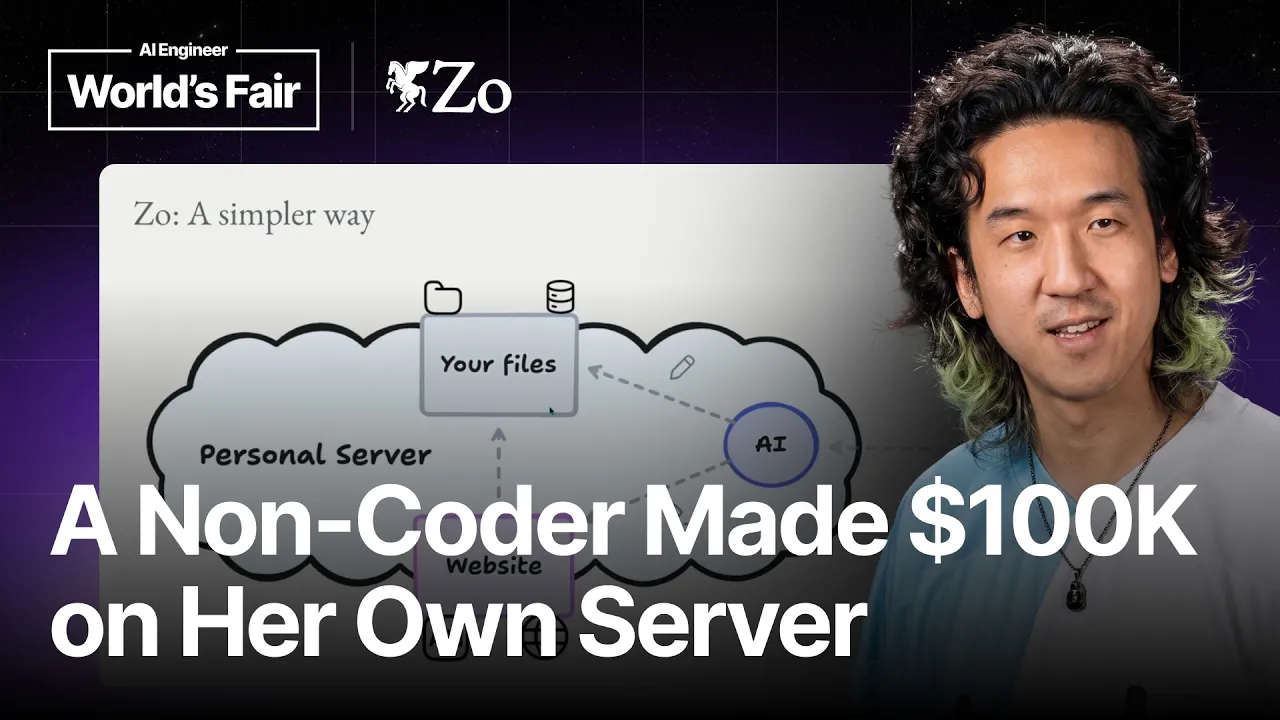
Description
Ben Guo built the page listing every speaker in this session while he sat waiting to go on, then put a QR code to it on his first slide. He builds that way because his computer is a server in the cloud that he talks to in plain language. Guo cofounded Zo Computer after starting on the early Venmo team and joining Stripe as its 80th engineer, and his argument is that people used to feel at home on their machines and no longer do, because everything they touch is rented. He calls the arrangement technofeudalism. You pay a subscription to a software company, which pays rent to a cloud provider, which pays rent to whoever sells the chips, and your data sits in silos you do not control while prices climb for features nobody asked for. Zo is his answer, a personal server with AI built into it, and the two users he walks through are not developers. Charlotte, a private chef and life coach, runs her websites, invoices, bookkeeping and scheduling from one place. Anthia, a free diving instructor, is on track to make $100,000 after replacing Squarespace, Calendly and the rest with a single server she owns. When someone asks about a retreat, Zo texts her the number, she calls at the moment of intent, asks for a payment link and closes on the spot. Guo closes on the question he thinks will decide the next few years: as agents move into the cloud, whose cloud is it, and which direction does the intelligence accumulate. Speaker info: - https://x.com/0thernet - https://linkedin.com/in/0thernet - https://0.zo.space Timestamps: 0:00 - A speaker site built while waiting to present 1:08 - From the early Venmo team to Stripe to Zo 1:36 - What the old Finder icon was meant to say 2:18 - When computers stopped feeling like ours 3:26 - Technofeudalism and the rent you pay upward 4:34 - Charlotte runs a business from one place 5:02 - What a personal cloud actually is 7:12 - Anthia cancels the SaaS stack 10:20 - A tour of the workspace 11:57 - Cloud agents, and whose cloud they run in
Summary
Generated by gpt-5.6-terraAt-a-Glance
- Verdict: Skim
- Core thesis: Zo argues that individuals and companies should own a personal cloud that combines files, applications, agents, automations, and hosting rather than renting fragmented SaaS and AI services.
- Why it matters: The talk presents a relevant control-plane thesis for personal agents: agent context, infrastructure, and the learning generated by agent use should accrue to the user or organization rather than a centralized AI provider.
- Best use: Use it as a product and market framing for self-owned agent infrastructure and as a lightweight scan of Zo's capabilities; do not expect a technical architecture, security model, or deployment playbook.
Executive Summary
Benjamin Guo positions ZoComputer as a "personal cloud": a user-owned Linux server with AI built in, intended to consolidate cloud storage, files, websites, APIs, automations, browser tasks, and personal agents. His central critique is that conventional SaaS and cloud stacks fragment users across services, lock in their data, and increasingly monetize them through unwanted AI features.
The presentation grounds that thesis in nontechnical small-business users. A private chef reportedly uses Zo for websites, invoicing, bookkeeping, scheduling, and notes. A freediving instructor, Anthea, reportedly replaced tools including Squarespace and Calendly, hosts multiple sites and retreat data on Zo, and uses text-driven workflows to follow up with leads and generate payment links.
For technical users, Zo is pitched as a managed but root-accessible Linux VM that can host OpenClaw or Hermes, arbitrary HTTP/TCP services, websites, APIs, files, and custom agents. It exposes API and MCP control, supports multiple models and bring-your-own API keys, and includes scheduled AI automations, integrations, and a browser.
The strategic extension is an agent-publishing platform in beta. Guo argues that company-level cloud agents may be ergonomic but create "intelligence feudalism" if user improvements primarily strengthen the vendor's system. Zo's intended alternative is for individuals or companies to publish, own, and improve agents from their own end-user usage. The talk is compelling vision and product positioning, but it omits material details on isolation, permissions, data governance, reliability, pricing, and how agent self-improvement is actually implemented.
Key Takeaways
- Claim: Zo's product thesis is that a personal cloud should replace a fragmented collection of SaaS tools with one user-controlled home for data, AI, hosted services, and workflows. | Evidence: Guo describes Zo as a personal server with AI built in, where users store files, add AI, host websites or APIs, and access the same environment from a cloud computer, laptop, Mac Mini, or phone. | Implication: For Ken, Zo is best understood as a potential personal/organizational agent runtime plus lightweight application platform, rather than merely another AI chat interface. | Caveat: The presentation is a product pitch and provides no independent comparison showing that one environment can fully replace specialized SaaS tools across reliability, compliance, or workflow depth.
- Claim: Zo is designed to make agentic software creation and operation accessible to nontechnical users, including live website and workflow changes through natural-language interaction. | Evidence: Guo says he created the event-speaker website immediately before presenting; Anthea can ask Zo to add retreat images to her site, while the system manages hosted files, a database, notes, and accounting without requiring her to understand databases or deployment. | Implication: The core UX bet is that deployment and operations disappear behind an agent; this is attractive for speed but makes change control and auditability essential evaluation criteria. | Caveat: The talk demonstrates outcomes but not the safeguards around agent-generated production changes, rollback, testing, or approval flows.
- Claim: The strongest business case presented is not generic AI assistance but connecting a business's web presence, customer data, communication, and payment workflow at the moment of buyer intent. | Evidence: For Anthea's retreat business, Zo reportedly texts her when someone is interested, enabling her to call immediately; she can then text Zo to create a payment link. Guo says this increased bookings enough that retreats became difficult to book due to demand, and that she is on track to make $100,000 on Zo. | Implication: The useful design pattern is an integrated lead-to-close loop: capture intent, notify a human instantly, surface relevant context, and create the transaction artifact in the same system. | Caveat: The $100,000 figure and causal attribution are anecdotal, with no baseline, timeframe, conversion data, or explanation of whether the revenue is incremental versus simply administered through Zo.
- Claim: Zo is also targeting advanced agent users by providing a controllable hosting substrate rather than a closed consumer application. | Evidence: Guo says users receive root access to a configured Linux VM, can SSH in, host arbitrary HTTP or TCP services, control Zo through API or MCP, bring Codex or Gemini subscriptions/API keys, and use it as a home for OpenClaw or Hermes. | Implication: Zo may be worth evaluating as an expedient managed host for agent experiments, but it should not be adopted for sensitive or production workflows without validating its security and operational model. | Caveat: No technical details are provided about sandboxing, credential management, network exposure, multi-tenancy, backups, observability, or permissions for browser and agent actions.
- Claim: Guo frames centralized AI platforms as an ownership problem: a cloud agent can accumulate an organization's context while the resulting intelligence and product value accrue mainly to the AI vendor. | Evidence: He contrasts a company-level cloud agent such as Claude with a model in which users own the cloud and agent, arguing that when customers improve their Claude setup, Anthropic benefits more than the customer. He labels this dynamic "intelligence feudalism." | Implication: For Ken's agent-system thesis, ownership of context, tool definitions, agent state, evaluation data, and improvements is a strategic design dimension—not just an infrastructure preference. | Caveat: This is a strategic and ideological argument, not proof that centralized providers cannot offer adequate portability, governance, or customer value.
- Claim: Zo's next product direction is an agent-publishing platform where the publisher, rather than a central platform, owns the agent and can benefit from its end-user usage. | Evidence: Guo says Zo has a beta version in which an individual or company can publish agents, have end users, and let end usage improve and self-improve the publisher's own agent. | Implication: This is the most strategically relevant but least substantiated portion of the talk; it is a watch item if Ken is assessing decentralized agent marketplaces or organization-owned agent products. | Caveat: The mechanics of publishing, distribution, monetization, feedback collection, self-improvement, evaluation, and safety boundaries are not described.
Detailed Brief
Product surface and workflow model
- Claims: Zo presents a single flat workspace that combines chat, files, hosted services, and personal web presence.; The product supports model choice rather than requiring a single proprietary model.; Its workflow model includes scheduled AI tasks and authenticated browser interaction with third-party sites.
- Evidence: The demo describes a built-in file system and cloud storage usable as a Dropbox-like store, with agents able to work directly against user files.; Guo says users can chat with any model, bring their own API key, and interact with Claude Code inside Zo.; He cites automations for scheduled AI tasks, a skill library and integrations, and a built-in browser through which a user can log into sites and have Zo buy items.
- Caveats: Browser-based purchasing and logged-in site automation create obvious authorization, spending-control, and credential-handling requirements that are not addressed.; The claim that integrations require no user setup is not reconciled with the need to authenticate external systems.
- Implications: The product is trying to compress the traditional stack of file manager, AI client, automation tool, browser agent, cloud host, and personal CMS into one operating environment.; Its breadth could reduce integration burden, but it also concentrates operational and security risk in a single agent-accessible environment.
Market framing: from SaaS fragmentation to direct agent relationships
- Claims: Guo argues that today's digital stack resembles a rent-extracting hierarchy in which users pay SaaS providers, who depend on cloud providers and infrastructure vendors.; His desired internet model is direct interaction between people, companies, and their respective agents without intermediating platforms.
- Evidence: He calls the current structure "techno-feudalism," citing data lock-in, degradation of services over time, attention monetization, and AI-driven price increases as symptoms.; He contrasts this with a future in which each individual has a durable online home and can directly interact with other people, companies, and their AIs.
- Caveats: The framing deemphasizes the benefits centralized providers can offer, including managed security, uptime, compliance, moderation, and low-friction interoperability.
- Implications: Zo's differentiation depends as much on data and infrastructure ownership as on model capability.; The market opportunity is likely strongest where users feel SaaS sprawl and need lightweight custom operations, especially solo operators and small service businesses.
Notable Concepts & Terms
- Personal cloud: Zo's core model: a user-owned cloud environment containing data, AI, hosted services, and workflows rather than separate vendor-controlled accounts.
- Techno-feudalism: Guo's label for SaaS and cloud dependency, where users rent fragmented tools, lose control of their data, and are subject to vendor incentives.
- Intelligence feudalism: The analogous AI-era critique: organizational context and usage improve a centralized AI provider's platform more than the customer-owned system.
- Zo computer: Guo's term for the cloud-based Zo environment that acts as his personal computer and hosts his agent, services, websites, and APIs.
- Agent publishing platform: Zo's beta direction for letting individuals or companies publish agents that they own and purportedly improve through end-user usage.
- MCP: Zo claims API and Model Context Protocol control, positioning the environment as interoperable with external agent and tool ecosystems.
- OpenClaw / Hermes: Named personal-agent tools Zo is presented as capable of hosting, signaling a target audience beyond nontechnical small-business users.
Operator Notes / Why Ken Should Care
- If evaluating Zo, request a technical diligence package covering VM isolation, tenancy, backup/restore, audit logs, secrets storage, network ingress, browser-session credential handling, and permissioning for autonomous actions.
- Test the practical agent-runtime claim with a bounded OpenClaw or Hermes deployment: MCP/API control, persistent state, service exposure, custom domains, scheduled jobs, and recovery after failure.
- For any commerce or browser automation use case, require explicit spend limits, approval gates, scoped credentials, and transaction logs before delegating purchase authority.
- Track Zo's agent-publishing beta for whether it offers exportable agent state, evaluation loops, ownership of usage data, distribution controls, and a credible mechanism for safe agent improvement.
- Use the Anthea example as a workflow template to test elsewhere: inbound-intent detection, immediate contextual notification, human follow-up, and one-step payment-link generation.
Source/Metadata
- Title: Everyone Gets A Software Company — Benjamin Guo, Zo Computer
- Transcript words: 2567
- Duration seconds: 908
- Timestamp note: No usable timestamps or chapters were present in the supplied transcript; the ending also contains repeated extraction artifacts.
Transcript
Hello everybody, I'm Ben from ZoComputer. I just posted on X from my Zo. I'll be giving away $100 in AI credits, and I do all sorts of stuff with my Zo. This is my computer. My Zo is my computer. And before I get started, I made the site just now while I was waiting to get started presenting. This is an overview of all the speakers in today's CLAW session. You can scan this QR code and check it out. I've got some useful links in here, but also I've got some deep research on everybody presenting, including their recent thoughts, links to their profiles, and websites, blogs, et cetera. So scan this. It's super useful. I just made it just now. This is my computer that you see right here, my Zo computer. I'll be talking about it. And this talk is about Zo and a lot of things. It's also about personal agents, personal cloud agents in particular, which Zo is one instance of, and the future, and where I see all of this going. So a little bit about me. I'm the co-founder of Zo. My name is Ben. I started my career on the early Venmo team back in 2013, and I met my co-founder, Rob, at Venmo. And I left Venmo to work at Stripe quite early. I was the 80th engineer. And my co-founder, Rob, he went on to build Substack. He was the first engineer there. And a final fact about me, as you can see, is that I really love computers. I'm dressed up as a computer. And I like to start with this fun fact about this Finder icon. So this icon was designed by Susan Kerr, an early graphic designer at Apple Computer. And many people don't know the story behind this icon, but it actually represents the human, this white face, and the machine, this blue face. And they're in happy harmony. And I think that is what we should aspire to as we build AI tools for people. Humans love tools. Humans have always loved machines. And when we feel at one with our machine, we feel happy. So who, like me, misses the way that computers used to feel? Raise your hand, right? The early internet, your first website, your first PC, right? It used to feel different, right? Today, the internet and our computers feels more like this. We are swimming in the sea of applications and sites and services, and it's not great. And on top of all of that, they're jacking up the prices on these things that we use, often because of AI features that we didn't ask for. And I think quite reasonably, consumers, or I'll just call them regular people, are upset or confused or scared of AI. ZoComputer is based in Brooklyn. We're in Bushwick, actually, in the heart of hipsters in New York, and there's a lot of this out there. I see a lot of this vandalism over AI ads in the city. On top of all of that, this is what our industry looks like. But the deeper root of why this is bad is a structural thing. It's what we call techno-feudalism. So feudalism was this shitty system back in the day. And though it no longer exists, it still is alive and well in our digital lives. So we are still the peasants. We pay rent to the SaaS providers, who pay rent to the cloud providers, who pay rent to the kings, who are probably Nvidia these days. And because we are peasants, our lives are shitty. We are fragmented between all these different tools. There are various services that we use that lock us in and shittify over time. The PM at that product that you use is not incentivized to make your life better. They are incentivized to improve their bottom line, to monetize your attention, to take your data, lock it in, and sell it back to you. And because you don't own anything, you are a peasant. So Zo, our mission has always been to solve this by giving people a real home on the internet. And we believe that most people in the world are living in the matrix, and we're trying to show people a better way. So Zo is alive and well. We've been out for about a year. And real people are using it. Real regular people like Charlotte, this LA-based private chef and life coach. She hosts her websites. She has multiple websites now on Zo. Zo manages her invoices and her accounts and bookkeeping and her scheduling and her notes. And it's this amazing system. It makes her feel clear and calm and on top of the world. And it's fucking fun, as you can see this text that she sent me. So what is Zo? Zo is a personal cloud. We've never really had a personal cloud before. But it's quite simple. You have your own home in the cloud. You're not using other cloud services. You have your own thing. You put your stuff in it. You put your AI in it. And because it is a place in the cloud, you can host stuff in it. You can host services like websites or APIs. And they're all yours. And I think for people in this room, if you're interested in CLAWs and personal agents, your personal cloud might look something more like this. You might have a suite of local devices. And for me, I have this Zo computer, this cloud computer as well, which has my Zo agent on it. It also has Hermes on it. And it has my services. I have many websites and APIs and things I've built all hosted in the same place. And it can also talk to my laptop or my Mac Mini, or I can use it on my phone. And that collectively is my personal cloud. So Zo is a personal server with AI built in. It's quite simple. And it harkens back to a simpler time. So back in the day, this is actually how we built and hosted websites. We just FTP'd our files onto a server, and that updated our website. You were just shipping to prod. You were always doing it live. And that's actually, I think, how most people should build. I don't think it's necessary for a regular person like Charlotte to think about deployment. Unfortunately for many of us in this room, this is probably what your life looks like. You're navigating between these different AIs and devices and SaaS services. And it's very confusing. Zo is meant to be a simpler way. It's one place for all of your stuff and your AI and the stuff you host, all of your personal stuff in the cloud. Here's another case study that we'd like to talk about. This is Anthea. She was one of our early users. She's totally non-technical. She's a freediving instructor. And she's already on track to make $100,000 on Zo. She used to use all of these different SaaS services to run her business and her life, like Squarespace, like Calendly, et cetera. And now she's replaced all of that with Zo. She's canceled all of those SaaS subscriptions. She is no longer a peasant. Anthea went from being very confused and having her data in all of these different SaaS silos and not really being able to connect them very easily to this. So Anthea not only hosts her retreat website on Zo on a custom domain. She has many different websites now. She has her personal workspace that looks like this. She's really into fairies and drawing and mushrooms. And she's expressing her whole self and her creativity online in this new way that we haven't really had as regular people for a long time since the 90s. And under the hood, all of those sites are just the tip of the iceberg. So when Anthea gets somebody who's interested in a retreat, Zo texts her with their number. Anthea now immediately calls them at that moment of intent to buy. She texts her Zo, give me a payment link. And she closes the deal right then and there. And that is how she's actually booking much more revenue than before with these retreats. Retreats are now actually hard to book because there's too much demand. And that's amazing. And under the hood, she has a database for all of her retreats. She doesn't really know what a database is, but she has one. She has all of her notes, all of her accounting, and it's all in one place. If she has images from a retreat and she wants to put those on her website, she just tells her Zo to do it. And it's right there. She can host files directly from her personal server. And she is self-hosting everything. So Zo is made to be simple enough for anyone, for people like Anthea, for my parents, for other people's parents. People are always telling me on LinkedIn or X that they signed up their parents to Zo and their parents are coding up a storm. It was awesome to see. I just got this message on LinkedIn the other day. Our caterer uses Zo to manage his staff at his restaurant. Our recruiter uses Zo as well. He's really into it. He's rebuilding his whole stack for his recruiting agency on Zo. Our marketing agency has become Zo pilled. So it's made for everybody. But it's also powerful enough for the audience in this room. It can be the home for your OpenCLAW or your Hermes. You can have a really nicely set up server to host your personal agent if you use one of those tools. You can bring your codex for Gemini subscriptions, et cetera. And you can build and host anything. You have root access to your own server to this nicely set up Linux VM. The networking is also well set up and you don't really have to worry about any of it. You can SSH in and you can control your Zo via API or MCP. So very flexible. So scan this QR code if you haven't yet to get $100 in AI credits. Just try Zo. I think you'll like it. And I'm going to do a little demo and then I'll have a little bit more to talk about after that. So a quick demo of Zo. You already saw it in the beginning, but Zo is this nice flat workspace. I made this website just now. I make all sorts of websites on the fly. You can chat with any model as I mentioned. You can bring your own API key. You can even talk to CloudCode in here. You've got this nice file system. Built-in cloud storage because it's your server. You can use it as a Dropbox. And you can work agentically in the chat with any of your files. You've got automations. So you can run tasks on a schedule with AI. You've got tons of built-in integrations. So you don't have to set any of this up. We have lots of skills. A large skill library. There's a built-in browser. So you can log into sites and let your Zo buy things for you or do whatever. Actually, I always text my Zo these days to buy stuff on Amazon. It's really dangerous for impulse purchasing. I see something, and I'm like let's buy it. And as I mentioned, you can host stuff. So you can host anything. Any arbitrary service. HTTP or TCP. And we also give you a really nice built-in personal website. This is my Zo space. And this is all set up nicely. And it's got nice vibe coding features. And you just chat with it to edit it. And I've built all sorts of cool things inside of here. This, for example, is my Calendly replacement. People can book time with me. And it has this custom setup that I like. And my Zo can review the people that are interested. I don't want anybody booking time with me directly. So that's what Zo is. And I want to conclude by talking a little bit about the future. So the reason we're building Zo is to build a better internet. One that looks more like this. Where everybody, every individual has a real home, a presence on the internet. And companies already have this. But we should interact directly with other people on the internet without middlemen. And we should also interact with the various companies and their AIs. And it should be more direct. Another way to look at this is that in the future, we will probably interact mostly with agents. And the agents will interact with the cloud. Like these software 1.0 things like websites and APIs. But if you dig a little deeper into this, what's probably going to happen is that most of these agents that we interact with will also be in the cloud. Some of them will be local. But many of them will be in the cloud. And when those agents are in the cloud, the question again is whose cloud is it? So Claude is newly out. And Claude is actually, if you think about it, a cloud agent. It's a cloud. It's a company level cloud that has all the company's context. And anybody can interact with it. And it's an interesting and very ergonomic model. Town and Victor are also similar instances of this. And it's like Claude. But the problem with Claude is this. Whose cloud is it? Whose cloud is it? It's not really your company's cloud. And as you improve your Claude setup, what really improves is Anthropic. Right? The arrow is pointing the wrong way. And this is intelligence feudalism. The intelligence now is bubbling up the wrong way. And you are still a peasant again. Or your company is still a peasant in a way. And at Zo, we believe strongly in changing the way that things work. And giving people and companies more ownership over their cloud and over their intelligence. So we believe that the future should actually look more like this. Anybody, a company or an individual should be able to publish agents. And own them. And have end users. And have the end usage of their agent improve and self-improve their own published agent. And that is the future that we're building. We have a beta version of this. So I'm going to go back to this Zo space and scan this QR code finally. If you want to talk to me, get AI credits, sign up for the beta of this new agent publishing platform. And also you can check out all the speakers that are presenting on this Zo space page. I'm Ben from ZoComputer. Thank you. If you want to talk to me, get AI credits, sign up for the beta of this kind of new agent publishing platform. And, yeah, also you can check out all the speakers that are presenting on this Zoespace page. I'm Ben from ZoComputer. Thank you. I'm Ben fromohohohohohohohohohohohohohohohohohohohohohohohohohohohohohohohohohohohohohohohohohohohohohohohohohohohohohohohohohohohohohohohohohohohohohohohohohohohohohohohohohohohohohohohohohohohohohohohohohohohohohohohohohohohohohohohohohohohohohohohohohohohohohohohohohohohohohohohohohohohohohohohohohohohohohohohohohohohohohohohohohohohohohohohohohohohohohohohohohohohohohohohohohohohohohohohohohohohohohohohohohohohohohohohohohohohohohohohohoh Thank you.