Give Your Chat Agent a Voice — Luke Harries, ElevenLabs
Description
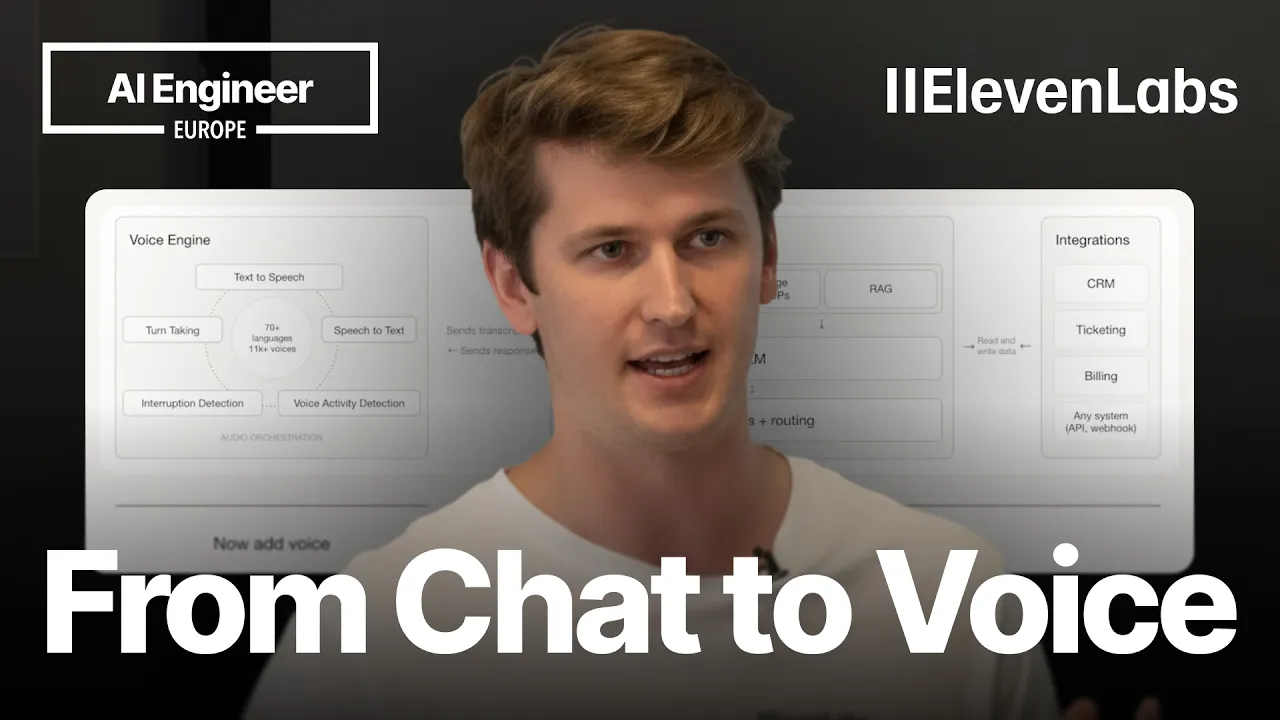
Chat agents dominated 2025. Every product either went AI-first or got left behind. But text-in, text-out is already starting to feel dated. Voice is faster, more accessible, and opens up interaction paradigms that chat just can't touch — phone lines, Zoom calls, screen readers, ambient interfaces. In this talk, Luke Harries from ElevenLabs argues that the next upgrade for every chat agent isn't better prompts or smarter RAG. It's a voice layer. The problem is most teams have already built and tuned their chat agents. They don't want to throw that out. This session shows how ElevenLabs' Voice Engine wraps any existing agent in a few lines — handling turn-taking, speech-to-text, text-to-speech, and emotion-aware interruption detection — without touching the underlying logic. There's a live demo of converting a working chat support agent to voice in a single prompt, plus a look at the client and server SDKs, Shadcn-based UI components, and how tool calling still works through the wrapper. Speaker info: - https://www.linkedin.com/in/luke-harries
Summary
Generated by claude-haiku-4-5-20251001Give Your Chat Agent a Voice — Luke Harries, ElevenLabs
Main Topics
- The Evolution of Chat Agents to Voice Agents: 2025 marks the shift from text-based chat interfaces to voice-enabled AI interactions
- Voice Engine Product Launch: ElevenLabs' new tool for converting existing chat agents to voice agents
- Developer Experience: Simplifying the process of adding voice capabilities to existing infrastructure
- Multi-channel Deployment: Expanding voice agents across different platforms (web, phone, video calls)
Key Points
Why Voice Matters
- Natural Medium: Voice is faster, more interactive, and more accessible than text
- Accessibility: Particularly beneficial for people with keyboard difficulties or dyslexia
- Omnichannel Opportunities: Unlocks new interaction paradigms—agents can join Zoom calls, handle phone support, and more
- Industry Trend: Linear, PostHog, and even UK government have adopted chat-first interfaces
Voice Engine Technical Features
- Best-in-class Models:
- Speech-to-text: Scribe (most accurate model)
- Text-to-speech: V3 model
- Advanced Turn-Taking: Emotion context-aware, detects pausing, semantic understanding
- Thousands of Voices & Languages: Extensive multilingual support
- Seamless Integration: Works with existing chat agent infrastructure without replacement
Developer-Friendly Implementation
- Minimal Code Requirements: Server SDK requires creating a client, initializing voice engine, and adding a wrapper to existing chat agents
- Client SDK: Only three lines of code needed for widget implementation
- UI Components: Pre-built, beautifully designed components based on shadcn and Vercel design systems
- AI-Assisted Conversion: Single prompt can convert an existing chat agent to a voice agent using coding agents
Two Solution Paths
- Voice Engine: Wrapper for existing chat agents with simple SDK integration
- Full Agent Platform: Out-of-the-box conversational AI platform for faster implementation
Notable Quotes
> "2025 was the year of the chat agents. And I think you either died of SaaS or you became AI first by adding a chat agent to your app."
> "Chat's cool but it doesn't feel like you're building the future though. And I really think voice is this natural medium."
> "I think these chat agents will either die as chat agents or start adding voice."
> "You can literally in about one prompt actually convert an existing chat agent to a voice agent."
Takeaways
- Immediate Actionability: Developers can add voice to existing chat agents with minimal code changes using the Voice Engine wrapper
- Preserve Existing Work: Companies don't need to rebuild their agents—Voice Engine works as a layer on top of existing infrastructure
- Tool Calling is Handled: Most complexity (tool calling, RAG, integrations) remains in the existing chat agent backend
- Future Inevitability: Voice adoption will become essential; chat-only agents may become obsolete
- Design Partner Opportunity: ElevenLabs is seeking early adopters to help shape the product before full release (launching in couple of weeks)
Transcript
Music So really excited to talk to you about giving your chat agent a voice. And 2025 was the year of the chat agents. And I think you either died of SaaS or you became AI first by adding a chat agent to your app. And so lots of you probably saw this tweet which went viral where it was a Linear, PostHog, SEO where they all went and added their home screen is now the chat interface. And I actually really agree with this. It's that the default way that you want to now be interacting with AI. You can use the tool calling, you can use the RAG. It's just very declarative. It's a great quick start. You even have the government doing the same. This is the GovUK approach into chat agents. Chat's cool but it doesn't feel like you're building the future though. And I really think voice is this natural medium. It's way quicker, it's way more interactive. It's also much more accessible. So lots of people who struggle with keyboards or dyslexia, voice is a much more natural medium. And it's also omnichannel. As soon as you add voice, you unlock all these different types of interaction paradigms. So let's say you were PostHog, well now your agent can actually join a Zoom call and start correcting you if you're saying wrong stats. Or if you're customer support, you can now add a phone line. And so what we really need to do is upgrade all these chat agents into voice agents. And there's some transitions. And what we found when we're building with companies is we first started 11labs, we were like, okay, let's just build the best text-to-speech models in the world. And then we got pulled into this big solution of how do you now build these agents. And we're working powering customers like Revolut's customer support. And all of them end up looking like this. Where you have this voice engine where you do the text-to-speech, the turn-taking, the speech-to-text. You then have this agent orchestration where you combine your LLMs, your RAG, your different tool calling, all your integrations. Probably a bunch of us in this room have either built the same system or pitched the same slide. But what we found is when we were starting working with these customers, loads of them went, yes, we're starting from scratch, that's great, let's use this out-of-the-box one. But for lots of them, they had actually already built this. And they were, well, hold on, I've already got my agent. I spent loads of time doing the evals, the transcriptions. Why would I need to completely replace and rebuild with what I have? And so that's why I'm giving you an early preview of a new product which will be coming out in a couple of weeks where we've basically taken this voice engine bit and wrapped it up into its own first-class primitive, which makes it really easy for you to add and wrap any existing agent. And so this is voice engine. We combine the best models, so speech-to-text with Scribe, which is the most accurate model, as well as the text-to-speech models like V3. It's got this really advanced turn-taking, which is emotion context-aware. It can tell when you're pausing. It does the semantic bad as well, as well as all the different thousands of different voices and languages. And really importantly for the folks in this room, we've really cared about what does the developer experience of this look like. And what's really cool about this is you've spent a ton of time building these complex chat agents, but to actually add voice to that is then remarkably simple. And so this is what the server SDK looks like. We basically have this, you create your client, you then create your voice engine, and then you add this little wrapper to your existing chat agent where you basically attach it, and then each time there's a new session started, it will kick off this loop and just proxy all the stuff to your existing chat agent. Additionally, with the server SDK, we also then have the client SDK. And so this is super simple. It's basically three lines you can then add and you have a widget in your site. One of the cool things you actually get for free as well is once you've started adding these client SDKs, you can then also add telephony and CSRs, and all of this is pretty much out the box once you've wrapped it. And finally, we have a bunch of really beautiful, well thought out UI components, all based on the shadcn and Vercel style, so you can actually just point your coding agent and give it a go. What's cool is you can literally in about one prompt actually convert an existing chat agent to a voice agent. So I'll give you a quick demo now. So this is your generic chat support agent where we can go, hello, how are you? Perfect. It replies. So that works pretty well. And this is the code all running locally. And when we release this, it will come with a skill which basically has all the best in class stuff. And then it's literally one prompt which will then analyze your code base, work out your chat agent, how to actually deploy it, work out how to wrap it. So it should be really cool and quick to do. I'll just show you some of the code that it ends up writing. So you can see here we've got the voice engine. You attach it with each new session. It then starts proxying it. So it should be really simple and easy to add to your existing agents. We can let it work in the background. Cool. So that's an early glimpse of voice engine. I also think this is a really useful paradigm, which more of the community should do where we start moving to this higher abstraction bundles instead of just the pure text-to-speech, speech-to-text. So to summarize the two different things we now have for developers building these different voice engines or voice agents, you've either got voice engine, which is fantastic. You spend all your time building these excellent chat agents. You can just do this little wrapper with a nice SDK. Or if you want to use a full agents platform for conversational, we've got that out of the box. It's very easy, very quick to prompt. I'll end with a prediction. I think these chat agents will either die as chat agents or start adding voice. I'm excited to work with lots of people in the room. We're also looking for some design partners. So if you want to be some of the first people to do this, we'd love to chat. But thanks so much. Thank you very much. Thank you very much. Thank you very much. Yeah? How do you handle tool calling? Yeah. The cool thing about this is your chat agent actually normally does the majority of tool calling. So it's actually already built out on the back end here. And so you can have this wrapper without needing to deal with any of the issues of tool calling. We also at 11labs have the concept of either client-side tools and server-side tools. So you can do some pretty cool stuff where you then expose the tools on the very front end to manipulate the DOM. And we're going to add in a way where you can proxy some of these tool calls to the wrapped agent. But most folks will already have all the tool calling already handled with the chat agents. Cool. Nice. Thanks so much. Thank you. Thank you. Thank you. I spent loads of time doing the evals, the transcriptions. Why would I need to completely replace and rebuild with what I have? And so that's why I'm giving you an early preview of a new product which will be coming out in a couple of weeks where we've basically taken this voice engine bit and wrapped it up into its own first-class primitive, which makes it really easy for you to add and wrap any existing agent. And so this is voice engine. We combine the best models, so speech-to-text with scribe, which is the most accurate model, as well as the text-to-speech models like V3. It's got this really advanced turn-taking, which is emotion context-aware. It can tell when you're pausing. It does the semantic bad as well, as well as all the different thousands of different voices and languages. And really importantly for the folks in this room, we've really cared about what does the developer experience of this look like. And what's really cool about this is you've spent a ton of time building these complex chat agents, but to actually add voice to that is then remarkably simple. And so this is what the server SDK looks like. We basically have this, you create your client, you then create your voice engine, and then you add this little wrapper to your existing chat agent where you basically attach it, and then each time there's a new session started, it will kick off this loop and just kind of proxy all the stuff to your existing chat agent. Additionally, with the server SDK, we also then have the client SDK. And so this is like super simple. It's basically three lines you can then add and you have a widget in your site. One of the cool things you actually get for free as well is once you've started adding these client SDKs, you can then also add like telephony and CSAS, and all of this is like pretty much out the box once you've wrapped it. And finally, we have a bunch of really beautiful, well thought out UI components, all based on the shad CN and Vercel style, so you can actually just point your coding agent and give it a go. What's cool is you can literally in about one prompt actually convert an existing chat agent to a voice agent. So I'll give you a quick demo now. So this is like your generic chat support agent where we can go, hello, how are you? Perfect. It replies. So that works pretty well. And this is the code all running locally. And when we release this, it will come with a skill which basically has all the best in class stuff. And then it's literally one prompt which will then go analyze your code base, work out your chat agent, how to actually deploy it, work out how to wrap it. So it should be really cool and quick to do. I'll just show you some of the code that it ends up writing. So you can see here we've got the voice engine. You attach it with each new session. It then starts proxying it. So it should be really simple and easy to add to your existing agents. We can let it work in the background. Cool. So that's an early glimpse of voice engine. I also think this is just like a really useful paradigm, which more of the community should do where we start kind of moving to this higher abstraction bundles instead of just the pure text-to-speech, speech-to-text. So to summarize the two different things we now have for developers building these different voice engines or voice agents, you've either got voice engine, which is fantastic. You spend all your time building these excellent chat agents. You can just do this little wrapper with a nice SDK. Or if you want to use a full agents platform for conversational, we've got that out of the box. It's very easy, very quick to prompt. I'll end with a prediction. I think these chat agents will either die chat agents or start adding voice. I'm excited to work with lots of people in the room. We're also looking for some design partners. So if you want to be some of the first people to do this, we'd love to chat. But thanks so much. Thank you very much. Thank you very much. Thank you very much. Yeah? How do you handle tool calling? Yeah. The cool thing about this is your chat agent actually normally does the majority of tool calling. So it's actually already built out on the back end here. And so you can have this wrapper without needing to deal with any of the issues of tool calling. We also at 11labs have the concept of either client-side tools and server-side tools. So you can do some pretty cool stuff where you then expose the tools on the very front end to manipulate the DOM. And we're going to add in a way where you can proxy some of these tool calls to the wrapped agent. But most folks will already have all the tool calling already handled with the chat agents. Cool. Nice. Thanks so much. Thank you. Thank you. Thank you.