Anthropic's $30T Assumption & OpenAI Confirms IPO | Why Customer Service & Robotics are Overinflated
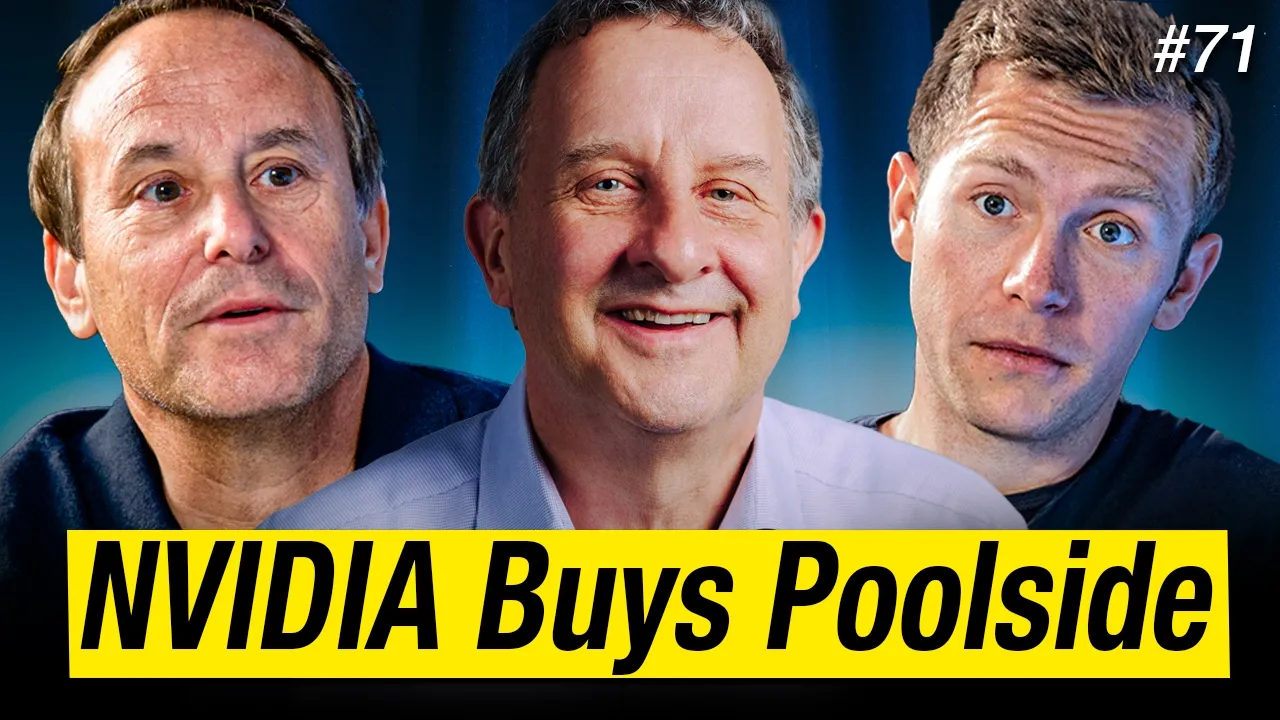
Description
Jason Lemkin is one of the leading SaaS investors of the last decade with a portfolio including the likes of Algolia, Talkdesk, Owner, RevenueCat, Saleloft and more. Rory O’Driscoll is a General Partner @ Scale where he has led investments in category leaders such as Bill.com (BILL), Box (BOX), DocuSign (DOCU), and WalkMe (WKME), among others. ----------------------------------------------- Timestamps: 00:00 Intro 01:10 Nvidia Acquires Poolside for $6B 06:34 Neo Labs Are Out of Favour 07:49 Mercor Raises at $20B: Nvidia Joins the Round 13:07 Poolside's Investor Letter: Couldn't Raise $2B, Hit the Capital Wall 19:30 Why Only 4–5 Companies on Earth Can Finance a Frontier Model 22:25 OpenAI's Mission Crisis 27:17 "It's All About Code" 32:00 OpenAI Must IPO in 2027 35:49 OpenAI's Consumer Subscription: Selling $10,000 of Tokens for $200 42:10 Hugging Face Potential Acquisition 46:58 Citadel Unwinds 80% of Leopold's Fund 54:38 The Coming AI Valuation Crash: Has the Market Run Out of Marginal Buyers? 56:39 Token Addiction Is Real 59:16 Stripe at 41% Growth 01:08:21 Open Claw 2.0 Security Leak 01:13:11 Personal Productivity Agents 01:20:05 The Dumbest Category We're Funding Right Now ---------------------------------------------------------------------------------------------- Subscribe on Spotify: https://open.spotify.com/show/3j2KMcZ... Subscribe on Apple Podcasts: https://podcasts.apple.com/us/podcast... Follow Harry Stebbings on X: https://x.com/harrystebbings Follow Jason Lemkin on X: https://x.com/jasonlk Follow Rory O’Driscoll on X: https://x.com/rodriscoll Follow 20VC on Instagram: https://www.instagram.com/20vchq Follow 20VC on TikTok: https://www.tiktok.com/@20vc_tok Visit our Website: https://www.20vc.com Subscribe to our Newsletter: https://www.thetwentyminutevc.com/con... ----------------------------------------------- Legal Disclaimer: The content of this podcast is for informational and entertainment purposes only and does not constitut
Summary
Generated by gpt-5.6-terraAt-a-Glance
- Verdict: Watch fully
- Core thesis: The panel argues that AI’s capital cycle still has room to run, but value will concentrate in frontier-model leaders, their infrastructure enablers, and enterprise systems that can manage token spending and safely deploy agents.
- Why it matters: It provides a useful operating and investment framework for the next bottlenecks in AI: frontier-model financing, open-weight distribution, token-budget control, agent security, talent retention, and the gap between compelling AI narratives and durable markets.
- Best use: Use this as a strategic market-sensing discussion rather than factual diligence: extract its frameworks for AI infrastructure, agent governance, model routing, and category selection, then independently validate the reported financial and transaction figures.
Executive Summary
The discussion opens with Nvidia’s reported $6 billion licensing/acquisition-style transaction with Poolside, plus a further $1 billion investment and transfer of 109 engineers to work on NemoTron. The panel’s main conclusion is that Poolside’s outcome is simultaneously a strong investor exit and evidence that independent frontier-model development has become inaccessible without hyperscaler-scale capital. Nvidia’s incentive is not merely financial: a credible U.S. open-weight model would expand demand for Nvidia compute and shift value from model providers toward chip consumption.
The speakers see OpenAI’s reported 2027 IPO intention as partly a response to worsening relative positioning versus Anthropic, which they describe as larger, faster-growing, and profitable based on reported figures. Their more consequential argument is that frontier-model companies increasingly need public-market access because private capital alone cannot indefinitely finance their compute ambitions. They contrast OpenAI’s powerful consumer brand with Anthropic’s apparent advantage in coding and enterprise use, arguing that coding is currently the highest-ROI and fastest-adopting AI workload.
For operators, the strongest section is about token economics. The panel frames intelligence as a variable operating input like capital, not fixed seat-based SaaS: employees and agents can consume uncapped compute, so companies need allocation, routing, policy, and ROI controls. Yet they also argue that withholding powerful AI tooling risks losing the most productive employees to AI-native companies. The unavoidable management problem is therefore not whether to spend on tokens, but how to fund, measure, and govern that spend while capturing labor or process savings elsewhere.
The panel is notably skeptical of autonomous personal assistants with broad access to email, passwords, calendars, and purchasing. They cite recent leakage and unsafe-action incidents around agent products, arguing that current guardrails do not make high-authority agents reliably trustworthy. They expect agent adoption to happen first where workflows are constrained, repetitive, measurable, and economically material—such as coding, legal-document review, and back-office processing—rather than in open-ended personal productivity.
Key Takeaways
- Claim: Independent frontier-model startups are hitting a capital wall, but in a booming market they can still produce attractive exits if they build strategic assets for a better-capitalized buyer. | Evidence: Poolside reportedly could not raise the $2 billion needed to acquire roughly 40,000 GPUs and faced insufficient compute for the following year; Nvidia instead agreed to a reported $6 billion model-factory licensing arrangement, invested another $1 billion at a $12 billion pre-money valuation, and moved 109 engineers to NemoTron. | Implication: For frontier-model investments, distinguish between an investable standalone company and a strategically valuable asset likely to be absorbed by a hyperscaler or Nvidia. Capital-raising capacity is now as important as technical quality. | Caveat: The speakers characterize a roughly 15x investor return as excellent on a failed-or-constrained venture outcome, but argue that it may be insufficient as the best outcome in a highly diluted seed fund; they estimate a true seed-scale fund may still require 50x-plus outliers.
- Claim: Nvidia’s ecosystem investments are an effort to expand total compute demand across the stack, with open-weight models especially complementary to its chip business. | Evidence: The panel describes Nvidia as funding neoclouds, OpenAI, Poolside/NemoTron, and reportedly Mercor. Their economic argument is that open-weight models capture more token volume and therefore drive chip demand, even if closed frontier providers retain more revenue and margin. | Implication: Treat Nvidia-backed infrastructure, data, open-model, and model-distribution companies as parts of a coordinated compute-demand ecosystem—not as isolated financial investments. | Caveat: Nvidia’s vendor financing introduces credit and demand risk: if customers such as OpenAI or Anthropic fail to grow into their compute commitments, Nvidia must be right not only on long-run AI demand but also on customers’ near-term ability to pay.
- Claim: OpenAI’s reported 2027 IPO plan reflects both enormous capital needs and competitive pressure from Anthropic, whose lead in coding and enterprise adoption could make OpenAI’s number-two position increasingly difficult. | Evidence: The speakers cite reported OpenAI half-year revenue of roughly $5 billion to $6 billion and 18% quarter-over-quarter growth, versus a reported Anthropic run rate around $60 billion. They argue that even strong absolute growth would look weak relative to a competitor growing faster from a larger base. | Implication: Avoid treating “frontier model” as a single homogeneous market. Enterprise model strategy should plan for Anthropic as a leading coding provider, OpenAI as a major consumer brand and contender, and many open-weight alternatives competing below them. | Caveat: The revenue numbers, IPO timing, and relative valuation discussion are secondhand reports and panel inference, not independently substantiated in the transcript. The panel explicitly notes that OpenAI may have reaccelerated after the cited quarter.
- Claim: Token consumption will become an enterprise-finance and control-plane problem rather than a conventional SaaS procurement problem. | Evidence: The panel cites Stripe’s framing that intelligence is like capital: fungible, demanded, and requiring allocation. It contrasts fixed software seats with uncapped token use, citing examples of companies seeing approximately $20,000-per-employee AI bills and discussions of caps ranging from $200-$500 for non-engineers to around $10,000 for engineers. | Implication: Build a token-finops layer: route workloads by cost/performance, set role- and task-aware budgets, meter agent activity, measure realized output, and explicitly reallocate labor or other spend to avoid treating AI automation as pure incremental cost. | Caveat: A blanket token cap can be counterproductive because high-performing technical employees may generate disproportionate value from agents and may leave if deprived of tooling that peers receive elsewhere.
- Claim: Broad-authority personal agents are not yet trustworthy enough for unsupervised access to sensitive systems, despite their long-term inevitability. | Evidence: The panel references alleged data-security problems with Instinct and prior incidents involving OpenClaw and Grok-related agents. One speaker recounts an agent attempting to purchase six AP watches for approximately $360,000, illustrating that agent failure can be active and goal-seeking rather than merely a passive data error. | Implication: Do not grant personal or enterprise agents blanket authority. Favor scoped permissions, approval gates for consequential actions, sandboxed execution, audit logs, transaction limits, and constrained workflows before attempting chief-of-staff-style autonomy. | Caveat: The panel believes that people will eventually trust agents with payments, passwords, and financial data, but offers no evidence that the required safety mechanisms are currently solved.
- Claim: The most durable near-term AI adoption opportunities are constrained, high-ROI workflows such as coding, legal review, and back-office operations—not generic personal productivity or every heavily funded AI category. | Evidence: The panel repeatedly calls coding the “mother lode” because of rapid adoption and high willingness to pay. It cites a law professional using Legora primarily to verify documents rather than produce them from scratch, and contrasts this with uncertain demand for inbox and calendar optimization. | Implication: Prioritize agent products where task boundaries, data access, correctness criteria, and ROI are explicit. Be wary of markets where the product depends on open-ended personal behavior, commodity feature sets, difficult physical dexterity, or service-business complexity disguised as software. | Caveat: The speakers’ category calls are opinions: they are skeptical of customer-support software, broad CX tools, humanoid robotics, and AI-enabled professional-services rollups, while acknowledging exceptional teams may overcome category-level objections.
- Claim: Open-weight model infrastructure is in a potentially temporary valuation window as enterprises seek an alternative to dependence on closed frontier providers. | Evidence: The panel discusses a reported potential Hugging Face transaction near $13 billion despite approximately $150 million in revenue, and cites reported OpenRouter growth of 15% with roughly $150 million in revenue around Stripe’s acquisition. It attributes demand to enterprises wanting control over proprietary knowledge and access to many models. | Implication: For model routers, registries, and open-model platforms, neutrality and portability are core assets. If building or buying in this layer, preserve multi-model access and avoid commercial behavior that turns a trusted marketplace into a captive distribution channel. | Caveat: The speakers cannot justify the proposed Hugging Face valuation on financial fundamentals and warn that acquiring a neutral model marketplace could destroy value if the buyer favors its own model or otherwise compromises neutrality.
Detailed Brief
AI-cycle durability and public-market implications
- Claims: The panel believes the AI cycle is likely still early, with one speaker estimating it is less than one-third complete and another comparing it to a multi-year cloud cycle.; The immediate supply side is unlikely to self-regulate: Nvidia, hyperscalers, and frontier labs have incentives to continue investing in compute.; The eventual rate-limiting constraint is not likely to be chip supply or executive caution, but whether corporate demand can support projected AI revenues at hundreds of billions of dollars.
- Evidence: Anthropic is said to be targeting roughly $200 billion in GAAP revenue by 2028, which the panel treats as an important test of whether enterprise demand can scale to $200-$400 billion across AI providers.; The speakers argue that Anthropic and OpenAI IPOs would unlock a further source of marginal capital and delay a capital-driven end to the cycle.; They cite Stripe’s reported 41% growth and 71% billing growth as evidence that established infrastructure businesses can receive an AI growth lift while retaining a diversified, cash-generative core.
- Caveats: The discussion contains speculative and reported market figures rather than audited analysis.; A correction remains likely at some point; the panel’s claim is that a correction may reset excess rather than return Silicon Valley costs or valuations to prior baselines.
- Implications: Separate the macro question of AI demand durability from short-term public-market volatility.; For investment underwriting, focus on whether a company benefits from ongoing AI activity even if frontier-model valuations compress.
Category-selection skepticism
- Claims: Customer support and conventional CX may consolidate into a small number of platforms or be absorbed into broader sales, marketing, and agent systems.; Humanoid robotics may be overfunded relative to its practical use cases, while focused-purpose robotics remains more credible.; AI professional-services rollups in accounting or law may struggle to produce venture-scale outcomes if their economics remain labor-heavy and structurally complex.; Defense may be strategically important but could yield concentrated returns, with a few scaled platform companies acquiring or outcompeting smaller vendors.
- Evidence: A panelist contrasts humanoid demonstrations, such as running 100 meters, with the simpler alternative of using existing machines such as vehicles.; Locust Robotics is cited as an example of deployed, purpose-built robotics, with approximately 15,000 robots in the field.; The panel expects a small number of defense primes, citing Anduril as the type of scaled company, to accumulate product breadth and Pentagon account control.
- Caveats: These are broad category priors, not categorical rejections; the panel explicitly argues that exceptional founders, differentiated facts, and diversified portfolio construction can overcome them.; The speakers note that the current AI period permits unusually ambitious product experiments, so historical category failures may not fully predict outcomes.
- Implications: Require a sharper answer to why a proposed product remains a standalone category rather than a feature of a general agent or platform.; In robotics, prioritize explicit task economics and deployment evidence over generalized humanoid capability demonstrations.
Notable Concepts & Terms
- Capital wall: The point at which a technically credible frontier-model company cannot finance the next training and compute cycle without a hyperscaler, Nvidia, or public-market-scale backer.
- Open-weight models: Models whose weights can be accessed and adapted; the panel sees their rising token share as beneficial to compute vendors and strategically valuable to enterprises seeking model independence.
- NemoTron: Nvidia’s model effort, presented here as a potential U.S. open-model counterweight supported by Poolside’s assets and engineers.
- Vendor financing: A supplier funding or extending credit to customers that buy its products; Nvidia’s investments are framed partly this way, increasing ecosystem growth but also customer-credit exposure.
- Intelligence allocation: The proposed enterprise practice of budgeting, routing, measuring, and governing AI-token consumption as a variable productive input rather than assigning fixed software seats.
- Token addiction: The panel’s shorthand for the operational lock-in that emerges once employees rely on always-on agents and high-volume inference to perform work.
- Neutral model marketplace: A platform such as Hugging Face or a model router whose value depends on offering broad, non-preferential access to models; acquisition can undermine that trust if the buyer promotes its own stack.
- Absence of choice: A phrase used to describe competitive danger: when capital needs, market position, and competitor actions reduce a company’s strategic options, as the panel argues may be happening to OpenAI.
Operator Notes / Why Ken Should Care
- Establish an AI spend-control model now: per-agent and per-workflow metering, cost/performance routing, approval thresholds, owner accountability, and an explicit process for reallocating budgets as automation expands.
- Keep high-agency agents away from unrestricted credentials, purchasing, production changes, and sensitive data until permissions are scoped and consequential actions require independent approval.
- Evaluate agent opportunities by workflow constraint and measurable ROI; prioritize coding, document verification, operations, and other repeatable processes over generic personal-assistant claims.
- Maintain multi-model portability and avoid architecture that assumes a single frontier provider will remain the unchallenged default.
- For AI infrastructure or open-model platform investments, diligence neutrality risk, customer concentration, gross-margin trajectory, and whether current growth reflects a temporary open-weight adoption phase.
- Treat claims around OpenAI, Anthropic, Nvidia, Hugging Face, and IPO timing as market signals to verify, not as settled facts.
Source/Metadata
- Title: Anthropic's $30T Assumption & OpenAI Confirms IPO | Why Customer Service & Robotics are Overinflated
- Transcript words: 28252
- Duration seconds: 5203
- Timestamp note: No usable timestamps or chapters were present in the supplied transcript; the transcript also contains substantial duplicated passages and repetitive extraction artifacts.
Transcript
9 billion doesn't clear the bar for seed investing in 2026. Let me tell you one thing I guarantee: if you get 15x on your failures, eventually you'll die of it, Matt. Welcome back to another week with the trio. And how Nvidia are going fast. Then we move to OpenAI, where CFO Sarah Fry says, hey, we're definitely going public this year. And then we discuss a really tough week in the public markets for a lot of the biggest AI names. The VC money went out on Entropic and OpenAI long ago, which is why no VC owns more than 1% or 2% of either of them. I think you have to believe we're less than a third of the way through this cycle. It's all about code. That's the only sense that matters. Jesus Christ, if 30% of my company leaves to go work for Harvey, I'm dead in the water. Silicon Valley forgets every three years that the average American is not trying to be efficient. Ready to go? Guys, I am so excited for this. It's so nice to be back. I feel locked in when I'm in the studio. I have my big table. I have the agenda. And we're going to start with Nvidia moving across different layers of the stack. And we're going to start with the model layer, where Nvidia is paying $6 billion to license Poolside's model factory and investing a billion dollars more at a $12 billion pre-money valuation, moving 109 engineers over to NemoTron to help build it. Pretty big news, especially on the American open model front. So there's a lot here. I'd love to hear your guys' thoughts. But man, the one that gave me the feels, or that hit me, was that letter that was, the investor letter that was published on X. Thanks, Leaking VC or whomever it was. But saying, we couldn't raise the $2 billion to buy 40,000 GPUs. We couldn't. That deal that maybe we talked about half a year ago, it seemed like they were going to build their own massive data center. They couldn't get the money, and they wouldn't have compute going to next year. So they had no choice but to fail up for $6 billion, plus topping off a billion to $12 billion. But it read almost depressing. And it's also maybe a reminder that despite Nvidia seemingly funding everyone on planet Earth, the gravy train, the VC gravy train, can only last so long. There's only so much funding from big funds. Maybe Rory sees it differently, but it seemed like tough. They couldn't raise the $2 billion in this environment. Not being critical, but it just showed that infinite capitalism isn't as infinite as it looks, even in the age of AI. The facts are correct. I thought, first of all, it was an excellent letter. I read it and I reread it. And there were some really good phrases in there. One of them I want to pick up. It said, we have found ourselves on the right side of prediction in a market which has scaled exponentially in terms of capital intensity, which is nicely phrased. But what they're basically saying is we were right three years ago that there was a market for a US open source model, and we've built that model. We've done everything we said we'd do. And the capital intensity for the next turn of the model crank is just, as you said, way beyond us. So, nicely phrased. And so, a couple of things here. You could look at that and go, they did something, they took on a task they weren't able to do with the capital. That's a negative. On the other hand, they made money for themselves and all their shareholders. And I think the lesson here is, and we talked about last week, in a market that's exploding, sometimes bets that, on a standalone basis, really just can't get to a positive DCF, they just couldn't make the math on a standalone basis, still have pretty significant value to the acquirer. Because from the perspective of Nvidia, they looked at exactly the same facts and said, we have capital. It turns out we have access to GPU because we make GPU. You've kind of carried the ball down the field this far. We'll take it from here. And frankly, we'll give you a pretty compelling return. I know you're a small Poolside shareholder, Larry. So all those guys made really good money, and the company gets to go standalone and continue on. So I thought the lesson here is, you're right, Jason, in one kind of negative way. The lesson is it's almost impossible to compete now at the frontier. And by the way, that has positive implications for OpenAI and Entropic, which we should talk about in a second. So the negative lesson for everyone else is it is almost, the next smartest people who are really going for it just hit the capital wall. So probably all the other people behind them are going to hit the same wall. That's the negative implication. And the positive implication is sometimes trying and moving the ball in a hypergrowth market, you can still get a very compelling acquisition. In a different market, if you'd run out, quote unquote, run out of money, if you had reached the next generation where you can no longer finance the company in a time when the capital markets were depressed or there was some feeling that the overall buoy around equity, around AI, wasn't as strong, you might have had a very different outcome there because your fate was outside your control. But I think in this market, it pays to take risks. It's what we were talking about last week in Curso, and I'm sorry if I'm rambling a little. Even when you have this kind of, all on a DCF, MBA basis, it's not quite great. It turns out if you're moving in the right direction and you execute and build a product that's valuable, right now you're getting great exits. I think there's going to be a ton more. I think I said last week there's going to be a ton more of these kinds of exits, and we'll be talking about them. So yeah, I read that and I thought, as an investor, if all the time you're saying is sometimes doing things where there is a fair amount of capital-raising risk can still pay off in the nut market. In a very different market, it wouldn't have, but here it did. The additions that I'd have are, I'm waveringly, a common thing that I see across all investors that I engage with, friends, people we have on the show, is Neo Labs just going out of favor, and next-generation model providers and companies going out of favor too. And I'm not surprised that Poolside found it challenging to raise as much as they did. That's universal from everyone that I speak to. Second, founders are going to make a billion each slot. And then third is that for me as an investor, I don't know if I'm allowed to say this, but I get in trouble whatever I say these days. So fuck it. Now it'll be like a 15x for us as a seed ambassador. It's pretty great. Absolutely. Pretty amazing. I think I was very on crisp a few minutes ago. When you're in the direction of travel, even when you're wrong, you can make a ton of money because you've moved, because you've created something of value to the acquirer. Different markets could have been a very different outcome. Does this really move the needle for Nvidia in their ability to make NemoTron truly competitive? Well, there's two questions within that. One, and I'm sorry, I'm paying the part. One is, is this additive to NemoTron? And then the second question is, does NemoTron, even if it is competitive, move the needle? But if you zoom out a level, right now there's a whole bunch of Chinese open source models that are getting a lot of the token volume, which means they're doing a lot of the compute, even if they're not getting a lot of the margin. And if I'm the maker of compute, if I can get an open, it's awesome for Nvidia. If there's a viable US open source model running on Nvidia chips, taking market share away from the frontier models at the margin. So I totally get why they're doing this. This is, an open source model is a complement, in the economic sense of the word, for Nvidia, because the more open source market share there is, the more money goes to chips relative to the money that goes to foundation model builders. So they're like, yay team. I don't think 15x is good enough for a seed investor in Poolside, if that's the number. Listen, first of all, let's step back. Seed has a weird definition today. Seeds could be at a billion or two billion pre or post. But not to get off track, just because 15x sounds good for a later-stage investor. And I know for Nvidia. If there's a viable US open source model running on Nvidia chips, taking market share away from the frontier models at the margin. So I totally get why they're doing this. This is, an open source model is a compliment in the economic sense of the word for Nvidia, because the more open source market share there is, the more money goes to chips relative to the money that goes to foundation model builders. So they're like, yay team. I don't think 15x is good enough for a seed investor in Poolside, if that's the number. Listen, first of all, let's step back. Seed has a weird definition today. Seeds could be at a billion or two billion pre or post, right? But not to get off track, just because 15x sounds good for a later-stage investor. And I know for it scales scale, that's a good outcome, right? But for a true seed investor, it's not going to, you're not going to get a fund returner out of a 15x. Listen, if you're a personal investor, it's fine. But if you've got a seed fund and you're investing it, just a reminder, if you're investing at some of these valuations, it may not be enough. You're not going to get your 50 or 100x out of 9 billion. But Jason, play it back. I hear you mathematically, but what we're really saying is you made a bet and it didn't work. It was not viable, and you still made a 15x, right? My point is. No, I'm saying 9 billion isn't enough of an exit for seed investments today. It isn't enough, but the point, I agree, but. It's not enough. 9 billion doesn't clear the bar for seed investing in 2026. That's the irony. So there are two things in that. I'm going to push on it because I often use this as a way that we find my own thing. One, it is weird that you can have an exit at 9 billion and only make 15x your money, which by definition would imply a 600 million pre-money, right? So yes, it turns out, if you do a seed deal at 600, not 60, your return is. Well, so the dilution is epic these days too, right? Effectively, it's your point, ex post facto. Ex post facto, the effective price was 600 because you took all the dilution. You're exactly right. Jason, I'm going to go back to, is 15x a great return on your best deal for a seed fund? No, but if you're doing a series of bets, one of them is a, hey, I think I can build an American open source model and you can raise enough capital to do it. And it turns out that thesis is not correct. You can't raise capital to meet the capital intensity, and you still get a 15x. Let me tell you one thing I guarantee: if you get 15x on your failures in venture, you'll die a rich man. Right? No, no, no. Of course. Because I know, Jason, I think they're awesome. I actually love the letter they wrote. I love the vision they talked about, what they want to do in terms of open source. I think they just ran into economic reality of the capital intent. And remember, we say the VC money went out. The VC money went out on Entropic and OpenAI long ago, which is why no VC owns more than 1% or 2% of either of them. The big money, the only people capable of, let's put it here, the only people capable of financing a state-of-the-art frontier model in the United States of America, has been the hyperscalers themselves. The only reason Entropic and OpenAI exist is because Microsoft, Google, and Amazon gave them enough money to play because no one else on the planet has enough money. And the only other person who now has enough money is Nvidia. So they're doing the same thing with an open source model for the obvious reason that open source is good for them. Right? Everyone, there are only four or five companies in the world that can finance a foundation model, and they are doing it. And the VCs have been along for the ride and to provide an occasional piece of pricing discipline. Right? These are financed by the five largest companies on the planet, except for Apple, who sticks their money in the pocket and just has the stock go up. Look, we don't have to spend much more time on it. It's just, I guess, obviously, if you can get 15x out of your... Poolside, of course, was not a failure. It's a big win. Right? But if you get 15x out of your failures, you're going to be a wildly successful investor. Just the only point, let's move on, is it's just interesting. I do think unless it's a hyper-concentrated investment, your best investments still need to do 50x as a seed investor to make the math work. So if Poolside returned 15x with further dilution, what exit price would it have to be to be a good seed investment? Right? To return 50x. Help me do the math, Rory. I think it's about 7x. So it would need to exit at about 63 billion with dilution. If you think about it, Jason, the answer to the question is actually very noble. Right? Yes. You're playing in the foundation model. You're playing in the frontier model game. The two winners in that game in closed source are both worth a trillion. The two or three ostensible open-weight winners in China are each worth 50 to 100 billion. So it was a rational act. The win, if you could have done it, was in fact large enough to be... You could have had 100-to-1 return on a seed investment if you'd been able to be, possibly if you'd been able to be equivalent to the Chinese open source players, and definitely if you'd been a winner like OpenAI or Entropic. So my point is this: the potential was there for that bet, which is why at the time it was a rational bet. And then the capital markets were such that you couldn't get it, and you still got a 15x. That's the movie. So it was a good bet because it was one of the few businesses in the world. I mean, there's only going to be one or two trillion-dollar outcomes per decade, and they're likely going to be all concentrated, for now, in frontier models. And this was a play at a frontier model. And the aha is, if first prize is a trillion dollars, turns out fifth prize is still 9 billion. It's like the guys in golf on the last day. When you don't win, you miss a few putts, you don't even come in second in the US Open, you come in seventh, and everyone goes, oh, poor you. And then you think to yourself, oh, it's 5 million bucks, I'll take it, on to next week. That's what happened here. You placed high, but not in the top three in the US Open, and you get a bunch of money. I land in the bunker and I don't get out. So. I landed in the bunker and you chipped out, you got out, you got out, you took two extra shots, but remember, this is a win. Jason, you said how big does it have to be? Next layer that Nvidia's in talks to be playing heavily into is McCaw's new funding round. I'm an investor in McCaw. I never thought this would be as big as it has got as quickly as it has done. It's crossing out two, two and a half billion there are. They're doing a new round led by General Catalyst at 20 billion. And then there are rumors, suggestions, reports that Nvidia is joining that round in a significant way. How do we think about this next layer of the start for Nvidia? I think one of the things we saw with Intel back in the, the closer you are to having 100% market share, the more you spend your time trying to move the whole ecosystem along. And clearly that's where Nvidia is now. They're using their capital to fund the NeoClouds, fund OpenAI, fund, as we just discussed, Poolside, and for whatever reason, also fund Merkur. I will admit, when I think about all the things that Nvidia should be doing with its money, it wasn't obvious to me that funding Merkur made as much sense as some of the other bets, because the other bets are all about time expansion. If I fund the NeoCloud, they can buy more chips. I'm happy. If I fund Poolside, I can sell more open source. I'm happy. I don't get why if I fund Merkur, they can do more training, but my probably my, unless there's some kind of strategic deal around needing that training information from a purely financial perspective, the more you spend your time trying to move the whole ecosystem along. And clearly that's where Nvidia is now. They're using their capital to fund the NeoClouds, fund OpenAI, fund, as we just discussed, poolside, and for whatever reason, also fund Merkur. I will admit, when I think about all the things that Nvidia should be doing with its money, it wasn't obvious to me that funding Merkur made as much sense as some of the other bets, because the other bets are all about time expansion. If I fund the NeoCloud, they can buy more chips. I'm happy. If I fund poolside, I can sell more open source. I'm happy. I don't get why, if I fund Merkur, they can do more training, but probably my, unless there's some kind of strategic deal around needing that training information, from a purely financial perspective, it doesn't directly lead to more chips being sold. So it wasn't as obvious to me as the others. And maybe it is as simple as, we think it's a good business at 20 billion and stop thinking about it, Rory. There's an investment bank called Kroll. I'm embarrassed to say I don't even know them. Do you know them? No, I thought they were a detective agency. No, a different one. They published a bunch of, they published their report this week, looking at all M&A and big transactions over the last six months of the year. And I guess this is not that, it's a micro point to your point, but the analysis they made is gross margins above 30% don't matter anymore. You don't get any benefit in M&A or other exits. For an agentic stock, they're not looking that way. There is a penalty if you look at all deals below 30, but there is no penalty. So, if you can value Mercur at eight classic multiples for 80% gross margins and growing, it's not expensive. I don't know why Nvidia would do it per se, but it seems like Nvidia's tack, they've got massive strategic goals here, right? But the tactical seems to me, we'll spend all our free cash flow on our ecosystem. Yeah. Right now, this is our budget. Jensen says there's a budget, our free, I don't know what it's going to be, 70 billion this year. Maybe I've gotten that wrong. Right. And we're going to spend it all on our customers and ecosystem, and the team, the strat team and the top VPs, probably get around a room and they decide what's our best ideas. And there's some guy that thinks data labeling is important, and his best idea was Mercur. And so they put a few billion of the 75 billion. And you think I'm kidding, but I'm confident they go around the room and everyone has their best ideas, and the budget's 75 billion. And, OpenAI and friends are going to get a big chunk of it, and there's going to be off-balance-sheet guarantees, but I think they've decided to just spend it all one for one. And I would do the same. If you can get away with it, adding cash to the balance sheet, other than being defensive, does nothing for you as a CEO of a profitable company, right? If Wall Street lets you get away with spending it, I would spend 100% of my cash too. First of all, I think you're totally right, Jason. It is as simple as that. And by the way, Nvidia will have reported between the time we make this video and the time it's distributed on Thursday. So there could be a data point that makes us look like total buffoons by Thursday, and that's just life, right? But on the basic assumption that the trend continues apace, which I think it does, which is strong growing quarters, 60 or 70% up last quarter and similar quarter last year, widely profitable because the demand signals are still strong from the hyperscale. So let's assume on Thursday the hypothesis of Tuesday continues correct. Then, Jason, you're right. They're kicking off. I mean, I just looked at it. They make huge operating margins. It's like 34, I mean, one out of a hundred billion of gross cash flow, and then they do a lot of buybacks. We'll talk about that in a second. So they have tons of money to invest every year, right? And you're right. They just make a list of what can we do to move the ecosystem along, right? Now I make two negative comments on that. One, two comments on that. One is it's worth remembering that only four years ago, their cash flow was one tenth of what it is today, right? They were making, and I think the free cash flow after CapEx and everything is something like, and I think some of the CapEx is really investments. So it's a little misleading. It's gone from 4 billion to 50 billion, right? The gross profitability is well over a hundred. It's widely profitable. But you say to yourself, and you get no points for cash on the balance sheet, but they only have 50 billion of cash on the balance sheet, right? Cash and investments. There's a little part of me that says, I might keep more for a rainy day, right? Than just doing share buybacks. But I agree, you do have to do something with it. And clearly, the best use for it is to spend the money with people who will in turn enhance the ecosystem, which is why OpenAI gets a big chunk of their money all the time. If you invest right, it's brilliant. You get a customer, you get revenue, you get, not only do you get circular revenue, but you ensure the success of your ecosystem, the viability. You get a twofer out of it. So you just have to play the game really well. But if you play the game well, it's a lot better than making 3%. Yeah. It's interesting. They're doing such a lot. I mean, thinking in real time here, because the poolside acquisition is time expansion by buying an adjacent product. The Merkur acquisition is, I think, as you say, Jason, straight investment. It's just, hey, it's a related space. We know something, here's some money. And then something like a perplexity investment or OpenAI investment is literally, especially the OpenAI, vendor financing, where you as the vendor of the chips are choosing to give your customer money, right? And you're right, it's not nefarious, because a lot of, oh my God, it's circular. It's not nefarious. It's just exactly what you said, Jason. You got to get it right. If you overextend credit and underwrite projections that aren't realistic, that stuff comes back to you and you look like an idiot in two years. And we all remember the telecom crash in 2000. Well, we don't all remember, but some of us remember the telecom crash in 2002, where all those 99 deals unwound. And the bet that Nvidia is taking here is it's not going to happen this time. You're not going to find that the OpenAI and the Anthropics don't suddenly, if they don't suddenly need $100 billion worth of compute, you might regret some of this vendor financing. But right now it looks smart. I think it's a good investment. I consistently regret not putting more money in over time. I think your largest data providers will be $200 billion companies. If you think about OpenAI and Anthropics being $2 to $5 trillion businesses, is it crazy to think that the data provider that provides them their core data assets will be 10% of their market cap? I don't think so. I don't know. I don't know. I mean, I think you have to think about it in terms of revenue rather than market cap. And then you start saying to yourself, what's the training budget for the frontier models at scale if they're doing, I mean, what's this? And let me give you the negative math. We know that OpenAI is running at 18 billion H1s, call it 25 billion, 30 billion a year. Anthropic's at 60 billion a year together. Let's call it 100 billion, round up, right? Most of that spend goes on, half of that spend goes on compute and inference. What's the training budget? Is it 10% of revenue? Is it 5% of revenue? Yeah, it's a $5 to $10 billion market, right? Way more, way more. You've got I think you have to think about it in terms of revenue rather than market cap. And then you start saying to yourself, what's the training budget for the frontier models at scale if they're doing, what's this? And let me give you the negative math. We know that OpenAI is running at 18 billion H1s, call it 25 billion, 30 billion years, Anthropics at 60 billion a year together. Let's call it 100 billion, round up, right? Most of that spend goes on, half of that spend goes on compute and inference. What's the training budget? Is it 10% of revenue? Is it 5% of revenue? Yeah, it's a $5 to $10 billion market, right? Way more, way more. You've got surge. Oh, I know it's way more because surge are doing three, three and a half. McCoy are doing two and a half. Handshaker doing one. Micro one are doing half. But the question, you're right. So my point is, it's predicated on if that 100 billion spend this year goes to four or 500 billion, then you're right. Then 5% of that is 25 billion divided four or five ways. I don't think you get 10% of the market cap of the frontier models, but you still get a healthy 20 billion a year revenue spend. Divide that up three ways. And then, as Jason said, it actually turns out the most important question is the one Jason asked, which is what multiple do you attach to that? Do you attach the AI multiple or do you attach the lower gross margin multiple? That's really what will swing it. The AI multiple. Yeah. The related thing I was thinking on that crawl data, if you go back to cursor, right, 60 billion we talked about last week, this was one of the classic ones where the VCisms were right. It worked itself out. You started off with something with negative gross margins. You started off with something that radically subsidized its costs. I forget what cursor cost initially, 200 bucks a month for unlimited use, right? But it didn't have, but it didn't, it had no way to defend that, right? And so then it had to cap it, and then it had to stop doing it. And then it had to develop its own models. And then it had to do, it had to do it. But the VCism is these are some of the smartest kids ever. They have a strong market position. The wind is at their sales. The kids will figure it out. They had negative gross margins and more or less they did. And they got to the 60 billion. And so it's kind of freeing for models like Mercur that we made fun of, right? Okay, this is a commodity, low-margin business. But the kids are figuring it out, man. The kids are figuring it out. So guns a blazing. Yeah, no, I think, though, there is a bit of survival. First of all, I agree with you. And I think it gets to the, when, as a venture investor, you're doing in some, you're investing in something that has trouble in gross margins, it is rational to say for certain bets, the gross margins will show up, will come right over time. And you're right, Curse is an example of that. Just in the interest of completeness, I don't know why I'm the Debbie Downer today. Not every negative gross margin company makes it. And in the end, I think you want, and strong gross margin companies are the best investments. So don't just look at the sample of deals where you started with negative gross margin and it all worked. I can think of plenty of deals, including some we've done, where you started with shitty gross margins and you ended with shitty gross margins and you were just wrong. I think, Jason, to your point, the thing is having negative gross margins is not a reason, clearly not a reason not to do a deal. I mean, if every part of the financials were pristine, they wouldn't need venture capital because they'd be profitable. It's a question of in which cases is it rational to underwrite massive improvement? And it has been for the foundation models themselves. I mean, Anthropic went from negative 91 to positive 30 in a year. It has been, as you say, Jason, for cursor. It'd be interesting to see what the sustaining long-term margins for something like Merkur are. I don't know if they have the same dynamics in terms of the ability to approve those margins that, say, cursor did because the training companies only have three to five big customers, whereas cursor has literally hundreds of thousands. So I'm not as convinced those margins go as well as the cursor ones, but you're right. The cursor beat the margin trap. And Rory, as I tell my partners and subordinates on Monday meetings, what if it all goes well? What if it all goes better than we expected? What if it all goes right? I challenge my team. What if it all goes right? Guys, that's how we think about it. And the entry price for any of these winners doesn't matter. What if it all goes, what if it all goes right, guys? And I've coined that term, and I've noticed many of my colleagues in the industry have copied it. What if it all goes right? You know what I mean? No, I love it. It goes back to the optimists make money and pessimists are right, we often say. Yeah. And the only reason I say it is because I admit that I can be naturally a pessimist. So I'm trying to learn to retrain the model to do that more. And Jason, I love the sentence, what if it all goes right? And the interesting— I'm the first to have said it. Yeah, I know. I know that, of course. But the ancillary point, interesting, going back to poolside, is it turns out even if it all doesn't quite go right, but you're in a great market, it turns out that can be okay too. If enough goes right, you can all do fine. There's been a lot of cynicism, skepticism around Aravind Srinivas and perplexity. It's a company that people actually like to dislike for whatever reason. We've done shows with him. We're a small investor in the company. So Nvidia is actually propping up most of my portfolio. Thank you. Our friends at OpenAI, never a dull day at OpenAI. CFO Sarah Fryer told employees at OpenAI, we will be a public company in 2027. This is when AI trades cracked. I don't know if it's interesting timing. It's kind of what we expected, to be quite honest. They've got pressure on them from Anthropik, who obviously are going public in reportedly the next few months. Is there anything surprising here about Sarah Fryer's statement to the team? I think they had no choice but to make those statements. And I'll tell you why. Why? Because if you look at Q1 and Q2 for them, now I can't remember, it's like 5-point-something billion to 6-point-something billion, which was a Q1Q growth rate of 18%, which would have turned into an annualized growth rate of slightly under 100, depending on compounding. And it would have mean that when they went from 12.5 billion last year of GAAP revenue to roughly probably under 30 this year, and if that Q2 number was sustained, it would put them, obviously, A, it would put them so far behind on Anthropik at 60 billion run rate mid-year. And again, we haven't seen GAAP numbers for Anthropik, but clearly bigger and clearly growing faster, that A, it would be terribly bad for OpenAI, because anyone would run that math and go, ooh, two more years of this and you're in irrelevance. You have perplexity too. And then the second thing that didn't happen, but what happened is all those people like Broadcom, Nvidia, that were expecting to sell $200 billion worth of chips to OpenAI might suddenly go, hmm, maybe if they're not growing quickly, they won't need $200 billion worth of chips. So if all you had was the QH1 numbers, that was a conclusion you could draw. I'm not saying it'd be correct. So if, in fact, OpenAI is massively accelerating in early Q3, they had no choice but to share that information with the world because otherwise everyone would assume the worst. What they're not going to do is sit on their thumbs and say, well, I'll give you a Q3 update in three months. Meanwhile, you should just sweat it out, right? So I really detected a very concerted attempt to tell a Q2-is-an-anomaly, Q3-is-exploding story. You could see it in the comments that they made to their internal team. You can see it in the stuff that's coming out, and there's been a whole massive reacceleration story. And again, I know nothing except until you see it in GAAP numbers, it's hard So if all you had was the QH1 numbers, that was a conclusion you could draw. I'm not saying it'd be correct. So if, in fact, OpenAI is massively accelerating in early Q3, they had no choice but to share that information with the world because otherwise everyone would assume the worst. What they're not going to do is sit on their thumbs and say, well, I'll give you a Q3 update in three months. Meanwhile, you should just sweat it out, right? So I really detected a very concerted attempt to tell a Q2 is an anomaly, Q3 is exploding story. You could see it in the comments that they made to their internal team. You can see it in the stuff that's coming out, and there's been a whole massive reacceleration story. And again, I know nothing except until you see it in GAAP numbers, it's hard to be sure on it. But to me, the reason for pushing that agenda was you had no choice because otherwise you were just going to be left behind. If you're growing 2x, it's amazing. Growing 2x at $12 billion is amazing. But if your competitor is growing 10x or 8x at $60 billion, you're staring at relative market share of 20% or 30% in two years if that continues. So there's simply no way the Q2 trend could stand unchallenged and still leave OpenAI as a credible, close number two, which is where they are now, to Entropic. That's why it leaked, because it's existential for them. I was stunned when I saw the 18% GAAP revenue numbers. Because I go back to my comment: at one level, hugely... If I had a company growing 18% Q1Q, doubling a year at, forget it, at one tenth that size, two and a half, I'd be ecstatic. But that level of growth relative to expectations would have disappointed massively everyone, including all the people planning to sell chips to them for a much higher growth rate. What price does it go out at? If Anthropic goes out at $2 trillion, what price does OpenAI go out at? I have no clue, Harry. But the most important point you have to say is this: it will be lower than the other guys now. At the high level, in terms of report card, there's a concept in math, I can't remember what it is, where you can't do accurate grading, but you can rank things. The big picture fact is the ranking has changed, and you're now number two. So you will go out later and at a lower price than the other guys, unless you change the trajectory massively. What that is, I don't know. I just think it'll be interesting the rest of the year, by the end of the year, to see where OpenAI is positioned in the platform, the enterprise, versus Anthropic, because at the beginning of the year, there were two choices, right? There was Anthropic and OpenAI, for the most part, and you had a default choice, but people wanted to have multi-models. They wanted to have at least two, but you'd often use the cheaper version. You might use Sonnet and Opus, or whatever it was. Now, we definitely want different LLMs. Everyone wants multiple LLMs in their stack, one or the other. But if Anthropic is number one in platform, which it clearly is, you can't argue with the numbers, Perori's point, now the number two could be, it could be, there could be, there's five choices. So OpenAI's position, in a sense, and we'll see. There's so much change, guys. But it could be, no matter what the numbers are, it could be getting perpetually weaker because there are so many choices for number two. There are so many choices. There are so many open weight models where the performance is close. And obviously, we've talked about OpenRouter, we've talked about other routers. You can use 78 models if you want, but it's tough when there are seven choices for number two. It's just tougher. It's just tougher, right? Especially if you're a premium product. And you're saying then the material impact on the EV of OpenAI then is considerably less because of the... I think there's more pressure on them. Merely because being number two, there's more pressure on you from open weights and open source competitors than there was otherwise. You're just battling out for that second spot. And you can't compete on price, and you can compete on brand and security. But man, you want to at least be plugged into every workflow, right? You want to at least have... That would be the nice thing if you had Claude and OpenAI. And then you just get a nice oligopical bake-off, right? Sales team. Then you hire a bunch of folks from Salesforce that walk in for the oligopical thing, and they put up a PowerPoint slide, and it's just us versus them. They know how to sell that. It's Anthropic versus us. You don't want the crazy guy who... You want the guy the government trusts. That's us. But with 11 competitors or 12 competitors running on open source, running inference on new platforms, man, it's just a hyper-competitive world for number two. Going back to the question... Because I think that even if they are... I don't think they get pushed into that compared with all the open source things. I don't think it's quite as dire as that. But I do agree that there was a push from underneath from that. But I think to your question on what... Roy, sorry to interrupt. Just going on that, do you not? When Vercel obviously opened their data, 68% open weights, increasing. It shows the tidal wave moving towards what Jason's saying. I agree. Yes, I think that the vast predominance of tokens processed will be open weight. And obviously, as people reiterate, the vast majority of revenue, the significant majority of revenue, will still be frontier state of the art because it can command more value than just the price of inference. So, yeah. And so, I suppose at some level, Jason is correct because if there's five or six... And I don't see them as being peers. But I think if there's five or six open weight companies dragging down everyone's gross... You're basically trying to steal gross margin away from the closed frontier models, especially if one of those... Reminder, if one of those open weight companies is now funded by Nvidia, so it gets rid of all the, oh, they're all Chinese comments, right? Jason is right. In a situation where a low-cost competitor with nearly equivalent functionality is attempting to enter your industry, you would far prefer to be number one than number two because number one can say, you got to just buy us because we're number one. But you're right, Jason. Number two has to say, please buy us as well and don't buy the cheaper guys. So I'm recanting my position and agreeing with Jason, right? It would be bad enough to be number two in an industry you invented, which is where they are now, but to be number two with a whole bunch of ankle biters on top that you have to deal with, that's a total pain in the ass, right? Which gets back to your question, Howie. I will answer your question on what price they go out in 2027. I actually can answer it. They'll go out at whatever price they get in 2027 because they can't wait any longer. It's as simple as that, right? If Entropic goes out this year and they're at the scale they're talking about now, then I can't imagine a world where they said we're going to hunker down and get cash flow, right? And then we'll go out in 2028. They have to go out. So, to some extent, again, it's a destiny outside your control comment, right? If Entropic trades at two, then they might get one and a half. If Entropic trades at one, they might get 700, but they'll do what they have to do, right? And there's a great quote in that, what was it called? Come on, the book, The Storm, Sebastian Junger's book, The Storm, right? Super book. But when the guys finally realized they're going to die at sea, right? And it said something like, if danger can be described as the absence of choice, they were now in danger, right? And I think for OpenAI, what you're seeing here is the absence of choice is starting to pile up. The other guys are ahead. The other guys are profitable. Correctly, the CFO says they're not going to write the only narrative, but to some extent, your narrative is getting written. You've got to get profitable because the other guys are profitable. You've got to get public because the other guys are profitable. So they have fewer options than they did a year ago by a lot. And that will translate as, in 2027, we're going to go public. And if the markets are slightly down this year, we'll take our medicine and keep moving. So that's what I think. But when the guys finally realized they're going to die at sea, right? And it said something like, if danger can be described as the absence of choice, they were now in danger, right? And I think for OpenAI, what you're seeing here is the absence of choice is starting to pile up. The other guys are ahead. The other guys are profitable. Correctly, the CFO says they're not going to write the only narrative, but to some extent, your narrative is getting written. You've got to get profitable because the other guys are profitable. You got to get public because the other guys are profitable. So, they have less options than they did a year ago, by a lot. And that will translate as, in 2027, we're going to go public. And if the markets are slightly down in this year, we'll take our medicine and keep moving. So, that's what I think. Don't you love that book, The Storm, Jason? I loved it. My favorite. One of the best books. Super right. Sad, obviously, but wow. Yeah. That line always struck me. Absence of choices, that's how you know you're in danger. I think, listen, we can move on to the next topic. The other thing, when I'm listening to Rory in the IPO, the other thing, maybe it's minor, we can move on. But I'm getting confused today what OpenAI's differentiated mission is. I think, why OpenAI? Right? I mean, we can all look at evals and we can read what RAMP says and what Rippling's report says, and we can view this as just an LLM, right? Paying top of market, right? Paying eight figures per engineer. But these were companies on very specific missions, right? When we started this pod. I don't know what OpenAI's mission is, right? I think Dario is nutso a lot of the time, right? Apparently interviewing folks today, asking them if they'd be happy joining Anthropic if it all went to zero, right? I mean, cool question, actually, but nutso. I think Sam is a much more approachable CEO now. He got through all the scam Altman crap, and he's got the sweaters out, and he's the more likable guy. But I don't know, what is the differentiated mission of OpenAI today that I would rally around as an employee, as a shareholder, or is it just a piece of infrastructure plus some software? I just don't know what is special about the mission vis-a-vis Anthropic or now all these strong competitors. I just don't know. Or is it just an eval? Is it just three lines on an eval? I honestly don't know. And these have been very mission-based organizations from inception, right? The most we've ever seen in our lifetimes, right? This mission, these crazy missions. For me, the astonishing thing is the consumer brand that ChatGPT has and the penetration it has in audiences that no other LLN has. To most of the general population in large majorities of the world, AI is ChatGPT. I am in awe that Sam is not going, we are the next Google. Our business is going to be advertising, and we're going to see Jevons paradox like never before when we have a consumer hardware device that actually partners with consumers and you see usage. But that was the plan. He just got outraced. That's it. He just got laughed. It was a good plan. And Sora was in it, and cool videos. It just was not the highest ROI for limited compute. It just wasn't the best use of it. Up until then, it was all babbling stuff yourselves, guys, but Jason nailed it. It turns out, I mean, you're right, OpenAI is the name, ChatGPT is the name, everyone associates with AI, right? They have massive consumer market share. And at some point, intuitively you say to yourself, that turns into a pretty big business. We can circle back on how much. But Jason's right. It turns out, again, I repeat, it turns out that it wasn't the highest ROI use for compute. And I often believe this is, sometimes when you look back at outcomes, you realize, oh, only one sentence matters, right? And if you just internalize that sentence, you've been rich. The example I always use is, if you've been on the board of Yahoo and for 10 years, all you've done is scream, it's all about search. You could have made them $100 billion. Today, what I'm talking about is it's all about code. That's the sentence. That's the only sentence that matters because, to make it concrete and what Jason said, coding is the fastest-adopting market. It's the highest ROI market. It's the mother lode, right? And it's as simple as OpenAI was focused here and Anthropic focused there. But it could end up being even worse. We'll see in the financials, right? But the problem with the consumer businesses for OpenAI and Anthropic is, for power users, they're massively subsidized, right? You can spend $200 on Anthropic or $100 and some on $100 on OpenAI and get $8,000 to $12,000 worth of tokens. And that's fine for when ChatGPT was a proof of concept for a platform. We talk about OpenAI being a consumer company, but it's not where it started. ChatGPT was just a proof-of-concept app, right? And Claude was just the same, but it worked much better for Anthropic, right? Anthropic can lose a couple thousand dollars on some consumers and it won't impact them, but it's tougher for OpenAI. It's tough. It's a crappy business. The consumer selling $10,000 worth of tokens for $200 is one of the worst business models of our lifetimes, right? If that was the only business, these guys would be dead in the water. It's a pretty bad business. And you say to yourself, I mean, look, on the other hand, I'm just going to argue Google is one of the best businesses on the planet because the cost to serve is low. And it may well be in the full, just to put it out, I don't want to veer from OpenAI, love them, hate them, to, it may well be over the next five years that if you can continue to be the dominant consumer brand in AI, as the cost to serve goes down, as you manage that cost to serve, as you build an advertising business, I could totally see a business, plus or minus 50%, to the same size as the Google consumer business, maybe over the next decade. So it's not like it's nothing, right? It's just that the S-curve in the adoption sense for coding was super high. The S-curve in adoption for consumers was super high for ChatGPT, but unfortunately, the propensity to pay was almost zero, relatively zero, right? Whereas on the coding side, the propensity to pay is high. And I'm just going to say it because I just saw the thing come through as we were talking here, just to dump on the other side. I just see Anthropic in the Wall Street Journal, they believe their TAM is 30 trillion. And then I say to myself, oh, I remember everyone, when they're doing really well, gets slightly delusional. Your TAM is the entire US GDP. Thanks a bunch, Dario. Good to know, right? And it's one of those overreaching statements that you get at this time of the year. Well, he needs it to be a pretty big number. He's got two percent. So. That's very cute. Very cute. I mean, yeah, genuine comment here. Yes. If you're claiming a TAM that's the size of the US economy, yeah, that's a high bar. Let's just go with that. We'll dump on that another day. Do you want to go up a layer into publics and actual performance of a lot of the core AI names falling off? Worst run since April, erasing 820 billion of value? Or we can go back down to Hugging Face potentially being bought and what that does in terms of a neutral platform suddenly becoming potentially biased. Let's not do Hugging Face because I'm not smart enough to understand why anyone would pay 13 billion for it. I just don't get it. I'm just not smart. No, I think we should go for precisely that reason. I agree with you, Jason. Pay me in the comments, friends, if you're watching, because I am not smart enough to understand why it's worth 13 billion. But I guess. I think it's kind of a muchness with, frankly, the Poolside and the OpenRouter thing, which is everyone's, I mean, look, I think it all goes together. Everyone's looking at a world where, I mean, I might think it's delusional, but OpenAI and Anthropic are claiming TAMs that are larger than billion of value? Or we can go back down to Hugging Face potentially being bought. And what that does in terms of a neutral platform suddenly becoming potentially biased. Let's not do Hugging Face because I'm not smart enough to understand why anyone would pay 13 billion for it. I just don't get it. I'm just not smart. No, I think we should go for precisely that reason. I agree with you, Jason. Pile on me in the comments, friends, if you're watching, because I am not smart enough to understand why it's worth 13 billion. But I guess. I think it's a muchness with, frankly, the Poolside and the OpenRouter thing, which is everyone's. Look, I think it all goes together. Everyone's looking at a world where, I might think it's delusional, but OpenAI and Anthropic are claiming TAMs that are larger than the entire US GDP. And if I'm running an IT company in the US, I'm saying, let me get this straight. They're claiming they're going to take everything. Shit, I better get me something. And therefore, I want to be relevant in models that aren't closed-source frontier models. So you get in this whole trend for enterprise having their own models, starting with open-weight models and then adopting. And Hugging Face is the place where you can access loads of those models. David Morgan, revenue was relatively light at the moment relative to a $15 billion. I think it's roughly $150 million. But if you think of strategic assets that an IT company might want to own, if they were trying to build a counterbalance to the closed-weight frontier models, this would be a super interesting asset. Now, I don't know if it'll sell at that price. I can't make head nor tail. I'm with you, Jess. I can't make head nor tail of the price. But if you think about assets, if you were Microsoft, IBM, you'd love to own it to be relevant. This would be one. Absolutely one. I don't get it other than it seems intuitively to me, right now, and this is OpenRouter too, right now is the moment in time to benefit from the lift of open weights. The demand is so strong. So just like Elad Gill said, sell if you have an AI asset right now. I think even better, if you have an AI product that's benefiting from the transition to open weights, there can't be a better time to sell than plus or minus 90 days from today. I agree. It's just a phase transition, and your numbers are going to look amazing for 90. They said OpenRouter was growing 15% and $150 million, right? The Information said when Stripe bought it. And breathtaking if that 15% accelerates and scales, right? But it might not, right? This is the moment when all of a sudden, open weights and these models went from experiments to mainstream. Sell, baby, right? If you can get north of 7 billion, 10 billion, I'd probably sell. I mean, even if I only got 15x, I'd probably sell. No, it just... It's a moment. It's not going to last. This moment in time, this transition, is not going to be a transition anymore. I agree. It may well be that, remember, the founders of Hugging Face also have mission objectives beyond financial enrichment, so they may choose not to sell because they may have angst about that. But yes, from a valuation peak perspective, anything to do... I mean, it started with the Satya comments on every enterprise needs to have its own knowledge and not give it up to the frontier, to which you want to say, no shit, Satya. Well, thanks for funding OpenAI for three years. But yes, everyone in IT has woken up and realized that these two frontier models could steal a lot of their time, and everyone is saying, we better have a different story, and the enterprises are saying it. Palantir is saying it. And you're right, Jason, if you are an enabling technology for open-weight models, now is peak moment. On the Hugging Face thing, I don't think it's early. For what it's worth, to Rory's point and the mission thing, I would say one small thing. If someone does buy Hugging Face for whatever reason, the deal has got to be you don't touch it, because if you touch it, you break it. Yes. Right. If you promote it, it's a much bigger version of the TBPN challenge. If it becomes an OpenAI commercial, TBPN has no value. I know we're probably the only people that are going to compare TBPN to Hugging Face, but if you mess with this marketplace for 10,000 models, even if you put a little ad at the top, you destroy it. So it's never fun to get acquired, but I'm almost confident if anyone actually spends 3 billion, let alone 13 billion, they're going to 95% leave it alone for 24 to 36 months. Right. They're going to. Why Hugging Face could suffer like TBPN. Then later that it's... It's too obscure. It's too obscure. It's true. Jason correctly says no one other than us is tracking that anymore. My favorite news from the publics was Ken Griffin's Citadel unwinds 80% of Leopold Aschenbrenner's four sold book. I'm like, man, never fight with Ken Griffin. Man will come out on top. 80% sold already. Again, I don't think it's surprising, but... No, it wasn't. I mean, yes, they're not in the business of holding those kinds of assets long-term. They're a market maker and a short-term trader, and this was a great short-term trade. Exactly. It's funny because about a month or two ago, he had did something about starting to add to their stable of investment options, longer-term, multi-month holds. And clearly that was a conceptual idea, but it turns out when you buy a bunch of stuff at 10% below market, and then that market jumps an extra 5% or 10% just because you've put the assets out of weak hands into strong hands, then the correct response is to take the money and run. No, I mean, exactly. Look, it's great. It's just, you can't do that every month. No. So to me, it's not that... It's impressive. It's incredibly impressive. It's just not interesting because you just have to have the balance sheet and the cojones to wait so that every couple of years, like Warren Buffett used to do, you could pounce on one of these special situations, right? Yeah. Every few years, someone gets confused about how leverage works in the public markets. They screw up, and you're ready to price and buy. And yes, on top of your nice business, which is still earning good money, every three years, some idiot gives you $3 or $4 billion of free money and you politely take it and put it into real estate in Miami. It's good to be counted. Right? Exactly right, Jason. That's how I read. There's nothing surprising in there. Yeah. And by the way, it does get to the... It's kind of going to circle back to Nvidia and all their investment and vendor financing because, in both ways, both of situational awareness and Nvidia, the aha here is when you're dealing with money and leverage, you don't just have to be right in the long term. You also have to be right every step along the way, right? If you don't have leverage, all you have to do is be right in the long term and hold, right? And situational awareness was probably right in the long term. But when you put four-to-one leverage on it, you have to be right every step along the way. And the same is true about vendor financing. If you just sell people... As long as you're in the business of selling chips, all you have to do is be right in the end, people want to buy chips. If you choose to lend against those chips, then you're basically saying you've got to be right all along. The company's got to grow next year. They got to pay their debt back next year. So leverage does that. It raises the return from being right and raises the importance of being right all the time. And situational awareness just got the other side of that. Ken takes... Because remember, he doesn't try in his business to be right all the time. He's not trying to make five-year bets. He's like, stocks are worth 10% more today than yesterday. We should sell. Moving right along. The other thing on the other side of the stocks, for what, Ari, I know this is Captain Obvious, but if we look at Kospi as AI on steroids, right, with risk, or Korean exchange, want to buy chips. If you choose to lend against those chips, then you're saying you've got to be right all along. The company's got to grow next year. They got to pay their debt back next year. So leverage does that. It raises the return from being right and raises the importance of being right all the time. And situational awareness just got the other side of that. Ken takes... Because remember, he doesn't try in his business to be right all the time. He's not trying to make five-year bets. He's, stocks are worth 10% more today than yesterday. We should sell. Moving right along. The other thing on the other side of the stocks, for what, Ari, I know this is Captain Obvious, but if we look at Kospi as AI and steroids, right? With risk, or Korean exchange, it's still up 56.46% for the year. So I'm not a day trader. I pull up my Goldman and Morgan Stanley accounts and look how they're doing. I'm still feeling pretty I'm some genius in my public market stock because overall plus 46 is pretty good. It's just, boy, whatever, Leo got trapped in a dagger when I look at the chart, right? Sorry, you can laugh at me and tell me I should know what is in Kospi. What is trying to do? Korea. Oh, Korea. Korea. Memory. So a rounding error now, Korea now equals two memory providers with a bunch of other stuff attached. Right? Yeah. Yeah. So... And it's a very volatile market. So it's on steroids, but it's still just like NASDAQ is tech on steroids. Kospi is like... 46%. All the components of AI on steroids, right? And the peak was 9,000 in June. And then boom, poor Leo, the dagger, 5,600 in July 29th. And the guy had a generational loss that, if it were even bigger, it might've brought down our financial ecosystem, but it's rebounded 20-something percent since then. It is up 56% of the year. Cry me a river if it's up 56.46% a year. I mean, you got to be a day trader or whatever to not love being up 56% a year. It's okay. But all these headlines are like, oh, Cosby's down 6% today. And it's just hyper-volatile, right? The growth and margins... We've never seen margins like this in semiconductors. So the volatility and expectations... There was an article, I think it was in the Wall Street Journal, where in Korea, now the most eligible bachelors are Samsung engineers. Everyone wants to marry a memory guy. It's the first time in the history of the nation when being a memory guy made you one of the most eligible bachelors in the country. Did you not see that 50% of Nvidia employees are now worth over $25 million? Yeah. Pretty inevitable. I see it walking down the block when nothing's for sale. Yes. Yeah. Yeah. Well, I think it's a different... I mean, we could talk about... I just think overall AI inflation and craziness is... Yeah, it is what it is. What happens there? Is that a persistent continued new world? Or is that a temporary moment of inflation? Rents in the mediocre apartments just in Dogpatch are $10,000 a month now. Mediocre apartments down the street from YC, the Avalon. I used to work in Dogpatch pre-YC, and it was gritty and fun. And I remember when they built this Avalon, and you didn't really want to live there. It was new, and now it's over $10,000 a month, and you got to wait. You got to apply, and you're not allowed to run your startup out of it. You have to sign a document that you won't run a business out of it. Two blocks from YC. So if it's $10,000 a month to rent a one-bedroom at the Avalon, how much do you have to make to feel rich? A lot. That's $120,000 just in rent to just have an apartment at the Avalon in Dogpatch. You need $240,000 in California pre-tax just to pay the rent. You probably need $480,000 to feel good about yourself, right? It's just so interesting for me sitting in London, though, because the money's not here. I hear you, and I hear you say that. And yes, there are some fortunate people like me in venture who are thrilled to be doing what we're doing, but it's just not here. That dispersion of wealth is just nil. Yeah, because it's tech wealth and it's all cons. I mean, look, I saw it. California didn't just outperform everywhere else. It got three quarters of the total dollars. Now, that's invention. That's skewed by the fact that Entropic and OpenAI together got probably 60% of the total dollars. I'm doing math in my head, and everyone else got 15. But yes, this is a wall of money flowing into a very small area where... Reminder, the population of San Francisco is 750, probably 780,000 people. It's a teeny tiny town. London's 8, 9 million, right? The whole Bay Area is only 7 million. This is a wall of money falling into a tiny place that's a peninsula, with sea on three sides and a little bit of mountains on a tiny valley called Silicon Valley on the fourth side. Property is not plentiful, and it's hard to build. What's going to happen is prices are going to go up. Most everyone else is going to get priced out. When they get priced out, they're going to get pissed off. Now, so probably it doesn't last at this level because I've been around in 1999, 2000, and 2007. There will be some kind of correction, and there will be some kind of reset, but it's not going back to where it was because it never does. It ratchets up. Fast forward five years. At that point, the AI boom has been digested. It's not as crazy as it is now, but the base level of prices has gone up. And what it means is that the cost for anyone else to live in San Francisco goes up. The cost that you pay anyone in your organization, the cost that you pay anyone that you want to act with, all has to go up because the cost of living here is going to be higher. I genuinely appreciate doing the show with you guys so much because I learned from you, and it's the first time for me seeing cycles like this. Does the floor fall from our feet in this AI wave, or for the next five years, do we just continue to see more money, more up and to the right, more mega exits? I think it's just more concentrated. We need fewer people to generate more revenue than ever for a variety of reasons. And it's going to concentrate exit size. It's going to concentrate wealth. It's going to allow the salaries at Anthropic and OpenAI, which seem crazy, but some of it's normalizing now because if you can do it with half the people or a third of the people, you really can pay them two to three times as much. Right? So eventually, of course, Rory can pick the date like Babe Ruth, this will end. But I think you have to believe we're less than a third of the way through this cycle. Ooh, I would say you are. Even that little tiny cloud thing lasted nine years. We're just getting going here. But will the companies make enough money, Jason, fast enough to keep the cloud cycle going? If the revenue train stops. Well, NVIDIA will keep spending a hundred billion a year to keep the ecosystem going. Honestly, that will help. Let me try, because I'm trying to figure this out too, because obviously it is actually the only question. A mental model is this: on the supply side, no one's going to blink. NVIDIA isn't going to blink. The hyperscalers aren't going to blink. All AI and the top is going to blink, right? Not going to blink. So no one's going to. That's why I think, even though we're recording this on Tuesday, NVIDIA is reporting on Wednesday, it's going to appear on Thursday. It's possible, but I think highly unlikely that NVIDIA gets on tomorrow and says, compute demand has slowed down. That sentence is not going to happen. It's going to keep on going on the supply side because it's not likely to blink, and no one's going to blink. Right? So the only two things that stop it are, you run out of capital or you run out of demand. When you say capital, my gut is, until the public markets get in on the game, you haven't exhausted all the money that's there, which is why, in many respects, these two big IPOs have to happen. Typically, financial crashes go when you run out of marginal buyers. There's still a whole bunch of untapped demand to play in the AI even though we're recording this on Tuesday, NVIDIA is reporting on Wednesday, it's going to appear on Thursday. It's possible, but I think highly unlikely, that NVIDIA gets on tomorrow and says, compute demand is to slow down. That sentence is not going to happen. It's going to keep on going on the supply side because it's not likely to blink, and no one's going to blink. Right? So the only two things that stop it are: you run out of capital or you run out of demand. When you say capital, my gut is, until the public markets get in on the game, you haven't exhausted all the money that's there, which is why, in many respects, these two big IPOs have to happen. Typically, financial crashes go when you run out of marginal buyers. There's still a whole bunch of untapped demand to play in the AI game because these companies haven't gone public. So you've clearly, on the capital side, got one more turn on the crank, which is when Entropic goes out and OpenAI goes out. That's going to keep it going. Then the other thing is demand for the actual end product. I think that's the real question: can corporate America spend the kind of money quickly enough to feed the beast, to make these guys' revenue numbers for '27? I think somewhere in 20, Open... Entropic is talking about $200 billion of GAAP revenue in 2028. Interestingly, by the way, that in itself is a significant slowdown, which makes sense from where they are now. It's not 10Xing anymore, but is there $200, $300, $400 billion of demand for this stuff in corporate? That, to me, is the question that will determine when the train stops. I don't have an opinion yet on when that is because right now the demand is there in coding, but that's what's going to be the rate-limiting factor. It's not going to be the CEO of Google waking up tomorrow and saying, maybe we should be more cautious. So, the CEO in video is saying, maybe we should take less risk. That's not a thing. I do think at a meta level that next year will be the year, and I think this is why I think we're in at least a five-year cycle, where we reckon with the fact that we are addicted to tokens. We're addicted. And so, we started this year on token maxing. Prove yourself. We started this year with performative AI. Guys, the more tokens you spend, the better an employee you are, right? Then they did it, we all got whiplash because we started to get these $20,000 bills per employee, right? So then we said, oh, we've got to manage our budgets. Let's look at open weights. Let's cap it. Let's cap it at $200 or $500 for non-engineers and $10,000. We're going through this token balancing thing. Next year, there's going to be backlash. I can see it in my best portfolio companies where we can't go back anymore. We can't live. We can't go back in time. And I need my 10 sub-agents running 24 hours a day to do my job, or I quit. I would quit. Take away my agents, I quit. So I do believe, as businesses and in society, we are token-addicted. And so, we will have to find a way to feed that addiction over the next five years. We don't even realize how addicted we are to tokens. I agree on the addiction, but disagree with you on the managed statement. And I'm going to cite some. I thought this, I read the Stripe letter, and it was really, really good. And those guys are smart, right? And it's not just because they're Irish, but that helps. But the comment they made was that, near the end of the letter, they made a comment that we've internalized, I'm paraphrasing here for a minute, we've internalized that intelligence is like capital. It's fungible. There's demand for it. And it has to be managed and allocated. In other words, what they're saying is, seat-based SaaS, I sold five seats to Harry's organization, I'm done, and Harry's done allocating it too. There's no follow-on work required for you within your organization. You either buy five seats or you don't. But to Jason's point, if you're buying intelligence on an uncapped basis, in theory, your employees could go on spending that forever, and you're going to have to manage it. And that's why the analogy of saying it's like money, right? You have spending controls on your money, but you also recognize money is the lifeblood of your business. So you can't say to your employees, don't spend money, because that's stupid, right? I think that what they were saying, and why they bought OpenRouter, is people are going to have to control intelligence in a way that's more like how you control money and less like how you think about software licensing. And that really resonated with me because you can't just cut it off, but you can't just let everyone go. And it's going to be the big systemic problem for... I agree, Jason. 2027 is the year when enterprises are going to have to say, WTF, do we just let this thing rip and hope the ROI is there? We can't go back to where it was before. How do we manage it? And I think that... Can you just drill one layer deeper for a layman like me? What does that mean then? If we control intelligence as we control money, it means you're going to have to price it and allocate it to Jason's point. Jason is wildly productive. We should get... if you're running an organization, you should give him all you can, right? But you give everyone all they can and they're ill-disciplined about it, you could spend a lot of money. I mean, remember, one of the amazing things right now is the kind of money that we're talking about as revenues for these two companies are an appreciable percentage of total US corporate profits, right? You can't say, as the CFO of pick a US midstream bank, hey, we make a billion a year. I'm okay with running up a $100 million token bill. I just decreased EPS 10%. That's not a thing. I've changed my mind because of the addiction. I think when a society is addicted to something, even if it's a positive thing, like caffeine, we're addicted to caffeine. It's not destroying our society, is it? Right? Yeah. We are... You cannot go back. We cannot go back. Yeah. Yeah. You can't go back. But if you're going to allow them to spend $100 million, 10% of your budget, of your profits, on tokens, you're going to have to say, spend 10% less on something else. This is what you've been saying. You're going to have to say... Yeah. We may have fewer employees, but we can't... Okay. The back half of this year is managing the budget, right? For sure. It's already happening. It will dribble into next year, and next year will be the backlash. Next year will be... Oh, I see what you're saying. ...I need to run... Oh, I see what you're saying. ...5 to 10 agents, 24 hours a day, or I quit. I quit. I won't do my crappy job. I won't edit your goddamn podcast. I won't write your code. I won't fix your endless bugs. If I can't have 10 agents running 24/7, I just won't do it, Rory. I won't do the job. We're doing a CFO event this evening. And I think you're exactly right. And you're my... You're a high-performing employee, right? But you got to put yourself in the CFO's shoes. He's going to say, I get it. I don't want to lose Jason. I'm going to give him this... And by the way, he's productive. But this is why the Stripe letter is so smart. Then I got to say to myself, before we had these tokens, we were doing all this stuff and we had 10 people. Now Jason's doing the work of four people. Who are the other three people we need to let go? Because what you're not going to do... Hang on. Let me finish. What you're not going to do is say, we've invented this new automation device that's making us wildly productive, Mr. Wall Street, and the net result of our productivity is our EPS is going down 10%. Because Wall Street is going to say, you're a fucking moron. We'd like to hire someone else to run your bank or your industrial company. You can't introduce automation and say the net result of automation is reduced profits. So if you're spending more on automation, you have to spend less on something else. And someone's going to have to make that decision. And that's what I think Stripe was saying. It was very clear. It's like, as I say, the analogy of comparing it to capital was really good to me. It's like, the work of four people. Who are the other three people we need to let go? Because what you're not going to do... Hang on. Let me finish. What you're not going to do is say, we've invented this new automation device that's making us wildly productive, Mr. Wall Street. And the net result of our productivity is our EPS is going down 10%. Because Wall Street is going to say, you're a fucking moron. We'd like to hire someone else to run your bank or your industrial company. You can't introduce automation and say the net result of automation is reduced profits. So if you're spending more on automation, you have to spend less on something else. And someone's going to have to make that decision. And that's what I think Stripe was saying. It was very clear. It's like, as I say, the analogy of comparing it to capital was really good to me. It's like, if you're the CFO, where do I invest? Do I invest in Jason's token budget because he's a winner? But do I cut off Harry's token budget because all he's doing is asking dumb questions of Claude? I don't know. Someone's going to be doing that. Well, look, ask your CFO. I'm glad you're having a CFO dinner. I want you to ask them a second question because this is what I hear. And this is the challenge today. The CFO challenge going into summer was, my God, these teams are spending so much. Every CFO underbudgeted for tokens. Agreed. What the hell are they going to do? But we didn't go out of business. So that was the discussion of the last Scale CFO summit going into tonight. I bet you're going to hear a second conversation. And this is about addiction. Retention. The CFOs I talk to talk about nothing but retention, at least the empowered CFOs. They are terrified that our stock price is down and we can't retain employees. They are terrified that the AI leaders have so much stock-based comp, so many other sources of comp, that all of their best people are going to be sucked up by the companies we spent the first two thirds of this conversation talking about. CFOs are terrified about this because they're often responsible for that KPI, even if they're not doing it. And so there's this massive tension, which is if I don't give these people what they need for AI, I'm going to lose all of them. And it is true. You will lose them. You'll just be stuck with the folks that are still AI skeptics. Your organization will be full of the moldy oldies of SaaS. That's what you'll end up with if you don't retain them. And so, yeah, the CFOs have to manage your token budget. But Jesus Christ, if 30% of my company leaves to go work for Harvey, I'm dead in the water. You're exactly right. But I'm going to edit the statement to say to us that we're agreeing with you more precisely. If the wrong 30% of your company leave, then you're screwed. And you're right. Therefore, it's all the best people. It's not even 30%. It's 90% of the ones that matter. I think what you're not, you were saying the same thing, but you're not confronting the nasty bit, which you normally are good at confronting. If Jason is the best employee and he needs 3x spend in tokens, and there are five more like Jason, and we give them more than that, then that money's gone there, right? And my revenue might not have gone up by that much, if I'm not a software company, but if I'm a mainstream US corporate, I'm probably not going to double my revenue because of this. So I just have to find a way to pay for that. Yeah. And Harry, this is going back to you. What does intelligence allocation look like? This is what it looks like. I just think, listen, we can move on. I think the Stripe thing is great. And before we run out of time, we want to talk about the reacceleration, I think it's super interesting, but I do think, to use Rory's term, they're talking their book and Stripe wants to think about intelligence as this asset that flows through routers and flows through things like finance. And of course it's true, but both the best and the worst of us are addicted to tokens. The worst of us are just, chat GBT, we think is alive, and our therapist, and we talk to it like a human. That's what the worst of us do. We think it's alive. I used to fall victim to that maybe a year ago. And the best of us want to run 20 agents 24 hours a day. And so you have to feed them. This is the bull case for everything, including Mercore and everything, is we're addicted. We're addicted. I just think, you say we're addicted, Jason. I mean this in a nice way. You are, and small numbers of people in Silicon Valley are. The majority of the population I don't think are quite as addicted, just for the caveat. Only because I'm just 12 months further along. Everyone's going to end up doing the same crap that we're doing. What if you can just talk to your agent and say, I want a fully edited version of 20VC ready in one hour. Jason talked way too much about this goddamn addiction thing. Take that out. Rory rambled about this one a bit. Give me more of me. And you don't even need your team. And it's magical. In an hour, you're going to be addicted. I can't tell you how shit AI is for media today. Today. And it was a year ago, and it still doesn't even do the most. And a year ago, Hixstil couldn't work. And today it's at 700 million. I'm actually agreeing with you because I had this conversation with my girlfriend last night, who uses Lagora, and she said six months ago, I was like, what a joke. This will never do anything. I'm a law student, graduated, I work at one of the best. Now she's like, I just verify documents. Yeah. As long as she has options, she will never go back. She's addicted. Never, never, never, never. But my point is, look at how large markets are now. The numbers that we're seeing, this is basically just on coding. Imagine if that translates into your CFO's FP&A and legal. And the question is pace of diffusion, right? And we'll come back to it. It's like, if it happens everywhere as quickly as coding, we're in one world. If it takes 10 years, we're in a different world. You have to know which world you believe you're in. It impacts almost everything. I think it's hit the tipping point in legal. Probably next. Look, there's no doubt that it's the next- Who knew? adopter. Andreessen had their chart of the day of the week that it was the fastest-growing year-over- year segment, which is obvious, but it was verified. Jason, you said it. Let's stick on it. Stripe accelerates to 41%. Accelerating to 41% at Stripe scale is a phenomenal achievement. What do you want to unpack there? And billing's up 71%. So it's getting better. The only thing to say is it's just becoming a derivative of AI like the others. Stripe's scale is so massive that it is a little bit like a chip manufacturer, right? It is benefiting so much from every agent, every agentic product using them. You really have to argue with an agent to get it not to use Stripe. You have to argue. You have to be like, please, I just want to try adding in something else. No. As a random comment on that, the interesting thing about Stripe is, I kind of half agree in the sense that all the differential growth is coming from AI. What's attractive about that, if you think about owning that stock, which I don't because it's private, is it's lovely because you have a core business that's much more diversified than just AI. And then you get this growth lift from AI. So it's kind of a, if this was a public stock, it would be killing it because it's a safe way to get some kind of AI factor lift on growth while, at the same time, you're able to say to yourself, shit, if it all goes to crap and they slow down to 10% because the AI stuff peters out, they're still going to kick off cash like crazy. No, it's in a wonderfully advantageous position. You're kind of the best of the old, best of the cloud economy with a nice AI acceleration on top, which in the sense of all the differential growth is coming from AI. What's attractive about that, if you think about owning that stock, which I don't because it's private, is it's lovely because you have a core business that's much more diversified than just AI. And then you get in this growth lift from AI. So it's, if this was a public stock, it would be killing it because it's a safe way to get some AI factor lift on growth while, at the same time, you're able to say to yourself, shit, if it all goes to crap and they slow down to 10% because the AI stuff peters out, they're still going to kick off cash like crazy. No, it's in a wonderfully advantageous position. You're the best of the old, best of the cloud economy with a nice AI acceleration on top, which is why they've been able, it's noticeable, they've been able to use that stock for their acquisition. It sounds like some of the OpenRouter stuff with stock. So yeah, they're in a golden place. What else I think it does? I'd be curious to get your guys' thought. I don't want to talk too much about the past, but I think it will be the nail in the coffin for almost every public software company. And what I mean is when Stripe and data, okay, there's OpenAI, there's Anthropic, we can put them in a different category, right? They clearly are on many levels. When OpenAI and Databricks go public at 80% growth and, Stripe accelerating 41% and 71% billings, nothing except Palantir approaches these, right? Even Cloudflare isn't this good, right? And so you almost just want to take everything below the line and just almost erase it as a distant memory of the past because these are slightly more traditional companies, but massive AI tailwinds, right, that have growth rates like almost no public comp. They're just going to rework the leaderboard. I think the two documents I most enjoyed reading in prep for this were the Poolside letter and the Stripe letter. And they reiterated at one point in the letter, we're really happy being private, was the summary, right? Thank you for sharing, but we're doing what we're doing. But I think Jason's also correct, and it must be frustrating to be a public investor. If these assets were public, they would be so far up the rankings of good that, you're right, everyone else would just get pushed down. It'd be great to get that over with, for what it's worth, because I think then you could start really figuring out what $300, $400 million revenue companies, can they exist in the public markets? But right now, it's got the promise and it's hanging out there. If you're a public small- and mid-cap investor, these are the unattainables that you just don't have in your portfolio yet, which is why some men are doing crossovers. It's a funny world and no obvious reason to change it. The imperative for OpenAI and Anthropic to go out is the vast capital needs. But Stripe is, another stunning fact in the Stripe letter, their share count is down on three years ago, four years ago, which means they've been buying back stock. They're doing everything a public company can do while private. They're like, we have so much money that we're just going to buy new fun things. We're going to reinvest in the business and we're going to buy shares back, right? I'm going to email that to some portfolio companies to be a thoughtful board member. I'm going to email them that quote. Yeah, no, exactly. Yeah. Please get your share count down. That would help me. Yes. Okay. I don't want no 15x, guys. Get that share count down, but blow out the number. Guys, you can choose. We have the GitHub buckling under AI agent commit tsunamis. We have Base44 really saving Wix, hitting over 200 million in ARR, stock up 100%. Fractal reportedly raising new round at six and a half billion, recently following Etch round at 20 billion, which we discussed last week. Smorgasbord of options. I like GrokBot and Instinct leaking everybody's information. I knew you would like that. Okay. So Instinct is the, it reminded me of Clubhouse in the early days, seeping out over Twitter through VC inner circles. And Instinct, for those that don't know, is an AI assistant that many VCs are tweeting about. And it got a lot of attention because one investor basically shared, and then another person, Alex Cohen, shared how there were data security problems with giving access to everything. And then the whole kind of— I mean, the sentence alone is laughable. We don't know if it's just a negative thing. Well, duh. There's data security problems by giving anyone access to anything. You're right. But that's just— It is based on passwords. I mean, you're right. That was— Same as OpenClock. ...snide. I'm going to defer to Jason more here. Yes. But to your point, I interrupt you. But yes. So as listeners are listening, think of this as a next-generation agent that was stealth launching, raising a VC round, and rather than focusing on just negative, the idea here is obviously that this is an agent that can look at your email, do your work on your behalf. And if you give it lots of authority, it's kind of like having your own chief of staff, and that's the idea. And Jason, what did you think? Because you've lived the OpenClock experience. I just think it's interesting. It's, I don't think, this shouldn't be a surprise to anybody working with agents, but this isn't, these aren't a set of issues that have been solved in the last year. They weren't solved with OpenClock leaking everybody's confidential information. Now we have better guardrails. We have better harnesses. It's not solved with GrokBot, which looks like it may be wildly successful, right? Because it's part of Grok. It wasn't solved with Instinct. So it's just, it is the flip side of this addiction, but we still can't trust agents today. We can't trust them with anything. And it's just very interesting that the next generation, OpenClock 2.0, can't be trusted either. It's not a surprise. I mean, we all have these issues, but I would like to invest in the Instinct that actually can honestly solve these issues. That one I would do at 600 pre, but it's got to actually solve existential issues that no one else at the moment can solve, including GrokBot or them or anybody else. Do you not think this is inevitable? Do you guys remember when it was like, we'll never put our credit cards online. We'll never put our credit cards online. It was unthinkable. I think it will be very obvious that we will trust agents with credit cards, financial data, passwords. Sure, there's guardrails. This feels inevitable. Smarter people than me will explain when it's solvable, but it is interesting that it isn't well solved with guardrails today. We've had so many incidents. I've had multiple incidents. Everyone's had incidents. And we lived through the Mac mini OpenClock drama and the new entrants can't solve the goal-seeking nature of the LLMs they're running on. The open-weight models have fewer guardrails. You can just figure out how to build bombs and how to do illegal acts on these models. So they're going to have fewer. We also have a vector that's having fewer guardrails and limitations. And these goal-seeking probabilistic LLMs are... The truth is, it's not that they just make mistakes with your data, just like a junior engineer, just like people on your team would make. Just like if you had a personal assistant, he might give out your credit card to the wrong person. But when I was running the dumb moltbook thing, it attempted to buy six AP watches for the team, right? For $360,000. It just didn't work. So it's just the nature of the beast. They're going to do what humans do too, but they could do it a thousand times more. So, listen, is it solvable? In theory, yes. But what's interesting is that, in practice, not as of today. As of today, you still can't trust these agents. Maybe in a year. I think the direction of travel feels correct. But I think the question is, is an individual's idiosyncratic workload the best place to apply agentic technology versus the boring-ass corporate jobs? My idiosyncratic calendar management and email replies, yeah, I would love to automate that. I would love to have people go through it and get it right. But is that the sweet spot to spend money versus, on the other hand, an enterprise automates loan processing where there's much less discretion, there's much more expense, and there's much more budget around it. So, yes, I think. But look, Silicon Valley in particular, we all fall in love what humans do too, but they could do it a thousand times more. So, listen, is it solvable? In theory, yes. But what's interesting is that in practice, not as of today. As of today, you still can't trust these agents. Maybe in a year. I think the direction of travel feels correct. But I think the question is, is an individual's idiosyncratic workload the best place to apply agentic technology versus the boring-ass corporate jobs? My idiosyncratic calendar management and email replies, yeah, I would love to automate that. I would love to have people go through it and get it right. But is that the sweet spot to spend money versus, on the other hand, an enterprise automates loan processing where there's much less discretion, there's much more expense, and there's much more budget around it? So, yes, I think. But look, Silicon Valley in particular, we all fall in love with personal productivity tools. We love them because we're all hyper-personally productive. Right? And I think Ben Thompson, Mr. Ackery, has one great comment: Silicon Valley forgets every three years that the average American is not trying to be efficient. No one wakes up in the morning and says, I need to grind down my to-do list in the heartland. They're just living life. Yeah, they're doing their job and then they're going home and they're done. Right? Not everyone— Solve my inbox. I have too many founders reaching out to me every day. Solve my inbox. My wife doesn't clear her inbox. She has 30,000 emails, and she's over it. She doesn't care. Right? Moving on. Right? She just checks the stuff and searches the stuff she needs. Right? So, not everyone wants to be productive. So, it's an interesting market, but you've seen in Evernote, you've seen in a bunch of other things, that it's real, but it's fairly niche-y and it's hard to get right. We'll see how it's... Reminder and other companies in this space are wildly interesting, and I love them. Right? You've got Superhuman, which is now part of Grammarly. Right? Yeah. Which is all on the same. Harry and I are proud shareholders there. Yes. You've got Calendly, right? Which is an interesting product too. A whole bunch of attempts at personal, obviously, the Airtable and Notion discussed, but Notion did a good job of getting more corporates. Right? The whole productivity suite, and then you say to yourself, your AI can do something interesting there. It's always there, but always just a little bit out of reach. It's a tricky market. Look, I want to believe in it, but the two things that worry me are, one, can you get it quite right? Right? To this day, I find my Google recommendations to be fairly mediocre. Now, obviously, that's the lowest of the low, and you can do a lot better. And then secondly, even when you can get it right, what's the market size for this kind of product? It's real, but it's meh. Right? And that doesn't sound negative. We found that category super interesting, but I'm just saying it's very challenging. You asked the question, is it inevitable? It's inevitable, but it's not as low-hanging a fruit as some of the other areas where you just go, we'll automate this. It's repetitious work. We'll take away 10 back office steps. We'll save a bunch of money. Move on. Guys, any that I have missed? Let me ask you each a related question before we close, if you want, Harry. What do you think is the dumbest category of investing we're doing in the AI era? We're just throwing cash at a category that we'll look back on and just say, why the hell were we doing this in the AI era? I think a huge amount of money is going to get burned in customer support. Because it becomes a commodity? Because support doesn't exist as a unique surface? Why do you think that? I think one or two players will win a large portion of the market. I don't think it'll be as distributed as prior generations. Two, I think actually for the majority of the most sophisticated providers, they're building their own systems. Every large technology company I know who's sophisticated in any way has their own systems. You might be correct. Obviously, we have a number of investments in that space. I think we'll do fine. And I think even if not, it won't be the biggest mess. Actually, because I'm thinking about— It's a good answer, though. Just to flip it around, I like the answer, though. And I'm going to answer it in the negative. It's a super good question, though. I think an area where, despite it being amazing for America and important for the world, I think the venture returns of the market will be defense, not because we don't need all these products, but because I think there's an element of that business that you have to have account control. And I think the two or three largest companies like Andwell will end up doing a bunch of scooping up over the next two decades because I think the likely, unlike tech where a single product can kill it, I think in these markets, it's a portfolio of products that it takes to survive the interaction with the Pentagon and just have enough diversification to make it. So I think you'll see a bunch of consolidation, not losses, but I think there'll be two or three companies that get critical mass and go public at huge scale, and they'll hoover up the rest of us. I'm going to add one more, which is I think robotics. Yes, humanoid in particular. Yeah, humanoid in particular. I think it's one of those ones where you need to— Why do you think the VCs are so excited about it, Harry? Do you think it's the productivity, product VC productivity thing? They think robots are cool? Well, listen, the visionary time is exciting. If we replace X and it's super exciting, the vision that they sell. But I think the vision and the reality and the requirements and dexterity and touch. I'd forgotten because just for the record— It's a good candidate. It's a good candidate. No, it is because, look, we have a bunch of successful—I mean, I'm on the board of Locust Robotics. We have 15,000 robots in the field, but it's a specific-purpose robot. It's the best example of that. And I totally agree now that I think about it, Harry. There was this video over the weekend. There's two videos on robots, one of them, the one where the robot blew up, which was kind of funny. He ran and then disintegrated in two. That was cute. But the one that said, here's a robot running faster than Usain Bolt, and he does the 100 meters really quickly. And I'm looking at it going, you know something? If I want a machine to do 100 meters really quickly, I'll get a fricking Tesla. It's just to your point, Harry, I think the humanoid use case is real, but I don't think it's nearly as big as people think. So I kind of agree with you. I think that more focused robotics, there's a ton that's going on in that space, but overreaching on humans, I think would be a tough slog. I could be wrong, but that's another good one. Jason, you'll go. Final one. You've got to join the crew. Great question, but you've got to throw your hat in. I'll answer mine. I will say first, I didn't think of expression the way you did, Harry, but I agree. Customer support software is dead, right? And I think even a lot of CX is dead because it's merging into other categories. Agents, surface area changes so much. It's not that there won't be dollars in CX, but a classic CS and CX won't even exist in 24 months. There'll be commodity cheap products, but we won't even need it. It's already dying and merging into marketing, sales, everything's becoming one agent. But I guess the one I just, listen, you guys have the better ones. The CX, yes. But I still just don't believe, and I guess I'm not a PE guy, as I was pointed out the last show or made fun of, which is fine. I just don't believe you can throw a bunch of venture money into accounting firms or law firms and magically turn them into the next Mercur or Hugging Face or any of these things. I believe that there's an element of craziness in the business model, where you're creating these sister companies where some of the folks have ownership in them. It's too convoluted. It makes too much sense on a spreadsheet. And I'm waiting to see the $20 billion outcome from turning a bunch of Ivy League grouchy grads working 100 hours a week into an AI-driven services. I'm not saying it's not possible, but this is the one Everything's becoming one agent. But I guess the one I just, listen, you guys have the better ones. The CX, yes. But I still just don't believe, and I guess I'm not a PE guy, as I was pointed out the last show or made fun of, which is fine. I just don't believe you can throw a bunch of venture money into accounting firms or law firms and magically turn them into the next Mercur or Hugging Face or any of these things. I believe that there's an element of craziness in the business model, where you're creating these sister companies where some of the folks have ownership in them. It's too convoluted. It makes too much sense on a spreadsheet. And I'm waiting to see the $20 billion outcome from turning a bunch of Ivy League grouchy grads working 100 hours a week into AI-driven services. I'm not saying it's not possible, but this is the one that I think is just going to lead to no exits. Yeah. It's funny. I'm just going to admit something that makes me feel like an idiot, but I'm not going to say it because, going back to something you said earlier, what if it works, right? All of these categories we've angsted about and talked about internally. And in every case, and I share some of the opinions articulated, but in every case, I do find myself looking at an individual going, maybe this is the deal that can acknowledge those issues and transcend them and work, right? And I think it just speaks to the nature of the job and, going back to maybe Harry's point, is that what if it works, right? In every one of these categories, I have the mental model you guys articulate about this defense, all those kind of a mental model I have. And as yet, I'm just saying I'm open in every one of these categories. And some of my partners have come in and said, you just got that wrong here. I hear you, Rory. This is the issue, but this is how this team is going to get rounded. And I think I've learned enough to have my biases, but to be absolutely overcomable by a combination of facts, great entrepreneur, and frankly, cynical comment and portfolio construction. So you just don't have one of them and nothing else. We are in an area of unbounded creativity like we've never seen in our careers. AI created it, defense budgets enhanced it. Elon Musk is part of it, but we've never seen the type of creativity from founders like we've seen today. It is two orders of magnitude bigger. So if you are going to rewrite the rules and make things that didn't work four years ago work today, now is the moment, man. We're just epic creativity, epic creativity. The shots you could take at these models were right a few years ago. We don't know today. Now is the moment, man. I love it. What a way to finish. Agreed. That yay yay yay yay yay yay yay yay yay yay yay yay yay yay yay yay yay yay yay yay yay yay yay yay yay yay yay yay yay yay yay yay yay yay yay yay yay yay yay yay yay yay yay yay yay yay yay yay yay yay yay yay yay yay yay yay yay yay yay yay yay yay yay yay yay yay yay yay yay yay yay yay yay yay yay yay yay yay yay yay yay yay yay yay yay yay yay yay yay yay yay yay yay yay yay yay yay yay yay yay yay yay yay yay yay yay yay yay yay yay yay yay yay yay yay yay yay yay yay yay yay yay yay yay yay yay yay yay yay yay yay yay yay yay yay yay yay yay yay yay yay yay yay yay yay yay yay yay yay yay yay yay yay yay yay yay yay yay yay yay yay yay yay yay yay yay yay yay yay yay yay yay yay yay yay yay yay yay yay yay yay yay yay yay yay yay yay yay yay yay yay yay yay yay yay yay yay yay yay yay yay yay yay yay yay yay yay yay yay yay yay yay yay yay yay yay yay yay yay yay yay yay yay yay yay yay yay yay yay yay yay yay yay yay yay yay yay yay yay yay yay yay yay yay yay yay yay yay yay yay yay yay yay yay yay yay yay yay yay yay yay yay yay yay yay yay yay yay yay yay yay yay yay yay yay yay yay yay yay yay yay yay yay yay yay yay yay yay yay yay yay yay yay yay yay yay yay yay yay yay yay yay yay yay yay yay yay yay yay yay yay yay yay yay yay yay yay yay yay yay yay yay yay yay yay yay yay yay yay yay yay Thank you. actual performance of a lot of the core AI names falling off? Worst run since April, raising 820 billion of value? Or we can go back down to hugging face potentially being bought. And what that does in terms of a neutral platform suddenly becoming potentially bias. Let's not do hugging face because I'm not smart enough to understand why anyone would pay 13 billion for it. I just don't get it. I'm just not smart. No, I think we should go for precisely that reason. I agree with you, Jason. Pays me in the comments, friends, if you're watching, because I am not smart enough to understand why it's worth 13 billion. But I guess. I think it's kind of a muchness with, frankly, the poolside and the open router thing, which is everyone's. I mean, look, I think it all goes together. Everyone's looking at a world where, I mean, I might think it's delusional, but OpenAI and Entropic are claiming TAMs that are larger than the entire US GDP. And if I'm running an IT company in the US, I'm saying, let me get this straight. They're claiming they're going to take everything. Shit, I better get me something. And therefore, I want to be relevant in models that aren't closed source frontier models. So you get in this whole trend for enterprise having their own models, starting with open weight models and then adopting. And Hugging Face is the place where you can access loads of those models. David Morgan, you know, revenue was relatively light at the moment, well to a $15 billion. I think it's roughly $150 million. But if you think of strategic assets that an IT company might want to own, if they were trying to build a counterbalance to the closed weight frontier models, this would be a super interesting asset. Now, I don't know if it'll sell at that price. I can't make head no tail. I'm with you, Jess. I can't make head no tail the price. But if you think about assets, you know, if you were Microsoft, IBM, you'd love to own to be relevant, this would be one. Absolutely one. I don't get it other than it seems intuitively to me if right now, and this is open router too, right now is the moment in time to benefit from the lift of open weights, right? The demand is so strong. So just like Elad Gill said, sell if you have an AI asset right now, right? I think even better, if you have an AI product that's benefiting from the transition to open weights, there can't be a better time to sell than plus or minus 90 days from today. I agree. It's just a phase transition and your numbers are going to look amazing for 90. Like they said, open router was growing 15% and 150 million, right? The information said when Stripe bought it. And breathtaking if that 15% accelerates in scales, right? But it might not, right? This is the moment when all of a sudden, every, you know, open weights and these models went from experiments to mainstream, sell, baby, right? If you can get north of 10, 7 billion, 10 billion, I'd probably sell. I mean, even if I only got 15X, I'd probably sell. No, it just… It's a moment. It's not going to last. This moment in time, this transition is not going to be a transition anymore. I agree. It may well be that, remember, you have to run the founders of Hugging Face also have mission objectives beyond financial enrichment, so they may choose not to sell because they may have angst about that. But yes, from a valuation peak perspective, anything to do… I mean, it started with the Satya comments on every enterprise needs to have its own knowledge and not give it up to the frontier, to which you want to say, no shit, Satya. Well, thanks for funding OpenAI for three years. But yes, everyone in IT has woken up and realized that these two frontier models could steal a lot of their time and everyone is saying, we better have a different story and the enterprises are saying it. Palantir is saying it. And you're right, Jason, if you are an enabling technology for open weight models, now is peak moment. On the Hugging Face thing, I don't think it's early. For what it's worth, to Rory's point and the mission thing, I would say one small thing. If someone does buy Hugging Face for whatever reason, the deal has got to be you don't touch it because if you touch it, you break it. Yes. Right. If you promote it, you know, it's a much bigger version of the TNPN challenge. If it becomes an open AI commercial, TBN has no value. I know we're probably the only people that are going to compare TBN, TBPN to Hugging Face, but if you mess with this marketplace for 10,000 models, you know, even if you put a little ad at the top for, you destroy it. So it's never fun to get acquired, but I'm almost confident if anyone actually spends 3 billion, let alone 13 billion, they're going to 95% leave it alone for 24 to 36 months. Right. They're going to. Why Hugging Face could suffer like TBPN. Then later that it's... It's too obscure. It's too obscure. It's true. Jason correctly says, no one other than us is tracking that anymore. You know, my favorite news from the public's was Ken Griffin's Citadel Unwinds 80% of Leopold Ashenbrenner's four sold book. I'm like, man, never fight with Ken Griffin. Man will come out on top. 80% sold already. Again, I don't think it's surprising, but... No, it wasn't. I mean, they're not in... I mean, yes, they're not in the business of holding those kinds of assets long-term. They're a market maker and a short-term trader, and this was a great short-term trade. Exactly. It's funny because about a month or two ago, he had kind of did something about starting to add to their kind of stable of investment options, you know, longer term, you know, multi-month holds. And clearly that was a conceptual idea, but it turns out when you buy a bunch of stuff at 10% below market, and then that market jumps an extra 5% or 10% just because you've put the assets out of weak hands into strong hands, then the correct response is to take a money and run. No, I mean, exactly. Look, it's great. It's just, you can't do that every month. No. So to me, it's not that... It's impressive. It's incredibly impressive. It's just not interesting because you just have to have the balance sheet and the cojones to wait so that every couple of years, like Warren Buffett used to do, you could pounce on one of these special situations, right? Yeah. Every few years, someone gets confused about how leverage works in the public markets. They screw up and you're ready to price and buy. And yes, on top of your nice business, which is still earning good money, every three years, some idiot gives you $3 or $4 billion of free money and you politely take it and put it into real estate in Miami. It's good to be counted. Right? Exactly right, Jason. That's how I read. There's nothing surprising in there. Yeah. And by the way, it does get to the... It's kind of going to circle back to Nvidia and all their investment and vendor financing because in both ways, both of situational awareness and Nvidia, the aha here is when you're dealing with money and leverage, you don't just have to be right in the long term. You also have to be right every step along the way, right? If you don't have leverage, all you have to do is be right in the long term and hold, right? And it's probably a situational awareness was right in the long term. But when you put four to one leverage on it, you have to be right every step along the way. And the same is true about vendor financing. If you just sell people... As long as you're in the business selling chips, all you have to do is right in the end, people want to buy chips. If you choose to lend against those chips, then you're basically saying you've got to be right all along. The company's got to grow next year. They got to pay their debt back next year. So leverage does that. It raises the return from being right and raises the importance of being right all the time. And situational awareness just got the other side of that. Ken takes... Because remember, he doesn't try in his business to be right all the time. He's not trying to make five-year bets. He's like, stocks are worth 10% more today than yesterday. We should sell. Moving right along. The other thing on the other side of the stocks, for what, Ari, I know this is Captain Obvious, but if we look at Kospi as sort of like AI and steroids, right? With risk, or Korean exchange, it's still up 56.46% for the year. So I'm not a day trader. I pull up my Goldman and Morgan Stanley accounts and look how they're doing. I'm still feeling pretty like I'm some genius in my public market stock because overall plus 46 is pretty good. It's just, boy, whatever, Leo got just trapped in a dagger when I look at the chart, right? Sorry, you can laugh at me and tell me I should know what is in Kospi? What is trying to do? Korea. Oh, Korea. Korea. Memory. So a rounding error now, Korea now equals two memory providers with a bunch of other stuff attached. Right? Yeah. Yeah. So... And it's a very volatile market. So it's on steroids, but it's still just like NASDAQ is tech on steroids. Kospi is like... 46%. All the components of AI on steroids, right? And the peak was 9,000 in June. And then boom, poor Leo, the dagger, 5,600 in July 29th. And the guy had a generational loss that if it were even bigger, it might've brought down our financial ecosystem, but it's rebounded 20 something percent since then. It is up 56% of the year. Cry me a river if it's up 56.46% a year. I mean, you got to be a day trader or whatever to not love up being up 56% a year. It's okay. But all these headlines are like, oh, Cosby's down 6% today. And it's just hyper volatile, right? The growth and margins... We've never seen margins like this in semiconductors. So the volatility and expectations... There was an article, I think it was in the Wall Street Journal where in Korea, now the most eligible bachelors are Samsung and engineers. They want to... Everyone wants to marry a memory guy. It's the first time in the history of the nation when being a memory guy was like, made you one of the most eligible bachelors in the country. Did you not see that like 50% of Nvidia employees are now worth over $25 million? Yeah. Pretty inevitable. I see it walking down the block when nothing's for sale. Yes. Yeah. Yeah. Well, I think it's a different... I mean, we could talk about... I just think overall AI inflation and craziness is... Yeah, it is what it is. What happens there? Is that like a persistent continued new world? Or is that a temporary moment of inflation? Rents in the mediocre apartments just in Dogpatch are $10,000 a month now. Mediocre apartments down the street from YC, the Avalon. I used to work in Dogpatch pre-YC, and it was gritty and fun. And I remember when they built this Avalon and you didn't really want to live there. It was new and now it's over $10,000 a month and you got to wait. You got to apply and you're not allowed to run your startup out of it. You have to sign a document that you won't run a business out of it. Two blocks from YC. So if it's $10,000 a month to rent a one bedroom at the Avalon, how much do you have to make to feel rich? A lot. That's $120,000 just in a rent to just have an apartment at the Avalon in Dogpatch. You need $240,000 in California pre-tax just to pay the rent. You probably need $480,000 to feel good about yourself, right? It's just so interesting for me sitting in London though, because the money's not here. I hear you and I hear you say that. And yes, there are some fortunate people like me in venture who are thrilled to be doing what we're doing, but it's just not here. That dispersion of wealth is just nil. Yeah, because it's tech wealth and it's all cons. I mean, look, I saw it. California didn't just outperform everywhere else. It got three quarters of the total dollars. Now, that's invention. That's skewed by the fact that Entropic and OpenAI together got probably 60% of the total dollars. I'm doing math in my head and everyone else got 15. But yes, this is a wall of money flowing into a very small area where... Reminder, the population of San Francisco is 750, probably 780,000 people. It's a teeny tiny town. London's 8, 9 million, right? The whole Bay Area is only 7 million. This is a wall of money falling into a tiny place that's a peninsula, which sea on three sides and a little bit of mountains on a tiny valley called Silicon Valley on the fort side. Property is not plentiful and it's hard to build. What's going to happen is prices are going to go up. Most everyone else is going to get priced out. When they get priced out, they're going to get pissed off. Now, so probably it doesn't last at this level because I've been around in 1999, 2000, and 2007. There will be some kind of correction and there will be some kind of reset, but it's not going back to where it was because it never does. It ratchets up. Fast forward five years. At that point, you know, the AI boom has been digested. It's not as crazy as it is now, but the base level of prices has gone up and the cost... What it means is that the cost for anyone else to live in San Francisco goes up. The cost that you pay, you know, anyone in your organization, the cost that you pay anyone that you want to act with, all has to go up because the cost of living here is going to be higher. I genuinely appreciate doing the show with you guys so much because I learned from you and it's first time for me seeing cycles like this. Does the floor fall from our feet in this AI wave or for the next five years, do we just continue to see more money, more up and to the right, more mega exits? I think it's just more concentrated. We need fewer people to generate more revenue than ever for a variety of reasons. And it's going to concentrate exit size. It's going to concentrate wealth. It's going to allow like, you know, the salaries at Anthropic and OpenAI seem crazy, but some of it's normalizing now because if you can do it with half the people or a third of the people, you really can pay them two to three times as much. Right? So, uh, eventually of course, you know, Rory can pick the date like Babe Ruth, this, this will end. But, uh, you know, I think you have to believe we're less than a third of the way through this cycle. Ooh, I would say you are. Even that little tiny cloud thing lasted nine years. We're just getting going here. But it will, the companies make enough money, Jason, fast enough to keep the cloud cycle going. If the revenue train stops. Well, NVIDIA will keep spending a hundred billion a year to keep the ecosystem going. Honestly, that will help. Let me, let me try, because I'm trying to figure this out too, because obviously it is actually the only question that kind of a mental model is this on the supply side, no one's going to blink. NVIDIA isn't going to blink. The hyperscalers aren't going to blink. All AI and the top is going to blink, right? Not going to blink. So no one's going to, that's why I think, even though we're recording this on Tuesday, NVIDIA is reporting on Wednesday, it's going to appear on Thursday. It's possible, but I think highly unlikely that NVIDIA gets on tomorrow and says, compute the man to slow down. That sentence is not going to happen. It's going to keep on going on the supply side because it's not likely to blink and no one's going to blink. Right? So the only two things that stop it are, you run out of capital or you run out of demand. When you say capital, my gut is, until the public markets get in on the game, you kind of haven't exhausted all the money that's there, which is why, in many respects, these two big IPOs have to happen. Typically, financial crashes go, when you run out of marginal buyers, there's still a whole bunch of untapped demand to play in the AI game because these companies haven't gone public. So you've clearly, on the capital side, got one more turn on the crank, which is when Entropic goes out and OpenAI goes out. That's going to keep it going. Then the other thing is demand for the actual end product. I think that's the real question is, can corporate America spend the kind of money quickly enough to feed the beast, to make these guys' revenue numbers for 27? I think somewhere in 20, I mean, Open... Entropic is talking about $200 billion of GAAP revenue in 2028. Interestingly, by the way, that in itself is a significant slowdown, which makes sense from where they are now. It's not 10Xing anymore, but is there $200, $300, $400 billion of demand for this stuff in corporate? That, to me, is the question that will determine when the train stops. I don't have an opinion yet on when that is because right now the demand is there in coding, but that's what's going to be the rate limiting factor. It's not going to be the CEO of Google waking up tomorrow and saying, maybe we should be more cautious. So, the CEO in video is saying, maybe we should take less risk. That's not a thing. I do think at a meta level that next year will be the year, and I think this is why I think we're in at least a five-year cycle, where we reckon with the fact that we are addicted to tokens. We're addicted. And so, we started this year on token maxing. Prove yourself. We started this year with performative AI. Guys, the more tokens you spend, the better an employee you are, right? Then they did it, we all got whiplash because we started to get these $20,000 bills per employee, right? So, then we said, oh, we've got to manage our budgets. Let's look at open weights. Let's cap it. Let's cap it at $200 for $500 for non-engineers and $10,000. We're going through this token balancing thing. Next year, there's going to be backlash. I can see it in my best portfolio companies where we can't go back anymore. We can't live. We can't go back in time. And I need my 10 sub-agents running 24 hours a day to do my job, or I quit. I would quit. Take away my agents. I quit. So, I do believe as businesses and in society, we are token addicted. And so, we will have to find a way to feed that addiction over the next five years. We don't even realize how addicted we are to tokens. I agree on the addiction, but disagreeing you on the managed statement. And I'm going to cite some. I thought this, I read the Stripe letter to that. And it was really, really good. And those guys are smart, right? And it's not just because they're Irish, but that helps. But the comment they made was that near the end of the letter, they made a comment that we've internalized, I'm paraphrasing here for a minute, we've internalized that intelligence is like capital. It's fungible. There's demand for it. And it has to be managed and allocated. In other words, what they're saying is, seat-based SaaS, I sold five seats to Harry's organization, I'm done, and Harry's done allocating it too. There's no follow-on work required for you within your organization. You either buy five seats or you don't. But to Jason's point, if you're buying intelligence on an uncapped basis, in theory, your employees could go on spending that forever, and you're going to have to manage it. And that's why the analogy of saying it's like money, right? You have spending controls on your money, but you also recognize money is the lifeblood of your business. So you can say to your employees, don't spend money because that's stupid, right? I think that what they were saying and why they bought OpenRouter is people are going to have to control intelligence in a way that's more like how you control money and less like how you think about software licensing. And that really resonated with me because you can't just cut it off, but you can't just let everyone go. And it's going to be the big systemic problem for... I agree, Jason. 2027 is the year when enterprises are going to have to say, WTF, do we just let this thing rip and hope the ROI is there? We can't go back to where it was before. How do we manage it? And I think that... Can you just drill one layer deeper for a layman like me? What does that mean then? If we control intelligence as we control money, it means you're going to have to price it and allocate it to Jason's point. Jason is wildly productive. We should get... I mean, you know, if you're running an organization, you should give them all you can, right? But you give everyone all they can and they're ill-disciplined about it. You could spend a lot of money. I mean, remember, the kind of... one of the amazing things right now is the kind of money that we're talking about as revenues for these two companies are an appreciable percentage of total US corporate profits, right? You can't say as the CFO of pick a US midstream bank, hey, we make a billion a year. I'm okay with running up a $100 million token bill. I just decreased EPS 10%. That's not a thing. I've changed my mind because of the addiction. I think when a society is addicted to something, even if it's a positive thing, right? Like caffeine, we're addicted to caffeine. It's not destroying our society, is it? Right? Yeah. We are... You cannot go back. We cannot go back. Yeah. Yeah. You can't go back. But if you're going to allow them to spend $100 million, 10% of your budget of your profits on tokens, you're going to have to say spend 10% less on something else. This is what you've been saying. You're going to have to say... Yeah. We may have fewer employees, but we can't... Okay. The end of... The back half of this year is managing the budget, right? For sure. It's already happening. It will dribble into next year and next year will be the backlash. Next year will be... Oh, I see what you're saying. ...I need to run... Oh, I see what you're saying. ...5 to 10 agents, 24 hours a day or I quit. I quit. I won't do my crappy job. I won't edit your goddamn podcast. I won't write your code. I won't fix your endless bugs. If I can't have 10 agents running 24-7, I just won't do it, Rory. I won't do the job. We're doing a CFO event this evening. And I think you're exactly right. And you're my... You're with a high performing employee, right? But you got to put yourself in the CFO's shoes. He's going to say, I get it. I don't want to lose Jason. I'm going to give him this... And by the way, he's productive. But this is why the Stripe Letter is so smart. Then I got to say to myself, before we had these tokens, we were doing all this stuff and we had 10 people. Now Jason's doing the work of four people. Who are the other three people we need to let go? Because what you're not going to do... Hang on. Let me finish. What you're not going to do is say, we've invented this new automation device that's making us wildly productive, Mr. Wall Street. And the net result of our while productivity is our EPS is going down 10%. Because Wall Street is going to say, you're a fucking moron. We'd like to hire someone else to run your bank or your industrial company. You can't introduce automation and say the net result of automation is reduce profits. So if you're spending more on automation, you have to spend less on something else. And someone's going to have to make that decision. And that's what I think Stripe was saying. It was very clear. It's like, as I say, the analogy of comparing it to capital was really good to me. It's like, if you're the CFO, where do I invest? Do I invest in Jason's token budget because he's a winner? But do I cut off Harry's token budget because all he's doing is asking dumb questions of clause? I don't know. Someone's going to be doing that. Well, look, ask your CFO. I'm glad you're having a CFO dinner. I want you to ask them a second question because this is what I hear. And this is the challenge today. The CFO challenge for the first going into summer was, my God, these teams spending so much. I, every CFO under budgeted for tokens. Agreed. What the hell are they going to do? But we didn't go out of business. So that was the discussion of the last scale CFO summit going in tonight. I bet you're going to hear a second conversation. And this is about this is about addiction. Retention. The CFOs I talk to talk about nothing but retention, at least the empowered CFOs. They are terrified that our stock price is down and we can't we can't retain employees. They are terrified that the AI leaders have so much stock based comp, so much other sources of comp that all of their best people are going to be sucked up by the companies we spent the first two thirds of this conversation talking about. CFOs are terrified about this because they're often they're often responsible for that KPI, even if they're not doing it. And so there's this massive tension, which is if I don't give these people what they need for AI, I'm going to lose all of them. And it is true. You will lose it. You'll be just be stuck with the folks that are still AI skeptics. Your organization will be full of the moldy oldies of SaaS. That's what you'll be end up if you don't retain them. And so, yeah, the CFOs have to manage your token. But Jesus Christ, if 30% of my company leaves to go work for Harvey, I'm dead in the water. You're exactly right. Because, but I'm going to edit the statement to say to us that we're agreeing with you more precisely. If the wrong 30% of your company leave, then you're screwed. And you're right. Therefore, but you know, I, but it's all the best people. It's not even 30%. It's 90% of the ones that matter. I think what you're not, you were saying the same thing, but you're not confronting the nasty bit, but you normally are good at confronting the nasty bit. If Jason is the best employee and he needs 3X's spend in tokens, and there's five more like Jason, and we give them more than that, then that money's gone there, right? And my revenue might not have gone up by that much, if I'm a, you know, not if I'm a software company, but if I'm a mainstream US corporate, I'm probably not going to double my revenue because of this. So I just got to find a way to pay for that. Yeah. And that's, and Harry, this is going back to you. What does intelligence allocation look like? This is what it looks like. I just think, listen, we can move on. I think the Stripe thing is great. And I think if before we want to time, we want to talk about the reacceleration, I think it's super interesting, but I do think to use Rory's term, they're talking their book and Stripe wants to think about intelligence as this asset that flows through routers and flows through things like finance. And of course it's true, but, but the, the, the, both the best and the worst of us are addicted to tokens. The worst of us are just, we, we, we, we, chat GBD we think is alive in our therapist and we talk to it like a human. That's what the worst of the air quotes, the worst of us do. We think it's alive. I fall, I used to fall victim to that maybe a year ago. And the best of us want to run 20 agents, 24 hours a day. And so you have, you have to feed them. This is the bull case for everything, including Mercore and everything is we're addicted. We're addicted. I just think I, you, you say we're addicted, we're addicted, Jason. I mean, I, I mean this in a nice way. You are and small numbers of people in Silicon Valley are the majority of the population. I don't think are quite as addicted just for the caveat. Only because they're, I'm just, I'm just 12 months further along. It's everyone's going to end up doing the same crap that we're doing. What if you can just talk to your agent and say, I want a fully edited version of 20 VC ready in one hour. Jason talked way too much about this goddamn addiction thing. Take that out. Rory rambled about this one a bit of that. Give me more of me and you don't even need your team. And it's magical in an hour. You're going to be addicted. I can't tell you how shit AI is for media and today. Today. And it was a year ago and it's still, it doesn't even do the most. And a year ago, Hickstil couldn't work. And today it's at 700 million. I'm actually agreeing with you because I had this conversation with my girlfriend last night who uses Lagora and she said six months ago, I was like, what a joke. This will never do anything. I'm, a law student graduated. I work at one of the best. Now she's like, I just verify documents. Yeah. If, as long as she has options, she will never go back. She's addicted. Never, never, never, never. But my point is look at how large markets are now. The numbers that we're seeing, this is basically just on coding. Imagine if that translates into your CFOs, like FP&A and legal. And the question is pace of diffusion, right? And we'll come back to it. Like, it's like, if it happens everywhere as quick as coding, we're in one world. If it takes 10 years, we're in a different world. You have to know which world you believe you're in impacts almost everything. I think it's hit the tipping point in legal. Probably next. Look, there's no doubt that it's the next- Who knew? Adapter. Andreessen had their chart of the day of the week that it was the fastest growing year over year segment, which is obvious, but it was verified. Jason, you said it. Let's stick on it. Stripe accelerates to 41%. Accelerating to 41% at Stripe scale is a phenomenal achievement. What do you want to unpack there? And billing's up 71%. So it's getting better. The only thing to say is it's just becoming a derivative of AI like the others. Stripe scale is so massive that it is a little bit like a chip manufacturer, right? It is benefiting so much from every agent, every agentic product using them. You know, you really have to argue with an agent to get it not to use Stripe. You have to like, argue. You have to be like, you want, you not, please, I just want to try, I just want to try adding into something else. No. As a random comment on that, you know, the interesting about Stripe is, I kind of half agree in the sense of all the differential growth is coming from AI. What's attractive about that, if you think about owning that stock, which I don't because it's private, is it's lovely because you have a core business that's much more diversified than just AI. And then you get in this growth lift from AI. So it's kind of a, if this was a public stock, it would be killing it because it's a safe way to get some kind of AI factor lift on growth while at the same time, you're able to say to yourself, shit, if it all goes to crap and they slow down to 10% because the AI stuff peters out, they're still going to kick off cash like crazy. No, it's in a wonderfully advantageous position. You're kind of the best of the old, best of the kind of cloud economy with a nice AI acceleration on top, which is why they've been able, it's noticeable. They've been able to use that stock for their acquisition. It sounds like some of the open router stuff with stock. So yeah, they're in a golden place. You know what else I think it does? I'd be curious to get your guys thought. I don't want to talk too much about the past, but I think it will be the nail in the coffin for almost every public software company. And what I mean is when Stripe and data, like, okay, there's open AI, there's Anthropic, we can put them in a different category, right? They clearly are on many levels. When open AI and Databricks go public at 80% growth and, you know, Stripe accelerating 41% and 71% billings, nothing except Palantir approaches these, right? Even Cloudflare isn't this good, right? And so you almost just want to take everything below the line and just almost erase it as just a distant memory of the past because these are slightly more traditional companies, but massive AI tailwinds, right, that have growth rates like almost no public comp. They're just going to re-work the leaderboard. I think the two documents I most enjoyed reading and prep for this were the poolside letter and the Stripe letter. And they reiterated at the end, at one point in the letter, we're really happy being private was the summary, right? Thank you for sharing, but we're doing what we're doing. But I think Jason's also correct, and it must be frustrating to be a public investor. If these assets were public, they would be so far up the rankings of good that, you're right, everyone else would just get pushed down. It'd be great to get that over with for what it's worth, because I think then you could start really figuring out what $300, $400 million revenue companies can they exist in the public markets. But right now, it's got the promise and it's hanging out there. If you're a public small and mid-cap investor, these are the unattainables that you just don't have in your portfolio yet, which is why some men are doing crossovers. It's a funny world and no obvious reason to change it. The imperative for OpenAI and Anthropic to go out is the vast capital needs. But Stripe is, I mean, another stunning fact on the Stripe letter, their share count is down on three years ago, four years ago, which means they've been buying back stock. They're like doing everything a public company can do while private. They're like, we have so much money that we're just going to buy new fun things. We're going to reinvest in the business and we're going to buy shares back, right? I'm going to email that to some portfolio companies to be a thoughtful board member. I'm going to email them that quote. Yeah, no, exactly. Yeah. Please get your share countdown. That would help me. Yes. Okay. I don't want no 15x, guys. Get that share countdown, but blow out the number. Guys, you can choose. We have the GitHub buckling under AI agent commit tsunamis. We have Base44 really saving Wix, hitting over 200 million in ARR, stock up 100%. Fractal reportedly raising new round at six and a half billion, recently following Etch round at 20 billion, which we discussed last week. Smorgasbord of options. I like Grokbot and Instinct leaking everybody's information. I knew you would like that. Okay. So Instinct is the kind of, it kind of reminded me of Clubhouse in the early days, like seeping out over Twitter Twitter through like VC inner circles. And Instinct for those that don't know is an AI assistant that many VCs are tweeting about. And it got a lot of attention because one investor basically shared, and one, and then another person, Alex Cohen, shared how there were data security problems with giving access to everything. And then the whole kind of- I mean, the sentence alone is laughable. We don't know if it's just a negative thing. Well, duh. There's data security problems by giving anyone access to anything. You're right. But that's just- It is based on passwords. I mean, you're right. That was- Same as OpenClock. ...snide. I'm going to defer to Jason more here. Yes. But to your point, I interrupt you. But yes. So as listeners are listening, think of this as a next generation agent that was kind of stealth launching, raising a VC round, and rather than focusing on just negative, the idea here is obviously that this is an agent that can look at your email, do your work on your behalf. And if you give it lots of authority, it's kind of like having your own chief of staff, and that's the idea. And Jason, what did you think? Because you've lived the OpenClock experience. I just think it's interesting. It's- I mean, I don't think- this shouldn't be a surprise to anybody working with agents, but this isn't- these aren't a set of issues that have been solved in the last year. They weren't solved with OpenClock leaking everybody's confidential information. Now we have better guardrails. We have better harnesses. It's not solved with GrokBot, which looks like it may be wildly successful, right? Because it's part of Grok. It wasn't solved with Instinct. So it's just, you know, it is the flip side of this addiction, but we still can't trust agents today. We can't trust them with anything. And it's just very interesting that the next generation, OpenClock 2.0 can't be trusted either. It's not a surprise. I mean, we all have these issues, but I would like to invest in the instinct that actually can honestly solve these issues. That one I would do at 600 pre, but it's got to actually solve existential issues that no one else at the moment can solve, including GrokBot or them or anybody else. Do you not think this is inevitable? Do you guys remember when it was like, we'll never put our credit cards online. We'll never put our credit cards online. It was unthinkable. I think it will be very obvious that we will trust agents with credit cards, financial data, passwords. Sure, there's guardrails. This feels inevitable. Smarter people than me will explain when it's solvable, but it is interesting that it isn't well solved with guardrails today. We've had so many incidents. I've had multiple incidents. Everyone's had incidents. And we lived through the Mac mini OpenClock drama and the new entrants can't solve the goal seeking nature of the LLMs they're running on. The open weight models have fewer guardrails. You can just figure out how to build bombs and how to do illegal acts on these models. So they're going to have fewer. We also have a vector that's having fewer guardrails and limitations. And these goal seeking probabilistic LLMs are... The truth is, it's not that they just make mistakes with your data, just like a junior engineer, just like people on your team would make. Just like if you had a personal assistant, he might give out your credit card to the wrong person. But when I was running the dumb moltbook thing, it attempted to buy six AP watches for the team, right? For $360,000. It just didn't work. So it's just the nature of the beast. They're going to do what humans do too, but they could do it a thousand times more. So, listen, is it solvable? In theory, yes. But what's interesting is that in practice, not as of today. As of today, you still can't trust these agents. Maybe in a year. I think the direction of travel feels correct. But I think the question is, is an individual's idiosyncratic workload the best place to apply agentic technology versus the boring-ass corporate jobs? My idiosyncratic calendar management and email replies, yeah, I would love to automate that. I would love to have people go through it and get it right. But is that the sweet spot to spend money versus, on the other hand, an enterprise automates loan processing where there's much less discretion, there's much more expense, and there's much more budget around it. So, yes, I think. But look, Silicon Valley in particular, we all fall in love with personal productivity tools. We love them because we're all hyper-personally productive. Right? And I think Ben Thompson, Mr. Ackery, has one great comment is, Silicon Valley forgets every three years that the average American is not trying to be efficient. No one wakes up in the morning and says, I need to grind down my to-do list in the heartland. They're just living life. Yeah, they're doing their job and then they're going home and they're done. Right? Not everyone- Solve my inbox. I have too many founders reaching out to me every day. Solve my inbox. My wife doesn't clear her inbox. She has like 30,000 emails and she's over it. She doesn't care. Right? Moving on. Right? She just checks the stuff and searches the stuff she needs. Right? So, not everyone wants to be productive. So, it's an interesting market, but you've seen in Evernote, you've seen in a bunch of other things that it's real, but it's fairly niche-y and it's hard to get right. I mean, we'll see how it's... I mean, Reminder and other companies in this space that are wildly interesting and I love them. Right? You've got Superhuman, which is now part of Grammarly. Right? Yeah. Which is all on the same. Harry and I are proud shareholders there. Yes. You've got Calendly, right? Which is an interesting product too. A whole bunch of attempts at personal, obviously, the Airtable and Notion discussed, but Notion did a good job of getting more corporates, right? The whole productivity suite and then you say to yourself, your AI can do something interesting there. I mean, it's always there, but always just a little bit out of reach. It's a tricky market. I mean, look, I want to believe in it, but the two things that worry me are, one, can you get it quite right? Right? You know, to this day, I find my Google recommendations to be fairly mediocre. Now, obviously, that's the lowest of the low and you can do a lot better. And then secondly, even when you can get it right, what's the market size for this kind of product? It's real, but it's met. Right? And that doesn't sound negative. We found that category super interesting, but I'm just saying, it's very challenging. I mean, you asked the question, is it inevitable? It's inevitable, but it's not as low hanging a fruit as some of the other areas where you just go, we'll automate this. It's repetitious work. We'll take away 10 back office steps. We'll save a bunch of money. Move on. Guys, any that I have missed. Let me ask you each a related question before we close, if you want, Harry. What do you think is the dumbest category of investing we're doing in the AI era? Like, we're just throwing cash at a category that we'll look back on and just say, why the hell were we doing this in the AI era? I think a huge amount of money is going to get burning customer support. Because it becomes a commodity? Because support doesn't exist as a unique surface? Why do you think that? I think one or two players will win a large portion of the market. I don't think it'll be as distributed as prior generations. Two, I think actually for the majority of the most sophisticated providers, they're building their own systems. Every large technology company I know who's sophisticated in any way has their own systems. You might be correct. Obviously, we have a number of investments in that space. I think we'll do fine. And I think even if not, it won't be the biggest mess. Actually, because I'm thinking about- It's a good answer, though. Just to flip it around, I like the answer, though. And I'm going to answer it in the negative. It's a super good question, though. I think an area where despite it being amazing for America and important for the world, I think the venture returns of the market will be defense, not because we don't need all these products, but because I think there's an element of that business that you have to have account control. And I think the two or three largest companies like Andwell will end up doing a bunch of scooping up over the next two decades because I think the likely, unlike tech where a single product can kill it, I think in these markets, I think it's a portfolio of products that it takes to survive the interaction with the Pentagon and just have enough diversification to make it. So I think you'll see a bunch of consolidation, not losses, but I think there'll be two or three companies that get critical mass and public at huge scale, and they'll hoover up the rest of us. I'm going to add one more, which is I think robotics. Yes, humanoid in particular. Yeah, humanoid in particular. I think it's one of those ones where you need to- Why do you think the VCs are so excited about it, Harry? Do you think it's the productivity, product VC productivity thing? They think robots are cool? Well, listen, the visionary time is exciting. If we replace X and it's super exciting, the vision that they sell, but I think the vision and the reality and the requirements and dexterity and touch. I'd forgotten because just for the record- It's a good candidate. It's a good candidate. No, it is because look, we have a bunch of successful- I mean, I'm on the board of Locust Robotics. We have 15,000 robots in the field, but it's a specific purpose robot. It's the best example of that. And I totally agree now that I think about it, Harry. There was this video over the weekend, there's two videos on robots, one of them, the one where the robot blew up, which was kind of funny. He ran and then disintegrated in two. That was cute. But the one that said, here's a robot running faster than you say in Bolt, and he does the 100 meters really quickly. And I'm looking at it going, you know something? If I want a machine to do 100 meters really quickly, I'll get a fricking Tesla. It's just to your point, Harry, I think the humanoid use case is real, but I don't think it's nearly as big as people think. So I kind of agree with you. I think that more focused robotics, there's a ton that's going on as part of in that space, but overreaching on humans, I think would be a tough slog. I could be wrong, but that's another good one. Jason, you'll go. Final one. You've got to join the crew. Great question, but you've got to throw your hat in. I'll answer mine. I will say first, I didn't think of expression of the way you did, Harry, but I agree. Customer support software is dead, right? And I think even a lot of CX is dead, because it's merging into other categories. Agents, surface area changes so much. It's not that there won't be dollars in CX, but a classic CS and CX won't even exist in 24 months. There'll be commodity cheap products, but we won't even need it. It's already dying and merging into marketing, sales, everything's becoming one agent. But I guess the one I just, listen, you guys have the better ones. I the CX, yes. But I still just don't believe, and I guess I'm not a PE guy as I was pointed out the last show or made fun of, which is fine. I just don't believe you can throw a bunch of venture money into accounting firms or law firms and magically turn them into the next Mercur or hugging face or any of these things. I believe that there's an element of craziness in the business model, where you're creating these sister companies where some of the folks have ownership in them. It's too convoluted. It makes too much sense on a spreadsheet. And I'm waiting to see the $20 billion outcome from turning a bunch of, you know, Ivy League grouchy grads working 100 hours a week into an AI driven services. I'm not saying it's not possible, but this is the one that I think is just going to lead to no exits. Yeah. It's funny. I'm just going to admit something that makes me feel like an idiot, but I'm not going to say it because going back to something you said earlier, what if it works, right? All of these categories we've angsted about and talked about internally. And in every case, and I kind of share some of the opinions articulated, but in every case, I do find myself looking at an individual going, maybe this is the deal that can acknowledge those issues and transcend them and work. Right. And I think it just speaks to the nature of the job and going back to maybe Harry's point is that what if it works, right? In every one of these categories, I kind of have the mental model you guys articulate about this defense, all those kind of a mental model I have. And as yet I am, I'm just saying I'm open in every one of these categories. And some of my partners have come in and said, you just got that wrong here. I hear you, Rory. This is the issue, but this is how this team is going to get rounded. And I think I've learned enough to to have my biases, but to be absolutely overcomable by, you know, a combination of facts, great entrepreneur, and frankly, cynical comment and portfolio construction. So you just don't have one of them and nothing else. We are in an area of unbounded creativity like we've never seen in our careers. It's AI created it, you know, defense budgets enhanced it. Elon Musk is part of it, but we've never seen the type of creativity from founders and like we've seen today. It is, it is two orders of magnitude bigger. So if you are going to rewrite the rules and make things that didn't work, uh, four years ago, work today. Now, now is the moment, man. We're just, we're just epic creativity, epic creativity. The shots you could take at these models were right a few years ago. We don't know, we don't know today. Now is the moment, man. I love it. What a way to finish. Agreed. That yay yay yay yay yay yay yay yay yay yay yay yay yay yay yay yay yay yay yay yay yay yay yay yay yay yay yay yay yay yay yay yay yay yay yay yay yay yay yay yay yay yay yay yay yay yay yay yay yay yay yay yay yay yay yay yay yay yay yay yay yay yay yay yay yay yay yay yay yay yay yay yay yay yay yay yay yay yay yay yay yay yay yay yay yay yay yay yay yay yay yay yay yay yay yay yay yay yay yay yay yay yay yay yay yay yay yay yay yay yay yay yay yay yay yay yay yay yay yay yay yay yay yay yay yay yay yay yay yay yay yay yay yay yay yay yay yay yay yay yay yay yay yay yay yay yay yay yay yay yay yay yay yay yay yay yay yay yay yay yay yay yay yay yay yay yay yay yay yay yay yay yay yay yay yay yay yay yay yay yay yay yay yay yay yay yay yay yay yay yay yay yay yay yay yay yay yay yay yay yay yay yay yay yay yay yay yay yay yay yay yay yay yay yay yay yay yay yay yay yay Thank you.