Evals for High-Stakes AI Agents — Doneyli De Jesus & Annabell Schäfer, Langfuse
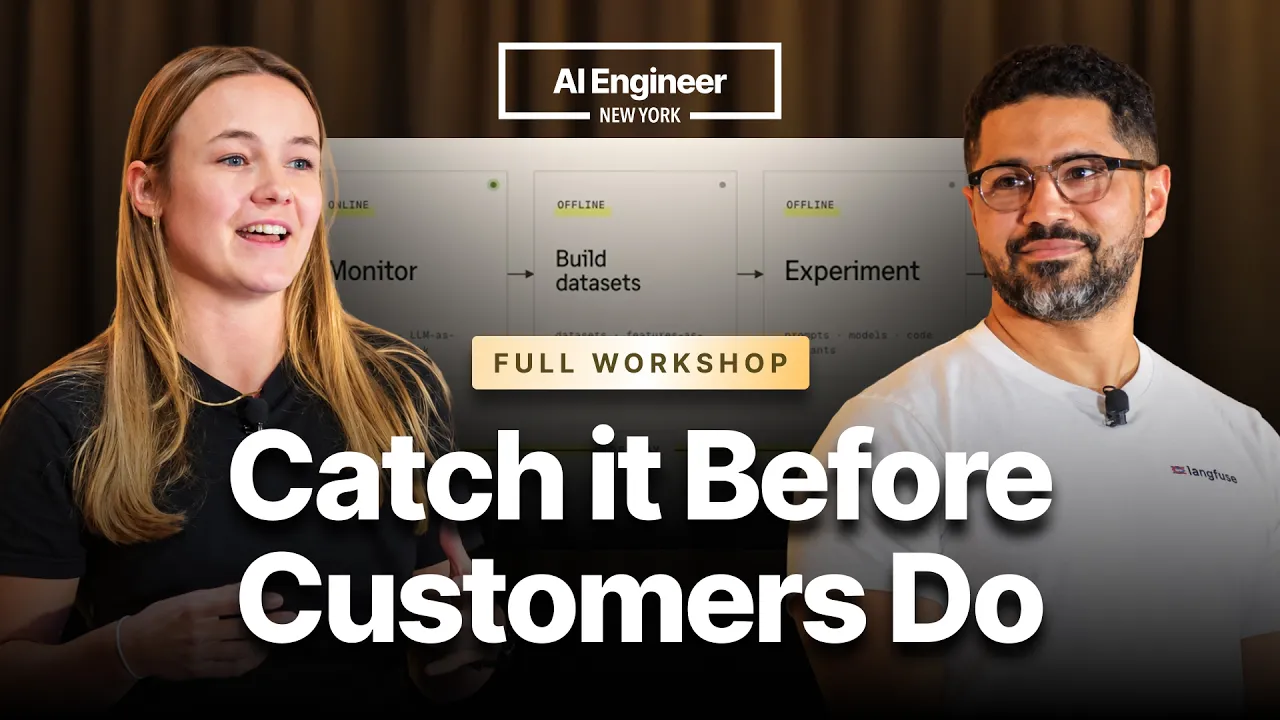
Description
A hands-on workshop on evaluating AI applications where mistakes are expensive. Annabell Schäfer and Doneyli De Jesus from Langfuse use a banking assistant to walk through the whole AI engineering loop. They cover tracing with PII masking, building datasets, turning domain-expert comments into failure modes, LLM-as-judge and code evaluators, and CI that blocks a prompt change when scores drop. Chapters: - 00:00 Why evals are hard - 05:01 The AI engineering loop - 12:47 Demo: a banking assistant with tracing and PII masking - 20:35 Building datasets - 25:18 Expert review and failure modes - 30:07 Choosing evaluators - 35:00 Running evals automatically on every prompt change - 39:44 Dashboards for stakeholders - 45:58 Working with your coding agent - 52:13 Q&A Doneyli De Jesus — https://langfuse.com Annabell Schäfer — https://langfuse.com Join us in SF for the second annual AIE CODE summit: https://aie.codes our last flagship summit of 2026. Applications live now!
Summary
Generated by gpt-5.6-terraAt-a-Glance
- Verdict: Watch fully
- Core thesis: High-stakes AI agents need a continuous engineering loop—trace every execution, turn production failures into curated ground truth, evaluate changes with blended deterministic and LLM-based checks, and enforce deployment gates rather than shipping on qualitative impressions.
- Why it matters: This is directly applicable to production agent systems where tool non-execution, policy violations, prompt regressions, PII exposure, and unreliable automated fixes can create financial, regulatory, security, and reputational risk while ordinary uptime metrics remain green.
- Best use: Use it as a practical blueprint for designing an eval/control plane around OpenClaw or other agent workflows, especially the dataset-to-CI-gate loop and the division of labor between domain experts, deterministic controls, and coding agents.
Executive Summary
Langfuse frames reliable-agent development as an AI engineering loop: tracing establishes an inspectable record of every model call, tool invocation, input, output, cost, and latency; monitoring finds anomalous or high-risk behavior at scale; datasets encode representative production cases and expected behavior; experiments isolate configuration changes; and evaluators decide whether changes improve or degrade the system. The central warning is that conventional system observability can look healthy while an agent quietly fails its actual task—for example, claiming it issued a refund without ever calling the refund tool.
For high-stakes deployments, the speakers argue that ground truth must come from domain expertise and production reality rather than prompt intuition alone. They recommend combining expert-curated test cases, shadow operation alongside humans, and human-in-the-loop review that is gradually narrowed to the cases safe to automate. Production traces should be sampled and sent to SMEs through lightweight annotation queues; an LLM can then cluster free-form SME feedback into recurring failure modes that become explicit quality dimensions and test criteria.
The operational design is to evaluate every agent configuration change—prompt, model, context, tool access, or data source—against a versioned dataset before release. A CI workflow is triggered by prompt/config promotion, runs the experiment, applies evaluator thresholds, and produces an auditable pass/fail result. The recommended evaluator portfolio mixes deterministic code checks for hard requirements with LLM-as-judge evaluations for semantic quality, rather than trusting either human spot checks or an LLM judge alone.
The workshop is product-led, but unusually useful because it translates the framework into concrete operating practices: redact PII before persistence, trace multimodal interactions, expose business-facing quality/failure dashboards, investigate filtered failure cohorts rather than raw trace volumes, calibrate judges against human labels, and retain human approval for consequential promotions. Its final position is not to fully automate agent improvement: automate instrumentation, analysis, experiments, and repetitive execution, while keeping human/domain judgment responsible for what quality means and where hard limits sit.
Key Takeaways
- Claim: Traditional observability is insufficient for agents because infrastructure health does not prove that the agent completed the intended real-world action. | Evidence: The opening support-agent example shows a user asking for a refund; the agent says it issued one, but no refund tool call was made. Latency and system status remain green, and the failure may emerge only weeks later when the user receives nothing. | Implication: Instrument agent execution at the action level: record tool selection, tool execution and outputs, not just response text, uptime, latency, and token use.
- Claim: Reliable production agents require a closed-loop process of tracing, monitoring, dataset building, experimentation, and evaluation—not a one-time pre-launch test suite. | Evidence: The speakers define the AI engineering loop: traces provide inspectable execution logs; monitoring detects aggregate quality/risk signals; production cases feed representative datasets; experiments vary one factor such as prompt, model, context, or tool description; evaluations measure the result. | Implication: Treat production traffic as a source of new test cases and failure modes, with regressions continuously returning to the benchmark rather than being fixed only ad hoc. | Caveat: The appropriate entry point varies by risk level: an internal low-stakes chatbot may begin with tracing and monitoring, whereas customer-facing regulated workflows need datasets and controls before broad deployment.
- Claim: Ground-truth datasets should test expected behavior and intent, not merely exact final wording, and they must be curated with domain experts. | Evidence: The banking example maintains separate datasets for prompt-injection/red-team cases and unresolved disputes. Expected outputs can encode intended action, classification, behavior, required content, or deferral—not only a canonical answer. Sources include pre-existing spreadsheet test cases, validated production traces, expert curation, shadow runs, and human-in-the-loop operation. | Implication: Define suites by risk and capability—e.g., tool execution, escalation, citation, policy compliance, out-of-scope refusal, and security attacks—rather than relying on a single generic conversation benchmark. | Caveat: A production trace is only suitable for a golden dataset after someone establishes it as a good example of desired future behavior.
- Claim: Human review scales when SMEs label a targeted representative sample simply, while LLMs are used to synthesize recurring failure categories from their feedback. | Evidence: The proposed workflow filters traces by segments such as disputes or card information, assigns them to an annotation queue, and asks an SME for lightweight scores plus raw comments such as 'missing citation.' The LLM then clusters comments into failure modes such as correctness, formal register, expected-source citation, language match, and unsolicited upsell. | Implication: Build an error-analysis pipeline that makes one hour of expert time produce reusable evaluators and datasets, instead of asking experts to inspect unlimited raw traces or invent a taxonomy upfront. | Caveat: LLMs should extract and organize patterns from SME feedback, not replace SMEs in deciding what the domain requires.
- Claim: A balanced evaluator stack should combine deterministic checks with LLM-as-judge scoring, because hard requirements need repeatability while semantic qualities need flexible assessment. | Evidence: The speakers use code evaluators such as regex/exact-match functions for repeatable outcomes and LLM judges for semantic criteria. They explicitly note that a deterministic evaluator returns the same result for the same input, whereas LLM-only grading has a non-zero error rate. | Implication: Make policy prohibitions and structural invariants deterministic where possible, and use calibrated judges for nuanced correctness, helpfulness, tone, and contextual compliance. | Caveat: LLM judges must be calibrated against a human-labeled representative sample and periodically rechecked for coherence with human raters; for production safety, start with more false positives rather than missing violations, then tune down.
- Claim: Prompts, models, tools, and context should be treated as release-controlled agent configurations that trigger automated eval gates, with human approval retained for consequential rollout. | Evidence: In the demo, a prompt version promotion triggers a GitHub CI job that runs an experiment against a dataset, evaluates criteria including source recall, language match, correctness, and no unsolicited upsell, and requires minimum score thresholds for a pass. The speakers emphasize that a pass need not auto-merge; it can create evidence for a reviewer or PR approval. | Implication: Implement regression gates for every material agent change, preserve the configuration/version/eval evidence with the release, and avoid autonomous production promotion solely because aggregate scores clear a threshold. | Caveat: Experiments should isolate variables—changing a prompt without simultaneously changing model, tools, and context—otherwise results are hard to interpret.
- Claim: Agent telemetry should be translated into business and risk dashboards that direct investigation toward the most consequential failure cohorts. | Evidence: The banking demo reports 1,400 agent interactions that avoided human escalation in seven days for under $7 in model cost, identifies top rising failure modes (out-of-scope, informal register, unresolved disputes), shows 18% thumbs-down feedback, and flags 89 investment-advice-risk cases over seven days. | Implication: Track containment, escalation, quality failures, user dissatisfaction, policy-risk categories, and cost together; use saved filters/views to inspect the smallest high-priority cohort rather than manually reading all traces. | Caveat: The claimed labor-savings comparison is directional rather than a demonstrated ROI calculation; unresolved or unsafe cases can offset apparent automation gains.
Detailed Brief
Security, privacy, and deployment architecture demonstrated
- Claims: PII should be sanitized before agent telemetry is persisted, rather than relying only on access controls around observability data.; The observability layer should cover multimodal workflows as well as chat, including the relationship between source media, transcription, model behavior, and the final response.; High-volume tracing infrastructure may require a datastore designed for event-scale analytical workloads.
- Evidence: In the banking demo, a customer enters a card number in clear text; a masking function redacts it before the trace lands in Langfuse.; A contact-center example processes an audio call through speech-to-text, retains a link to the media plus the transcript, and evaluates the interaction.; In Q&A, Langfuse says its data plane has a hard dependency on ClickHouse after Postgres did not support its scale; it supports SaaS, self-hosting including on Amazon infrastructure, and export/consumption through S3, API, CLI, or MCP.
- Caveats: The transcript does not specify the PII detector's recall, false-positive behavior, retention policy, encryption boundaries, or how source audio is governed; masking must be independently tested as a safety control.; The scale and infrastructure claims are vendor statements in a Langfuse workshop rather than independently validated benchmarks.
- Implications: Make redaction a pre-persistence testable control and include adversarial examples of identifiers in the eval suite.; For voice or multimodal agents, trace lineage across media ingestion, transcription, tool calls, and final output so compliance review can reconstruct the complete decision path.
Automation boundary: use coding agents as accelerators, not owners of quality
- Claims: The speakers reject the pattern of giving a coding agent unrestricted access to telemetry and asking it to 'fix my agent' without explicit quality criteria.; The desirable operating point is selective human judgment plus extensive machine automation: coding agents can assist with instrumentation, failure discovery, evaluator implementation, and running many experiments.
- Evidence: Their quality-versus-time-investment framework places fully automated, unconstrained improvement in the low-time/low-quality quadrant and contrasts it with a human-guided approach.; They recommend installing a Langfuse agent skill that supplies documentation and best-practice context, then collecting ground truth and defining non-negotiable limits such as never giving investment advice.
- Caveats: The session does not provide controlled evidence that the referenced agent skill improves implementations; it is presented as a Langfuse-supported starting point.
- Implications: Constrain any code-writing or self-improvement agent with versioned datasets, explicit failure thresholds, limited change scope, and a reviewable promotion path.; Separate automation of execution from ownership of policy: humans should define desired outcomes, acceptable trade-offs, and irreversible-risk boundaries.
Notable Concepts & Terms
- AI engineering loop: The workshop's operating model: tracing, monitoring, datasets, experiments, and evaluation continuously feed one another to improve an agent from real production evidence.
- Trace: An inspectable tree of an agent execution, including model generations, tool calls, inputs, outputs, timing, cost, tokens, and metadata; it enables verification of actual actions rather than trusting final prose.
- Ground-truth dataset / golden dataset: A versioned collection of representative cases and expected outputs or behaviors used as the stable benchmark for offline experiments and CI/CD gates.
- Error analysis: Human inspection of selected traces to understand whether the agent took correct steps and to identify recurring defects that can become datasets, evaluators, and remediation priorities.
- Annotation queue: A focused workflow for SMEs to quickly score and comment on sampled production outputs, preserving their feedback as evidence on the underlying trace.
- LLM-as-a-judge: Using an LLM to score another model's output against a rubric; it enables semantic evaluation at scale but requires human-grounded calibration and monitoring.
- Deterministic evaluator: A code-based check such as exact match, regex, classification, or required tool/action verification that gives identical results for identical inputs and is suited to hard requirements.
- Deployment/quality gate: A CI-controlled threshold that blocks or routes for review an agent configuration change when benchmark scores or policy controls fail.
Operator Notes / Why Ken Should Care
- Create a minimum viable agent release gate: version prompts, model/tool configuration, and a risk-weighted dataset; run it automatically on every material configuration change; require human sign-off for high-impact actions.
- Add trace assertions for tool-backed workflows: identify cases where the final response claims an external action, then verify that the required tool was called, succeeded, and produced a corresponding result.
- Establish a weekly SME annotation cadence on a filtered production sample, with 30- to 60-second labeling tasks and free-text comments; convert recurring comments into a named failure-mode taxonomy.
- Define which controls are absolute and deterministic—PII redaction, prohibited advice, authorization boundaries, required escalation, required citations/tool calls—and do not leave those solely to LLM judges.
- Calibrate any LLM judge against a human-labeled representative holdout before using it as a production gate; initially bias toward catching too much, then measure false positives and adjust.
- Build an executive dashboard that joins cost, containment/escalation, user dissatisfaction, policy-risk flags, and failure-mode trends; avoid presenting token cost or deflection as standalone evidence of value.
- Evaluate whether Langfuse's ClickHouse dependency, self-hosting model, PII redaction implementation, data export paths, and multimodal retention behavior meet the target deployment's security and data-governance requirements.
Source/Metadata
- Title: Evals for High-Stakes AI Agents — Doneyli De Jesus & Annabell Schäfer, Langfuse
- Transcript words: 16541
- Duration seconds: 3212
- Timestamp note: No usable timestamps or chapter markers were present in the supplied transcript. The transcript contains substantial repeated sections from the workshop/demo and closing Q&A.
Transcript
All right, let's get started. Welcome everybody to our workshop on evaluating AI applications with LangFuse. My name is Annabelle. I'm an AI solutions engineer at LangFuse, and I'm today joined by my colleague Donnelly, who is literally leading AI solution architecture at LangFuse, so working with our biggest customers on making sure they are actually shipping reliable agents to production. I myself, in my previous life—how I like to call it because it feels like a lifetime—worked at a company building AI agents for medical device compliance. In this industry, it was super important to make sure we are running evals, we're making sure we have ground truth data sets that are validated by our customers, and we also ran a lot of human-in-the-loop systems. A lot of my time I actually spent in LangFuse, and at some point I decided, okay, why not swap sides and also help other teams that are shipping agents, especially in regulated industries, and joined the LangFuse team roughly seven months ago. But before we dive right into it, we wanted to get a feeling of who is here today and who we are coming together with. So we were wondering, who of you has brought AI agents to production before? And with that, I mean been part of a team doing it, not necessarily yes, someone in the company did it. So actually been part of the process to bring it to production. Okay, that's good. Amazing. It's a lot of people, and we hoped to have this. And who of you has worked with LangFuse before? Okay, quite some. And any other kind of observability and evals tool? Okay, yeah, also a few. Amazing. And then finally, who has solved evals for AI applications? For confident hands, I would love you to come by at our booth and explain to us how, because actually it is quite hard. And I think all of you have experienced it if you're working with AI or also just chatting with ChatGPT or Claude. It is quite tough because AI agents can fail while the system metrics themselves look green. So if you, for example, look at this example here, we have a user support agent, and the user is asking, "Can I get a refund?" The agent takes in the request, looks up some policies, and then it's like, "Yeah, sure, I issued your refund," and the user is like, "Thank you," and it will take some days until the user sees if it actually worked out. The status is green. Nothing went wrong in traditional observability terms. There's also no latency issues. But if we dig deeper into what actually happened, the agent never did refund anything. So the tool was never called. It was never executed. And the agent lied about doing it to the user. And we will only know about it in a few weeks when the user comes back and it's like, "Hey, by the way, I forgot—I've never gotten my refund." And this is the problem that we have with non-deterministic systems. They might tell us they do things, but they actually don't. And this is why you have to find an approach and a way to continuously mine for those signals where things are going wrong and make sure they don't happen again, or maybe not even at all in the first place. And this is a problem our founders also faced three years ago when they were in the Y Combinator batch, and they realized, okay, there's nothing like a unit test for AI applications, and we need a solution for it. So they built LangFuse, which is by now an open-source platform to continuously trace, monitor, and improve your AI systems. And while we started out as a dev tool mostly, by now we also have domain experts as a target group—so collaborating with AI engineers to make sure the system does what it actually should be doing—but also a new user group for the past probably eight to twelve months, which are coding agents that are helping our engineers also work with AI applications and improve them. This is by now adopted by more than 150,000 developers globally, also largely driven by our open-source setup, of course. Twenty-one of the Fortune 50 have us as part of their core tech stack when shipping AI applications, and every month more than 90 billion observations are ingested into LangFuse instances—of course, increasing tendency as agents are taking more and more steps and also taking over more and more tasks. Companies like Ramp, Canva, Khan Academy, and some at Upwork work with us. And over the last three years, we have spent a lot of time with them, and one thing we realized working with those companies is that the ones that successfully managed to ship reliable agents and also continuously improve them follow something that we call the AI engineering loop. And it is a set of practices that help you to continuously improve your system by taking a systematic approach. The foundation to this is always tracing. Tracing is about getting all the steps of what your agent is doing into more of a log, but ideally also in a way you can inspect it as a human. Monitoring is about finding the interesting ones—so what is going wrong, where should we look deeper into—but also understanding how is it performing on average. Building data sets is about finding a representative set of examples that you want your application to be able to handle and also how you want it to handle it. And then you want to run experiments on it, so try different variations of your system to check how it is performing. And then, of course, you want to evaluate how it's going. And this is not something you do once, but you continuously close this loop and want to improve those AI agents and learn from production and get it back into datasets. But let's dive into each of those steps a little bit more in detail. So for traces, the most important goal is that you want to get deep insights into what your agent is actually doing. On the right side of the screen, we can see a trace that is also a screenshot from LangFuse. And in this case, it's a dead IT support agent—so an agent that is answering questions from your parents so you don't have to do it. And we can see that there's first the root trace, and we can see aggregate time and also costs of the step. But we then also get a breakdown of each of the individual steps that agent is taking, so both the generations, which are the OpenAI chat ones, and also the tool calls, which we can see with a little tool in front of it. So we have a detailed view of what's going on. And if the screen would be wider, we would also see that we can see the inputs and outputs and all the metadata involved. This is then the foundation to track the cost, the latency, the tokens involved, and also have a log to inspect for you as a human to really dig into what's going on, but also for your coding agents to work with it and look at it at scale and just have this inspectable log of what's actually been going on. Monitoring is then about making sense of it at scale because, especially now with increasing automation levels, longer traces, and a lot of use cases, it's just not feasible anymore for you as a human to look through those logs completely manually. But you actually want a way to get aggregate metrics on what's actually going on and also detect signals where things are going wrong. So, for example, cost and latency metrics, but maybe also quality signals like our compliance guardrails kept true—also, how many users are actually frustrated with our system, how many are writing all-caps messages because they are maybe a bit upset with what the agent just did? Yeah, all of this aggregating and then, of course, also finding the interesting stuff that you want to dig deeper into. What you get from production through this monitoring is then also one of the foundations that you can use to build out your data sets. And data sets, in the end, are a representation of what you want your agent to handle in production—so all the cases that it might be getting, also maybe out-of-scope requests that you want to correctly also defer, and make sure that the agent is not trying to give investment advice or also answering what the weather in New York is going to be like if it's actually just a dead IT support agent. And those items you can then have the input but also what you expect it to have as the output, which can both be a sample reply or also expected behavior that you want to see or keywords you want to have covered. And this can then be used as a stable benchmark, either for improving and iterating offline or also as part of your CI/CD. Those data sets are then used to run experiments on, and experiments are—if you maybe look back into university and statistics or anything that you might have done—in the end, this idea of varying something about your setup and looking what happens then. So, for example, changing a prompt, changing a model, changing the context, or the tool description, and to see if it's then better dealing with what you actually wanted to deal with. And ideally, isolating concerns so if you want to check if the same model performs better with a different prompt, you ideally only change the prompt and not five other things, because otherwise it's going to be hard for you to interpret what you actually see. And then finally, you need evals or evaluation approaches to make sure you can also measure what's happening in those experiments, because again, you don't want to look at everything yourself—which you, by the way, should probably sometimes do—but still, you also want the scalable approaches, which are, for example, LLM as a judge, so using another LLM to check what the LLM did, and also code-based evals for things like classification tasks where you can check for an exact match or also check behavior. It can be a deterministic check or if you are checking for all-caps type things. So this is the AI engineering loop, and what we observe with many of our customers is that, depending on your use case, there's a few different entry points into this. performs better with a different prompt. You ideally only change the prompt and not five other things because otherwise it's going to be hard for you to interpret what you actually see. And then finally you need evals or evaluation approaches to make sure you can also measure what's happening in those experiments because again you don't want to look at everything yourself, which you by the way should probably sometimes do, but still you also want the scalable approaches, which are for example LLM as a judge, so using another LLM to check what the LLM did. And also code based evals for things like classification tasks where you can check for an exact match or also checking behavior, which can be a deterministic check or if you are checking for all caps type things. So this is the AI engineering loop and what we observe with many of our customers is that depending on your use case, there are a few different entry points into this. So if you're for example in a low stakes environment and you're only building your internal chat agent, you might first not have an observability tool in place at all and then you maybe get started with tracing and add some monitors to just check where people are getting frustrated. But you don't care about the evals part too much in the first place. You just build it out over time and look at those test cases as you progress, but you can go to production directly. However, if you're building a case that is customer facing and especially if you're building a case that is in regulated environments, you probably don't want to risk the agent doing something that it's actually not supposed to do. So for those regulated industries, we've seen a few approaches emerging and the foundation is always tracing. So you always want to know what is actually happening, what steps is it taking, what inputs and outputs is it seeing and also what tools are being called. And then on top of this, those teams in regulated industries found a few approaches on how to go about building out these ground truth data sets that you can then also loop on, improve on and also, you probably all heard about auto improvement. All of this definitely needs the foundation of a ground truth data set and you have a few approaches to get there. For example, expert curation, so working with your domain experts within the company to make sure you're building out the ground truth data set. Then for example, shadow runs, so you run the process continuously manually but in parallel you also have agent running and you can always compare how the agent handled it, how the agent went about it. And then measure the accuracy but also build out your ground truth. And then finally, like we did it also in my previous company, run a fully human in the loop system and over time slice the data into parts where you are confident to automate versus things where you always want a human in the loop. So much on the introduction. We now want to go in a more practical example and for this I'm also welcoming Donnelli again on stage. And we're going to look together into how to trace your agent execution into Langfuse, how to evaluate and improve your system and how to continuously close this loop. Hi everybody, like Annabelle said, I'm Donnelli, but you can call me Don to keep it easy for everybody. Only my mom calls me Donnelli when I'm in trouble. Yeah, okay, that's great. A few giggles. So, you know, nice icebreaker. So that's the first eval, it went perfectly. So now what I'm going to show you is an example that we built for a few financial institutions that we are working with because they're in the kind of this process where they build their first prototype, they build their first demo. But then the question comes from leadership or maybe from the teams: How do we evaluate this customer facing agentic solutions that we're building? How many of you here are in financial services or in finance? Yeah, we're in New York, so of course you all are. Any other industries, other than financial services, regulated industries like healthcare and stuff like that? Okay, cool. Awesome. So I think this is going to speak to you very much. So basically what I have here is a typical banking assistant. Everybody, anybody of us that has banking services probably has seen this in each of your banks, right? However, all the stuff that happens behind is very important for the bank itself or for the institution to provide you with very accurate information because there is financial liability, there's legal liability, there's a bunch of risk for the bank itself to put out this type of solutions when they are powered by LLMs, which, as we all know, are inherently non-deterministic. So we want to make sure that we reduce the unpredictability and that we can then reproduce the outcomes as much as we can and figure out where are the failure modes and what is the agent giving us the results that we don't want so that then we can improve upon those. So in this example, I have a few things that I would like to show you. The first thing is that I can impersonate a few different type of clients, because obviously a bank is always going to have customers that are your everyday Joe like myself. I only have a couple of bucks in the bank, but then you're going to have your ultra high net worth individuals and all that. So we can have here impersonation of different kinds. And this is important because we want to be able to know if the agent is able to respect any guardrails that we have put in place when it comes to those type of personas that we have. The other thing is, if you notice here, maybe let me blow it up. We also have PII identification enabled and any sort of data that is deemed as PII is automatically masked before it gets persisted into Langfuse. Again, this is another very big requirement for especially specifically financial institutions that they don't want to persist in an observability system their credit card information or social security numbers for the clients. They want to keep that on the systems of record and as much as possible in their systems that they own. So that is also enabled. And I'll show you a couple examples on how we can get that to work. And then we're also going to see if the agent itself is respecting some of the controls that we have put in place and how it's being scored. And if the quality gates that we have defined are also being enforced. So we're going to measure all of that. I'm going to show you a few examples and then take you behind the scenes in the product itself to show you how you can set that up and then how an end to end flow looks like. So let's say that I am, in this case, coming in as Anna. I'm asking about international wire fees. Very simple question. Just a knowledge base. And then in a few seconds, it's going to come back and give me the results from our knowledge base. And here you go. You see in here, I'm surfacing information that obviously I wouldn't surface this to a customer, but I'm doing it here for the purposes of the demo. But I'm calling out here the tools that are being called, the data sources that are being called as well, and some of the details as well that make up the configuration of this agent when it comes to giving back this answer. If I were to then say, OK, look, I lost my card. This is my number. Is it blocked? I'm putting my credit card number in clear text, right. So that is obviously not great. So you want to make sure that even though the user, you cannot control that, you cannot control what your users input in the system, you want to make sure that you catch that whenever you are instrumenting and whenever you are building your evals. So now we'll see in the trace itself that the credit card will be indeed redacted. If I come here to Langfuse and I open my trace, you'll see that now the question is "My card number is" and then it landed in Langfuse completely redacted. That is because I have a masking function that automatically any sort of PII information that I have defined will be immediately masked and then is not persisted in plain text in my system. So just to show you in terms of what a typical interaction looks like. And I can see from the top here, this was the prompt that the user sent. But then, as you all know, behind the scenes, there's a lot of stuff going on that we don't necessarily surface to our end users, but are critical for us as the platform teams, as the developers to understand how the agent is behaving, performing and the quality of the outputs as well. I can see the entire tree of all the steps that it took. You know, here the Anthropic LLM call that it made, the tools that are available. Here it called a list of tools, it listed the accounts and so forth. And these are the outputs. But then more importantly, here on the top, I can see all the scores that I have defined for this particular use case. You see that they're automatically calculated whenever there is a new interaction or a new trace being captured by the system. And I can capture things down from if the information that I gave to the customer is compliant with banking information, meaning that the customer is asking about the weather. I'm not going to give that information. It's not compliant. but are critical for us as the platform teams, as the developers to understand how the agent is behaving, performing and the quality of the outputs as well. I can see the entire tree of all the steps that he took. Here the Anthropic LLM call that he made, the tools that are available. Here it called a list of tools, it listed the accounts and so forth. And these are the outputs. But then more importantly, here on the top, I can see all the scores that I have defined for this particular use case. You see that they're automatically calculated whenever there is a new interaction or a new trace being captured by the system. And I can capture things down from if the information that I gave to the customer is compliant with banking information, meaning that the customer is asking about the weather. I'm not going to give that information. It's not compliant. If there's any sort of failure modes, if there's any guardrails that were blocking any answers that were given back to the customer. One example of that is, for instance, I can come someone can come on and ask, can I put my savings in Bitcoin? Right. So that is something that the bank itself shouldn't be providing information about because that has some ramifications and the agent correctly does that. But at the same time, it is flagging it as investment advice. And this requires for the person to either talk to an advisor or something else. And we are using a score to do that. And if I go again to my trace, this is how I see it. I have the input guardrail here that tells me that this primary risk is investment advice. And in the score here, I can see that the intent of the customer on this score was indeed investment advice. So that way I can very easily go out and filter for those in particular. But anyway, I wanted to show you a simple flow of this. The last one before getting into the end to end on how you build a data set and how you build an evaluation flow is that the fact that we can also support multimodal. So let's say that instead of customers writing via chat, they're calling your contact center, we can come here. We can say I want to process this call and this is going to do a speech to text. And then the text is going to be evaluated to figure out if there's any violation on here. And I can come then in here and say that the customer was asking about blocking his card. And I can indeed see the trace here and I can even see the actual link to the media that the customer was sent in terms of that audio or that call that the customer made. And also the transcript and what the assistant gave back. So that is in terms of the tracing. How can I capture all of those activities? Now, when I am trying to then think about, OK, how do I then put together or put in place a framework on how to evaluate these interactions that my customers are going to be sending through my system? Because as we all know, customers are unpredictable. We might design a system or solution with a specific intention, but our customers are always going to find very clever ways to use the system in a different way. And we also cannot anticipate every single outcome, specifically with LLM powered solutions that are going to happen when we release this into the wild for customers to use. So that is when we start relying on building our evaluation criteria. And for us, the anchor of that is building data sets. So what is a data set? A data set is basically your set of questions and expected outputs that allow you to then measure the quality of the outputs of your LLM or AI solution. If you come from a software development background, the way that I like to think about this is that these are your test cases. And I don't think anybody here that has shipped software into production will ship anything without passing it to QA unless you merge into main or prod, which I'm pretty sure most of you have done it. But it's not a best practice. I know I have, but whatever. But at the same time, this is the way that you can then have the evidence that you pass the agent through a series of steps or requirements that measure all the things that you want to capture. And one thing to note here that the expected output doesn't necessarily need to be the answer that the agent is going to give. It could also be that you want to measure the intent of the agent. You want to measure what the agent is supposed to do. You want to measure behavior. There are different ways that you can measure the quality of the output. And that is why you typically end up with different sets of data sets to measure specific things or specific areas of quality in your agent fleet. You see here how I have one that is red teaming my agent and looking for prompt injection attacks and any sort of attack that will allow someone to come in and circumvent the guardrails that we have put in place to then provide information that they shouldn't get. The other one I have here is very specifically for a use case where I want to know which cases have been disputed and where that dispute has not been solved. So the point here is that I can come and curate specific data sets that are very specific to not only the use case, but also the technical requirements that I have for that agent. This is where I would say that, unfortunately, because I think humans are very important, this is where you still need your domain experts in the loop working with the development teams defining what are these. There are two main ways that you can basically create your golden data sets. You either have a team, and I've seen variations of both. You either have a team that already has a spreadsheet somewhere. These are all the things that we want to test on my agent and just upload it and that's pretty easy. You can come here and say, OK, perfect. I want to create a test data set and then I want to upload a CSV. You can upload the CSV and it will exactly bring up everything that you just had before. The other thing I'd like to mention here, everything that I'm showing, you can do it as well identically through our CLI or NCP in our APIs. It's just that I think it's better for me to show it in a UI rather than telling Claude to do it and make no mistakes. OK, so that is that. But then I can also come here and say that I want to add items into my data set, for instance, that are already as part of my production traces. So let's say that you saw how I was already collecting a lot of activity from my application. I can come here and say I want to add all of these into my data set and then select the data set that I want to select. So this way you can dog food in a way the data set that you're going to use by looking at the production traces that your agent is producing. As long as you have determined that, yes, these are good examples of what I want future outputs or traces to look like. Now, an important thing here to do is a process that I always like to call out, which is error analysis. Right. So error analysis is basically this idea that I want to look at my traces. And I think Annabelle talked about this very eloquently as well when she was on the other side as a user of Langfuse. She had to spend days literally looking at traces. That was her job, looking at the trace, the structure, what were the outputs and all of that. And that is still a very important process because when you look at the trace, you first start understanding how the agent is behaving. If it's taking all the steps that you needed to take, if it's calling all the tools that it needs to call and if it's giving you the output that you want. That's very, very important. But then how do you simplify that process? Because obviously it is not feasible for me as a human to go out and look at thousands of traces once the system is in production. So what we typically do is we want to curate a sample that is representative of our production system of traces for a human expert to come look and give me feedback. Right. It's the same as, hey, I have all this activity. I'm just going to take 10 percent or 20 percent. And I can say I just want to focus on the ones where the customer is talking about disputes or credit card information, whatever filter that you want. You can do that. And then you can build for them what we call an annotation queue. Right. In this annotation queue, effectively what you're doing, you're telling a domain expert, in this case, let's say me, that, hey, you are the risk expert. I need you to take a look at this output that the agent is giving us or is giving our clients and give me your input. And the thing is here, you want to make it very, very simple for the domain expert, because obviously they have their day job. It's the same as, hey, I have all this activity. I'm just going to take 10 percent or 20 percent. And I can say I just want to focus on the ones that the customer is talking about—disputes or credit card information, whatever filter that you want. You can do that. And then you can build for them what we call an annotation queue. Right. In this annotation queue, effectively what you're doing, you're telling a domain expert in this case, let's say me, that, hey, you are the risk expert. I need you to take a look at this output that the agent is giving us or is giving our clients and give me your input. And the thing is here, you want to make it very, very simple for the domain expert, because obviously they have their day job. They cannot spend just hours looking at this. So the typical thing that I recommend is you can give them a couple of scores that they can give you—yes, no, true, false, a scale one to ten, whatever that is. And then they can also come here and give you a comment. So let's say here the SME failure mode, let's just say for the sake of argument that in this case is missing a citation. And then I'm going to put a comment: citation is not there, needs to be included in all these cases. Right. You're going to go through this process and look how simple it was for me. It took me, what, ten seconds, maybe. So let's say I have a hundred of these and it takes me 30 seconds each. That is what, 50 minutes? No, not even. Right. I'm bad at math today. But anyway, so you get the idea, right? So you can tell your domain expert, hey, give me an hour of your time. I'm going to curate a bunch of activity for you. Just give me your feedback. Just give me a few comments. And now with Whisper Flow or something, they can just dictate it. They don't even need to type it. Right. So make it very simple. The second thing that you're going to do with this, I'm going to mark this as completed. Now this human annotation lives with the trace as evidence. But then the second step that I want to do is take all this information, all this annotation that they gave us, and then actually use an LLM to find all the failure modes or categories that are patterns across all other comments. Right. So there might be—you're not asking the SME to invent categories. You're just telling them, give me your unfiltered raw commentary on these traces. And then you're going to use an LLM to then figure out the categories because that's what they are great at. They are great at pattern matching. They are great at extracting information from text. So that way you keep it simple for the domain expert and use LLMs for what they are great at. Now, once you have all those categories, that is where we can then get into our failure modes. And those failure modes, if I come here and look at my experiments, that is what you're going to see whenever I run an evaluation. You see all of these things that I'm measuring against. Maybe let me bring it up here. So now after I have my domain expert give me the inputs, I extracted what are the most common categories that appear in my corpus of data based on my domain expert. I can then define what are my vectors or dimensions of quality. Let's just call it scores. Right. But I like to come up with fancy words to say things. But you see here how one of them was sites experts expected source, correctness, formal register, meaning that in some languages you want to address your customers with a more formal tone. If the language matches what the customer came in with, must include non-solicited and so forth. So now that I have that foundation of the categories that I'm going to measure on, the quality of my outputs, then I can decide, OK, cool. So now how am I going to grade that? Right. What type of score is that? What type of evaluator is that? And for that, I can either come here and build my kind of library of evaluators. Right. So as traces coming in, they're automatically calculating those scores for me. But at the same time, I can have the scores being calculated directly from the client application whenever something happens online in real time so that then I can surface it back to the system. But basically, I want to have a way of me measuring the outputs of the agent across both LLM as a judge scores or evaluators, but also deterministic evaluators. Another lesson that we've seen working with these clients is that the more that you can have a mix, a balanced mix, depending on the type of categories that you identify between LLM as a judge evaluators and deterministic evaluators, the better. Because what that's going to do is if you rely 100% just on LLM as a judge, there's a non-zero chance that some of the outputs are not going to be accurate because that's just the nature of the LLMs. But if you factor in some deterministic checks that are always going to be exactly the same for the same inputs, irrespective of what happens, then you can have a blended score or a blended assessment on the quality of your agent. So that's what we typically would like to see. And you see here, when I'm trying to define a new evaluator, I can come and say I want it to be a new LLM as a judge evaluator, or I want it to be a code evaluator. And I can define all the details as to how I'm going to evaluate that particular agent activity. So that's that. And then if I want to have a code evaluator, you see this is just code. It's a function. This is very simple. It's just a regex. This is doing an exact match. But this is going to give me the same output 100% of the time. This is not going to be 95% or 80%. It's always going to be 100% the same output for the same input. So, again, the lesson here, you want to have a mix of both. So that's on the evaluation side. So now we've talked about, like Annabelle said, and maybe let me go back here to the AI engineering loop. So we've talked about here building the datasets. We've touched on how we can then operationalize the measurement of the quality of those agents running experiments. And then maybe let me go back here. So basically an experiment is anchored on a dataset. That's my test cases. Those are my tests that I'm going to run against my agents. And now I'm going to say, you know what, this agent is running today with this system prompt, this model, these tools. What happens if I change the model? What happens if I make a change on the system prompt? What happens if I now, all of a sudden, I give it access to new tools to access new data? So you want to be able to prototype that before, you know, promoting into production and just running on vibes, which is pretty much what we've all been doing, right? It's like, oh yeah, it looks kind of good. Let me just push it into prod. But this is a systematic way of you doing that. And in a few minutes, I'll show you how you can incorporate this as part of your CI/CD pipeline so you don't have to be in the loop. So that any time a change hits on your agent, then a CI job is going to kick off to run the experiment against the dataset. It's going to evaluate your agent with a new configuration. And it's going to give you a pass-fail gate, effectively, across all of the scores and evaluators that I mentioned before. So you have a consistent way on how you evaluate and measure the outputs of these agents. Make sense? Okay, perfect. So that's experiments. That's great. So we touched on experiments. We touched on datasets and human annotation to bring those humans and their expertise into the loop. So now, how do I bring it all together, right? If I come here and I have my prompt, my system prompts that I'm versioning here in LangFuse, you can do it either here in LangFuse. We don't charge for this, so that's fine. A lot of our customers, what they do is they have a version in system. They have a version in GitHub, GitLab, whatever that is. But you should look at this as your trigger for then kicking off the automation to do your eval completely automatically. So the way that this happens is I already have defined an automation here. And if you see the configuration, it's triggering on any prompt changes that I have here. And then the action is it's going to launch a CI job in my GitHub, which is this guy right here. Hopefully I'm not getting the unicorn from GitHub. So it's this guy right here. So I have already my CI set up, waiting for any changes in the config of my agent. you can do it either here in LangFuse. We don't have, it's okay. We don't even charge for this, so that's fine. A lot of our customers, what they do is they have another version in system. They have a version in GitHub, GitLab, whatever that is. But you should look at this as your trigger for then kicking off the automation to do your eval completely automatically. So the way that this happens is I already have defined an automation here. And if you see the configuration, it's triggering on any prompt changes that I have here. And then the action is it's going to launch a CI job in my GitHub, which is this guy right here. Hopefully, I'm not getting the unicorn from GitHub. So it's this guy right here. I have already my CI set up, waiting for any changes in the config of my agent. Let me bring it closer here. And then I can come and see my prompt. Let's just see this one. I have five versions of the prompt. You see how the prompt has evolved over time. Version 1, it used to have this. And then version 2, a slight change. Then version 3, we tried something different. This is for development. Then version 4, we added more details and also passing different parameters into the configuration of the agent. But what I can do now is I can say, you know what? This is the production system problem that I have right now. I want to test again with version 4 because I saw some regressions. So I can come here and do promote into production. And again, I'm showing you this as a human clicking through. All of this can be done via the API and the CLI. So you don't even have to do this by hand. You can just call the API and say promote this prompt version with a production tag and it will kick it off for you. I have the production tag. I'm going to save and promote to production, which is the new configuration. In a few seconds, we should have a new CI job that is going to launch here. That then is going to kick off the experiment to run my evaluation run. Okay. There you go. Thank you, GitHub. Thank you so much. So perfect. So now I have this job that is running automatically. So anytime that I push any changes in the config of my agent, it's going to hit the CI. It's going to run the eval gates to tell me if I'm passing or failing any of the evaluators that we have defined from before. And then with this way, I can have the evidence and also the assurance if I can go into production safely with this new configuration. If it's actually the agent is degrading or improving in quality or maybe even violating any sort of guardrails that I have put in place. That's going to run for a few minutes. But let me show you one that I ran earlier and to show you the result. I can come here and see what the output is. And it's telling me that this was the prompt that was sent, the version, the labels. And then it's telling me that they gave passed. Right. So perfect. And these are the evaluators that I measured my agent against. I have here the most include, the source recall, the language match, the correctness and non-unsolicited upsell. And I can also define minimums. I can say this is the minimum threshold I have for this specific score. If it doesn't clear that bar, it's not going to be considered as a pass to go into production. Now, obviously, in this case, I'm not crazy enough to just say, okay, cool, you pass, go merge it and push into main. I'm just letting it sit there. But admittedly, you could have a full end-to-end process that it will just create a PR for you and it will just wait for someone to review the PR. Or maybe if you are everybody doing today, just pushing the PR into main straight up if it's clearing the bar. But at least you have the evidence here. Right. So you're not pushing a PR just running on vibes or just running on what you think that the agent is good at doing. You actually have the paper trail, so to speak, and the evidence on why you make that decision for this new configuration of the agent. Perfect. Perfect. So now I want to show you a couple more things as an actual use case, right? Because we've been talking a lot about the technical aspects of LangFuse, how you can set up the entire end-to-end. But I also understand that more and more organizations are focused on tokenomics, right? I think beginning of 2025 to 2026, everybody was token maxing. Now everybody is token valuing or whatever they're calling it now. So now everybody's trying to extract as much value as they can from their tokens. So now let me show you a couple of ways that you can then show your bosses or your leaders or whoever, or maybe you want to build this for your business stakeholders, for them to feel a bit more reassured that whatever agentic solution that you're building is actually bringing benefits to the business. This is not just the cool thing that we're building now. I have here a dashboard that I'm trying to put together a few metrics that I can report on to the business based on the data that I'm collecting from my agent, right? The first one is, and this is where you might argue with me on the logic behind this, but, you know, every organization is different. But what I'm trying to show here is that I've had 1,400 interactions of this agent over the last seven days that didn't need to go to a human agent, right? So that's great. So that means that I'm saving human capital from spending time talking to customers. And do the math then, how much has that cost me? It has cost me less than $7, right, over the last seven days. If you take any contact center, I used to be a contact center employee back in the day, 20 years ago, what are you going to pay that person? $15, $20 an hour, right? So that person is not going to handle 1,400 calls in one hour. So already you're showing at least some directional business benefit by having this solution in place, right? So that's the first thing. The second thing is, you can also start pinpointing what are the areas where your agent is tripping up, right? If you remember, we defined the categories or the failure modes, as we call them in the industry, where the agent is not giving me the results or the answers that I want. And these are the ones that I'm capturing in order of occurrence over the last seven days. You see here that now out of scope, informal register, and dispute not resolved are my top three. And they've been creeping up over time. So now, instead of me having to go through thousands or hundreds of thousands of traces, trying to figure out which one is the activity from the agent that is causing the most errors or the most trouble, I can come here and scope it down. And I know already that this failure mode is my top one, the out of scope, the informal register, and the dispute not resolved. So now, I can come here in my tracing and do a very simple filter and say dispute not resolved. I can save it as a view, so I don't even need to filter it every time. You see how it's filtering up top for me. And even on the side, I can come here and say dispute not resolved equals zero. So that shows all the instances where the customer had a dispute or was asking for a dispute of a product, and it hasn't been resolved by the agent. So it either had to go to a human agent or it just lingered and the session closed and nothing happened. But now, I can then spend my time, instead of going through thousands, I can scope it down to maybe dozens or hundreds. And now I can do an investigation that is more targeted. And now I can also find where are the areas where my agent is actually tripping itself up. So that's one. The second one is that if I want to come here in the dashboards, I want to then be able to say, okay, what are the number of times where my customers are giving me either thumbs up, thumbs down? I can capture that as a score very easily. You see here, every time I can come here, thumbs up, thumbs down, and I can just show it here in a dashboard. Very easy to consume. Any business person, any user, any human actually is going to be able to see this and say, okay, most of them are thumbs up. That's cool. But what about the thumbs down? Let's focus on that. You know, 18% of them. What's been happening? And then the other one is around the security mix. In here, good news, most of our interactions from the agent is not catching any sort of risk in the interaction that is having with the customers. But we see here that in 89 cases over the last seven days, I want to then be able to say, okay, what are the number of times where my customers are giving me either thumbs up, thumbs down? I can capture that as a score very easily. You see here, every time I can come here, thumbs up, thumbs down, and I can just show it here in a dashboard. Very easy to consume. Any business person, any user, any human actually is going to be able to see this and say, okay, most of them are thumbs up. That's cool. But what about the thumbs down? Let's focus on that. 18% of them. What's been happening? And then the other one is around the security mix. In here, good news, most of our interactions from the agent is not catching any sort of risk in the interaction that is having with the customers. But we see here that in 89 cases over the last seven days, it actually, the customer was asking for investment advice, and the agent might have given or might have tried to give investment advice. So we can then go out and focus on those. And again, same thing. I can come here and say, let me go back to my default view. And now I can say, instead of the numeric score, I can come and say the categorical scores at a condition, and then say, what is the intent of the security risk? And then the security risk, let's say, investment advice. And now I can see what are the specific examples where investment advice was identified as a reason for being flagging that the agent shouldn't engage in that with the customer. And you see here, even from the previous example that I was showing you. So that's what I wanted to show in terms of, first, the nature of going end-to-end on a solution that you're putting customer-facing first, obviously, which has a lot of critical implications in terms of liability, financial implications and reputational as well, because you don't want to be putting out information that is not accurate or is hallucinated in front of your customers. And how you can follow a systematic process so that then you can show evidence and validate that the outputs of these agents is actually following the guardrails and the controls that you have put in place. And with that, I would like to leave you with Annabelle again so we can close, and then maybe we can take a couple of questions at the end. Thank you. So what we see some companies trying to do or some teams trying to do is this. Please fix my agent. Make no mistakes. And there's probably a few things that we can recommend less than this. Even though your agent might be hooked up by an MCP or CLI with your data in LangChain use or in whichever tool you might be using, this is something that we just see producing rather slop than anything that is actually helping you. But, of course, we're also very much in favor of working with your coding agents to continuously improve your applications. So we wanted to share this just as a picture, how you can maybe memorize it. So we have two of those axes here. We have one being the time invest, so a lot of time spent or very little time spent. And then also a low-quality system or a high-quality system. And you don't want to be down there. If you fully automate it and just let your agent go for it and just be like, fix everything, do it for me, this is not going to turn out well. You will end up with low-quality. And, yes, you don't have to do anything, but also your customers will not be super satisfied. At the same time, you also don't want to go the full manual way anymore. You don't want to instrument yourself anymore. This is something that can be automated. You don't want to catch all the failure modes yourself and review all the data yourself. This can be automated. But at the same time, for some things, you should get your taste in. You should get your domain experts in the room to build out the data sets to curate what actually is the problem that your application should be solving and in which direction you want it to go. And for this, you want to land somewhere here, where the ideal balance is between you reviewing data, bringing in your taste, bringing in your domain expertise, but also working with your coding agent for all the things that you can automate, like instrumenting it, finding failure modes, running the evals, maybe making also 20 experiments instead of only one that you would come up with. And, yes, just avoid getting down there in the left down corner, but try to be the tasteful AI engineer that is bringing in the taste, making sure the evals are great, and then you can also more and more automate this loop over time. If we were you and we would have to get started tomorrow, this is what we would be doing. We would install the LangFuse skill, which is an agent skill, so it's a set of markdown files that is helping your coding agent to wrap its head around how to work with LangFuse and how to implement those best practices. It is hooked up with our documentation, with all our integration pages, and it is hooked up with our academy, where we ingrain the best practices around data sets and how to instrument and how to write evaluators and all of this. So it's a great starting point to do the things automatically that you should be doing automatically, but also to curate a set of data that you should look manually at. You should then start to collect all the ground truth that you can evaluate your agent against, maybe from historical data, also from production or from some samples that you're running with your domain experts. And if you're in a regulated space, define your hard limits in a way to make sure these are the things that definitely shouldn't happen. For financial services, for example, it should never give investment advice. So make sure that you're ingraining this also in your evaluation set, that this is ideally never happening, but at least you will know about it when it's going to happen. And we have a few resources for you. So the repository Donnelly showed you and used is also available online. You can check it out yourself. You can take everything that you want from it and also use it for your own use cases. It's, of course, fictional data and not something that actually was taken from our customers. And I think also this session will be recorded, so you can take a look again. We then also recommend the Langfuse Academy, which is a larger write-up of how to go about AI engineering and the whole steps described again. And we also have a self-serve workshop that is basically guiding you through all the steps so you understood it once and then you can go ahead with your own application. There are some opportunities to bump into us over the next days. One is Donnelly is giving a talk also on building deployment gates for AI agents on Wednesday. So check it out if you want to understand how you can make sure that AI models that go to production are actually clearing quality gates. We're also having a booth, booth nine. I haven't checked out where it is, but I'm sure you will find it. You can meet the team there, but also you can get custom stickers. So you take a picture of your face, and then AI generates stickers of your face and Langfuse with maybe some jokes also included. And you can take them home and sticker it on everything you have. And then finally, we also have a community run. So if you want to step out the conference center and meet the team, we also have two of our founders here and a few more team members. And we're all big runners, so we thought we just might invite everyone else as well to join us for this. So, yes, please come for this one as well. And we're super happy to use the remaining minutes for any kind of questions. I also have some non-custom stickers here. It's just a Langfuse sticker, but I think it's still pretty cool. So if you want some, you can come up and get them. We're happy to take any questions, and please meet us, and don't be a stranger. I'm handing this to Janeli. Yeah, well, the Langfuse per se has a hard dependency for their stores with ClickHouse. That is just because, in the evolution of the product, it started with Postgres, but then Postgres couldn't handle the scale that we achieved and billions of events per day. That's when we moved it over to ClickHouse. So in terms of that data plane, yes, in ClickHouse. But maybe the follow-up for you, what is the need for you in terms of that data stores? Because we also offer the ability for you to export the data. You can export it to S3. You can use the API, the CLI, or the MCP if you want to consume the data from Langfuse. So it's totally up to you. Yeah. I want to host it on Amazon. Yeah. Yeah. You can host it 100% on Amazon. We have a self-hosted deployment as well. You can either use our cloud offering that is fully SaaS, turnkey, you don't need to do anything. It runs on Amazon. But if you want to run the infra yourself because you have, I don't know, some EC2 instances lying around there you want to use, That's when we moved it over to ClickHouse. So in terms of that data plane, yes, in ClickHouse. But maybe the follow-up for you, what is the need for you in terms of that data stores? Because we also offer the ability for you to export the data. You can export it to S3. You can use the API, the CLI, or the MCP if you want to consume the data from Langfuse. So it's totally up to you. Yeah. I want to host it on Amazon. Yeah. Yeah. You can host it 100% on Amazon. We have a self-hosted deployment as well. You can either use our cloud offering that is fully SaaS, turnkey, you don't need to do anything. It runs on Amazon. But if you want to run the infra yourself because you have, I don't know, some EC2 instances lying around there you want to use, we also have a deployment model for that, and it comes prepackaged with all the components. Yeah. Super important question. So the question was about inter-rater reliability and also probably just consistency of LLM as a judge evaluator to make sure it's actually catching what you want it to catch. There's actually also part of this language skill is handling this as well and helping you to—there's a term for it. It fell out of my head, but it's in the end about the process of making sure the LLM is judging like a human would judge. And what you do basically is you judge a sample, ideally a representative sample yourself, and then you run your LLM as a judge, and you then optimize for the LLM as a judge being coherent with what your human raters do. And ideally you have a few human raters, and that's an academic approach to it. So probably the practical approach to it is have one human label some data, and then optimize against this ground truth. And then ideally you just check it over time to make sure you're set. And especially if you are using it for running on production data, it's, in the end, ideally you just start with having a few too many false positives. So you catch a little more than necessary, but don't miss anything, and then you just tune it down over time. Yeah. Yeah. Now, when I am trying to then think about, OK, how do I then put together or put in place a framework on how to evaluate this interactions that my customers are going to be sending through my system? Because as we all know, customers are unpredictable. We might design a system or solution with a specific intention, but our customers are always going to find very clever ways to use the system in a different way. And we also cannot anticipate every single outcome, specifically with LLM power solutions that are going to happen when we release this into the wild for customers to use. So that is when we start relying on building our evaluation criteria. And for us, the anchor of that is building data sets. So what is a data set? A data set is basically and let's go to this one that is the generic one. A data set is basically your set of questions and expected outputs that allow you to then measure the quality of the outputs of your LLM or AI solution. If you come from a software development background, the way that I like to think about this is that these are your test cases. And I don't think anybody here that has shipped software into production will ship anything without passing it to QA unless you merge into main or prod, which I'm pretty sure most of you have done it. But it's not a best practice. I know I have, but whatever. But at the same time, this is the way that you can then have the evidence that you pass the agent through a series of steps or requirements that measure all the things that you want to capture. And one thing to note here that the expected output doesn't necessarily need to be the answer that the the agent is going to give. It could also you want to measure maybe the intent of the agent. You want to measure what the agent is supposed to do. You want to measure behavior. There are different ways that you can measure the quality of the output. And that is why you typically end up with different sets of data sets to measure a specific things or specific areas of quality in your agent fleet. You see here how I have one that is like basically red teaming my agent and looking for prompt injection attacks and any sort of attack that will allow someone to come in and circumvent the guardrails that we have put in place to then provide information that they shouldn't get. The other one I have here is like very specifically for a use case that I want to know which which cases have been disputed and where that dispute has not been solved. So the point here is that I can come and curate a specific data sets that are very specific to not only the use case, but also the technical requirements that I have for that agent. This is where I would say that not unfortunately because I think I still think humans we are very important. So this is where you still need your domain experts in the loop working with the development teams defining what are these there are two main ways that you can basically create your golden data sets. You either have a team and I've seen variations of both. You either have a team that already has a spreadsheet somewhere. These are all the things that we want to test on my agent and just upload it and that's pretty easy. You can come here and say, OK, perfect. I want to create a test data set and then I want to upload a CSV. You can upload the CSV and it will exactly bring up everything that you just had before. The other thing I'd like to mention here, everything that I'm showing, you can do it as well identically through our CLI or NCP in our APIs. It's just that I think it's very it's better for me to show it in a UI rather than telling Claude to do it into and make no mistakes. OK, so that is that on that. But then I can also come here and say that I want to add, you know, items into my data set, for instance, that are already as part of my production traces. So let's say that you saw how I was already collecting a lot of activity from my application. I can come here and say I want to add all of these into my data set and then select the data set that I want to select. So this way you can kind of dog food in a way the data set that you're going to use by looking at the production traces that your agent is producing. As long as you have determined that, yes, these are good examples of what I want future outputs or traces to look like. Now, an important thing here to do is a process that I always like to call out, which is error analysis. Right. So error analysis is basically this idea that I want to look at my traces. And I think Annabelle kind of talked about this very eloquently as well when she was on the other side as a user of Langfuse that she had to like. And we were talking earlier today. She spent like days like literally looking at traces like that was her job, like looking at the trace, the structure. What was what were the outputs and all of that? And that is still a very important process, because when you look at the trace, you you first start understanding how the agent is behaving. If it's taking all the steps that you needed to take, if it's calling all the tools that it needs to call and if it's giving you the output that you want. That's, you know, very, very important. But then how do you simplify that process? Because obviously it is not feasible for me as a human to go out and look at thousands of traces once the system is in production. So what we typically do is we want to curate a sample that is representative of our production system of traces for a human expert to come look and give me feedback. Right. It's the same as like, hey, I have all this activity. I'm just going to take 10 percent or 20 percent. And I can say I just want to focus on the ones that the customer is talking about, you know, disputes or credit card information, whatever filter that you want. You can do that. And then you can build for them what we call an annotation queue. Right. In this annotation queue, effectively what you're doing, you're telling a domain expert in this case, let's say me that, hey, you are the risk expert. I need you to take a look at this output that the agent is giving us or is giving our clients and give me your input. And the thing is here, you want to make it very, very simple for the domain expert, because obviously they have their day job. They cannot spend just hours looking at this. So the typical thing that I recommend is you can give them like a couple of scores that they can give you, you know, yes, no, true, false, a scale one to ten, whatever that is. And then they can also come here and give you a comment. So let's say here the SME failure mode, let's just say for the sake of argument that in this case is missing a citation. And then I'm going to I'm going to put a comment citation is not there needs to be included. In all these cases. Right. You're going to go through this process and look how, you know, it was simple for me. It took me, what, ten seconds, maybe. So let's say I have, I don't know, a hundred of these and it takes me 30 seconds each. That is what, 50 minutes? No, no, not even. Right. I'm bad at math today. But anyway, so you get the idea, right? So you can tell your domain expert, hey, give me an hour of your time. I'm going to curate a bunch of activity for you. Just give me your feedback. Just give me a few comments. And now with Whisper Flow or something, they can just dictate it. They don't even need to type it. Right. So make it very simple. The second thing that you're going to do with this, I'm going to mark this as completed. Now this human annotation lives with the trace as evidence. But then the second step that I want to do is take all this information, all this annotation that they gave us, and then actually use an LLM to find all the failure modes or categories that are patterns across all other comments. Right. So there might be you're not asking the SME to invent categories. You're just telling them, give me your unfiltered raw commentary on these traces. And then you're going to use an LLM to then figure out the categories because that's what they are great at. They are great at pattern matching. They are great at extracting information from text. So that way you keep it simple for the domain expert and use LLMs for what they are great at. Now, once you have all those categories, that is where we can then get into our failure modes. And those failure modes, if I come here and look at my experiments, that is what you're going to see whenever I run an evaluation. You see all of these things that I'm measuring against. Maybe let me brought it up here. So now after I have my domain expert give me the inputs, I extracted what are the most common categories that appear in my corpus of data based on my domain expert. I can then define what are my vectors or dimensions of, you know, quality. Let's just call it. We just call it scores. Right. But I like to come up with fancy words to say things. But you see here how one of them was sites experts expected source, correctness, formal register, meaning that, you know, in some languages you want to address your customers with a more formal tone. If the language matches what the customer came in with, must include, non-solicited and so forth. So now that I have that foundation of the categories that I'm going to measure on, the quality of my outputs, then I can decide, OK, cool. So now how am I going to grade that? Right. What type of score is that? What type of evaluator is that? And for that, I can either do come here and build my kind of library of evaluators. Right. So that those as you know, traces coming in, they're automatically calculating those scores for me. But at the same time, I can have the scores being calculated directly from the client application whenever something happens online in real time so that then I can surface it back to the system. But basically, I want to have a way of me measuring the outputs of the agent across both LLM as a judge scores or evaluators, but also deterministic evaluators. Another lesson that we've that we've seen working with these clients is that the more that you can have a mix, a balanced mix, that is, depending on the type of categories that you identify between LLM as a judge evaluators and deterministic evaluators, the better. Because what that's going to do is if you rely 100% just on LLM as a judge, there's a non-zero chance that some of the outputs are going are not going to be accurate because that's just the nature of the LLMs. But if you factor in some deterministic checks that are always going to be exactly the same for the same inputs, irrespective of what happens, then you can have a blended score or a blended assessment on the quality of your agent. So that's what we typically would like to see. And you see here, when I'm trying to define a new evaluator, I can come and say I want it to be a new LLM as a judge evaluator, or I want it to be a code evaluator. And I can define all the details as to how I'm going to evaluate that particular agent activity. So that's that. And then if I want to have a code evaluator, you see this is just code. It's a function. It's code. This is very simple. It's just a regex. This is doing an exact match. But this is going to give me the same output 100% of the time. This is not going to be, well, 95% or 80%. It's always going to be 100% the same output for the same input. So, again, the lesson here, you want to have a mix of both. So that's on the evaluation side. So now we've talked about, like Annabelle said, and maybe let me go back here to the AI engineering loop. So we've talked about here building the datasets. We've touched on how we can then operationalize the measurement of the quality of those agents running experiments. And then maybe let me go back here. So basically an experiment is anchored on a dataset. That's my test cases. Those are my tests that I'm going to run against my agents. And now I'm going to say, you know what, this agent is running today with this system prompt, this model, these tools. What happens if I change the model? What happens if I make a change on the system prompt? What happens if I now, all of a sudden, I give it access to new tools to access new data? So you want to be able to kind of prototype that before, you know, promoting into production and just running on Vibes, which is pretty much what we've all been doing, right? It's like, oh, yeah, it looks kind of good. Let me just push it into prod. But this is a systematic way of you doing that. And in a few minutes, I'll show you how you can incorporate this as part of your CICD pipeline so you don't have to be in the loop. So that any time a change hits on your agent, then a CI job is going to kick off to run the experiment against the dataset. It's going to evaluate your agent with a new configuration. And it's going to give you a pass-fail gate, effectively, across all of the scores and evaluators that I mentioned before. So you have a consistent way on how you evaluate and measure the outputs of these agents. Make sense? Okay, perfect. So that's experiments. That's great. So we touched on experiments. We touched on datasets and human annotation to bring those humans and their expertise into the loop. So now, how do I bring it all together, right? If I come here and I have my prompt, my system prompts that I'm versioning here in LangFuse, you can do it either here in LangFuse. You know, we don't have, it's okay. We don't even charge for this, so that's fine. A lot of our customers, what they do is they have another version in system. They have a version in GitHub, GitLab, whatever that is. But you should look at this as your trigger for then kicking off the automation to do your eval completely automatically. So the way that this happens is I already have defined an automation here. And if you see the configuration, it's triggering on any prompt changes that I have here. And then the action is it's going to launch a CI job in my GitHub, which is this guy right here. Hopefully, I'm not getting the unicorn from GitHub. So it's this guy right here. So I have already my CI set it up, set up, waiting for any changes in the config of my agent. Let me bring it closer here. And then I can come and see my prompt. Let's just see this one. I have five versions of the prompt. You see how the prompt has evolved over time. Version 1, it used to have this. And then version 2, a slight change. Then version 3, it was, you know, we tried something different. This is for development. Then version 4, we added more details and also passing different parameters into the configuration of the agent. But what I can do now is I can say, you know what? This is the production system problem that I have right now. I want to test again with version 4 because I saw some regressions. So I can come here and do promote into production. And again, I'm showing you this as a human, you know, like a caveman, like clicking through. All of this can be done via the API and the CLI. So you don't even have to do this by hand. You can just call the API and say promote this prompt version with a production tag and it will kick it off for you. I have the production tag. I'm going to save and promote to production, which is the new configuration. In a few seconds, we should have a new CI job that is going to launch here. That then is going to kick off the experiment to run my evaluation run. Okay. There you go. Thank you, GitHub. Thank you so much. So perfect. So now I have this job that is running automatically. So anytime that I push any changes in the config of my agent, it's going to hit the CI. It's going to run the eval gates to tell me if I'm passing or failing any of the evaluators that we have defined from before. And then with this way, I can have the evidence and also the assurance if I can go into production safely with this new configuration. If it's actually the agent is degrading or improving in quality or maybe even violating any sort of guardrails that I have put in place. That's going to run for a few minutes. But let me show you one that I ran earlier and to show you the result. I can come here and see what the output is. And it's telling me that this was the prompt that was sent, the version, the labels. And then it's telling me that they gave passed. Right. So perfect. And these are the evaluators that I measured my agent against. I have here the most include, the source recall, the language match, the correctness and non-unsolicited upsell. And I can also define minimums. I can say this is the minimum threshold I have for this specific score. If it doesn't clear that bar, it's not going to be considered as a pass to go into production. Now, obviously, in this case, I'm not crazy enough to just say, OK, cool, you pass, go merge it and push into main. I'm just letting it sit there. But admittedly, you could have a full end-to-end process that it will just create a PR for you and it will just wait for someone to review the PR. Or maybe if you are, you know, like everybody's doing today, just pushing the PR into main straight up if it's clearing the bar. But at least you have the evidence here. Right. So you're not pushing a PR just running on vibes or just running on what you think that the agent is good at doing. You actually have the paper trail, so to speak, and the evidence on why you make that decision for this new configuration of the agent. Perfect. Perfect. So now I want to show you one couple more things as an actual, like, use case, right? Because we've been talking a lot about the technical aspects of LangFuse, how you can set up all the entire end-to-end. But I also understand that more and more, you know, organizations are focused a lot on tokenomics, right? I think 2025, in beginning of 2026, everybody was token maxing. Now everybody is, like, token valuing or whatever they're calling it now. So now everybody's, like, trying to extract as much value as they can of their tokens. So now let me show you a couple of ways that you can then show your bosses or your leaders or whoever, or maybe you want to build this for your business stakeholders, for them to feel a little bit more reassured that whatever agentic solution that you're building is actually bringing benefits to the business. This is not just, like, oh, the cool thing that we're building now. I have here a dashboard that I'm trying to put together a few metrics that I can report on to the business based on the data that I'm being collecting from my agent, right? The first one is, and this is where you might argue with me in the logic behind this, but, you know, every organization is different. But what I'm trying to show here is that I've had 1,400 interactions of this agent over the last seven days that didn't need to go to a human agent, right? So that's great. So that means that I'm saving, you know, human capital from spending time to talking to customers. And do the math then, how much has that cost me? It has cost me less than $7, right, over the last seven days. If you take any contacts, I used to be a contact center employee back in the day, 20 years ago, you know, what are you going to pay that person? $15, $20 an hour, right? So that person is not going to handle 1,400 calls in one hour. So already you're showing at least some directional business benefit by having this solution in place, right? So that's the first thing. The second thing is, you can also start pinpointing what are the areas where your agent is tripping up, right? If you remember, we define the categories or the failure modes, as we call them in the industry, where the agent is not giving me the results or the answers that I want. And these are the ones that I'm capturing in order of occurrence over the last seven days. You see here that now out of scope, informal register, and dispute not resolved are my top three. And they've been creeping up over time. So now, instead of me having to go through thousands or hundreds of thousands of traces, trying to figure out which one is the activity from the agent that is causing the most errors or the most trouble, I can come here and scope it down. And I know already that this failure mode is my top one, the out of scope, the before more registered, and the dispute not resolved. So now, I can come here in my tracing and do a very simple filter and say dispute not resolved. I can save it as a view, so I don't even need to every time filter it. You see how it's filtering up top for me. And even on the side, I can come here and say dispute not resolved equals zero. So that shows all the instances where the customer had a dispute or was asking for a dispute of a product, and it hasn't been resolved by the agent. So it either had to go to a human agent or it just lingered and the session closed and nothing happened. But now, I can then spend my time, instead of going through thousands, I can scope it down to maybe dozens or hundreds. And now I can do an investigation that is more targeted. And now I can also find where are the areas where my agent is actually tripping itself up. So that's one. The second one is that if I want to come here in the dashboards, I want to then be able to say, okay, what are the number of times where my customers are giving me either thumbs up, thumbs down? I can capture that as a score very easily. You see here, every time I can come here, thumbs up, thumbs down, and I can just show it here in a dashboard. Very easy to consume. Any business person, any user, any human actually is going to be able to see this and say, okay, most of them are thumbs up. That's cool. But what about the thumbs down? Let's focus on that. You know, 18% of them. What's been happening? And then the other one is around the security mix. In here, good news, most of our interactions from the agent is not catching any sort of risk in the interaction that is having with the customers. But we see here that in 89 cases over the last seven days, it actually, the customer was asking for investment advice, and the agent might have given or might have tried to give investment advice. So we can then go out and focus on those. And again, same thing. I can come here and say, let me go back to my default view. And now I can say, instead of the numeric score, I can come and say the categorical scores at a condition, and then say, what is the intent of the security risk? And then the security risk, let's say, investment advice. And now I can see what are the specific examples where investment advice was identified as a reason for being flagging that the agent shouldn't engage in that with the customer. And you see here, even from the previous example that I was showing you. So that's kind of what I wanted to show in terms of, first, the nature of going end-to-end on a solution that you're putting customer-facing first, obviously, which has a lot of critical implications in terms of liability, financial implications and reputational as well, because you don't want to be putting out information that is not accurate or is hallucinated in front of your customers. And how you can follow a systematic process so that then you can show evidence and validate that the outputs of these agents is actually following the guardrails and the controls that you have put in place. And with that, I would like to leave you with Annabelle again so we can close, and then maybe we can take a couple of questions at the end. Thank you. So what we see some companies trying to do or some teams trying to do is this. Please fix my agent. Make no mistakes. And there's probably a few things that we can recommend less than this. Even though your agent might be hooked up by an MCP or CLI with your data in length use or in whichever tool you might be using, this is something that we just see producing rather slop than anything that is actually helping you. But, of course, we're also very much in favor of working with your coding agents to continuously improve your applications. So we wanted to share this just as a picture, how you can maybe memorize it. So we have two of those axles here. We have one being the time invest, so a lot of time spent or very little time spent. And then also a low-quality system or a high-quality system. And you don't want to be down there. If you fully automate it and just let your agent go for it and just be like, fix everything, do it for me, this is not going to turn out well. You will end up with low-quality. And, yes, you don't have to do anything, but also your customers will not be super satisfied. At the same time, you also don't want to go the full manual way anymore. You don't want to instrument yourself anymore. This is something that can be automated. You don't want to catch all the failure modes yourself and review all the data yourself. This can be automated. But at the same time, for some things, you should get your taste in. You should get your domain experts in the room to build out the data sets to curate what actually is the problem that your application should be solving and in which direction you want it to go. And for this, you want to land somewhere here, where the ideal balance is between you reviewing data, bringing in your taste, bringing in your domain expertise, but also working with your coding agent for all the things that you can automate, like instrumenting it, finding failure modes, running the evals, maybe making also 20 experiments instead of only one that you would come up with. And, yeah, just like avoid getting down there in the left down corner, but try to be the tasteful AI engineer that is bringing in the taste, making sure the evals are great, and then you can also more and more automate this loop over time. If we were you and we would have to get started tomorrow, this is what we would be doing. We would install the LengthView skill, which is a, yeah, it's an agent skill, so it's a set of markdown files that is helping your coding agent to wrap its head around how to work with LengthViews and how to implement those best practices. It is hooked up with our documentation, with all our integration pages, and it is hooked up with our academy, where we ingrain the best practices around data sets and how to instrument and how to write evaluators and all of this. So it's a great starting point to do the things automatically that you should be doing automatically, but also to maybe curate a set of data that you should look manually at. You should then start to collect all the ground truth that you can evaluate your agent against, maybe from historical data, also from production or from some samples that you're running with your domain experts. And if you're in a regulated space, define your hard limits in a way to make sure these are the things that definitely shouldn't happen. For financial services, for example, it should never give investment advice. So make sure that you're ingraining this also in your evaluation set, that this is ideally never happening, but at least you will know about it when it's going to happen. And we have a few resources for you. So the repository Donnelly showed you and used is also available online. You can check it out yourself. You can take everything that you want from it and also use it for your own use cases. It's, of course, fictional data and not something that actually was taken from our customers. And I think also this session will be recorded, so you can take a look again. We then also recommend the Langfuse Academy, which is like a larger write-up of how to go about AI engineering and the whole steps described again. And we also have a self-serve workshop that is basically guiding you through all the steps so you understood it once and then, yeah, you can go ahead with your own application. There are some opportunities to bump into us over the next days. One is Donnelly is giving a talk also on building deployment gates for AI agents on Wednesday. So check it out if you want to understand how you can make sure that AI models that go to production are actually clearing quality gates. We're also having a booth, a booth nine. I haven't checked out where it is, but I'm sure you will find it. You can meet the team there, but also you can get custom stickers. So you take a picture of your face, and then AI generates stickers of your face and Langfuse with maybe some jokes also included. And you can take them home and sticker it on everything you have. And then finally, we also have a community run. So if you want to step out the conference center and meet the team, we also have two of our founders here and a few more team members. And we're all big runners, so we thought we just might invite everyone else as well to join us for this. So, yeah, please come for this one as well. And we're super happy to use the remaining minutes for any kind of questions. I also have some non-custom stickers here. It's just a Langfuse sticker, but I think it's still pretty cool. So if you want some, you can come up and get them. We're happy to take any questions, and please meet us, and don't be a stranger. I'm handing this to Janeli. Yeah, well, the Langfuse per se has a hard dependency for their stores with ClickHouse. That is just because, you know, in the evolution of the product, it started with Postgres, but then Postgres couldn't handle the scale that we achieved and, like, billions of billions of events per day. That's when we moved it over to ClickHouse. So in terms of that data plane, yes, in ClickHouse. But maybe the follow-up for you, what is the need for you in terms of that data stores? Because we also offer the ability for you to export the data. You can export it to S3. You can use the API, the CLI, or the MCP if you want to consume the data from Langfuse. So it's totally up to you. Yeah. I want to host it on Amazon. Yeah. Yeah. You can host it 100% on Amazon. We have a self-hosted deployment as well. You can either use our cloud offering that is fully SaaS, turnkey, you don't need to do anything. It runs on Amazon. But if you want to run the infra yourself because you have, I don't know, some easy-to-instances lying around there you want to use, we also have a deployment model for that, and it comes prepackaged with all the components. Yeah. Super important question. So the question was about inter-reader reliability and also probably just consistency of LLM as a judge evaluator to make sure it's actually catching what you want it to catch. There's actually also part of this language skill is handling this as well and helping you to – there's a term for it. It fell out of my head, but it's in the end about the process of making sure the LLM is judging like a human would judge. And what you do basically is you judge a sample, ideally a representative sample yourself, and then you run your LLM as a judge, and you then optimize for the LLM as a judge being coherent with what your human raters do. And ideally you have like a few human raters, and that's an academic approach to it. So probably the practical approach to it is have one human, label some data, and then optimize against this ground truth. And then ideally you just check it over time to make sure you're set sales representative. And especially if you are using it for running on production data, it's in the end, ideally you just start with having a few too many false positives. So you catch a little more than necessary, but don't miss anything, and then you just tune it down over time. Yeah. Yeah.