Your AI Isn't the Advantage. Your Judgment Is - Sid Pednekar
Description
Sid Pednekar, an AI, technology and data executive in asset management, looks at why most companies now have AI but only a few see real results from it. Following two hypothetical firms, he lays out three things the leaders do differently: they pick the right problem and invest deeply in a few high-value workflows instead of scattering pilots, they build shared capabilities by standardizing the core and breaking down silos, and they make every success and failure feed back into the system. Running through all of it is one idea: when intelligence gets cheap, judgment becomes the scarce resource. Chapters: 0:00 Intro 1:48 Who's actually getting value from AI 3:38 Judgment is the scarce resource 5:28 Pillar 1: Design the right problem 8:15 Invest deeply, not widely 9:59 Redesign how work gets done 11:53 Pillar 2: Build shared capabilities 13:04 Standardize the core, personalize the edges 14:37 The enterprise wasn't built for agents 16:34 Pillar 3: Compound the advantage 17:46 The final question Sid Pednekar Join us in SF for the second annual AIE CODE summit: https://aie.codes our last flagship summit of 2026. Applications live now!
Summary
Generated by gpt-5.6-terraAt-a-Glance
- Verdict: Skim
- Core thesis: AI access is becoming commoditized; durable advantage comes from applying scarce human judgment to high-value problems, redesigning workflows around it, building shared capabilities, and turning lessons into institutional feedback loops.
- Why it matters: This is a useful operating model for avoiding shallow copilot deployments and for designing agent systems that improve decisions rather than merely accelerate existing tasks.
- Best use: Use it as a concise strategic framing for AI portfolio prioritization and organizational design, not as an implementation guide or source of rigorously substantiated benchmarks.
Executive Summary
Sid Pednekar argues that widespread access to models, copilots, analytics, and automation means intelligence itself is increasingly abundant. The limiting resource is judgment: deciding which problems matter, what good looks like in context, and which trade-offs to make when there is no objectively correct answer. The central management question is therefore where an organization should spend its best human judgment.
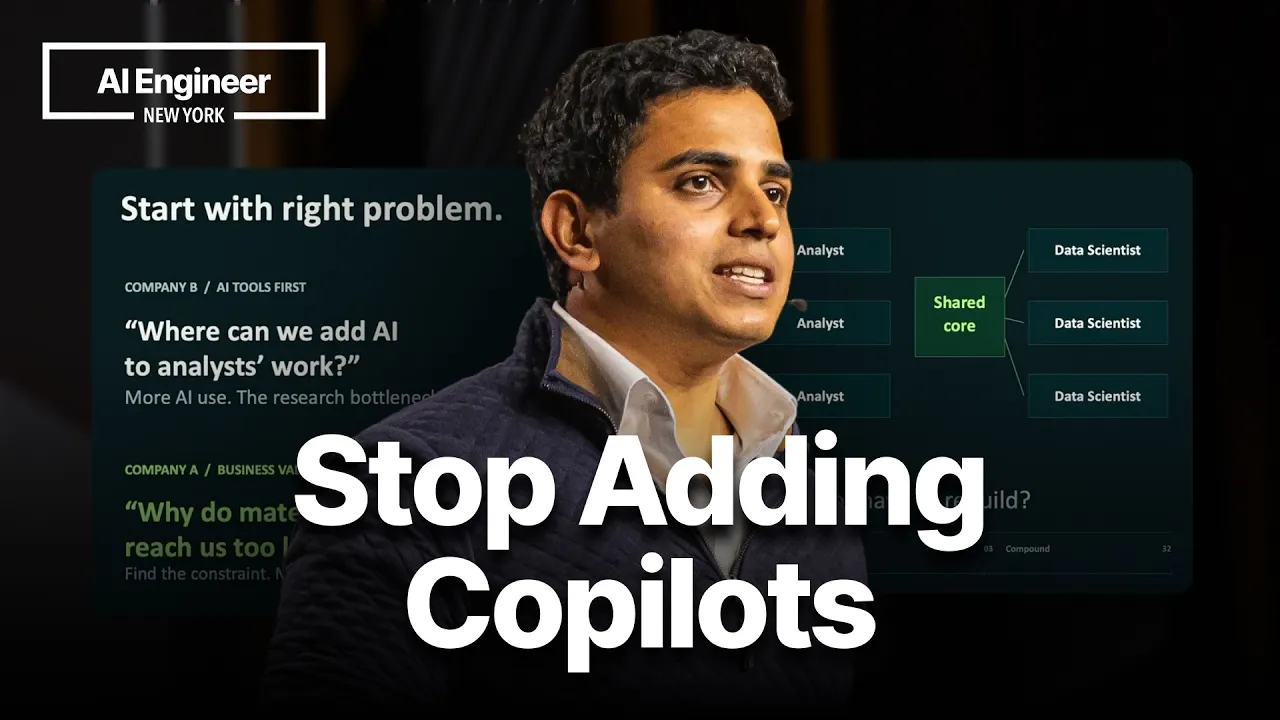
His first pillar is to design the right problem rather than begin with a tool. Using hypothetical asset-management firms, he contrasts Company B, which uses AI to summarize earnings transcripts more quickly, with Company A, which asks why material signals arrive late and redesigns the research workflow around thesis definition, continuous evidence monitoring, exception investigation, and targeted deep dives. The point is that acceleration of an existing step can reduce context and preserve the real bottleneck.
The second pillar is building shared capabilities. Pednekar advocates tighter business-technology collaboration, a standardized shared core of reusable data, semantic layers, decision records, and lessons learned, with customization at the team or user edge. He also argues that conventional enterprise systems were designed for humans operating individual applications, whereas agents need to operate across workflows, carry context, deliberate, and act.
The final pillar is compounding advantage: capture both successful patterns and corrective lessons, preserve the evidence behind them, and feed them back into tools, context, and workflows. The video is strongest as a strategic warning against scattered AI pilots and "productivity theater"; it offers useful agent-system principles but few concrete implementation details, source citations, or measurement methods.
Key Takeaways
- Claim: The competitive differentiator is not access to AI but the allocation of scarce organizational judgment. | Evidence: Pednekar defines judgment as choosing what matters and how to act without a single obvious answer; he applies it to executives, engineers, AI leaders, portfolio managers, and data scientists alike. | Implication: Evaluate AI initiatives by whether they improve the quality, timing, and leverage of consequential decisions—not merely by whether they produce more output.
- Claim: Leading organizations start with a business bottleneck or decision problem, not with a copilot or model looking for a use case. | Evidence: In the asset-management example, Company B asks where it can add AI and builds an earnings-transcript summarizer; Company A asks why material investment signals reach analysts too late and where attention, AI capacity, and bandwidth should be focused. | Implication: Frame agent opportunities around latency to signal, decision quality, research capacity, reliability, data quality, or another measurable operational constraint before choosing the automation. | Caveat: Summarization is not presented as inherently useless; the issue is treating a local speed improvement as the objective when it can remove context and leave the underlying bottleneck intact.
- Claim: Concentrating investment in a small number of end-to-end, high-value workflows beats launching many disconnected AI pilots. | Evidence: Company B accumulates scattered document-summary, copilot, and retrieval bots, while Company A aligns engineering, analytics, AI capacity, and judgment around an end-to-end research pipeline. Pednekar states that leaders put more than 80% of investment into high-value use cases that transform core functions or create new offerings. | Implication: Set a high bar for pilots: either they produce learning needed for a strategic workflow or they should be stopped in favor of a few integrated systems with clear business ownership. | Caveat: The cited investment statistic is unattributed in the transcript, so treat it as directional rather than a benchmark for budget-setting.
- Claim: The winning move is workflow redesign around judgment, not simply automation of each existing step. | Evidence: The contrast is between making transcript review, financial-model updates, and PM recommendations faster versus having an analyst explicitly define an investment thesis, continuously gather confirming and disconfirming evidence, investigate exceptions, and conduct deep dives only where warranted. Pednekar says high performers are 75% more likely to redesign workflows, compared with 25% of the other cohort. | Implication: For agent design, define the human judgment checkpoints, the exceptions that merit escalation, and the evidence required for a decision; do not build an agent that only replicates the old task sequence faster. | Caveat: The speaker does not specify the study population, the definition of high performance, or how redesign was measured.
- Claim: Shared organizational infrastructure should be standardized at the core while allowing domain-specific personalization at the edges. | Evidence: For data-science teams, Pednekar proposes a common foundation of datasets, semantic layers, documented trade-offs, records of what worked and failed, dataset strengths, and known gaps, allowing new people to build on predecessors rather than recreate one-off workflows. | Implication: Treat reusable context, data definitions, evaluation history, and decision provenance as platform assets; customize agent behavior for each function without making every team rebuild its own knowledge base.
- Claim: Agent deployment requires infrastructure designed for cross-application context and action, not just traditional single-application human workflows. | Evidence: Pednekar characterizes agents as operating across workflows and applications, taking context, deliberating, and acting. He cites data quality and data reusability as common constraints, says 71% of organizations are modernizing core infrastructure for AI, and notes that 23% are investing 6%–10% of annual revenue in modernization. | Implication: Prioritize a control plane for reusable context and workflow interoperability before scaling action-taking agents; do not mistake a chat interface for an agent-ready operating environment. | Caveat: The figures are presented without named sources, and the talk does not cover the practical controls required for agent permissions, identity, auditability, or error recovery.
- Claim: AI advantage compounds only when individual successes and failures become reusable organizational learning with preserved evidence. | Evidence: Pednekar asks whether the system—not merely an individual—learned after a correction, and recommends feeding lessons back through new tools or context while retaining the evidence behind those lessons. | Implication: Build explicit feedback mechanisms: log outcomes, retain source evidence, convert recurring corrections into policies or context, and monitor whether reclaimed capacity is redirected to higher-value work.
Detailed Brief
Organizational design: convergence of business and technology
- Claims: AI changes the boundary between business and technical functions: engineers move closer to business outcomes while business professionals increasingly build tools and automations.; The relevant operating model is not simply forward-deployed technical staff; domain operators can also be embedded into product and technology work.
- Evidence: Pednekar names forward-deployed engineers and product managers, then proposes the inverse example of forward-deployed portfolio managers.; He says large enterprises increasingly view technology as a business-growth function rather than solely a support function.
- Caveats: The talk does not specify governance mechanisms for resolving ownership conflicts when business and technology roles converge.
- Implications: Staff major AI workflows with jointly accountable domain, product, data, and engineering ownership rather than handing them to an isolated innovation team.; Assess whether technical teams are measured on business outcomes and whether domain experts can directly shape agent requirements, evaluations, and exceptions.
A practical taxonomy of team agents
- Claims: Different forms of agents should serve different organizational roles rather than being treated as one generic chatbot category.; Reusable knowledge makes these agents more useful as organizational systems instead of isolated personal assistants.
- Evidence: Pednekar distinguishes expert agents that act as subject-matter specialists, workflow agents that work across systems such as Slack and ticketing, and chief-of-staff-style agents that maintain awareness of organizational state and outstanding work.
- Caveats: No criteria are given for when an agent should only advise, when it may act autonomously, or how each category should be evaluated.
- Implications: Separate agent roadmaps by function: expert retrieval and reasoning, cross-system execution, and coordination/state management require different data, permission, and reliability designs.; Avoid combining all three roles into an initially over-scoped autonomous agent.
Notable Concepts & Terms
- Judgment: The scarce resource in an AI-abundant environment: selecting what matters, recognizing quality in context, and making trade-offs under ambiguity.
- Design the right problem: A problem-first AI strategy that identifies the actual decision or operational bottleneck before selecting a tool or model.
- Productivity theater / innovation theater: Visible activity—many pilots, bots, and local speed gains—that does not translate into material business value.
- Standardize the core, personalize the edges: Create shared data, semantic, knowledge, and evaluation infrastructure while tailoring workflows and interfaces to specific users or functions.
- Agent-ready enterprise: An organization whose systems can support agents acting across applications with context, rather than only humans using isolated software tools.
- Expert, workflow, and chief-of-staff agents: A three-part taxonomy: domain-specialist assistance, cross-system task execution, and organizational coordination/state tracking.
- Compounding advantage: The flywheel created when evidence-backed successes, failures, and corrections are systematically incorporated into shared tools and context.
Operator Notes / Why Ken Should Care
- Create an AI-opportunity scorecard that requires each proposed workflow to name the decision bottleneck, accountable owner, baseline metric, required evidence, human judgment point, and expected economic value before a pilot is approved.
- Choose one or two end-to-end workflows where agent orchestration can change signal latency or decision quality, and explicitly reject standalone copilots that cannot connect to those workflows.
- Inventory reusable foundations for agents: canonical data sources, semantic definitions, prior decisions, exception rules, evaluation outcomes, and evidence retention; assign owners for the gaps.
- Define action boundaries for any workflow or chief-of-staff agent before deployment, including read versus write permissions, escalation conditions, audit logs, and recovery paths.
- Establish a post-deployment learning loop that converts repeated agent corrections and successful interventions into versioned context, workflow rules, and evaluations.
Source/Metadata
- Title: Your AI Isn't the Advantage. Your Judgment Is - Sid Pednekar
- Transcript words: 4148
- Duration seconds: 1093
- Timestamp note: No timestamps or chapter markers were provided; the transcript also contains a near-complete repeated segment.
Transcript
Good afternoon, everyone present here. It's been a great day and an absolute pleasure to be here. The topic of my talk today is everyone has AI, who has the advantage? I'll be talking about what the organizations that are doing, that are leading in AI with their implementation and adoption, what are they doing differently? And so before that, who am I and what's my perspective? I'm Dr. Sid Pednecker. I am an AI technology and data executive in asset management. I've spent most of my tenure in hedge funds and investment and academic research. What I've done and focused on is lead strategy and build specialized teams towards three main verticals: optimizing efficiency, driving PNL, and reducing costs. I'll be following the discussion along with two hypothetical companies, Company A and Company B. These are hypothetical with made-up workflows, but we'll be following their journey along the rest of this presentation. So everyone has AI. Who has the advantage? Before we get started there, first let's see what the lay of the land is. Recent studies have shown that only about 37% of enterprises that were surveyed are showing a positive contribution to their EBIT. And only about 6% of those would be qualified as high performers. So that's about 5% contribution to their EBIT. Other studies earlier in the year have shown that about 66% are saying they're having a productivity increase. But only about 40% and 20% are actually seeing cost reductions and revenue growth. So as we know, access to AI is widespread. Yet the impact remains uneven. So the question I would ask, or how I think about this, is really in terms of three verticals. And the way I think about these three verticals should apply to organizations and individuals alike. And it should apply to functions, regardless of where you are in that organization. So the three main vertical pillars that I think of are, number one, design the right problem. Number two, build shared capabilities. And number three, compound the advantage. Now, before we dive into each of these pillars, there is an idea that I think goes through all these verticals. And I think the best leading firms are taking advantage of that and capitalizing on it. As we know, throughout time, the only constant in this world has been change. What's different in the AI and superintelligence era is that intelligence has become cheap. Regardless of what your unit of intelligence is, whether it be software, analytics, recommendations, reports, AI is creating an abundance in all of it. And as we know, more answers don't necessarily create more value. So what is scarce? What is the scarce resource in an abundant world? What are companies taking advantage of, the leaders at least? It's judgment. What is judgment? Judgment is choosing what matters and how to act when there's no single obvious answer. It's the creativity that lets you explore what possibilities are worth exploring. It's the taste that tells you what good looks like in your given context. It's the decisions where you can weigh what trade-offs are worth making. Judgment is ubiquitous. It exists throughout your organization on a daily basis. Your C-suite is asking questions, taking advantage of judgment all the time. So are the software engineers, the AI leaders, the portfolio managers, and the data scientists. So the question that they're focused on is given judgment is a finite asset, a limited capacity. The main question becomes, where is our best judgment worth spending? I'd like for you to hold on to that thought. With that, we'll dive into our first pillar: Design the right problem. So questions, a question that the leading organizations are asking all the time is, they're obsessed over what is the right problem to solve. It's tempting to start with a tool. Today, we're surrounded with better models and harnesses. We're surrounded with all these AI tools. We're surrounded with co-pilots. But that isn't the way about it, at least not the way the leaders are approaching it. Now, let's go back to our hypothetical two companies. Let's say they're from asset management. Let's say we're tracking the workflow of two research analysts in these hypothetical organizations. Well, let's say organization B starts with the tool, the co-pilot. They're asking, where can we add AI to the analyst's work? They're looking at the current existing process to say, earning transcript comes in. I discovered a summarization workflow. Let me pass all of this through. Analysts get earning summaries faster. Win-win, right? Well, not so much, at least not compared to the ones who are leading. And such a workflow of being a faster horse introduces one key nuance. That is, you are losing context as you have information reduction as part of your summarization. So what is a hypothetical organization A doing in this? Well, they're obsessed on the right problem to ask. They could be asking, why are our material signals reaching us too late? Where do we focus the attention, the AI, the bandwidth, the capability on? Where is our bottleneck? And so it becomes this redesigning of the workflow, or at least the reevaluation on what to focus on. That's what they're doing different. Now, this consideration isn't particular to finance. It's across the realm and function. You're asking the same question on what to focus on, whether it be research capacity, decision speed, quality of your data, latency, reliability. It traverses all of that. And studies show this. The leading studies, on average, spend their attention on fewer higher quality decisions than the other cohort. So leaders are being more selective in where they focus their attention and what they focus their attention on. So it's great. The leading companies have an idea of what the right problems are. Where do they go from there? Well, they also concentrate their investments in the highest value workflows. I get it. And I've been culpable of something similar where AI is almost creating too many opportunities. And experimentation can be a good thing. But one needs to separate experimentation and the resulting innovation theater, or worse, the productivity theater, from actual value generation. Going back to our two hypothetical companies, what does this mean? Company B is looking at how do we launch the most number of AI pilots. And what that ends up looking like is a document summarization bot here, a co-pilot there, a data retrieval bot here. It's scattered all over the place. Whereas what company A is focused on in their investments is potentially use cases like end-to-end workflows on the research pipeline. They're focused on aligning engineering, analytics, AI, capacity, and judgment towards a singular focus. And research has shown that the leaders spend more than 80% of their investments on these high value use cases, transforming key business functions and creating new offerings. Perfect. We know they're focusing on finding the right problem. And they're also spending deep investment in select workflows. Well, they're also doing something different. They're reimagining how work is done. I think this is key. And it goes back to what we discussed previously, which is judgment. They're redefining and reorganizing functions, roles, capacities around this key element of judgment. What does that mean for our hypothetical company? Well, company B might be focused on, as we discussed, I'm getting my earnings transcript. I'm getting my research reports. How do I summarize it? Maybe I make that faster. Maybe I update my financial models faster. Maybe I send my recommendation to my PM faster. Company A is focused on an entirely different ballgame. Hypothetically, they could be asking the analyst to define the investment thesis. And they're watching and gathering evidence that could refute that thesis or support it. They'd be monitoring continuously. They'd be investigating exceptions. And they could be deep diving on select examples that could lead to actual generation of value. So the winners don't just automate. They redesign. And studies show that the cohort of high performers are 75% more likely, or in practice, they actually do redesign their workflow versus 25% of the cohort that doesn't. So where does this leave us with our two hypothetical companies and designing the right problem? Company B adds AI to existing workflows. They're completing individual projects. And they're moving to the next initiative. Whereas company A is rethinking how work is done. They're redesigning processes around AI, and they're obsessing over the right problem. That's the difference in how organizations put AI to work. Great. So they've picked the right problem. What happens next? Well, we all know in order to actually enable that capacity, you need to build shared capabilities across the organization. And what's a trend that's seemingly emerging for some time now is that the lines between technology and business are converging. And we're seeing this everywhere. We're seeing engineers that are moving closer to business outcomes. We're seeing business professionals that are building tools and automations. And as you can see and imagine, you can have forward deployed engineers. You can have forward deployed product managers. But you could also have the inverse, which is forward deployed portfolio managers. And it's really this combination of getting the right people in the room by breaking down organizational silos that the leaders are really leaning on. And studies have shown that more and more of the large enterprises are viewing their technology arm as a business growth function. And that's creating an edge for these companies. So the other vertical inside building shared capabilities that is probably a personal favorite of mine, it's standardizing the core and personalizing the edges. And this is something that isn't new to the technology world. We've built infrastructure. We've built shared modules and system design. But what's interesting here today is that it's taking a very different shape with the capabilities out there and with the organization and the breaking down of silos. And this could look very different depending on where you sit. You could be building shared core for a team that looks very different with analysts and clients. You could be doing that with a bunch of analysts. Or you can be doing that for software engineers or data scientists. With the data scientists example in particular, that could look very interesting where instead of having one-off workflows that is really common in the industry, you could build a shared core of the data sets, the semantic layers, the trade-offs are what worked, what didn't. What some data sets do good. Where are the gaps? And so on and so forth, such that each new personnel becomes almost a plug-and-play module in the system where they can then stand on the shoulder of their predecessors. So what should the next person not have to rebuild? Now, what's also interesting is the enterprise wasn't really built for agents. Agents, they work across workflows and applications. They take context. They deliberate. They take actions. Whereas really, the enterprises are focused previously on a single human or a collection of them interacting with a single application. So the leaders are cognizant that something needs to change and that they need to modernize their infrastructure. And they're very self-aware of where they are in their journey. And so studies show that 71% of the organizations are modernizing their core infrastructure to support AI. And 6% to 10%, or 23% of them are investing 6% to 10% of their annual revenue in core system modernization to take advantage of this. And a common complaint here or a common challenge here is data quality and the ability to reuse data. So great. We have the right people in the room. We have the right knowledge there. What do we do next? And then comes the concept of, how do we make this knowledge reusable and accessible? And that's where we have, depending on the adoption and where they are, you can have different types of team agents, where you can have expert agents being subject matter experts. You can have workflow agents that work across streams like Slack bots that are creating and opening tickets, closing them, and what have you. And then you can have really chief of staff kind of agents that keep a tab on what the state of the organization is and what needs to be done. So going back to our workflows, A again is looking at this very differently in terms of shared capabilities. Now, the last pillar here that I want to draw your attention to is, well, when does this system really compound? What happens when it's deployed? Well, the leading companies, what they're doing is they're actually thinking about it slightly differently. What are failures that can give us an edge that we can learn from? If there's a success, how do you make it part of the system? And the way they think about this is, you know, the individual learned but did the system. Is there a way perhaps when they've encountered something where they need to make a correction that that knowledge is fed back into the organization, either through a new tool or context or what have you? And what's key here is preserving the evidence along with those learnings. So really the last vertical here is AI free use capacity. Where does it go? Being cognizant that you need to redesign your system and really focus it on key metrics that you're evaluating, you're monitoring, and you're creating a flywheel off. So where does this leave us for companies A and B? You know, company A has their entire work redesigned. They're building capabilities and compounding, and they have shared capabilities built. So I want to leave you off with one final question. Everyone has AI. Who has the advantage? Thank you. Your C-suite, the C-suite is asking questions, taking advantage of judgment all the time. So are the software engineers, the AI leaders, the portfolio managers, and the data scientists. So the question that they're focused on is given judgment is a finite asset, a limited capacity. The main question becomes, where is our best judgment worth spending? I'd like for you to hold on to that thought. With that, we'll dive into our first pillar. Design the right problem. So questions, a question that the leading organizations are asking all the time is, they're obsessed over what is the right problem to solve? Right? It's tempting to start with a tool. Today, we're surrounded with better models, harnesses. We're surrounded with all these AI tools. We're surrounded with co-pilots. But that isn't the way about, is it? At least, that's not the way the leaders are approaching it. Now, let's go back to our hypothetical two companies. Let's say they're from asset management. Let's say we're tracking the workflow of two research analysts in these hypothetical organizations. Well, let's say organization B starts with the tool, the co-pilot. They're asking, where can we add AI to the analyst's work? They're looking at the current existing process to say, earning transcript comes in. I discovered a summarization workflow. Let me pass all of this in through my fire hose. Analysts get earning summaries faster. Win-win, right? Well, not so much, at least not compared to the guys who are leading. And such a workflow of being a faster horse introduces one key nuance. That is, you are losing context as you have information, I guess, reduction as part of your summarization. So what is a hypothetical organization A doing in this? Well, they're obsessed on the right problem to ask. They could be asking, why are our material signals reaching us too late? Where do we focus the attention, the AI, the bandwidth, the capability on? Where is our bottleneck, right? And so it becomes this redesigning of the workflow, or at least the reevaluation on what to focus on. That's what they're doing different. Now, this consideration isn't particular to finance. It's across the realm and function. You know, you're asking the same question on what to focus on, whether it be research capacity, decision speed, quality of your data, latency, reliability. It traverses all of that. And studies show this. They show the leading studies, on average, spend their attention on fewer higher quality decisions than the other cohort. So leaders are being more selective in where they focus their attention and what they focus their attention. So it's great. The leading companies have an idea of what the right problems are. Where do they go from there? Well, they also concentrate their investments in the highest value workflows. I get it. And I've been culpable of something similar where, you know, AI is almost creating too many opportunities. And experimentation can be a good thing. But one needs to separate experimentation and the resulting innovation theater, or worse, the productivity theater, which actual value generation. Going back to our two hypothetical companies, what does this mean? Company B is looking at how do we launch the most number of AI pilots. And what that ends up looking like is a document summarization bot here, a co-pilot there, a data retrieval bot here. It's scattered all over the place. Whereas what company A is focused on in their investments is potentially use cases like end-to-end workflows on the research pipeline. They're focused on aligning engineering, analytics, AI, capacity, and judgment towards a singular focus. And research has shown that the leaders spend more than 80% of their investments on these high value use cases. Transforming key business functions and creating new offerings. Perfect. We know they're focusing on finding the right problem. And they're also spending deep investment in select workflows. Well, they're also doing something different. They're reimagining how work is done. I think this is key. And it goes back to what we discussed previously, which is judgment. They're redefining and reorganizing functions, roles, capacities around this key element of judgment. What does that mean for our hypothetical company? Well, company B might be focused on, as we discussed, I'm getting my earnings transcript. I'm getting my research reports. How do I summarize it? Maybe I make that faster. Maybe I update my financial models faster. Maybe I send my recommendation to my PM faster. Company A is focused on an entirely different ballgame. Hypothetically, they could be asking the analyst to define the investment thesis. And they're watching and gathering evidence that could refute that thesis or support it. They'd be monitoring continuously. They'd be investigating exceptions. And they could be deep diving on, you know, select examples that could lead to actual generation of value. So the winners just don't just automate. They redesign. And studies show that the cohort of high performers are 75% more likely, or in practice, they actually do redesign their workflow versus 25% of the cohort that doesn't. So where does this leave us with our two hypothetical companies and designing the right problem? Company B adds AI to existing workflows. They're completing individual projects. And they're moving to the next initiative. Whereas company A is rethinking how work is done. They're redesigning processes around AI, and they're obsessing over the right problem. That's the difference in how organizations put AI to work. Great. So they've picked the right problem. What happens next? Well, we all know in order to actually enable that capacity, you need to build share capabilities across the org. And what's a trend that's seemingly emerging for some time now is that the lines between technology and business are converging. And we're seeing this everywhere. We're seeing engineers that are moving closer to business outcomes. We're seeing business professionals that are building tools and automations. And as you can see and imagine, you can have forward deployed engineers. You can have forward deployed product managers. But you could also have the inverse, which is forward deployed portfolio managers. And it's really this combination of getting the right people in the room by breaking down organization silos that the leaders are really leaning on. And studies have shown that more and more of the large enterprises are viewing their technology arm as a business growth function. And that's creating an edge for these companies. So the other sort of vertical inside building shared capabilities that is probably a personal favorite of mine, it's standardizing the core and personalizing the edges. And this is something that isn't new to the technology world. We've built infrastructure. We've built shared modules and system design. But what's interesting here today is that it's taking a very different shape with the capabilities out there and with the org and the breaking down of silos. And this could look very different depending on where you sit. You could be building shared course for a team that looks very different with analysts and clients. You could be doing that with a bunch of analysts. Or you can be doing that for software engineers or data scientists. With the data scientists example in particular, that could look very interesting where instead of having one-off workflows that is really common in the industry, you could build a shared core of the data sets. There are semantic layers. The trade-offs are what worked, what didn't. What some data sets do good of. Where are the gaps? And so on and so forth, such that each new personnel becomes almost a plug-and-play module in the system where they can then stand on the shoulder of their predecessors. So what should the next person not have to rebuild? Now, what's also interesting is the enterprise wasn't really built for agents. Agents, they work across workflows and applications. They take context. They deliberate. They take actions. Whereas really, the enterprises are focused previously on a single human or a collection of them interacting with a single application. So the leaders are cognizant that something needs to change and that they need to modernize their infrastructure. And they're very self-aware of where they are in their journey. And so studies show that 71% of the orgs are modernizing their core infrastructure to support AI. And 6% to 10% or 23% of them are investing 6% to 10% of their annual revenue in core system modernization to take advantage of this. And a common complaint here or a common challenge here is data quality and the ability to reuse data. So great. We have the right people in the room. We have the right knowledge there. What do we do next? And then comes the concept of, hey, how do we make this knowledge reusable and accessible? And that's where we have, depending on the adoption and where they are, you can have different types of team agents, where you can have expert agents being subject matter experts. You can have workflow agents that work across streams like Slack bots that are creating and opening tickets, closing them, and what have you. And then you can have really chief of staff kind of agents that keep a tab on what the state of the organization is and what needs to be done. So, you know, going back to our workflows, A again is looking at this very differently in terms of shared capabilities. Now, the last pillar here that I want to draw your attention to is, well, when does this system really compound? What happens when it's deployed? Well, the leading companies, what they're doing is they're actually thinking about it slightly differently. What are failures that can give us an edge that we can learn from? If there's a success, how do you make it part of the system? And the way they think about this is, you know, the individual learned but did the system. Is there a way perhaps when they've encountered something where they need to make a correction that that knowledge is fed back into the org, either through a new tool or context or what have you? And what's key here is preserving the evidence along with those learnings. So really the last vertical here is AI free use capacity. Where does it go? Being cognizant that you need to redesign your system and really focus it on key metrics that you're evaluating, you're monitoring, and you're creating a flywheel off. So where does this leave us for companies A and B? You know, company A has their entire work redesigned. They're building capabilities at Compound, and they have shared capabilities built. So I want to leave you off with one final question. Everyone has AI. Who has the advantage? Thank you.