Deploying AI Inside a Bank Is Not an Engineering Problem — Paden Gayle, Applied AI Engineers
Description
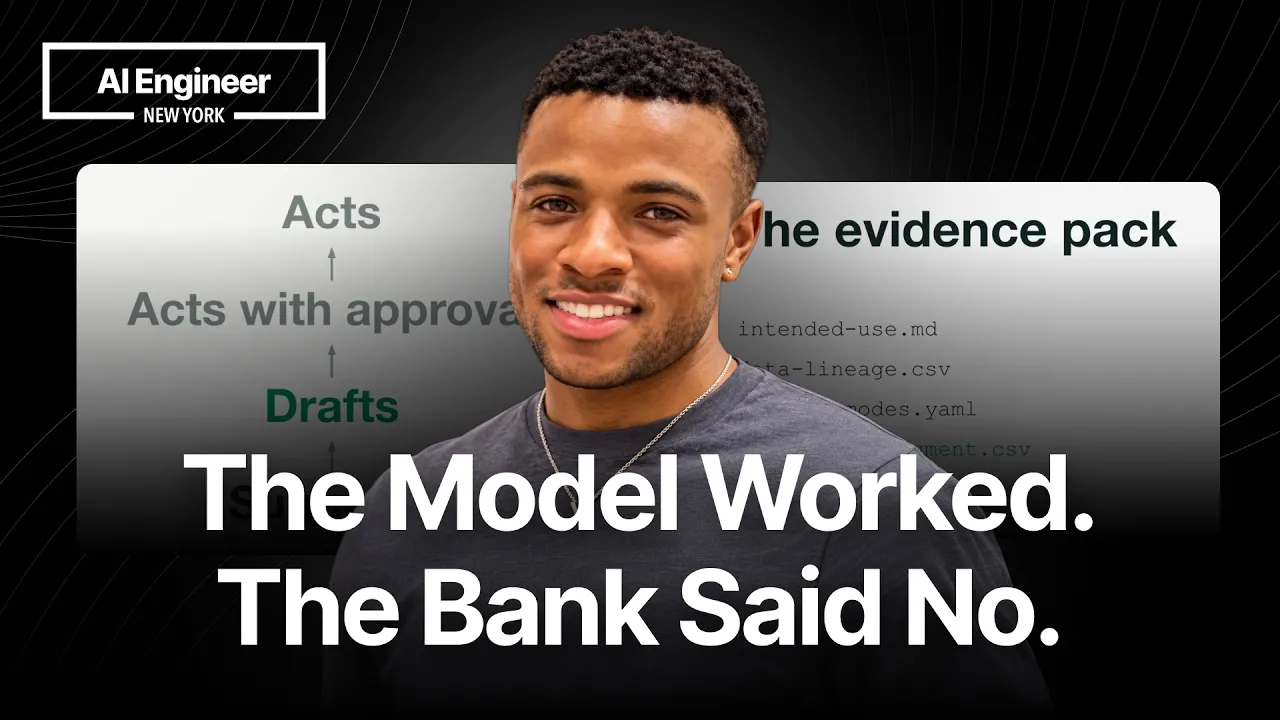
A bank's document exception assistant produces a convincing demo, but security, data owners and risk reviewers still cannot approve it. Paden Gayle uses that hypothetical project to show why a working model does not establish a route into production. The missing decisions concern where the system runs, who authorized the documents, who reviews a wrong exception and which existing controls the workflow must satisfy. Drawing on his engineering experience, Gayle makes discovery part of the build: find the people who own those decisions in the first week, then define the smallest useful system they can evaluate. When a customer cannot supply a complete specification, his method is to shadow the work, draft a concrete workflow and shrink it with the control owners. Autonomy starts with the least authority needed to solve the problem. A drafting assistant can gather evidence about errors, overrides and recovery before anyone grants it permission to take further actions. Gayle also outlines an evidence pack covering intended use, data lineage, failure modes, results by segment and accountable controls. Original inputs and outputs belong in that record; rerunning a model later cannot reconstruct exactly what happened. Aggregate performance can conceal a poorly supported document type or user group, so weak segments need explicit restrictions. The closing checklist turns unresolved approval decisions into named owners and next steps. It is a planning aid for deployment, rather than a claim that the illustrative bank project shipped or that a checklist guarantees approval. Speaker info: - https://www.linkedin.com/in/padengayle/ - https://padengayle.com/ Timestamps: 00:00 - A working bank demo that still cannot ship 1:27 - Finding the people who own approval 5:47 - Shadow, draft and shrink the workflow 8:42 - Start with the smallest necessary authority 9:57 - Scoping the hypothetical exception assistant 12:21 - Five files for the evidence pack 13:37 - The first week deploy
Summary
Generated by gpt-5.6-terraAt-a-Glance
- Verdict: Watch fully
- Core thesis: Bank AI deployments fail less often on model quality than on unaddressed ownership, approval, control, autonomy, and audit-evidence decisions that must shape the system from week one.
- Why it matters: It offers a reusable operating model for deploying agents into regulated workflows: map decision owners before architecture, shrink scope to an approvable human-reviewed workflow, and generate evidence as part of operation.
- Best use: Use it as a discovery and deployment checklist for any high-consequence enterprise AI workflow, especially where data access, third-party providers, human review, and audit reconstruction matter.
Executive Summary
Peyton Gale argues that deploying AI in a bank is primarily a discovery and operating-model problem, not an engineering or model-performance problem. A document-exception assistant can have an effective demo and still fail to ship because security, data owners, risk teams, auditors, and production-platform owners were not involved before the design hardened. The engineering task is therefore to expose the decisions that constrain the deployable system, assign each decision to a named owner, and identify the evidence and next conversation required.
The proposed approach begins with four dependency areas: data, model risk, third-party risk, and auditability. Teams should determine who owns each dataset and its permitted use; which model-risk review applies and who will operate the system post-launch; the real provider/hosting dependency chain; and what records are needed to reconstruct a consequential action. By the end of the first week, relevant decision-makers should know the project exists, rather than being surprised by a completed design submitted for approval.
When a customer cannot provide a clean specification, Gale recommends observing the existing workflow, drafting a deliberately concrete proposal, and shrinking it. The first useful version should generally augment an analyst—such as highlighting source passages and drafting an exception form—rather than autonomously classifying and filing exceptions. Scope should expand only when operating evidence shows the prior authority level is safe, useful, recoverable, and supported by the right controls.
The video’s most operational contribution is its evidence-pack model. Every evaluation and production run should preserve inputs, prompts, model/version/configuration, outputs, and reviewer actions, because rerunning a model later may not reproduce the historical decision. Results should be segmented by difficult document classes rather than hidden in averages, and each failure mode needs a detection path, fallback, stop authority, and accountable owner.
Key Takeaways
- Claim: Discovery is part of the engineering work because organizational decisions determine the architecture that can actually be approved and operated. | Evidence: In the opening example, an AI system that reviewed client documents and drafted exceptions had a successful demo and adequate model performance but did not ship once security asked about hosting, data owners asked who approved the document use, and risk asked who would review incorrect exceptions. | Implication: Do not treat compliance, security, data governance, and operations as downstream sign-off functions; make their unresolved decisions explicit design inputs before implementation commitments.
- Claim: A credible deployment requires named owners for four decision domains: data, model risk, third-party risk, and audit. | Evidence: For data, Gale distinguishes source ownership, access-grant authority, and approval for workflow use. For model risk, she asks which review applies and what evidence the post-launch owner needs. For third-party risk, she maps the model provider, hosting arrangement, and operating-service role. For audit, she asks what would be needed to reconstruct a consequential action. | Implication: Architecture diagrams should be accompanied by a decision-owner map: every material data path, vendor dependency, action, and record requirement needs an accountable person and an identified approval path. | Caveat: The exact reviews and approval paths vary by institution and use case, so the framework identifies questions and owners rather than supplying a universal approval process.
- Claim: The practical specification for an AI workflow should be derived by observing current operations, then drafted and reduced to the smallest useful approved scope. | Evidence: Gale’s “shadow, draft, and shrink” method starts by sitting with an analyst, recording systems used, judgment points, escalation/permission steps, and handling of missing documents. For the exception-assistant example, the initial workflow is narrowed to reviewing documents, drafting exceptions, and having an analyst submit them. | Implication: For agent deployments, begin with the real work sequence and exception handling—not a generic AI feature request—and turn sponsor/control-owner corrections into specific build constraints.
- Claim: Autonomy should start at the lowest authority level that creates value, with expansion justified by operational evidence rather than confidence in the model. | Evidence: The authority ladder is: suggest, draft, act with approval, and act within pre-approved limits. In the example, the system highlights likely exceptions, cites source evidence, and prepares a form; the analyst verifies, edits, and decides whether to submit rather than allowing automatic filing. | Implication: Separate model intelligence from action authority. A useful initial agent may be a tightly bounded drafting system embedded in the existing analyst workflow, not an autonomous actor. | Caveat: Human review does not itself guarantee regulatory approval or determine the applicable risk category; intended use and required reviews must still be confirmed.
- Claim: Human review is only a meaningful control when the reviewer has sufficient evidence and authority to detect and correct the system’s work. | Evidence: Gale notes that a review button is insufficient unless the analyst can check the source evidence and see uncertainty. In the exception workflow, the analyst must inspect the cited passage, correct the draft form, and choose whether to submit. | Implication: Design review interfaces around verification: expose supporting source material, make correction practical, and ensure the reviewer controls the consequential action.
- Claim: Evaluation must be an operating evidence system, not a one-time benchmark, with reconstructable records, segmented results, failure responses, and stopping rules. | Evidence: The proposed evidence pack includes intended use and prohibited actions; data lineage and approval records; failure modes with detection and fallback; results by segment; and controls such as review rules, thresholds, stopping rules, and owners. Each run should retain the input, prompt, model version, configuration, output, and reviewer action. | Implication: Build observability, replay records, fallback paths, and governance artifacts in sprint one. Report weakest segments—such as scans, rare exceptions, or new document types—rather than relying on overall averages. | Caveat: Offline targeted cases can reveal weaknesses such as missed exceptions but cannot detect every live miss; affected work may need to remain under manual review.
- Claim: A simple first-week readiness heuristic can prevent premature delivery commitments. | Evidence: By Friday, Gale wants answers to five questions: whether the data owner is engaged; whether production environment and administrators are named; whether the sponsor can describe the workflow without saying AI; whether the smallest scope fits confirmed existing controls; and whether the risk signer and precedent are known. Four or five yeses indicate a credible path, three requires assigned owners and dates, and zero to two requires resolving or shrinking scope before committing. | Implication: Use a readiness gate before committing roadmap, staffing, or launch dates for regulated AI initiatives. | Caveat: The score does not predict approval; it is a prioritization device for locating unresolved decisions.
Detailed Brief
Discovery-call questions that convert ambiguity into a delivery plan
- Claims: Useful discovery outputs are names, decisions, and next conversations—not broad assurances that a function such as security will be supportive.; An unnamed owner is not merely an organizational inconvenience; it is an unscoped dependency that can invalidate an otherwise sensible design.
- Evidence: Suggested questions include: where data lives and who approves reading it; who blocked similar projects and why; which existing controls might cover the workflow; where production will run and who administers it; who signs the risk review and what precedent exists; and which obligation concerns the sponsor personally.; When someone says “security will be fine,” Gale recommends asking who specifically reviews the design and arranging that conversation directly.; After discovery calls, send each owner a short description of the proposed use and confirm what they need from the team.
- Caveats: A technical component can depend on several approvals, and some decisions apply across the whole system; a simplified owner map will not capture all dependencies initially.
- Implications: Treat owner mapping as a living project artifact, updated as new data paths, actions, and providers enter scope.; Use direct confirmation with accountable owners rather than relying on sponsor interpretation of another function’s requirements.
Scope expansion changes the approval surface
- Claims: Each increase in an AI system’s access or authority creates a distinct engineering and governance scope.; The right MVP is the increment that creates useful value while remaining inside controls that have been explicitly confirmed.
- Evidence: The example progresses from summarizing a document the analyst already has, to reading a second system, to drafting a customer-facing response, to automatically sending that response.; Adding a second system introduces another data path and approval. Drafting customer-facing content requires a content reviewer and applicable rule. Automatic sending requires an action owner, error recovery design, and a stop mechanism.; Gale suggests an initial success criterion of reduced review time with no increase in missed exceptions, measured against the current workflow.
- Caveats: Existing analyst access may not automatically authorize AI processing of the same documents; that use still needs confirmation.; Success criteria remain proposals until the sponsor and relevant control owners agree on measurement.
- Implications: Frame roadmap stages in terms of changes to data access and action authority, not only feature additions.; Require explicit control revalidation whenever a workflow crosses into a new source system, external communication, or autonomous action.
Notable Concepts & Terms
- Discovery is the engineering: The central framing: identifying owners, approvals, evidence requirements, and operating constraints is what determines the feasible technical design.
- Shadow, draft, and shrink: A specification method for ambiguous enterprise workflows: observe real work, write a concrete proposed workflow, then reduce it to the smallest useful and approvable version.
- Decision-owner map: A practical extension of an architecture diagram that identifies who owns data use, platforms, risk reviews, controls, actions, and audit records.
- Autonomy ladder: A progression from suggestion to drafting to human-approved action to pre-authorized autonomous action, where each step raises consequences and control requirements.
- Action boundary: The point at which model output becomes an operational or customer-impacting act; moving this boundary from automated filing to analyst submission materially reduces deployment risk.
- Evidence pack: The review-ready documentation set covering intended use, data lineage, failure modes, segmented results, and controls/owners.
- Reconstructability: The audit requirement to preserve the actual historical input, prompt, model/version, configuration, output, and reviewer action because later model reruns may differ.
- Segmented evaluation: Reporting performance and control behavior separately for groups such as clean files, scans, rare exceptions, and new document types so averages do not hide a serious weakness.
Operator Notes / Why Ken Should Care
- Add a pre-build deployment-discovery gate to AI projects: no implementation commitment until data owner, production administrator, risk-review path, and consequential-action owner are identified.
- Require every agent/workflow design to state its current autonomy rung, the exact human verification evidence exposed, and the criteria required to move to the next rung.
- Create a standard evidence schema that logs input provenance, prompt, model and configuration versions, output, reviewer decision, alerts, fallback invocation, and stop/recovery ownership.
- Evaluate agent performance by operationally meaningful segments and publish the weakest segment first; block or constrain unsupported segments rather than allowing aggregate metrics to justify broad rollout.
- Use the five-question Friday heuristic as a portfolio triage mechanism: delay or shrink initiatives with two or fewer confirmed answers instead of treating approval risk as post-MVP work.
Source/Metadata
- Title: Deploying AI Inside a Bank Is Not an Engineering Problem — Paden Gayle, Applied AI Engineers
- Transcript words: 2857
- Duration seconds: 907
- Timestamp note: No timestamps or chapters were present in the supplied transcript.
Transcript
Hello and welcome. Today we will be talking about deploying AI inside of a bank and how it is not an engineering problem. Before we get into that, I want to introduce myself. My name is Peyton Gale. I worked across many different fields, so I started off at consulting at Accenture. Before moving over to Bloomberg as a software engineer, where I worked on a trade infrastructure team and a data platform team. Then afterwards, I would be at Google working on security and deployment. And right now, I am a founding FTE at a startup and writing the book on forward deployed engineering with O'Reilly. In this example, the system reviews client documents and drafts exceptions for an analyst. The demo shows the intended workflow and everybody can see why it would be useful. Then security asks, okay, which environment will host it? The data owners ask who agreed to this use of documents and someone from RISC asks who will review a wrong exception before it reaches the next system. Those are reasonable questions, right? Each question can change what we are allowed to build. The team has already invested in a design while several people responsible for that design have never seen it. So in this case, the demo worked. The model was fine. However, it still did not ship. I want to now show you how to uncover those decisions in week one so you can design a system with a credible route into production. These four labels represent decisions your deployment depend on. For each one, I want a person who can explain the decision, the evidence they need, and the next step. So let's start with data. Data, who owns the source, who can grant access, who can approve using this in the workflow. Those responsibilities may belong to different people, but being able to create a dataset does not settle every question about how the application may use it. For the model RISC, find a person who can tell you which review applies to the intended use. Ask what a previous submission looked like. Learn who will own the system after launch and what evidence that owner will need to maintain it. For third-party RISC, draw the actual dependency chain. Include the model provider, the host arrangements, and your role in the operating service. Find out which relationships have already been reviewed and which proposed changes require another decision. For audit, ask what someone would need to reconstruct a consequential action. Which input was used? Which configuration produced the output? What did the reviewer see? And who approved the action? Those are the questions that affect the records you need to capture from the beginning. Now imagine getting those answers after you built the whole entire system. A deployment boundary, a data path, or action may have to change. The useful move is to bring these people in and bring them into the design early. Their responsibilities help us identify the system we can actually operate. And here, discovery is the engineering. So now we want to talk about what discovery is and who we need to really find out to understand what exactly we need to build. So we want to think every dataset has an owner. The work I did at Bloomberg on the data platform team made this concrete for me. Building infrastructure for an LLM meant understanding which datasets could be used and who could approve that use. The idea we want to get across is that every dataset has an owner. My work at Bloomberg on the data platform team made this concrete for me. Building an infrastructure for an LLM meant understanding which datasets can be used and who could approve that use. And then we want to know where the data is used. Carry that into each bank deployment, honestly any deployment. So before designing retrieval, find the person accountable for each source. Confirm the allowed use and the environment where the processing can actually start to happen. If those answers change, your design changes with them. Imagine the key on this slide stands for a real permission with a real owner. We should be able to name that owner to know where exactly this key needs to come from. When starting to scope out an architecture, a lot of the questions you may have can be answered by looking at the org chart. Read the top row first. Documents go into the model. And an analyst reviews the output. You can probably sketch that system in a few minutes. Now read the row underneath it. The documents have a data owner. The model service needs a platform owner. The analyst workflow needs someone who can confirm the relevant risk requirements. And the last name still has a question mark. That question mark is a dependency. We have designed a workflow without finding the person who can tell us whether its intended use is acceptable, and what evidence will be required. So I would walk through this diagram with a sponsor or someone you trust and figure out, okay, who owns the documents? Have they heard about this use? Who can help us reach the appropriate reviewer? Then I would confirm the answers directly with those people. The real map will have more relationships than this. A technical component may depend on several approvals. Some decisions span the entire system. The point is to make those dependencies visible while the design is still easy to change. An unnamed owner becomes a specific task with a person responsible for resolving it. That is how discovery starts turning uncertainty into an implementation plan. And given that, you may start to ask yourself, okay, Peyton, what sort of questions should I be asking? So here are some of the questions I would bring to a discovery call. Where does the data live and who can approve reading it? Who has stopped it in a similar project before and why? Which existing controls could cover this workflow and who owns them? Where will this production run? And who are the administrators for that environment? Who signs the relevant risk review and what have they signed before? What obligation is the sponsor personally worried about and who can explain it? Notice what I want to leave with. It's either names, decisions, or next conversations. If someone says security will be fine, ask who will actually review the design and when you can meet them. Then close the loop, send each owner a short description of the proposed use, and confirm what they need from you. By Friday, the people whose decisions the deployment depends on should know the project exists. That gives scoping a much firmer starting point. And once all that is done and we know who owns the decisions, I can scope the work. When the customer cannot write or give out the spec, I rely on these two things. Shadow, draft, and shrink. For example, at Bloomberg, I worked on a system that handled cash flows. That work had to reconcile. That gave me a concrete place to start. Follow the flow and the people responsible for it. I use that approach when a sponsor wants AI for onboarding. Sit with an analyst. Watch which systems they open. Where they make a judgment. And when they ask for permission, ask what happens when the document is missing. Write down the actual sequence. That is the beginning of your specification. Now imagine we are building the document exception assistant. This is a hypothetical example, but I would still put these three lines in front of the sponsor. One, review the documents. Two, draft the exceptions. And three, analyst submits. Then I would make each line specific. Which documents can the analyst access? Is that access approved for this processing? What should the model produce? And that will be a highlighted passage, a draft form, or both. And who checks the draft? And also who submits it? For a first version, suppose the output is a highlighted exception in a draft form. The analyst checks the source, edits the form, and submits. That is a boundary someone can correct. I would also propose a success criteria. So either less review time with no increases in missed exceptions. We still need to agree on how to measure that against the current workflow. Because that, again, right, is the whole point. It is a proposal until we have an agreement. Take the draft to the sponsor and the control owners. They can cross out a document type. They can change the reviewer. Or they can just flat out reject the output. Each correction gives a decision we can build around. So once the workflow is complete, scope becomes a series of approval questions. So now let's grow our hypothetical system one step at a time. First, it summarizes a document that the analyst already has. We will still confirm whether that existing access covers this use. Next, it reads from a second system. Now there's another data path and somebody needs to approve it. Next, after that, it drafts a response that a customer will see. Who checks the content and which rule applies that we can use. Finally, it sends a response automatically. Who owns that action? What happens if it sends something wrong? And how do we stop it and recover it? Those are the four different engineering scopes. The applicable reviews depend on the institution and the use case. So I would confirm them with people who own those decisions. Then I ask which increment creates the useful value today. Could I draft inside the analyst's current workflow to solve enough of the problem? If so, start there. Confirm that the existing control really fits. And build the smallest useful version, or the MVP, with a credible path of approval. That brings me to autonomy. I start with the least authority that the problem solved. Then ask what task can be proven as evidence to give the system more. So when working on cash flows at Bloomberg, I thought about automation a lot of the time. So every automation step needs a control and somebody owns the number. I carry that discipline into AI. So find the consequential action, name its owner, decide what happens when the system is wrong. So for example, in a hypothetical exception workflow, the submission is an action. An analyst reviewing the draft needs to source evidence and visible uncertainty to make a real judgment. A review button only helps if the person can actually check the work. So in thinking about autonomy, I want you to read the ladder from bottom up. Suggest means the analyst receives a recommendation and chooses what to do with it. Draft means the system prepares something the analyst checks and submits. That is the highlighted step. Acts with approval means a person authorizes each action before it happens. Acts means the system operates within limits that have already been approved. Each step changes the consequences of an error. However, it also changes which controls must work and which reviewer needs to be convinced. I would start at the lowest step that creates value, then collect evidence from there. Are the reviews overriding the drafts? Which failures keep recurring? Can people recover when something breaks? Use those observations to make the next authority decision. A model does not become more capable by itself. Answer how much authority this particular workflow should give it. So now let's make that concrete with the same hypothetical exception assistant. Suppose the initial request is an agent that reads client documents, decides which ones fall outside of policy, and files exceptions automatically. In that design, the model's judgment can become an operational action without an analyst checking each case. Now keep the model and change the action boundary. It highlights a likely exception, points to the relevant source, and prepares the draft form. The analyst checks the evidence, corrects the form, and chooses whether to submit. Follow that sequence on the slide. Model. Human. Submit. I'll take that design to the people we found during discovery. Can this use the analyst's existing workflow? Does the approved data access cover the processing? Which controls apply? And what evidence do the reviewers need? Human review does not guarantee approval, and it does not determine a regulatory category on its own. We still have to confirm the intended use and the required reviews. The useful question is whether this drafting version solves enough of the problems to ship first. If it does, we can collect evidence without errors, overrides, and recovery while operating within that boundary. The next decision about authority can draw on what happened in real use. That makes the evaluation part of the operating plan. And that brings us to our fourth promise: an evaluation the risk team can use for evidence, which really just means the ones they're responsible for managing. At Google, the question I needed answered was what happens when the system breaks? Who notices? What stops? Who takes responsibility? How long will it take to bring back up? For an AI deployment, I want the same concrete account, right? The intended use, a threat model, the failure modes, and a response plan. Show me the controls working when the model gets something wrong. Name the person who receives the alert and can stop the workflow. That gives a practical way to evaluate our example. So going back to our example, the hypothetical exception assistant. If it invents an exception, the analyst checks the source passage and rejects the draft. If extraction produces unreadable text, stop and request a clean file. If it misses exceptions, targeted offline cases help expose that weakness. They do not detect every live miss. Keep affected work under manual review. For each failure, name the detection path, the fallback, and its owner. Put those decisions in an evidence pack. These five files make the review complete. Intended use, record users, boundaries and prohibited actions, data lineage, records, each example source and use approval. Failure modes, records, detection and fallback. Results by segment, record coverage and errors. Controls, record reviews, thresholds, stopping rules, and owners. So with all of this, we generate the evidence with each evaluation run. Alongside it, preserve the input, prompts, model version, configuration, output, reviewer action. That lets us reconstruct the historical decision. Calling the model again later may produce a different answer, so we preserve what actually happened. A reviewer can then expect that supporting record, so now we can take a look to see what exactly is being used to organize that result, which is in the fourth file. For a hypothetical workflow, I would separate clean documents, scans, rare exceptions, and new document types. Measure the errors and control behaviors in each group, then lead with the weakest result. An average can hide a serious gap in one segment. If a group has little evidence, say so and restrict that use until you have enough. This tells reviewers what the results support, and it also brings us back to our week one decisions. Now, just rounding everything up, by Friday, I want five answers. Is the data owner engaged and aware of this project? Are the production environment and its administrators named? Can the sponsor describe the workflow without saying AI? Can the smallest useful scope fit existing controls confirmed with their owners? Do we know the risk signer and what happened to the person that signed last time? Use those answers as a planning heuristic. Four or five yeses suggest a credible path to ship. Three means unresolved decisions need owners and dates. Zero to two means resolve those decisions before committing to delivery, including possibly shrinking scope or even redefining scope. This score does not predict approval, but it does tell us where to spend the next week. And here is what I would carry into these next conversations. So to wrap this up, what I want people to walk away with is that discovery is the engineering. Draft the spec, then shrink it. Give the system only the authority it needs. Build the evidence pack in sprint one. The demo worked. The model was fine. It still didn't ship. So what do we do? We go find the people. Thank you for going through this presentation with me. My name is Peyton Gale. I am a founding forward deployed engineer, writing the book on FTE for O'Reilly. And yeah, I love to talk about FTE and everything related to it. If that's of interest, you can find me on LinkedIn or my website, PeytonGale.com, has all of my information. Thank you again for watching today. And yeah, looking forward to connect. Thank you. And yeah, I love to talk about FTE and everything related to it. If that's of interest, you can find me on LinkedIn or my website, PeytonGale.com, has all of my information. Thank you again for watching today. And yeah, looking forward to connect. Thank you.