Stop Building Software Factories — Justin McCarthy, Diffusion
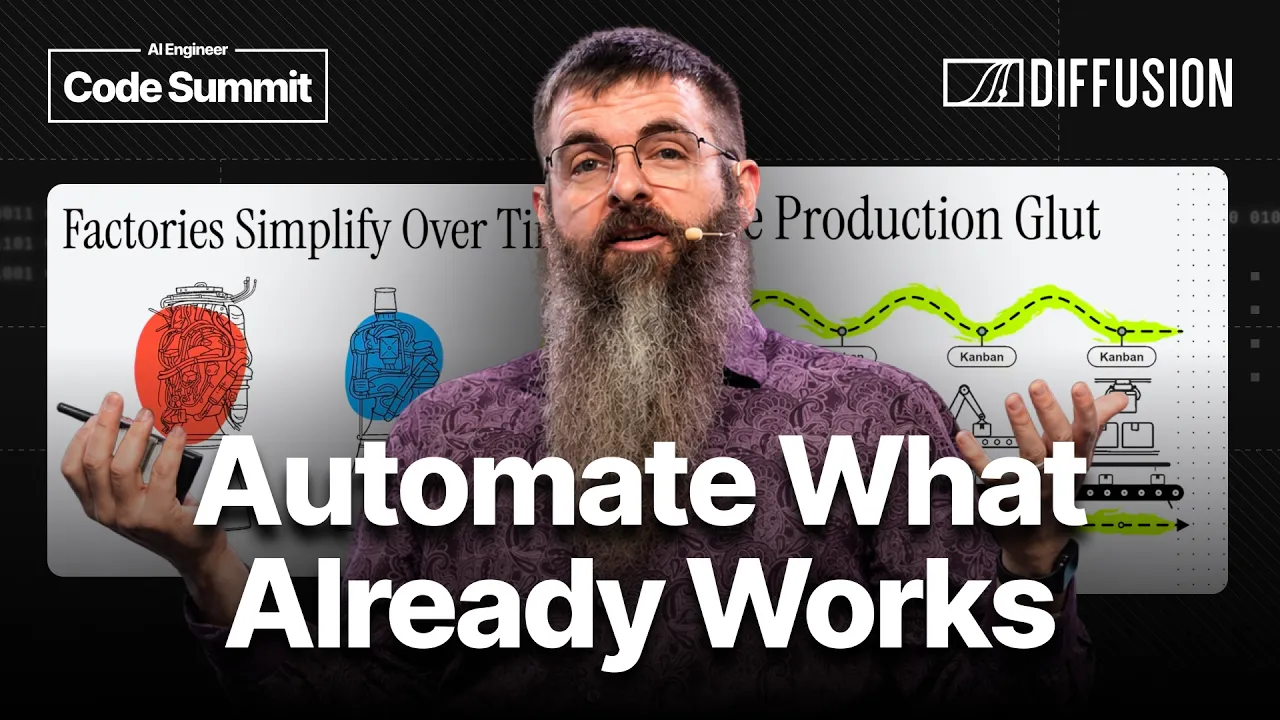
Description
Most of the time you don't know what you want yet, so putting new ideas through a factory wastes time and tokens. Justin McCarthy, founder and CEO of Diffusion, argues for brownfield factories instead: continuous loops that keep the promises of software customers already pay for, getting faster, cheaper and safer around the clock. He explains why these factories simplify with every model release and why one takes about a week to stand up. Then he raises the stakes: with code now abundant, engineers need to build a demand factory that finds what customers will actually buy. Timestamps: 0:00 - Diffusing the models into the economy 0:57 - Where software factories came from 2:27 - Stop building software factories 3:12 - Greenfield discovery vs brownfield 4:46 - Promises and feedback loops 6:16 - Continuous, 24/7 factories 8:31 - Factories simplify over time 10:50 - The same, but faster, cheaper, safer 11:35 - Stand one up in a week 12:20 - Too much software, not enough demand 13:50 - Building a demand factory 15:20 - Fill your brand envelope
Summary
Generated by gpt-6.1-terraAt-a-Glance
- Verdict: Skim
- Core thesis: Use agentic software factories to preserve and improve existing customer commitments, but pair them with market discovery rather than industrializing products whose demand is still unknown.
- Why it matters: Faster software production can magnify wasted effort unless agents also help identify customer outcomes and validate demand.
- Best use: Use the brownfield-versus-discovery distinction to frame an agent workflow, then inspect the separately referenced technical resources before making implementation decisions.
Executive Summary
Diffusion CEO Justin McCarthy argues that the provocative title is partly tongue-in-cheek: teams should build software factories for established products, where customer usage and existing commitments supply feedback, but avoid treating uncertain product discovery as a manufacturing problem.
His proposed brownfield factory continuously checks and improves explicit product promises—including functionality, cost and security—through feedback loops. He favors improvements such as faster, cheaper and safer operation where one promise does not regress to improve another. He reports that stronger models have allowed his team's skills and harnesses to become simpler, though he provides little implementation detail.
The bigger strategic bottleneck, he argues, is demand: customers want outcomes, not an ever-growing supply of software. His speculative answer is a 'demand factory' that helps teams prioritize customer questions, synthesize feedback and allocate experiments. The talk offers a useful operating frame rather than a proven demand-generation system or technical build guide.
Key Takeaways
- Claim: Separate maintenance of validated products from discovery of what customers want; an industrialized loop is a poor substitute for product-market-fit exploration. | Evidence: McCarthy contrasts brownfield products, where customers pay and use the existing system, with greenfield work where the desired product is not yet known. | Implication: Give established systems and new bets different agent objectives and evaluation criteria rather than routing both through one factory. | Caveat: Existing usage is useful evidence of value, not proof that every current behavior or feature should be preserved.
- Claim: Encode existing product 'promises' into feedback loops that continuously detect and correct regressions. | Evidence: His promise concept spans features, price or cost, and security; he points to runtime behavior, customer usage and support tickets as potential feedback signals. | Implication: Treat observable guarantees and their evaluators as core control-plane assets, not merely prompts appended to a coding agent. | Caveat: The talk does not specify how to turn those signals into reliable tests, resolve conflicts between promises, or safely approve autonomous changes.
- Claim: A brownfield factory should run in the background and favor improvements that preserve other commitments. | Evidence: McCarthy proposes continuous attention to slowness and insecurity and summarizes the objective as 'the same but faster,' cheaper and safer. | Implication: Define regression thresholds across performance, cost and security before optimizing any one dimension. | Caveat: He explicitly conditions this on avoiding tradeoffs such as making a system faster by making it less safe; qualitative 'better' may require human judgment and discovery.
- Claim: Factory scaffolding may simplify as models and harnesses improve, but that is an observed trend rather than a guaranteed upgrade path. | Evidence: McCarthy says early Claude 4-era loops required extensive hand-built machinery and high token expense; at Diffusion he reports shorter skills and more general harnesses over time. | Implication: Design orchestration components so they can be re-evaluated and removed as model capabilities change, while retaining measured reliability. | Caveat: His prediction of simpler, higher-performing systems with little additional effort is not supported by benchmarks in the talk.
- Claim: Software output alone does not create a moat; production capacity must be matched to real demand and customer outcomes. | Evidence: He argues that customers may actually seek gross margin, more customers or brand differentiation rather than more windows and buttons. | Implication: Evaluate agent-generated work against demand and business outcomes, not code volume or shipping rate alone. | Caveat: His proposed 'demand factory' is explicitly an emerging idea, not a demonstrated operating system.
- Claim: Agents could accelerate market learning by helping select questions, synthesize responses and prioritize experiments. | Evidence: McCarthy suggests overnight re-ranking of customer feedback and using limited experimental bandwidth to investigate questions such as price elasticity. | Implication: Prototype the workflow as decision support, with real customer evidence and human review, rather than assuming it generates demand autonomously. | Caveat: He does not provide results, an experiment design, or evidence that agent prioritization outperforms existing product research.
Detailed Brief
Expansion boundaries and absorption capacity
- Claims: McCarthy calls the plausible outer boundary of what a company can credibly promise its 'brand envelope.'; He argues that absorbing greater production capacity may require more customers, greater share of wallet, additional SKUs and coherent product lines; he further speculates that early movers could eventually acquire competitors.
- Evidence: His hypothetical Spindrift example treats a caffeinated drink as a plausible brand extension and motor oil as implausible.
- Caveats: The progression from more software capacity to more SKUs or acquisitions is a strategic assertion, not an established necessity; customer change-management capacity may itself constrain expansion.
- Implications: Credibility and customer adoption can limit monetizable output even when engineering capacity is abundant.
Implementation claims and source limitations
- Claims: McCarthy says establishing a brownfield factory takes him about a week and offers Diffusion's help.; He references technical brownfield resources via a QR code and describes them as material agents can consume alongside his human-facing talk.
- Caveats: The one-week estimate is speaker-reported and lacks scope, baseline infrastructure and outcome measures; the linked technical material is not included in the transcript.; The transcript repeats substantial passages, so its stated word count overstates the amount of distinct material.
- Implications: The presentation is insufficient to estimate deployment effort or assess operational safety without the referenced resources and independent testing.
Notable Concepts & Terms
- Brownfield factory: An agent-driven, continuous improvement loop for an existing product with established customer commitments.
- Promise: A product guarantee or priority—such as functionality, price or security—that the factory should preserve.
- Feedback loop: A mechanism that feeds output and observed signals back into subsequent work to maintain fidelity rather than amplify noise.
- Demand factory: McCarthy's tentative idea for an agent-assisted market-learning system that matches product output to customer demand.
- Brand envelope: The range of adjacent offerings a company can credibly promise under its existing brand.
- Greenfield discovery: Exploration of new products or markets where the desired outcome is not sufficiently established for a maintenance-style factory.
Operator Notes / Why Ken Should Care
- Inventory one existing service's customer-facing promises and assign an owner and measurable acceptance check to each before piloting autonomous changes.
- Set a bounded pilot with rollback, approval gates and a baseline for incident rate, cost and performance; compare results before expanding continuous operation.
- Run a small demand-learning experiment using existing customer interviews and support data, and compare agent-ranked questions with the product team's priorities.
- Retrieve the QR-linked technical resources if available and verify their applicability, safety controls and prerequisites independently.
- Review orchestration complexity after model upgrades; remove a component only when evaluation results show that reliability is preserved.
Source/Metadata
- Title: Stop Building Software Factories — Justin McCarthy, Diffusion
- Transcript words: 4953
- Duration seconds: 1083
- Timestamp note: No timestamps or chapters were provided.
Transcript
Justin McCarthy All right, my name is Justin McCarthy. I'm the founder and CEO at Diffusion. And we are diffusing the capabilities of the model into the global economy. It's a big place out there. There's a hundred trillion dollars of it. There's eight billion of us. So there's a lot to do. And that's what we're doing. And one way we're doing it is by building software factories. This talk actually, I guess it's got the factory thing in the name. It's not going to be super technical. There's a QR code at the end that is going to have some technical stuff for you. So I would encourage you to pick up or have your agents pick things up. I'm sending a lot of dual channel messages these days where I say the human stuff up here and then I attach something for the agent down there. So that's this presentation. I'm going to say human things to you. And then your agents are going to pick up the agent channel stuff at the end. OK, so this started for me in July of last year. We were on the Claude 4 series of models. And I had the privilege of being able to dive very, very deep and really ask what happens when you begin looping these things. So that was the story of the beginning of the software factory that I built together with the team. And I'll say that even on the four series of models, even as we were awaiting GPT-5 and the initial codex harness, even then we could see glimmers that this thing was going to work, but at tremendous token expense and only in the presence of a real Rube Goldberg contraption. OK, so only when the loops were very duct taped together and very handcrafted would you be able to see these glimmers of some kind of an output that would stabilize the input, that would lead to the kinds of reliability that we would ultimately want. OK, so I'll just say that feeling—if you judge from the number of software factory talks that have been present here at the conference, that feeling I think is what we know now as software factories and it's accepted in the zeitgeist that at least some part of this just happens now. And it requires substantially less of our creativity and input to achieve. So that's, of course, the time for me to say, please stop building software factories. Right? So, and I'm obviously a little bit tongue in cheek here, but also serious. I think you really should stop subjecting your ideas and your ambitions and your goals to a factory process. Because most of the time we don't know what we want, or at least a lot of the time we're creating something new. We don't yet know what we want. And if we're trying to industrialize something where we don't know what we want, we're certainly not going to get the right thing or we're going to take too long or we're going to spend too much. We're going to have all—it's going to be sad in multiple ways. OK, so what I would say is let's begin to use some discernment about whether we're discovering product market fit, we're breaking new ground, we're conquering new territory or whether we are doing something that already has a precedent and is already working. OK, and that discernment about what mode we're working in—you know, I find it really helpful because the great thing about a brownfield factory is it's something that we're already being paid for. It's something where customers are saying with their dollars and their utilization, "Yeah, this works for me. I like it. I want more of this." OK, it's the existing things that keep lights on, pay the bills, keep customers happy. And you don't need to discover anything about it because everything you need to know to loop the stability of that system is just built into the runtime. OK, so everything that's happening, all the ways your customers are using it, everything they're saying about it, maybe even the support tickets—those are reinforcing the integrity and the vitality and the utility of whatever you've got in that brownfield. OK, and then, of course, we're going to talk about this. But the another exciting thing, as we heard from many of our other speakers—you know, Jared just talked all about rewriting Bun and Cloud Code. You can rewrite a lot of that brownfield, of course. OK, so this becomes all of that technical debt, all those boat anchors that are slowing us down historically, all that impossibly long backlog. We can see those drying up now. And we don't have to spend much energy asking what the customer wants because the customer is arriving every day and they're saying what I'm using is what I want. OK, so we know what to build. We build the existing thing. And a couple of notes about ways of thinking about working with your brownfield and cleaning it up and making it self-sustaining. At Diffusion, we use the word promise to represent some guarantee, some aspect, some priority and some dimension within the product that we value. OK. Feature is a promise. You know, the cost and price of the thing is a promise. The security of a thing is a promise. And it's rare that you want to revert and regress on your promises. OK. So if you can start talking about the ways that we have expectations that are against an existing product, you can begin to encode those in loops. OK. And a loop, just like any of the factory schemes we've been discussing, whether represented in a YAML file or some Python or graph, a loop has the characteristic of somehow taking an input and an output and then feeding it back. OK. As many of you know, this is the idealized block diagram of an amplifier. And if you cut that feedback leg, you're just going to amplify noise. OK. And I think we all have this feeling now that we've been working with software factories and working with loops. There has to be some way of feeding back that fidelity into the input of the system. But if you do it and you tune it right, it can work. Right. So this is what we should strive for, especially in a brownfield. We're getting all the signal we need to cure, stabilize, and improve those loops. The next attribute of a brownfield factory is, you know, it really should be continuous. If you look at the history and the before times of when commits would arrive, there's some seasonality to those commits. There would be a daily and hourly seasonality. There would be a weekly cycle. And you would see those commits come in at intervals. It can happen continuously now. When your loops are being maintained by your agents in a factory, it might just look like a straight line. Just a solid list of activity that's happening 24-7 because there's always something to worry about. Is it a little bit slow? Is it a little bit insecure? Is it a little bit whatever? All those worries apply around the clock. And if you're building your brownfield factory the right way, it should be compatible with continuous intelligence, continuous application of this question. And it should just run. OK? So you've got an existing code state. You've got an existing set of promises. Just make it continuous. Make it loop. And make it keep those promises. OK? So another way to summarize that is, you know, my brownfield factory on an existing set of promises, it should just be continuous. It should be background and should be keeping those promises for me. OK? So I'm a strong advocate of building a system like this. And it's going to give you the freedom and the creativity to begin asking what you should be doing in the greenfield. You know, probably not with the same level of looping rigor, probably with more true product market fit and discovery energy. OK? All right. One other really fascinating property. This is certainly something that I've experienced over the last year. I mentioned earlier, a year ago it would work, but there was a lot of componentry. Getting it to work was still very much engineering. As we heard from some others, from Zach and from Potato, these systems are getting a little bit easier. And a lot of credit goes to the model itself, as well as the harnesses. But one thing you can expect from your factory is that it is going to simplify over time. OK? This is something that we've seen in our skills. The skills are getting shorter, of course. The harnesses are getting more general, of course. And a lot of this, again, is credit to the models themselves. I'll note that there's a famous AI company that also makes these widgets. And this is a famous progression. So the Raptor One engine from that AI company was really fiddly, but it worked. OK? It looked like this. There were a lot of tubes. But it definitely propelled the rocket. OK? In that same package, that same approximate external dimension, the second version had higher performance and fewer moving parts. OK? The delta between this one and this one was a tremendous application of intelligence. OK? Like literal rocket scientists and engineers focusing on how can we make this thing simpler. But one thing you can expect from your factory is that it is going to simplify over time. OK? This is something that we've seen in our skills. The skills are getting shorter, of course. The harnesses are getting more general, of course. And a lot of this, again, is credit to the models themselves. I'll note that there's a famous AI company that also makes these widgets. And this is a famous progression. So the Raptor One engine from that AI company was really fiddly, but it worked. OK? It looked like this. There were a lot of tubes. But it definitely propelled the rocket. OK? In that same package, that same approximate external dimension, the second version had higher performance and fewer moving parts. OK? The delta between this one and this one was a tremendous application of intelligence. OK? Literal rocket scientists and engineers focusing on how can we make this thing simpler. OK? That's hard. It's hard to get those people. And it's hard to concentrate them on a difficult problem. We have tremendous allies in this simplification, of course, because we have Astra and Fable and Carbon. Right? And so they are trying to take our factory from version one to two to three. So that by the time we come back, we start our jobs on Monday or whatever, maybe we have a much simpler factory than when we started. Right? Or we wait one more model version and our factory has fewer moving parts yet twice the performance. OK? So this is a really interesting feature of this moment that hasn't existed before. So if you can just barely get the thing to work, you can expect a smoother, laminar flow, higher performance, soon. OK? Without much of your creative contribution in between. OK. So let's make a brownfield factory. A great instruction to give that factory is the same but faster. I've been in very few meetings where someone debated increasing the performance of a system. Right? As long as you are at some sort of a Pareto equilibrium where you're not trading faster for cheaper or trading safer for faster, OK, then this is just good. OK? So it should be faster. It should be cheaper. It should be safer. Note that sometimes we include better in this mix. And better may be difficult to achieve in a brownfield factory. Better may involve more of your intent. Better may involve more of your judgment and taste. So maybe that's where you go into discovery and use different techniques. But faster, cheaper, safer. Especially on the other side of the vulnpocalypse. Sorry, still at the beginning of the vulnpocalypse. We definitely need these things to just autonomously get safer. Right? OK. So you should have that. OK. So I think everyone should have the brownfield factory. You should have it for your existing commitments. You should have it. It should become better, faster, and cheaper over time. I find that this takes a week. So if you haven't spent that week yet, just do it. Whenever you get home, go, spend a week. Say you're on vacation next week. And just stand up your brownfield factory on all your existing commitments. If you don't have a way to do that or you feel like you need help, you can always reach out to me and we're standing by to help. So brownfield factories, you should do them. But also, too easy. OK? Come on. Too easy. OK? You need to elevate your ambition as well. OK? So in my remaining couple minutes here, we're going to talk about how to elevate our ambition. OK. So one of the things that I think we are all struggling with at this moment is there's a lot of code coming out. Even worse, it's working. That's a lot of stuff. It's maybe too much stuff. We maybe have a glut of stuff. And it could be the case that our customers didn't want all this software. They actually weren't asking for software. They were asking for more gross margin. They were asking for more customers. They were asking for more brand differentiation. OK? And just shipping them more windows to click on and buttons to click on, that's not doing it for them anymore. OK? And this is where all of us are beginning to see the emergence of our new job. OK? We can communicate with the models quite well. That's why you're here. Right? There are other people in your firms who are not as fluent in communicating with these things. OK? So that means we have a new job now. We have to figure out how to build a demand factory. Because our brownfield factory can't build the moat. Right? All it can do is keep our existing promises running well. That's great, because it allows us to focus on outside the building and look toward the market and look toward the future. But we need to start working on the demand factory. OK? I don't really know what a demand factory is, but it probably looks something like this. It probably looks like the thing that we need so that when we boost performance in the back end here, in the software factory, we don't end up spilling software all over the floor. And we rate match the demand systems to our production systems. OK? But there's a lot of discovery that needs to go into the demand factory. This is a new idea. OK? But I think you are absolutely the ones who can begin pushing your organizations to ask these questions. Don't wait for sales and marketing to come to you on this question. You can see that within the envelope of your brand, there's something more you can ship. But you're going to need to explain that to the world. And you're going to need to explain it using new words and new imagery and new product lines and so forth. I think your demand factory helps you ask better questions of your market. Because the agents can help prioritize what to ask next. I think it can help with better listening because the agents can synthesize the answers you get back from those questions and can help you re-rank. And they can help you re-rank overnight. And they can compare it to everything else you've heard. OK? And therefore, I think they can schedule better experiments. How do we get the price elasticity of demand on this particular offering? You have a finite amount of experimental bandwidth. How do you allocate it? The models are going to help you with that. I think this could lead to lower latency responses where we are saying yes, faster. And customers begin uncensoring themselves and they start asking for more. That would be great. I think, even though our competitors have the same models, there's some version of some new equilibrium where we're all doing game theory optimal competition. And yet still, if we start first, there'll be some edge. OK? So get started now. And then figure out what is the maximum extent of what I can possibly promise to the market. And that's my brand envelope. And let's fill it up. And quick digression on brand envelope. Let's say we're Spindrift. We're selling some awesome sparkling water with a little fruit juice. I propose, hey, you know what? Let's throw some caffeine in there. Maybe that gets by the committee. Maybe we ship that. And then the next week I come in and I say, and motor oil. OK? You know, that's going to get shut down. But energy drink, that's a good expansion of our brand envelope. For every one of your companies, you have the same thing. Maybe you can't sell motor oil, but maybe you can sell an energy drink. So figure out what your energy drink is and start selling it now. OK? So let's build your demand factory. It's going to have a high volume of high quality signal coming in from customers, coming in from the market, coming in from any place where you can measure demand. OK? And it's going to have a high volume of flow. OK? But in order for that flow to not overwhelm change management, desire, it can't blow out the needs of your customer. So therefore, you need to have more customers. OK? You, in fact, need to have more of everything. But you need to have more wallet within those customers. OK? To get more share of wallet within those customers, you're going to have to sell more SKUs. OK? In addition to more SKUs, you're going to have to organize them into coherent product lines. You're going to have more product lines. OK? And once you've maxed out all of that, you're going to need to just acquire your competitor. OK? And if you get started now, you're going to be the one doing the acquiring. OK? So this is it. This is Brownfield Factories. I think you can build your Brownfield factory. I think you can absolutely build your demand factory beginning now. I also obviously think you can reboot your product management and reboot and you can wake up your executive team. And we are standing by at Diffusion. So we do have some technical resources attached there on some Brownfield techniques that I really like. And yeah, I look forward to connecting with many of you. OK. To get more share of wallet within those customers, you're going to have to sell more SKUs. In addition to more SKUs, you're going to have to organize them into coherent product lines. You're going to have more product lines. And once you've maxed out all of that, you're going to need to just acquire your competitor. And if you get started now, you're going to be the one doing the acquiring. So this is it. This is Brownfield Factories. I think you can build your Brownfield factory. I think you can absolutely build your demand factory beginning now. I also think you can reboot your product management and wake up your executive team. And we are standing by at Diffusion. We do have some technical resources attached on some Brownfield techniques that I really like. And I look forward to connecting with many of you. Take care. Thanks. Right? Or we wait one more model version and our factory has fewer moving parts yet twice the performance. OK? So this is a really interesting feature of this moment that hasn't existed before. So if you can just barely get the thing to work, you can expect a smoother, laminar flow, higher performance, you know, soon. OK? Without much of your creative contribution in between. OK. So let's make a brownfield factory. A great instruction to give that factory is the same but faster. I've been in very few meetings where someone debated, you know, increasing the performance of a system. Right? As long as you are at some sort of a Pareto equilibrium where you're not trading faster for cheaper or trading safer for faster, OK, then this is just good. OK? So it should be faster. It should be cheaper. It should be safer. Note that sometimes we include better in this mix. And better may be difficult to achieve in a brownfield factory. Better may involve more of your intent. Better may involve more of your judgment and taste. So maybe that's where you go into discovery and use different techniques. But gosh, faster, cheaper, safer. Especially on the other side of the vulnpocalypse. Sorry, other side still at the beginning of the vulnpocalypse. Like, we definitely need these things to just autonomously get safer. Right? OK. So you should have that. OK. So I think everyone should have the brownfield factory. You should have it for your existing commitments. You should have it. It should become better, faster, and cheaper over time. I find that this takes like a week. So if you haven't spent that week yet, just do it. Just like whenever you get home, like go, go, spend a week. Say you're on vacation next week. And just stand up your brownfield factory on all your existing commitments. If you don't have a way to do that or you feel like you need help, you can always reach out to me and we're standing by to help. So brownfield factories, you should do them. But also, too easy. OK? Like, come on. Too easy. OK? You need to elevate your ambition as well. OK? So in my remaining couple minutes here, we're going to talk about how to elevate our ambition. OK. So one of the things that I think we are all struggling with at this moment is, gosh, there's a lot of code coming out. Even worse, it's working. That's a lot of stuff. It's maybe too much stuff. We maybe have a glut of stuff. And it could be the case that our customers didn't want all this software. They actually weren't asking for software. They were asking for more gross margin. They were asking for more customers. They were asking for more brand differentiation. OK? And just shipping them more windows to click on and buttons to click on, that's not doing it for them anymore. OK? And this is where all of us are beginning to see the emergence of our new job. OK? We can communicate with the models quite well. That's why you're here. Right? There are other people in your firms who are not as fluent in communicating with these things. OK? So that means we have a new job now. We have to figure out how to build a demand factory. Because our brownfield factory can't build the moat. Right? All it can do is keep our existing promises running well. That's great, because it allows us to focus on outside the building and look toward the market and look toward the future. But gosh, we need to start working on the demand factory. OK? I don't really know what a demand factory is, but it probably looks something like this. It probably looks like the thing that we need so that when we boost performance in the back end here, in the software factory, we don't end up spilling software all over the floor. And we rate match the demand systems to our production systems. OK? But there's a lot of discovery that needs to go into the demand factory. This is a new idea. OK? But I think you are absolutely the ones who can begin pushing your organizations to ask these questions. Like, don't wait for sales and marketing to come to you on this question. Like, you can see that within the envelope of your brand, there's something more you can ship. But you're going to need to explain that to the world. And you're going to need to explain it using new words and new imagery and new product lines and so forth. I think your demand factory helps you ask better questions of your market. Because the agents can help prioritize what to ask next. I think it can help with better listening because the agents can synthesize the answers you get back from those questions and can help you re-rank. And they can help you re-rank overnight. And they can compare it to everything else you've heard. OK? And therefore, I think they can schedule better experiments. How do we get the price elasticity of demand on this particular offering? You have a finite amount of experimental bandwidth. How do you allocate it? The models are going to help you with that. I think this could lead to lower latency responses where we are saying yes, faster. And customers begin uncensoring themselves and they start asking for more. That would be great. I think, like, weirdly, you know, even though our competitors have the same models, there's some version of some new equilibrium where we're all doing game theory optimal competition. And yet still, if we start first, there'll be some edge. OK? So get started now. And then figure out what is the maximum extent of what I can possibly promise to the market. And that's my brand envelope. And let's fill it up. And just quick digression on brand envelope. Let's say we're Spindrift. We're selling some awesome sparkling water with a little fruit juice. I propose, hey, you know what? Let's throw some caffeine in there. Like, maybe that gets by the committee. Like, maybe we ship that. And then the next week I come in and I say, like, and motor oil. OK? You know, that's going to get shut down. But energy drink, that's a good expansion of our brand envelope. For every one of your companies, you have the same thing. Maybe you can't sell motor oil, but maybe you can sell an energy drink. So figure out what your energy drink is and start selling it now. OK? So let's build your demand factory. It's going to have a high volume of high quality signal coming in from customers, coming in from the market, coming in from any place where you can measure demand. OK? And it's going to be, it's going to have a high volume of flow. OK? But in order for that flow to not overwhelm change management, desire, it can't blow out the needs of your customer. So therefore, you need to have more customers. OK? You, in fact, need to have more of everything. But you need to have more wallet within those customers. OK? To get more share of wallet within those customers, you're going to have to sell more SKUs. OK? In addition to more SKUs, you're going to have to organize them into coherent product lines. You're going to have more product lines. OK? And once you've maxed out all of that, you're going to need to just acquire your competitor. OK? And if you get started now, you're going to be the one doing the acquiring. OK? So this is it. This is Brownfield Factories. I think you can build your Brownfield factory. I think you can absolutely build your demand factory beginning now. I also obviously think you can reboot your product management and reboot and you can wake up your executive team. And we are standing by at Diffusion. So we do have some technical resources attached there on some Brownfield techniques that I really like. And yeah, I look forward to connecting with many of you. OK. Take care. Thanks. By By By By By By By By By By By By By By By By By By By By By By By By By By By By By By By By By By By By By By By By By By By By By By By By By By By By By By By By By By By By By By By By By By By By By By By By By By By By By By By By By By By By By By By By By By By By By By By By By By By By By By By By By By By By By By By By By By By By By By By By By By By By By By By By By By By By By By By By By By By By By By By By By By By By By By By By By By By By By By By By By By By By By By By By By By By By By By By By By By By By By By By By By By By By By By By By By By By By By By By By By By By By By By By By By By By By By By By By By By By By By Thank you.