AI Writes the Code. So What's Left for Engineers? - Laurie Voss, Arize AI
Description
Laurie Voss, head of developer relations at Arize AI and co-founder of npm, argues that coding agents made writing code nearly free, so the bottleneck keeps moving: first to code review, then to operations and security. What agents can't take over is finding out what people actually need and defining what "good" means. He calls the job that remains the product engineer, looks at the data on collapsing junior hiring, and lays out what engineering leaders should do now. Chapters 00:00 Intro: beyond the AI engineer 01:19 Code got free, so the bottleneck moved 03:04 8x more code, only 30% faster shipping 04:39 Can machines do code review? 08:02 The theory of constraints 09:00 The next bottlenecks: ops and security 11:21 What agents won't eat: deciding what good means 13:45 Essential complexity and the spec 16:34 The product engineer 19:45 The junior developer problem 22:57 For people who love the craft 25:11 What to do now Laurie Voss, Arize AI Join us in SF for the second annual AIE CODE summit: https://aie.codes our last flagship summit of 2026. Applications live now!
Summary
Generated by gpt-5.6-terraAt-a-Glance
- Verdict: Watch fully
- Core thesis: As agents make code generation cheap, engineering value and bottlenecks shift to specifying the right problem, defining and evaluating quality, managing high-risk decisions, and integrating directly with users—a role Laurie Voss calls the product engineer.
- Why it matters: This is directly relevant to agent-system design because it reframes specs, rubrics, evaluation loops, production monitoring, and selective human review as the real control plane for AI-generated software.
- Best use: Use it to pressure-test engineering-org design, review policy, evaluation infrastructure, and junior-talent development rather than as a literal near-term labor forecast.
Executive Summary
Voss argues that autonomous coding agents have made typing code dramatically cheaper but have not made the rest of software delivery equally fast. He cites a claimed 741% increase in code written by developers using autonomous agents versus only 30% faster shipping. His immediate diagnosis is a code-review bottleneck: humans cannot accurately absorb agent-scale diffs, while automated reviewers are useful but insufficiently reliable to replace oversight wholesale.
His larger argument uses Goldratt's theory of constraints: once review is automated, the bottleneck will move through deployment, operations, scaling, and security. Voss expects much of this work eventually to become increasingly automatable because it can be formalized, verified, and trained against. The durable human bottleneck, in his view, is eliciting context-specific needs from customers, deciding what “good” means, and converting tacit judgment into usable specifications.
He calls the resulting role the product engineer: an engineer who works with users, defines desired outcomes and acceptance criteria, and directs agents to implement them. This is less a claim that programming disappears than a claim that programming and software development separate; agents perform much of the implementation while humans own problem definition, taste, judgment, and accountability.
The practical advice is unusually concrete: limit human review to explicitly cataloged high-blast-radius areas; automate checks for anything that is cheaply verifiable; encode senior judgment into specs, rubrics, rules, and evals; and measure shipped outcomes rather than code volume or test-pass rates. The strategic risk is talent-pipeline collapse: the traditional junior path of executing well-specified tickets is precisely the work agents now absorb, while organizations have not built a scalable training path for product-oriented engineers.
Key Takeaways
- Claim: AI coding has shifted the primary delivery constraint from producing code to determining whether agent-produced code should be trusted and shipped. | Evidence: Voss cites developers using autonomous agents writing 741% more code while shipping only 30% faster. He also cites an older Cisco study finding that review accuracy falls sharply above roughly 450 lines per hour; a 10,000-line agent diff would therefore require about a week of careful human review. | Implication: Do not interpret code-output growth as engineering throughput. The operative constraint is validation capacity and release confidence. | Caveat: The 741% figure and other data points are presented verbally with slide citations rather than sourced in the transcript, so treat the exact magnitude as directional.
- Claim: Automated code review is becoming necessary, but a single AI reviewer is not reliable enough to serve as the sole quality gate. | Evidence: GitHub Copilot reportedly performs more than one in five GitHub code reviews and can be configured as final approver. Yet four AI reviewers tested by Voss each found real but entirely different bugs; Dexter Horthy reportedly reversed a six-month “do not read the code” position after costly rip-and-replace failures, while Amazon and Anthropic postmortems are cited as warnings about inadequately reviewed AI-produced changes. | Implication: Use diverse automated review and targeted human escalation, not blind one-shot generation or a single-model approval workflow. | Caveat: The speaker expects reviewer capability to improve, so this is a present operating constraint rather than a claim that human review remains permanently necessary at today's scope.
- Claim: Passing tests is materially weaker than satisfying a maintainer's standard for a merge, because repository quality depends on tacit and contextual information beyond executable correctness. | Evidence: Voss says Claude 3.5 passed about 80% of a standard coding benchmark, while Cognition's “would a maintainer merge this PR?” framing reduced the pass rate from 87% to 54%. He attributes the gap to style, side effects, external systems, history, and local judgment that are not fully represented in the codebase. | Implication: Build evaluation around mergeability and operational fitness, not merely test success. Capture the unwritten criteria that experienced maintainers currently apply mentally. | Caveat: The implication is not that tests are unimportant; it is that they are incomplete proxies for production-readiness and maintainability.
- Claim: The bottleneck will keep moving downstream as each software-delivery stage becomes automatable; the highest-leverage human work is defining desired outcomes and quality thresholds before implementation. | Evidence: Using Goldratt's theory of constraints, Voss predicts code review will be followed by operations, deployment, scaling, and security. He argues these can increasingly be automated when practices are documented and verifiable, whereas a bakery's order-tracking needs cannot be inferred from the generic requirement “keep track of orders.” | Implication: The durable advantage is privileged access to user context and the ability to turn ambiguous business needs into precise, testable system intent. | Caveat: Voss frames operations, scaling, and security automation as a five-to-ten-year progression, not a problem he expects solved in the next 12 months.
- Claim: The emerging engineering role is a product engineer who combines user discovery, specification, quality judgment, and agent-directed delivery. | Evidence: Voss draws on Fred Brooks's distinction between accidental complexity (tools and syntax) and essential complexity (the problem itself), and Sean Grove's formulation that code is a lossy projection of the specification. He also cites Andrew Ng's observation that engineers who understand users and decide what to build can execute exceptionally quickly. | Implication: Engineering hiring, career ladders, and team interfaces should reward customer fluency, product judgment, and specification skill as core engineering capabilities rather than optional senior traits. | Caveat: “Product engineer” is Voss's chosen label; the market uses many adjacent titles, including forward deployed engineer.
- Claim: Any judgment that can be made explicit becomes a candidate for automation, making specs, rubrics, rules, and evals the mechanism for scaling expert judgment rather than preserving it as individual intuition. | Evidence: Cognition created a benchmark for mergeability, while Cursor's Bugbot reportedly converts team thumbs-down feedback into rules and had accumulated 44,000 rules. Voss's prescription is to put the best people's judgment into specs, rubrics, and evals, then use production behavior plus model grading as a continuing evaluation loop. | Implication: Treat specification and evaluation assets as first-class operational infrastructure: version them, measure them, audit failures, and continuously update them from real production outcomes. | Caveat: Externalizing judgment can move a task into the automation domain, but it also creates governance risk if stale, incomplete, or misaligned rubrics are treated as ground truth.
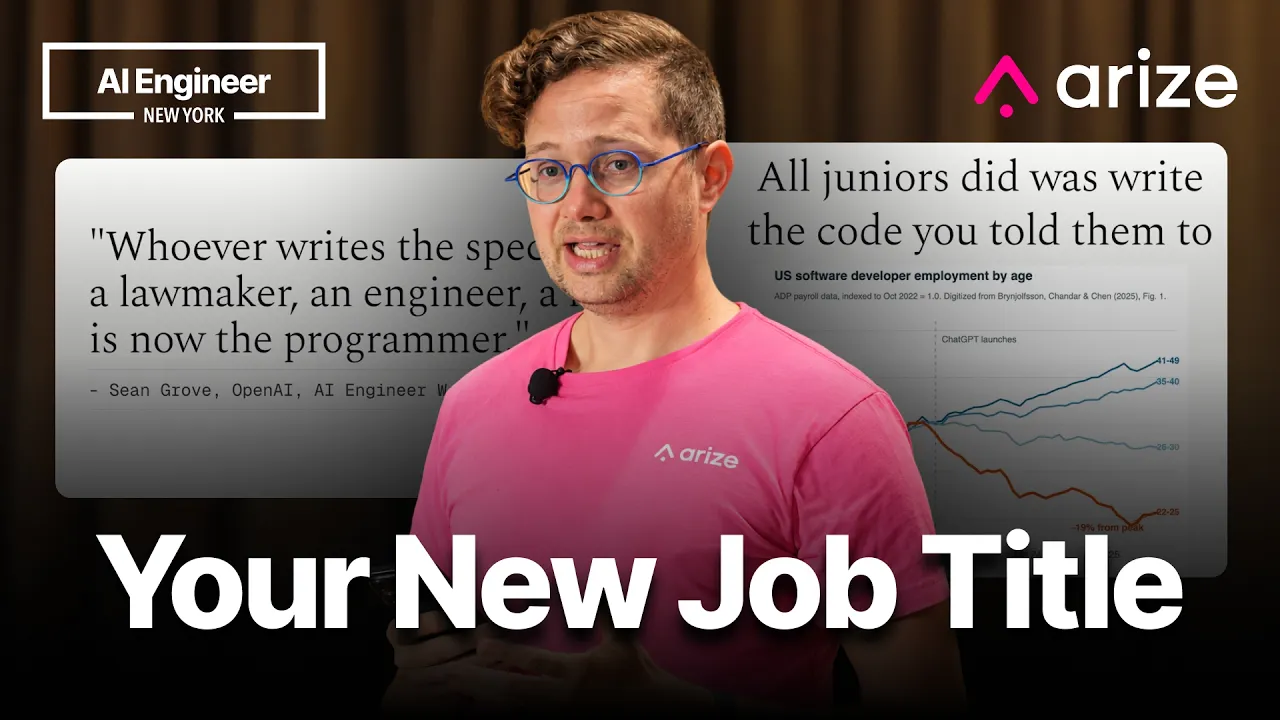
- Claim: The junior-engineer training pipeline is already under strain because its traditional work—well-specified implementation tasks followed by review—is being taken over by agents. | Evidence: Voss describes labor data since January 2023 showing employment falling for engineers aged 22-25 while rising for those aged 41-49. He contrasts Google's Associate Product Manager program producing roughly 50 people annually, and similar programs roughly 1,000, with his estimate that at least 10,000 product-oriented engineers per year are needed. He notes IBM is redesigning entry-level work around customer conversations and writing specs. | Implication: Organizations that want a future senior bench need deliberate apprenticeships in discovery, problem framing, specifications, eval design, and supervised agent operation—not merely fewer entry-level coding roles. | Caveat: The labor-data interpretation and required training-volume estimate are the speaker's framing, not a causal proof that AI is solely responsible for junior hiring weakness.
Detailed Brief
Operating model proposed for agent-heavy engineering
- Claims: Human review should become exception-based rather than the default response to every generated diff.; The team should distinguish high-blast-radius code from routine changes and reserve scarce expert attention for the former.; The relevant performance metric is delivered and trusted software, not tokens consumed, lines generated, or even raw test success.
- Evidence: Voss recommends first documenting high-blast-radius code as the work humans continue to review directly.; He recommends delegating everything that is cheap to verify by first building an automatic means of judging whether it is good.; Suggested metrics include shipping rate, the rate at which reviewer comments are acted upon, and the gap between tests passed and a maintainer's willingness to merge.
- Caveats: Production is presented as the final reviewer, but production feedback is only safe as an evaluation channel when releases have appropriate blast-radius controls, observability, rollback, and incident response.; Automating a check does not establish that the check captures the business objective; it only scales what has been formalized.
- Implications: The central engineering artifact increasingly becomes an executable or evaluable definition of acceptable behavior.; Agent adoption should be managed as a constraint-removal program across the delivery pipeline, not as an isolated developer-productivity purchase.
Long-horizon forecast and cultural transition
- Claims: Voss expects the next decade to be disruptive because tooling and organizational training will lag the pace at which code generation is automated.; He predicts the software-development profession will ultimately be larger and similarly paid, but organized primarily around product-engineering work.; He acknowledges that this is a vocational loss for engineers who value implementation craft itself, rather than presenting the transition as universally positive.
- Evidence: He compares the shift with compilers, frameworks, and open source, each of which eliminated a generation of manual work while expanding the field.; He expects operational, scaling, and security automation to evolve incrementally over five to ten years rather than via imminent AGI.; His analogy is that programming may persist as woodworking did after industrial furniture production: meaningful and practiced, but less central to paid mass production.
- Caveats: The long-term forecast rests on strong assumptions: demand for custom software remains effectively unlimited, and agents become capable enough to handle progressively more operational and security work.; The talk offers a coherent organizational thesis, not evidence that all software categories, regulated environments, or safety-critical domains will converge at the same speed.
- Implications: A company can gain advantage by redesigning roles and training before the labor market settles on standard titles and curricula.; Leaders should manage the cultural impact explicitly instead of treating resistance as mere reluctance to use new tools.
Notable Concepts & Terms
- Product engineer: Voss's proposed successor role: someone who elicits user needs, defines what good means, writes specifications and evaluation criteria, and uses agents for much of the implementation.
- Theory of Constraints: Goldratt's framework that improving a non-bottleneck does not improve system throughput, and resolving one bottleneck merely exposes the next; Voss applies it to code, review, operations, and security.
- Essential vs. accidental complexity: Fred Brooks's distinction between inherent problem complexity and tool/syntax overhead; Voss uses it to argue that faster coding does not eliminate the difficult work of understanding the problem.
- Mergeability: A stronger quality standard than test passing: whether a maintainer would actually accept a pull request given style, history, side effects, architecture, and operational context.
- High-blast-radius code: Code whose failure has outsized consequences and therefore deserves focused human review even as routine review becomes automated.
- Specs, rubrics, and evals: Mechanisms for converting tacit expert judgment into criteria agents can follow and systems can measure; Voss treats them as the core assets of an agent-native engineering process.
- Forward deployed engineer: A market title adjacent to Voss's product engineer: a senior technical operator who works close to customers and translates their needs into delivered systems.
- Code as a lossy projection of the specification: Sean Grove's formulation that the real programming act is deciding the specification; implementation code incompletely represents that higher-level intent.
Operator Notes / Why Ken Should Care
- Create a risk-tiered change policy: enumerate high-blast-radius components, define mandatory human approval for them, and make low-risk changes eligible for automated review and deployment gates.
- Add a dashboard that separates code-generation volume from deployment throughput, reviewer-comment adoption, post-release defects, rollback rate, and the test-pass-to-mergeability gap.
- Build a review ensemble evaluation: compare multiple model reviewers against known defects and maintainer decisions before granting any model final-approval authority.
- Treat specifications, decision logs, acceptance rubrics, and production evals as version-controlled assets with owners, refresh cycles, and incident-driven updates.
- Redesign junior development work around supervised user research, requirements extraction, eval construction, and controlled agent operation; do not rely on ticket implementation as the default apprenticeship mechanism.
- Audit where critical quality criteria live only in senior engineers' heads, then prioritize externalizing the highest-value criteria without assuming every written rule fully captures the underlying objective.
Source/Metadata
- Title: AI Writes the Code. So What's Left for Engineers? - Laurie Voss, Arize AI
- Transcript words: 6743
- Duration seconds: 1629
- Timestamp note: No timestamps or chapters were present in the supplied transcript. The transcript also contains repeated sections near the end.
Transcript
My name is Laurie. I'm Head of Developer Relations at Arise AI. In a former life, I co-founded NPM Inc. So some of you may remember me from JavaScript days. But these days, I think about AI agents and, in this case, what they are doing to our jobs. So a little bit over three years ago, Swix wrote an essay called The Rise of the AI Engineer. And his argument was that when it comes to shipping AI products, you want engineers, not researchers. I think that is a message that resonated with everybody, especially the people who come to this conference. And so he created the job title of the AI engineer. And companies since then have been hiring for it. And part of what I'm here today to do is to convince you that he did not, in fact, go far enough. There is not just an AI engineer revolution happening. There is a revolution happening to every kind of engineer. All engineering jobs are being replaced by a new type of job. And not everybody is going to be happy to get that news. The underlying change that kicked all of this off is that agents have made writing code basically free. You pay for the tokens, but relative to the cost of the time it used to take you, it is basically free. Everything that comes after writing the code did not become free at the same time. So the bottleneck moved from writing code is really slow and all of this other stuff happens at roughly the same speed, to writing code is super fast. And now we get stuck behind new things. So the thing that's stuck behind right this second, this month, is code review. But my thesis is that it's not going to stop there. We are going to figure out how to automate code review. We are going to make code review move at the speed of agents. And then we are going to run into another bottleneck and another bottleneck and another bottleneck and another bottleneck. And at some point, we're going to stop. We're going to hit one that we can't get past. And that is what is going to be left for the humans to do. Whatever the bottleneck is that we can't get agents past. So I'm making a bet that I can think of a thing that agents reliably are not going to be able to do. And then once we've come to that bottleneck, we're going to have to figure out how do we train the next generation of engineers to be able to do that job, because we're not training them to do that job right now. So a quick warning slash apology. I have 18 minutes, because that is how long Swix gives for talks. And I have a really big pile of data. I did a ton of research for this. And I don't have time to give it all to you. I don't have time to quote my sources and do all that stuff. So I'm just going to throw numbers at you with a bunch of citations on the slides. And I'm just going to have to ask you to trust me. So developers who switch on autonomous coding agents write 741% more code, eight times as much. But they ship only 30% faster. 30% faster is not nothing. 30% faster is amazing. We are shipping a lot more code than we used to. But given that we're writing eight times more code, only a third more actual shipping is kind of bad, right? It means that we're stuck somewhere. And where we're stuck is code review. And the reason that we're stuck is because humans can't just review faster. There is an enormous study done by Cisco 20 years ago about how fast you can do code review and how accurately you can do code review. And it turns out that humans' ability to parse what's going on in code falls off radically after about 450 lines of code per hour. So if you've produced a 10,000-line diff with your agent, it would take you like a week to reasonably review that code. And the answer is that nobody's actually doing that, right? Because we're all throwing 10,000 diffs around these days. So I did a whole talk about this phenomenon at a previous AIE. And that talk is called the death of the code review. And if you want all of the information about the death of the code review, you can watch that talk. But the problem facing us right now, which is not the same as the problem I'm trying to solve with this talk overall, is that the cost of producing plausible code has collapsed, while the cost of knowing whether to trust that code has stayed exactly the same. So the obvious move right now is to make sure that we can make the machines do the review. And that is already happening. GitHub's Copilot does more than one in five of the code reviews on GitHub as of last month. You can, if you want to, opt in to let Copilot be the final reviewer before something goes to production. You can make it have the approval power if you want to, which is crazy. I don't know who's turning on that option, but you can do it if you want to. OpenAI says that at OpenAI, humans may review their pull requests but aren't required to. But the problem is that the machine reviewers aren't very good yet. The data says that there's four AI reviewers that I put through their paces, and they all found a bunch of bugs, but none of the same bugs. They did not agree on any individual bug. They all found actual issues in the code. They all found different issues in the code. So they're worth running, but if you are serious about this, you're never going to run just one of them, because they are not reliable enough yet. And there are some people who went all the way. They were, I'm just not going to review the code anymore. I'm just going to assume my agent has one-shotted this perfectly. Dexter Horthy, who is here, I don't know if he's in the audience, probably not. He spent six months telling people not to read the code. And then after that six months, he got on stage and said, nope, I was wrong. You can't actually skip code review entirely. We tried that. It was a disaster. We had to rip and replace whole systems. That's not an option. The agents are not good enough. They're not one-shotting the code. Amazon had a run of outages that they did postmortems on and decided that it was because their coding agent had produced a bunch of slop and they just released it into the wild without thinking. And so now they don't let them do that anymore. Senior engineers must sign off on code reviews at Amazon. And Anthropic published a postmortem on bugs that had got past every reviewer that they had, both human and machine. So the problem is that the automations that we've built so far to check whether our code is good enough are not good enough themselves. Claude 3.5 passes the tests on 80% of a standard coding benchmark. And so Cognition, the makers of Devon, they built a benchmark that asks a different question, which is not, does it pass the tests? The question is, would you as the reviewer, as the maintainer of this repo, merge this PR? And if you ask that question instead, the pass rate falls from 87% to 54%. Because there's a lot of extra information that goes into deciding whether you would merge it. There's code style, there's side effects, there's external systems, there's history that is not encoded into the code base. It is encoded into the brain of the maintainer. So what the maintainer is adding, what the maintainer is demonstrably adding, is something that we haven't given the agents yet. There is information they don't have, there is a skill they don't have. And it is the sense of what good means. That is what the agents don't have yet. And that is a critical insight that I'm going to come back to. Eliyahu Goldratt, if I'm pronouncing that correctly, was a physicist who became a management guru. And in 1984, he wrote a novel about running a factory. Does that sound like an interesting novel to you? It is called The Goal. And his big idea was the theory of constraints. Every system has one bottleneck and speeding things up does not work unless the thing that you were speeding up is the bottleneck. That is our problem with code review. We have sped up the code and we have not sped up the review. His second idea is the one that matters today, which is that when you fix the bottleneck, it doesn't go away. It just moves and finds another bottleneck to pile up against. So let's assume, despite everything that I've said about how bad the code reviewers are right now, that we figure that out. That we get automated code review to a higher standard and we move that bottleneck. What is the next bottleneck that it is going to run into? If we figure out review, the next bottleneck is probably going to be operations. How do I deploy this thing? How do I scale it up? And then you're probably going to run into security. How do I make this thing safe at scale? How do I make sure that this thing is private? How do I make sure that it's not radically going off the rails? That is our problem with code review. We have sped up the code and we have not sped up the review. His second idea is the one that matters today, which is that when you fix the bottleneck, it doesn't go away. It just moves and finds another bottleneck to pile up against. So let's assume, despite everything that I've said about how bad the code reviewers are right now, that we figure that out. That we get automated code review to a higher standard and we move that bottleneck. What is the next bottleneck that it is going to run into? If we figure out review, the next bottleneck is probably going to be operations. How do I deploy this thing? How do I scale it up? And then you're probably going to run into security. How do I make this thing safe at scale? How do I make sure that this thing is private? How do I make sure that it's not radically going off the rails? But I'm going to make, and this is the big leap that I'm making in this talk, I'm going to assume we figure those things out as well. Because those things are very heavily solved by humans. There's an enormous amount of data out there about them. If we can figure out how to do operations, how to do scaling, how to do security using progressively more advanced agents, what is it that we are left to do? What is the role of a human in that situation? It's a big question and it's a long-term question. I'm not telling you what is going to happen in the next 12 months. In the next 12 months, I think we'll probably make some real progress on code reviews. I do not think 12 months from now we will have sorted out operations and scaling and security. I think that is going to take somewhere between five and ten years to get done. Despite people who are saying AGI 2027. No, we're going to slowly iterate on this stuff. But the other assumption that you need to make for my thesis to be correct is that the amount of software that we need is effectively infinite. And I feel that one is a much easier case to make. Think of every website you've ever run into in the world, in production. And it's probably pretty bad. And the reason it's bad is not because we don't know how to make really great websites. The problem is that there's not enough people to make all of the websites good. Every time you run into a terrible website at your hairdresser or the government or your bank, it's not because there's not somebody who knows how to make that website good. It's because A, it's very expensive to make it good. And B, the people who are doing that are busy doing other things. You know, probably shipping AI agents. So assume that we can make as much software as we want basically for free. And that the appetite for making software is essentially infinite. That is a wonderful situation in which to be in. We've got infinite demand and also suddenly infinite supply. Where does the bottleneck end up? What do we think the agents are not going to eat? To try and figure that out, I split up the job of software development into as many pieces as I could think of. And I sorted them by how soon the agents get to them. Writing code has already collapsed. Reviewing and maintaining code is going soon. Shipping to production and scaling are next on the chopping block, although there isn't a lot of data there yet. And then there's the stuff that I think is probably safe, which is deciding what to build. Defining what good means. And finally, making it delightful. What's left is finding out what people actually want. Every piece of software is a formalization of something that a human wanted to get done. So if a customer tells you, I need to keep track of my orders, there are 10,000 pieces of software that keep track of your orders. That's what they do. But only one of those, if you're lucky, is good if the thing that you're doing is you're running a bakery. If you're running an auto parts store, that's going to be different. If you're running a giant manufacturing concern, it's going to be completely different. That requirement is not sufficient. The whole job is figuring out what exactly do you mean when you say that you want to keep track of your orders. What does that mean for your business? What does it have to do? How does that work? And that knowledge isn't in the training data. It isn't in the weights. It is in the mind of the person who runs that business. And the only way to get it out is by talking to them. That is the only way to get the information out. And that work has a very important property, which is that it doesn't transfer. If you think about what good means for a calendar app and what good means for a scheduling app, those are solving almost the same problem. A calendar app and a scheduling app. But they're completely different pieces of software. They have totally different requirements and a totally different definition of good, even though those two use cases are so close together and we have a zillion use cases. Any time that you've used software that has a zillion configuration options and it still doesn't do what you need, I'm looking at you, Jira. That is the problem you're running into of software that is trying to do everything and still failing at it. So the bottleneck moves to describing the problem and defining what it means to have solved the problem. And my big bet for this talk and for the next 10 years is that is where it stays. Fred Brooks, who ran IBM's System 360 project and wrote The Mythical Man Month, he wrote about this in 1986. He split the difficulty of software into two kinds. Accidental complexity is the difficulty of the tools, so the languages, the typing, the syntax. And then there's the essential complexity, which is the difficulty of the problem itself. And he predicted that no single tool would make us 10 times more productive because the essential part is the hard part. And Brooks' prediction is looking pretty solid because we made code eight times faster and we still didn't get very much faster at shipping because the hard part is the essential part. Sean Grove from OpenAI made the same point a year ago. He said that code is a lossy projection of the specification and whoever writes the spec, if it's a PM or a lawmaker or an engineer or a marketer, they become the programmer. And so writing down what good means is where the value is now. I'm beginning to run out of time because I haven't timed this well. Anything that you can verify cheaply, you can train against until you beat it if you are a model maker. So Cognition tried to write down, because of their benchmark, what it counts to merge something. Is this code mergeable? They were trying to figure out a benchmark that defines what mergeable really means. They were trying to get all of that other information into the benchmark and then train a model on it. Cursor's reviewer bugbot turns every thumbs down that your team gives it into a rule and they have 44,000 rules now. So the moment the maintainer takes knowledge out of their brain and puts it somewhere written down that a model can train on it, the bottleneck moves again. That is why I think security can go. That is why I think operations can go. I think we can write those things down eventually, even though we haven't done it yet. Andrew Ng, the co-founder of Google Brain and Coursera, says that one of his teams proposed having twice as many product managers as engineers. And he said that that was a first in his life. But his answer since then hasn't been hire more PMs. It's to blur the jobs together. In his words, when an engineer understands users and can make decisions on what to build and build it directly, they can execute incredibly quickly. And that is where I think we are beginning to hit on the answer. In the 1960s, there was a job called the Systems Analyst. Their job was not to write code. Their job was to talk to the business and find out what the problem was. Then that analyst turned into something that we call a product manager today. And we've had two professions where there used to be one and a half. I think what is happening is they are collapsing back into one. We are going back to the 60s. So that is not an AI engineer. They're not just building AI. They're not just building with AI. They are building everything. They are building all software. And I've decided to call this job the product engineer. This is somebody who finds out what people need, defines what good looks like, and ships it with agents doing the typing. Gergely Orosz, whose name I have probably butchered, he writes the Pragmatic Engineer newsletter. He described the product-minded engineer back in 2019 as a nice trait for an engineer to have. And what I'm saying now is it has gone from nice to essential. It has gone from a skill that senior engineers used to have to a skill that every engineer has to have if they are going to be an engineer. And we've had two professions where there used to be one and a half. I think what is happening is they are collapsing back into one. We are going back to the 60s. So that is not an AI engineer. They're not just building AI. They're not just building with AI. They are building everything. They are building all software. And I've decided to call this job the product engineer. This is somebody who finds out what people need, defines what good looks like, and ships it with agents doing the typing. Gergi Oshoz, whose name I have probably butchered, he writes the Pragmatic Engineer newsletter. He described the product-minded engineer back in 2019 as a nice trait for an engineer to have. And what I'm saying now is it has gone from nice to essential. It has gone from a skill that senior engineers used to have to a skill that every engineer has to have if they are going to be an engineer. And you can see the market already paying for this. Forward deployed engineers who look very much like product engineers. Job postings for them rose 800% in nine months of 2025. They are everywhere. Everybody is trying to hire them. Who in this room is trying to hire a forward deployed engineer? Show of hands. Okay. Well, I was expecting more hands. So the average comp for a forward deployed engineer, by the way, is $240,000, which is to say that it pays like a senior engineer because it is a senior engineer. It's a very useful kind of engineer. But nobody agrees on what to call it yet. There are like 1,000 different job titles for this thing that I am describing and have decided arbitrarily to call the product engineer. And probably at this point, some of you are thinking that isn't programming. And you are correct. It is not programming. The programming is being done by an agent. It is, however, recognizably still software development. And we are going to have to wrap our minds around the idea that being a software developer and being a programmer have become divorced in 2026. And when I say stuff like, well, I think the hard part is deciding what good is, I realize that I'm falling into a trap that lots of people in AI land fall into, which is all of the parts, everything about everything can be automated by AI except the thing that I'm good at. Because that's too hard. I heard a VC say that the other day. And I was like, buddy, no, no. Someone is going to automate your job any day now. So you have to take this with a grain of salt. Am I just thinking that the thing that I enjoy about software development, which is figuring out what the problem is, is the hard part of software? You can tell me if I'm wrong. But say you believe me so far. Programming goes to zero. Product engineering goes to infinity. That brings us to a new and important problem, which is junior developers. Because the way we used to train a junior developer is we used to give them very well-specified tickets that said, write this software this way in particular. And then give it to me so that I can tell you all the ways that you were wrong. And that is gone. Because that's what we do with the coding agents now. We say, write this thing, and then I'll tell you how you're wrong. And then we have a conversation with them. And that is not a job that we need a human to do anymore. But we still need an enormous number of forward deployed engineers or product engineers. And we have to get them from somewhere. We can't just abandon the current generation of new developers who have showed up and said, how do I do this stuff? And we're like, I don't know. Because I don't know what your job is anymore. This is not a theoretical future. This is an actual graph of labor statistics since January 2023. It is sorted by age. The red line is engineers aged 22 to 25. Their employment is collapsing. We are not hiring junior engineers. This is not a thing that I think is going to happen. This is a thing that's been happening for two years. Job market sucks for them. Meanwhile, the job for older engineers, 41 to 49, has gone way up. Because senior engineers are still super valuable, more valuable than before. But junior engineers are being screwed. And we need to fix that as a profession. So if we're going to reap the benefits of a world where we 10x code output and figured out the rest of the software supply chain and figured out what humans need to do, then we are going to need a lot of people to do that. I said that the demand for this software is going to infinity. We need infinity people. Where are we going to get them? We've been creating them accidentally so far. And we need to figure out a way to do them on purpose. Google has a program called the Associate Product Manager Program, which turns out people that are going to do it. But look very much like product engineers. They churn out 50 of them per year. We need 10,000 of them per year. Even if you look at all of the other companies that have a program like Google's APM, it's been extensively copied. They're only churning out about 1,000 people a year. And we need 10 times that number at minimum to keep up with demand. Universities teach data structures. Boot camps teach React. Nobody teaches go sit with a baker for a week and come back with a spec. And that is the person that we need. So if you lead an engineering team, you're going to have to grow them on purpose. IBM is already redesigning its entry-level role around talking to customers and writing specs instead of programming. You're going to have to figure out how to do that for yourself. You're going to have to figure out how do you train product people. And you're going to have to do it very quickly because the time we should have started was two years ago. And there's a whole cohort of very sad unemployed juniors right now who have this problem. And we are not hiring them. And we need to do something about that. Or we are going to be screwed and not just them. So if all of that happens, there's one big thing that I don't want to just gloss over or hand wave away, which is a lot of people got into programming because they love the craft. They love a clean abstraction, the feeling of a hard bug finally giving up, making a machine do exactly what you told it to do. They did not sign up to interview bakers about what they want in their lives. That is not the job that they signed up for. And they are going to hate this. They already hate this. They are complaining about it very loudly. I have no consolation prize for them. But I do have an observation which is that for a lot of people who think they love the typing, maybe what you loved was the moment just before you started typing when you figured out the problem. That part doesn't go away. That part is still there. That creative spark when you are like, I know how to make this into a repeatable system that glows in my brain. That is not going away. And the craft of programming will survive in the same way that woodworking survived the furniture factory. Programmers program the way that singers sing, right? They do it in an empty room with nobody watching just because they love it and that won't go away. You can still do that. It just won't be the thing that people pay you hundreds of thousands of dollars every year to do. So here is my prediction. The next 10 years are going to be ugly. The last two years have been ugly. The load of this stuff is arriving before the tools are ready. The junior ladder is gone before we have figured out how to train more juniors. And a lot of people who love the craft are going to have to decide if they love the job that is replacing it. But this has happened before. Compilers and then frameworks and then open source each made a generation's worth of typing before them unnecessary. And each time we came out of it with more software developers, we just changed what software development meant. And I think that's going to happen again. In 10 years time we will get a profession that is bigger than today's, pays about as well, and is mostly shaped like product engineering. That is the case that I'm making for you today. But that is a whole lot of high level predictions and I hate those. What does this mean for real? What should you actually do with this today? First, be prepared for a world in which humans are barely involved in the production of code. So write down your high blast radius code and make that be the only thing that you are reviewing anymore. Because the rest of it, your automatic reviewers are going to get done. Then delegate everything that's cheap to verify. Spend a lot of time thinking about how would I build an automatic way of telling whether this thing, whatever that thing is, is good or not. And then feed that to your agent instead of trying to figure out the review process. And finally, put your best people's judgment into specs and rubrics and evals. Get stuff that exists only in people's heads into code. That is your job as a product engineer. But that is a whole lot of high level predictions and I hate those. What does this mean for real? What should you actually do with this today? First, be prepared for a world in which humans are barely involved in the production of code. So write down your high blast radius code and make that be the only thing that you are reviewing anymore. Because the rest of it, your automatic reviewers are going to get done. Then delegate everything that's cheap to verify. Spend a lot of time thinking about how would I build an automatic way of telling whether this thing, whatever that thing is, is good or not. And then feed that to your agent instead of trying to figure out the review process. And finally, put your best people's judgment into specs and rubrics and evals. Get stuff that exists only in people's heads into code. That is your job as a product engineer. It is turning the sense of the problem into a spec of the problem so that the agents can build it for us. And measure the right thing. 741% more code was never the point. Measure how much stuff you are actually shipping. Measure how often your reviewers' comments get acted on. Measure the gap between the tests passed and a maintainer would merge this. And remember that the last reviewer is production. Watching what it does there with another model grading it, that is an eval. I'm not going to pitch Arise. That's just what we do. And that's why we're so popular right now. And I'll leave it at that. Three years ago, SWIX wrote about the rise of the AI engineer, which is engineers learning to build with models. And the rise of the product engineer is about what's left when the models do the building. Finding out what people need, writing down what good means, and making it something people like. That is the job now. It is going to be the job for everyone in this room, whether we like it or not. We are all product engineers now. Thank you so much for your time and attention. Thank you. Because the way we used to train a junior developer is we used to give them very well-specified tickets that said, write this software this way in particular. And then give it to me so that I can tell you all the ways that you were wrong. And that is gone. Because that's what we do with the coding agents now. We say, write this thing, and then I'll tell you how you're wrong. And then we have a conversation with them. And that is not a job that we need a human to do anymore. But we still need an enormous number of forward deployed engineers or product engineers. And we have to get them from somewhere. We can't just abandon the current generation of new developers who have showed up and said, how do I do this stuff? And we're like, I don't know. Because I don't know what your job is anymore. This is not a theoretical future. This is an actual graph of labor statistics since January 2023. It is sorted by age. The red line is engineers aged 22 to 25. Their employment is collapsing. We are not hiring junior engineers. This is not a thing that I think is going to happen. This is a thing that's been happening for two years. Job market sucks for them. Meanwhile, the job for older engineers, 41 to 49, has gone way up. Because senior engineers are still super valuable, more valuable than before. But junior engineers are being screwed. And we need to fix that as a profession. So if we're going to reap the benefits of a world where we 10x code output and figured out the rest of the software supply chain, and figured out what humans need to do, then we are going to need a lot of people to do that. I said that the demand for this software is going to infinity. We need infinity people. Where are we going to get them? We've been creating them accidentally so far. And we need to figure out a way to do them on purpose. Google has a program called the Associate Product Manager Program, which turns out people that are going to do it. But look very much like product engineers. They churn out 50 of them per year. We need 10,000 of them per year. Even if you look at all of the other companies that have a program like Google's APM, it's been extensively copied. They're only churning out about 1,000 people a year. And we need 10 times that number at minimum to keep up with demand. Universities teach data structures. Boot camps teach React. Nobody teaches go sit with a baker for a week and come back with a spec. And that is the person that we need. So if you lead an engineering team, you're going to have to grow them on purpose. IBM is already redesigning its entry-level role around talking to customers and writing specs instead of programming. You're going to have to figure out how to do that for yourself. You're going to have to figure out how do you train product people. And you're going to have to do it very quickly because the time we should have started was two years ago. And there's a whole cohort of very sad unemployed juniors right now who have this problem. And we are not hiring them. And we need to do something about that. Or we are going to be screwed and not just them. So if all of that happens, there's one big thing that I don't want to just gloss over or hand wave away, which is a lot of people got into programming because they love the craft. They love a clean abstraction, the feeling of a hard bug finally giving up, making a machine do exactly what you told it to do. They did not sign up to interview bakers about what they want in their lives. Like that is not the job that they signed up for. And they are going to hate this. They already hate this. They are complaining about it very loudly. I have no consolation prize for them. But I do have an observation which is that for a lot of people who think they love the typing, maybe what you loved was the moment just before you started typing when you figured out the problem. That part doesn't go away. That part is still there. That creative spark when you are like, I know how to make this into a repeatable system that glows in my brain. That is not going away. And the craft of programming will survive in the same way that like woodworking survived the furniture factory. Like programmers program the way that singers sing, right? They do it in an empty room with nobody watching just because they love it and that won't go away. You can still do that. It just won't be the thing that people pay you hundreds of thousands of dollars every year to do. So here is my prediction. The next 10 years are going to be ugly. The last two years have been ugly. The load of this stuff is arriving before the tools are ready. The junior ladder is gone before we have figured out how to train more juniors. And a lot of people who love the craft are going to have to decide if they love the job that is replacing it. But this has happened before. Compilers and then frameworks and then open source each made a generation's worth of typing before them unnecessary. And each time we came out of it with more software developers, we just changed what software development meant. And I think that's going to happen again. In 10 years time we will get a profession that is bigger than today's, pays about as well, and is mostly shaped like product engineering. That is the case that I'm making for you today. But that is a whole lot of high level predictions and I hate those. What does this mean for real? What should you actually do with this today? First, be prepared for a world in which humans are barely involved in the production of code. So write down your high blast radius code and make that be the only thing that you are reviewing anymore. Because the rest of it, your automatic reviewers are going to get done. Then delegate everything that's cheap to verify. Spend a lot of time thinking about how would I build an automatic way of telling whether this thing, whatever that thing is, is good or not. And then feed that to your agent instead of trying to figure out the review process. And finally, put your best people's judgment into specs and rubrics and evals. You know the Arise guy was going to say evals at some point. Get stuff that exists only in people's heads into code. That is your job as a product engineer. It is turning the sense of the problem into a spec of the problem so that the agents can build it for us. And measure the right thing. 741% more code was never the point. Measure how much stuff you are actually shipping. Measure how often your reviewers' comments get acted on. Measure the gap between the tests passed and a maintainer would merge this. And remember that the last reviewer is production. Watching what it does there with another model grading it, that is an eval. I'm not going to pitch a rise. That's just what we do. And that's why we're so popular right now. And I'll leave it at that. Three years ago, SWIX wrote about the rise of the AI engineer, which is engineers learning to build with models. And the rise of the product engineer is about what's left when the models do the building. Finding out what people need, writing down what good means, and making it something people like. That is the job now. It is going to be the job for everyone in this room, whether we like it or not. We are all product engineers now. Thank you so much for your time and attention. Thank you.